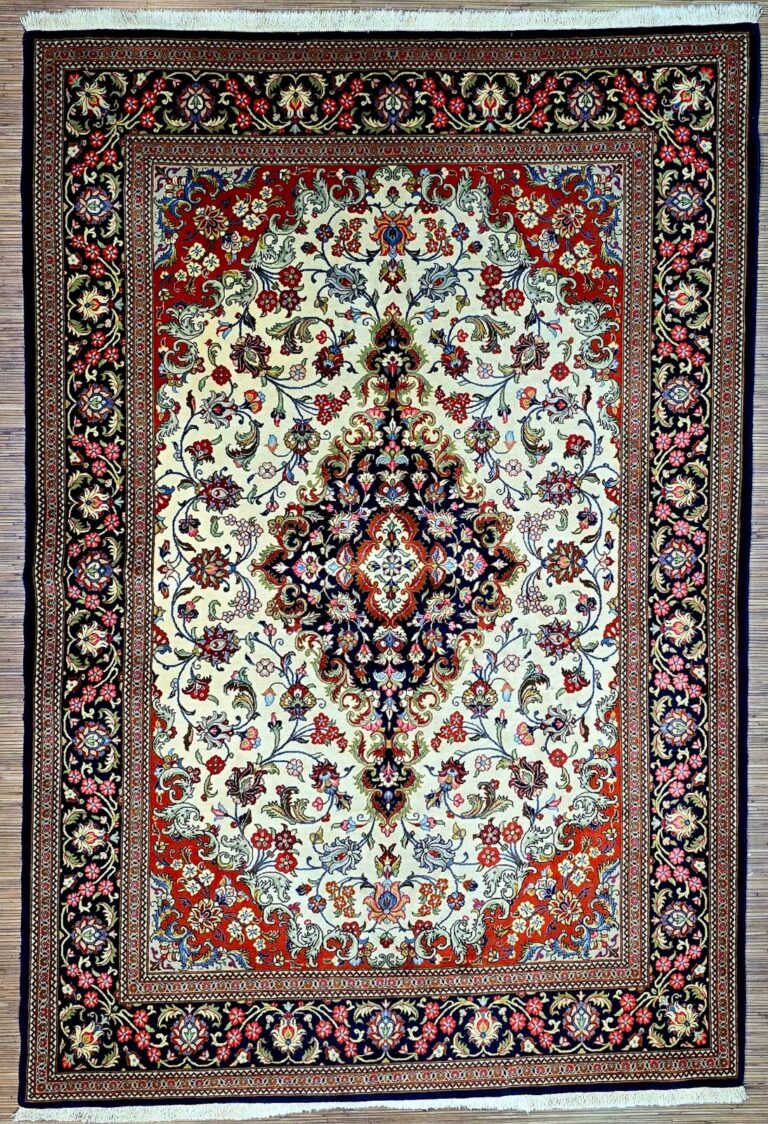
This new, hand-knotted Nain Persian rug has a pile made from virgin wool and silk, with a cotton warp. Each material contributes a different quality to the finished textile. Wool gives the surface a firm, natural handle and a comfortable warmth, while silk adds a smoother touch and a restrained sheen. The cotton warp forms the structural foundation into which the knots are tied.
Virgin wool has long been used in hand-knotted rugs because its fibres are resilient and naturally elastic. A wool pile can feel substantial underfoot while remaining comfortable in everyday living areas. Wool also interacts with the surrounding air and can absorb and release a degree of moisture. These properties are part of the reason it has remained central to Persian rug making across many generations.
Silk is valued in rug weaving for its smooth fibre and its ability to catch light. In a wool-and-silk pile, the change between the two materials can make selected details appear more distinct. The surface may show slightly different reflections as the viewing angle or lighting changes. The cotton warp is not the visible pile material, but it is essential to the construction: it holds the rows in place and provides a stable basis for the hand-knotting process.
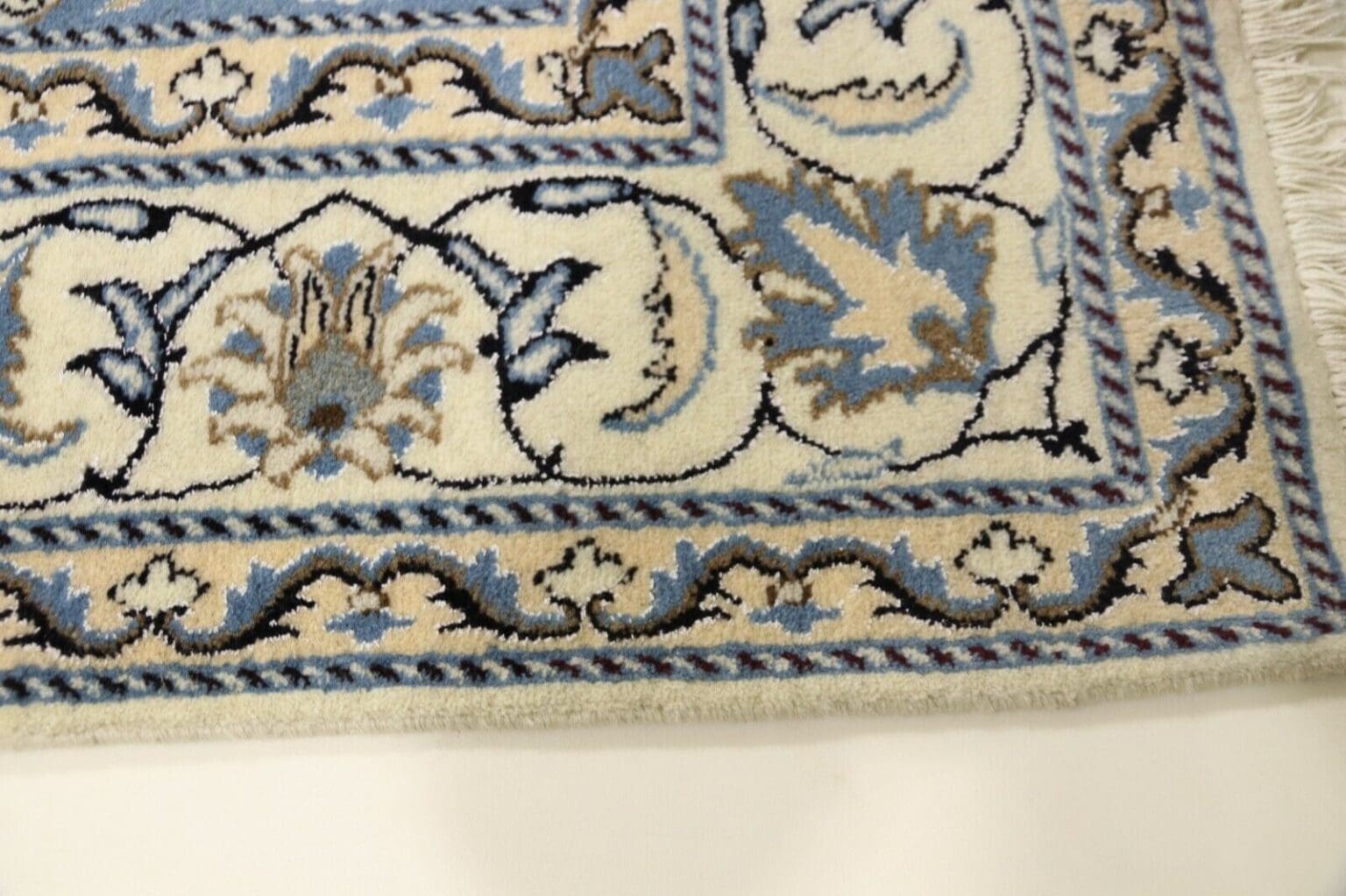
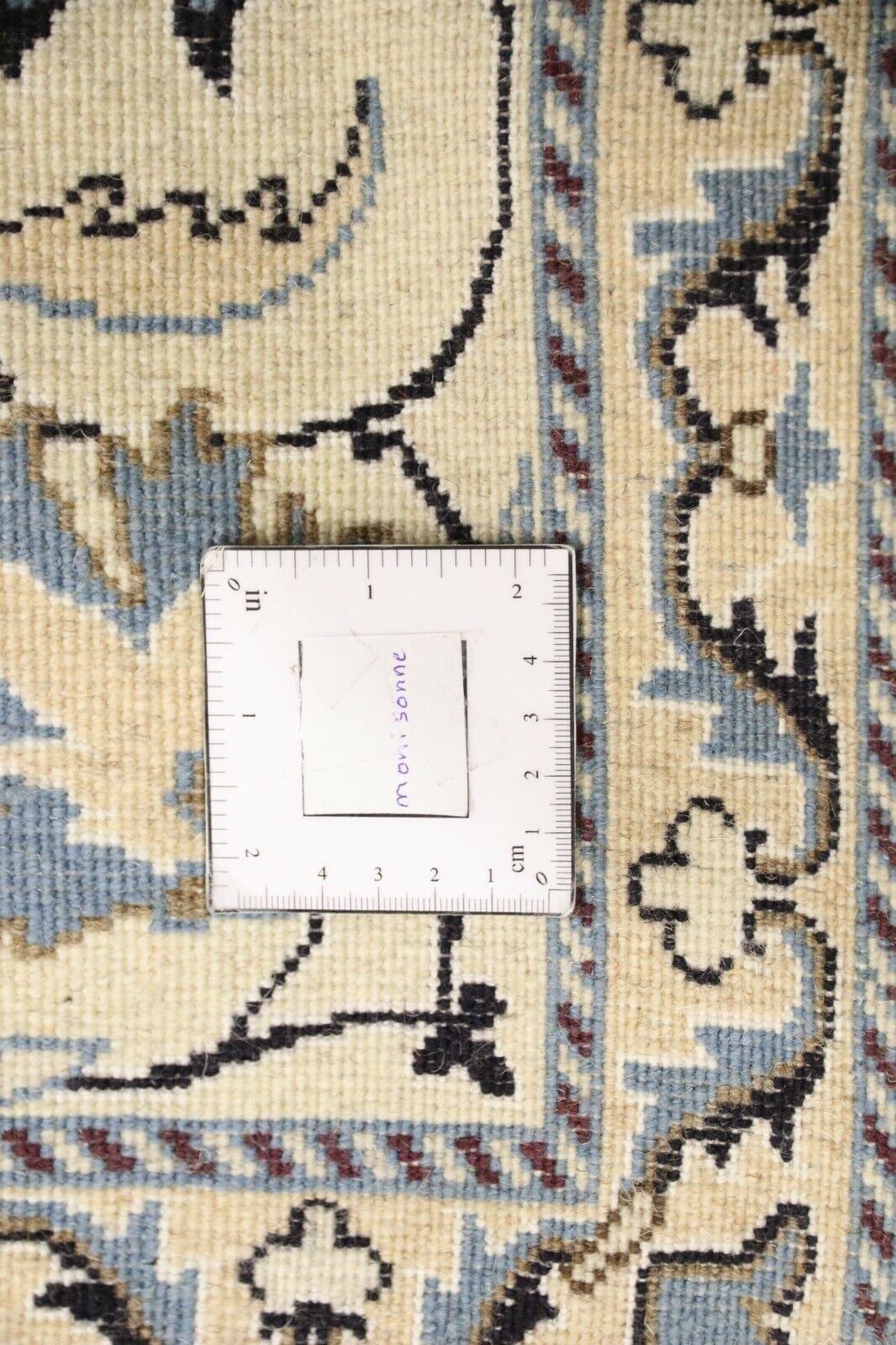
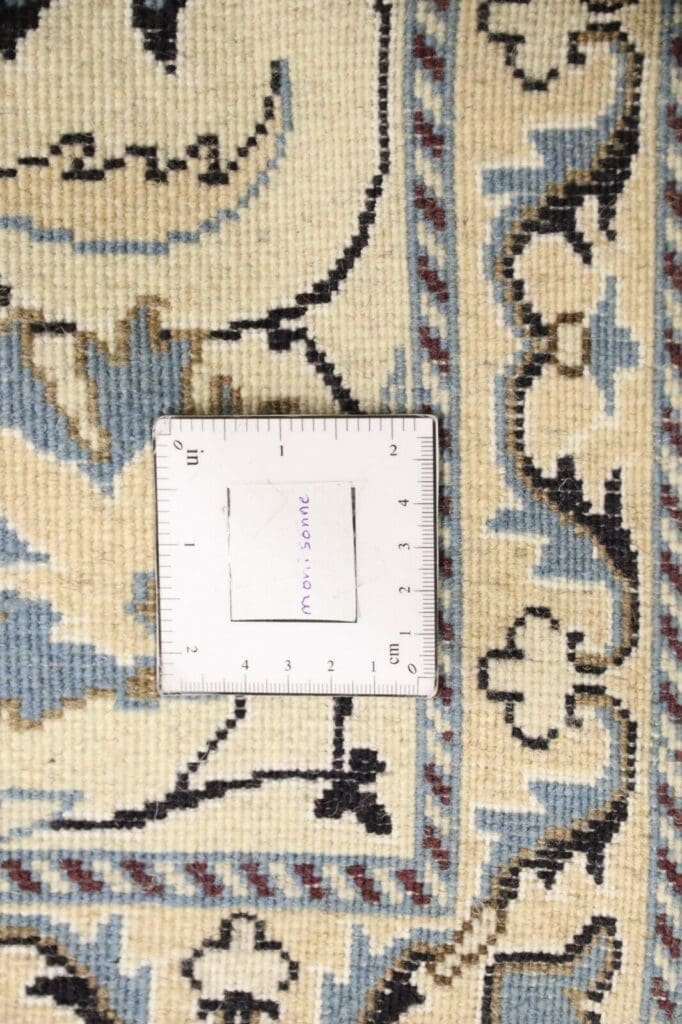
Hand-knotting is carried out knot by knot rather than by mechanically repeating a complete design. The weaver works row by row, building the pattern from many individual colour placements. This method allows small motifs, narrow outlines and gradual transitions to be rendered with precision. It also means that the finished rug retains the character of manual work. The high knot density recorded for this rug supports the detailed appearance associated with finely made Nain rugs.
The pile materials and the knotting method should be considered together. Wool gives the rug a practical textile body, while silk helps bring clarity and variation to the ornament. Cotton supports the underlying construction. This combination is typical of the way Persian workshops balance strength, surface character and decorative detail. The rug is described as new and in perfect condition.
Origin and Tradition
The rug comes from Persia and is associated with the Nain region of Iran. Nain is known for finely drawn Persian rugs with carefully ordered compositions and a restrained, balanced use of colour. The town lies in central Iran, in a dry landscape whose settlement and craft traditions developed under distinctive environmental conditions. Over time, weaving became an important expression of local skill and a way of preserving regional design knowledge.
Nain rugs belong to the broader Persian weaving tradition, but the name Nain also suggests a recognisable regional approach. Many examples use a clearly organised field, delicate floral ornament and a border system that frames the central composition. This is not a single fixed pattern. Nain workshops produce variations in the arrangement of medallions, scrolling vines, leaves, blossoms and geometric divisions. What connects them is the disciplined drawing and the emphasis on fine detail.
Persian rugs are traditionally produced on a loom, with the design built through successive rows of knots. A pattern may be followed from a drawn plan or carried through established workshop knowledge. Once the knots are tied and the rows secured, the pile is trimmed so that the design becomes readable. Edges and ends are finished separately and help protect the woven structure. The work requires concentration throughout, since a small change in colour or placement can affect the continuity of the design.
The Nain tradition is associated with fine knotting and an orderly visual language. Light grounds are often used to give the field openness, while darker lines define flowers, vines and border elements. Blue is an important colour in many Persian design vocabularies, and dark blue can provide a strong outline without replacing the calm character of a pale ground. The present rug is identified as Super Nain and belongs to this regional Persian context.
Regional tradition should not be confused with a claim that every Nain rug follows precisely the same historical design. Weaving is carried out by different workshops and individual makers, and the details vary from one piece to another. The name identifies the place and the related craft tradition; the individual combination of material, colour and ornament makes each hand-knotted rug distinct. Here, the Persian origin, Nain designation and manual construction form the basis of the rug’s classification.
The term Persian rug refers to Iranian origin, while Oriental rug is a broader category that can include many weaving regions. This piece is specifically presented as a Persian rug from the Nain tradition. Its identity therefore rests on its Persian provenance, its Nain designation and the techniques associated with hand-knotted Iranian textiles.
Design and Pattern
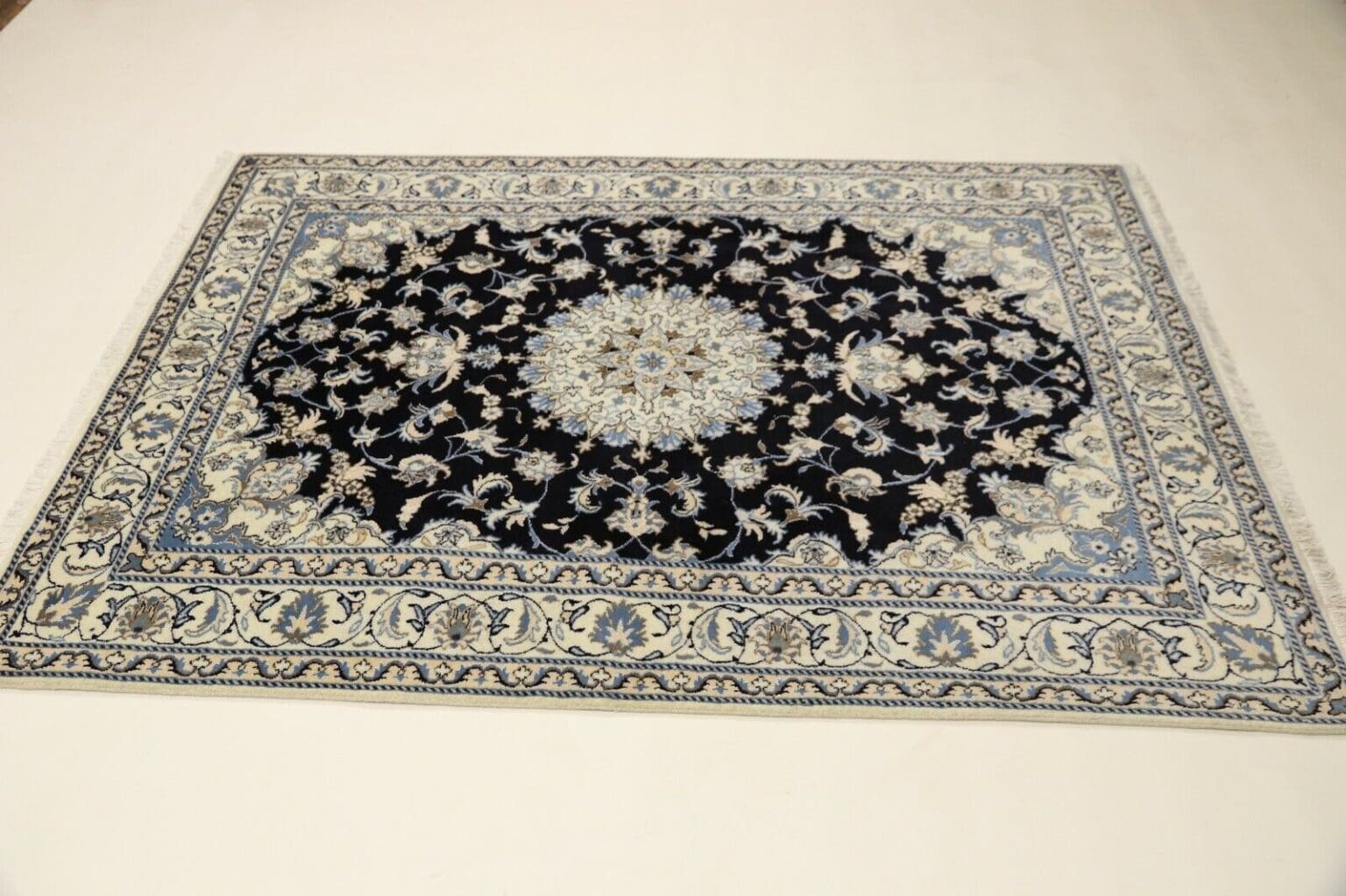
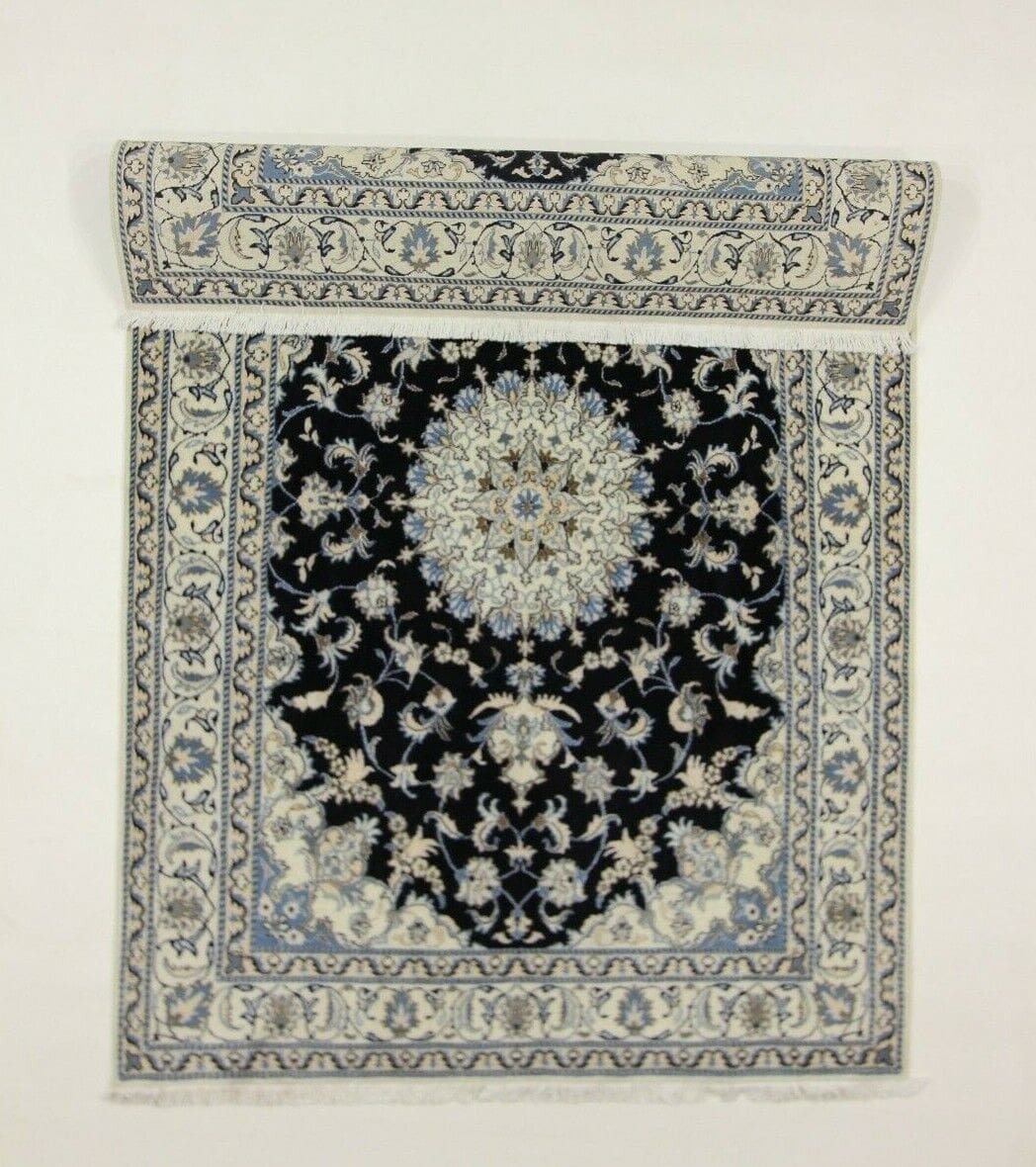
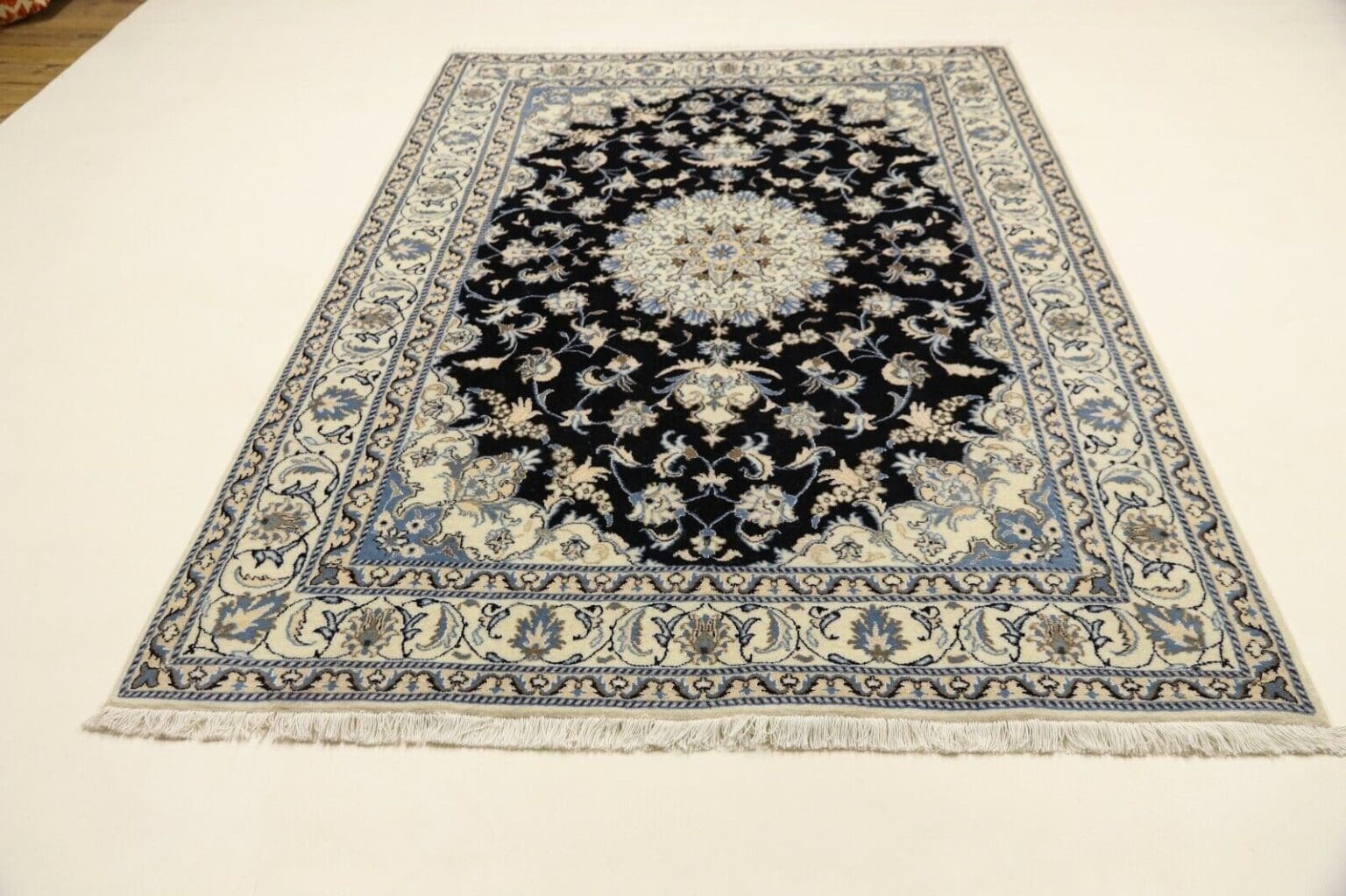
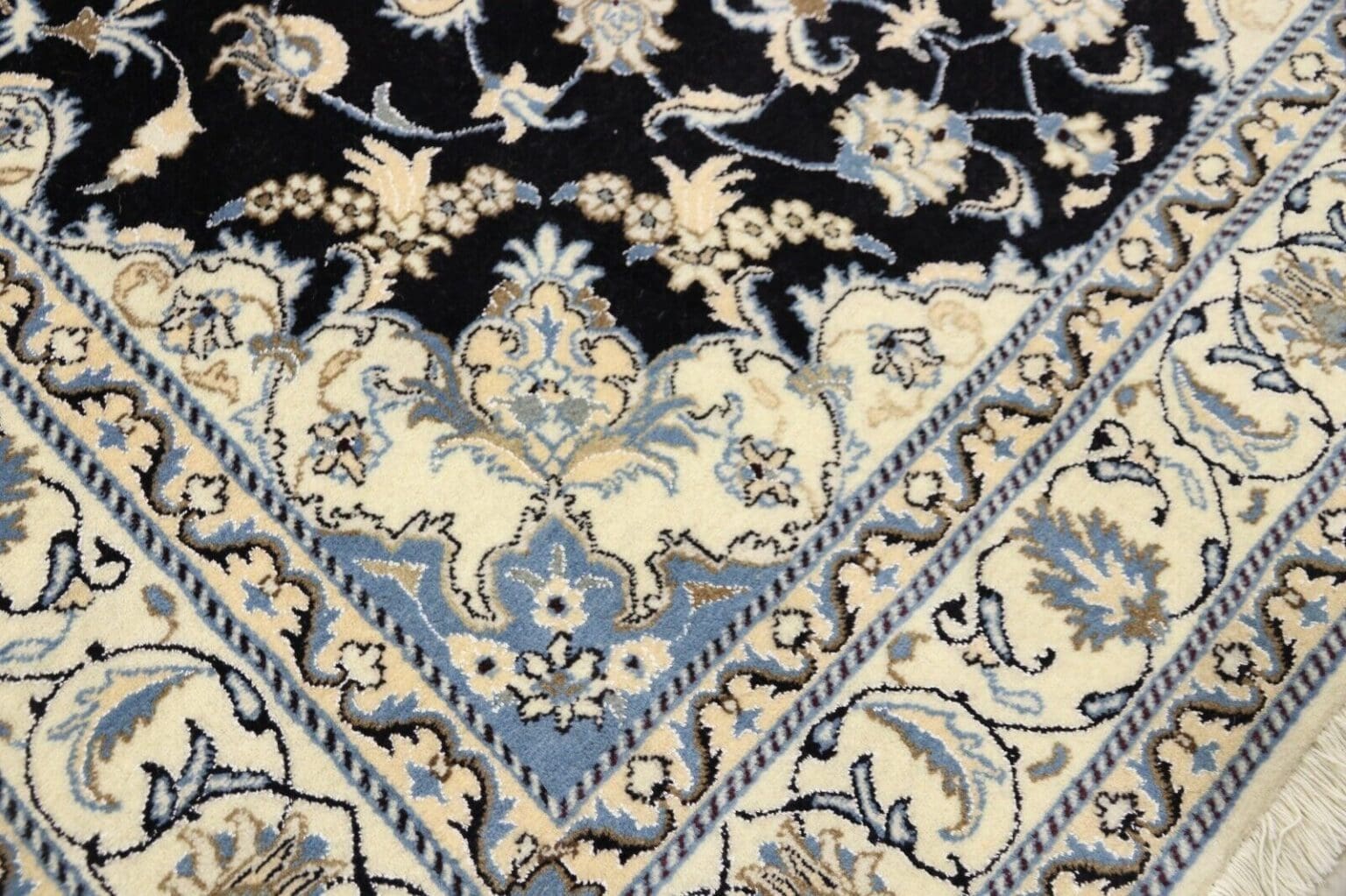
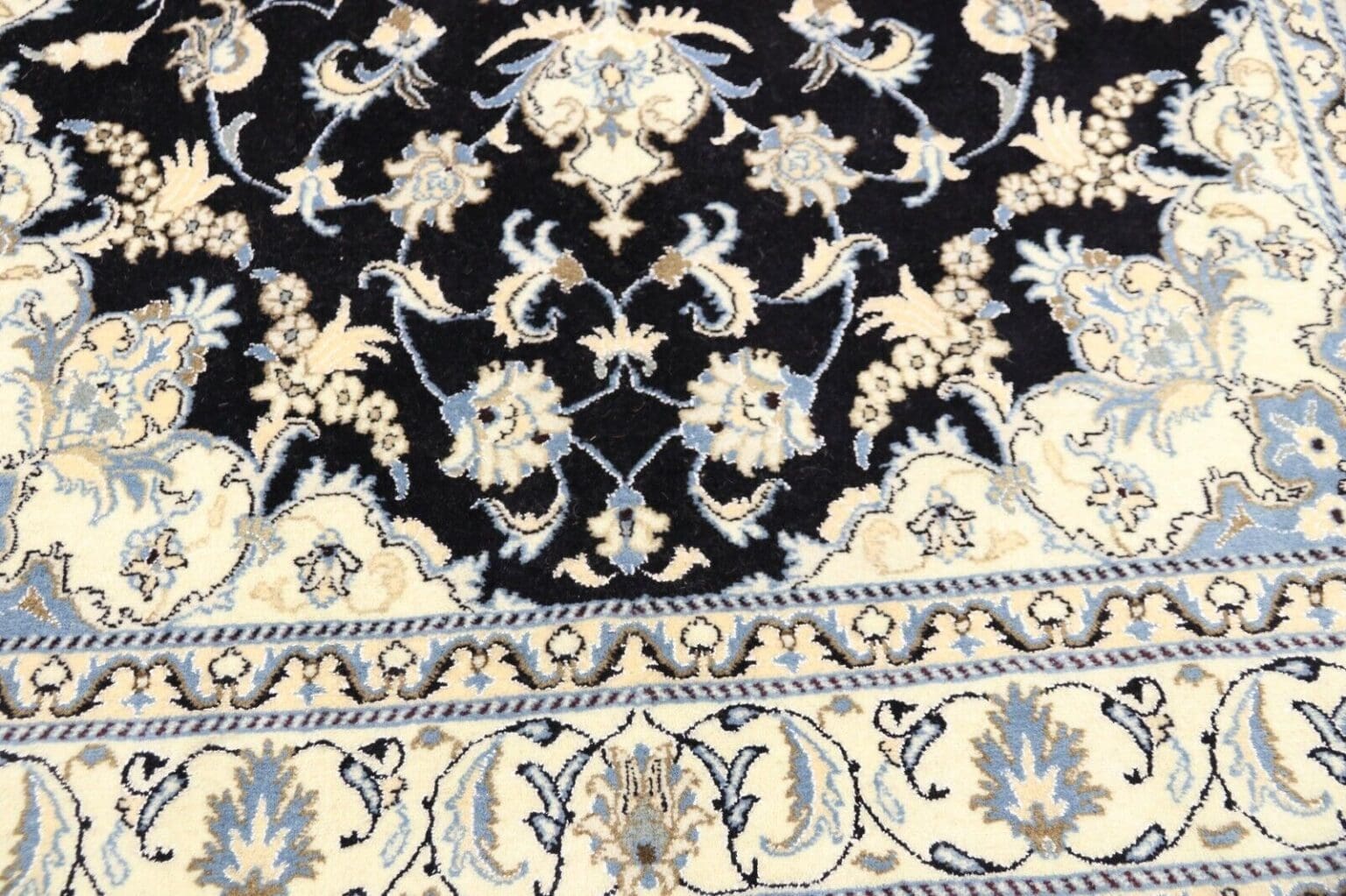
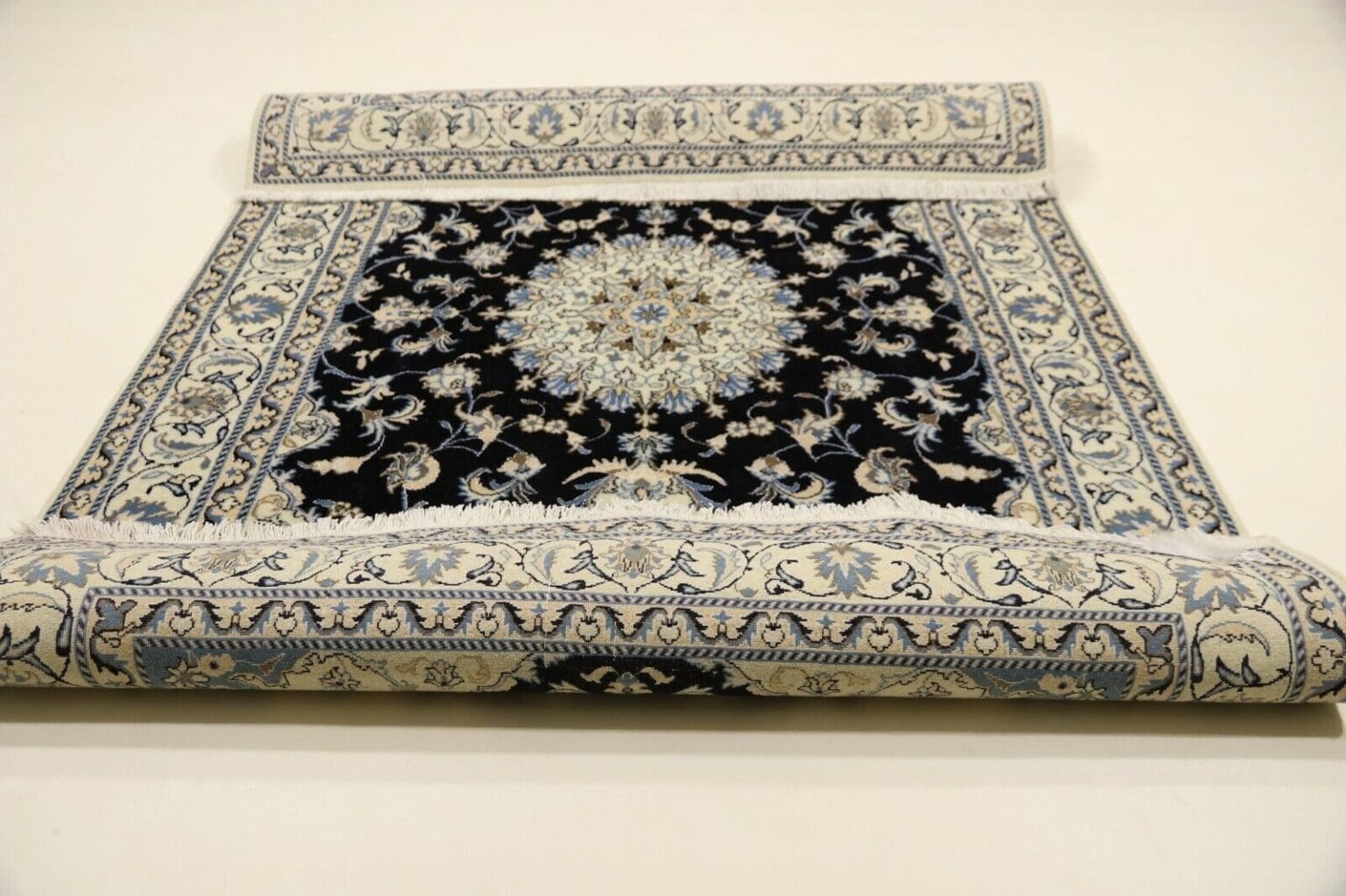
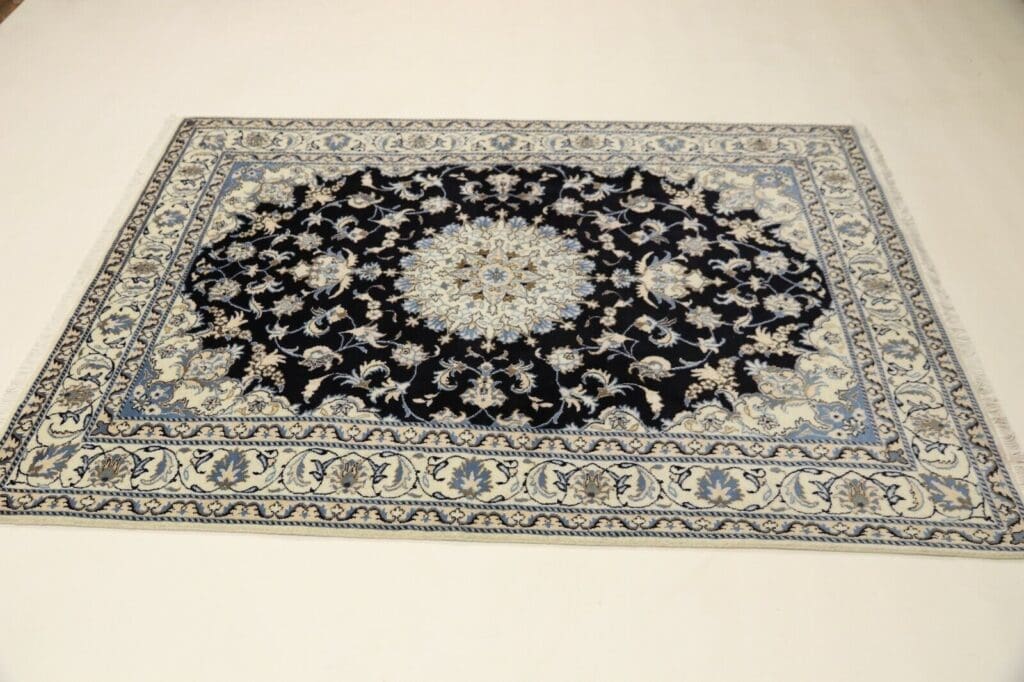
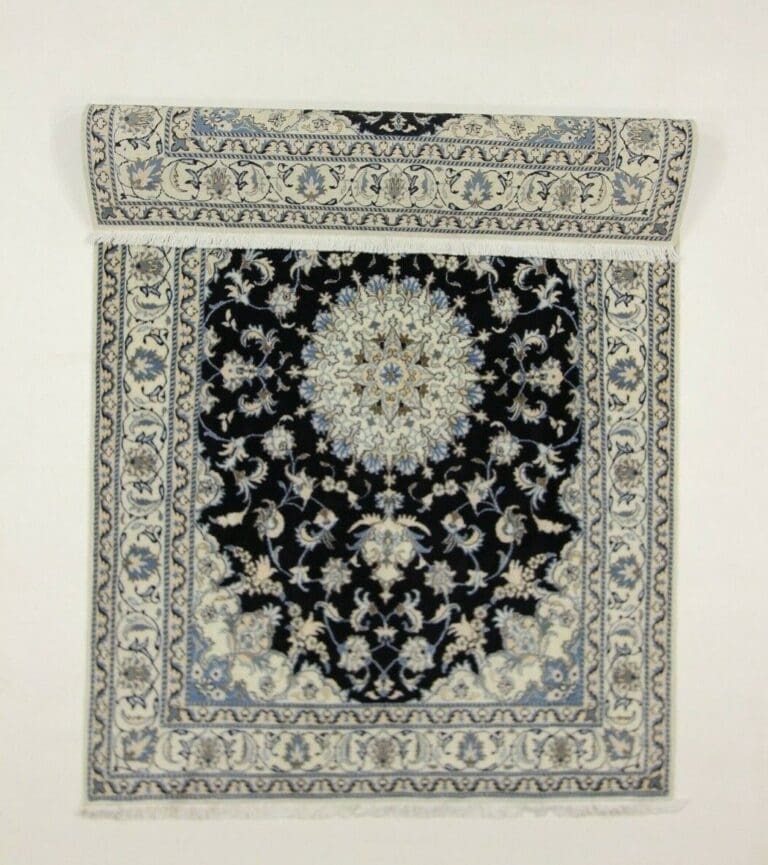
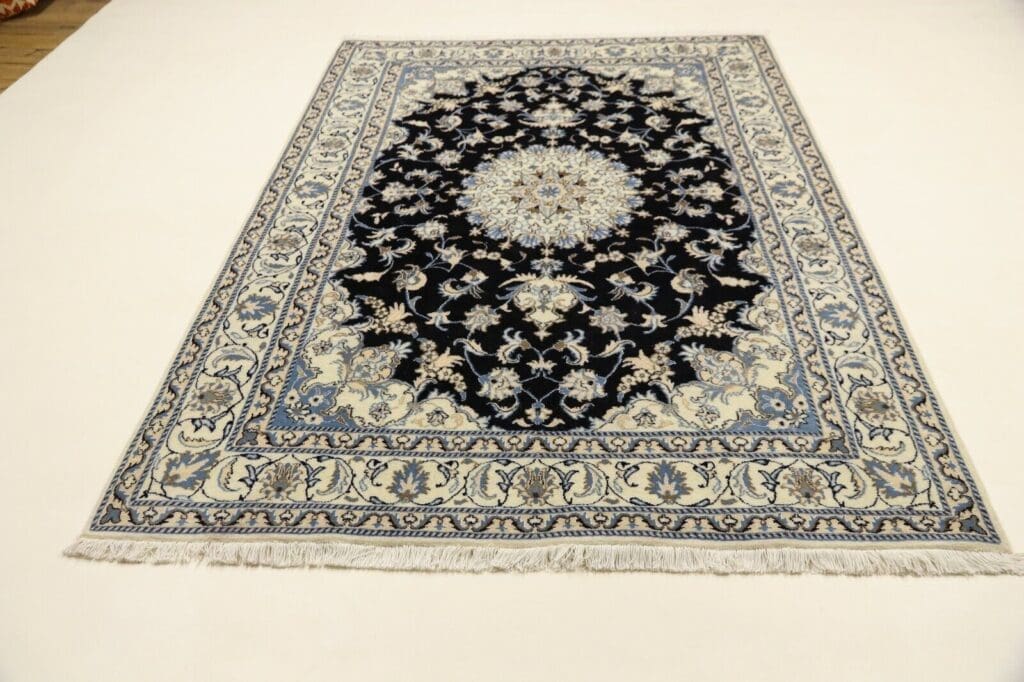
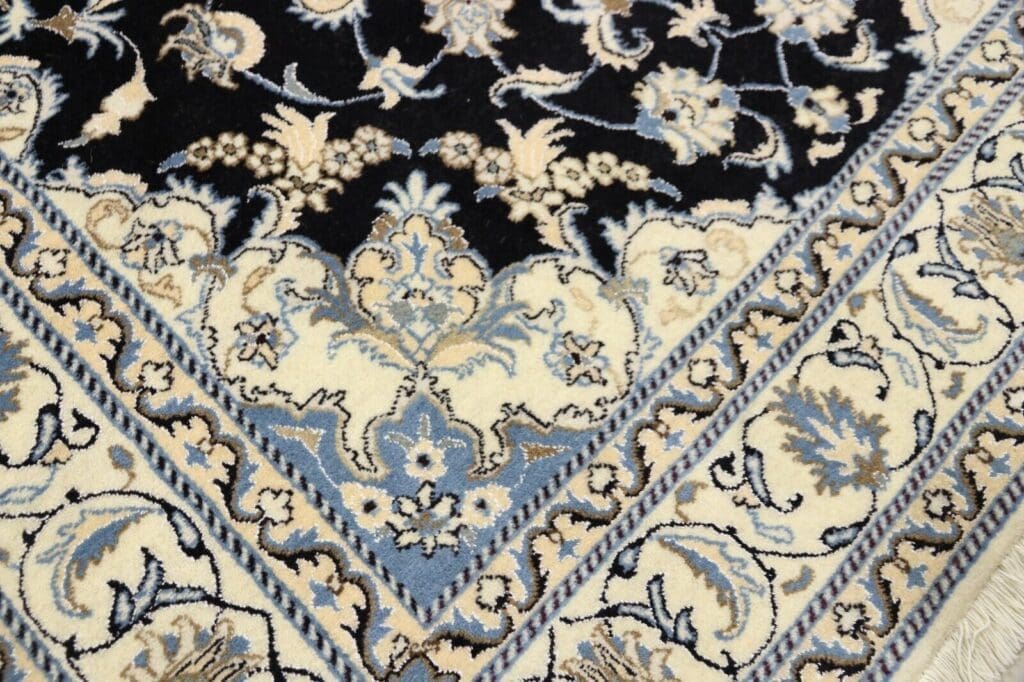
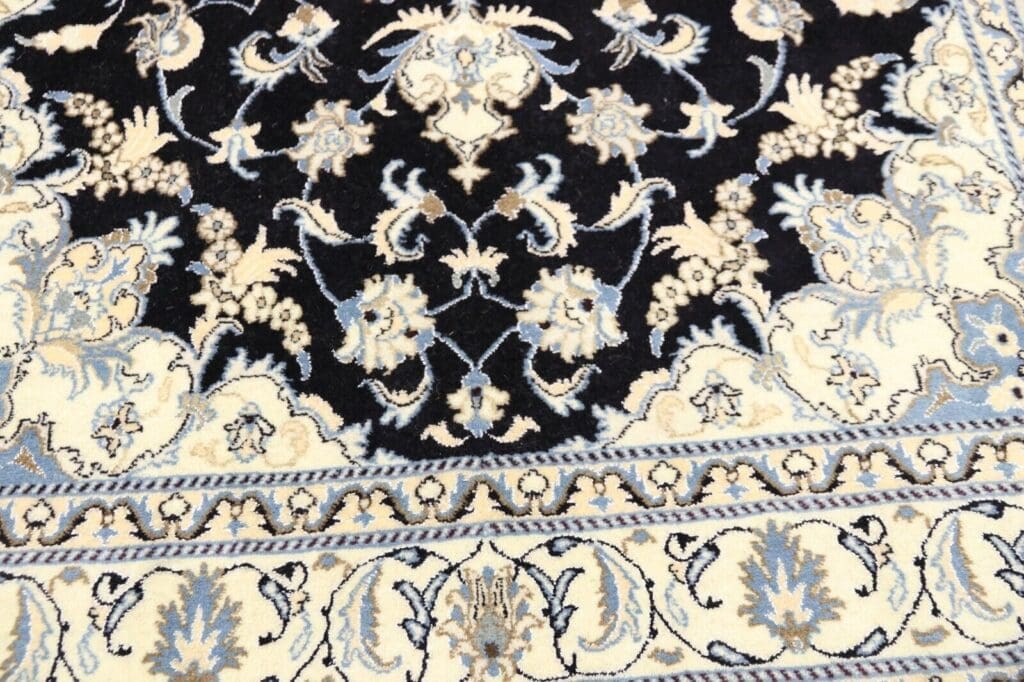
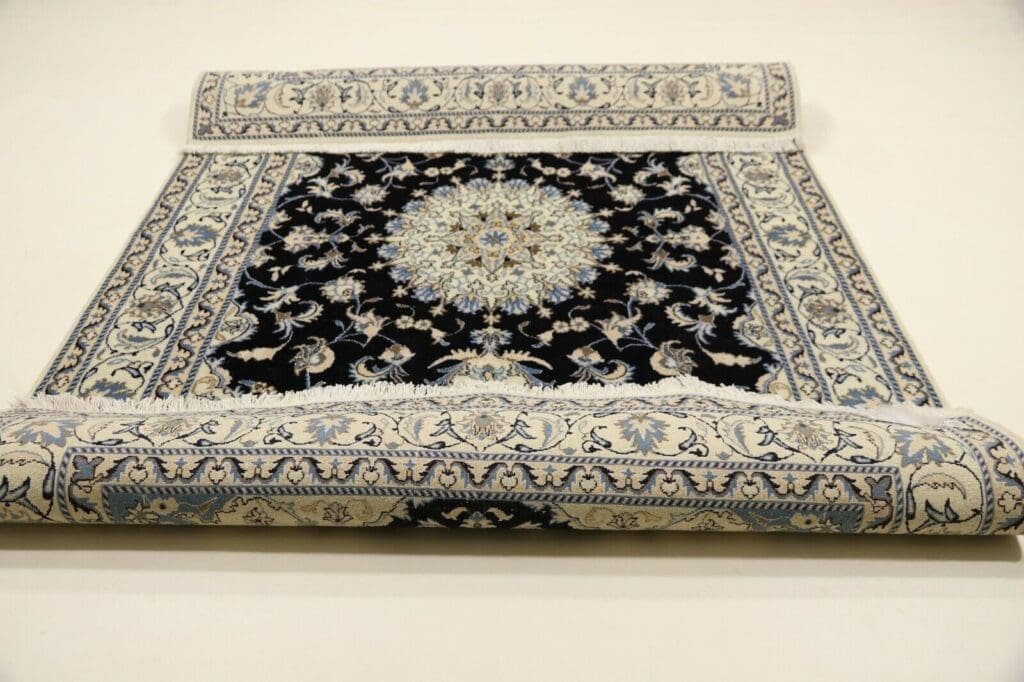
The stated colours are white and dark blue. White provides a light ground, while dark blue creates contrast in the ornament and gives the design visible definition. This palette can make a finely drawn pattern appear orderly and clearly structured. The silk in the pile may reflect light differently from the wool, allowing some parts of the composition to appear more luminous without changing the underlying colours.
The style is described as traditional Oriental and Persian. Nain designs commonly draw on floral motifs, scrolling foliage and geometric organisation. Blossoms may be stylised rather than copied directly from nature, and leaves can be arranged along curving vines to connect separate parts of the field. Geometric elements often appear in borders, corner areas or as a framework around the central design. The balance between organic and ordered forms is a familiar feature of Persian rug composition.
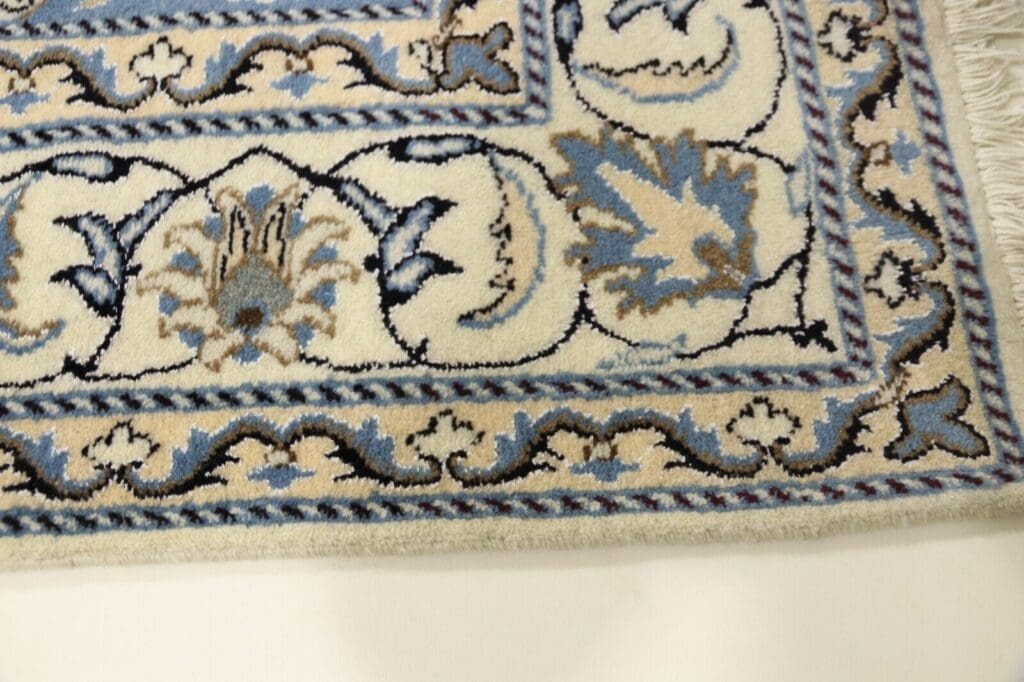
A finely drawn rug is read at several distances. Close up, the viewer can see the individual knots, the variation between wool and silk and the way colours meet at the edges of motifs. From farther away, those separate marks combine into a continuous ornamental surface. High knot density helps keep small forms legible and allows narrow contours to remain distinct. This relationship between close detail and overall order is central to the visual language of finely knotted Nain rugs.
Persian borders provide more than a simple frame. They separate the central field from the outer edge, establish a rhythm and give the composition a controlled finish. A principal border may be accompanied by narrower side borders, creating layers of line and ornament. Floral scrolls can move through these bands, while geometric boundaries keep the pattern contained. The white and dark-blue palette allows such divisions to remain clear without relying on a large number of colours.
The rectangular format supports an intentional direction in the room. It can be aligned with furniture, a passage or the long axis of a living area. The traditional pattern language does not require a historically furnished setting; the pale ground and dark blue drawing can also sit alongside contemporary pieces. Placement should still take account of the room, furniture and traffic, since these determine how much of the design remains visible in daily use.
Floral and geometric motifs are not merely decorative additions. They organise the surface and establish a visual sequence from the centre through the field and toward the border. Repetition creates continuity, while changes in scale prevent the composition from becoming mechanically uniform. In a hand-knotted rug, the pattern is built from textile decisions rather than printed onto a finished surface. This gives the design a material depth that can be observed in the pile and in the changing reflection of the silk.
Special Features
This rug is described as new and in perfect condition. It has a rectangular shape, a white and dark-blue colour scheme and a traditional Oriental and Persian style. Its pile combines virgin wool with silk, and its warp is cotton. The Nain designation, Persian origin, hand-knotted technique and high knot density are also stated characteristics of this individual piece.
The rug is suitable for rooms with underfloor heating. Heat should be distributed evenly, and the room should be ventilated regularly so that excessive heat does not accumulate beneath the rug. This suitability is connected with the materials and hand-knotted construction described for the piece. As with any textile floor covering, sensible use and appropriate care help protect the pile, edges and underlying structure.
Routine care consists of regular gentle vacuuming and prompt attention to spills. Stains should be lifted rather than aggressively rubbed, and mild cleaning products are preferable to harsh chemicals. For a deeper clean, professional rug cleaning is appropriate, particularly because wool, silk and cotton require considered treatment. These measures preserve the surface and allow the fine drawing of the pattern to remain visible.
FAQ
How should I care for this Nain Persian rug?
Vacuum the rug regularly using a gentle setting and respond to spills as soon as possible. Blot stains instead of rubbing them forcefully, and use mild cleaning products only. Avoid aggressive chemicals. Professional cleaning at suitable intervals can help maintain the colour appearance and structure. Because the pile contains both wool and silk, cleaning should be entrusted to specialists familiar with hand-knotted Persian rugs when more than routine care is required.
Where can I use the rug?
The rectangular rug is suitable for living rooms, dining rooms and hallways. Its white ground, dark-blue details and traditional Persian design can work with both classic and modern interiors. The final position should be chosen according to the room, furniture arrangement and walking routes. In an appropriate setting, the rug’s Nain character, hand-knotted surface and carefully drawn ornament remain visible while it serves as a practical floor covering.
Is the rug suitable for underfloor heating?
Yes. This hand-knotted Nain Persian rug is suitable for rooms with underfloor heating. The heat should be distributed evenly, and regular ventilation is recommended to prevent excessive heat from building up. Avoid continuously overheating the rug. Used in this way, the wool-and-silk pile, cotton warp and hand-knotted construction receive appropriate protection while the rug remains in everyday use.
To provide the best experiences, we use technologies like cookies to store and/or access device information. Consenting to these technologies will allow us to process data such as browsing behavior or unique IDs on this site. Not consenting or withdrawing consent, may adversely affect certain features and functions.
Functional Always active
The technical storage or access is strictly necessary for the legitimate purpose of enabling the use of a specific service explicitly requested by the subscriber or user, or for the sole purpose of carrying out the transmission of a communication over an electronic communications network.
Preferences
The technical storage or access is necessary for the legitimate purpose of storing preferences that are not requested by the subscriber or user.
Statistics
The technical storage or access that is used exclusively for statistical purposes.The technical storage or access that is used exclusively for anonymous statistical purposes. Without a subpoena, voluntary compliance on the part of your Internet Service Provider, or additional records from a third party, information stored or retrieved for this purpose alone cannot usually be used to identify you.
Marketing
The technical storage or access is required to create user profiles to send advertising, or to track the user on a website or across several websites for similar marketing purposes.

 SECURE PAYMENT
 SHIPPING PARTNERS