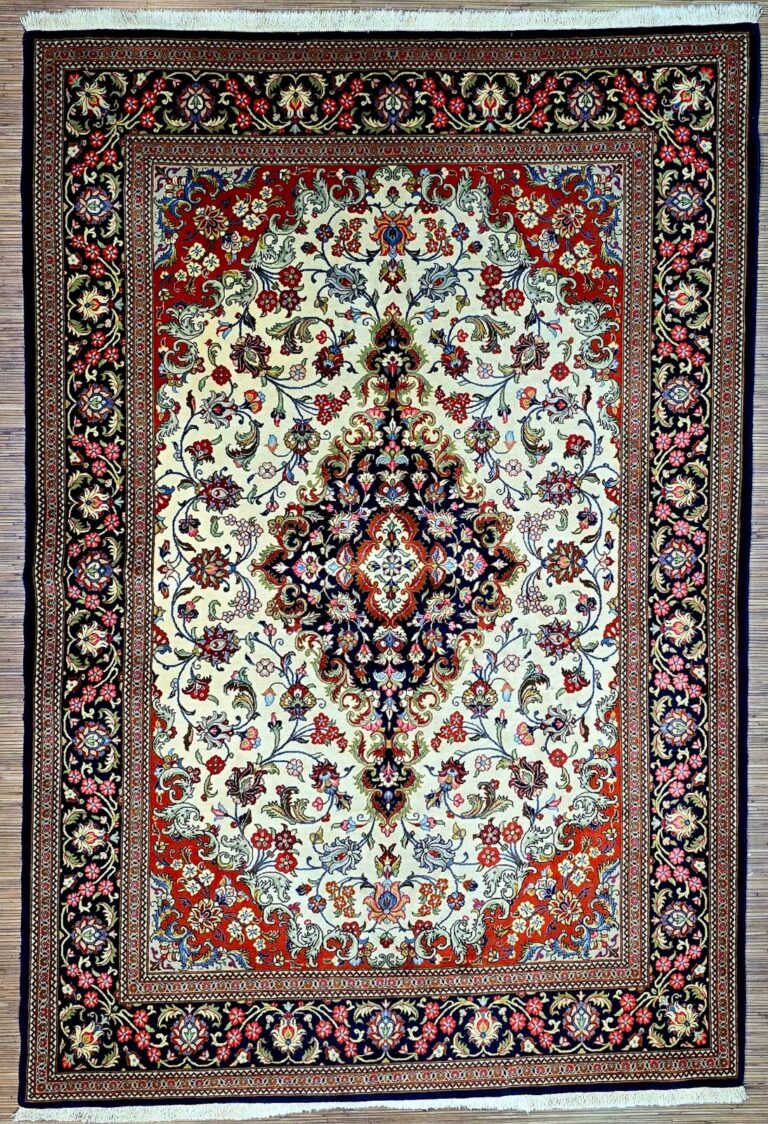
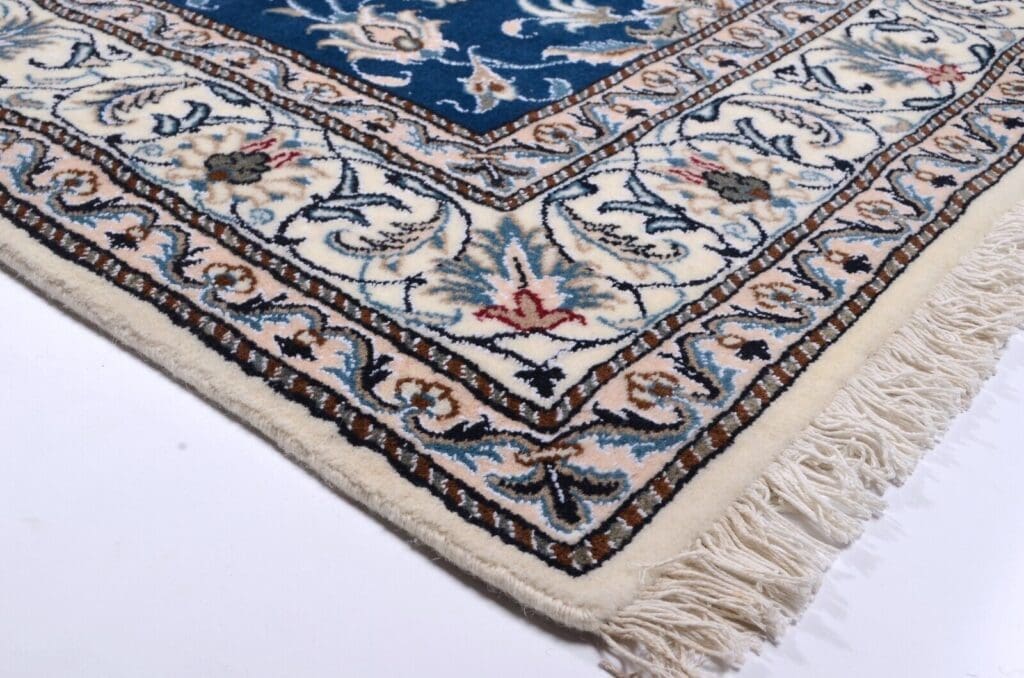
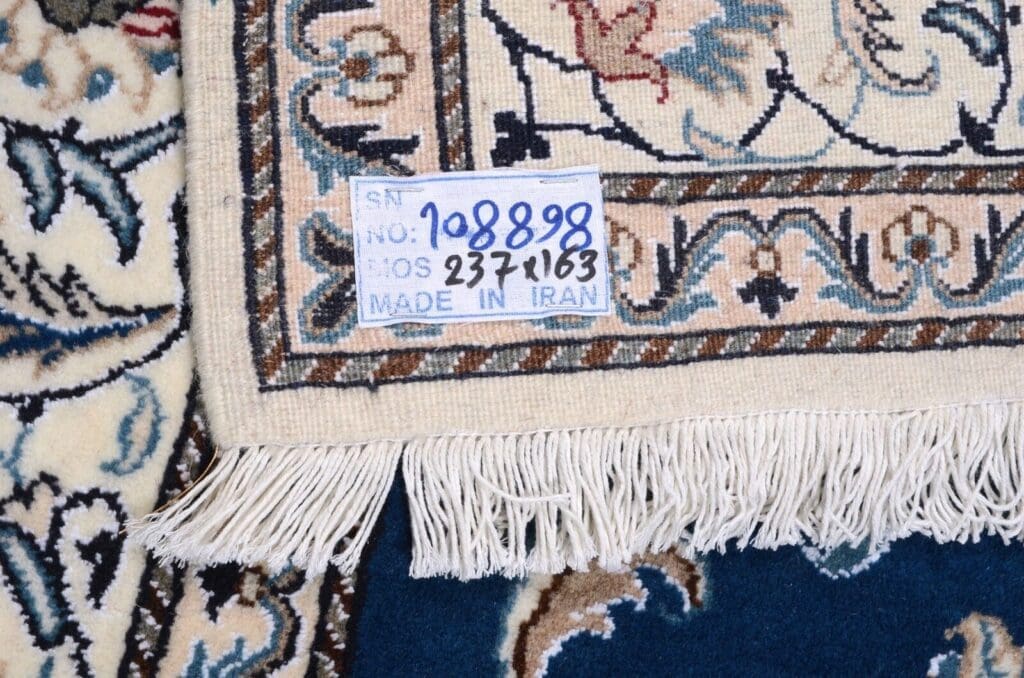
This Nain Persian rug is hand-knotted and has a pile made from 100% virgin wool. Hand-knotting places the individual knots into the structure by hand, creating a textile surface rather than a repeated machine-made product. The process gives each one-off rug its own relationship between colour, texture and ornament. Small variations belong to the nature of this form of workmanship and distinguish a hand-knotted piece from an industrial floor covering.
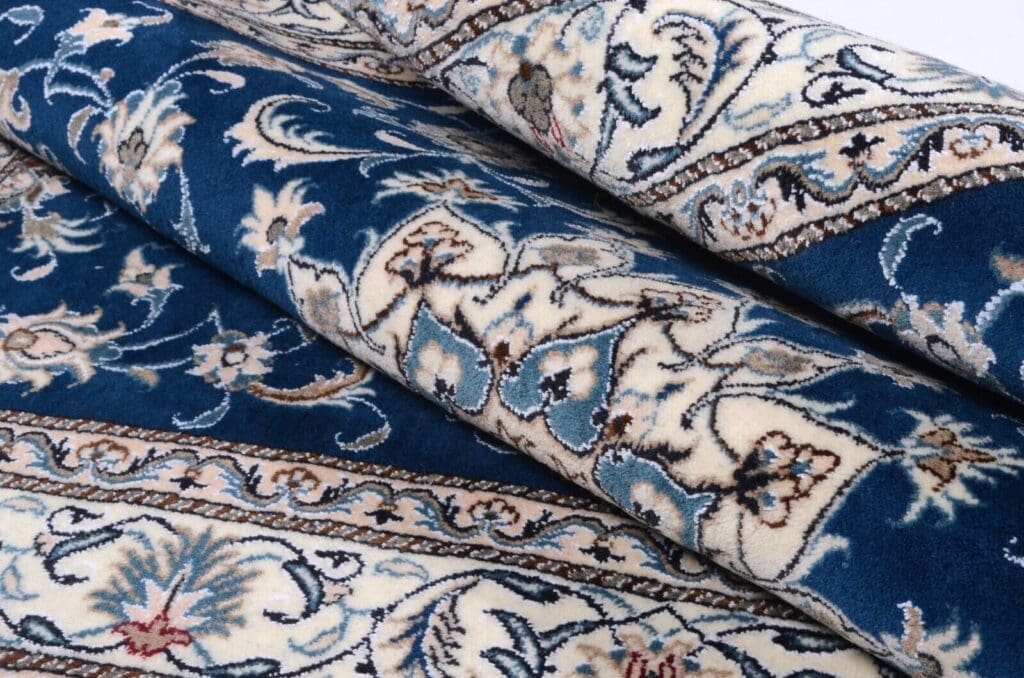
Wool has long been used in rug making because its natural fibres are resilient and pleasant underfoot. Its structure accepts dye well and allows the outlines of decorative elements to be worked into the pile. Wool can also provide a degree of insulation and a comfortable textile feel. In this rug, virgin wool is identified as the pile material, so it is the visible fibre that carries the pattern and contributes to the character of the surface.
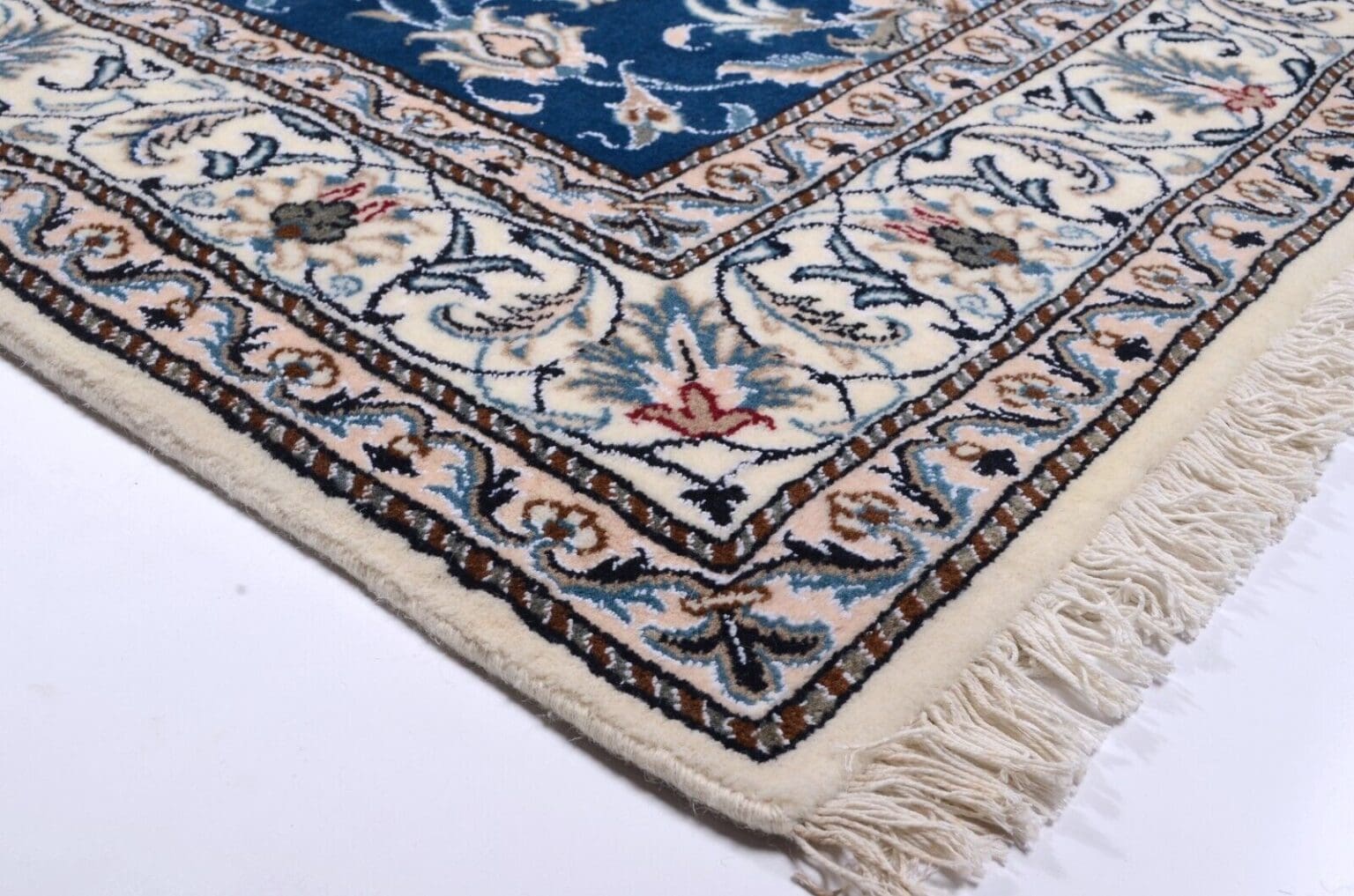
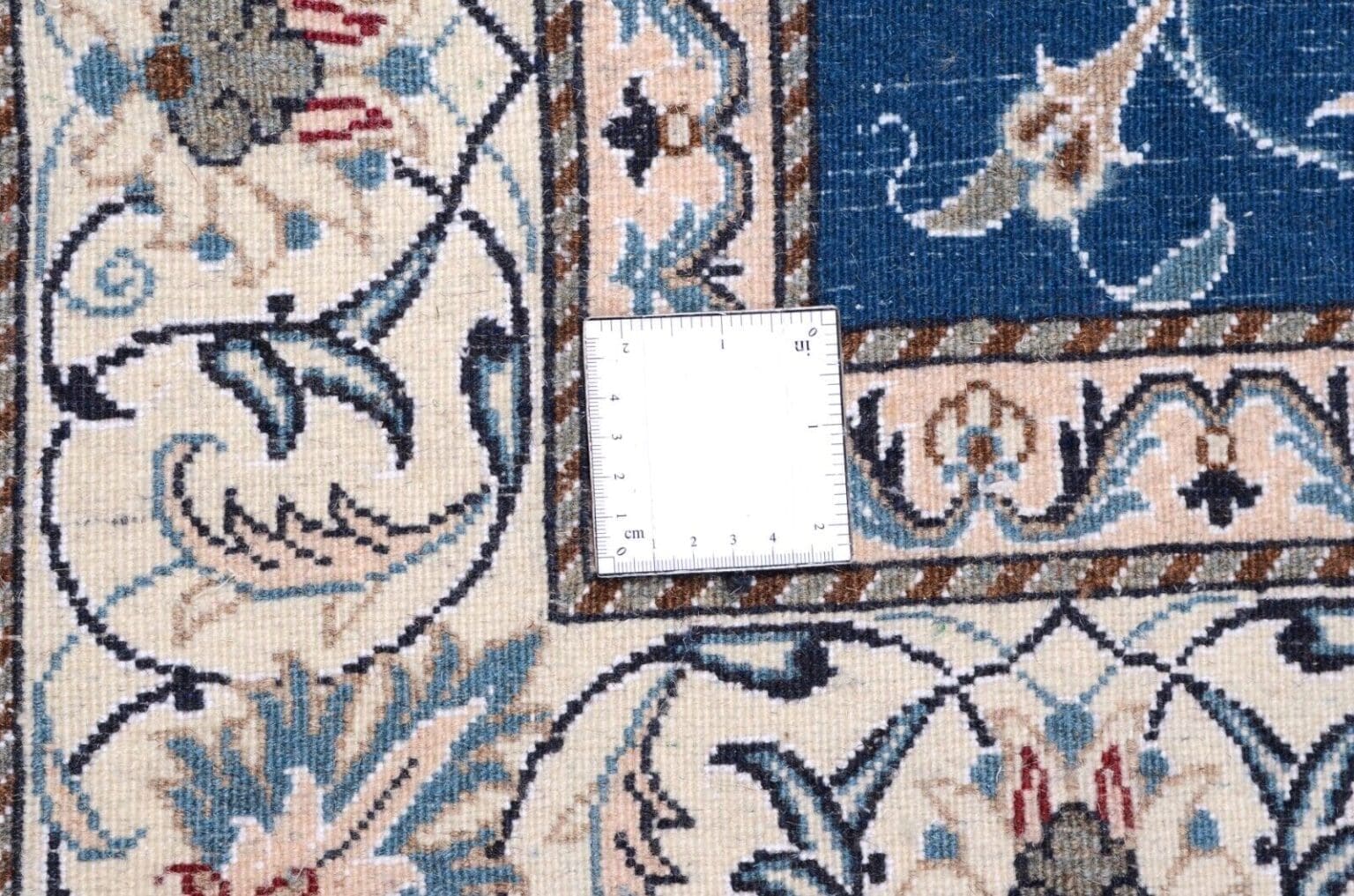
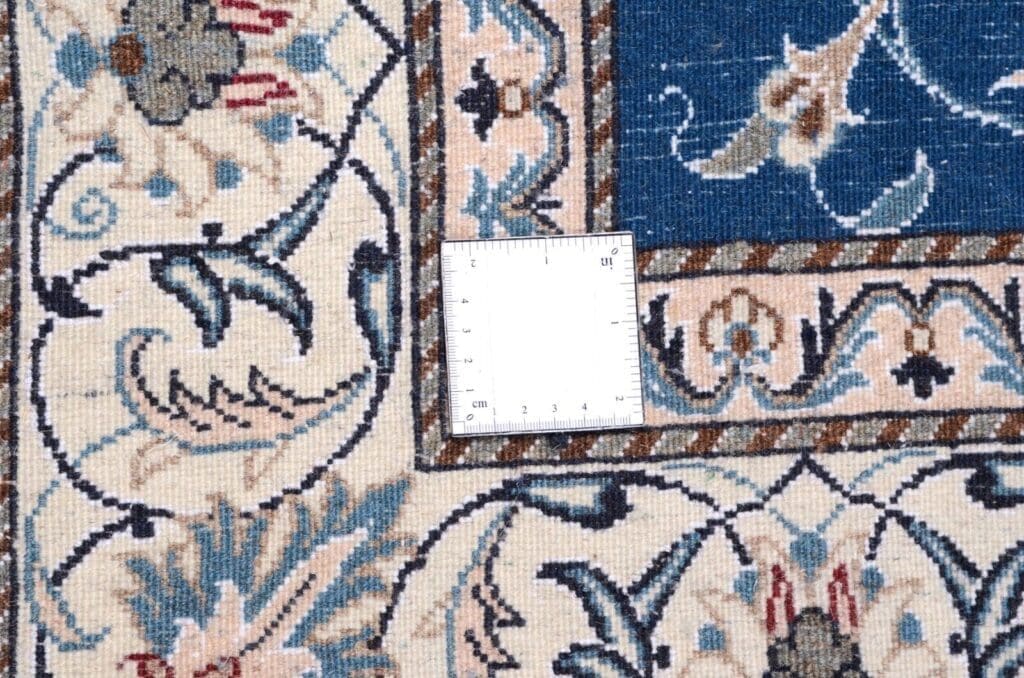
The hand-made process is especially relevant when a design contains a central medallion and floral detail. Knots are placed row by row, building the image into the rug rather than printing it onto the finished surface. The listed knot density is 300,000 knots per square metre. The pile height is given as approximately 10 mm. Together, these details describe a wool pile produced through a fine, manually executed construction.
Hand-knotting involves more than tying isolated knots. The foundation is prepared, the pile yarn is inserted, and each completed section is compacted before the following rows are made. Finishing work can include trimming the pile, washing the rug and bringing the shape into order. The precise sequence varies between workshops, but the principle remains the same: the design develops through repeated manual decisions. That method is central to the identity of a hand-knotted Persian rug.
Origin and Tradition
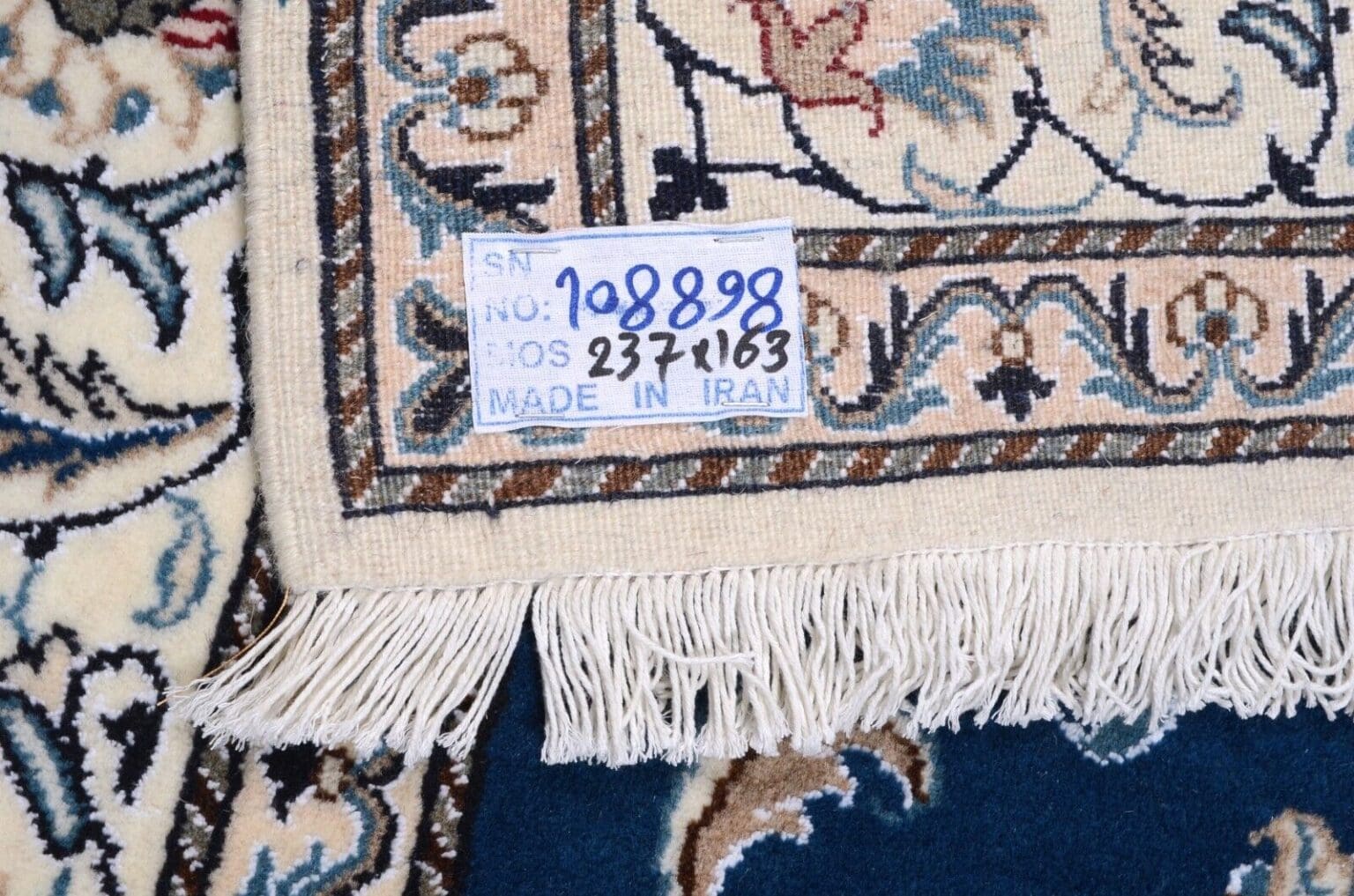
Nain is a city in Iran with a recognised tradition of Persian rug weaving. Rugs associated with Nain are known for carefully organised compositions and finely worked ornament. The name identifies a regional weaving tradition, not merely a decorative label. Over generations, workshops in the area have maintained knowledge of preparing fibres, handling colour, planning a design and executing a dense knot structure.
The history of Nain weaving belongs to the wider culture of Iranian carpet making. In that culture, a rug is developed from a planned arrangement of field, centre and borders. The design may be drawn in advance or communicated through established workshop practice, while the weaver translates the plan into rows of knots. Skills are learned through repeated work and passed between generations. Material preparation, colour control and finishing all contribute to the final appearance.
A Persian rug is traditionally built on a loom with a foundation of warp and weft. The pile is formed by tying yarn around the foundation, then securing each row with weft passages. As the work advances, the pile is trimmed so that the drawing remains legible. The density and regularity of the knots affect the amount of detail that can be represented. This rug is identified as hand-knotted, placing it within that long-established Persian construction method.
Nain designs often use a disciplined layout in which a central medallion is supported by floral ornament and framed by borders. The approach reflects a preference for balance and measured repetition. Floral elements may be arranged symmetrically or adapted to fill a field while maintaining visual order. These conventions are part of the regional design language, although individual rugs differ in their drawing, scale and colour arrangement.
Iranian carpet traditions also show how practical craft and visual design develop together. The rug must be built as a stable textile, while the knotting must at the same time express the intended pattern. A skilled weaver therefore works with structure and image simultaneously. The result is a surface in which the design is inseparable from the construction. This relationship explains why Persian rugs are studied both as useful textiles and as examples of regional decorative art.
The Nain tradition is also associated with an appreciation of precision. Fine outlines, repeated botanical forms and carefully separated areas require concentration throughout the weaving process. The stated density of this rug belongs to that technical context. It should not be read as a separate decoration, but as part of the way the floral medallion composition is rendered in wool. The regional name, the hand-knotted method and the ordered ornament therefore belong to one connected tradition.
Design and Pattern
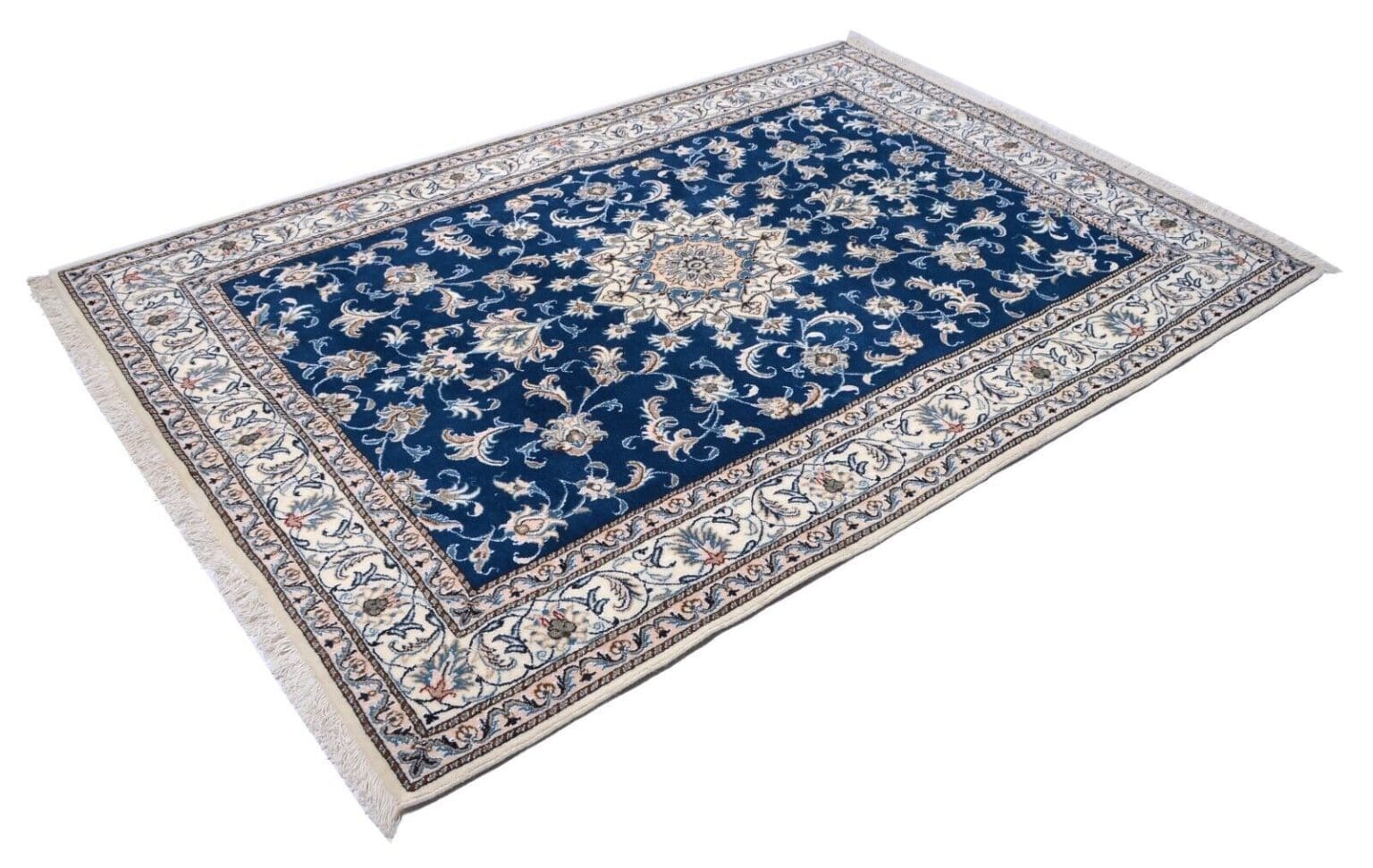
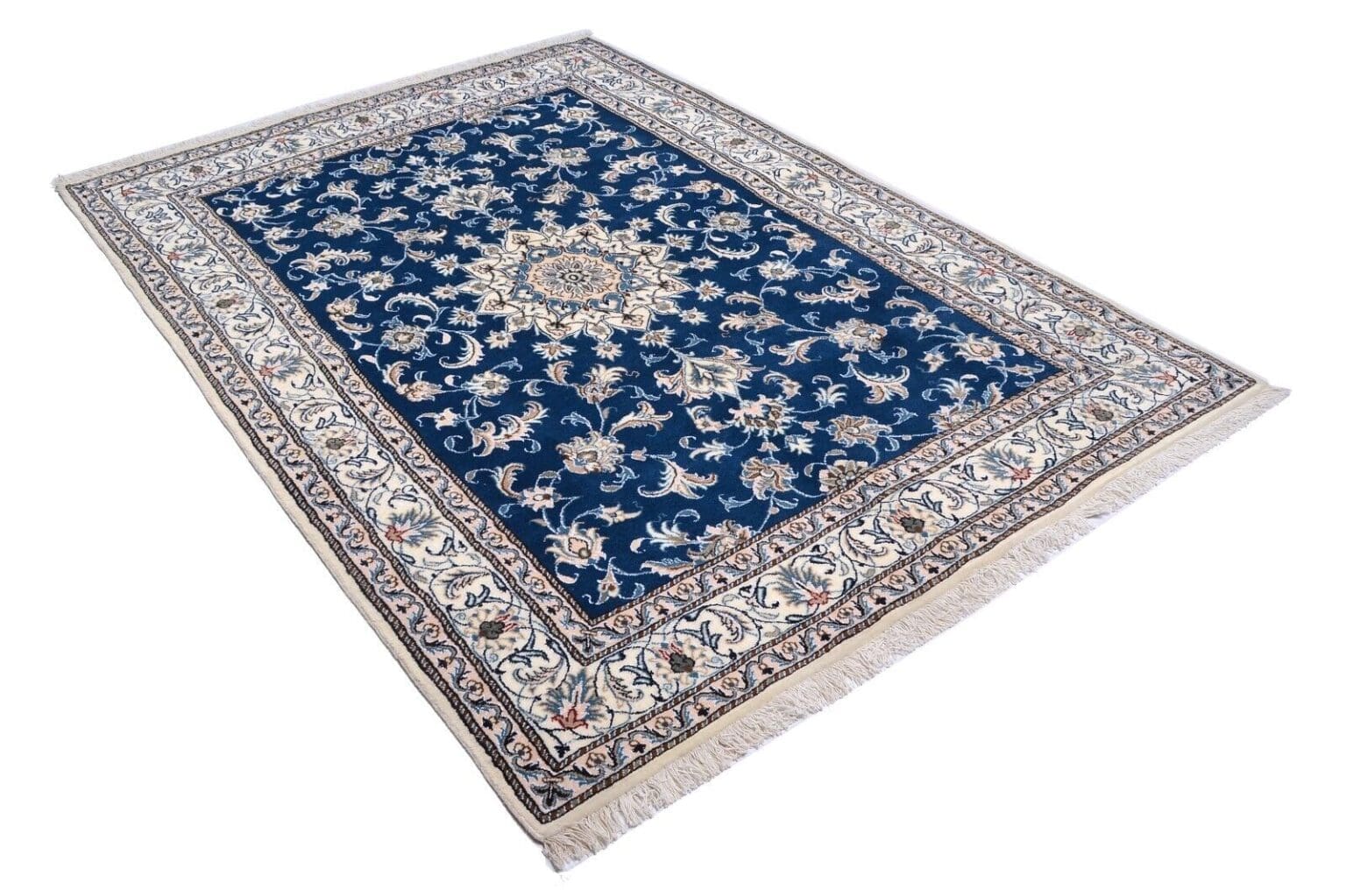
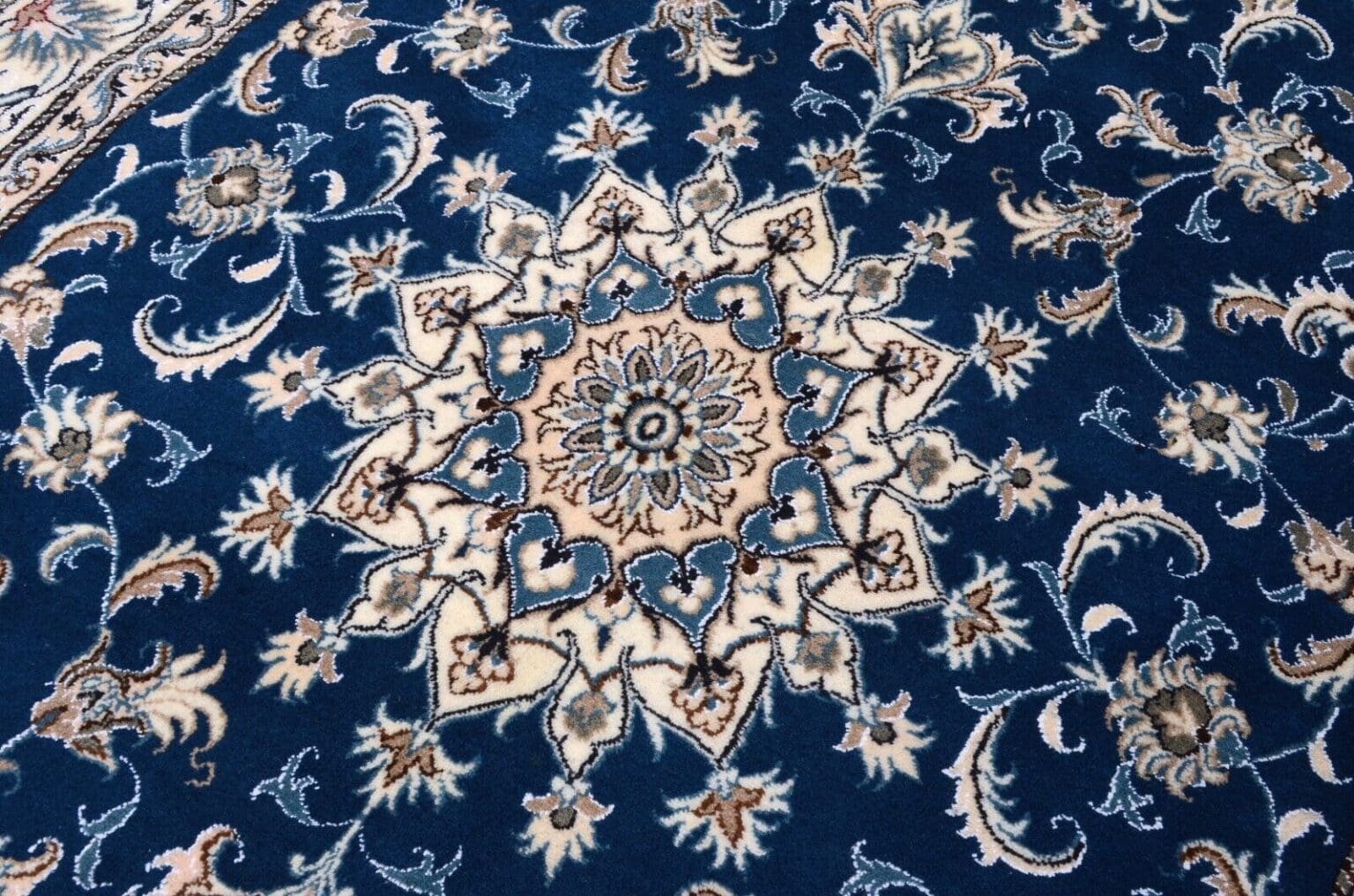
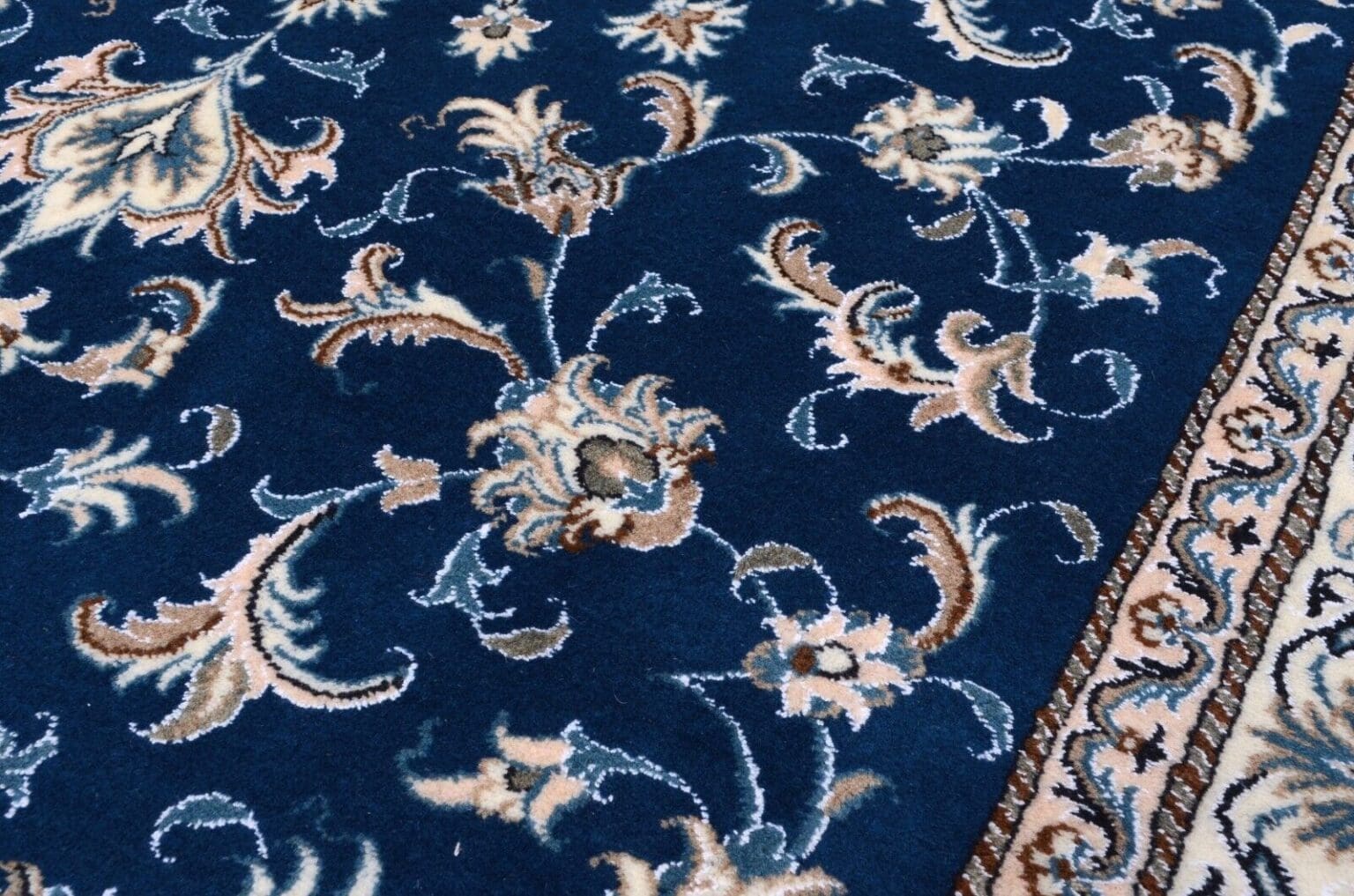
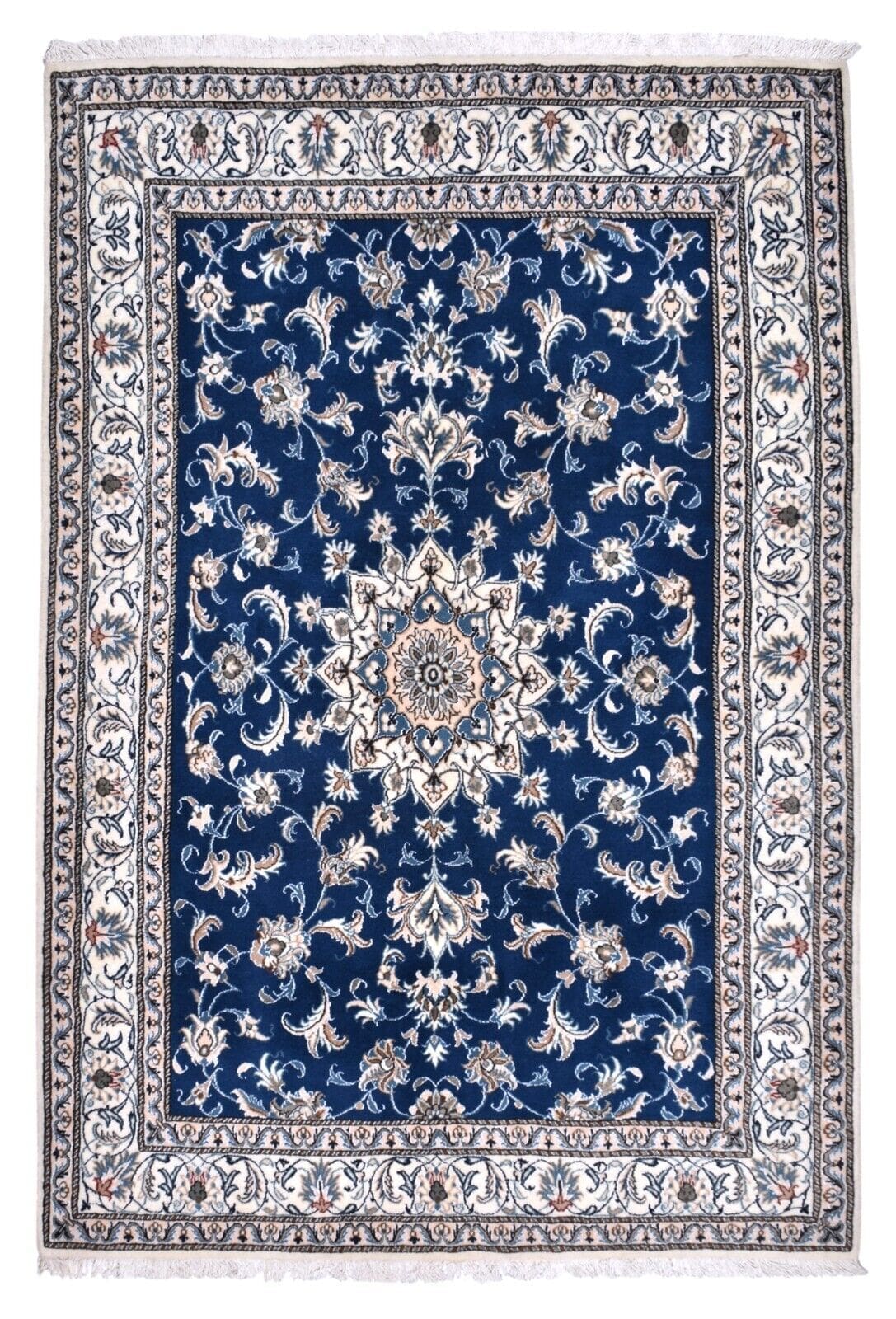
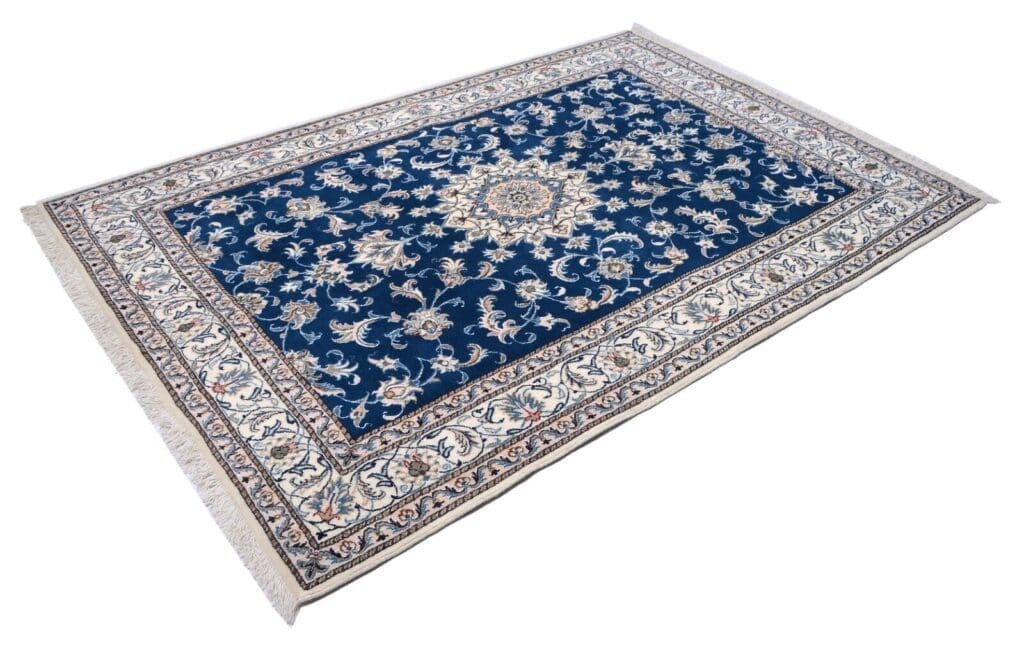
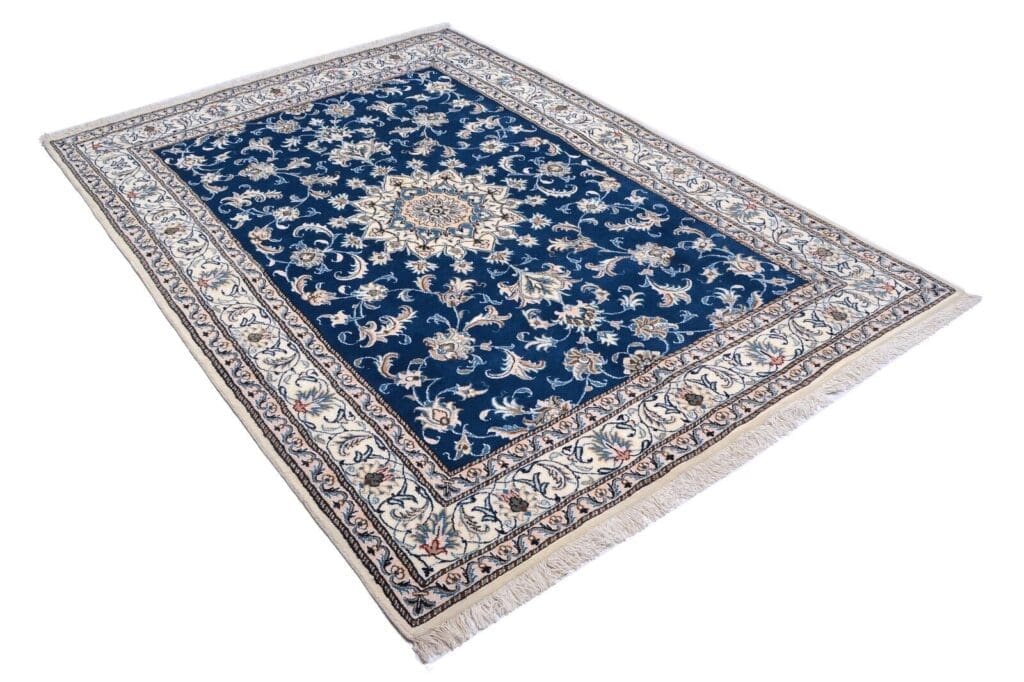
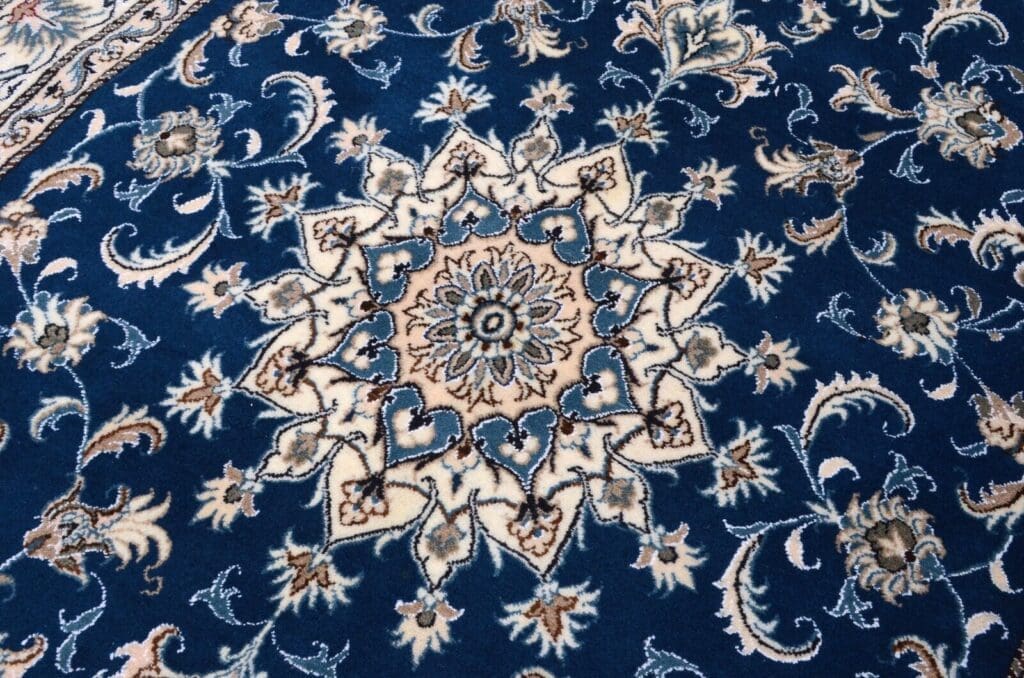
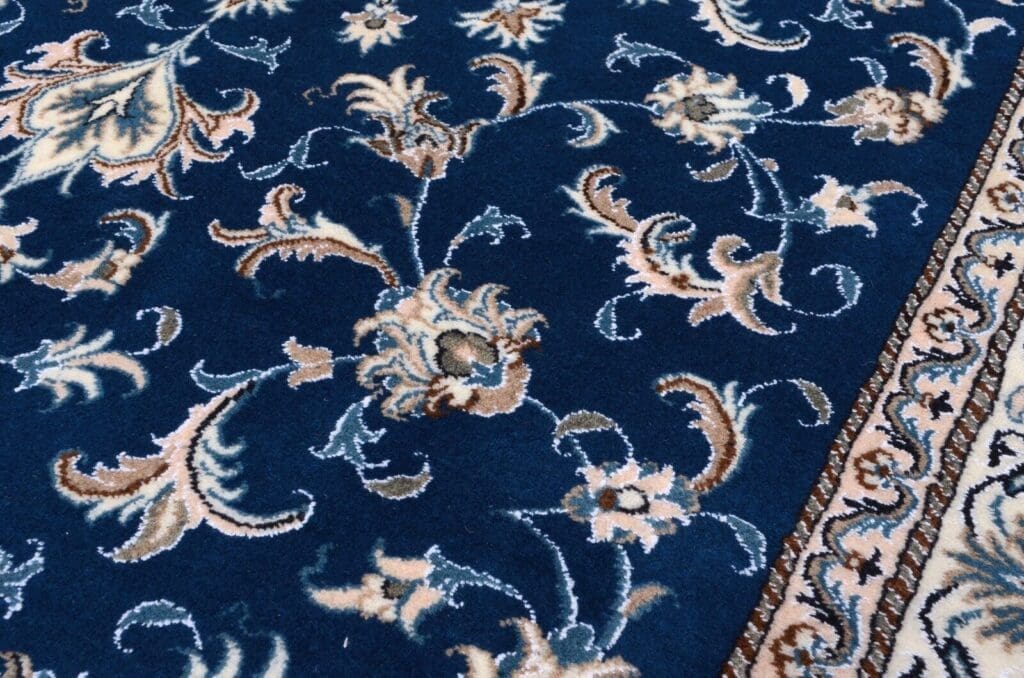
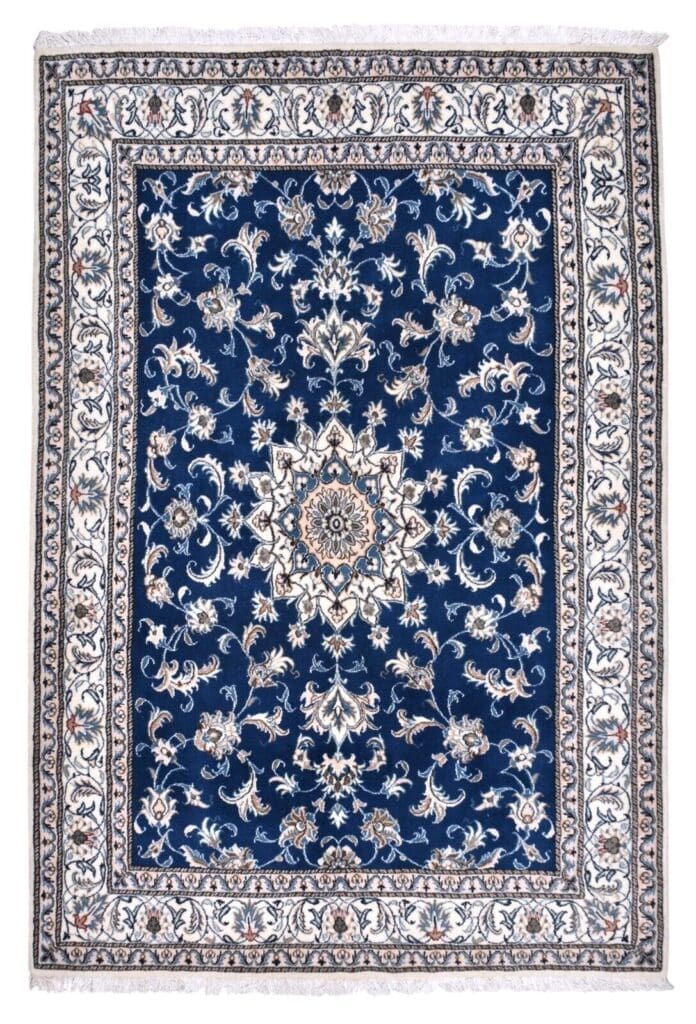
The pattern of this Nain Persian rug is described as a floral motif with a medallion. A medallion establishes a visual centre, while the floral elements organise the surrounding field. In Persian carpet design, flowers, leaves and scrolling stems are often stylised rather than copied directly from nature. Their shapes are adjusted to fit the geometry of the composition, allowing botanical references to work within a carefully structured textile image.
Royal blue is the named principal colour of this rug. Blue has a long history in Persian decorative arts and appears in many shades across regional weaving traditions. A deep, vivid blue can give the field a strong visual foundation and set off the lines of lighter or contrasting ornaments. Only Royal blue is specified here as a colour; additional colours are not stated and are therefore not assigned to this individual rug.
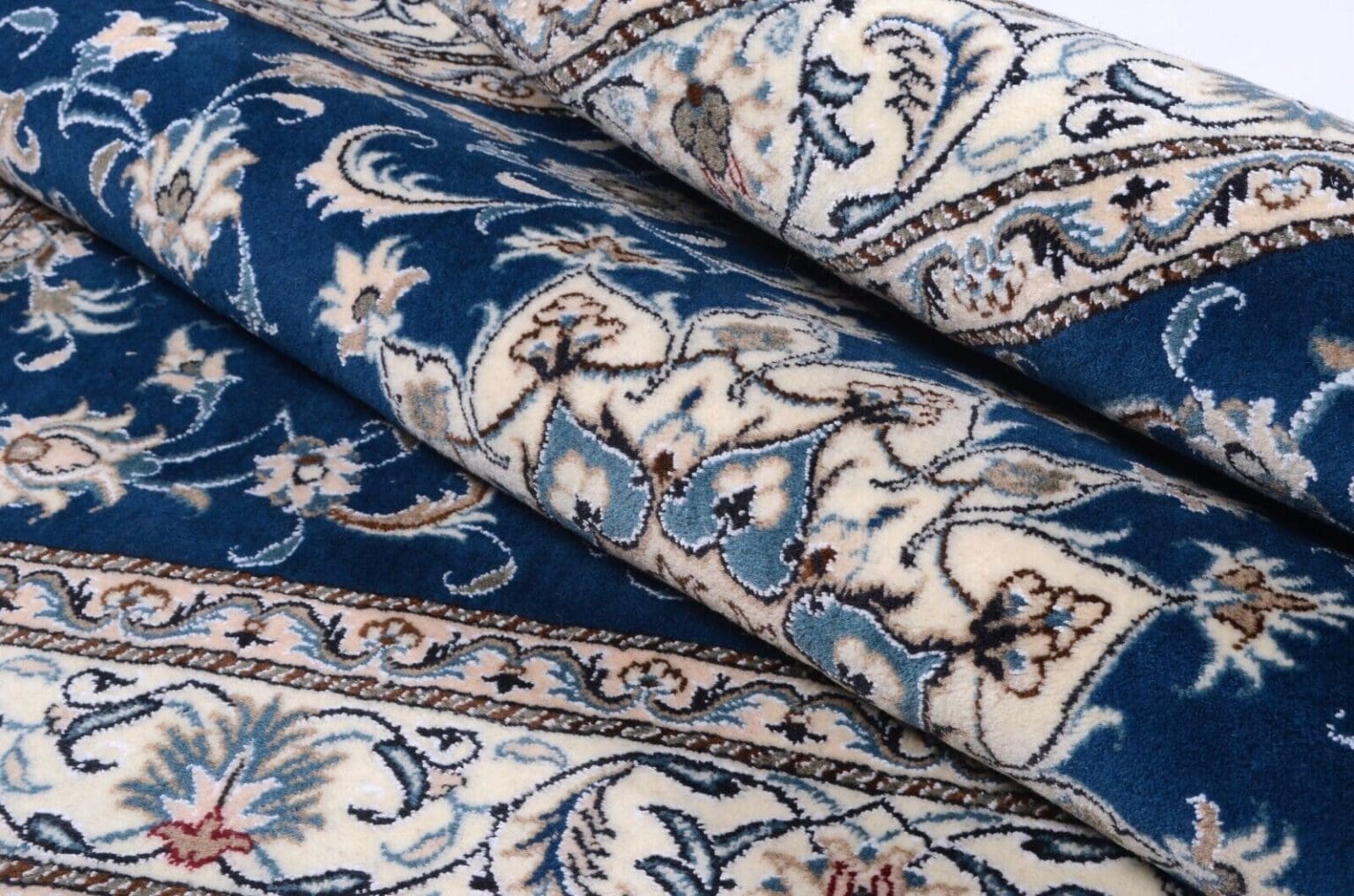
The medallion format guides the eye from the centre towards the surrounding pattern. Floral scrolls can connect the central form with the outer field, while a border gives the design a defined edge. In an organised Persian composition, repetition creates continuity and symmetry helps establish balance. The hand-knotted construction makes these relationships part of the pile itself, so the outlines are formed through changes in knot placement and colour rather than applied as a separate surface image.
Floral ornament is one of the enduring vocabularies of Persian rugs. It can suggest gardens, cultivated plants and the ordered beauty of nature, while remaining fully decorative. The weaver may vary the size of flowers, turn leaves along a scrolling stem or repeat a motif at measured intervals. Such decisions keep a large field connected and give the eye a path through the composition. The floral language can consequently appear both organic and geometric.
The central structure makes the rug adaptable to different interior arrangements. A medallion can define a clear area beneath furniture or remain visible as an independent textile image. In a living room, entrance area or bedroom, the Royal blue ground and floral drawing can function as a distinct decorative element. The appropriate placement depends on the surrounding furnishings and the amount of the pattern that is intended to remain visible.
What distinguishes the design of this piece is the combination of a named regional tradition with an immediately readable colour and pattern. Nain supplies the Persian context, Royal blue establishes the principal chromatic identity, and the floral medallion supplies the composition. The knotting then translates these choices into wool pile. Pattern, colour and technique are therefore not separate additions but three aspects of the same rug.
Special Features
The rug is described as new and in perfect condition. It is hand-knotted, made with 100% virgin wool in the pile and suitable for use over underfloor heating. Its named colour is Royal blue, and its pattern is a floral motif with a medallion. These are the specific characteristics that define the individual piece.
The approximately 10 mm pile height refers to the visible wool surface. The one-off nature of a hand-knotted rug comes from its manual construction: the textile is built through many individual operations rather than reproduced as an identical machine-made article. For routine care, regular gentle vacuuming helps remove dust and loose dirt. A damp cloth may be used when needed, while professional rug cleaning is appropriate for more thorough maintenance.
FAQ
How should I care for the Nain Persian rug?
Vacuum the rug regularly and gently to remove dust and everyday dirt from the wool pile. For an isolated mark, the surface can be wiped with a damp cloth. More extensive cleaning is best entrusted to a professional rug cleaner, who can take the wool and hand-knotted construction into account during the treatment.
Where can I use the Nain Persian rug?
It can be used in several residential settings, including a living room, a classic entrance area or a bedroom. The floral medallion pattern is suited to a room where the rug is intended to remain visible as a central decorative feature. The rug is also specified as suitable for use with underfloor heating.
Why does knot density matter in Persian rugs?
Knot density indicates how many knots are worked into a defined area of the rug. It influences the compactness of the construction and the degree of detail that can be represented in the pattern. This Nain rug is listed with 300,000 knots per square metre. A dense structure supports the precise rendering of floral outlines and medallion ornament.
To provide the best experiences, we use technologies like cookies to store and/or access device information. Consenting to these technologies will allow us to process data such as browsing behavior or unique IDs on this site. Not consenting or withdrawing consent, may adversely affect certain features and functions.
Functional Always active
The technical storage or access is strictly necessary for the legitimate purpose of enabling the use of a specific service explicitly requested by the subscriber or user, or for the sole purpose of carrying out the transmission of a communication over an electronic communications network.
Preferences
The technical storage or access is necessary for the legitimate purpose of storing preferences that are not requested by the subscriber or user.
Statistics
The technical storage or access that is used exclusively for statistical purposes.The technical storage or access that is used exclusively for anonymous statistical purposes. Without a subpoena, voluntary compliance on the part of your Internet Service Provider, or additional records from a third party, information stored or retrieved for this purpose alone cannot usually be used to identify you.
Marketing
The technical storage or access is required to create user profiles to send advertising, or to track the user on a website or across several websites for similar marketing purposes.

 SECURE PAYMENT
 SHIPPING PARTNERS