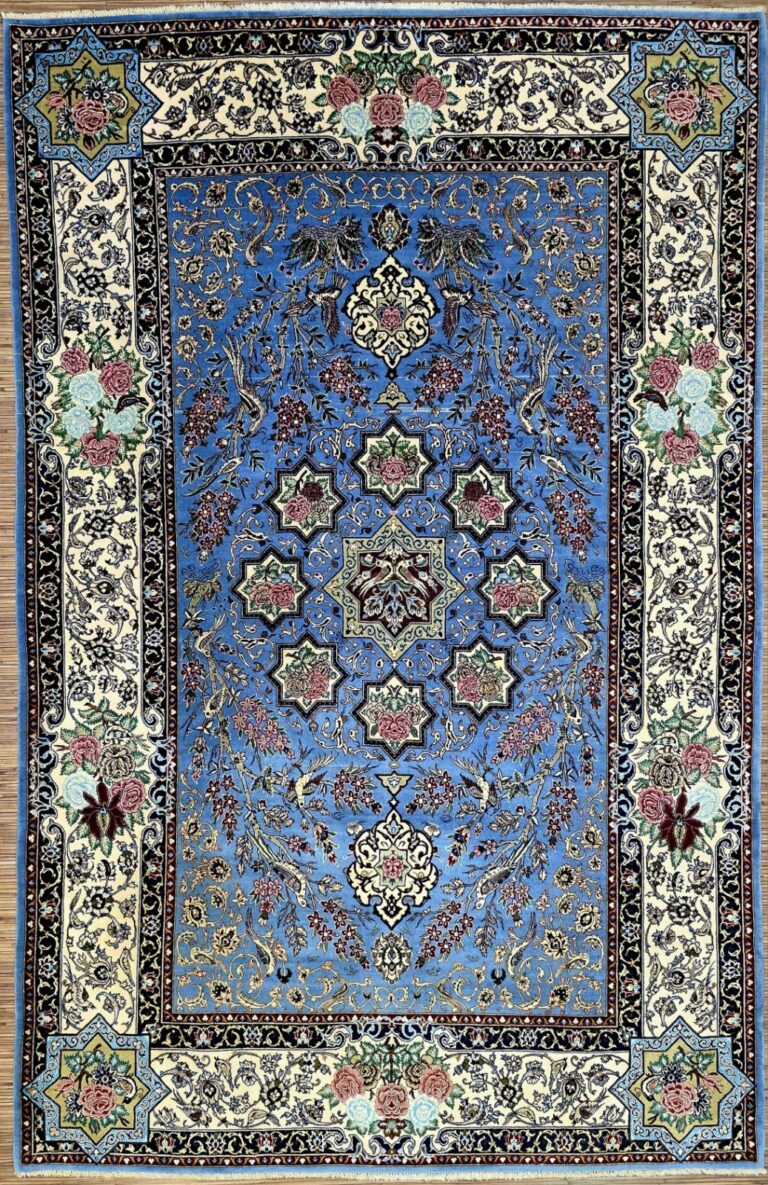
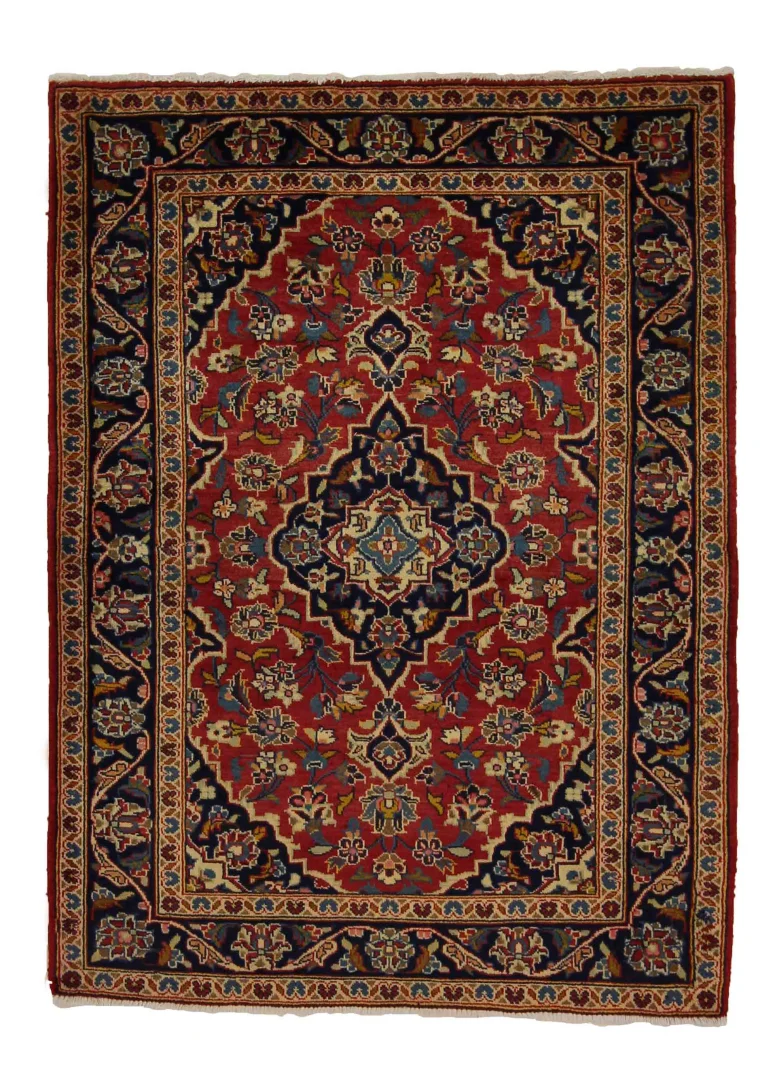
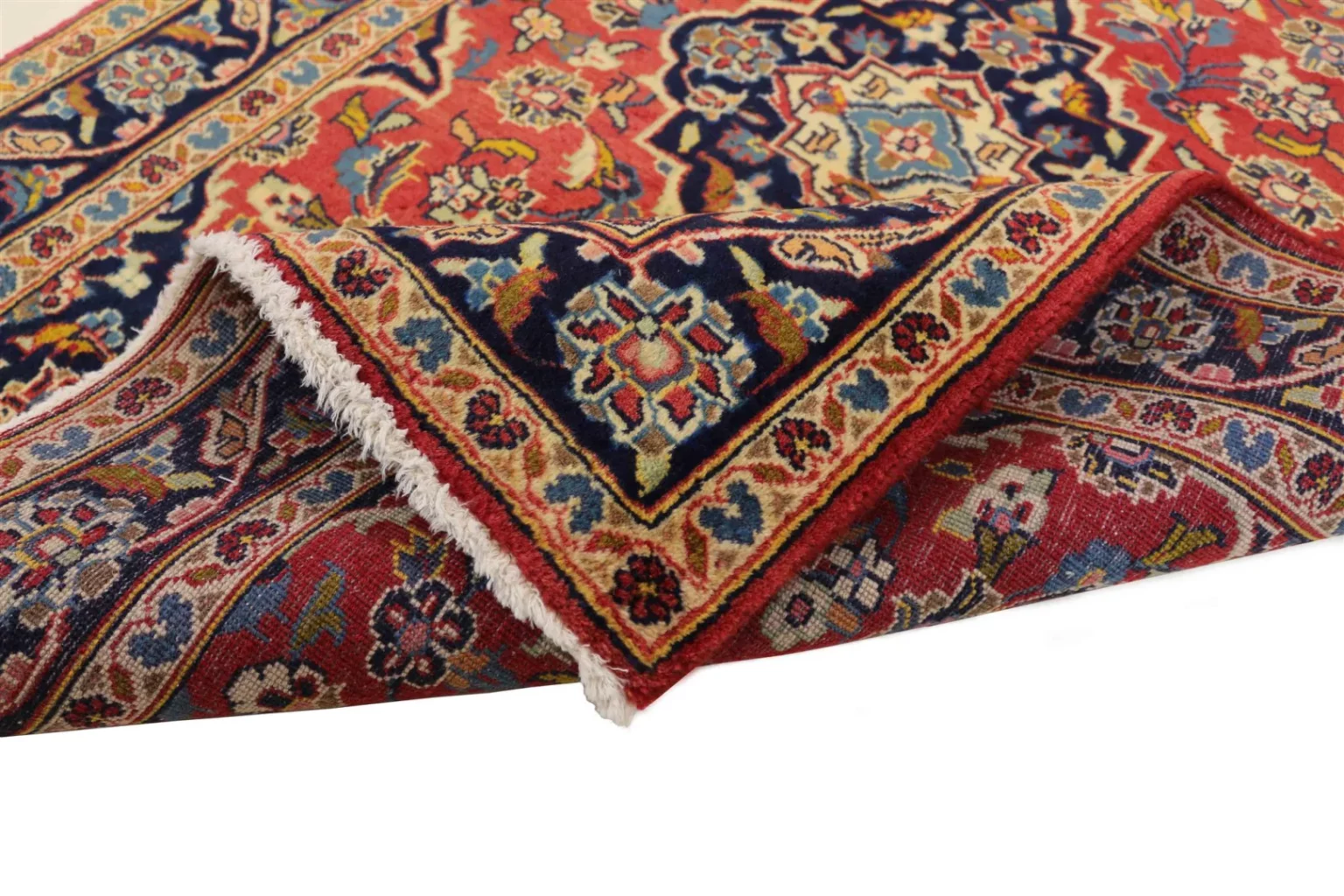
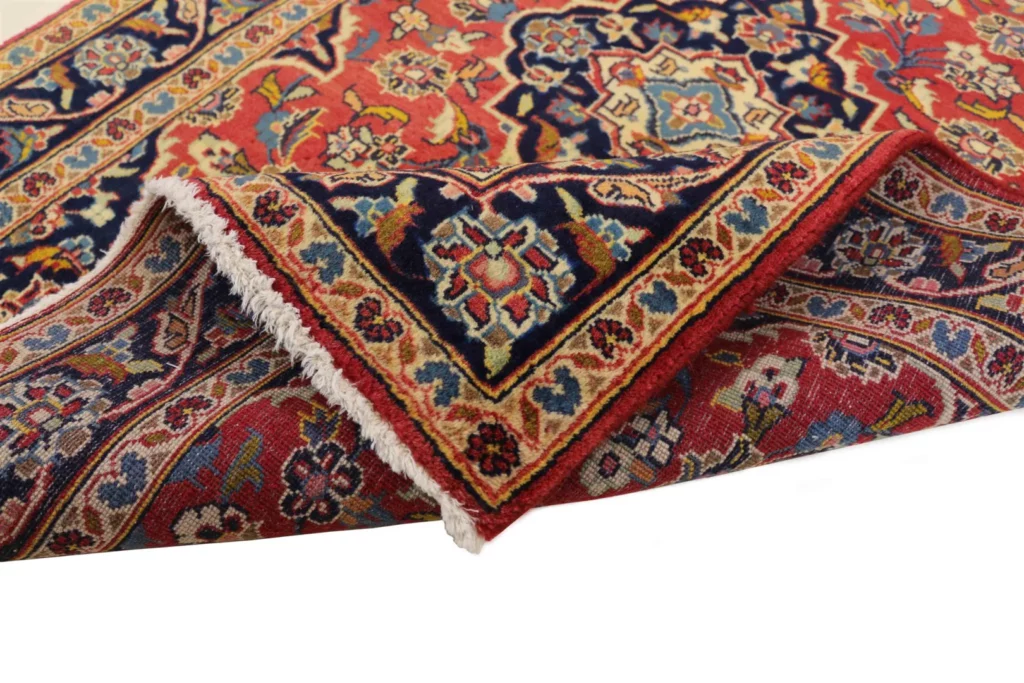
This Keshan Persian rug is hand-knotted. Its pile is made from high-quality sheep wool, while cotton is used for the warp and weft. The combination of a wool pile and a cotton foundation is characteristic of the established Keshan weaving tradition. Sheep wool provides a resilient surface with a distinct textile texture. Cotton gives the underlying structure the strength needed for an even and durable construction.
The stated knot density ranges from 100,000 to 300,000 knots per square metre. This density allows patterns to be drawn with precision while creating a compact rug structure. In hand-knotting, every knot is inserted individually into the foundation. Row by row, the weaver builds a textile surface in which the design is inseparable from the manual process.
The materials are selected to perform different functions within the rug. Wool is suited to the pile because it is resilient and holds its form. Cotton provides a firm basis for the warp and weft. The result is a woollen walking surface supported by a stable textile foundation, following a material arrangement long associated with Persian rug production.
Origin and Tradition
The rug comes from Keshan in Iran. Keshan, also known as Kashan, is a historic city recognised for carpet weaving, textiles and ceramics. The name Keshan therefore identifies both a place of origin and an important centre of Iranian craftsmanship. Textile production became an established part of the region’s cultural and economic life, with techniques and designs passed from one generation of weavers to the next.
Keshan’s history is closely connected with the Silk Road. These routes carried goods, fibres, visual ideas and craft knowledge between distant regions. Carpets were among the products traded along such networks. This commerce contributed to the city’s prosperity and helped make it a place where textile traditions could be maintained, adapted and refined.
Persian rugs are produced in many regions through carefully ordered working methods. The process includes preparing the foundation, tying the pile knot by knot, and finishing the surface after the pattern has been completed. Keshan rugs are associated with a balanced combination of a dense construction, an organised layout and decorative patterning. The origin in Keshan places this individual rug within the Iranian tradition of hand-knotted Oriental rugs.
The Keshan area also belongs to a wider Persian weaving landscape. Ardekan rugs are made in the surrounding region and may share similar patterns, although they are often produced in a different quality. Other Iranian centres have their own visual identity. Tabriz is associated with highly detailed work, while Isfahan is known for an opulent palette and complex compositions. These distinctions illustrate the range of Persian rug traditions without changing this rug’s origin in Keshan.
Across Iran, regional forms, practical knowledge and inherited ornament are combined in the making of rugs. Keshan represents a tradition in which textile construction and an orderly decorative composition belong together. Its background includes the history of Silk Road exchange, local production and the continued transmission of weaving skills. That context explains why Keshan remains a recognised name within Iranian carpet culture.
Design and Pattern
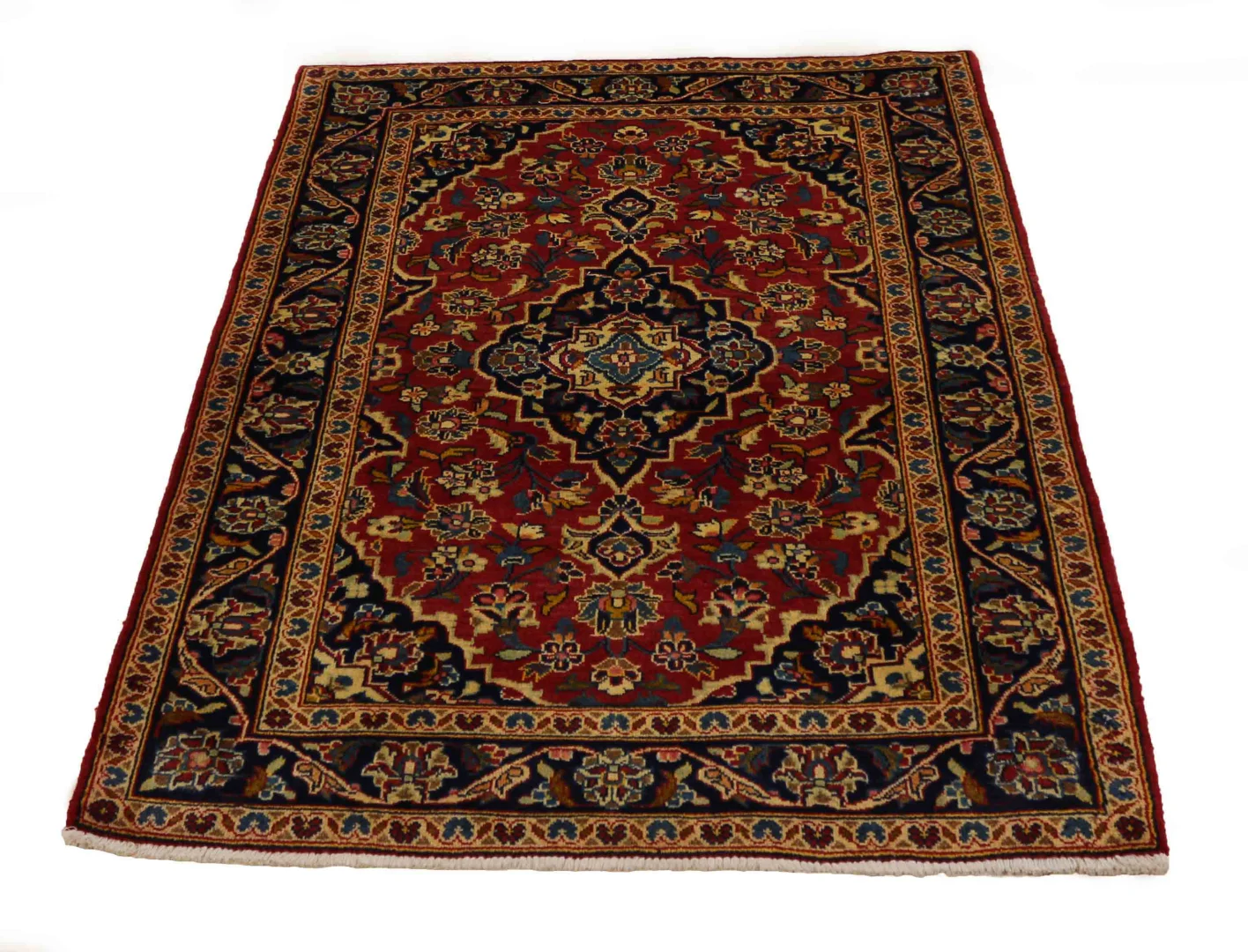
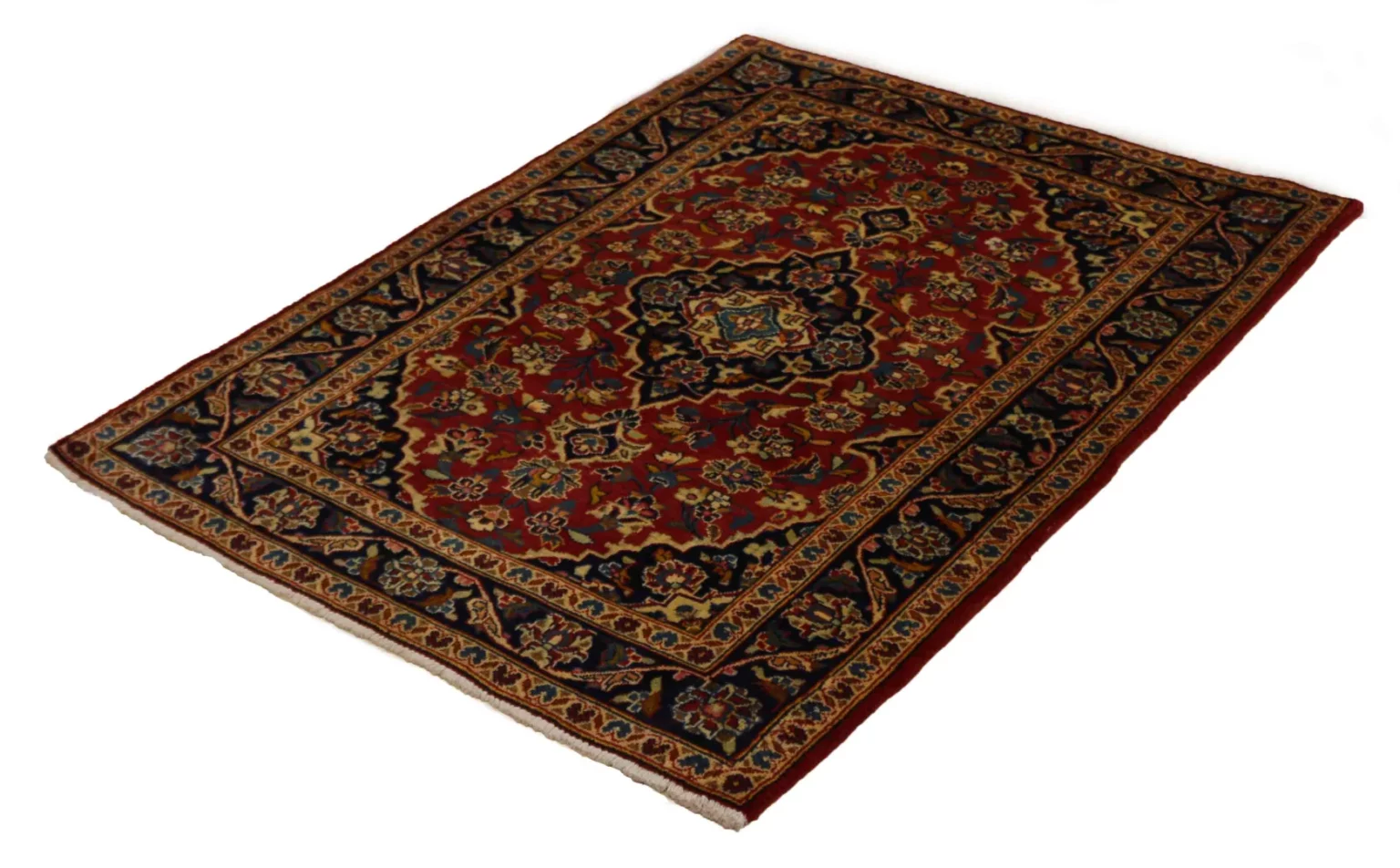
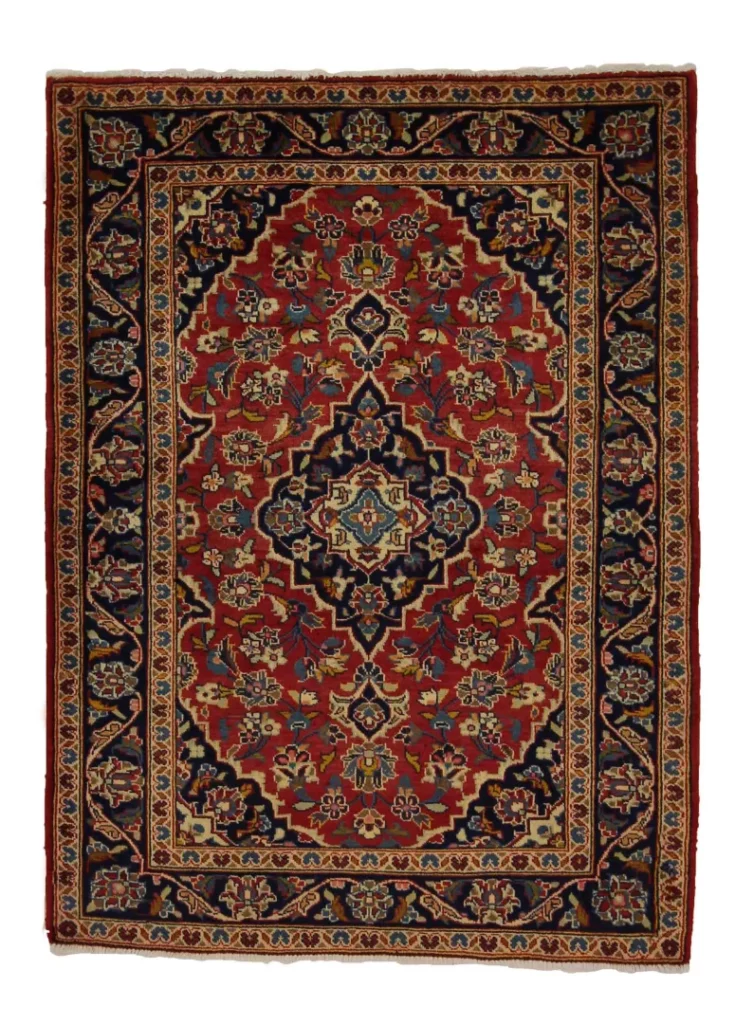
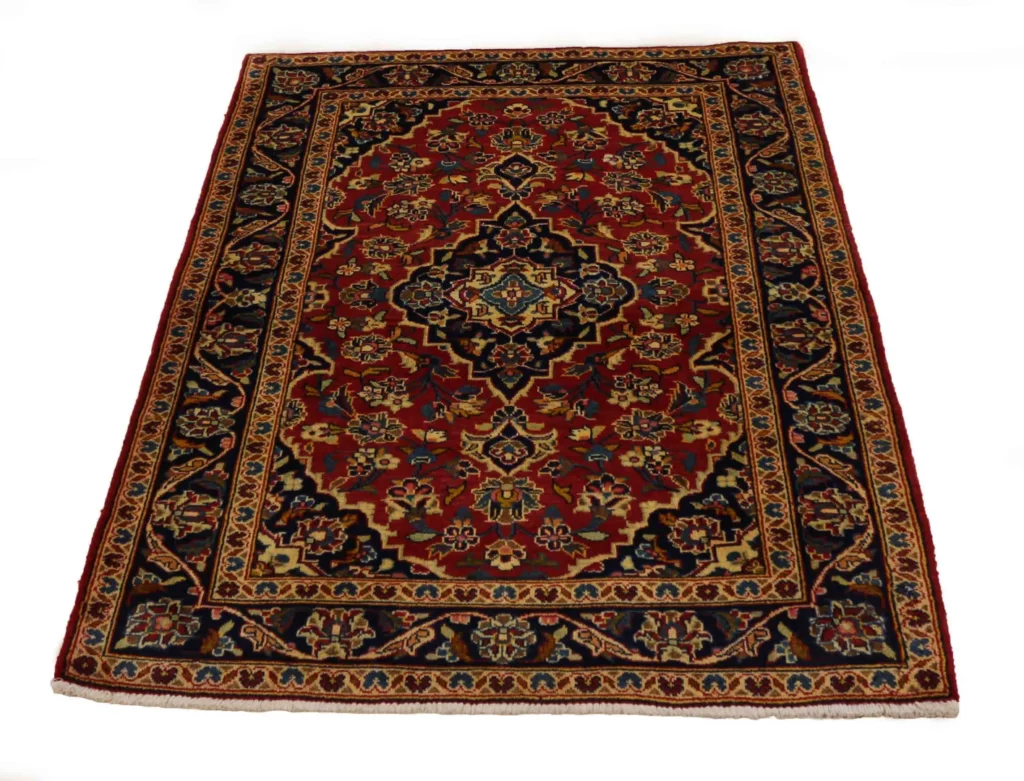
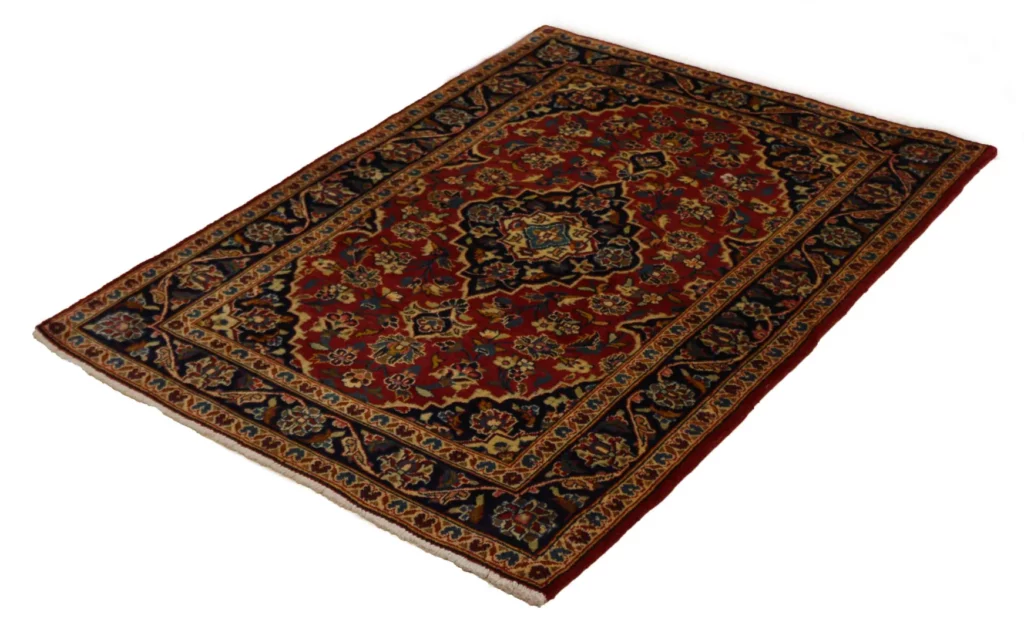
This rug uses a medallion design. A pronounced central medallion organises the composition and gives the field a clearly defined centre. Floral and geometric elements may be arranged around this central form. The result is a pattern that combines a strong focal point with a carefully divided decorative field.
The central medallion is a recurring feature of classic Keshan rugs. It may be surrounded by vines, blossoms, leaves and other ornamental details. Floral motifs introduce organic movement, while geometric forms provide structure and visual boundaries. Together, these two groups of motifs keep the design ordered and create a rhythm that leads across the surface.
The frequently used colours in this Keshan are red, blue and beige. Red can serve as a defining ground or accent, blue creates contrast and beige introduces lighter transitions or quieter areas. Together they form a traditional Persian colour range. Their arrangement supports the visibility of the medallion and helps separate floral and geometric details within the overall composition.
Keshan rugs can also be made in less common grey colourways, which are particularly appreciated in Europe. The pattern described here, however, is characterised by the frequent use of red, blue and beige. The effect depends not only on the individual colours but also on their relationship to the medallion and the surrounding ornaments. A balanced sequence of tones allows the different pattern zones to read as one connected design.
The Keshan pattern tradition demonstrates how weaving precision and ornamental order work together. A dense knotting structure can support finely controlled outlines, curves and small floral details. The medallion acts as the compositional centre, while the surrounding motifs fill the field and guide the eye across it. The design is therefore centrally organised while remaining richly structured.
Comparison with Tabriz and Isfahan helps clarify the particular character of Keshan design. Tabriz is associated with especially intricate detail, while Isfahan is linked with complex patterns and an opulent colour palette. Keshan rugs are distinguished by the characteristic combination of a central medallion, floral and geometric ornament, and the frequently used colours red, blue and beige.
Special Features
The rug is very well preserved. Its specifically described features include hand-knotting, a pile of high-quality sheep wool, and cotton in the warp and weft. Its Keshan knot density is another stated characteristic. The medallion design, with red, blue and beige among its frequent colours, gives the rug its identifiable appearance.
Keshan rugs are generally described as combining dense knotting, a wool pile and a strong cotton foundation in a form suitable for different living areas. They are considered easy to care for and can also be used in busy parts of a home. Regular vacuuming is appropriate for routine maintenance. Spills should be treated immediately with a damp cloth and mild cleaning agent, while professional cleaning is recommended at regular intervals.
FAQ
What makes a Keshan Persian rug distinctive?
A Keshan rug combines a high knot density with high-quality sheep wool in the pile and cotton in the warp and weft. Its medallion design is another defining feature and is often accompanied by floral and geometric motifs. Red, blue and beige are frequent colours in this design tradition. Hand-knotting brings the decorative order together with a dense and durable textile construction.
How should I care for my Keshan Persian rug?
The rug should be vacuumed regularly so that loose particles do not remain in the pile. Any stain should be addressed promptly with a damp cloth and a mild cleaning agent. Work gently rather than rubbing the surface vigorously. Professional cleaning is recommended at regular intervals for long-term care. This approach helps preserve the wool pile, the colours and the textile structure without replacing routine maintenance.
Where do the materials for Keshan rugs come from?
Keshan rugs traditionally use materials available in the surrounding area. The wool comes from regional sheep, while the cotton used for the warp and weft can come from local production. This use of regional fibres supports the established manufacturing tradition of Keshan. In this rug, the pile is made from high-quality sheep wool, and the warp and weft are made from cotton.
To provide the best experiences, we use technologies like cookies to store and/or access device information. Consenting to these technologies will allow us to process data such as browsing behavior or unique IDs on this site. Not consenting or withdrawing consent, may adversely affect certain features and functions.
Functional Always active
The technical storage or access is strictly necessary for the legitimate purpose of enabling the use of a specific service explicitly requested by the subscriber or user, or for the sole purpose of carrying out the transmission of a communication over an electronic communications network.
Preferences
The technical storage or access is necessary for the legitimate purpose of storing preferences that are not requested by the subscriber or user.
Statistics
The technical storage or access that is used exclusively for statistical purposes.The technical storage or access that is used exclusively for anonymous statistical purposes. Without a subpoena, voluntary compliance on the part of your Internet Service Provider, or additional records from a third party, information stored or retrieved for this purpose alone cannot usually be used to identify you.
Marketing
The technical storage or access is required to create user profiles to send advertising, or to track the user on a website or across several websites for similar marketing purposes.
 SECURE PAYMENT
 SHIPPING PARTNERS