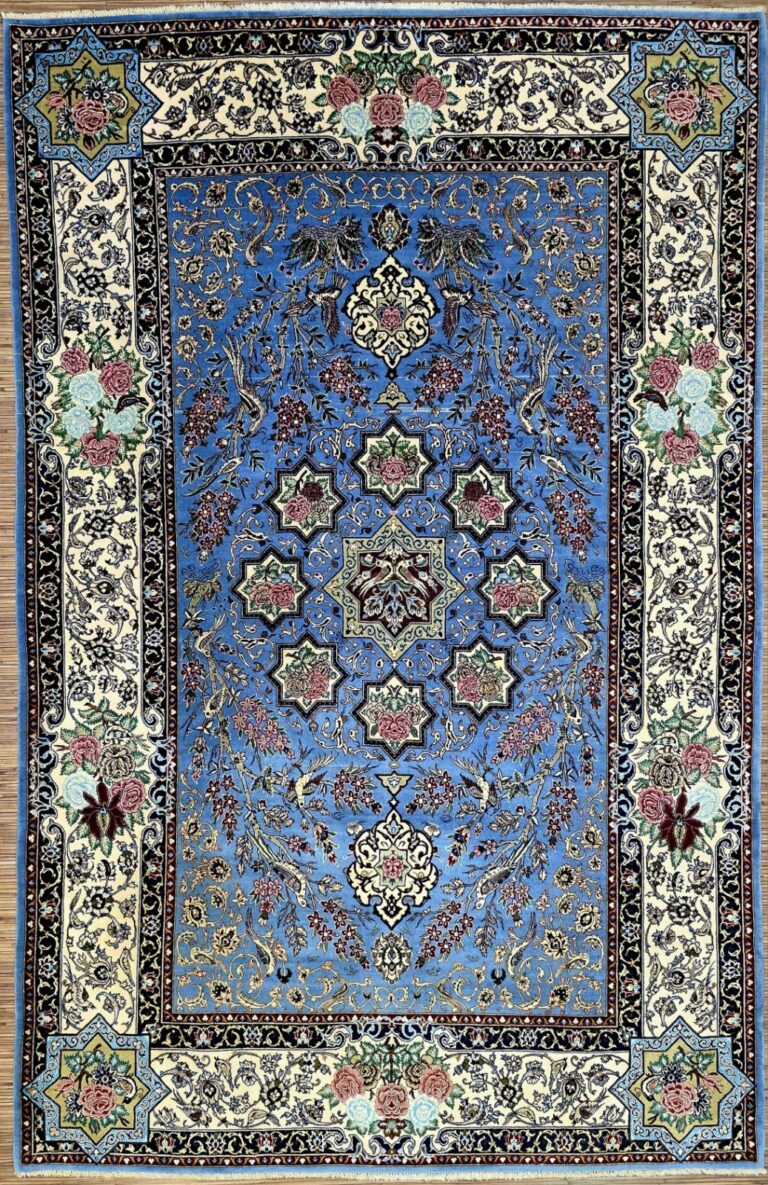
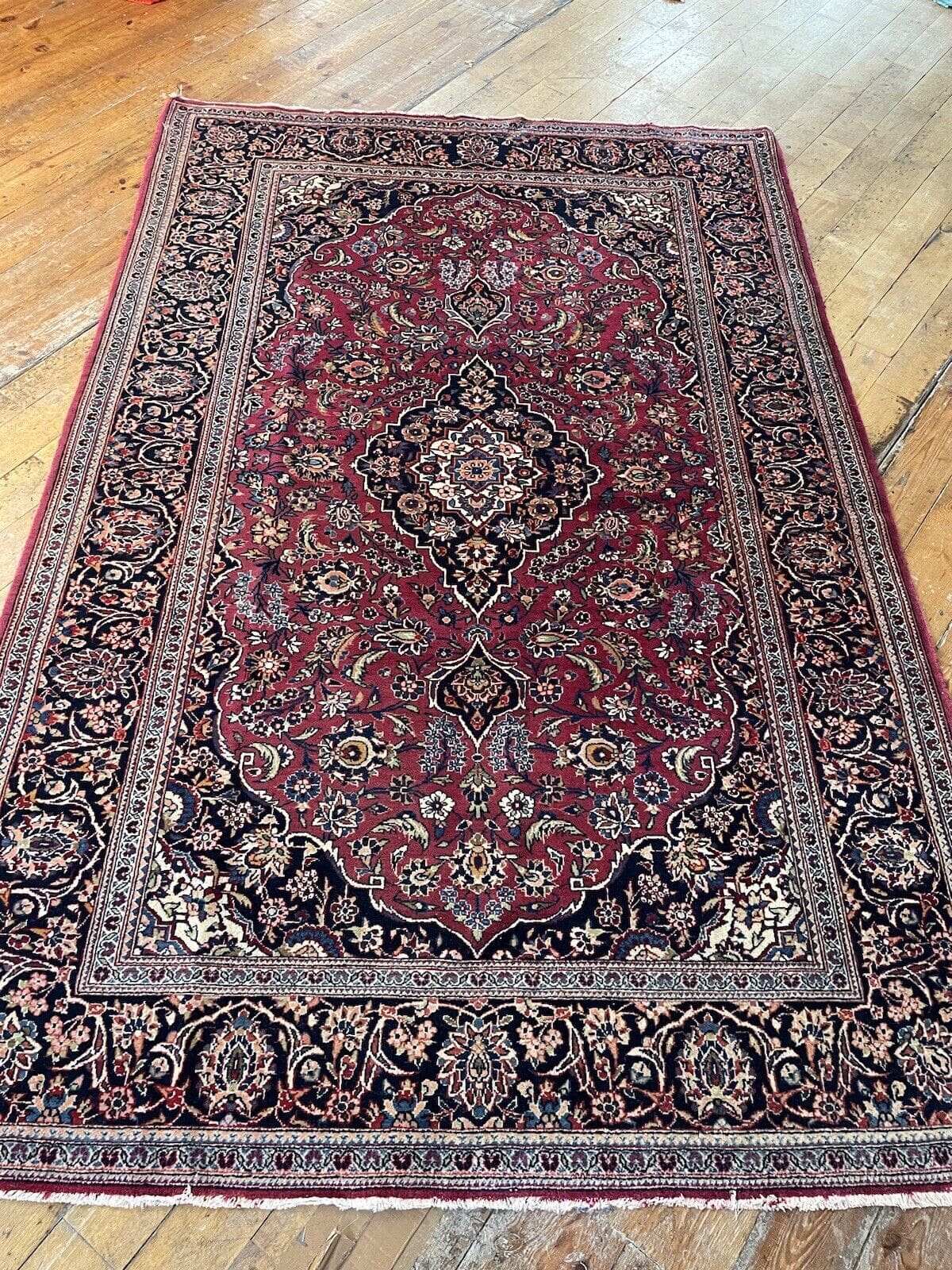
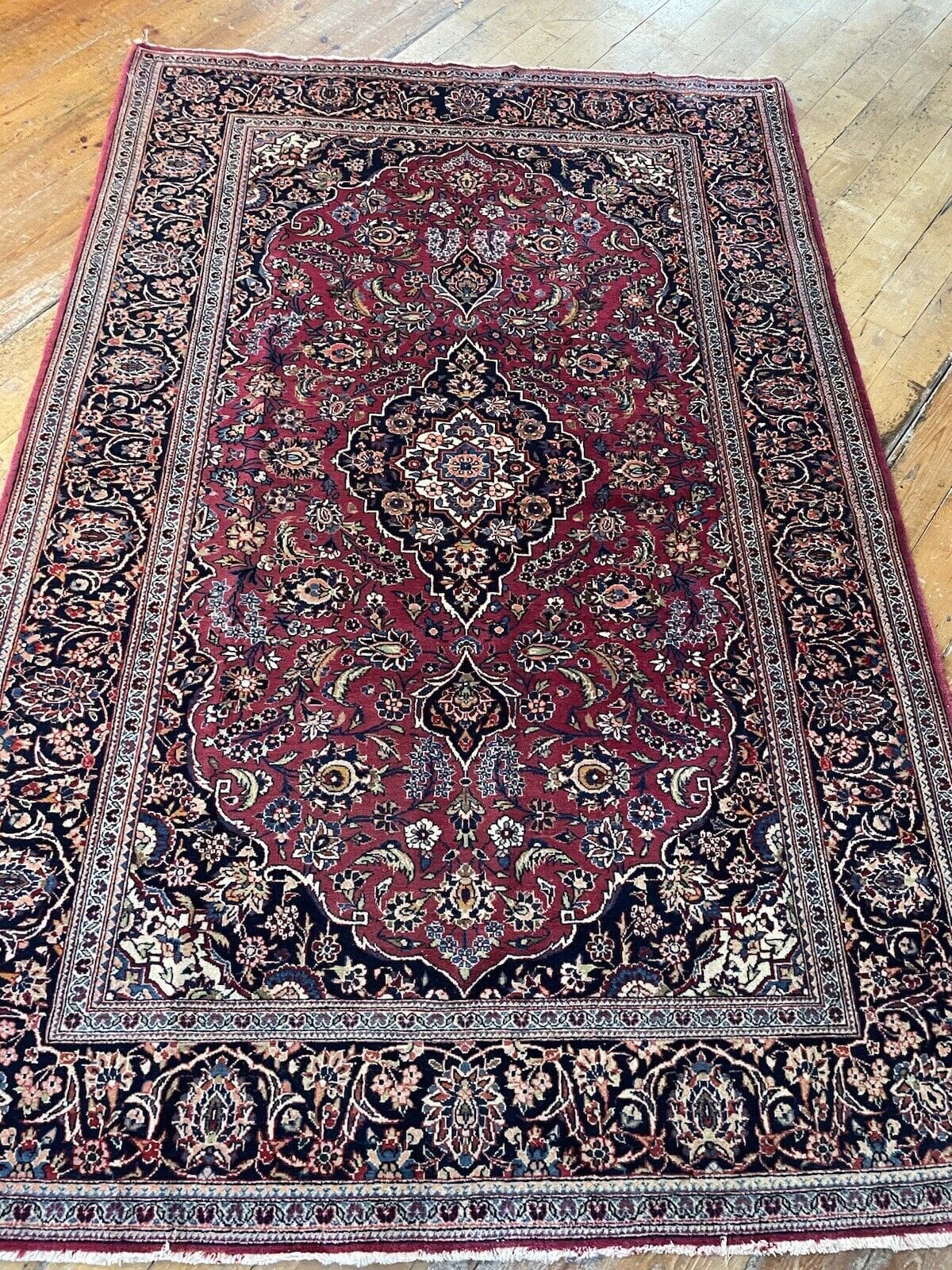
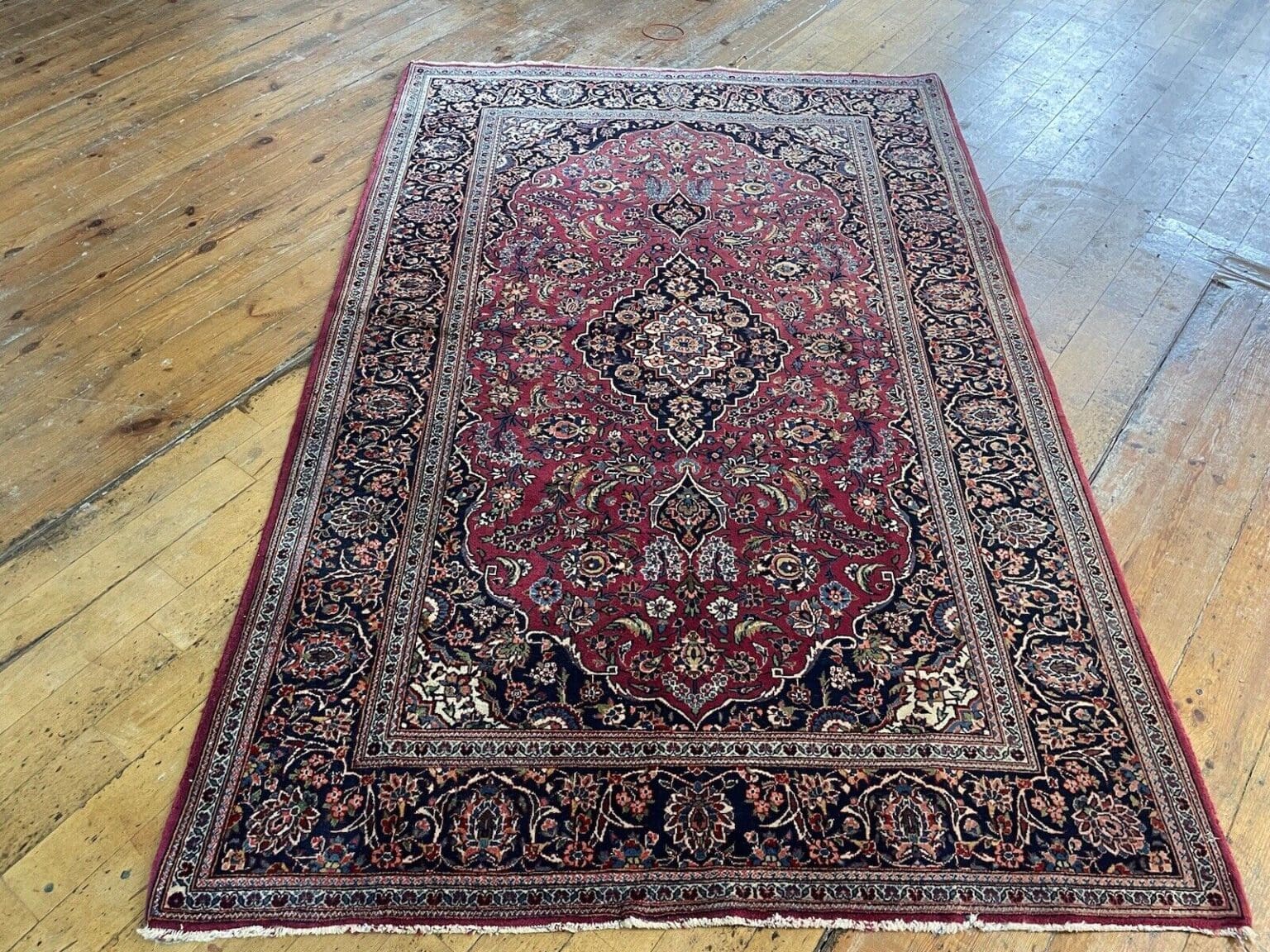
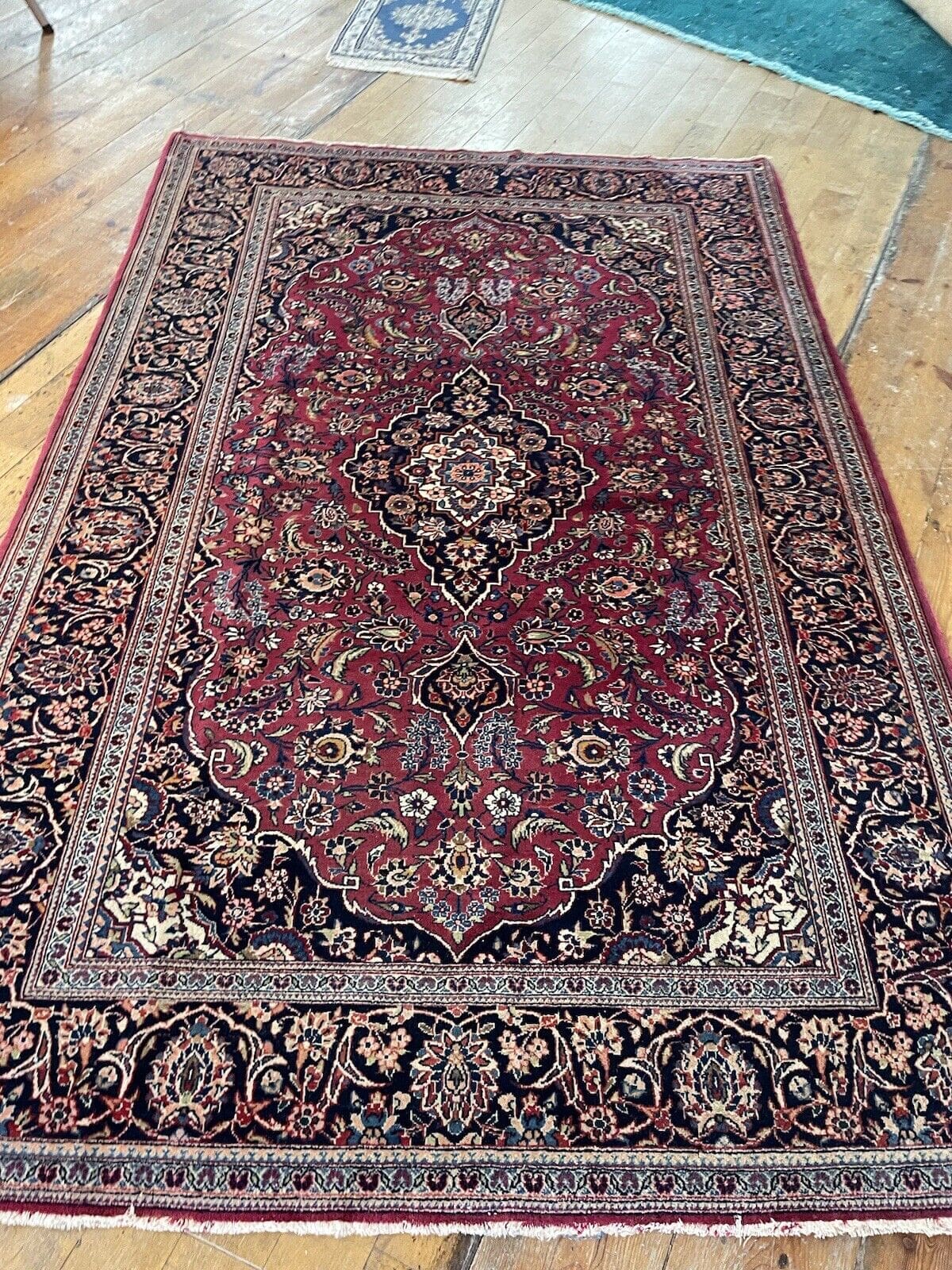
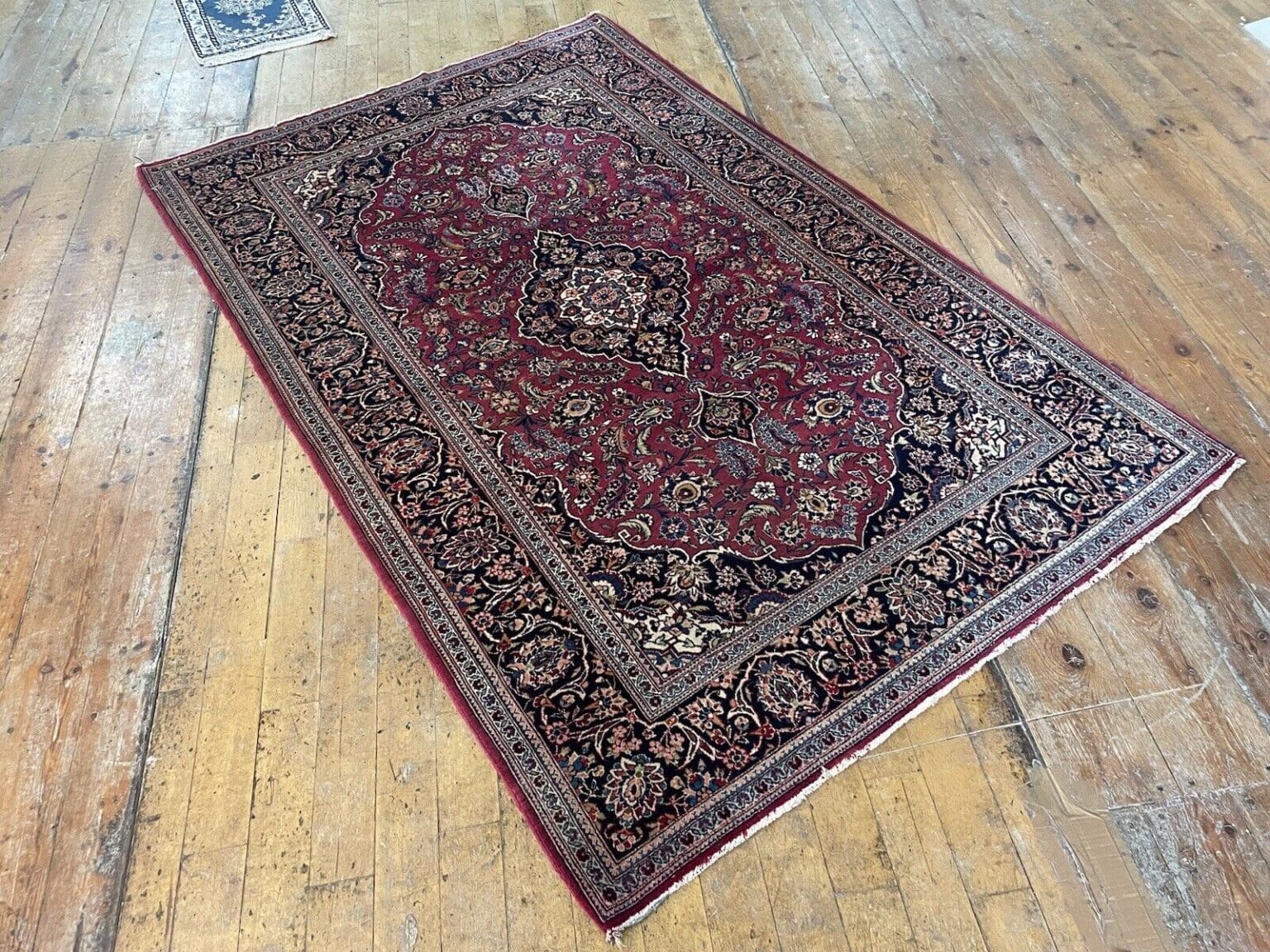
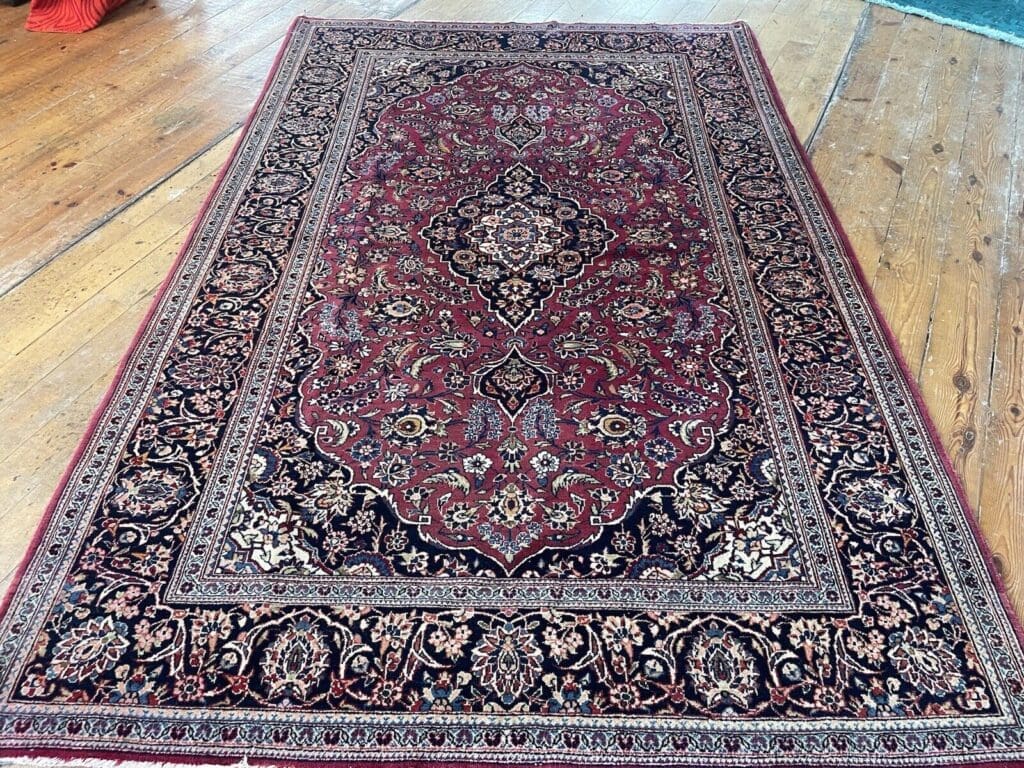
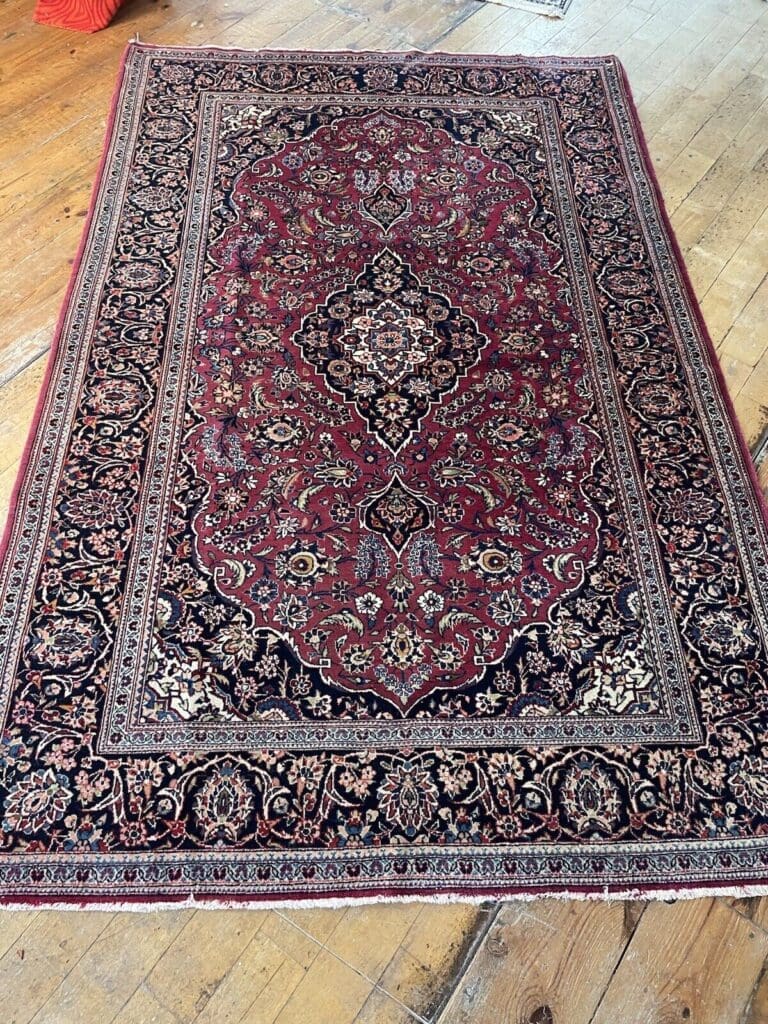
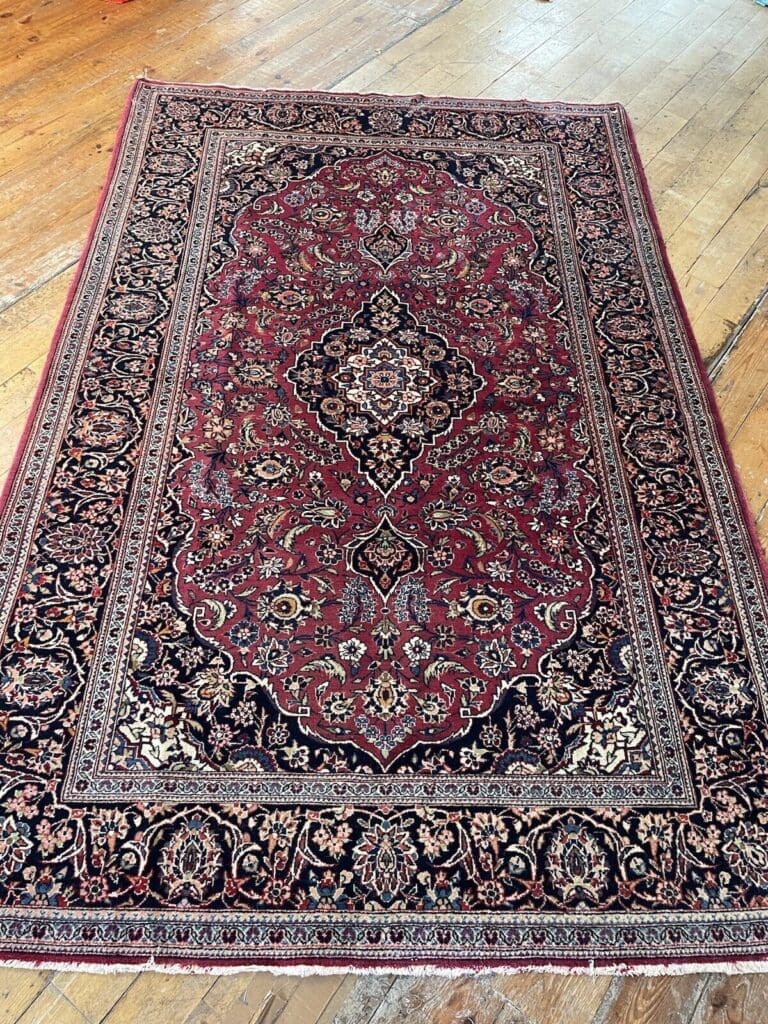
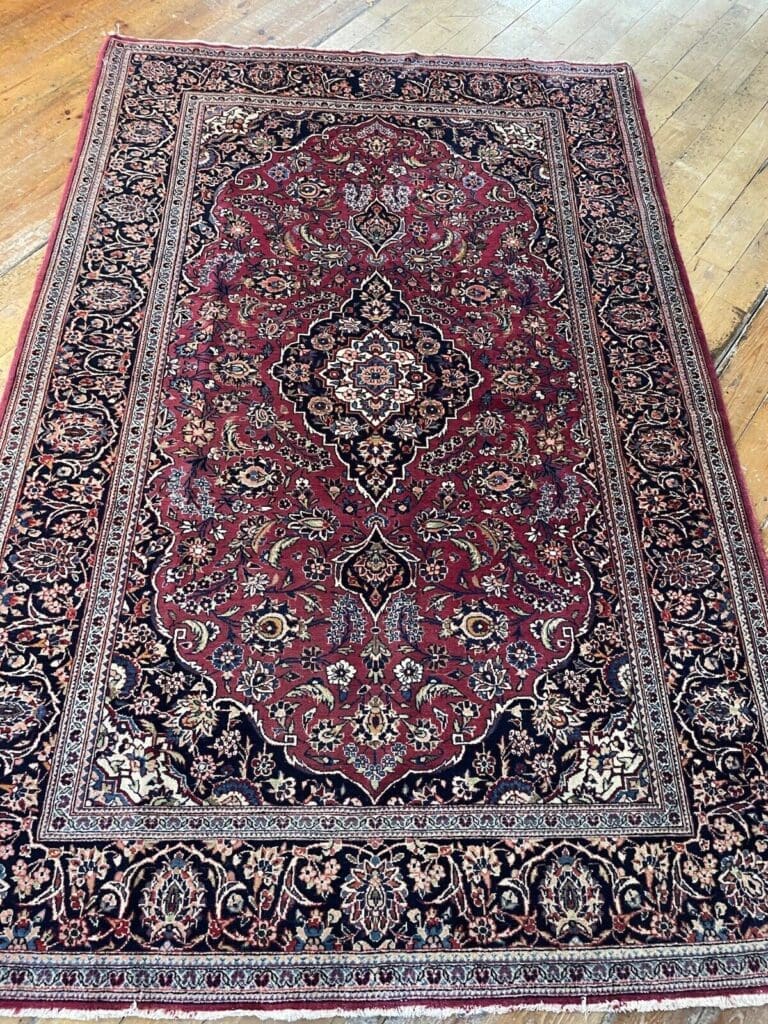
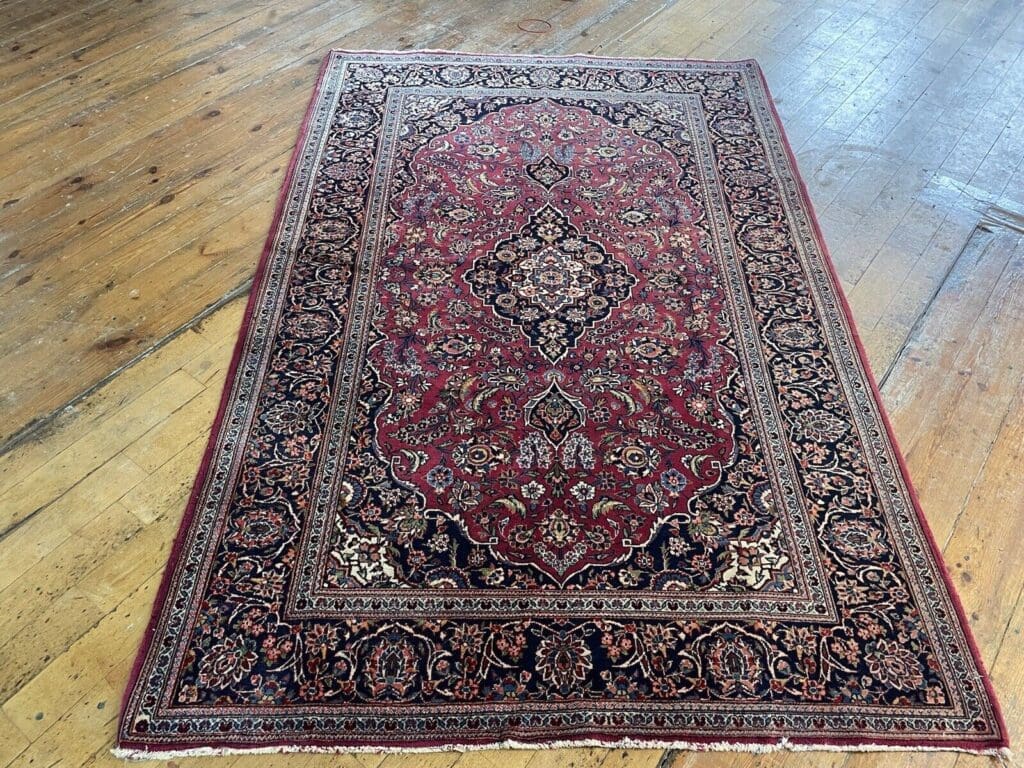
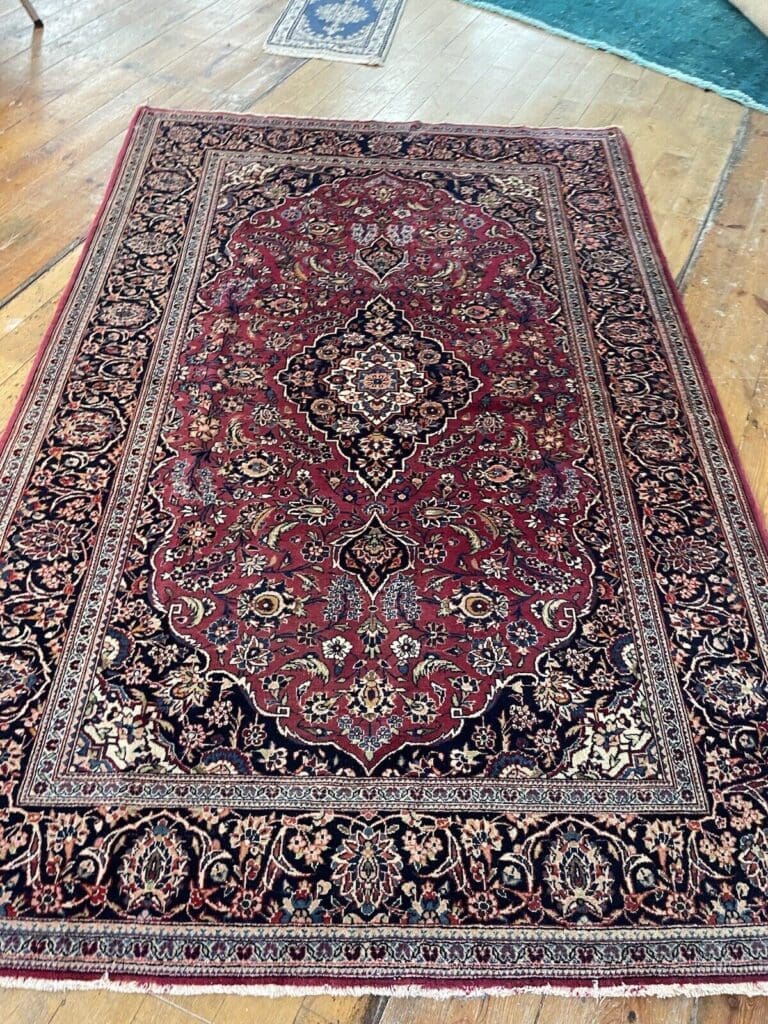
Hand-knotted Kashan Persian rug | Knot density: particularly high | Material: wool pile | Size: 210×140 cm | Pattern: medallion | Condition: used but in perfect condition
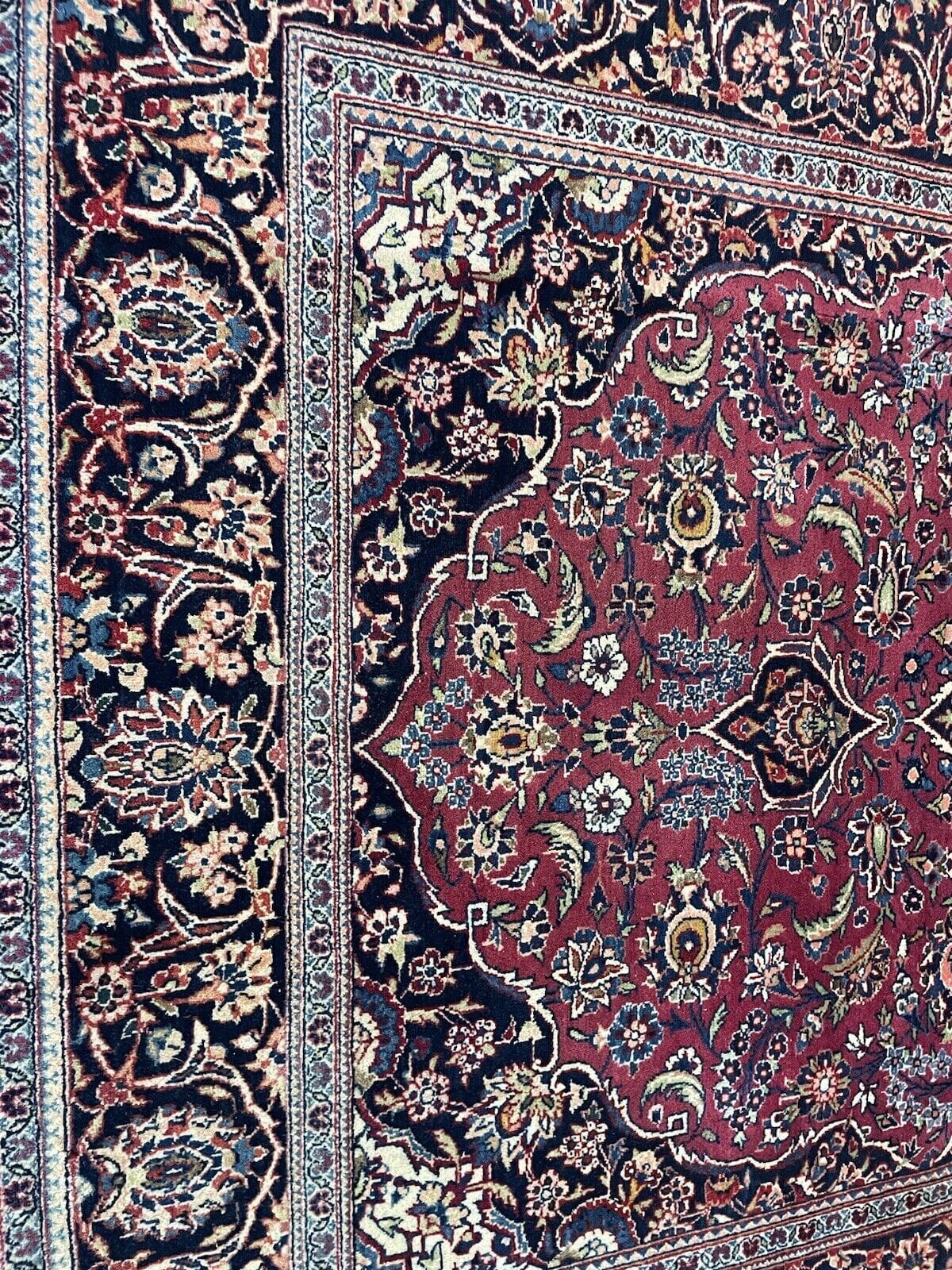
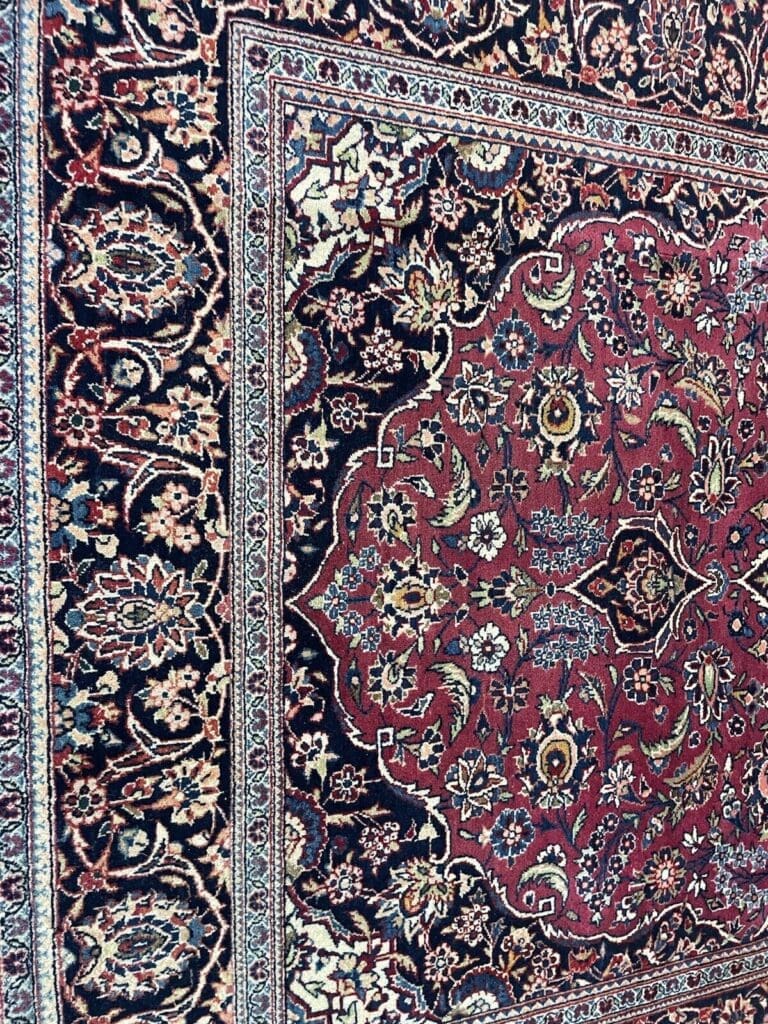
This Kashan Persian rug is hand-knotted with a pile made from high-quality wool. The natural fibre gives the surface a pleasantly soft handle while providing the resilient character associated with wool rugs. Its fine pile contributes to the restrained texture of the surface and supports the definition of the medallion design. The pile height is 6 mm. This relatively low profile allows the rug to function in a living space as well as in a setting where its decorative qualities are the main focus.
Hand-knotting makes every knot part of the finished composition. Knots are inserted row by row into the foundation, after which the pile is trimmed and worked into an even surface. The knot density of this rug is described as particularly high. A high knot density allows outlines, colour changes and small ornaments to be rendered with greater differentiation. It also reflects a labour-intensive process in which experience, regular tension and consistent execution are important throughout the making of the rug.
Wool has long been used in rug making because it combines durability with a comfortable tactile quality. It accepts colour effectively and can give a pattern a nuanced, textile appearance. In a hand-knotted rug, the fibre and the knotting method work together to create a surface suited to regular interior use. This piece combines that established material choice with a fine pile, dense knotting and a carefully arranged traditional pattern.
Origin and Tradition
Kashan is a city in Iran and an important centre of Persian rug culture. Its weaving tradition reaches back to the sixteenth century. During the Safavid dynasty, Kashan became a centre of art and culture, and this historical role helped shape the region’s approach to design and craftsmanship. Kashan therefore represents more than a geographical name in rug history. It identifies a regional tradition in which precise workmanship, balanced composition and a developed ornamental vocabulary are brought together.
Kashan rugs are traditionally associated with wool construction and carefully organised designs. Weavers from the region became known for their ability to execute complex patterns with control and consistency. A rug is planned as a relationship between field, central element and border rather than as a collection of unrelated details. Each knot has a place within that plan. In more densely knotted work, small leaves, flowers and lines can be separated clearly, allowing the design to retain its structure even when it contains numerous individual motifs.
Persian rug making combines practical textile production with a visual language passed down through generations. A rug can define an area, add warmth and texture to an interior and carry a carefully ordered surface at the same time. Kashan designs often bring strong colours together with floral forms and geometric organisation. The tradition is not limited to one single layout; it includes a range of compositions whose common features are control of proportion, clarity of drawing and careful hand execution.
The medallion is one of the recurring layouts in Oriental rug art. A central emblem gives the field a point of focus and establishes an order for the surrounding decoration. Borders, vines, flowers and geometric details may then be arranged around that centre. In traditional symbolism, medallions are often associated with the tree of life or with a connection to nature. They may also be understood as signs of harmony and balance. In Kashan weaving, a central medallion can be combined with a detailed field and a clearly defined border, producing a composition that is both structured and ornamental.
The importance of a Kashan rug consequently lies not only in its decorative presence. It also comes from the relationship between Iranian origin, regional history, wool, hand-knotting and inherited design principles. This rug belongs to that tradition through its Kashan designation and medallion pattern. Its vivid red colouring and detailed ornamentation correspond to the strong colour contrasts and carefully developed forms associated with Persian rug design from the region.
Design and Pattern
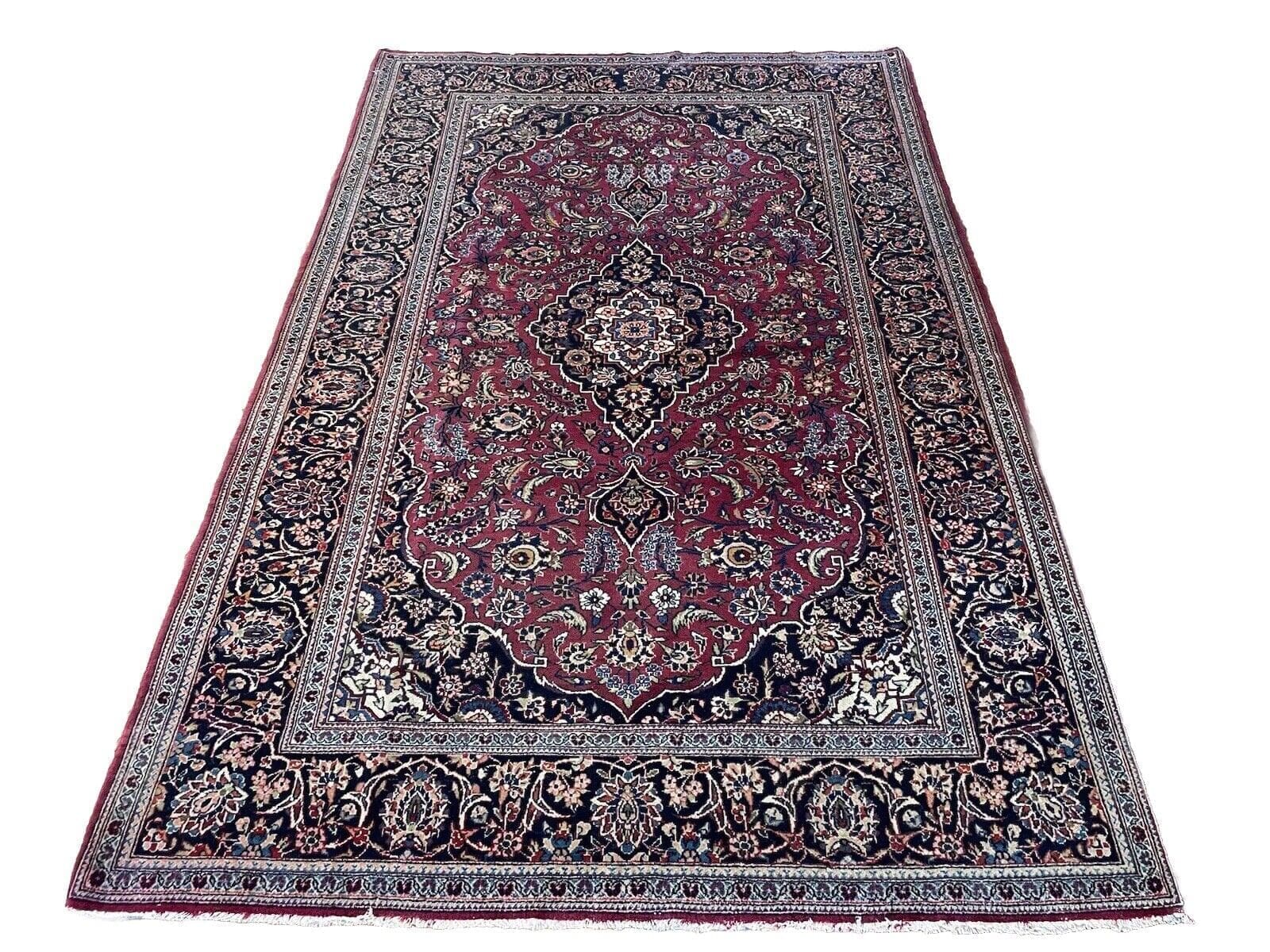
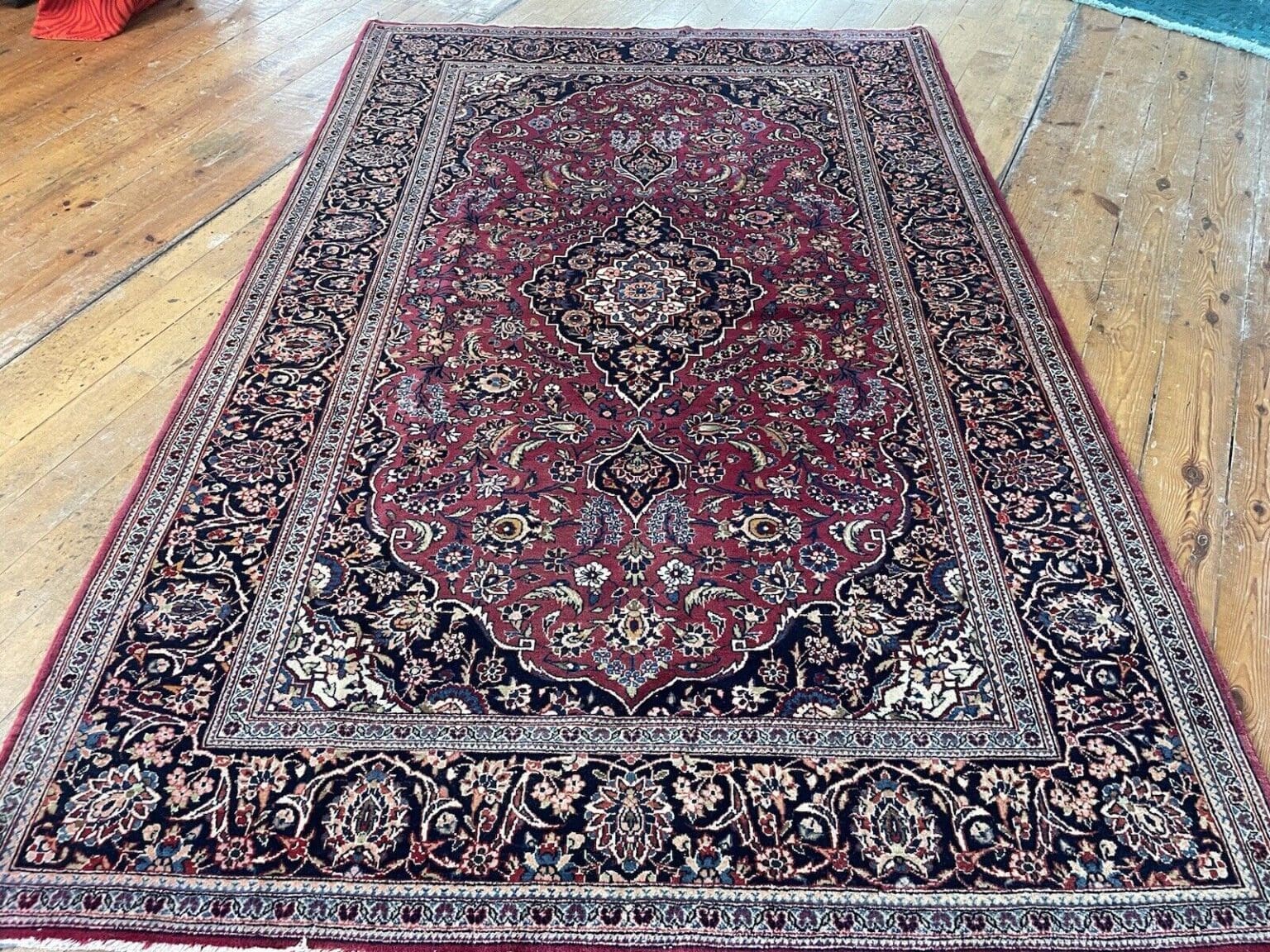
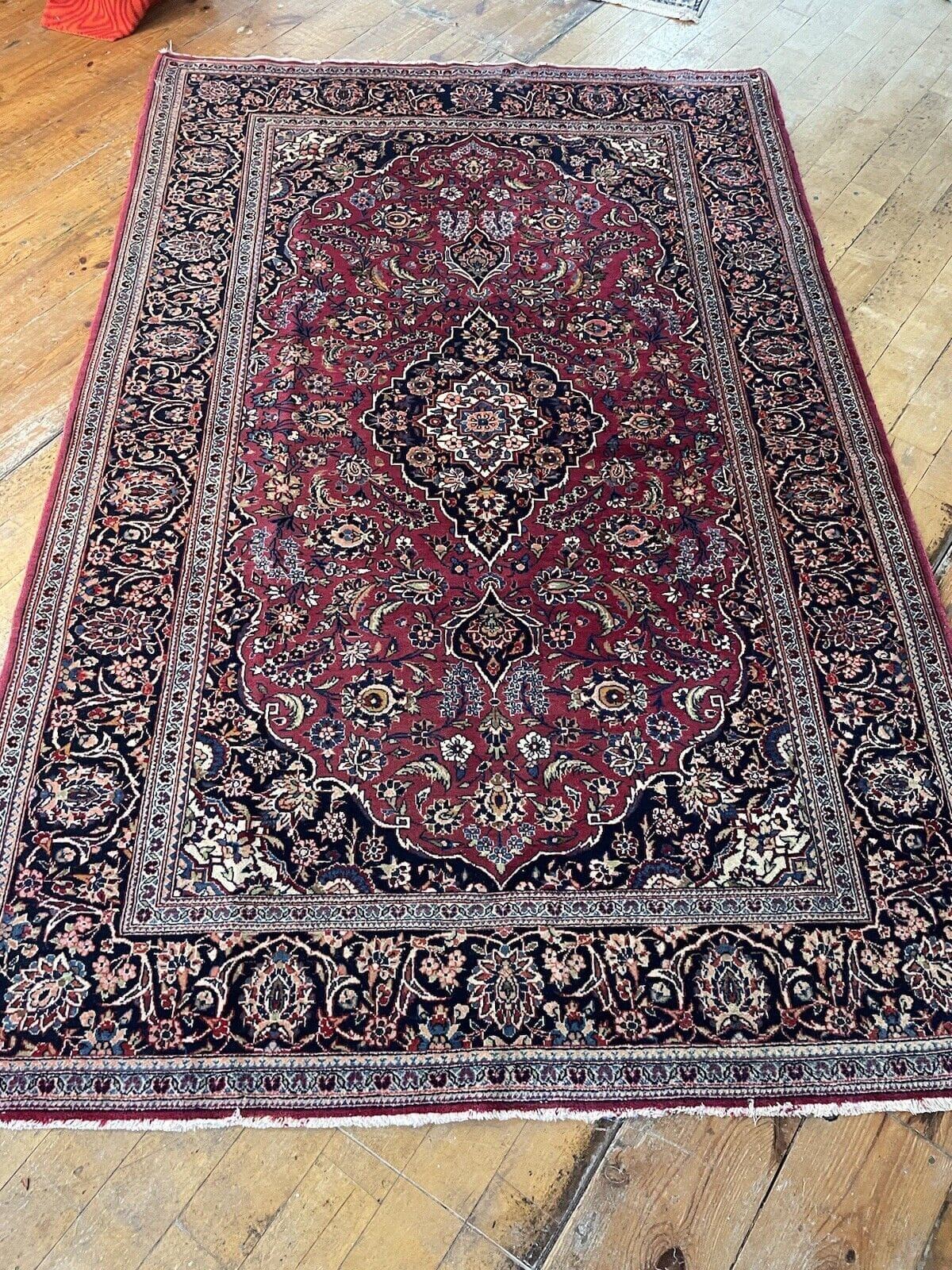
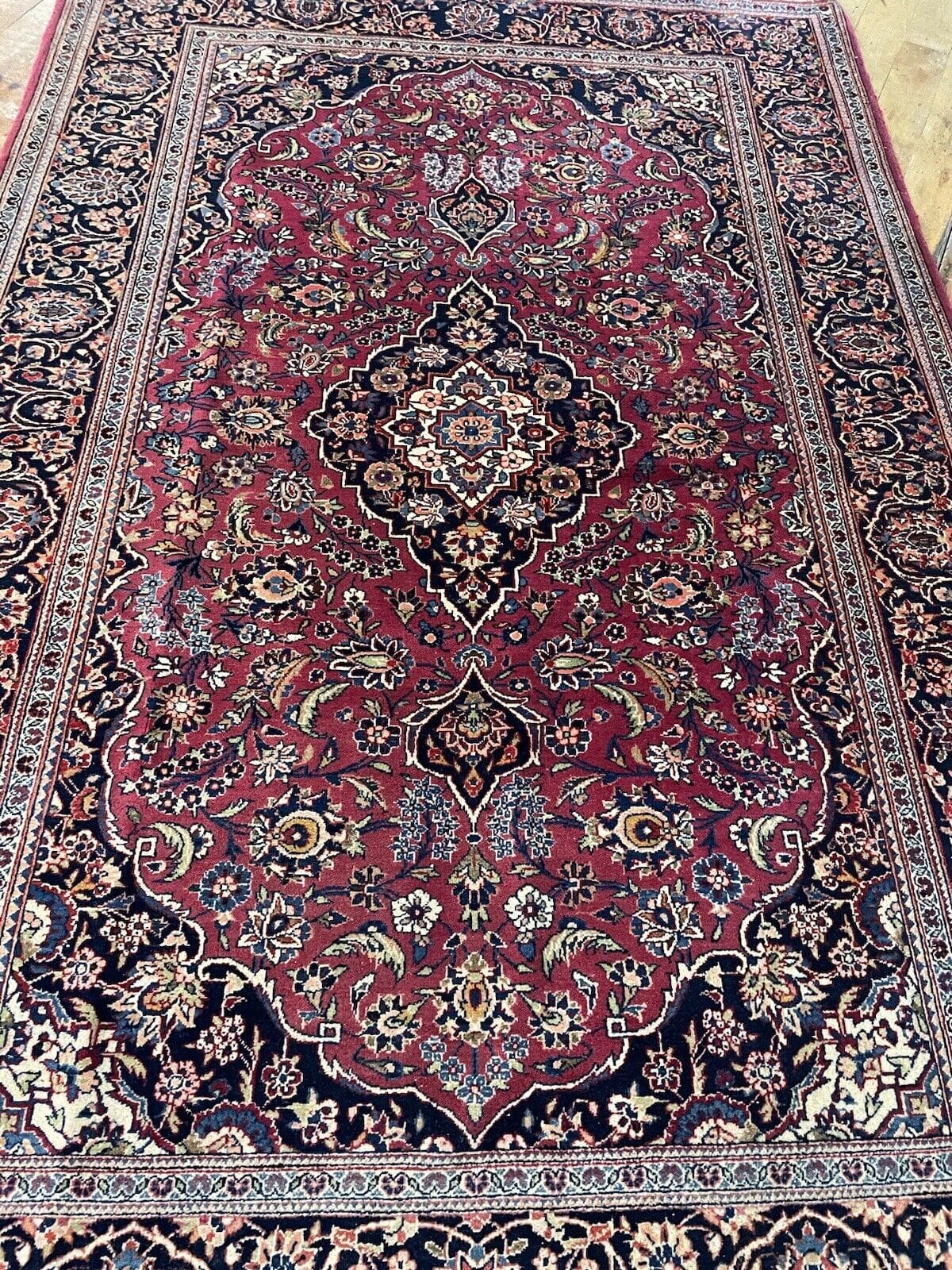
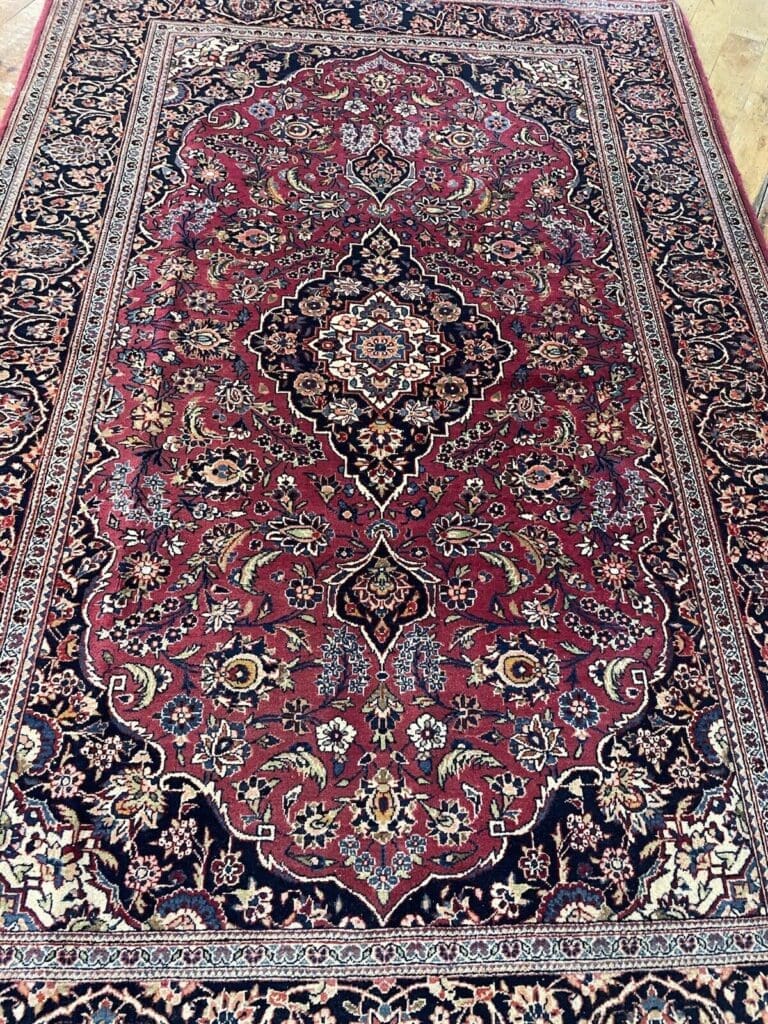
Vivid red gives this rug its most immediate colour impression. It establishes a strong field for the central medallion and provides a clear background against which the accompanying colours and motifs can be read. The overall effect is harmonious because colour and structure are considered together. The red does not merely decorate the surface; it helps distinguish the centre, frame the ornaments and guide the eye through the ordered arrangement.
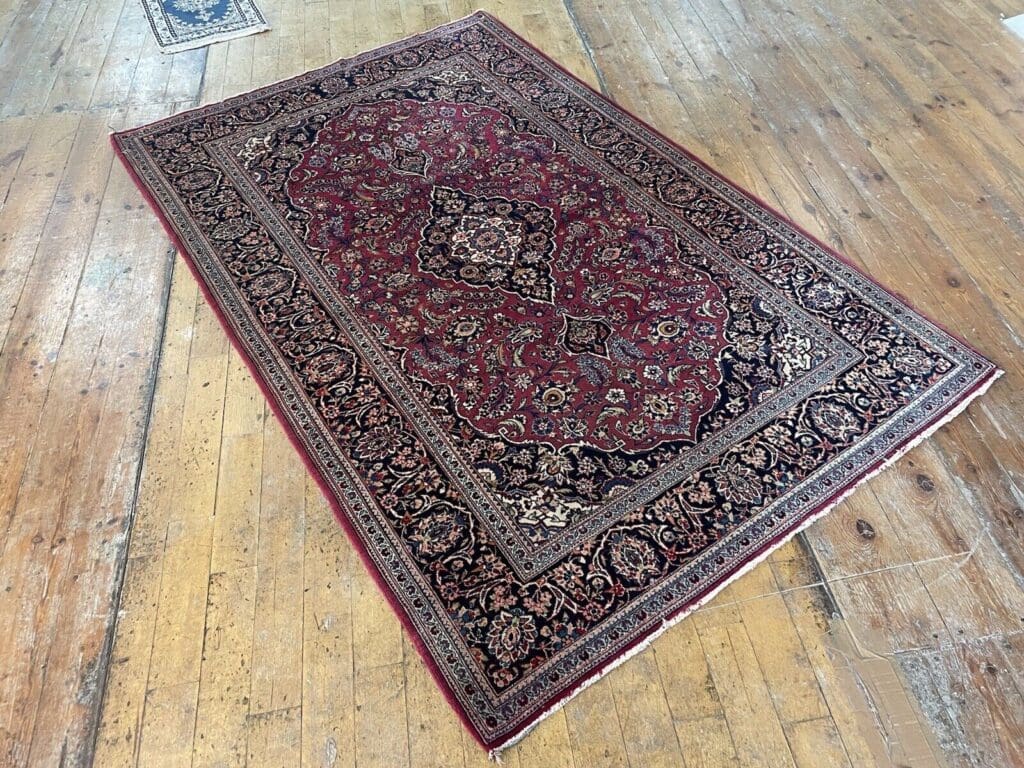
The medallion occupies the centre and acts as the principal visual anchor. In Oriental rug design, this arrangement is used to organise the field around a defined middle. A central motif can structure the surface in much the same way that a central architectural element organises a room, while surrounding details create transitions and rhythm. The result is a coherent composition in which the smaller ornaments remain visible without competing with the main form.
Floral motifs introduce organic movement into the design. Flowers, leaves and scrolling vines can be repeated as units, linking the central area with the surrounding field or border. Geometric elements give these organic forms additional definition and establish a measured framework. The combination is characteristic of many Oriental rug compositions: natural forms provide variation, while geometry maintains order. From a distance the pattern can read as a unified arrangement; closer inspection reveals numerous separate details.
Rendering such a design places specific demands on the knotting process. Lines must remain consistent across many rows, and small changes can affect the symmetry of a medallion or the rhythm of a border. Particularly high knot density supports the precise expression of outlines and ornamental transitions. The fine pile also helps the drawing appear controlled and legible. On this rug, vivid red, the central medallion, floral motifs and geometric elements work together as parts of a traditional Persian design structure.
The pattern can be placed alongside different interior approaches because its foundation is traditional while its colour creates a distinct accent. In a classically furnished room, the medallion can relate to other ornamental elements. In a more restrained interior, the red field can serve as a deliberate textile focal point. This adaptability concerns the design language of the rug and does not assign it to a particular room or style of furnishing.
Special Features
The rug is described as used but in perfect condition. It shows almost no signs of wear. This condition is an important part of its character, as it preserves the visual relationship between the fine wool pile, the vivid colour and the central medallion. The traditional appearance is therefore accompanied by a clearly stated present condition rather than by visible heavy use.
The rug is also suitable for use over underfloor heating. It can therefore be used in rooms equipped with this type of heating. The heating temperature should not be set excessively high, even though the rug can be used when the system is operating at full output. Moderate settings help protect the textile structure. Its traditional design also allows it to be combined with both traditional and contemporary furnishings.
Iranian origin, hand-knotting, high-quality wool, particularly high knot density, a fine pile and the almost complete absence of wear marks define this one-off piece. It is both a functional floor covering and a hand-made textile object carrying a long-established Persian design vocabulary.
FAQ
How should I care for my Kashan Persian rug?
Gentle, regular vacuuming helps remove loose dust and everyday particles from the pile. The rug should be protected from strong direct sunlight so that its vivid colour remains as even as possible over time. If more thorough cleaning is needed, professional rug cleaning is recommended. Specialist treatment reduces the risk of wool, pile or colours being affected by unsuitable products or incorrect handling. Because this is a hand-knotted rug, cleaning should always take its material and construction into account rather than treating it like a generic machine-made floor covering.
Can the rug be used over underfloor heating?
Yes. This high-quality wool rug is suitable for use over underfloor heating. It can be used while the heating system is operating at full output, although the temperature should not be set unnecessarily high. A moderate setting helps protect the textile structure. The rug should also be laid correctly and kept flat so that its surface is used evenly. Underfloor-heating suitability makes it practical for contemporary living spaces while leaving its traditional Kashan design and hand-knotted character unchanged.
How can I assess the authenticity of a Persian rug?
Several features should be considered when assessing a Persian rug. These include the pattern, the knotting technique and the material. An original Persian rug is hand-knotted and has a high knot density. The execution of the central medallion, the floral and geometric ornaments and the treatment of the wool pile can also be examined. A quality seal or proof of origin may provide additional guidance. A sound assessment considers these characteristics together instead of relying only on colour or decoration, since the construction and the way the design has been executed are equally important.
To provide the best experiences, we use technologies like cookies to store and/or access device information. Consenting to these technologies will allow us to process data such as browsing behavior or unique IDs on this site. Not consenting or withdrawing consent, may adversely affect certain features and functions.
Functional Always active
The technical storage or access is strictly necessary for the legitimate purpose of enabling the use of a specific service explicitly requested by the subscriber or user, or for the sole purpose of carrying out the transmission of a communication over an electronic communications network.
Preferences
The technical storage or access is necessary for the legitimate purpose of storing preferences that are not requested by the subscriber or user.
Statistics
The technical storage or access that is used exclusively for statistical purposes.The technical storage or access that is used exclusively for anonymous statistical purposes. Without a subpoena, voluntary compliance on the part of your Internet Service Provider, or additional records from a third party, information stored or retrieved for this purpose alone cannot usually be used to identify you.
Marketing
The technical storage or access is required to create user profiles to send advertising, or to track the user on a website or across several websites for similar marketing purposes.
 SECURE PAYMENT
 SHIPPING PARTNERS