This Turkman Persian rug is hand-knotted and has a pile made from high-quality wool. Hand production brings the textile material together with a traditional method in which the design is built knot by knot. The result is not a mechanically repeated image, but an individual woven work with its own execution. The wool gives the pile a pleasant, soft handle and is also described as a durable material.
The knot density is approximately 200,000 knots per square metre. In combination with the varied Göl designs, this density supports a fine rendering of the pattern and allows geometric and floral elements to be arranged with distinction. The rug’s craftsmanship is therefore defined by its wool pile, hand-knotting and stated knot density. The knots form the basis of the visible drawing and make the textile construction apparent.
High-quality wool is used in hand-knotted rugs not only for its resilience. It also has a naturally supple textile character that makes the pile pleasant to touch. For this rug, wool is the stated pile material; no other materials are listed. The description likewise specifies hand production rather than machine manufacture. The material information belongs directly to the rug’s identity as a hand-knotted piece from Northern Persia.
Origin and Tradition
The Turkman Persian rug comes from Northern Persia, a region with a long-established tradition of carpet weaving. Its origin is associated with the area near the border with Turkmenistan. Over centuries, textile forms developed in this cultural setting in which patterns, colours and practical weaving skills were passed from one generation to the next. The name Turkman refers to a regional and stylistic tradition, while the stated origin of this rug is Northern Persia.
Rugs from Northern Persia are understood as more than practical floor coverings. They are also part of the region’s craft heritage and cultural transmission. Knotting a rug requires patience, knowledge of the material and a clear understanding of how a design is constructed. Each hand-knotted work is made through individual stages and therefore carries the execution of its particular weaver. In a one-off piece, the relationship between inherited design and personal workmanship remains visible in the textile itself.
The proximity to Turkmenistan explains the name and cultural association of the Turkman tradition, but it does not change this rug’s stated origin. This piece is described as a Persian rug from Northern Persia. Its classification rests on the origin given for it and on the weaving tradition connected with that region. Northern Persian carpet culture includes a range of visual expressions, among them the decorative vocabulary of Göl motifs.
Within Persian carpet culture, hand-knotted rugs are often regarded as useful household objects, heirlooms and expressions of cultural memory. Their significance comes from the meeting of function and craft. A rug can be used in everyday life while also preserving part of the textile history of its region. In this Turkman piece, those aspects meet a palette of red, violet and brown and a finely knotted pattern arrangement.
Northern Persia is also known for the diversity of its carpet traditions. Other rug types from the broader region have their own pattern languages and craft emphases. Gabbeh rugs, for example, are often associated with vivid colours and simple yet expressive designs. Isfahan and Tabriz represent different Persian traditions known for elaborate compositions and careful workmanship. These comparisons illustrate the breadth of Persian carpet art; they do not alter the origin stated for this Turkman Persian rug.
Design and Pattern
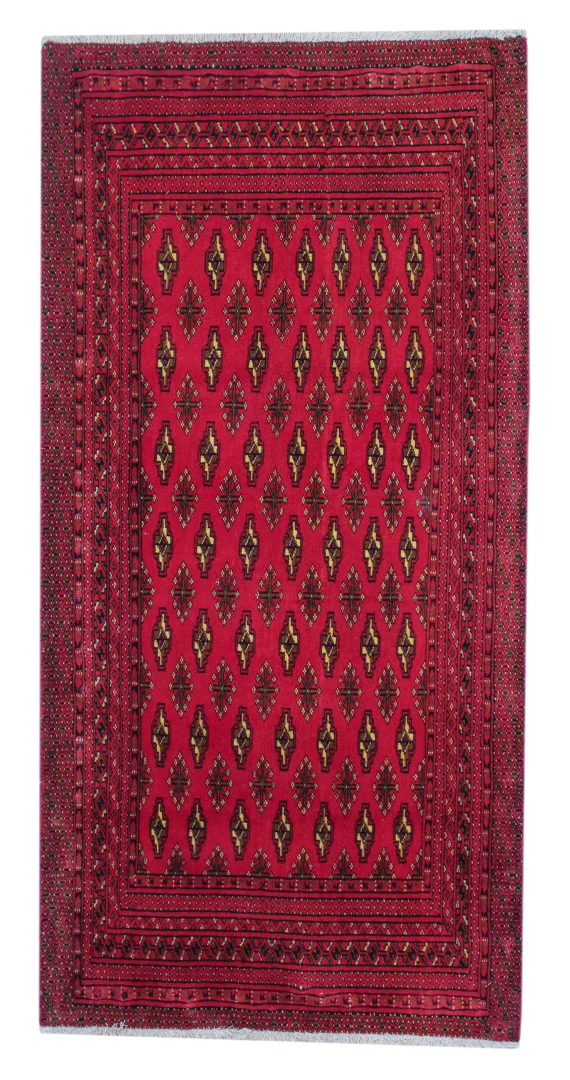
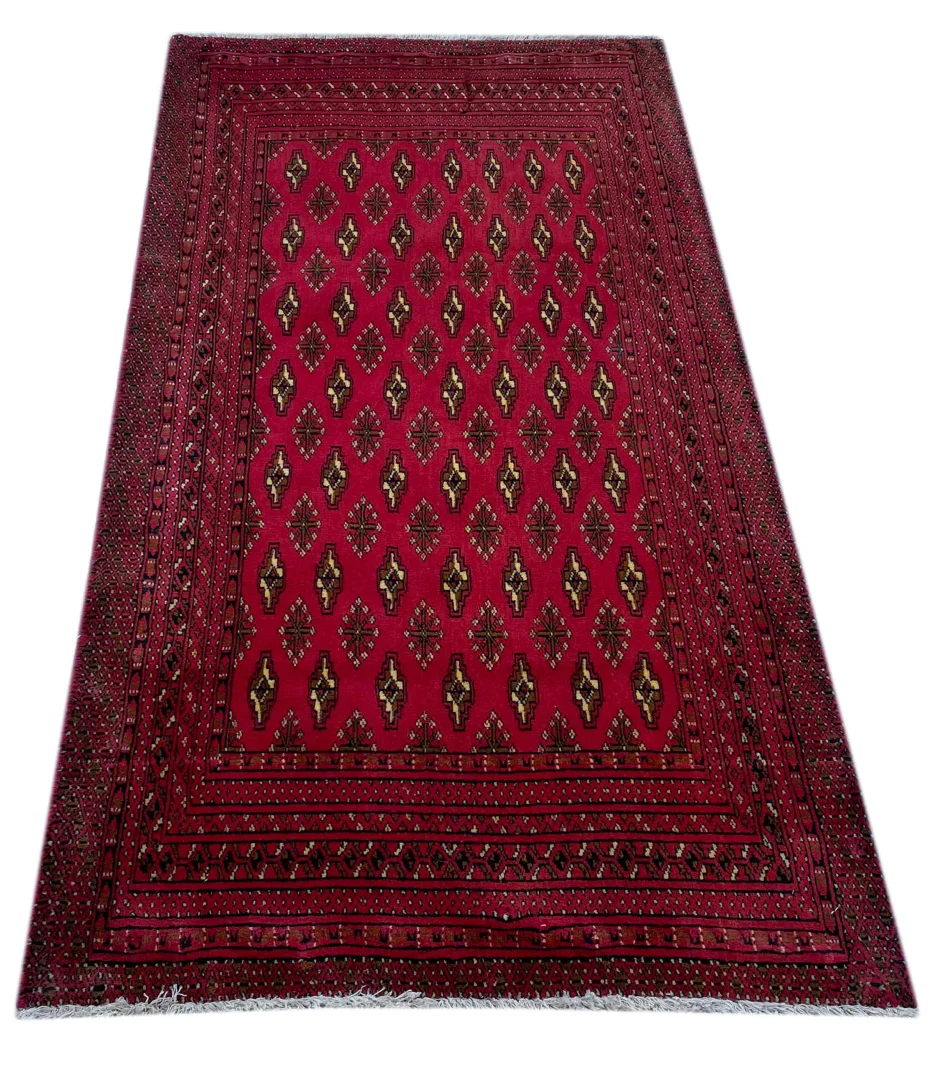
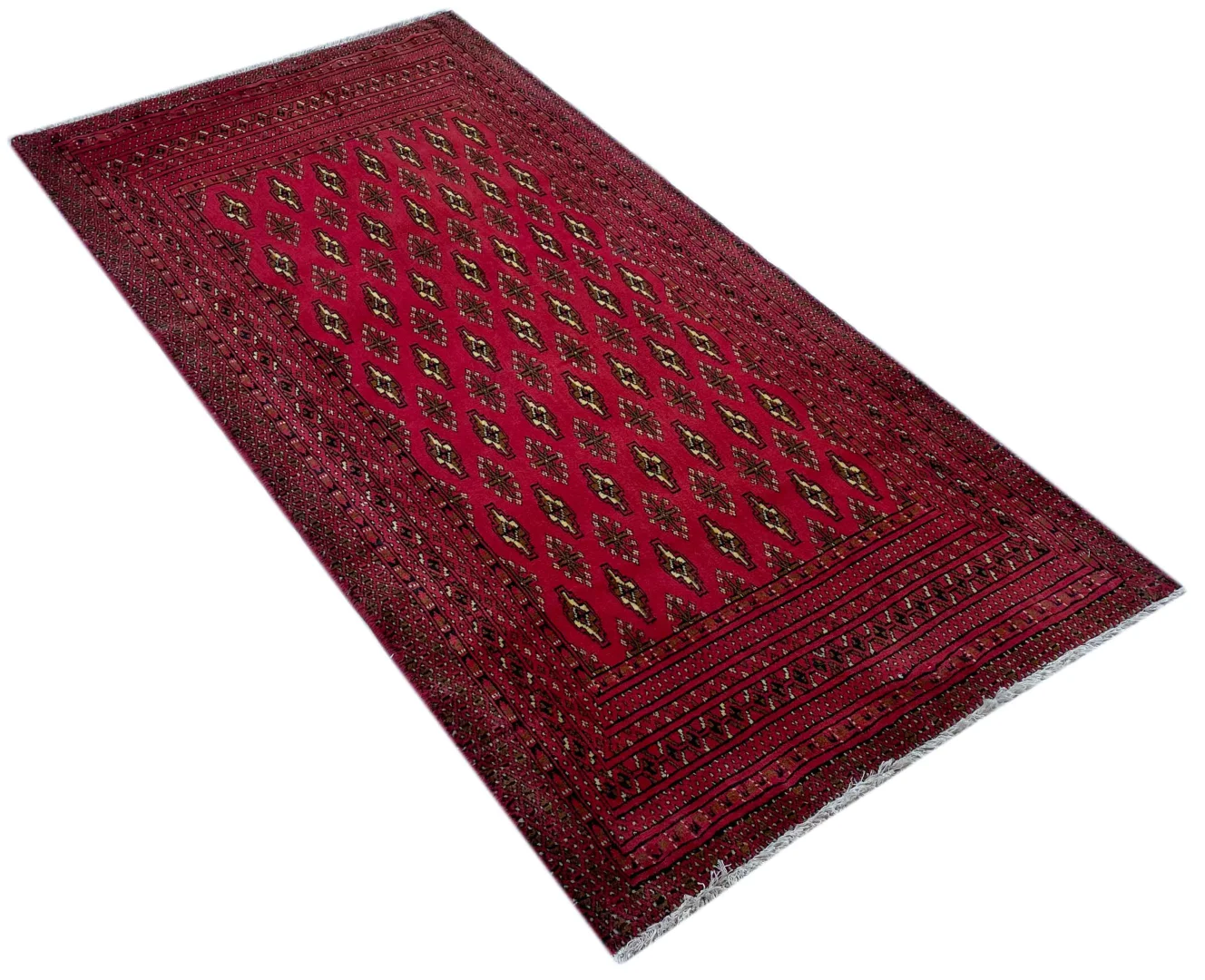
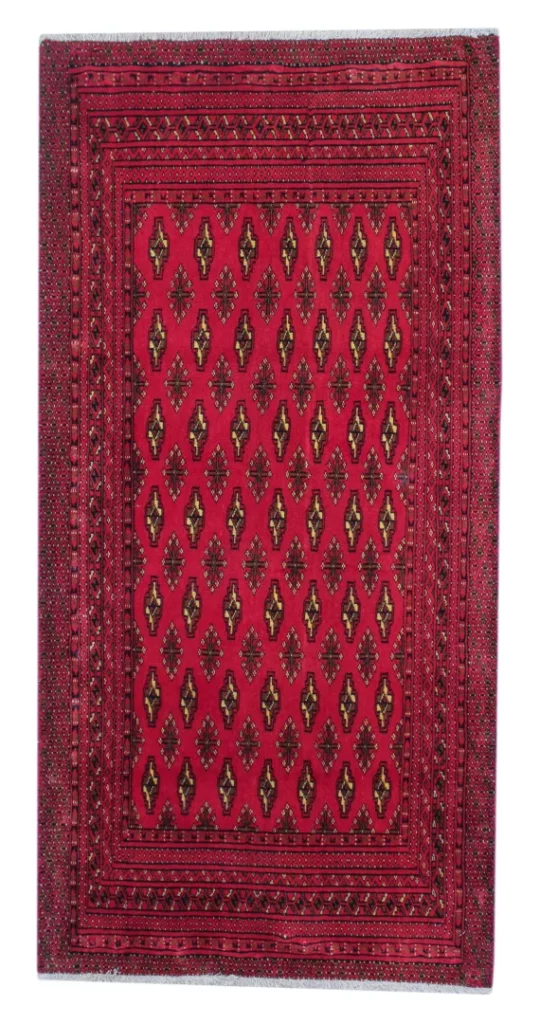
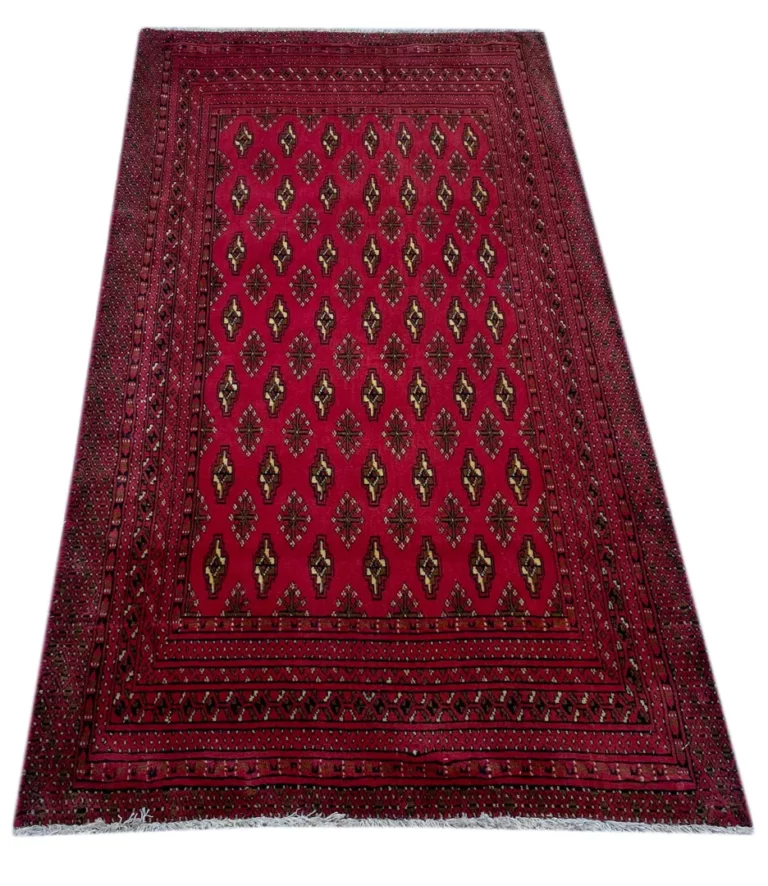
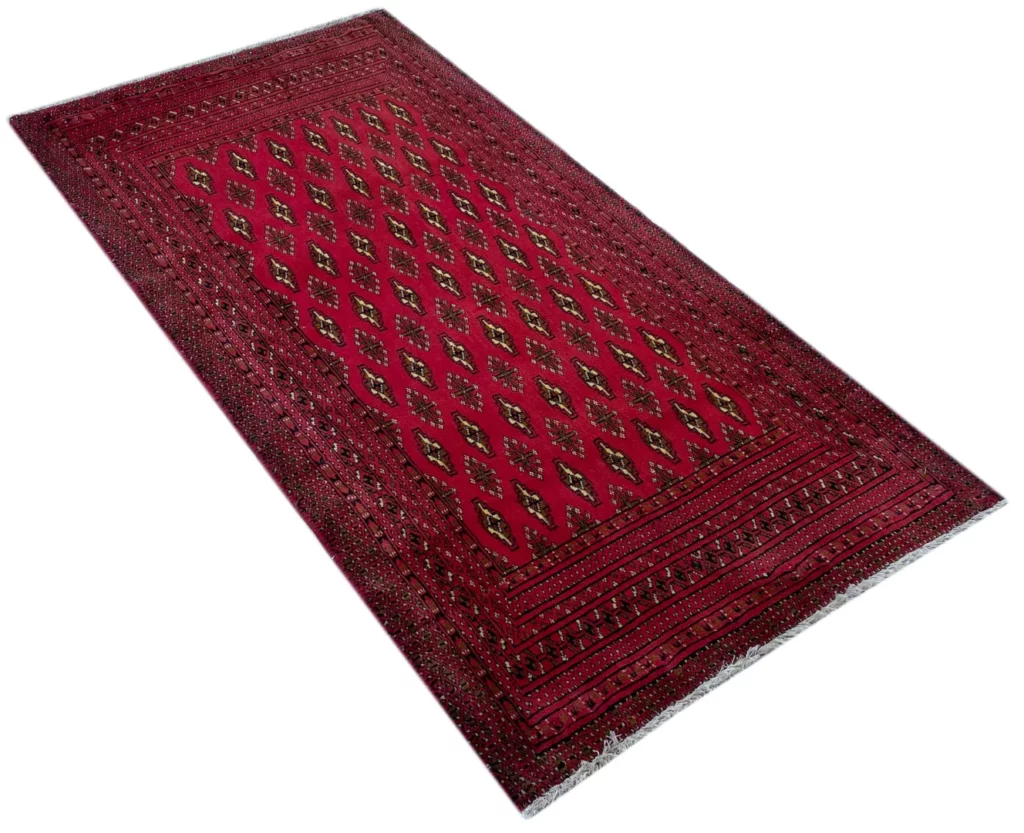
The design of this rug is defined by varied Göl designs. A Göl is a recurring, clearly organised motif that provides structure within a carpet composition. In Turkman rugs, such forms may appear in different arrangements. The description of this particular piece expressly identifies a range of Göl motifs and combines them with geometric and floral elements.
Geometric forms give the pattern a recognisable order. Lines, fields and outlines may repeat, stand beside one another or be connected within a regular composition. Floral elements add an organic quality to this more structured visual language. The interaction of both areas creates a design that is ordered without being uniform. The Göl designs are therefore not a single isolated sign, but recurring components within a larger carpet pattern.
The colour scheme is based on red, violet and brown. Red provides a warm and distinctive foundation, while violet introduces additional depth. Brown contributes an earthy tone and helps relate the other colours within the overall image. These colour details describe the palette of this piece. No additional shades are added here, since no other colours are specified.
Within the Turkman design tradition, Göl motifs can serve more than a decorative purpose. They are also connected with inherited signs, narratives and cultural forms of transmission. A carpet pattern does not necessarily communicate one fixed statement; its meaning grows from regional tradition, recurring shapes and the way an individual rug is made. In this piece, those inherited design elements meet hand-knotting and a fine knot density.
The large number of knots supports the detailed execution of the pattern. Small variations in line and contour can be rendered within a compact design. This helps explain why a rug with Göl motifs can remain varied even when its geometry is clearly organised. Repeated forms provide cohesion, while the floral elements and the combination of red, violet and brown create visual variation.
A Turkman rug can be used in several living areas. In a living room, its warm colours can relate the furnishings to one another; in a bedroom or hallway, the pattern can act as an individual accent. Its precise effect depends on the surrounding interior and the existing furnishings. What defines this piece is the combination of Göl designs, the stated colours and the Northern Persian tradition behind its form.
Special Features
This rug’s special features include its origin in Northern Persia, its hand-knotted construction and its pile of high-quality wool. Its knot density of approximately 200,000 knots per square metre is another defining detail. Together, these points describe the textile and its workmanship while keeping the design connected to the regional tradition.
The varied Göl designs combine geometric and floral elements. Alongside red, violet and brown, they create a clearly recognisable language of colour and form. The rug is understood as a unique one-off piece and therefore carries the individual character of handwork. The wool provides a pleasant, soft handle and is also described as durable.
FAQ
How should I care for my Turkman Persian rug?
Regular vacuuming helps remove dust and loose dirt from the pile. The surface should be treated gently so that the wool and hand-knotted structure are not put under unnecessary strain. Spills and other marks should be blotted promptly with a damp cloth. Rubbing can place more stress on the pile and colour than careful dabbing. For long-term care, professional cleaning every few years is recommended. Proper cleaning supports the preservation of the colours, wool pile and structure.
Which room is best suited to a Turkman rug?
The rug is suitable for living rooms, bedrooms and hallways. Its warm palette of red, violet and brown can be used with a range of interior styles. The varied Göl designs give the room a clearly defined pattern, while the rug remains suitable for more than one type of living space. In a living room it can help bring furnishings together, in a bedroom it can provide a colour foundation, and in a hallway it can create an independent accent. The final effect depends on the furniture, wall colours and the rest of the interior.
Why are Turkman rugs valuable?
The value associated with Turkman rugs comes from several qualities. These include high-quality wool, hand-knotted construction and fine knot density. Working the varied Göl designs also requires careful execution so that geometric and floral elements form a coherent composition. In addition, these rugs have cultural and historical significance because they are connected with the long-standing weaving tradition of Northern Persia. The combination of material, workmanship, regional origin and inherited pattern language makes Turkman rugs sought-after collector’s pieces.
To provide the best experiences, we use technologies like cookies to store and/or access device information. Consenting to these technologies will allow us to process data such as browsing behavior or unique IDs on this site. Not consenting or withdrawing consent, may adversely affect certain features and functions.
Functional Always active
The technical storage or access is strictly necessary for the legitimate purpose of enabling the use of a specific service explicitly requested by the subscriber or user, or for the sole purpose of carrying out the transmission of a communication over an electronic communications network.
Preferences
The technical storage or access is necessary for the legitimate purpose of storing preferences that are not requested by the subscriber or user.
Statistics
The technical storage or access that is used exclusively for statistical purposes.The technical storage or access that is used exclusively for anonymous statistical purposes. Without a subpoena, voluntary compliance on the part of your Internet Service Provider, or additional records from a third party, information stored or retrieved for this purpose alone cannot usually be used to identify you.
Marketing
The technical storage or access is required to create user profiles to send advertising, or to track the user on a website or across several websites for similar marketing purposes.
 SECURE PAYMENT
 SHIPPING PARTNERS


