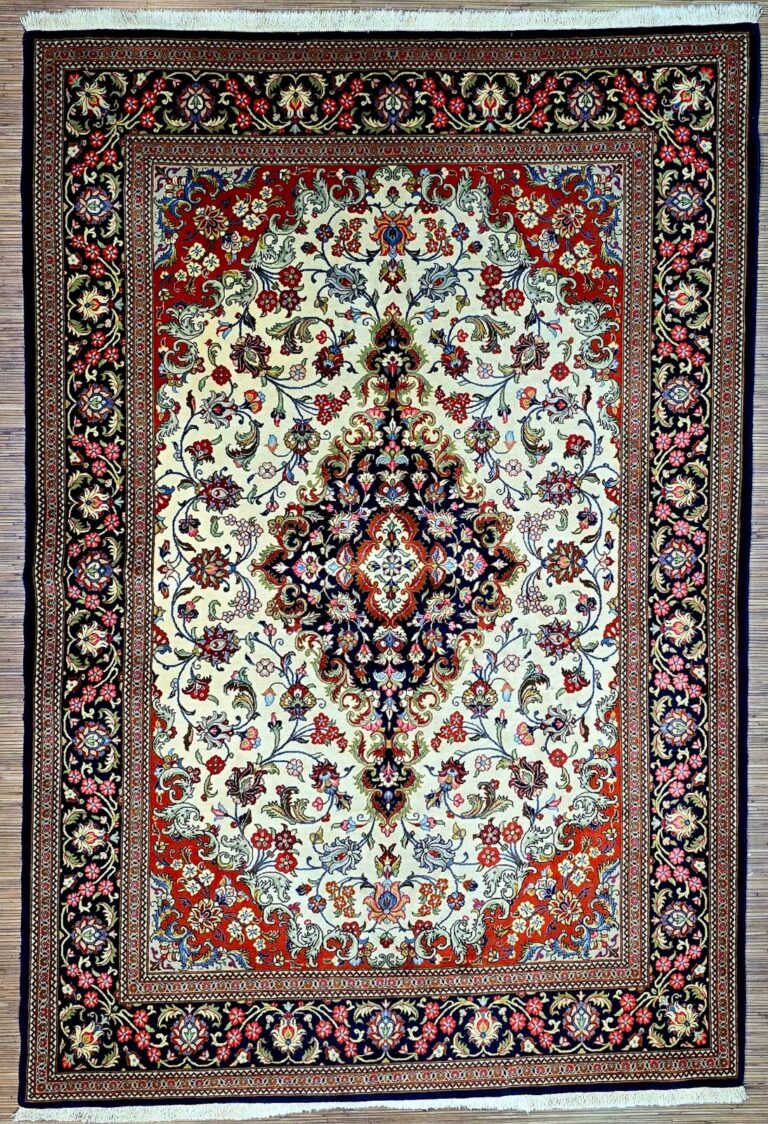
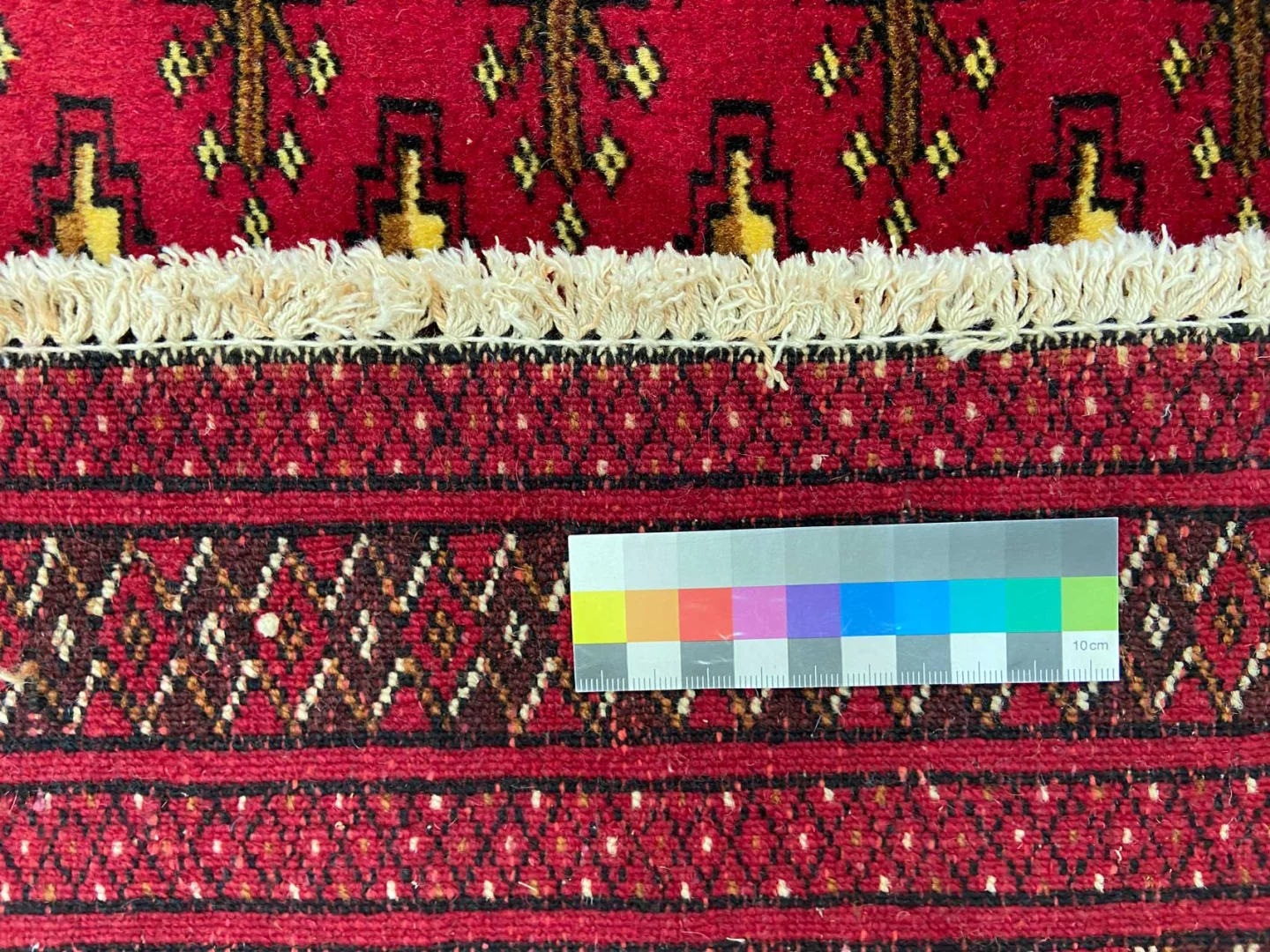
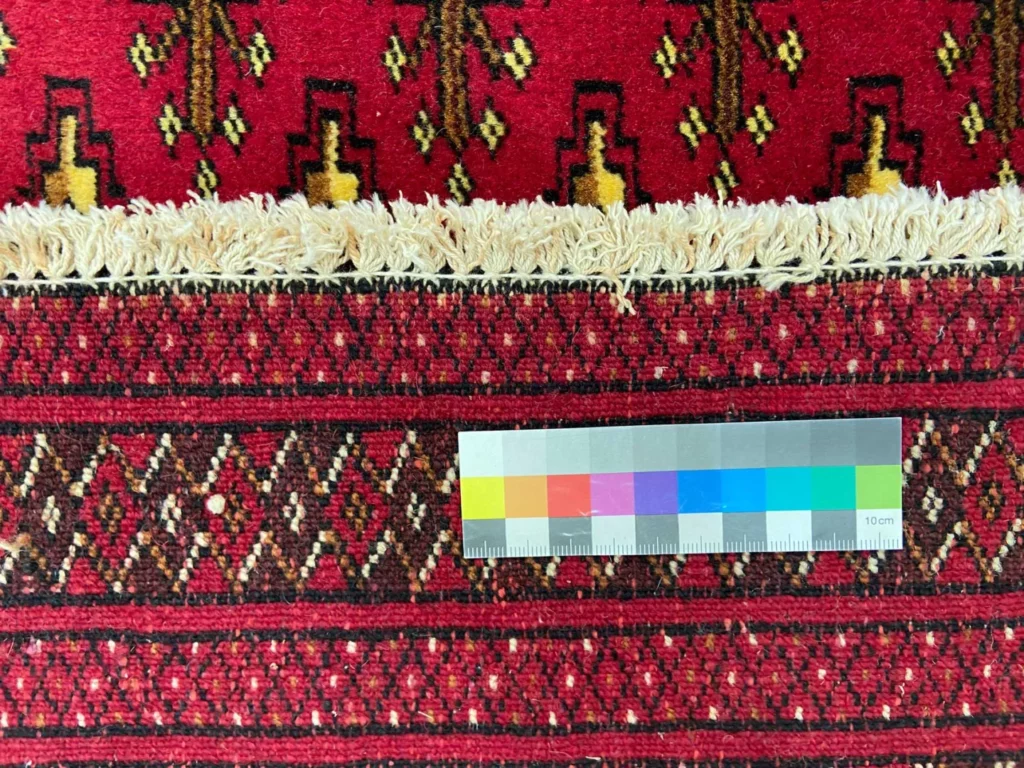
This Turkman Persian rug is made from high-quality wool and knotted by hand. Wool is a traditional material in oriental rug making. It can be worked into a dense surface that is durable while remaining pleasant underfoot. Here, the wool is formed with finely made knots. The careful construction contributes to the rug’s clear appearance and gives the pile a defined textile structure.
Hand production distinguishes each individual rug from an industrially manufactured floor covering. The design is built knot by knot, with the composition developing gradually across the surface. Small variations in the execution are therefore part of the handmade process and underline the character of this one-off piece. The fine knotting also allows the varied Göl motifs to be rendered in an ordered and detailed way.
The wool combines practical use with a traditional tactile quality. It supports the rug’s durability and creates a comfortable surface for walking. The knotting is precise and even, allowing material, structure and pattern to work together. The result is both a decorative textile and a functional floor covering, with its appearance shaped by the handwork rather than by mechanical repetition.
Origin and Tradition
This Turkman rug comes from northern Persia, near the border with Turkmenistan. That location connects Persian rug-making traditions with design languages associated with the Turkmen cultural sphere. Northern Persia has a long history of rug production. Regional materials, patterns and working methods have shaped the character of rugs made there, while the craft itself has been passed on through generations of skilled makers.
The name Turkman refers to a rug tradition in which structured geometric compositions and recurring ornamental forms play an important role. Such motifs are not distributed randomly across the field. They follow an established order and are carefully built into the weave. This produces a balanced relationship between repetition, rhythm and clearly defined shapes.
The cultural importance of these rugs reaches back through a long history. Rugs from northern Persia represent a craft tradition in which practical use and ornament are closely connected. They were made for everyday life, yet their surfaces also carried signs and motifs that expressed regional identity and inherited ideas. Göl motifs are among the characteristic elements associated with Turkman rugs.
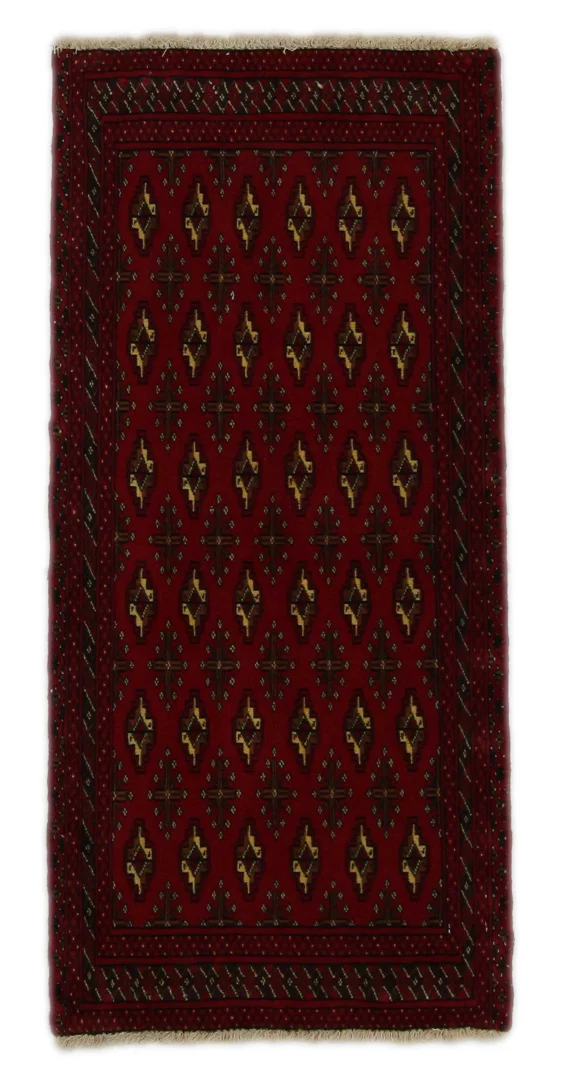
A Göl is a recurring ornament arranged as a clearly recognisable form within the rug. Several Göl can be linked together, placed in rows or framed by additional borders. Their exact execution may differ from one rug to another. This range of variation is part of the tradition and explains why hand-knotted Turkman rugs can share a visual language while each retaining its own appearance.
The proximity to Turkmenistan is relevant to the cultural context of the Turkman designation, but it does not change the stated country of origin of this rug. This piece is described as a Persian rug from northern Persia. Its classification rests on that stated origin and on the associated Turkman tradition. The interaction of regional influences is visible primarily in the ornamentation, not in an interchangeable claim about where the rug was made.
Creating a hand-knotted rug requires time, experience and confident handling of the design. The maker works across the surface step by step, following the intended composition while maintaining the relationship between the individual motifs. The result is not a mechanically identical repetition but a textile work with its own execution. In this way, the rug preserves the connection between inherited tradition and individual craftsmanship.
Design and Pattern
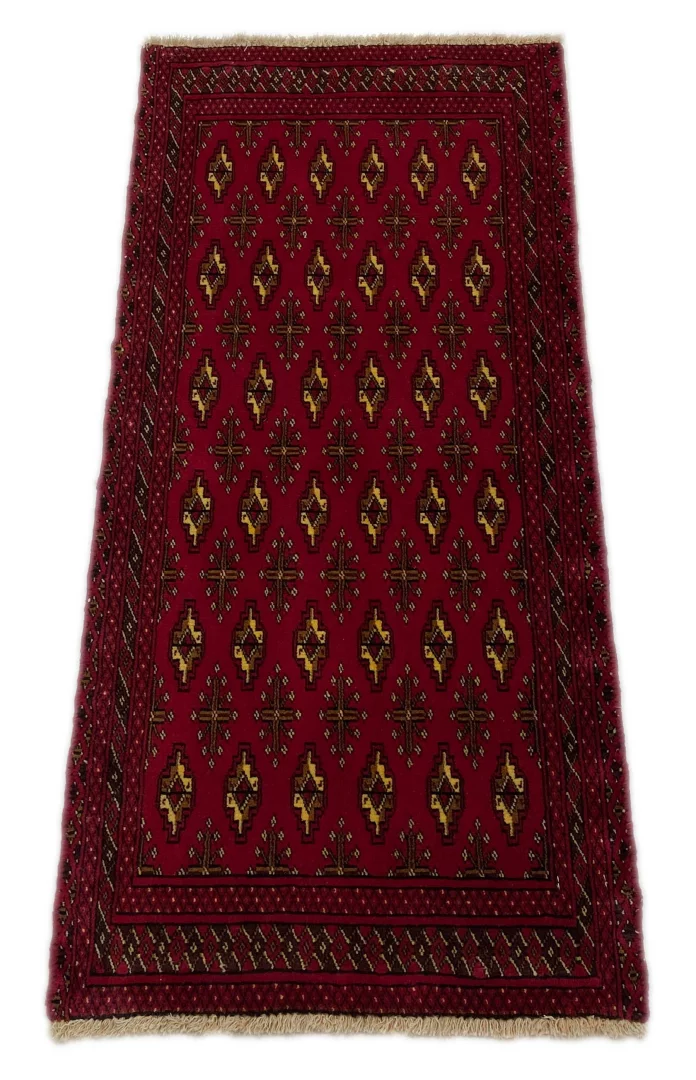
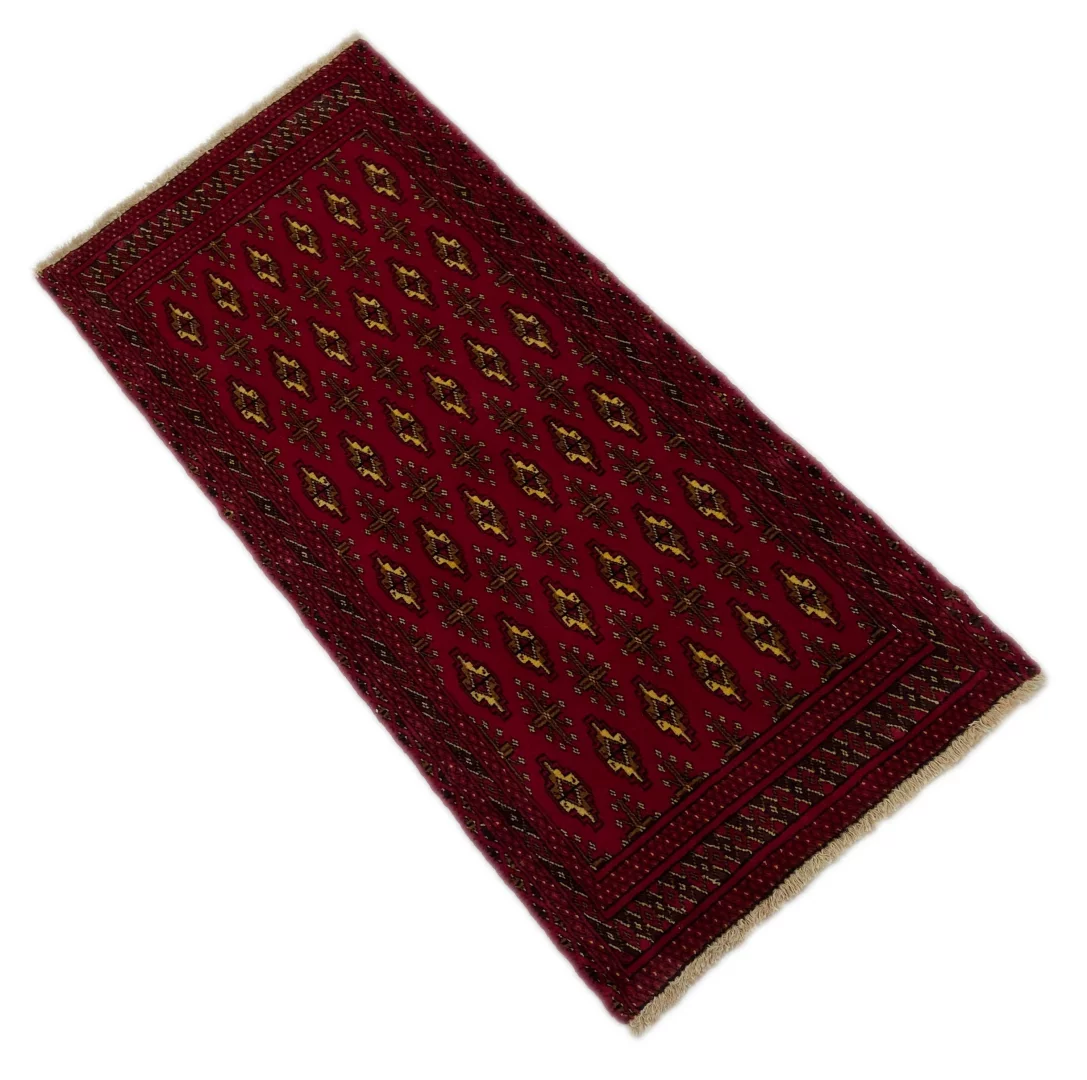
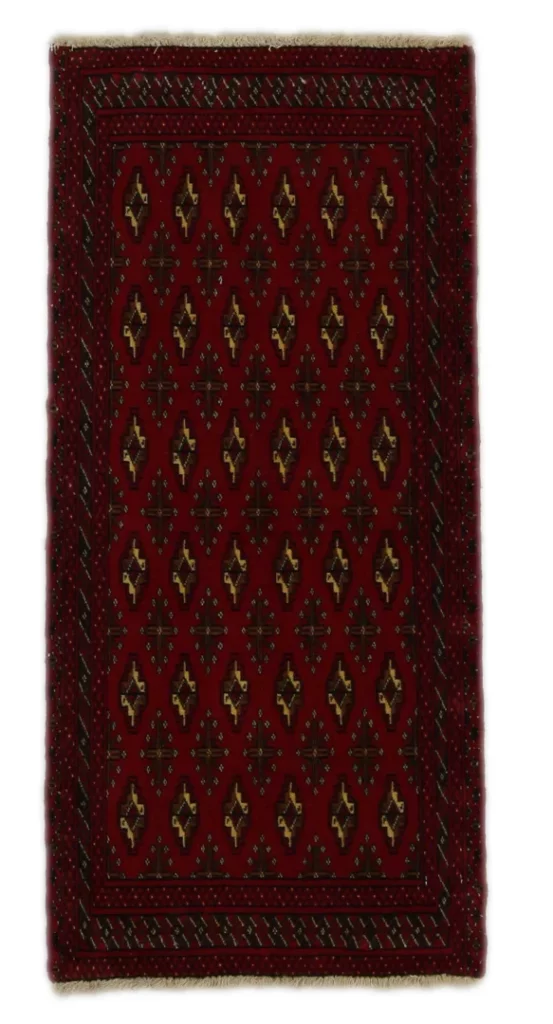
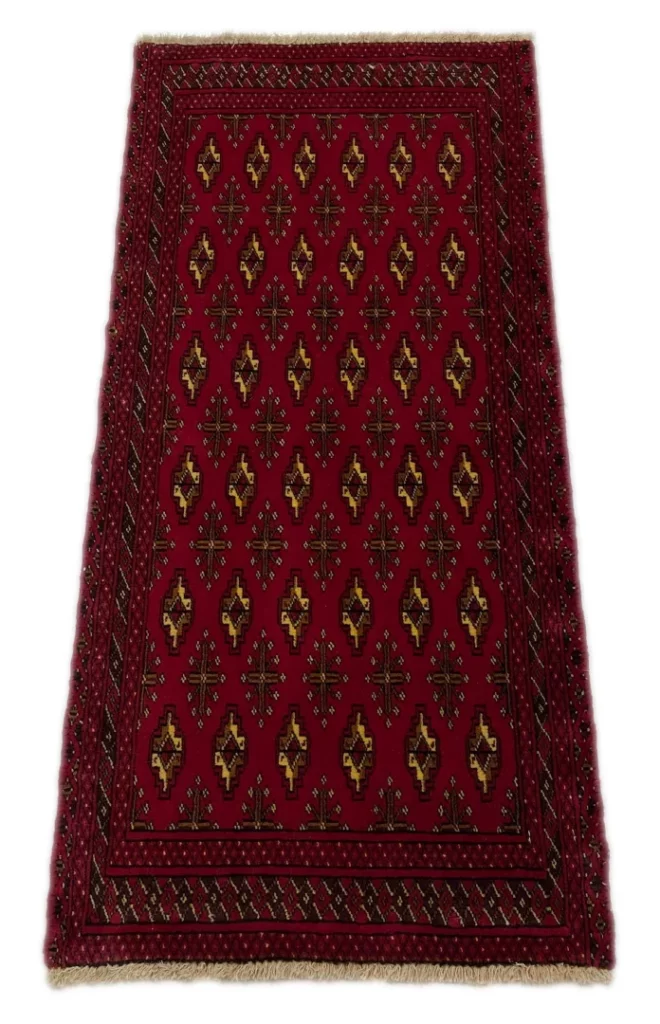
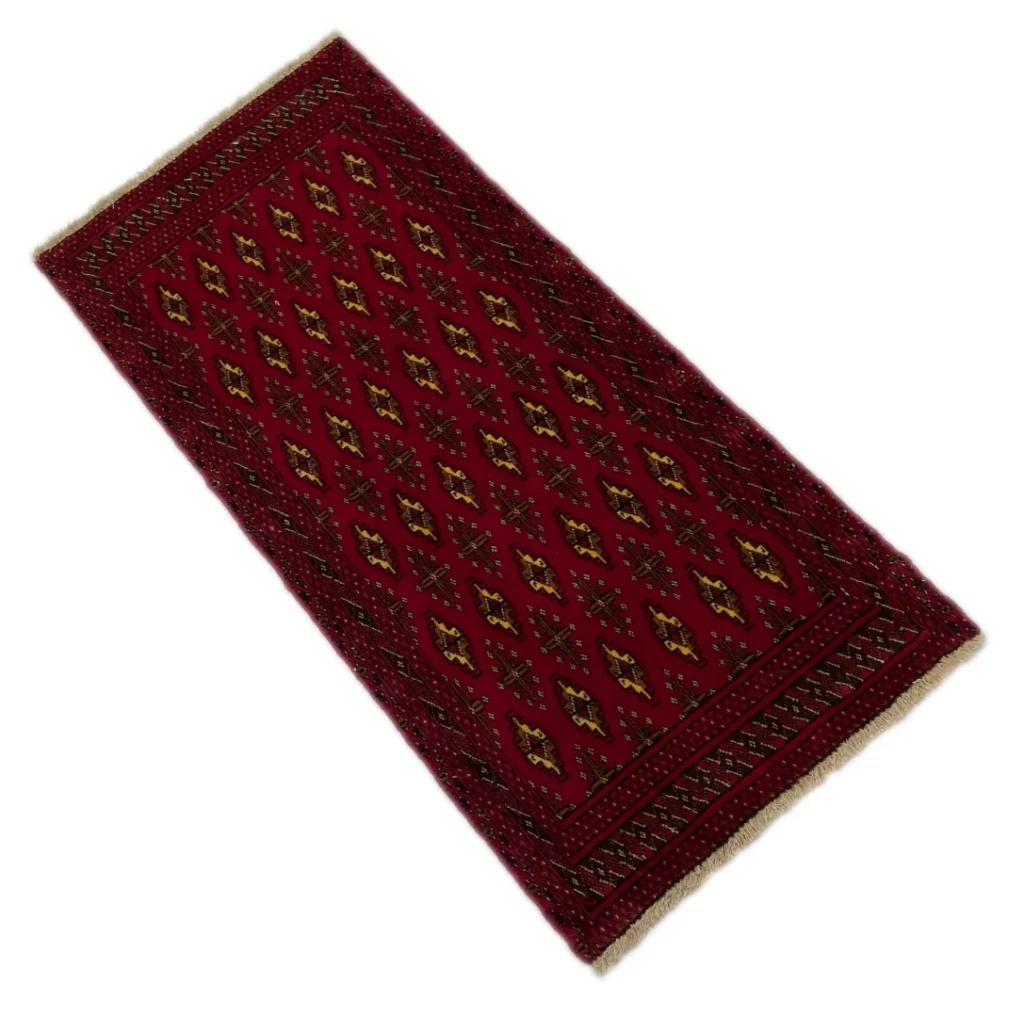
The design of this rug is defined by varied Göl motifs. These recurring ornamental units organise the field and give it a distinct structure. Their relationship creates a sense of rhythm while keeping the overall composition cohesive. The ornament makes the rug recognisable as a Turkman rug without removing the individual character that comes from its handmade construction.
Geometric patterning has an important role in oriental rug design. It provides orientation across the field and connects separate motifs into a unified composition. Lines, angles, outlines and repeated forms can divide one area from another. In a Göl-based design, the visual effect often comes from the relationship between the central ornament and the surrounding field or border elements.
The colour scheme of this rug consists of red, violet and brown. Red provides a strong, warm foundation. Violet adds a distinctive yet measured note, while brown introduces an earthy element connected to the natural character of wool. Together, these colours create a warm overall impression and allow the ornamental forms to remain clearly visible.
Colour cannot be separated from the pattern. In a hand-knotted rug, colour helps distinguish one Göl from another and makes the repetition of the motifs easy to read. Coloured areas may draw attention toward the centre of an ornament or emphasise its outline. This gives the design visual depth without requiring additional decorative devices.
Varied Göl motifs can differ in their form, scale and arrangement. Their shared basis is the recurring ornamental idea, while the specific execution gives each rug its own identity. This combination of continuity and variation is central to the Turkman design vocabulary. It also explains why a hand-knotted example does not look like a precisely duplicated printed pattern.
The combination of red, violet and brown gives the rug a warm and welcoming presence. It can therefore serve as a clearly visible furnishing element in rooms where colour and ornament are intended to contribute to the interior. At the same time, the pattern remains self-contained and does not depend on additional decoration. In a traditional setting it can complement regional motifs; in a modern interior it can provide a structured colour accent.
The design is consequently based on a direct relationship between ornament, repetition and colour. The Göl motifs establish the rhythm, the colour groups create contrast, and the handwork preserves the individual line of the piece. This is not an arbitrary decorative pattern, but the expression of a northern Persian tradition whose forms have been permanently rendered in wool through knotting.
Special Features
The fine knotting, high-quality wool and varied Göl motifs are among the defining features of this rug. Its hand-knotted construction makes the method of production visible and gives the one-off piece its own textile surface. Minor variations in the pattern are possible with this method and belong to the character of handmade rugs.
The palette of red, violet and brown strongly shapes the rug’s appearance. It combines warm and earthy shades with a noticeable violet accent. This allows the rug to function as a decorative element in different living areas. Its role is not limited to interior decoration: the wool surface is also intended for use underfoot.
The Turkman tradition brings together regional origin, recognisable ornament and careful handwork. This piece comes from northern Persia and expresses that connection through its material, pattern and colours. It can be used as a small runner in a hallway, as an accent in a living room, dining room or bedroom, or as part of a modern interior.
FAQ
How should I care for my Turkman rug?
Regular vacuuming without a brush attachment helps remove dust and loose dirt without placing unnecessary strain on the wool fibres. If a fresh spill occurs, dab the area gently with a damp cloth as soon as possible. Rubbing may affect the surface and the appearance of the colours, so it should be avoided. Professional cleaning is recommended for more thorough care. It helps preserve the wool and the hand-knotted surface over time.
Which rooms are particularly suitable for a Turkman rug?
A Turkman rug works well in living rooms, dining rooms and bedrooms. Its warm colours and varied Göl motifs can act as a focal point and give the room a clearly recognisable ornamental structure. It can also be placed in a hallway, where its runner format comes into its own. In a modern interior it provides a hand-crafted colour accent, while in a more traditional setting it can sit naturally within a regional pattern scheme.
How can I assess the quality of a Turkman rug?
Several features should be considered together. These include the density and precision of the knotting, the quality of the wool and the consistency of the handmade workmanship. Colour intensity and the level of detail in the Göl motifs also indicate careful design and execution. This rug combines high-quality wool, finely made knots and hand-knotted construction. Small variations in the pattern do not contradict quality; they can be a natural result of individual handwork.
To provide the best experiences, we use technologies like cookies to store and/or access device information. Consenting to these technologies will allow us to process data such as browsing behavior or unique IDs on this site. Not consenting or withdrawing consent, may adversely affect certain features and functions.
Functional Always active
The technical storage or access is strictly necessary for the legitimate purpose of enabling the use of a specific service explicitly requested by the subscriber or user, or for the sole purpose of carrying out the transmission of a communication over an electronic communications network.
Preferences
The technical storage or access is necessary for the legitimate purpose of storing preferences that are not requested by the subscriber or user.
Statistics
The technical storage or access that is used exclusively for statistical purposes.The technical storage or access that is used exclusively for anonymous statistical purposes. Without a subpoena, voluntary compliance on the part of your Internet Service Provider, or additional records from a third party, information stored or retrieved for this purpose alone cannot usually be used to identify you.
Marketing
The technical storage or access is required to create user profiles to send advertising, or to track the user on a website or across several websites for similar marketing purposes.
 SECURE PAYMENT
 SHIPPING PARTNERS