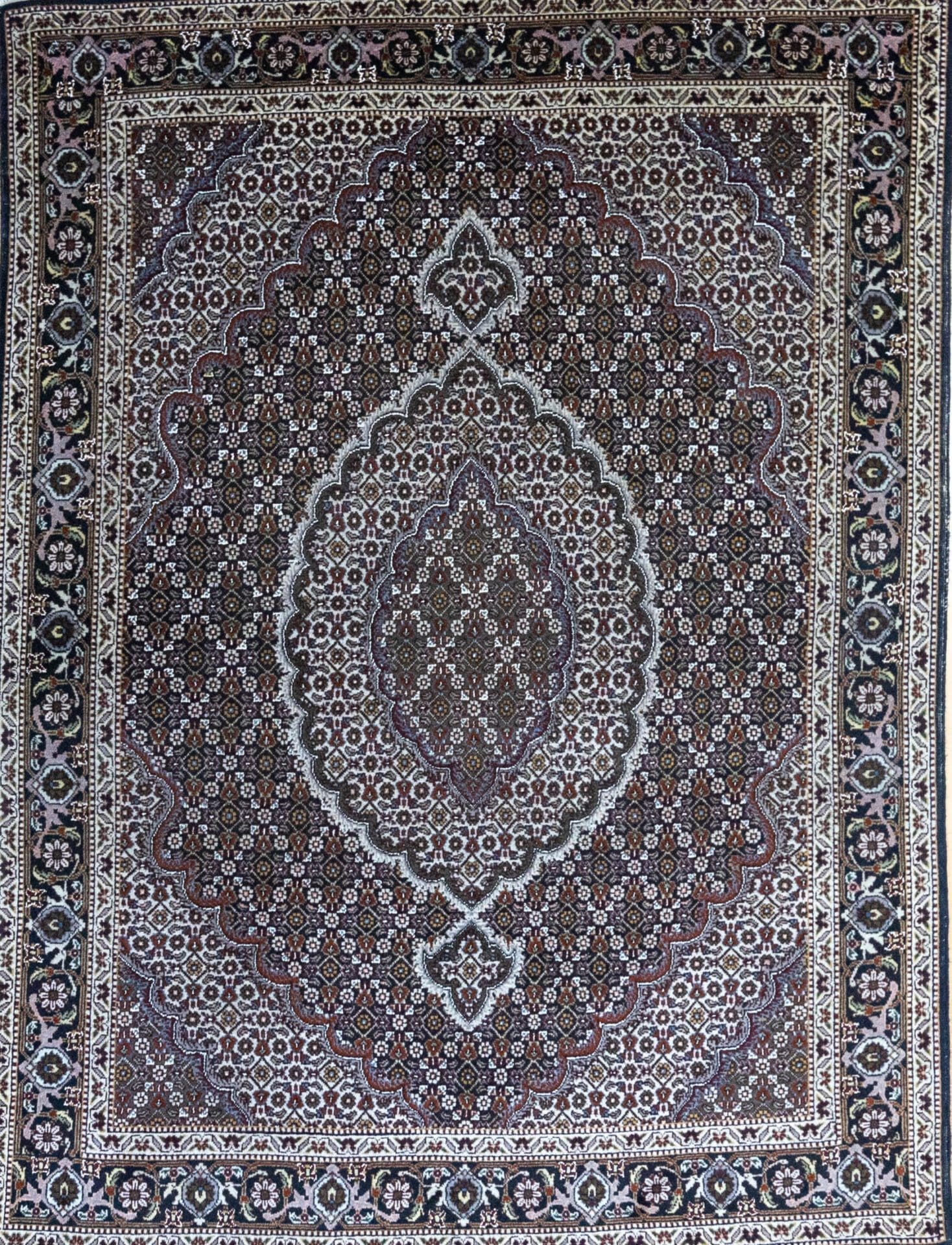
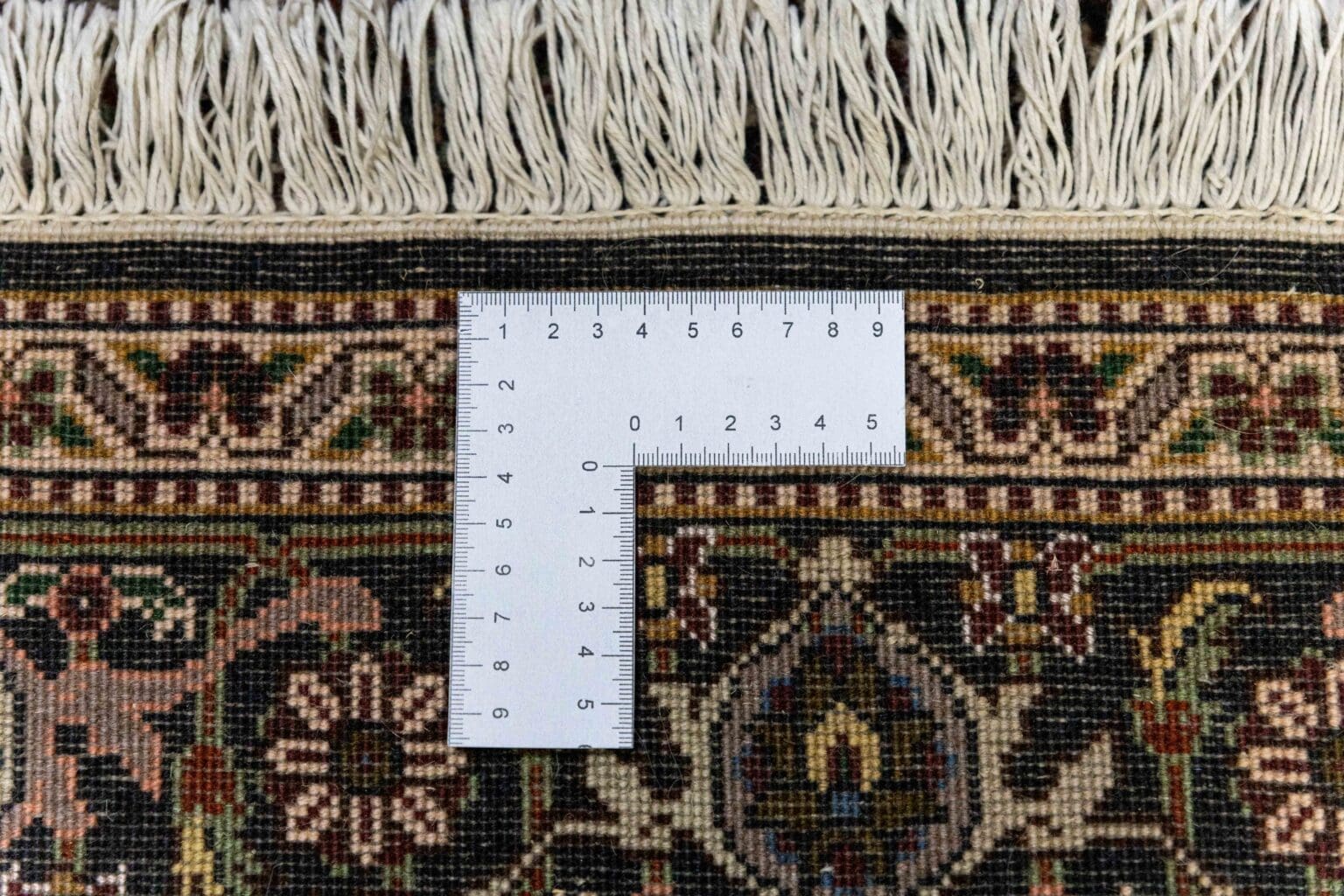
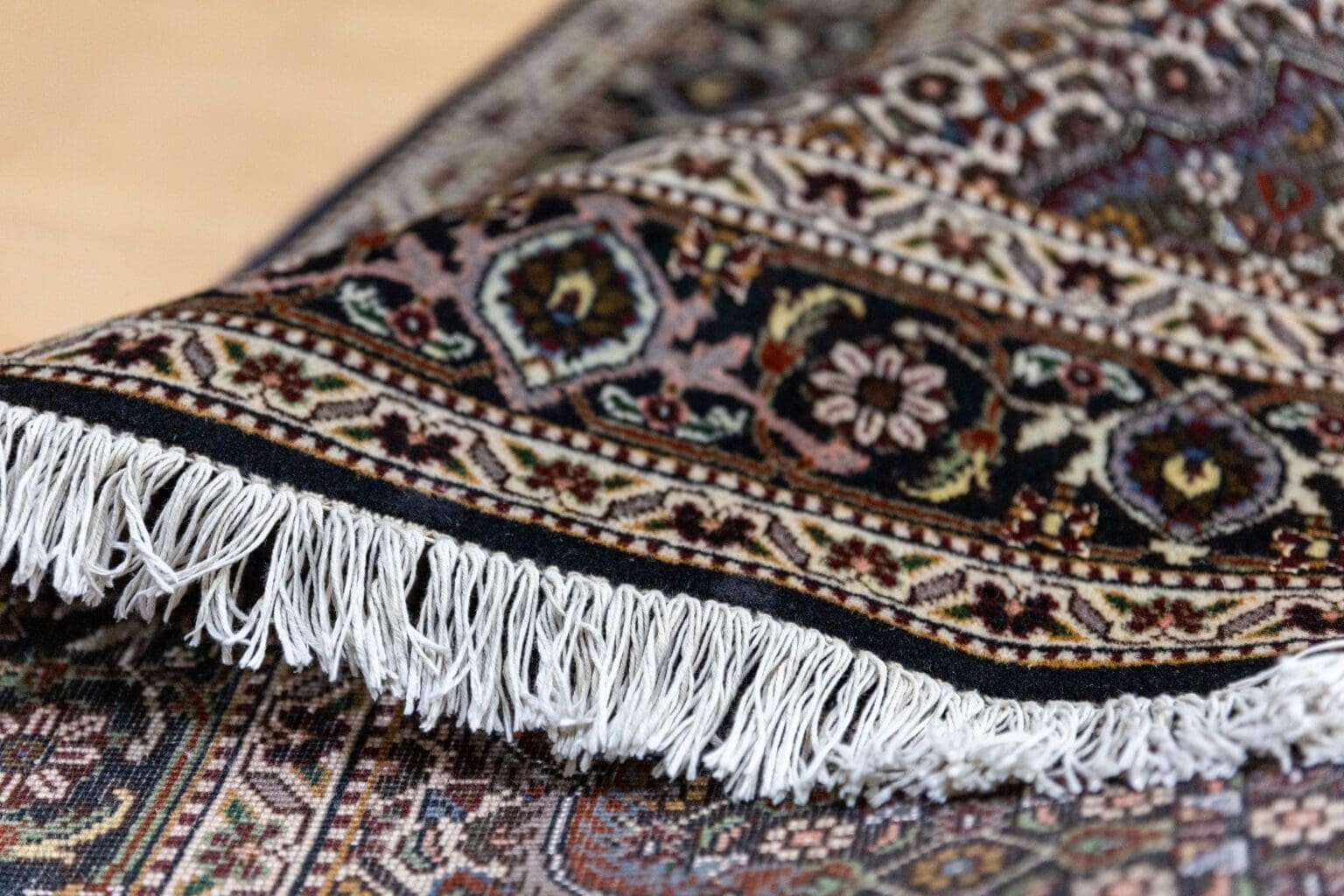
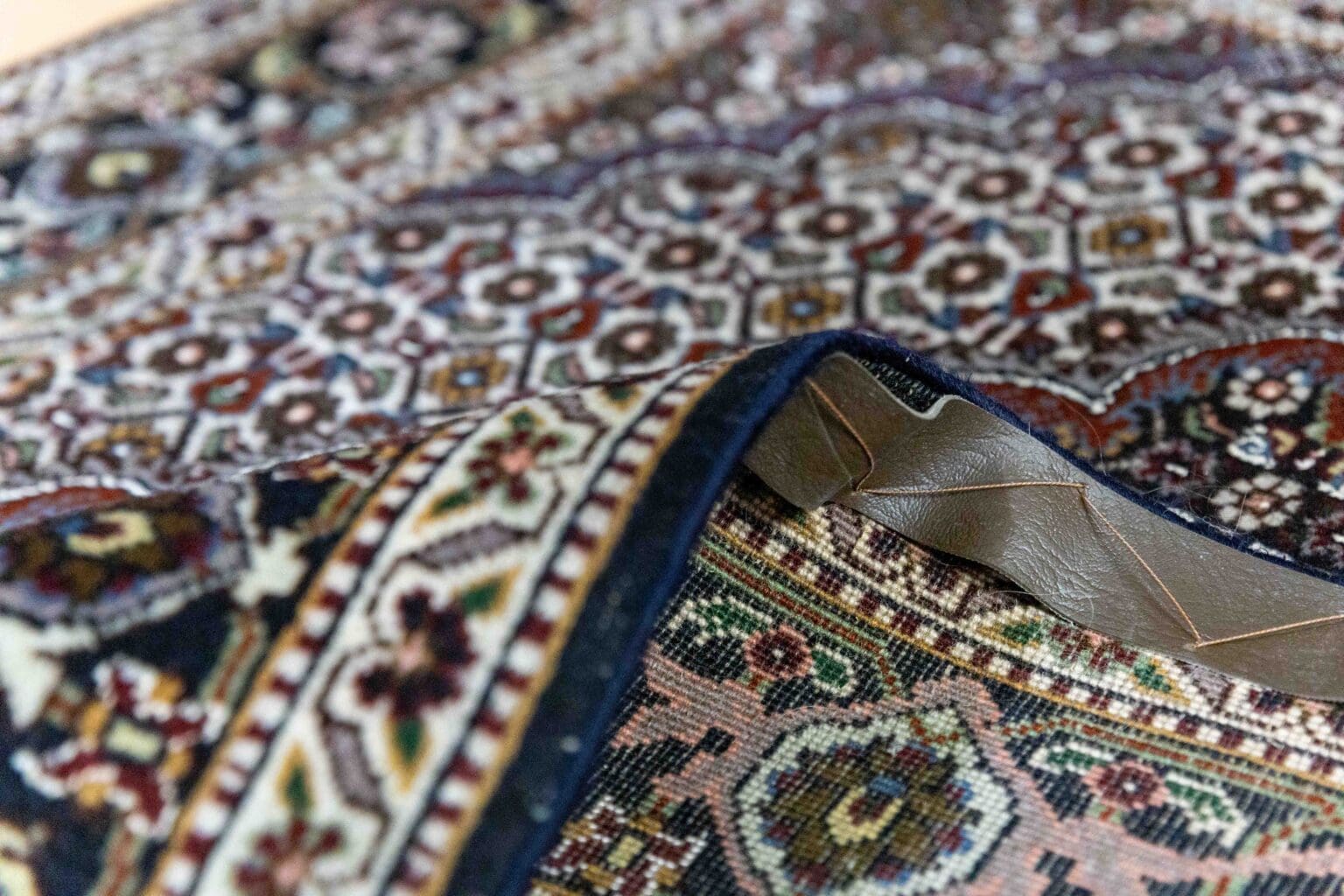
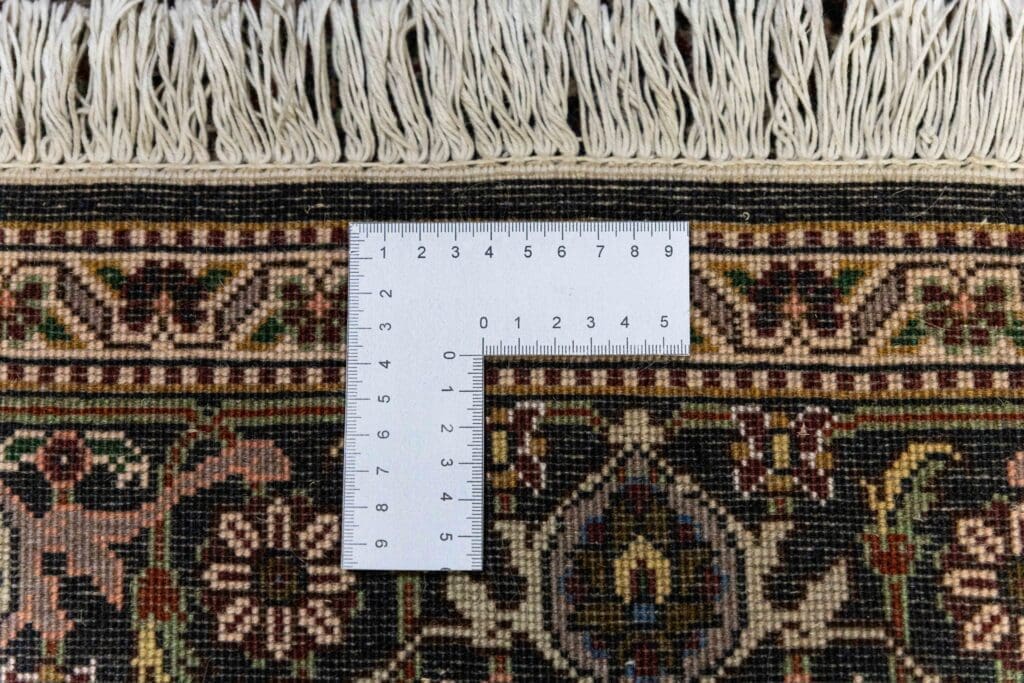
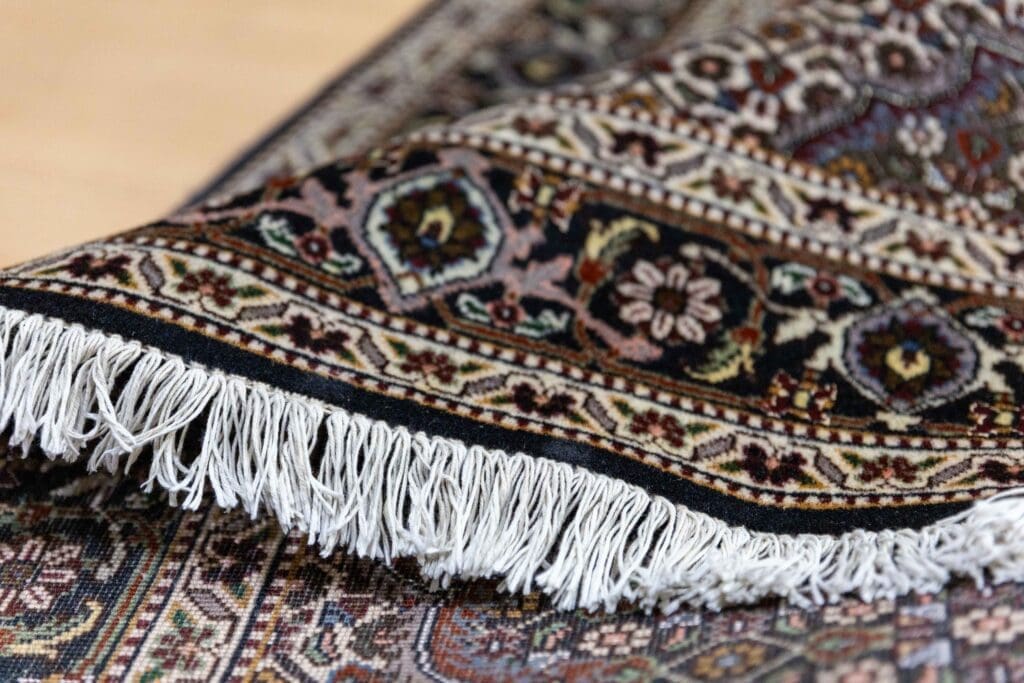
This Persian rug from Tabriz is hand-knotted. The pile is made from 100% virgin wool, while the warp is 100% cotton. In a hand-knotted rug, the warp forms the supporting framework. Pile yarn is tied into this framework one knot at a time, with each knot contributing to the visible design. After knotting, the pile is sheared and finished so that the outlines and structure of the pattern can be clearly seen.
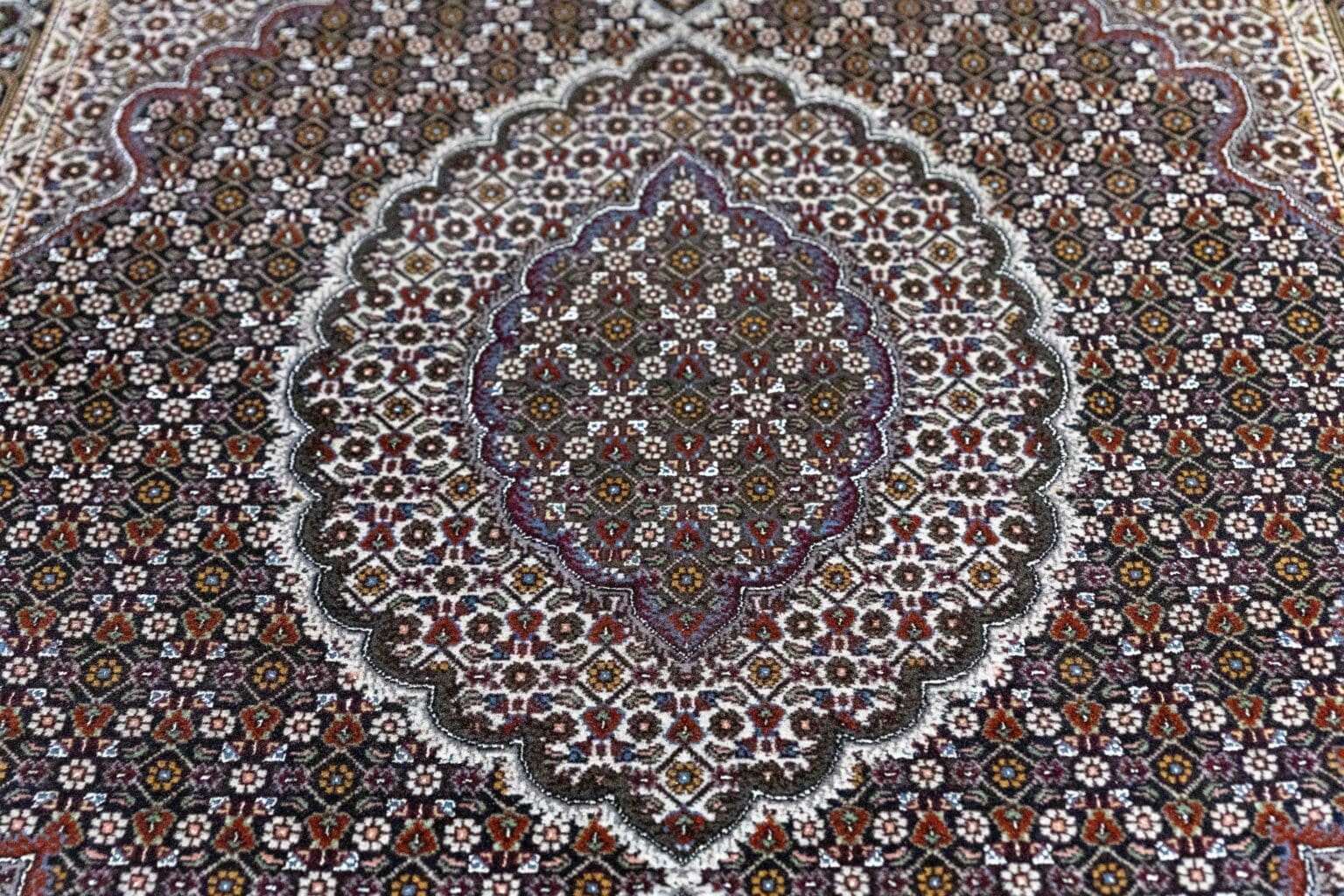
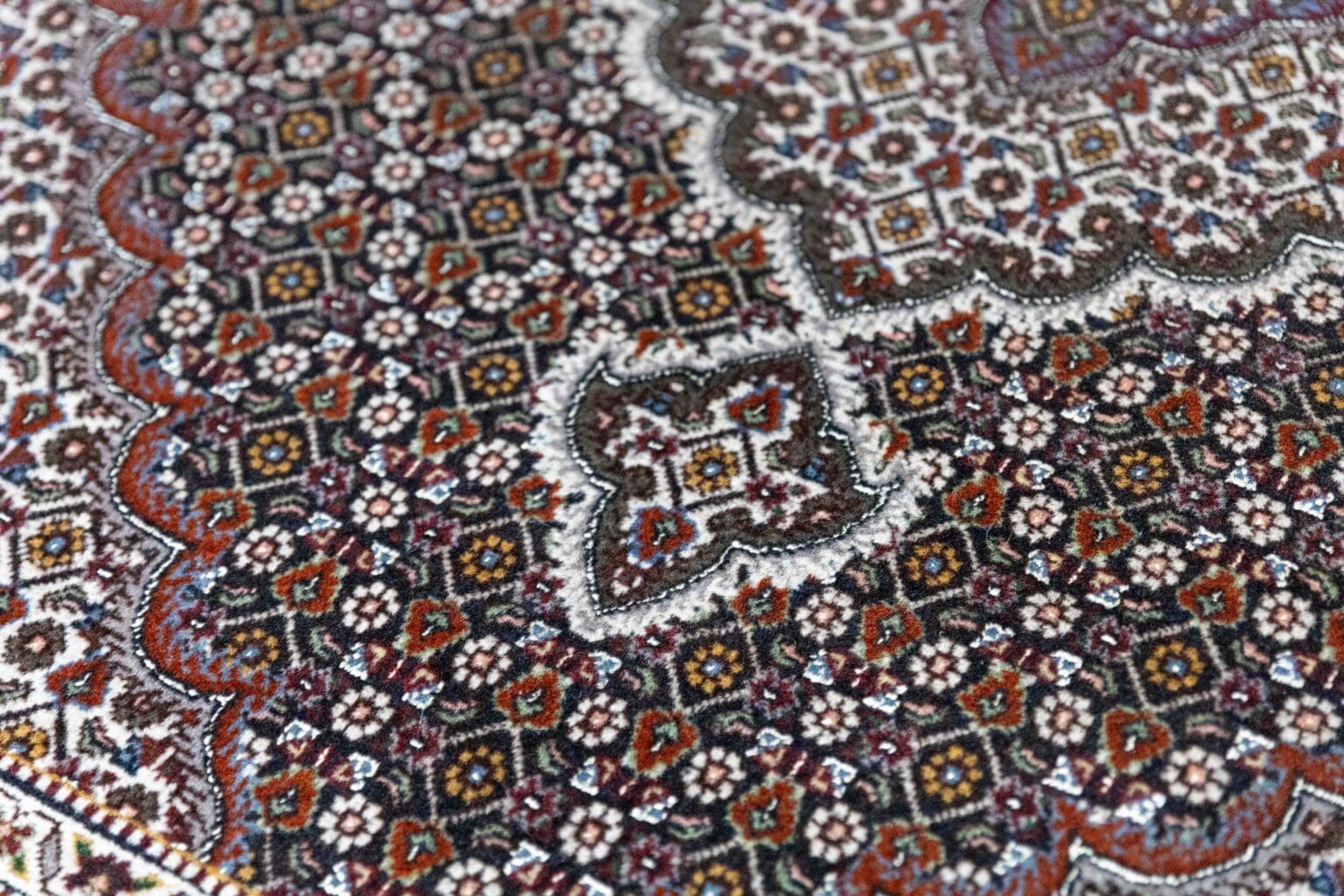
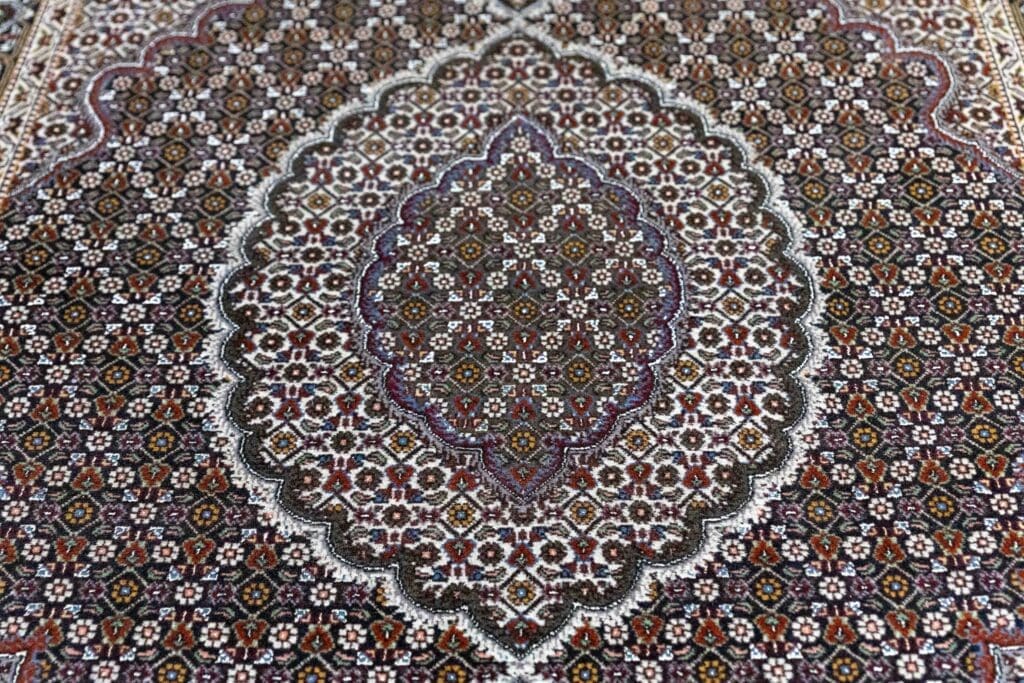
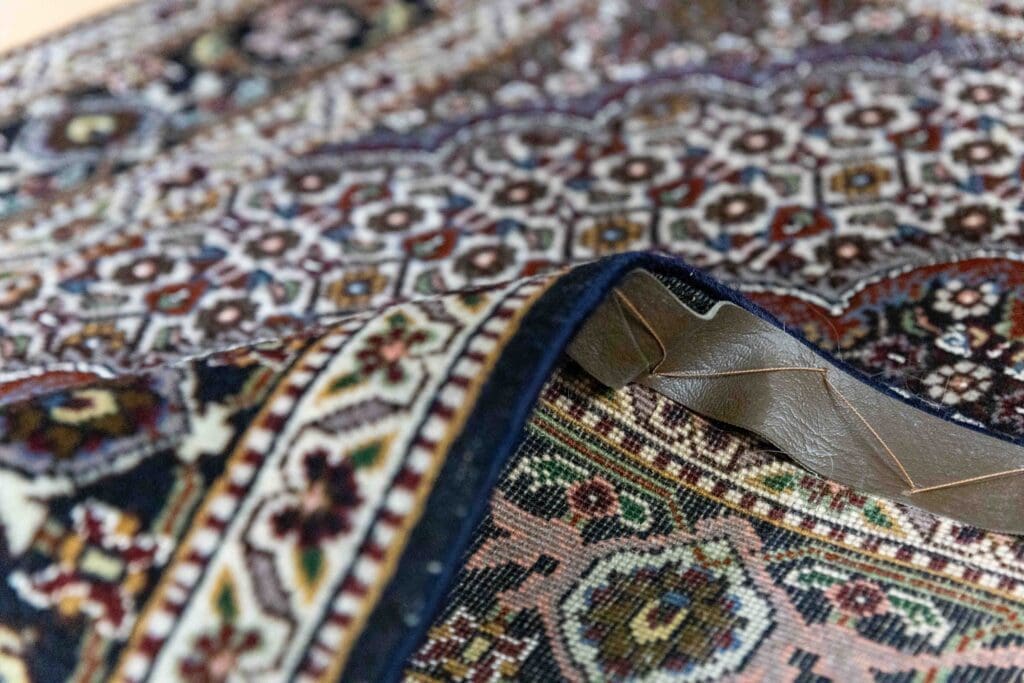
The knot density of this rug is approximately 200,000 knots per square metre. A relatively fine knot structure allows outlines, small ornaments and transitions to be worked with care. The pattern is not printed onto a completed surface; it is built from individual knots arranged according to a planned design. The surface therefore retains the textile character of the knotting process while allowing the medallion and Mahi elements to be distinguished in detail.
Virgin wool is used in rug making because its fibres combine softness with resilience. Wool can retain warmth and offers good resistance during use. Its natural fibre structure also contributes to low static build-up. Cotton is often used for the warp because it can form a firm, even foundation. In this rug, the wool pile, cotton warp and hand-knotting together describe the material and technical construction of the piece.
Hand-knotting builds a design row by row. The result depends not only on the number of knots but also on the regular tension of the warp, the preparation of the yarn and the careful placement of each motif. A central composition such as a medallion requires controlled arrangement around a fixed centre. Repeated Mahi motifs must be fitted into the surrounding field with attention to direction, spacing and continuity.
The handmade construction makes the surface an individual textile rather than a printed decorative layer. The virgin wool gives the pile its fibre character, while the cotton warp remains the internal structure that supports the knotted rows. Knot density describes the fineness of the work, but it is most meaningful in connection with the material and technique. Together, these elements explain how a Persian rug can combine a carefully planned image with the visible structure of manual production.
Origin and Tradition
Tabriz, also written Täbriz, is located in Iran and is one of the important centres of Persian carpet production. The city has a long history of carpet making that reaches back to the sixteenth century. Tabriz workshops are known for a broad range of designs rather than one fixed pattern. Their traditions include central medallion layouts, floral fields, scrolling vines, geometric details and stylised references to nature.
The importance of Tabriz in Persian carpet making comes from the combination of design knowledge, material expertise and careful execution. A rug from this tradition may be organised around a clearly defined medallion, or it may use a continuous field in which floral elements spread across the surface. This variety is part of the regional design culture. The name Tabriz therefore refers not only to a place, but also to inherited methods of planning, drawing and producing carpets.
The history of Persian rugs is connected with the development of specialised workshops, trade routes and the exchange of artistic ideas. In important weaving centres, knowledge could be divided between people concerned with design, dyeing, knotting and finishing. Patterns and proportions were passed from one generation to the next, while individual workshops adapted them to new compositions. Regional traditions could therefore remain recognisable without requiring every rug to follow an identical layout.
Traditional production begins with the preparation of the warp. Weft threads and knots gradually stabilise the textile foundation. The knotter works in successive rows, following a drawn design or remembered pattern knowledge. The placement of colours and shapes is checked as the field develops. In a medallion rug, the centre provides a point of order, while borders and secondary ornaments can create a transition from the interior field to the edge.
Persian carpet design includes flowers, leaves, vines, geometric shapes and stylised animals. These forms are not necessarily intended as naturalistic pictures. They are simplified, repeated and connected so that they work within a woven surface. Individual signs become part of a larger composition. The pattern can consequently be appreciated both at close range, where the small details are visible, and from farther away, where rhythm and balance become more apparent.
The Mahi design belongs to this established vocabulary. Its name refers to fish forms that may be repeated, arranged in pairs or integrated into vines and foliage. In Persian symbolism, the fish is associated with abundance, prosperity and good fortune. This meaning adds cultural context to the ornament. Within the rug, however, the fish is transformed into a stylised form that must also fit the order, direction and rhythm of the textile design.
The relationship between nature motifs and geometric organisation is an important feature of many Persian design traditions. A motif can carry a symbolic association while also performing a practical visual function. It may fill a section of the field, guide the eye, repeat a rhythm or connect two different ornamental areas. In a Mahi pattern, repetition and balance are especially important because the individual fish forms work together as a continuous decorative language.
Iran is the origin of the Persian rug tradition represented by Tabriz. Within that national tradition, Tabriz identifies a particular regional history of workshop practice and design. The origin should be distinguished from the pattern description: the medallion and Mahi fish pattern describe the visual composition, while Tabriz identifies the regional source and its associated craftsmanship. These two levels of description complement one another but do not mean the same thing.
Design and Pattern
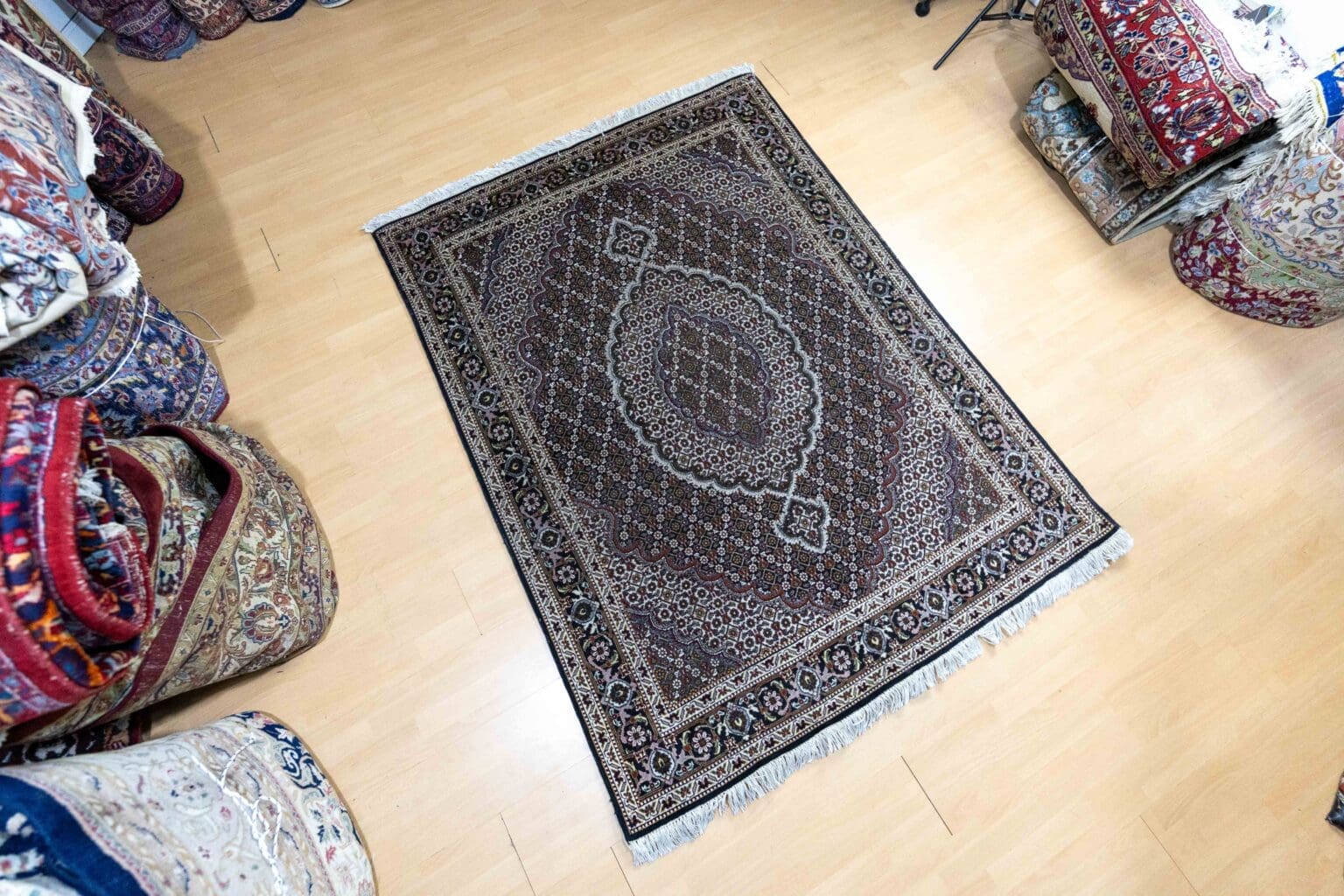
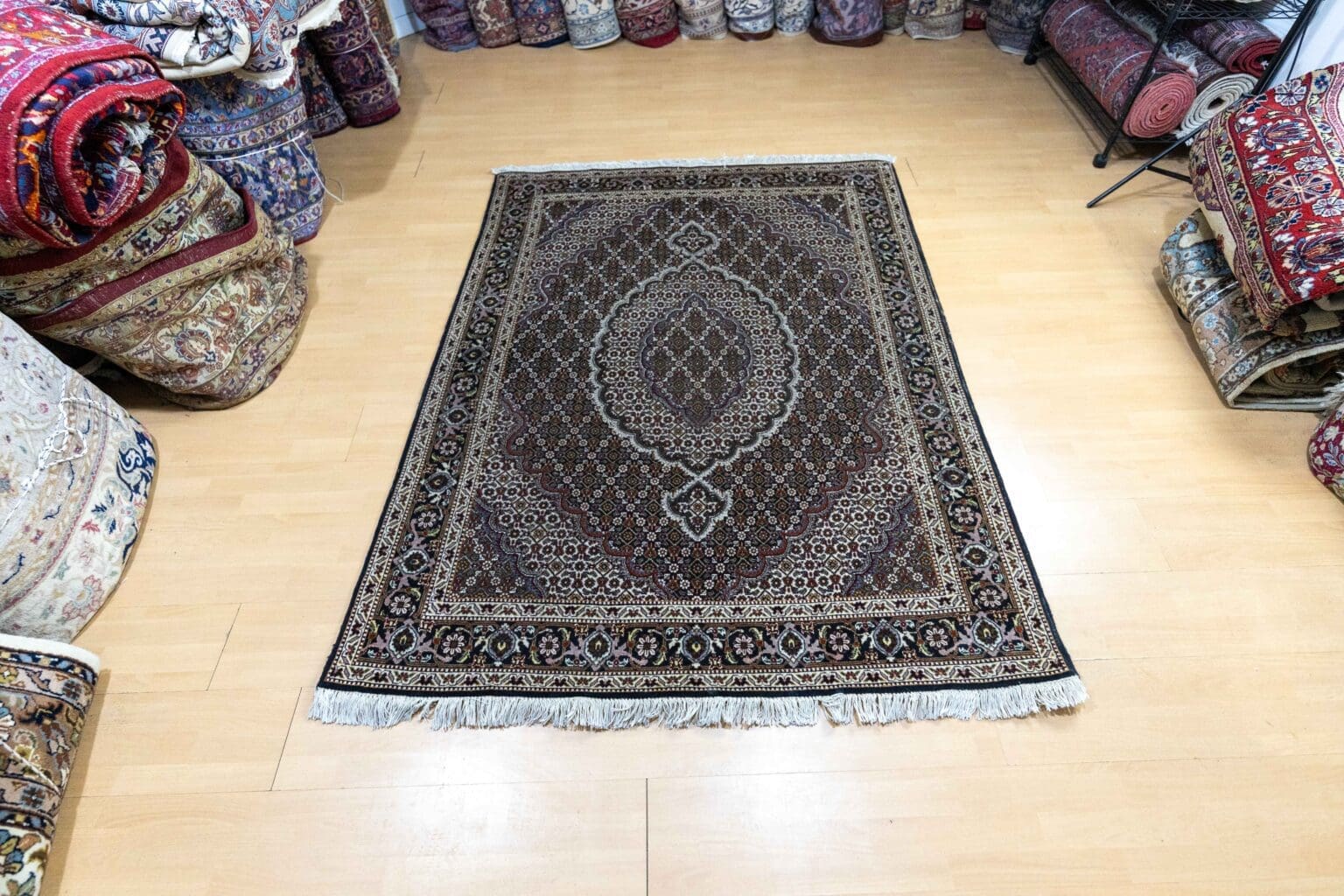
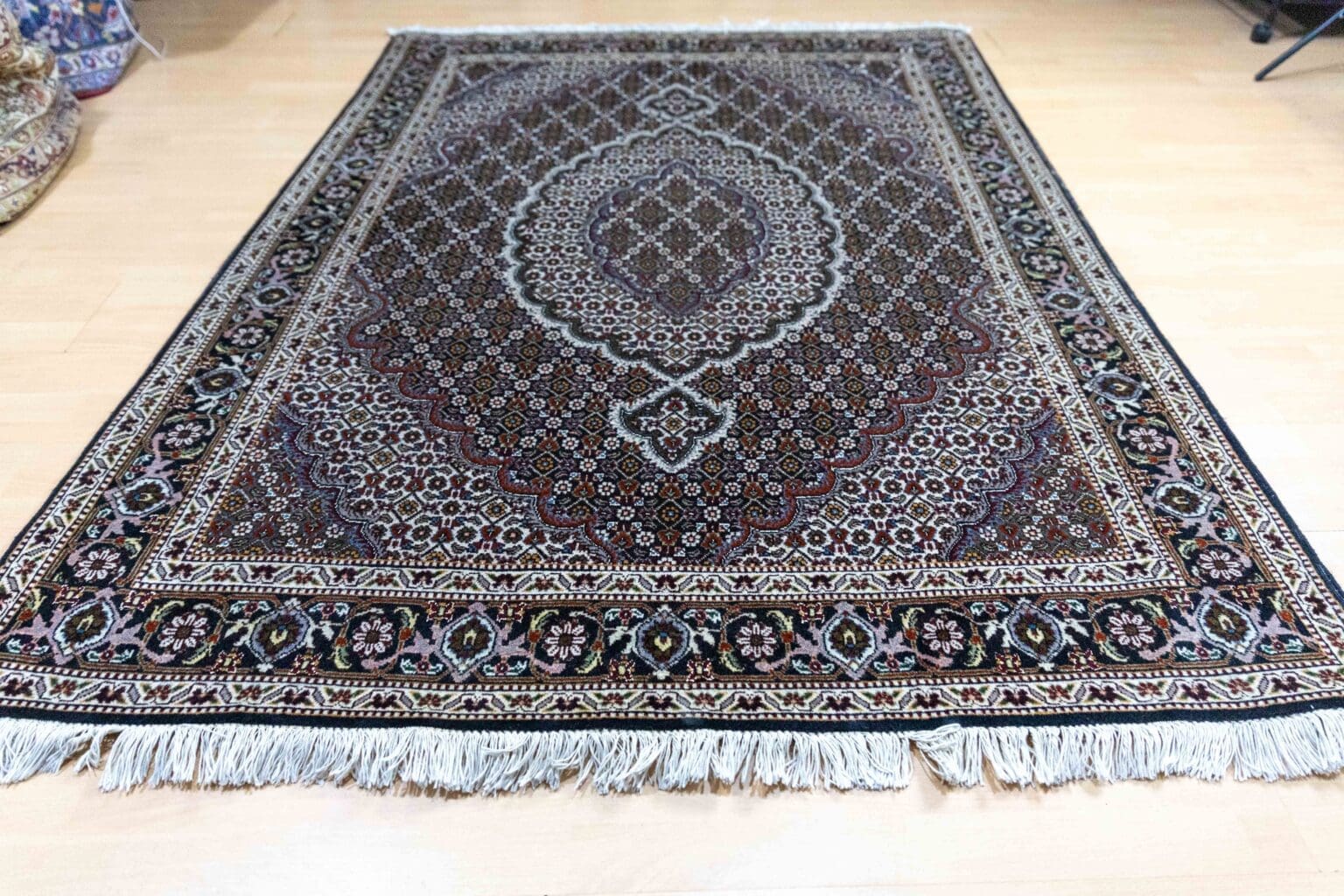
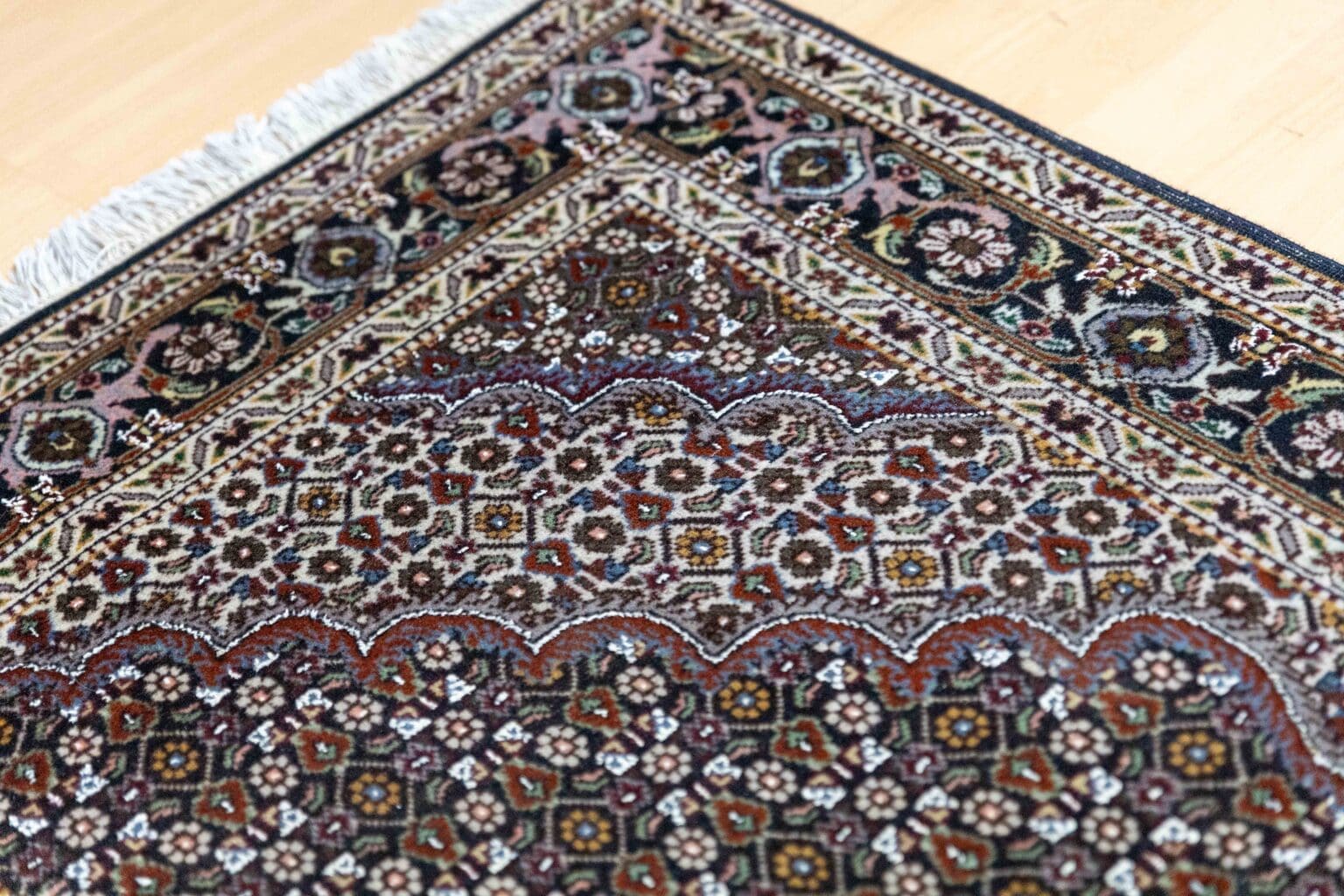
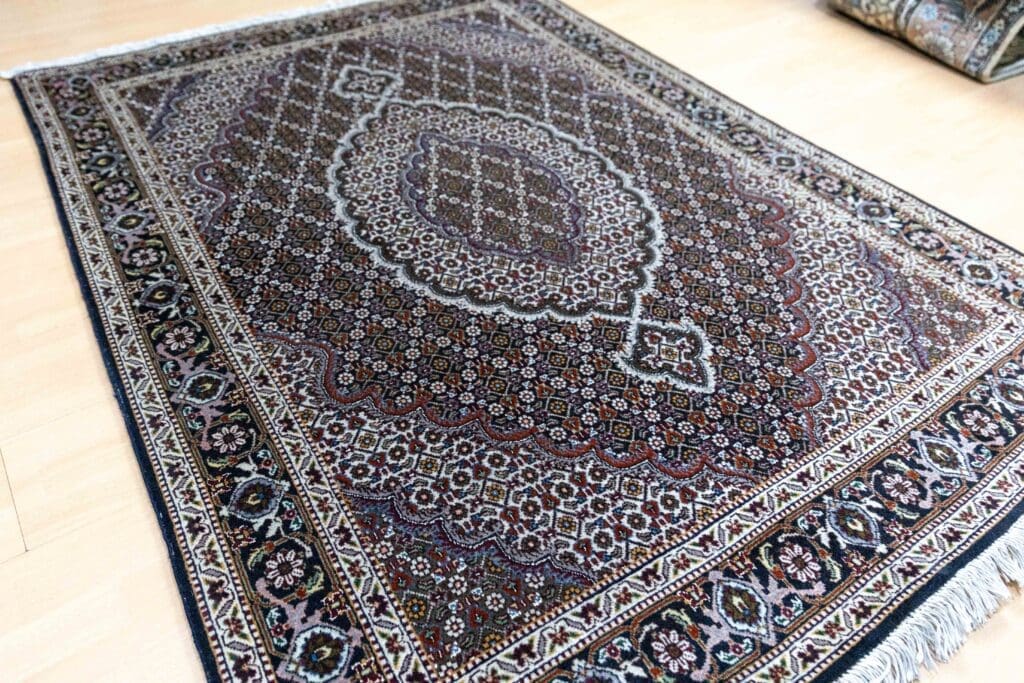
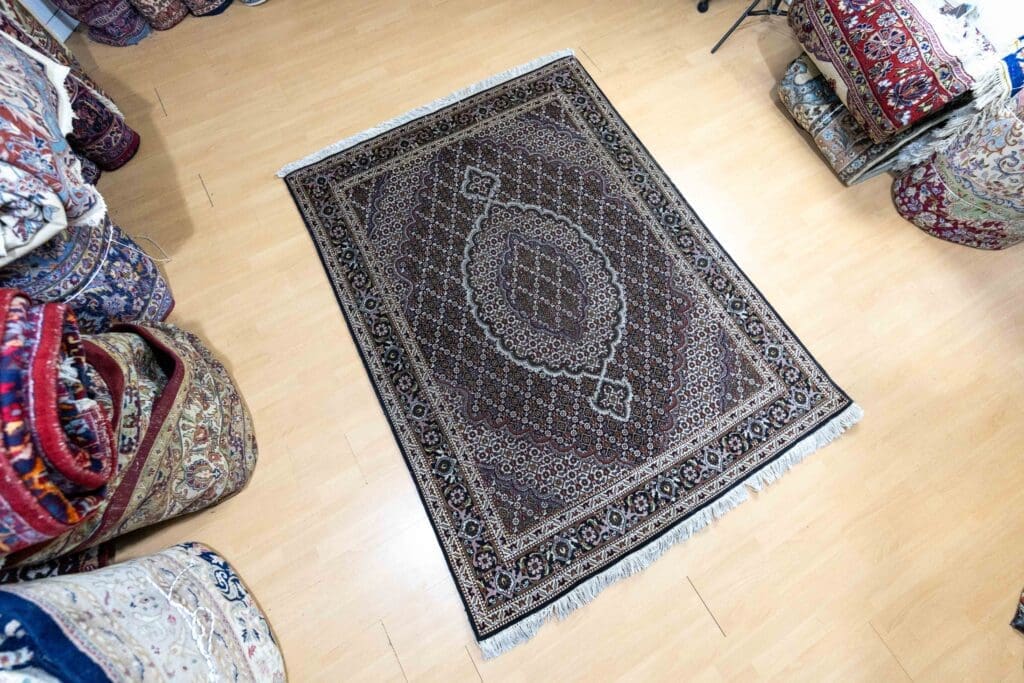
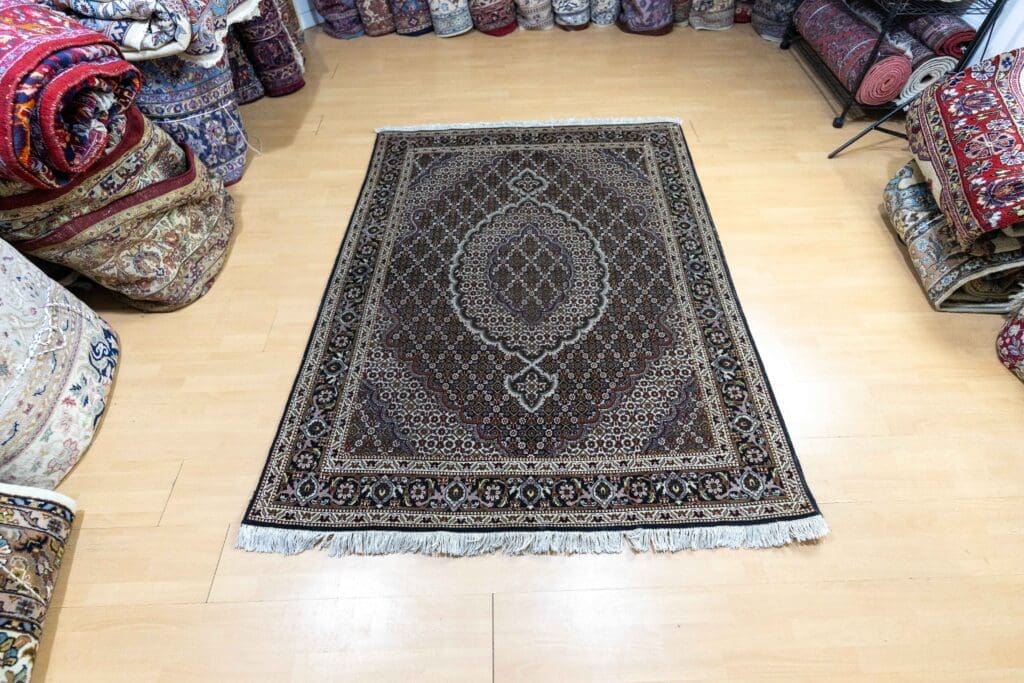
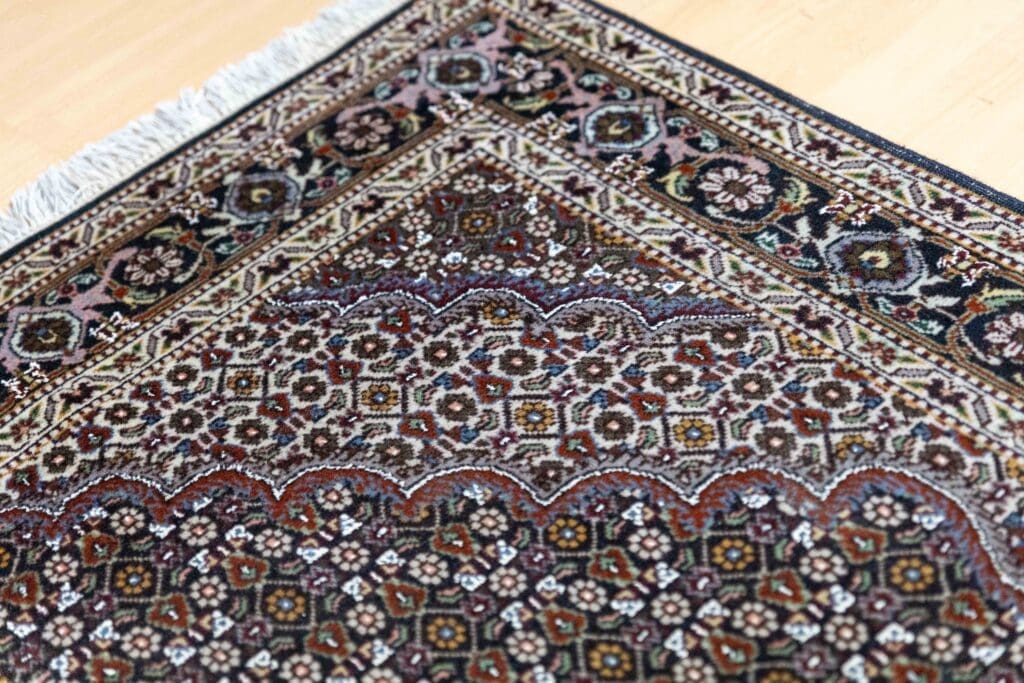
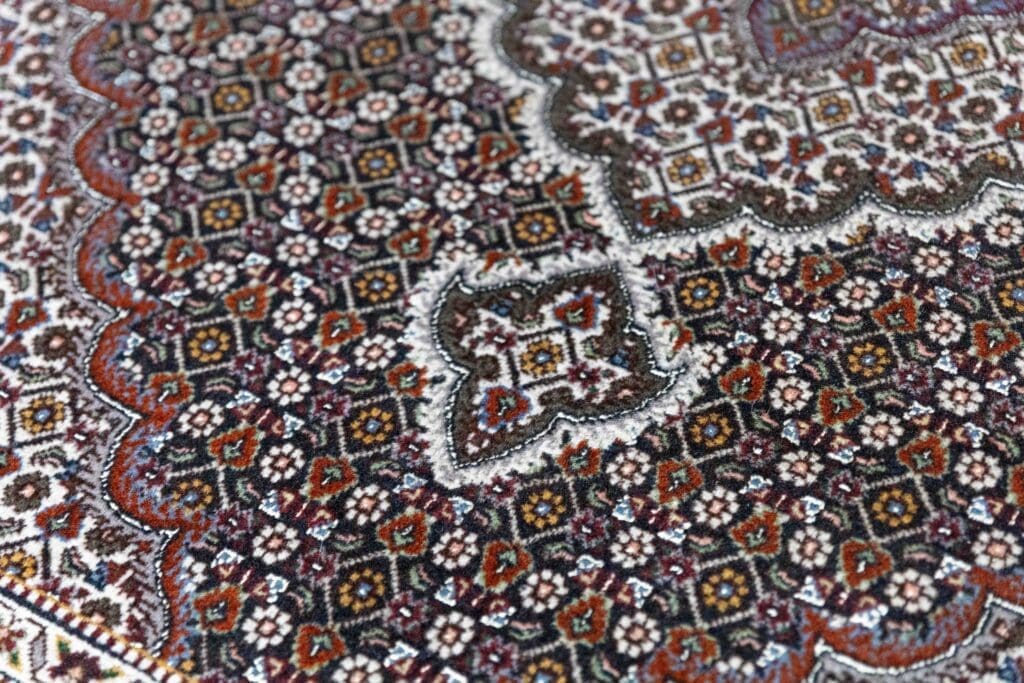
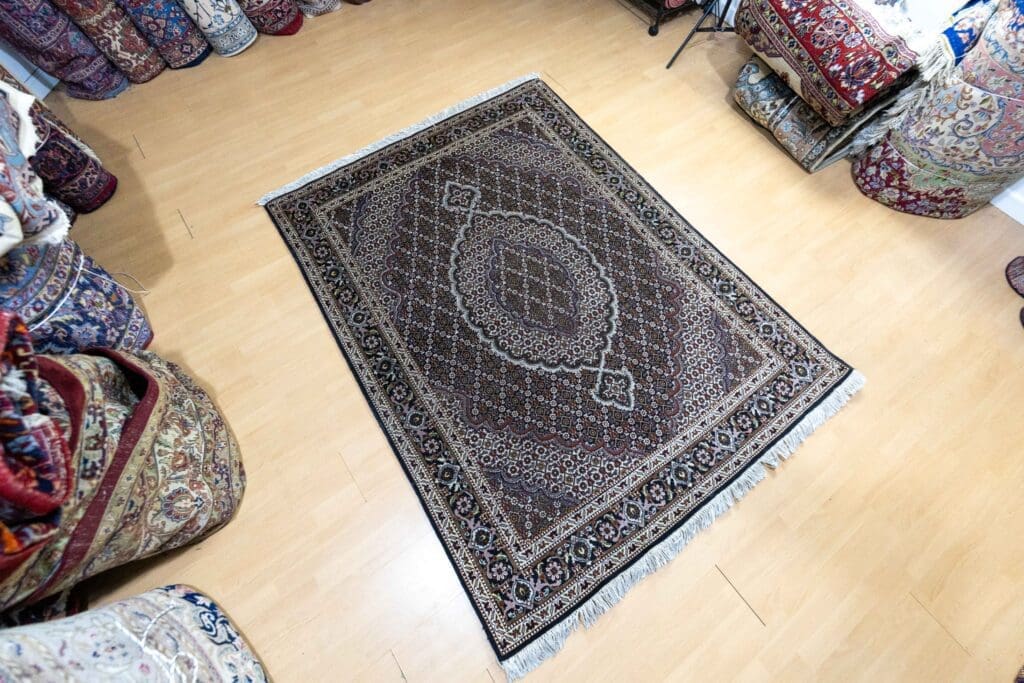
The design is organised around a central medallion. A medallion is a dominant middle ornament that gives the field a focal point and establishes an internal order. Depending on the design, it may be formed from curved, oval, rounded or polygonal shapes. Its function is to gather the surrounding decoration into a coherent arrangement. In Tabriz work, the central form may be developed with fine outlines, detailed framing and floral extensions that connect it to the surrounding field.
The Mahi fish pattern accompanies this central arrangement. Mahi refers to stylised fish forms that can be repeated in groups or placed in relation to vines and leaves. Repetition creates a steady visual rhythm. Each fish functions as a small ornamental unit, while the complete sequence of forms can structure a much larger area. The eye can therefore move between the central medallion and the many smaller details that articulate the surrounding design.
The fish is a traditional motif in Persian decorative art. Its cultural associations include abundance, prosperity and good fortune. In carpet design, the motif is not normally rendered as a naturalistic scene. Bodies, fins and contours are reduced to characteristic lines and shapes that can be repeated and aligned. The symbolism remains connected to the decorative task: the fish is both a cultural sign and a building block within a carefully organised pattern.
The medallion and Mahi ornament follow two complementary principles. The medallion draws attention to the centre and gives the composition a fixed orientation. The fish pattern introduces repetition, movement and small-scale structure around that centre. This combination allows a Persian rug to unite a strong focal element with a finely articulated field. The specified knot density supports the precise drawing of repeated forms and the contours that separate one ornament from another.
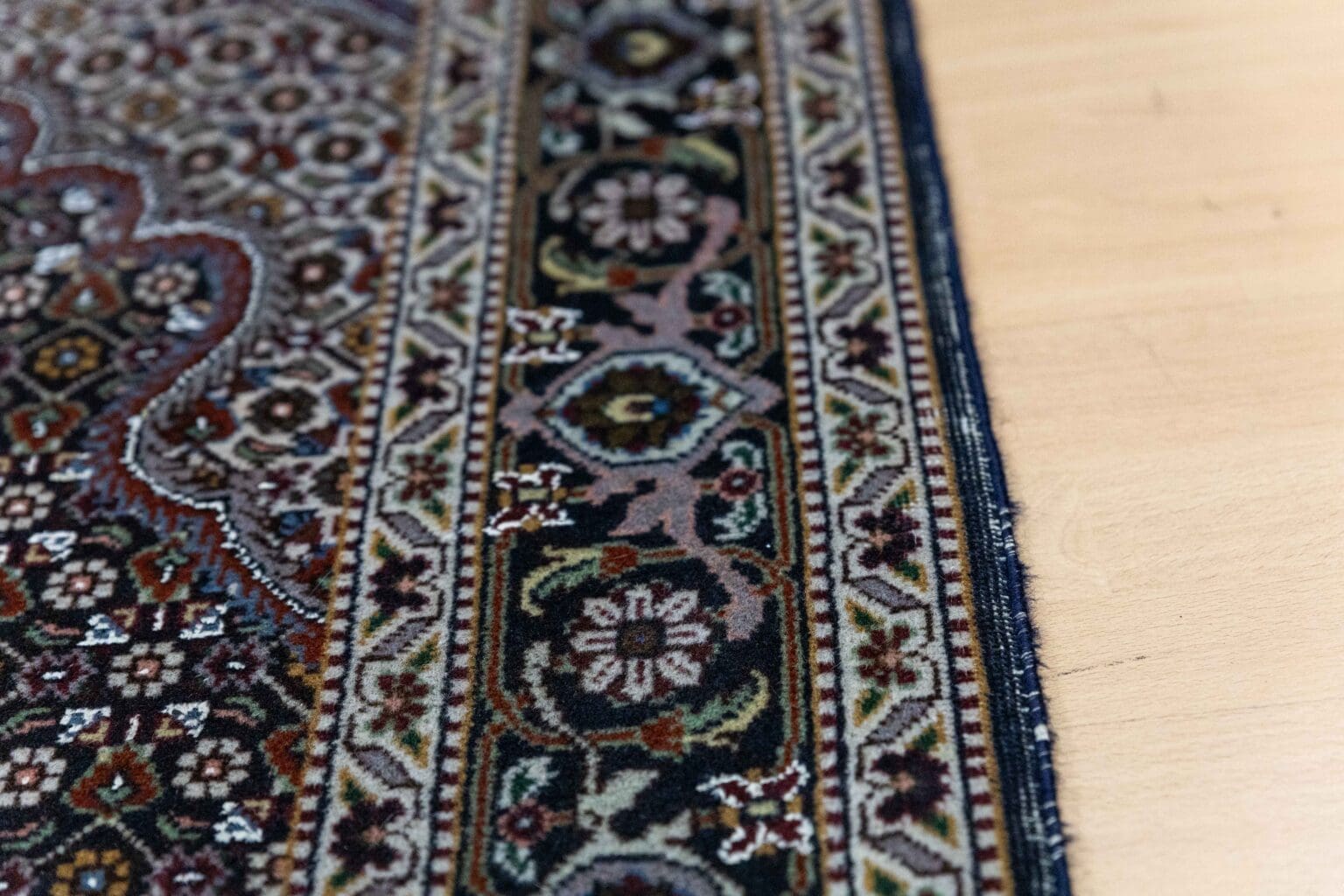
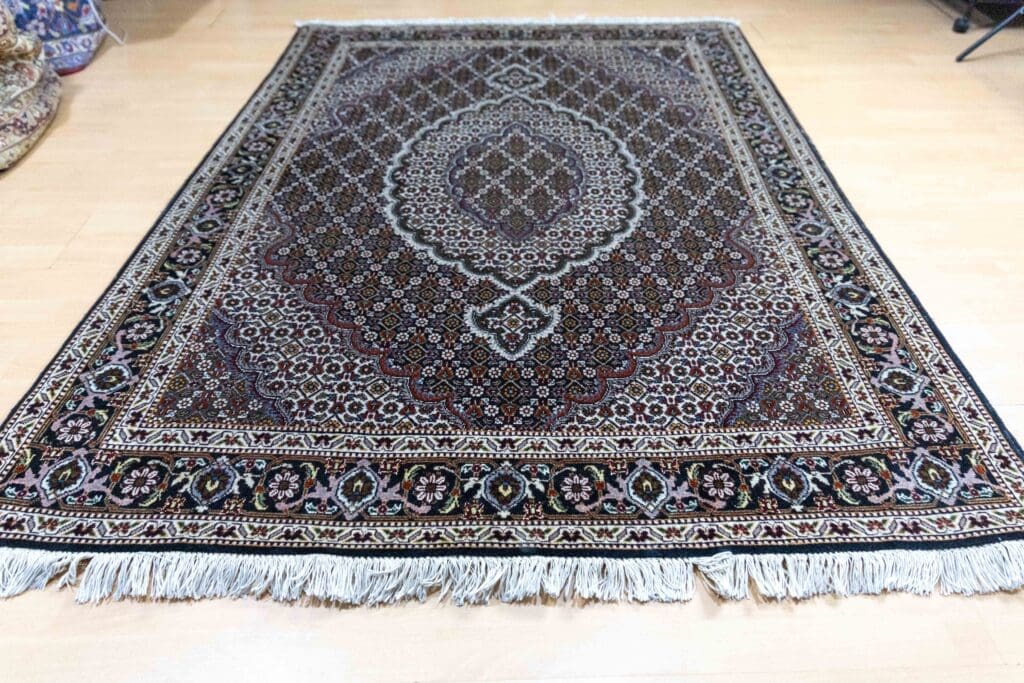
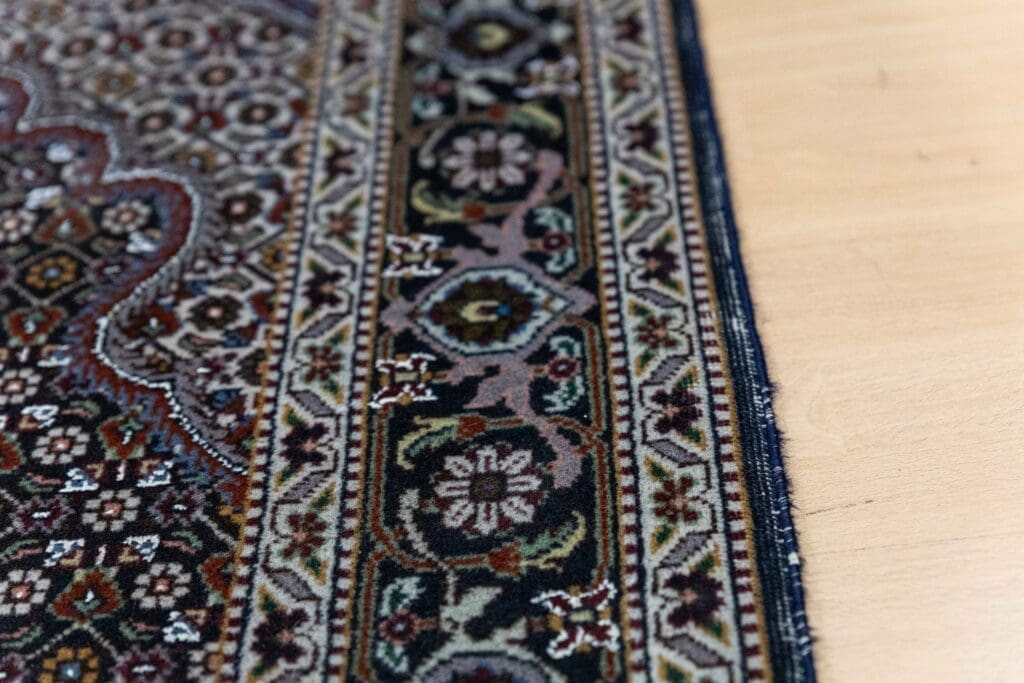
In a composition of this kind, borders can frame the interior field and create a transition to the outer edge. Traditional borders may contain vines, blossoms, leaves, geometric details or repeated motifs of their own. What matters compositionally is the relationship between the areas: the centre, the surrounding field and the border should read as parts of one design. The Tabriz tradition provides a broad repertoire for balancing these sections and adapting them to an individual carpet.
Mahi should therefore not be understood as a randomly placed image of a fish. It is the name of an established ornamental concept that is adapted to the composition around it. Combined with a central medallion, it produces a design with a clear point of focus and a detailed decorative environment. A reference to nature is translated into a textile language based on repetition, symmetry, contour and the measured distribution of forms.
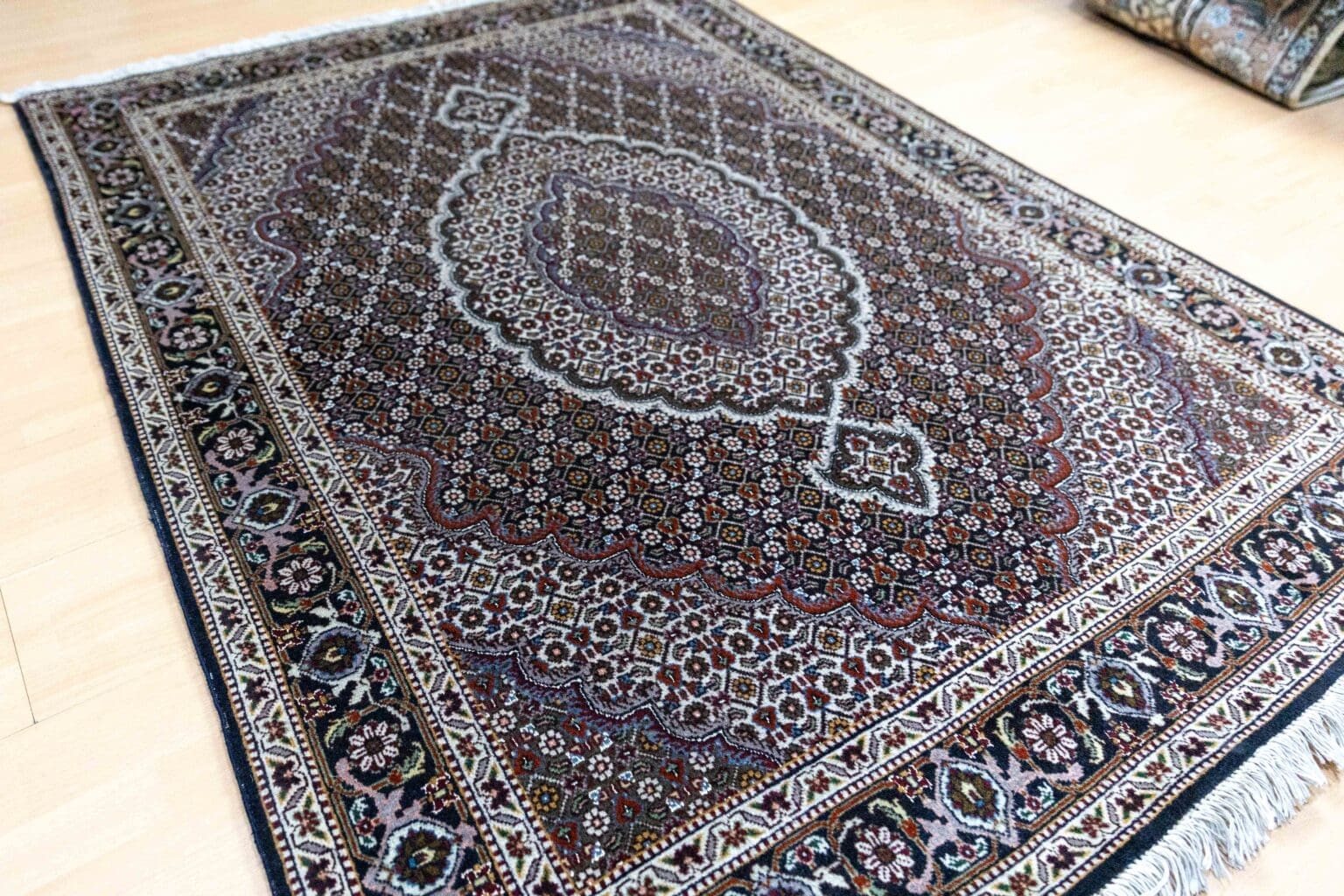
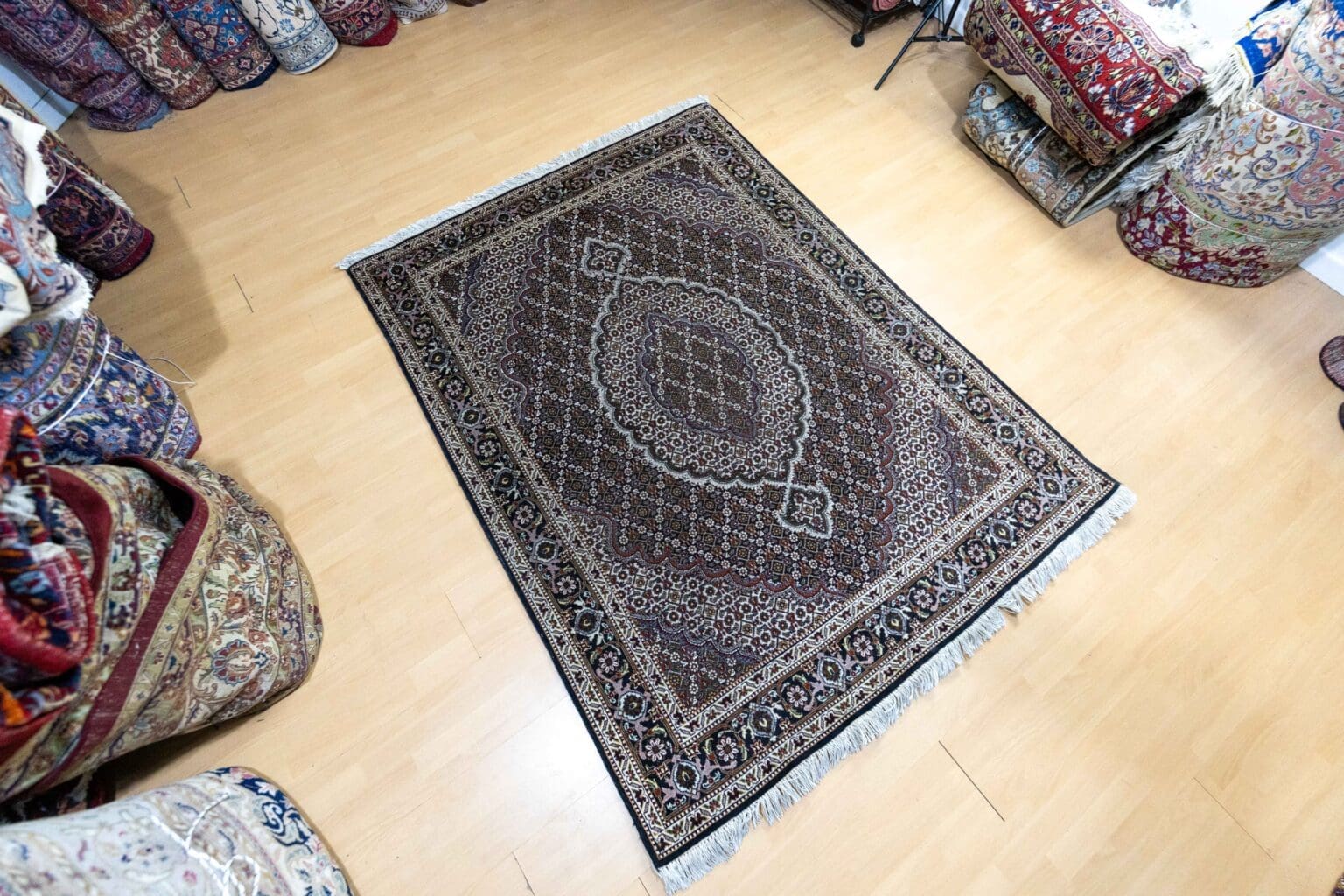
The pattern of this rug is described as Tabriz with a medallion and Mahi fish pattern. These terms identify its main visual features. One describes the central arrangement, while the other names the traditional ornament used in the design. The composition depends on the relationship between them: the medallion establishes the centre, and the fish motifs with their accompanying forms develop and rhythmically organise the surrounding field.
Special Features
The rug is in good condition, has been professionally washed and shows signs of use visible in the photographs. These signs belong to the actual condition of this individual piece and should be considered when viewing it. Professional washing describes its care history, but it does not change the fact that marks from use remain visible. Both the washed condition and the signs of use are part of the rug’s present state.
Its technical features include hand-knotting, a knot density of approximately 200,000 knots per square metre, a pile made from 100% virgin wool and a warp made from 100% cotton. The medallion is combined with the traditional Mahi fish pattern. The properties mentioned for the wool include warmth retention, durability and low static build-up. These details describe the materials and construction without separating them from the rug’s regional design tradition.
The versatile colour arrangement and appealing pattern are described as suitable for both modern and classical interior styles. The rug can therefore be used in different living areas. Its ease of care and durability are also named as practical qualities. Continued preservation benefits from regular, careful maintenance and professional cleaning when necessary, with attention to the wool pile, cotton warp and the visible signs of use.
FAQ
How should I care for the Tabriz Persian rug?
Vacuum the rug regularly and gently to remove dust and loose dirt from the wool pile. If a stain occurs, treat it as soon as possible with a damp cloth and a mild cleaner. Vigorous rubbing should be avoided because unnecessary friction can stress the fibres and affect the surface. Professional cleaning every few years is recommended for thorough care. Since this individual rug has already been professionally washed and has visible signs of use, any further cleaning should be matched to its actual condition and degree of soiling.
Can the rug be used in a room with underfloor heating?
Yes, the rug can be used over underfloor heating. Wool is a good insulator and contributes to a comfortable sense of warmth. Heat should be distributed evenly so that the rug and the room environment are treated gently. A clean, dry and level surface is suitable for use. The rug should not remain damp for a prolonged period. Care should also take the properties of its wool pile and cotton warp into consideration.
What does the fish represent in the Mahi pattern?
The fish in the Mahi pattern is a traditional motif in Persian carpet art. In Persian culture, it is associated with abundance, prosperity and good fortune. As an ornament, the fish is stylised and commonly repeated or integrated into an environment of vines and floral forms. It is therefore not a naturalistic depiction but a culturally established pattern element. In this Tabriz rug, the Mahi motif is combined with the central medallion, linking a reference to nature with inherited symbolism and the structured language of Persian textile design.
To provide the best experiences, we use technologies like cookies to store and/or access device information. Consenting to these technologies will allow us to process data such as browsing behavior or unique IDs on this site. Not consenting or withdrawing consent, may adversely affect certain features and functions.
Functional Always active
The technical storage or access is strictly necessary for the legitimate purpose of enabling the use of a specific service explicitly requested by the subscriber or user, or for the sole purpose of carrying out the transmission of a communication over an electronic communications network.
Preferences
The technical storage or access is necessary for the legitimate purpose of storing preferences that are not requested by the subscriber or user.
Statistics
The technical storage or access that is used exclusively for statistical purposes.The technical storage or access that is used exclusively for anonymous statistical purposes. Without a subpoena, voluntary compliance on the part of your Internet Service Provider, or additional records from a third party, information stored or retrieved for this purpose alone cannot usually be used to identify you.
Marketing
The technical storage or access is required to create user profiles to send advertising, or to track the user on a website or across several websites for similar marketing purposes.
 SECURE PAYMENT
 SHIPPING PARTNERS