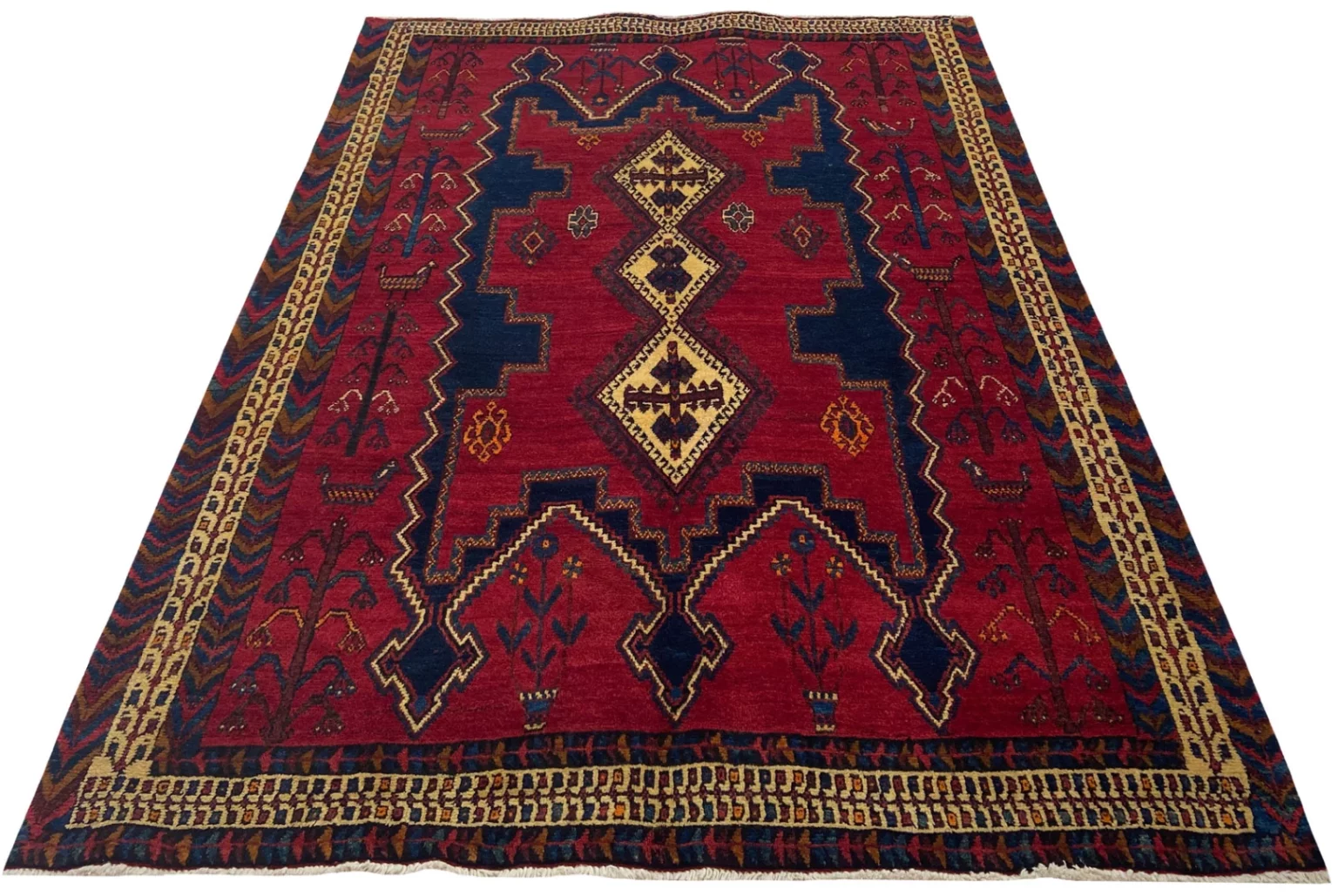
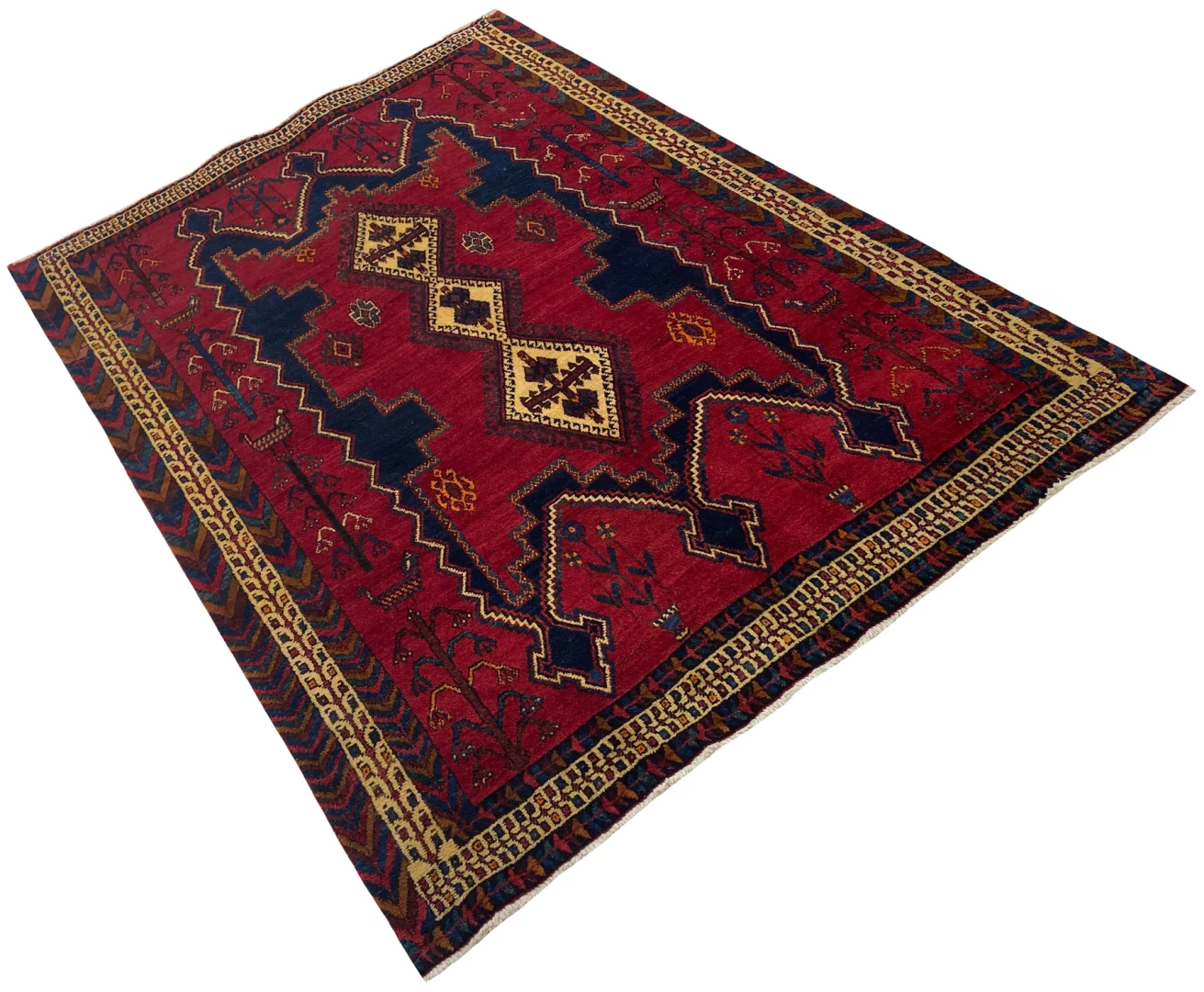
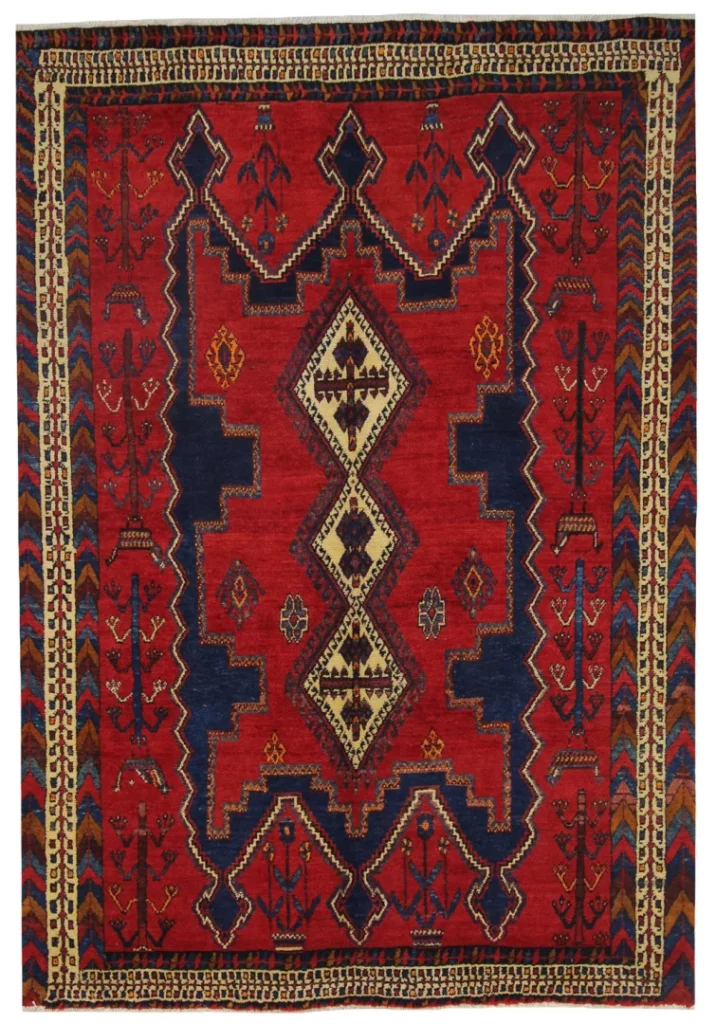
Hand-knotted Sirjan Persian Rug | Material: Wool and cotton | Size: 220 x 155 cm | Pattern: Combination of high pile and Kilim rug | Condition: Very good
This Sirjan Nimbaf is a hand-knotted Persian rug made from wool and cotton. Its construction brings together knotted pile sections and woven Kilim areas. Instead of presenting one uniform surface, it alternates between higher pile and flatter woven passages. The difference in height is a defining feature of this type of rug and gives the surface a distinctly three-dimensional character.
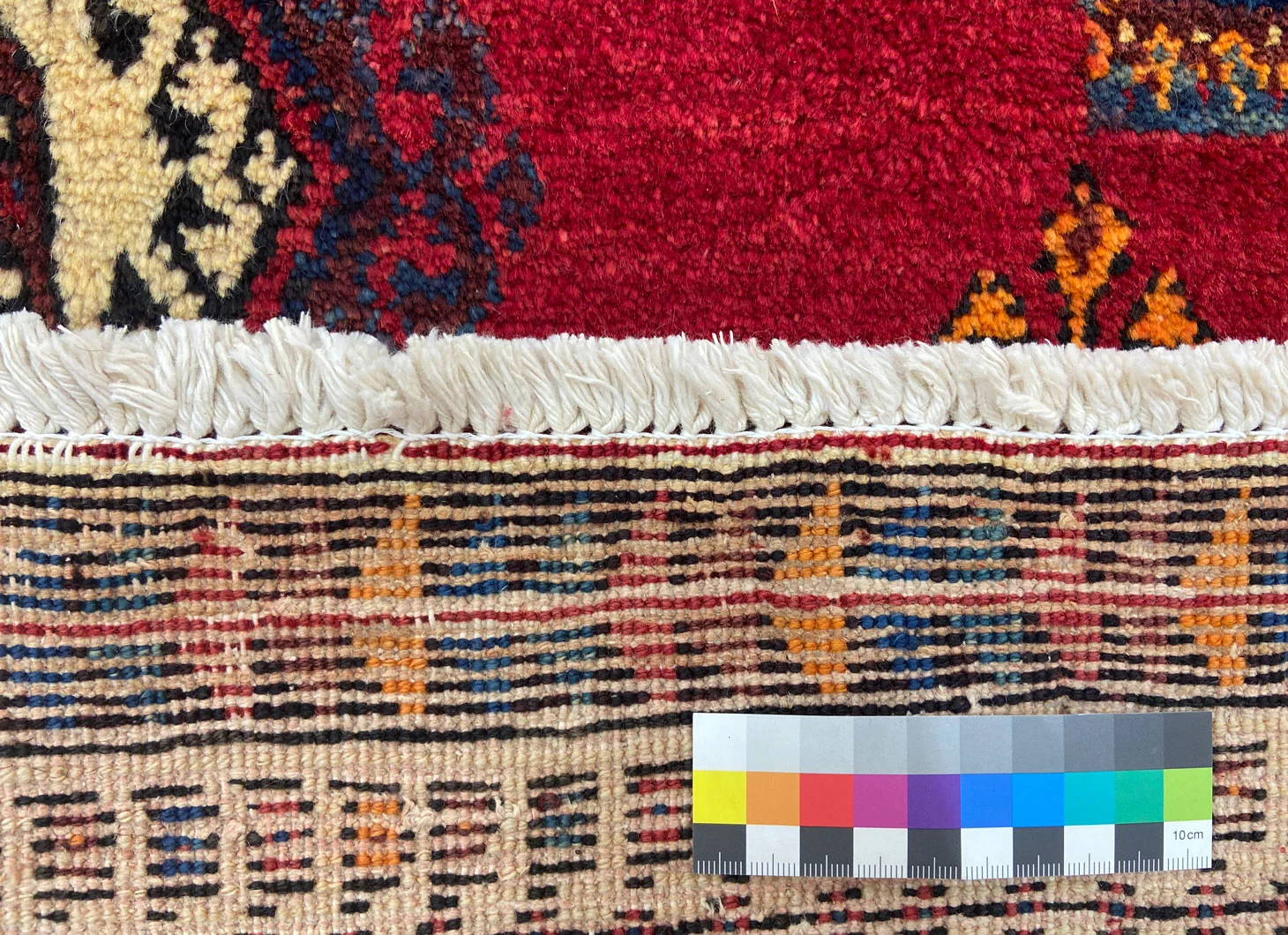
Soft sheep wool is used for the knotting technique. Wool provides the knotted areas with a soft feel and supports a hard-wearing textile surface. Cotton is also part of this rug’s stated material composition. Together, the two fibres form the basis for a piece in which knotting and weaving are deliberately combined rather than treated as separate decorative details.
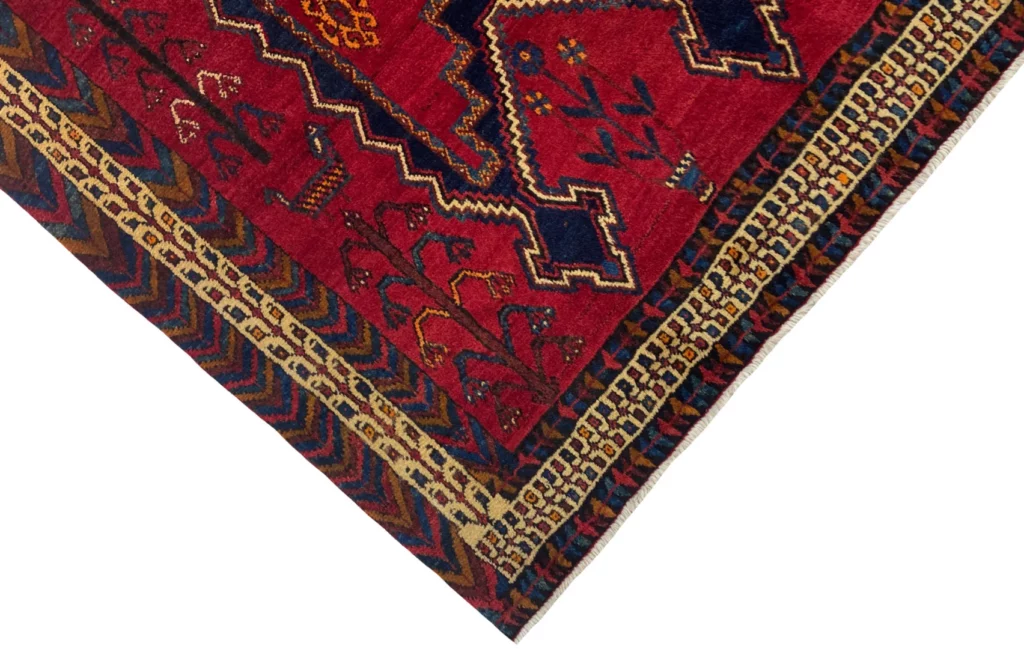
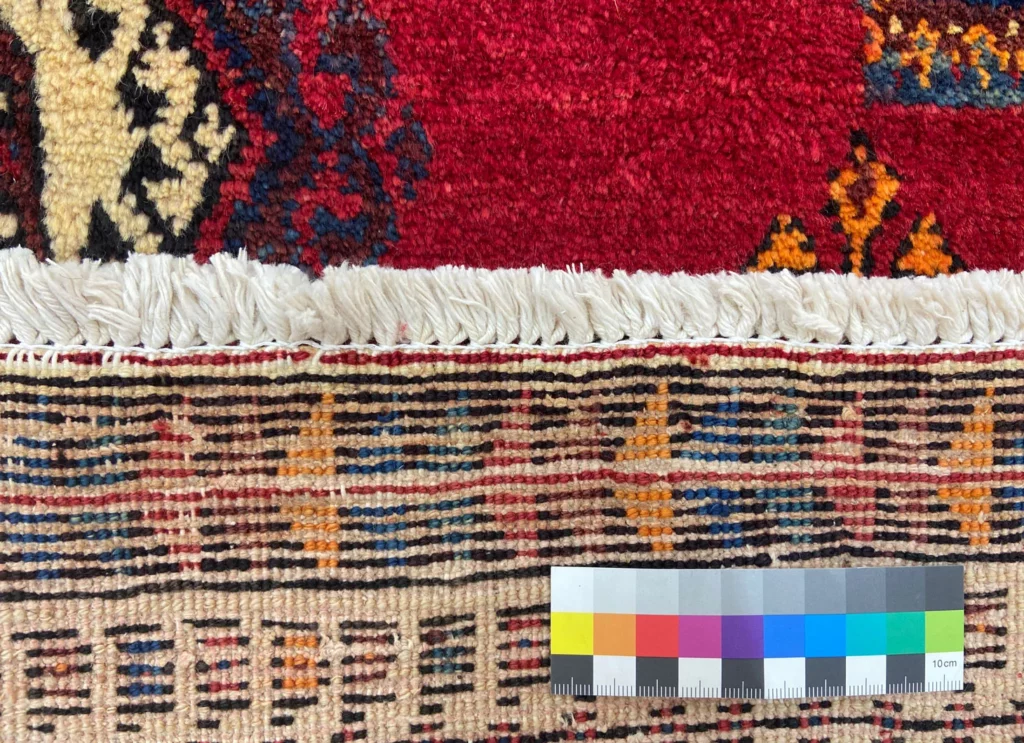
In the knotted sections, individual threads are inserted into the textile foundation and compacted to create pile. A Kilim is built differently: its design is formed by weaving, with the interlaced threads creating a flat textile surface. The Sirjan Nimbaf makes this distinction easy to see and feel. Raised pile and woven sections sit alongside one another, producing a surface with clear relief.
The construction can be experienced underfoot as well as seen from above. The high-pile areas feel softer and more substantial, while the woven passages retain a flatter texture. This contrast is central to the Nimbaf form associated with Sirjan. Hand-knotting, the use of wool and cotton, and the inclusion of Kilim weaving all contribute to the way the finished surface is built.
The workmanship also explains why the rug has a different appearance from a conventional flat-weave Kilim or from a rug with an even pile throughout. Each technique contributes its own visual and tactile quality. The result is a textile whose design is created through structure as much as through colour and line.
Origin and Tradition
This rug comes from Sirjan in the southern Fars region of Iran. Fars is one of Iran’s established textile and rug-making regions, known for a broad range of weaving and knotting traditions. Its rug culture reflects the coexistence of workshop production and long-established knowledge passed through different local communities. For that reason, rugs connected with Fars cannot be reduced to one single visual formula.
Sirjan belongs to a cultural setting in which woven and knotted textiles have developed side by side. A Kilim is made on a loom, with the weft threads creating the visible design. A knotted rug, by contrast, builds its pile through individual knots tied into a foundation. A Sirjan Nimbaf brings these two principles together. The change in technique accounts for the changing surface height and the relief that distinguishes it from a completely flat textile.
The weaving traditions of Fars have historically served both practical and expressive purposes. Textiles could be used as household furnishings and floor coverings while also carrying regional approaches to colour, structure and pattern. Techniques varied according to the place of production, the makers’ experience and the intended textile form. Knowledge of fibre preparation, tension, knotting, weaving and surface finishing was essential to producing a coherent piece.
Fars is also associated with several other Iranian rug traditions. Kerman rugs are known for intricate designs and fine detail, while Yazd rugs often feature geometric arrangements. Qashqai rugs are widely recognised for vivid colours and robust materials. These traditions illustrate the diversity found in Iranian rug making, but they should not be confused with one another. The origin of this particular rug is Sirjan, within the southern Fars region.
The name Sirjan therefore identifies the regional background of this rug. Nimbaf refers to the distinctive union of weaving and knotting. It does not describe an ordinary flat Kilim alone, nor does it refer to a uniformly knotted pile rug. The place and the technique complement one another: Fars provides the cultural setting, Sirjan the regional attribution, and Nimbaf the description of the mixed construction.
Persian rug making traditionally involves a sequence of skilled operations. Fibres are selected and prepared, a foundation is established, and the visible surface is built through knotting or weaving. The surface may then be arranged so that the structure reads clearly across the whole piece. When high pile and Kilim areas are combined, the transitions between them must become part of the overall textile design. Craft tradition is consequently expressed through construction as well as through ornament.
The region’s importance lies in this variety of textile knowledge. A Fars rug may communicate its identity through materials, technique, colour relationships or the way its surface is organised. This Sirjan Nimbaf is particularly defined by the meeting of two methods. Its regional history is not an added label placed on top of the object; it is connected with the way the rug is conceived as a woven and knotted textile.
Design and Pattern
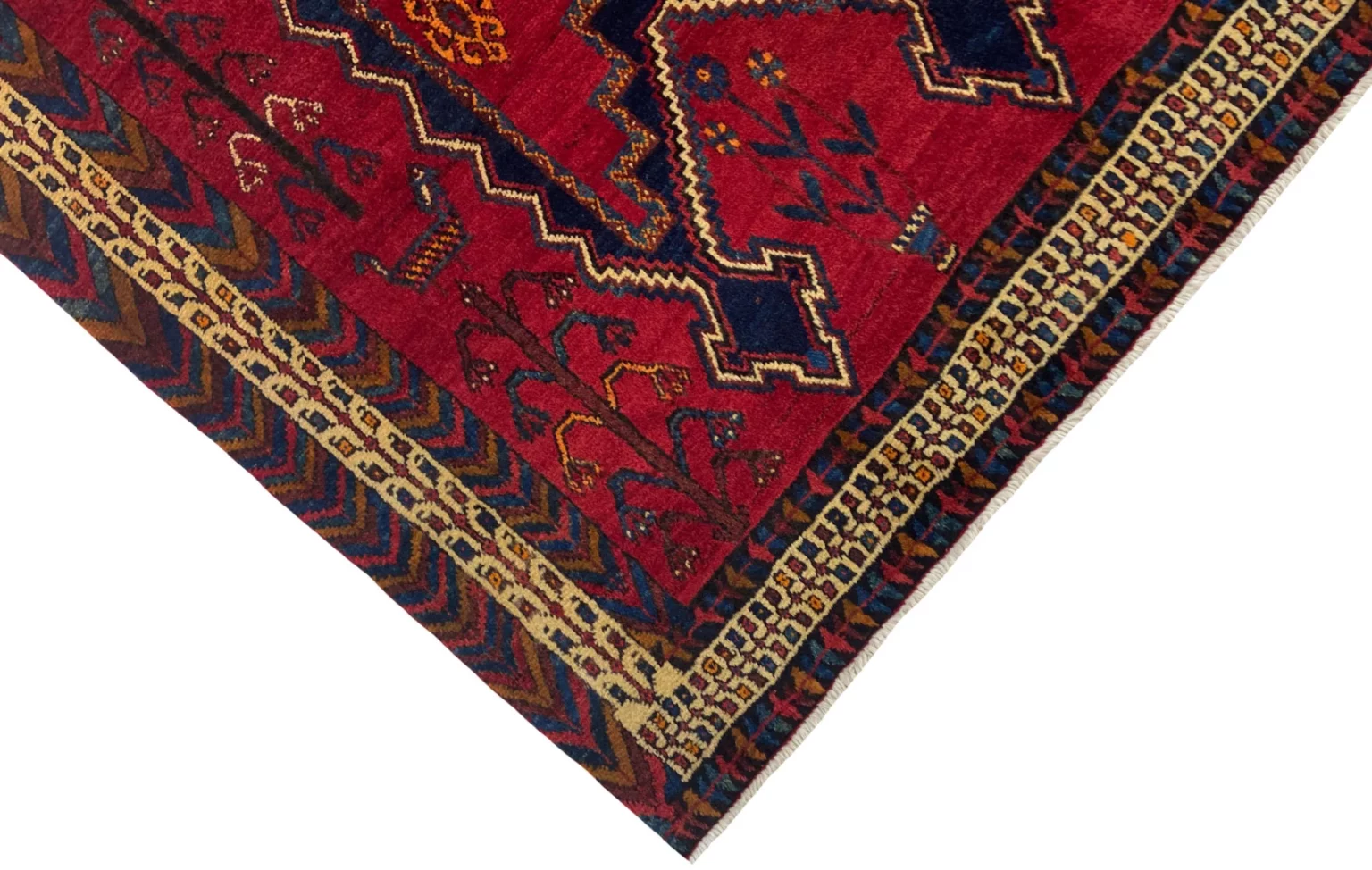
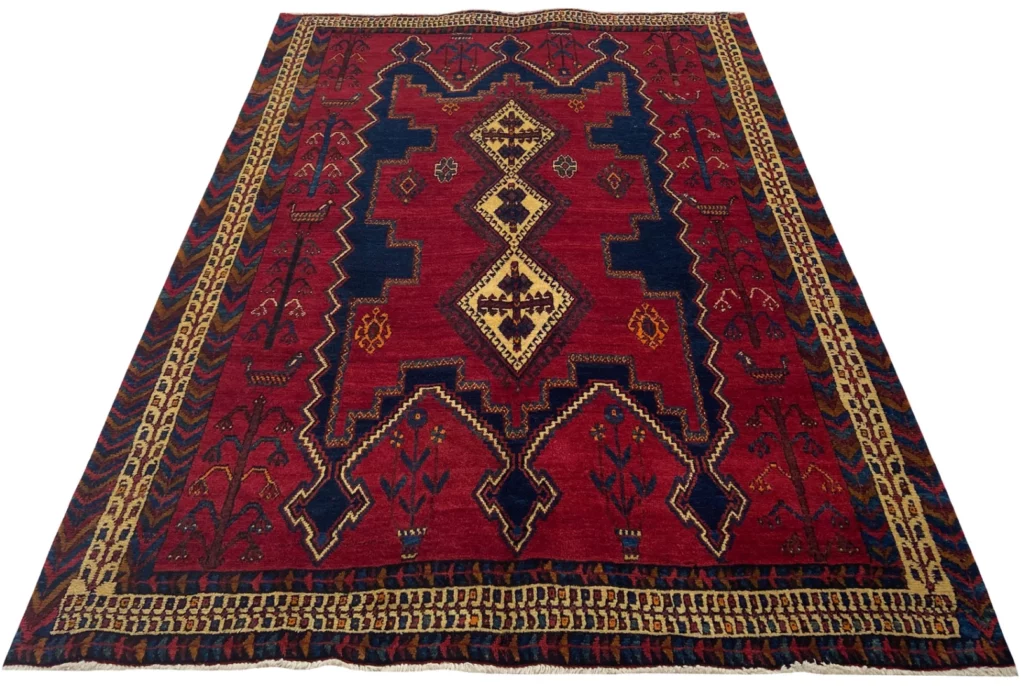
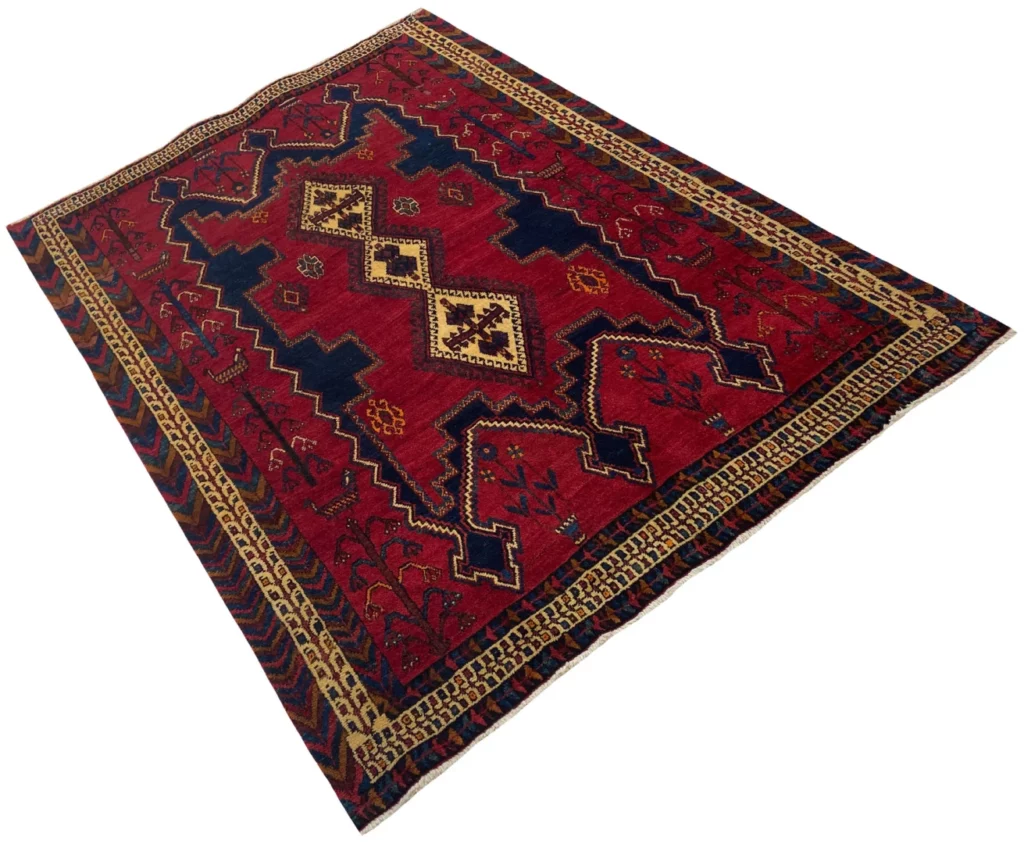
The main design feature of this Sirjan Nimbaf is the combination of high pile and Kilim rug sections. The surface is divided into areas with visibly different structures. Raised portions stand above flatter woven passages, creating a pattern that is read through texture as well as through colour. The three-dimensional appearance is therefore a direct result of the construction rather than a separate ornament applied after the rug was made.
Changes in light and viewing angle can make the relief more apparent. The higher pile catches attention differently from the flatter woven areas, while the transitions give the overall field additional rhythm. The tactile contrast remains present even when the rug is viewed without close inspection. This is what makes the design distinctive: the pattern is part of the surface architecture.
The traditional colour range associated with Sirjan rugs includes deep reds, gentle blues, and earthy beige and brown tones. These colours can be combined harmoniously and support the visual separation between the different textile areas. Darker and lighter passages may make variations in height easier to perceive. Colour and material consequently work together, with neither one functioning independently from the rug’s relief.
Iranian rug patterns are often connected with the culture and traditions of their region. In this rug, the defining point is not a single named motif but the way two forms of textile production are integrated. The woven areas relate to the established Kilim tradition, while the knotted high-pile sections add softness and volume. The design is thus experienced through the contrast between a flatter plane and a more pronounced pile.
This construction can sit within both traditional and contemporary interiors. Its appearance comes from a long-established craft vocabulary, while the strongly differentiated surface gives it a clear presence in a modern setting as well. In a living room, the rug can function as a structured textile field. In a bedroom, the softer high-pile sections become especially noticeable. In a hallway, the relief can serve as a decorative feature without requiring a separate ornamental frame.
The rug remains recognisably handmade because its character depends on the interaction of knotting, weaving, fibre and colour. It is not defined by a mechanically uniform surface. Instead, its visual effect comes from the deliberate presence of different heights and textures. The description of the piece as exotic refers to this unusual combination of regional Persian craft, mixed construction and pronounced surface relief.
Pattern and technique are inseparable in a Nimbaf. A purely flat design would not communicate the same qualities, and an uninterrupted pile would remove the contrast that gives the form its identity. The woven and knotted passages create a measured variation across the textile. That variation is both decorative and structural, allowing the rug to be recognised through its construction even before its regional background is considered.
Special Features
The most notable feature of this rug is its three-dimensional effect. It is produced by the contrast between high pile and woven Kilim sections and can be seen as well as felt. This makes the Sirjan Nimbaf different from a rug with one consistent pile height. The mixed construction reveals the handwork directly and gives the surface a varied tactile character.
Sirjan Nimbaf rugs are not widely available and are regarded as a rare form within Persian rug making. This piece is in very good condition. Regular vacuuming is recommended as part of its care, while occasional professional cleaning helps maintain the textile surface. Direct sunlight should be avoided because it can cause the colours to fade.
The rug’s structure can also contribute to the comfort of a room. The varying pile heights make it pleasant to walk on and may provide an insulating textile layer. It can be used in living rooms, bedrooms or hallways. Its design is compatible with both traditional furnishing schemes and more contemporary interiors.
FAQ
What makes a Sirjan Nimbaf distinctive?
A Sirjan Nimbaf combines woven Kilim sections with knotted high-pile areas. This change of technique gives the rug a textured surface and a three-dimensional appearance. Its distinction therefore lies not only in its colour palette, but above all in its construction. The combination is relatively rare within Persian rug making and appeals to people who value traditional handwork together with an unusual tactile structure.
How should a Sirjan Nimbaf be cared for?
The rug should be vacuumed regularly so that dust and loose particles do not remain in the different pile heights. Occasional professional cleaning is recommended for more thorough care. Direct sunlight should be avoided because prolonged exposure may fade the colours. Any cleaning process should take the mixed construction into account, since the high-pile areas and woven Kilim sections require careful handling.
Where can a Sirjan Nimbaf be used?
The rug is suitable for living rooms, bedrooms and hallways. In a living room, its relief can act as an independent textile design element. In a bedroom, the soft feel of the high-pile sections becomes particularly apparent. In a hallway, the contrast between woven and knotted areas can provide a decorative feature. The design works with traditional interiors as well as with modern furnishing concepts.
To provide the best experiences, we use technologies like cookies to store and/or access device information. Consenting to these technologies will allow us to process data such as browsing behavior or unique IDs on this site. Not consenting or withdrawing consent, may adversely affect certain features and functions.
Functional Always active
The technical storage or access is strictly necessary for the legitimate purpose of enabling the use of a specific service explicitly requested by the subscriber or user, or for the sole purpose of carrying out the transmission of a communication over an electronic communications network.
Preferences
The technical storage or access is necessary for the legitimate purpose of storing preferences that are not requested by the subscriber or user.
Statistics
The technical storage or access that is used exclusively for statistical purposes.The technical storage or access that is used exclusively for anonymous statistical purposes. Without a subpoena, voluntary compliance on the part of your Internet Service Provider, or additional records from a third party, information stored or retrieved for this purpose alone cannot usually be used to identify you.
Marketing
The technical storage or access is required to create user profiles to send advertising, or to track the user on a website or across several websites for similar marketing purposes.

 SECURE PAYMENT
 SHIPPING PARTNERS


