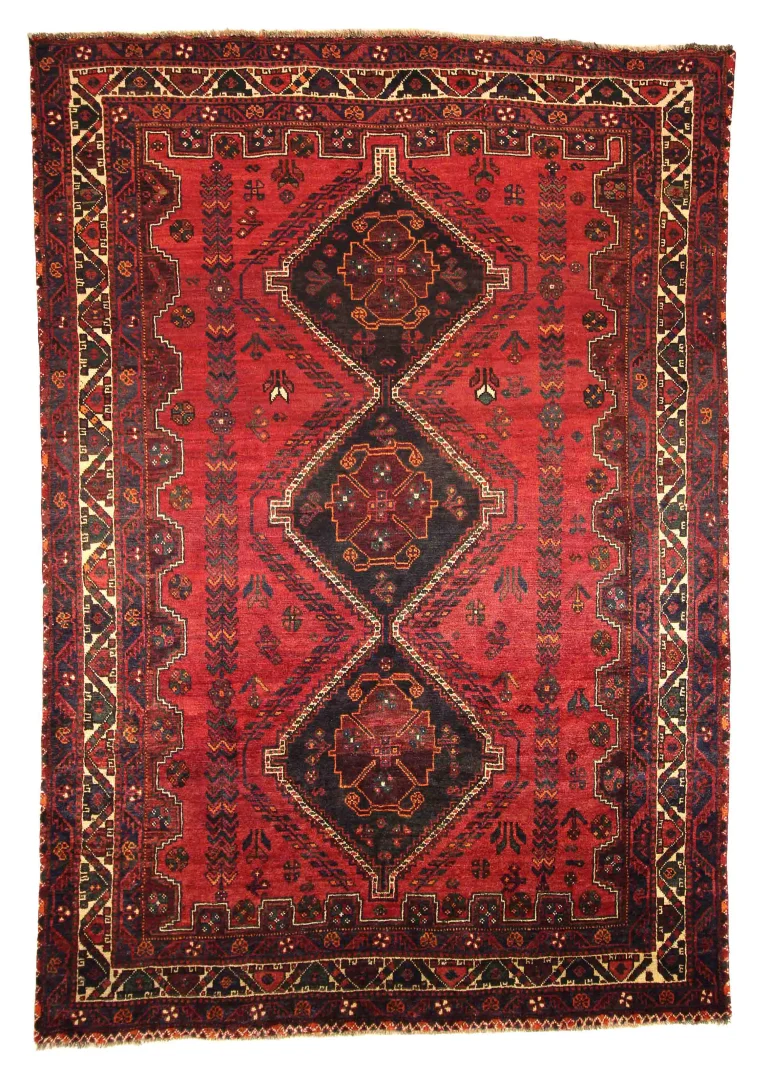
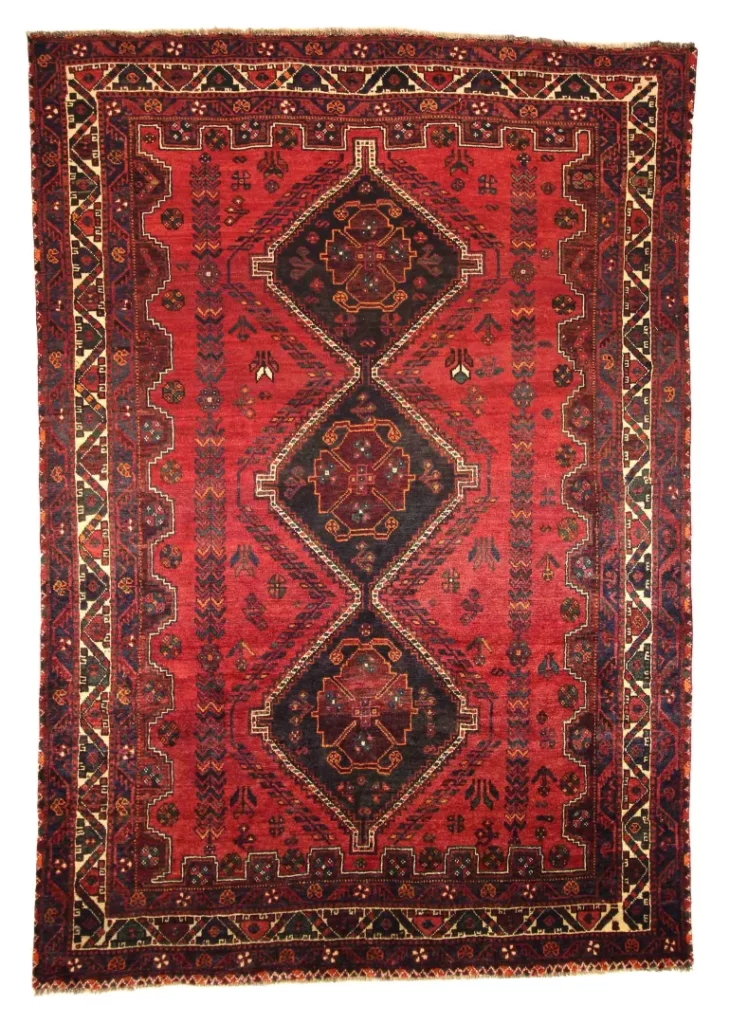
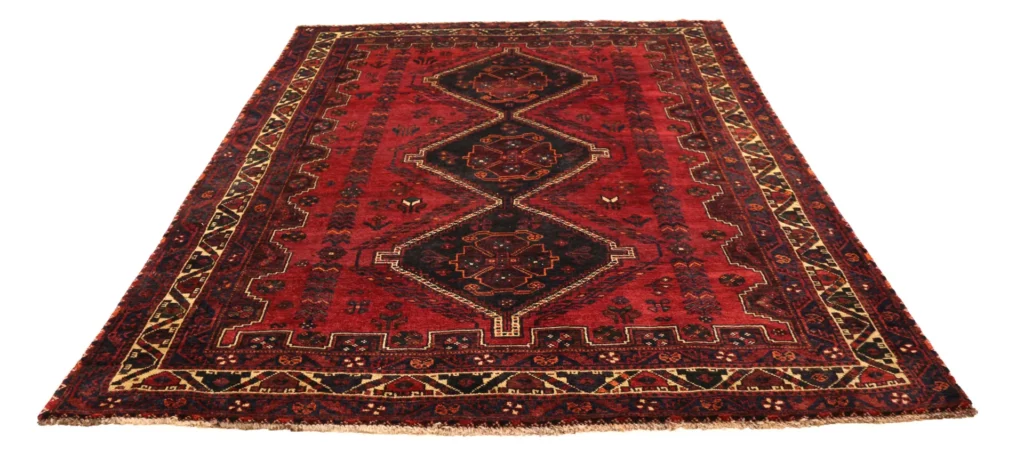
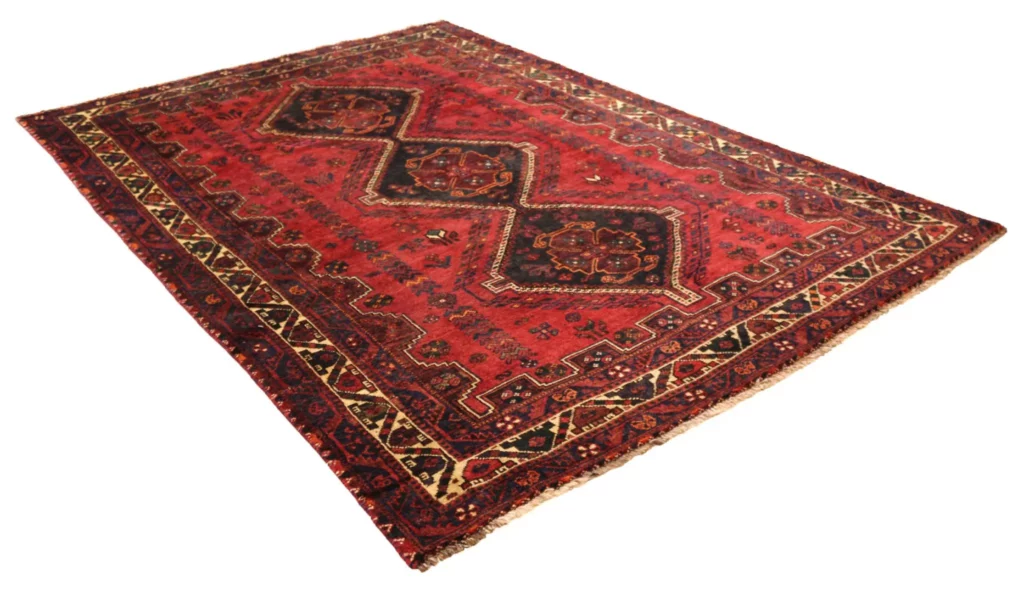
Hand-knotted Shiraz Persian Rug | Knot density: 100,000 – 180,000 knots/m² | Material: Natural wool pile | Size: 303 x 215 cm | Pattern: Geometric ornaments | Colours: Shades of red and brown | Condition: Very well preserved
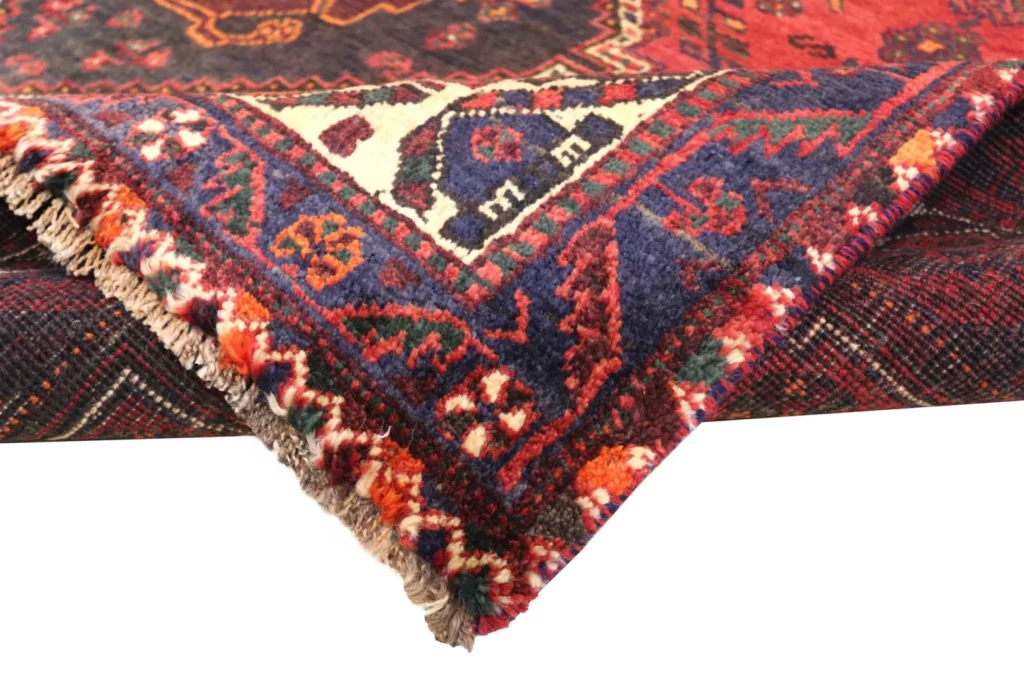
This Shiraz Persian rug is hand-knotted with natural wool forming the pile. Wool has been a traditional rug material for centuries because it combines a soft feel with natural resilience. The fibre can absorb and release moisture from the surrounding air, which may help create a comfortable indoor climate. It also provides warmth underfoot and gives the surface a distinctly textile character. These qualities explain why wool remains central to many Persian and regional rug-making traditions.
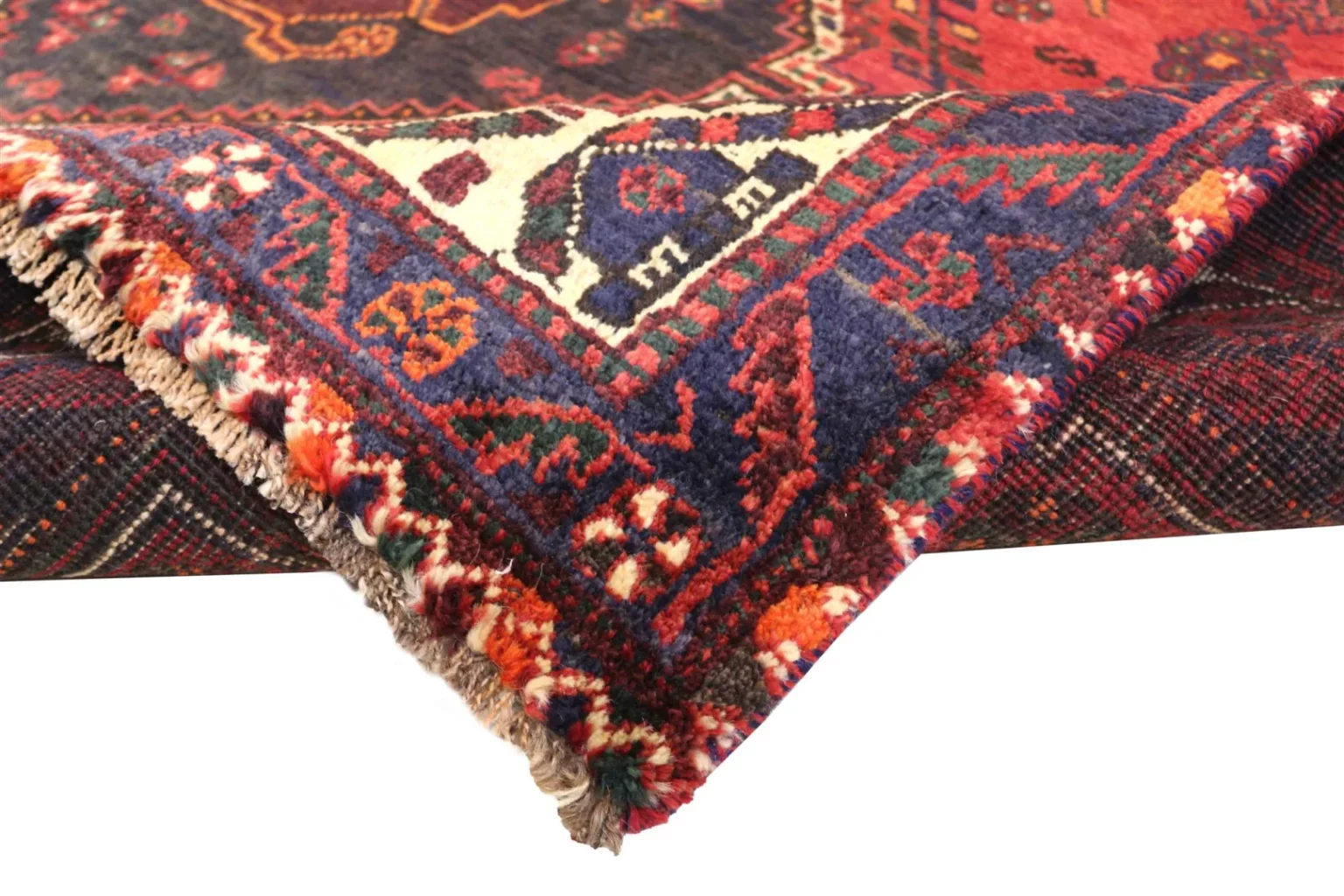
Hand-knotting is a gradual process in which each knot is inserted into the foundation individually. Rows of coloured pile yarn are built up and compacted, after which the surface is worked so that the pattern becomes clear. This method differs from machine production, where the structure is produced mechanically and uniformly. Hand craftsmanship requires familiarity with the material, control of the knotting technique and attention to the relationship between the design and the pile. Small variations are a normal part of a handmade textile.
The knot density of this rug is between 100,000 and 180,000 knots per square metre. Knot density describes how closely the knots are placed; it should not be confused with pile height or total weight. A higher density can support finer lines and more closely defined ornaments. In a geometric design, careful knotting helps preserve the rhythm and boundaries of the forms. Natural wool also affects the appearance of the colours, giving them a tactile depth that belongs to a woven and knotted surface rather than a printed one.
Wool is valued in everyday use for its durability and its ability to retain warmth. Its fibrous surface can absorb sound and may therefore contribute to room acoustics. It remains breathable while providing a comfortable feeling underfoot. These technical qualities accompany the handmade construction. They are general properties of wool and do not imply a particular treatment or finishing method for this individual rug.
Origin and Tradition
Shiraz is located in southern Iran and is the principal city of the historic Fars region. It is associated with a long cultural history, gardens, poetry and its proximity to Persepolis. Persepolis was the ceremonial centre of the ancient Achaemenid Empire and is one of Iran’s major archaeological sites. This historical setting forms part of the cultural background of Shiraz and of the crafts produced in the wider region.
The rug traditions of Fars developed among communities with different ways of life. Urban workshops existed alongside rural and nomadic production. As a result, the region has no single design language that accounts for every rug associated with Shiraz. Instead, its traditions share a broad interest in handwork, natural wool, strong colour relationships and geometric organisation. Regional identity can therefore be expressed through several related but distinct approaches to structure and decoration.
Persian rugs from Shiraz belong to a culture in which textile knowledge was passed from one generation to the next. This knowledge includes preparing wool, building the foundation, interpreting a design, arranging colour and finishing the pile. The maker’s experience is visible in the way a pattern is translated into rows of individual knots. Rug making is consequently both a practical craft and a form of cultural continuity. A hand-knotted rug takes shape through many stages rather than through a single industrial operation.
Ghashghai rugs are often discussed in connection with rugs from Shiraz. The Ghashghai are a Turkic-speaking people of southern Iran, and their rugs are known for complex geometric compositions, vivid colours and distinctive ornament. Designs may be remembered and adapted rather than transferred from a fully pre-drawn plan. Such a working method can produce a lively and individual arrangement, with variations from one rug to another. The relationship between the traditions explains why some Shiraz designs resemble nomadic work, but it does not turn every Shiraz rug into a Ghashghai rug.
Qashqai and Khamseh rugs are also associated with Fars. These traditions are known for lively colours, wool construction and inherited patterns. Nomadic designs often translate plants, animals and symbolic forms into simplified geometry. Diamonds, hooked shapes, angular lines and stepped figures may become recurring elements. The meaning of a particular sign depends on its cultural setting, and no single interpretation applies to every use of a motif.
Historically, rugs in the region served practical purposes as well as decorative ones. They could provide insulation, cover a floor and form part of a movable household. At the same time, they preserved knowledge about colour, composition and local identity. Urban rugs might use more systematically planned arrangements, while nomadic pieces could rely on memory and a freer balance of forms. These approaches are not mutually exclusive; together they contribute to the broad history of Persian rug making in Fars.
Shiraz therefore represents a distinct regional context within Iranian rug production. Its tradition is shaped by the interaction of urban culture, regional trade and nomadic craftsmanship. Natural wool and handwork remain central reference points, while geometric ornament and strong colour combinations provide a recognisable visual vocabulary. The historical significance of Fars gives Shiraz rugs a place within the wider development of Persian textiles without reducing the region to a single fixed pattern.
Design and Pattern
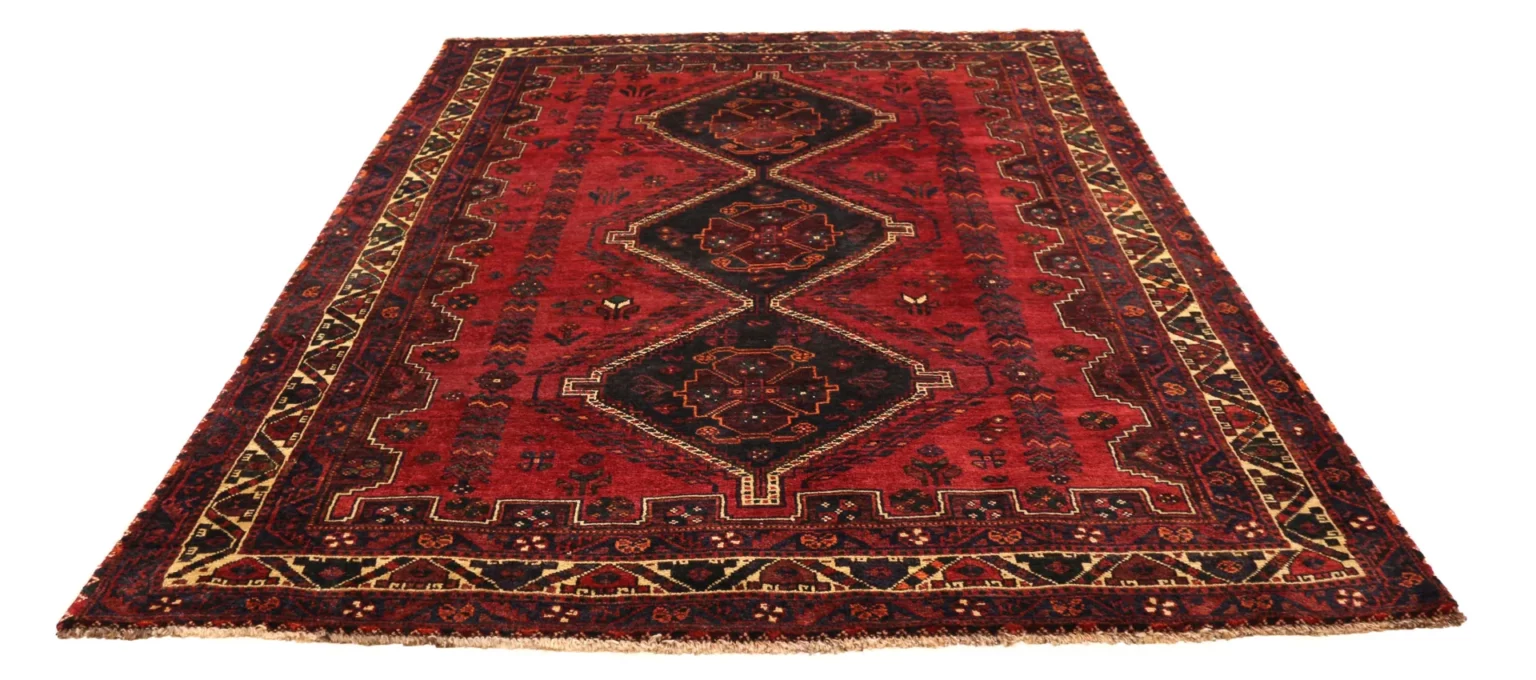
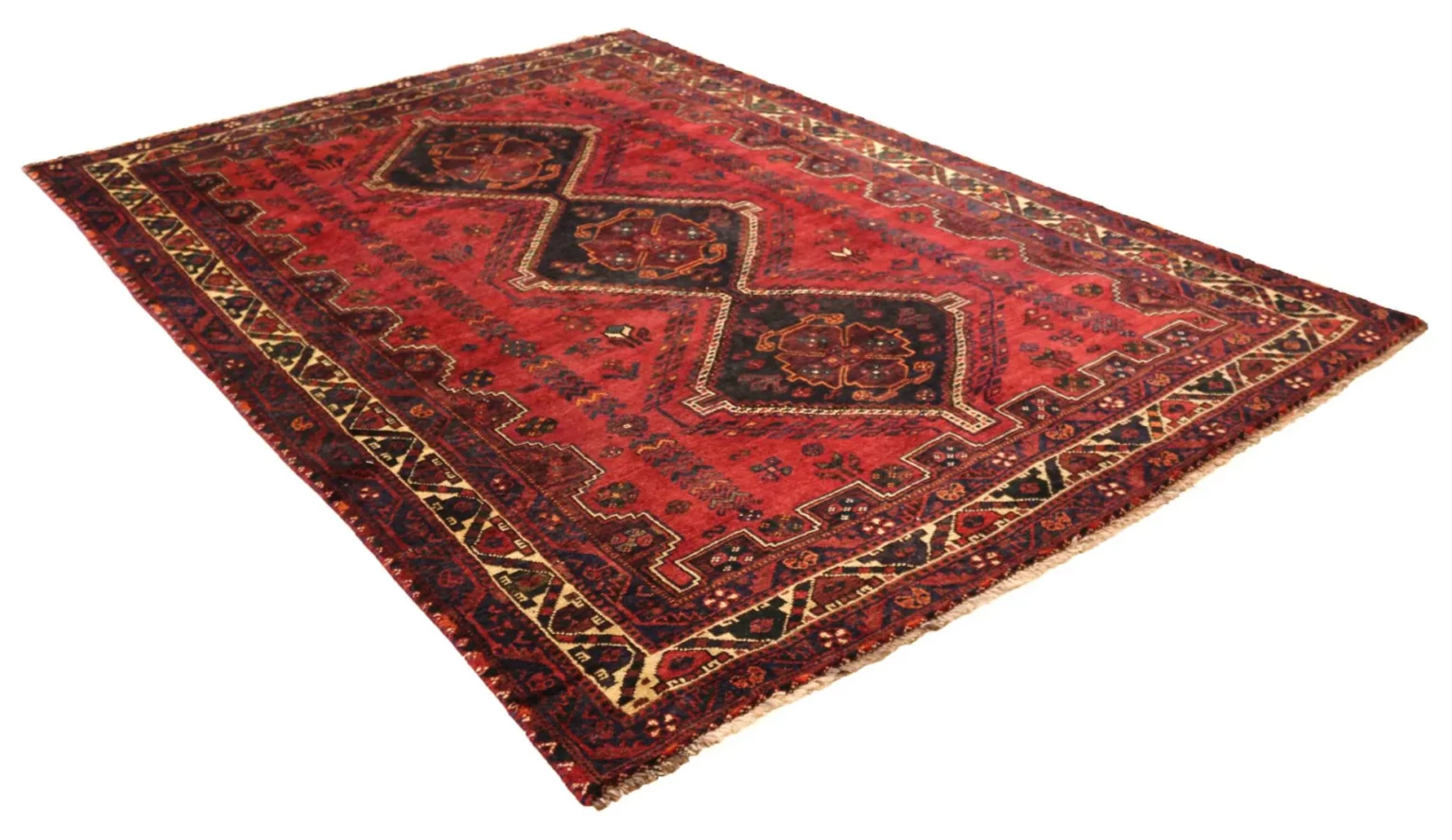
The pattern of this rug consists of geometric ornaments. Geometric designs organise a field through repeated forms, lines and directional movement. A composition may use a central field, a border or several groups of related motifs. The exact arrangement varies from rug to rug. In a hand-knotted piece, the ornament is not printed onto the pile; it is created through the placement of individual knots, so each line and contour is the result of many small decisions during production.
Geometric ornament has a long history in Iranian rug traditions. Natural forms can be simplified into diamonds, hooks, angles, stepped lines and abstract figures. Once reduced to basic shapes, a motif can be repeated and combined into a rhythm across the field. This gives the design visual order while allowing the maker to introduce slight differences through handwork. Geometry is therefore not only a decorative choice; it is also a method of structuring the surface.
The colour scheme of this rug uses shades of red and brown. Red is a frequent colour in Persian rugs and may range from deep, subdued tones to brighter nuances. Brown introduces an earthy range associated with soil, wood and natural landscapes. Together, the two colour families can create a warm and coherent impression. They also help separate the various parts of a geometric pattern and give the ornaments a readable relationship with the surrounding field.
Traditional rug making in Iran has often used dyes derived from plants, roots, bark and other natural sources. Different recipes and preparation methods produce different shades. The final result can depend on the wool, the water, the length of dyeing and the treatment after colouring. Light also changes how a colour is perceived over time. This is part of the general history of Persian dyeing and does not establish a particular dye source or process for this individual rug.
Regional rugs from Fars often combine strong outlines with a rhythmic distribution of motifs. Nomadic influences may favour direct, simplified forms, while urban traditions can place more emphasis on a carefully planned division of the field and border. In actual practice these influences overlap. A Shiraz rug may therefore appear firmly ordered, freely composed or somewhere between the two. The regional tradition is broad enough to include more than one approach to geometry.
Qashqai, Khamseh and Ghashghai traditions are associated with inherited geometric signs and strong combinations of colour. Motifs can be passed through a community and adjusted by successive makers. Similar elements may consequently appear in several rugs without producing identical compositions. Handwork preserves the general idea of a design while allowing individual interpretation in scale, spacing and detail. This is one reason regional rugs can be recognised as related while remaining visibly distinct from one another.
The warm palette and clear geometry can be placed in both traditional and contemporary interiors. Red and brown shades work with wood, leather, neutral textiles and understated surfaces. They can also complement a more classic room by echoing existing warm colours. This flexibility comes from the balance between the ornament and the colour group. It does not remove the regional identity of the Shiraz design, which remains rooted in the visual traditions of Fars.
Special Features
The rug is very well preserved. Its hand-knotted construction, natural wool pile and geometric ornament connect practical use with the traditional craftsmanship of Shiraz. The knot density is between 100,000 and 180,000 knots per square metre and describes the compactness of the handmade surface. Shades of red and brown determine the colour impression. The design belongs to the wider regional context of Fars and its varied Persian rug traditions.
Natural wool is breathable and provides comfortable warmth underfoot. Its textile surface may also help with room acoustics. Regular vacuuming is recommended for care. Spills should be treated immediately with a damp cloth and a mild cleaning product. Professional rug cleaning is also advisable. Shiraz rugs are generally considered suitable for underfloor heating because wool offers good thermal insulation while remaining breathable.
FAQ
What makes a Shiraz Persian rug distinctive?
A Shiraz Persian rug brings together hand-knotted workmanship, natural wool and the regional design culture of Fars. Geometric ornaments give the surface a clear structure, while shades of red and brown create a warm colour relationship. The Shiraz tradition developed in a setting where urban, rural and nomadic influences met. It is often discussed alongside the rug traditions of the Ghashghai, Qashqai and Khamseh. Those connections describe the wider regional background rather than assigning every rug to one of those groups. In this rug, the documented knot density and very well-preserved condition are additional characteristics.
How should I care for my Shiraz Persian rug?
A Shiraz Persian rug should be vacuumed carefully and regularly as part of normal maintenance. This removes loose dust and particles before they remain in the wool pile. If a stain occurs, treat it promptly with a damp cloth and a mild cleaning product. Work gently and avoid vigorous rubbing, which can put unnecessary stress on the surface. For a deeper treatment or persistent soiling, professional rug cleaning is recommended. A specialist can take the natural wool and hand-knotted construction into account when selecting a suitable cleaning method.
Are Shiraz rugs suitable for underfloor heating?
Shiraz rugs are generally suitable for underfloor heating. Natural wool provides good thermal insulation while remaining breathable. A wool rug can therefore complement the heat rising from the floor and still provide a comfortable feeling underfoot. The fibre can also contribute to a pleasant indoor climate. Heat should be distributed evenly when a rug is used over underfloor heating. The exact installation and operation also depend on the heating system, so the manufacturer’s recommendations should be followed.
To provide the best experiences, we use technologies like cookies to store and/or access device information. Consenting to these technologies will allow us to process data such as browsing behavior or unique IDs on this site. Not consenting or withdrawing consent, may adversely affect certain features and functions.
Functional Always active
The technical storage or access is strictly necessary for the legitimate purpose of enabling the use of a specific service explicitly requested by the subscriber or user, or for the sole purpose of carrying out the transmission of a communication over an electronic communications network.
Preferences
The technical storage or access is necessary for the legitimate purpose of storing preferences that are not requested by the subscriber or user.
Statistics
The technical storage or access that is used exclusively for statistical purposes.The technical storage or access that is used exclusively for anonymous statistical purposes. Without a subpoena, voluntary compliance on the part of your Internet Service Provider, or additional records from a third party, information stored or retrieved for this purpose alone cannot usually be used to identify you.
Marketing
The technical storage or access is required to create user profiles to send advertising, or to track the user on a website or across several websites for similar marketing purposes.
 SECURE PAYMENT
 SHIPPING PARTNERS


