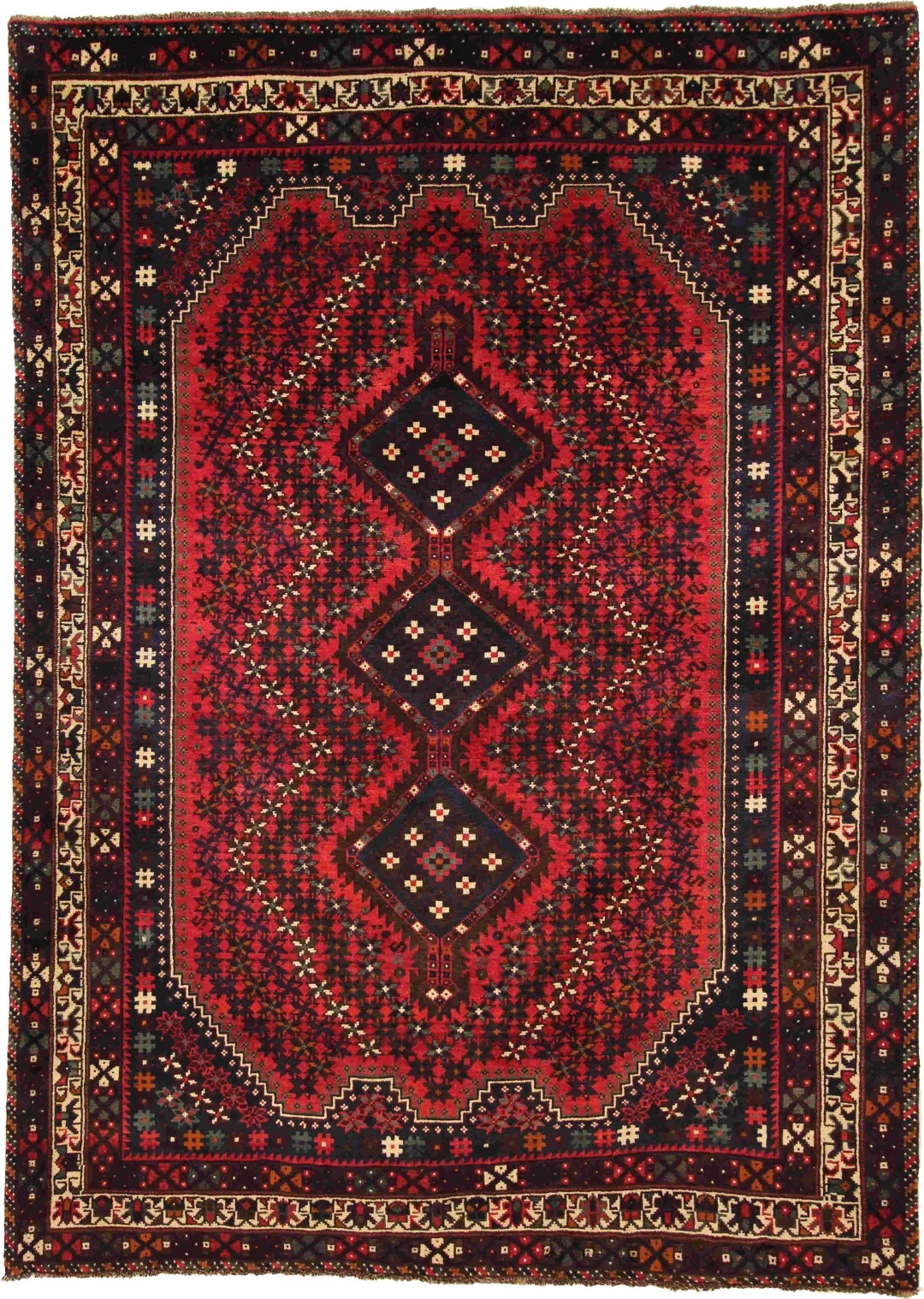
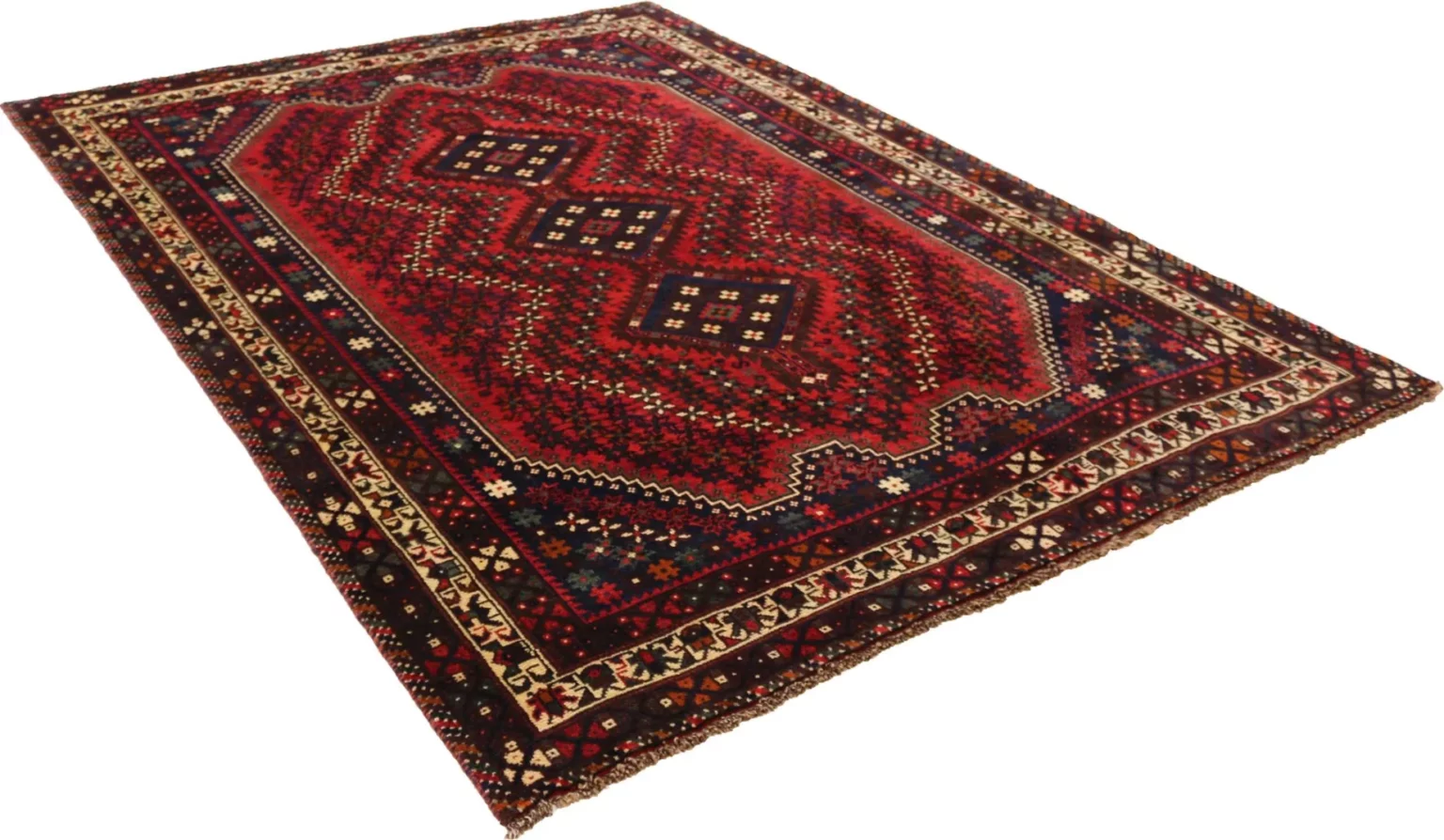
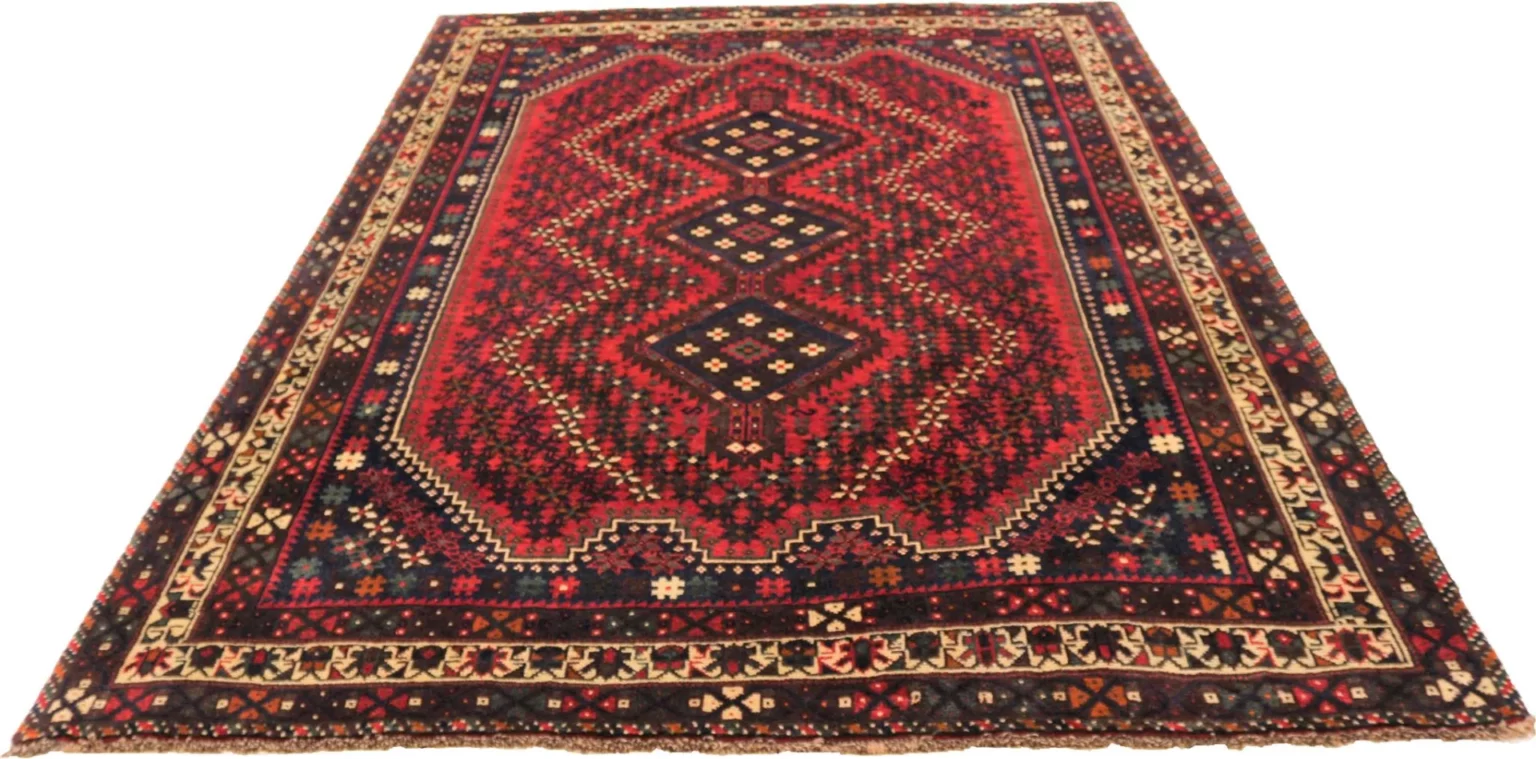
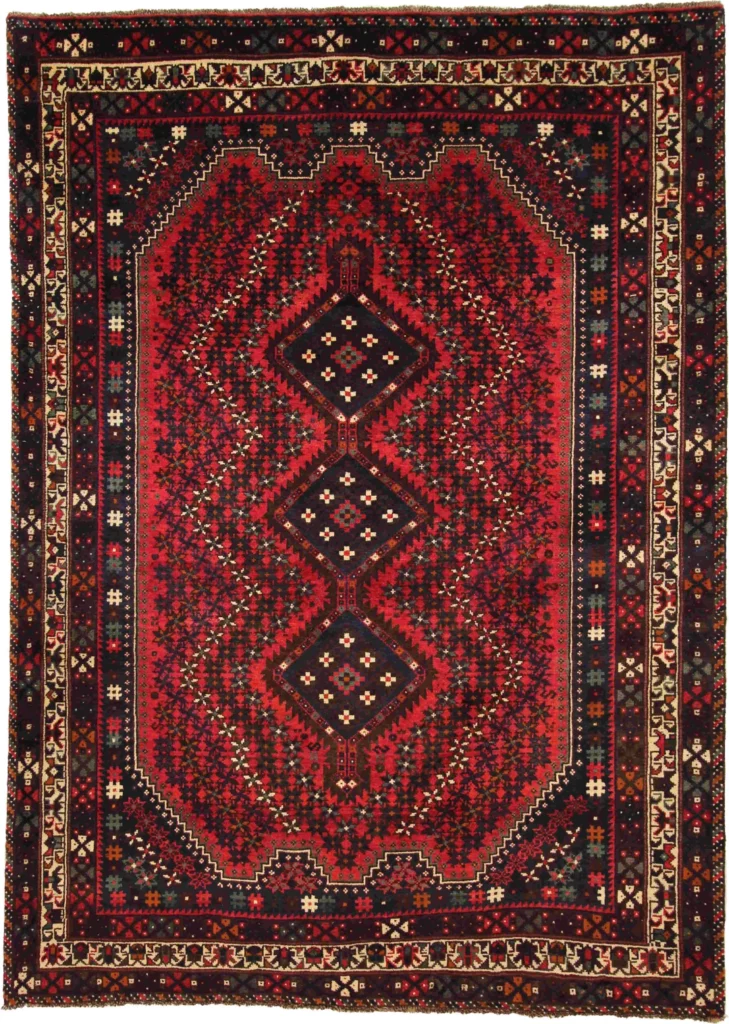
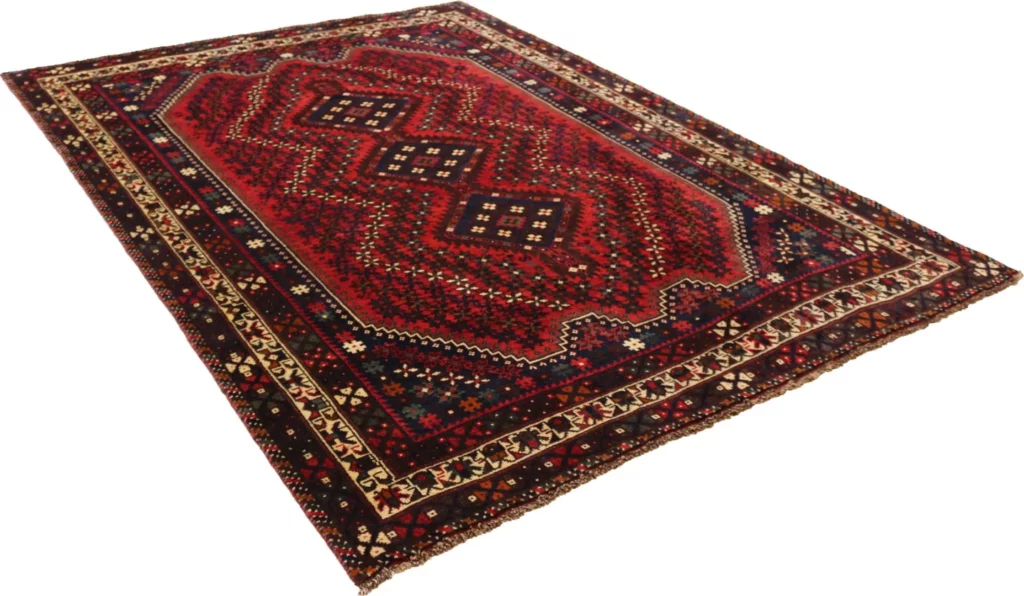
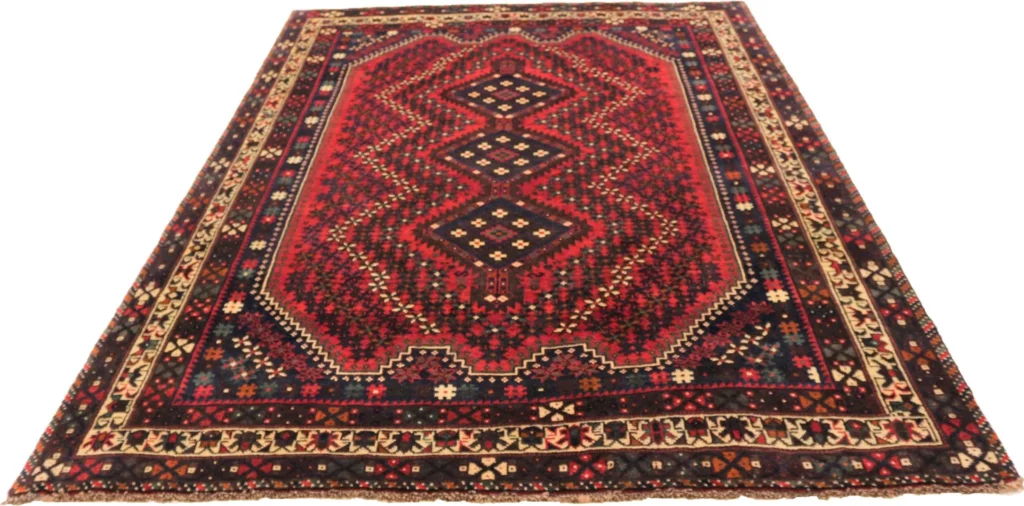
Hand-knotted Shiraz Persian rug | Knot density: 100,000 – 180,000 knots/m² | Material: Pile natural wool | Size: 277 x 200 cm | Pattern: Geometric ornaments, shades of red and brown | Condition: Well preserved
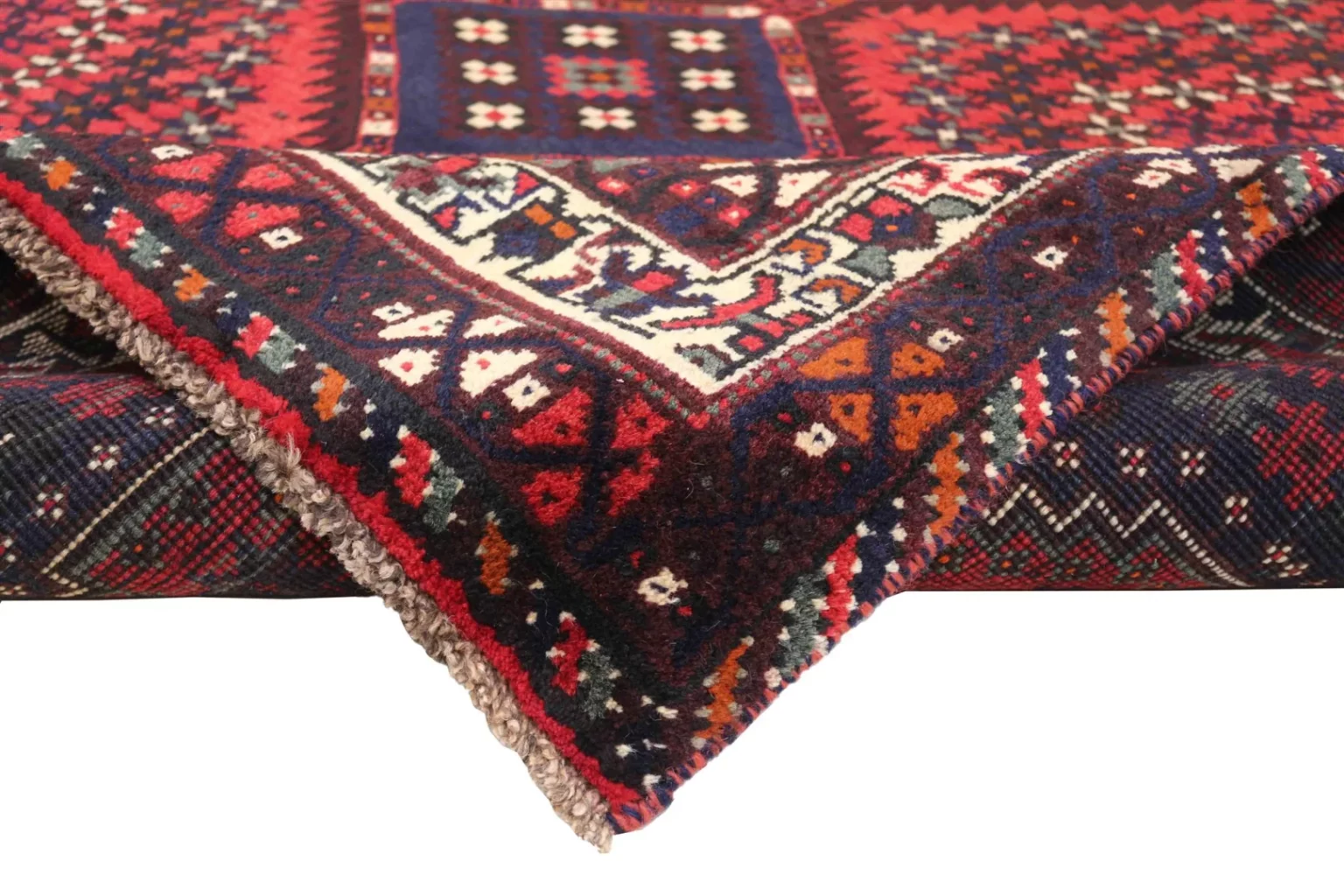
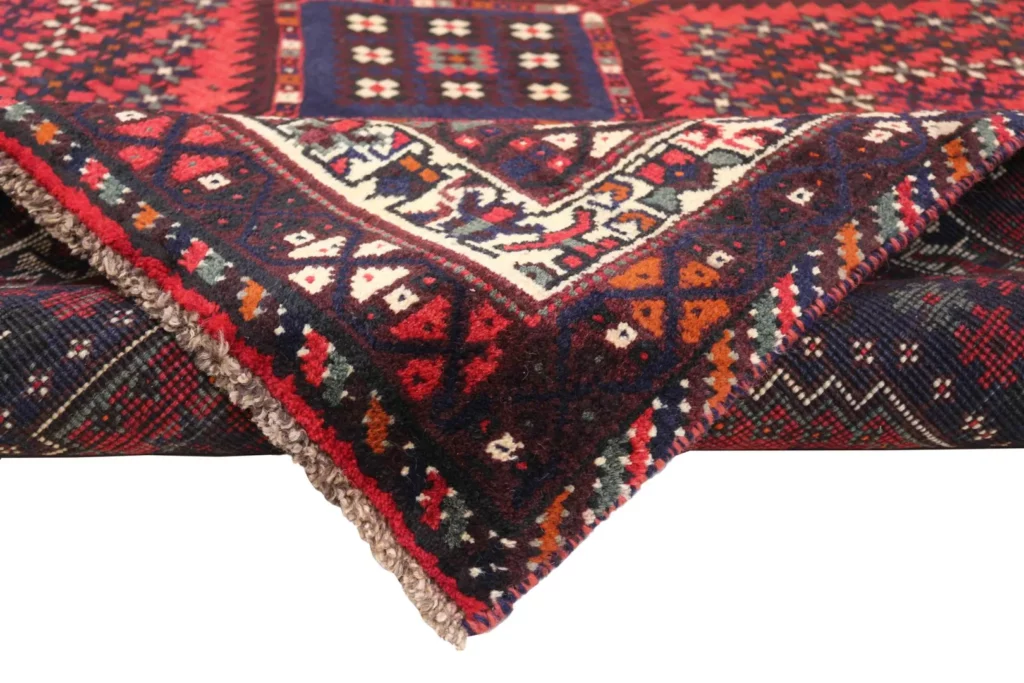
This Persian rug from Shiraz is hand-knotted and made from natural wool. The wool forms the pile and gives the surface its characteristic textile structure. Natural wool has long been used in rug making because it can be spun into durable yarn and create a pleasantly tactile surface. In a hand-knotted rug, the pattern is not printed onto a finished cloth; it is built knot by knot on the foundation.
The stated knot density is 100,000 to 180,000 knots per square metre. Knot density records how many knots are worked into a defined area and provides an indication of the fineness of the knotting. A higher number of knots can support more detailed lines and ornaments, although it is always considered together with the yarn, the knotting method and the design. Here, the stated density accompanies a geometric composition.
Hand knotting requires a consistent structure and careful work across the entire surface. Individual knots are placed in rows and secured through the further stages of weaving. The natural wool is worked into a pile with a substantial textile character. This rug is specifically described as hand-knotted. No information is provided about its warp or about any additional special weaving technique.
Origin and Tradition
This rug comes from Shiraz in Iran. Shiraz lies in the south of the country, in Fars Province, and is recognised as an important cultural centre of the region. The city is closely associated with Persian history and with a landscape where both urban and nomadic ways of life have shaped textile traditions. These different influences help explain why rugs from the wider Shiraz area can appear in more than one visual form.
The Shiraz tradition belongs to the broader history of Iranian rug making. In Iran, rugs have long been produced as useful household textiles, woven images and inherited forms of craft. Knowledge of spinning, dyeing, stretching the foundation and tying knots has often been passed through families and workshops. Regional experience influences the way patterns are arranged, colours are combined and materials are handled. A hand-knotted Shiraz rug therefore belongs to a tradition in which practical use and ornament exist together.
Fars is also associated with nomadic carpet traditions. Nomadic weavers often worked with materials available in their surroundings and developed designs from inherited signs, geometric forms and elements of their own environment. Urban workshops could adopt parts of this visual language and organise them into more regular compositions. For this reason, Shiraz should not be understood as one single, fixed pattern. The name primarily identifies the region of origin and its craft environment.
Shiraz has a long cultural history. The surrounding area includes important evidence of Iranian civilisation, including the ruins of Persepolis. These historical connections form part of the regional background, but they do not establish the age or date of this particular rug. The origin given for this piece is Shiraz, Iran. No more precise date, workshop attribution or signature is provided.
Iranian rugs are often distinguished internationally by their towns and regions of origin. Shiraz is one of the names associated with a southern Iranian tradition. In rug terminology, Ghashghai, Bakhtiari and Tabriz rugs may also be discussed alongside it. Those names refer to separate regional or tribal developments and should not be confused with this rug’s origin. The rug presented here is a Shiraz Persian rug.
Design and Pattern
The design of this rug consists of geometric ornaments. Geometric design uses clearly organised shapes, lines, angles, repetition and symmetrical or rhythmic arrangements. Such elements may structure a field, form a border or separate individual ornaments. The composition of this rug is described as geometric; no more detailed identification of medallions, vines or borders is given.
Geometric patterning has a long place in Iranian rug design. It appears in rural and nomadic work as well as in rugs made in urban workshops. Its visual effect comes from the relationship between area and line and from the repetition of selected forms. Small variations within a regular arrangement can be part of the character of handwork. During knotting, every shape is assembled from individual coloured knots, so the design remains directly connected to the method of making.
The colour scheme is described as shades of red and shades of brown. Red in rugs can range from deep, earthy nuances to stronger tones, while brown may include warm wood-like, soil-coloured and darker natural shades. These colour families can make geometric lines stand out or visually join larger areas. For this rug, they form the named palette. No further colours or more precise colour names are specified.
Shades of red and brown are frequently found in Iranian rug design because they can work in both decorative and everyday interiors. In traditional compositions, colours are not considered in isolation but in relation to field, ornament and border. A red ground may carry the main forms, while brown elements can soften transitions or emphasise outlines. The exact role of each colour in this rug is not described, so it is not assigned a more detailed colour layout.
The geometric ornament connects this rug with an important vocabulary of regional rug making. It differs from an exclusively floral design through its stronger emphasis on contour, axis and repetition. At the same time, geometric patterns can preserve traditional or symbolic forms. The defining combination here is the geometric ornament together with red and brown tones, not an attribution to another named rug type.
Special Features
The clearly identified features are the origin in Shiraz, Iran, the hand-knotted construction, natural wool as the material, a knot density of 100,000 to 180,000 knots per square metre and a geometric pattern. The colour scheme includes shades of red and brown. The rug is well preserved. These details describe the individual piece without adding a date, workshop attribution or signature.
The combination of natural wool and hand knotting makes the textile process an essential part of the rug’s character. Its knot density also gives a concrete indication of how the surface has been worked. Every rug forms its own combination of material, knots, ornaments and colour. The age, precise workshop, warp construction and signature are not stated for this piece.
FAQ
How should I care for a Shiraz Persian rug?
Careful, regular vacuuming helps remove loose dust and everyday dirt from the pile. The rug should be protected from direct sunlight so that its colours remain as even as possible. Spills should be dealt with immediately by blotting them with a damp cloth. Vigorous rubbing should be avoided because it can stress the wool fibres and the surface. For more extensive cleaning, professional treatment suited to hand-knotted wool rugs is advisable.
What sizes are available for Shiraz Persian rugs?
Shiraz Persian rugs are made in a range of formats. The selection includes narrow runners as well as larger rugs for living spaces. The right format depends on the available floor area, the intended arrangement and the position of the furniture. This piece has its own fixed format; other rugs must be assessed by their individual dimensions. The available area should therefore be measured before choosing a rug for a particular place.
Are Shiraz Persian rugs a good investment?
A hand-knotted Shiraz rug can remain usable for a long time when it is handled and maintained carefully. Natural wool and traditional knotting are among the features that contribute to its textile durability. A rise in value cannot be guaranteed for every rug. Age, condition, provenance, rarity, workmanship and market demand may all influence value. This piece is well preserved and has the stated craft characteristics, but those facts do not constitute a promise of future appreciation or an investment guarantee.
To provide the best experiences, we use technologies like cookies to store and/or access device information. Consenting to these technologies will allow us to process data such as browsing behavior or unique IDs on this site. Not consenting or withdrawing consent, may adversely affect certain features and functions.
Functional Always active
The technical storage or access is strictly necessary for the legitimate purpose of enabling the use of a specific service explicitly requested by the subscriber or user, or for the sole purpose of carrying out the transmission of a communication over an electronic communications network.
Preferences
The technical storage or access is necessary for the legitimate purpose of storing preferences that are not requested by the subscriber or user.
Statistics
The technical storage or access that is used exclusively for statistical purposes.The technical storage or access that is used exclusively for anonymous statistical purposes. Without a subpoena, voluntary compliance on the part of your Internet Service Provider, or additional records from a third party, information stored or retrieved for this purpose alone cannot usually be used to identify you.
Marketing
The technical storage or access is required to create user profiles to send advertising, or to track the user on a website or across several websites for similar marketing purposes.
 SECURE PAYMENT
 SHIPPING PARTNERS


