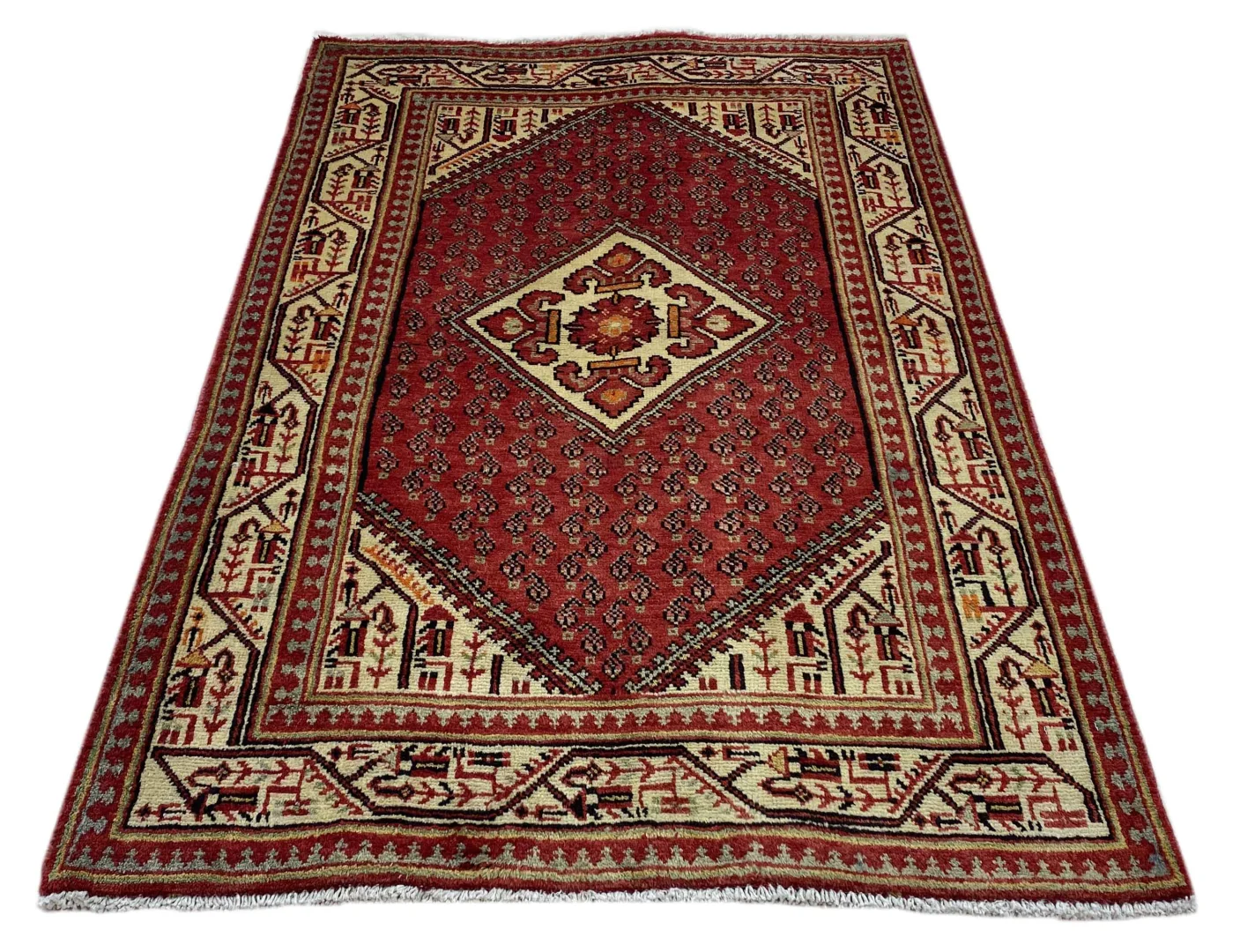
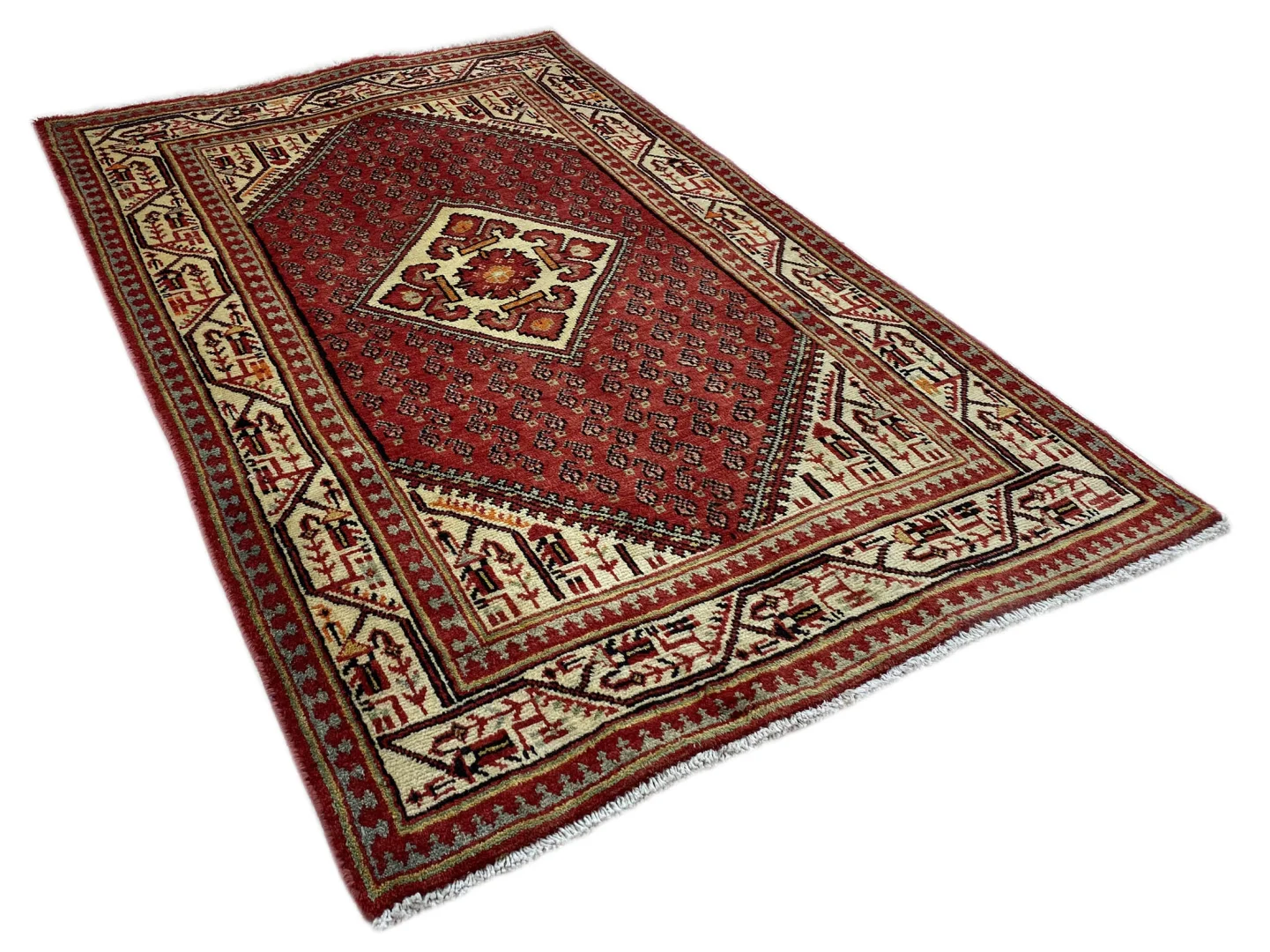
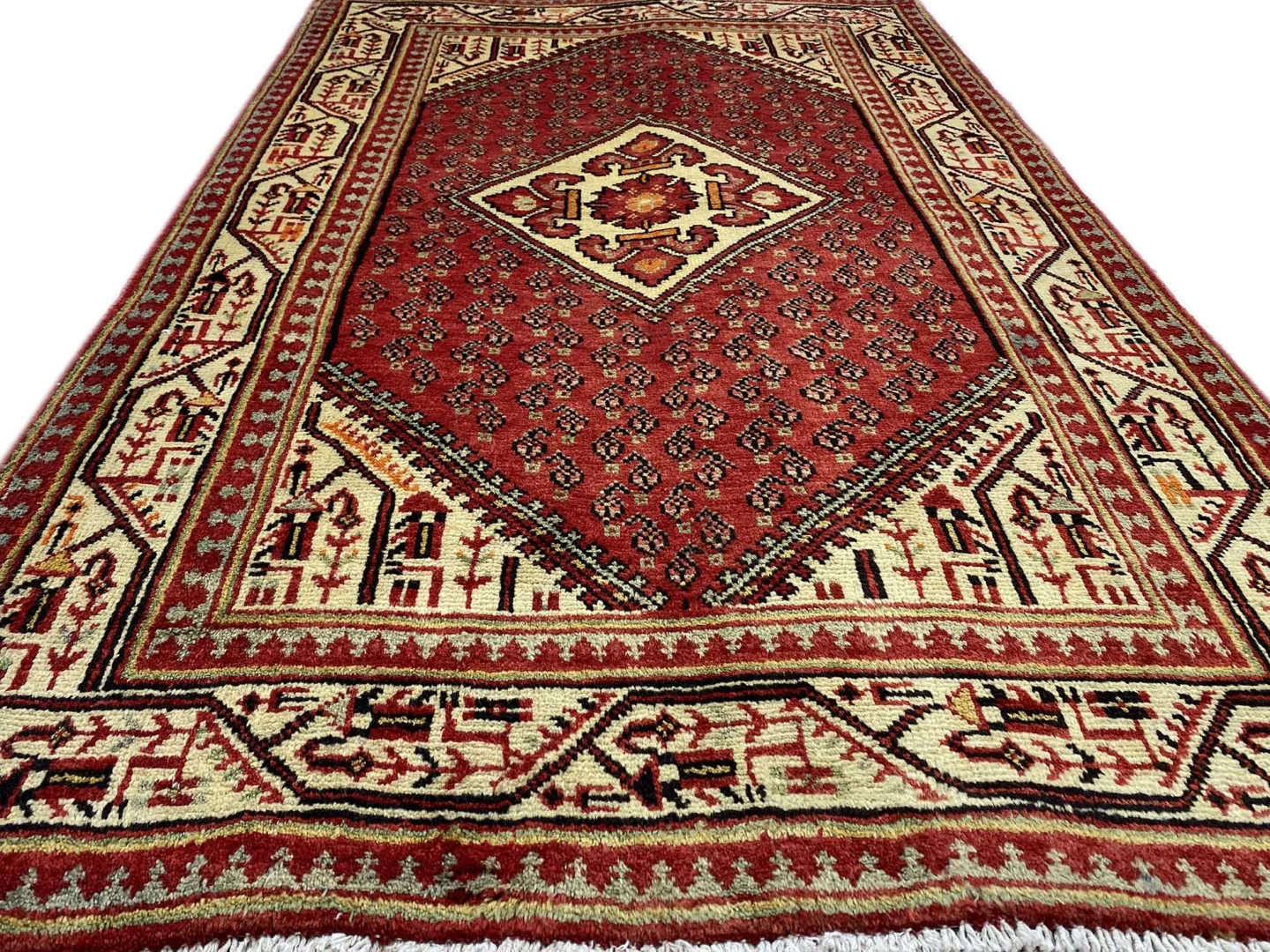
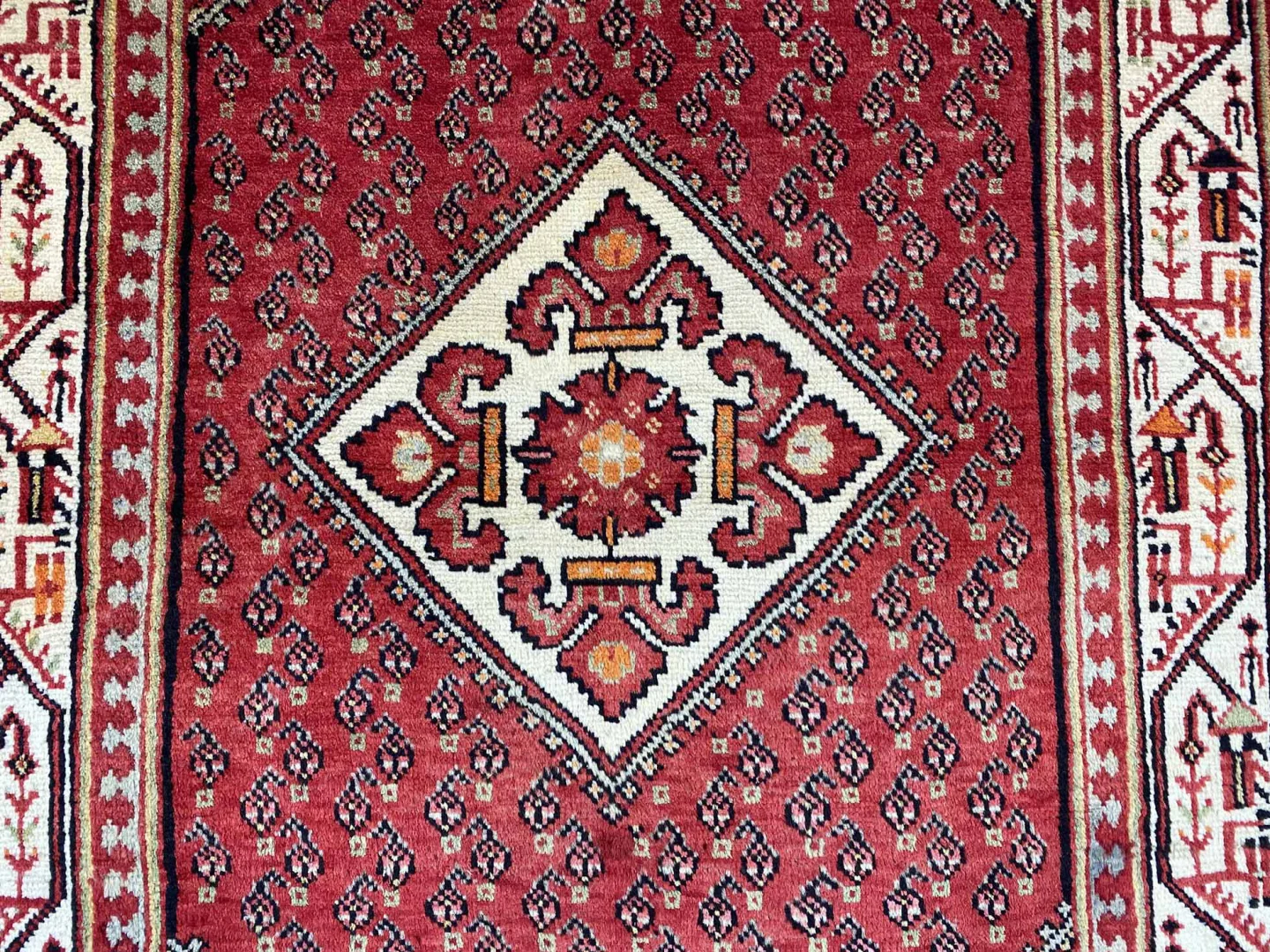
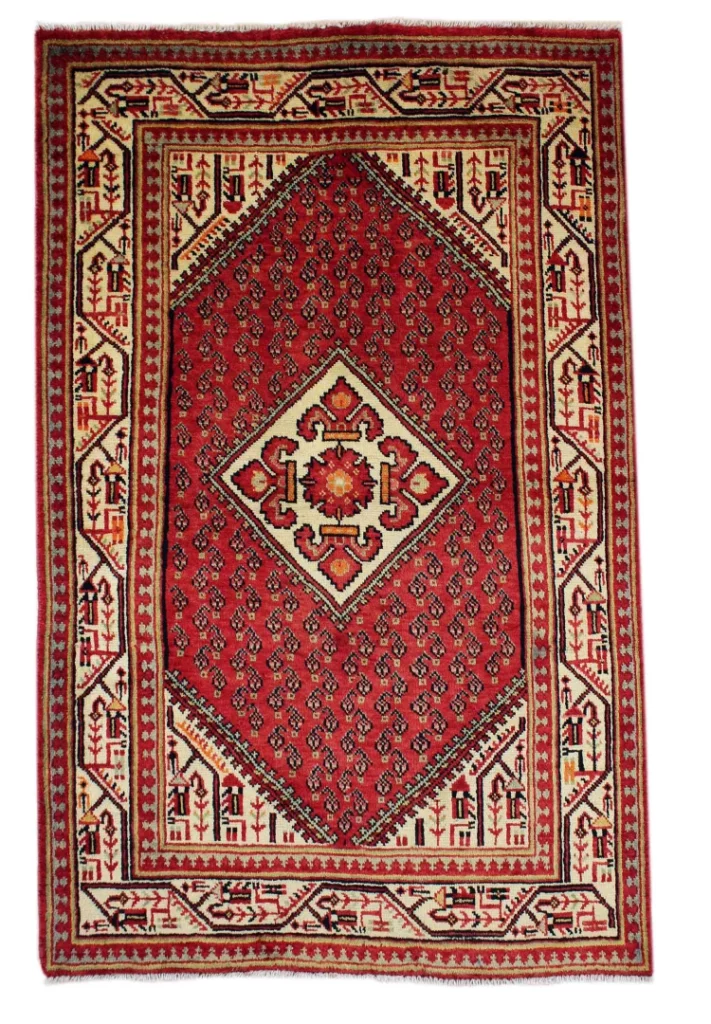
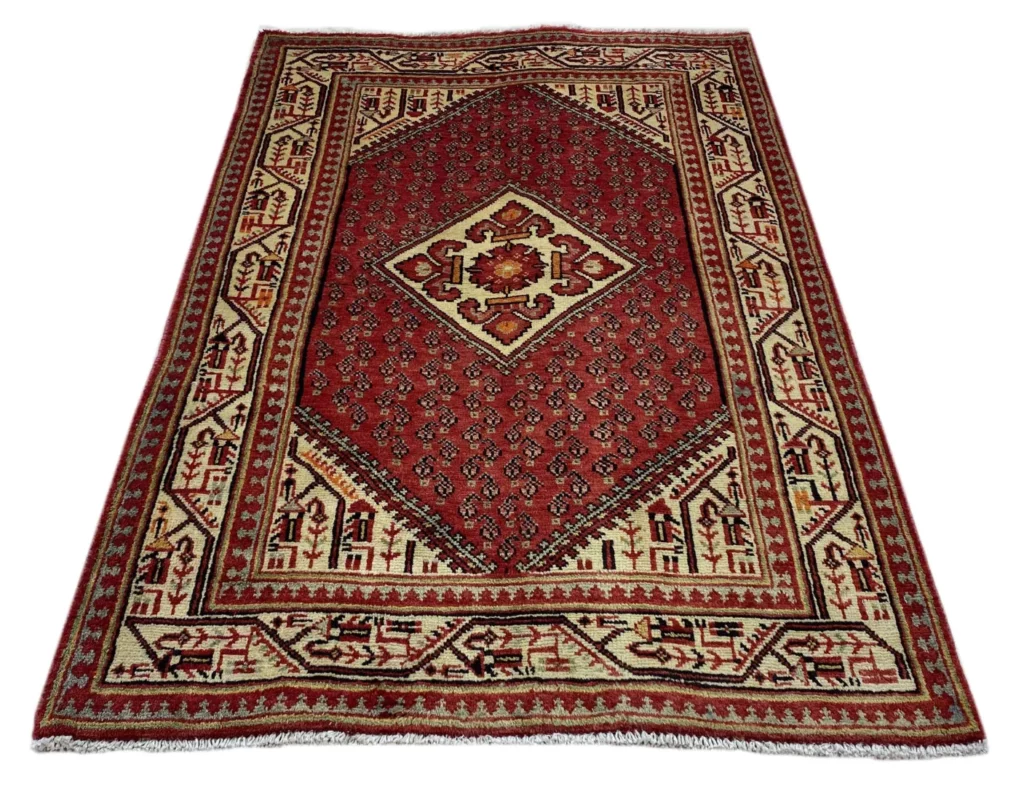
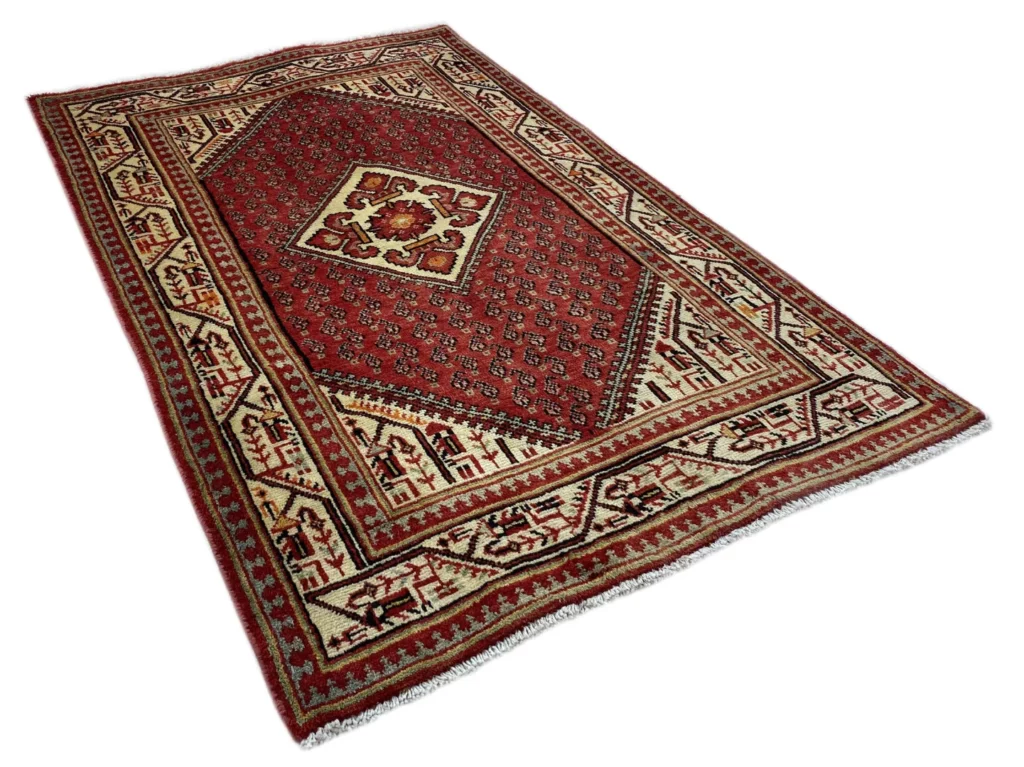
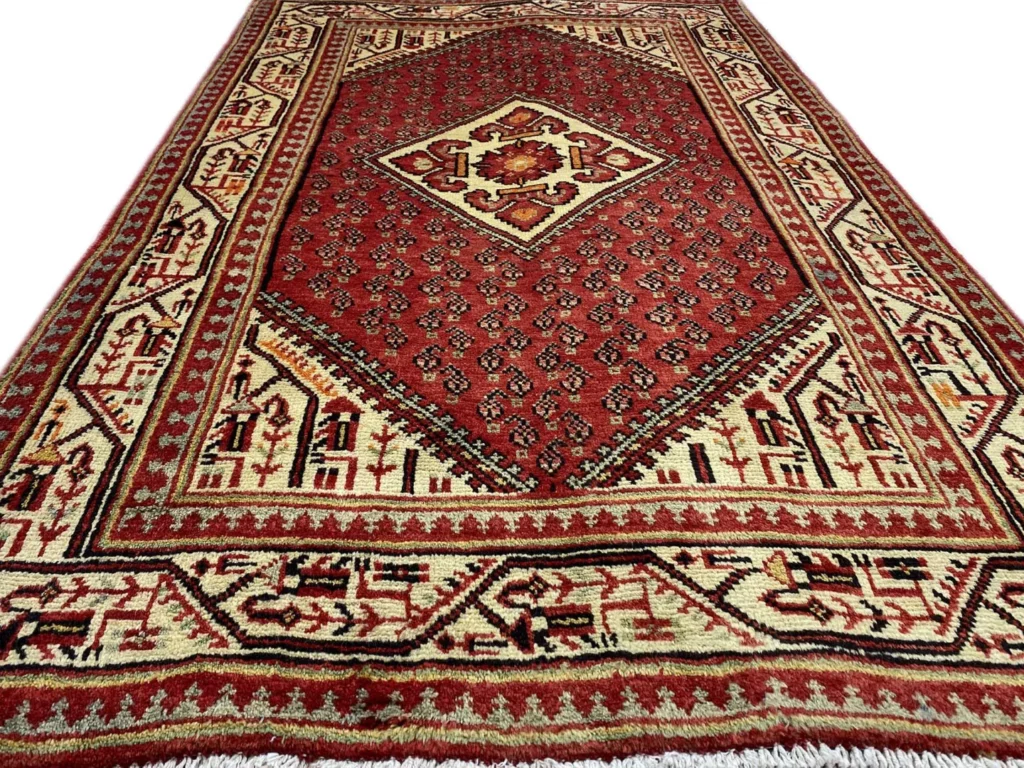
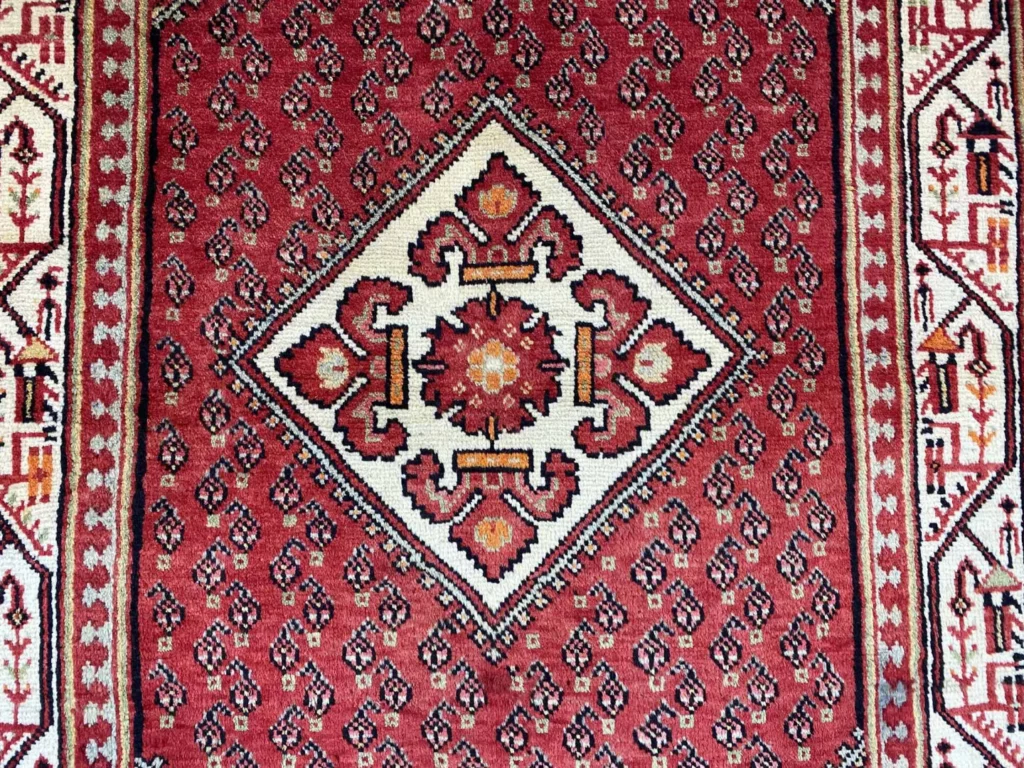
Hand-knotted Sarough Persian Rug | Knot density: 200,000 – 400,000 knots/m² | Material: Wool pile | Size: 168 x 107 cm | Pattern: Floral design in red and brown ground tones | Condition: Very good
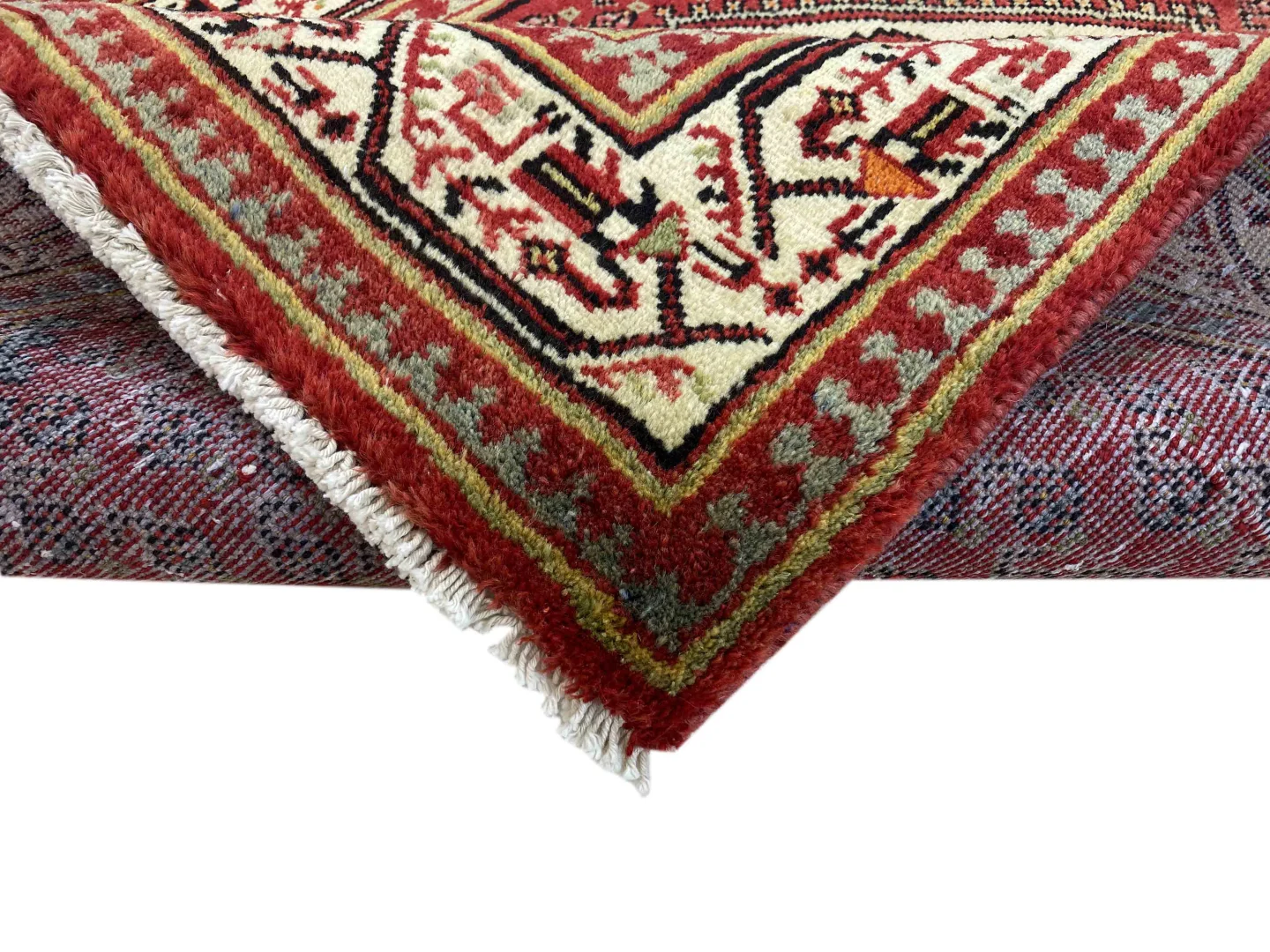
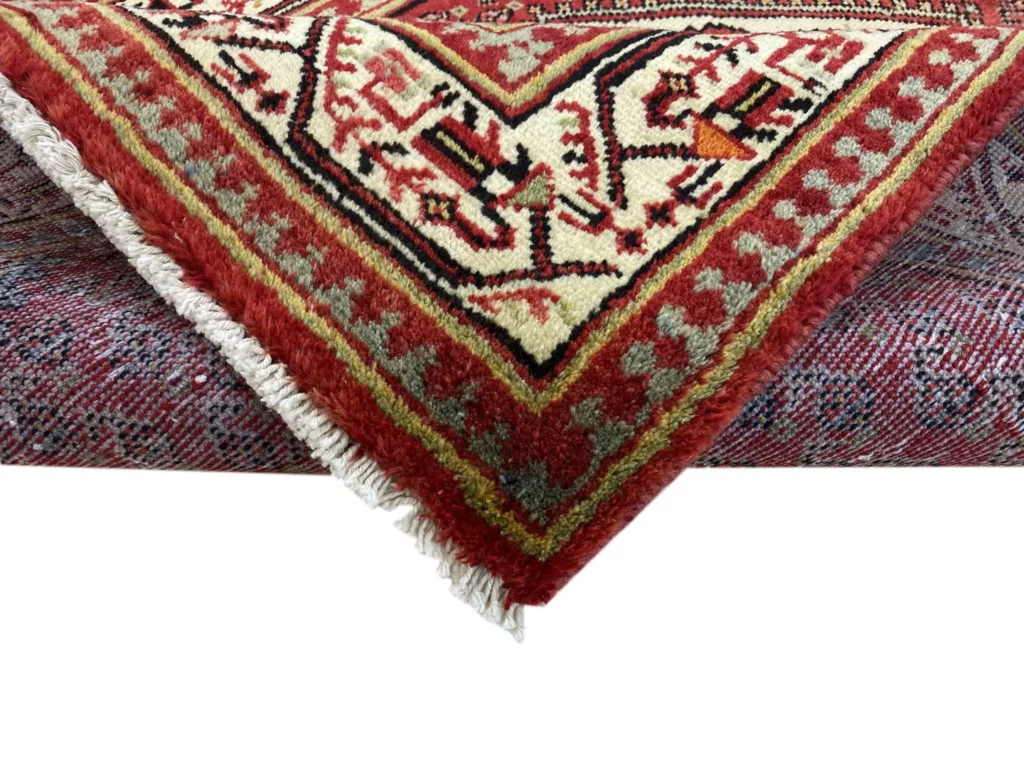
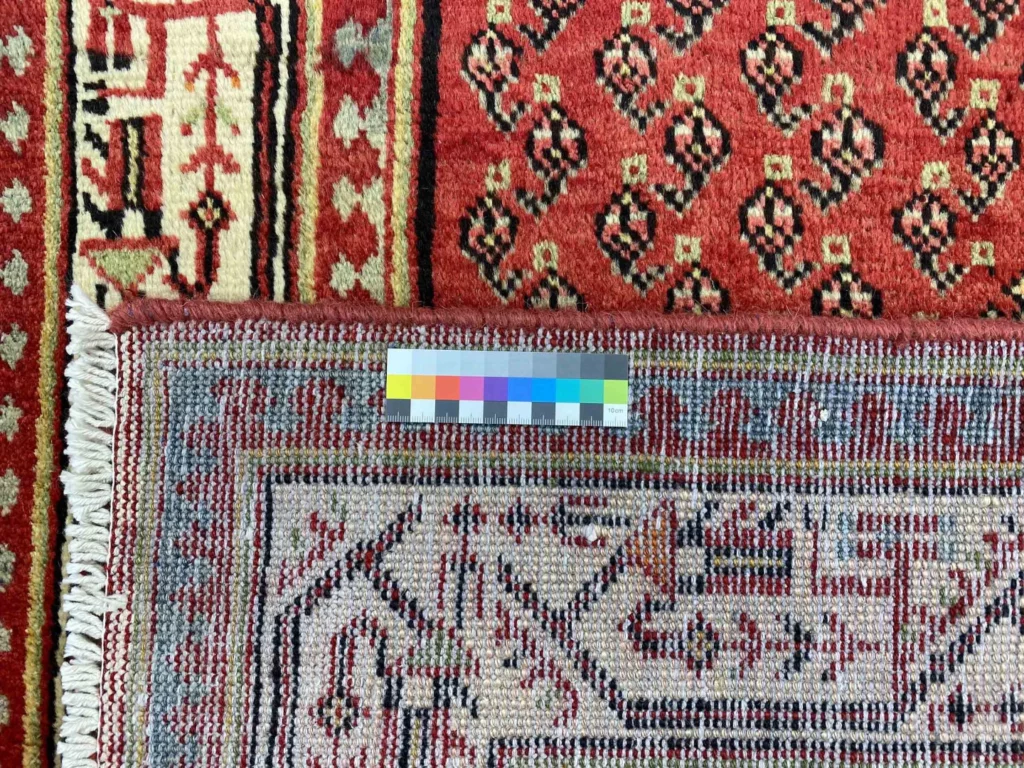
This Sarough is a hand-knotted Persian rug made with high-quality wool. Its construction reflects a traditional textile process in which the design is created through the placement of individual knots rather than applied as a printed surface. Hand knotting makes each rug a separate piece of craftwork. The wool pile and the carefully executed knotting are central to the character of this rug.
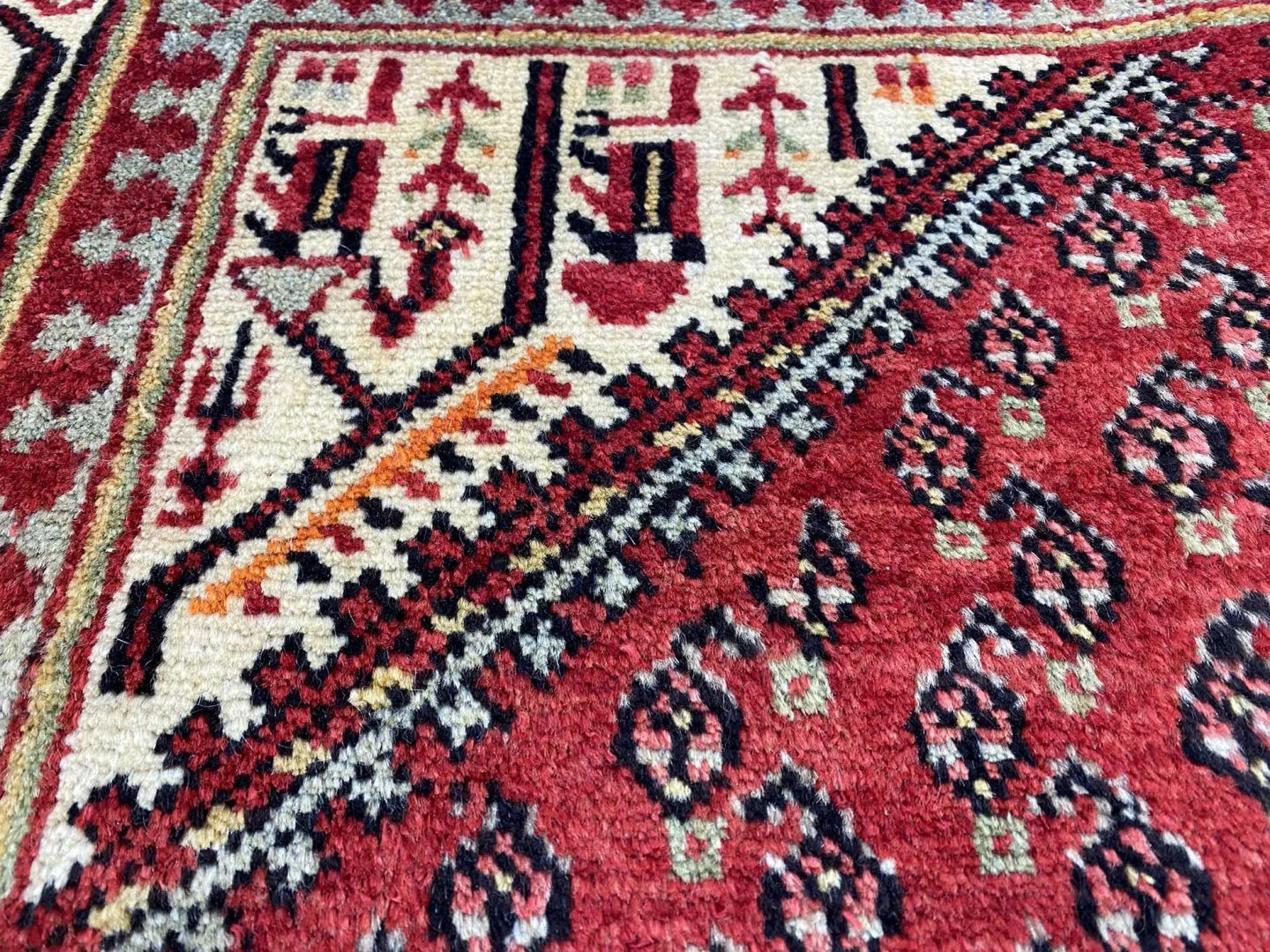
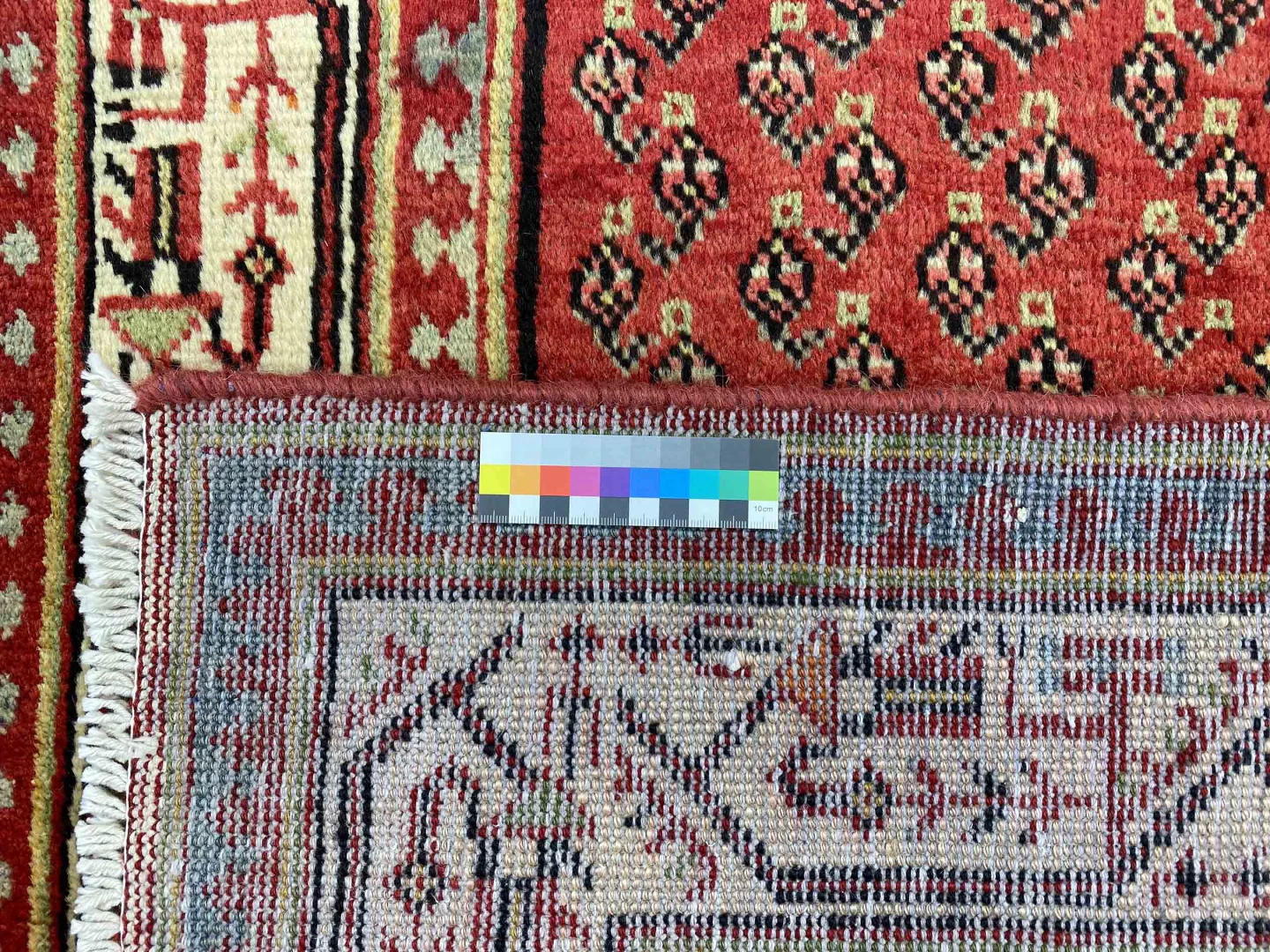
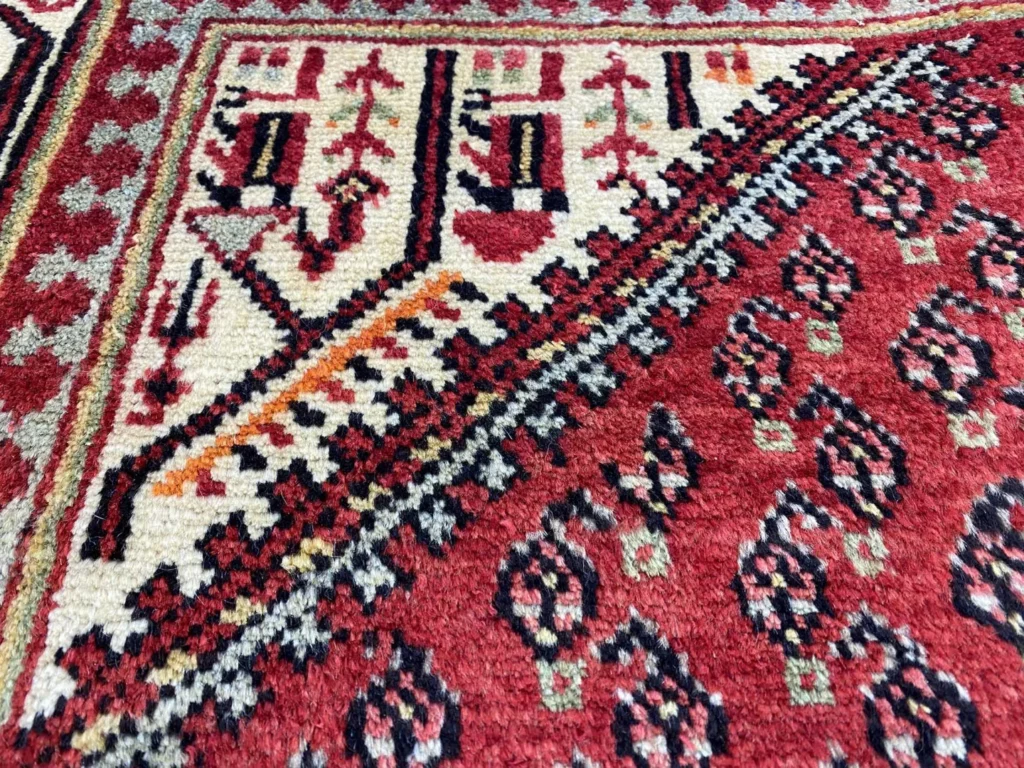
The knot density is given as 200,000 to 400,000 knots per square metre. A density in this range supports the precise rendering of floral forms and allows fine decorative details to be set close together. Curving lines, leaves and other elements can be differentiated clearly when the pattern is worked at a fine scale. The high-quality wool forms the pile of the rug.
Wool has long been used for the pile of oriental rugs because it is suitable for knotting and accepts colour well. Its textile surface gives the design a coherent appearance and allows the pattern to remain legible from different viewing positions. In this Sarough, the stated wool quality, hand-knotted technique and high knot density describe the principal aspects of the workmanship.
A high knot density is a technical feature: it describes how many knots are present within a defined area. It does not, by itself, establish a rug’s age or replace its regional attribution. For this piece, the density is specifically stated within the range from 200,000 to 400,000 knots per square metre. The condition is described as very good, adding a separate assessment to the information about material and construction.
Origin and Tradition
The Sarough Persian rug comes from the village of Sarough in northern Persia. Sarough therefore identifies a place of origin as well as a regional weaving tradition. It is not simply the name of a floral decoration. This distinction matters because floral patterns occur in many Persian weaving areas, while the Sarough name connects this rug with the village and its surrounding northern Persian tradition.
Carpet making in northern Persia developed through the interaction of inherited designs, practical workshop knowledge and the use of suitable natural materials. Skills were passed through families and weaving workshops. They included preparing the material, planning the pattern and completing the knotting step by step. A hand-knotted Sarough is consequently an example of a process in which the textile image takes shape during production rather than being added after the rug has been made.
Sarough rugs are associated with floral designs and warm ground colours. This association describes a recognised regional character without suggesting that every Sarough follows an identical scheme. This particular rug is specified as floral, with red and brown ground tones. These elements place its appearance within a Persian tradition in which plant forms are repeatedly adapted into ordered ornamental compositions.
Sarough rugs also have a connection with the American market. Some were originally produced for American buyers, and many rugs known as American Sarough later made their way back to Europe. This commercial history helps explain the presence of Sarough rugs in European interiors and collections. It complements the regional attribution but does not replace it: this rug is identified as a Sarough from northern Persia.
Other Persian weaving centres developed their own approaches to floral and geometric decoration. Kerman is often associated with floral compositions in delicate pastel colours. Tabriz is known for detailed designs and high knot counts. Nain and Kashan also have a strong reputation for high-quality rugs. These comparisons illustrate the diversity of Persian carpet traditions, but they do not change the origin of this piece. It is not presented as a Kerman, Tabriz, Nain or Kashan rug; its origin is Sarough in northern Persia.
Regional identity and technique are closely connected in Persian carpet making. A place contributes an established design vocabulary, while the knotting process turns that vocabulary into a textile surface. Sarough rugs are therefore understood through both their place of origin and their floral language. This example combines that attribution with a high knot density, a hand-knotted construction and a wool pile.
Design and Pattern
The pattern of this Sarough is floral, with red and brown ground tones. Floral rug designs draw on forms associated with plants, including leaves, blossoms, stems and curling vines. These forms are usually stylised rather than intended as a literal depiction of one particular plant. They can be arranged across the field to create a connected ornamental rhythm and to guide the eye through the composition.
Red ground tones give the design a distinct and present colour foundation. Brown adds an earthy, more subdued value to the same palette. Together, these colours create the warm colour range specified for this rug. Colour relationships can help separate individual ornaments and give a floral composition visual continuity. In this case, red and brown are identified as the ground tones; no further colour claims are added.
A high knot density can contribute to the precision of a pattern because many small changes can be represented within a given area. Lines may be worked more finely, and leaves or floral details can be separated with greater clarity. Knot density is nevertheless a construction detail, not a complete pattern name. The design of this rug remains floral, while the fine knotting supports its detailed execution.
Persian carpet design contains many regional versions of floral ornament. Some compositions are built around large individual blossoms, while others use repeated leaves, vines and smaller botanical details to form a denser field. Geometric organisation may also be present within a floral arrangement. Sarough rugs are particularly associated with floral styling. This rug is therefore described through its floral design and its red and brown ground tones, without assigning an additional named motif that is not specified.
The warm palette can be placed alongside both traditional and contemporary interiors. In a classic setting, the colours relate to established Persian carpet palettes. In a more modern setting, they can provide a defined colour element among wood, neutral surfaces and natural materials. This is a description of the design’s possible visual relationship with a room, not an assertion that the rug was made for a particular type of interior.
The broader Persian tradition makes related floral designs visible in regions such as Kerman and Tabriz. Their similarities reflect shared ornamental themes, while their different regional practices remain distinct. Kerman is often linked with soft pastel palettes, and Tabriz with detailed compositions and high knot counts. Such parallels provide useful context for Persian floral design, but they do not turn this Sarough into a rug from another province.
The design can therefore be summarised through three stated features: a floral pattern, red and brown ground tones, and a hand-knotted execution capable of rendering detail. Together they provide a clear description of the rug’s appearance and technique. No further individual motif, border arrangement or medallion structure is specified, so none is added here.
Special Features
This Sarough combines hand-knotted construction, high-quality wool and a high knot density. The density is specified within the range of 200,000 to 400,000 knots per square metre. That technical range is one of the defining details of the piece and relates to the precise execution of its floral pattern. It is presented alongside the regional name rather than as a substitute for the rug’s origin.
The colour scheme is another notable feature. Red and brown ground tones provide a warm basis for the floral decoration and give the design a clearly identifiable palette. The rug is described as being in very good condition. This condition statement is separate from the description of the wool, the knotting technique and the pattern, and all three aspects contribute to a complete factual account of the piece.
Its Sarough origin is also significant. Sarough rugs are connected with the traditional weaving of the village of Sarough in northern Persia and with floral designs made in high-quality materials. The history of American Sarough adds a commercial dimension: some rugs of this type were made for the American market and later returned to Europe. This background belongs to the Sarough tradition and does not establish an additional individual provenance for this rug.
The piece can thus be understood through a combination of regional, technical and visual characteristics: Sarough as its origin, hand knotting as its method, wool as its pile material, high knot density as a construction detail, and a floral design in red and brown ground tones. Sarough rugs are available in different sizes, from smaller runners to larger room rugs; the specific size of this example is listed separately.
FAQ
How should I care for my Sarough Persian rug?
Regular vacuuming helps remove dust and loose dirt from the pile. When a more thorough cleaning is needed, professional rug cleaning is recommended. Direct sunlight should be avoided so that the red and brown colours do not fade unnecessarily. Care should take the hand-knotted construction and wool surface into account. If the appropriate method is uncertain, a specialist cleaner can select a process suited to the material and the type of soiling. Gentle, consistent care helps preserve the appearance of the floral design.
What sizes are available for Sarough rugs?
Sarough rugs are made in different sizes. The range extends from smaller runners to larger rugs intended for living areas. The available floor space and the function of the rug should guide the choice. A smaller format can define a particular area, while a larger format relates more strongly to the arrangement of the room. This example has the size stated in the product information; the general statement about different formats applies to Sarough rugs as a group.
Where does the Sarough Persian rug come from?
The Sarough Persian rug comes from the village of Sarough in northern Persia. The region is known for traditional carpet making and the use of high-quality materials. Sarough here identifies the origin, not merely the appearance of the floral pattern. Similar floral designs can also be found in Kerman, Tabriz, Nain and Kashan, but this piece is identified as a Sarough from northern Persia. Its hand-knotted construction and wool pile are part of the same description.
To provide the best experiences, we use technologies like cookies to store and/or access device information. Consenting to these technologies will allow us to process data such as browsing behavior or unique IDs on this site. Not consenting or withdrawing consent, may adversely affect certain features and functions.
Functional Always active
The technical storage or access is strictly necessary for the legitimate purpose of enabling the use of a specific service explicitly requested by the subscriber or user, or for the sole purpose of carrying out the transmission of a communication over an electronic communications network.
Preferences
The technical storage or access is necessary for the legitimate purpose of storing preferences that are not requested by the subscriber or user.
Statistics
The technical storage or access that is used exclusively for statistical purposes.The technical storage or access that is used exclusively for anonymous statistical purposes. Without a subpoena, voluntary compliance on the part of your Internet Service Provider, or additional records from a third party, information stored or retrieved for this purpose alone cannot usually be used to identify you.
Marketing
The technical storage or access is required to create user profiles to send advertising, or to track the user on a website or across several websites for similar marketing purposes.

 SECURE PAYMENT
 SHIPPING PARTNERS


