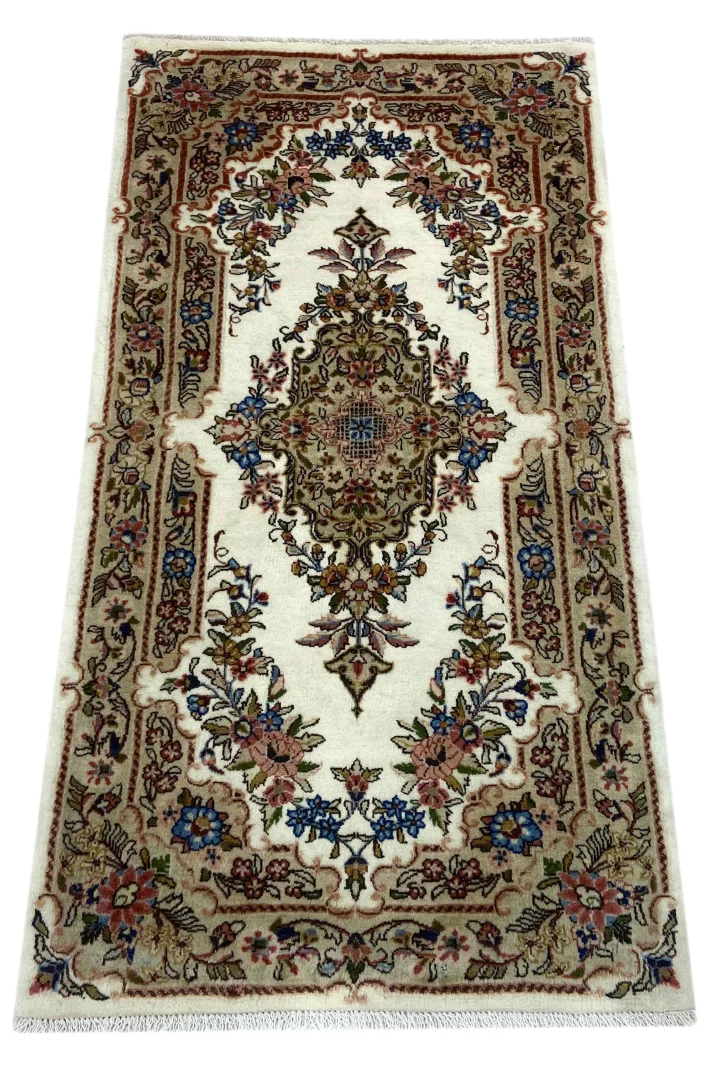
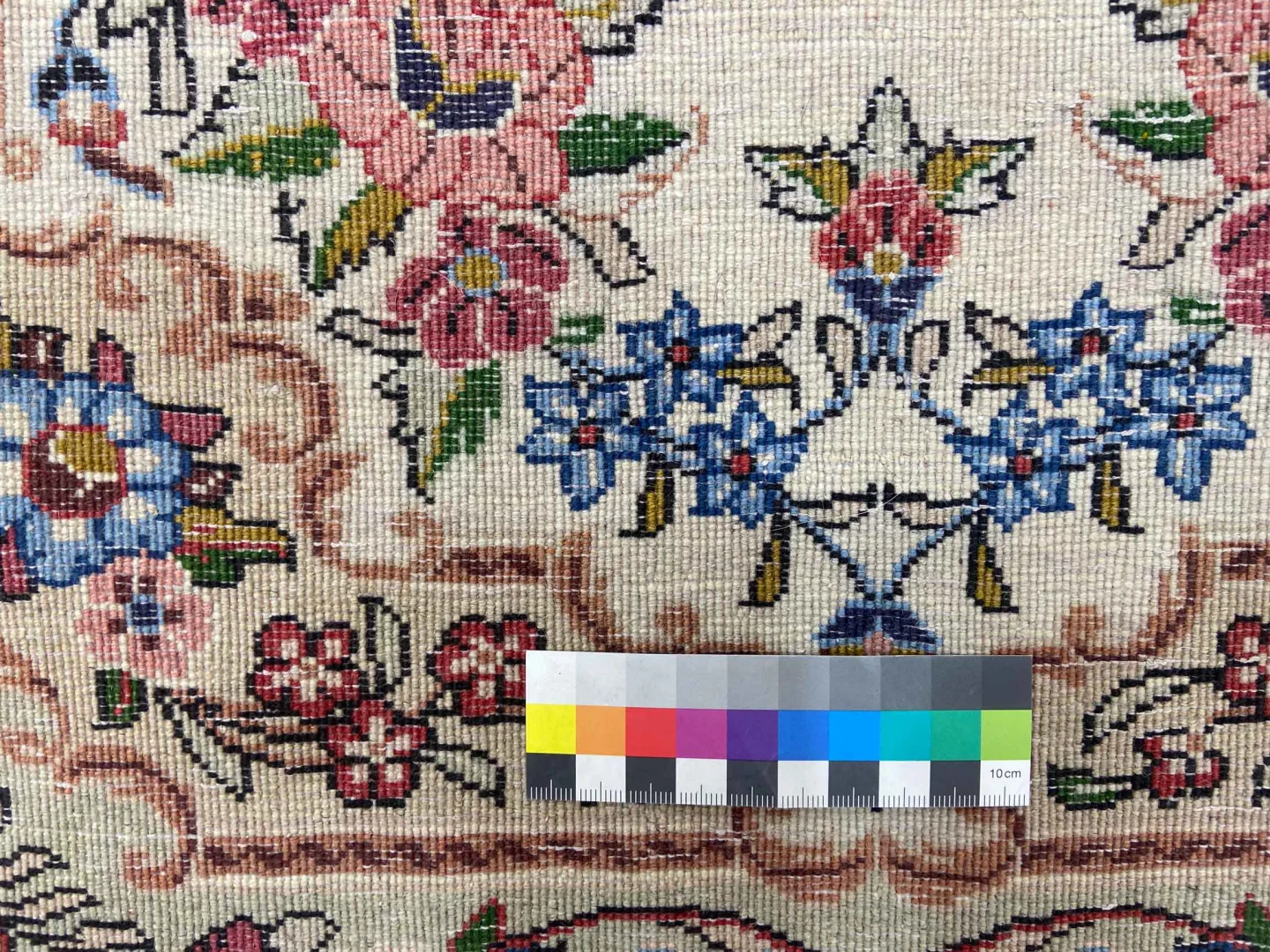
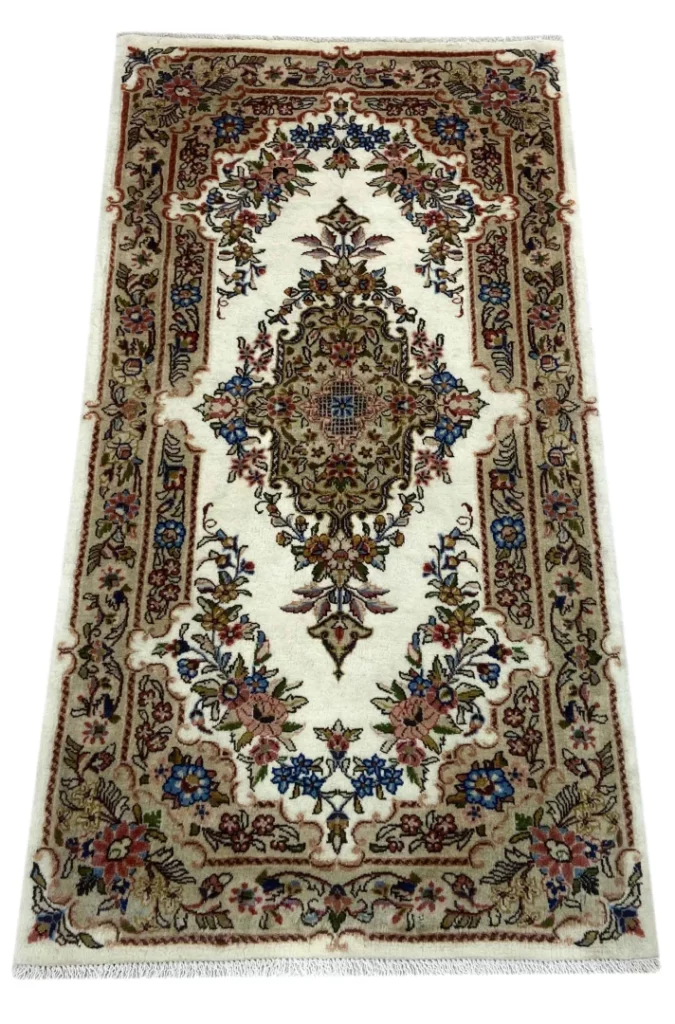
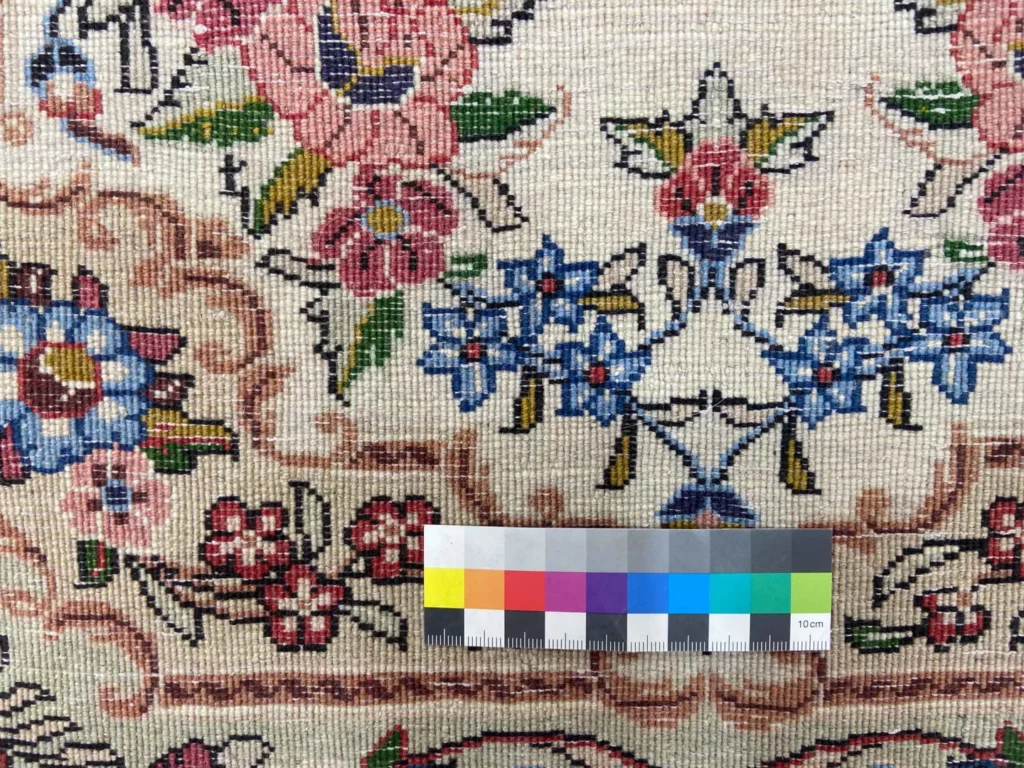
This Sarough Persian Rug is hand-knotted and has a pile made from high-quality wool. Hand knotting is a defining feature of Persian rugs: the surface is built knot by knot, allowing colour, pattern and texture to become part of one continuous textile structure. The listed knot density is 200.000 – 400.000 knots per square metre. Knot density is a technical description of how many knots occupy a given area and is closely connected with the amount of detail that can be worked into a design.
Wool has long been used in hand-knotted rugs because its fibres combine resilience with a soft, substantial feel. As a pile material, it forms a textile surface that accepts colour clearly and gives the rug a distinct tactile character. High-quality wool is specified for this rug. Its hand-made construction means that the visible pattern is not printed onto a finished surface; it is created through the arrangement of coloured knots. Every hand-knotted rug therefore has its own textile expression.
Producing a rug with this kind of construction requires consistent work across the entire field. The design takes shape while the knots are tied, and the relationship between knot placement, pile and colour creates the finished appearance. A high knot density allows floral details and narrow transitions to be represented with greater definition. The process remains a form of manual craftsmanship, in which the structure of the rug and its decorative image are formed together rather than added separately.
Origin and Tradition
Sarough is a small village in northern Persia and gives its name to a recognised Persian rug tradition. Sarough rugs are associated with floral designs and lively colours. Red and brown grounds are particularly familiar within descriptions of this type. This rug has a floral design on a red/brown ground, linking its stated appearance with the visual language associated with Sarough. The origin is northern Persia, while Sarough identifies the regional weaving tradition.
Persian rug production developed across many regional centres, each with preferences concerning structure, colour and ornament. Sarough forms part of that broad tradition without being interchangeable with every other Persian weaving area. Floral designs are especially important in its visual vocabulary. Vines, leaves and blossoms can be arranged across a field to create continuity, movement and balance. These elements are usually stylised for weaving rather than copied as literal botanical illustrations.
The history of Persian rugs is also a history of practical textile making. A rug had to provide a durable surface while carrying a carefully organised design. In Sarough weaving, these purposes meet through hand knotting, dense construction and an emphasis on floral composition. Colour is not treated as an isolated decoration; it helps separate motifs, establish rhythm and organise the field. The red and brown ground described for this piece provides the base against which the floral forms are read.
Sarough rugs became known beyond their original region. Some were made for export to the United States and are referred to as “American Sarough”. This term relates to their export history and market context, not to a different place of manufacture. The popularity of these rugs also brought them to the attention of collectors in Europe. This rug is described as being in excellent condition and as ideal for collectors, placing it within that broader appreciation of Sarough pieces.
Other Persian centres illustrate the variety of the wider tradition. Tabriz rugs are known for intricate floral patterns and vivid colours, Kashan rugs are often associated with large central medallions, and Isfahan rugs with fine detail and high-quality workmanship. These are distinct regional design traditions. Gabbeh represents another approach, often using a simpler visual language, strong colours and geometric forms, generally associated with the Fars region. None of these comparisons changes the stated Sarough origin of this rug.
Regional traditions also travelled through trade, commissions and changing tastes. Export production could make a particular design language familiar in distant markets, while retaining the construction methods and visual vocabulary of its weaving area. Sarough’s reputation therefore belongs both to northern Persian weaving and to the international history of Persian rugs. The rug offered here remains specifically identified as a Sarough piece, with a floral design and a red/brown ground.
Design and Pattern
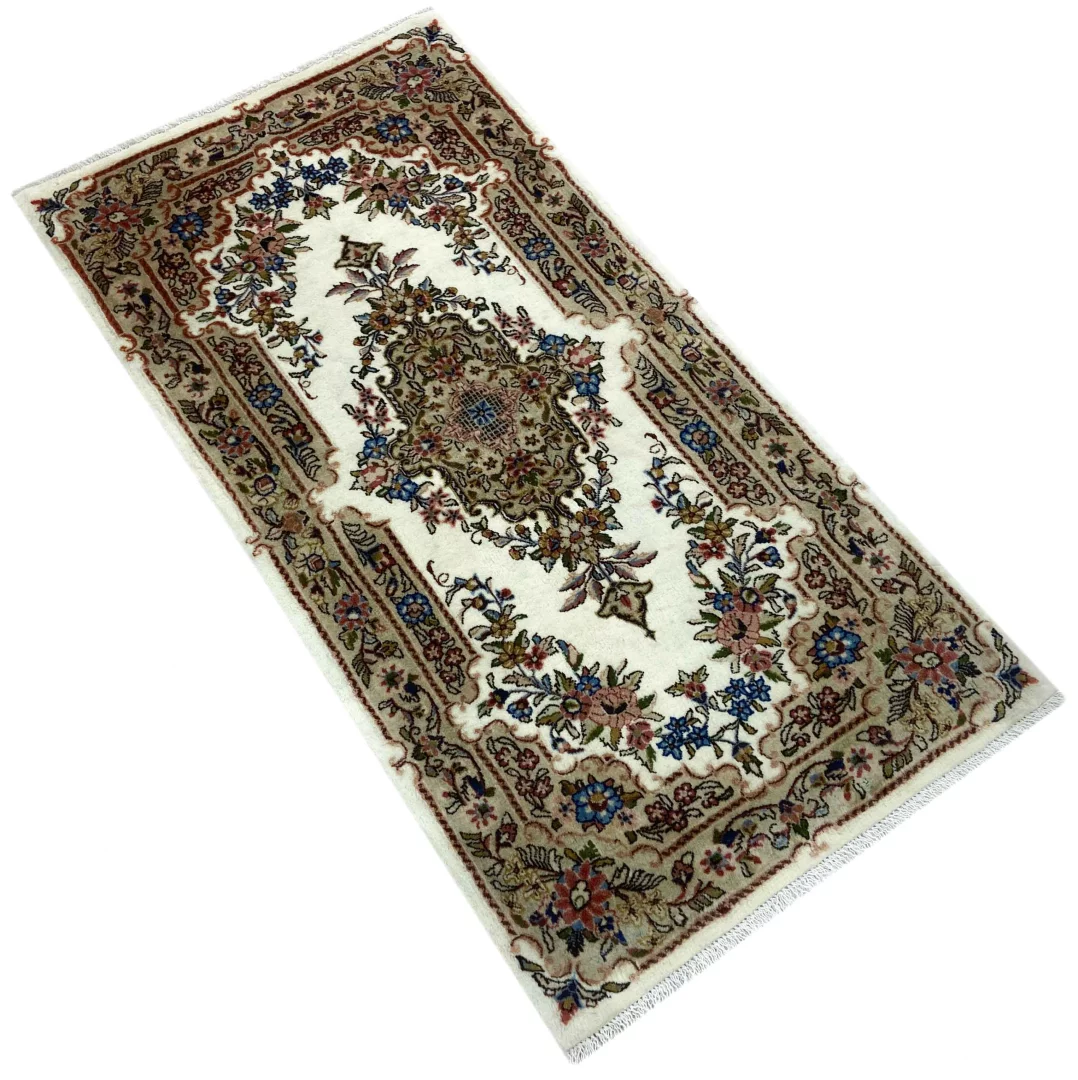
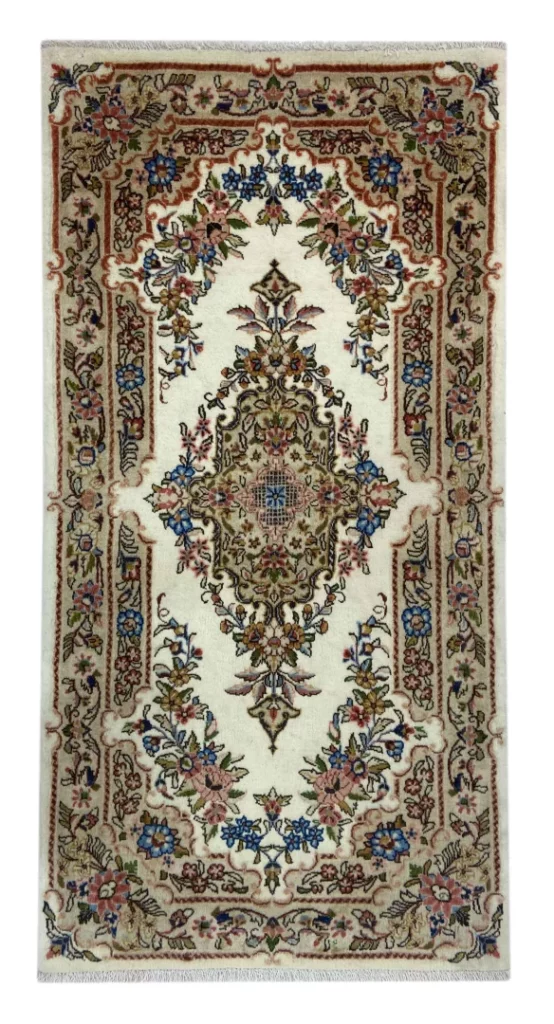
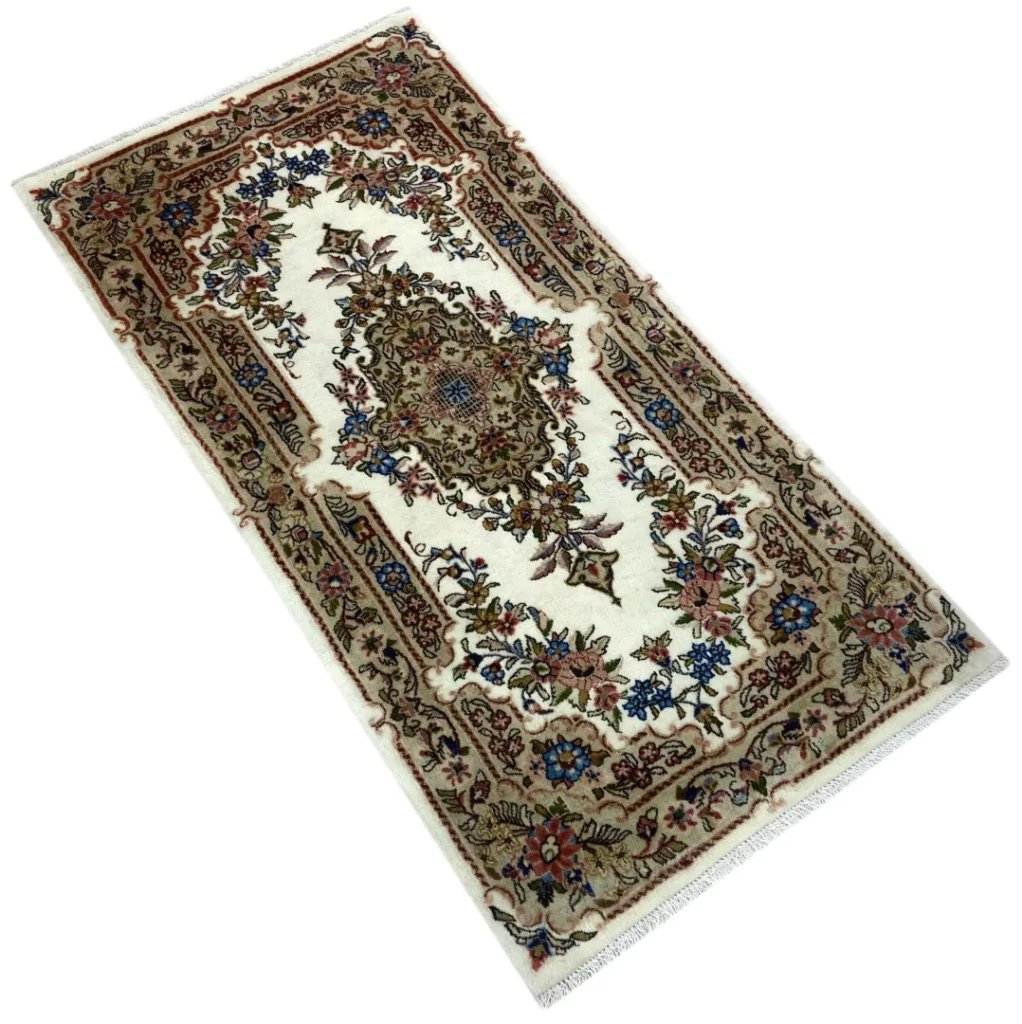
The pattern of this rug is described as a floral design on a red/brown ground. Its primary visual language is therefore botanical rather than purely geometric. Floral Sarough compositions may combine blossoms, leaves, curling vines and branching ornaments into a connected field. In woven art, these forms are stylised so that they can be repeated and balanced within the limits of the textile structure. The result is a pattern based on rhythm and relationship rather than on one isolated emblem.
A red or brown ground establishes a warm colour setting for the design. Red gives the composition a lively presence, while brown adds an earthy and subdued counterpoint. When these tones appear together, the ground can support both stronger accents and quieter passages. The floral motifs are then read as part of a unified field. The colour description here applies to the rug’s stated red/brown ground and does not imply a different palette or an unstated dye composition.
Floral Persian patterns often rely on repetition. Repeated leaves or blossoms create continuity, while variations in scale and spacing keep the surface from appearing mechanical. Vines can guide the eye across the field, and flowers can act as points of emphasis. The hand-knotted structure gives these repeated forms a textile quality: contours are built from individual knots, not drawn with a perfectly uniform line. That combination of order and hand-made variation is central to the appearance of many traditional floral rugs.
Knot density supports the rendering of a design but does not determine the design by itself. At 200.000 – 400.000 knots per square metre, the stated density provides a technically detailed construction for the floral composition. Fine outlines, smaller leaves and close colour changes can be represented with greater definition when more knots are available within the area. The actual pattern still depends on the arrangement of motifs and colours selected for the rug.
Sarough designs are often recognised for their balanced decorative character. This does not mean that all Sarough rugs share one identical layout. Regional design traditions allow for variations in the placement of flowers, the treatment of vines, the density of ornament and the balance between field and border. This one-off rug combines the Sarough designation with the specifically described floral pattern and red/brown ground. Its visual identity comes from that combination rather than from a generic label alone.
As an interior textile, a floral rug can work with both traditional and contemporary settings. That is a general quality of the design type rather than a claim about one particular room. The warm ground may be coordinated with wood, neutral furnishings or deeper accent colours, while the floral pattern can provide a structured decorative element. The hand-knotted surface, wool pile and regional design tradition remain the defining features of this piece.
Special Features
The notable features of this rug are its hand-knotted construction, high-quality wool pile and stated knot density of 200.000 – 400.000 knots per square metre. It has a floral design on a red/brown ground and is identified as a Sarough from northern Persia. Its condition is described as excellent, and it is considered ideal for collectors. These are the specific characteristics that distinguish the piece within the Sarough tradition.
The expression “American Sarough” refers to Sarough rugs originally produced for export to the United States. Such rugs are sought by collectors on the European market. It is useful as historical context for the wider type, while the origin of this piece remains Sarough in northern Persia. The export term does not replace or alter that regional identification.
FAQ
How should I care for my Sarough Persian Rug?
Regular, gentle cleaning helps prevent dust and dirt from settling into the wool pile. Use a vacuum cleaner with low suction and take care not to damage the fibres. Chemical cleaning products should be avoided because they may affect the colours. If the rug has heavier soiling, professional rug cleaning is the safer approach. Care should always be carried out gently so that the hand-knotted surface remains intact.
Where is the best place for my Sarough rug?
A Sarough rug can be placed in a central living area, a sitting room or a dining area. The important point is that the floral design should complement the existing furnishings rather than compete with too many other patterns. The red/brown ground can provide a colour link to furniture and textiles. The final placement should follow the room layout and allow the rug’s composition to remain visible.
What makes Sarough rugs a good investment?
Sarough rugs are valued for their craftsmanship, materials and cultural significance. Hand knotting, high-quality wool and dense construction make the textile work an important part of their identity. Sarough rugs are also appreciated as collector’s pieces, particularly in connection with the history of “American Sarough” export rugs. This rug is described as being in excellent condition and ideal for collectors, combining decorative use with recognised collector interest.
To provide the best experiences, we use technologies like cookies to store and/or access device information. Consenting to these technologies will allow us to process data such as browsing behavior or unique IDs on this site. Not consenting or withdrawing consent, may adversely affect certain features and functions.
Functional Always active
The technical storage or access is strictly necessary for the legitimate purpose of enabling the use of a specific service explicitly requested by the subscriber or user, or for the sole purpose of carrying out the transmission of a communication over an electronic communications network.
Preferences
The technical storage or access is necessary for the legitimate purpose of storing preferences that are not requested by the subscriber or user.
Statistics
The technical storage or access that is used exclusively for statistical purposes.The technical storage or access that is used exclusively for anonymous statistical purposes. Without a subpoena, voluntary compliance on the part of your Internet Service Provider, or additional records from a third party, information stored or retrieved for this purpose alone cannot usually be used to identify you.
Marketing
The technical storage or access is required to create user profiles to send advertising, or to track the user on a website or across several websites for similar marketing purposes.

 SECURE PAYMENT
 SHIPPING PARTNERS


