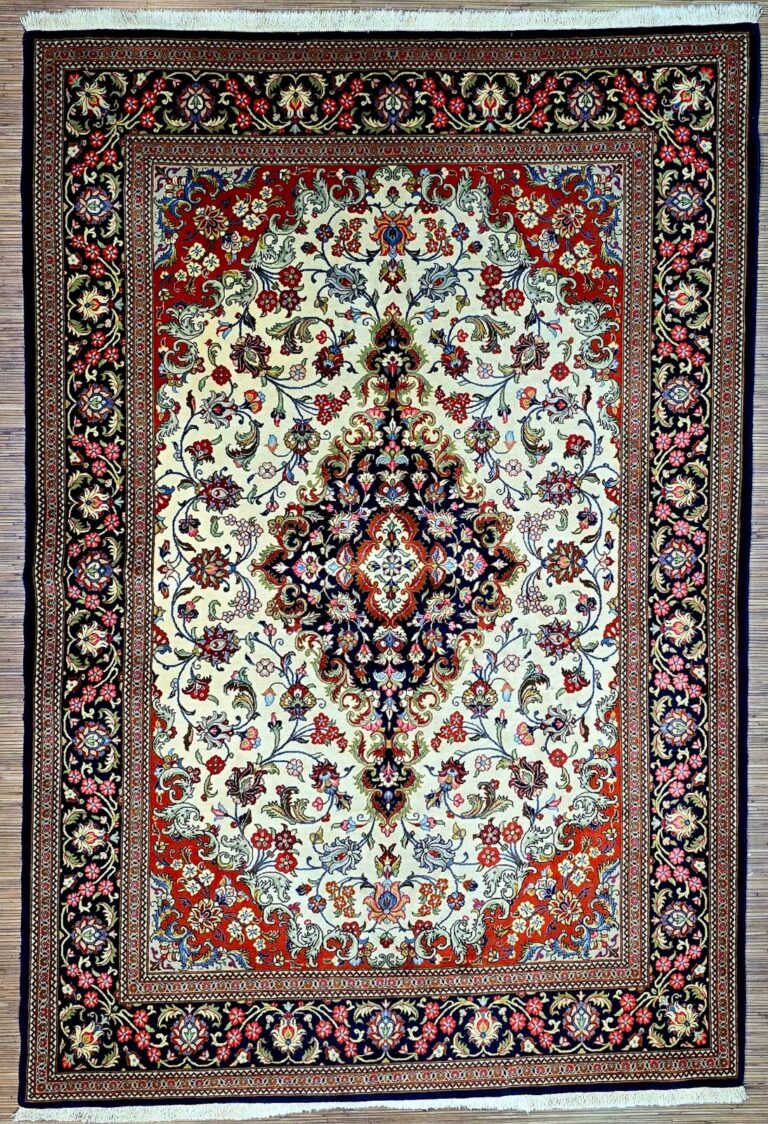
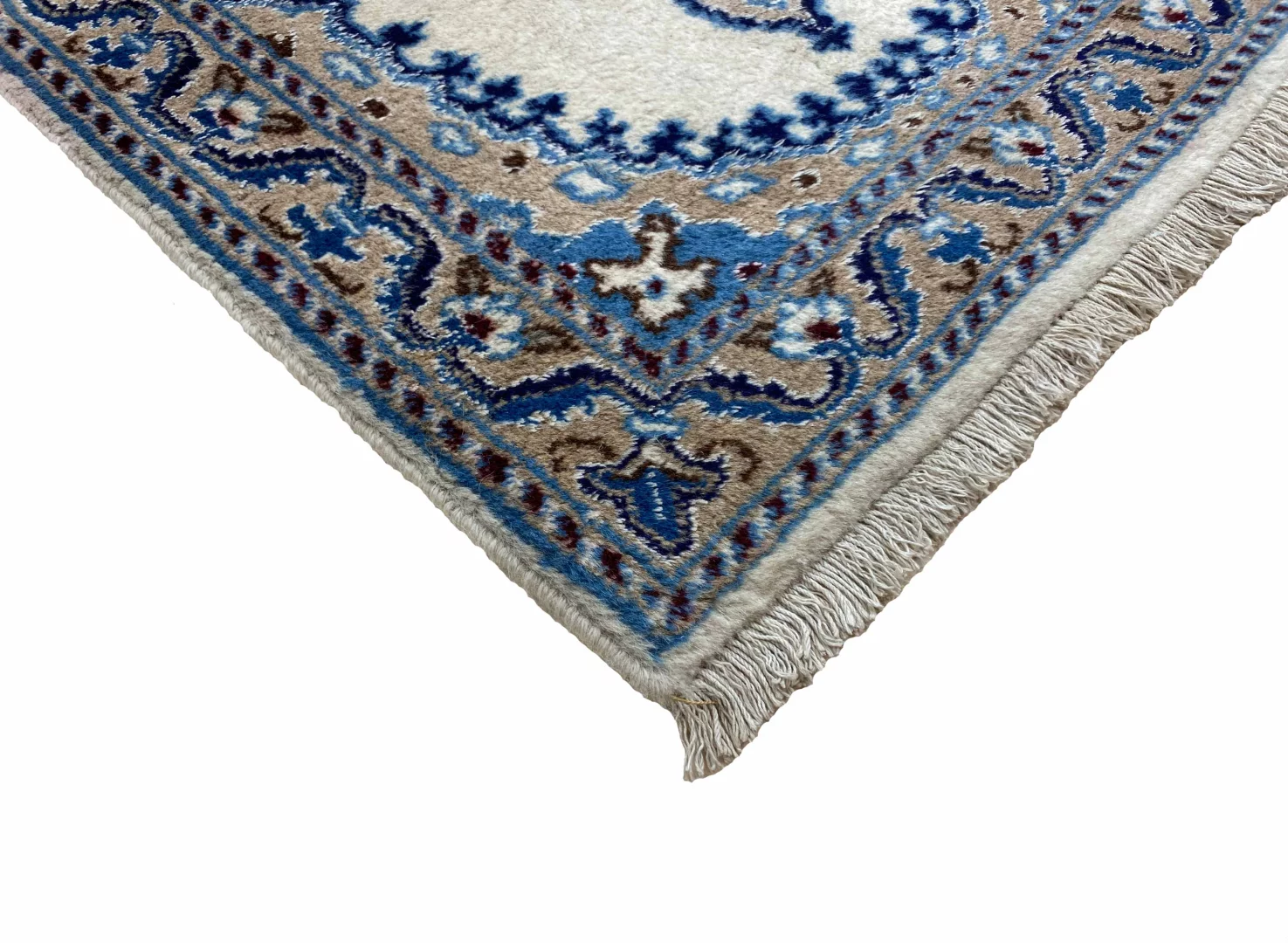
This Nain Persian rug is hand-knotted and made from wool and silk. The combination of these two materials is one of the features described for fine Nain rugs. Wool provides a resilient and pleasantly soft foundation, while silk contributes a smooth texture and a subtle sheen. Together, the materials create a surface with a soft feel and support the durability traditionally associated with Persian rugs.
The knot density of this rug is classified as 12-Lah and is given as approximately 250,000 knots per square metre. Nain quality is traditionally described through knot density and the Lah classification. The source names the common levels as 4-Lah, 6-Lah, 9-Lah and 12-Lah. In general, a higher number of knots permits more finely drawn lines and ornaments, while a lower density allows larger forms with a more readily visible structure.
Hand-knotting connects the materials with the established working method of Oriental carpet making. Individual knots are inserted into the construction so that floral lines, borders and a central medallion can be built with distinction. For this particular rug, the documented materials are wool and silk, the technique is hand-knotting, and the density is identified as 12-Lah.
Origin and Tradition
Nain rugs originate in the city of Nain in Central Persia. This rug is also assigned to the Isfahan region of Central Persia. Nain belongs to an important Persian carpet landscape in which weaving methods, the selection of fine materials and the arrangement of ornament have been developed and passed on through generations of craft practice.
Persian carpet making has a long history. In Persia, rugs served as useful textiles, furnishings and carriers of a visual language made from repeated ornamental forms. Designs were not created only for decoration; they also preserved established patterns whose interpretation could vary between regions and workshops. Within this broader tradition, Nain is associated with orderly compositions in which the precision of the drawing is central to the character of the rug.
The connection with Isfahan places Nain within a wider cultural and weaving context. Isfahan rugs are also known for hand-knotting, complex designs and high-quality materials. Kashan rugs represent another nearby Persian tradition and are often associated with rich floral compositions and strong red and gold tones. Tabriz rugs are known for their range of designs and high quality. These comparisons describe the breadth of Persian rug production; they do not alter the origin of this piece. It is a Nain Persian rug associated with Isfahan in Central Persia.
The name Nain therefore indicates a place of origin rather than merely a general floral style. This distinction matters because medallions and floral ornaments appear in many Persian weaving traditions. The regional name connects the rug with the city of Nain and with a craft tradition in which materials, hand-knotting and a clearly structured ornamental language belong together.
Design and Pattern
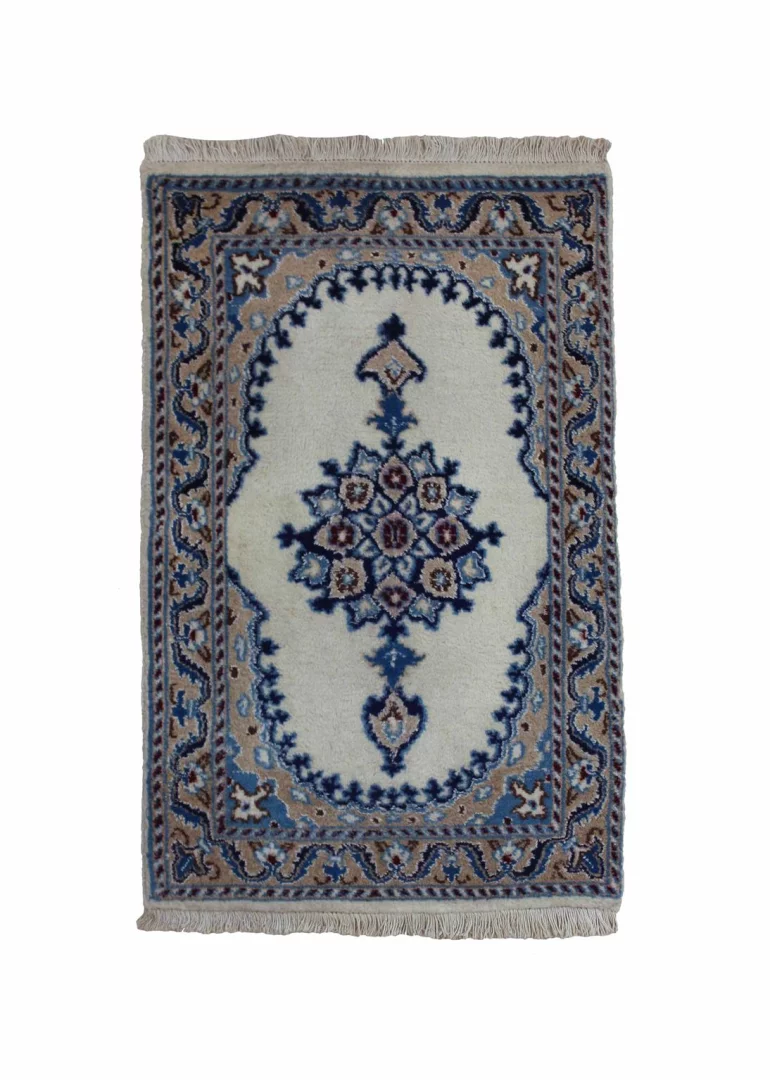
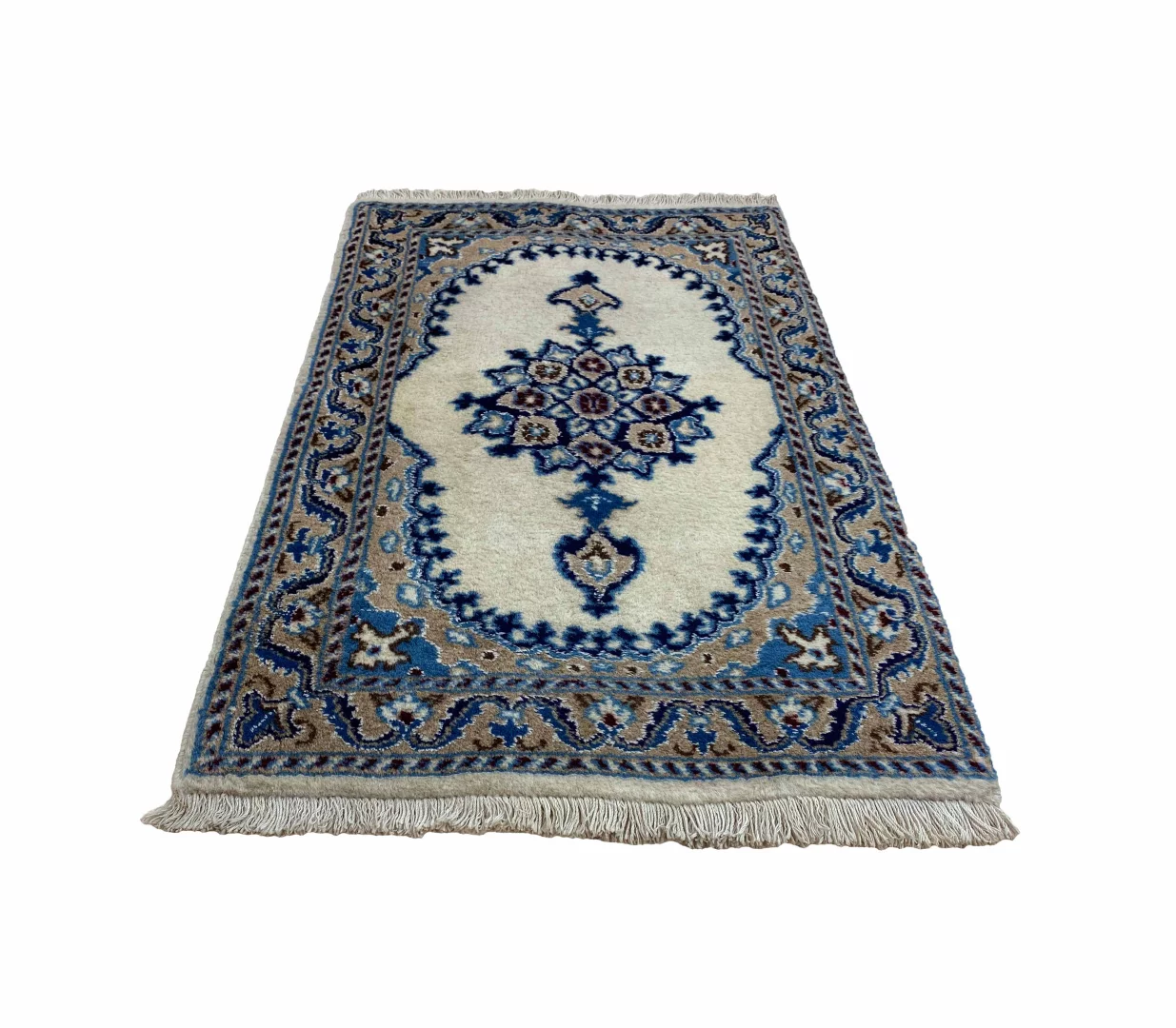
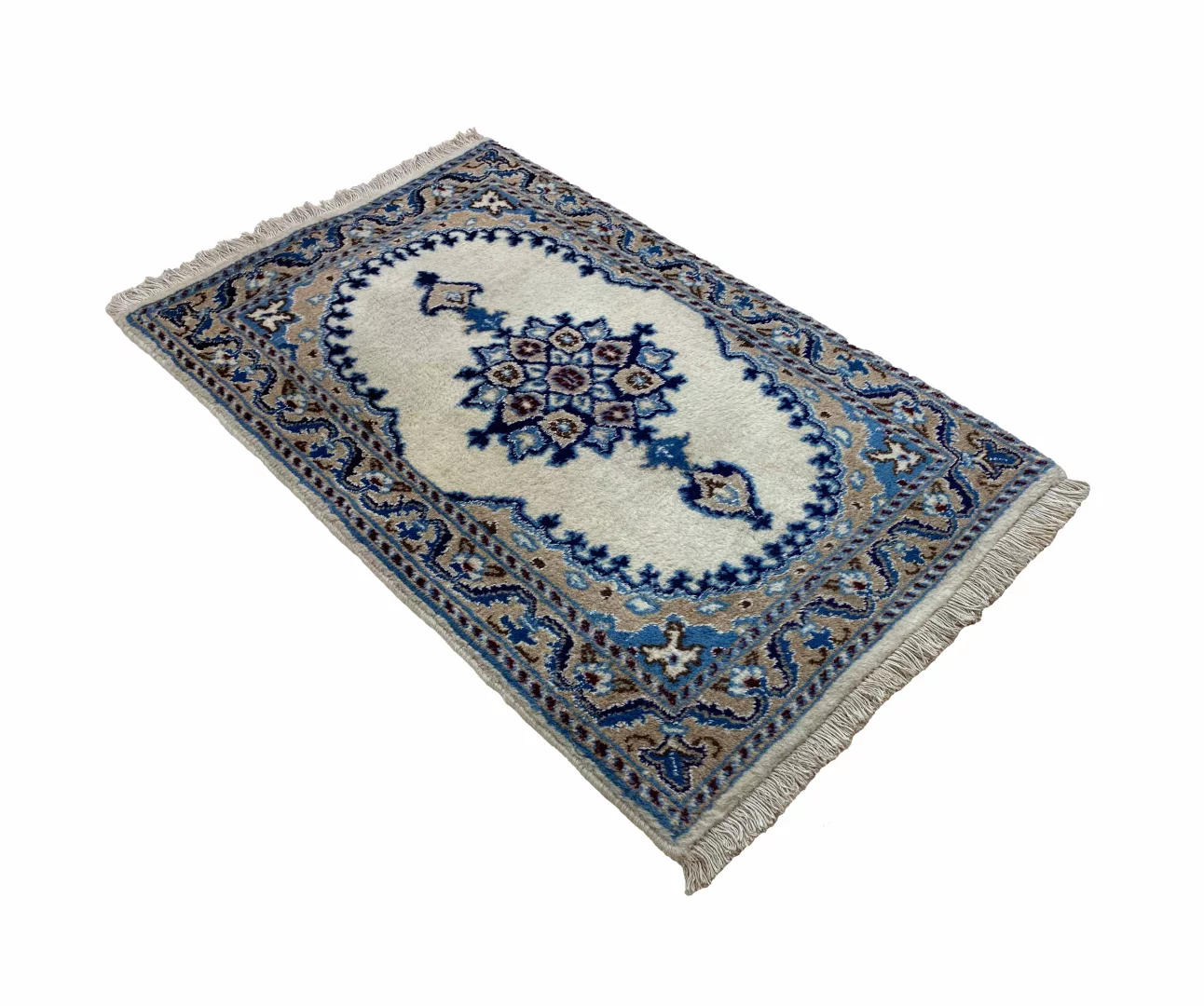
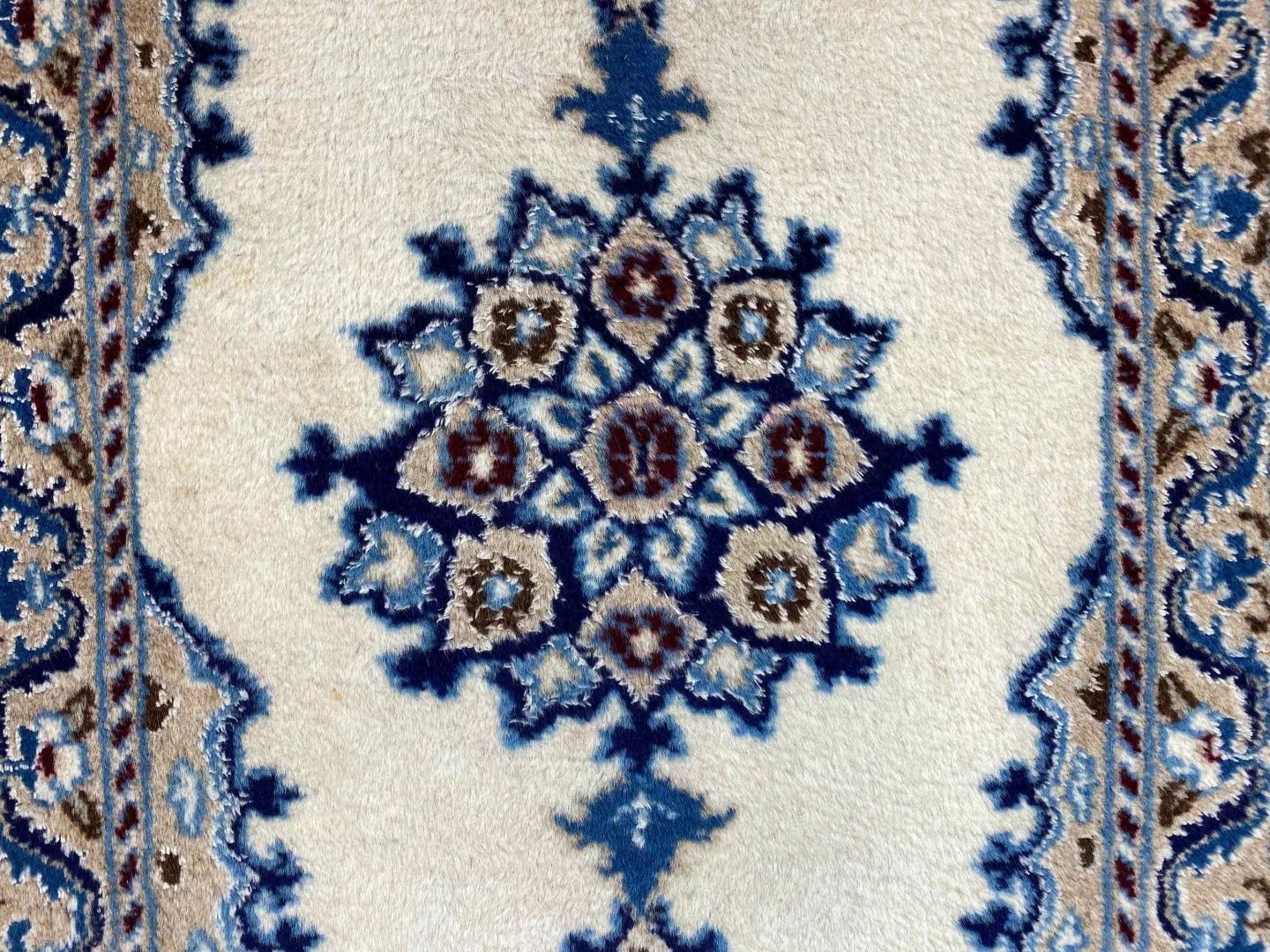
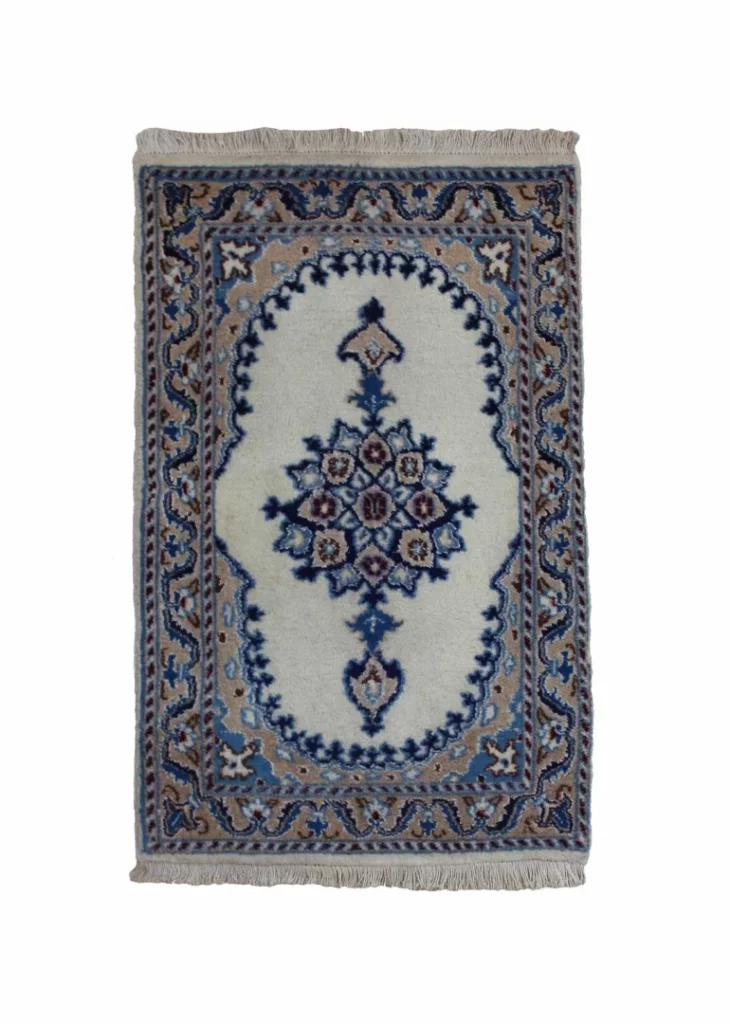
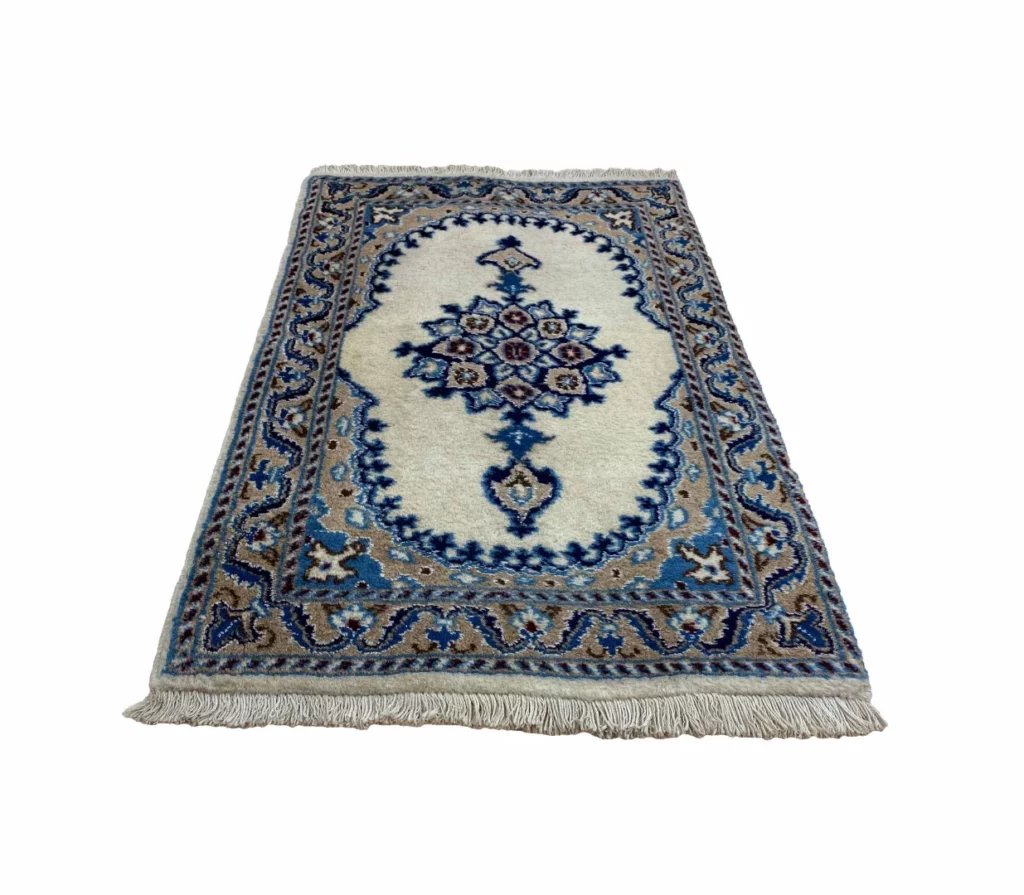
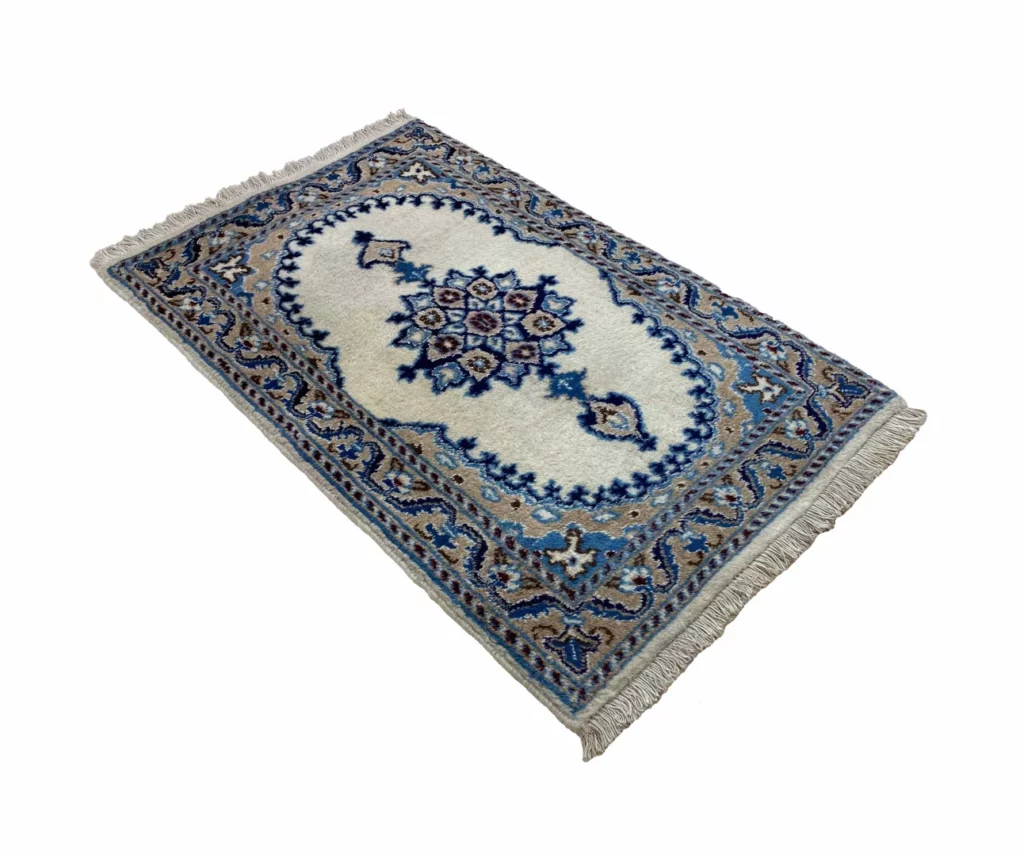
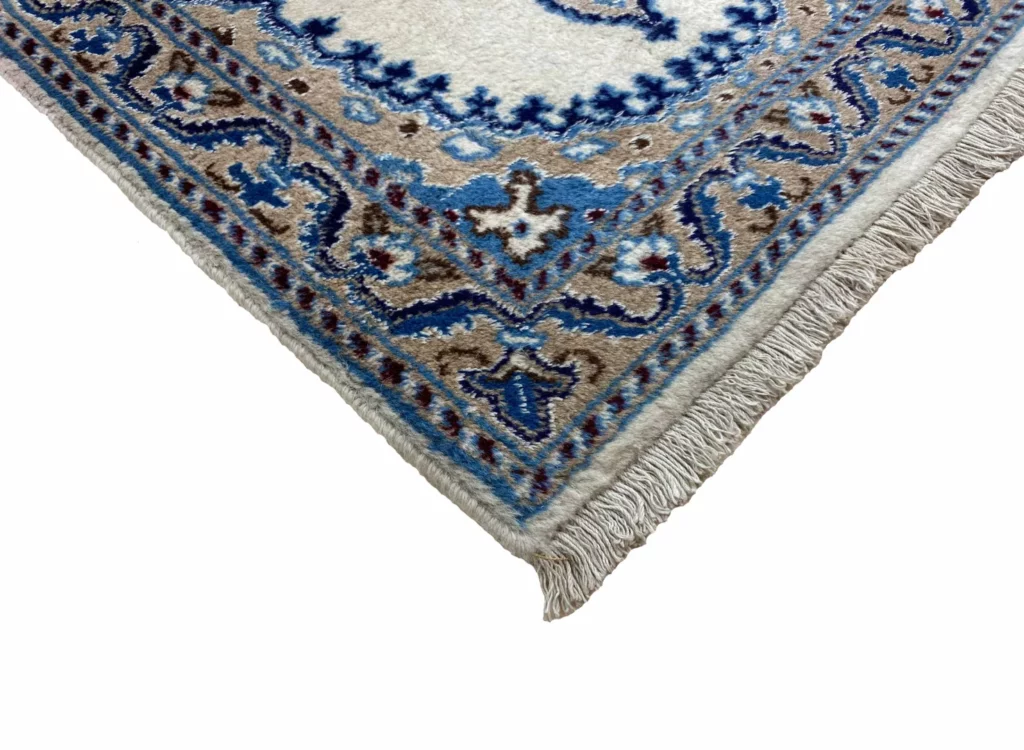
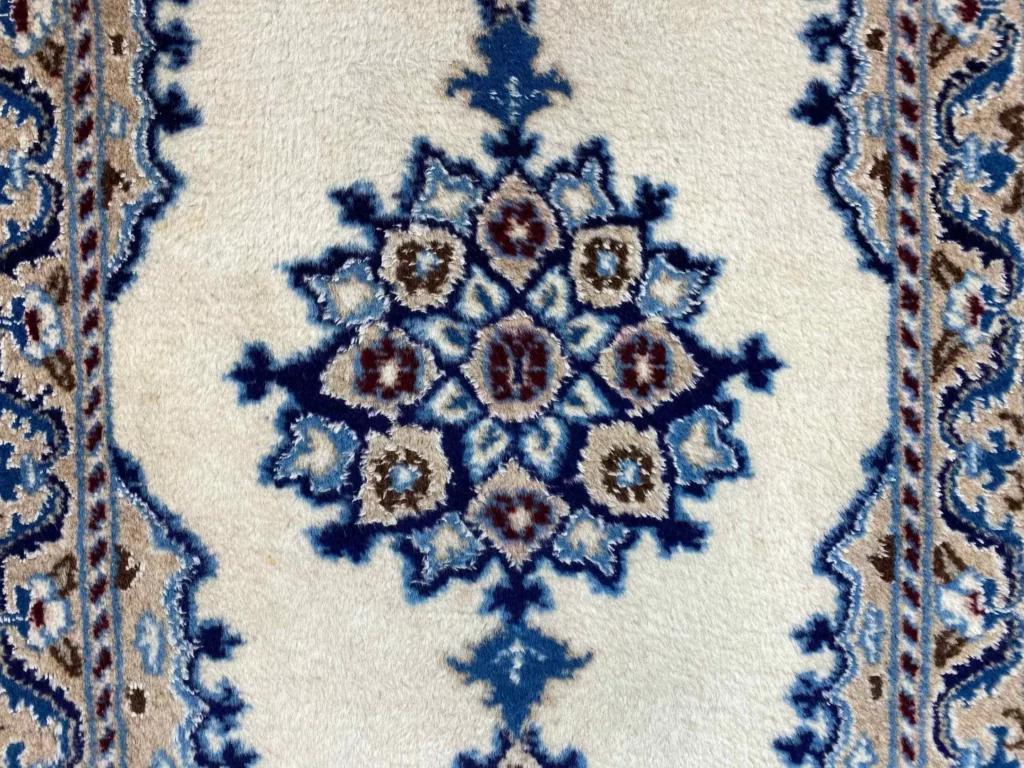
The pattern of this rug is described as classic floral with a medallion. The medallion serves as the central organising element of the composition. It draws attention towards the middle of the field and gives the surrounding floral ornament a balanced framework. Flowers, leaves and scrolling forms are arranged as a connected decorative system rather than as isolated images.
Floral designs are among the most familiar elements of Persian rugs. They may take inspiration from botanical forms, but in a rug they are rendered as stylised ornaments within a woven and knotted vocabulary. Flowers, leaves and vines help divide the field, create transitions and extend the effect of the central medallion into the surrounding design. Their purpose is compositional as well as descriptive.
Nain rugs are often associated with light colour schemes combined with floral drawing and medallions. The source describes bright blue, red and beige tones as typical for Nain patterns. These colours belong to the regional design tradition. The specific pattern recorded for this rug is classic floral with a medallion; a complete colour description of this individual piece is not provided. This keeps the description of the rug separate from general characteristics of the Nain style.
Knot density influences the degree of detail that can be expressed in Nain designs. Finer densities generally permit smaller ornaments and more differentiated contours, while a 12-Lah construction can still present floral motifs and a medallion in a clearly organised manner. The visual structure results from the relationship between the central form, the floral filling and the hand-knotted execution. This is why Nain compositions can appear ordered and symmetrical while containing many individual details.
A medallion in Persian carpet design is not an isolated emblem. Floral elements may echo its outline, extend towards the sides or fill the surrounding field in a measured rhythm. The connection between centre and field creates a readable overall composition. For this rug, the documented design feature is precisely the combination of classic floral motifs and a medallion.
Special Features
The notable features of this one-off rug are its hand-knotted construction, its wool and silk material combination and its classification as 12-Lah. The knot density is given as approximately 250,000 knots per square metre. Its pattern consists of classic floral motifs with a medallion. The condition is described as very well preserved.
The material combination gives the rug the soft texture and pleasant feel described in the source. Silk can contribute a fine sheen, while wool provides a resilient foundation. These are general properties of the stated materials. No additional claims about the rug’s age, construction or provenance are added beyond the documented details.
FAQ
How should I care for my Nain Persian rug?
Vacuum the rug regularly and gently to remove dust and loose particles from the pile. Blot stains promptly with a damp cloth rather than rubbing them into the fibres. Avoid harsh cleaning agents, as they can affect the materials and may be particularly unsuitable for fine silk. When a deeper cleaning is needed, occasional professional cleaning is recommended. This approach helps protect the hand-knotted surface and maintain its condition.
Where do Nain rugs come from, and what makes them distinctive?
Nain rugs come from the city of Nain in Central Persia. This rug is associated with the Isfahan region. Nain rugs are distinctive for their hand-crafted construction, frequent use of wool and silk, differentiated knot densities and floral designs with medallions. Their quality is traditionally described in part through the Lah classification, which helps indicate the fineness of the knotting and the level of detail that can be achieved.
What sizes are available for Nain Persian rugs?
Nain Persian rugs are made in a range of formats, from small runners to large rugs intended for living areas. This variety allows them to be used in different rooms and settings. The rug described here is a single hand-knotted piece with a classic floral medallion pattern; its individual size is provided in the product details.
To provide the best experiences, we use technologies like cookies to store and/or access device information. Consenting to these technologies will allow us to process data such as browsing behavior or unique IDs on this site. Not consenting or withdrawing consent, may adversely affect certain features and functions.
Functional Always active
The technical storage or access is strictly necessary for the legitimate purpose of enabling the use of a specific service explicitly requested by the subscriber or user, or for the sole purpose of carrying out the transmission of a communication over an electronic communications network.
Preferences
The technical storage or access is necessary for the legitimate purpose of storing preferences that are not requested by the subscriber or user.
Statistics
The technical storage or access that is used exclusively for statistical purposes.The technical storage or access that is used exclusively for anonymous statistical purposes. Without a subpoena, voluntary compliance on the part of your Internet Service Provider, or additional records from a third party, information stored or retrieved for this purpose alone cannot usually be used to identify you.
Marketing
The technical storage or access is required to create user profiles to send advertising, or to track the user on a website or across several websites for similar marketing purposes.
 SECURE PAYMENT
 SHIPPING PARTNERS