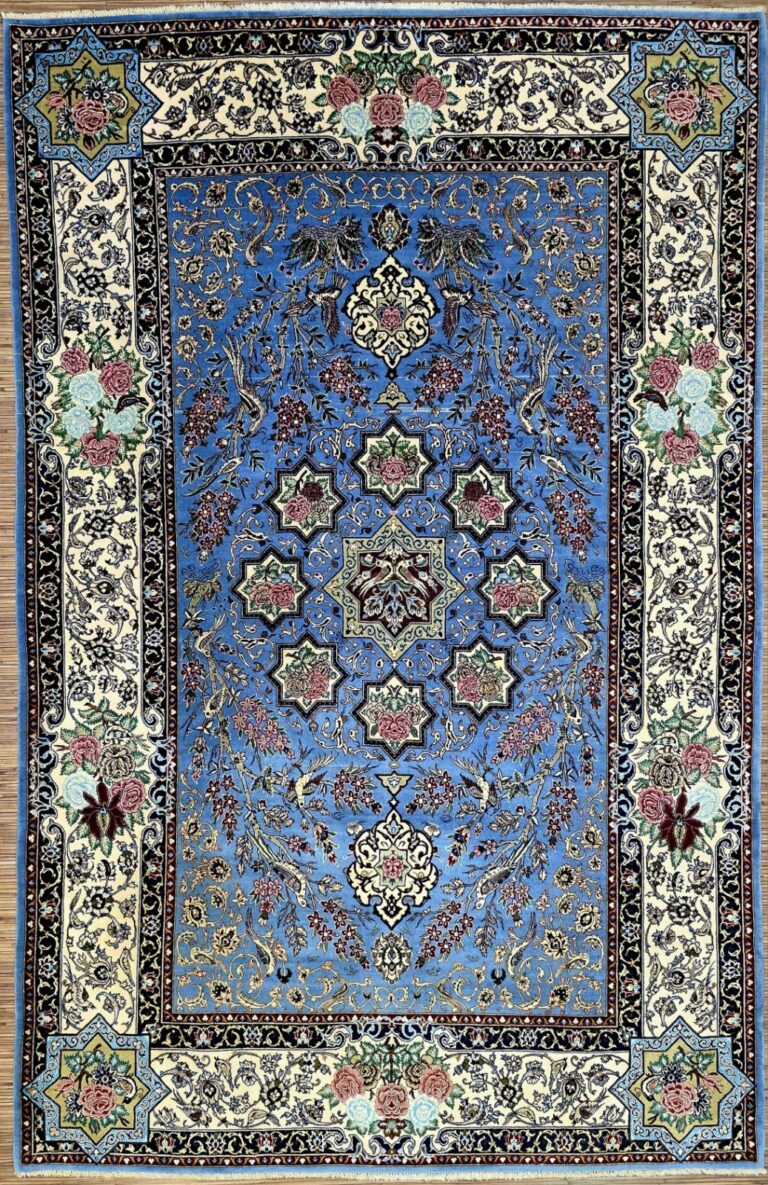
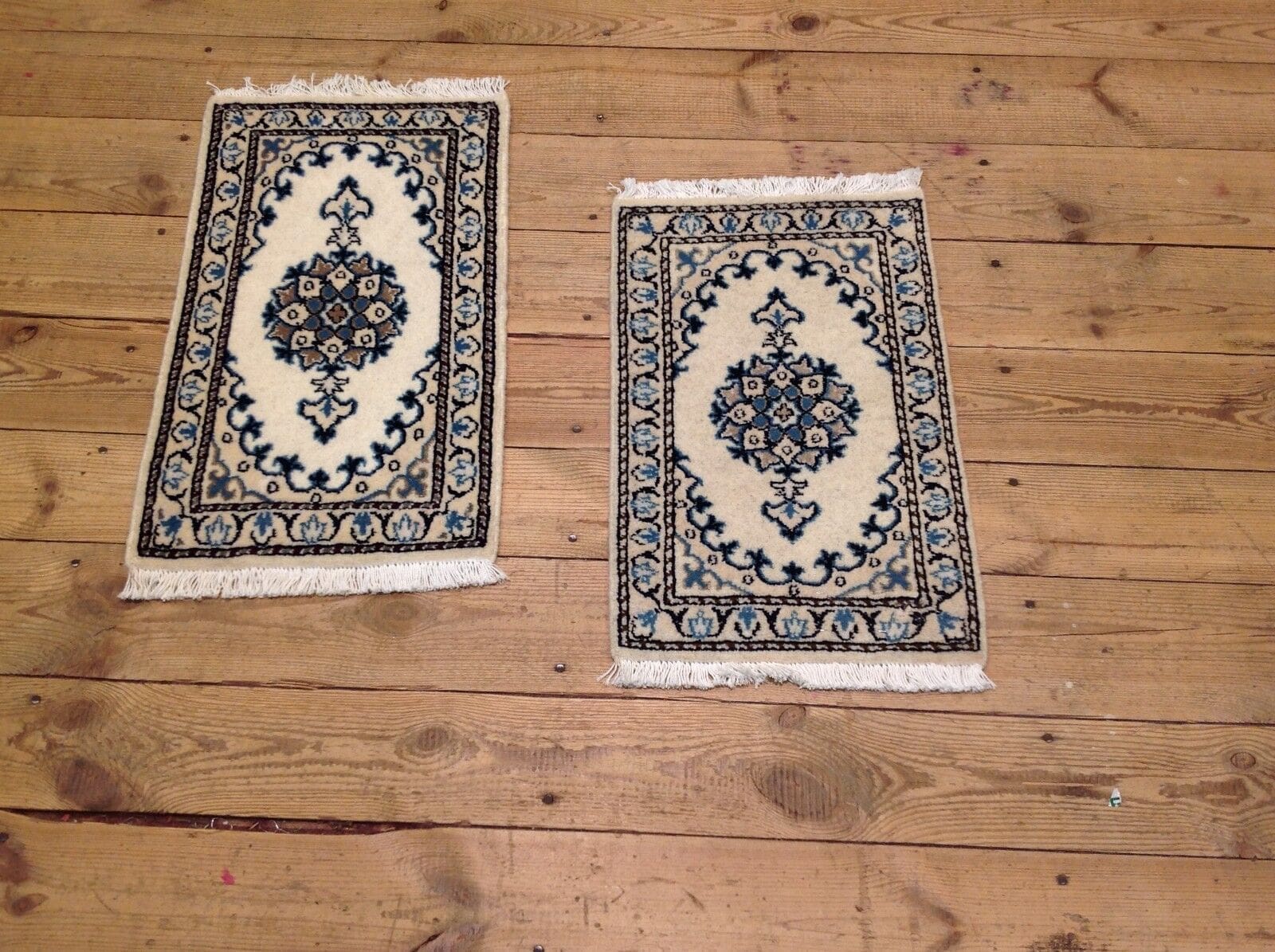
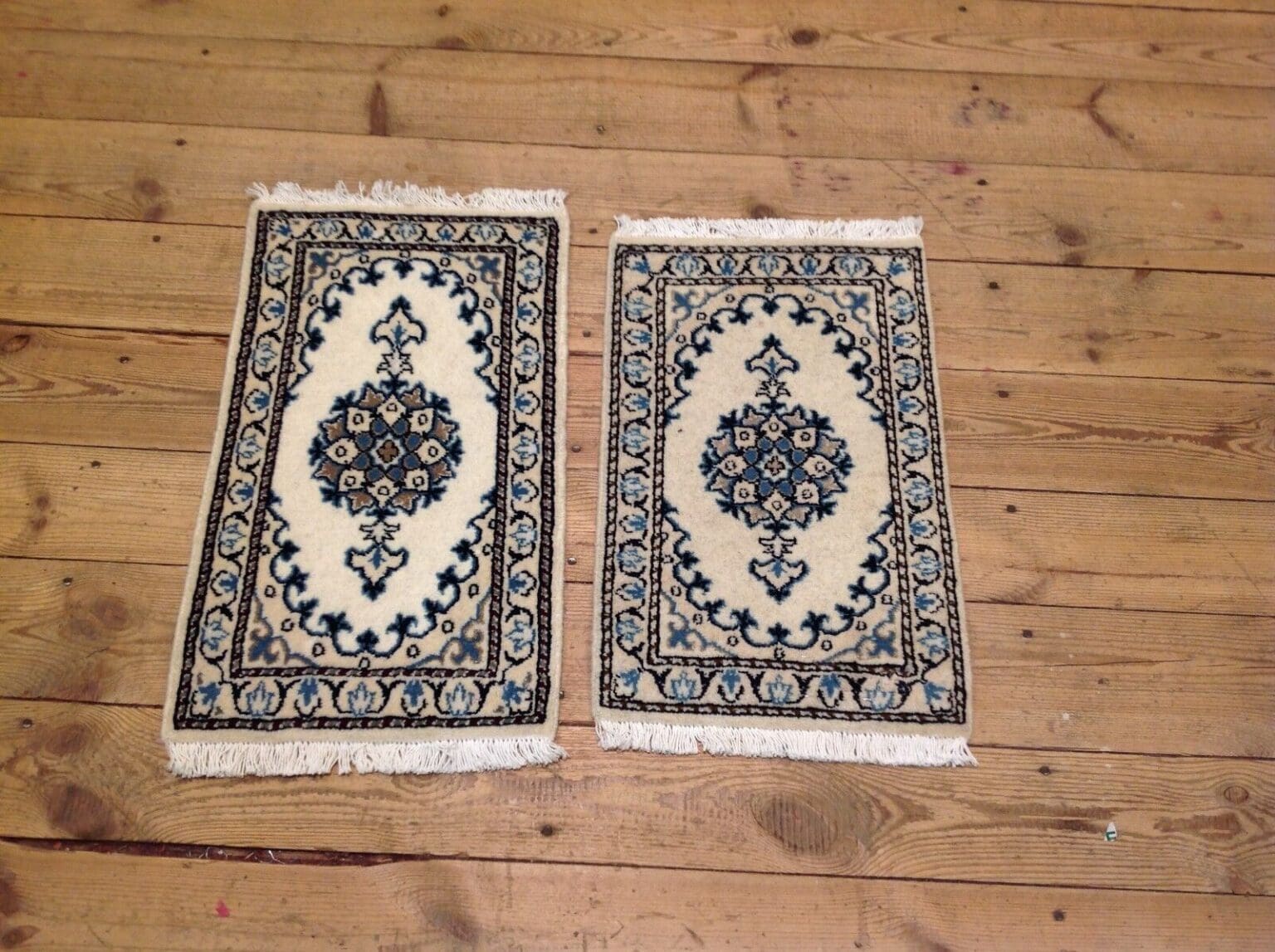
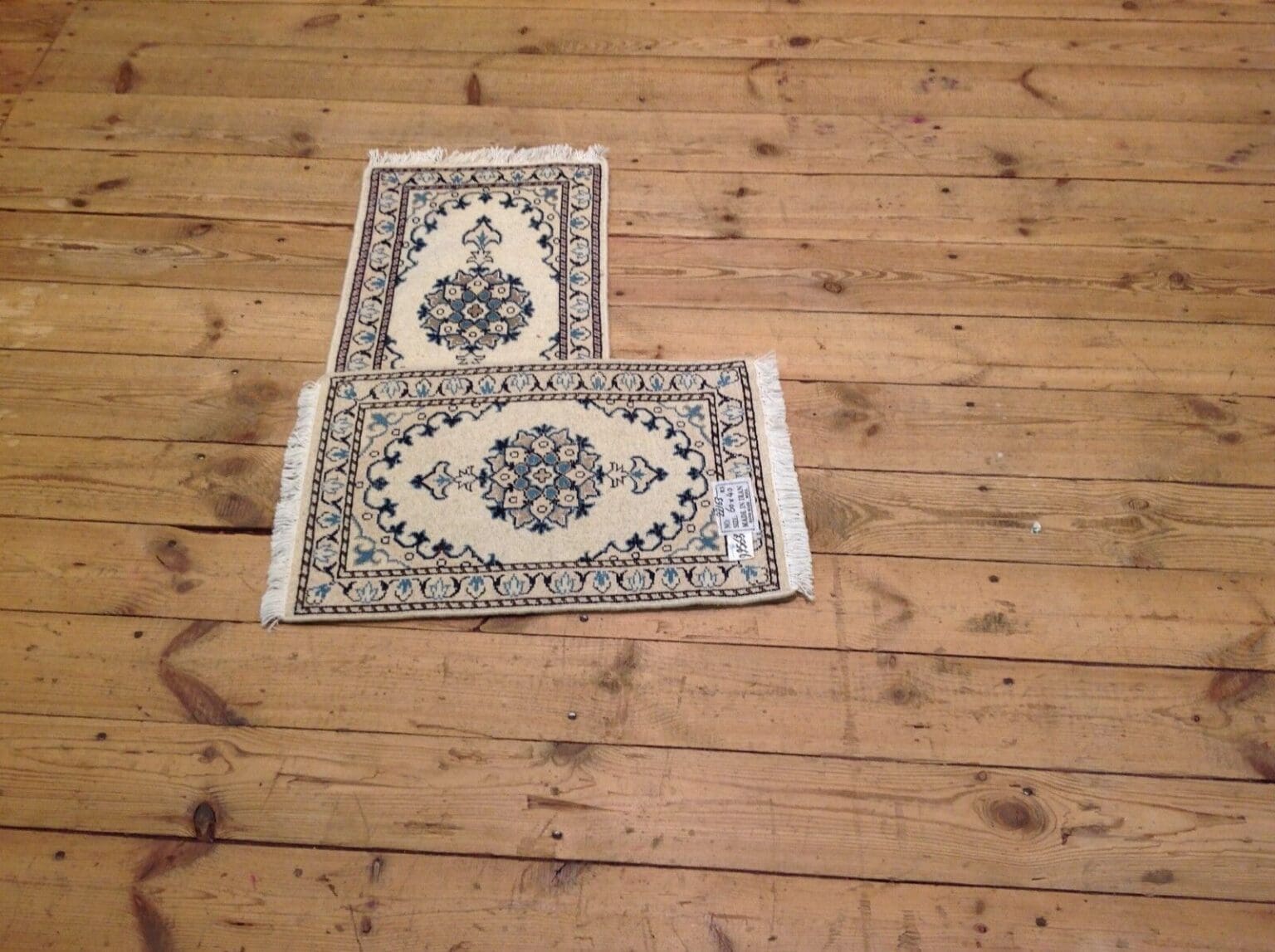
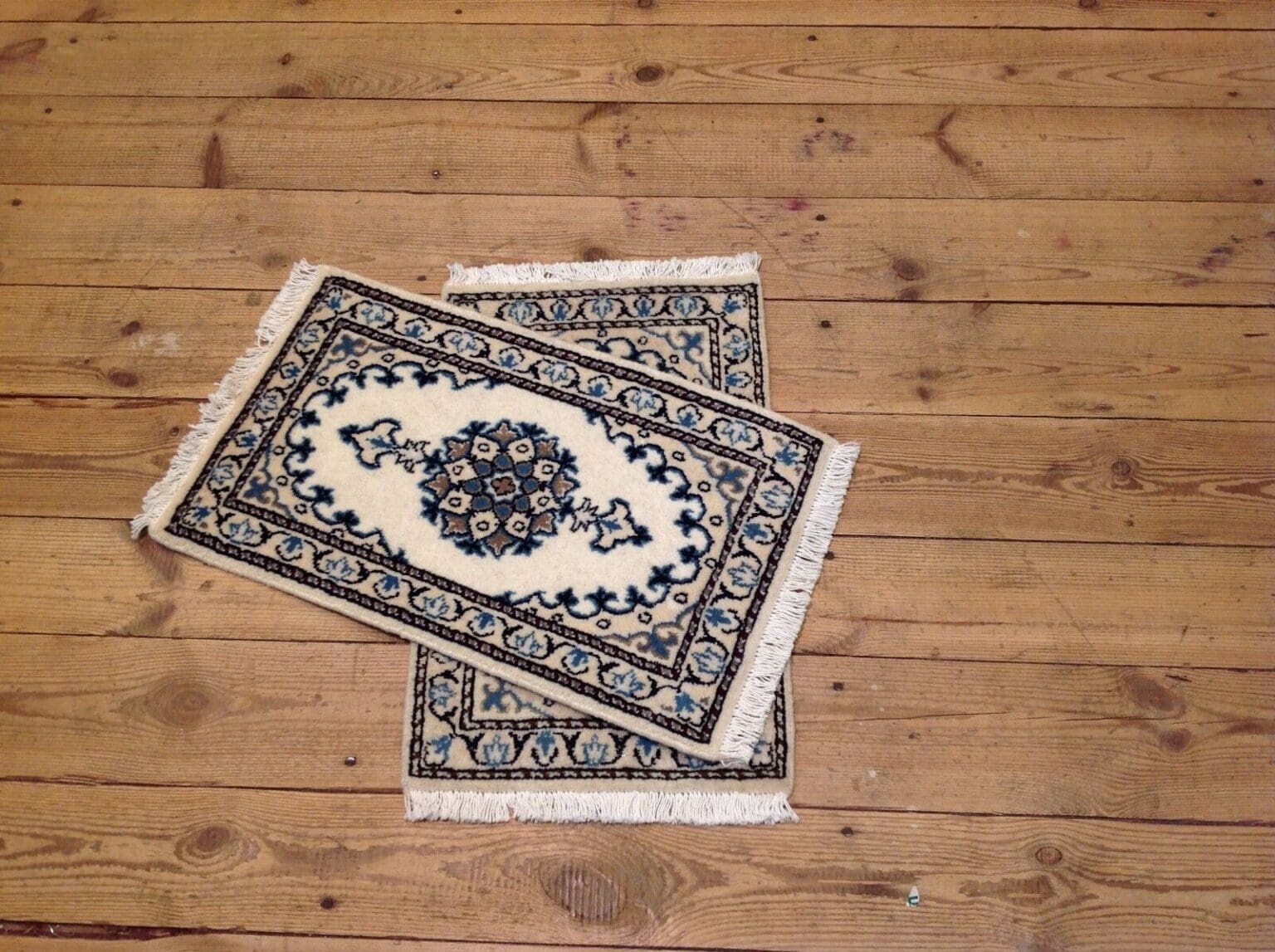
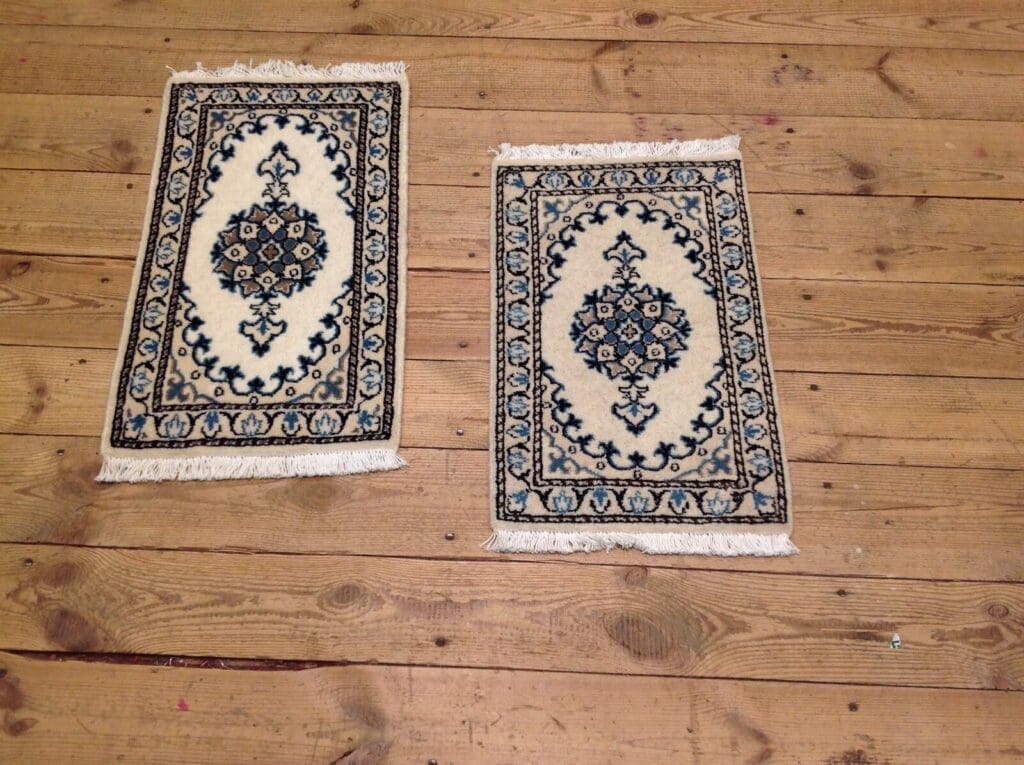
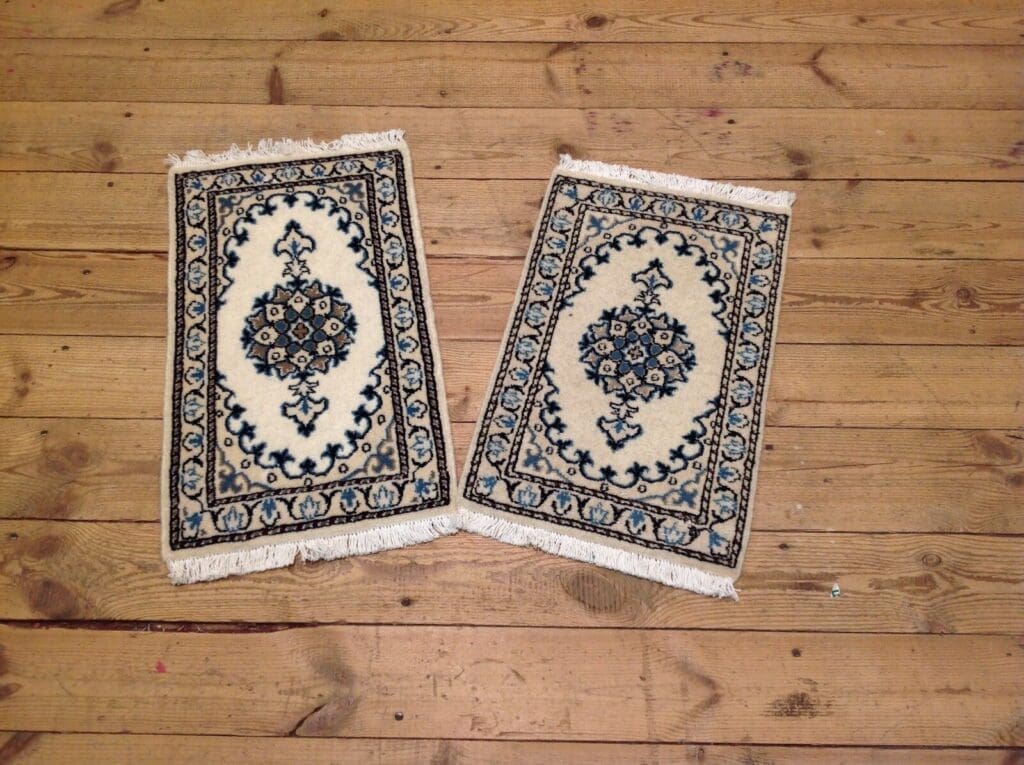
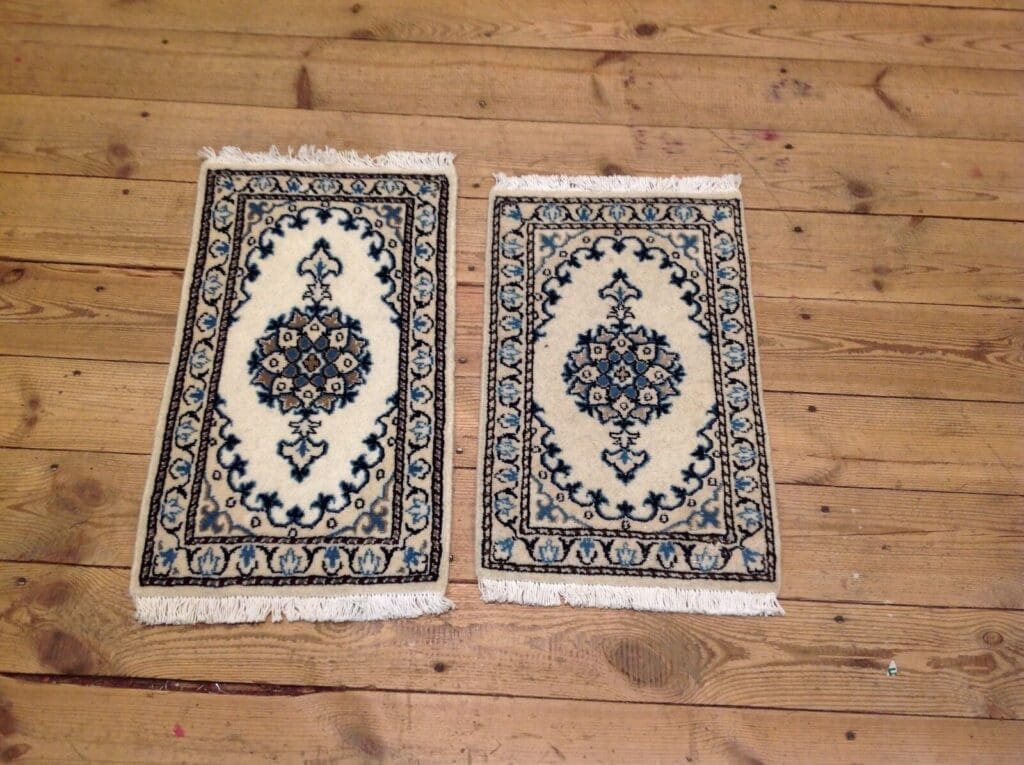
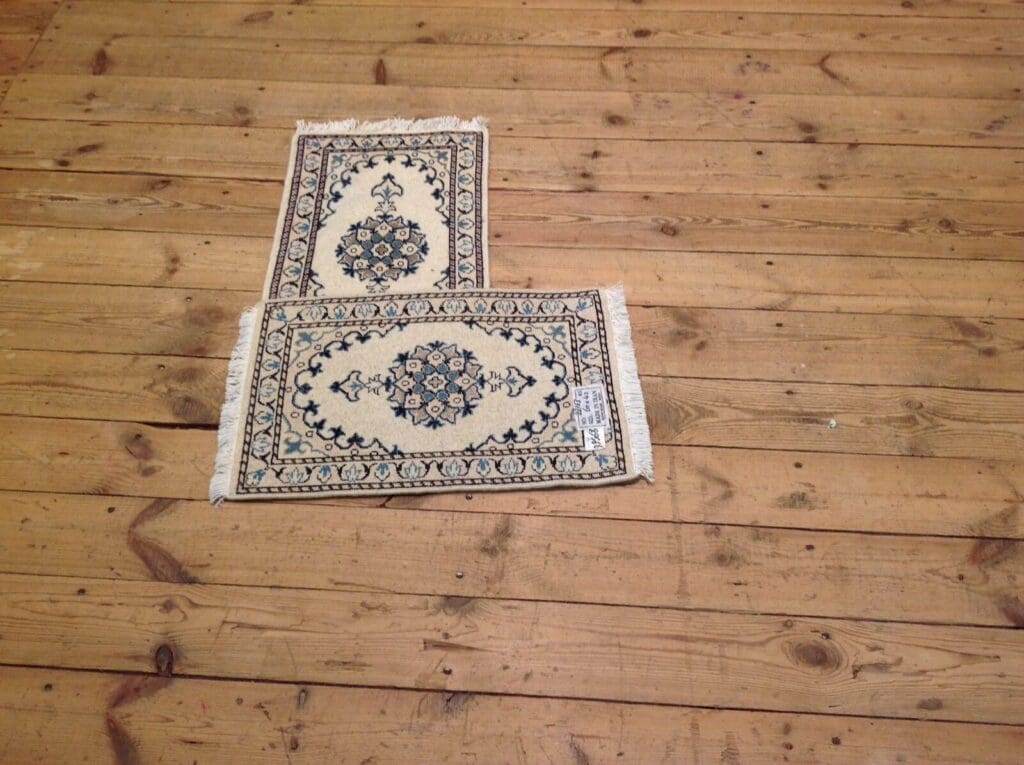
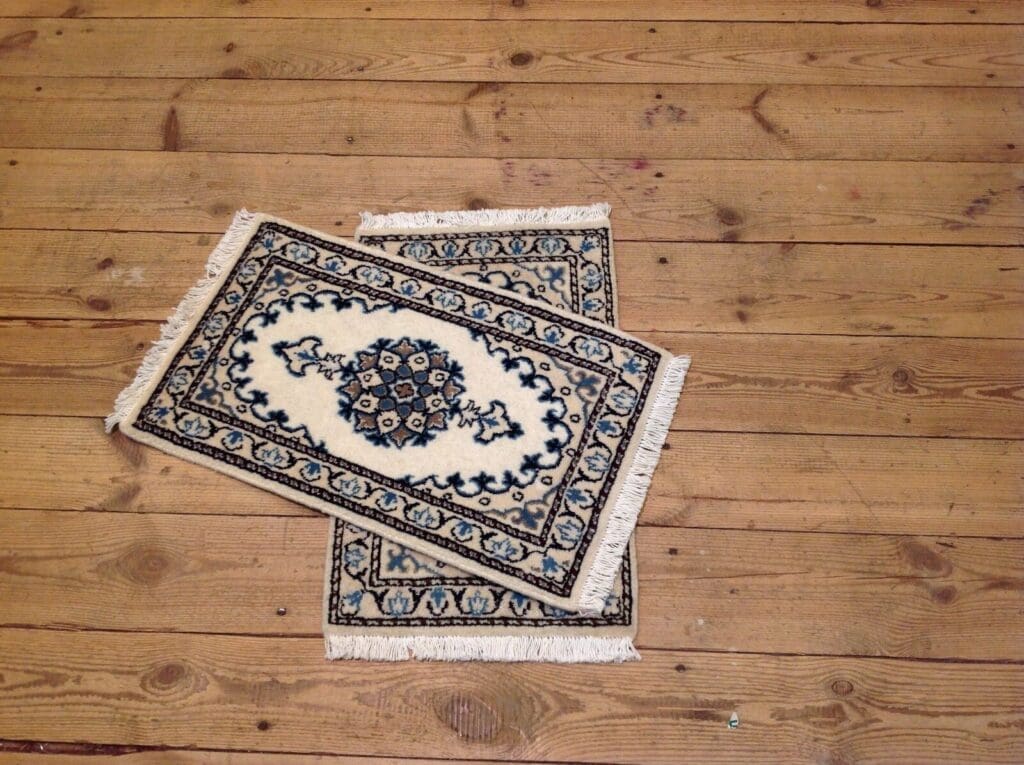
Hand-knotted Nain Persian rug | Knot density: approx. 300,000 knots/m² | Material: pile 90% virgin wool and 10% silk, warp cotton | Size: 60 x 40 cm | Pattern: floral and geometric motifs | Condition: new and in very good condition
This Nain Persian rug is entirely hand-knotted. Hand knotting is a traditional method in which each knot is formed individually and secured within the foundation of the rug. The process allows the weaver to build a precise surface with closely arranged details rather than producing the design through an industrial or mechanically repeated process. Every hand-knotted rug is therefore made as an individual piece, and this rug is described as unique.
The pile consists of 90% virgin wool and 10% silk. Virgin wool contributes a soft, resilient surface, while silk is used as a refined supplementary fibre within the pile. The combination is associated with a smooth handle and the ability to render fine visual distinctions in a woven design. The rug also has a cotton warp and cotton foundation. The warp forms the structural framework around which the knots are arranged, while the foundation supports the construction and helps maintain its form.
The pile and the foundation work together as a textile structure. Wool gives the surface substance and practical resilience, while silk can add a subtle variation in texture and reflection. Cotton in the warp and foundation provides a stable basis for the hand-knotting process. The rug is described as having a dense knotting of approximately 300,000 knots per square metre. Such density permits the representation of carefully drawn floral and geometric details.
The rug is supplied with a certificate of authenticity. This certificate documents its origin and quality. The piece is new and in very good condition. These details concern the individual rug itself and distinguish it from general descriptions of Nain weaving. Its construction, fibre composition, condition and accompanying certificate are part of the specific description of this one-off piece.
Origin and Tradition
The rug comes from Nain, a city in northeastern Iran, and belongs to the tradition of Persian carpet weaving. Nain is recognised for carpets with carefully controlled drawing, fine knotting and a measured relationship between the field and the surrounding borders. The local tradition developed within the wider culture of Iranian textile production, where carpet weaving combines practical knowledge of materials with established design vocabulary. A Nain carpet is read not only through its colours and motifs, but also through the precision of its construction.
Persian carpet weaving has been shaped by many regional centres, each with its own habits of drawing, colour selection and construction. Nain is one of these centres. Weavers traditionally work with a clear layout and a balanced arrangement of ornament. Floral elements may be distributed across a central field, placed around a medallion, or organised into an ordered repeat. Geometric structure helps keep the composition coherent, even when the surface contains numerous small details.
The craft depends on a sequence of connected decisions. The foundation must be prepared so that the rows remain stable, the knots must be placed consistently, and the pile must be trimmed to reveal the intended drawing. The weaver also has to follow the design while maintaining the relationship between the field, border and secondary ornaments. This is why knotting is both a technical and an artistic discipline. A design can only appear clearly when the construction supports its scale and rhythm.
Nain carpets are often associated with finely worked surfaces and a restrained, orderly sense of composition. Their appearance reflects the interaction of wool, silk, knot density and the discipline of the drawing. The use of silk alongside wool can help distinguish delicate accents and make small changes in the pattern legible. Cotton in the foundation provides the structural support needed for the knots to form a stable textile. These methods belong to the broader Persian tradition, while the name Nain identifies the regional weaving context of this rug.
The source also places this rug within a wider family of Persian carpet traditions. Tabriz carpets, from Tabriz in northwestern Iran, are known for artistic designs and high-quality materials, often including complex floral and geometric arrangements. Isfahan carpets are likewise associated with detailed handwork and the use of silk. Qom carpets are valued for fine silk knotting and lively colours, while Kashan carpets often feature traditional motifs and a high knot count. These places represent related but distinct weaving traditions. They are useful comparisons for understanding the variety of Persian carpets, but they do not change this rug’s origin: this is a Nain Persian rug.
Regional names in Persian carpet culture refer to more than a location on a map. They can indicate a vocabulary of ornament, a way of organising a field, and a history of workshop practice. At the same time, no two hand-knotted carpets are identical. The individual weaver’s handling of colour, spacing and detail gives each piece its own surface. That combination of a recognised regional tradition and individual execution explains why a Nain rug can be part of a long-established craft while remaining a unique object.
Design and Pattern
The design of this rug combines floral motifs with geometric forms. These elements are carefully arranged and reflect the traditional artistic vocabulary associated with Nain. Floral ornament introduces organic movement through leaves, blossoms and branching forms, while geometry provides order through repetition, alignment and the definition of borders or compartments. Together they create a composition in which curved and angular lines can be read as parts of one coordinated design.
Floral patterns in Persian carpets are not simply naturalistic pictures. They are usually stylised so that a blossom, leaf or vine can be repeated, mirrored or extended across the field. Stylisation allows the motif to fit the proportions of the carpet and to connect with neighbouring elements. A small floral unit may be part of a larger rhythm, while a larger ornament can serve as a visual anchor. This approach gives the surface continuity without requiring every detail to be identical.
Geometric forms perform a different but complementary function. They can mark the edges of a border, frame a field, organise a medallion or create regular intervals between floral elements. Lines and shapes establish direction and balance. In a finely knotted carpet, the clarity of these forms depends on the accuracy of the knot placement and on the way the pile is finished. The stated knot density supports the rendering of detailed motifs, but the appearance of the design also depends on the weaver’s control of proportion and spacing.
The design is described as unique, including its colour arrangement and pattern. This does not mean that the rug is detached from tradition. Rather, it means that the traditional vocabulary has been worked into an individual composition. The precise relationship between floral details, geometric structure and colour belongs to this particular piece. A similar Nain design may share general motifs, yet its exact drawing and arrangement will differ because a hand-knotted rug is not produced as an exact industrial duplicate.
When viewing the design, the eye can move between larger structural zones and smaller decorative details. Borders provide a visual frame, while the field carries the main rhythm of the composition. Floral forms soften the regularity of geometric organisation, and geometric forms prevent the floral elements from becoming visually unstructured. This balance is a recurring principle in Persian carpet design. It allows ornament to be rich in detail while remaining readable as a complete surface.
The comparison with Tabriz, Isfahan, Qom and Kashan helps place the pattern within Persian design history. Tabriz is associated with complex floral and geometric designs. Isfahan is known for detailed workmanship and silk. Qom is particularly associated with fine silk carpets and vivid colour use, while Kashan often uses traditional motifs in carpets with high knot counts. These traditions may share visual principles, but their regional identities are distinct. The floral and geometric design described here belongs to the Nain rug offered as this individual piece.
Colour and pattern are also part of the rug’s individual character. Because this carpet is one of a kind, its combination of tones, spacing and ornaments is not interchangeable with another example. The visual result comes from the selected design, the wool and silk pile, the cotton foundation and the hand-knotting technique. The pattern therefore represents both a regional tradition and the specific decisions embodied in this rug.
Special Features
The rug is a one-off hand-knotted Nain Persian carpet with a pile of virgin wool and silk and a cotton warp and foundation. Its approximately 300,000 knots per square metre support the detailed floral and geometric drawing. The rug is new and in very good condition, and it comes with a certificate of authenticity documenting its origin and quality. Its unique colour arrangement and pattern are further characteristics of this individual piece.
For care, regular vacuuming is recommended. If more intensive cleaning is needed, professional cleaning should be used. Direct sunlight should be avoided because prolonged exposure can cause colours to fade. The rug can be used in a room with underfloor heating, provided that the temperature is not set too high in order to protect the materials.
The rug can be placed in a living room or dining room, and it can also provide an accent in a study or hallway. It should not be positioned in a heavily trafficked area if unnecessary wear is to be avoided. These placement and care recommendations respect the hand-knotted construction and the wool and silk pile without adding characteristics that are not part of the rug’s description.
FAQ
How should a Nain Persian rug with silk be cared for?
Vacuum the rug regularly to remove everyday dust and loose particles. If it requires deeper cleaning, arrange professional cleaning rather than attempting an unsuitable treatment at home. Direct sunlight should be avoided, since strong and prolonged exposure can fade the colours. Careful routine maintenance and appropriate cleaning help preserve the pile, the pattern and the overall condition of this hand-knotted rug.
Can the rug be used over underfloor heating?
Yes, the rug can be used in a room with underfloor heating. The heating temperature should not be set too high, as excessive heat may affect the materials. A moderate setting is the appropriate approach for a rug made with a wool and silk pile and a cotton warp and foundation. The rug should also lie securely and be checked periodically as part of normal household care.
Where is the best place to position the rug?
The rug is suitable for a living room or dining room. It can also create an accent in a study or hallway. To reduce avoidable wear, it should not be placed in an area with particularly heavy foot traffic. Positioning it where the hand-knotted surface can be seen and used without constant intensive passage allows the floral and geometric pattern to remain part of the room’s visual arrangement while supporting careful use.
To provide the best experiences, we use technologies like cookies to store and/or access device information. Consenting to these technologies will allow us to process data such as browsing behavior or unique IDs on this site. Not consenting or withdrawing consent, may adversely affect certain features and functions.
Functional Always active
The technical storage or access is strictly necessary for the legitimate purpose of enabling the use of a specific service explicitly requested by the subscriber or user, or for the sole purpose of carrying out the transmission of a communication over an electronic communications network.
Preferences
The technical storage or access is necessary for the legitimate purpose of storing preferences that are not requested by the subscriber or user.
Statistics
The technical storage or access that is used exclusively for statistical purposes.The technical storage or access that is used exclusively for anonymous statistical purposes. Without a subpoena, voluntary compliance on the part of your Internet Service Provider, or additional records from a third party, information stored or retrieved for this purpose alone cannot usually be used to identify you.
Marketing
The technical storage or access is required to create user profiles to send advertising, or to track the user on a website or across several websites for similar marketing purposes.
 SECURE PAYMENT
 SHIPPING PARTNERS