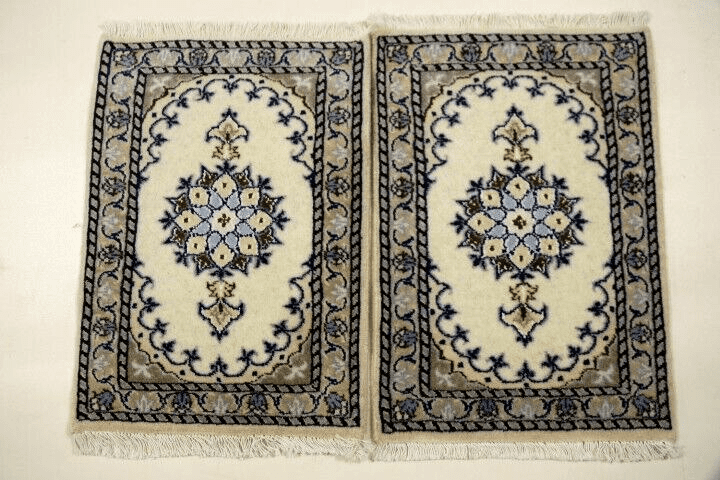
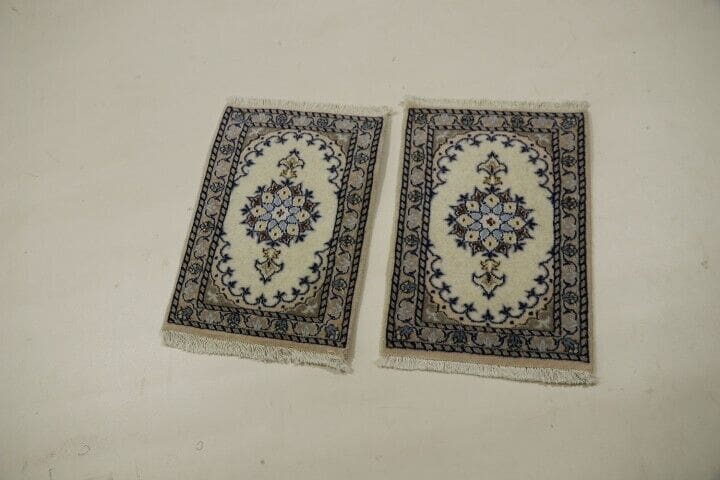
This Nain Persian rug is hand-knotted and has a pile made of 95% virgin wool and 5% silk. The two natural fibres contribute different qualities to the surface: virgin wool provides the resilient and pleasantly tactile main component, while silk can add fine accents and a subtle sheen that changes with the light. Their combination gives the rug its stated material character and sets it apart from machine-made floor coverings.
The knot density is approximately 300,000 knots per square metre. Fine knotting allows small ornaments, narrow outlines and delicate colour transitions to be worked with precision. In hand-knotting, each knot is tied individually into the foundation. The rows are then compacted and the pile is finished by hand. This sequence produces a one-off textile object, and minor variations are part of the nature of hand craftsmanship.
Virgin wool has long been used in rug making for its natural resilience, comfortable feel and relatively practical care properties. Silk is valued for its fine structure and the way its smoother surface reflects light. Combining wool with silk is part of the material tradition associated with many Nain rugs. This particular rug is new and in very good condition.
Origin and Tradition
Nain is a city in Iran and also the name of an important Persian rug tradition. The city lies in Isfahan Province, a region known for architecture, artistic work and textile crafts developed over many centuries. Nain is situated on the edge of Iran’s central desert landscape. Its location, local workshops and links with the cultural centres of Isfahan helped shape a distinctive approach to rug making.
Rug production in Nain is often connected with the development of local craft during the nineteenth century. A recognisable tradition emerged from that period, drawing on older Persian design systems while favouring a more restrained and carefully ordered appearance. Nain rugs are traditionally made in specialised workshops. Knowledge of knotting, colour arrangement, pattern repetition and foundation preparation is passed on within the craft and refined through practice.
The Nain tradition is associated with fine knotting and the use of selected natural materials. Many Nain rugs combine wool surfaces with silk content or silk-like details so that outlines and ornaments can be defined more clearly. The fine construction supports precise representations of vines, flowers, medallions and structured fields. The name Nain therefore refers not simply to a decorative motif, but to the origin and workshop tradition of the city.
Persian rugs reflect the history of their individual production centres. Over time, workshops develop their own approaches to proportion, colour and ornament. In Nain, regional identity is often expressed through controlled compositions, careful line work and a balanced relationship between the field and the border. The tradition joins practical textile production with decorative art, and Nain rugs have been used in homes, representative interiors and collections.
The term Persian rug identifies this piece as Iranian in origin. A hand-knotted rug from Nain is created through a sequence of manual processes rather than anonymous industrial production. These processes include stretching the foundation, tying the knots, inserting the weft, trimming the pile and carrying out a final inspection. The character of a regional tradition is therefore found in the interaction of material, technique and pattern organisation rather than in one isolated feature.
Design and Pattern
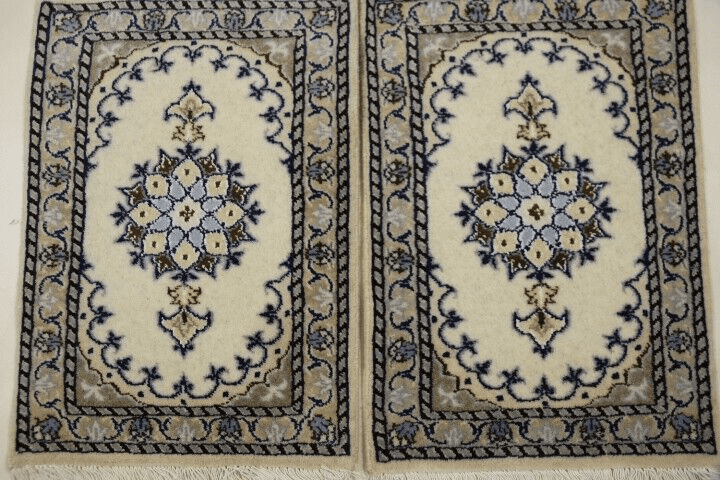
Nain rugs are known for elegant and detailed compositions. Their designs often draw on flowers, curling vines, leaves and stylised botanical forms. Geometric structures may organise these organic elements and give the composition a clear rhythm. Such motifs belong to the long development of Persian ornament, where forms from nature are transformed into repeatable and balanced signs rather than copied literally.
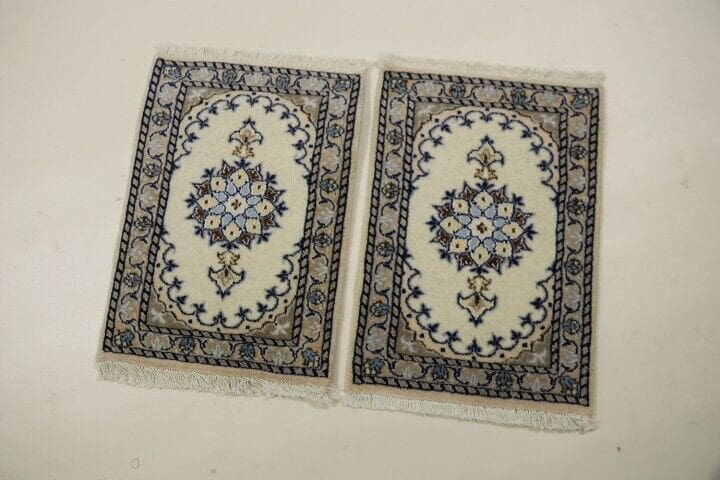
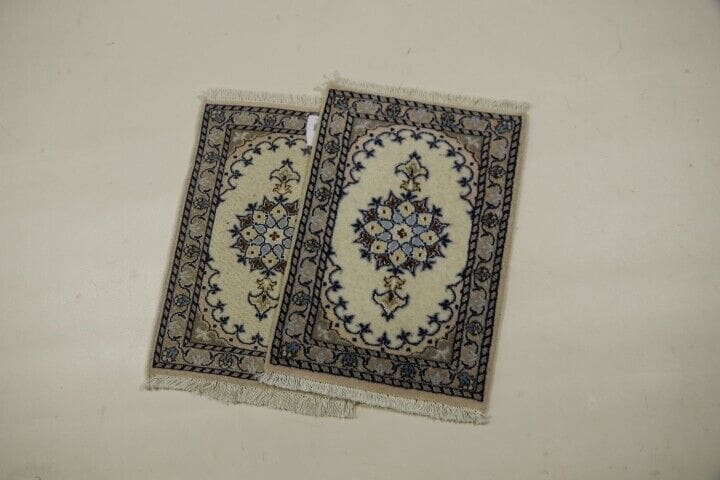
A Nain design may be arranged around a central medallion, across a continuously ornamented field or as a carefully balanced overall composition. A medallion directs attention towards the centre, while vines and flowers create transitions towards the sides. In an all-over arrangement, the ornament is distributed more evenly across the field. The border frames the central area and provides a visual finish. The precise arrangement depends on the individual design.
Fine knotting has a direct role in the way a pattern can be rendered. The more detailed the design structure, the more precisely narrow lines, small contours and graduated forms can be worked. The knot density of this rug supports a differentiated surface, but it does not establish a particular motif that is not named in the source. The Nain design tradition includes several floral and geometric approaches, and individual workshop designs vary in their choice and combination of elements.
Harmonious colour relationships are part of the established visual language of many Nain compositions. Light grounds may be combined with delicate floral lines, defined contours and measured borders. Colour contrast is not only decorative; it also helps separate vines, medallions and layers of the composition. Silk can introduce another variation in the way light moves across selected areas because its smoother surface reflects light differently from wool.
Persian patterns can also carry cultural associations. Flowers, vines and symmetrical arrangements may evoke ideas of order, growth and a connection with the natural world. In rug design, however, these meanings are not always presented as a fixed pictorial story. They often work through repetition, balance and the relationship between the centre, field and border. Each hand-knotted rug brings inherited design elements together in its own arrangement.
This piece is offered as a one-off with a certificate of authenticity. Here, one-off refers to the particular hand-knotted execution and the specific combination of material and design. The Nain tradition provides the regional framework, while the individual execution means it is not an identical industrial series product. Its identity can therefore be described through both its Persian Nain origin and its status as a single handmade object.
Special Features
The stated features of this rug are its hand-knotted construction, a knot density of approximately 300,000 knots per square metre, a pile of 95% virgin wool and 5% silk, and a new, very good condition. It is offered as a one-off with a certificate of authenticity. These details describe the individual piece and complement its classification within the Nain tradition.
The rug is suitable for different rooms, including a hallway, living room or bedroom. It should be placed on a clean, dry and reasonably even surface. Regular gentle vacuuming without a rotating brush can remove loose dust. Occasional careful airing or beating is a traditional part of rug care. For a thorough wash, a professional cleaner experienced with hand-knotted rugs and natural fibres is recommended so that wool and silk are treated appropriately.
The certificate of authenticity accompanies the one-off as part of the offering and should be kept with the rug. Strong, direct sunlight can alter textile colours over time, so considered placement helps preserve the appearance. If furniture is placed on the rug, areas subject to concentrated pressure should be checked from time to time. These precautions are general care guidance and do not add any further condition claim about this individual piece.
FAQ
How should I clean my Nain Persian rug?
For routine care, vacuum regularly without using a rotating brush or brush attachment. This removes loose dust while treating the pile gently. Occasional careful airing or beating can supplement everyday maintenance. Avoid aggressive detergents, excessive soaking and untested household remedies, since wool and silk can react differently to moisture and chemicals. If a spill occurs, absorb the liquid carefully rather than rubbing it into the pile. A complete wash should be entrusted to a professional cleaner familiar with hand-knotted rugs made from natural fibres. The cleaner can assess the fibre combination, dyes and pile before selecting a suitable process.
How can I identify a genuine Persian rug?
A hand-knotted Persian rug can be assessed through its knot structure, pattern work and materials. On the back of a hand-knotted piece, individual knots and the rows of the foundation can usually be seen. Fine, consistent knotting may indicate careful workmanship, but it is not a substitute for an expert examination. The Nain origin, the combination of virgin wool and silk, and the treatment of floral or geometric ornaments also help place a rug within its tradition. This rug is accompanied by a certificate of authenticity. For an independent assessment, a knowledgeable person should also examine the back, edges, fringes, colours and overall condition.
Where can I buy a Nain Persian rug?
Nain Persian rugs are available from specialised rug dealers, selected antique shops and online retailers focusing on oriental rugs. A reliable listing should describe the individual piece clearly. Relevant details include its origin, knotting technique, materials, knot density, condition and any certificate of authenticity. When buying online, buyers should also look for clear images of the front and back, along with information about care and returns. Trustworthy sellers distinguish between a regional tradition and a general decorative pattern and make the properties of the one-off transparent. This rug belongs to the Nain tradition, is hand-knotted, new and in very good condition, and is offered with a certificate of authenticity.
To provide the best experiences, we use technologies like cookies to store and/or access device information. Consenting to these technologies will allow us to process data such as browsing behavior or unique IDs on this site. Not consenting or withdrawing consent, may adversely affect certain features and functions.
Functional Always active
The technical storage or access is strictly necessary for the legitimate purpose of enabling the use of a specific service explicitly requested by the subscriber or user, or for the sole purpose of carrying out the transmission of a communication over an electronic communications network.
Preferences
The technical storage or access is necessary for the legitimate purpose of storing preferences that are not requested by the subscriber or user.
Statistics
The technical storage or access that is used exclusively for statistical purposes.The technical storage or access that is used exclusively for anonymous statistical purposes. Without a subpoena, voluntary compliance on the part of your Internet Service Provider, or additional records from a third party, information stored or retrieved for this purpose alone cannot usually be used to identify you.
Marketing
The technical storage or access is required to create user profiles to send advertising, or to track the user on a website or across several websites for similar marketing purposes.
 SECURE PAYMENT
 SHIPPING PARTNERS


