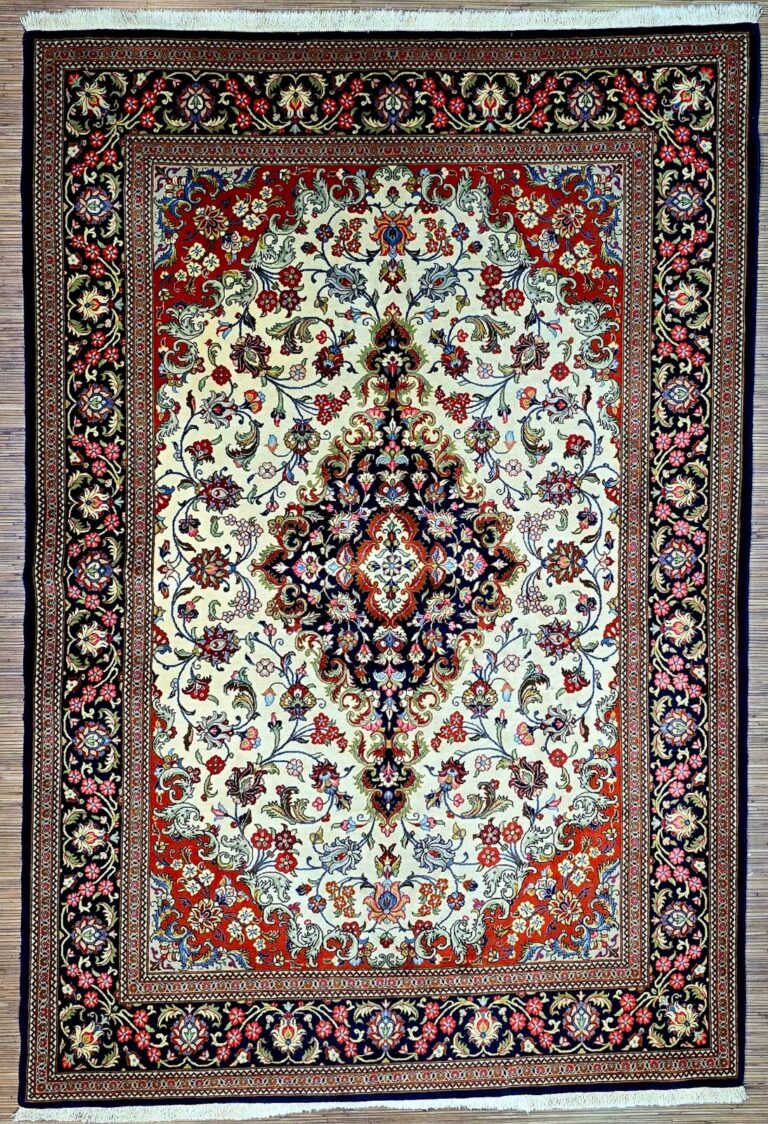
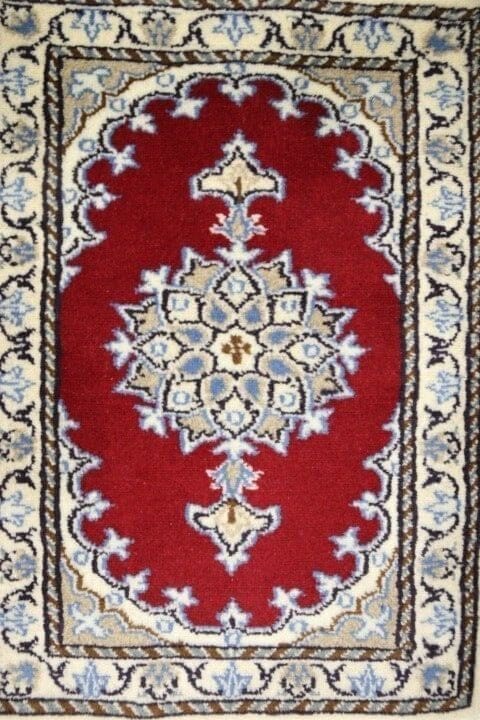
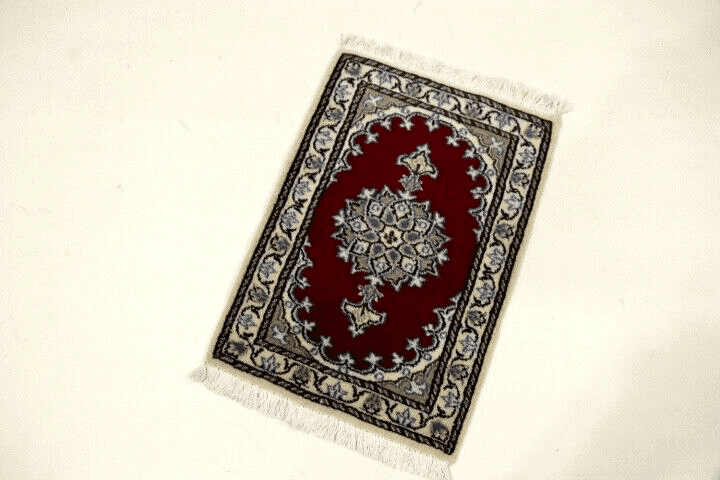
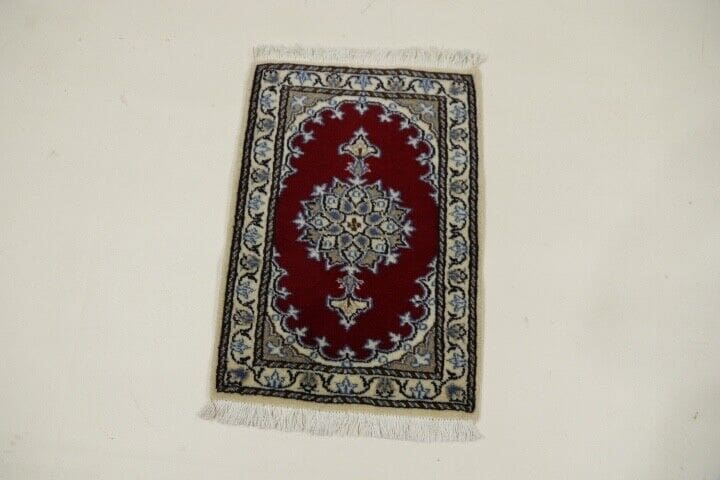
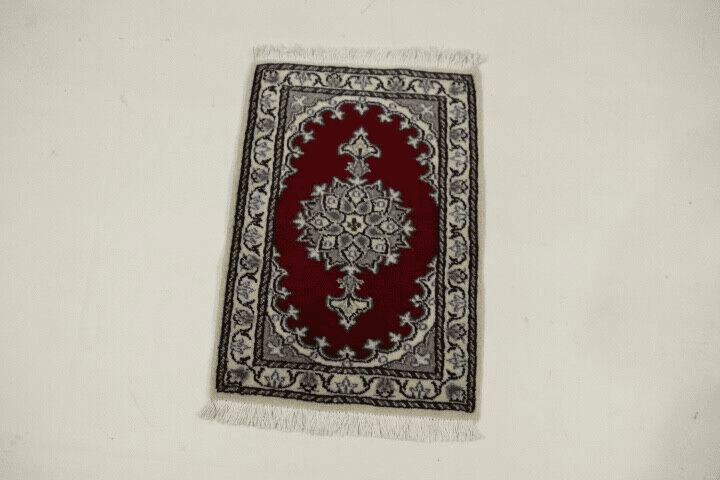
This Nain Persian rug is hand-knotted, with a pile made from virgin wool and silk. Virgin wool makes up the greater part of the pile, while silk is incorporated as a finer component. Cotton is used for both the warp and the weft. The construction therefore distinguishes clearly between the pile materials and the cotton foundation. Wool gives the surface a soft, resilient textile character, while silk can add a fine, smooth quality and a restrained sheen. Together, these materials create the material profile specified for this individual rug.
Hand-knotting is carried out one knot at a time. Each knot is secured into the foundation before the next part of the design is built. The process requires close attention to the placement of the knots and to the continuity of the drawn pattern. The listed knot density describes a finely executed construction. It is a technical feature of the rug and helps explain the detailed appearance associated with its Nain classification.
Virgin wool has long been used in Persian rug making for its adaptable, durable fibre and pleasant handle. It can give a pile a degree of resilience and help the surface retain its structure in ordinary use. Silk is valued in rug weaving for its fine fibre and its ability to reflect light in a subtle way. Cotton provides the supporting textile structure formed by the warp and weft, into which the pile is tied. These roles remain distinct while working together in the finished weave.
The rug was made by hand and is described as a one-off piece. It is supplied with a certificate of authenticity. The condition is new and perfect. These details concern this specific rug and complement the description of its materials and construction. The hand-knotted technique also means that the work is formed through a sequence of individual manual decisions rather than through a uniform industrial process.
Origin and Tradition
Nain is a city in Iran with an established tradition of fine Persian rug weaving. Nain rugs are associated with carefully controlled drawing, precise knotting and a refined treatment of ornamental detail. The name identifies both a place and a regional weaving tradition. It is therefore more than a decorative label: it places the rug within the Iranian history of hand-knotted textile production.
The Nain tradition belongs to the wider culture of Persian carpet making. A Persian rug is developed through the relationship between a design, a foundation, a pile and the repeated act of knotting. Weavers build the composition gradually, following established layouts, recurring borders and carefully balanced proportions. Patterns may be learned through workshop practice and passed on through generations, while the handwork of each individual piece allows small differences in line and execution.
Fine drawing is an important part of the way Nain rugs are commonly understood. Small floral details, curving stems and ordered geometric passages can be placed close together in a compact field. A dense knot structure supports clear outlines and allows transitions between larger forms and minute ornaments to be handled with control. The technical discipline of the weaving is therefore closely linked to the calm, balanced character of the regional design language.
Iranian rug traditions have preserved and developed methods over long periods of time. Workshop knowledge includes the preparation of the foundation, the selection of fibres, the reading of a pattern and the finishing of the woven surface. Such knowledge does not prevent every rug from having its own character. Hand work may produce variations in contour, colour interaction and detail while keeping the composition recognisably connected with its regional tradition.
This rug is identified as originating in Persia, or Iran, and is consequently described as a Persian rug. Nain functions here as the named place of origin and tradition, not merely as the name of an ornamental theme. Iranian origin, hand-knotting and the Nain weaving tradition together provide the factual framework for its classification.
Design and Pattern
The design is classified as traditional Persian and Oriental. Nain designs are often associated with floral and geometrically ordered elements. Flowers, leaves, scrolling vines and medallion structures may be arranged with symmetrical lines and carefully divided fields. The ornaments are set within an organised composition in which the central area, borders and repeated details relate to one another.
Floral forms in Persian rug design can animate a field and guide the eye through the composition. Vines create links between blossoms, while leaves add rhythm to a curving line. Geometric details provide another kind of order, defining transitions and framing the more organic forms. The combination allows a design to appear structured without losing the fine variation that comes from hand-drawn and hand-knotted work.
Nain rugs are frequently connected with a quiet and carefully coordinated colour language. Softer colour areas can keep the drawing legible and allow fine outlines to remain visible. Light grounds may give the composition a spacious appearance, while selected contrasts clarify individual ornaments. The exact colours used in a particular rug belong to its specific design; the traditional classification describes the overall Persian and Oriental style rather than adding unstated colour details to this piece.
A fine knot structure can support the representation of small motifs and controlled contours. Floral details may be drawn with greater clarity, and the junctions between curving and geometric forms can be kept precise. This produces a cohesive pattern surface. At the same time, a hand-knotted rug is not a mechanically repeated image. Minor variations in the execution of lines and motifs are part of the character of an individually made textile.
Traditional Persian ornaments often carry visual ideas connected with gardens, ordered nature and balanced space. A floral form does not need to be assigned one fixed meaning in every rug, and a symmetrical layout is not limited to a single interpretation. In Nain weaving, these inherited ideas are combined with a restrained, finely articulated drawing. The result can work in a range of interiors, from a living room to a bedroom or corridor, while remaining recognisably rooted in Persian design tradition.
The description traditional Persian/Oriental defines the stylistic setting of this rug. It supports the named origin Nain and points to a design vocabulary in which floral detail and geometric organisation are brought together. The rug is therefore identified through both its regional association and its place within the broader history of Oriental rug design.
Special Features
A notable technical feature is the stated knot density of approximately 300,000 knots per square metre. This indicates a finely worked knot structure and reflects the time and precision required to create such a surface. It also supports the detailed drawing associated with the Nain tradition. Knot density is one of the measurable construction characteristics supplied for this individual rug.
The rug is new and in perfect condition. It is offered as a one-off piece with a certificate of authenticity. Its combination of virgin wool and silk, cotton warp and weft, and hand-knotted construction are part of its specified identity. The rug is suited to use as a decorative Oriental textile in areas such as the living room, bedroom or corridor, provided it is placed and cared for appropriately.
FAQ
How should I care for my Nain Persian rug?
Regular vacuuming on a low setting is suitable for removing loose dust and everyday dirt while placing less strain on the pile. For stains or a more thorough treatment, professional cleaning is recommended. Specialist cleaning can help protect the wool, silk and colours from unsuitable products or excessive moisture. Cleaning agents should not be tested casually on the surface, since different fibres can react differently and a stain should be treated with care.
Can the Nain Persian rug be used over underfloor heating?
Yes, the Nain Persian rug can be used with underfloor heating. The temperature should not be set too high in order to protect the materials. Moderate, even warmth is preferable to prolonged exposure to intense heat. The rug should also lie flat on a clean, suitable surface so that it can be used safely and the heat is not unnecessarily obstructed by unsuitable additional layers.
Where is the best place to put my Nain Persian rug?
The rug can be placed in several rooms, including a living room, bedroom or corridor. A location where it remains visible while being protected from unnecessary wear is appropriate. This allows the traditional drawing to contribute to the interior while helping preserve the new and perfect condition. A level, clean surface supports careful everyday use and keeps the hand-knotted textile lying evenly.
To provide the best experiences, we use technologies like cookies to store and/or access device information. Consenting to these technologies will allow us to process data such as browsing behavior or unique IDs on this site. Not consenting or withdrawing consent, may adversely affect certain features and functions.
Functional Always active
The technical storage or access is strictly necessary for the legitimate purpose of enabling the use of a specific service explicitly requested by the subscriber or user, or for the sole purpose of carrying out the transmission of a communication over an electronic communications network.
Preferences
The technical storage or access is necessary for the legitimate purpose of storing preferences that are not requested by the subscriber or user.
Statistics
The technical storage or access that is used exclusively for statistical purposes.The technical storage or access that is used exclusively for anonymous statistical purposes. Without a subpoena, voluntary compliance on the part of your Internet Service Provider, or additional records from a third party, information stored or retrieved for this purpose alone cannot usually be used to identify you.
Marketing
The technical storage or access is required to create user profiles to send advertising, or to track the user on a website or across several websites for similar marketing purposes.
 SECURE PAYMENT
 SHIPPING PARTNERS