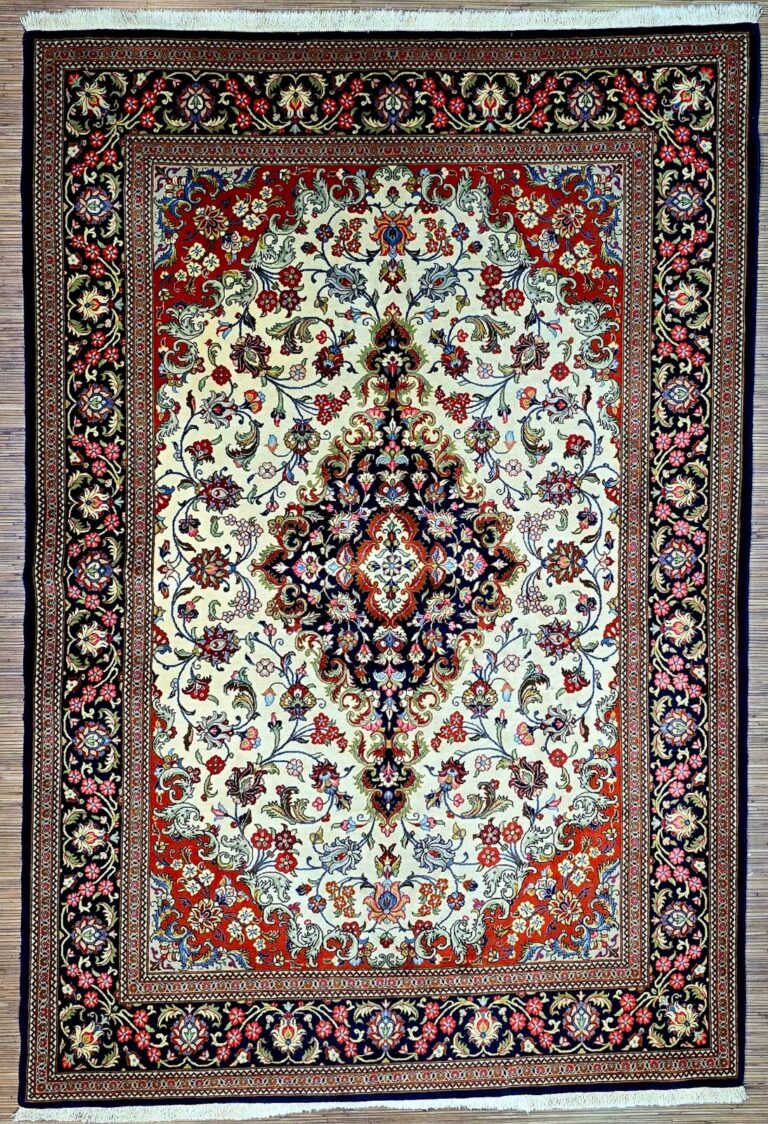
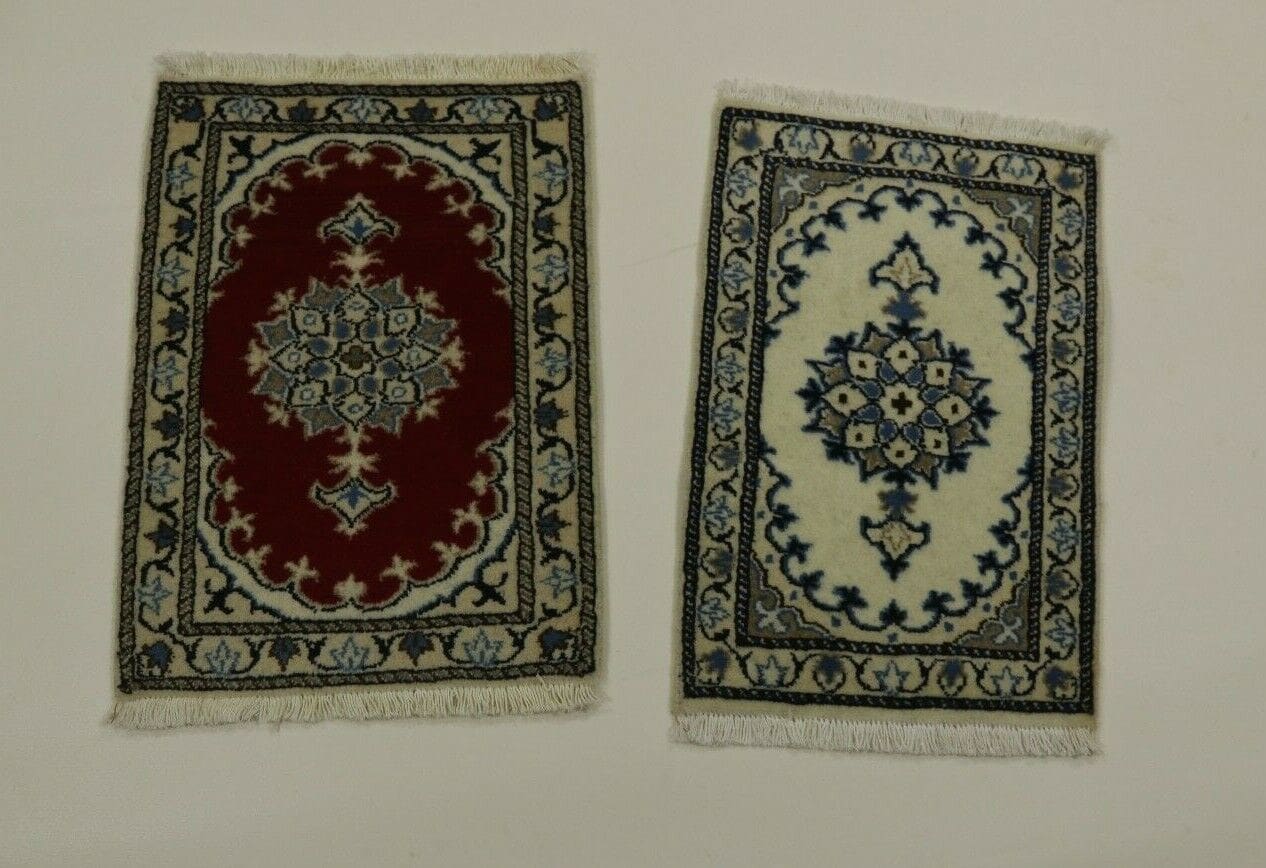
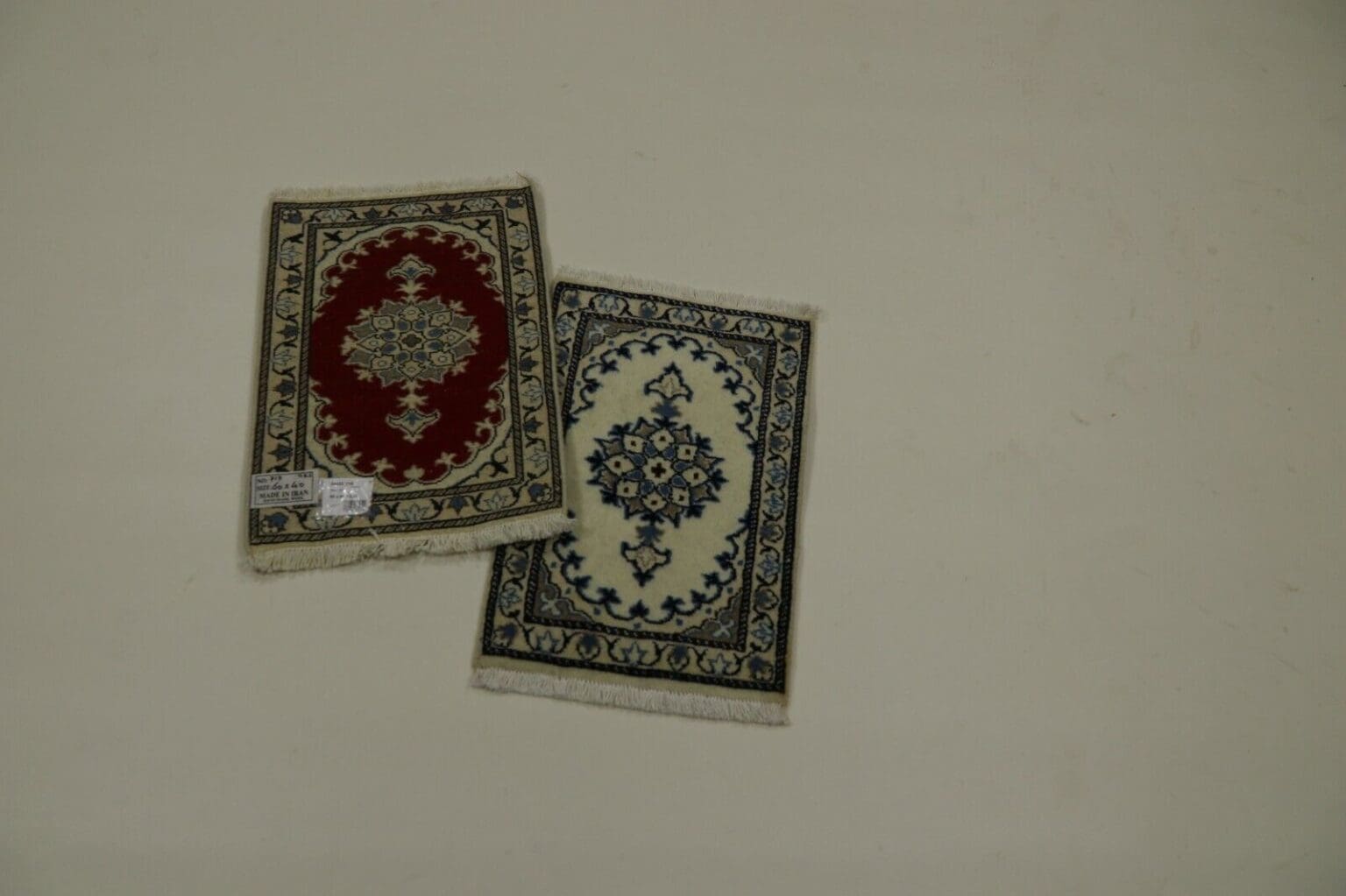
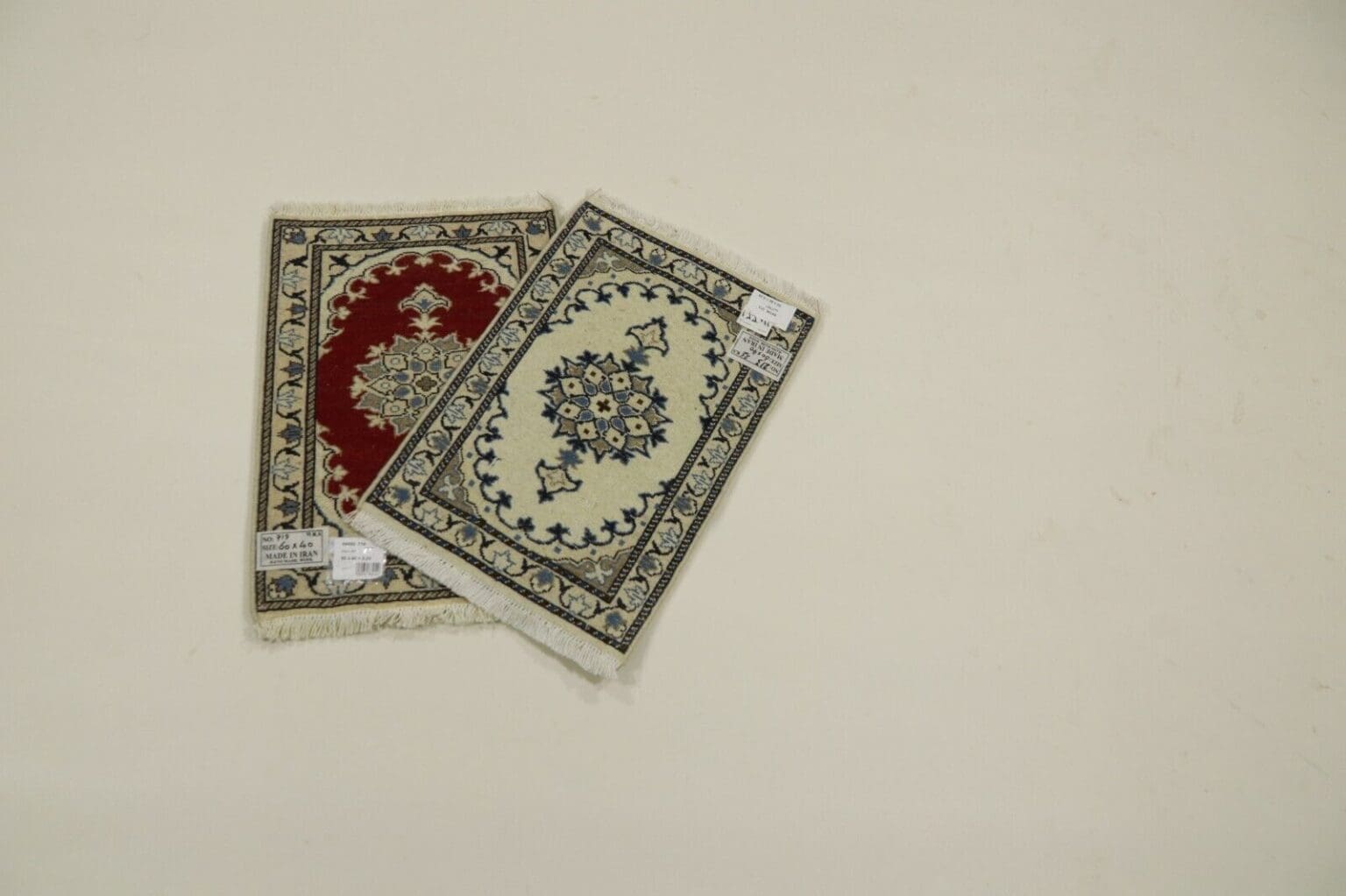
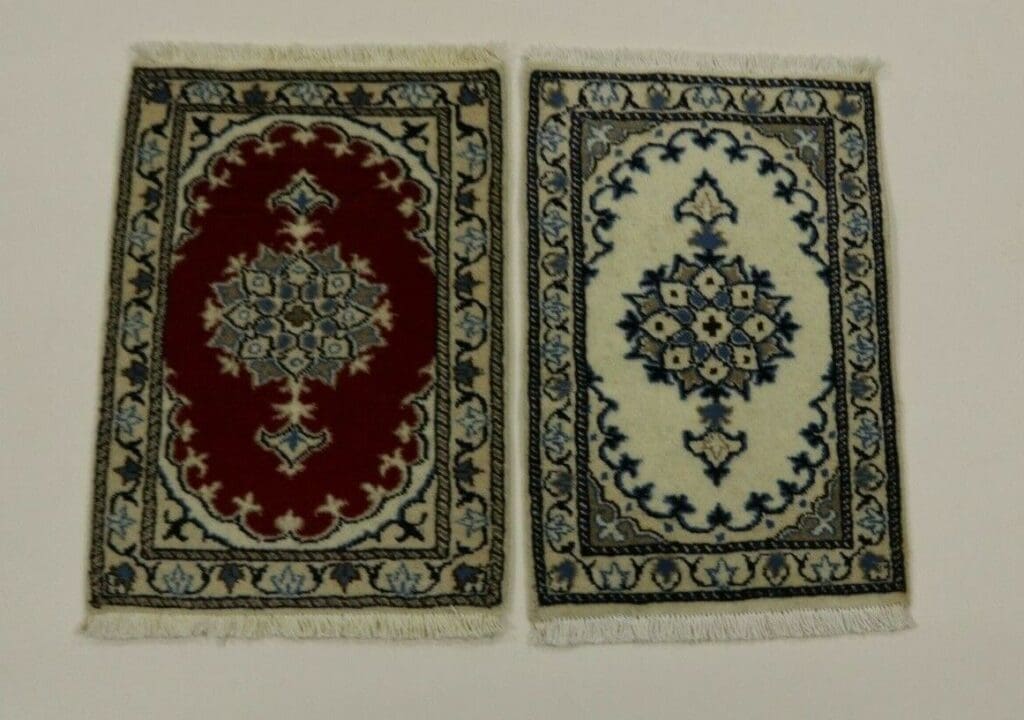
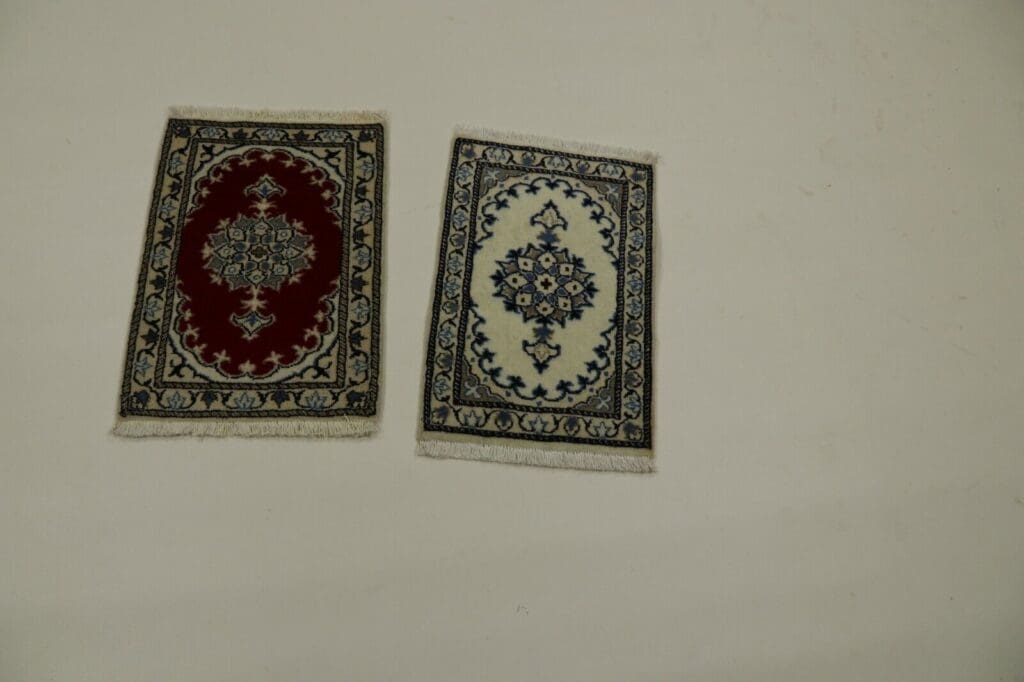
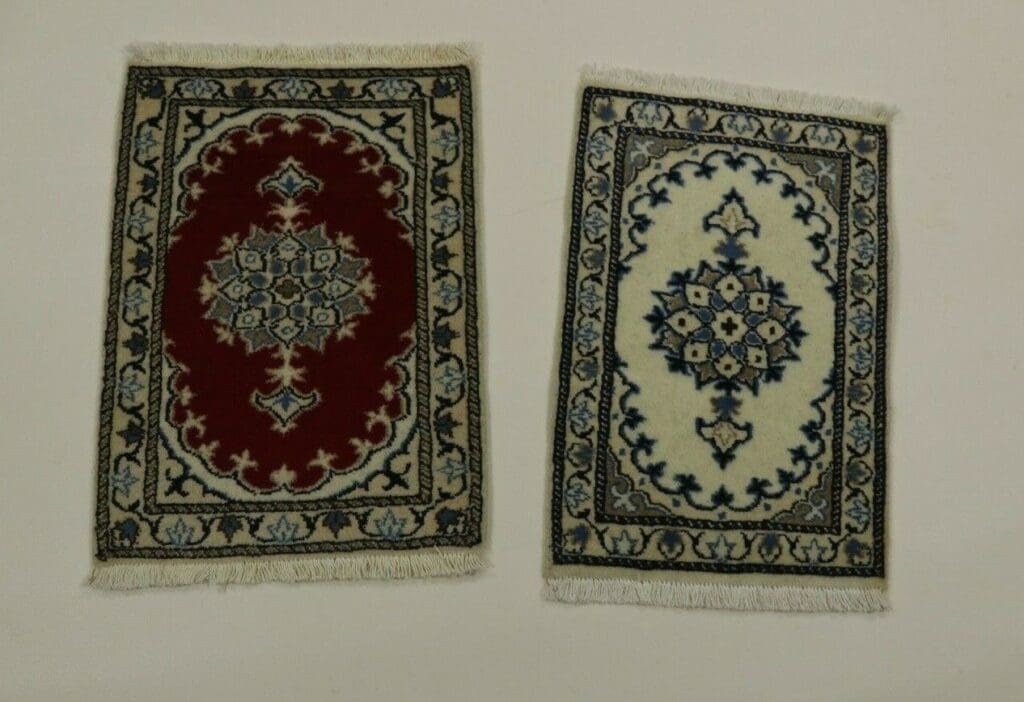
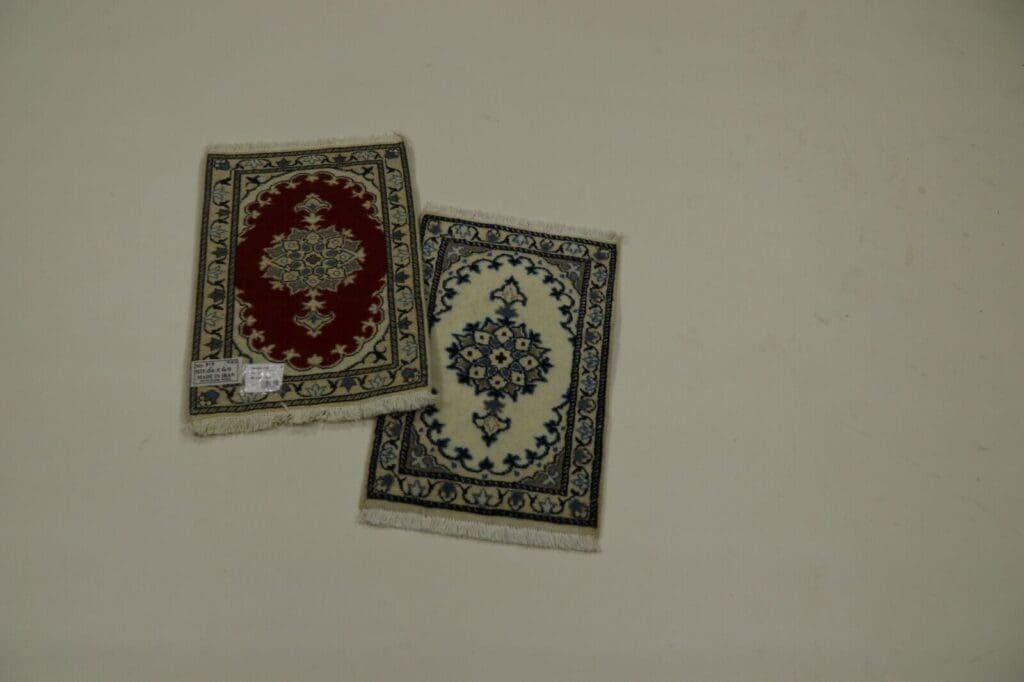
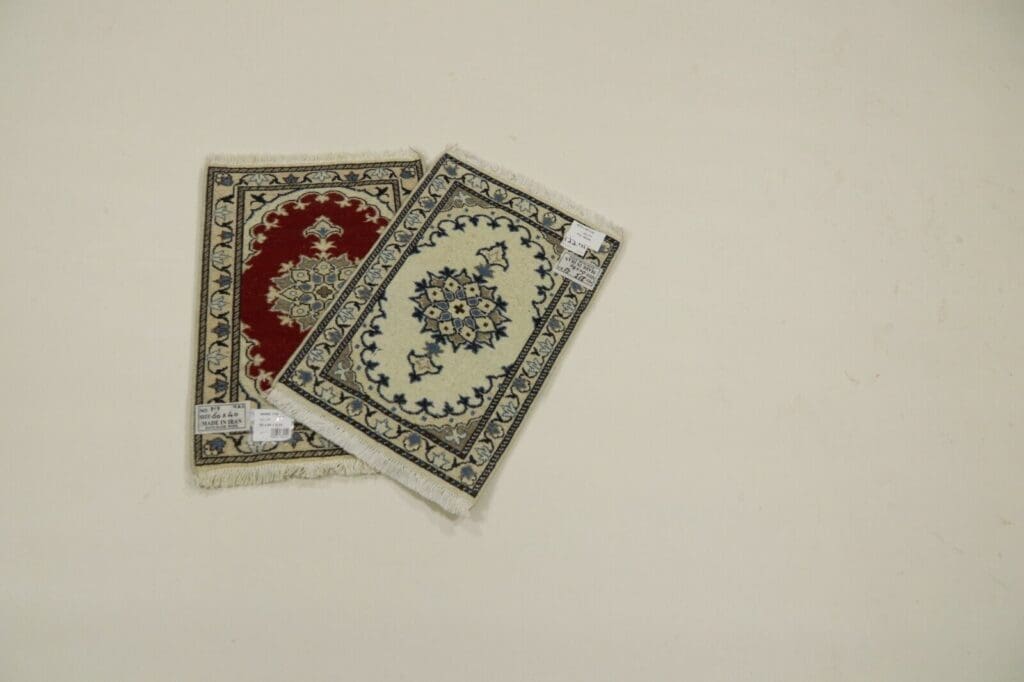
Hand-knotted Nain Persian rug | Knot density: approx. 300,000 knots/m² | Material: 95% wool and 5% silk pile, 100% cotton warp | Size: 60 x 40 cm | Pattern: traditional Persian and Oriental | Condition: new, very good
This Nain Persian rug is hand-knotted, with a pile made from 95% virgin wool and 5% silk. Its warp is made from 100% cotton. The material combination brings together the fuller character of wool, the fine surface of silk and the textile foundation provided by cotton. Wool forms the greater part of the pile and gives it a soft yet durable character. Silk contributes a distinctive sheen and a finer tactile quality.
Hand-knotting builds the rug one knot at a time. Individual knots are secured into the foundation, after which the pile is aligned and trimmed as the work progresses. This process allows the weaver to articulate small details, outlines and ornamental transitions with considerable control. The high knot density of this rug supports the clear rendering of its design and is a characteristic of careful, labor-intensive craftsmanship.
Wool and silk serve different purposes within the pile. Wool gives the surface body and resilience, while silk introduces a more delicate texture and a brighter response to light. The cotton warp provides the structure to which the knots are attached. Together, these materials form a hand-made textile whose construction differs fundamentally from that of a machine-produced rug.
The rug is new and in very good condition. It is made as a one-off piece and is supplied with a certificate of authenticity. The designation one-off refers to the individual execution of this particular hand-knotted rug.
Origin and Tradition
Nain is a city in Iran and the place that gives this carpet tradition its name. It lies within one of the country’s old weaving regions and is known for fine hand-knotted rugs that combine established motifs with carefully coordinated color schemes. This Nain Persian rug therefore belongs to the Iranian, or Persian, weaving tradition rather than merely sharing a decorative name with it.
The weaving tradition of Nain reaches back to the nineteenth century. Over time, the town developed a strong identity through the knowledge required to prepare the foundation, place the knots, define the outlines and finish the pile. Such knowledge is transmitted through practical experience. Although the carpet industry has developed considerably since the tradition began, handwork remains central to the character associated with Nain rugs.
A Nain carpet is shaped by more than a single motif. Its appearance depends on the relationship between drawing, knotting method, fiber and color. Weavers work within established principles of balance, repetition and proportion, while the interpretation of those principles can vary from one design to another. This creates a recognizable regional vocabulary without making every individual rug identical.
Persian carpet making is closely connected with the preservation of craft knowledge. In a hand-knotted Nain rug, the design is not simply printed or mechanically repeated on a finished surface. It is built through the placement of knots and the subsequent treatment of the pile. Attention to the tension of the foundation, the density of the knotting and the transitions between pattern areas affects how clearly the finished ornament can be read.
Color is another important part of the Nain tradition. Nain rugs are associated with a considered palette in which individual shades are selected for their relationship to the entire composition. Natural dyes have an important place in the history of Persian carpet making. Colors can distinguish ground, border, outlines and floral details, while their arrangement creates continuity across the design rather than a collection of unrelated patches.
The name Nain here identifies both the Persian origin and the regional craft tradition. It is not being used only as a description of a visual fashion. The Iranian provenance, the hand-knotted construction and the traditional Persian approach to pattern connect this individual rug with the broader history of Oriental carpet weaving.
Design and Pattern
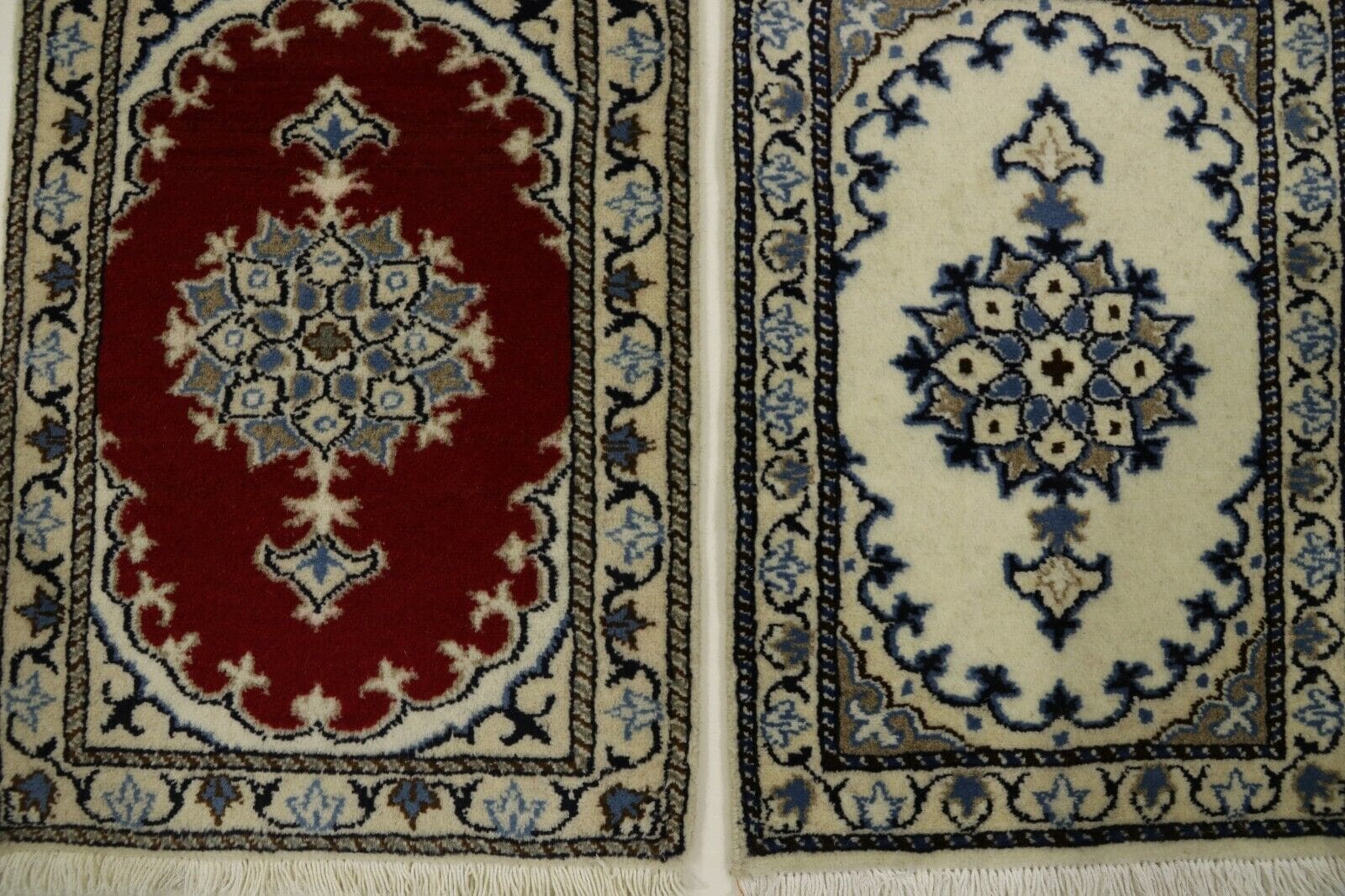
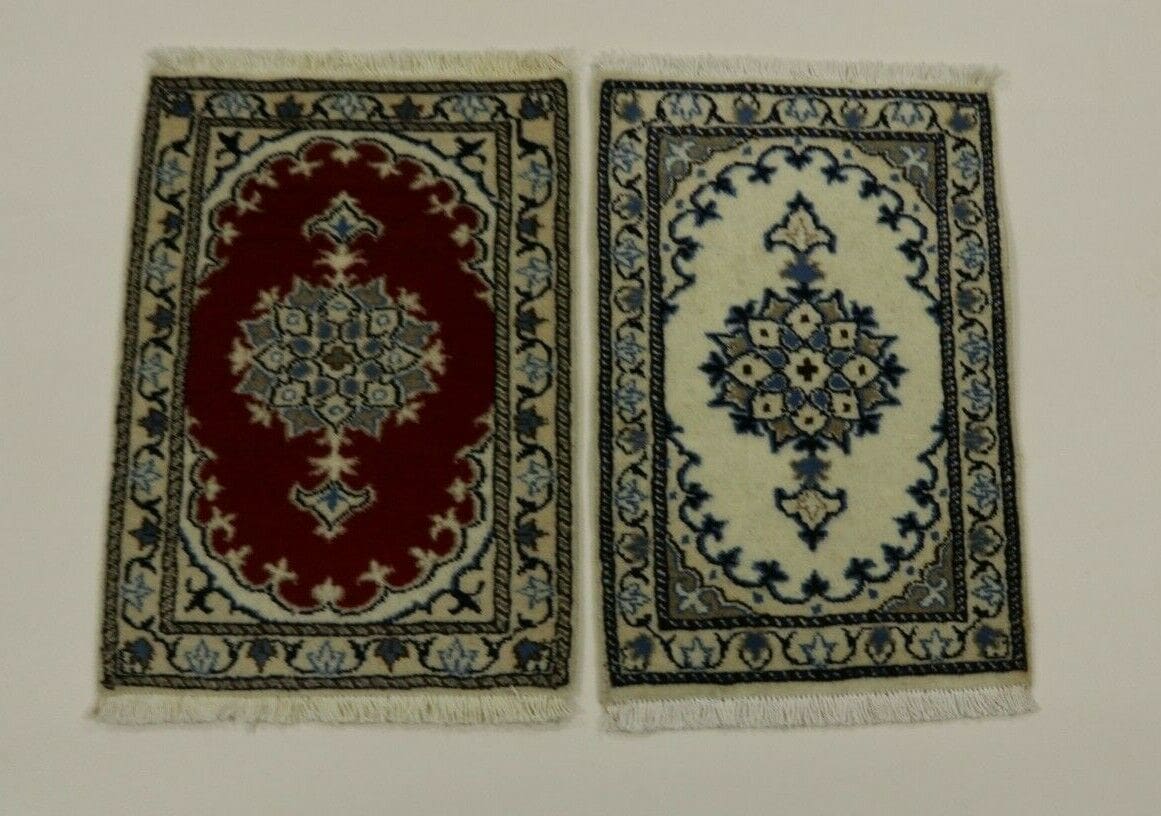
Nain designs often bring floral and geometric elements together. Floral ornaments may include leaves, blossoms and curling branches, while geometric forms provide structure and direction. These components can be arranged around a central feature or distributed throughout the field. The result is a composition in which small decorative details remain part of a clearly organized whole.
Asymmetrical arrangements, stylized medallions and geometric shapes are among the design devices associated with Nain rugs. A medallion may establish a visual center, with vines and floral motifs extending into the surrounding field. In other compositions, ornament spreads more evenly across the surface. The tradition therefore allows a range of relationships between central order, repeated decoration and flowing pattern movement.
Floral motifs in Persian weaving are generally stylized rather than intended as literal botanical illustrations. Leaves and blossoms are simplified into forms that can be repeated and recognized within a detailed woven design. Clear outlines help preserve their identity, while geometric accents may frame them or connect separate ornament groups. The alternation between curved lines and measured shapes produces the rhythm found in many traditional Persian compositions.
An asymmetrical pattern is not necessarily random. It can be part of a carefully planned design whose balance comes from the distribution of shapes, colors and open areas. Repetition, reflection and controlled variation are often used together. This gives the field coherence while allowing individual motifs to differ in scale or position. Hand-knotting makes it possible to interpret such relationships with fine adjustments during production.
The color range associated with Nain extends from soft, pastel-like shades to stronger, more vivid tones. Gentle colors can keep delicate outlines visible without overwhelming them, while more pronounced contrasts can bring selected ornaments forward. The combination of wool and silk affects this visual effect: wool provides depth with a more subdued surface, whereas silk reflects light and can make particular details appear brighter.
In a hand-knotted rug, the pattern is part of the structure rather than an image applied afterward. The placement of knots establishes the contours, and the finished pile reveals the drawing through its surface. A high knot density supports the rendering of small floral forms, medallion details and precise geometric lines. This technical relationship between construction and appearance is one reason fine Nain designs can contain both intricate ornament and an orderly overall composition.
The traditional Persian and Oriental character of this rug consequently rests on the interaction of regional motifs, balanced color relationships and skilled handwork. The precise arrangement belongs to this one-off piece. Its stylistic classification comes from the Nain tradition, its floral and geometric vocabulary, and the Persian approach to color and carpet construction.
Special Features
One notable feature of this Nain Persian rug is its high knot density. Dense knotting supports the precise expression of pattern details and is a visible sign of demanding hand craftsmanship. It also contributes to a robust and resistant construction. Fine outlines and small ornamental elements can be worked with clarity when the knots are closely arranged.
The rug is a hand-knotted one-off supplied with a certificate of authenticity. Its pile and warp fibers are clearly identified as wool, silk and cotton. The new, very good condition completes the description of this individual piece. Together, these characteristics define a single Persian rug with a traditional Nain design and a documented material composition.
FAQ
How should I care for my Nain Persian rug?
Regular vacuuming helps remove dust and loose dirt from the pile. The surface should be treated gently so that the fibers and the hand-knotted outlines are not placed under unnecessary strain. For persistent stains, a professional carpet cleaner should be consulted. Specialist cleaning can take the combination of virgin wool and silk into account and reduces the risk that unsuitable products will affect the pile or alter the colors.
Where is the best place to put a Nain rug?
A Nain rug can be used in an elegant living room, a bedroom or as a distinctive accent in a hallway. Its traditional Persian design works with a variety of interior arrangements. To help preserve the colors, the rug should not be placed in direct sunlight. A carefully chosen position with consistent light conditions supports the long-term appearance of this hand-knotted one-off.
How can I assess the quality of a Persian rug?
Knot density, materials and the condition of the design are important points when assessing a Persian rug. A high knot density indicates demanding craftsmanship and allows patterns to be rendered with greater precision. The fibers used also matter: in this rug, the pile and warp are clearly identified. Its new, very good condition and certificate of authenticity provide further information about the execution and identity of this one-off piece.
To provide the best experiences, we use technologies like cookies to store and/or access device information. Consenting to these technologies will allow us to process data such as browsing behavior or unique IDs on this site. Not consenting or withdrawing consent, may adversely affect certain features and functions.
Functional Always active
The technical storage or access is strictly necessary for the legitimate purpose of enabling the use of a specific service explicitly requested by the subscriber or user, or for the sole purpose of carrying out the transmission of a communication over an electronic communications network.
Preferences
The technical storage or access is necessary for the legitimate purpose of storing preferences that are not requested by the subscriber or user.
Statistics
The technical storage or access that is used exclusively for statistical purposes.The technical storage or access that is used exclusively for anonymous statistical purposes. Without a subpoena, voluntary compliance on the part of your Internet Service Provider, or additional records from a third party, information stored or retrieved for this purpose alone cannot usually be used to identify you.
Marketing
The technical storage or access is required to create user profiles to send advertising, or to track the user on a website or across several websites for similar marketing purposes.
 SECURE PAYMENT
 SHIPPING PARTNERS