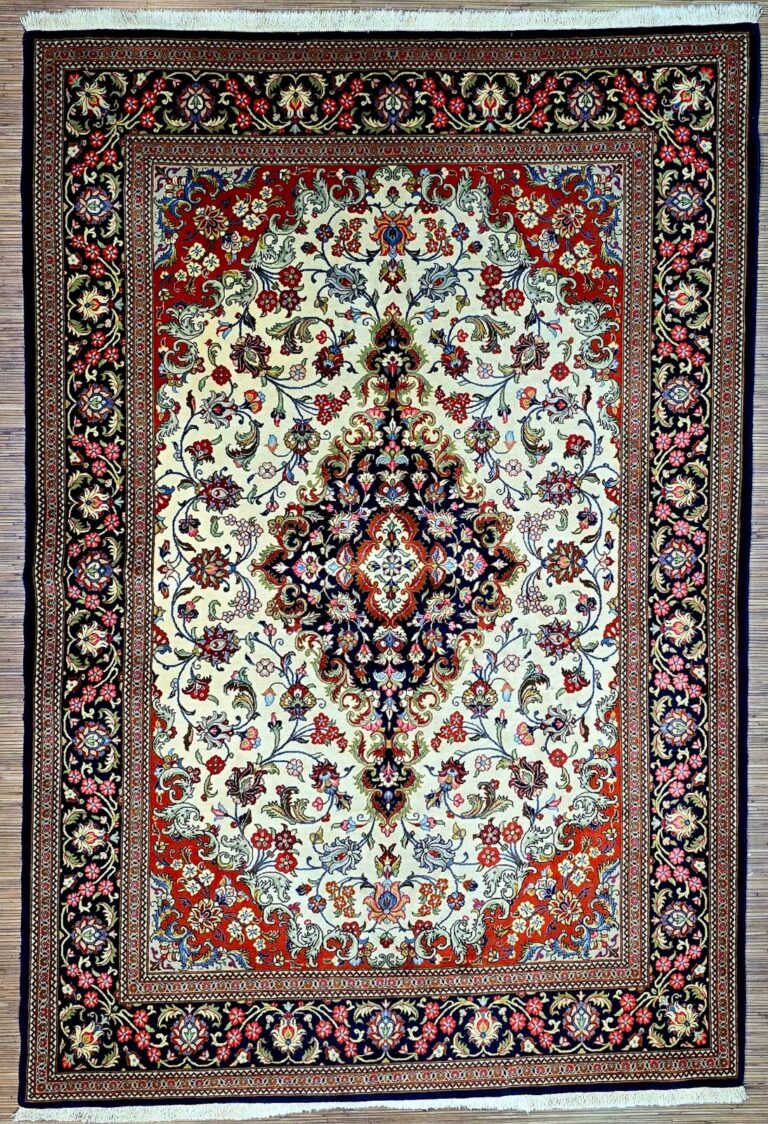
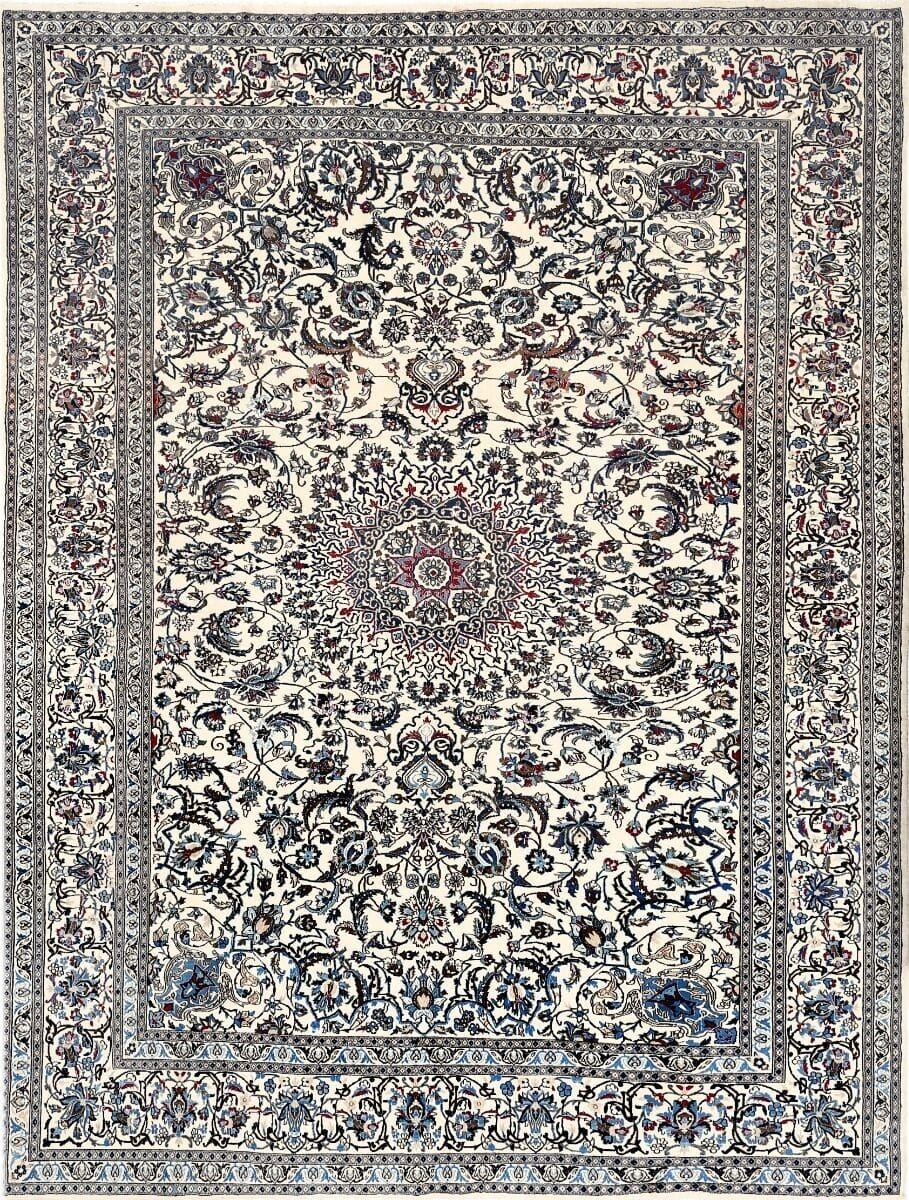
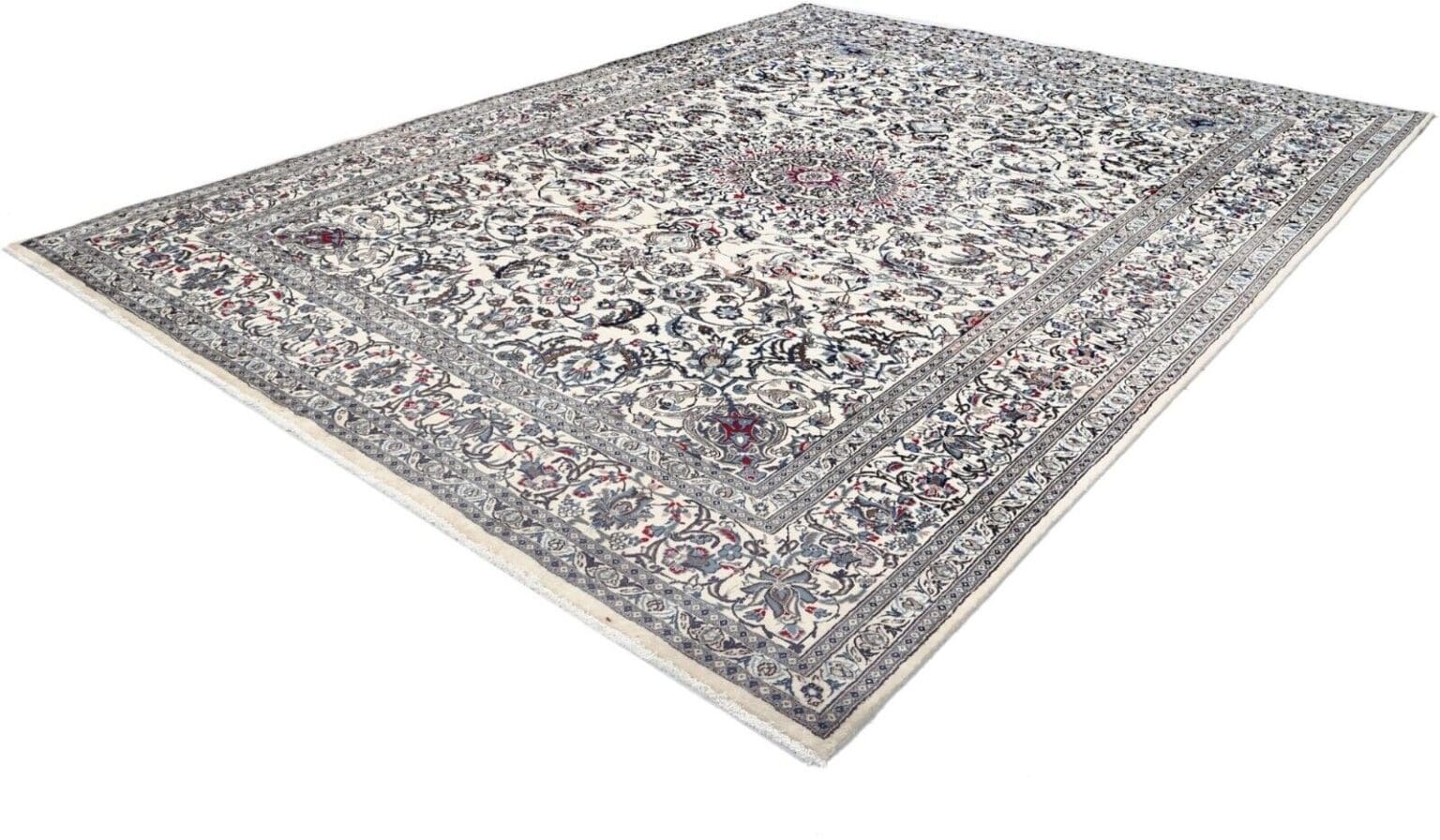
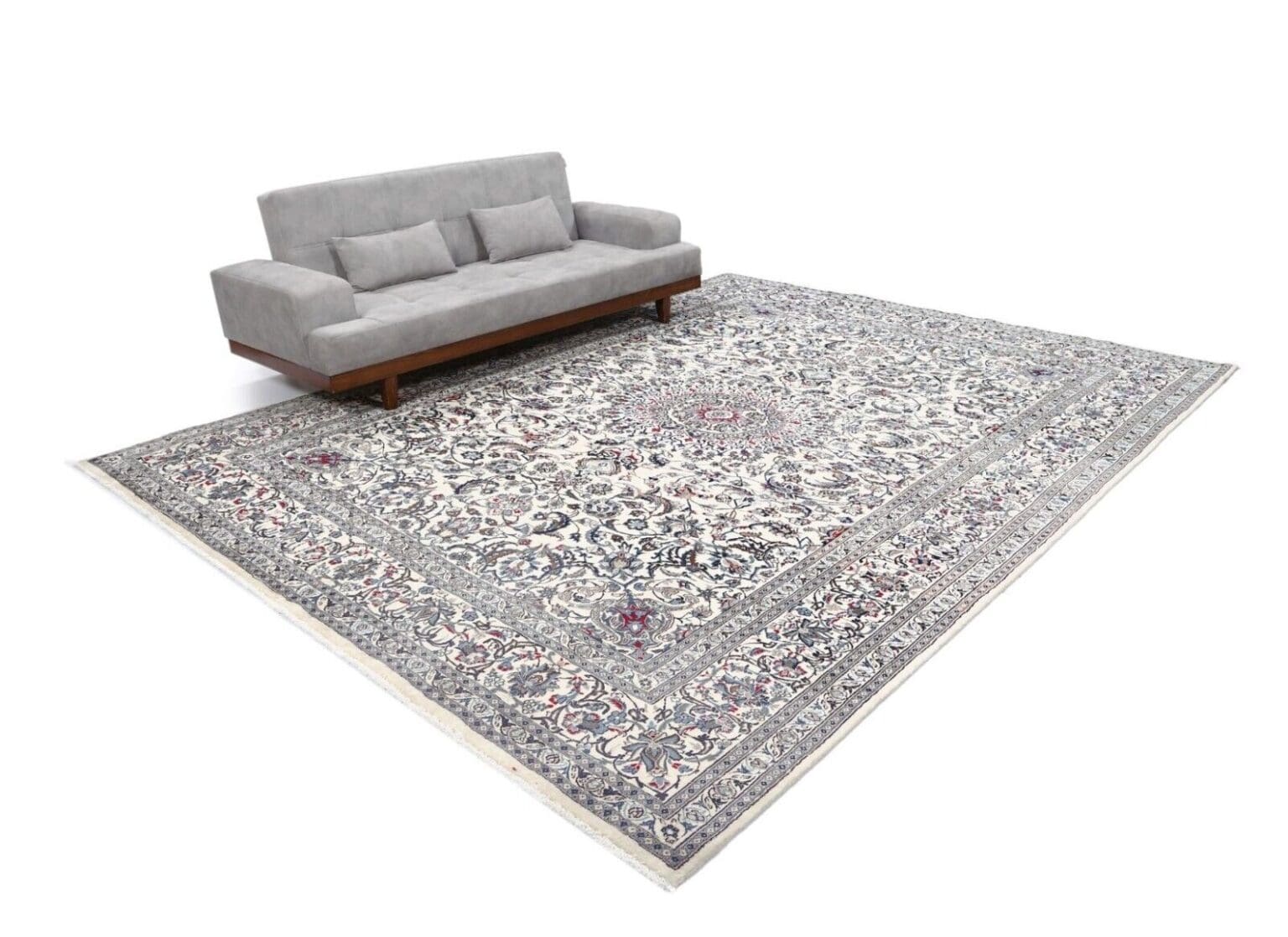
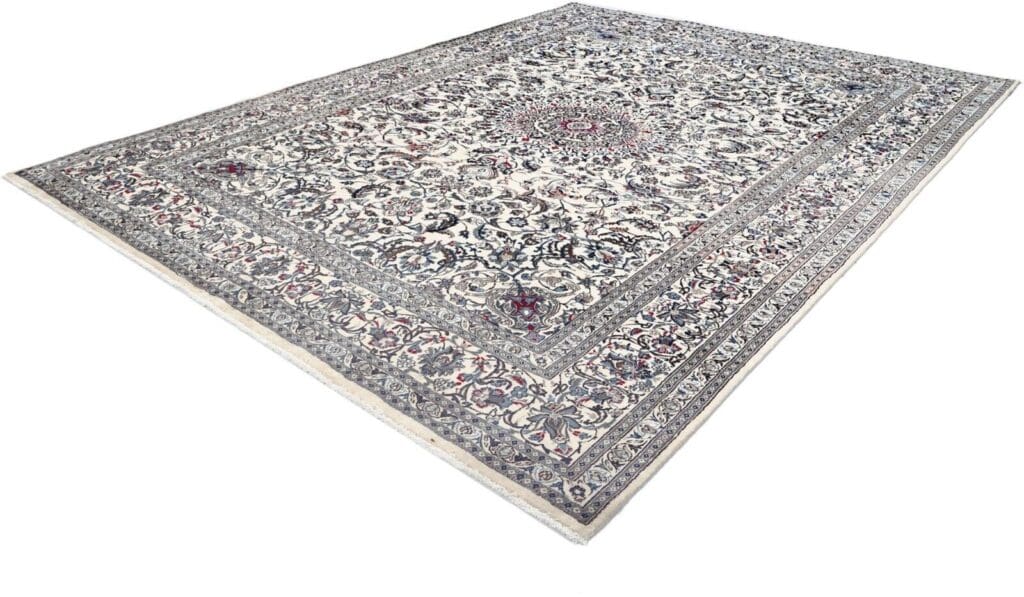
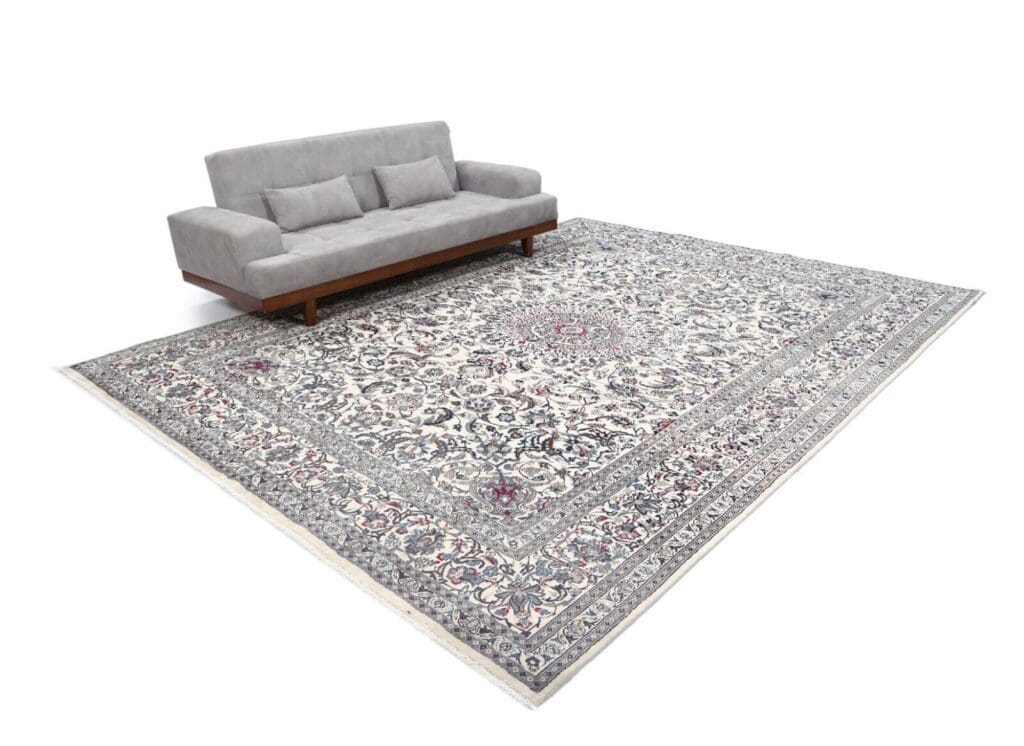
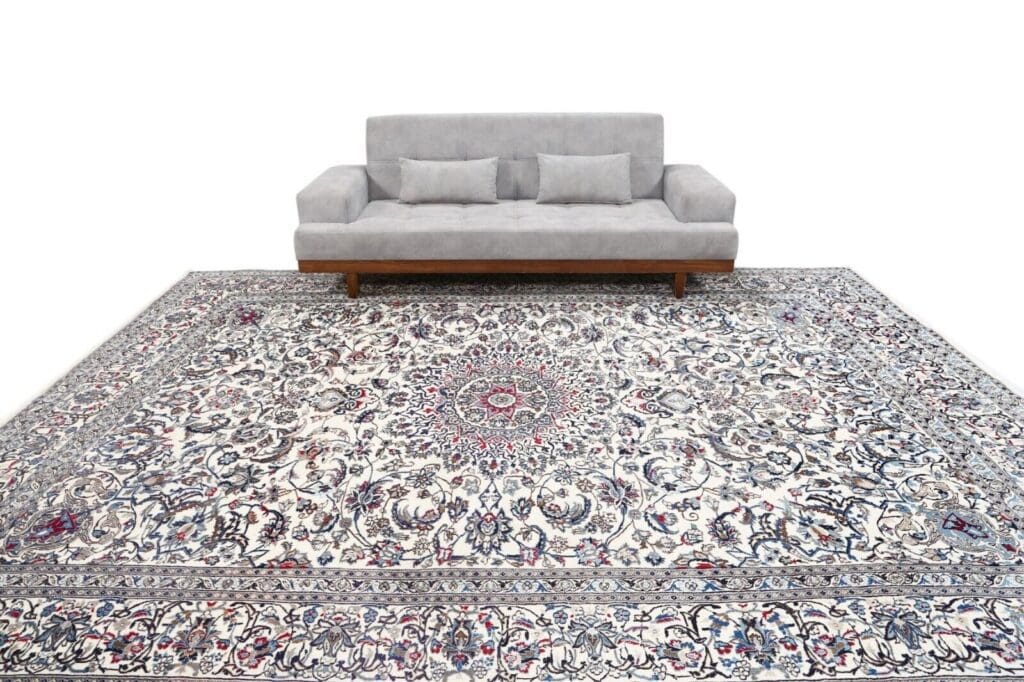
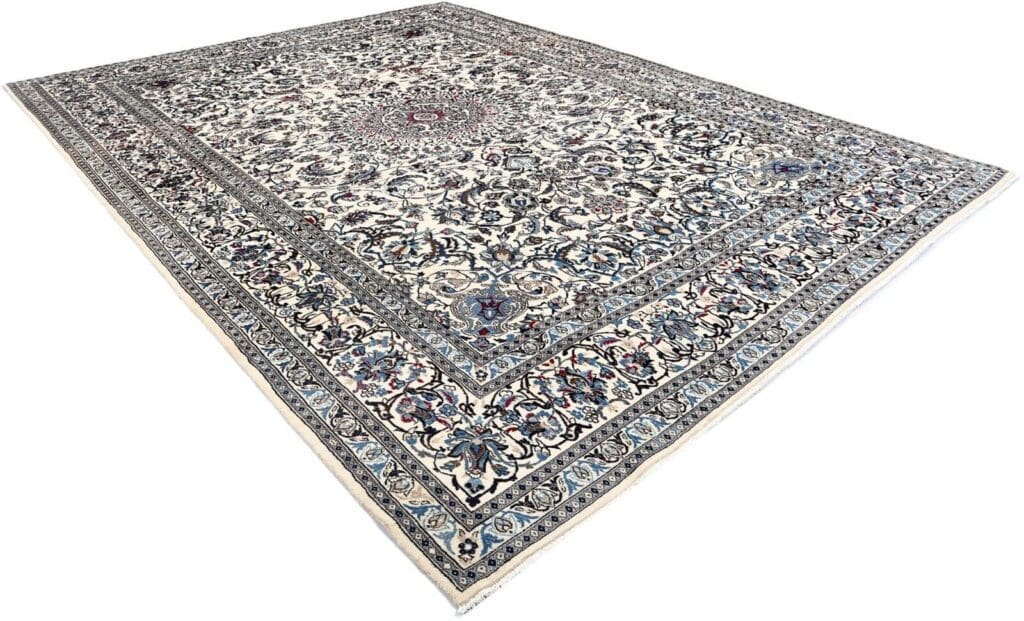
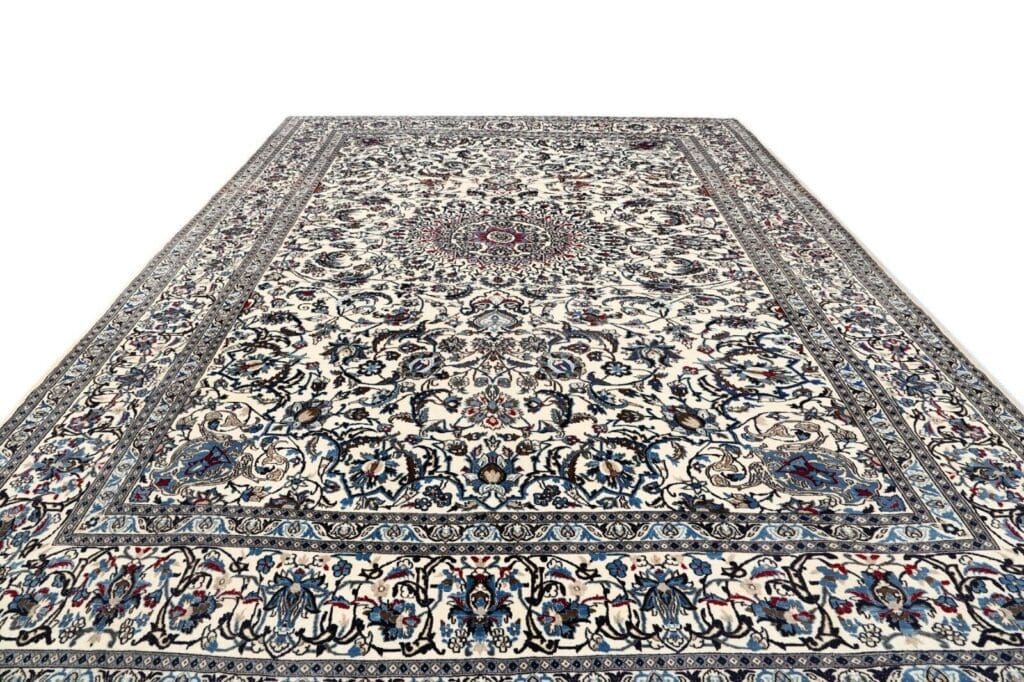
Hand-knotted Nain Persian Rug | Knot density: Hand-knotted | Material: Wool and cotton pile | Size: 390 x 297 cm | Pattern: Oriental with floral motifs | Condition: New with tag
This Nain Persian rug is hand-knotted and is identified as a silk rug in the title. The material entry for the piece lists wool and cotton. Both source details are retained: the title refers to silk, while the detailed material line names wool and cotton. Hand knotting is a traditional form of Persian rug making. Individual knots are tied into a prepared foundation, and the pile develops row by row as the work progresses. Unlike a hand-woven Kilim, a knotted rug has a pile created from tied yarns. Its surface therefore has a distinct textile structure produced by the construction itself rather than by printing. Every hand-knotted rug is a one-off because each piece is assembled through individual manual work. Minor variations in the sequence of knots, the drawing of contours and the distribution of colour belong to this process. The rug is listed as new with tag. It is also described as allergy-friendly, suitable for underfloor heating, slip-resistant and easy to clean. These are the practical characteristics stated for this particular rug. Gentle regular vacuuming is a standard way to care for a Persian rug, while the source text also recommends occasional professional cleaning when more extensive cleaning is required.
Origin and Tradition
The rug comes from Iran and is identified as a Nain Persian rug. Nain is one of the recognised weaving regions of Iran. Its tradition is commonly associated with careful handwork and compositions in which the organisation of the design is important. Persian rug making brings together a useful floor textile and an inherited artistic vocabulary. A rug is not created in a single operation. The foundation, knots, weft, pile and pattern are developed through a sequence of connected technical steps. A regional name therefore indicates not only a place but also a cultural setting in which particular methods and designs have been passed on.
Nain rugs are often discussed in specialist descriptions in connection with finely drawn ornament, clearly structured compositions and floral designs. This background places the present rug within Iranian weaving tradition. It does not establish a particular workshop, weaver or production year for this one piece. The documented details are Iran as the origin, Nain as the designation and hand knotting as the construction. No more precise workshop provenance or age is supplied. The name Nain should therefore be understood as the stated regional identity and tradition, not as a reason to add undocumented information about the maker or history of the individual rug.
Persian knotting skills have been transmitted across generations. Knowledge of preparing the foundation, setting knots, inserting wefts and following a drawn design forms the technical basis of this craft. Different Iranian regions developed their own preferences for composition, ornament and colour, while retaining the central importance of manual work. Wool and silk are used in Persian rug making for different textile qualities. Wool can create a resilient and warm pile, while silk can be used for fine lines and a smooth, lustrous effect. Cotton is frequently used in the foundation of Persian rugs. For this item, the material entry lists wool and cotton, while the title specifies silk. These source details are presented together without turning them into an additional claim about proportions or construction.
Iranian rugs from Kerman, Isfahan and Tabriz are also associated with distinctive regional histories. Each place has its own design language and weaving traditions, but none of them is given as the origin of this Nain. Persian textile culture also includes Kelims. These are hand-woven flat textiles and differ from a knotted rug because they do not have the same pile structure. Gabbeh is another Persian rug type, often associated with a coarser construction and colourful geometric designs. Nain rugs are frequently noted for fine patterns and the use of silk. Such comparisons explain the relationship between different Persian rug types; they do not change the origin or classification of the present piece.
The history of Persian rugs is closely connected with workshops, regional pattern books and the teaching of craft skills. Designs could be preserved, adapted and recombined over generations. A traditional rug can therefore carry a familiar regional vocabulary while remaining an individual handmade work. The term Persian rug refers both to an Iranian origin and to a long-established craft tradition. The origin of this rug remains Iran, and the regional designation remains Nain. The description does not provide a date, workshop, signature or exact numerical knot count. Those details are not added. The historical background explains the type of rug, while the information about this individual piece stays limited to the supplied facts.
Design and Pattern
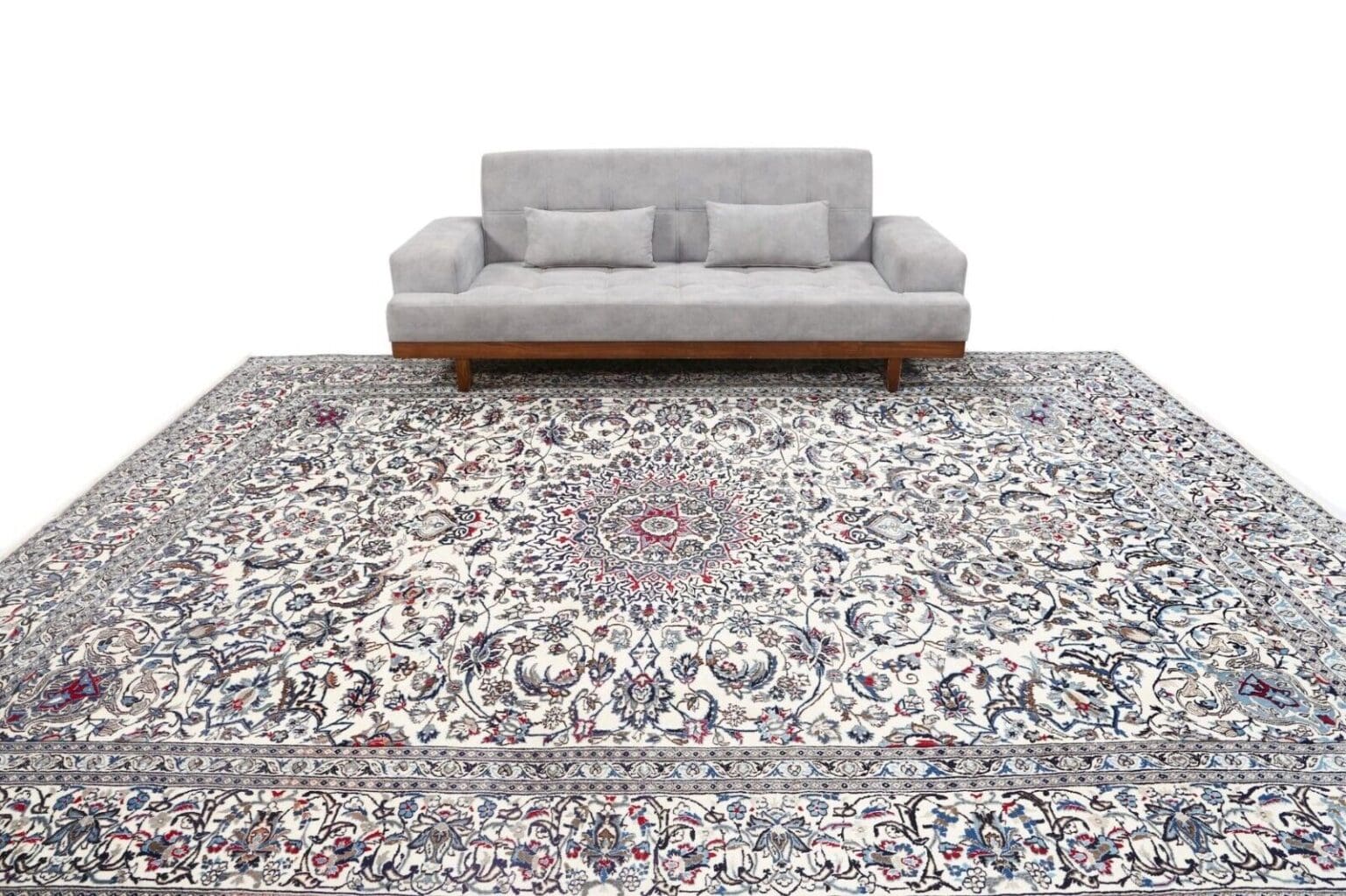
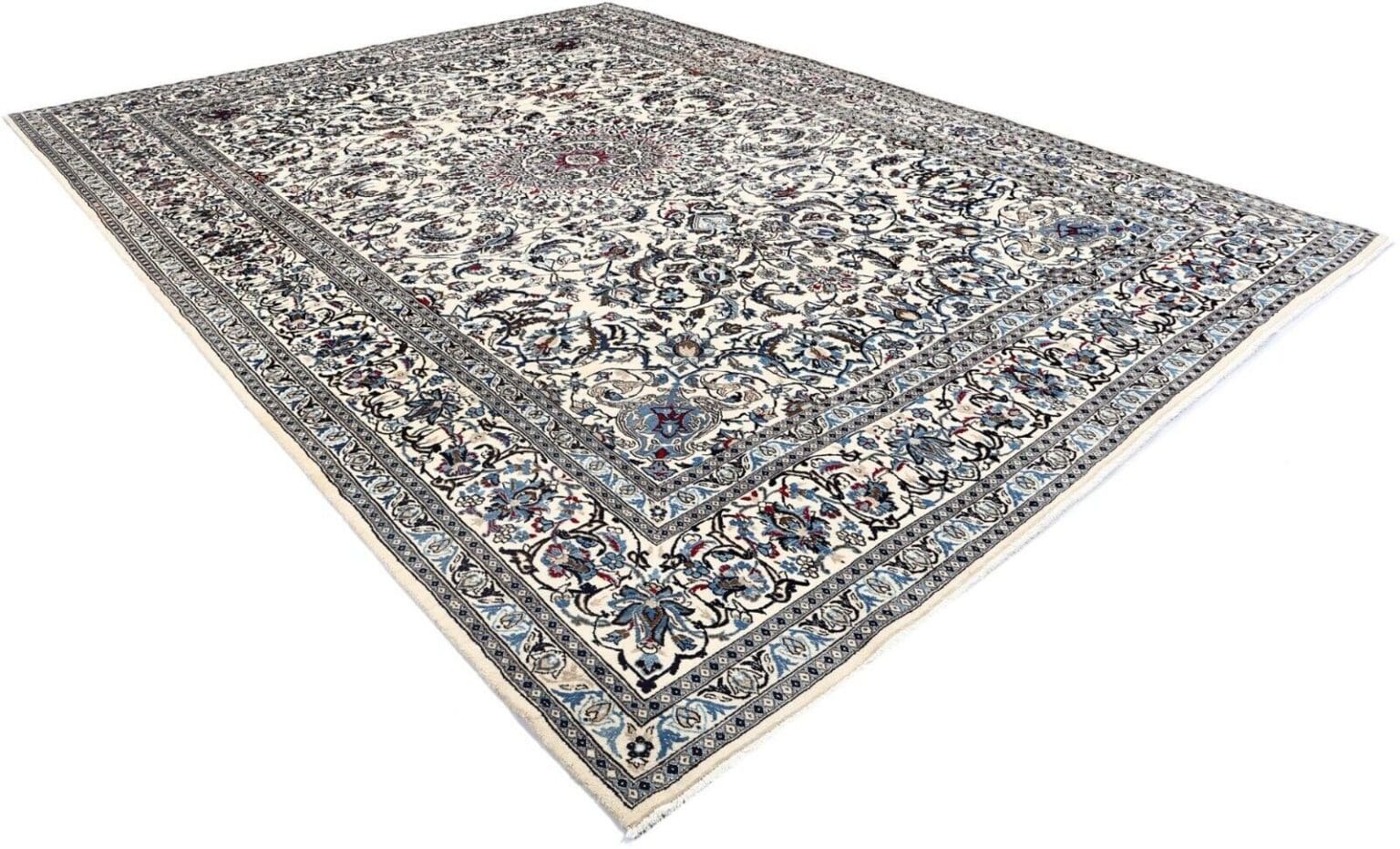
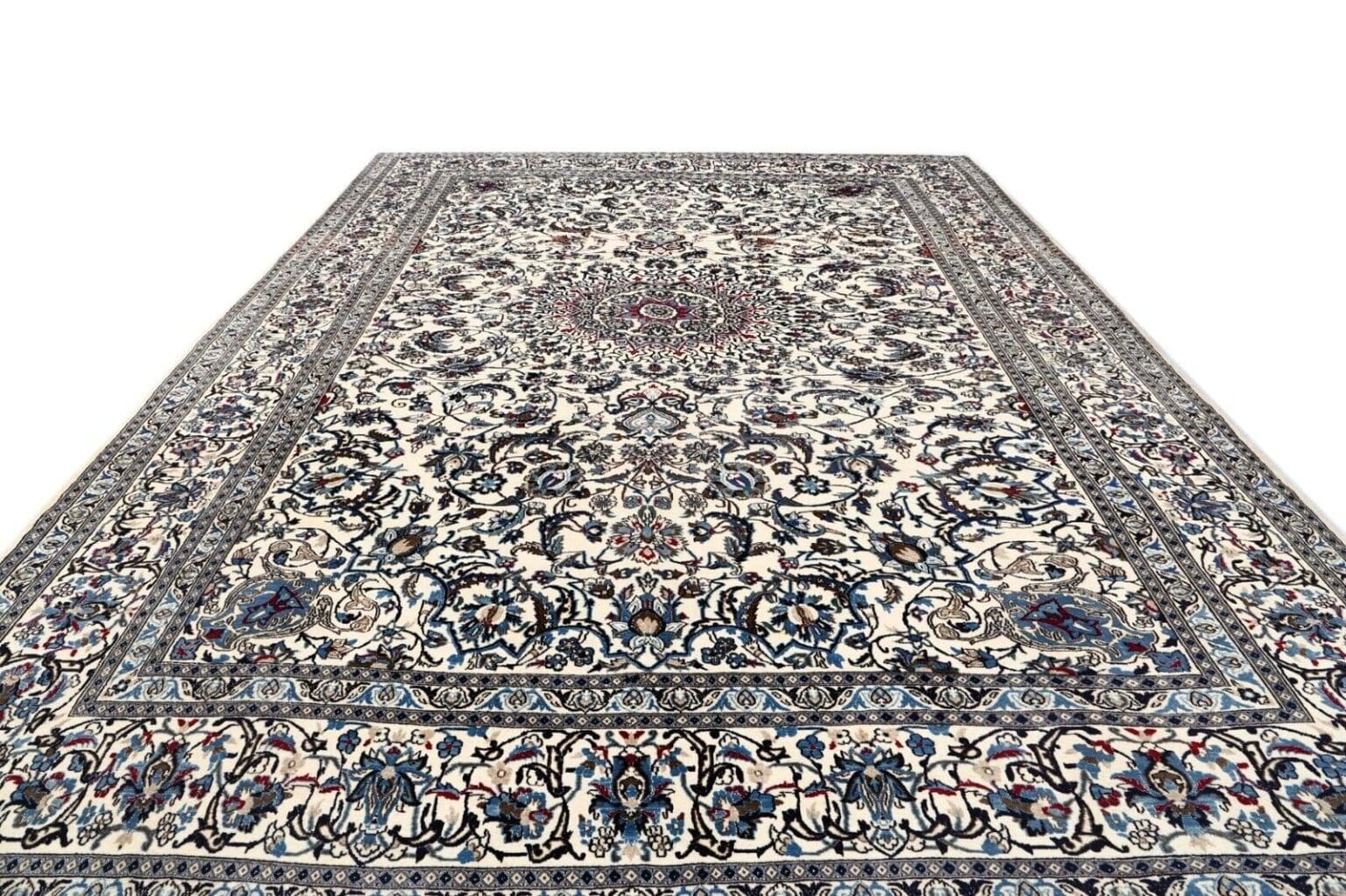
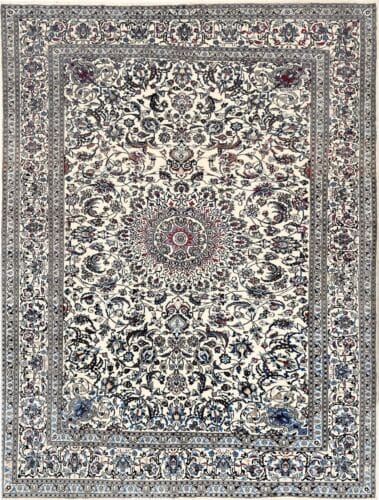
The pattern of this rug is described as Oriental with floral motifs. Floral ornament is a recurring part of Persian rug design. Flowers, leaves and curling vines may be connected into a continuous field, repeated in an ordered rhythm or arranged within framed areas. In a hand-knotted rug, these forms are not printed onto the finished surface. They are built from many individual knots. Each outline is formed through the placement of yarn, and each row contributes to the gradual development of the drawing. The result is a pattern whose visual character is inseparable from its textile construction.
The phrase floral motifs identifies the stated subject of the design. It does not identify a particular species of flower or assign a symbolic meaning that is not recorded for this rug. The product information also gives no colour palette. No specific colours are therefore claimed. Likewise, the description does not establish a particular border arrangement or central medallion. The accurate description remains an Oriental design with floral motifs. This places the rug within a broad Persian ornamental tradition without adding visual details that are not documented for the individual piece.
Oriental compositions can be organised in several ways. Some designs use a central medallion, while others spread a continuous pattern throughout the field. Floral forms may also be arranged in regular repeats or combined with secondary ornaments. General accounts of Nain often mention fine floral drawing, balanced areas and clearly structured Persian ornament. This regional background helps explain why floral decoration fits the Nain tradition. It does not determine every detail of the present rug. The specific information remains its Oriental pattern with floral motifs, not a named pattern formula or an unrecorded arrangement of borders and medallions.
Flowers and vines in Persian ornament often have both decorative and organising functions. They connect separate areas, create transitions and give structure to an open field. Repetition can provide continuity, while finer lines allow a design to be developed with greater visual detail. The knotting method directly affects this appearance. A motif is not applied as a later illustration but assembled from individual knots placed in a planned sequence. A hand-knotted surface consequently presents a design differently from a printed textile or a flat-woven Kilim. The construction and the pattern are closely linked because the drawing must be translated into rows of knots.
Persian floral designs may be combined with borders, medallions and smaller supporting motifs. Only the Oriental character and floral motifs are specifically stated for this rug, however. No particular number of borders, Herati pattern, medallion design or colour sequence is given. The name Nain adds a regional design context. Nain rugs are often associated with fine ornament and the use of silk. That general knowledge helps place the piece within Persian design history, but it does not assign the rug to another province. Its documented characteristics remain Iranian origin, Nain designation, hand-knotted construction and an Oriental pattern with floral motifs.
Special Features
The rug is listed as new with tag. It is described as allergy-friendly and suitable for use with underfloor heating. The product information also calls it slip-resistant and easy to clean. These features concern the practical use of this particular one-off rug. Its origin is Iran, its designation is Nain and its construction is hand-knotted. The material information lists wool and cotton, while the title also identifies silk. No additional statements are made about age, workshop, signature, exact knot count or dyes because those details are not supplied. The special features are therefore its new condition with tag, the stated suitability for allergy sufferers and underfloor heating, its slip-resistant description and its easy-cleaning characteristic.
FAQ
What defines a Nain Persian rug?
A Nain Persian rug belongs to an Iranian hand-knotting tradition. Nain is often associated with carefully arranged designs, fine ornament and floral compositions. For this particular rug, the pattern is explicitly described as Oriental with floral motifs. Its design is built by hand from individual knots rather than printed onto the surface. The rug comes from Iran, is listed as new with tag and is identified with silk in the title as well as wool and cotton in the material entry. General characteristics associated with Nain rugs should not automatically be transferred to every example. The stated features of this individual rug remain decisive.
How should I care for this Persian rug?
The rug is described as easy to clean. Regular gentle vacuuming is generally recommended for a Persian rug so that dust and loose dirt do not remain in the pile. If deeper soiling occurs, professional cleaning is advisable because the material and knotting can then be treated appropriately. Strong cleaning products should not be used without checking their suitability for the fibres. The product description also calls the rug slip-resistant, although it should still be placed on a clean and suitable floor. It is suitable for underfloor heating. Even heat and material-appropriate care support the intended use of the rug.
Why does the Iranian origin matter?
Origin matters for a Persian rug because different Iranian regions developed their own design traditions, craft practices and histories. This rug is stated to come from Iran and is identified as Nain. Kerman, Isfahan and Tabriz are also recognised Iranian weaving centres, but none of those places is given as the origin of this piece. Nain is often linked with fine ornament and floral design. The origin therefore explains the cultural and technical context of the rug. It does not mean that a Nain rug automatically comes from Kerman, Isfahan or Tabriz. For this individual piece, Iran is the origin and Nain is the stated regional designation.
To provide the best experiences, we use technologies like cookies to store and/or access device information. Consenting to these technologies will allow us to process data such as browsing behavior or unique IDs on this site. Not consenting or withdrawing consent, may adversely affect certain features and functions.
Functional Always active
The technical storage or access is strictly necessary for the legitimate purpose of enabling the use of a specific service explicitly requested by the subscriber or user, or for the sole purpose of carrying out the transmission of a communication over an electronic communications network.
Preferences
The technical storage or access is necessary for the legitimate purpose of storing preferences that are not requested by the subscriber or user.
Statistics
The technical storage or access that is used exclusively for statistical purposes.The technical storage or access that is used exclusively for anonymous statistical purposes. Without a subpoena, voluntary compliance on the part of your Internet Service Provider, or additional records from a third party, information stored or retrieved for this purpose alone cannot usually be used to identify you.
Marketing
The technical storage or access is required to create user profiles to send advertising, or to track the user on a website or across several websites for similar marketing purposes.

 SECURE PAYMENT
 SHIPPING PARTNERS