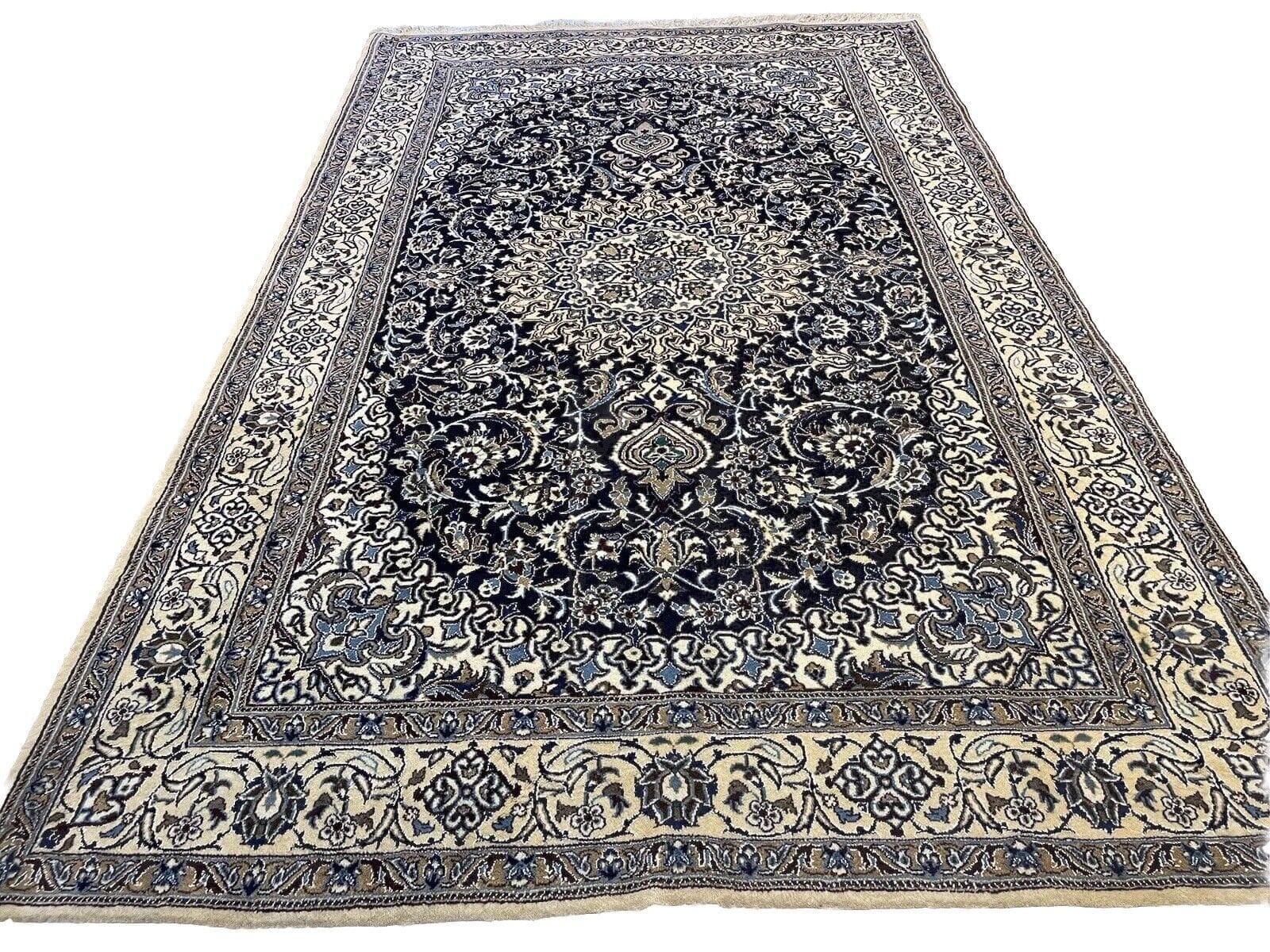
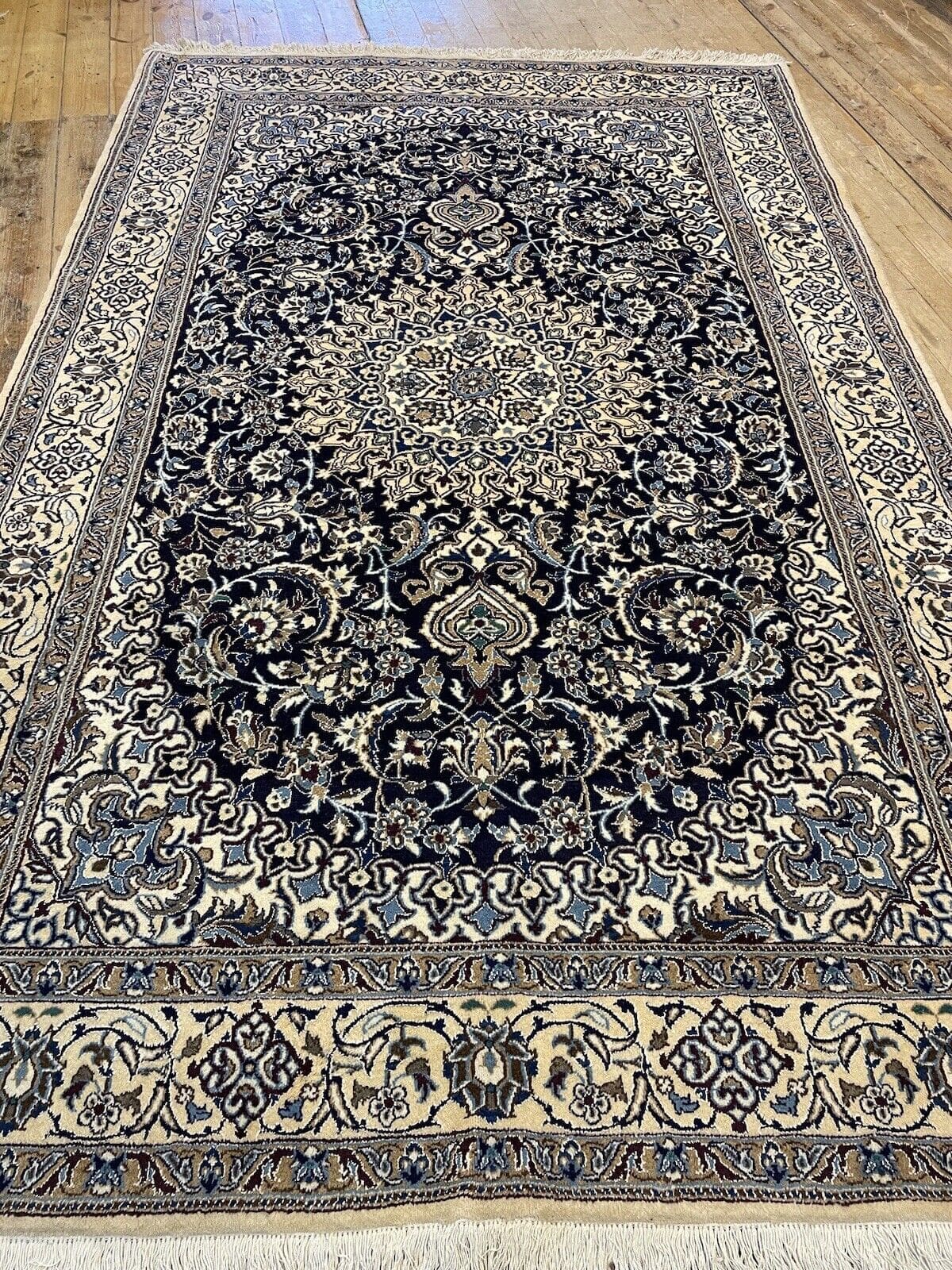
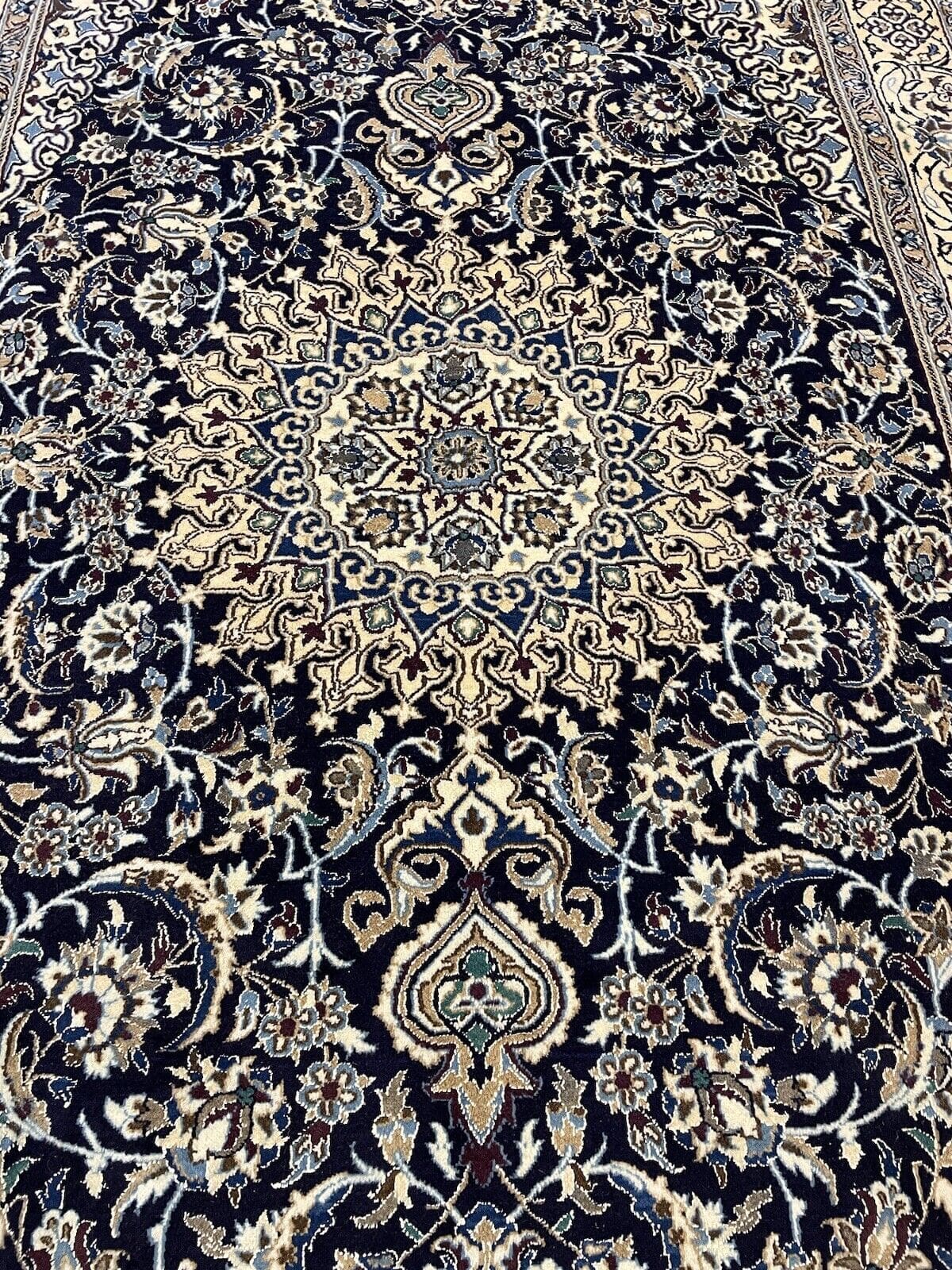
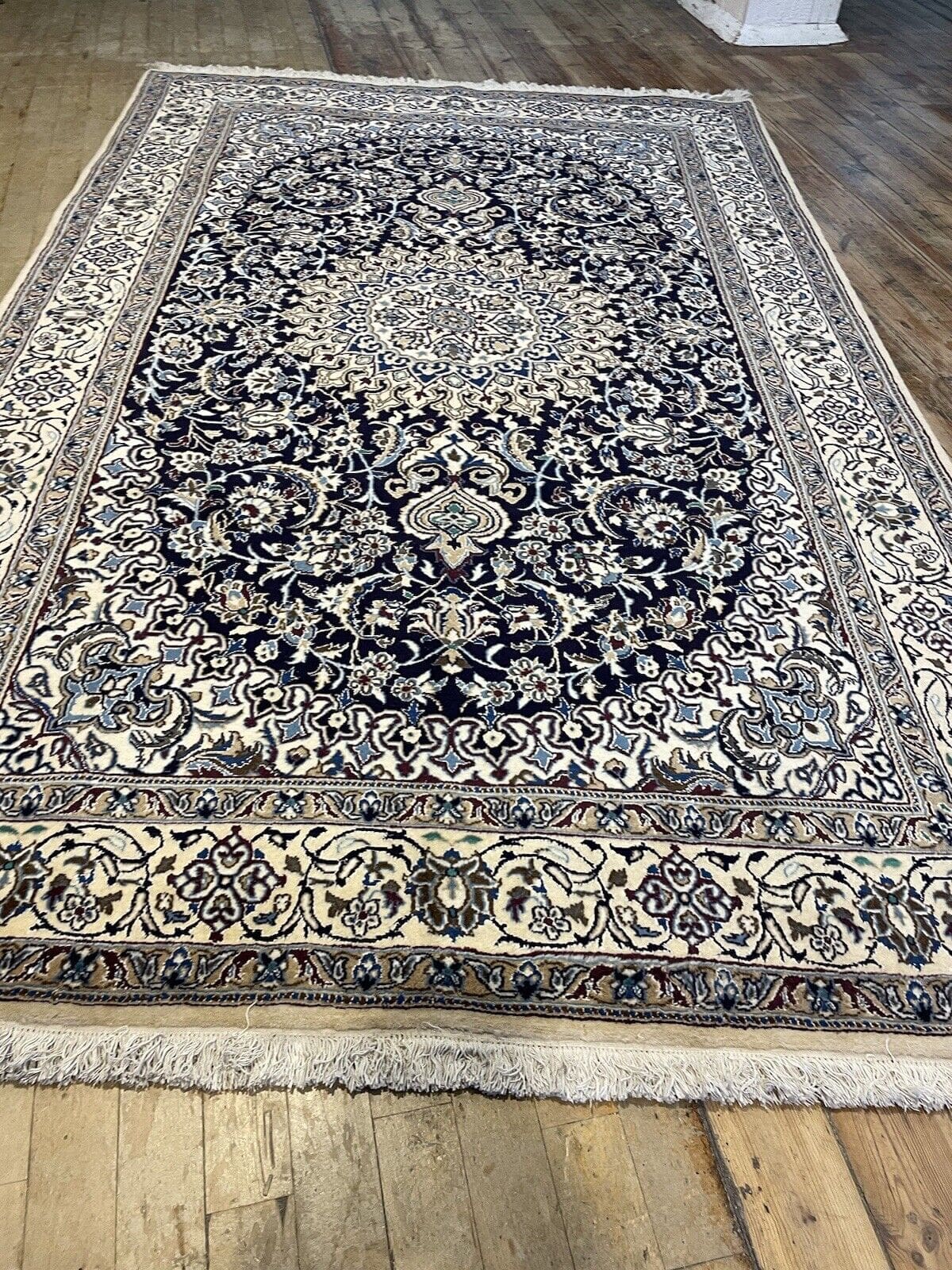
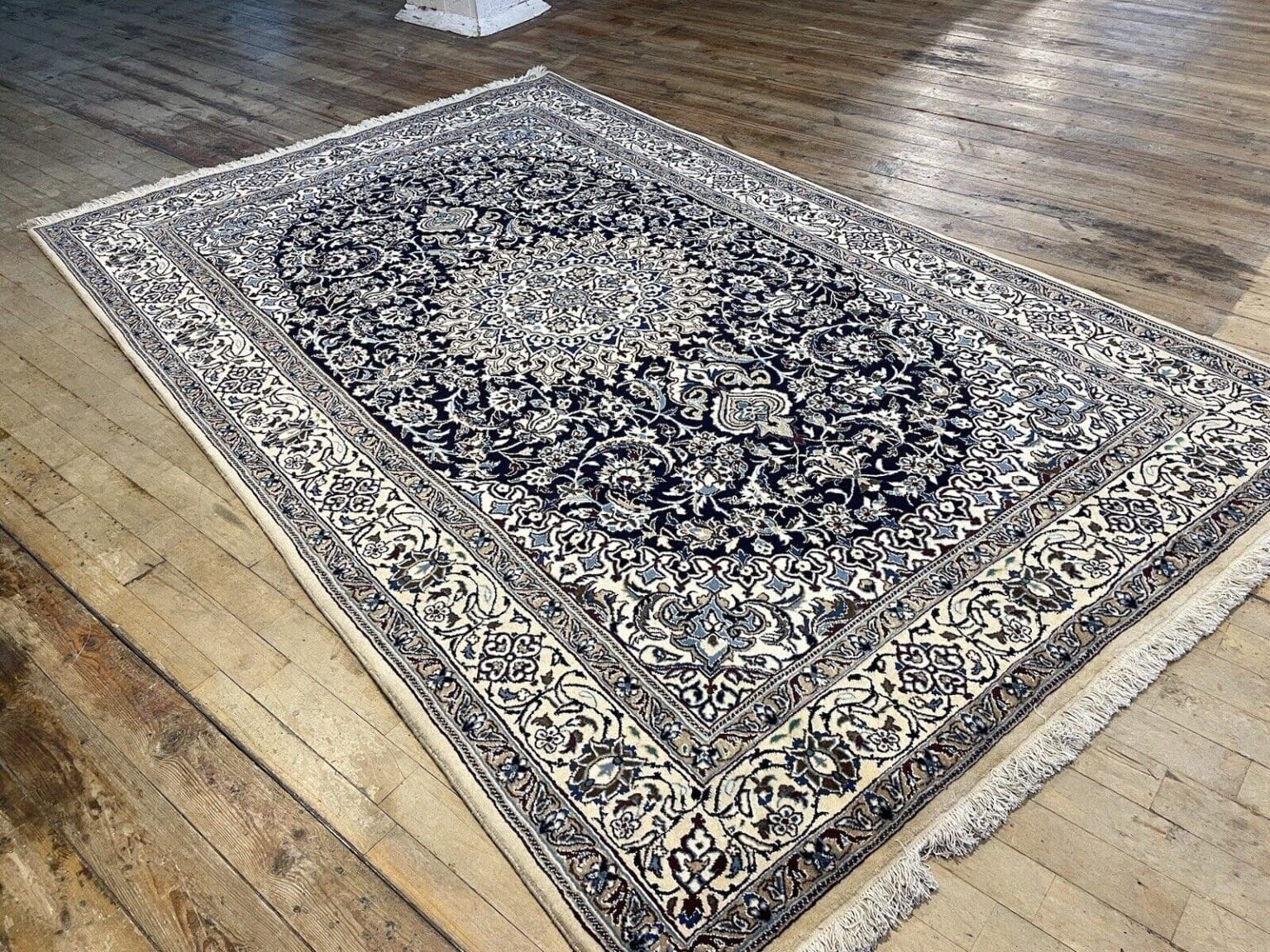
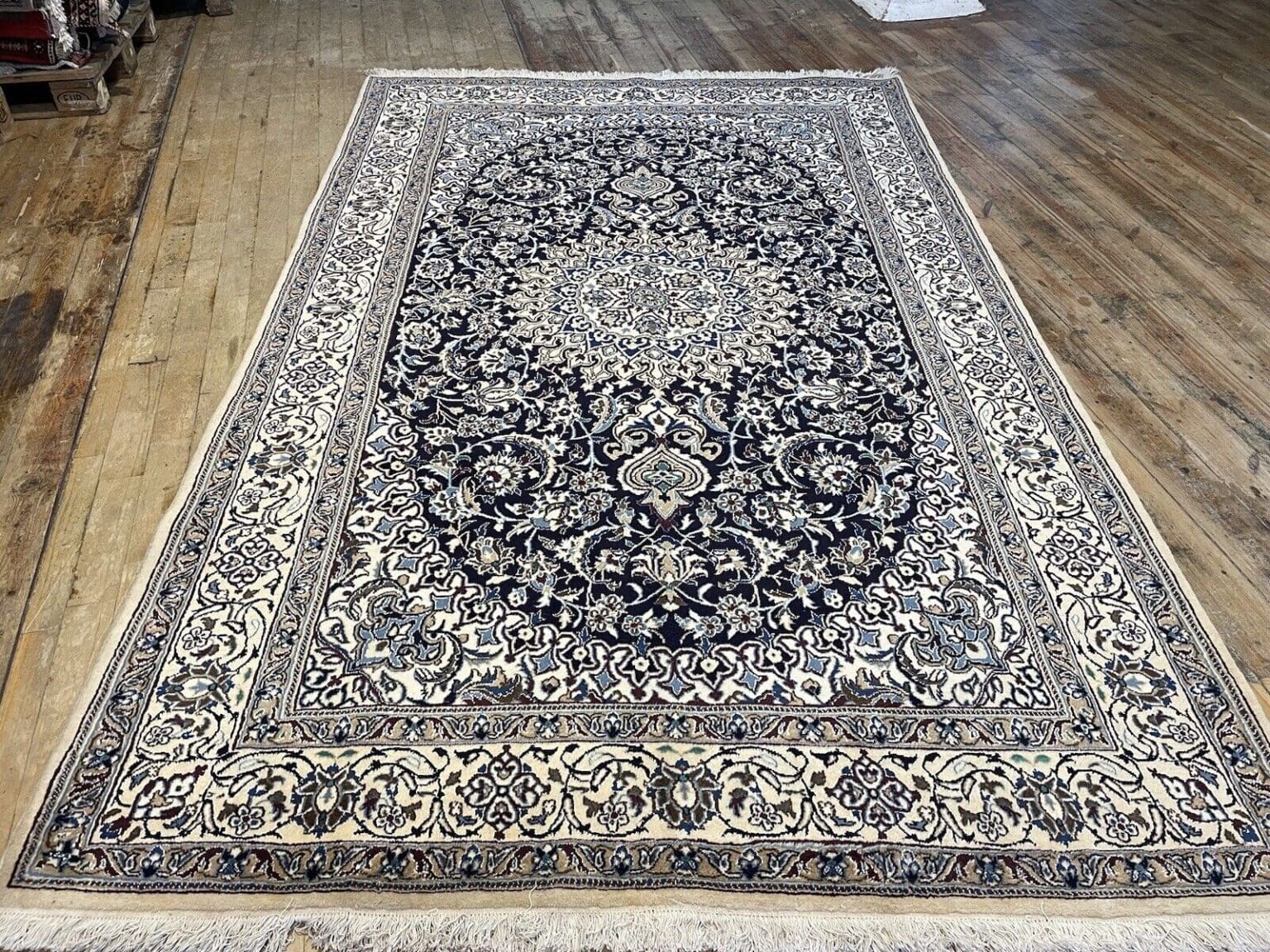
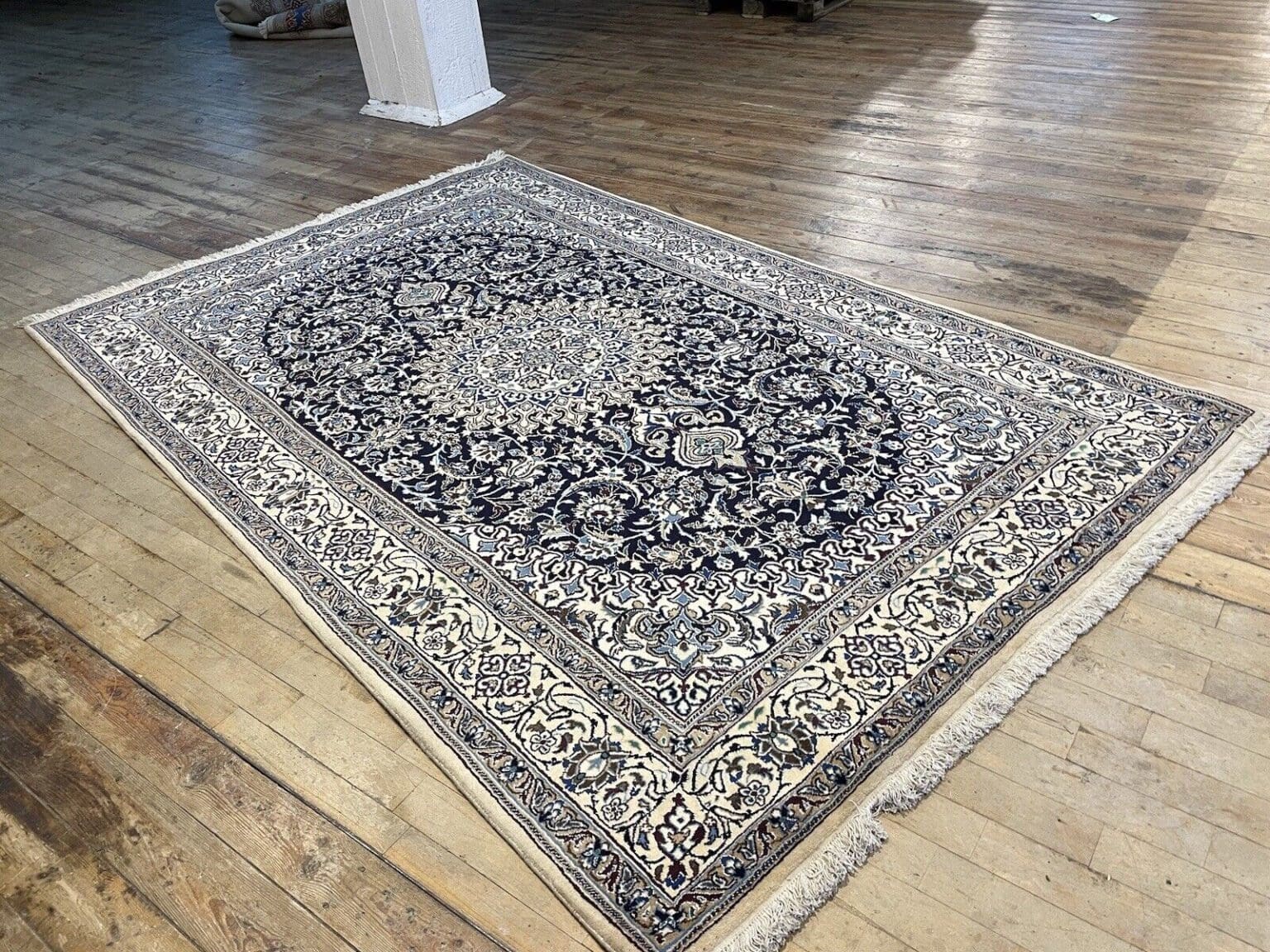
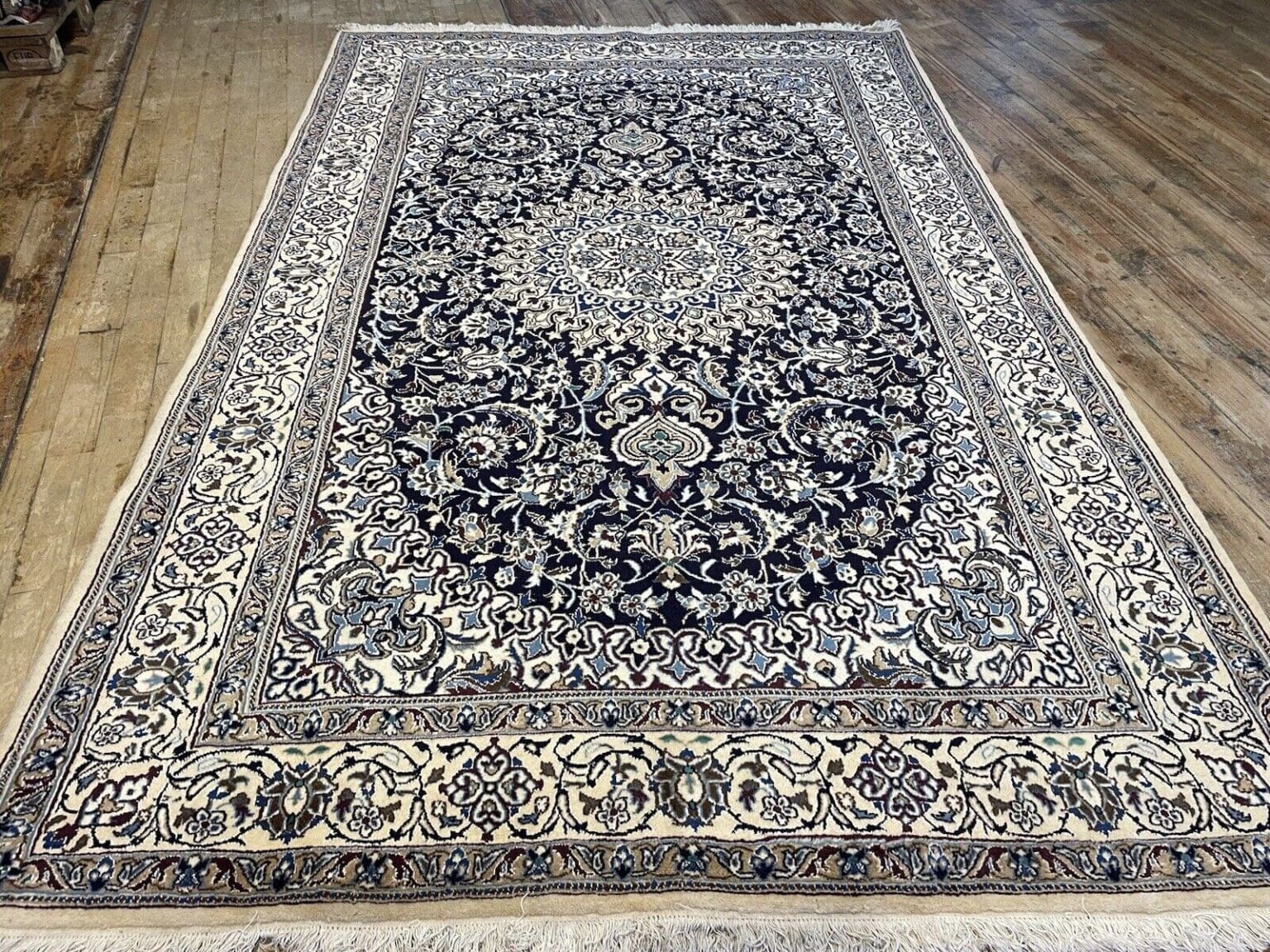
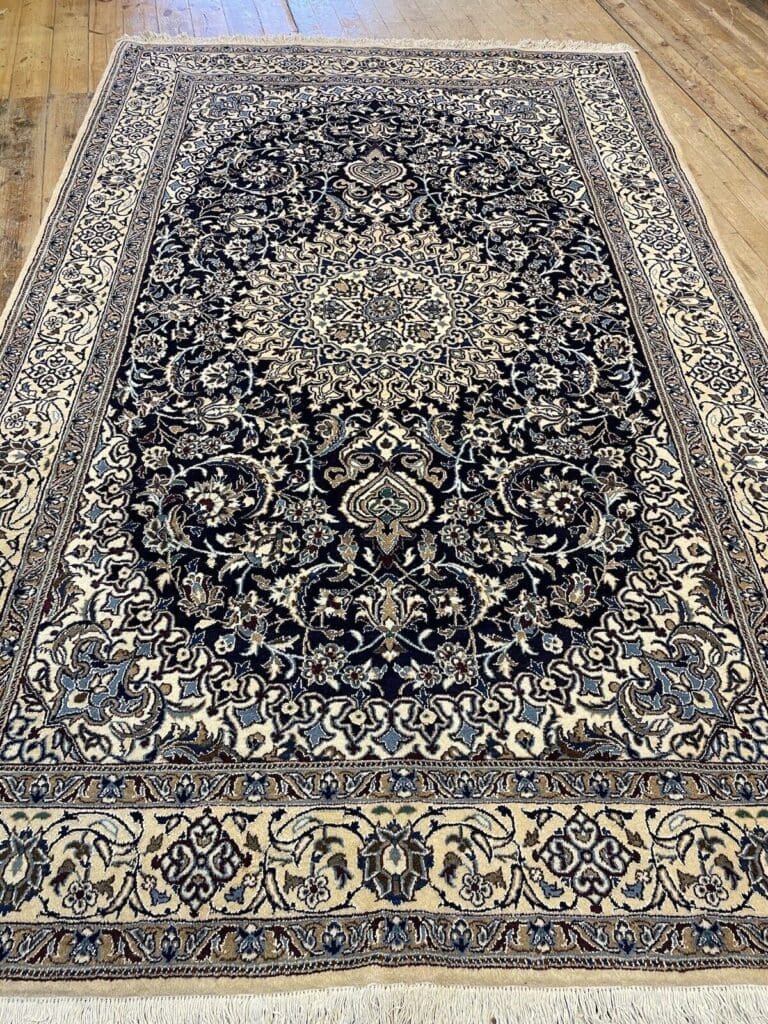
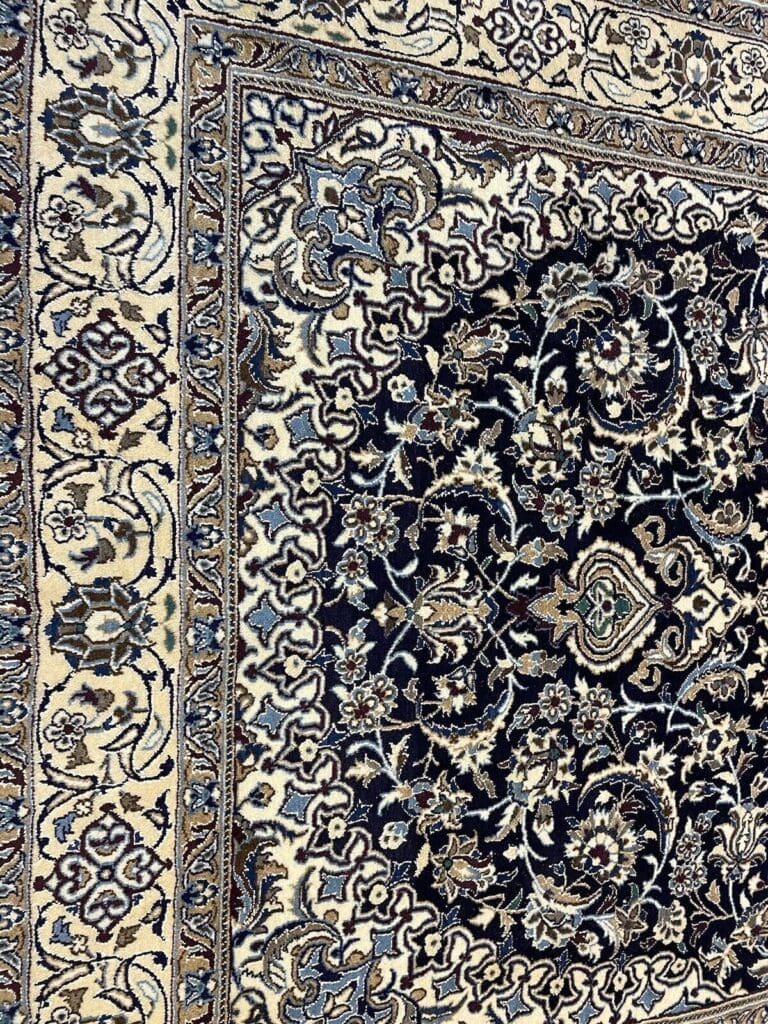
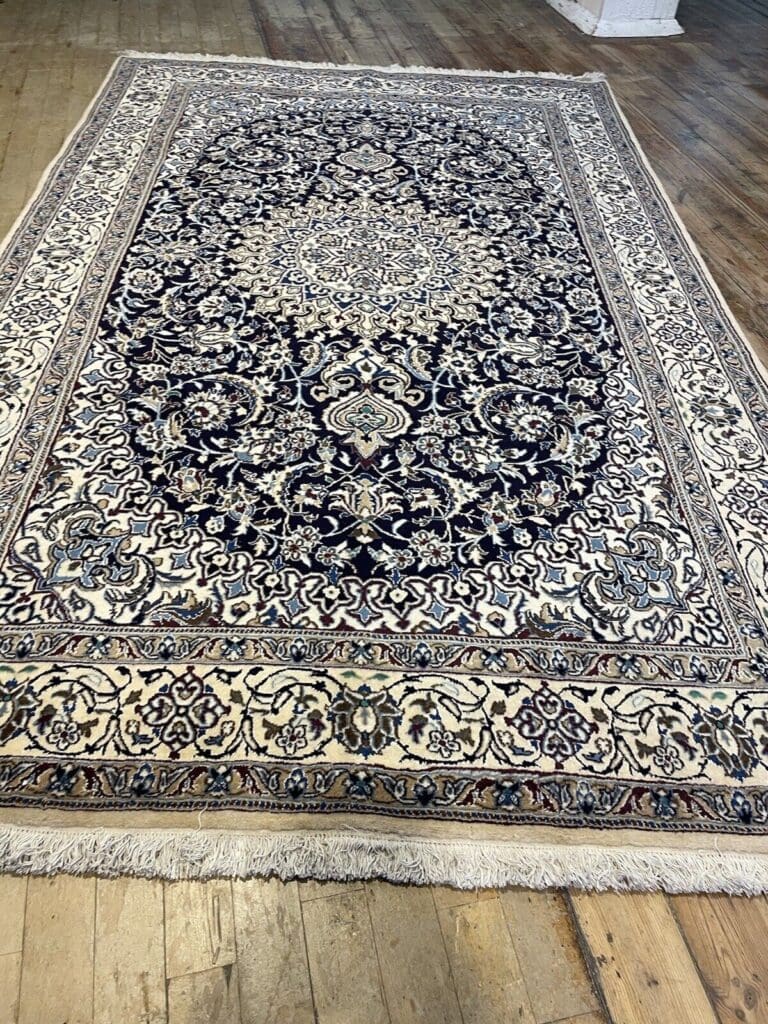
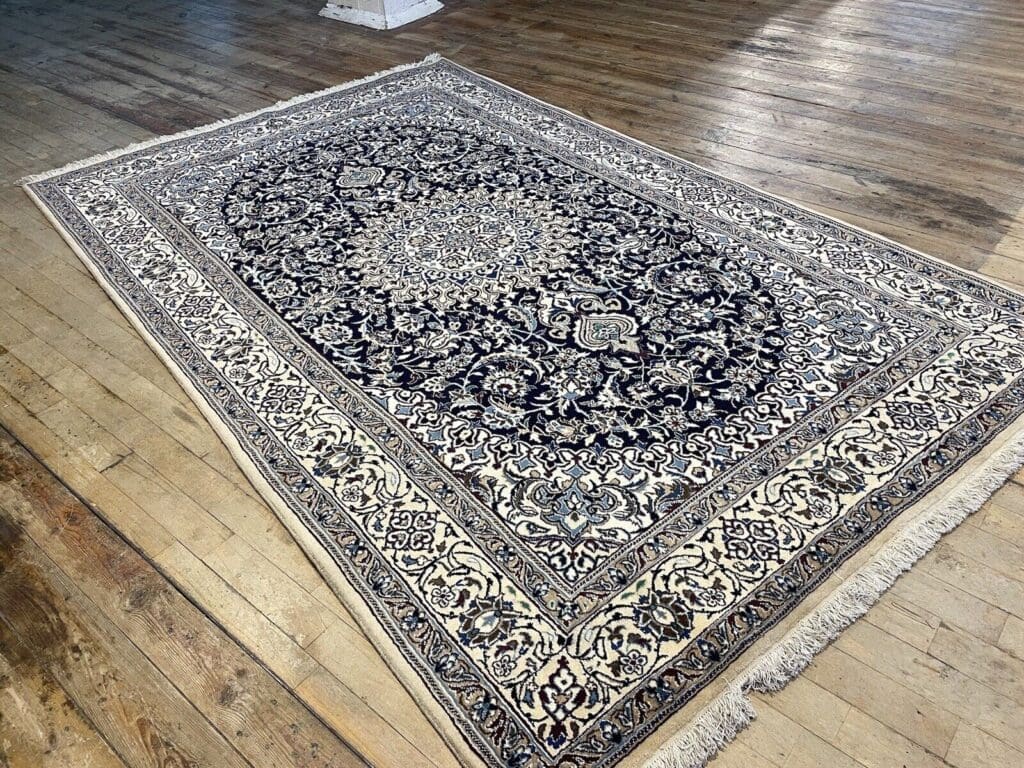
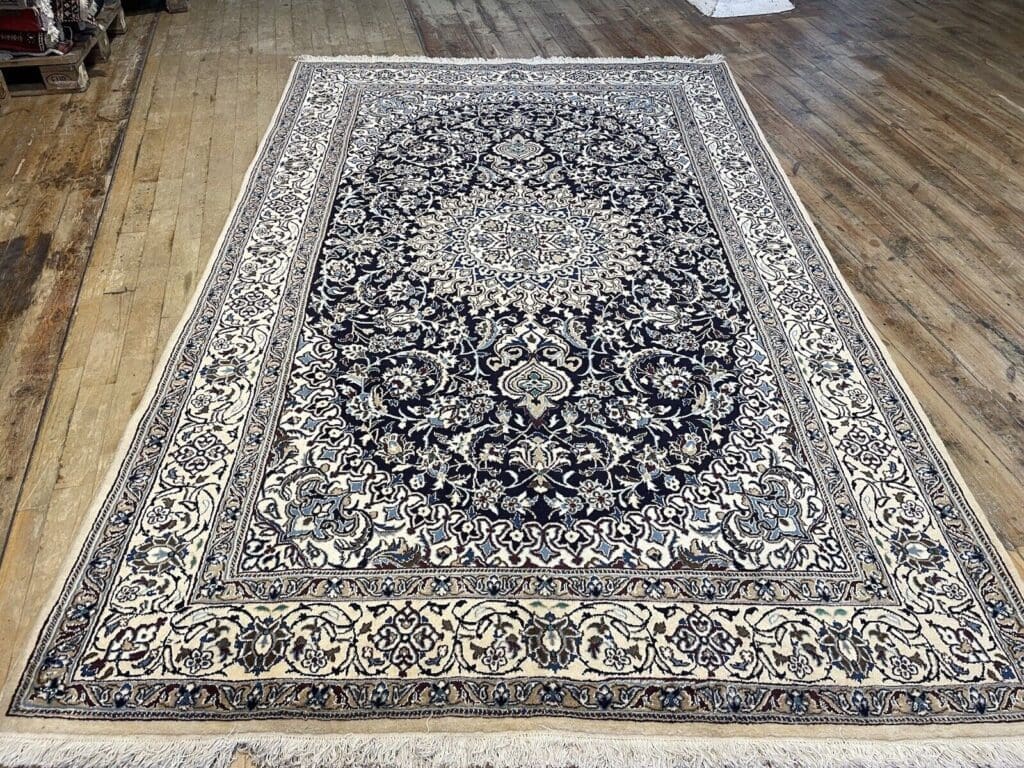
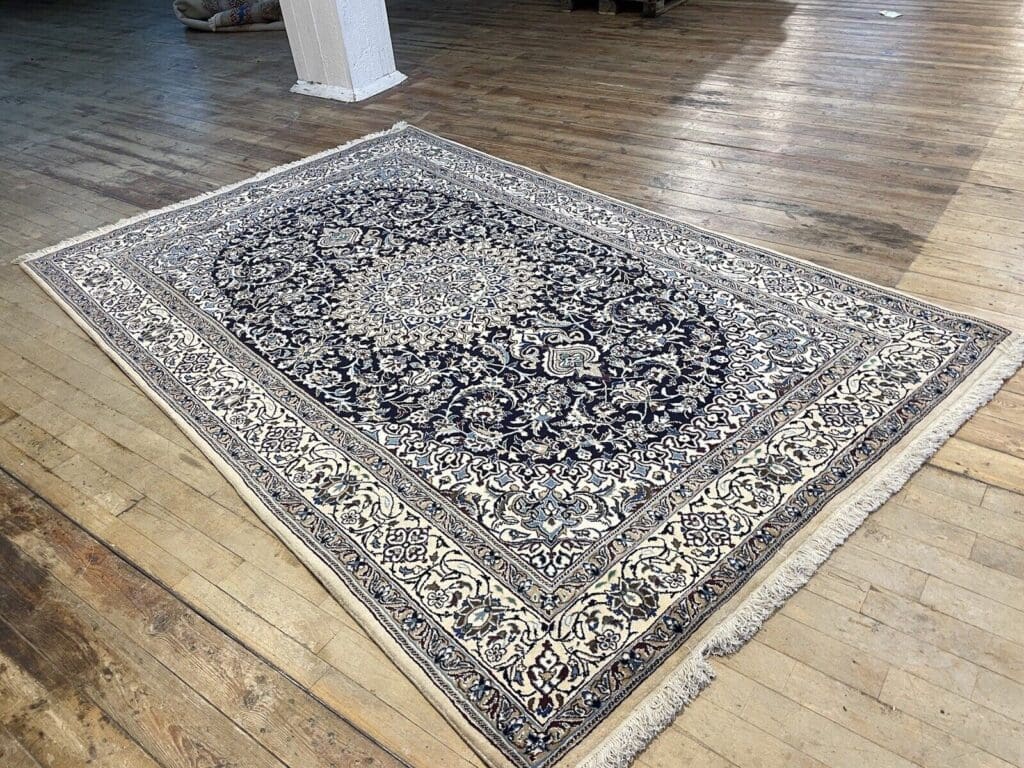
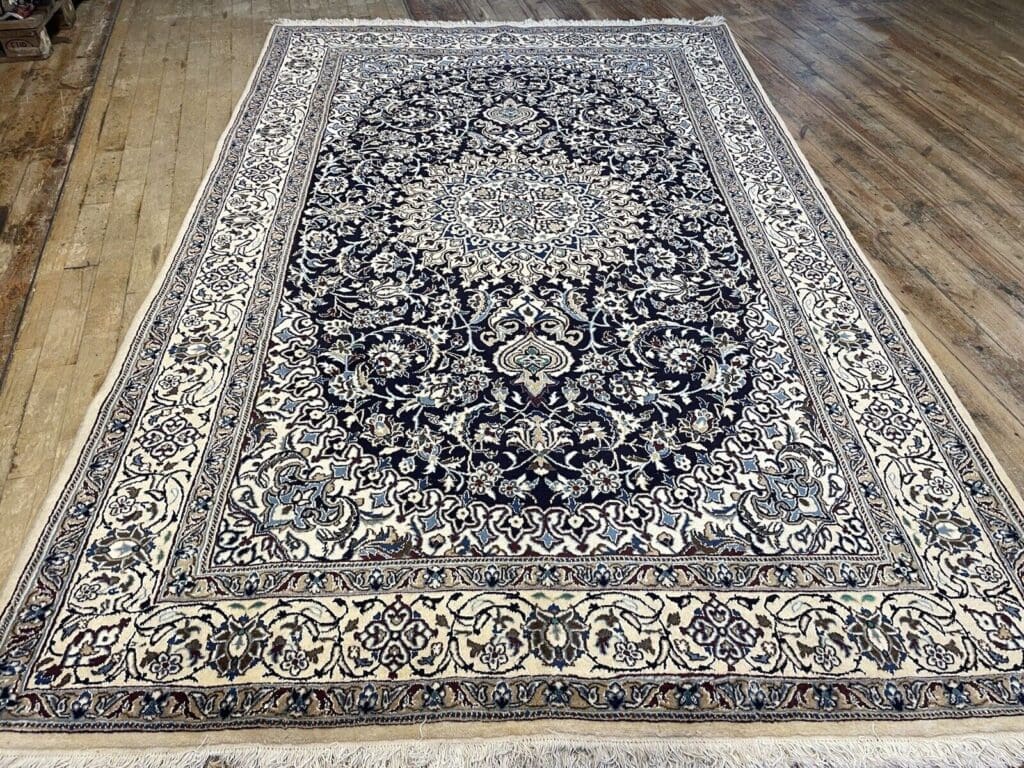
This Nain Persian rug is hand-knotted and has a pile made from wool with silk. Combining these materials is associated with finely made Persian rugs, where wool provides a durable textile foundation and silk can add a subtle sheen to the surface. The beige colouring gives this individual rug a calm, classical appearance. Its material description is therefore closely connected with both traditional Iranian rug making and the refined visual effect often sought in Nain weaving.
Hand-knotting builds the pile knot by knot on a prepared foundation. The design is created during the weaving process rather than printed onto a finished surface. The source description characterises the construction as dense, a feature that supports careful definition in a detailed pattern. The pile height is specified as 8 mm. A hand-knotted rug is shaped through repeated manual work, so the relation between foundation, knots, rows and clipped pile is central to its finished appearance.
The rug is suitable for rooms with underfloor heating. It is therefore intended for use in heated interiors where a traditional textile floor covering is required. Wool and silk respond differently to light and touch, and their combination gives the surface a varied visual structure. The hand-knotted technique, the stated materials and the compatibility with underfloor heating are the specific construction features described for this Nain rug.
Origin and Tradition
Nain is a recognised rug-producing region in Iran and is associated with hand-knotted Persian rugs made with precise pattern work. The city lies in central Iran, an area shaped historically by an arid climate and by connections between important trade routes. The name Nain consequently refers to a developed regional weaving tradition, not merely to a decorative pattern. This rug is identified as a Nain Persian rug and therefore belongs to the Iranian tradition of Persian carpet making.
Persian carpet art developed over many centuries into a sophisticated form of textile design. Rugs served practical purposes in homes, but they could also have social, ceremonial and representative roles. Different parts of Iran developed their own preferences for colour groups, ornament, knotting methods and material combinations. Nain became known for an approach that places emphasis on controlled drawing, carefully organised compositions and a refined execution.
The Nain tradition brings inherited Persian design principles together with workshop craftsmanship. Producing a hand-knotted rug requires knowledge of the warp, weft and pile, as well as the ability to transfer a planned composition into a textile surface. Knotters build the image progressively, using a cartoon, a pattern guide or established regional conventions. Repeated forms, balanced axes and carefully spaced details help maintain the structure of the design across the rug.
Nain rugs are often discussed in connection with light grounds, restrained colour arrangements and detailed floral or geometric compositions. These are general characteristics of the regional design language and do not mean that every Nain rug has exactly the same appearance. The rug described here is beige, oriental and traditionally Persian or Oriental in style. Those classifications connect its individual appearance with a broader Iranian vocabulary of ordered ornament and classical textile design.
The history of Nain weaving also forms part of the wider development of Iranian textile culture. Persian rugs travelled through trade networks and influenced ideas about Oriental decoration in many countries. Regional workshops preserved established techniques while responding to changing interiors and changing preferences. This combination of continuity and adaptation helps explain Nain’s continuing place within Iranian rug making. It also places the hand-knotted work of this rug in a tradition where regional identity, material knowledge and pattern planning are closely related.
Design and Pattern
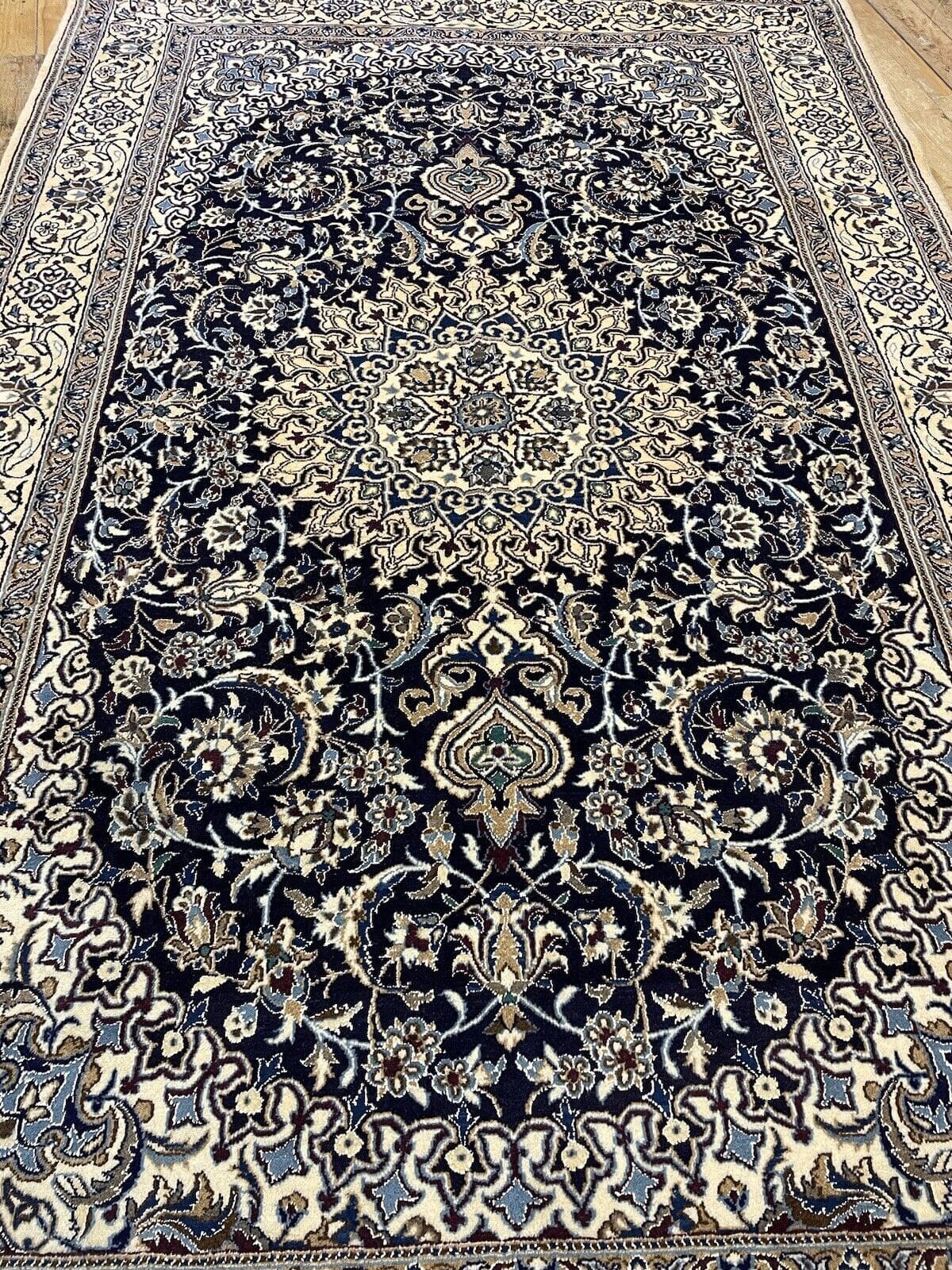
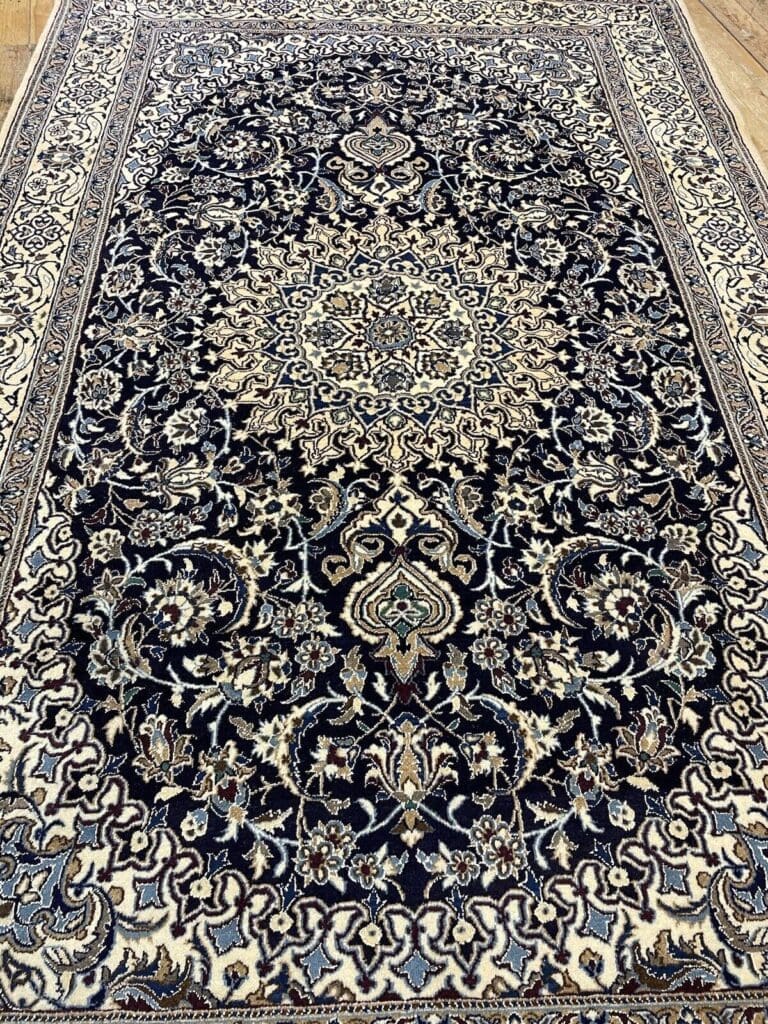
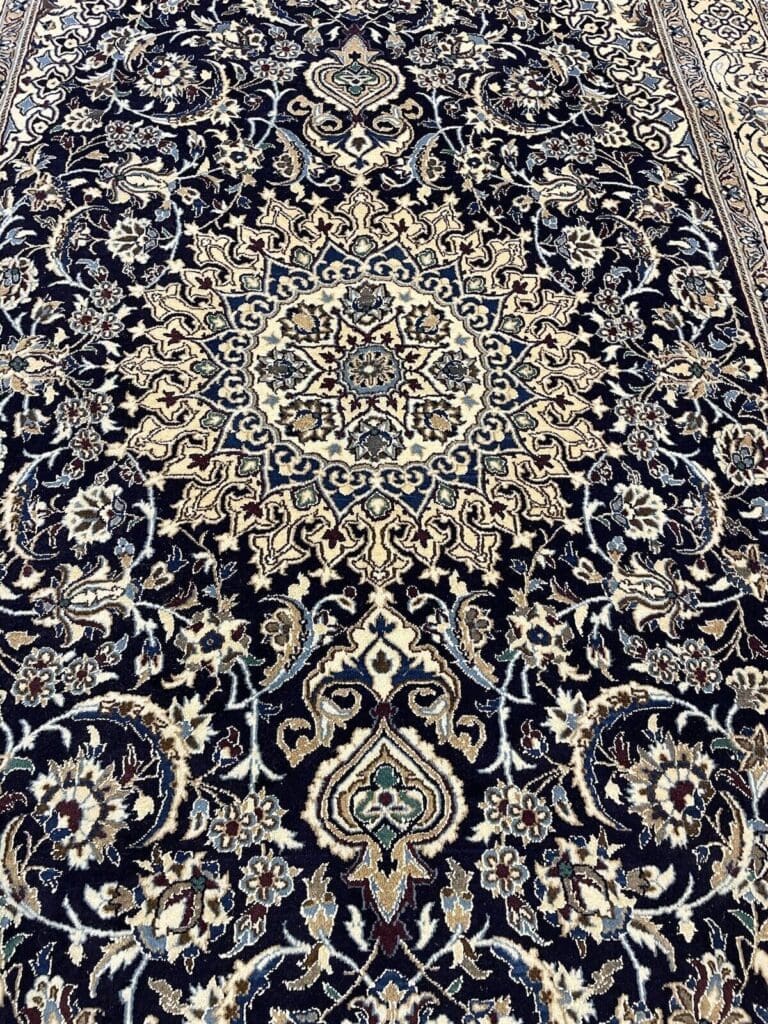
The pattern of this rug is described as Oriental and its style as traditional Persian or Oriental. Its beige ground provides a light and balanced basis for the composition. A classical rug design depends on the relationship between the field, the border and the ornaments arranged within them. The precise individual motif is not named in the source, so the rug is best described through its stated Oriental and classical character rather than through a more specific pattern title.
Persian rug compositions often rely on clear internal order. A central medallion may focus the eye, while mirrored elements and repeated shapes create a unified structure. In other designs, a continuous pattern spreads across the field without a dominant centre. Floral vines, leaves, blossoms and stylised branches may be combined with geometric lines. Regional pattern systems use these building blocks to create rhythm and balance, while individual workshops and individual weavers can vary the details.
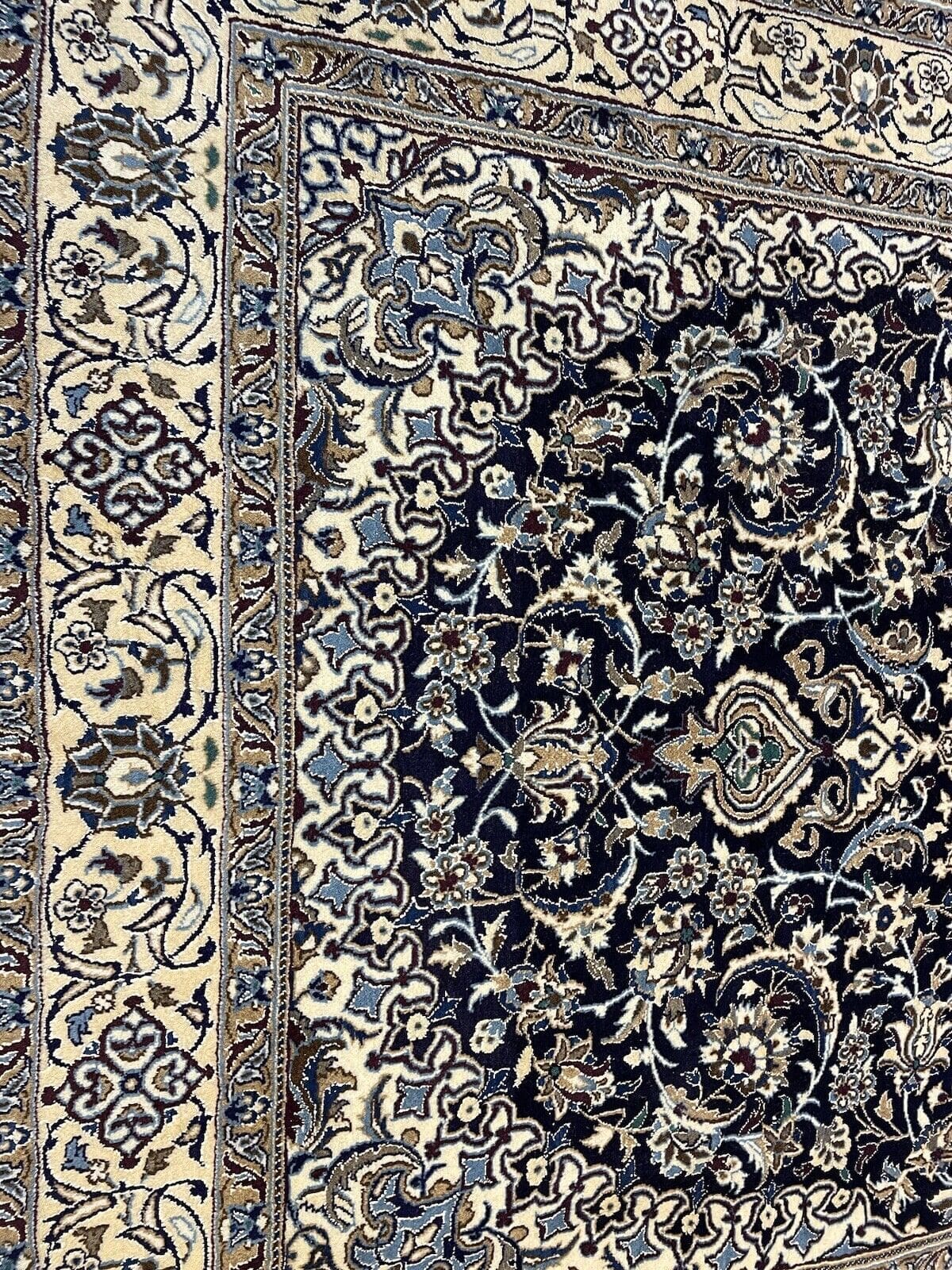
In many Oriental rugs, the border frames the field and gives the main composition a defined edge. Narrow guard borders can separate the central field from a wider principal border. The effect depends on the scale of the drawing, the clarity of the outlines and the relationship between the colours. In pale Nain-style compositions, details are often arranged so that the pattern remains legible without becoming visually congested. Silk in the pile can catch light differently from wool and may make fine areas of the design appear more distinct as the viewing angle changes.
Traditional Persian ornament is decorative, but it also carries a cultural vocabulary. Flowers and vines are frequently abstracted rather than copied as literal botanical images. Geometric elements make repetition, symmetry and structure visible. Some patterns are discussed in relation to symbolic meanings, although interpretations vary according to region, design and tradition. For this rug, the available description establishes a classical Oriental pattern but does not identify a particular named motif or symbolic programme.
The design can be placed in a variety of interiors. Traditional furnishings can reinforce its Persian references, while a restrained modern room can use an Oriental pattern as a link to historical textile design. Beige is often chosen when a rug is expected to connect several interior colours without creating a strong contrast. The rectangular format suits common living and working areas. These observations describe the design tradition and possible visual relationships, not an additional claim about a specific room or placement for this one-off rug.
Special Features
This rug is new with a tag. It is suitable for use over underfloor heating and can therefore be placed in heated indoor rooms. As a beige, rectangular Nain Persian rug, it combines a traditional Persian or Oriental visual language with hand-knotted construction. The description names living rooms, offices and reception areas as possible settings for this type of use.
Regular vacuuming without a brush attachment is recommended for routine care. A specialist rug cleaner should be consulted for heavier soiling. The rug is not suitable for permanent outdoor use because weather and ultraviolet radiation can affect wool, silk and the appearance of the textile. It should be kept in protected indoor spaces where it is shielded from direct exposure to the elements.
FAQ
How should I clean my Nain Persian rug?
For routine care, vacuum the rug without using a brush attachment. This removes loose dust and particles while avoiding unnecessary mechanical stress on the pile. If the rug has heavier soiling, a specialist rug cleaner should handle the treatment. Professional cleaning is appropriate for a hand-knotted pile made from wool with silk because the fibres and the pattern need to be treated carefully. Harsh products or improvised wet cleaning should not be used when their effect on the rug has not been assessed.
Is the rug suitable for underfloor heating?
Yes. This Nain Persian rug is suitable for underfloor heating. It can be used in heated indoor rooms and combines that suitability with a hand-knotted pile made from wool with silk. The heating system should be operated evenly and within its normal appropriate range. Proper placement and regular care help keep the rug in the environment for which it is intended.
Can I use the rug outdoors?
This Nain Persian rug is not suitable for permanent outdoor use. Weather, moisture and ultraviolet radiation can place stress on a hand-knotted textile made from wool with silk and may affect both its appearance and material properties. The rug should therefore be used indoors in a protected setting, such as a living area, office or reception room. Keeping it away from direct exposure to the elements protects the textile during normal use.
To provide the best experiences, we use technologies like cookies to store and/or access device information. Consenting to these technologies will allow us to process data such as browsing behavior or unique IDs on this site. Not consenting or withdrawing consent, may adversely affect certain features and functions.
Functional Always active
The technical storage or access is strictly necessary for the legitimate purpose of enabling the use of a specific service explicitly requested by the subscriber or user, or for the sole purpose of carrying out the transmission of a communication over an electronic communications network.
Preferences
The technical storage or access is necessary for the legitimate purpose of storing preferences that are not requested by the subscriber or user.
Statistics
The technical storage or access that is used exclusively for statistical purposes.The technical storage or access that is used exclusively for anonymous statistical purposes. Without a subpoena, voluntary compliance on the part of your Internet Service Provider, or additional records from a third party, information stored or retrieved for this purpose alone cannot usually be used to identify you.
Marketing
The technical storage or access is required to create user profiles to send advertising, or to track the user on a website or across several websites for similar marketing purposes.
 SECURE PAYMENT
 SHIPPING PARTNERS


