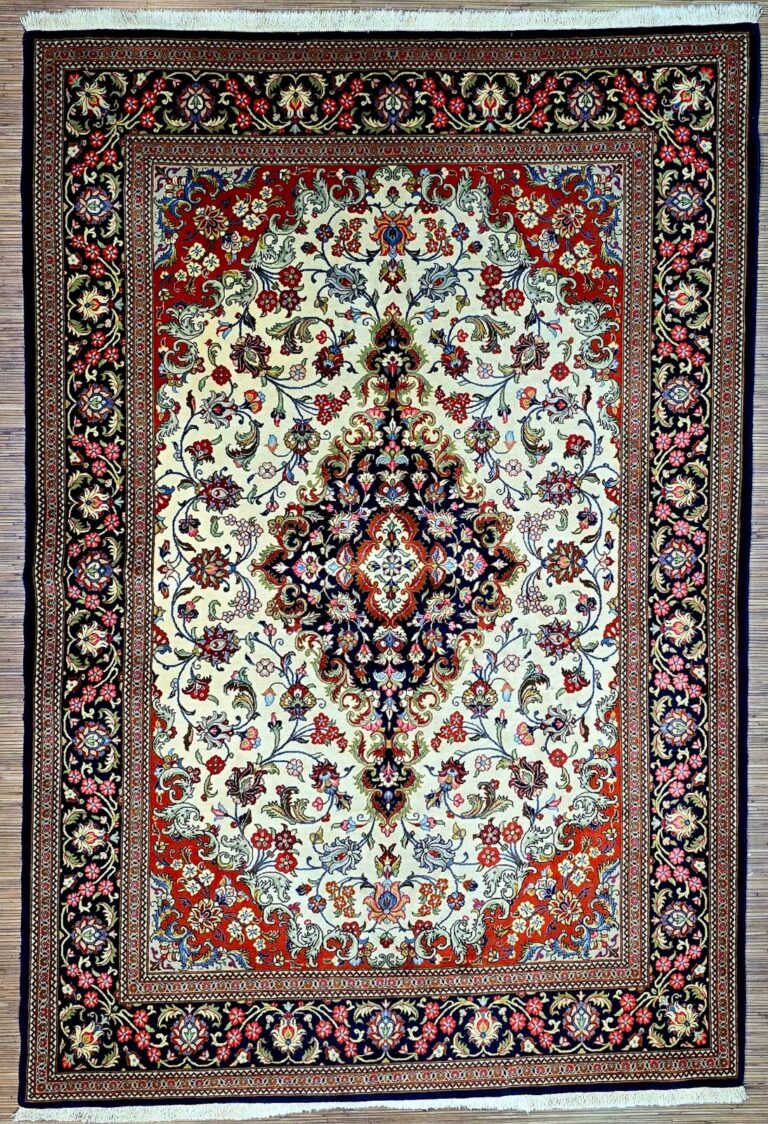
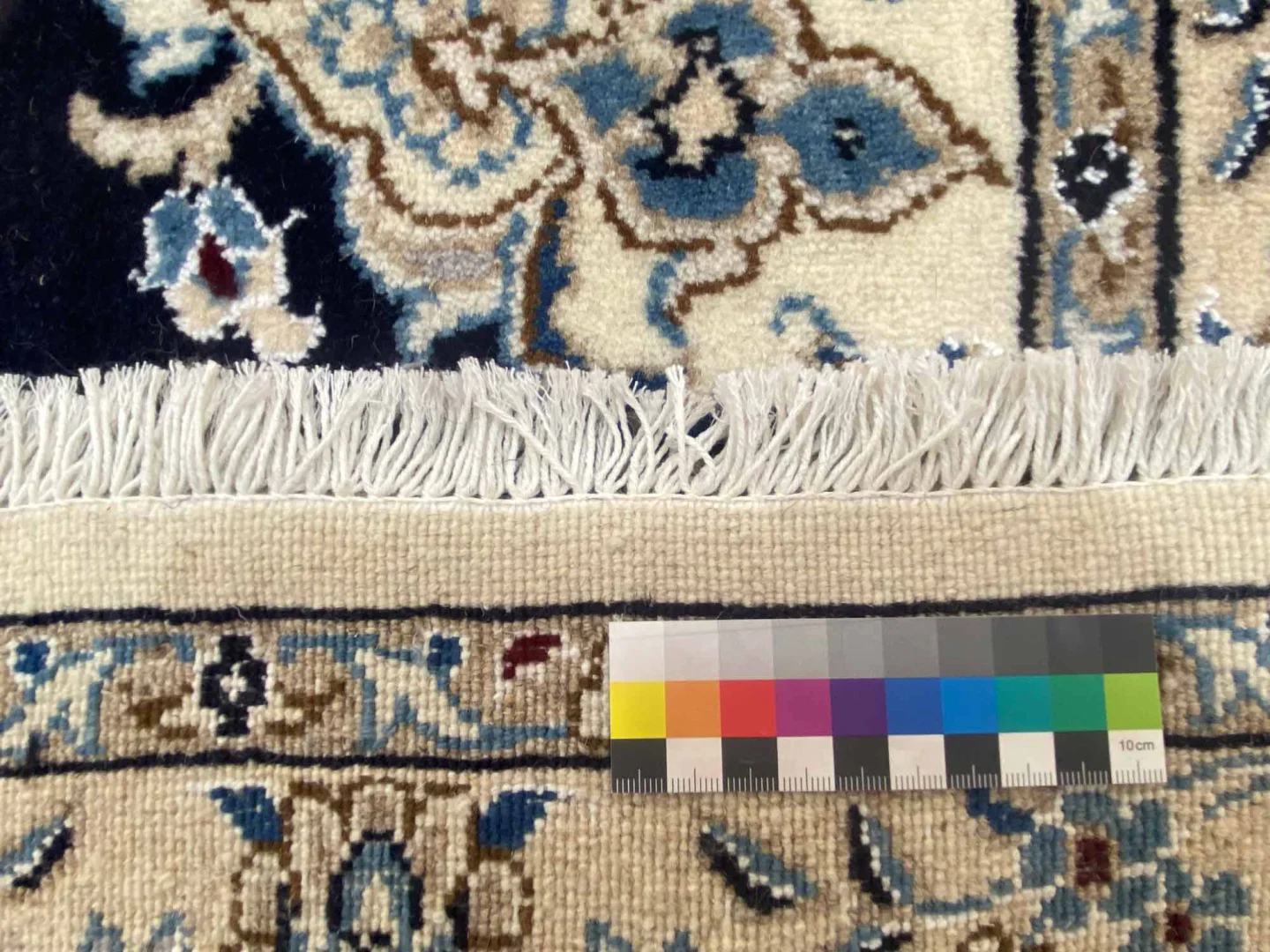
This Nain Persian rug is hand-knotted with a pile made of high-quality wool. Hand-knotting is built up knot by knot on a loom rather than produced as a single industrial surface. Each knot contributes to the visible structure and to the drawing of the design. The result is a woven textile whose practical use and decorative pattern are joined through a traditional Persian method.
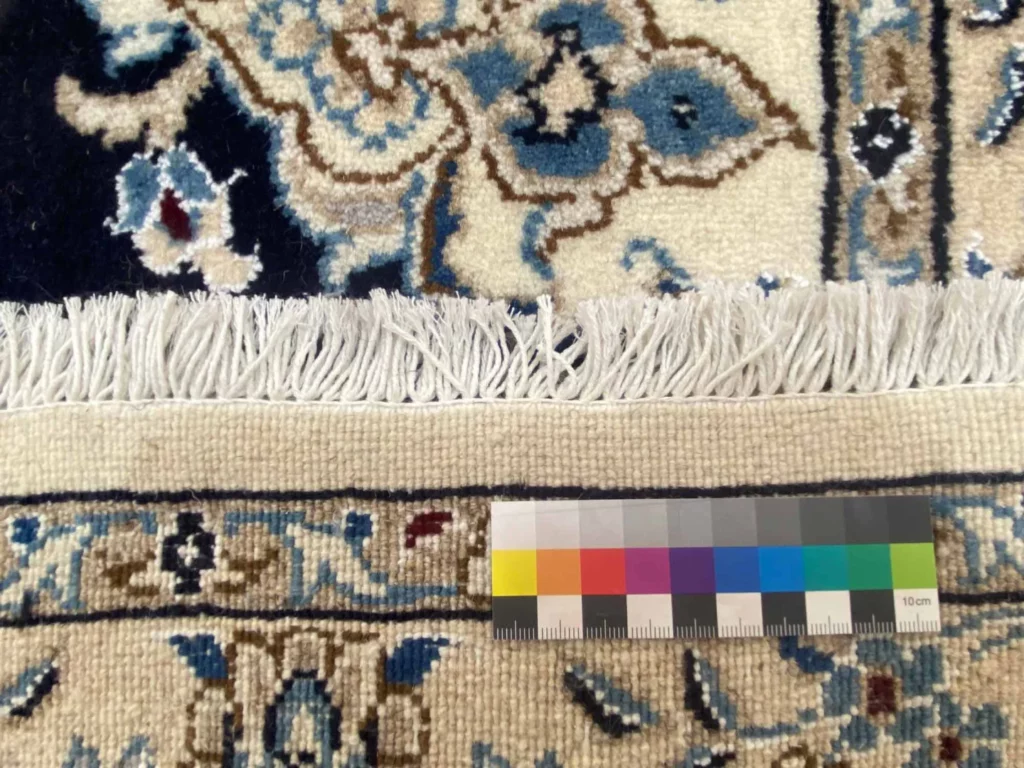
The knot density of this rug is specified as 12-Lah. In Nain rug terminology, Lah is a quality and density classification connected with the number of knots. The term provides a way to place the fineness of a Nain rug within the range of regional workmanship. Here, the pile itself is wool, giving the rug a natural textile surface suitable for the role of a floor covering.
Wool has long been used in rug making because its fibres are resilient and can hold colour effectively. It can be worked into different pile structures and allows outlines and floral details to remain legible. In a hand-knotted rug, the material is part of the relationship between surface, pattern and everyday use. Wool also gives a pile a tactile character distinct from a flat-woven textile.
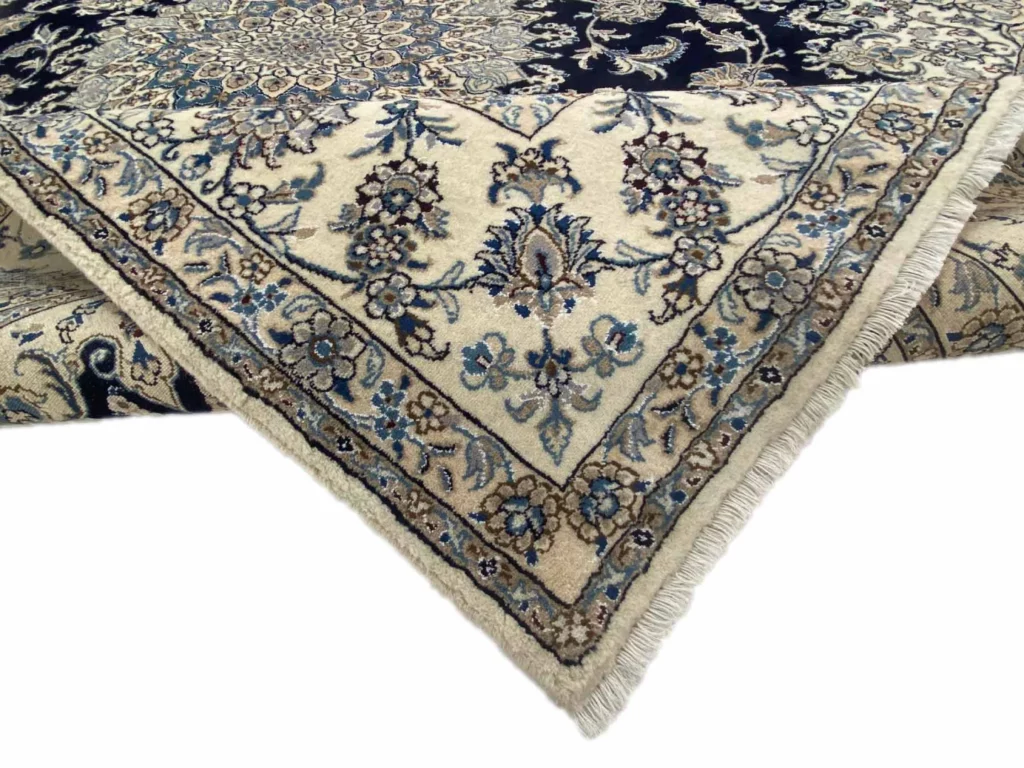
This particular rug is very well preserved. That condition is a fact about the individual piece and belongs alongside its material and method of construction. A hand-knotted rug is formed over many rows, then its pile is finished so that the composition can be read clearly. The character of the finished object depends on the interaction of knotting, wool, colour, pattern and preservation.
Origin and Tradition
Nain is a city in central Iran and one of the recognised centres of Persian rug production. It lies in an arid region shaped by long-standing routes between important cultural areas. Rugs from Nain are associated with light colour fields, carefully organised ornament and finely articulated floral drawing. The name Nain therefore identifies more than a decorative look: it refers to a regional weaving tradition and to the city connected with its production.
Nain’s rug industry grew within an established Persian textile culture. Workshops in the area became known for making finely designed rugs in which the composition is carefully controlled. Compared with strongly geometric tribal rugs, many Nain designs favour balanced layouts, plant forms and a measured relationship between field and border. The ornaments are repeated and adapted so that they form a coherent whole rather than a collection of unrelated details.
Persian rugs are traditionally knotted on looms. Knots are placed around the warp and secured with weft rows as the work advances. In this way, the pattern is created directly through the arrangement of coloured knots. After the knotting is completed, the pile is trimmed and finished so that the design becomes visible and the surface can be used. The process requires consistent tension, attention to the drawing and an understanding of the structure being built row by row.
In Nain rugs, fine pattern organisation is closely associated with the regional identity. Workshops often use pale grounds and restrained contrasts to support a light, finely divided appearance. The effect does not depend on density alone. It also comes from the precision of the composition: borders contain the central field, scrolling forms connect blossoms and leaves, and the central element establishes a point of balance. Material, colour, technique and ornament work together to express the Nain tradition.
Nain belongs to a wider Persian rug culture that includes other well-known centres. Isfahan is associated with complex compositions and the use of wool and silk. Kashan is often recognised for traditional Persian patterns and lively colour arrangements. Regional vocabularies overlap, so floral motifs, medallions and border structures may appear in more than one place. Even so, a Nain rug is identified through its stated origin and through the particular balance of light colouring and detailed ornament associated with Nain.
The term Persian rug is appropriate here because Nain is an Iranian place of origin. Oriental rug is a broader category that can include rugs from many countries and weaving regions. In rug terminology, Iranian place names often provide both geographical information and a useful indication of design tradition. Nain workshops continue to use inherited methods while producing compositions for different settings and purposes. The tradition is therefore historical, but it is also a continuing form of textile production.
Hand-knotting preserves a direct link between the maker’s work and the finished drawing. Small variations in the way individual knots are placed are part of the nature of a handmade rug. At the same time, the repeated structure makes it possible to create highly ordered designs. This balance between manual work and formal planning is central to the history of Persian carpets, including the Nain tradition represented by this rug.
Design and Pattern
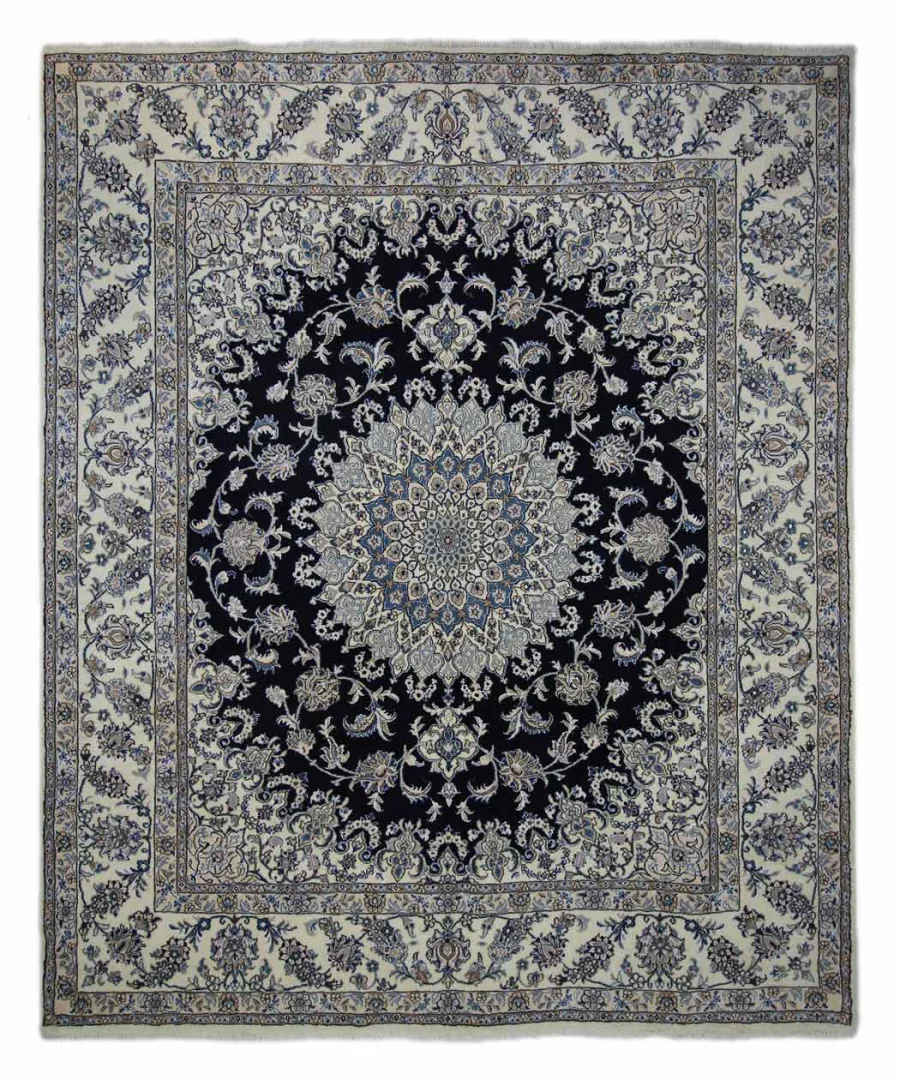
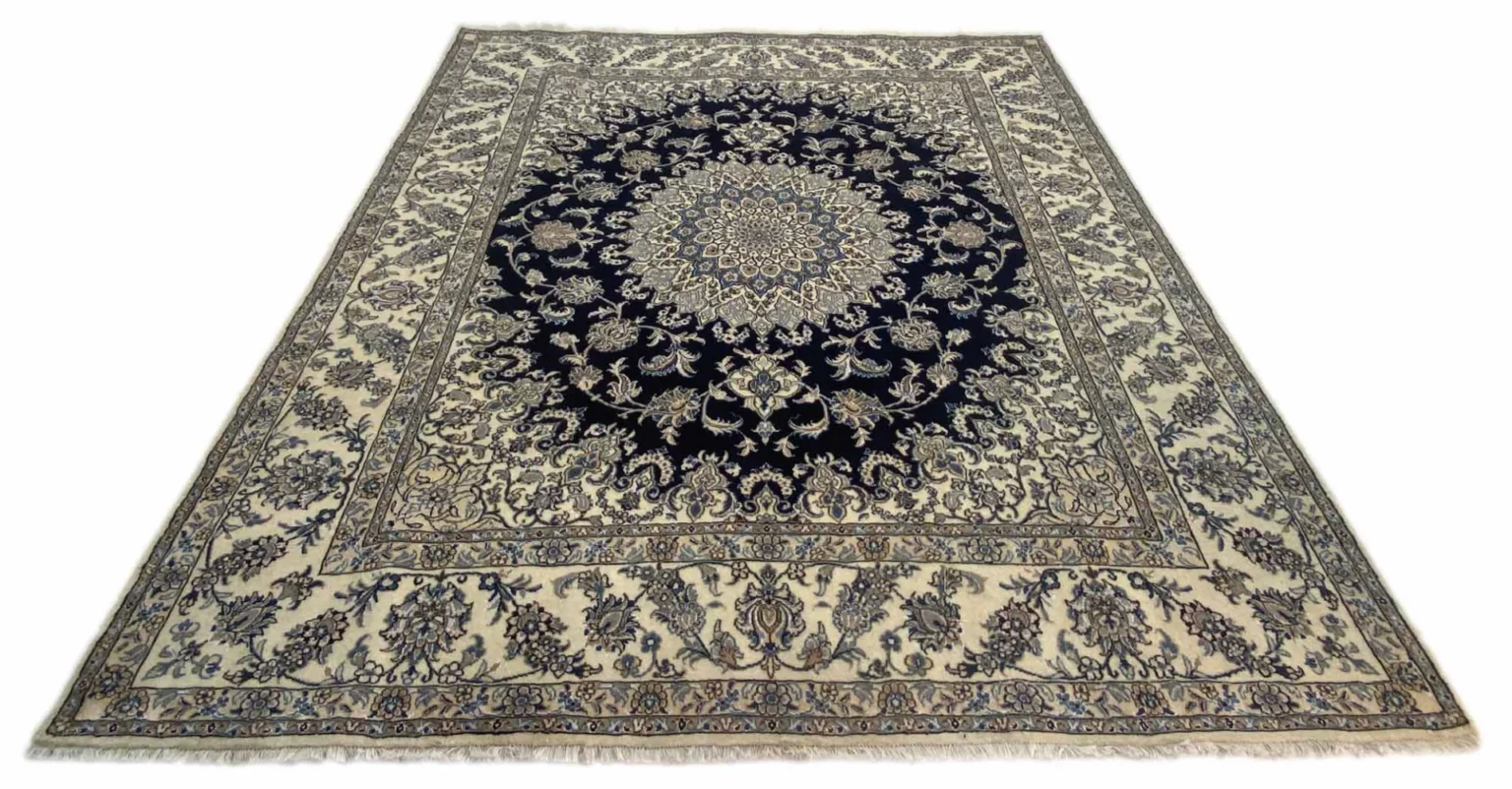
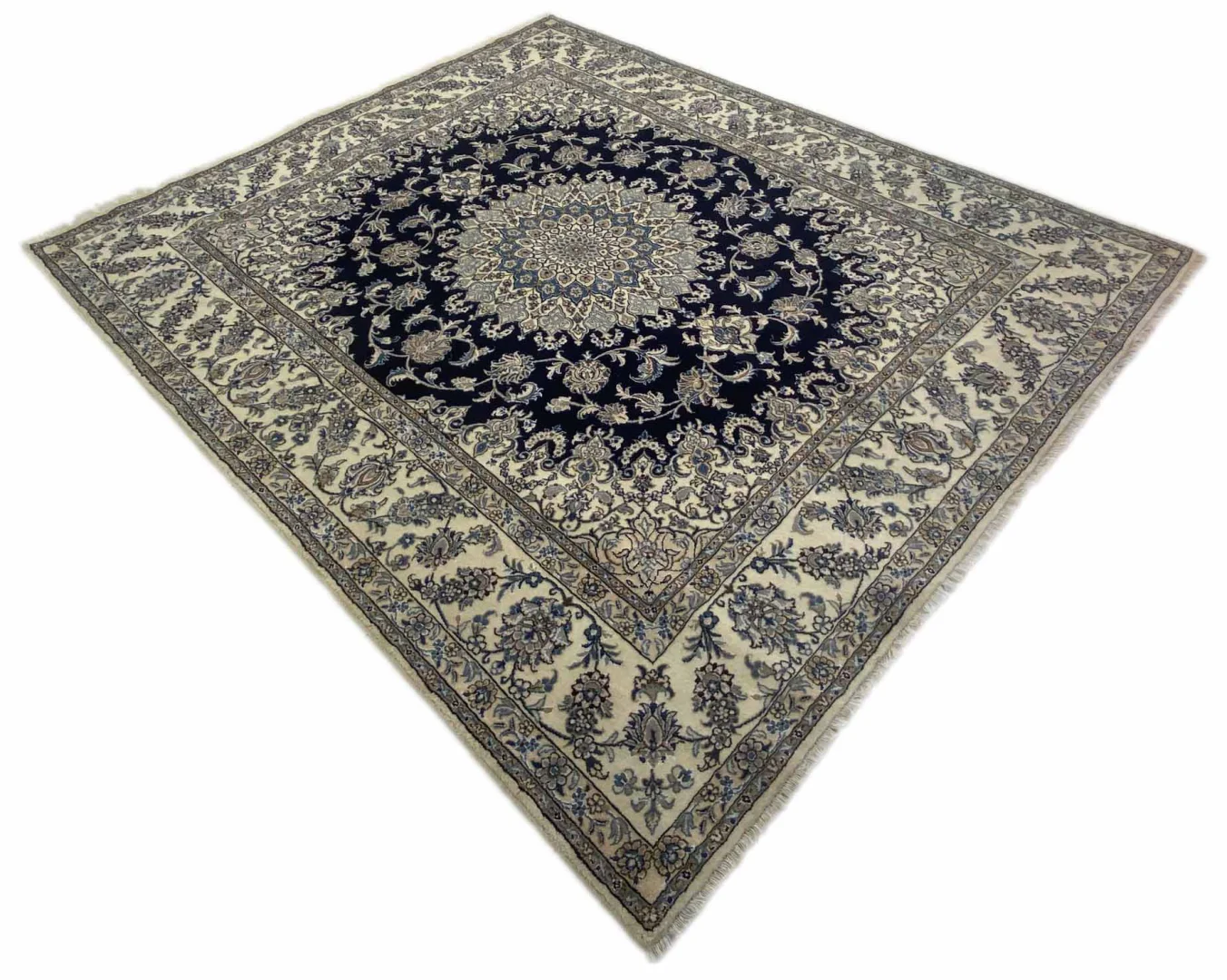
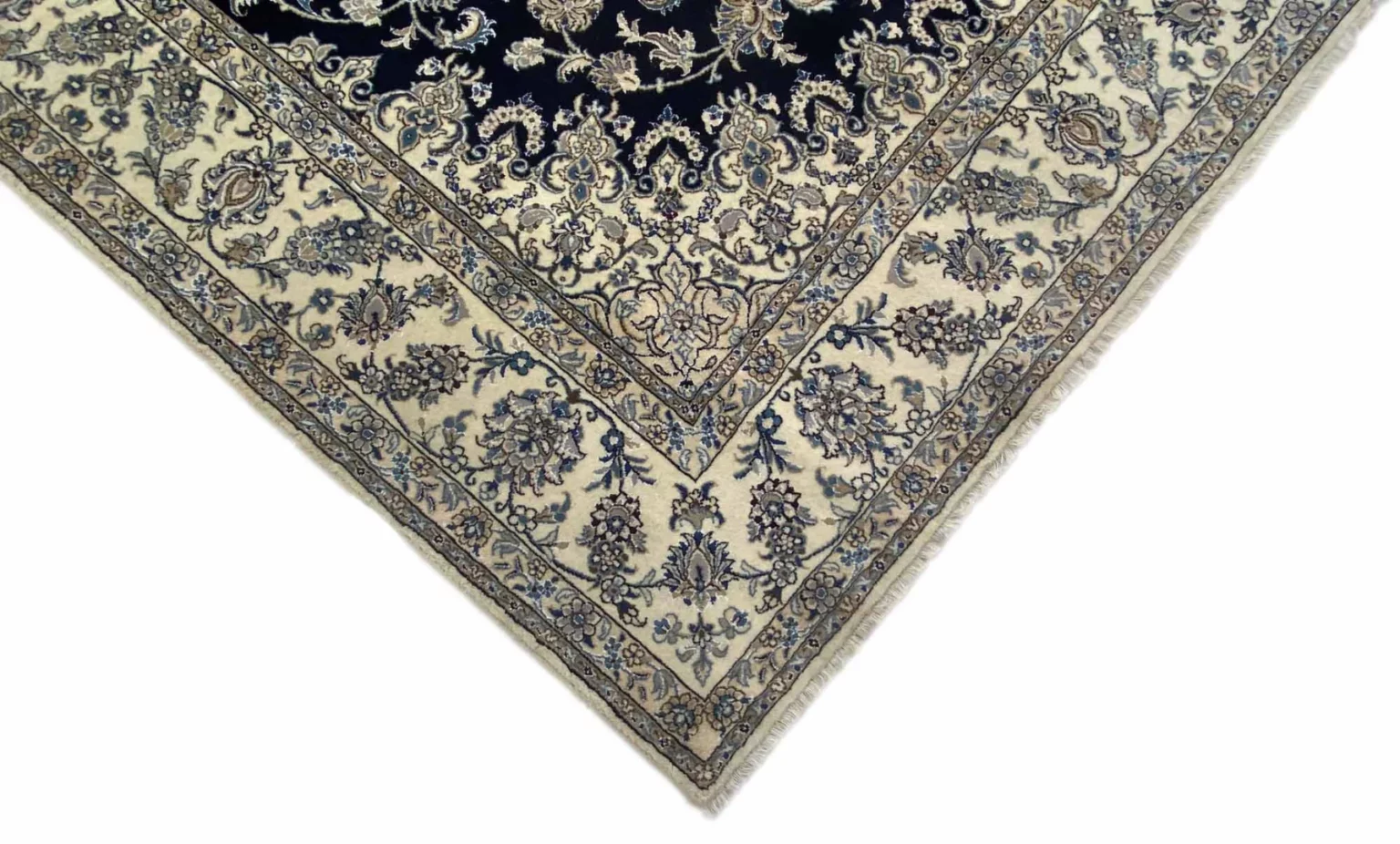
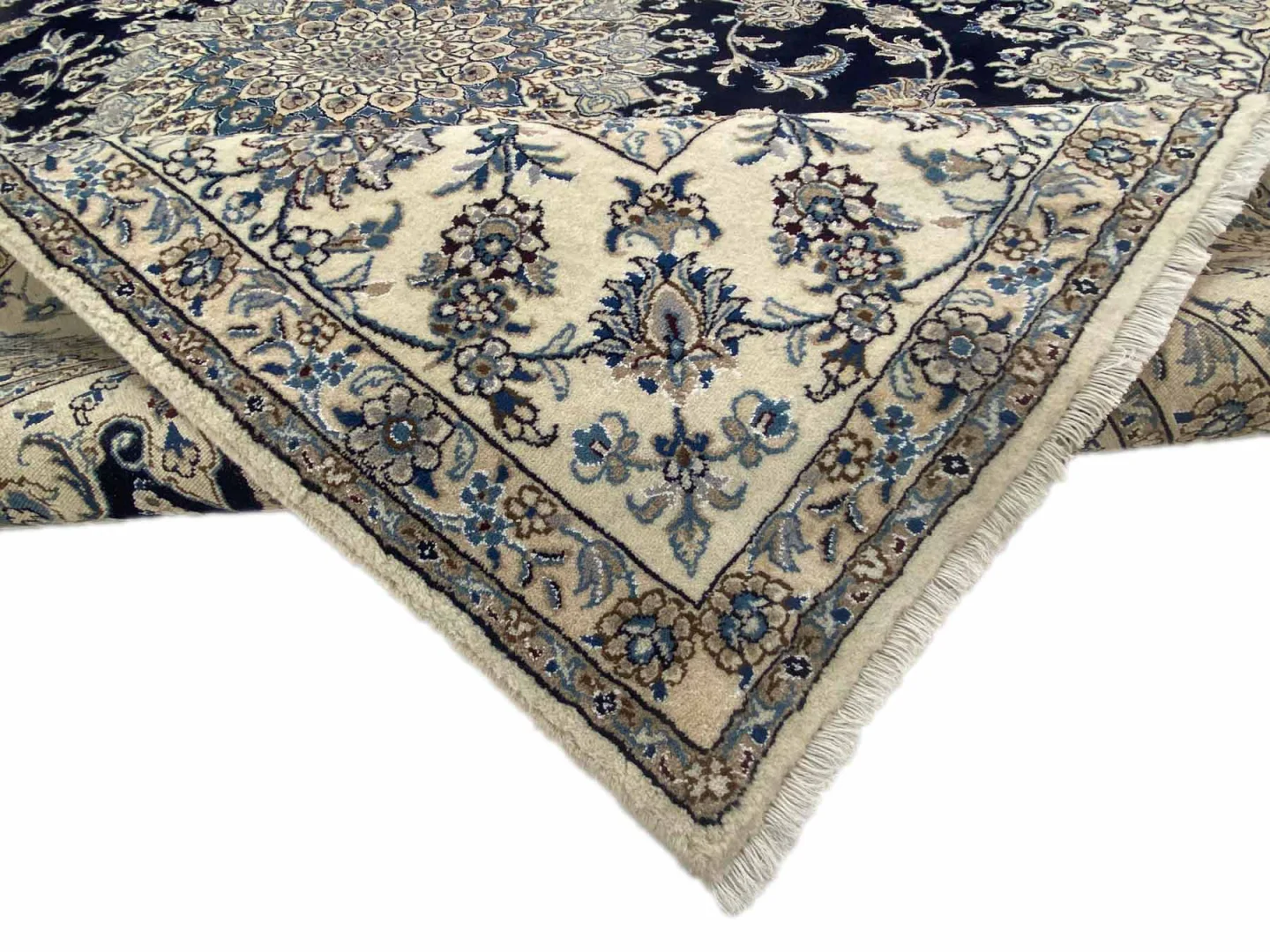
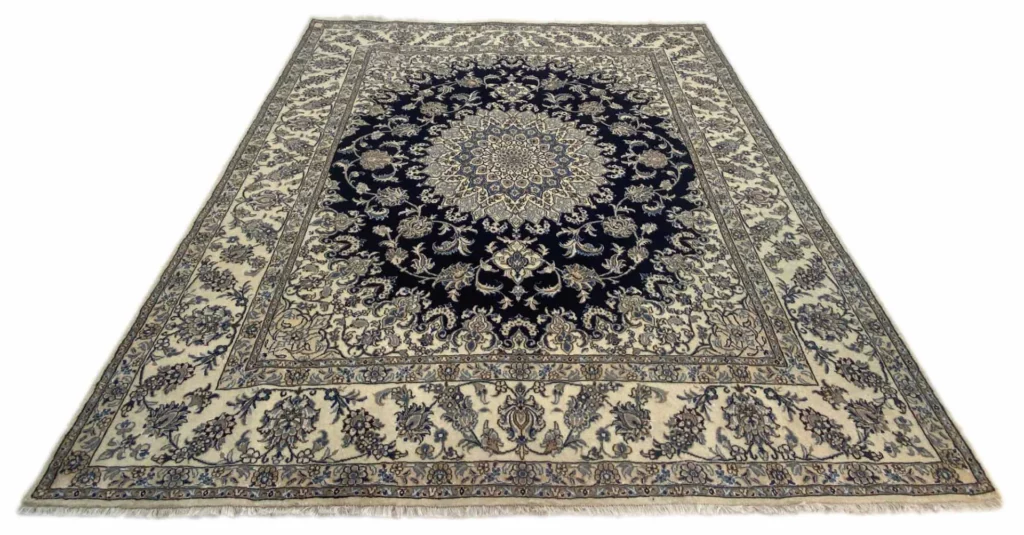
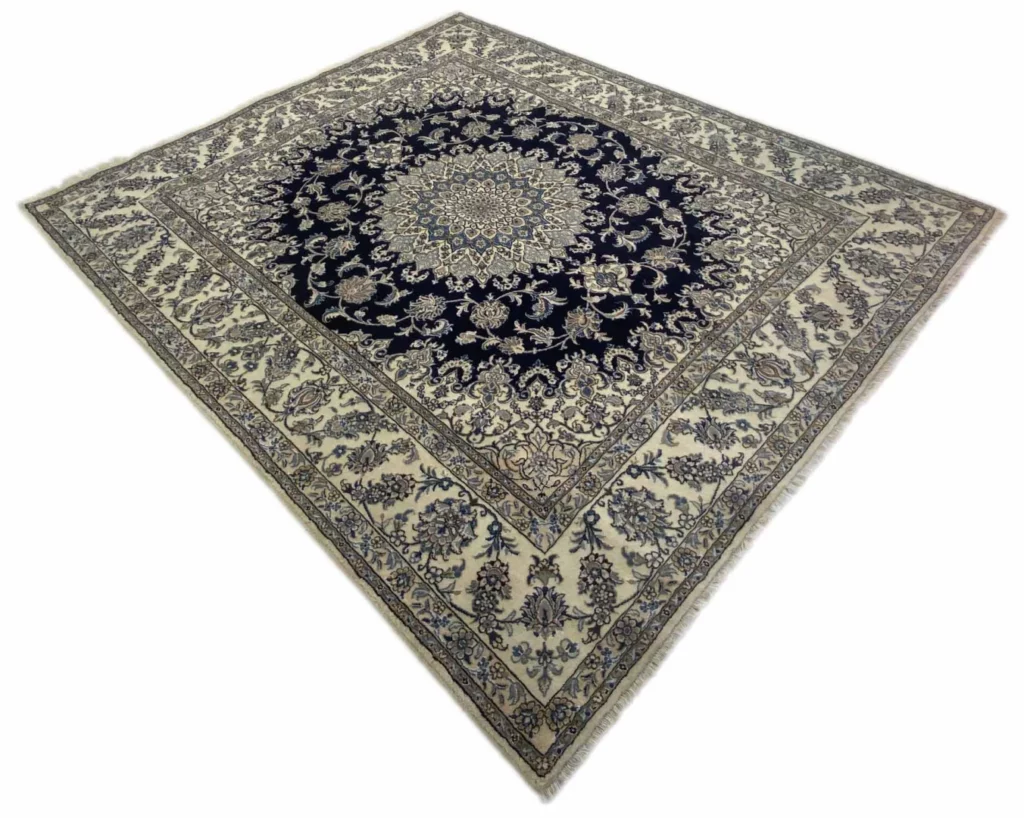
The pattern of this rug is described as a classic floral design with a medallion. A medallion acts as the visual centre of this type of composition. It may be rounded, oval, stepped or more elaborately outlined, depending on the design. Floral elements are arranged around it to create a connected field. The description establishes the central organisation and floral character of this individual rug without assigning names to particular flowers.
Floral Persian ornament uses stylised plant forms rather than botanical illustration. Vines, leaves, blossoms and small infill motifs are arranged as decorative signs. Repetition creates rhythm, while the movement of the lines connects separate parts of the field. In a Nain composition, slender scrolling forms can lead the eye around the central element, and smaller ornaments can occupy the spaces between larger motifs without disturbing the overall order.
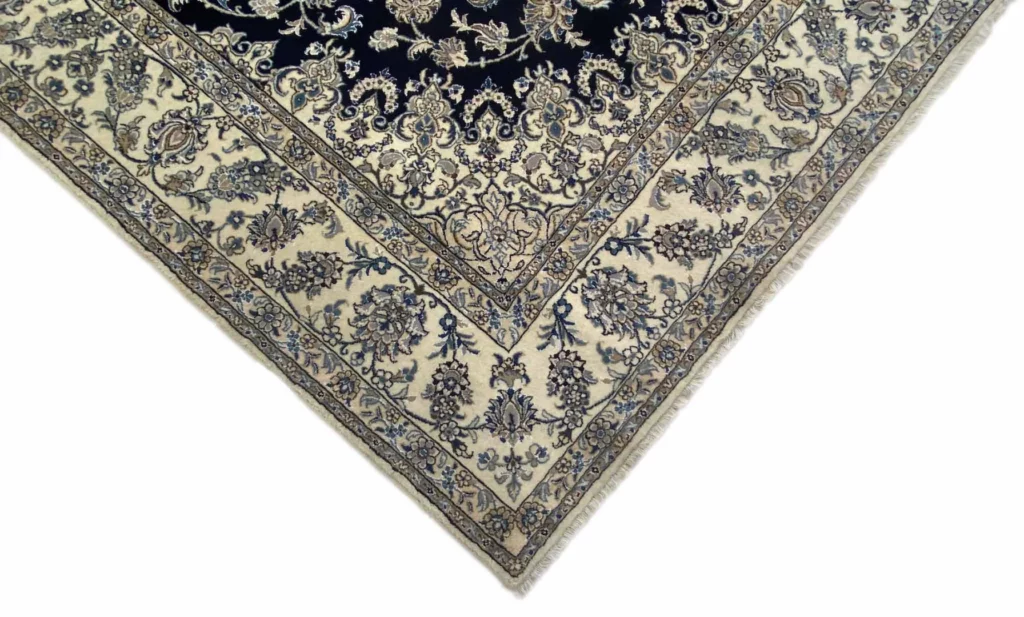
Borders are an important part of many Persian rug designs. They separate the main field from the edges and establish a frame for the composition. A broad main border may be accompanied by narrower guard borders. These bands can contain recurring vines, flowers or more structured ornaments. Their role is not merely to finish the outer edge. They also regulate the proportions of the rug and create a transition between the central design and the surrounding space.
A medallion layout is often arranged around a central axis. Forms may mirror one another or approach symmetry along the length and width of the field. This order is a common principle in classical Persian design because it makes a large textile easier to read as a unified composition. The floral vocabulary introduces movement into the structure: vines may extend outward, while leaves and blossoms fill the spaces that remain between the main lines.
Nain rugs are frequently associated with light colours and detailed drawings. A pale ground can give the pattern an open appearance, while darker outlines or measured contrasts define the forms. The impression depends on the relationship between ground, medallion, borders and secondary motifs. When these elements are proportioned carefully, the central design remains distinct and the borders support rather than compete with it.
Floral ornament has a long history in Persian carpet art. Its sources include garden imagery, manuscript decoration, architecture and earlier textile patterns. On a rug, these references are converted into a surface composition that must work across a broad field. A garden design may divide the area into compartments, whereas a medallion design develops from a dominant centre. The rug described here follows the medallion principle and combines it with the established language of flowers, leaves and scrolling forms.
The pattern can be read in two ways depending on distance. Close viewing reveals small infill details, outlines and the rhythm of individual motifs. From farther away, these details merge into larger colour areas and a clear central structure. This layered reading is characteristic of finely organised rug designs. It explains why both the precision of small details and the balance of the complete field matter in the Nain tradition.
Special Features
The notable features of this piece are its Nain origin, hand-knotted construction, high-quality wool pile and classic floral design with a medallion. Its stated 12-Lah classification places it within the quality terminology used for Nain rugs. The rug is very well preserved. These characteristics belong together: origin, technique, material, pattern and condition jointly describe the identity of a one-off hand-knotted rug.
Nain rugs are often recognised through their light colour effect and carefully drawn floral compositions. This example is defined by a central ornament accompanied by floral patterning rather than by a purely geometric layout. Wool provides the pile with a durable textile basis, while the handwork carries the regional design tradition into the finished surface. It can therefore be understood as a Persian rug from Nain with a classical ornamental arrangement.
FAQ
How can the quality of a Nain Persian rug be assessed?
Knot density is an important point of reference and is expressed in Lah for Nain rugs. It describes the fineness and compactness of the knotted structure. The Lah scale includes finer and less dense classifications; a higher Lah number represents the finer classification within this terminology. Material, evenness of the knotting, clarity of the design and condition also matter. Silk is often associated with particularly fine Nain work, while wool is a traditional and resilient pile fibre.
How should a Nain Persian rug be cared for?
Regular vacuuming helps remove loose dust and dirt from the pile. If something is spilled, dab the area carefully with a damp cloth instead of rubbing it vigorously. Suitable rug-cleaning products should be used for further treatment. Direct sunlight is best avoided because prolonged exposure can alter or fade colours. For heavier soiling, professional cleaning is advisable so that the fibre, pile and hand-knotted structure are treated appropriately.
Where can an authentic Nain Persian rug be purchased?
Authentic Nain Persian rugs are available from specialist rug dealers and established online platforms focusing on hand-knotted rugs from Persia. When choosing one, clear information about origin, construction, material and condition is useful. Certificates or other provenance information can support the identification. The name Nain should be checked as an actual origin reference rather than being treated only as a pattern label, since the origin of each individual rug should be stated separately.
To provide the best experiences, we use technologies like cookies to store and/or access device information. Consenting to these technologies will allow us to process data such as browsing behavior or unique IDs on this site. Not consenting or withdrawing consent, may adversely affect certain features and functions.
Functional Always active
The technical storage or access is strictly necessary for the legitimate purpose of enabling the use of a specific service explicitly requested by the subscriber or user, or for the sole purpose of carrying out the transmission of a communication over an electronic communications network.
Preferences
The technical storage or access is necessary for the legitimate purpose of storing preferences that are not requested by the subscriber or user.
Statistics
The technical storage or access that is used exclusively for statistical purposes.The technical storage or access that is used exclusively for anonymous statistical purposes. Without a subpoena, voluntary compliance on the part of your Internet Service Provider, or additional records from a third party, information stored or retrieved for this purpose alone cannot usually be used to identify you.
Marketing
The technical storage or access is required to create user profiles to send advertising, or to track the user on a website or across several websites for similar marketing purposes.

 SECURE PAYMENT
 SHIPPING PARTNERS