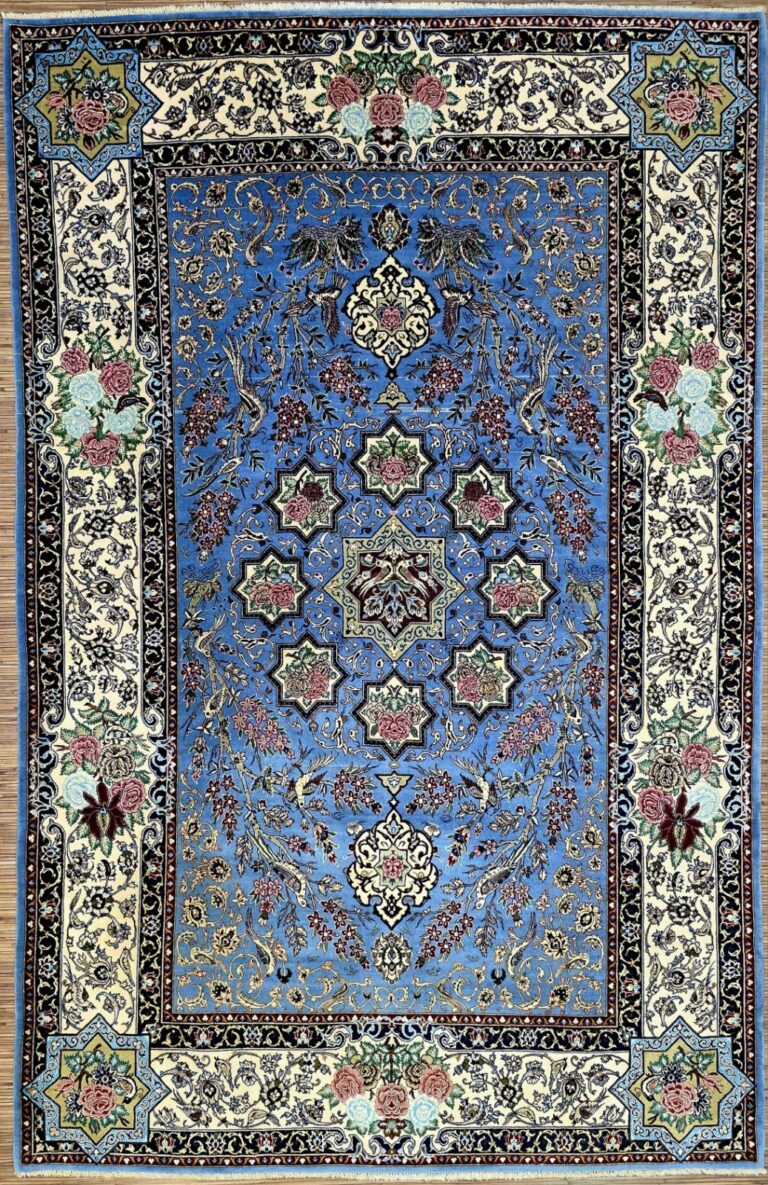
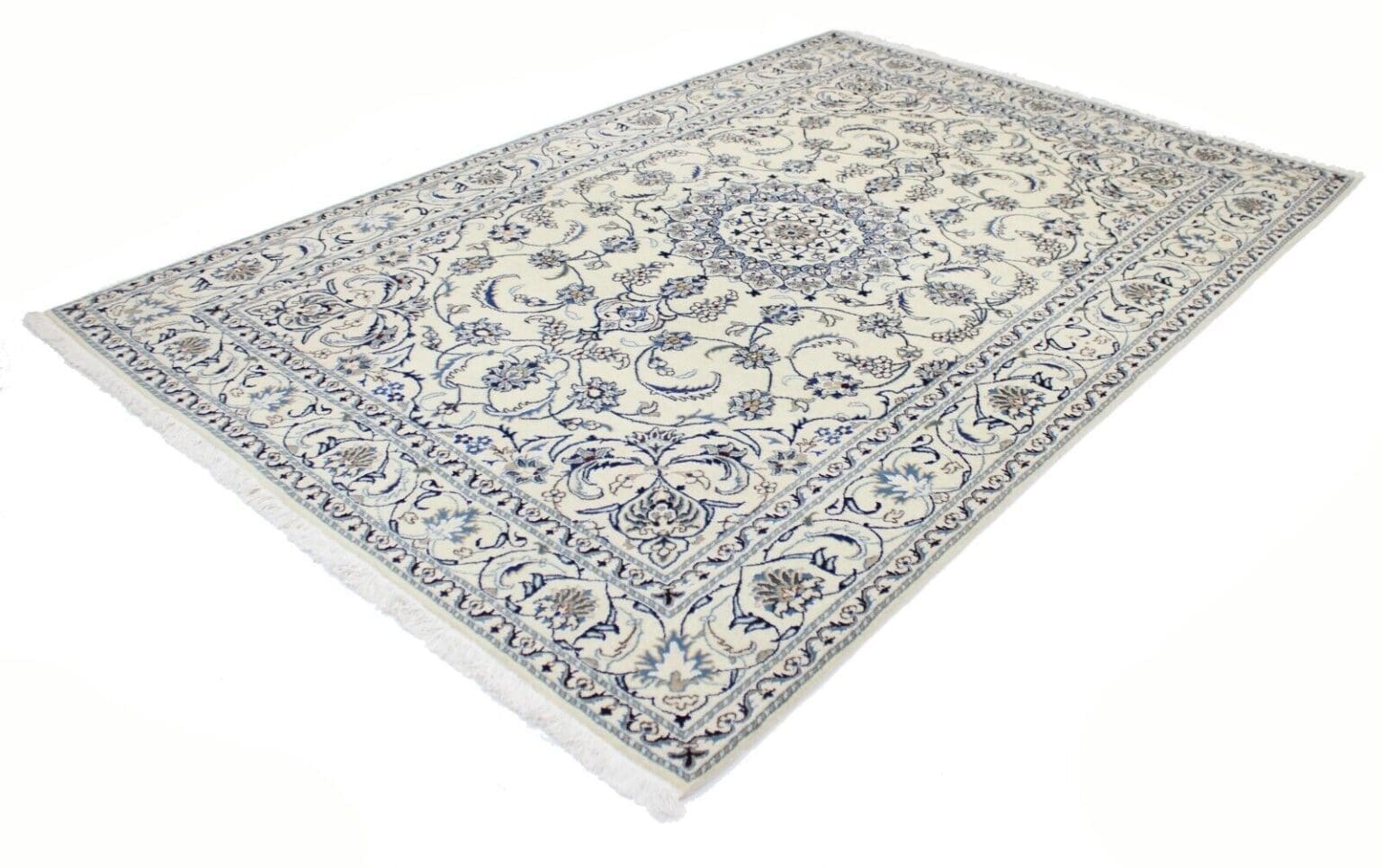
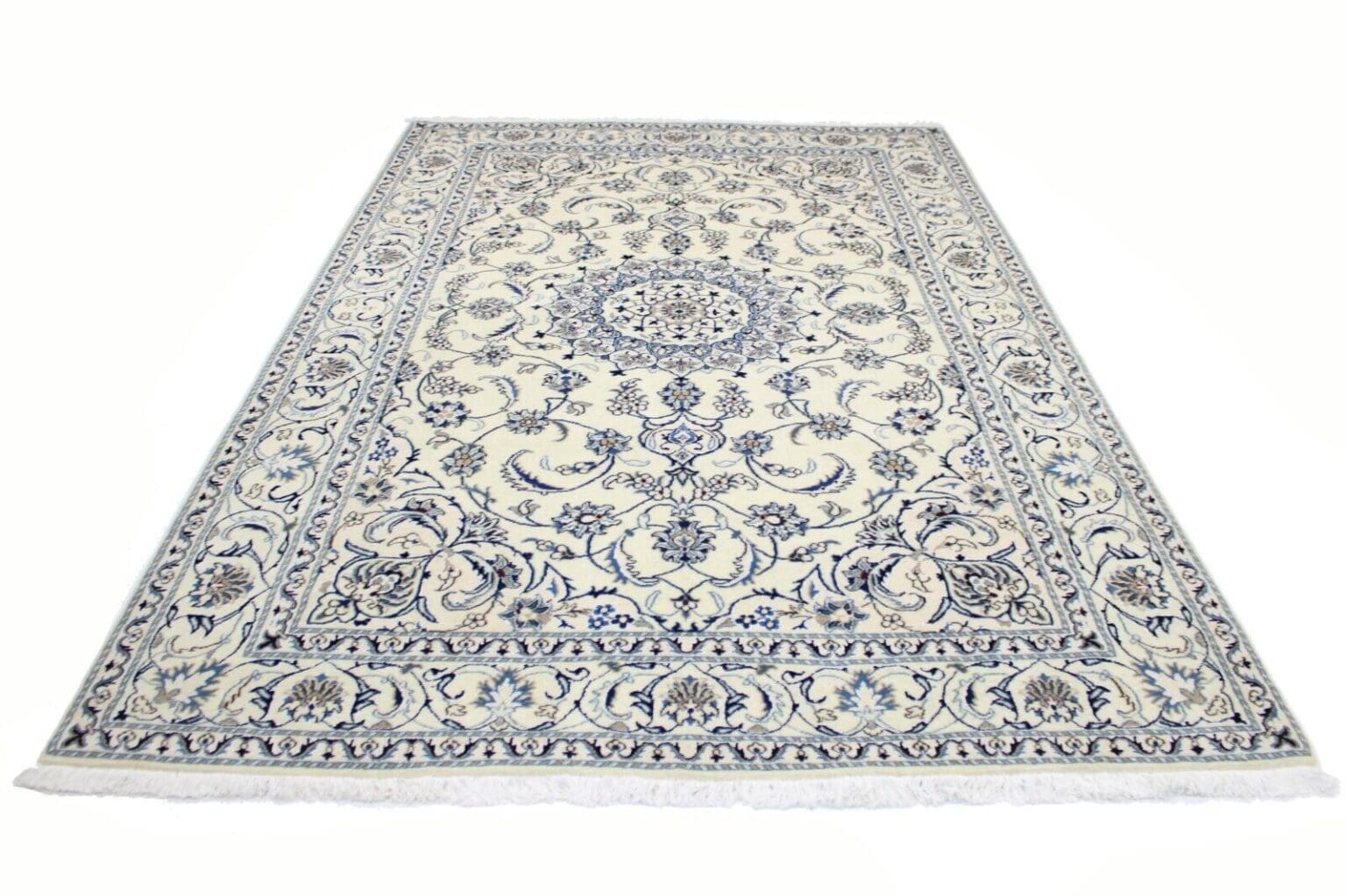
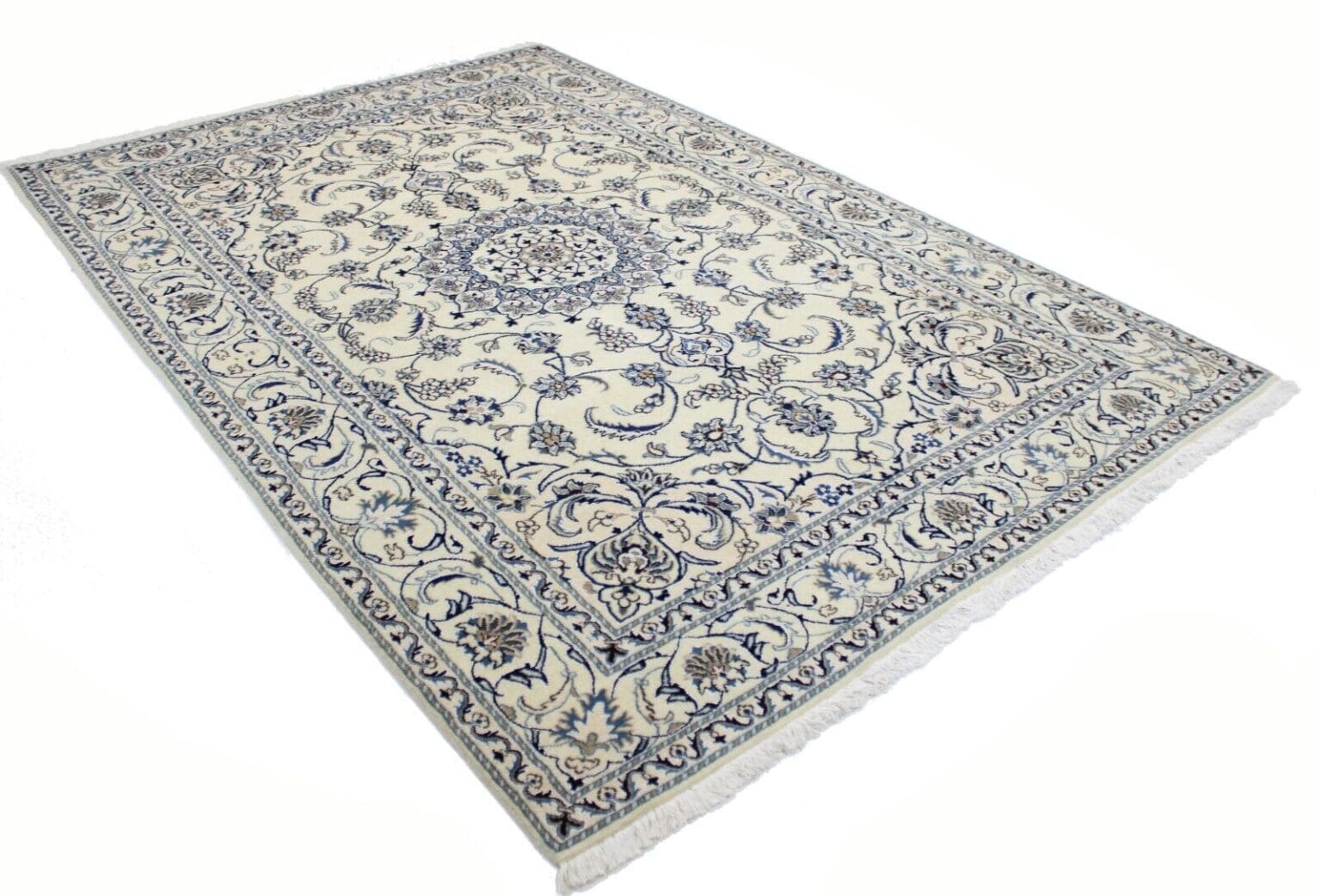
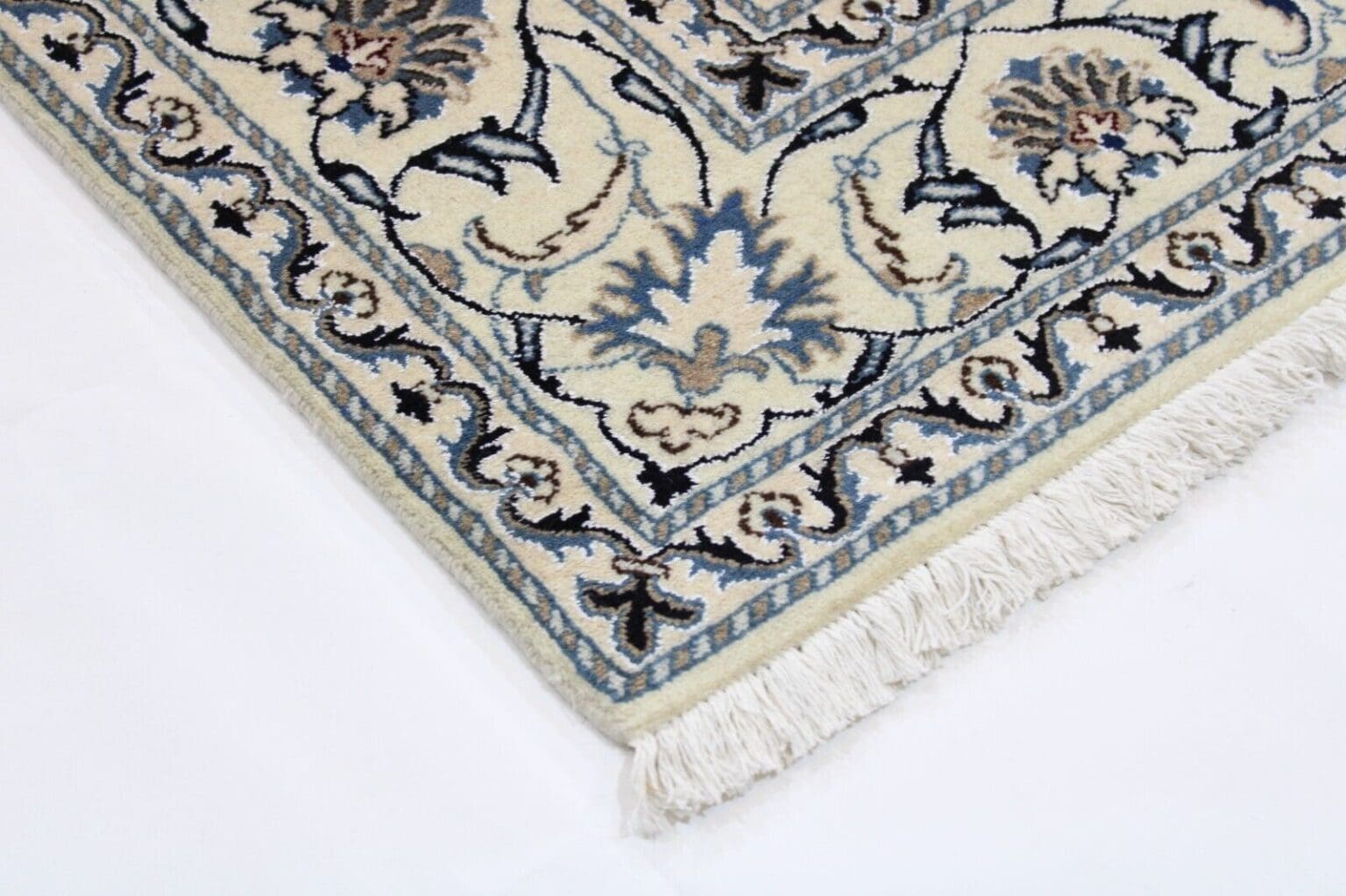
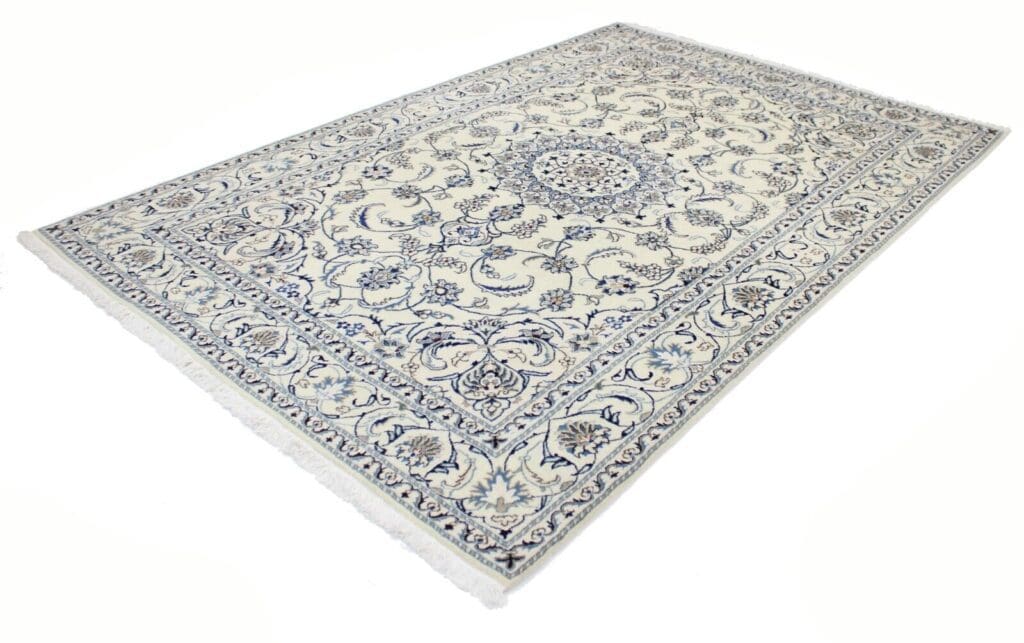
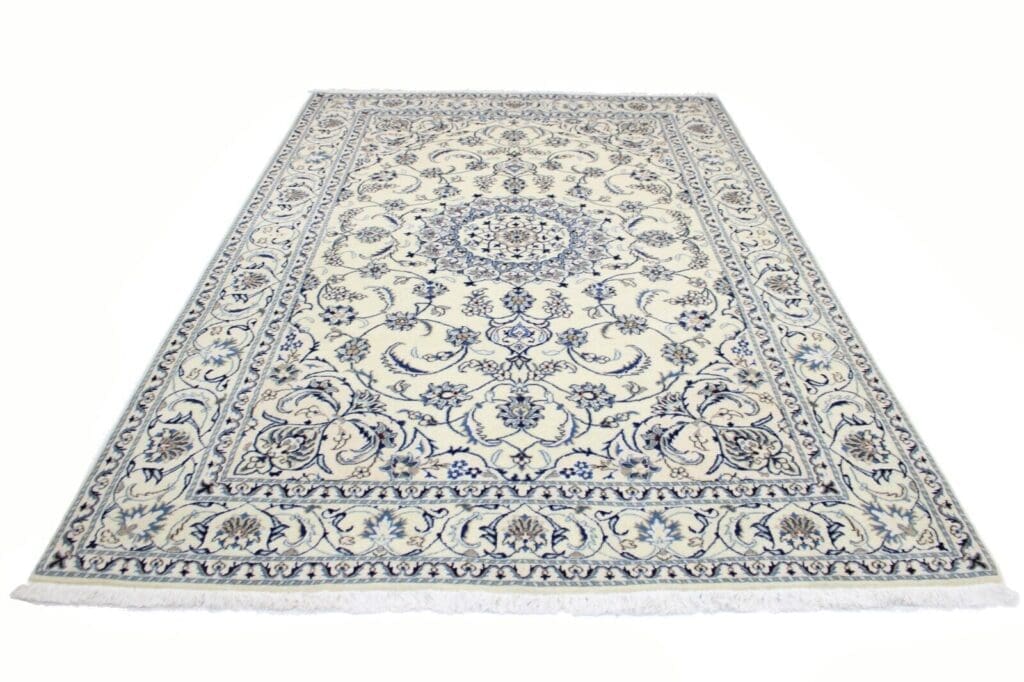
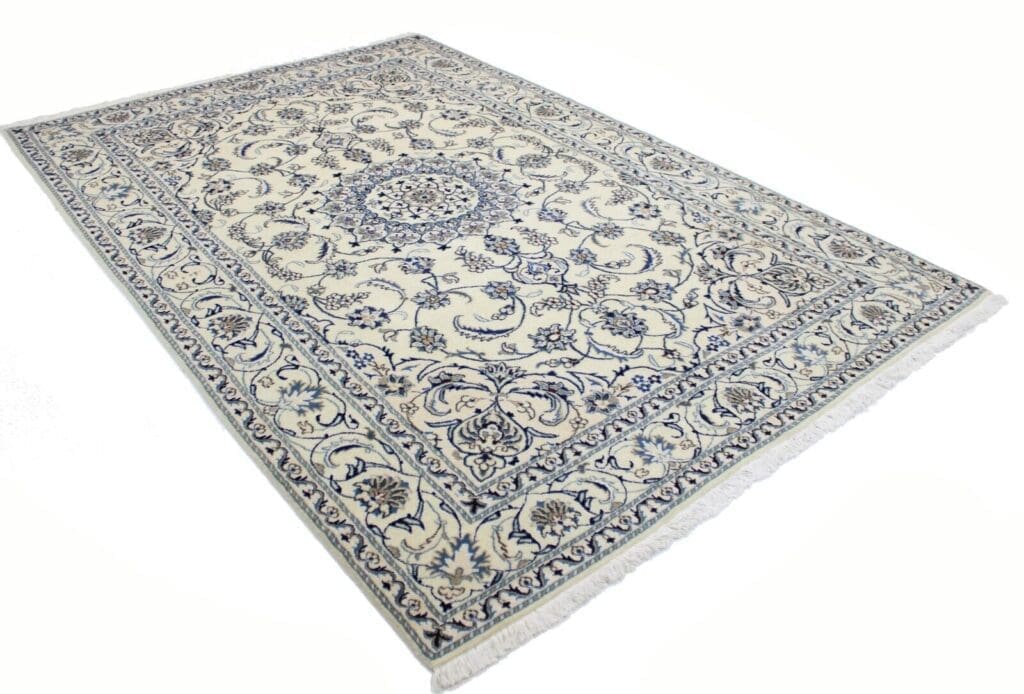
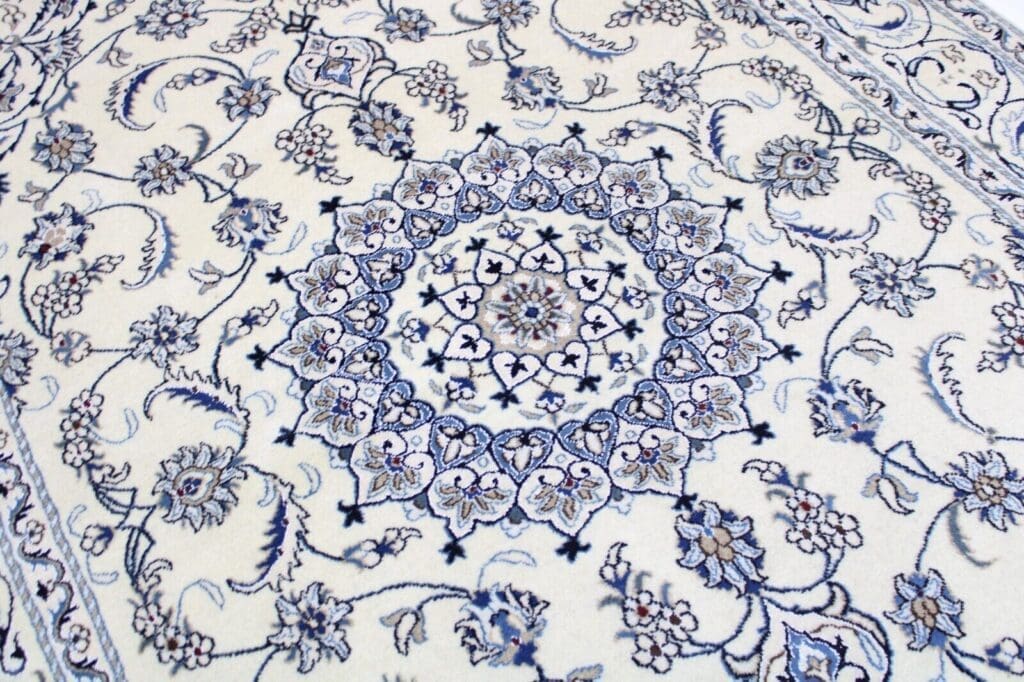
Hand-knotted Nain Persian rug | Knot density: exceptionally high | Material: pile pure new wool | Size: 297 x 198 cm | Pattern: traditional fine floral and geometric design | Condition: new and excellent
This Nain Persian rug is hand-knotted and made from genuine pure new wool. Wool gives a rug a distinct tactile quality and supports its use as a durable floor covering. Its natural fibre structure creates a surface that feels substantial underfoot. In a hand-knotted rug, the pile is built knot by knot rather than applied to a pre-made surface. The design is therefore formed as part of the rug itself, with the individual knots creating the outlines, fields and ornamental details.
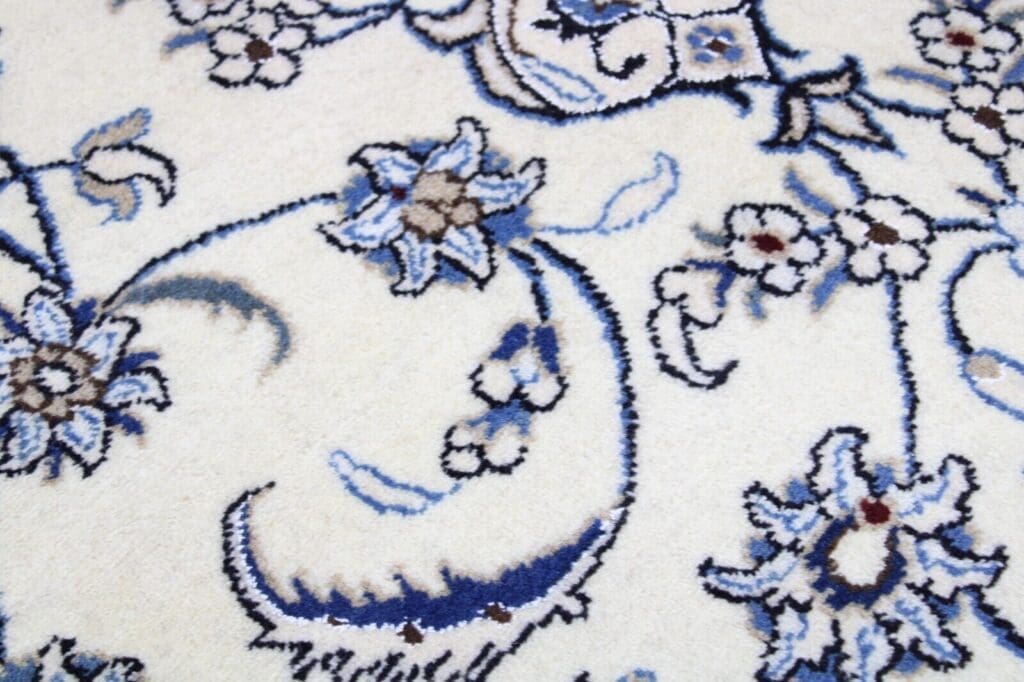
The knot density of this rug is described as exceptionally high. In Persian rugs, a high knot density allows fine lines, floral details and geometric elements to be rendered with greater precision. It also contributes to a closely structured appearance in the pile. Knot density is not the only factor involved in a rug’s workmanship: the regularity of the knots, the skill of the weaver, the handling of the wool and the finishing of the pile all influence the final result. Here, the high density is specifically associated with the fineness and detail of the pattern.
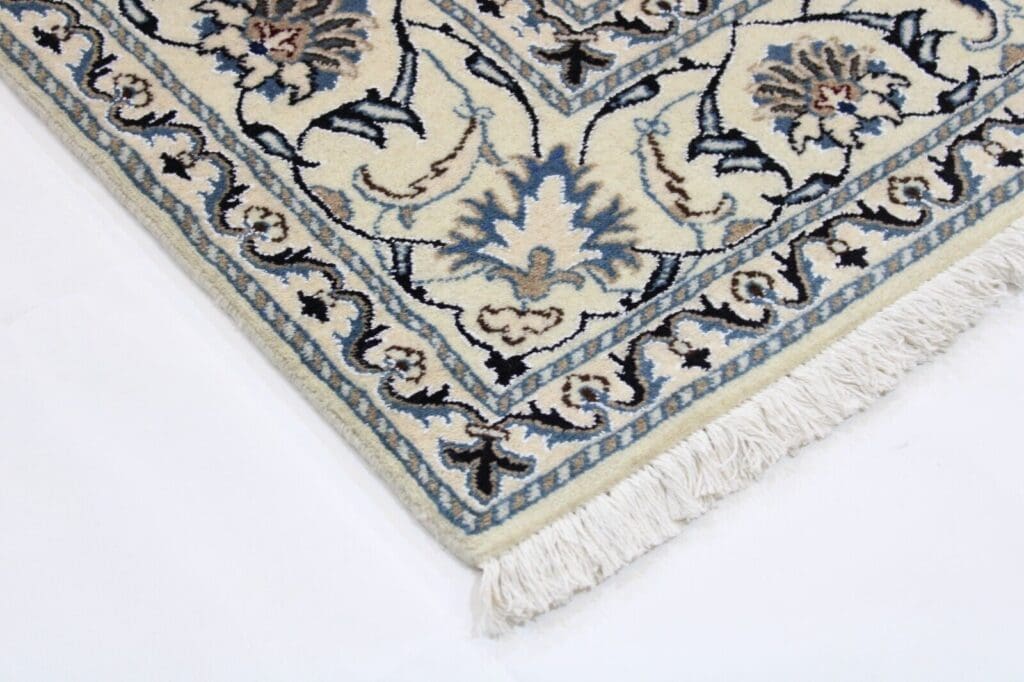
The rug was traditionally washed and professionally inspected. Washing is an established part of rug preparation and can help settle the pile and clarify the overall appearance. Professional inspection provides a further check of the workmanship and condition. The rug is described as a high-pile rug, with the pile made from genuine wool. This gives the surface a clearly perceptible texture while retaining the characteristic construction of a knotted Nain rug.
Hand knotting is a manual process that requires time, concentration and control. The weaver follows a design structure while placing the knots in successive rows. The pile is then trimmed and finished so that the composition can be read clearly. Unlike a machine-made floor covering, a hand-knotted rug is shaped directly through the work of the maker. This process accounts for the individual character of each piece. This particular rug is described as new merchandise and as being in excellent condition.
The combination of pure new wool, hand knotting and exceptionally high knot density places the rug within a technically refined form of Persian rug making. The material, construction and finishing are not separate decorative additions; they work together to determine the feel and appearance of the finished textile. The traditional wash and professional inspection are also part of the preparation specified for this rug.
Origin and Tradition
Nain is a city in Iran, located in Isfahan Province. Isfahan is recognised as one of the important centres of Persian carpet production and artistic craftsmanship. Nain rugs have developed a distinct identity within this wider regional tradition. They are commonly associated with carefully ordered compositions, fine floral drawing and a restrained colour language. Their appearance reflects both the local weaving tradition and the broader design culture of Persian carpets from the Isfahan area.
The making of a Nain rug involves knowledge of several connected crafts. Wool must be prepared for use, the foundation must be set up, knots must be placed consistently, and the pile must be finished so that the drawing remains legible. These skills are not limited to one moment in production. They depend on familiarity with the structure of the rug, the rhythm of the knotting and the way a pattern is built across the field and borders. In traditional weaving communities, such knowledge has often been passed down through generations.
Regional names in Persian rug production refer to more than a visual style. They connect a rug with a place, a body of craft knowledge and an established way of organising motifs. Nain is therefore the origin designation of this rug, while the association with Isfahan places it within a larger cultural and artistic landscape. Nain rugs are often recognised for their delicate floral compositions and soft tonal relationships. These are general characteristics of the Nain tradition and explain the rug’s classification without adding an unsupported individual colour description.
Persian carpet making has a long history of combining practical use with visual design. Rugs were made to cover floors, but their patterns also recorded preferences for symmetry, repetition, proportion and ornament. In Nain weaving, carefully arranged motifs and controlled line work are especially important. A field may be organised around a central structure, while surrounding borders contain and frame the composition. The exact execution remains individual because the rug is made by hand.
The connection with Isfahan is significant in the history of Persian textile arts. Isfahan has long been associated with refined decorative arts and with compositions in which floral ornament is arranged in a disciplined manner. Nain rugs belong to this environment while retaining their own regional character. Their visual language can be delicate without being unstructured, and detailed without losing an overall sense of order. The high knot density described for this rug is consistent with the tradition’s emphasis on precise drawing.
A hand-knotted rug also preserves evidence of its making in a way that a mass-produced textile does not. The placement of the knots, the treatment of the pile and the balance of the pattern reflect a sequence of manual decisions. This does not mean that every rug from one region is identical. Rather, regional tradition provides a shared vocabulary, while the individual weaving gives each rug its own execution. That relationship between inherited design and individual workmanship is central to the identity of Nain rugs.
The Nain tradition is consequently understood through its origin, its fine ornament and its technical discipline. It is part of Iranian carpet culture and is distinguished from rugs whose place names merely describe a motif. In this case, Nain is the named origin of the Persian rug. The connection to Iran, the Isfahan region and the hand-knotted method together provide the relevant cultural context for the piece.
Design and Pattern
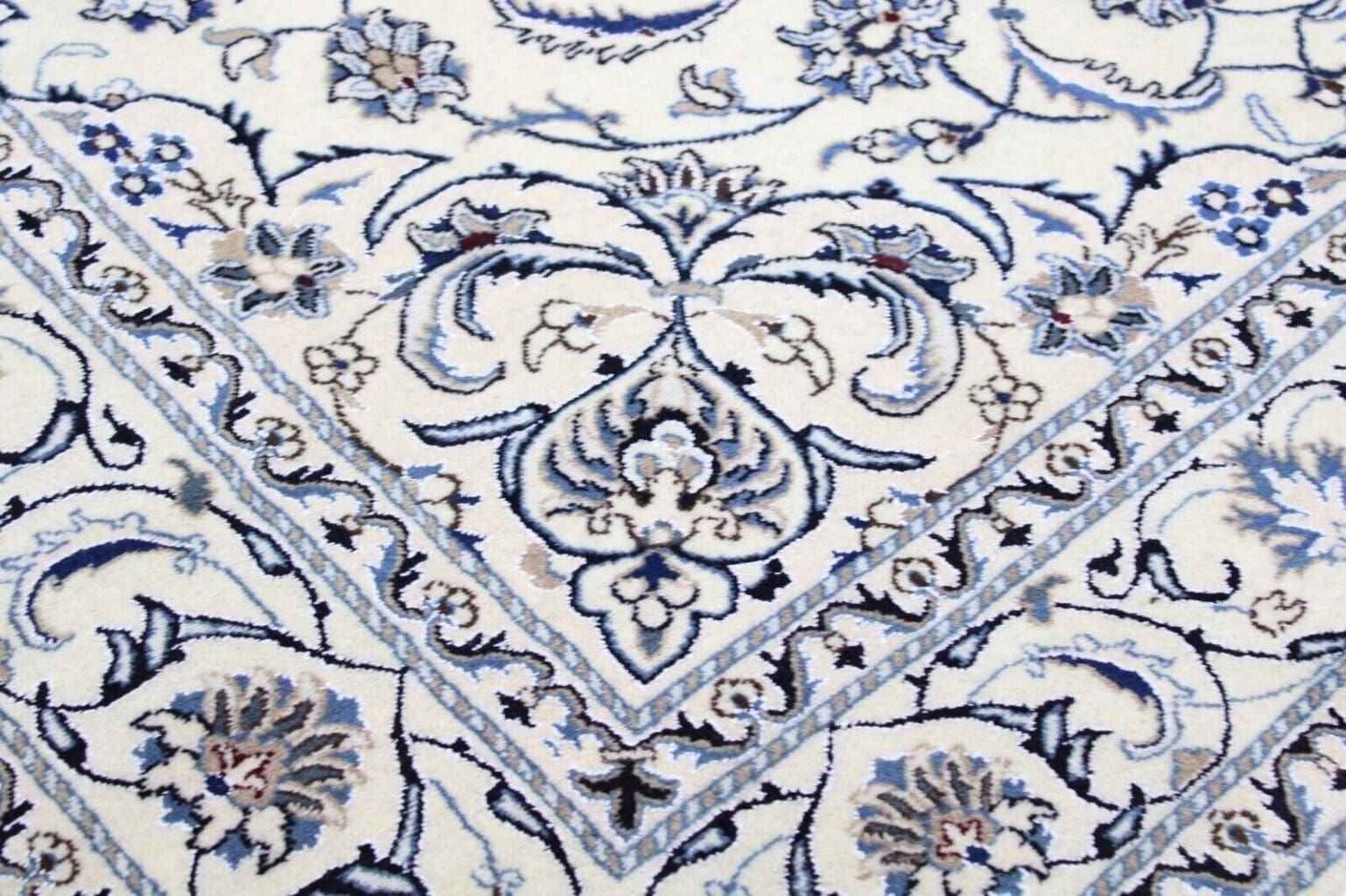
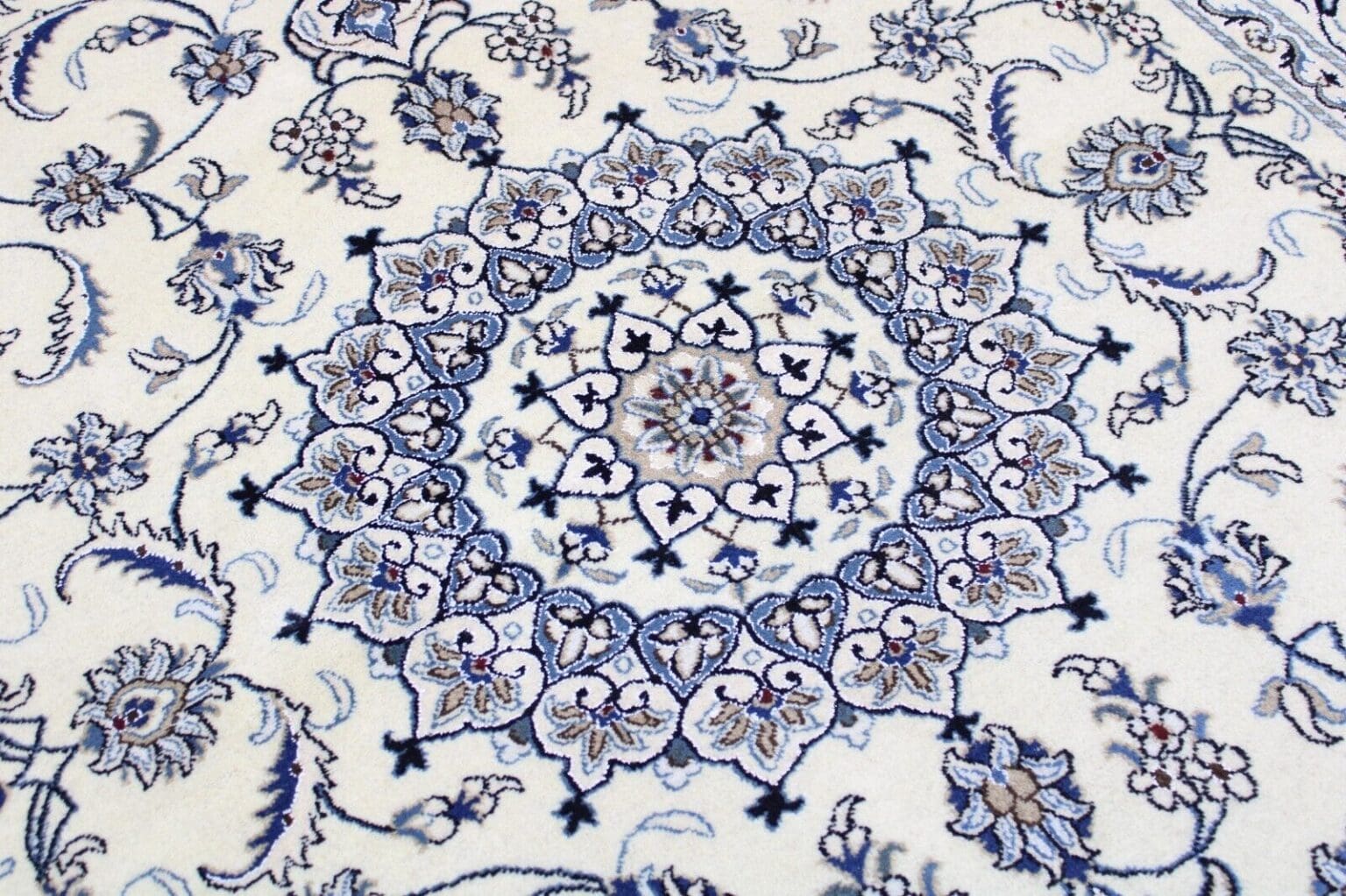
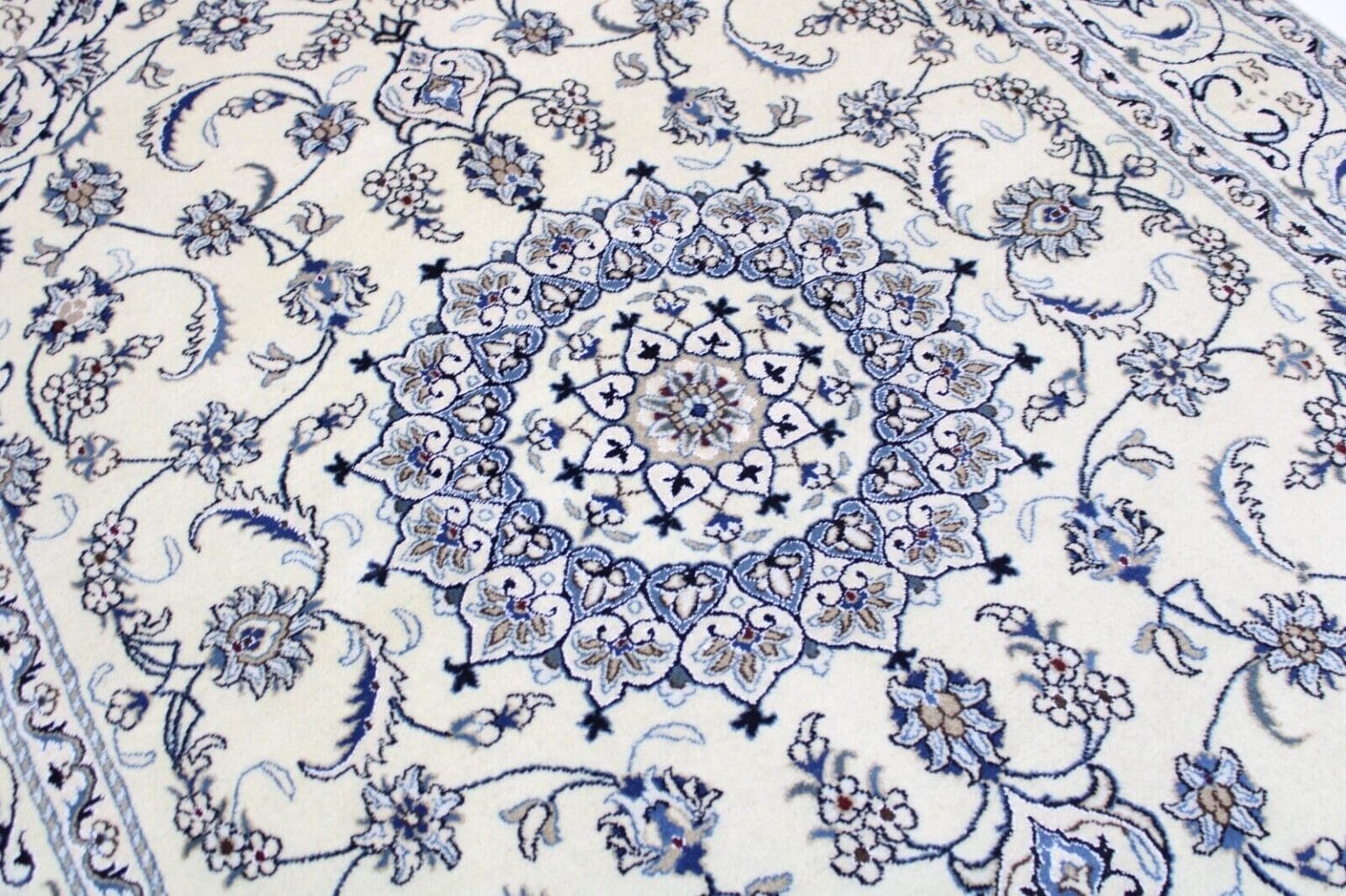
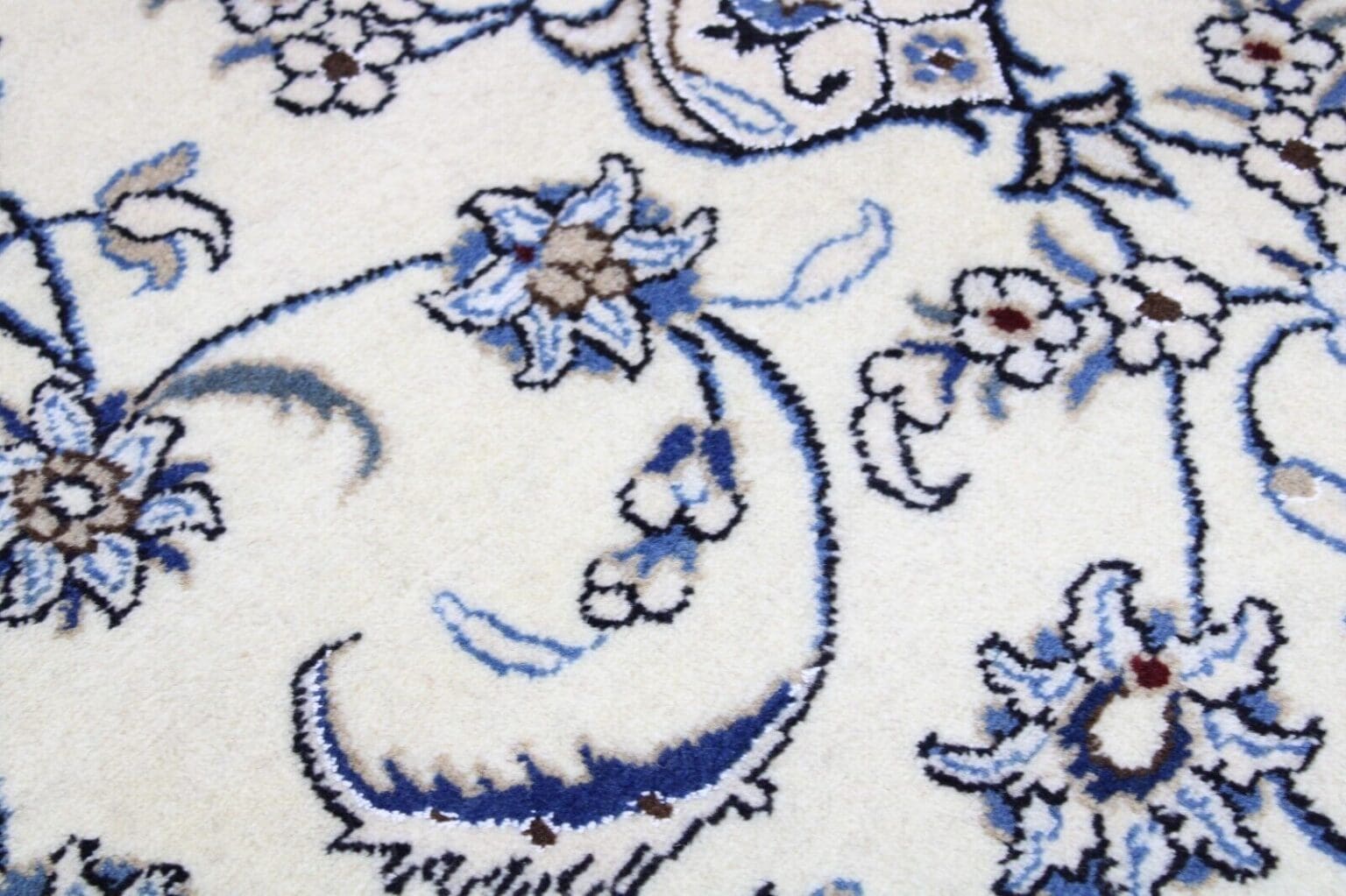
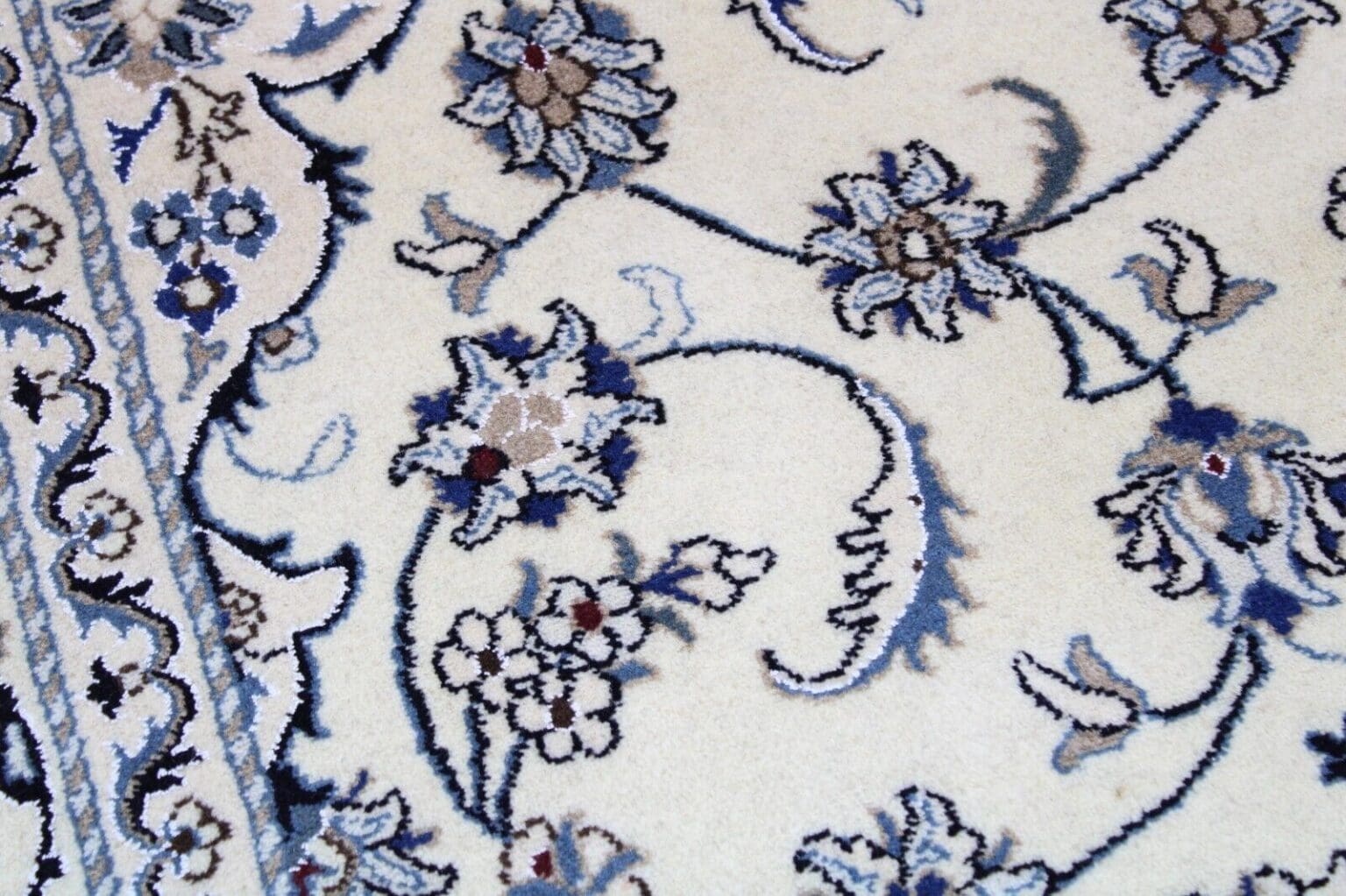
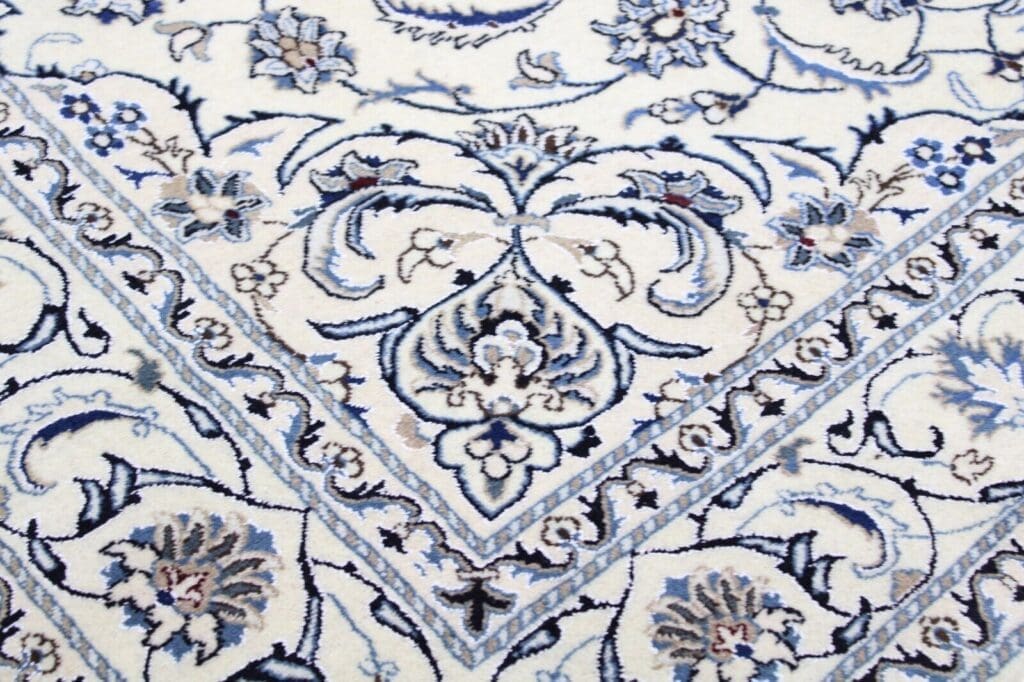
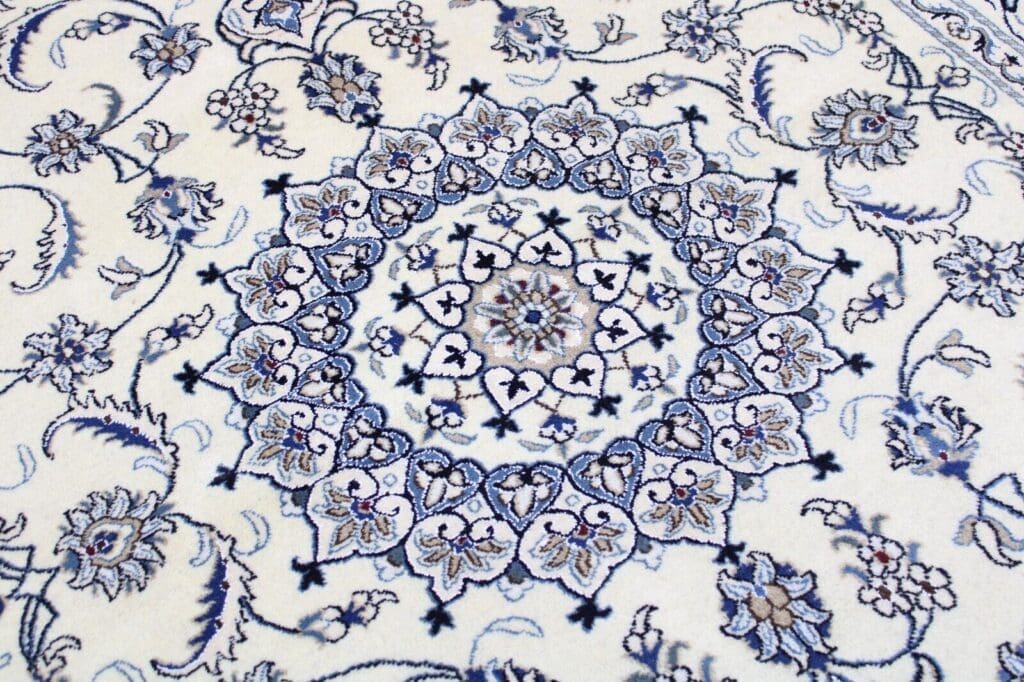
The design of this Nain Persian rug is described as traditional and finely drawn. It combines floral elements with geometric forms. Floral ornament may include flowers, leaves, scrolling vines and delicate connecting lines, while geometric shapes establish structure and repetition. Together these elements create a composition in which organic forms are held within an ordered framework. The description identifies this rug specifically with a traditional, intricate pattern rather than with a modern or purely abstract design.
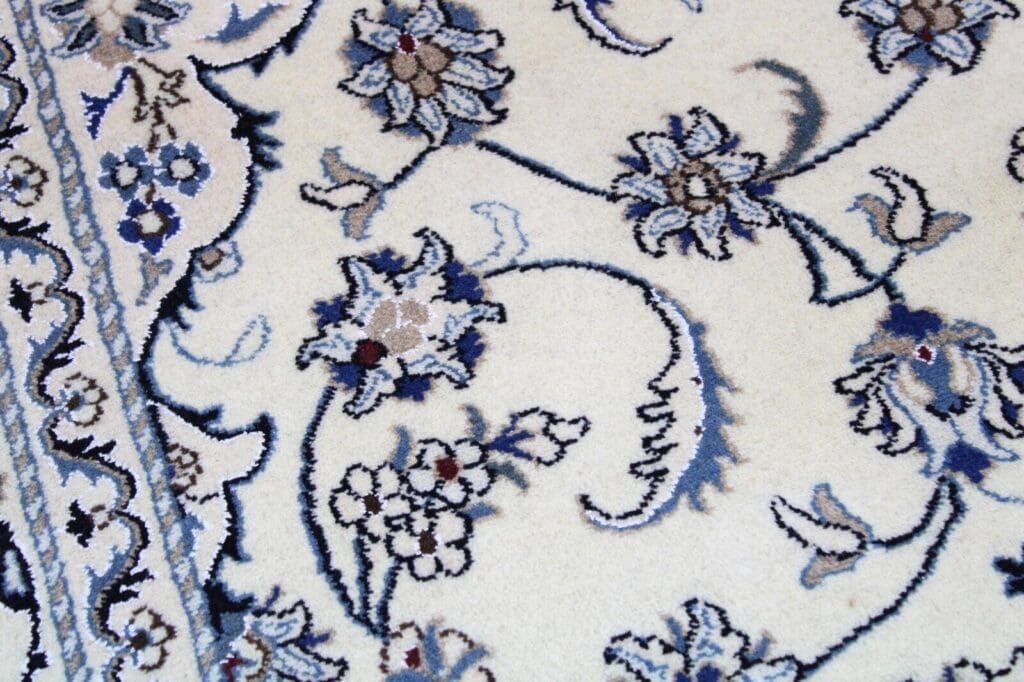
Fine pattern work depends on accurate execution. Small contours, narrow lines and repeated details must be translated into knots with sufficient regularity for the drawing to remain clear. The exceptionally high knot density is connected with the fineness and detail of this pattern. It allows the visual transitions between floral and geometric passages to be articulated more closely. The result is a surface in which the pattern is read through the arrangement of the pile rather than through a later printed image.
The colours are described as harmoniously coordinated. Soft blues, cream tones and earthy nuances are identified as typical colours associated with Nain rugs. Such a palette can create contrast without making the design visually harsh. Lighter areas can separate floral motifs from their surrounding field, while earthier tones can support the borders and structural elements. These colour references describe the traditional Nain palette presented in the source; they do not add a separate claim about an unlisted individual colour plan.
Many traditional Persian compositions are organised through a relationship between a central field and framing borders. Floral elements can extend across the field in a repeated or balanced arrangement, while geometric details help define the edges and transitions. Borders are not simply a frame added after the design; they help establish proportion and contain the visual rhythm. In a hand-knotted rug, this organisation is built gradually as the weaver follows the pattern.
The fine drawing makes the rug adaptable to several rooms. The description names the living room, bedroom and entrance area as possible settings, and also states that the rug is suitable for all rooms. In a living room, a traditional field can provide an ordered textile surface; in a bedroom, the softer tones can support a quieter arrangement; in an entrance area, the detailed border can make the design immediately legible. The pattern remains recognisably Persian in each context.
Nain design demonstrates how botanical imagery and geometry can coexist within one textile. Flowers and vines bring an organic vocabulary, while axes, repeats and measured outlines introduce discipline. Neither aspect has to dominate completely. The visual character comes from their relationship, supported by the precision of the knotting and the close treatment of the pile. This is why Nain patterns are often discussed as both decorative and technically exact.
The rug’s traditional Persian style is therefore expressed through its fine ornament, its combination of floral and geometric forms, and its harmonious tonal approach. These features belong to the design language stated for this piece and to the wider Nain tradition. The hand-knotted construction gives the pattern its physical form, while the wool pile gives the ornament a textured surface rather than a flat printed appearance.
Special Features
This rug is described as new merchandise and as being in excellent condition. It has been traditionally washed and professionally inspected, and it is ready for immediate use. The high-pile construction and genuine wool pile are stated features of the piece. It is also described as suitable for use with underfloor heating. These details relate directly to its preparation, condition, material and intended everyday use.
The offer includes free shipping within Germany and fast delivery within two to three working days. An authenticity certificate can be supplied on request at no additional cost. The rug is presented as suitable for all rooms and as an option for collectors and admirers of Oriental art. These service and usage details complement the rug’s origin as a Nain Persian rug and its hand-knotted construction.
A Nain rug brings together a practical textile function and a tradition of Iranian craftsmanship. In this piece, pure new wool, high pile, hand knotting, exceptionally high knot density and a fine traditional pattern are identified features. The professional inspection and excellent condition are also part of the description. Its cultural character comes from its Iranian Nain origin and from the Persian design tradition represented by the floral and geometric composition.
FAQ
How should I clean and care for my Nain Persian rug?
Regular vacuuming on a low setting is recommended to remove dust and dirt from the pile while treating the surface gently. Spills should be addressed promptly by carefully dabbing the affected area with a damp cloth rather than rubbing it vigorously. Professional cleaning should not be omitted. A specialist can treat the wool and colours appropriately and help preserve the condition of the rug. The high-pile surface benefits from consistent, careful maintenance rather than aggressive cleaning methods.
Are Nain Persian rugs a good investment?
Nain Persian rugs are often regarded as potentially valuable because of their craftsmanship and the use of high-quality materials. Their value may increase over the years, although the development of any individual rug depends on factors such as workmanship, condition, material quality and design. A hand-knotted rug can remain in use for generations. For that reason, it can function both as a furnishing and as a valuable heirloom, in addition to representing a Persian craft tradition.
Where can I buy Nain Persian rugs?
Nain Persian rugs can be found at specialist rug dealers, trade fairs, auction houses and online. Buyers should choose trustworthy sellers who can provide reliable information about origin and authenticity. For this rug, an authenticity certificate is available on request without an additional charge. Checking the stated origin, construction, material and condition helps distinguish an original Nain Persian rug from a textile that merely uses a Nain-inspired motif.
To provide the best experiences, we use technologies like cookies to store and/or access device information. Consenting to these technologies will allow us to process data such as browsing behavior or unique IDs on this site. Not consenting or withdrawing consent, may adversely affect certain features and functions.
Functional Always active
The technical storage or access is strictly necessary for the legitimate purpose of enabling the use of a specific service explicitly requested by the subscriber or user, or for the sole purpose of carrying out the transmission of a communication over an electronic communications network.
Preferences
The technical storage or access is necessary for the legitimate purpose of storing preferences that are not requested by the subscriber or user.
Statistics
The technical storage or access that is used exclusively for statistical purposes.The technical storage or access that is used exclusively for anonymous statistical purposes. Without a subpoena, voluntary compliance on the part of your Internet Service Provider, or additional records from a third party, information stored or retrieved for this purpose alone cannot usually be used to identify you.
Marketing
The technical storage or access is required to create user profiles to send advertising, or to track the user on a website or across several websites for similar marketing purposes.

 SECURE PAYMENT
 SHIPPING PARTNERS