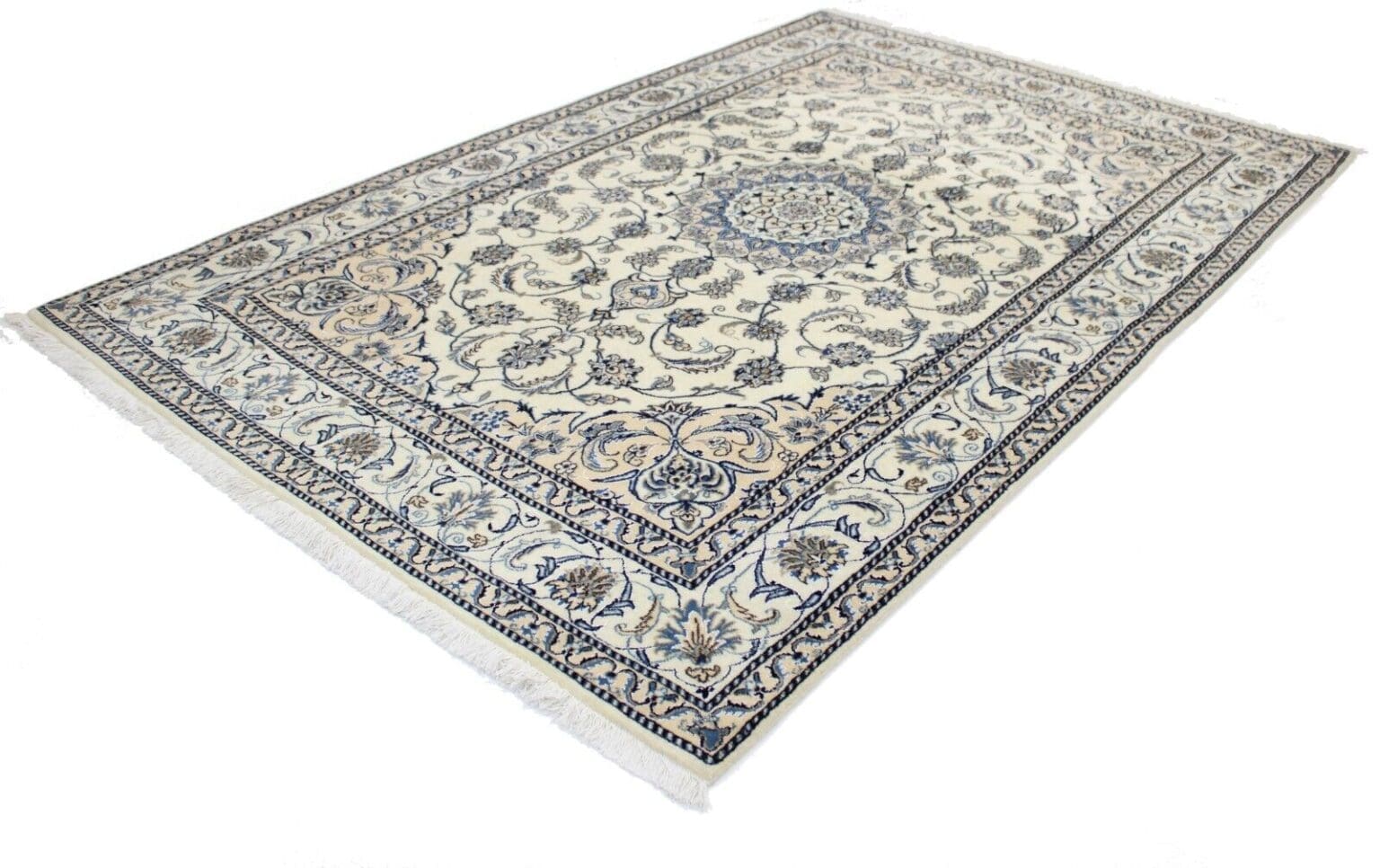
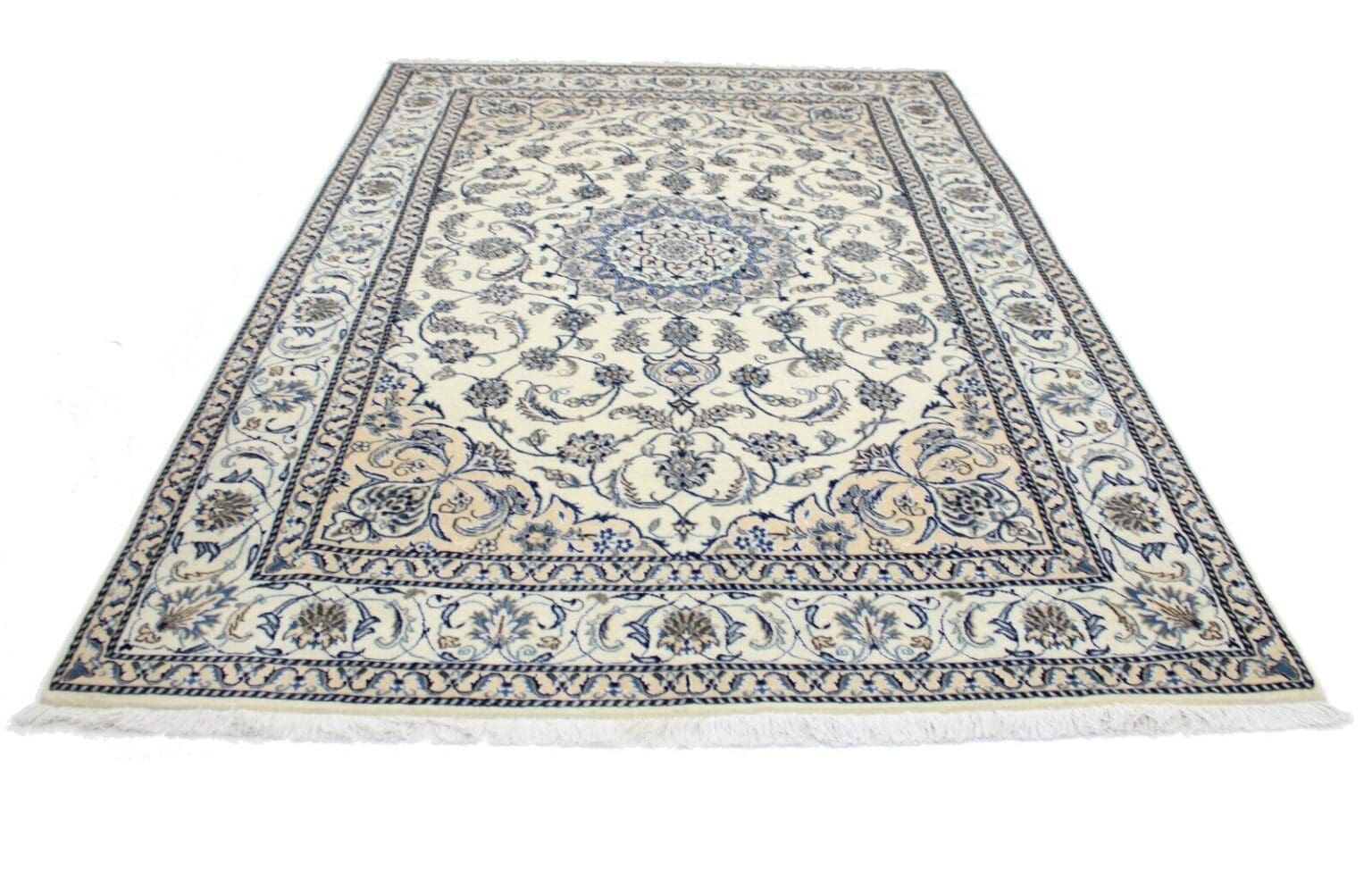
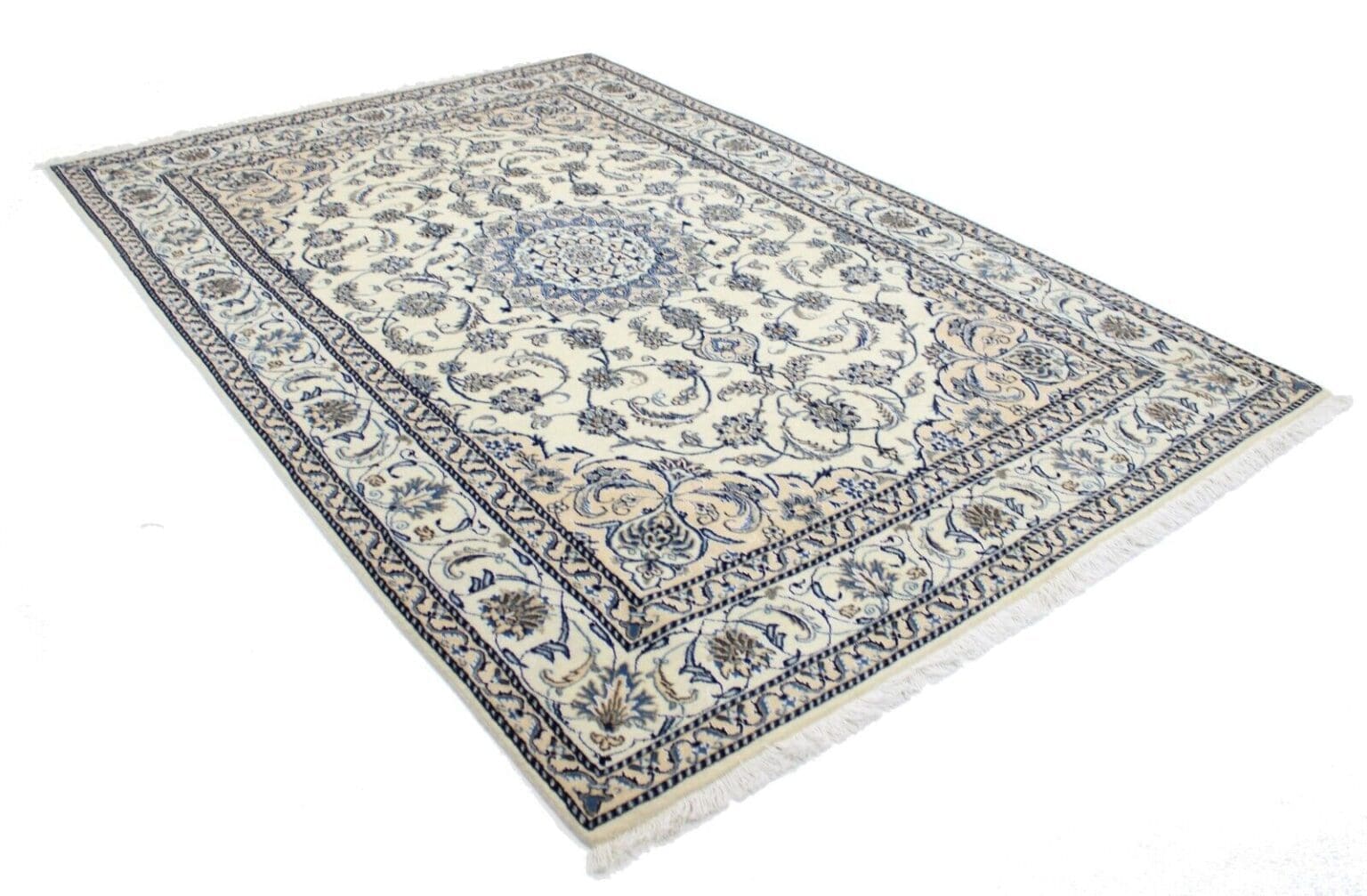
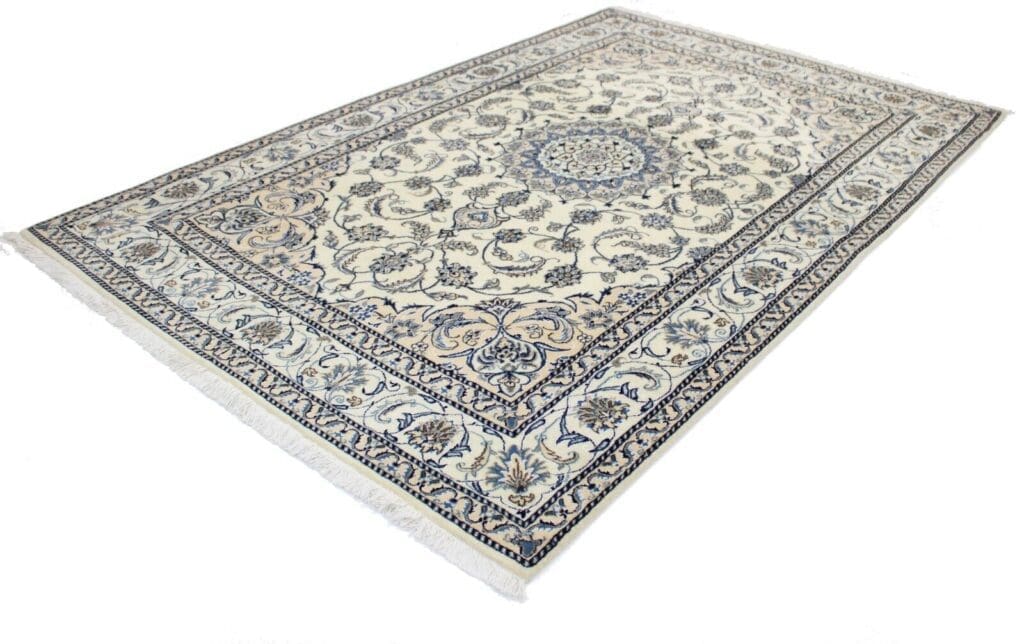
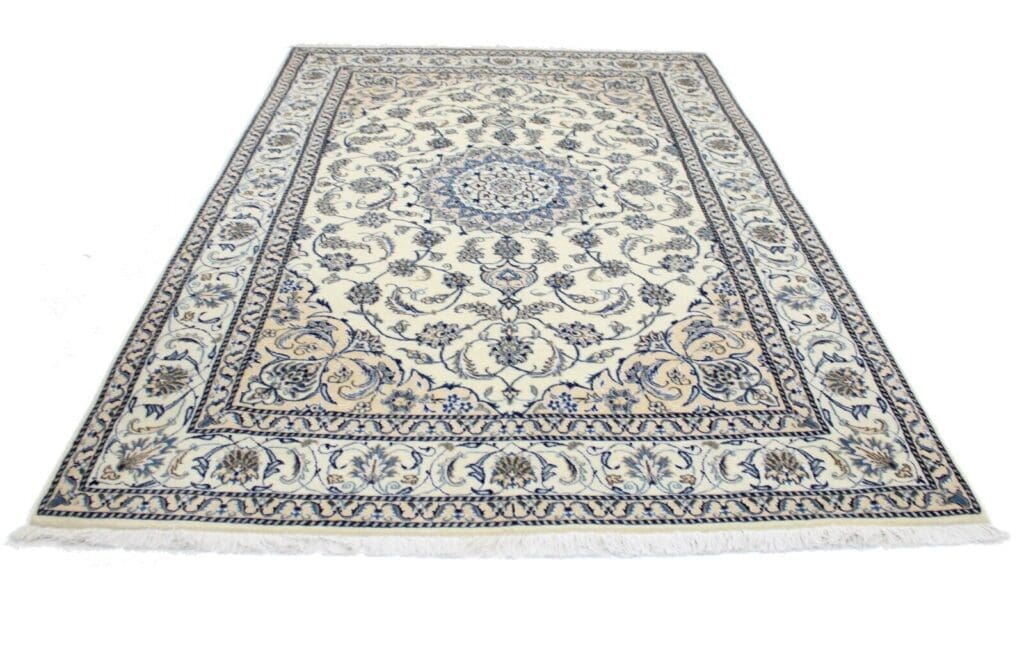
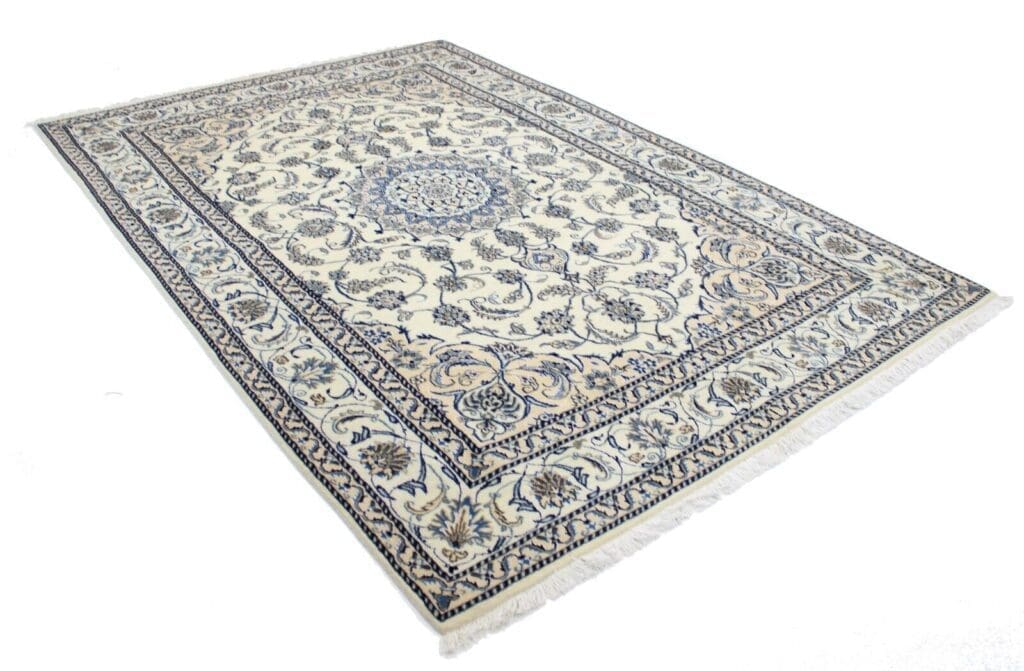
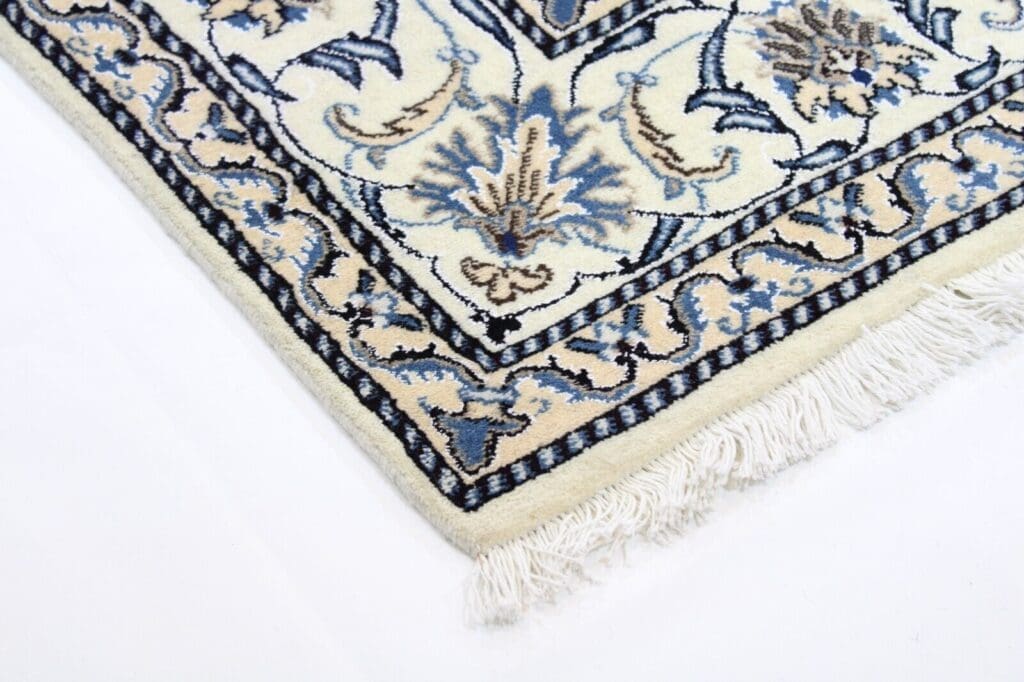
Hand-knotted Nain Persian rug | Material: pile wool | Size: 295 cm x 195 cm | Pattern: Nain regional design, traditional Persian-Oriental, beige | Condition: new goods, excellent condition
This original Nain Persian rug is hand-knotted and made from high-quality wool. The wool gives the pile a soft, pleasant handle. It is also described as durable and easy to care for. The rug has a high pile and is suitable for rooms with underfloor heating.
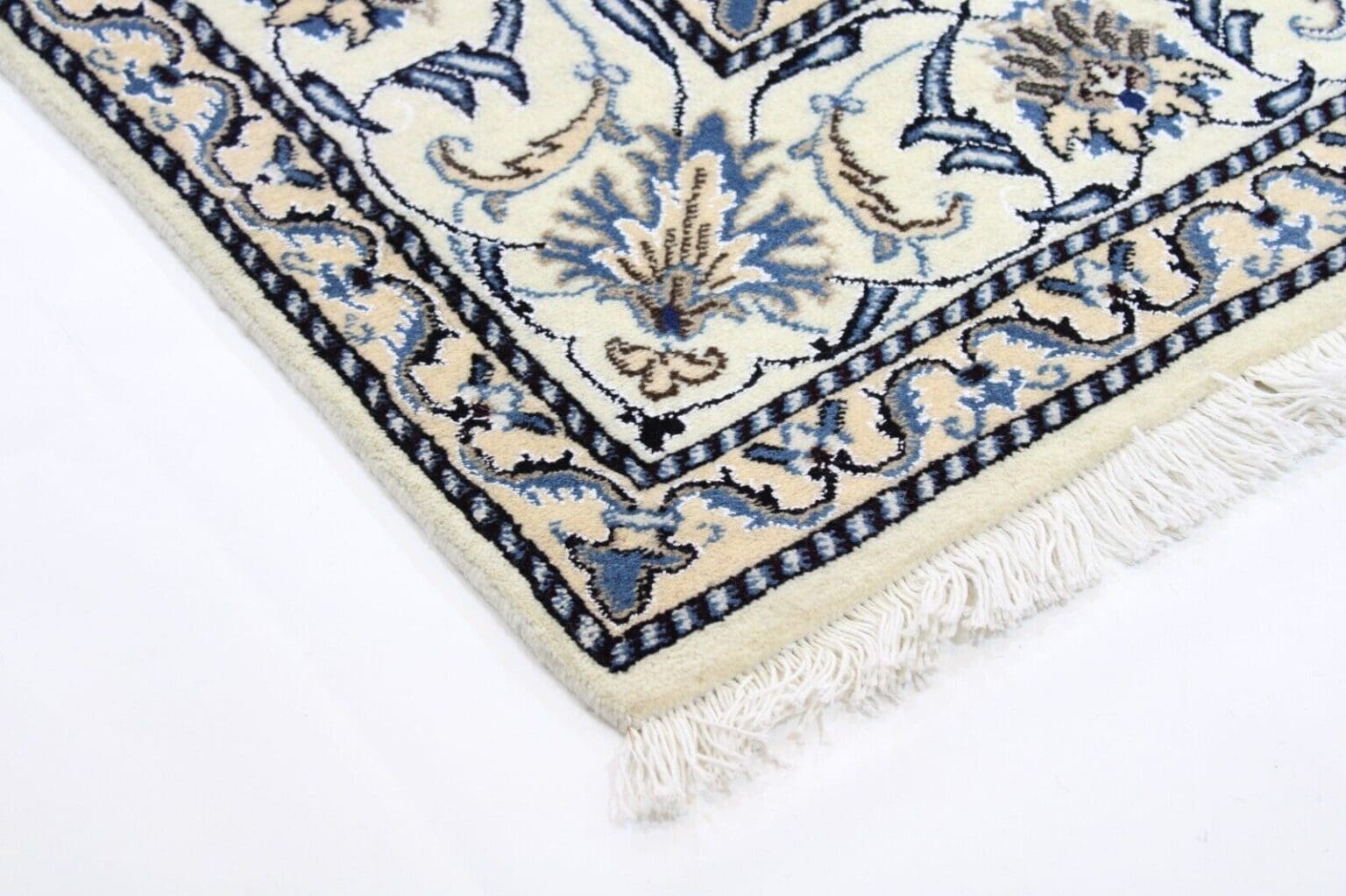
With hand-knotting, the pattern is built one knot at a time. Individual knots are inserted by hand into the warp, gradually forming the pile, drawing and surface. This differs from machine production, where a design is made through a standardised manufacturing process. In a hand-knotted rug, the finished textile remains connected to the individual work of the knotters.
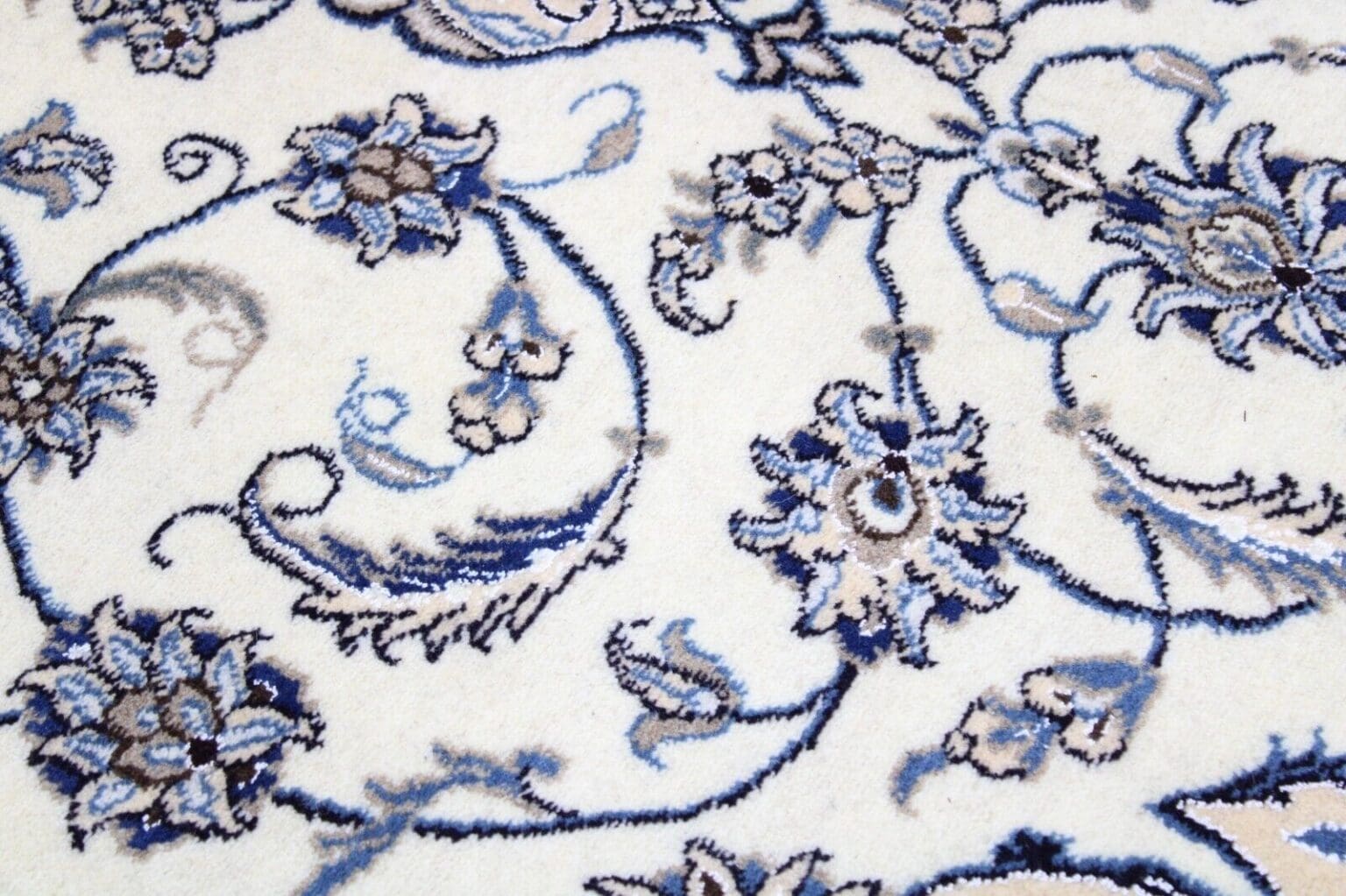
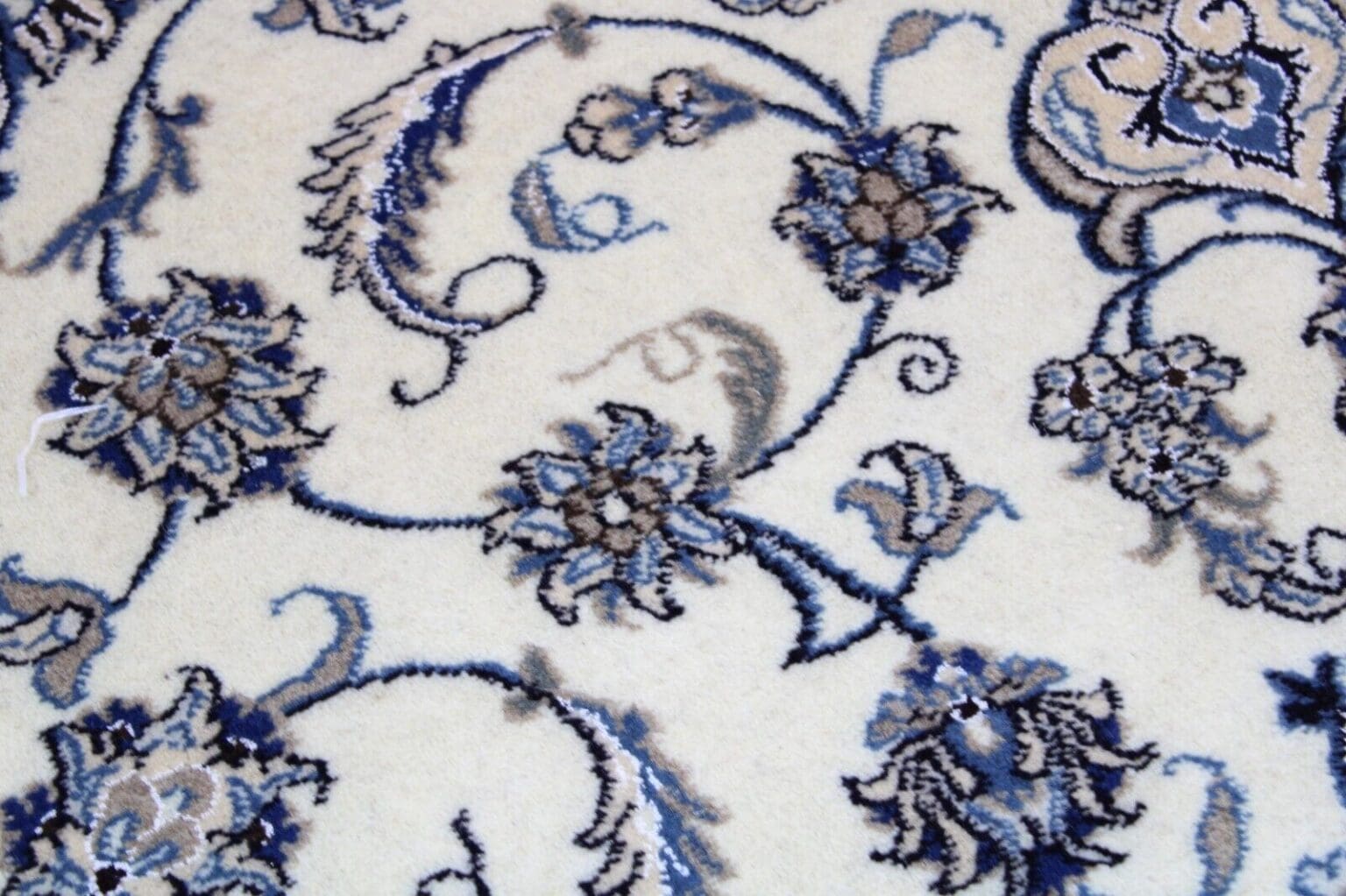
Knot density is an important technical quality feature in Nain rugs. A finer construction can support the depiction of small shapes, narrow outlines and carefully differentiated ornaments. It also affects the compactness of the surface and the level of detail that a design can carry. For this type of rug, material, knotting technique and pattern are therefore closely related.
The rug has been traditionally washed and professionally inspected. It is offered as new goods in excellent condition and is ready for immediate use. The stated properties describe a hand-knotted wool rug with a high pile, careful workmanship and a construction intended for use in interior spaces.
Origin and Tradition
Nain is the origin associated with this Persian rug. The town lies in Iran’s Isfahan Province and is known for its long tradition of carpet making. Nain rugs form part of Persian knotting culture, combining refined design with the craft knowledge of the region. The name Nain therefore refers both to a regional origin and to a particular technical and visual tradition.
The carpet tradition of Nain developed over many generations. Knowledge of drawing, ornament placement, colour relationships and wool preparation was passed on through craft practice. A hand-knotted rug is not a completely uniform series product. Instead, the planning of the design is joined to the slow process of building the pile and to the experience of the people carrying out the work.
Nain belongs to the cultural landscape of Isfahan Province. Isfahan has been an important centre of Iranian art, design and craft culture for centuries. Nain’s carpet tradition exists within this broader setting while retaining a recognisable character of its own. Fine quality, light colour effects and carefully drawn ornaments are especially often associated with Nain.
Persian rugs in Iran have never served only a practical purpose. They also preserve regional patterns, craft methods and established ideas of order and harmony. In a Nain rug, this relationship can be seen in the interaction between a light ground, fine drawing and controlled placement of motifs. The rug becomes a textile expression of Iranian craft history while remaining connected to everyday interior use.
The region’s long tradition depends on the transmission of practical skill. This involves more than tying individual knots; it also includes reading and interpreting a design. A finely divided drawing requires attention to the arrangement of lines, fields and ornaments. The craftsmanship of a Nain rug is therefore shaped by several stages: preparing the material, selecting and balancing colours, carrying out the knots and finishing the surface.
Within Iranian carpet art, Nain represents an approach in which precision and restraint work together. Patterns may contain many individual details without relying on a strong or restless colour effect. Light and gentle shades make the drawing visible and give the field a clear structure. This relationship between fine workmanship and quiet colouring forms part of the cultural background against which Nain rugs are understood.
An origin name does not replace a description of every detail in an individual rug. It identifies the regional tradition in which Nain rugs are rooted. For this rug, Nain is given as both origin and regional design. It is therefore associated with Iranian Persian carpet art and, more specifically, with the Nain tradition of Isfahan Province.
Design and Pattern
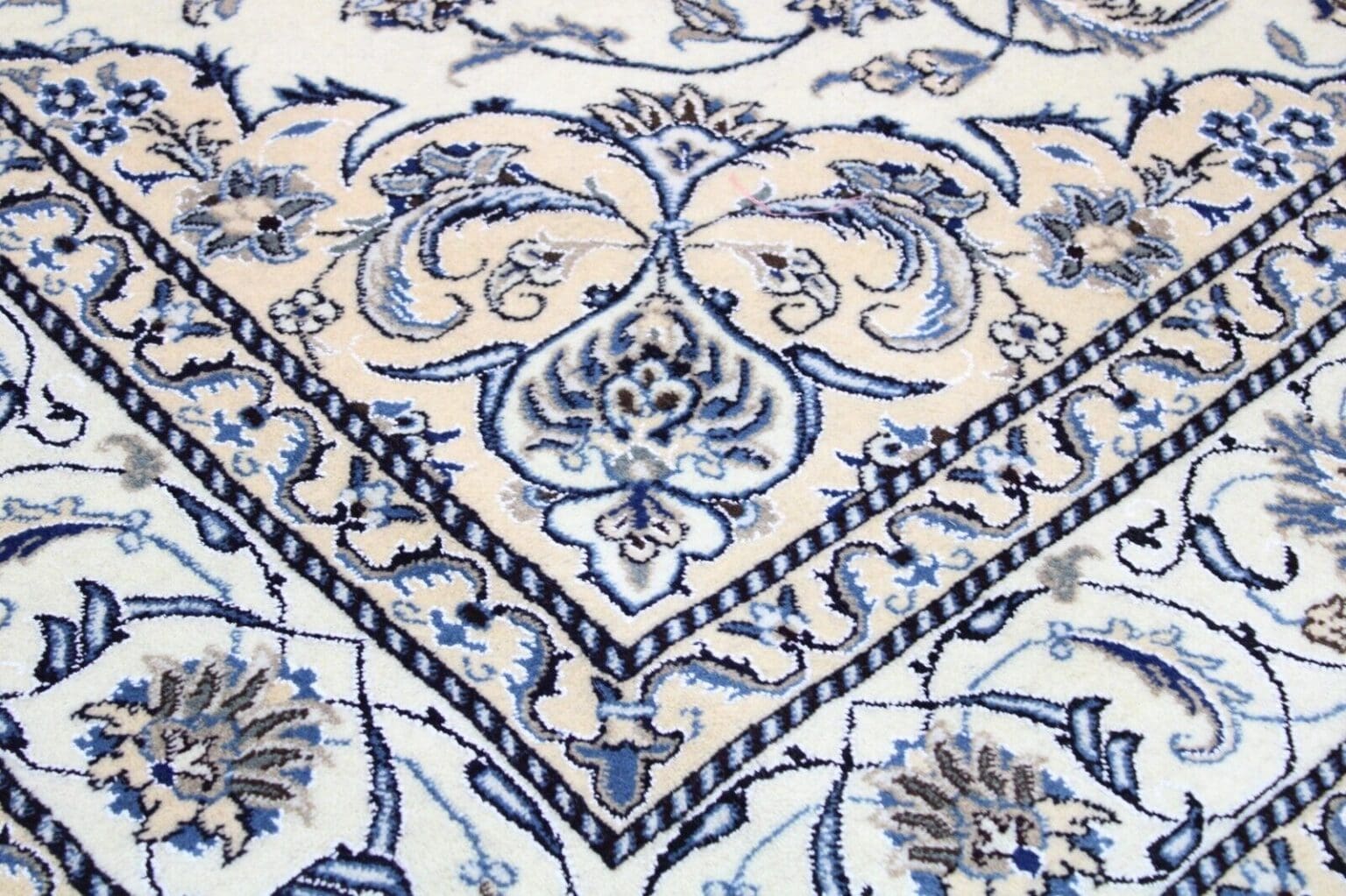
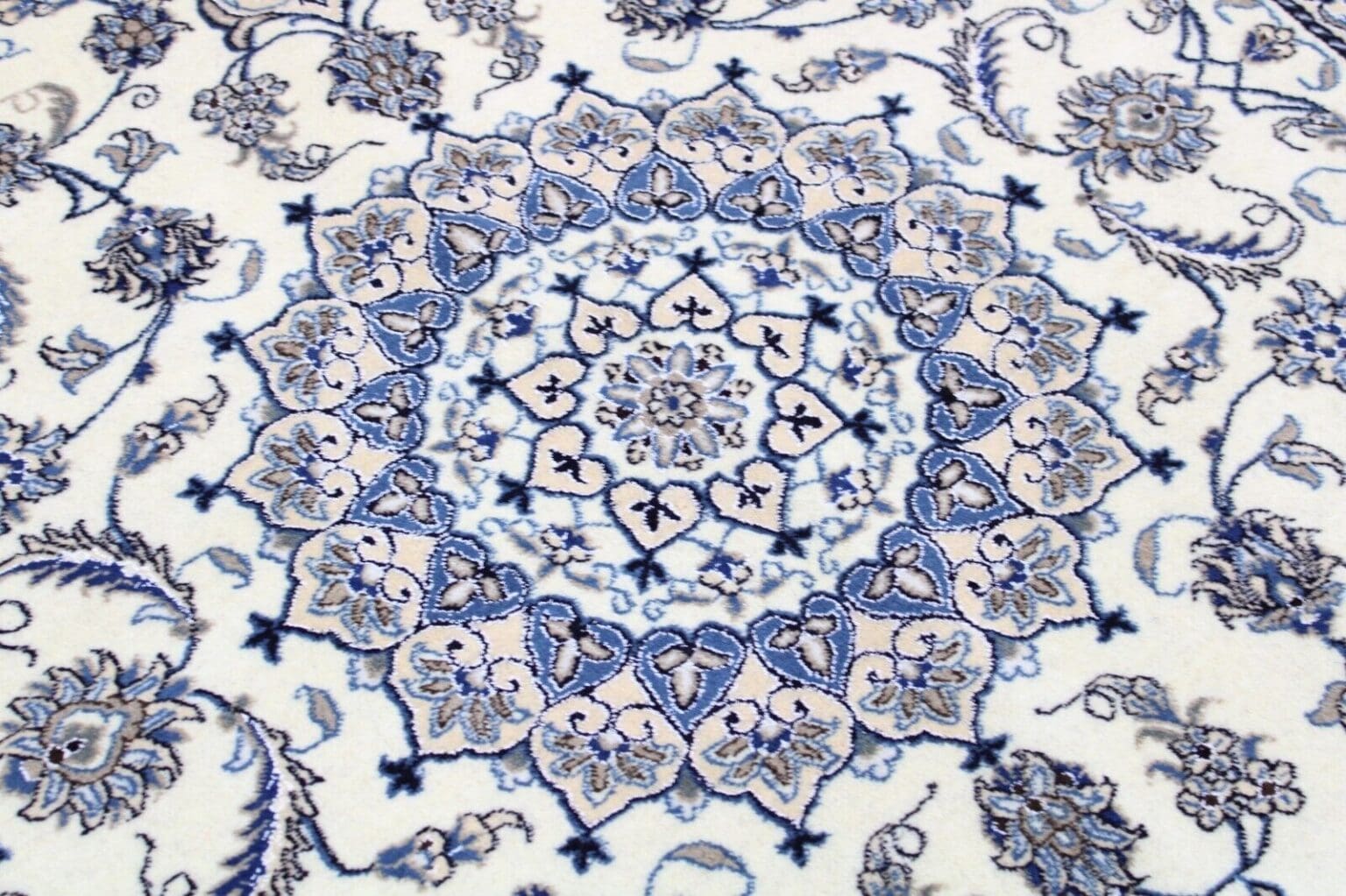
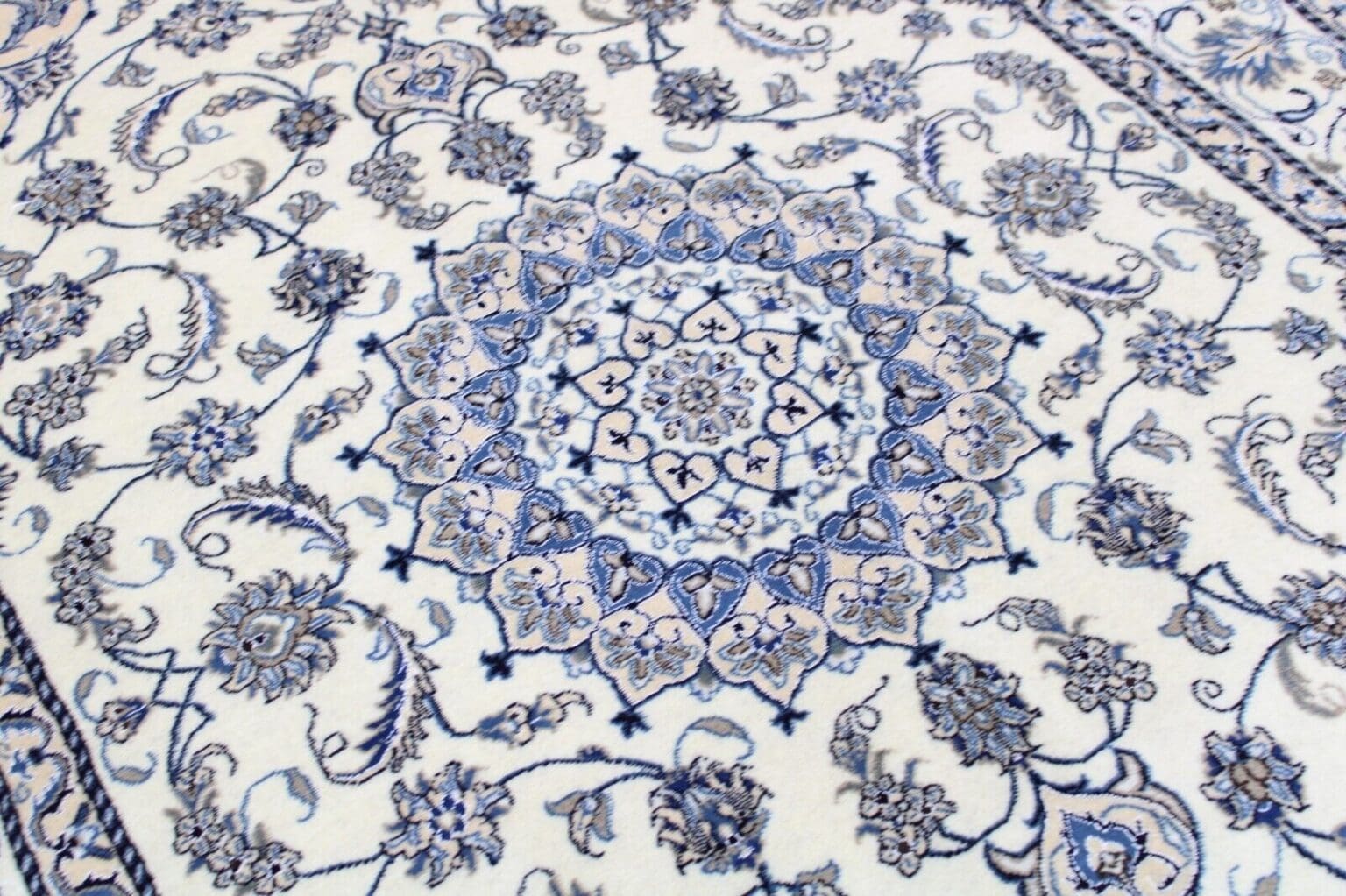
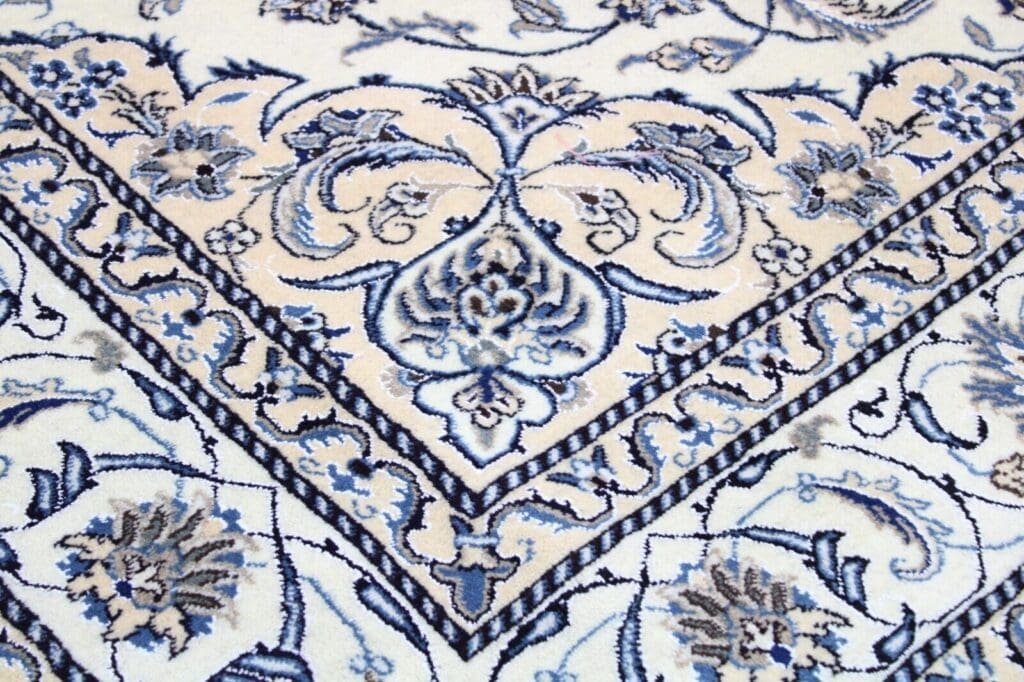
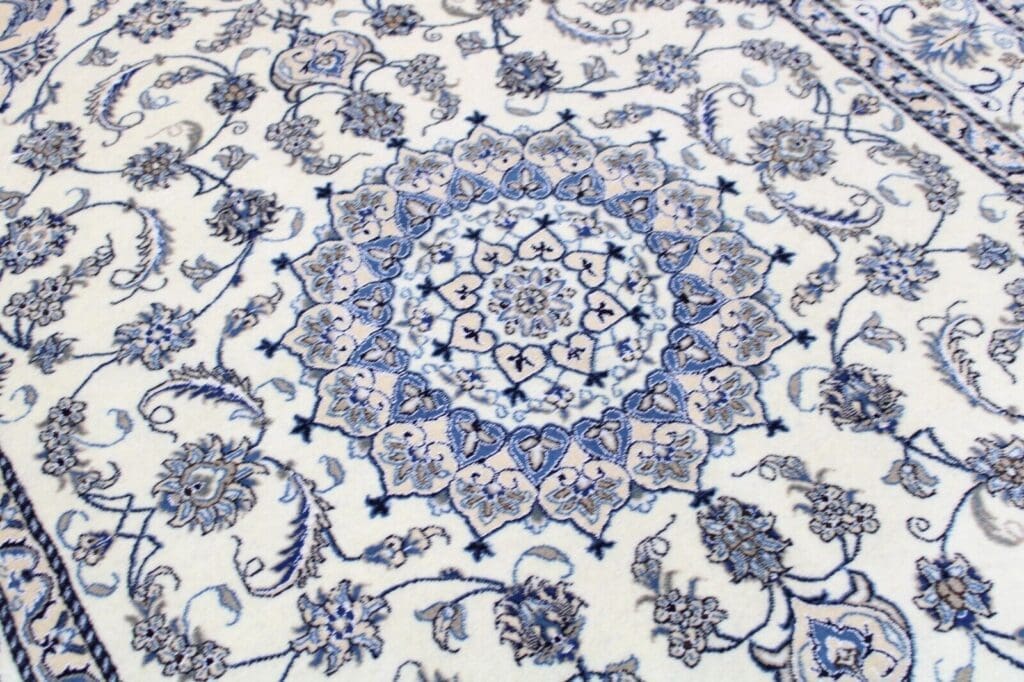
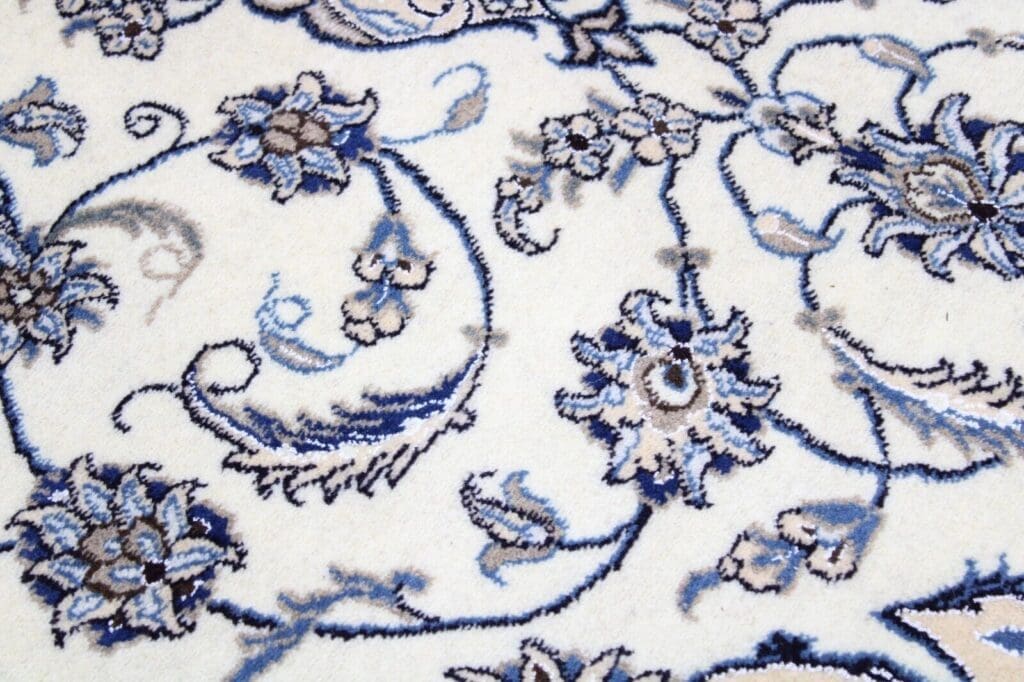
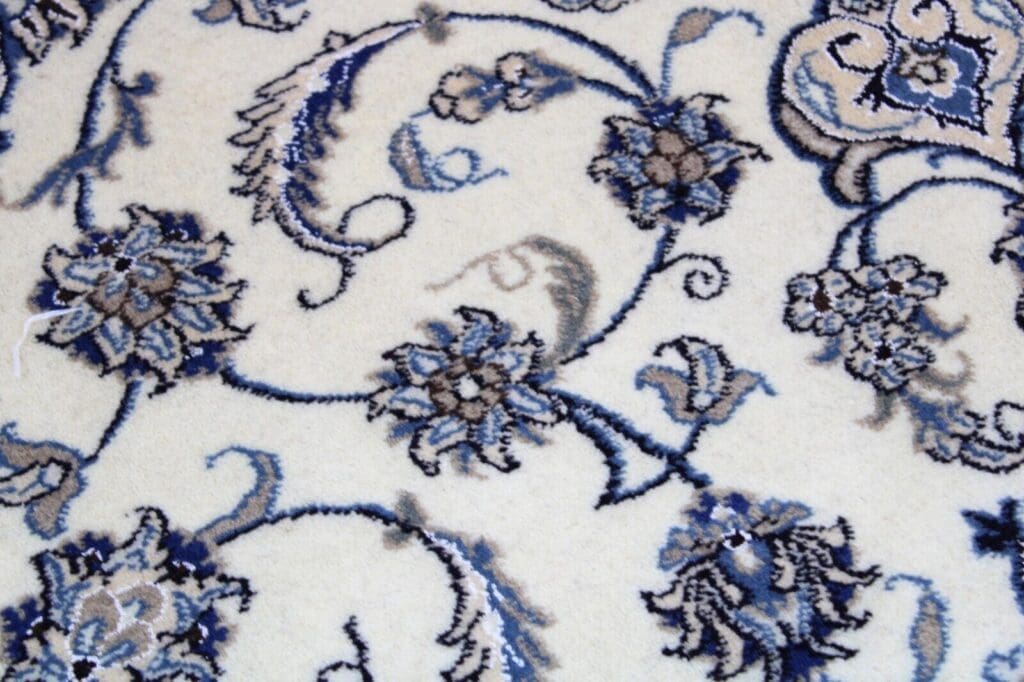
This rug is identified with Nain regional design. Its style is described as traditional Persian-Oriental, and its colour is beige. Light grounds and soft, harmonious colours are typical design elements associated with Nain patterns. Such a palette supports clear reading of the drawing and allows the ornamentation to appear as a coherent surface.
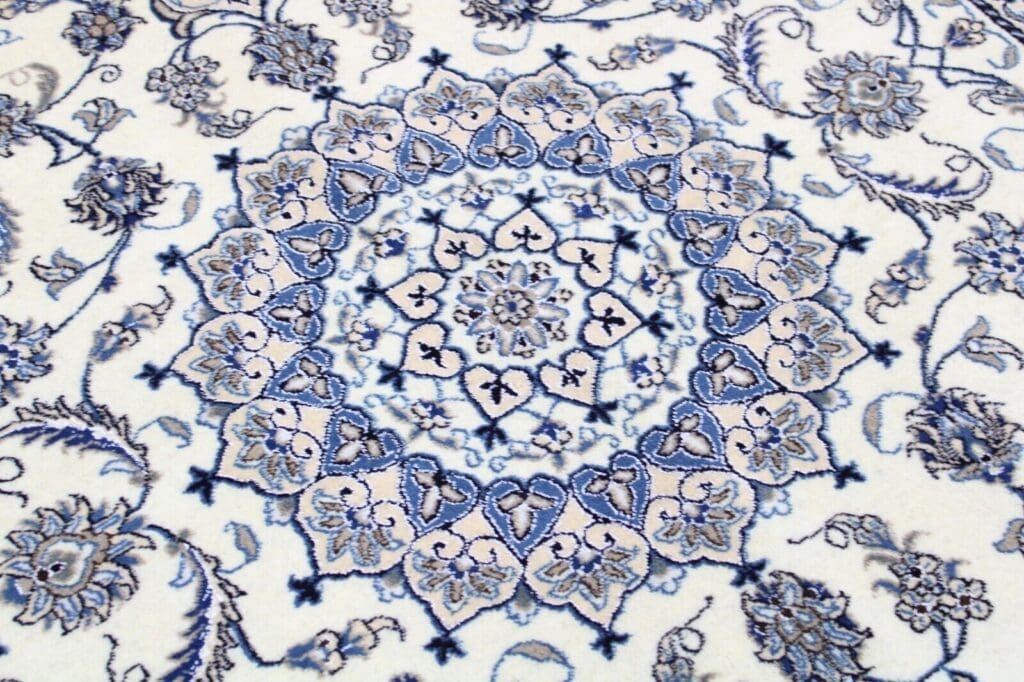
Nain designs commonly include floral motifs and geometric forms. Floral elements may appear as stylised blossoms, leaves, vines or connected plant shapes. Geometric forms give the composition a recognisable order. Persian rug design often brings these two areas together so that organic lines and structuring shapes form a balanced pattern.
Nain patterns are generally detailed and carefully worked. Small ornaments, fine contours and repeated forms are related to one another so that the entire field appears integrated. The visual effect comes not only from separate motifs, but also from the relationship between ground, border, central field and the designs placed within them. Although the execution of every individual rug is distinct, this pattern organisation provides the general background of the Nain tradition.
Knot density has a technical role in rendering patterns of this kind. The more differentiated a design is, the more important it is to have a construction capable of expressing small forms and narrow lines clearly. Nain rugs are therefore often associated with fine, controlled workmanship. Pattern detail is not merely a decorative quality; it results from the interaction of the drawing, knotting, material and distribution of colour.
The beige colour of this rug belongs to a light design approach. Gentle shades can separate floral and geometric elements without allowing the overall impression to become dominant. The source description also refers to natural dyes as a feature of the traditional design. Natural dyes connect the materials, handmade production and inherited understanding of colour. The colour statement thus remains within the established vocabulary of Persian rug design.
A Nain pattern can gain its character from the contrast between fine lines and quieter areas of the field. Ornaments are not placed at random but arranged within an ordered composition. Floral motifs give the drawing an organic direction, while geometric forms create structure and repetition. This combination is an important part of the regional visual language and helps explain why Nain rugs can appear both artistic and clearly organised.
Traditional Persian rug patterns are not only decorative signs. They also preserve design ideas that have been developed over long periods. In Nain, this can be seen in the careful execution and the coordination of colour and form. The regional design of this rug therefore combines the stated beige palette with a Persian-Oriental vocabulary shaped by floral motifs, geometric forms and fine detail.
Special Features
The rug is described as an original Nain Persian rug, new goods and in excellent condition. It is certified and guaranteed authentic. An authenticity certificate is available on request at no extra charge. The piece has also been traditionally washed and professionally inspected, making it ready for immediate use.
The high pile, suitability for underfloor heating and the easy-care nature of the wool are specifically stated features. A rug of this kind can also contribute to room acoustics and to the atmosphere of an interior. Its hand-knotted construction makes each piece unique and preserves the individual relationship between material, pattern and craft.
For care, the rug should be vacuumed regularly and protected from direct sunlight. Any stain should be dabbed promptly with a damp cloth. Occasional professional cleaning is also recommended so that the colours and structure remain well preserved. These instructions address the care requirements stated for this wool rug.
FAQ
How should I care for my Nain Persian rug?
The rug should be vacuumed regularly and protected from direct sunlight. If a stain occurs, dab the affected area promptly with a damp cloth rather than rubbing it further into the pile. Professional cleaning is recommended from time to time. These steps help preserve the colours, pile and structure. The wool is described as easy to care for, but intensive treatment should still be handled professionally. Regular, gentle care helps keep the surface clean during everyday use.
What makes Nain rugs distinctive?
Nain rugs are known for fine quality, high knot density and detailed design. A fine construction allows small pattern areas and narrow lines to be rendered precisely. Other characteristic features include fine materials, artistic designs, floral motifs and a long tradition within Iranian carpet art. Light grounds, gentle colours and the combination of floral and geometric forms shape the regional design. Hand-knotting makes each rug a unique piece and joins its decorative effect to an established craft tradition.
How does a hand-knotted rug differ from a machine-made rug?
A hand-knotted rug is made knot by knot through individual manual work, which makes it a unique piece. Production can take several months. Fine detail, handmade execution, durability and individual design are among the stated qualities of hand-knotted rugs. Machine-made rugs, by contrast, are produced through a standardised process and are usually less expensive. They do not have the same individual craftsmanship as a hand-knotted Nain Persian rug. The difference therefore lies chiefly in the method of production, the personal work involved and the relationship between the design and the completed knotting.
To provide the best experiences, we use technologies like cookies to store and/or access device information. Consenting to these technologies will allow us to process data such as browsing behavior or unique IDs on this site. Not consenting or withdrawing consent, may adversely affect certain features and functions.
Functional Always active
The technical storage or access is strictly necessary for the legitimate purpose of enabling the use of a specific service explicitly requested by the subscriber or user, or for the sole purpose of carrying out the transmission of a communication over an electronic communications network.
Preferences
The technical storage or access is necessary for the legitimate purpose of storing preferences that are not requested by the subscriber or user.
Statistics
The technical storage or access that is used exclusively for statistical purposes.The technical storage or access that is used exclusively for anonymous statistical purposes. Without a subpoena, voluntary compliance on the part of your Internet Service Provider, or additional records from a third party, information stored or retrieved for this purpose alone cannot usually be used to identify you.
Marketing
The technical storage or access is required to create user profiles to send advertising, or to track the user on a website or across several websites for similar marketing purposes.

 SECURE PAYMENT
 SHIPPING PARTNERS


