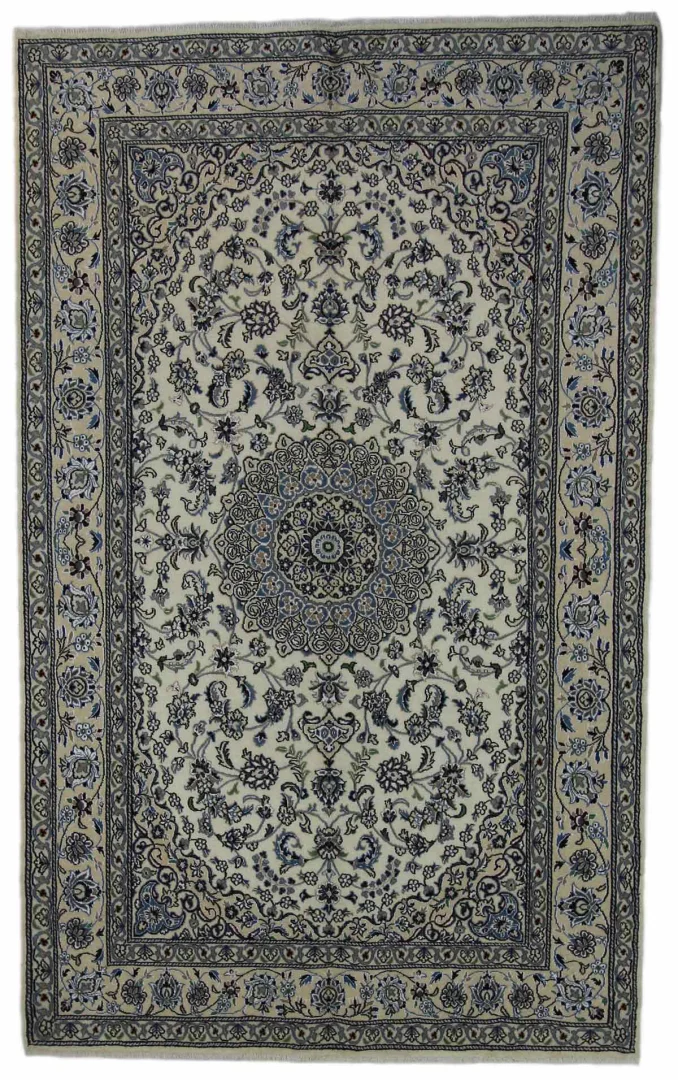
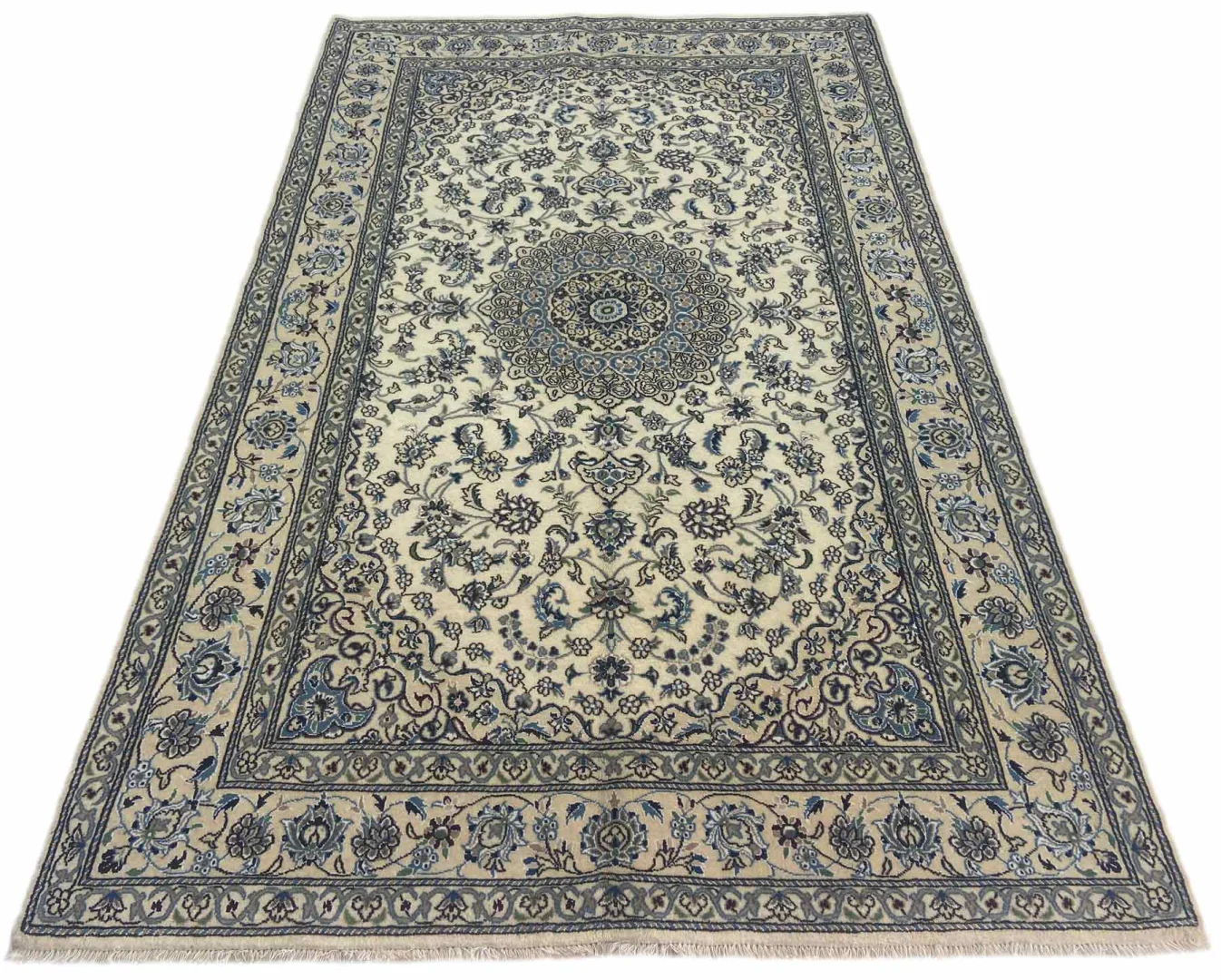
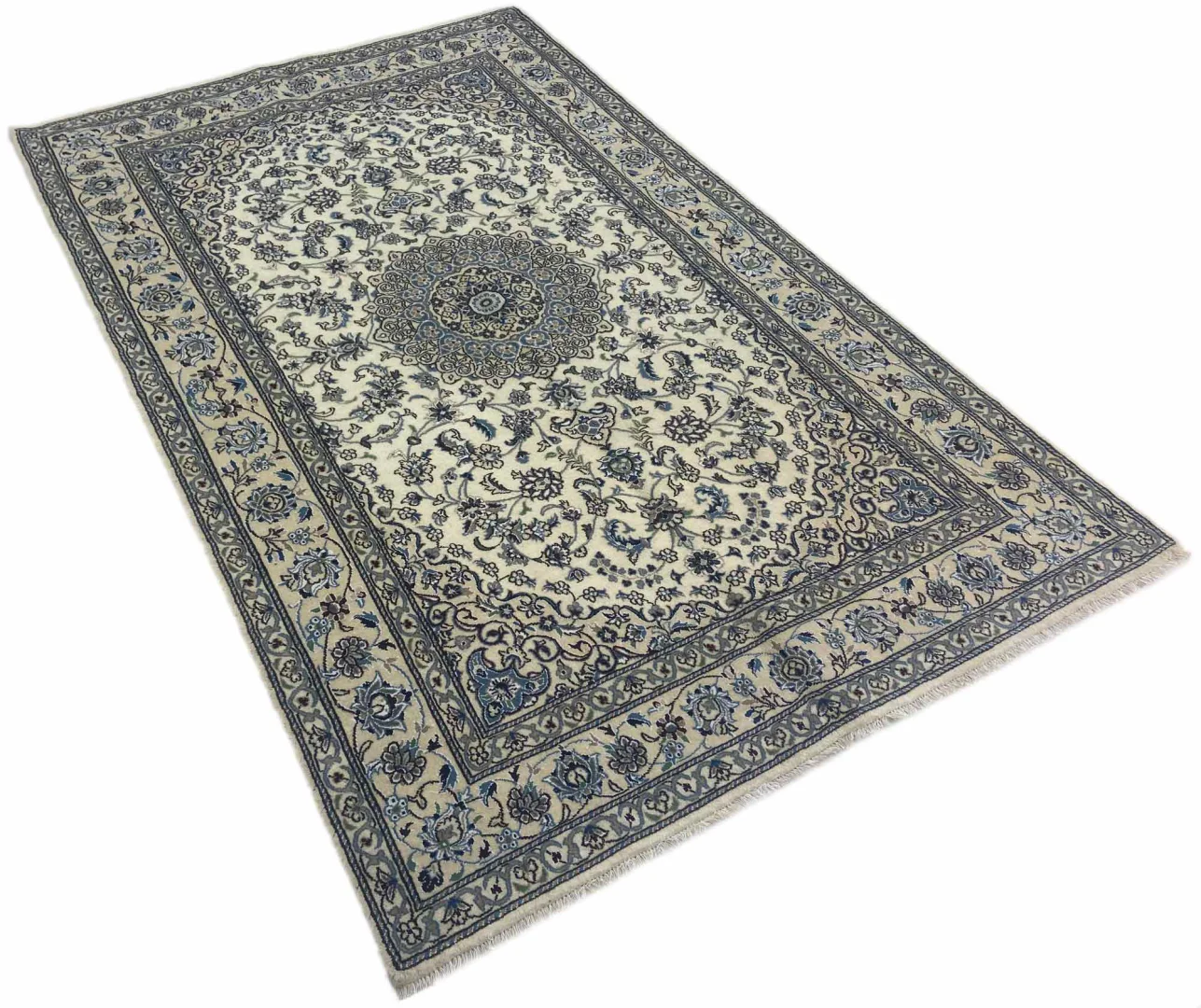
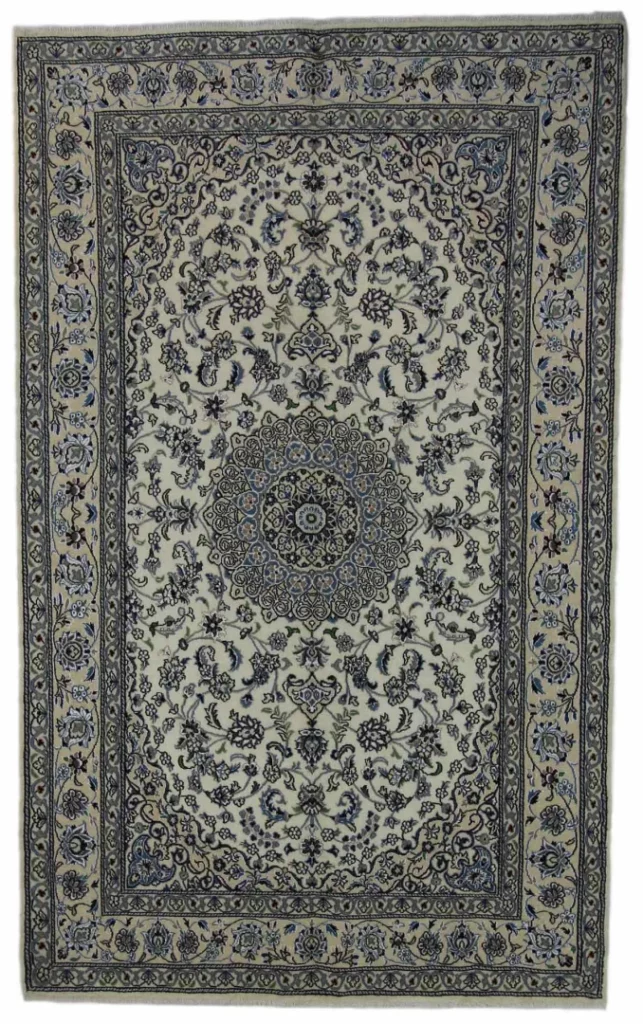
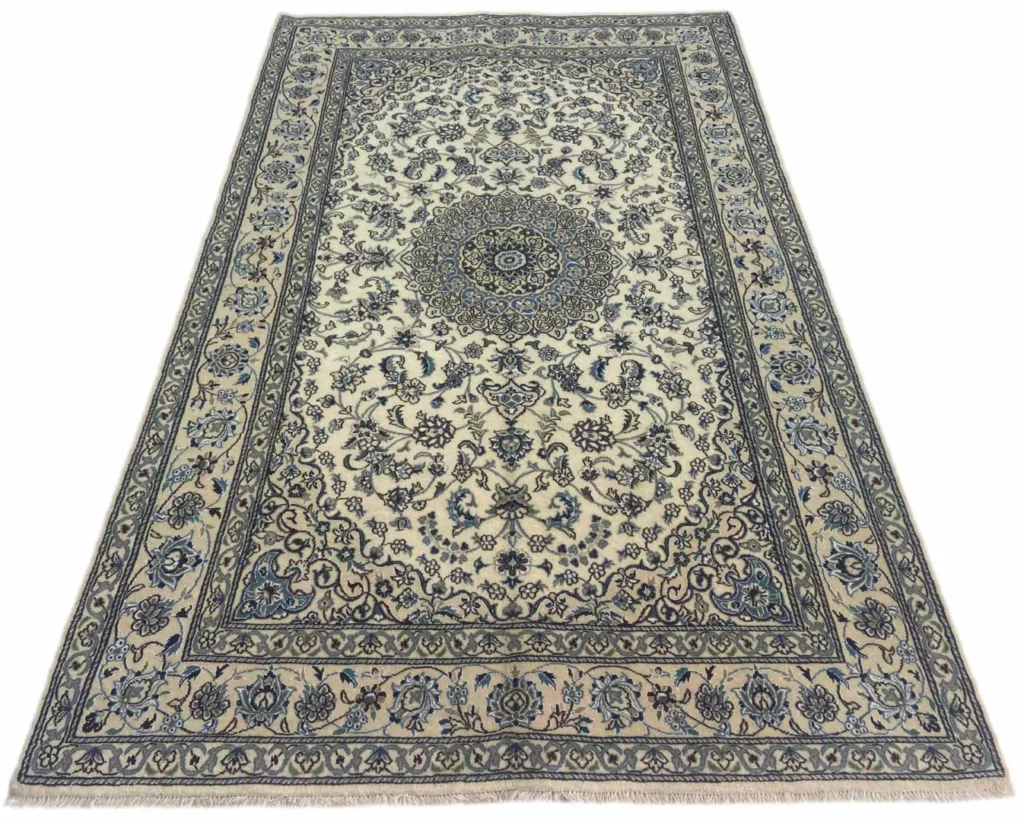
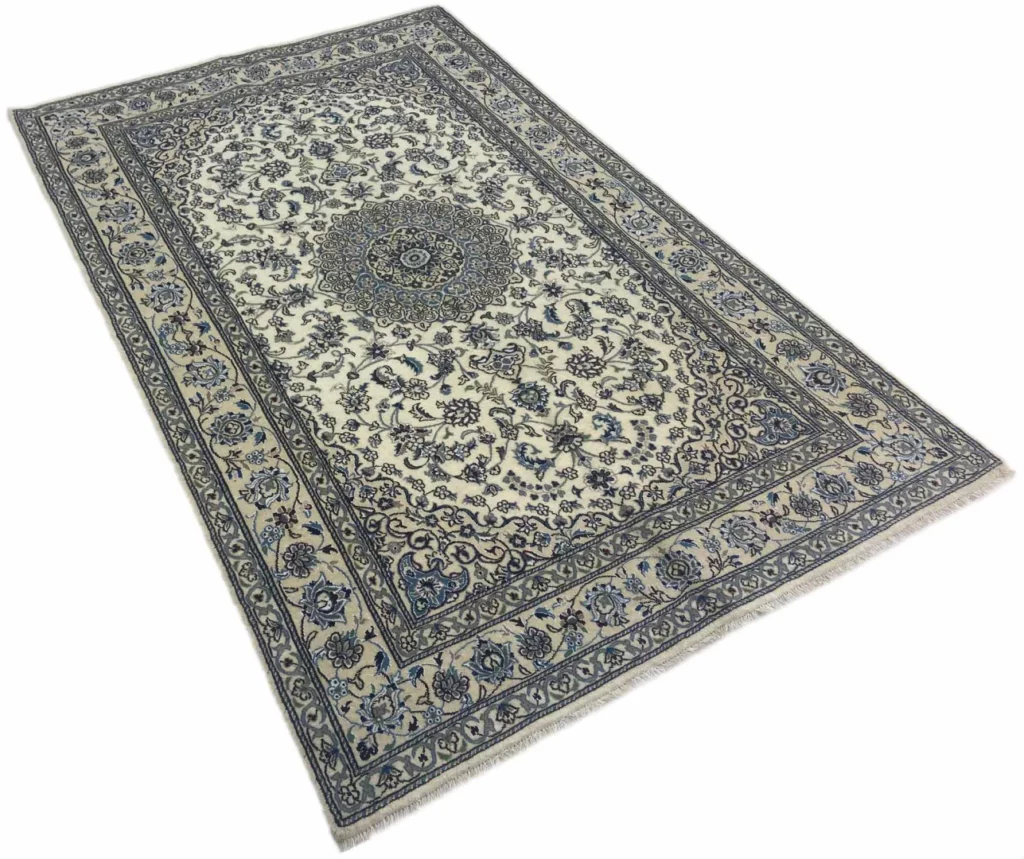
Hand-knotted Nain Persian Rug | Knot density: 9-Lah | Material: Wool pile | Size: 255 x 157 cm | Pattern: Classic floral motifs with medallion | Condition: Very good
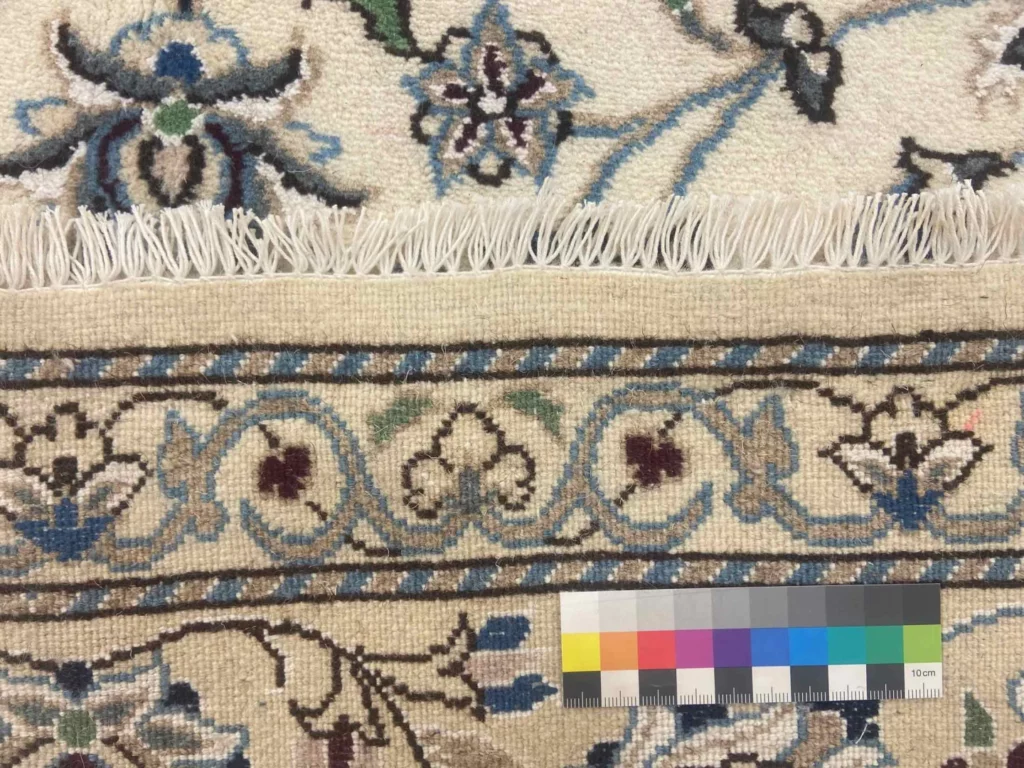
This Nain Persian Rug is hand-knotted and has a wool pile. Its visible surface is built through the traditional knotting process, with the design formed knot by knot rather than printed onto a finished textile. Wool gives the pile its stated material character and creates the familiar structure of a woven rug. The hand-knotted construction is an essential part of how the floral design and central medallion are brought into the carpet.
The knot density is described as 9-Lah. In Nain carpet terminology, Lah is used as a quality and fineness classification for knotting. Different Lah classifications distinguish different levels of fineness within the Nain tradition. The designation therefore provides context for the way the carpet was made, while the present piece is specifically identified as 9-Lah. Its craftsmanship is paired with a wool pile and a condition described as very good.
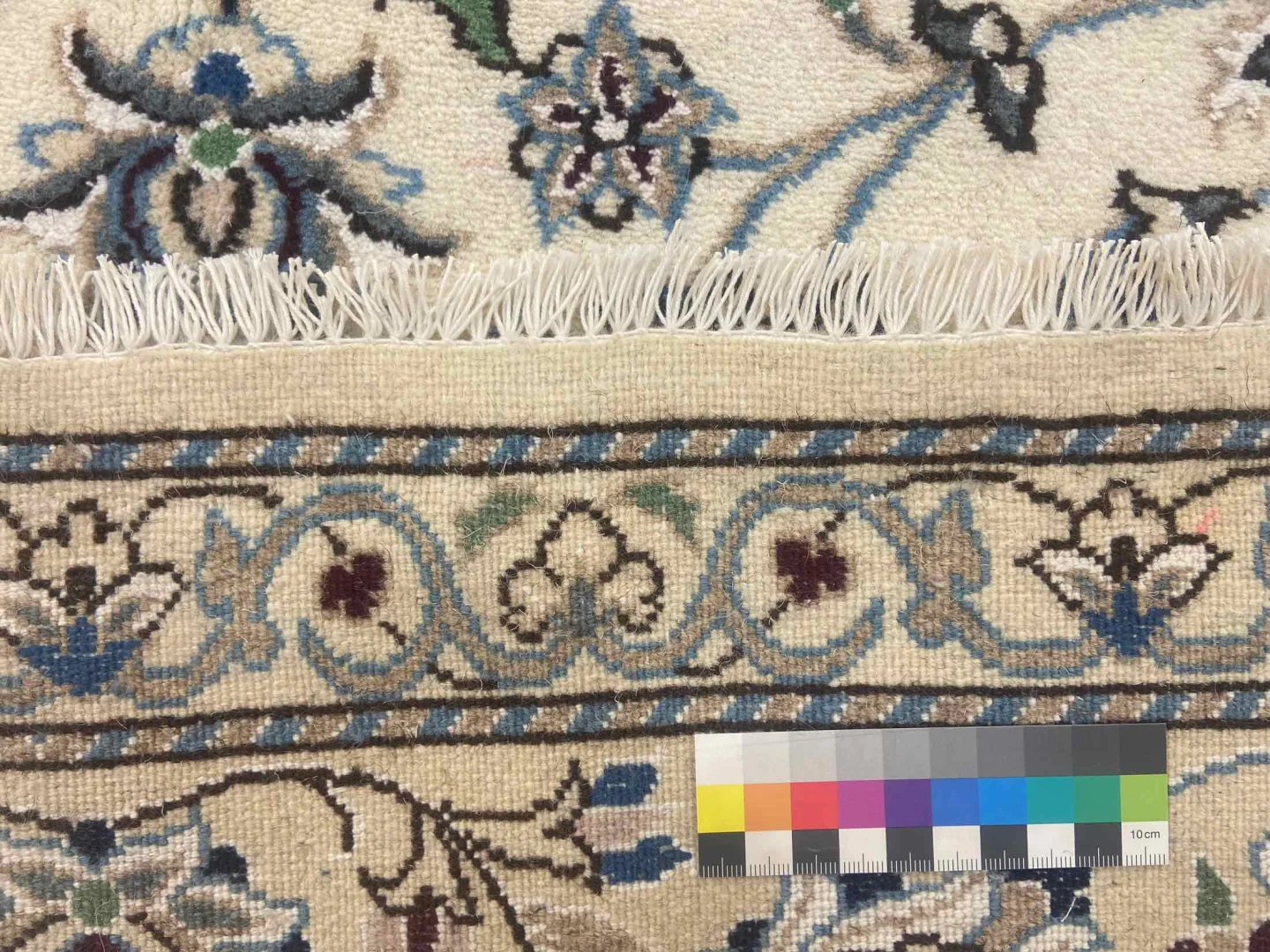
Hand knotting requires steady, careful work at the loom. Knots are placed in successive rows and secured as the carpet develops, allowing the pattern to emerge from the arrangement of colored threads. The process is laborious and gives the design a textile depth that belongs to the structure of the rug itself. The source describes the wool as high quality; no other pile material is stated for this individual carpet.
Origin and Tradition
This carpet comes from Nain in Central Persia. Nain has a distinct place in Persian carpet history and is associated with finely organized compositions, precise ornament and carefully controlled workmanship. The name Nain is therefore the origin stated for this rug, not merely a reference to its decorative style. Its hand-knotted construction and floral medallion design place it within a recognized regional tradition.
Persian carpet making is shaped by local schools whose visual languages have been passed from one generation to the next. In Nain, a balanced overall structure is commonly combined with botanical ornament. Designs may be organized around a central focus and supported by vines, blossoms and repeated details. The result is an ordered composition in which the individual motifs remain important without disrupting the clarity of the whole.
Lah classifications are part of the way Nain rugs are traditionally described. They help distinguish the fineness of the knotting within this particular regional vocabulary. Nain carpets are commonly discussed in four, six, nine and twelve Lah qualities, with the classification indicating a different degree of knotting fineness. The rug presented here is identified as 9-Lah. This information concerns its stated construction classification and does not change its named origin.
Nain is often associated with light, clearly drawn color schemes and carefully articulated ornament. These are general features of the regional tradition, not additional claims about every individual rug. They help explain why Nain carpets can work in both traditionally furnished rooms and more restrained contemporary interiors. Their formal organization gives the textile a defined presence while leaving room for the surrounding furnishings.
Other Persian centres, including Tabriz, Kashan, Isfahan and Qom, are also known for developed designs and the use of fine materials. Each place has its own history, workshop practices and preferred approaches to composition. Their mention does not alter the origin of this piece: it is a Nain Persian Rug from Central Persia. Regional names in the Persian carpet world describe different traditions rather than interchangeable labels.
Design and Pattern
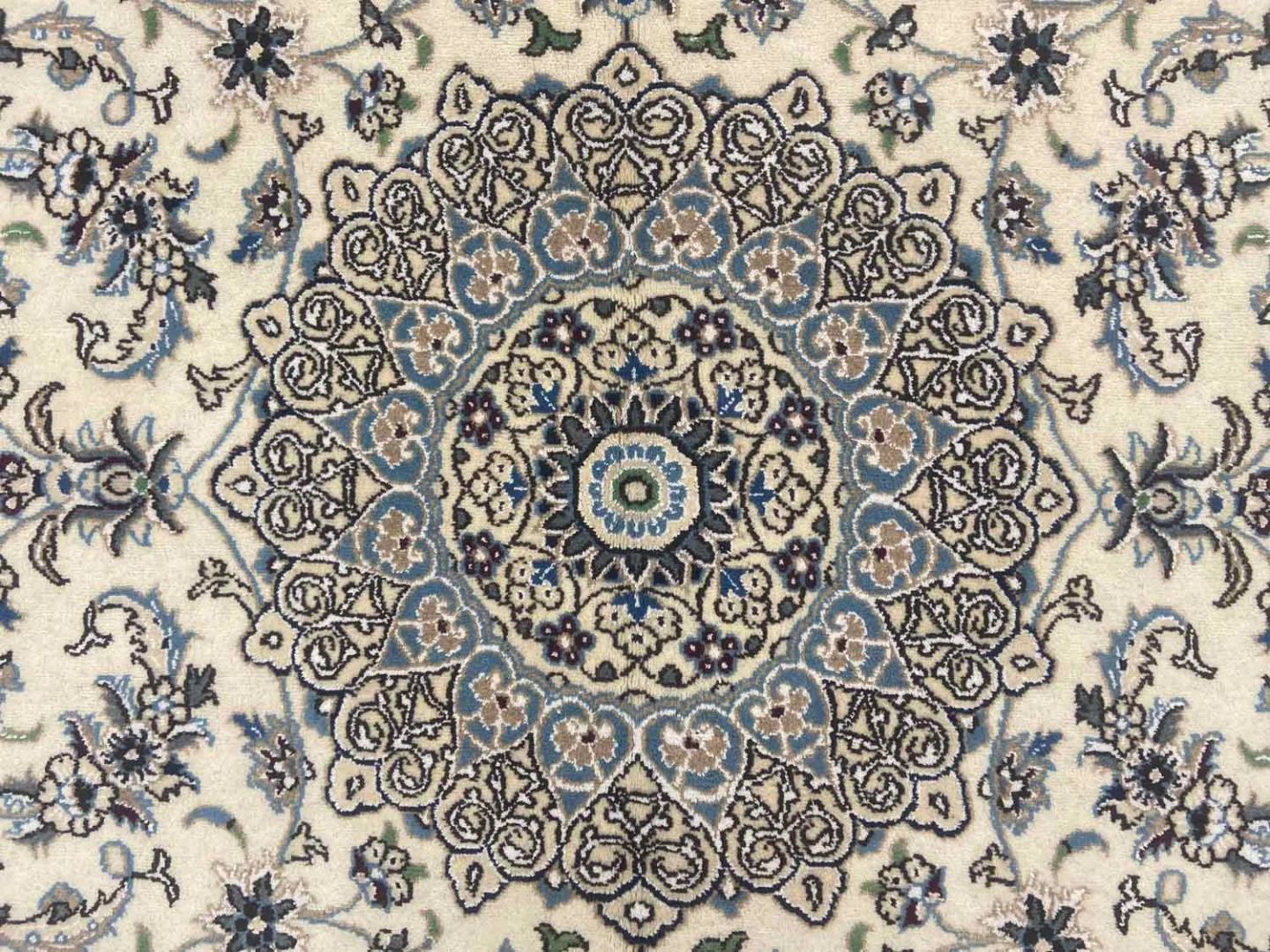
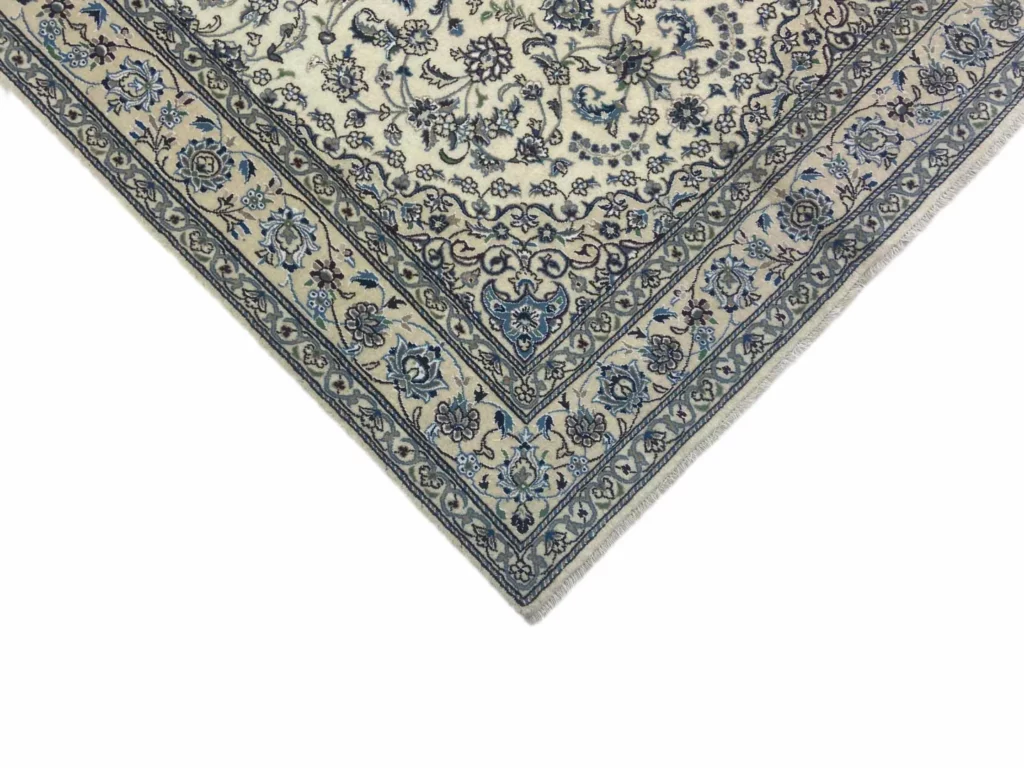
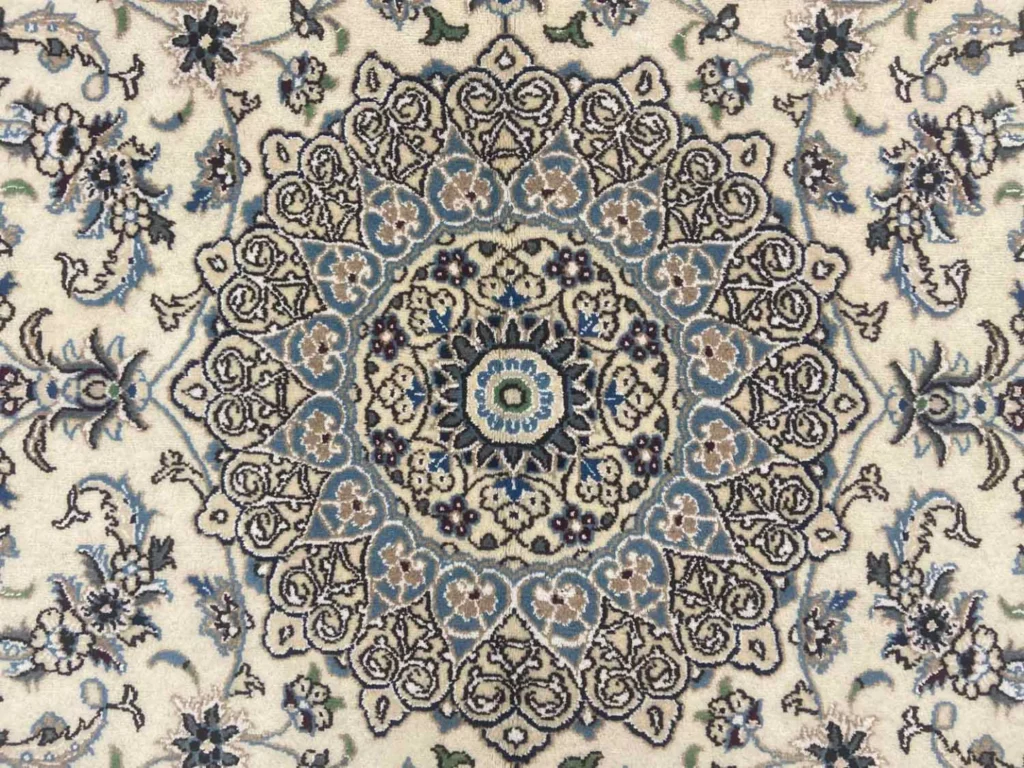
The design of this rug is classically floral and includes a medallion. In Persian carpet design, a medallion creates a central point of organization. It establishes the focus of the composition and gives the surrounding ornament a visual relationship to the middle. In a floral arrangement, blossoms, leaves and scrolling vines can be placed around that centre to form a connected field rather than a collection of unrelated motifs.
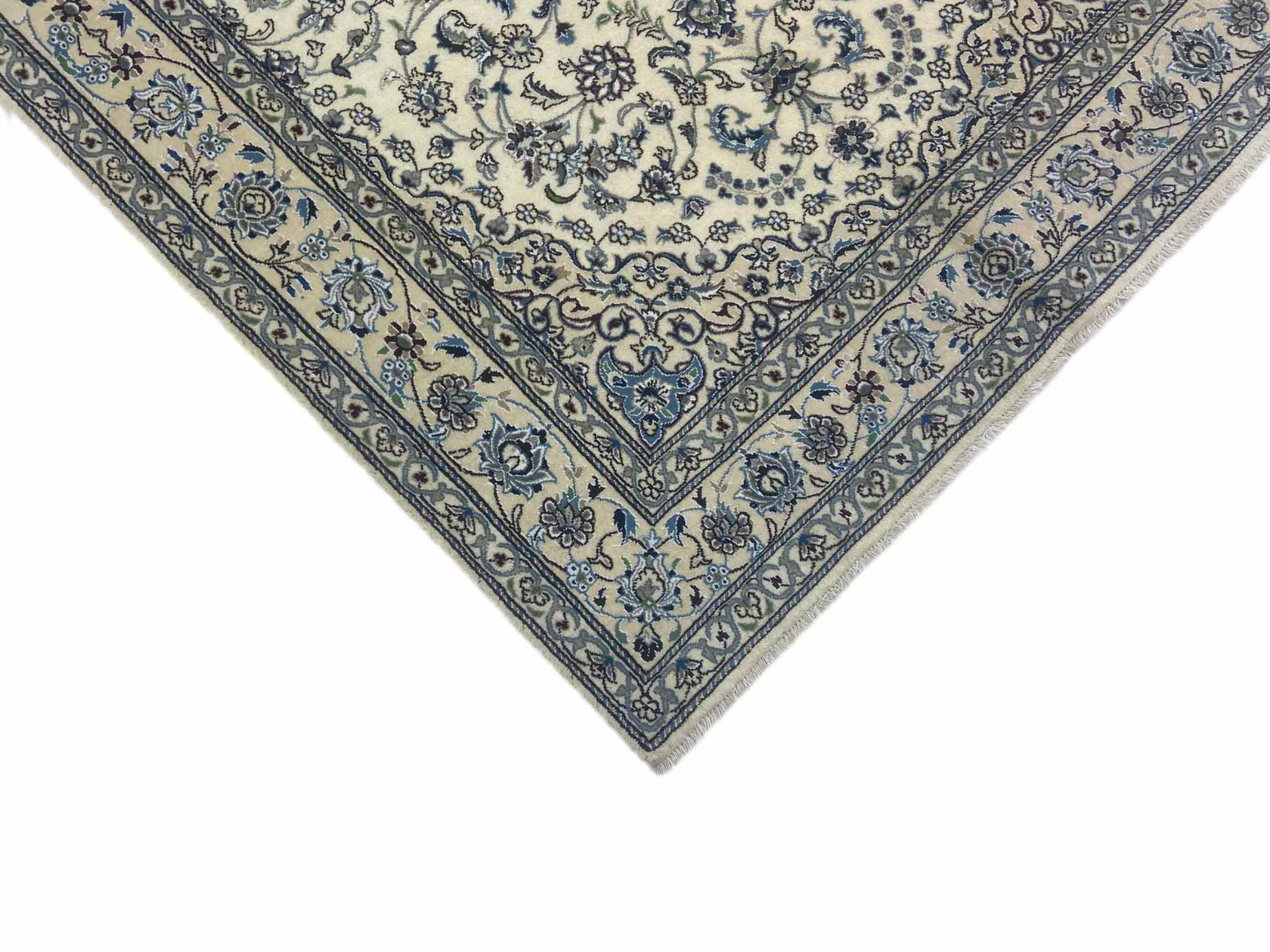
Nain floral designs draw on plant forms in a stylized way. They are not intended as a literal botanical illustration of one particular garden. Instead, blossoms and foliage are shaped, repeated and balanced within the carpet’s ornamental framework. This allows the pattern to remain decorative and coherent across the surface. The floral vocabulary also links the rug to the broader Persian tradition, where nature-inspired forms are refined into carefully ordered motifs.
A medallion composition gives the eye a clear centre while the surrounding details keep the design connected to the rest of the rug. Repeated vines, leaves and blossoms can create rhythm around the central form. Symmetry or visual balance helps maintain the relationship between the centre and the outer areas. Small variations within hand-knotted work keep the pattern from feeling mechanically detached from the making process.
The Nain design tradition is associated with precise drawing and a controlled distribution of detail. Lines are carefully directed, ornamental elements are related to one another and the full composition remains legible even when it contains many small forms. This balance between order and detail is one reason Nain patterns can be used with both traditional furnishings and simpler modern pieces. The design has a classical basis without depending on a short-lived decorative trend.
Silk is frequently used in some high-quality Nain carpets to add fine definition or lustrous accents. That is a general feature of certain Nain examples and is not a claim about this rug’s pile. The material stated for this piece is wool. Its own pattern is described as classic floral motifs with a medallion, which remains the relevant description of its decoration.
Special Features
The defining details of this one-off rug are its Nain origin in Central Persia, hand-knotted construction and 9-Lah classification. Its pile is wool, its design combines classic floral motifs with a medallion and its condition is described as very good. Together these points provide a concise profile of the carpet without adding characteristics that are not stated for this individual piece.
The central medallion and botanical ornament place the rug within a Persian design language built around balance, repetition and carefully arranged plant forms. Nain rugs are versatile in use and are traditionally found in living rooms, dining rooms and bedrooms. Their structured decoration can sit alongside traditional furniture or provide a defined textile element in a more contemporary setting.
FAQ
What are the main features of a Nain Persian Rug?
A Nain Persian Rug is identified by its origin in Nain in Central Persia and by a tradition of hand knotting, precise organization and floral ornament. A central medallion is a frequent compositional feature, often accompanied by blossoms, leaves and scrolling vines. Knot fineness is described through Lah classifications, with a higher number indicating a finer level within that system. This rug is identified as 9-Lah, with a wool pile and very good condition.
How should I care for a Nain Persian Rug?
Regular, careful vacuuming helps remove dust before it settles deeply into the pile. The rug should be protected from prolonged direct sunlight, since strong light can gradually affect textile colours. Spilled liquids should be blotted rather than rubbed into the wool. For substantial soiling or stains, professional cleaning is recommended. A specialist can select a process that respects the wool pile and the hand-knotted structure.
Which room is best suited to a Nain rug?
A Nain rug can be used in several areas of the home, including the living room, dining room or bedroom. Its floral medallion can be paired with traditional furniture or with a quieter modern interior. The most suitable placement is a level area where the rug can be used safely and its composition remains visible. The organized pattern gives the room a recognizable textile focus without restricting the furnishing style.
To provide the best experiences, we use technologies like cookies to store and/or access device information. Consenting to these technologies will allow us to process data such as browsing behavior or unique IDs on this site. Not consenting or withdrawing consent, may adversely affect certain features and functions.
Functional Always active
The technical storage or access is strictly necessary for the legitimate purpose of enabling the use of a specific service explicitly requested by the subscriber or user, or for the sole purpose of carrying out the transmission of a communication over an electronic communications network.
Preferences
The technical storage or access is necessary for the legitimate purpose of storing preferences that are not requested by the subscriber or user.
Statistics
The technical storage or access that is used exclusively for statistical purposes.The technical storage or access that is used exclusively for anonymous statistical purposes. Without a subpoena, voluntary compliance on the part of your Internet Service Provider, or additional records from a third party, information stored or retrieved for this purpose alone cannot usually be used to identify you.
Marketing
The technical storage or access is required to create user profiles to send advertising, or to track the user on a website or across several websites for similar marketing purposes.
 SECURE PAYMENT
 SHIPPING PARTNERS


