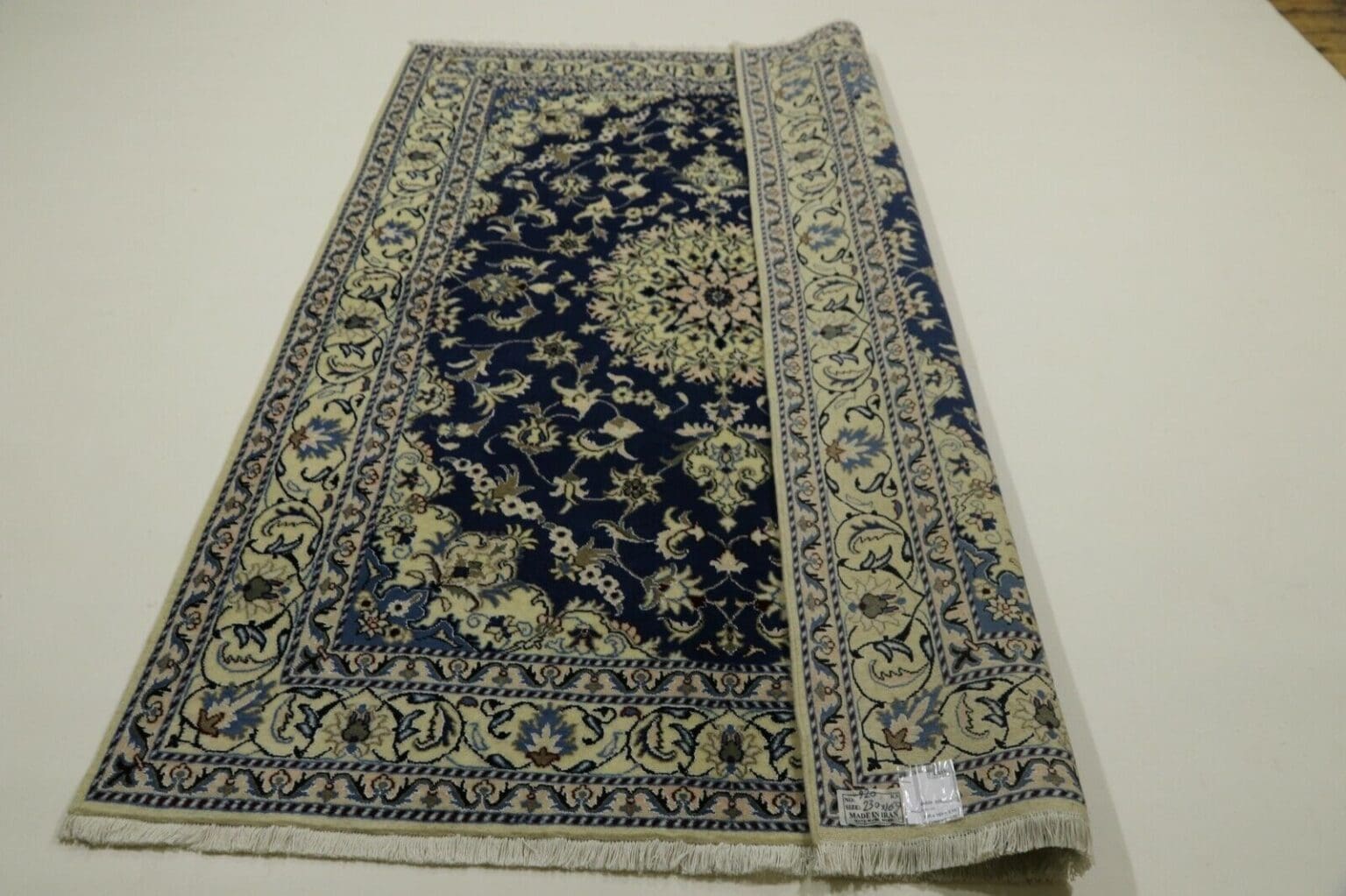
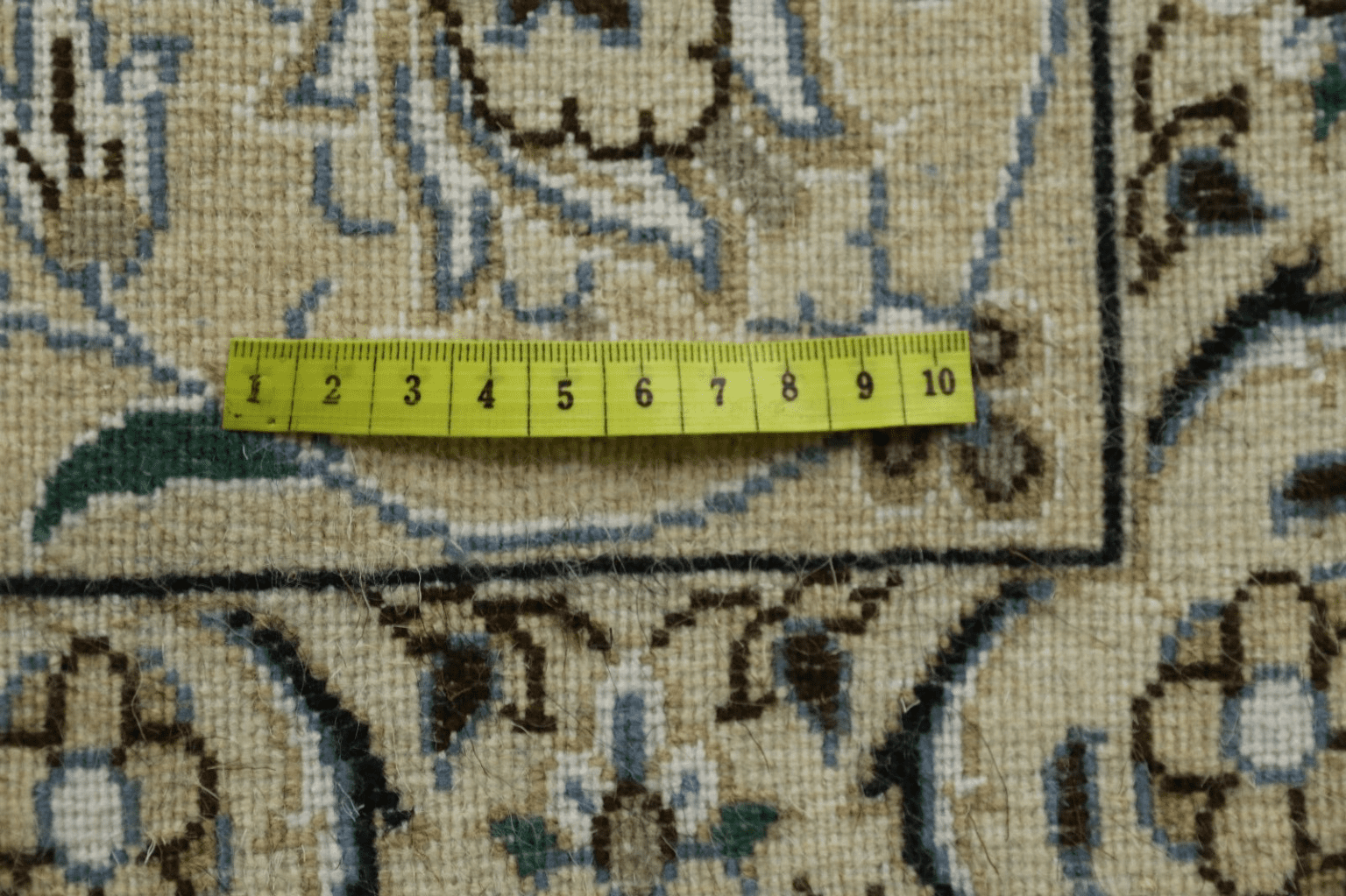
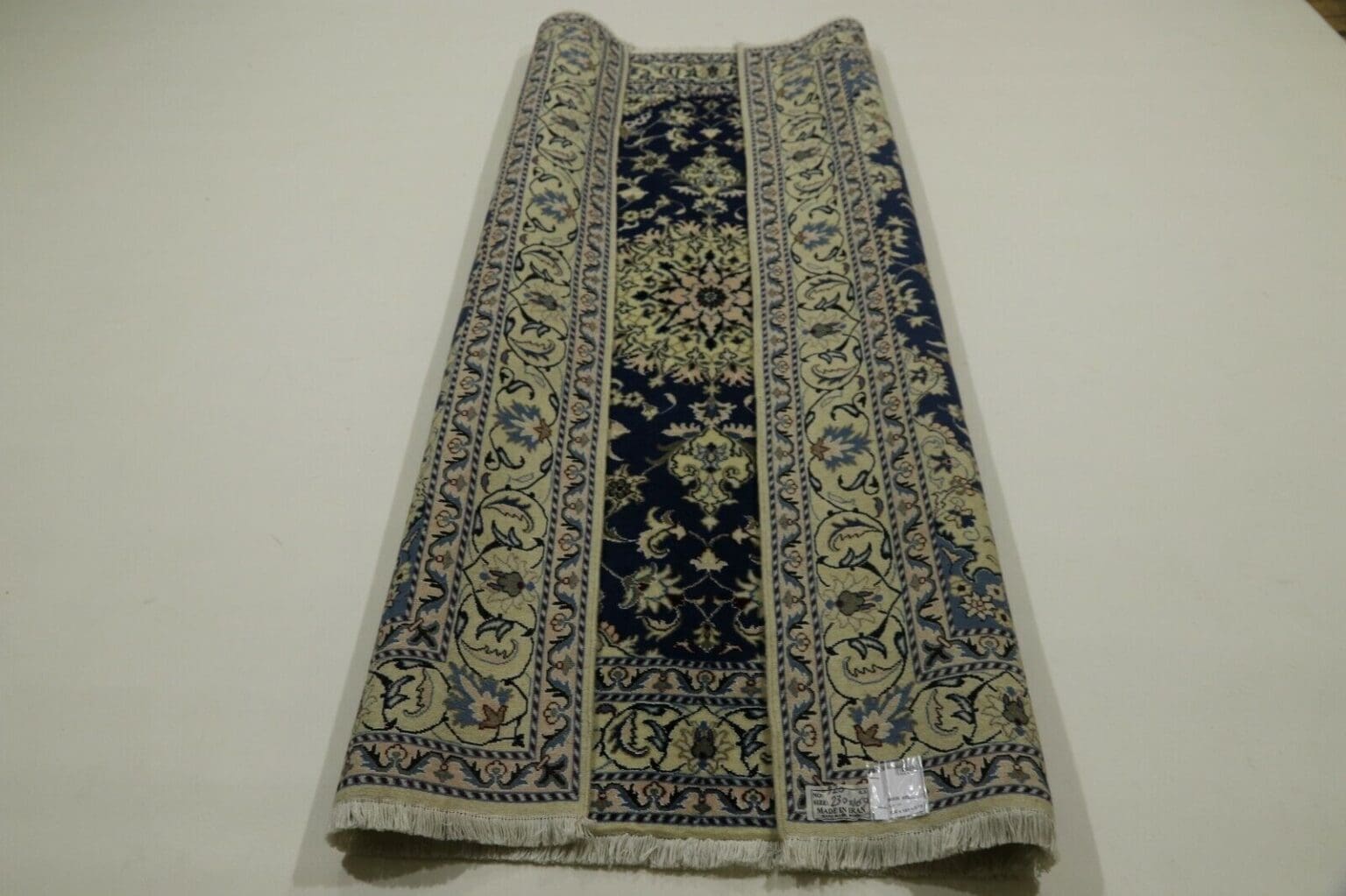
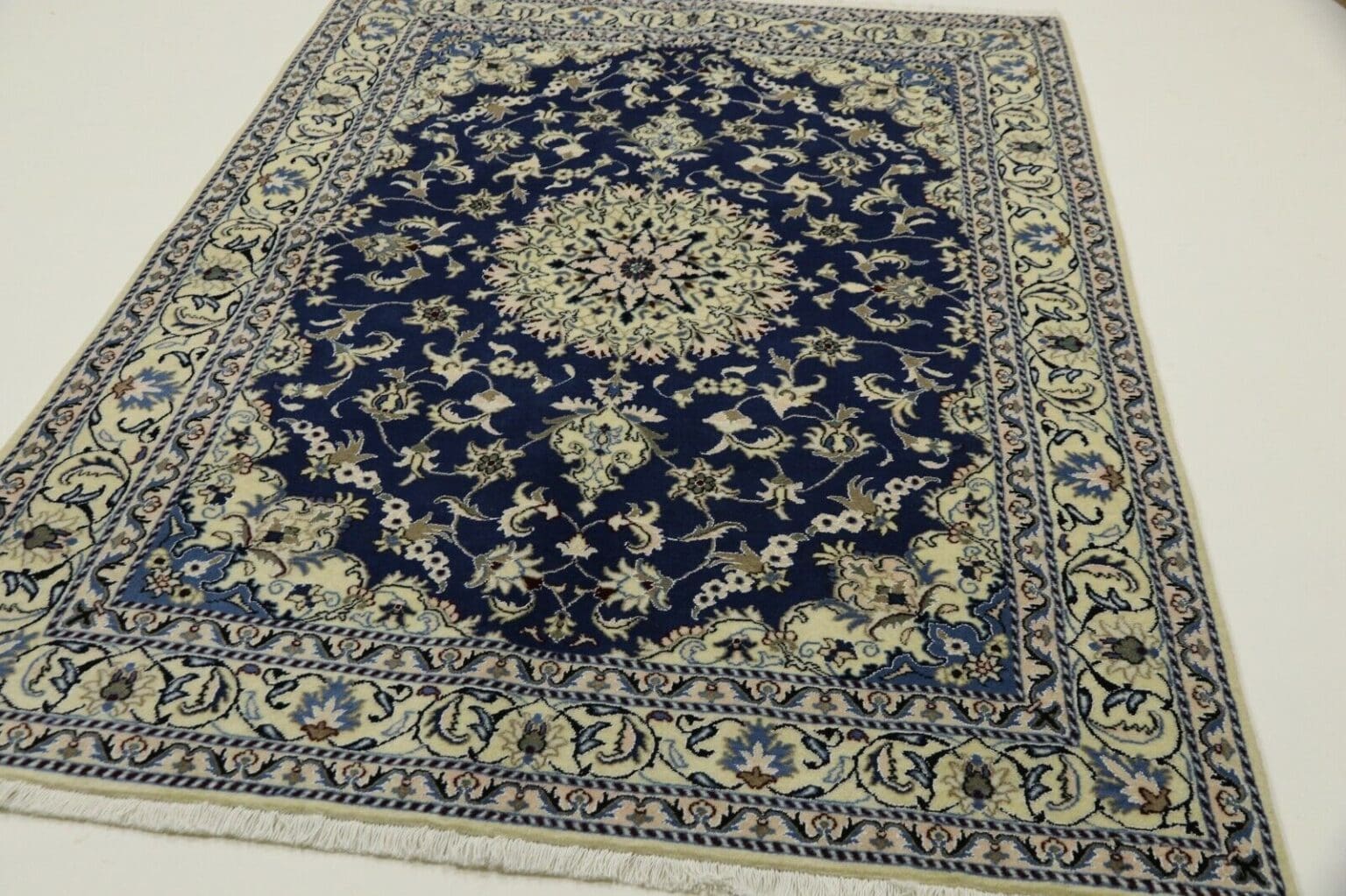
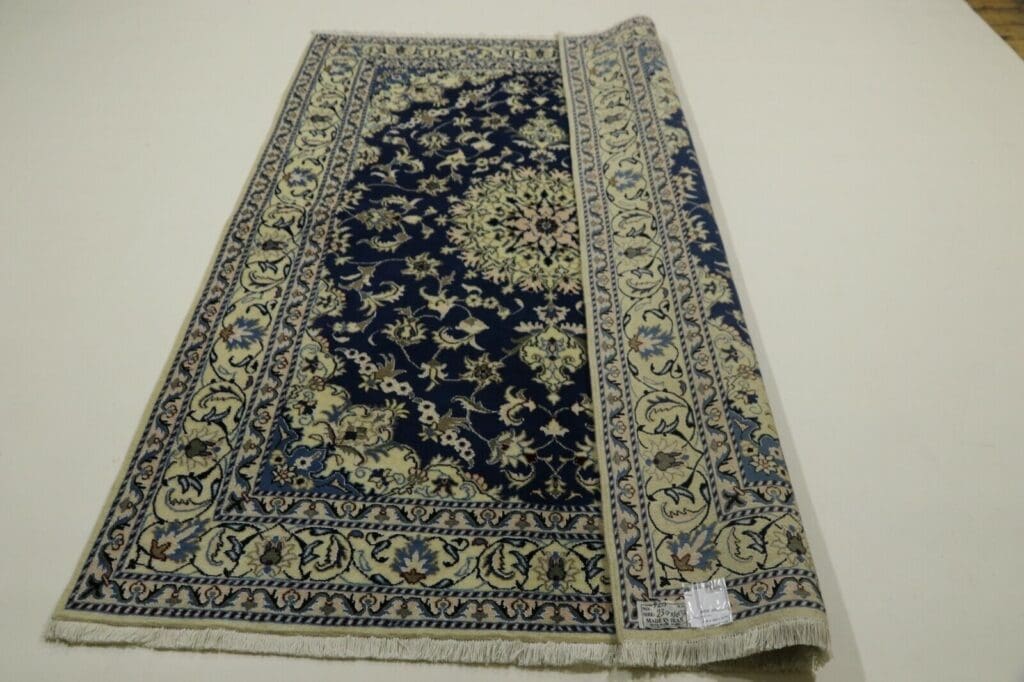
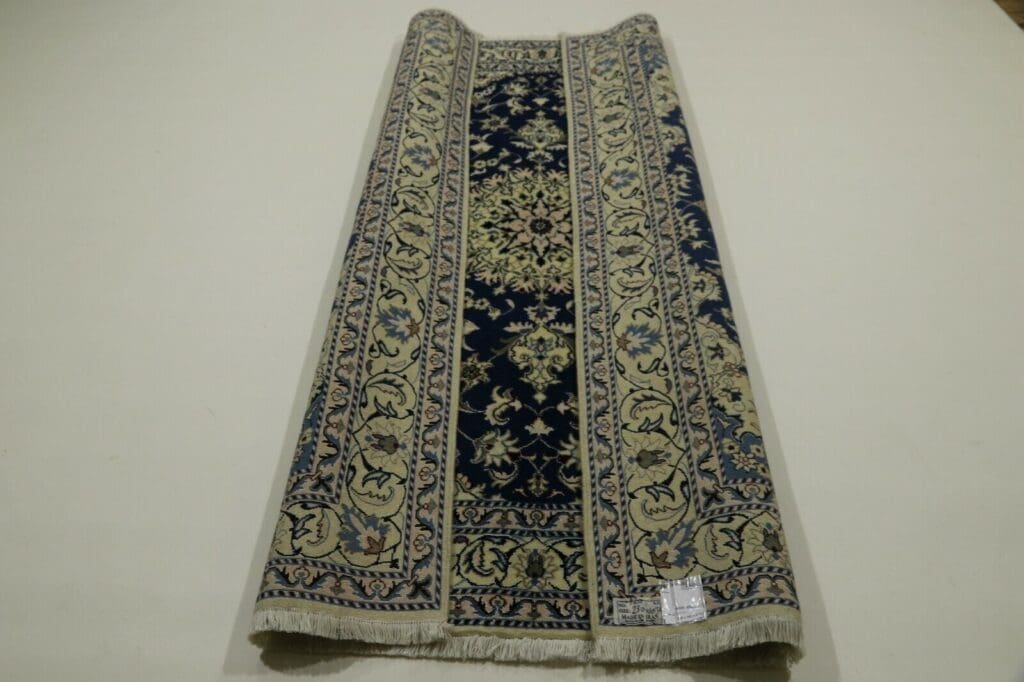
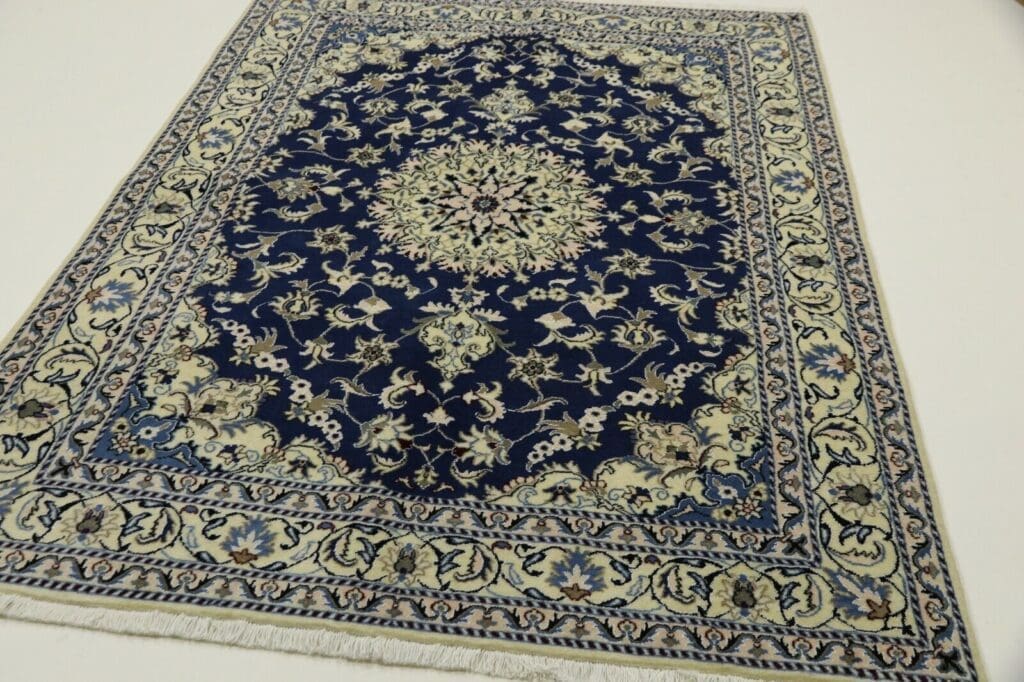
Hand-knotted Nain Persian Rug | Knot density: approx. 300,000 knots/m² | Material: pile 90% virgin wool and 10% silk | Size: 230 x 169 cm | Pattern: traditional Oriental/Persian | Condition: New, very good
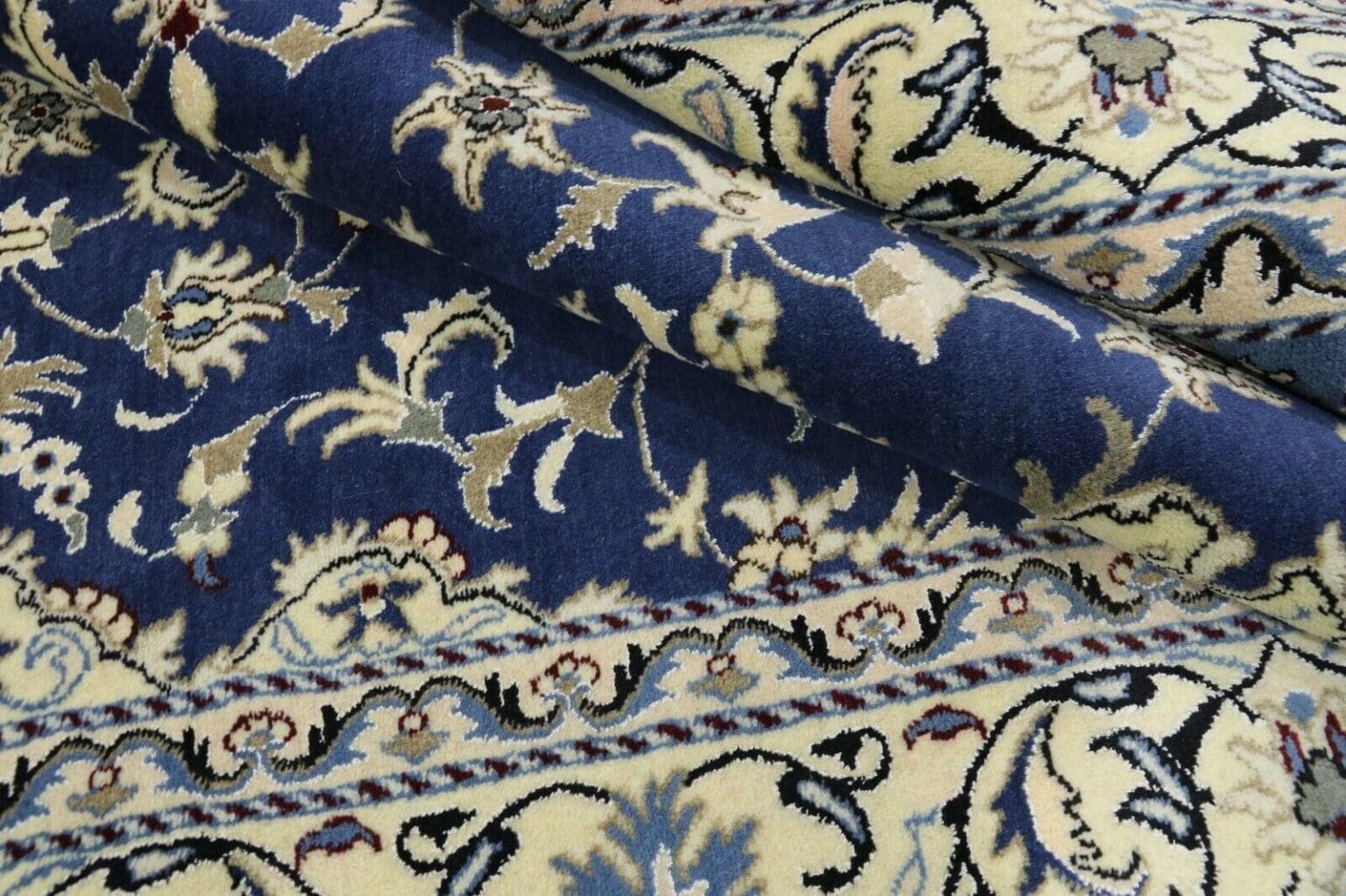
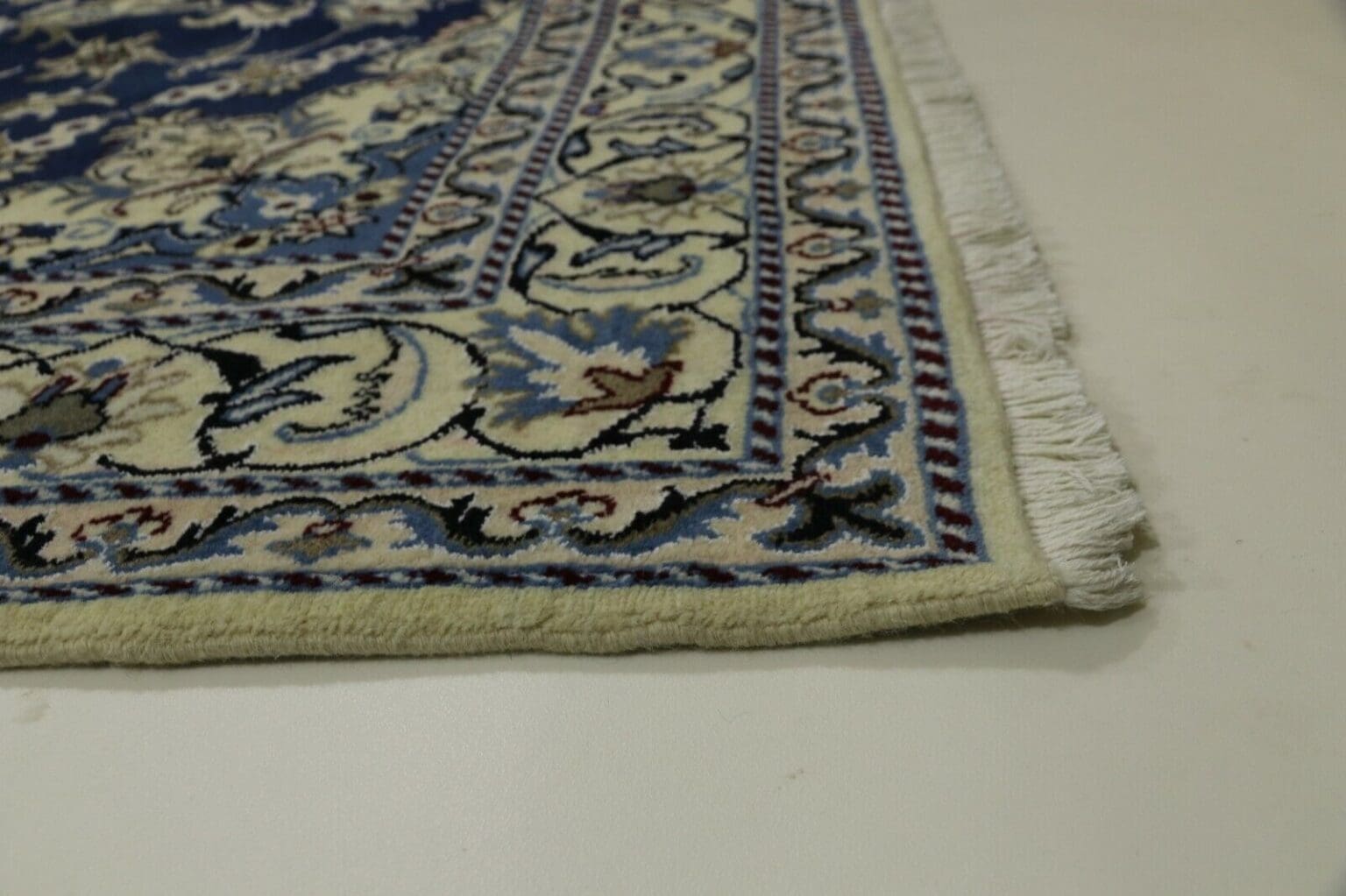
This Nain Persian rug is hand-knotted and has a pile made from 90% virgin wool and 10% silk. The two materials shape the surface in different but complementary ways. Virgin wool is a traditional textile for rug making. Its resilient fibres can retain warmth and help regulate moisture, making wool suitable for a floor covering intended for regular use in a living space.
The silk component adds a smoother handle and a restrained sheen to the wool pile. Silk can help contours and transitions appear clearly, while the wool provides a more substantial and resilient textile foundation. In a blend of virgin wool and silk, the character of the pile therefore comes from the interaction of durability, softness and surface lustre. No cotton warp is specified for this rug, so the material statement is limited to the pile composition given here.
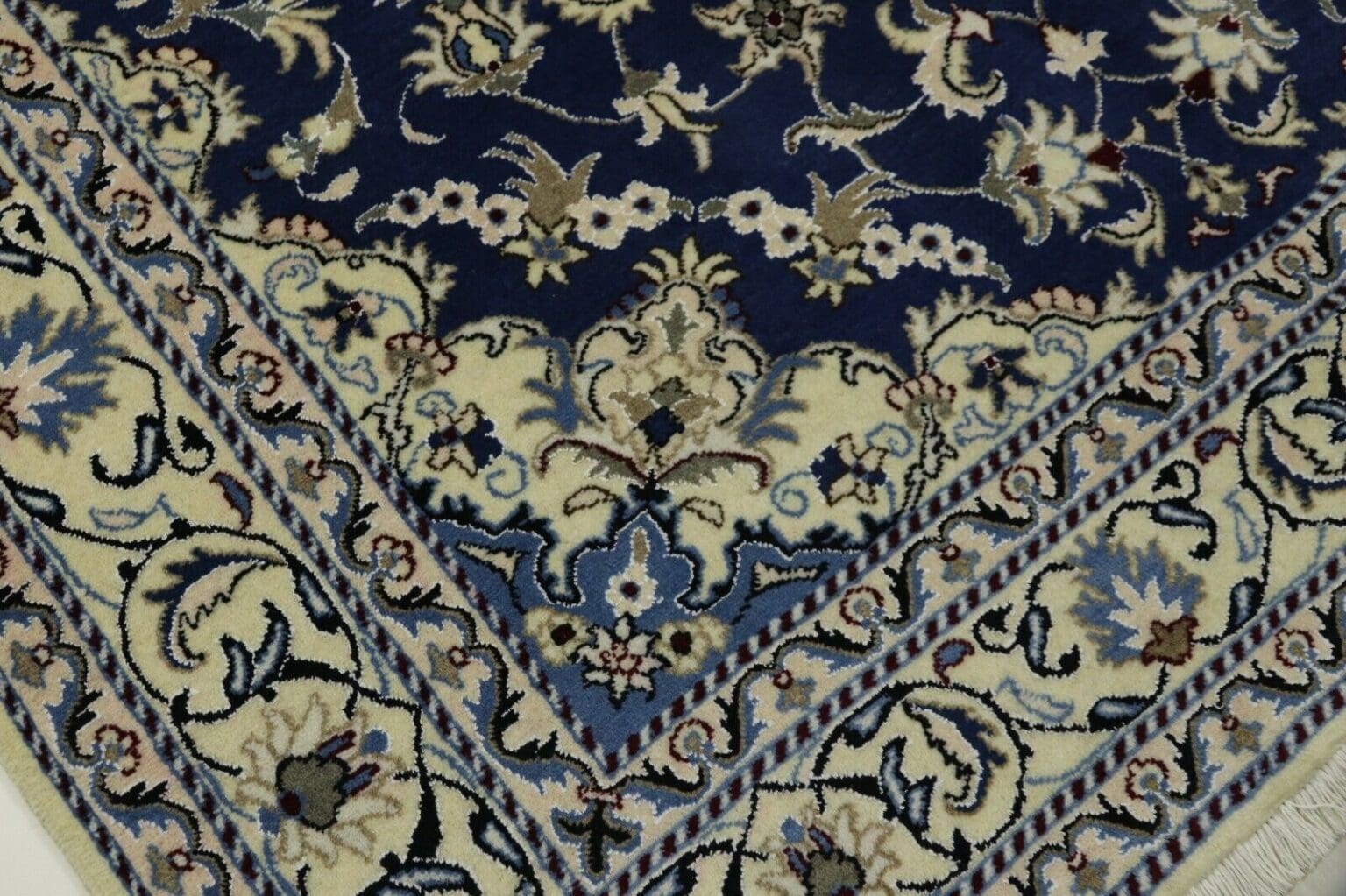
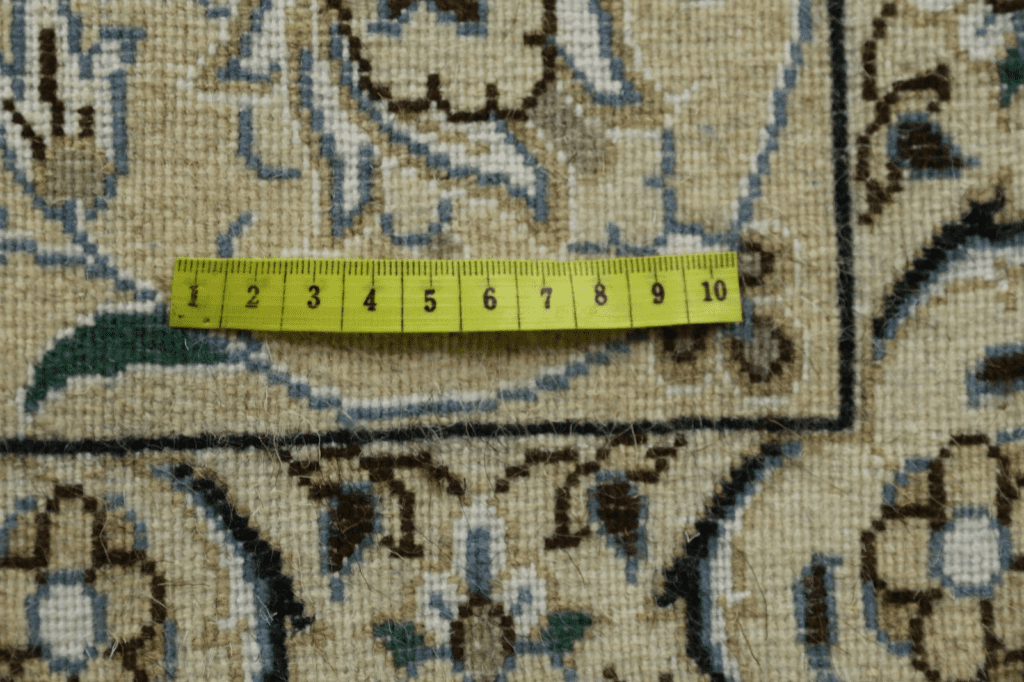
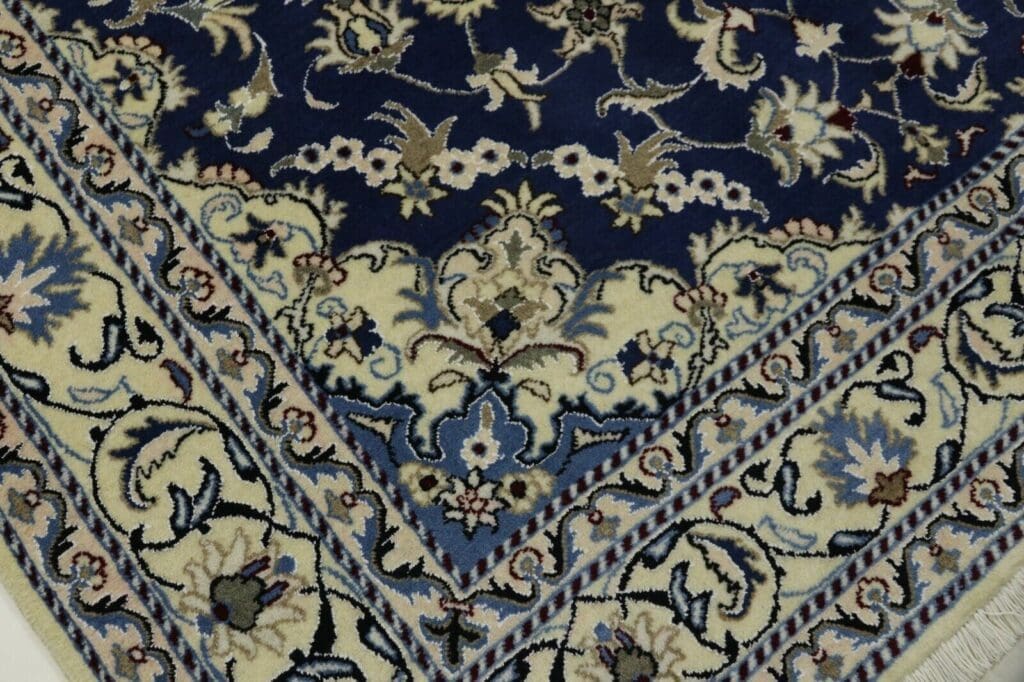
Hand-knotting is carried out one knot at a time. Unlike a machine-made floor covering, a hand-knotted rug is formed through the individual placement of knots into a prepared structure. This process requires time, experience and consistent workmanship. A density of approximately 300,000 knots per square metre indicates a closely worked surface and allows fine ornaments and transitions to be rendered with considerable differentiation. The knotting process gives each rug its own textile structure.
Hand-knotting is one of the established methods of Persian rug production and has been practised in Iran for centuries. The method combines inherited knowledge with the careful selection and handling of textile materials. In this piece, the production method is identified as hand-knotted, while the pile composition and knot density are also specifically stated.
Origin and Tradition
This rug comes from Nain in Iran. Nain lies east of Isfahan and is known for its rug production. The city has a strong cultural and craft tradition and has been recognised as a centre of rug making since the nineteenth century. The origin places this rug within a regional weaving culture associated with fine workmanship and carefully organised designs.
Nain’s rug tradition developed within the wider history of Iranian knotting. In this tradition, knowledge of knotting methods, material preparation and pattern construction is passed from one generation to the next. A rug is not created by knots alone. The preparation of the foundation, the even control of tension and the measured execution of a design are also important. Hand production makes these stages part of the object’s textile character.
Nain rugs are traditionally associated with a fine knot density and elegant patterns. Close knotting enables weavers to arrange small forms, narrow lines and gradual transitions with precision. It also supports a composed, continuous appearance across the pile. The designation Super Nain is part of the product name here; it is not used to introduce an additional material, date or provenance that has not been specified.
The Nain region is also connected with a balanced approach to colour and form. Traditional designs from the area often use harmonious colour relationships and a clearly ordered ornamental language. This regional tradition belongs to the general identity of Nain rugs and helps explain why Nain is recognised as a distinct Persian weaving origin in the international rug trade.
Iran contains many established weaving centres, each with its own visual vocabulary and working traditions. Nain occupies a particular place among them because the city is associated with finely knotted and elegant rugs. The combination of regional knowledge and careful handwork is therefore relevant when classifying a rug from Nain. This piece is identified as a Persian rug from Nain and consequently as an Iranian work.
Design and Pattern
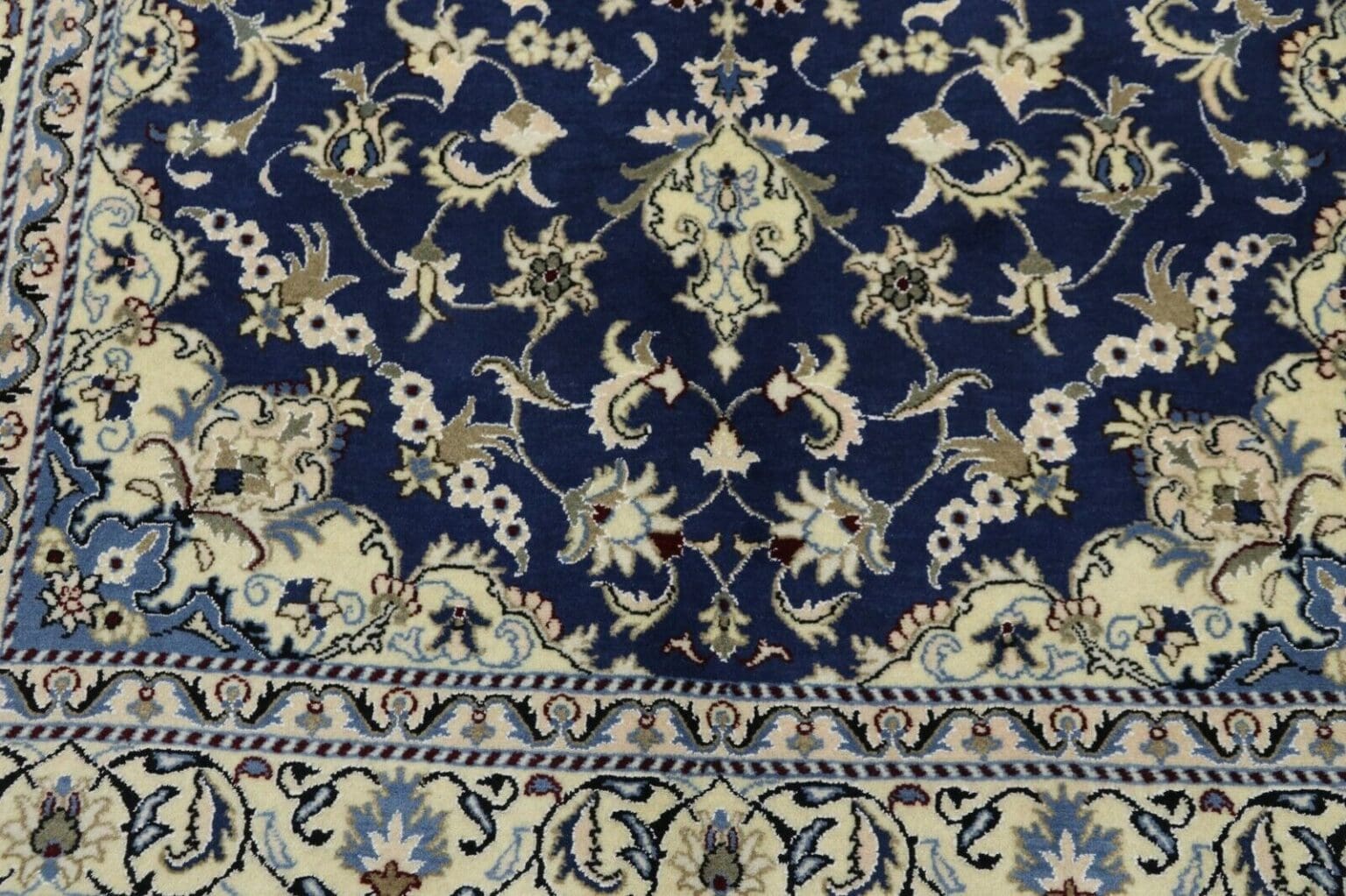
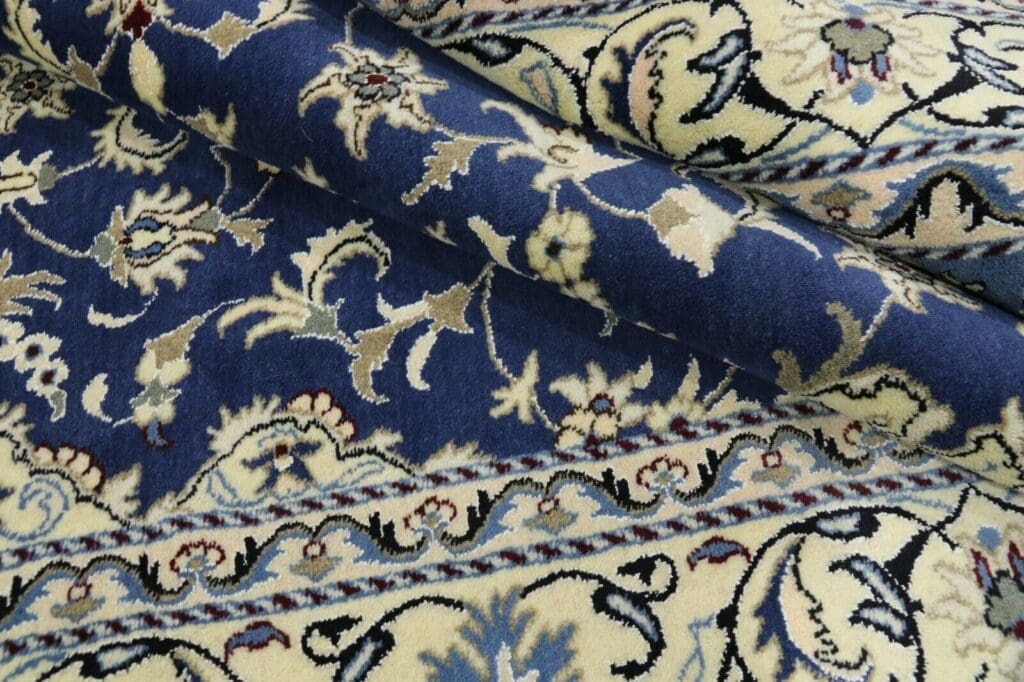
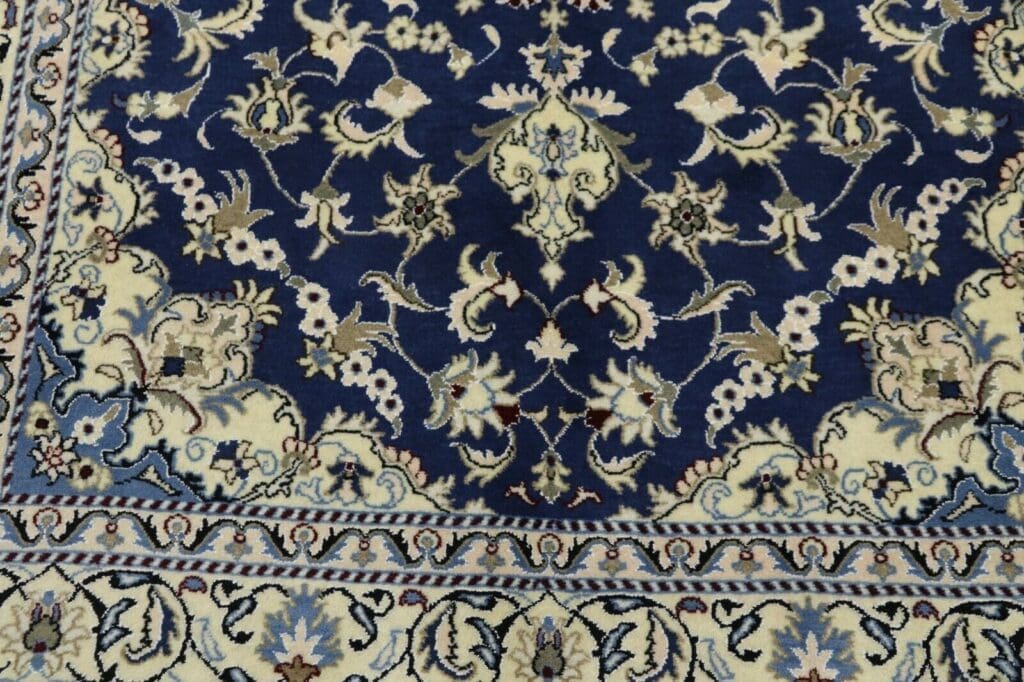
The style of this rug is listed as traditional Oriental/Persian. Nain rugs are generally associated with floral motifs and geometrically ordered elements. Floral forms may appear as stylised leaves, blossoms and vines, while geometric structures create order through axes, repetition and symmetry. Persian rug design often brings these two levels together, allowing organic ornament and measured composition to share the same field.
In Nain designs, the organisation of the surface is important. A central medallion, a continuous network of vines or a carefully balanced all-over composition are among the established possibilities within the regional vocabulary. These are general characteristics of Nain design, not unreported details of this individual rug. For the piece offered here, the source identifies a traditional Oriental/Persian style but does not specify a particular medallion, border arrangement or motif.
Ornaments are connected through repeated lines, leaf forms and controlled proportions. Fine hand-knotting can reproduce such contours with precision. The stated knot density supports the general ability to render small design elements, but it does not justify assigning a specific drawing to the rug when that drawing is not described. The visual language of a Nain rug is understood through the relationship between layout, ornament rhythm and the discipline of its craftsmanship.
Traditional Nain colour schemes are often harmonious and restrained. Blue is frequently used in the regional design language, together with light cream or beige tones. Such colour families can provide a quiet ground for floral and ornamental forms. The source does not give specific colours for this rug, however. The colour discussion therefore describes the Nain tradition rather than claiming a particular palette for this one-off piece.
Persian patterns often reflect cultural and historical design principles. Motifs are arranged according to ideas of symmetry, repetition and balance rather than placed at random. This gives the field a sense of order and allows separate ornaments to remain connected within the overall composition. Nain is associated with an elegant and finely articulated interpretation of these principles. The listed traditional Oriental/Persian style places the rug within that broader design vocabulary.
A hand-knotted rug carries its pattern not only as a graphic arrangement but also as a woven structure. Small variations in tension and knot formation are part of manual production and make the making process legible without disrupting the intended order of the design. In this Nain Persian rug, regional design tradition, hand craftsmanship and the combination of virgin wool and silk are therefore considered together.
Special Features
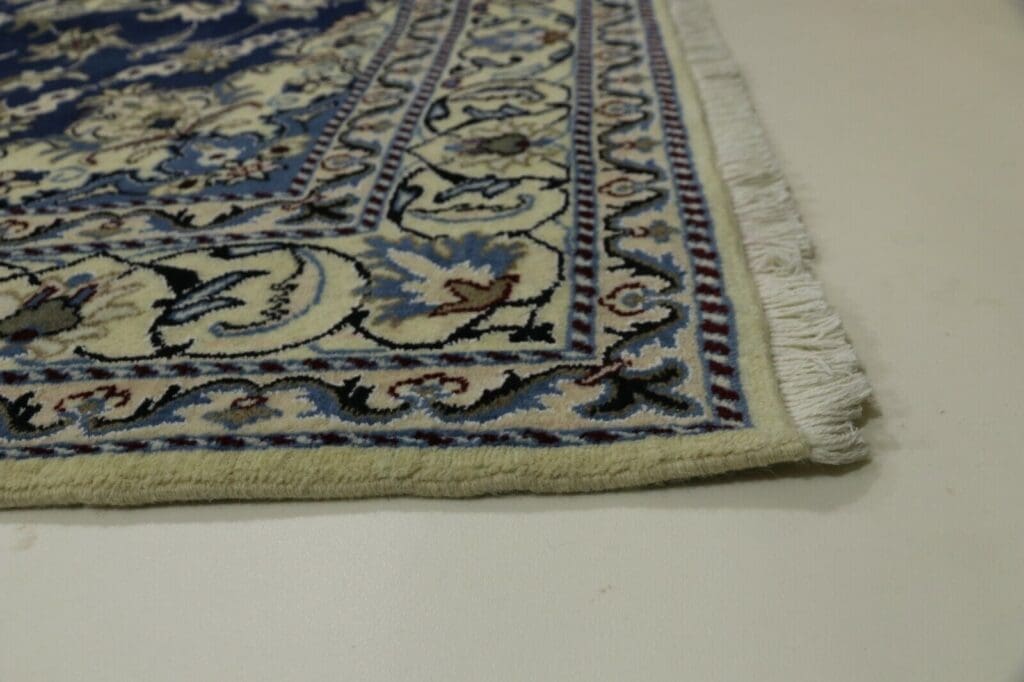
The rug is described as new and in very good condition. It is suitable for use with underfloor heating. This suitability allows it to be used in living spaces with a heated floor, while an appropriately moderate temperature setting should still be observed. The combination of virgin wool and silk brings together a resilient textile base and a finer surface character.
As a hand-knotted rug from Iran, this piece belongs to a production method in which every knot is made by hand. Its stated knot density, its specified pile composition and its new, very good condition are the concrete features of this offering. No signature, production date or particular colour scheme is provided, so none of those details is assigned to the rug here.
FAQ
How should a Nain Persian rug be cared for?
For routine care, vacuum the rug gently without using a brush. This removes dust and loose soil while avoiding unnecessary mechanical stress on the pile. For deeper stains, professional rug cleaning is recommended. Specialist cleaning is the safer choice for a pile made from virgin wool and silk because unsuitable products or methods can damage the fibres or alter the surface.
Can the rug be used over underfloor heating?
Yes. This Persian rug is suitable for use with underfloor heating. Wool has good thermal conductivity and can therefore be used above a heated floor. The temperature should not be set too high, however. A moderate setting helps preserve the textile structure and the material properties of the rug during use.
What are the benefits of a hand-knotted rug?
In a hand-knotted rug, every knot is made by hand. This produces an individually crafted one-off with its own structure and character. Hand-knotted rugs are valued for their quality and durability. When natural materials such as virgin wool and silk are used, the result is also a textile floor covering whose production generally requires less energy than the manufacture of many industrial alternatives.
To provide the best experiences, we use technologies like cookies to store and/or access device information. Consenting to these technologies will allow us to process data such as browsing behavior or unique IDs on this site. Not consenting or withdrawing consent, may adversely affect certain features and functions.
Functional Always active
The technical storage or access is strictly necessary for the legitimate purpose of enabling the use of a specific service explicitly requested by the subscriber or user, or for the sole purpose of carrying out the transmission of a communication over an electronic communications network.
Preferences
The technical storage or access is necessary for the legitimate purpose of storing preferences that are not requested by the subscriber or user.
Statistics
The technical storage or access that is used exclusively for statistical purposes.The technical storage or access that is used exclusively for anonymous statistical purposes. Without a subpoena, voluntary compliance on the part of your Internet Service Provider, or additional records from a third party, information stored or retrieved for this purpose alone cannot usually be used to identify you.
Marketing
The technical storage or access is required to create user profiles to send advertising, or to track the user on a website or across several websites for similar marketing purposes.

 SECURE PAYMENT
 SHIPPING PARTNERS


