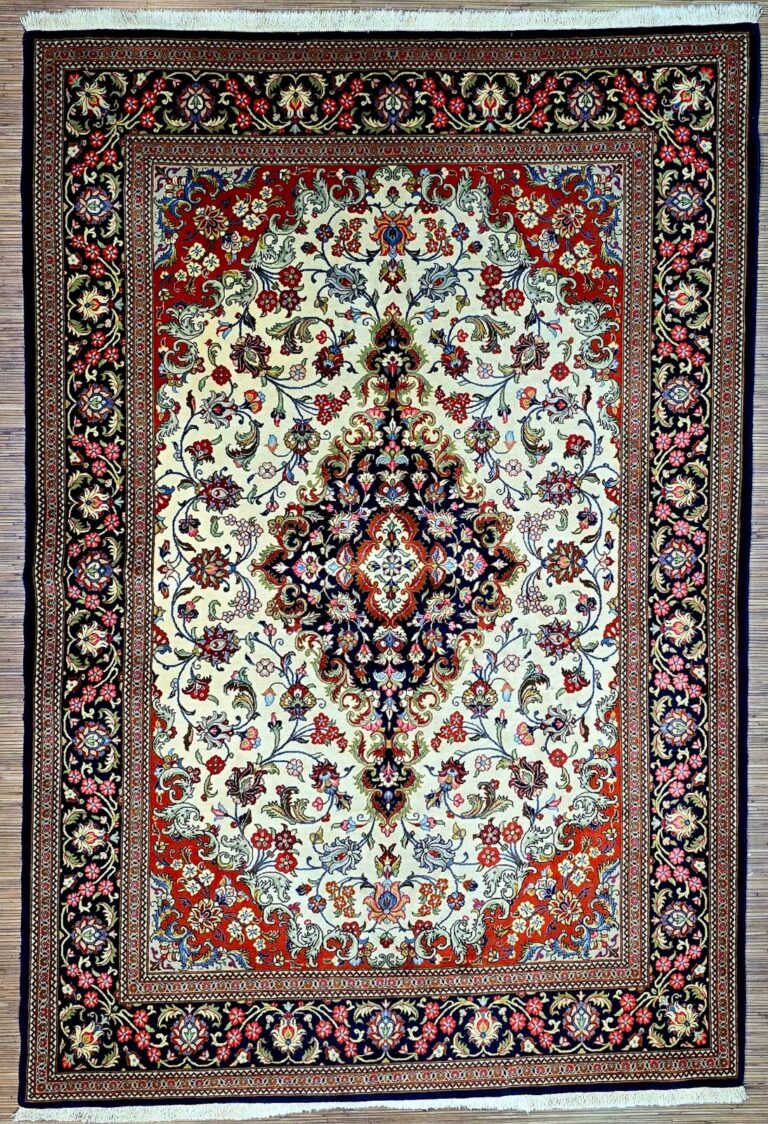
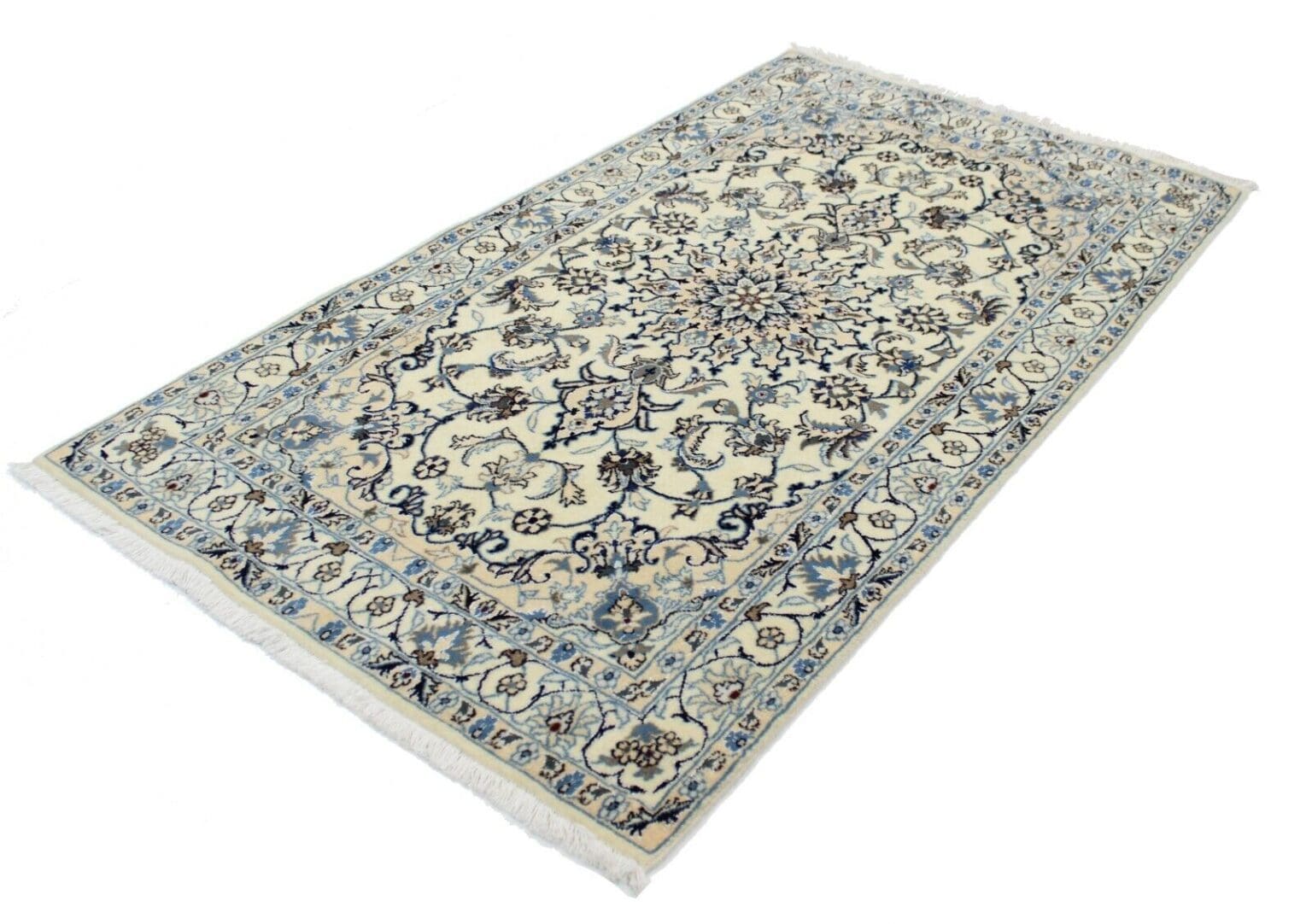
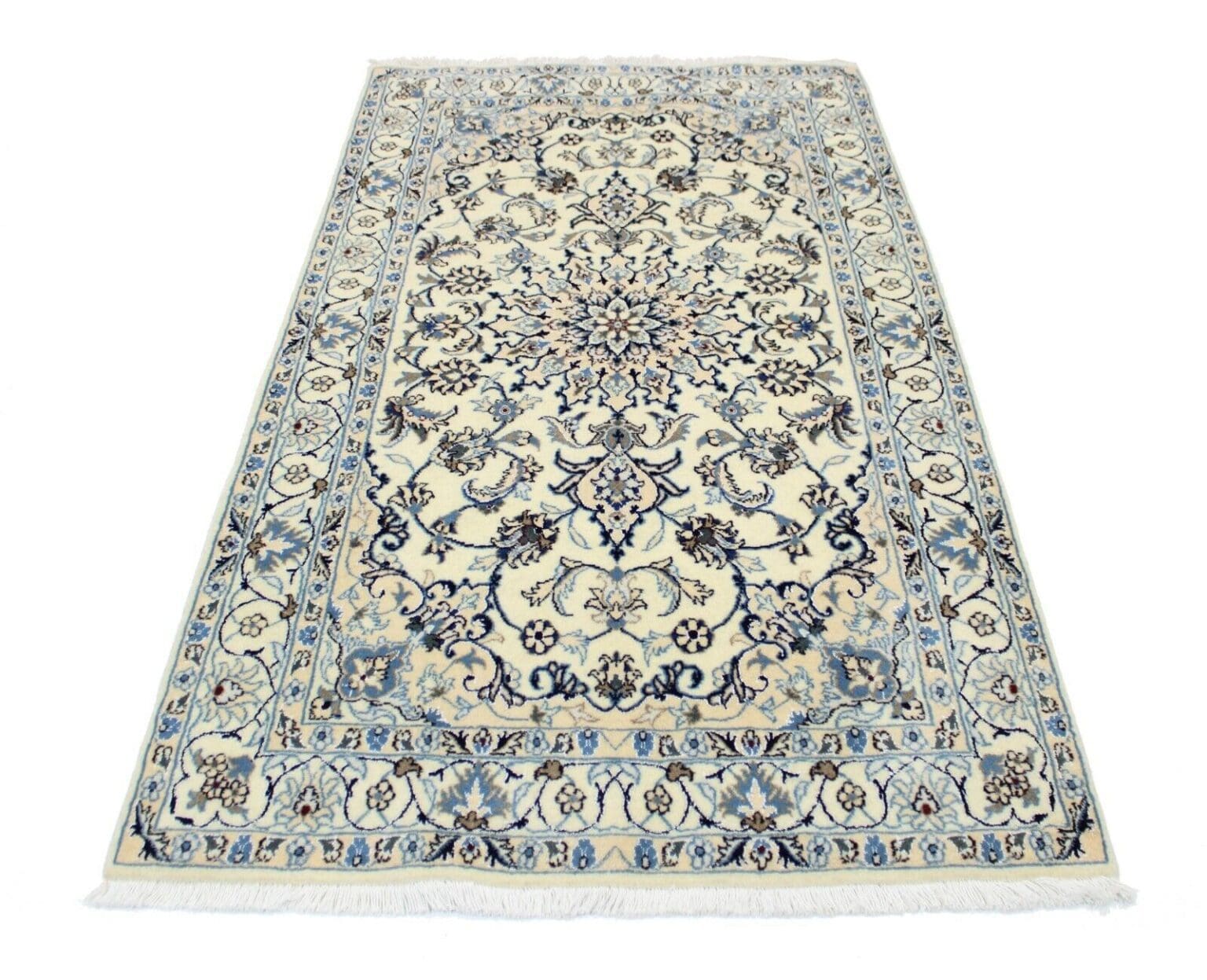
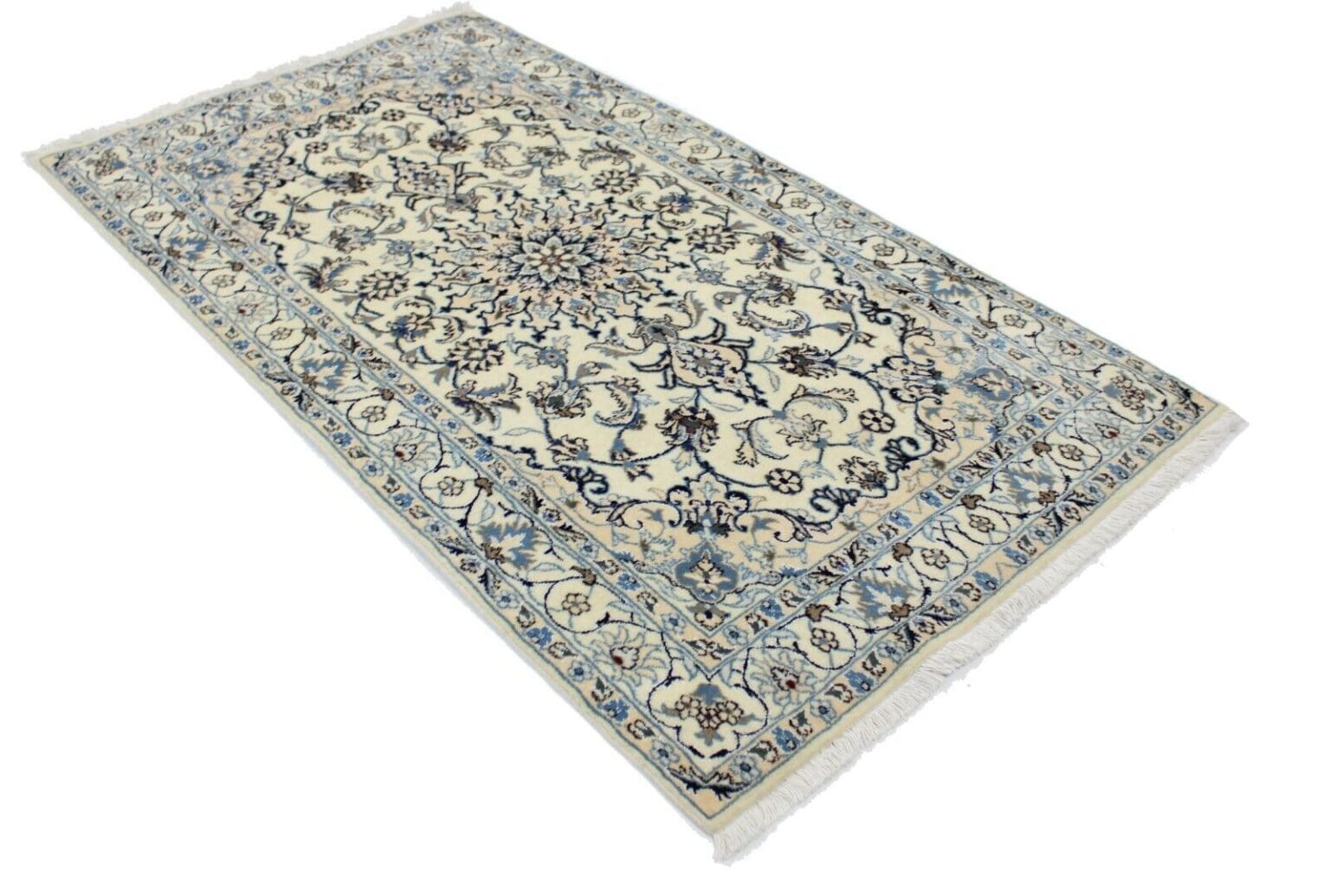
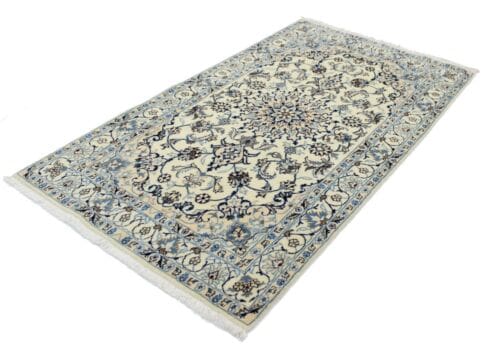
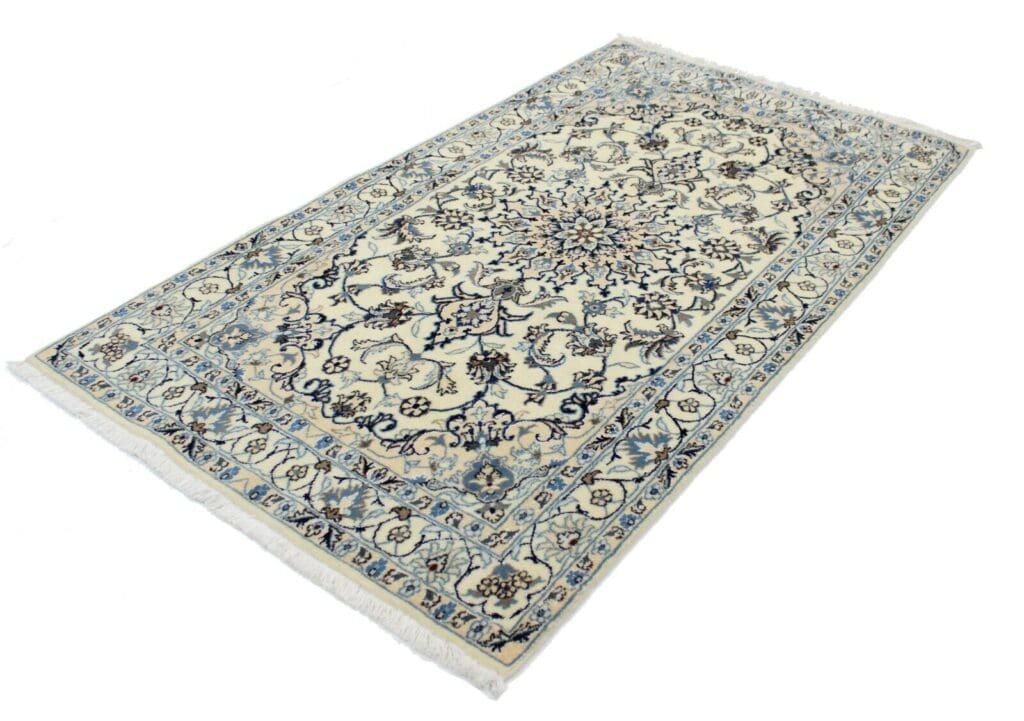
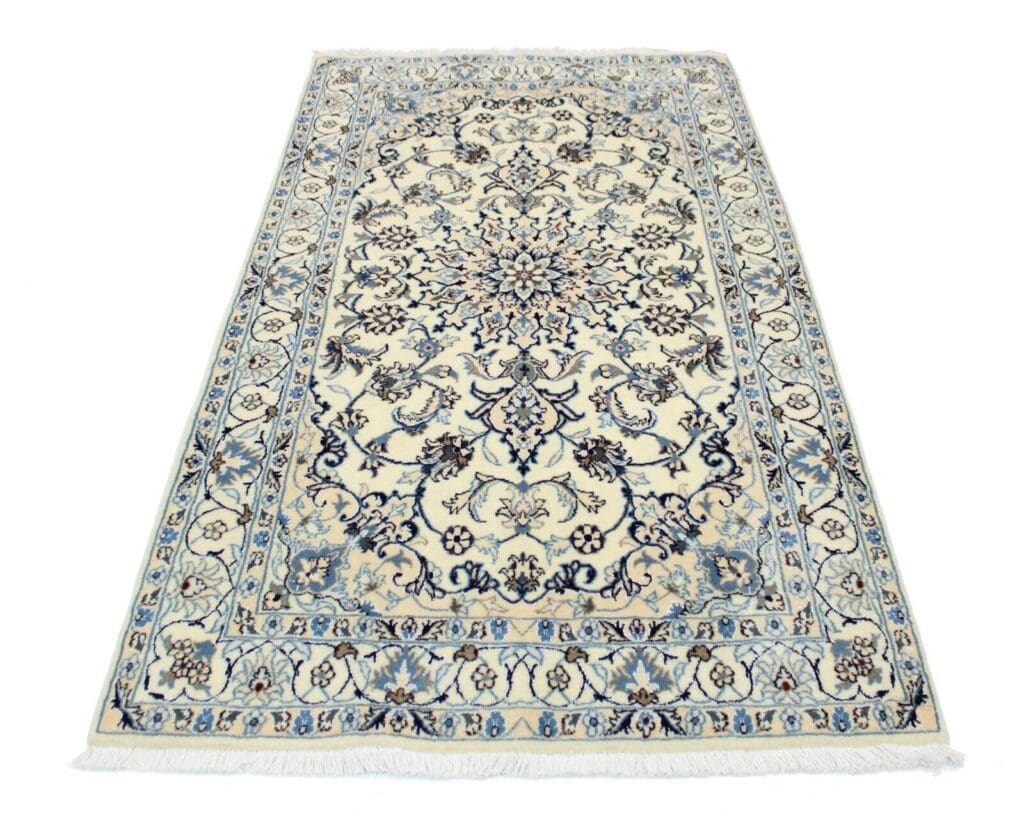
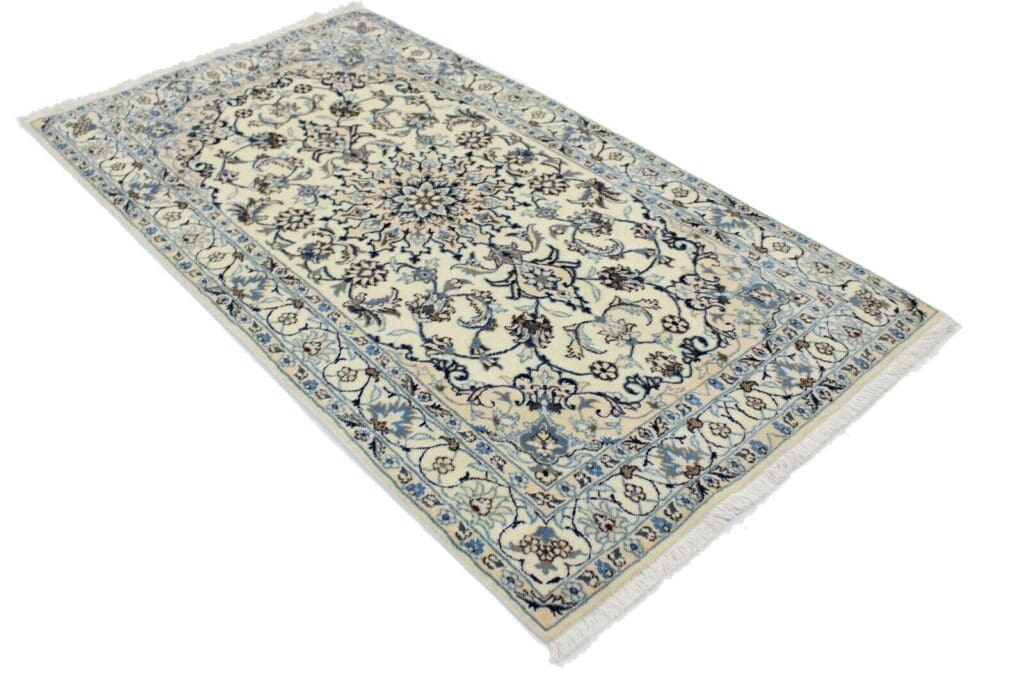
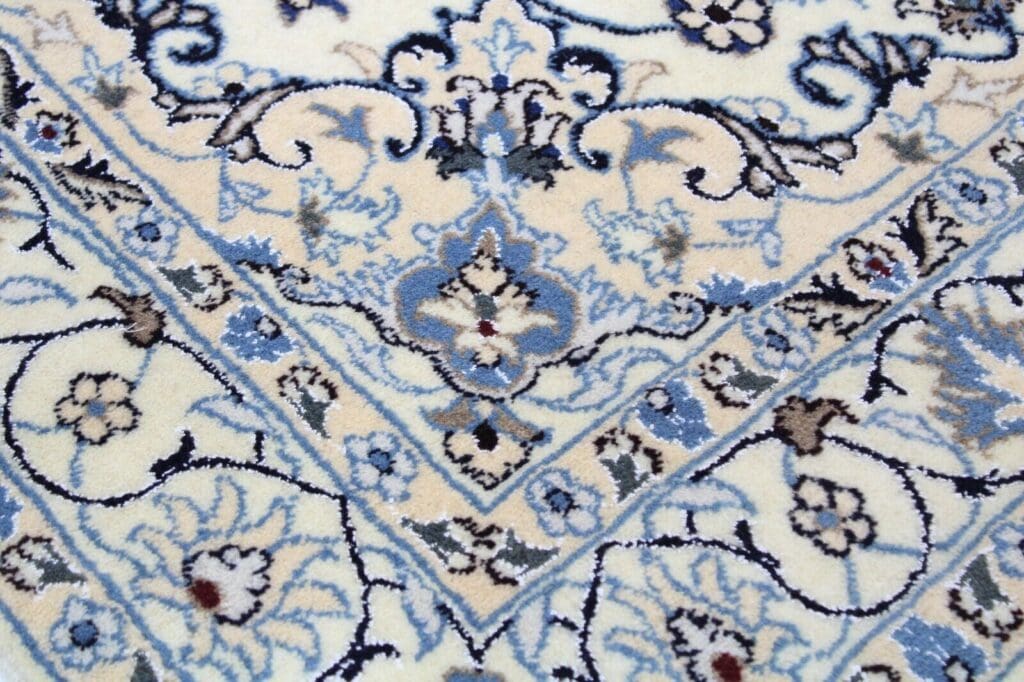
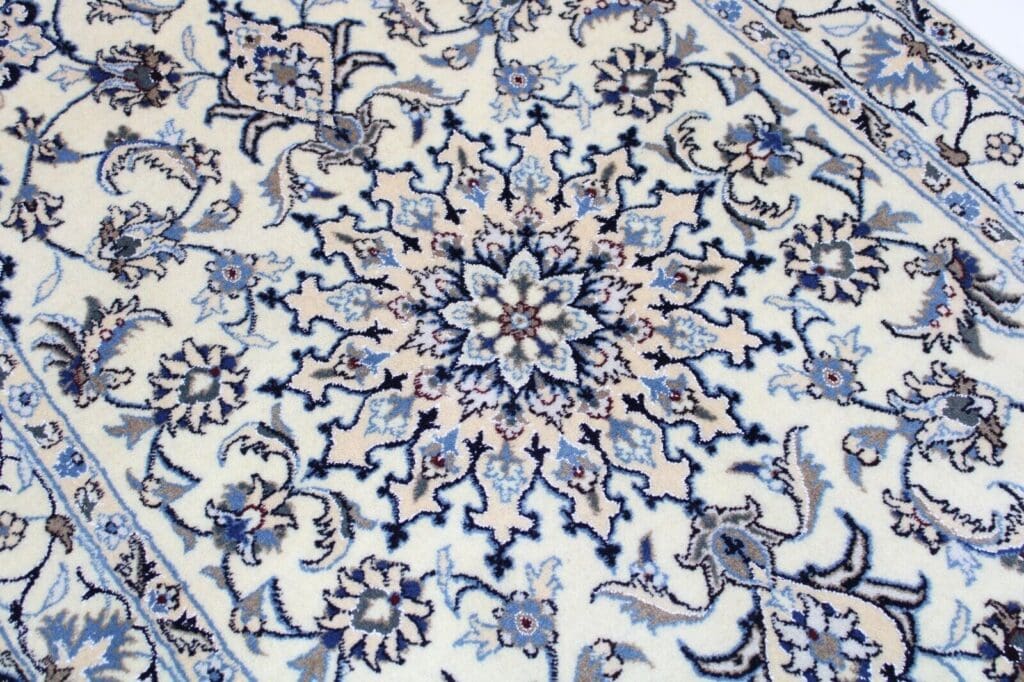
Hand-knotted Nain Persian Rug | Material: fine wool and silk are typical of Nain rugs | Size: 215 x 119 cm | Pattern: floral and geometric motifs in soft blue, cream and earth tones | Condition: excellent
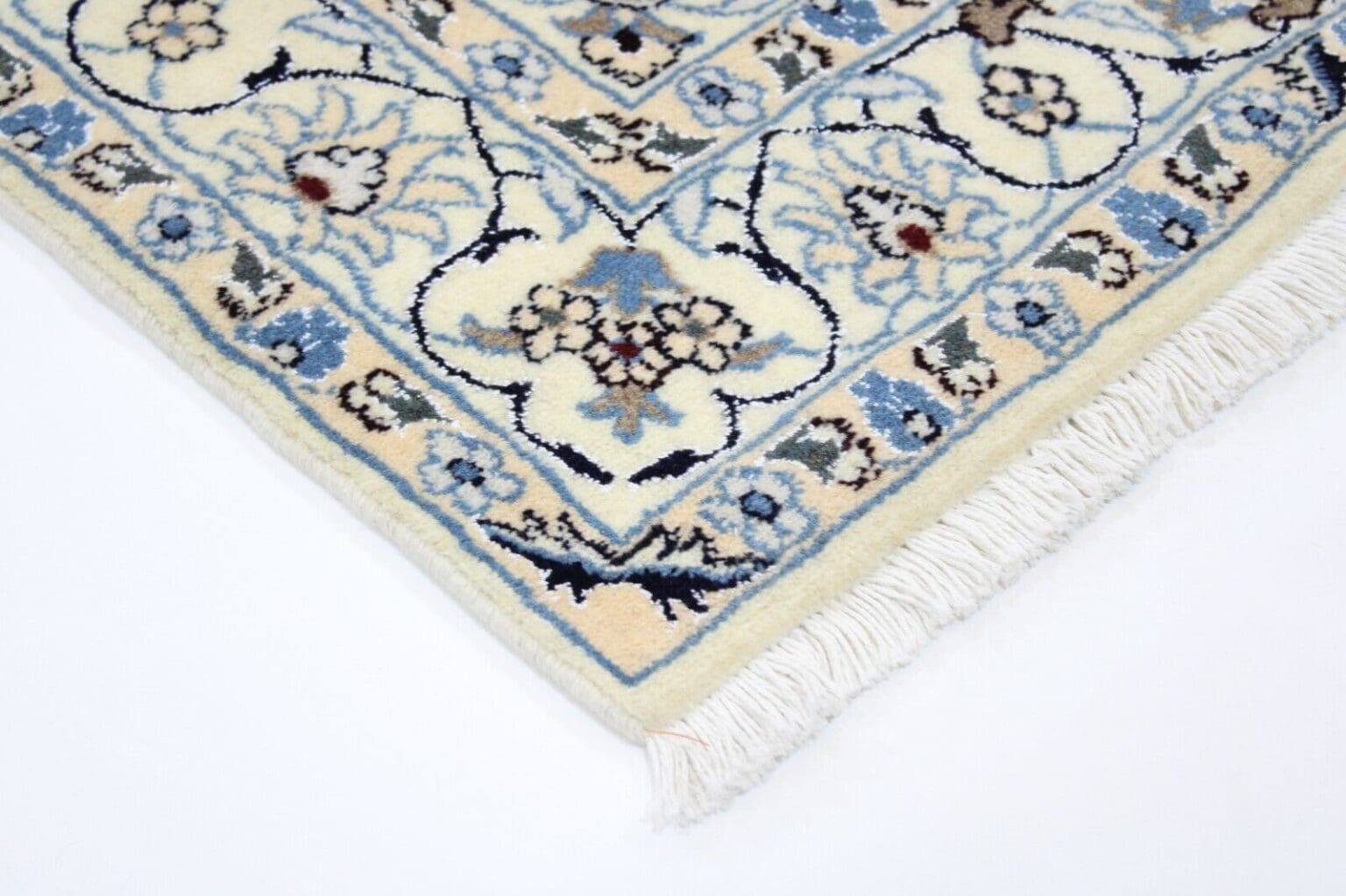
This original Nain Persian rug is hand-knotted. Hand knotting is a traditional process in which individual knots are formed by hand and placed row by row around the warp. The structure allows the design to be built with considerable precision and gives the finished textile a distinctive woven character. The source describes the piece as finely made and in excellent condition.
Nain rugs are commonly made with fine wool and silk. Wool is valued for its resilience and practical suitability as a pile fibre, while silk is traditionally used to create a particularly fine surface and to define delicate details. Depending on the construction, these materials can be used in different parts of the rug and can contribute both to the tactile quality and to the clarity of the pattern. No separate warp material is specified for this rug.
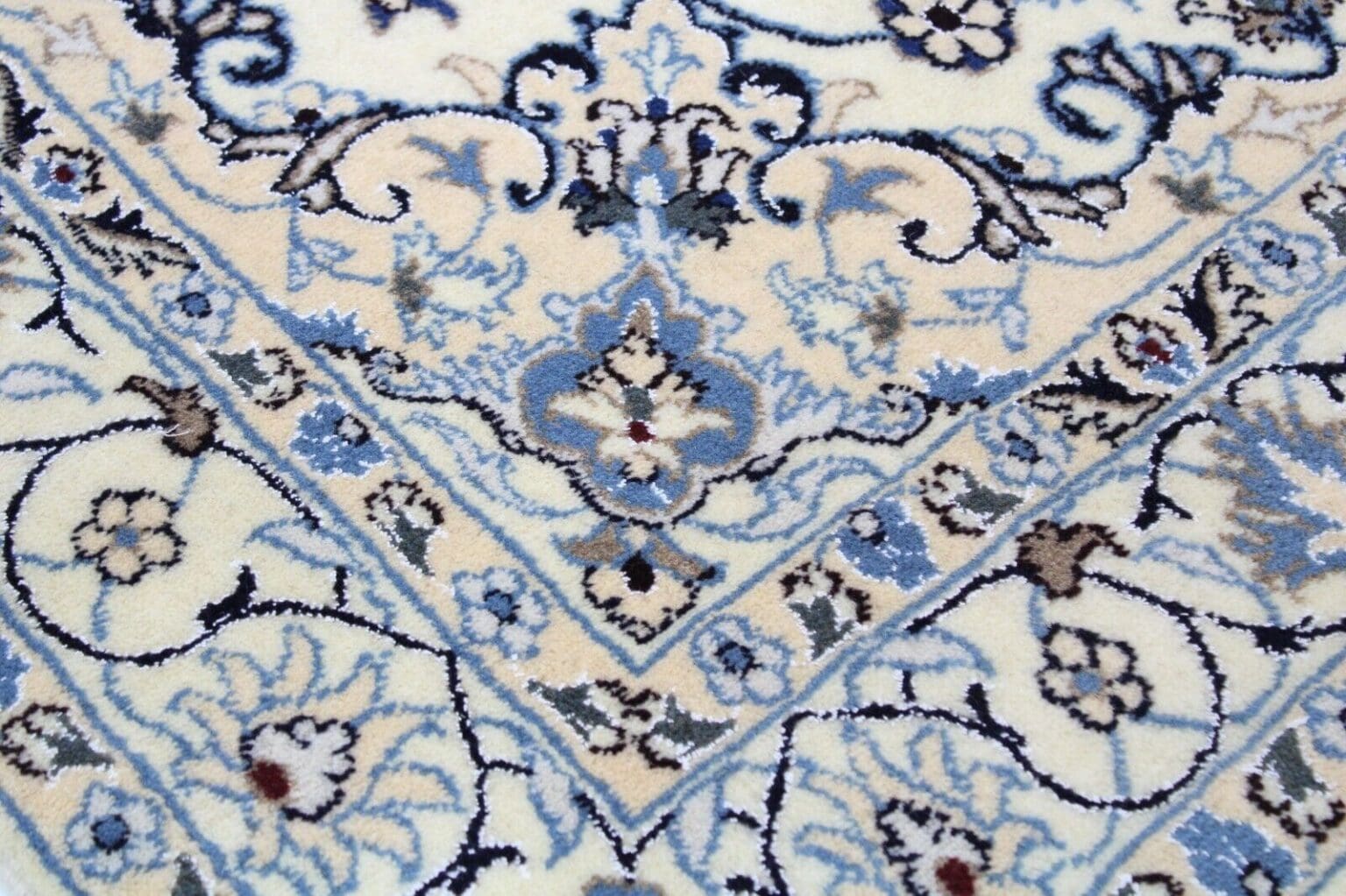
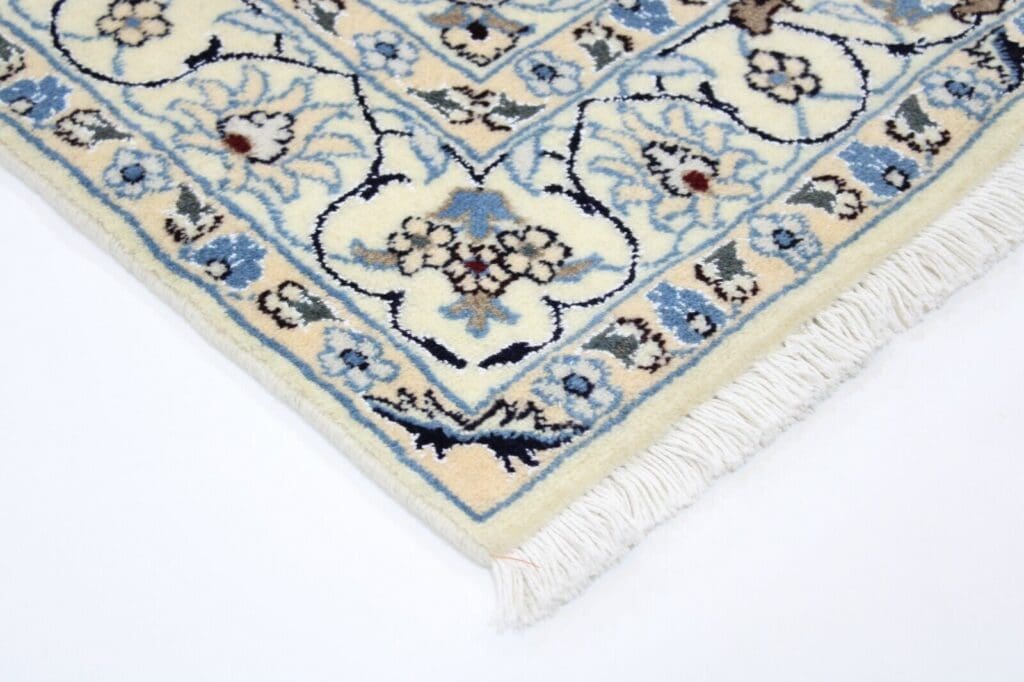
A finely knotted rug permits small floral elements, narrow outlines and balanced geometric details to be rendered with accuracy. The hand-knotted construction also makes it possible for the design to remain visually coherent across the field and border. Nain weaving is associated with careful execution, controlled drawing and an orderly surface, qualities that are reflected in the traditional character of this piece without requiring any claim about an unstated knot count.
The rug is described as being in excellent condition. Careful everyday handling and suitable cleaning help preserve the pile, colours and overall structure of a hand-knotted textile. Since the rug is an individual piece, its character is found in the combination of its hand-made construction, its Nain design tradition and the condition recorded for this example.
Origin and Tradition
Nain is a city in Iran known for its carpet production. The region has a long tradition of carpet weaving, and Nain rugs have become recognised for their controlled drawing, fine appearance and elegant arrangement of ornament. The name Nain therefore refers to an established Iranian weaving tradition rather than to a single fixed pattern. Within that tradition, individual rugs can differ in scale, colour balance and the way floral and geometric elements are combined.
Iranian carpet weaving developed through generations of practical knowledge. Weavers work with a design plan, prepare the foundation, tie the knots and secure the rows as the textile grows. The process demands patience and consistency, because the drawing must be maintained over the entire field. Traditional workshop practice also includes finishing steps such as trimming, securing the edges and preparing the rug for use. These stages help explain why hand-knotted Persian rugs are regarded as both functional textiles and works of applied art.
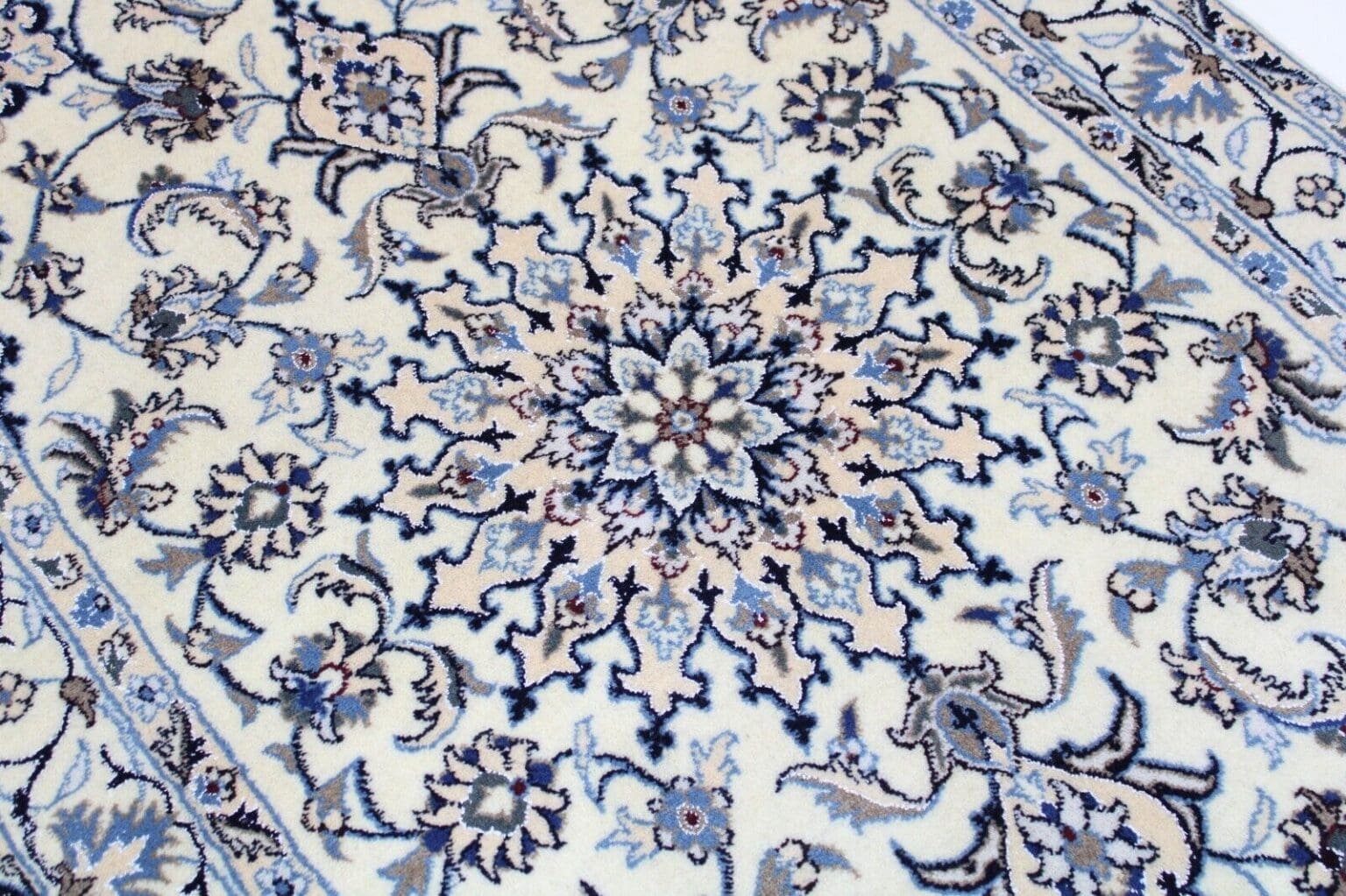
Nain rugs are associated with clear lines and refined ornament. Their designs often use a measured central organisation, repeated botanical forms and geometric structure. This order is not merely decorative; it reflects the discipline of the weaving process and the importance of keeping the relationship between field, border and individual motifs in balance. Floral drawing may be highly detailed, while the surrounding lines provide definition and visual rhythm.
The cultural significance of Persian rugs extends beyond furnishing. Carpet weaving forms part of Iran’s artistic and social history, with knowledge passed through families, workshops and regional traditions. A Persian rug can document the design vocabulary, technical habits and aesthetic preferences of the place in which its tradition developed. Nain’s reputation rests on the combination of precise workmanship, restrained elegance and a recognisable approach to pattern.
This rug belongs to that Nain tradition and is identified as an original Persian rug. Its hand-knotted construction connects it with the longer history of Iranian textile production, in which utility and artistic expression are closely linked. The result is a piece that can be understood within the history of Persian carpet making while remaining an individual textile with its own colours, drawing and condition.
Design and Pattern
The design of this Nain rug is described as classical and elegant. Its palette brings together soft blue, cream and earth tones. Such a restrained range allows the structure of the ornament to remain visible and creates a calm relationship between the different parts of the composition. The colours are not treated as isolated accents; they work together to establish the overall balance of the rug.
Floral motifs form an important part of the design. They are described as precise and detailed, which is characteristic of the careful drawing associated with Nain carpets. Botanical forms can be arranged as blossoms, leaves, stems or scrolling branches, creating continuity across the field. In a hand-knotted rug, these elements are built knot by knot, so the final appearance depends on the accuracy of the drawing and on the regular progression of the rows.
Geometric elements also belong to the design language named for this rug. They can give the composition structure through borders, repeated intervals, framed areas or carefully placed outlines. Floral and geometric ornament are not opposites in Persian carpet design; they are often combined so that organic forms are held within an ordered framework. This interaction gives the pattern definition while preserving its decorative flow.
Nain designs may draw on traditional compositions while also appearing in arrangements suited to contemporary interiors. This does not mean that every rug follows the same scheme. Rather, the tradition offers a vocabulary of motifs, borders, colours and proportions that can be interpreted in different ways. The present rug is described in terms of classical elegance, soft blue, cream and earth tones, and finely worked floral ornament.
Because the design uses both detailed floral drawing and a clear overall organisation, it can relate to different furnishing contexts. The source describes Nain rugs as suitable for modern and classical interior styles. Their visual effect depends on the surrounding room, the available light and the relationship between the rug’s colours and the furnishings. The design remains recognisably Persian while allowing a composed setting around it.
Special Features
A defining feature of this piece is its combination of original Nain Persian rug designation, hand-knotted construction and excellent condition. Nain rugs are also associated with practical durability and straightforward care when they are treated appropriately. Fine materials traditionally used in Nain weaving can provide a pleasant surface and support long use, while the hand-made structure should be protected from avoidable stress.
Regular vacuuming helps remove everyday dust. Spills should be addressed promptly with a damp cloth and a mild cleaning product rather than being left to penetrate the pile. Professional cleaning is recommended as part of ongoing care. Direct sunlight should be avoided where possible, since prolonged exposure can affect textile colours. These measures are general care guidance for preserving the appearance and structure of a hand-knotted rug.
Persian carpets are also connected with cultural meanings such as prosperity, good fortune and the skill of their makers. Those associations belong to the wider tradition and do not replace the material qualities of the textile itself. In this Nain rug, cultural context, hand craftsmanship, classical ornament and the recorded excellent condition come together as the relevant features of the piece.
FAQ
How can I recognise an original Nain Persian rug?
Key indicators include the fine character of the materials traditionally used for Nain rugs, a carefully executed hand-knotted structure and precise floral or geometric motifs. The reverse side is useful for inspection: hand-knotted rugs show the individual knots, which should appear consistently arranged in relation to the design. Colours may also appear particularly clear on the back. These observations should be considered together with the rug’s drawing, construction and overall condition rather than relying on a single detail alone.
How should a Nain rug be cared for?
Vacuum the rug regularly to remove loose dust and everyday particles. Treat spills as soon as they occur, using a damp cloth and a mild cleaning product. Avoid aggressive rubbing and unsuitable chemical cleaners, since they may affect the pile or colours. Professional cleaning once a year is recommended in the source. It is also advisable to limit direct sunlight, as continuous exposure can gradually change the appearance of dyed fibres.
Which surroundings suit a Nain Persian rug?
A Nain Persian rug can be used in different interior styles and is suitable for living areas as well as offices. Its classical drawing and soft blue, cream and earth tones can work with both traditional and modern furnishings. It may be placed in a living room, bedroom or reception area, provided that the surrounding arrangement gives the pattern enough space to remain legible. Direct sunlight should be avoided to help protect the colours over time.
To provide the best experiences, we use technologies like cookies to store and/or access device information. Consenting to these technologies will allow us to process data such as browsing behavior or unique IDs on this site. Not consenting or withdrawing consent, may adversely affect certain features and functions.
Functional Always active
The technical storage or access is strictly necessary for the legitimate purpose of enabling the use of a specific service explicitly requested by the subscriber or user, or for the sole purpose of carrying out the transmission of a communication over an electronic communications network.
Preferences
The technical storage or access is necessary for the legitimate purpose of storing preferences that are not requested by the subscriber or user.
Statistics
The technical storage or access that is used exclusively for statistical purposes.The technical storage or access that is used exclusively for anonymous statistical purposes. Without a subpoena, voluntary compliance on the part of your Internet Service Provider, or additional records from a third party, information stored or retrieved for this purpose alone cannot usually be used to identify you.
Marketing
The technical storage or access is required to create user profiles to send advertising, or to track the user on a website or across several websites for similar marketing purposes.
 SECURE PAYMENT
 SHIPPING PARTNERS