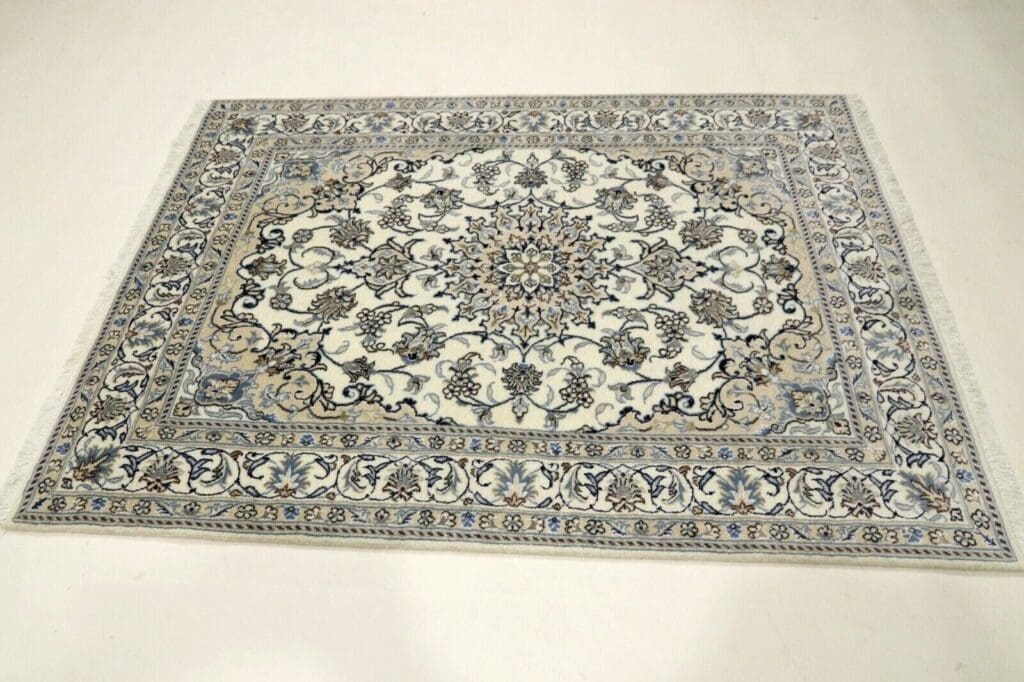
This Nain Persian rug is hand-knotted from 90% virgin wool and 10% silk. Virgin wool makes up the main part of the pile and is valued for its resilience, durability and practical care properties. Wool can absorb and release moisture from the surrounding air, helping to create a balanced indoor climate. It also gives the surface a warm, comfortable feel underfoot.
The silk content adds a smooth touch and a restrained sheen. Silk can deepen the appearance of colour and help fine parts of an ornament stand out more clearly. Together, the two fibres combine the hard-wearing character associated with wool with a more refined, lustrous surface quality. The material blend therefore has both a practical and a visual role in the rug.
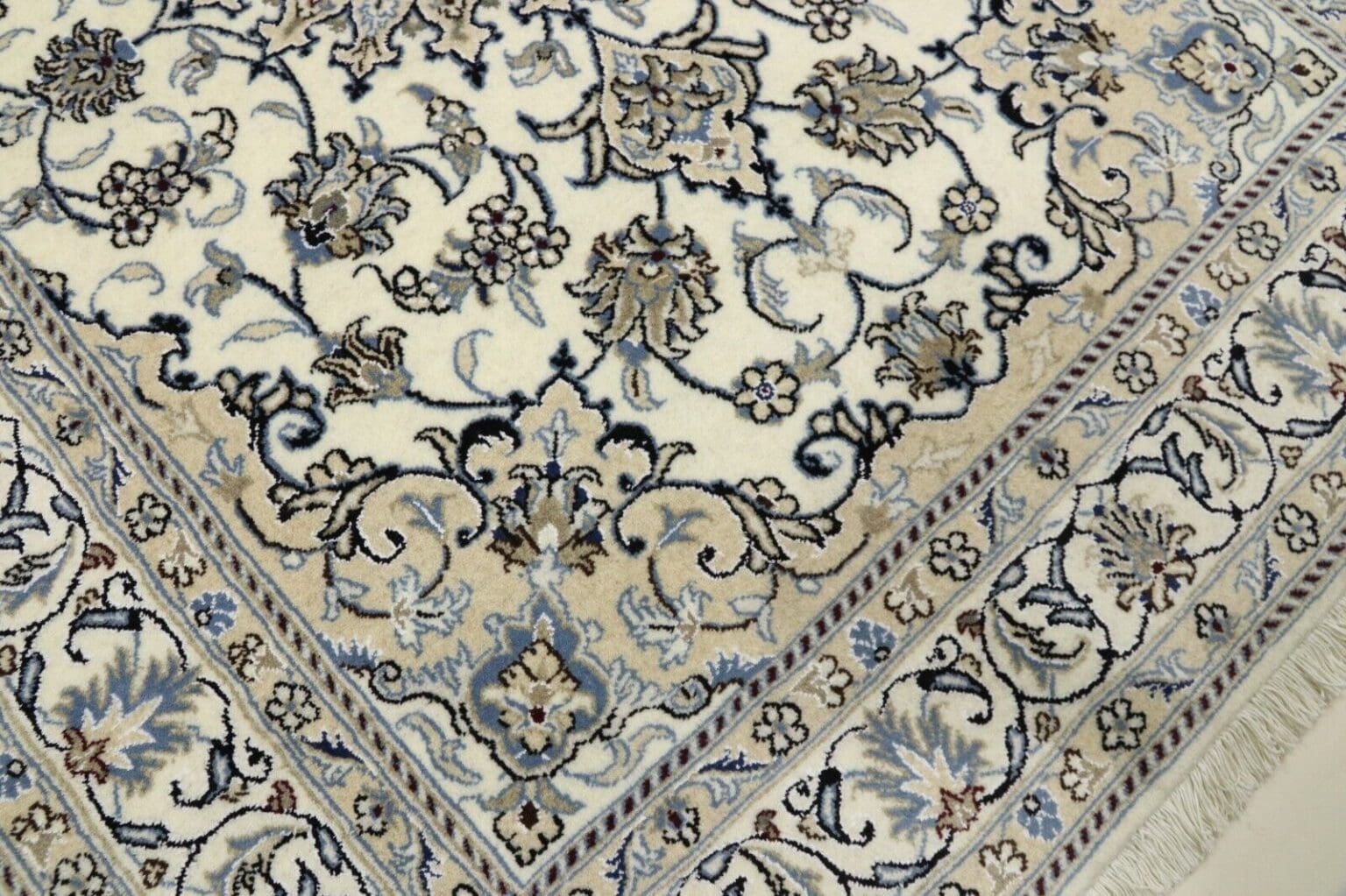
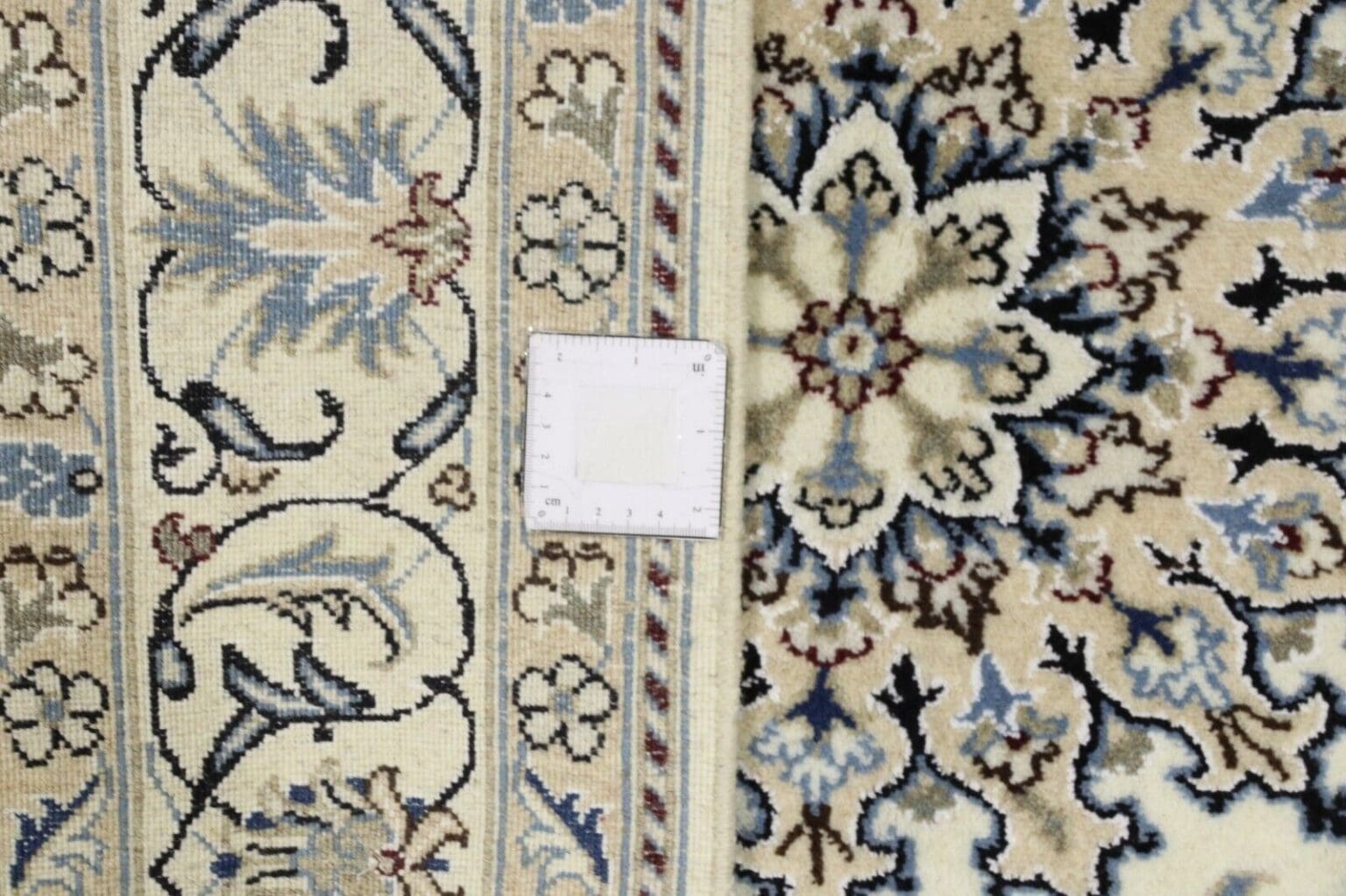
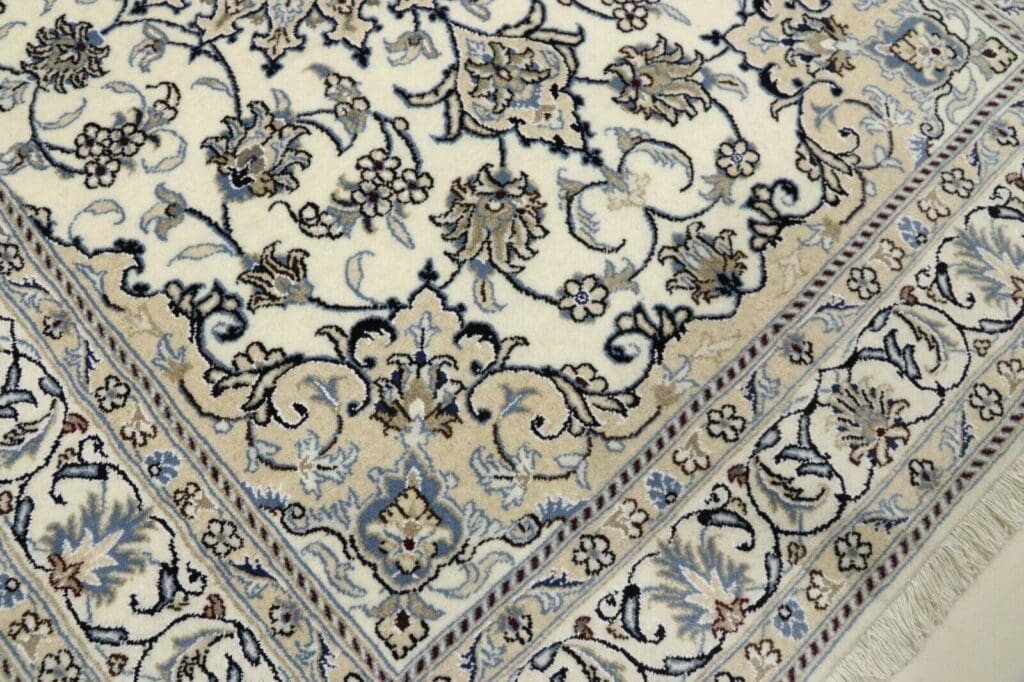
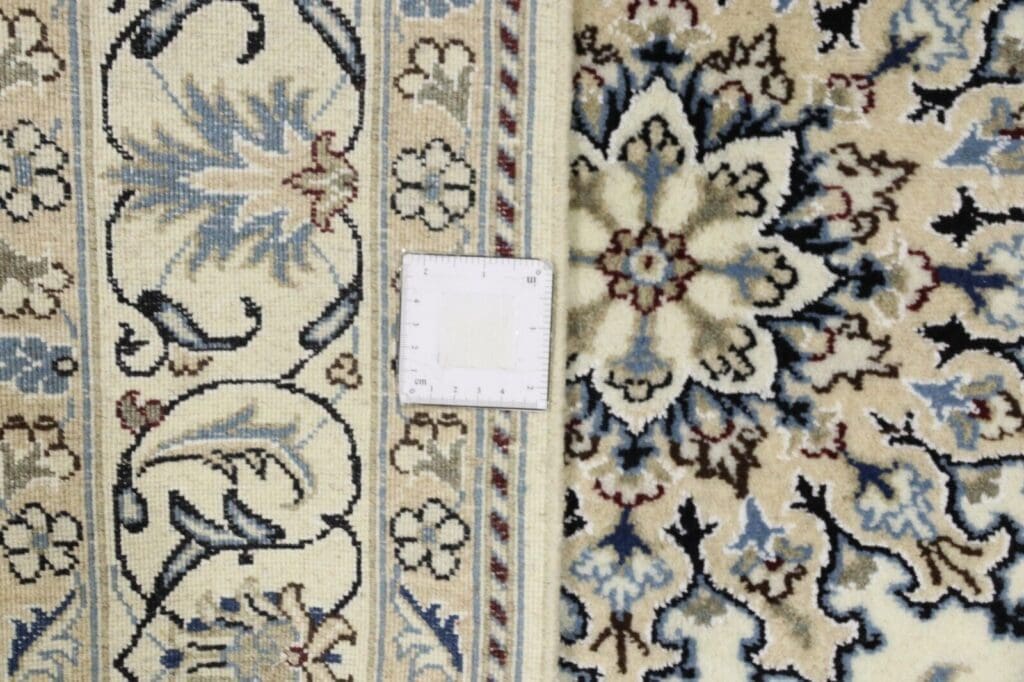
The rug is made by hand. In hand knotting, individual knots are placed into the foundation one at a time. The pile is built row by row, then levelled and finished so that the design can be read across the surface. Its stated density of approximately 300,000 knots per square metre indicates a finely worked construction. In general, a dense knotting structure allows weavers to render small flowers, curved vines, narrow outlines and gradual changes in colour with greater definition. Hand production also means that each rug is an individual piece.
Wool’s naturally soil-resistant character supports everyday use and straightforward maintenance. Regular vacuuming without a brush attachment is recommended, while minor marks can be treated with a damp cloth. Strong direct sunlight should be avoided because prolonged exposure may cause colours to fade. These care measures preserve the surface and respect the different qualities of wool and silk.
Origin and Tradition
The rug comes from Persia, present-day Iran. Iranian carpets are produced in many towns and regions, each with its own preferences for structure, ornament, colour and weaving practice. This regional variety is one reason Persian rugs can look very different while sharing a common craft heritage. Nain is one of Iran’s recognised carpet centres, and the name is associated with a finely ordered Persian weaving tradition.
Carpet making in Iran extends back for centuries. Knowledge of stretching the warp, inserting the weft, tying and securing knots, trimming the pile and defining the outlines has traditionally been passed through workshops and families. A hand-knotted rug is consequently not made in a single industrial operation. It develops through repeated manual actions that require patience, consistency and close attention to the intended composition.
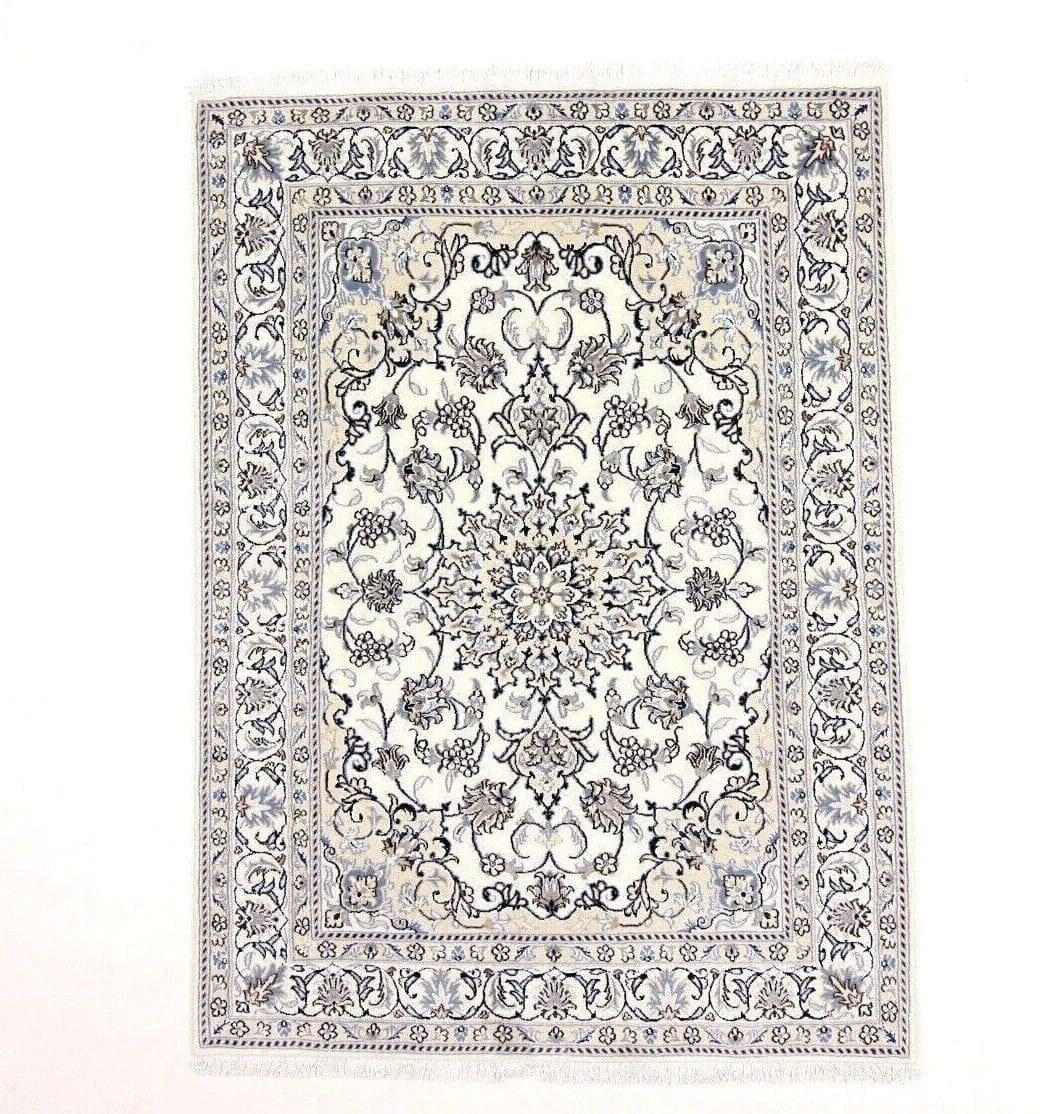
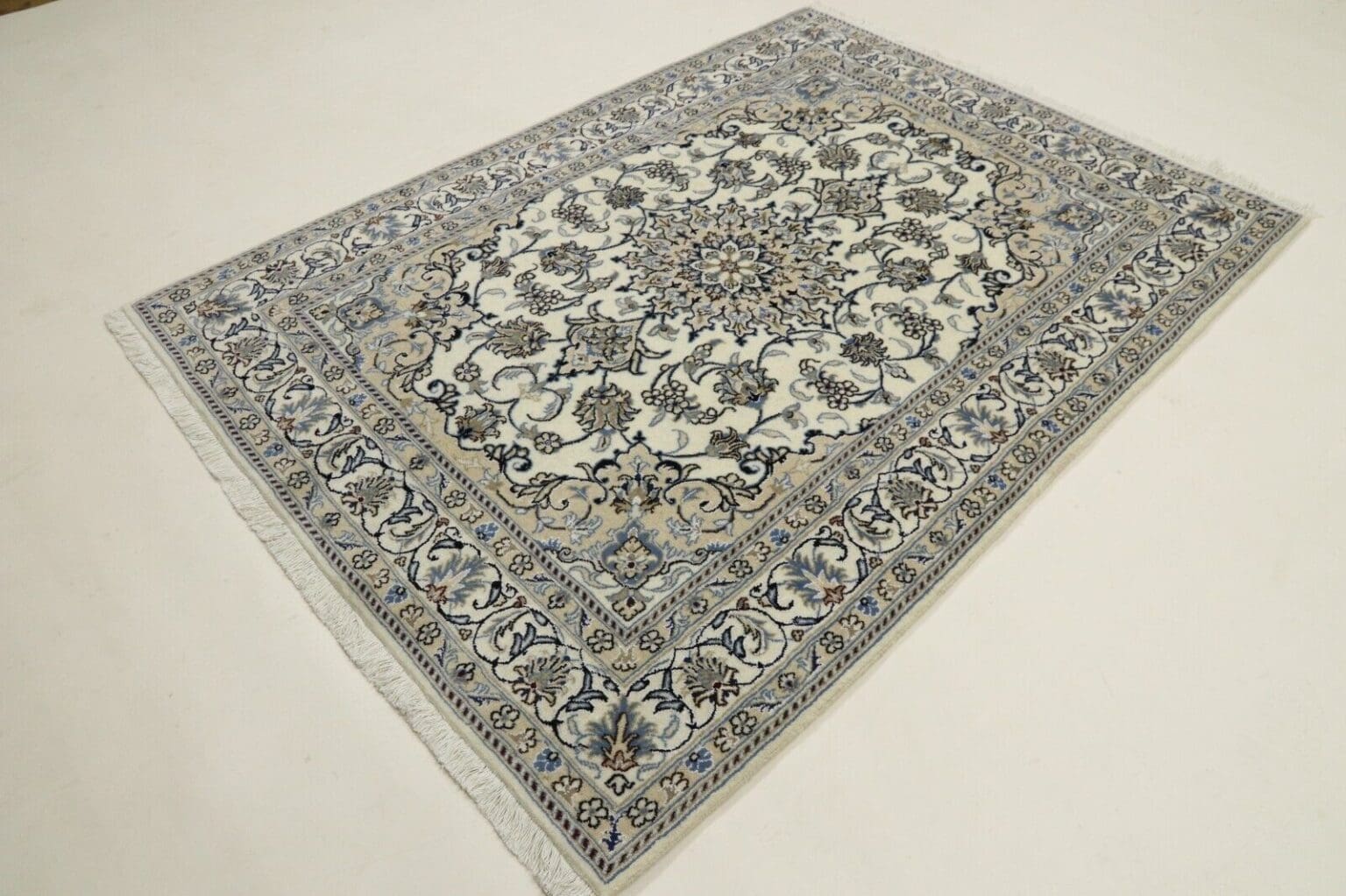
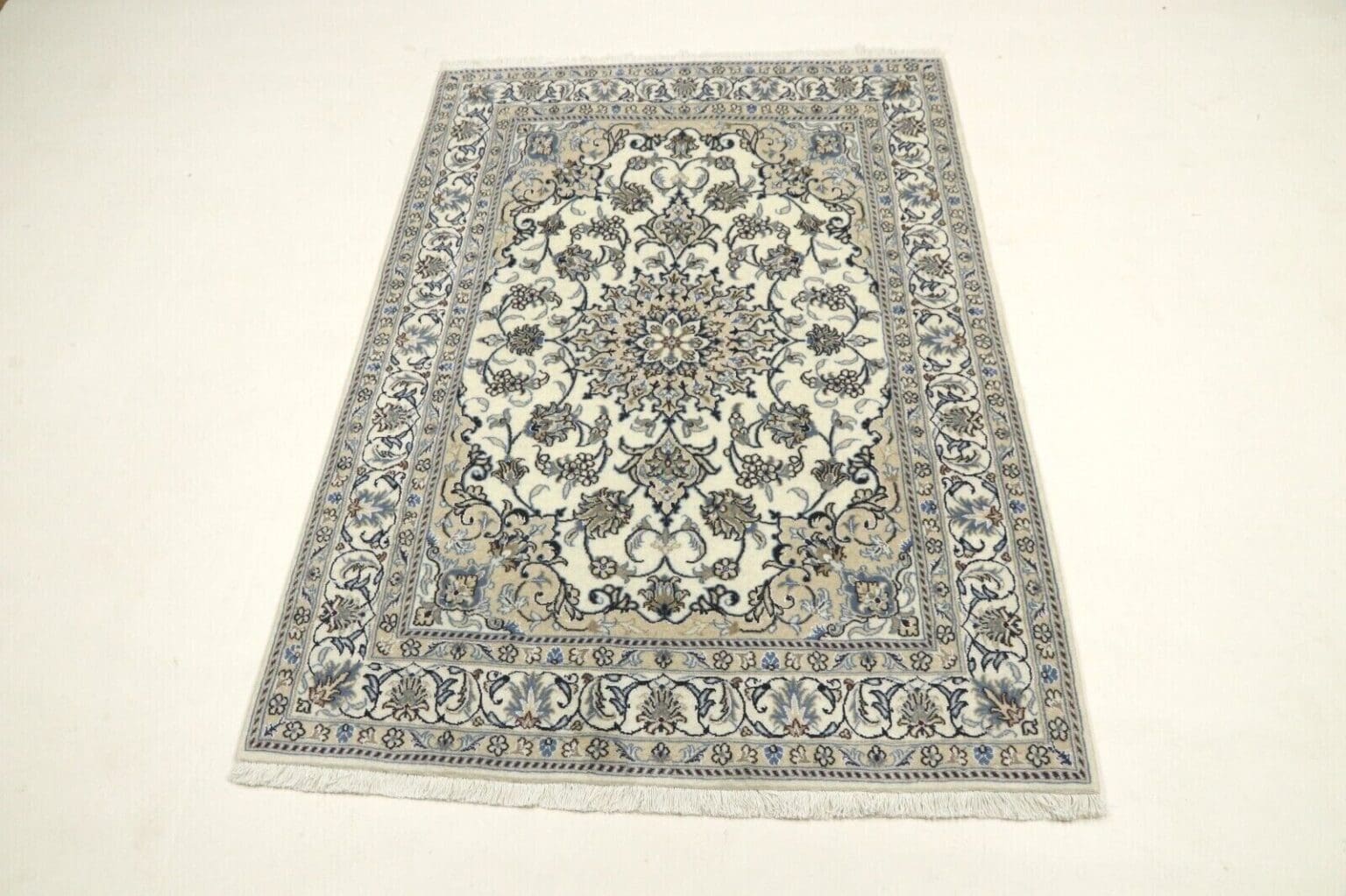
Nain rugs are commonly discussed in connection with precise drawing and a carefully balanced arrangement of ornament. Symmetry plays an important role in many Persian designs. A central medallion, mirrored side elements or a repeating field can give a composition a clear internal order. Floral shapes, scrolling vines and framed borders are also established tools within Persian carpet design. These observations describe the wider Nain tradition rather than adding unrecorded individual details to this particular rug.
Isfahan and Tabriz are also widely known for their carpet traditions and illustrate the breadth of Iranian weaving culture. Isfahan is often associated with elegant floral compositions, measured symmetry and detailed drawing. Tabriz has developed a broad design vocabulary that includes different medallion, garden and scrolling-vine arrangements. Such regional schools demonstrate how Iranian rugs are shaped by local workshops, inherited patterns and the skills of the people who weave them.
The designation Nain therefore points to a Persian tradition rather than to a generic decorative style. Calling this rug a Persian rug reflects its Iranian origin. Hand knotting connects it to a culture in which carpets serve as useful floor coverings while also carrying a highly organised visual language. Proportion, repetition, contrast and rhythm are used to structure the surface, allowing a design to remain coherent from its centre through its borders.
Traditional Iranian weaving also shows how technical decisions and design are connected. The density of the knots, the handling of the pile and the relationship between foundation and surface all affect how an ornament can be drawn. The result is not simply a printed image transferred onto a textile. It is a pattern built into the fabric through many separate manual decisions. This relationship between craft and ornament is central to understanding the Nain tradition.
Design and Pattern
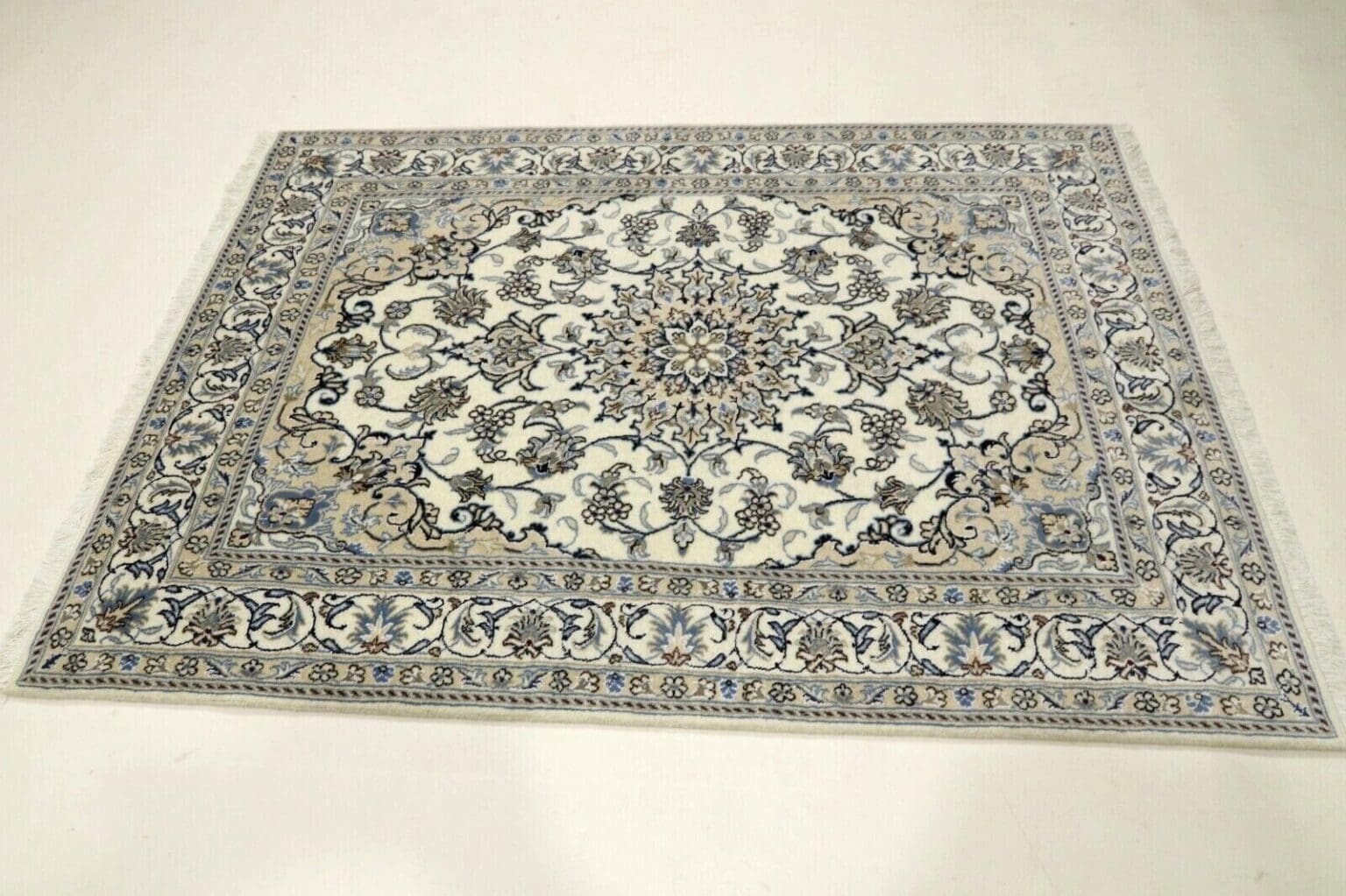
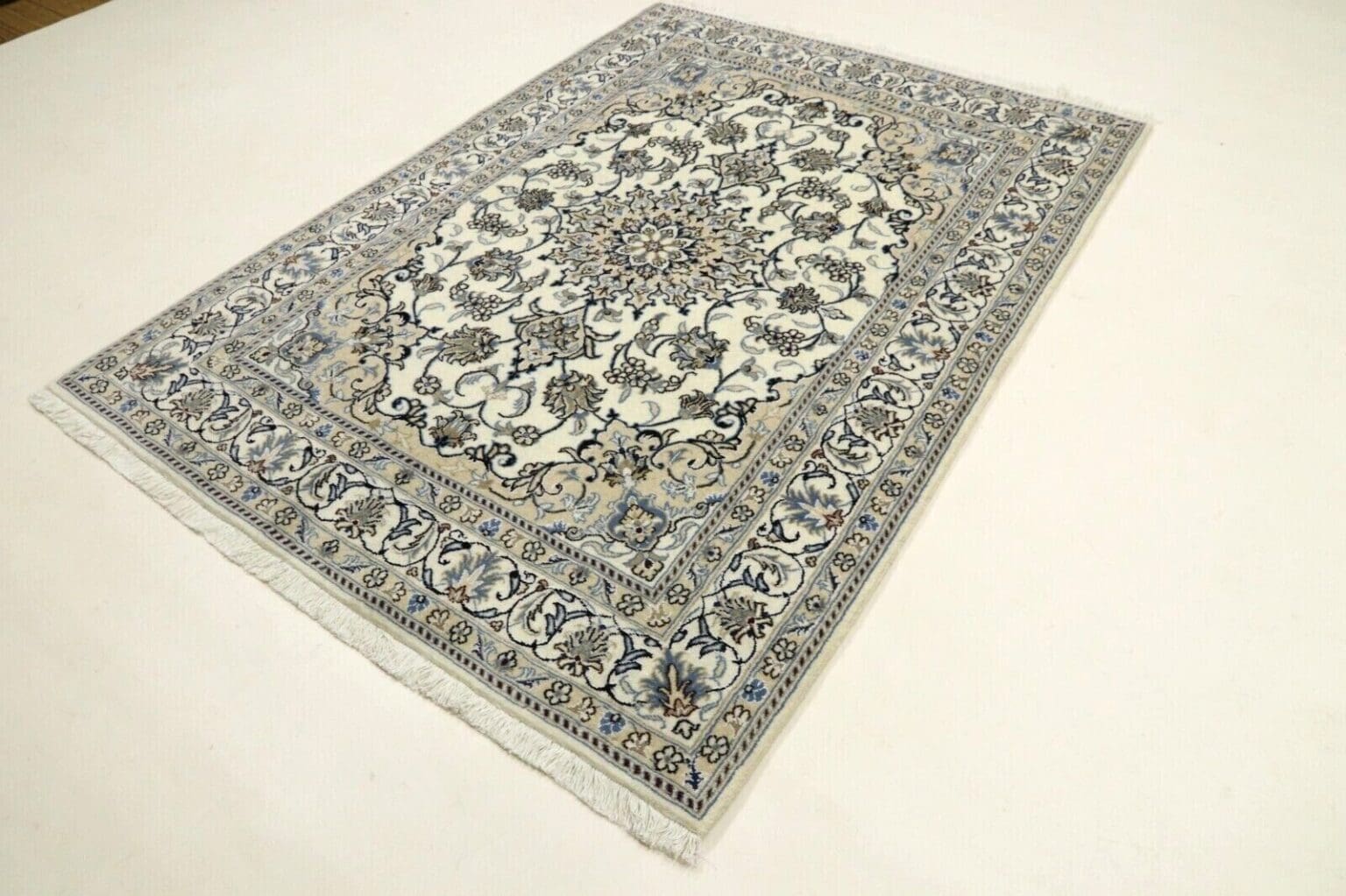
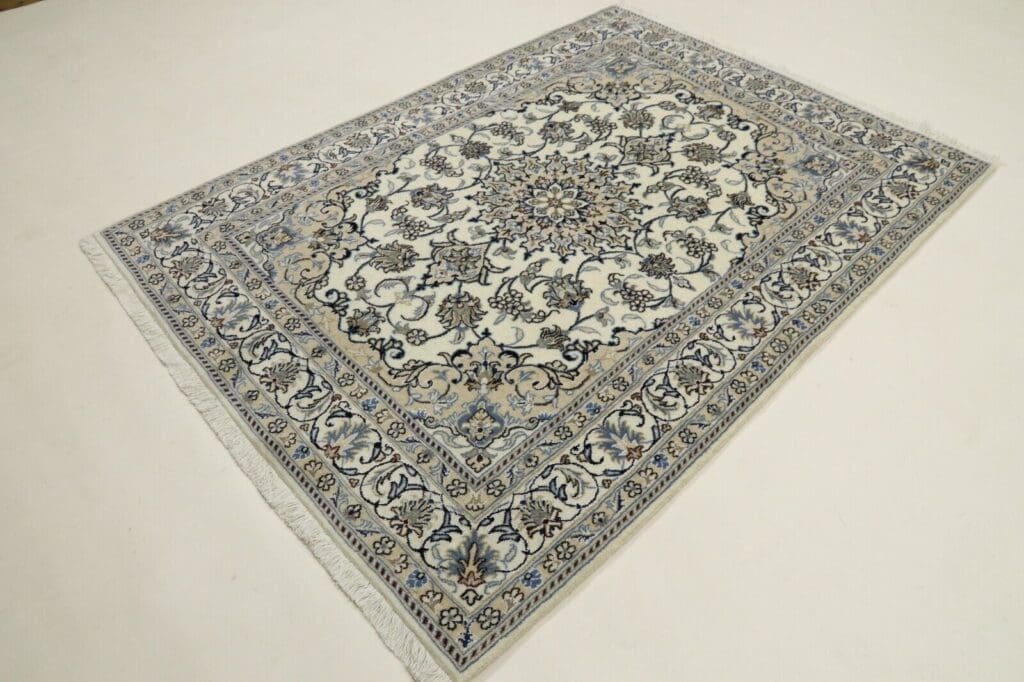
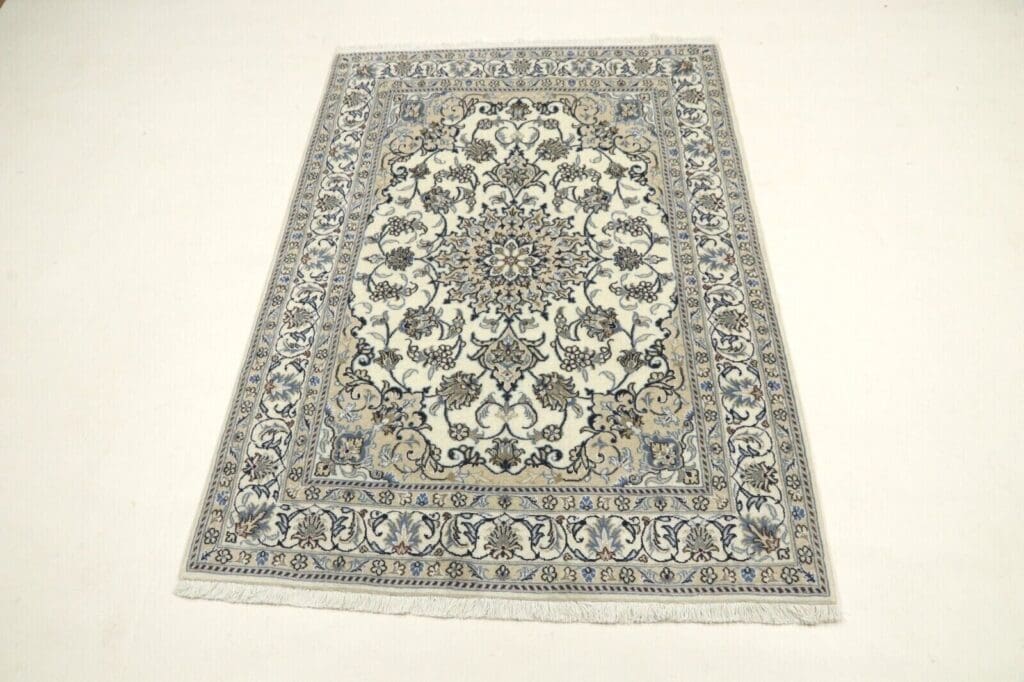
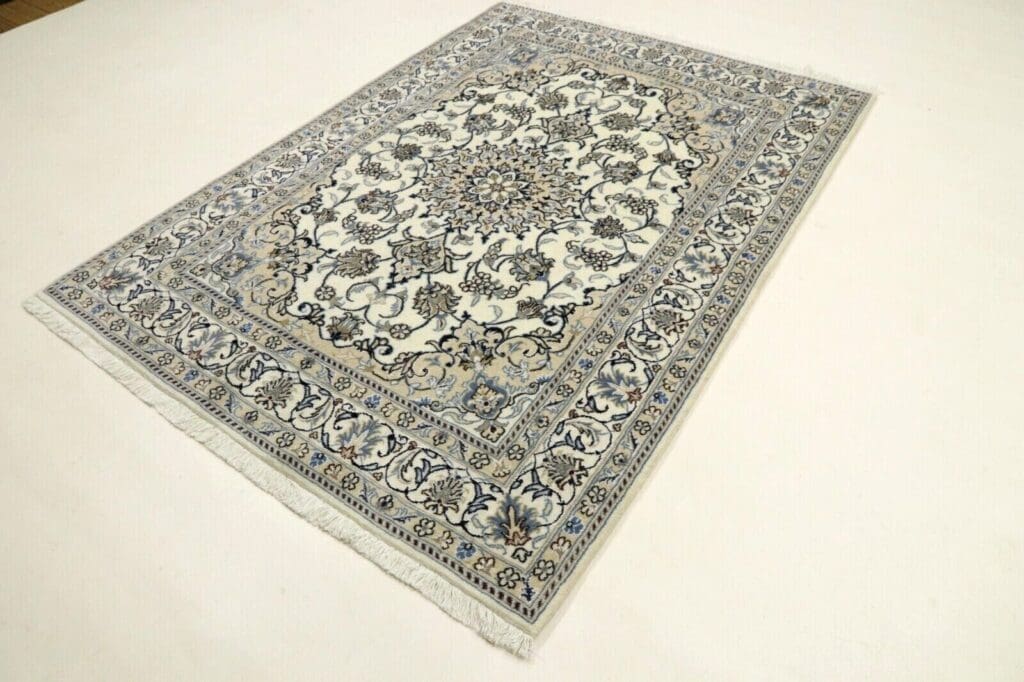
The pattern is described as traditional oriental and Persian, with the designation super Nain. Traditional Persian compositions often use a clear hierarchy of areas. A centre may organise the eye, a principal border frames the field, and narrower secondary borders create a transition between the inner design and the outer edge. This structure gives the pattern a sense of order without requiring every section to carry the same visual weight.
Floral motifs and arabesque forms are recurring elements in Iranian carpet design. Flowers, leaves and vines may be arranged as separate motifs, reflected around an axis or joined into a continuous movement. Arabesque lines create an impression of uninterrupted growth and lend flow to a composition. In a finely knotted design, such contours can be drawn with considerable precision, while silk fibres may add subtle differences in lustre between adjacent areas.
The source characterises the style as traditional oriental and Persian. This refers to an inherited Iranian design language rather than to a purely modern geometric treatment. Red, blue and gold are frequently used in Persian carpets and can bring warmth, depth and a formal accent to a room. The effect of any colour depends not only on the pigment itself, but also on its relationship to surrounding tones, the border and the quieter spaces of the field.
Many Persian patterns depend on repetition and controlled contrast. A motif can appear as a small filler ornament and then return in a larger form as part of the main composition. Such changes in scale link the different zones of the design. Symmetrical layouts need not appear rigid: slight variations in line, leaf and flower forms can keep a repeated arrangement visually active. A dense knotting structure generally supports the rendering of these smaller distinctions.
Borders are another important part of Persian visual grammar. They define the central field, guide the eye along the sides and provide a finished edge to the composition. Depending on the design, principal and secondary borders may contain flowers, scrolling vines or regularly arranged details. This type of structure can sit naturally beside classic furniture, while the traditional pattern language can also provide contrast in a more contemporary interior.
The rug is described as elegant and sophisticated in design. Its hand-knotted construction, fine knot density and wool-and-silk composition provide the technical basis for a clearly articulated pattern. No additional individual colour, medallion or specific motif is assigned here beyond the source description. The Nain tradition can therefore be explained in its broader regional context without presenting general design features as undocumented facts about this one piece.
Special Features
The condition is stated as new and perfect. The listed special features include suitability for underfloor heating and pet-friendly use. Its blend of virgin wool and silk combines a practical, resilient main fibre with a finer, gently lustrous element. Wool also gives the surface a pleasant feel underfoot and can complement the warmth of a room.
The hand-knotted technique and high knot density are further defining characteristics. They reflect a labour-intensive production method and support the detailed presentation of traditional ornament. The style is identified as traditional oriental and Persian, making it compatible with classic, modern or vintage-inspired surroundings without limiting the rug to only one furnishing approach.
FAQ
How should the Nain Persian rug be cared for?
Vacuum regularly without using a brush attachment. Small marks can be treated with a damp cloth, while strong direct sunlight should be avoided because it may gradually fade the colours. Virgin wool is naturally soil resistant and relatively easy to maintain. If deeper cleaning is required, professional rug cleaning is appropriate so that the pile and the silk content are handled carefully.
Can the rug be used over underfloor heating?
Yes. This hand-knotted rug made from virgin wool and silk is suitable for rooms with underfloor heating. Wool provides a comfortable feeling underfoot and allows the warmth from the floor to be experienced evenly across the room. Correct installation with a suitable underlay is recommended so that the rug lies securely and the heat transfer is not unnecessarily restricted.
Where do the rug’s patterns and colours come from?
The patterns and colours draw on nature as well as traditional Persian and oriental designs. Floral forms, arabesque lines, ordered repetition and framed borders are part of this inherited visual vocabulary. Red, blue and gold are frequently found in Iranian carpet art. Colours may also carry cultural associations, while their particular effect depends on how they work together across the complete composition.
To provide the best experiences, we use technologies like cookies to store and/or access device information. Consenting to these technologies will allow us to process data such as browsing behavior or unique IDs on this site. Not consenting or withdrawing consent, may adversely affect certain features and functions.
Functional Always active
The technical storage or access is strictly necessary for the legitimate purpose of enabling the use of a specific service explicitly requested by the subscriber or user, or for the sole purpose of carrying out the transmission of a communication over an electronic communications network.
Preferences
The technical storage or access is necessary for the legitimate purpose of storing preferences that are not requested by the subscriber or user.
Statistics
The technical storage or access that is used exclusively for statistical purposes.The technical storage or access that is used exclusively for anonymous statistical purposes. Without a subpoena, voluntary compliance on the part of your Internet Service Provider, or additional records from a third party, information stored or retrieved for this purpose alone cannot usually be used to identify you.
Marketing
The technical storage or access is required to create user profiles to send advertising, or to track the user on a website or across several websites for similar marketing purposes.
 SECURE PAYMENT
 SHIPPING PARTNERS


