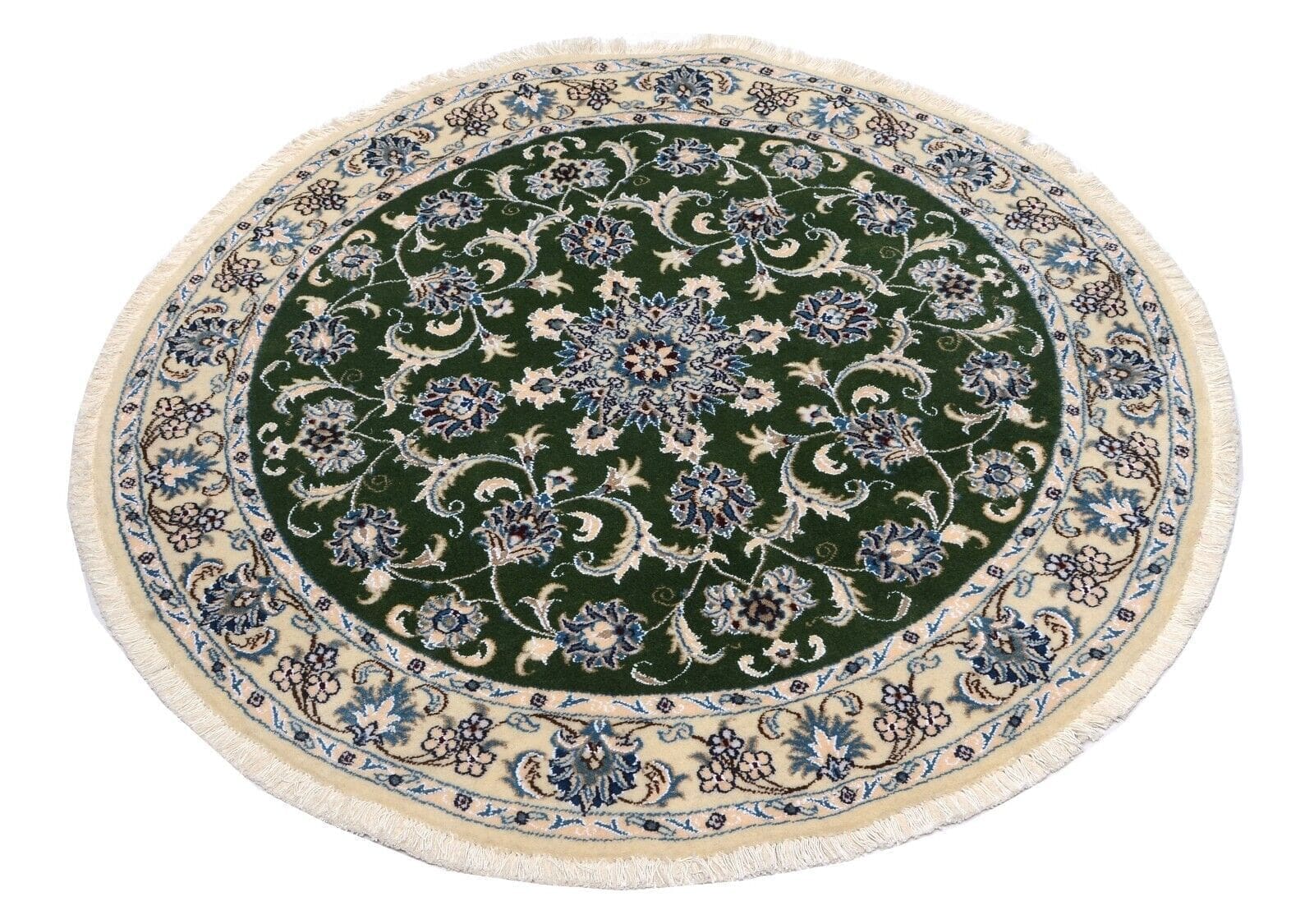
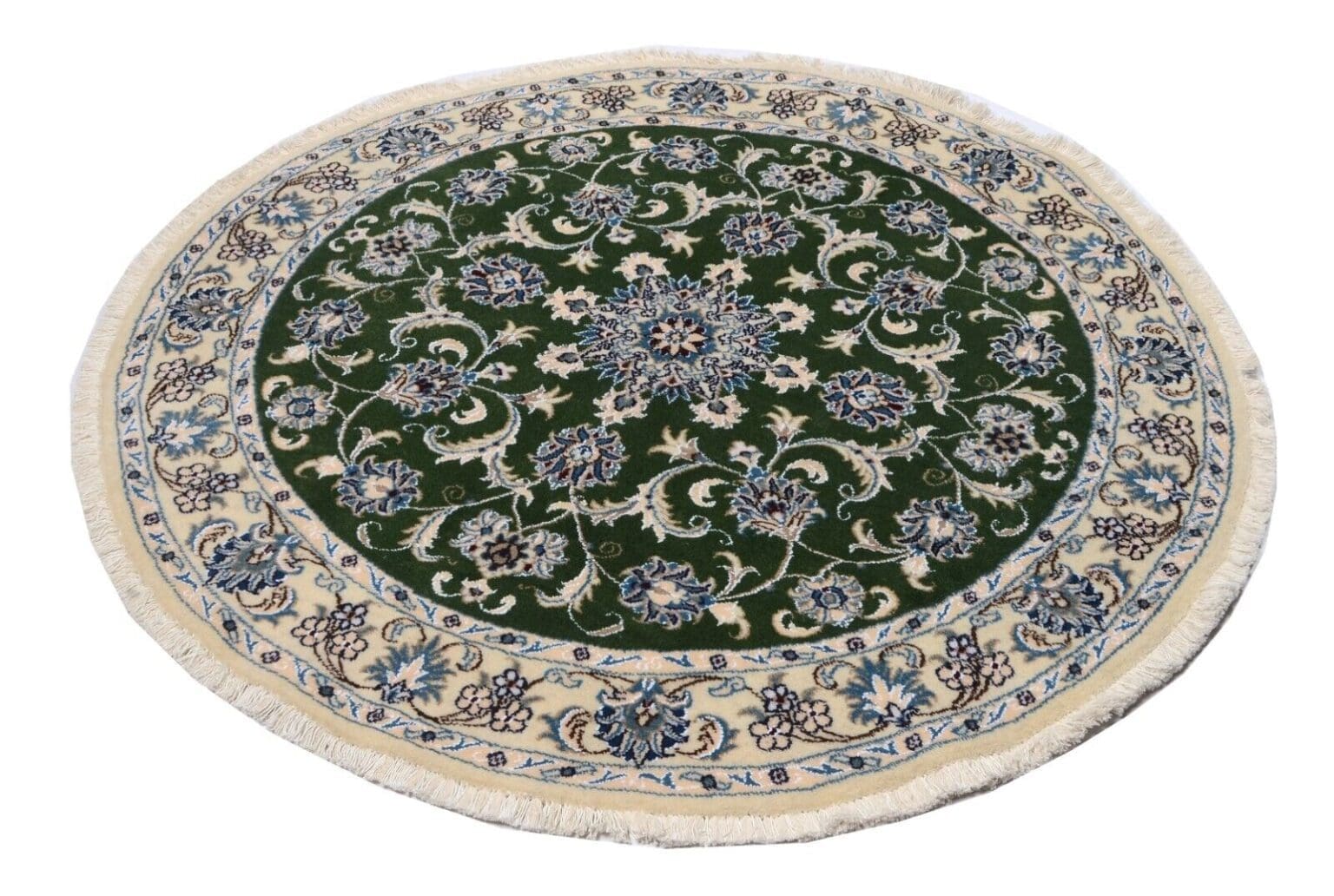
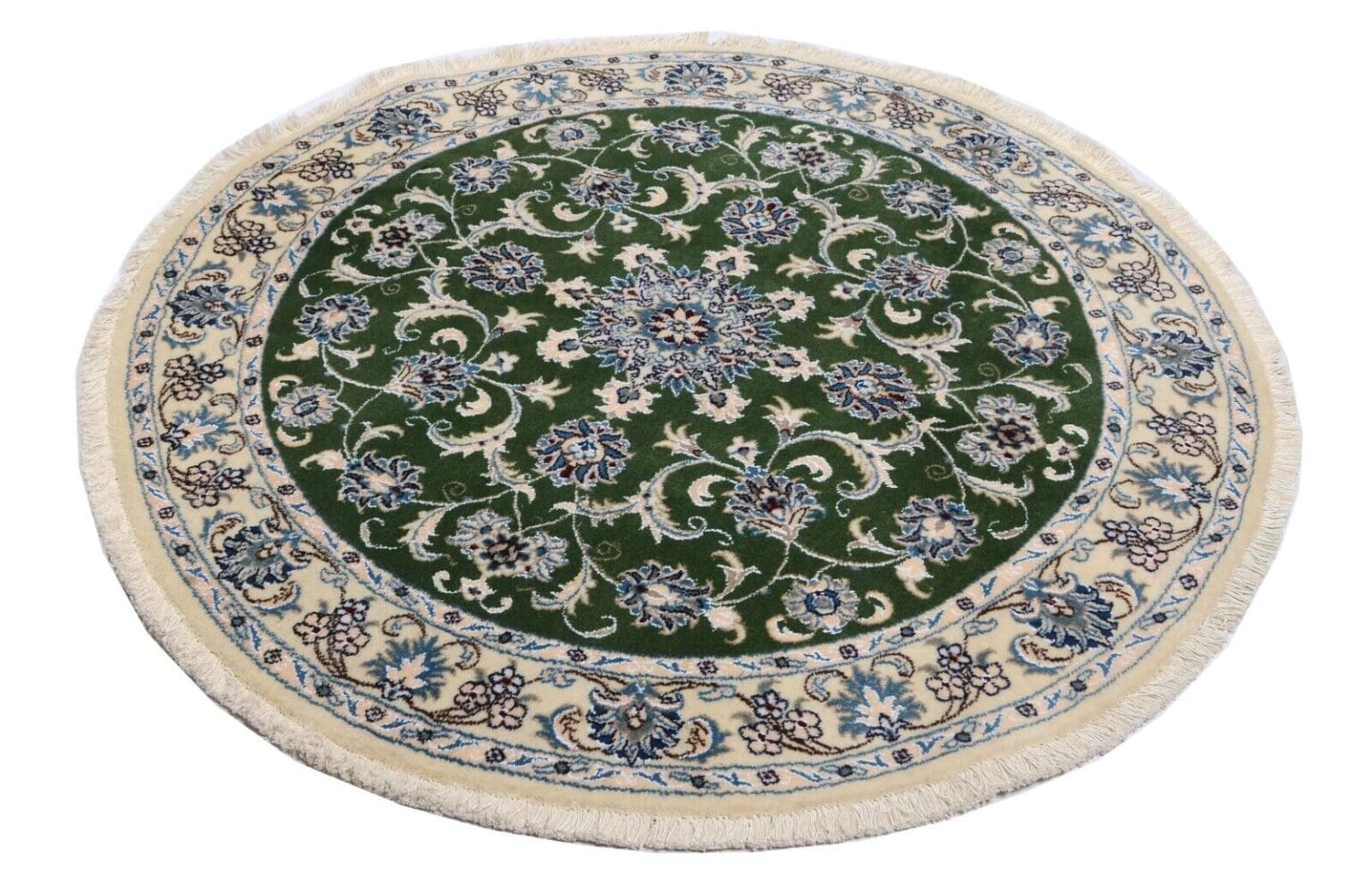
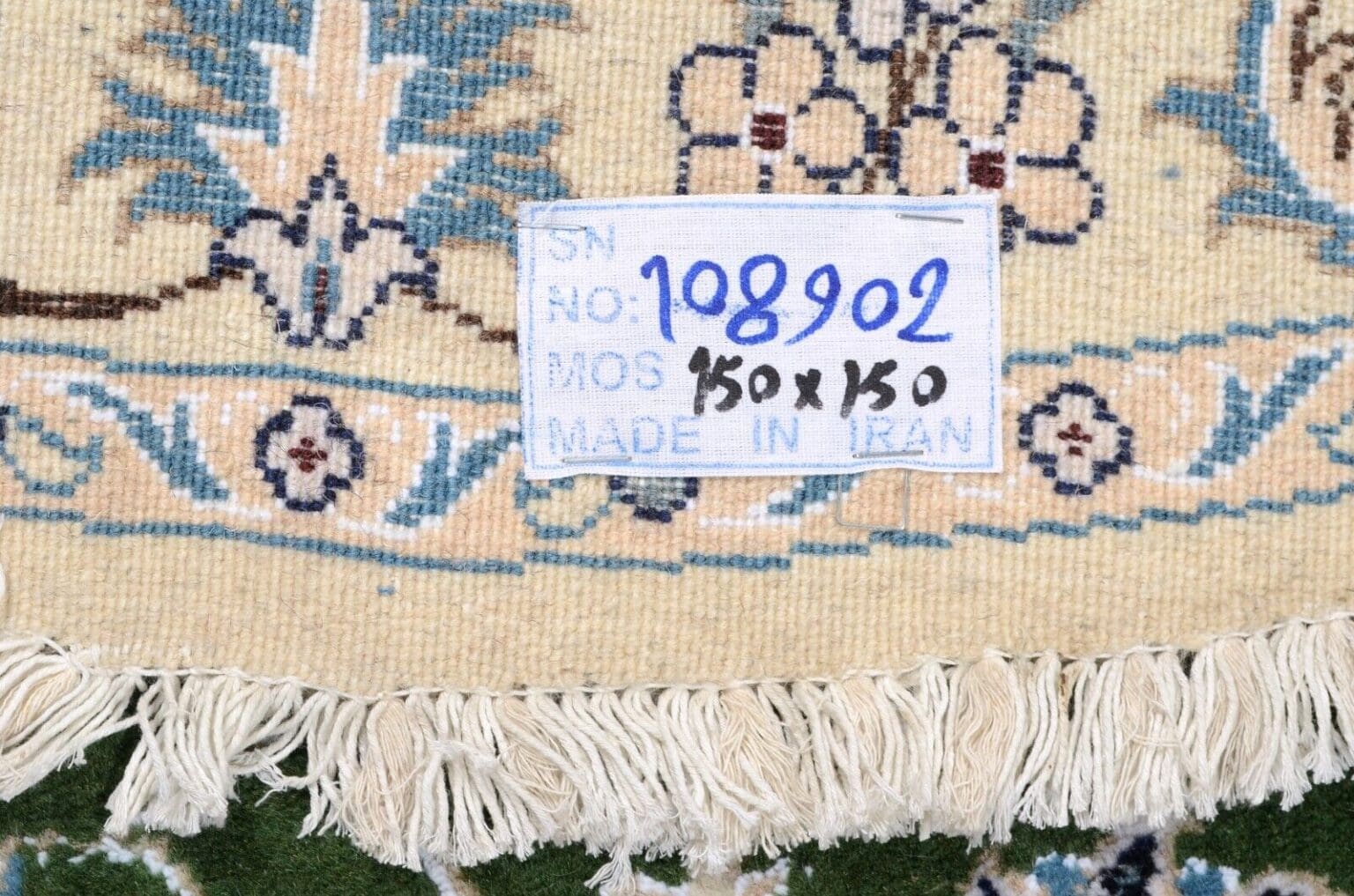
Hand-knotted Nain Persian Rug | Knot density: 300,000 knots/m² | Material: 100% wool pile | Size: 150 x 150 cm | Pattern: Floral design with central medallion | Condition: New
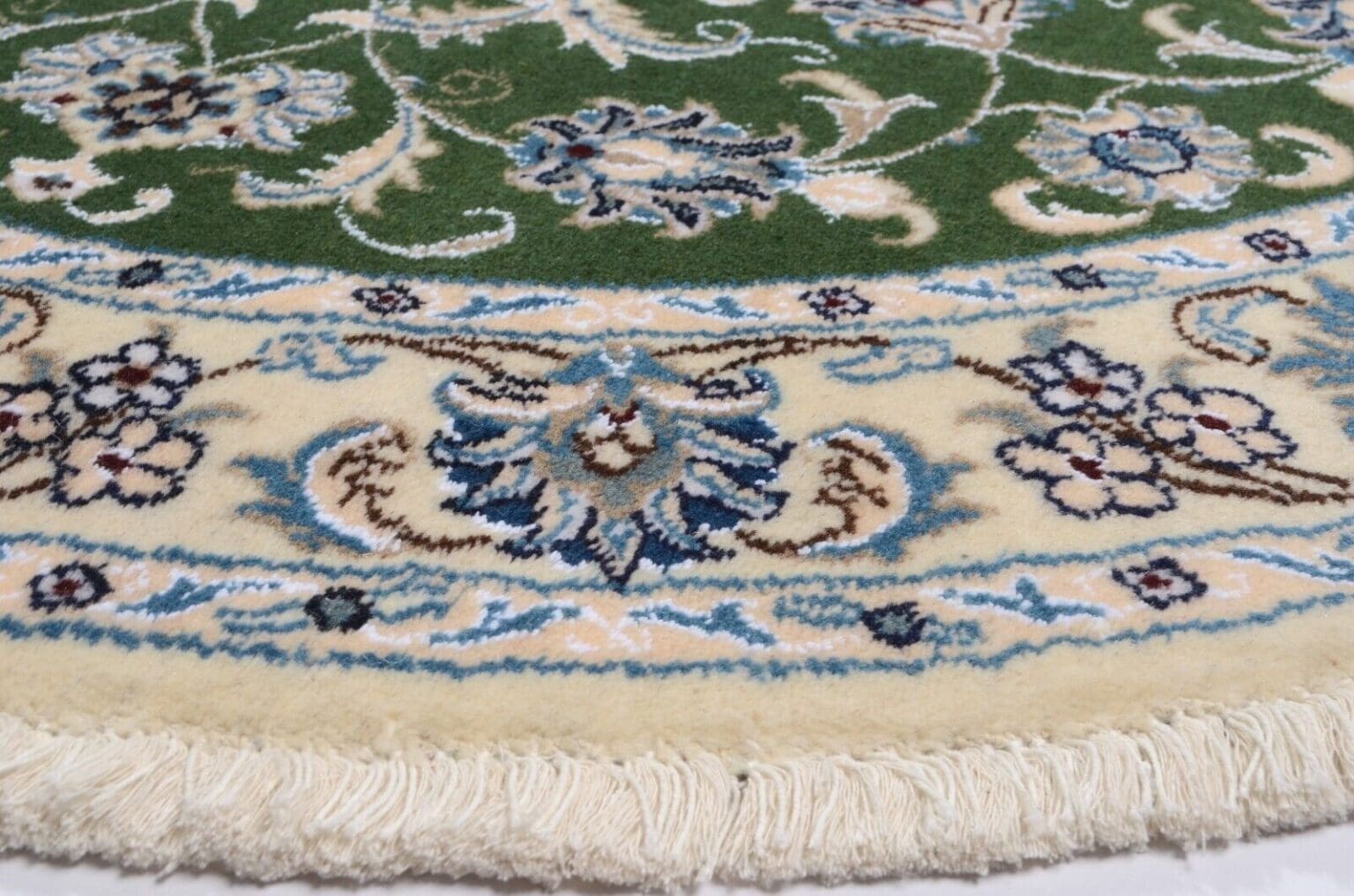
This Nain Persian rug is hand-knotted and made with 100% wool. Its pile height is 10 mm. Wool is a traditional material in Oriental rug making and is used for its pleasant tactile quality and its suitability for durable textile work. The pile creates the rug’s surface and gives the floral drawing a distinct physical presence.
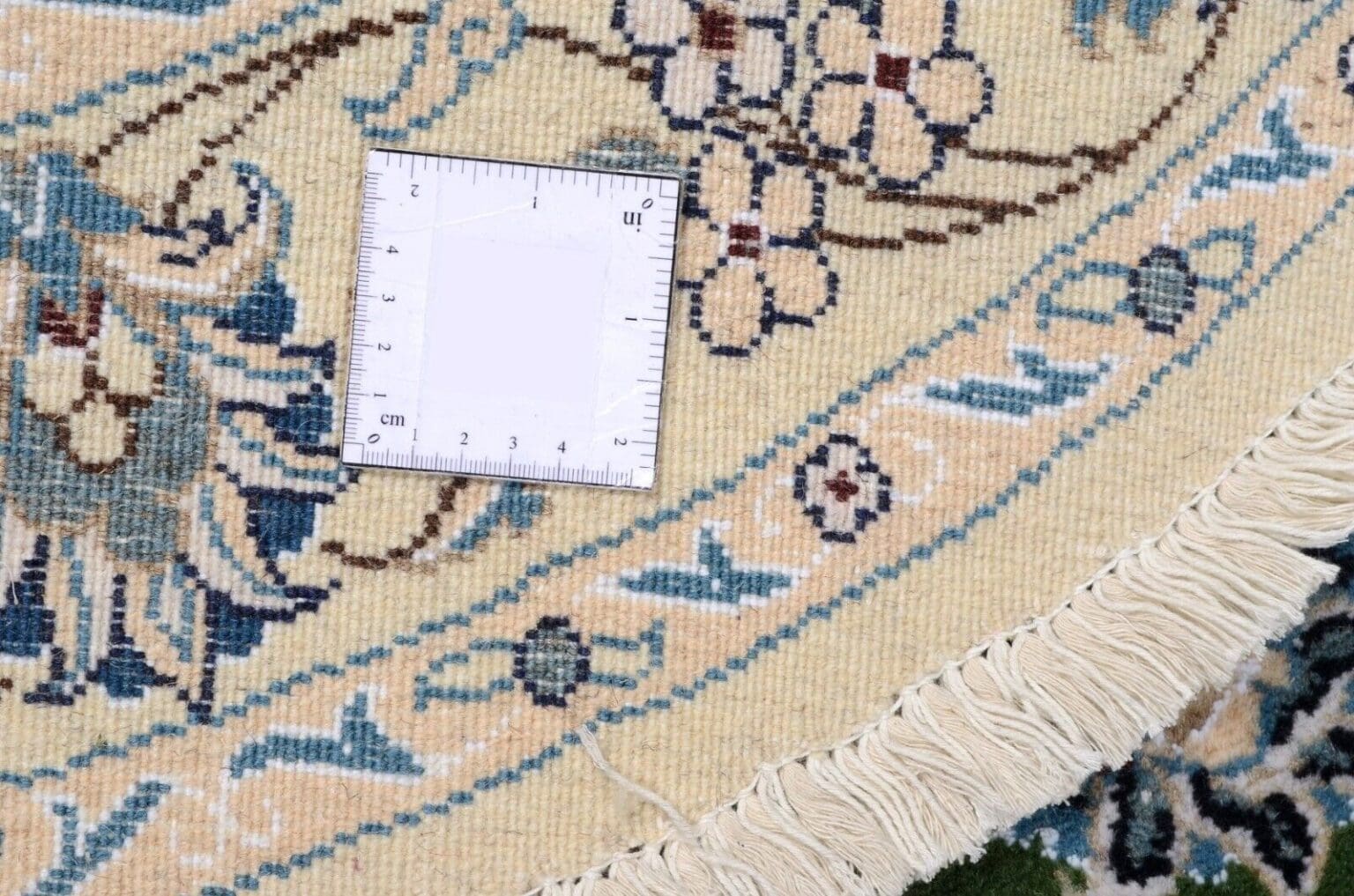
Hand-knotting builds the rug knot by knot. Individual knots are inserted by hand into the foundation, then secured through the subsequent stages of weaving and finishing. This method allows floral lines, leaves, vines and medallion forms to be rendered with precision. Because the work is done by hand, every rug has its own particular execution within the established Nain tradition.
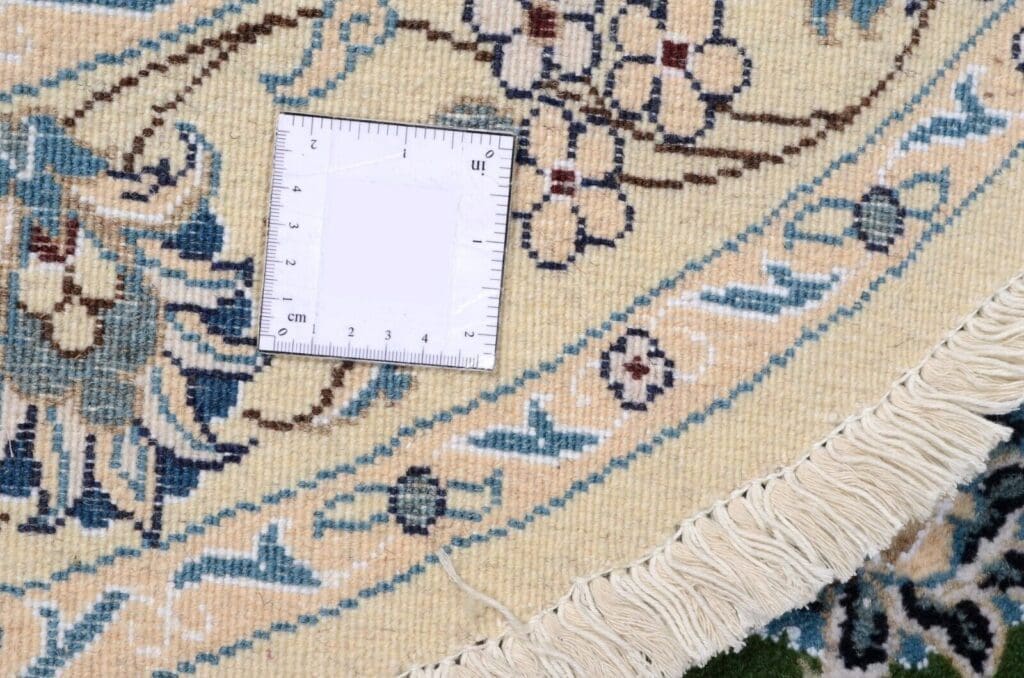
The stated knot density is 300,000 knots per square metre. Such a fine construction allows the design to be drawn with considerable detail and makes it possible to place smaller ornaments within a carefully balanced overall arrangement. The material specification refers to the pile: this rug is identified as 100% wool. Its condition is new, and it is suitable for use with underfloor heating.
The making process combines a traditional technique with a clearly organised decorative composition. Wool forms the pile, while handwork determines the structure and definition of the pattern. The green colour is part of this rug’s recorded design, as is its traditional Oriental Persian style. Together, the material and construction describe a hand-made textile rather than a mechanically produced floor covering.
Origin and Tradition
Nain is a city in Iran and an established name in Persian rug culture. Nain rugs are associated with fine knotting, carefully ordered ornament and a balanced composition. The city belongs to a region where rug making has been passed from one generation to the next. Knowledge of pattern structure, colour coordination and working methods is preserved through local and family-based craft traditions.
The name Nain identifies a regional language within Persian rug making. Its designs are commonly understood through finely divided surfaces, controlled symmetry and floral forms that join together as a coherent whole. A central medallion can organise the field, while vines and blossoms animate the surrounding areas. The distribution of the ornaments follows a planned composition rather than an accidental arrangement.
Persian rugs come from many regions, each with its own customary forms, colours and technical habits. Nain represents a tradition in which refined drawing and visual balance have an important role. Weavers often pass their knowledge through families or local communities. As a result, older pattern principles remain recognisable while every hand-knotted piece still carries the individual character of its maker.
Floral ornaments and medallions also have a cultural dimension in Persian design. Blossoms, leaves and vines are frequently connected with ideas of abundance, beauty and life. The medallion provides a structural centre and can be read as the focal point of the composition. These visual arrangements belong to the wider history of Persian interiors and are part of the decorative vocabulary found in many Iranian homes.
Nain rugs are valued both in their region of origin and internationally. Their combination of hand craftsmanship, fine drawing and inherited pattern structure has made them a recognised part of Persian rug culture. This piece is identified as a Persian rug from Persia, or Iran, and therefore belongs to that regional tradition. Its traditional Oriental Persian style places its design within the classical vocabulary of Persian carpet making.
The tradition should not be confused with a claim that every Nain rug has exactly the same appearance. Regional design languages allow variations in colour, scale and ornament. What connects them is the relationship between a disciplined composition, floral vocabulary and careful handwork. In this rug, that relationship is expressed through the green ground or colour impression, the floral design and the central medallion.
Design and Pattern
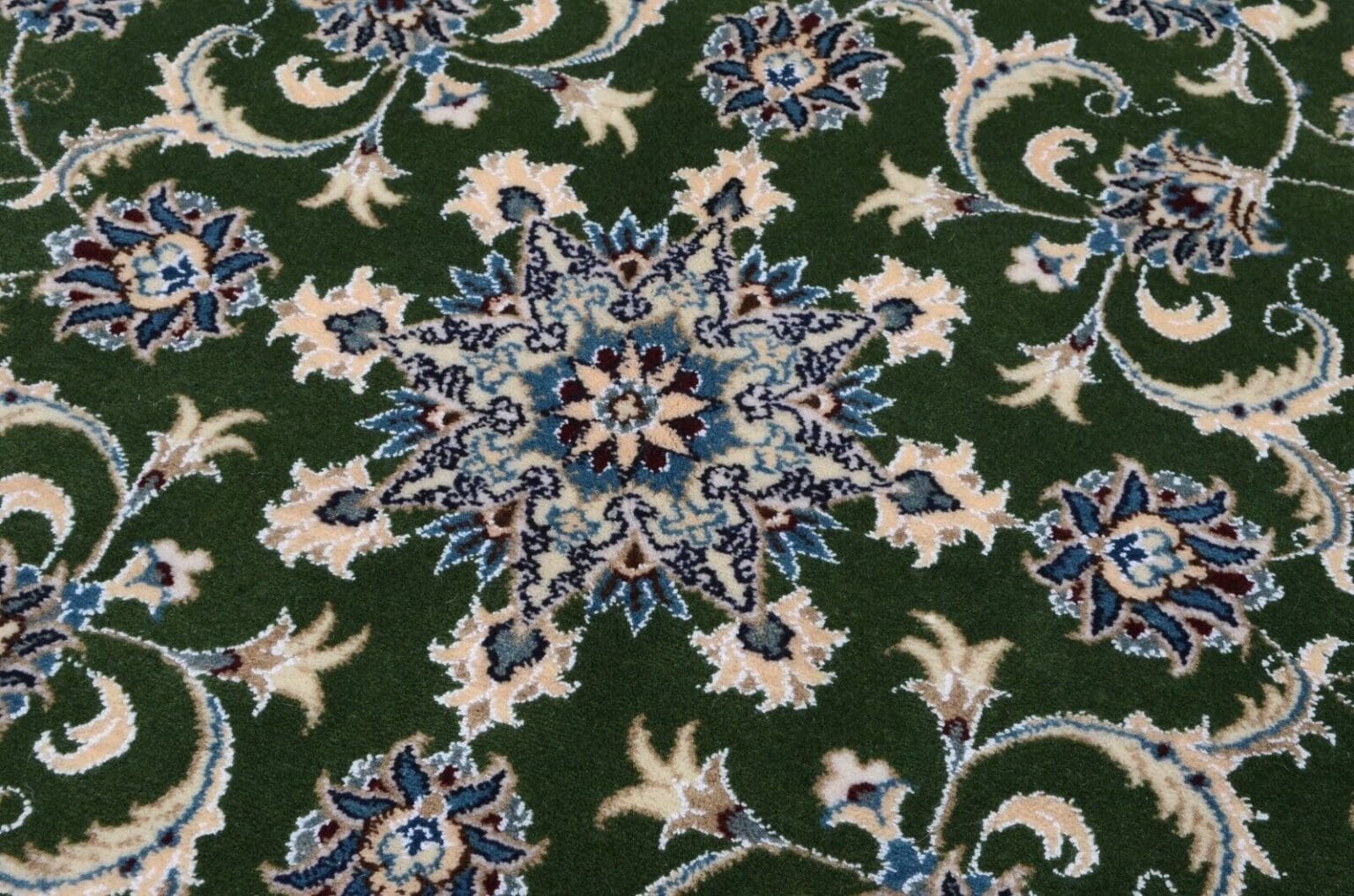
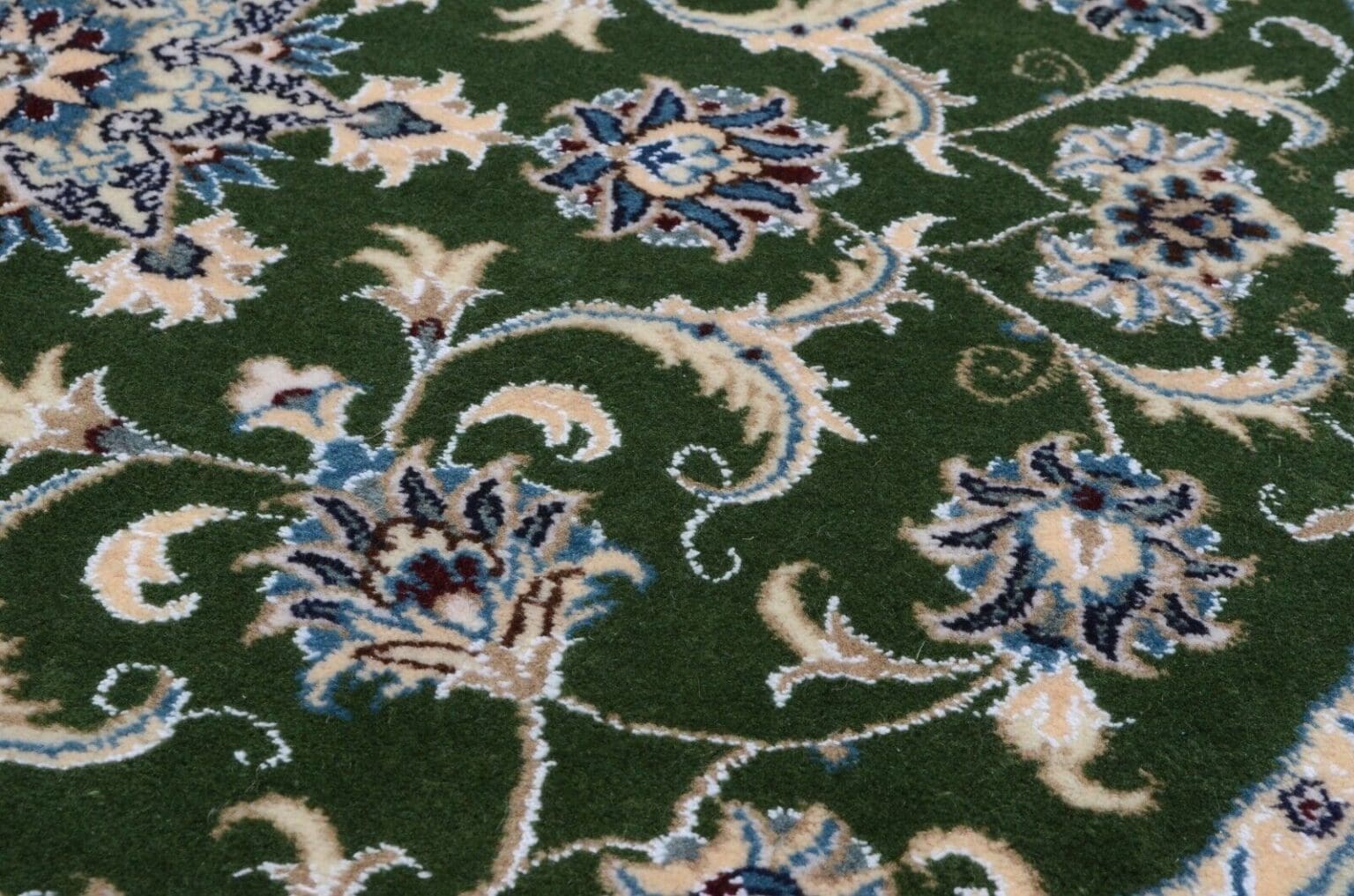
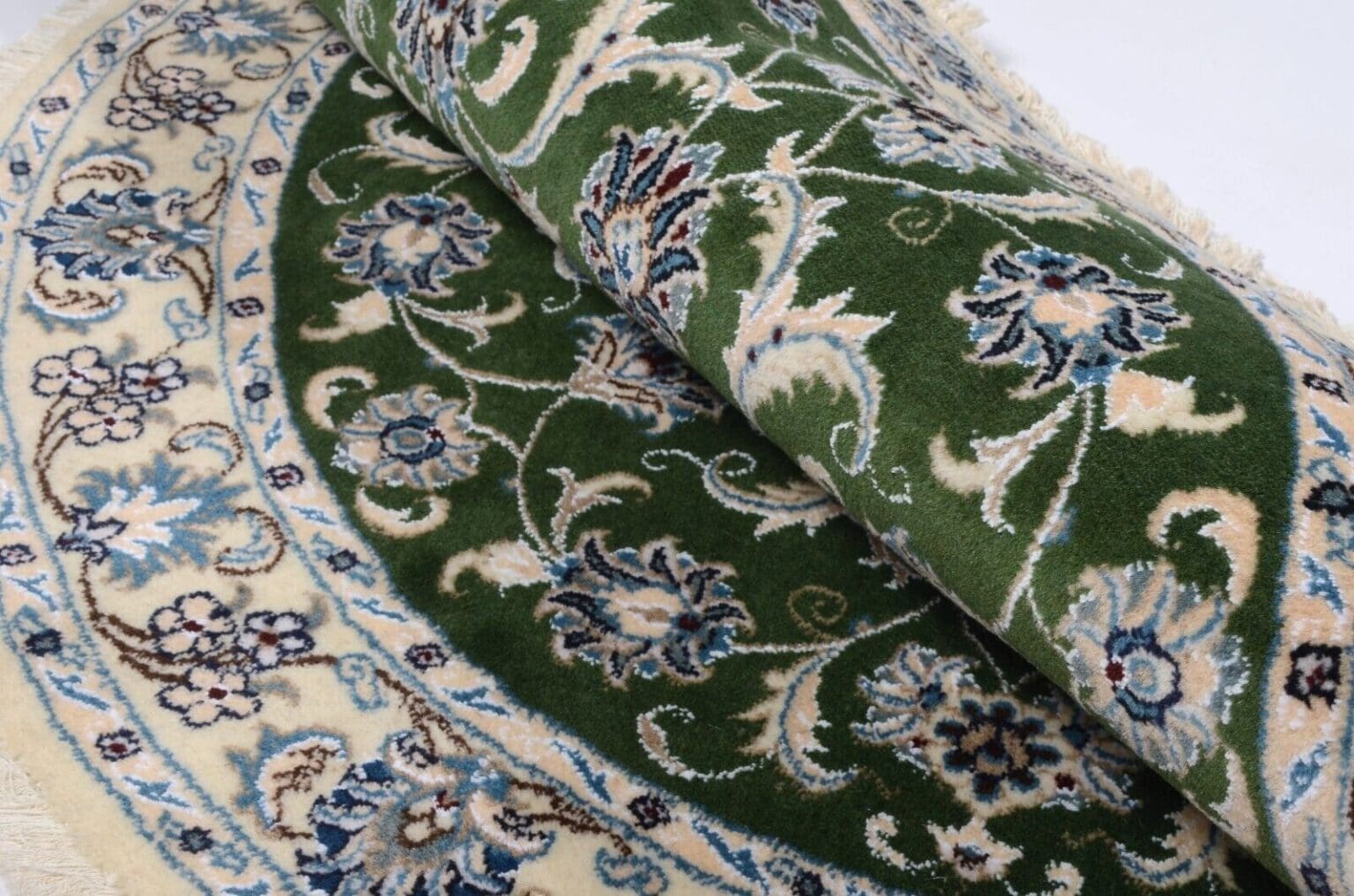
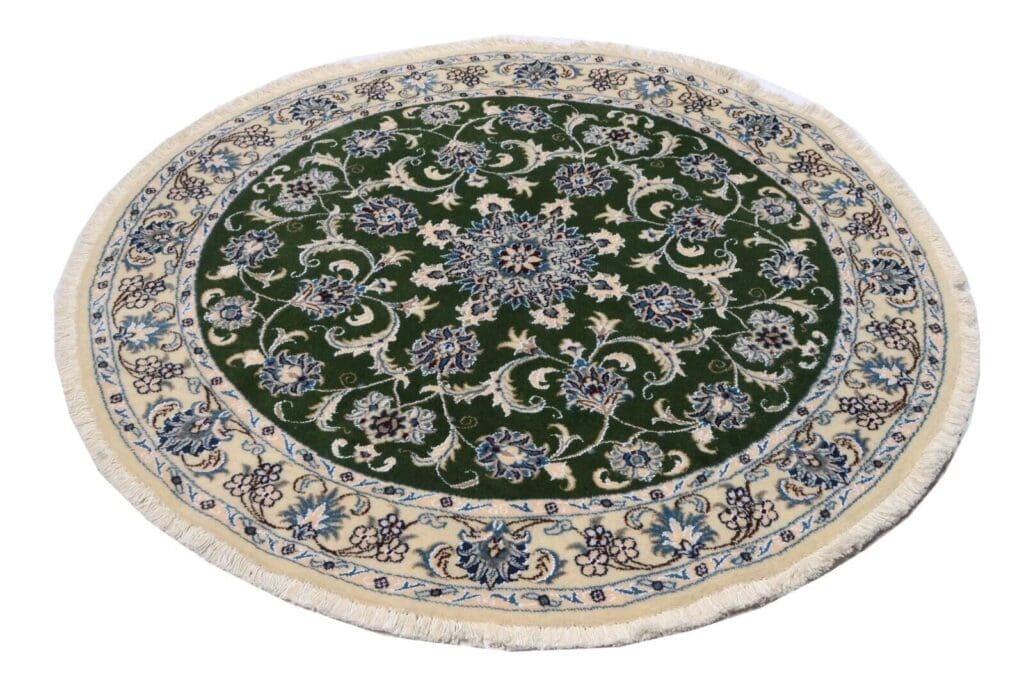
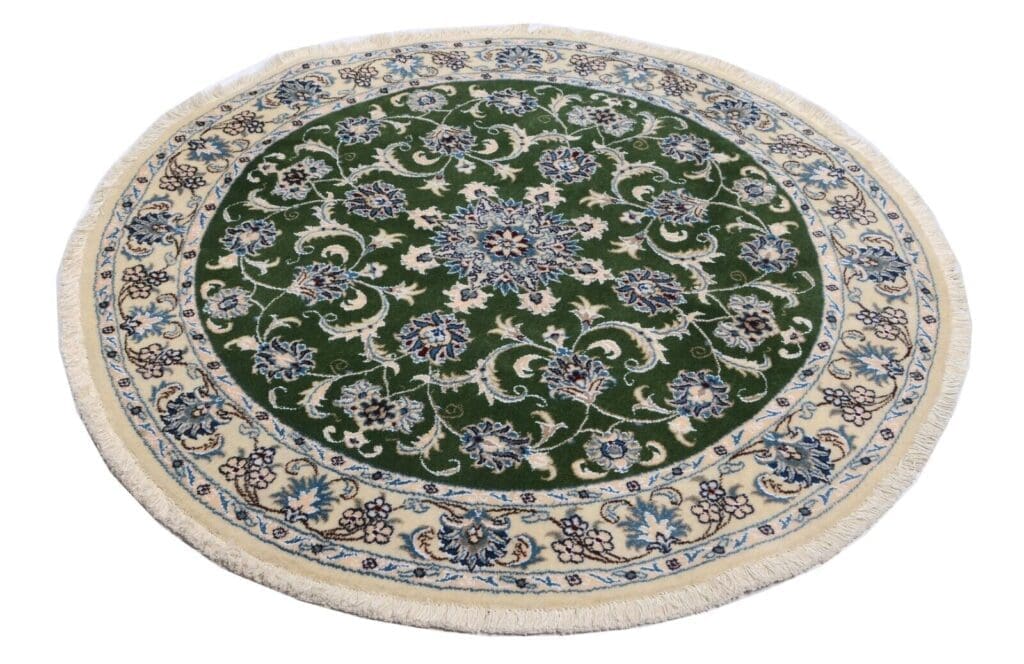
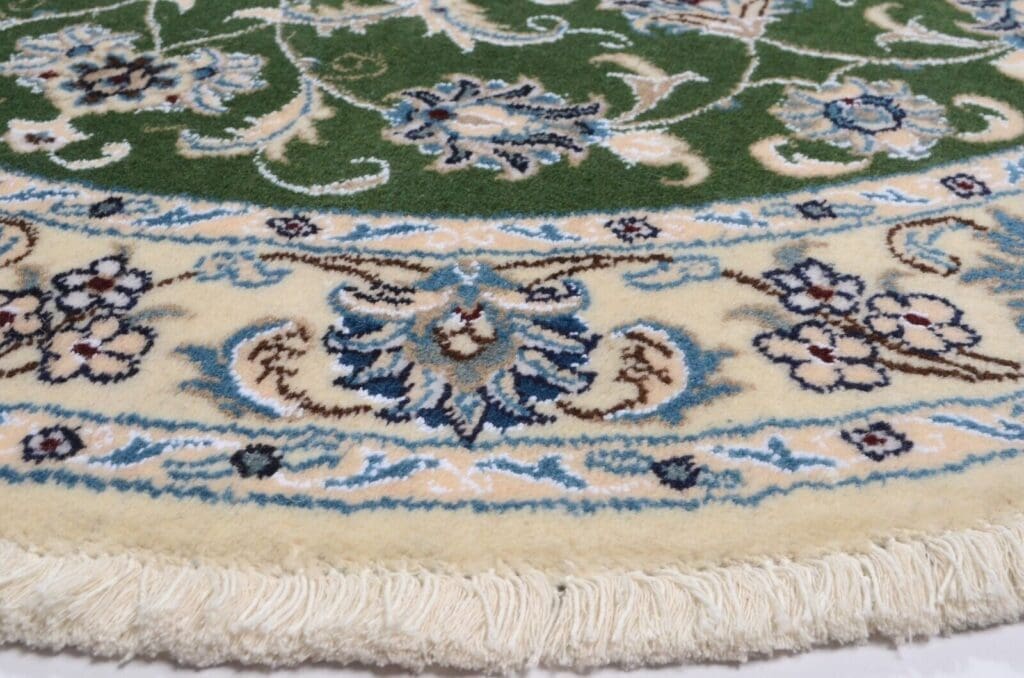
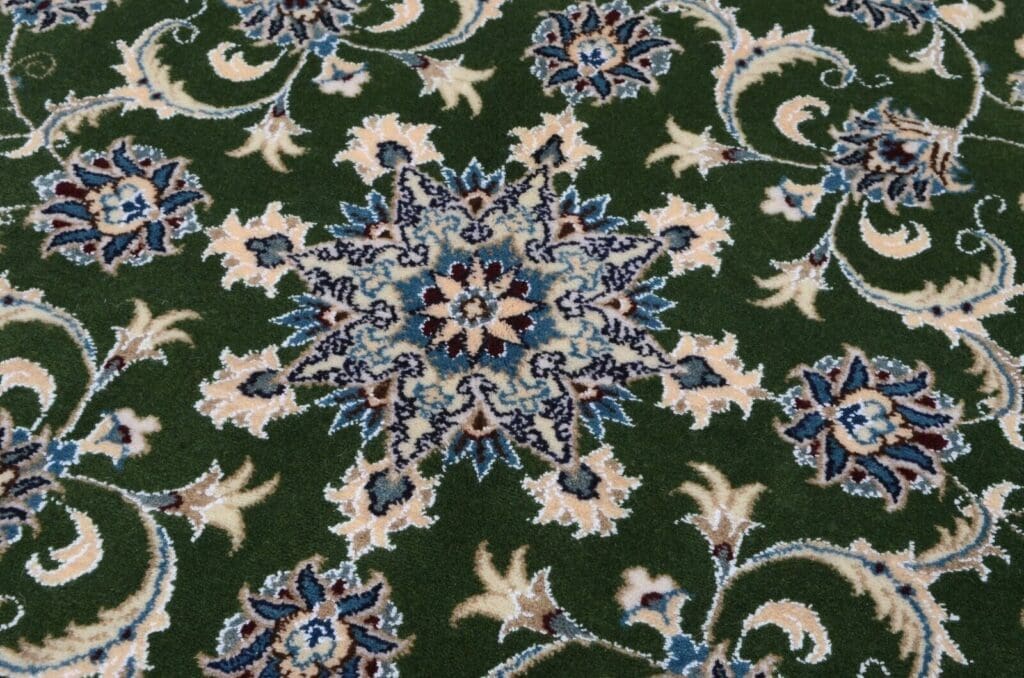
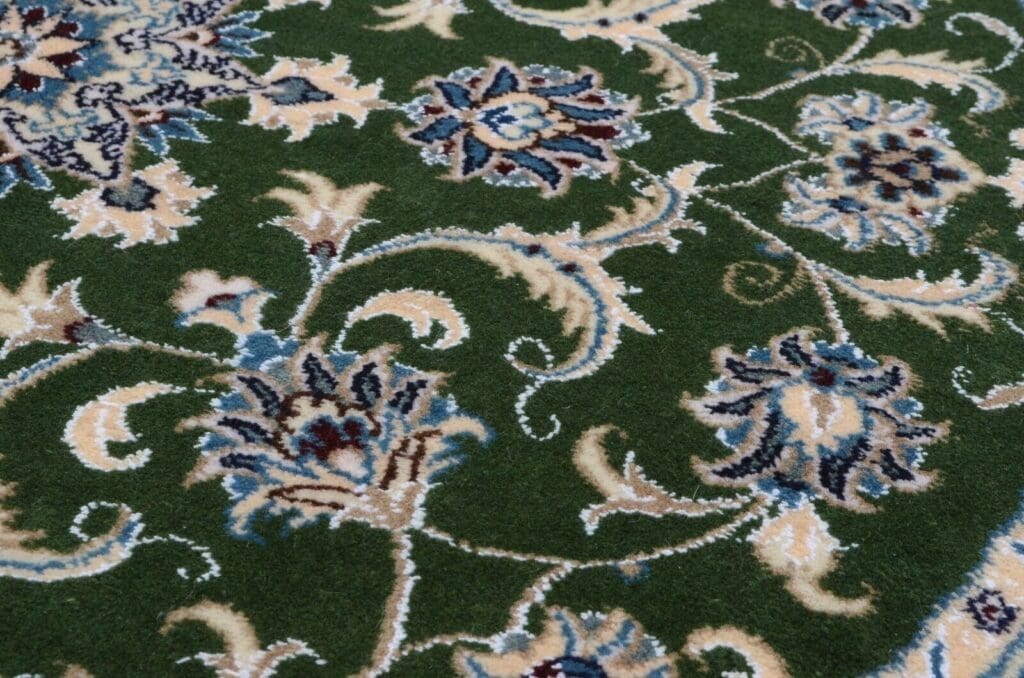
This rug features a floral design with a central medallion. The medallion serves as the visual centre and gives the composition an internal order. Around it, floral ornaments can be arranged in a fine and symmetrical manner, allowing blossoms, leaves and curved lines to lead the eye across the field. The hand-knotted construction supports the precise rendering of these individual forms.
Floral designs are among the principal elements of Persian rug decoration. They may depict individual plant forms or combine them into vines that connect different areas of the field. Repetition, mirroring and measured spacing create a continuous rhythm. In a medallion composition, the central form works together with the surrounding ornaments, giving the pattern both a fixed point and a detailed perimeter.
The colour specified for this rug is green. In Oriental ornament, green can be associated with plants, gardens and living nature. Together with floral forms, it reinforces the design’s connection to blossoms and foliage. This description keeps the colour statement to green and does not add shades that are not specified for this particular rug.
Nain designs traditionally bring refined detail together with a calm and symmetrical visual language. Smaller ornaments can be placed within larger shapes without making the overall image difficult to read. The central medallion establishes a clear reference point, while the floral elements connect the centre with the remaining field. The result is an ordered composition in which detail serves the structure of the pattern.
Persian rug ornament does not tell a story in a literal, sequential way. Instead, it works with inherited symbols and recurring forms. Flowers, vines and medallions carry associations that have developed within Iranian art and interior tradition. They combine decorative order with cultural memory. A Nain pattern can therefore be viewed both as a precisely drawn surface and as an expression of a long regional design history.
Its traditional Oriental Persian style can be read in a classically furnished room or against a more restrained interior where the medallion becomes the principal point of attention. That is a statement about the formal language of the design, not about a particular room. The defining elements remain the Nain composition, the floral drawing, the green colour and the clearly established centre.
Special Features
A notable specification of this rug is its knot density of 300,000 knots per square metre. This is one of the features supporting the fine drawing of the floral design and central medallion. The rug is hand-knotted, new and made with 100% wool. Its pile height is 10 mm.
The green colour and traditional Oriental Persian style shape its visual character. As a Persian rug from Persia, or Iran, it belongs to the Nain tradition. It is also suitable for use over underfloor heating. In this way, the rug combines an inherited hand-making method with a stated suitability for contemporary rooms equipped with this type of heating.
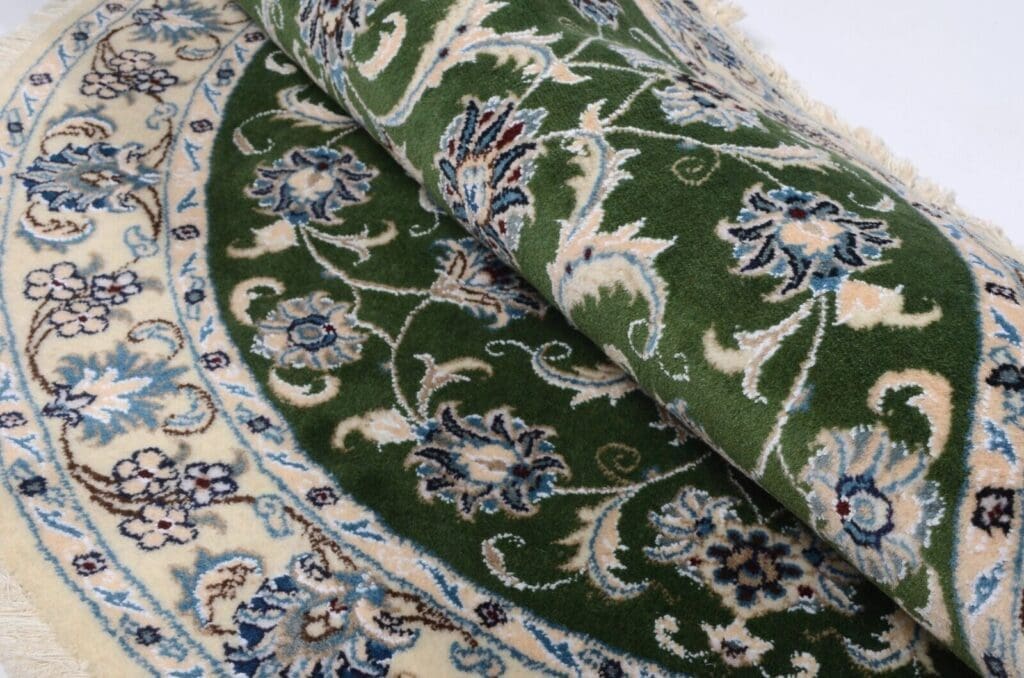
Its round form and central composition establish the relationship between the outer shape and the interior pattern. The medallion creates a fixed centre, while the floral elements work through the remaining design. Wool, hand-knotting and fine knot density together describe the technical identity of this one-off Nain Persian rug without separating it from its regional tradition.
FAQ
What is the best way to clean my Nain Persian rug?
For routine care, vacuum the rug regularly using a low setting. This removes loose dirt while avoiding unnecessary stress on the pile. Occasional professional cleaning helps maintain the surface and the colour. Direct sunlight should be avoided because prolonged exposure can cause the green colour to fade. For heavier soiling, or whenever the correct treatment is uncertain, a professional rug cleaner is the appropriate choice for a hand-knotted wool rug.
Is every Nain Persian rug hand-knotted?
Yes. Nain Persian rugs are made in the traditional hand-knotted manner. With this technique, each knot is inserted by hand into the foundation. This gives every individual rug its own craft character. Hand-knotting also permits the detailed execution of floral designs and medallions and represents the established production tradition of Nain rugs. This particular rug is hand-knotted as well, with a knot density of 300,000 knots per square metre.
How can I tell whether my Nain Persian rug is genuine?
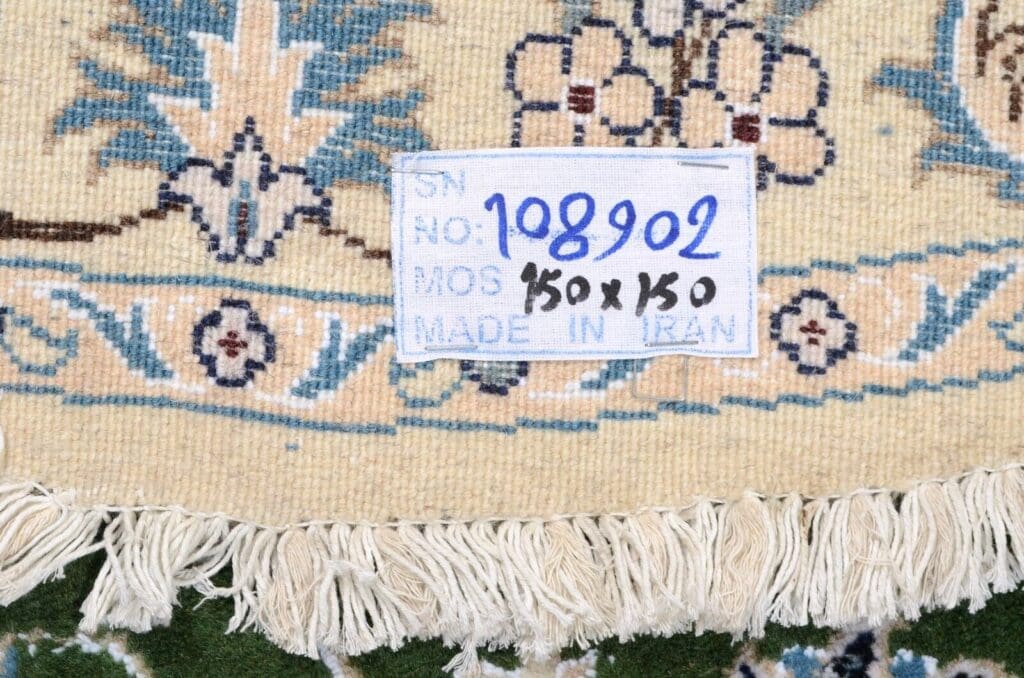
A genuine Nain Persian rug can be assessed through several characteristics, including fine knotting, the quality of the materials and the typical Nain design language with floral ornament and a medallion. A label will often provide information about origin and material. For this rug, the recorded details identify Persia, or Iran, as the origin, 100% wool as the material and hand-knotting as the technique. If uncertainty remains, a professional appraisal can provide additional assurance.
To provide the best experiences, we use technologies like cookies to store and/or access device information. Consenting to these technologies will allow us to process data such as browsing behavior or unique IDs on this site. Not consenting or withdrawing consent, may adversely affect certain features and functions.
Functional Always active
The technical storage or access is strictly necessary for the legitimate purpose of enabling the use of a specific service explicitly requested by the subscriber or user, or for the sole purpose of carrying out the transmission of a communication over an electronic communications network.
Preferences
The technical storage or access is necessary for the legitimate purpose of storing preferences that are not requested by the subscriber or user.
Statistics
The technical storage or access that is used exclusively for statistical purposes.The technical storage or access that is used exclusively for anonymous statistical purposes. Without a subpoena, voluntary compliance on the part of your Internet Service Provider, or additional records from a third party, information stored or retrieved for this purpose alone cannot usually be used to identify you.
Marketing
The technical storage or access is required to create user profiles to send advertising, or to track the user on a website or across several websites for similar marketing purposes.
 SECURE PAYMENT
 SHIPPING PARTNERS