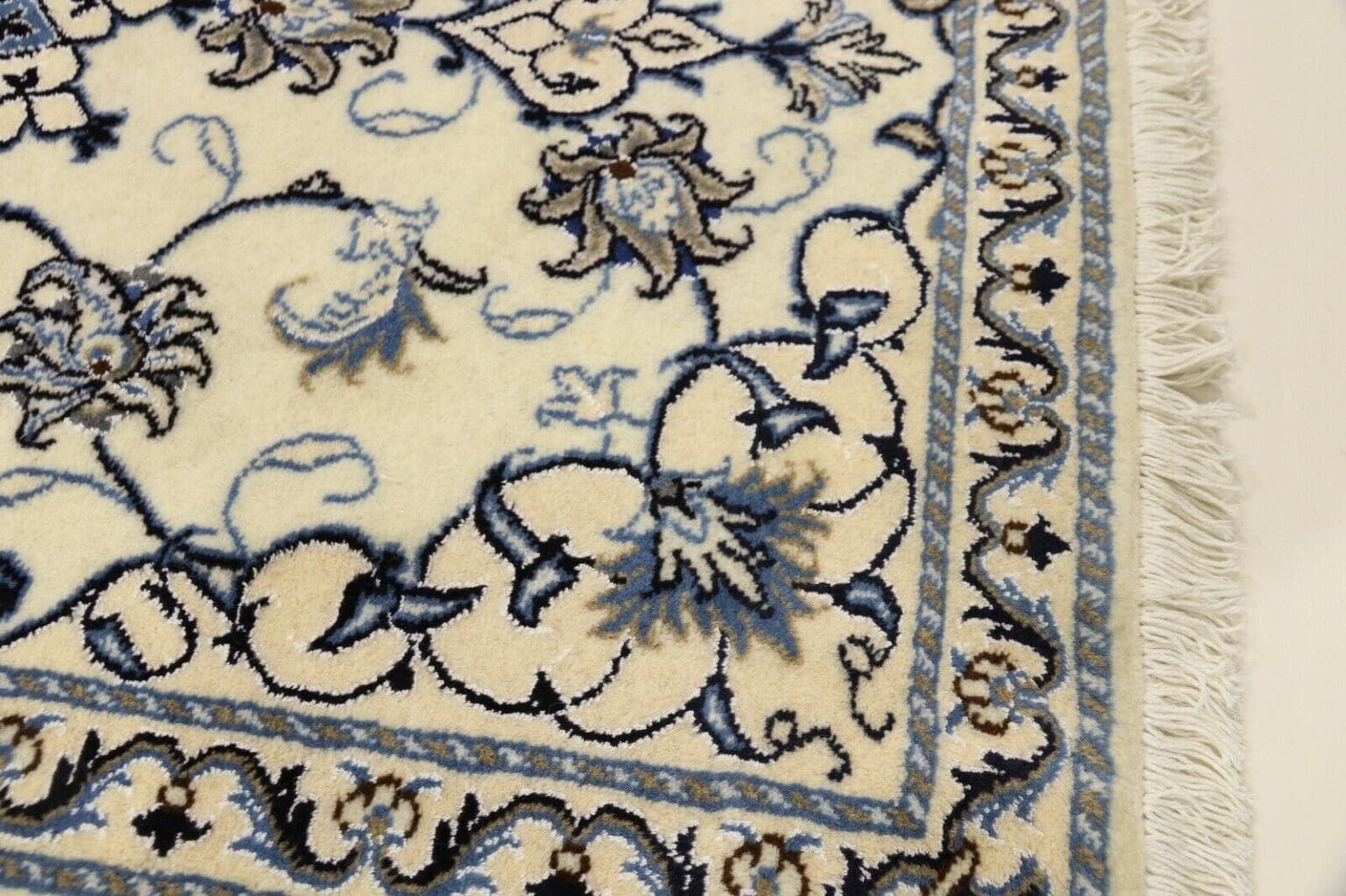
This Nain Persian rug is hand-knotted from virgin wool and silk. Virgin wool makes up the principal part of the pile and is valued in rug making for its combination of resilience and a pleasantly soft feel. Wool can be shaped with precision during hand knotting, allowing the weaver to define fine outlines and carefully ordered ornamental details. A wool pile therefore contributes both to practical use and to the clear rendering of a traditional design.
Silk is worked into the pile alongside the wool. It has a smoother surface and can contribute a subtle sheen to selected areas. Since wool and silk reflect light differently, parts of the surface may appear to change gently as the viewing angle changes. Silk is traditionally used in Persian weaving where delicate drawing and narrow contours require particular definition. The combination of wool and silk belongs to the established material tradition of finer Nain rugs.
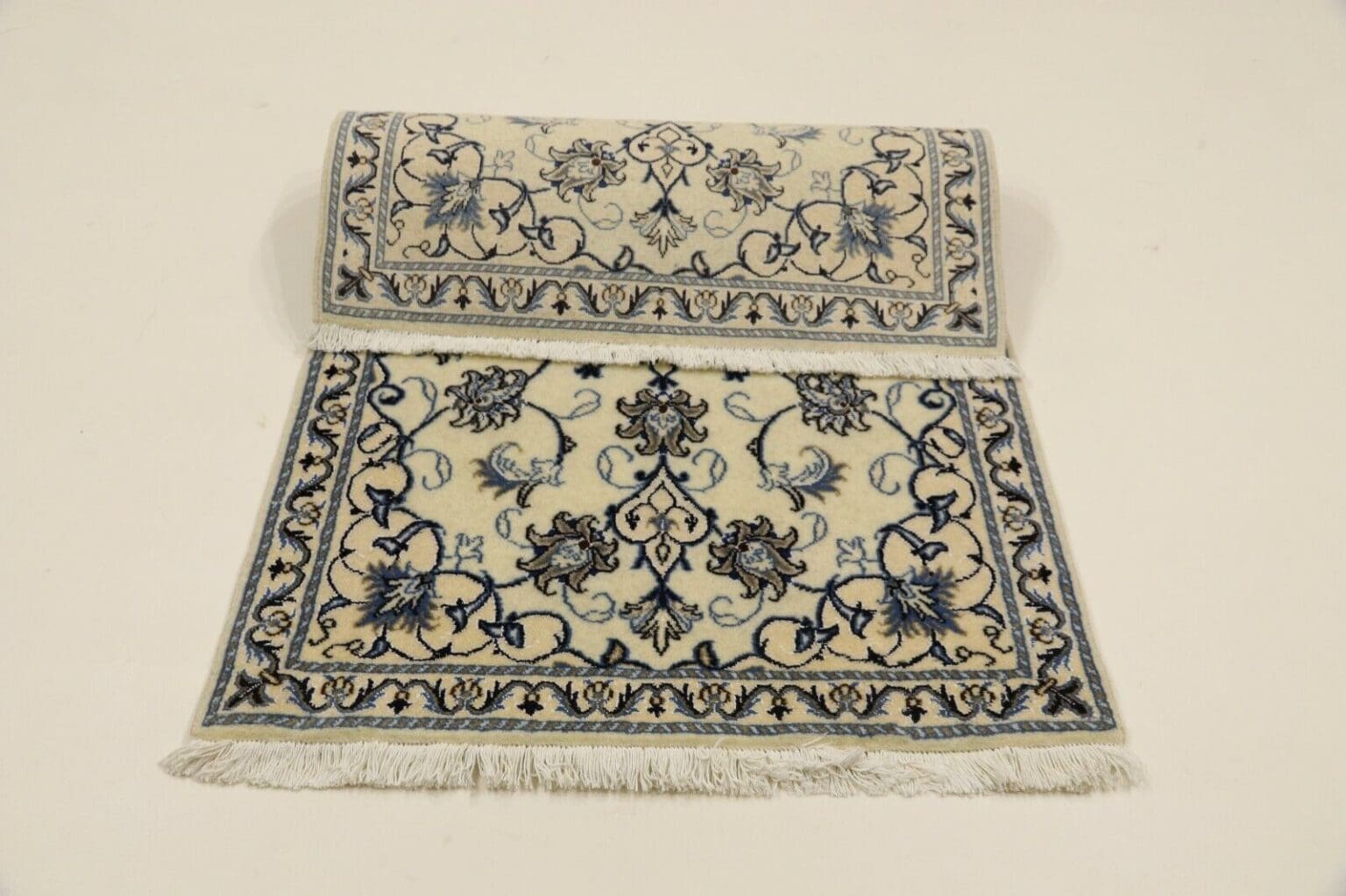
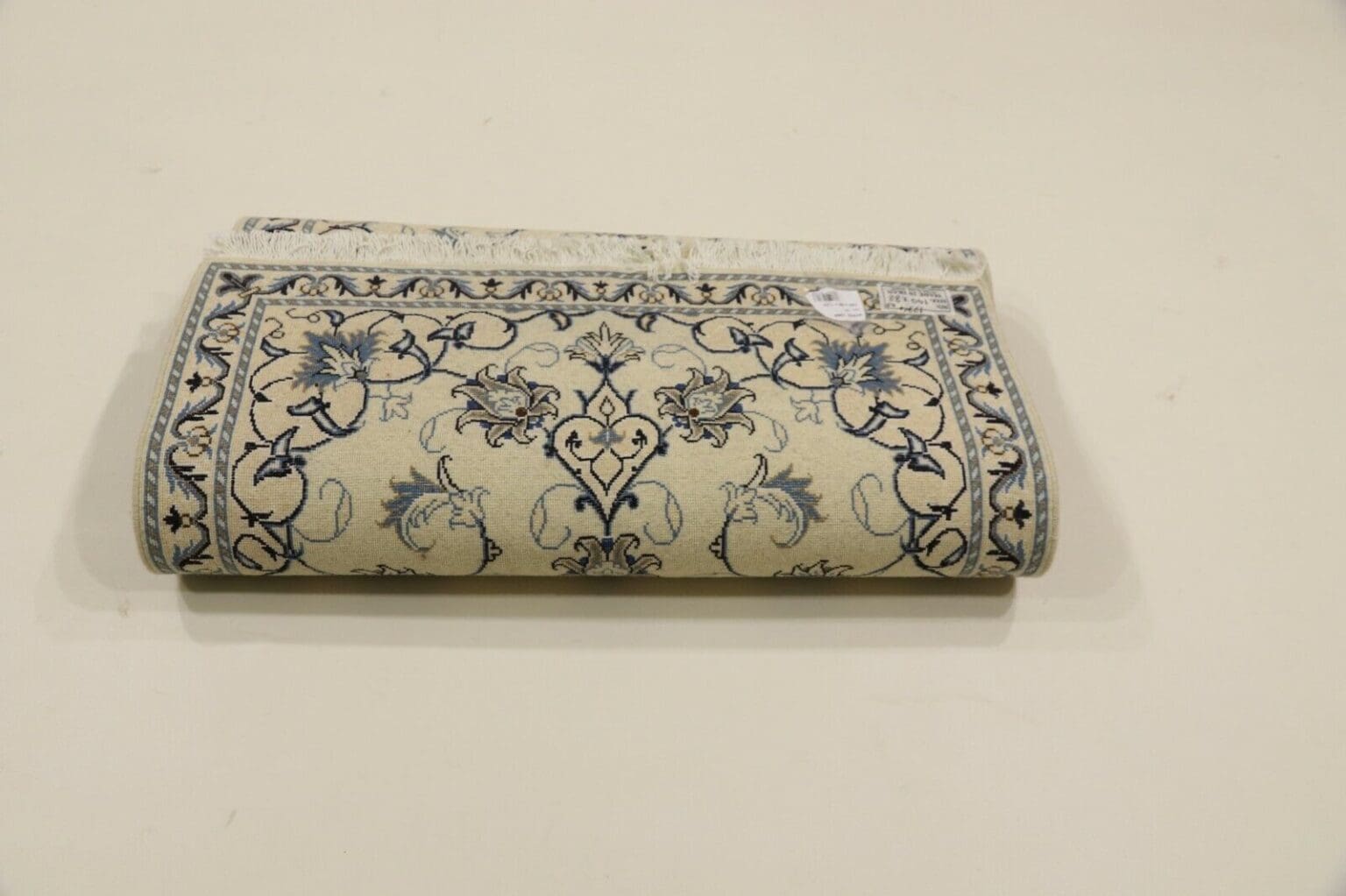
With hand knotting, each knot is formed separately and inserted into the foundation. The pile and pattern are built together, row by row, rather than being printed onto a finished textile. This work calls for even tension, controlled handling of the yarn and close attention to the design. The weaver must transfer the lines, colour changes and repeated ornaments from the drawing into the knot structure. Because it is made by hand, the rug is a single textile piece rather than an identical machine-produced item.
A high knot density supports the detailed rendering of small forms. Fine lines, floral elements and transitions can be arranged more closely in a densely worked structure than in a coarse construction. Knot count is not the only measure of workmanship, however. The preparation of the foundation, consistent tension, careful yarn selection and finishing of the pile also affect the result. In a Nain rug, these stages work together to give the pattern its clarity.
Origin and Tradition
Nain is a city in Iran, in Isfahan Province. It is known for its rugs and occupies a distinct position within Persian weaving. Nain rugs are associated with refined drawing, controlled execution and balanced compositions. The name therefore identifies not only a place of origin but also a regional tradition with its own approach to design, materials and hand craftsmanship.
The Nain tradition is linked to the wider artistic culture of Isfahan, where planning and proportion have long been important to textile design. A rug may begin with a drawn pattern setting out the field, borders and individual ornaments. The weaver then translates that plan into rows of knots, keeping the proportions and contours consistent. This requires experience in reading a design as well as skill in managing the materials. The final appearance depends on the relationship between the drawing, the knotting and the finishing work.
Persian rugs are traditionally understood as textile compositions in which surface, rhythm and ornament work together. In Nain rugs, this relationship can be seen in the ordered distribution of floral forms and framing elements. A central field may be enclosed by one or more borders, with smaller motifs guiding the transition between centre and edge. Other designs use an all-over arrangement instead of a single central focus. The precise layout belongs to each individual design, while careful organisation remains a central feature of the regional tradition.
Nain is situated in the dry interior of Iran. Its regional setting, the history of Persian ornament and the development of local workshops form part of the cultural background of these rugs. Weaving knowledge is passed on through workshops and families. It includes preparing the foundation, handling wool and silk, coordinating colours and checking the completed pile. This knowledge is both technical and visual: it governs the stability of the textile as well as the readability and balance of its design.
Within Persian rug history, Nain is often associated with a finely drawn and carefully planned style. The construction of a composition requires attention to proportion, repetition and the relationship between field and border. A frame must contain the interior without overwhelming it, while small details should enrich the surface without disturbing its order. These principles give Nain weaving a recognisable place within the broader Iranian tradition.
The tradition of Nain is therefore also a tradition of transmitted skills. The work combines the preparation of a drawing with manual production. Every section of the design must be converted into a sequence of knots, and every colour area must fit into the larger composition. The connection between Iranian origin, regional visual language and hand-knotting explains the position of Nain rugs within Persian textile culture.
Design and Pattern
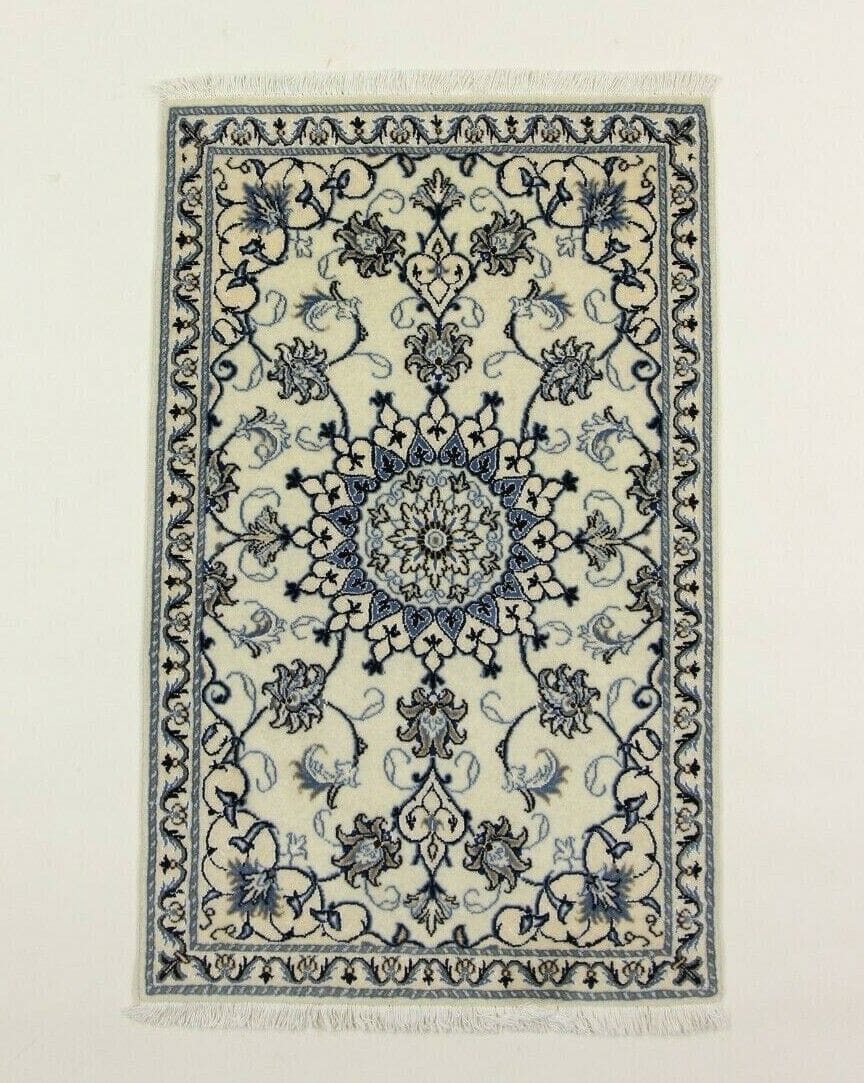
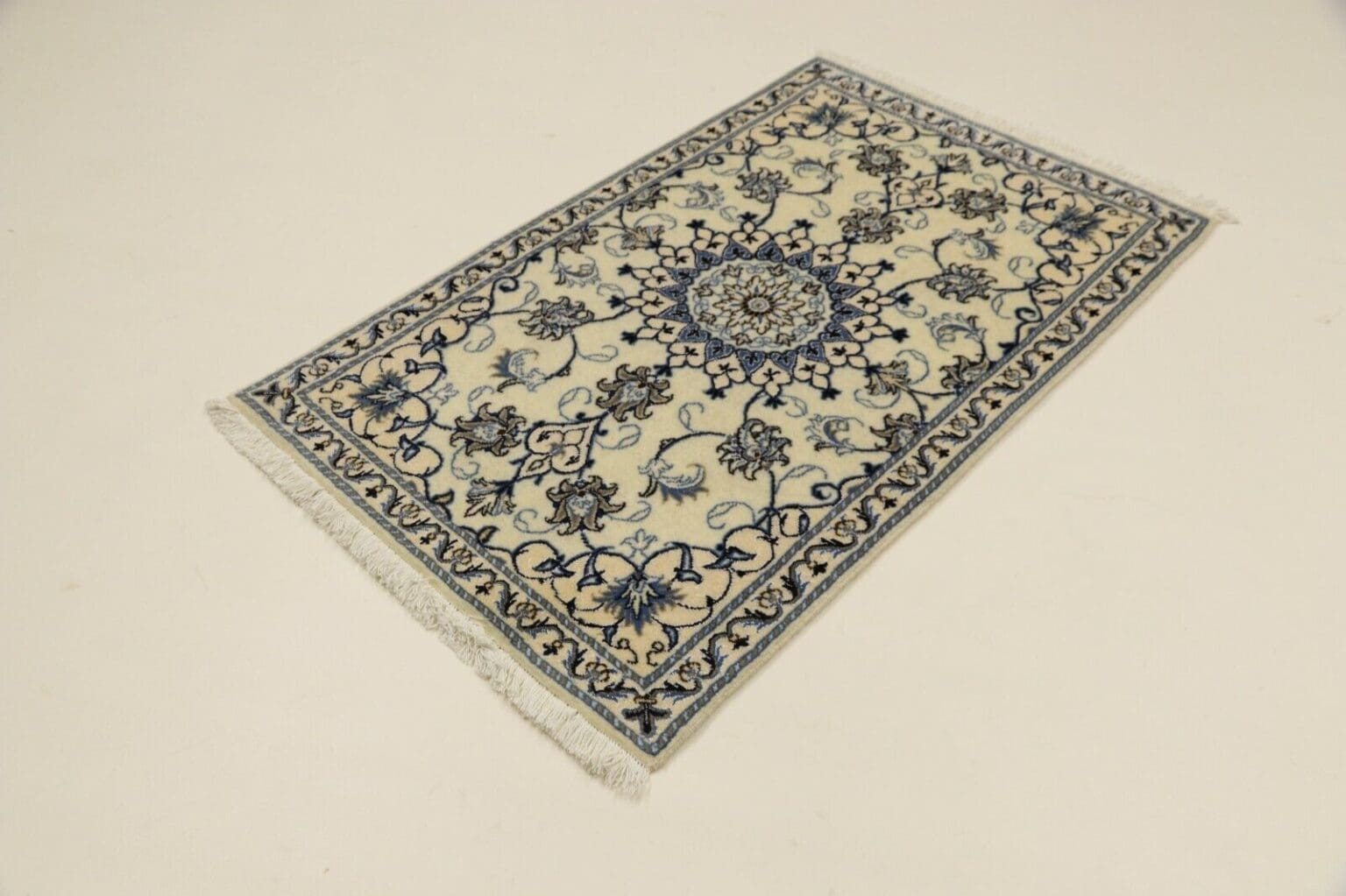
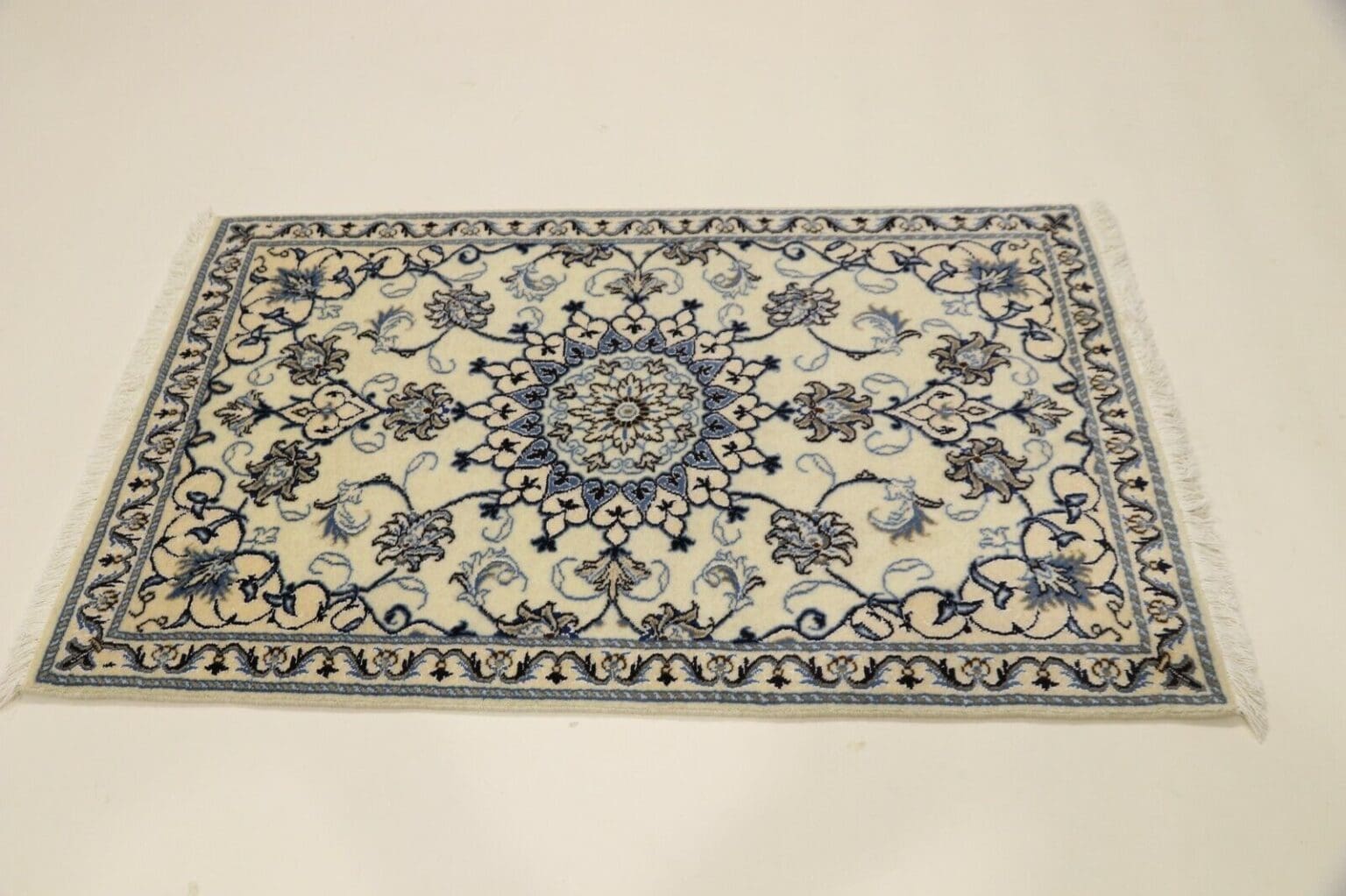
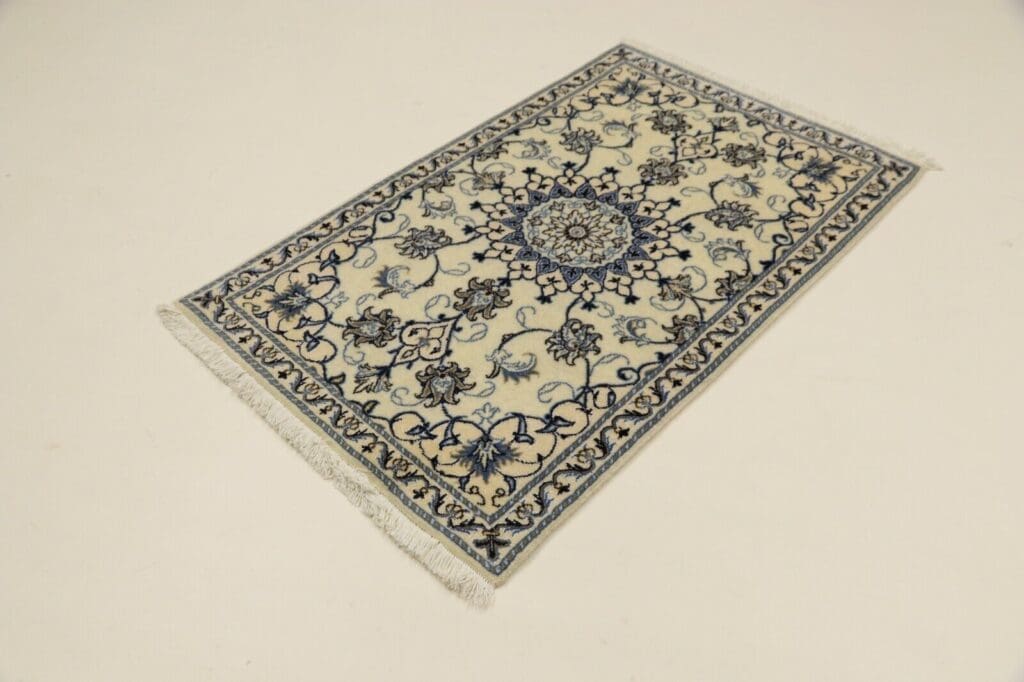
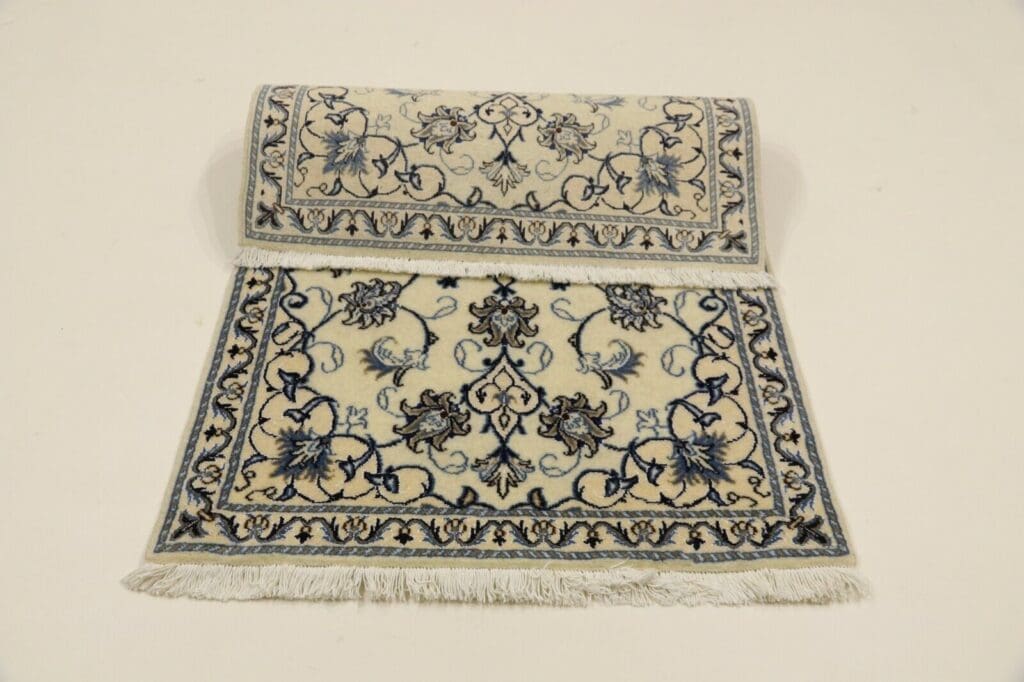
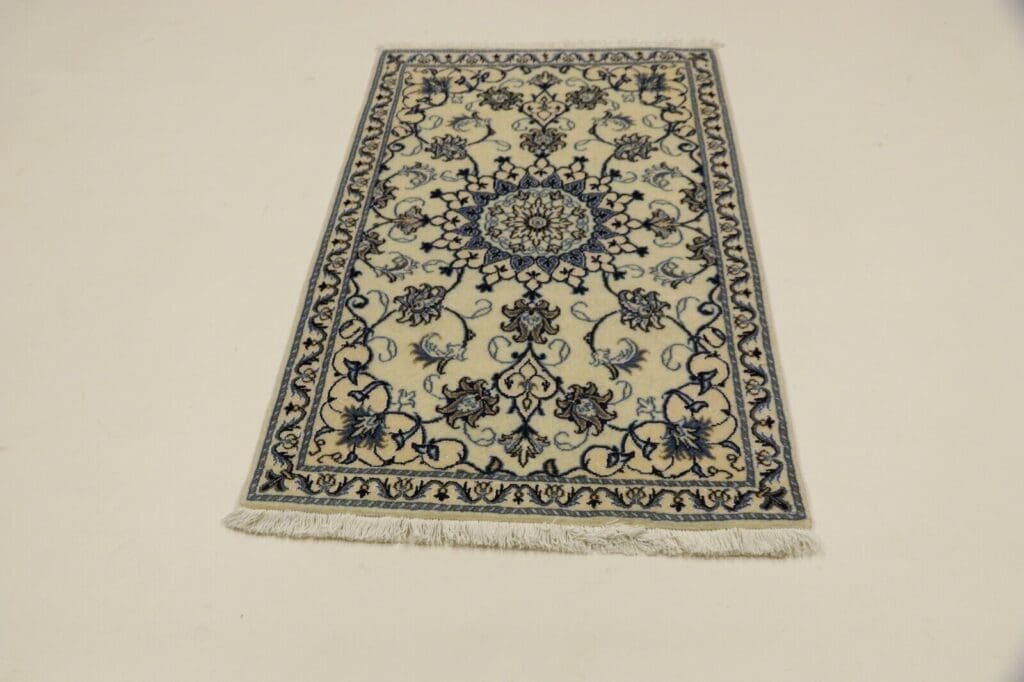
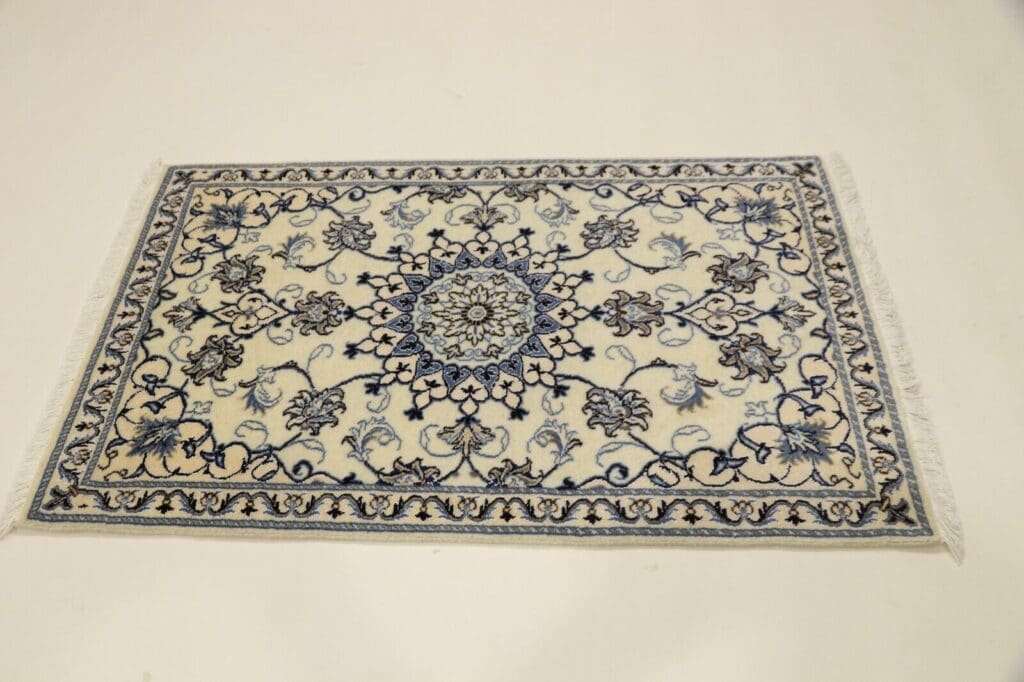
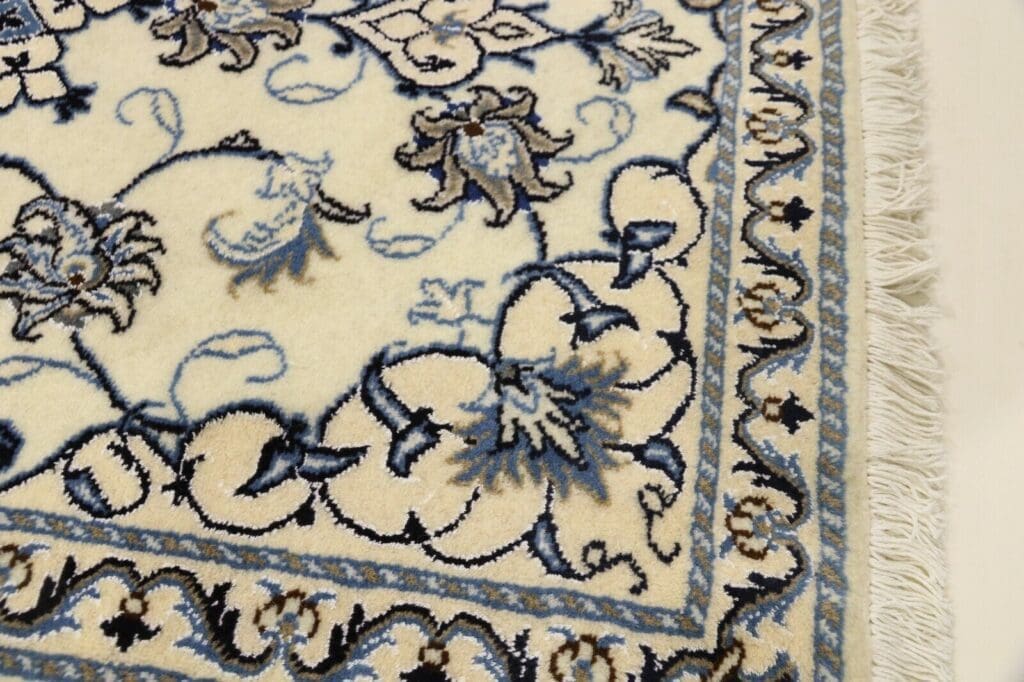
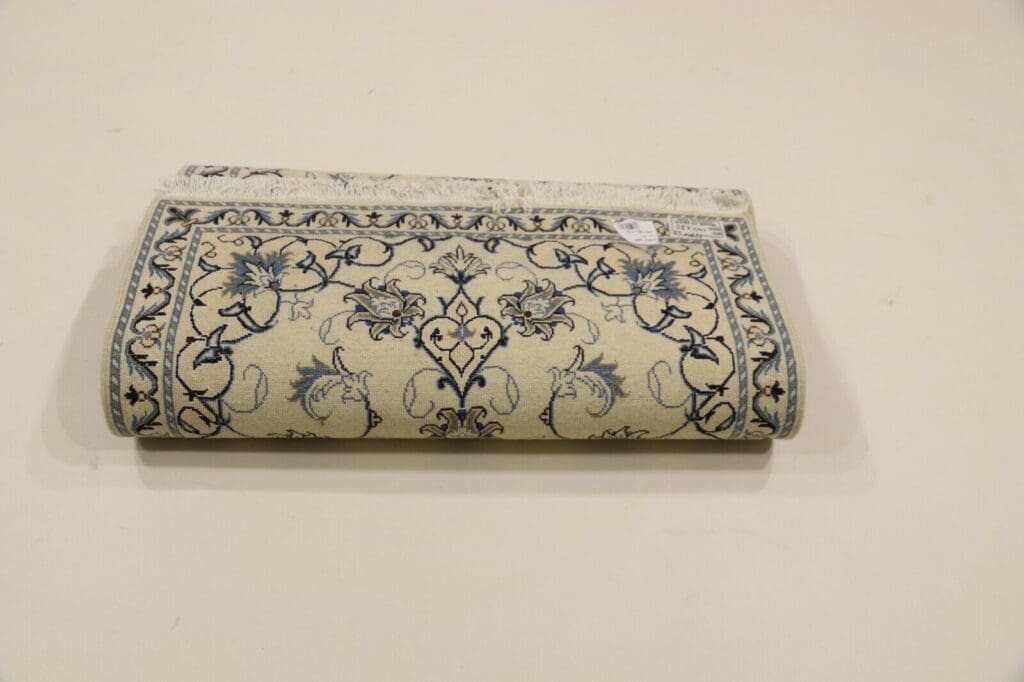
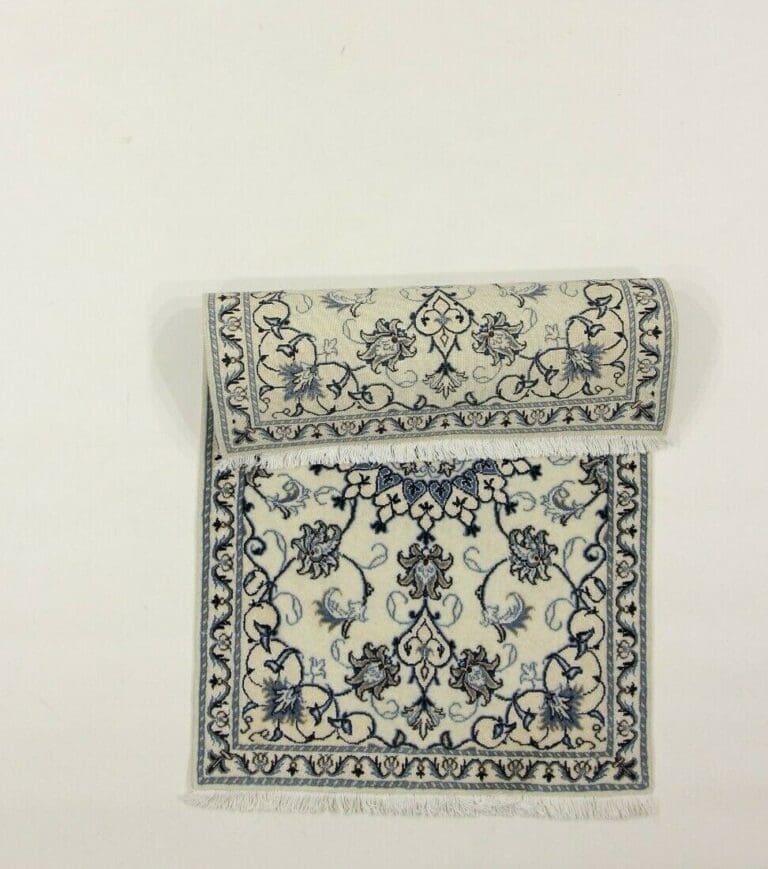
The pattern of this rug is described as Oriental. This classification places it within the broad ornamental language of Oriental rugs. Nain designs commonly use floral elements, symmetrical arrangements and finely drawn lines. Stylised flowers, leaves, vines and plant forms may be connected into a continuous repeat. Geometric outlines and framed areas can give the composition additional structure. Together, these elements produce a surface that is read as an organised whole rather than as a collection of isolated decorations.
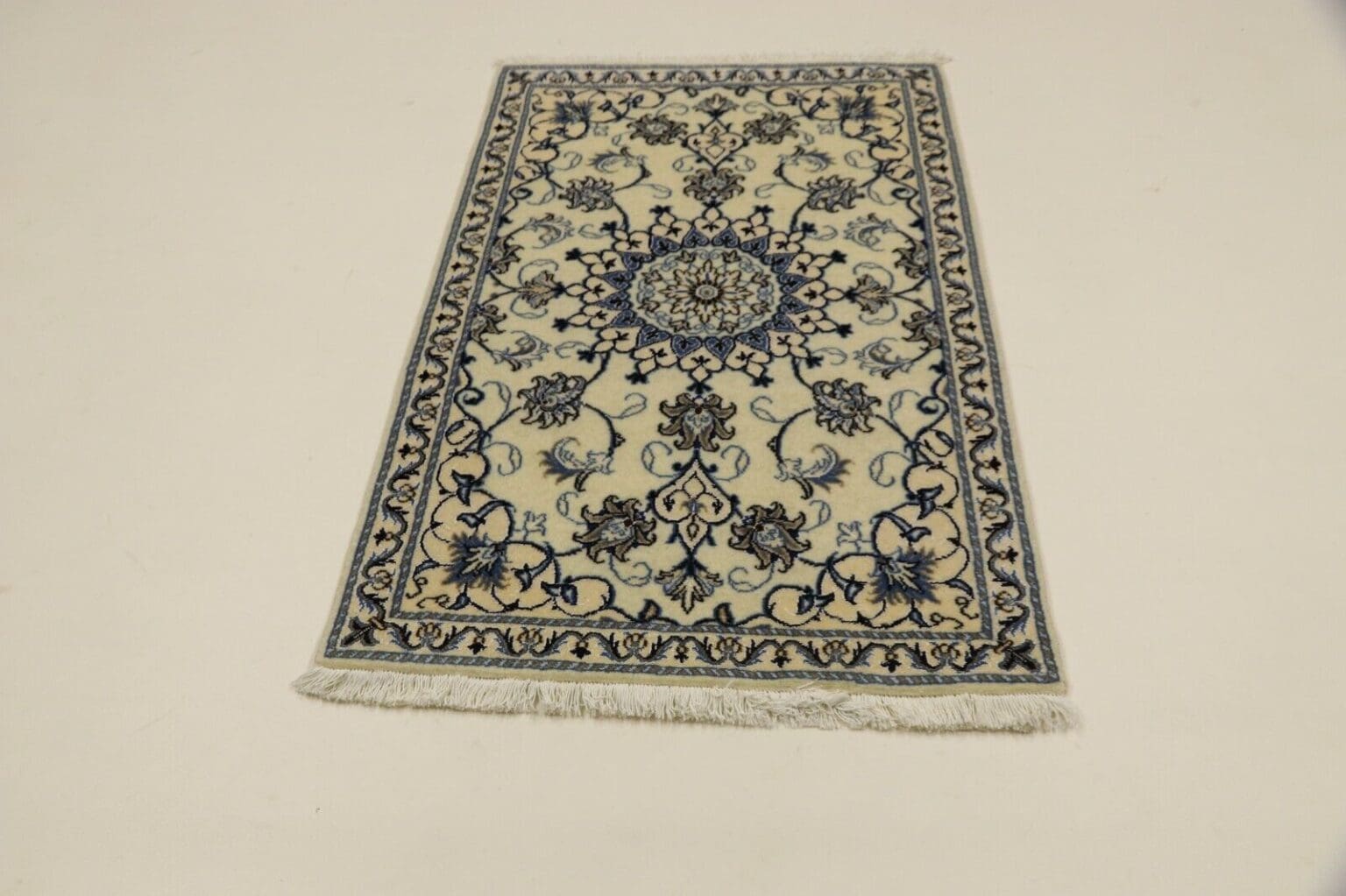
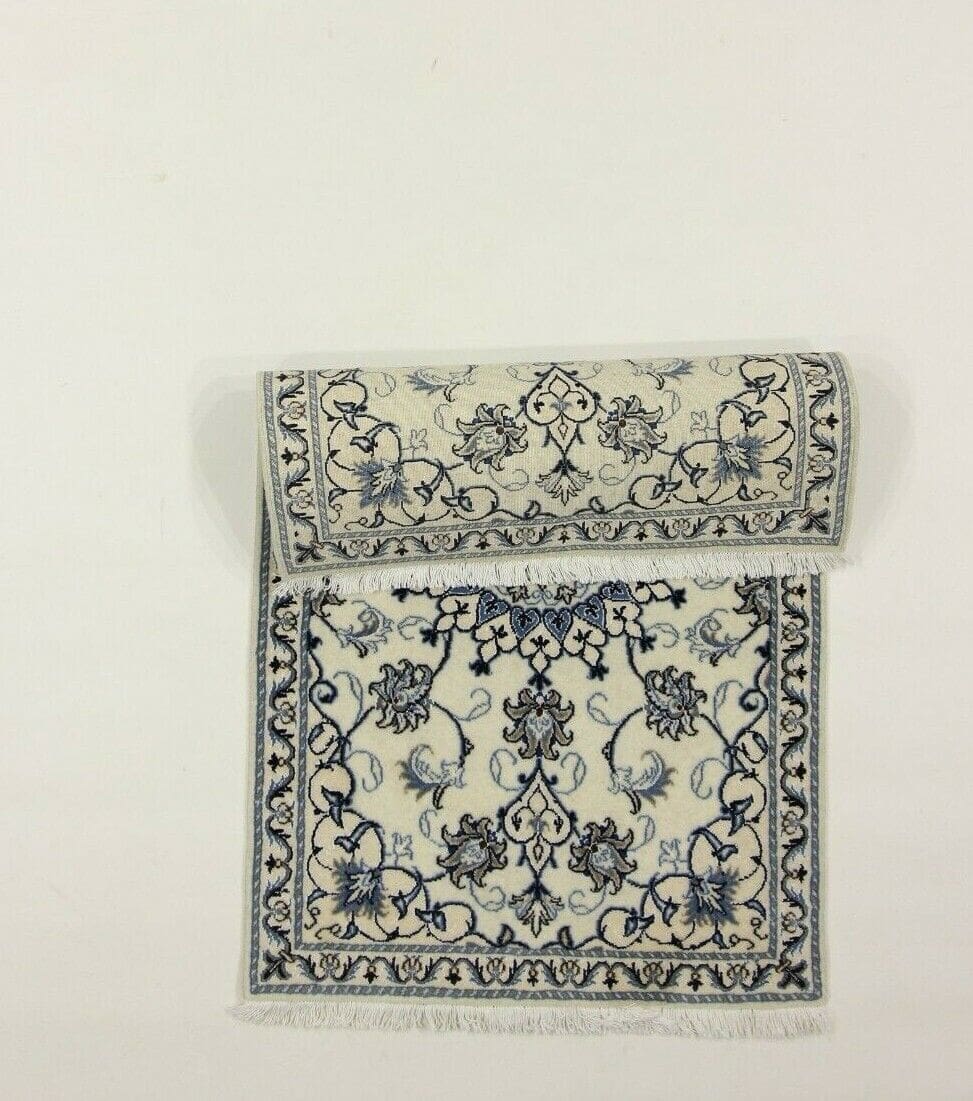
Many Nain compositions are based on the relationship between a principal motif and smaller supporting details. A medallion may establish the centre, while vines and flowers extend into the surrounding field. Other designs distribute the ornament more evenly across the surface. Borders perform an organising function by enclosing the field, repeating selected shapes and creating a transition towards the outer edge. The visual effect is produced by the interaction of line, spacing, symmetry and colour contrast.
Nain rugs frequently use light, restrained ground colours together with blue, red and warm earth tones. Cream and beige can create an open background, while darker outlines make delicate drawing easier to follow. Blue may define leaves, flowers, vines or border elements. Red and earthy accents can establish points of emphasis within the composition. The actual balance of shades depends on the particular design, but the controlled relationship between background, outline and ornament remains important to the tradition.
Fine patterning creates movement without giving up structure. Small motifs can fill the spaces between larger forms, while repeated vines establish a measured rhythm across the field. Slight variations in flowers and leaves prevent the surface from looking mechanically uniform. This balance between repetition and variation is a recurring principle in Persian textile design. It allows a Nain rug to contain considerable detail while retaining a coherent overall appearance.
The border also contributes to the way the design is read. It directs the eye around the field and separates the inner composition from the surrounding floor. Narrow secondary borders may accompany a wider principal border and create stepped transitions. In Nain design, such framing elements are often coordinated with the motifs in the field. The centre, the border and the intervening details therefore form a connected composition rather than unrelated decorative sections.
The combination of floral drawing, geometric framing and coordinated colour connects the general Oriental classification with the Persian Nain tradition. Oriental describes the broad pattern language, while Nain identifies the regional rug tradition. No more specific named motif is assigned to this individual rug in the description. Its documented design character therefore rests on the Oriental classification and on the established visual vocabulary associated with Nain.
Special Features
The rug is described as new and in very good condition. It has a rectangular form and is completely hand-knotted. It is also suitable for use with underfloor heating, making it compatible with rooms equipped with this type of heating. The combination of virgin wool and silk, the hand-made construction and the fine knotting are further characteristics specified for this Nain Persian rug.
Its dense knotting supports detailed execution of the Oriental design. Small ornaments, outlines and colour transitions can be differentiated within a closely worked structure. For identifying this one-off piece, its Iranian origin, Nain attribution and hand-knotted construction are central. These features bring together a named regional tradition, traditional fibres and a technique in which the pattern is built directly into the textile.
FAQ
How should I care for a Nain Persian rug?
Regular vacuuming is suitable for routine care. Use a setting appropriate for Oriental rugs and work evenly across the surface, avoiding unnecessarily aggressive brushing. Fresh stains can be carefully lifted with a damp cloth. Rubbing should be avoided, since it may work moisture further into the fibres or put additional stress on the pile. Cleaning products should not be used without suitable professional advice, as they may affect the colours or the combination of wool and silk. If the rug is heavily soiled, professional cleaning is recommended. A specialist can choose a method that takes the hand-knotted construction and mixed fibre composition into account.
Where is the best place for this Nain rug?
The rectangular rug can be used in a living room, dining room, hallway or bedroom. In a living room it can help define a seating area, while in a dining room it can be coordinated with the table and surrounding furnishings. A hallway or bedroom is another possible location. A contrasting and relatively quiet floor allows the colours and Oriental pattern to remain visible without competing with the fine details. Since the rug is suitable for underfloor heating, it can also be used in rooms fitted with that heating system.
How can an authentic Nain rug be identified?
Several characteristics should be considered together when identifying a Nain rug. These include the Nain designation, Iranian origin, hand-knotting, fine materials such as wool and silk, and floral or geometric elements associated with Nain design. The construction should be examined directly rather than inferred from appearance alone. A dealer may also provide a certificate of authenticity. When assessing a purchase, material, workmanship, condition and price should be considered as a group. The regional name should correspond to the documented origin and to the way the textile was actually made.
To provide the best experiences, we use technologies like cookies to store and/or access device information. Consenting to these technologies will allow us to process data such as browsing behavior or unique IDs on this site. Not consenting or withdrawing consent, may adversely affect certain features and functions.
Functional Always active
The technical storage or access is strictly necessary for the legitimate purpose of enabling the use of a specific service explicitly requested by the subscriber or user, or for the sole purpose of carrying out the transmission of a communication over an electronic communications network.
Preferences
The technical storage or access is necessary for the legitimate purpose of storing preferences that are not requested by the subscriber or user.
Statistics
The technical storage or access that is used exclusively for statistical purposes.The technical storage or access that is used exclusively for anonymous statistical purposes. Without a subpoena, voluntary compliance on the part of your Internet Service Provider, or additional records from a third party, information stored or retrieved for this purpose alone cannot usually be used to identify you.
Marketing
The technical storage or access is required to create user profiles to send advertising, or to track the user on a website or across several websites for similar marketing purposes.
 SECURE PAYMENT
 SHIPPING PARTNERS


