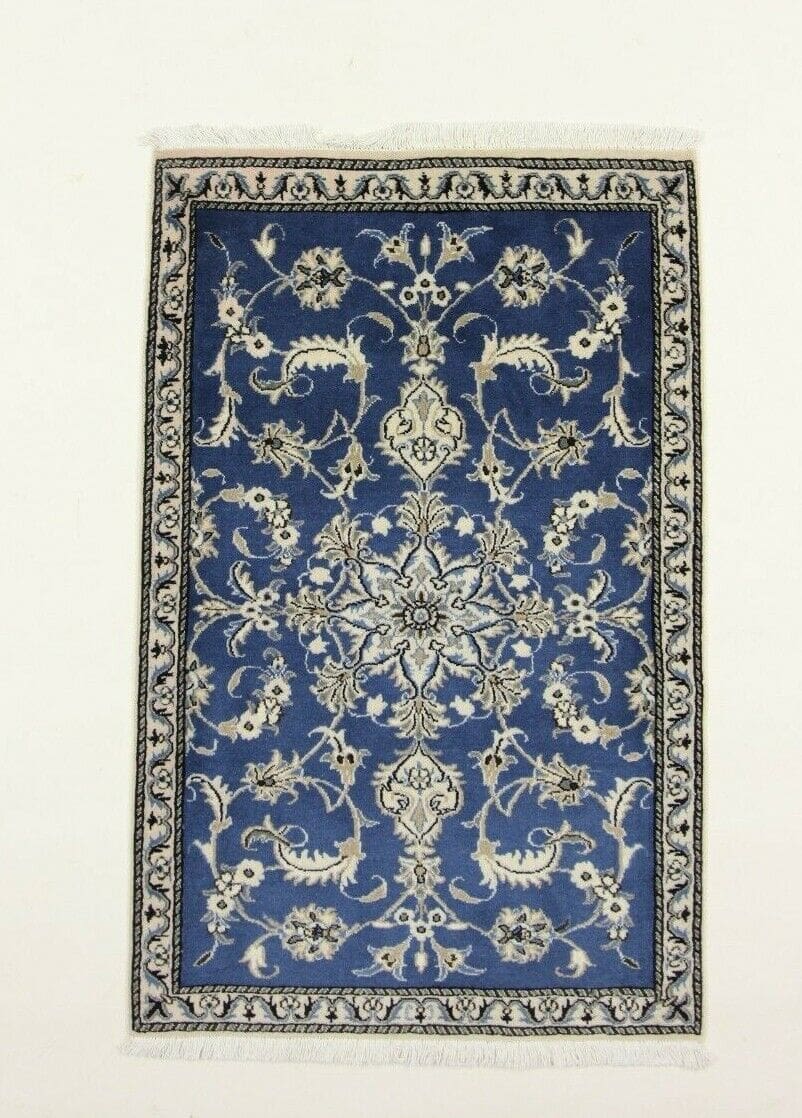
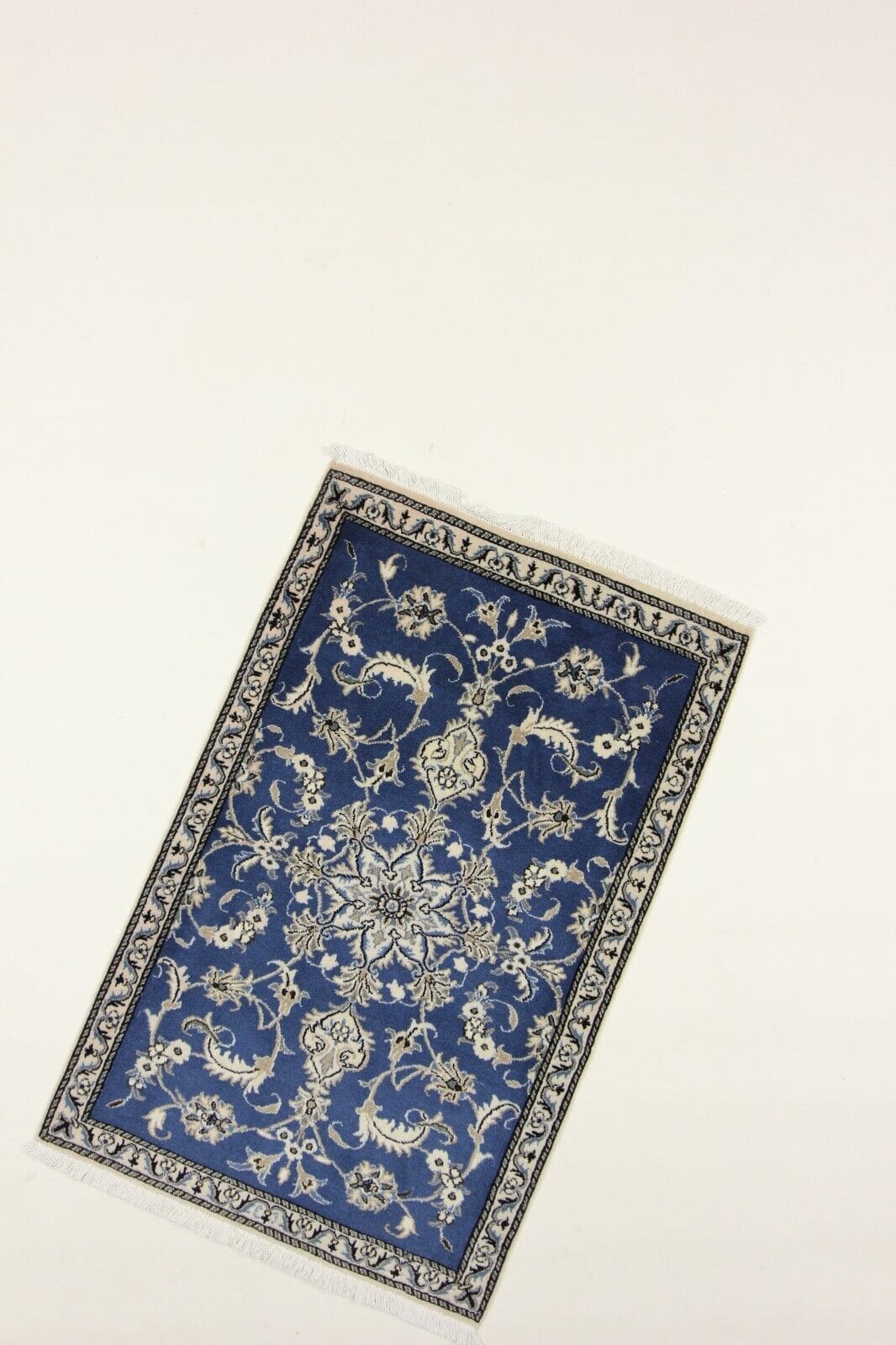
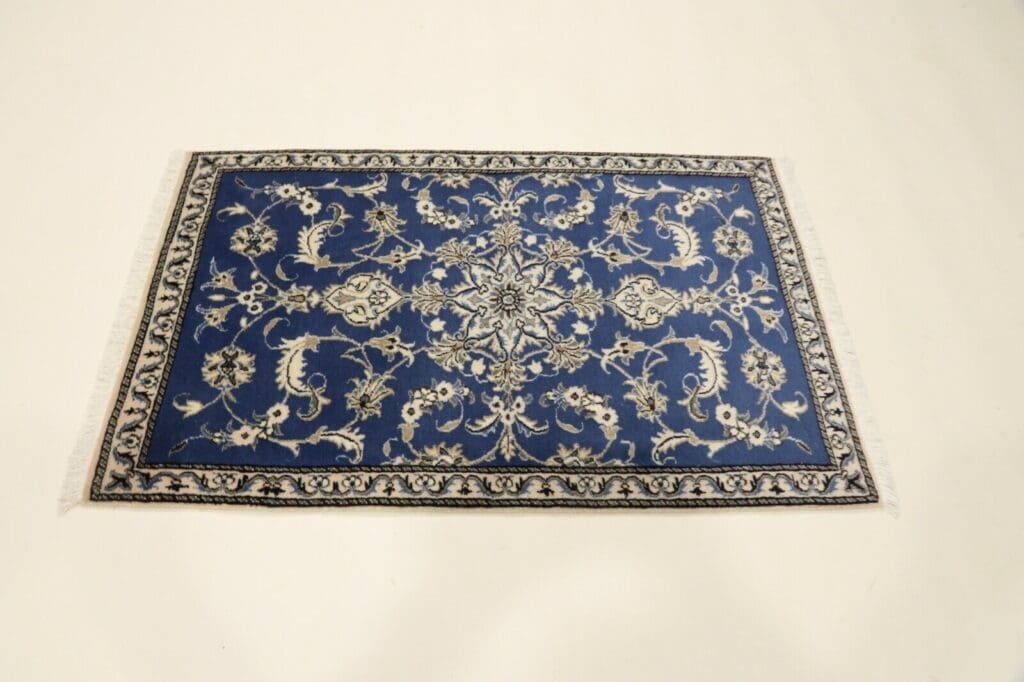
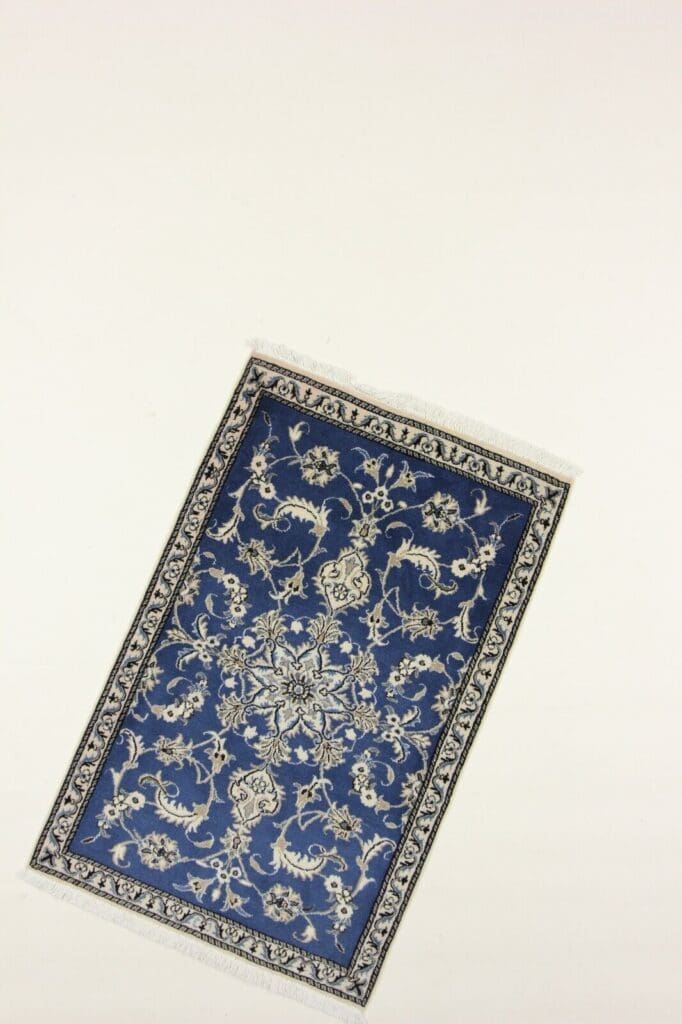
This Nain Persian rug is hand-knotted from a pile consisting of 95% new wool and 5% silk. New wool is valued in rug making for its resilient structure and its ability to withstand regular use. It also provides a naturally warm and pleasant surface underfoot. Silk contributes a different character to the material composition: its smooth fibres can reflect light softly and give selected areas a refined sheen. In combination, wool and silk create a surface with both substance and a delicate visual quality.
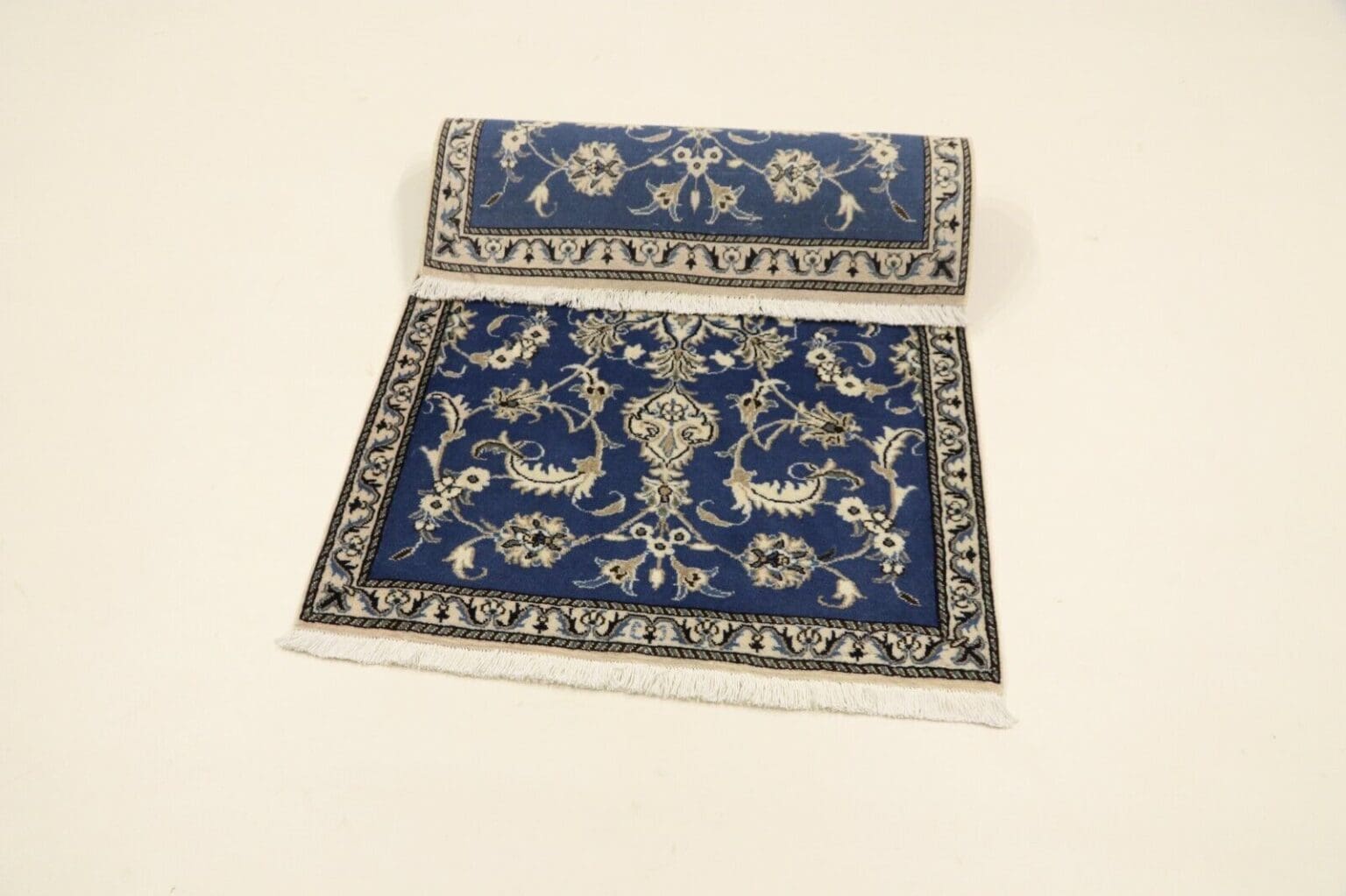
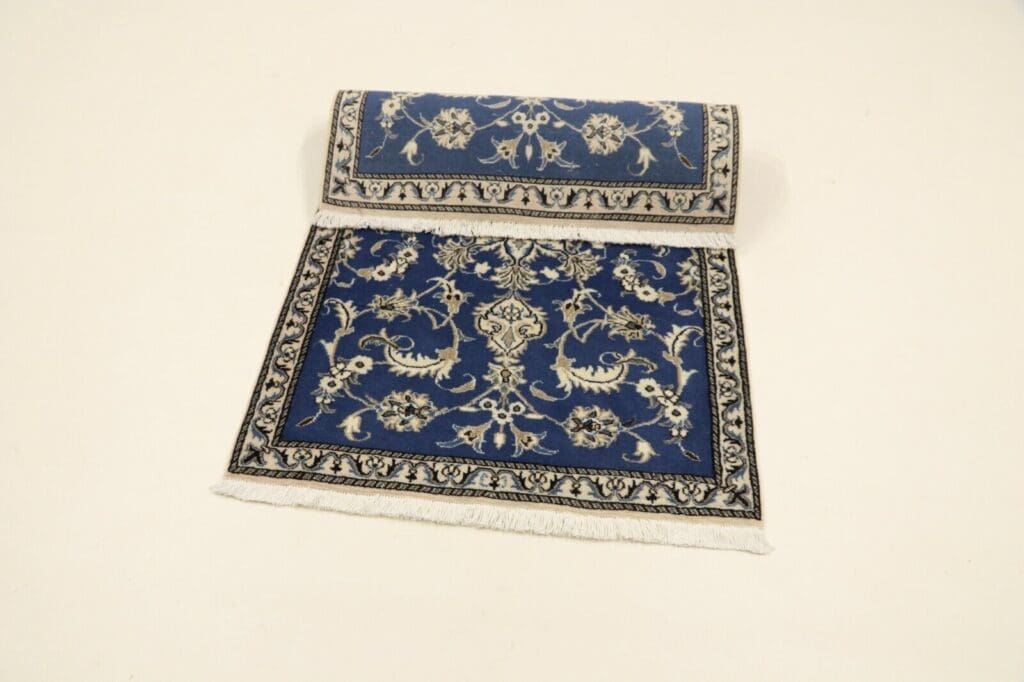
Hand-knotting is a process in which individual knots are tied by hand around the foundation of the rug. Rows of knots are secured and compacted as the work progresses, while the pile is trimmed to form an even surface. This method allows the weaver to render fine lines, small floral details and carefully balanced outlines. It also means that the appearance of a hand-knotted rug is shaped by the particular work of the knotter rather than by a fully uniform industrial process.
The rug has a knot density of 300,000 knots per square metre. A high knot density can support precise drawing and a clearly defined pattern because more individual knots are available to form small visual elements. It is also associated with a compact construction. The combination of new wool, silk and hand-knotting therefore describes both the material character and the traditional craft process of this particular rug.
Origin and Tradition
Nain is a city in Iran and gives its name to this Persian rug tradition. The area is known for the production of hand-knotted rugs, and the tradition of carpet making there reaches back to the sixteenth century. Nain rugs are associated with a restrained, elegant approach to design and with the use of fine wool and silk. Their reputation developed through the careful relationship between material, drawing and disciplined execution.
The city lies in a region where carpet weaving became an important artistic and practical craft. In a traditional workshop, the design is transferred to the loom and followed knot by knot. The work requires concentration because the proportions of the field, the border and the smaller ornaments must remain connected throughout the weaving process. A finished rug is therefore the result of repeated manual decisions rather than a single act of production.
Nain designs are commonly recognised for delicate colours, floral forms and geometric organisation. These elements are not necessarily separate from one another. Floral branches may be arranged symmetrically, enclosed by geometric borders or distributed across a field according to a carefully measured order. This combination gives Nain rugs a sense of clarity while retaining the irregularities and fine variations that belong to manual weaving.
The Nain tradition is also connected with the use of contrasting fibre qualities. Wool supplies body and durability, while silk may be used to introduce a smoother surface and points of light within the design. This material language supports the refined appearance for which Nain rugs are known. The result is not defined by a single motif alone, but by the interaction of a precise drawing, balanced colour and a technically demanding knotting process.
Persian carpets carry both practical and cultural importance. They serve as floor coverings, yet their patterns, materials and workmanship also express the knowledge of a weaving community. In Iran, regional traditions developed distinct vocabularies of colour, composition and construction. Nain belongs to this wider Persian carpet culture while maintaining its own identifiable approach to fine, orderly and graceful ornament.
Design and Pattern
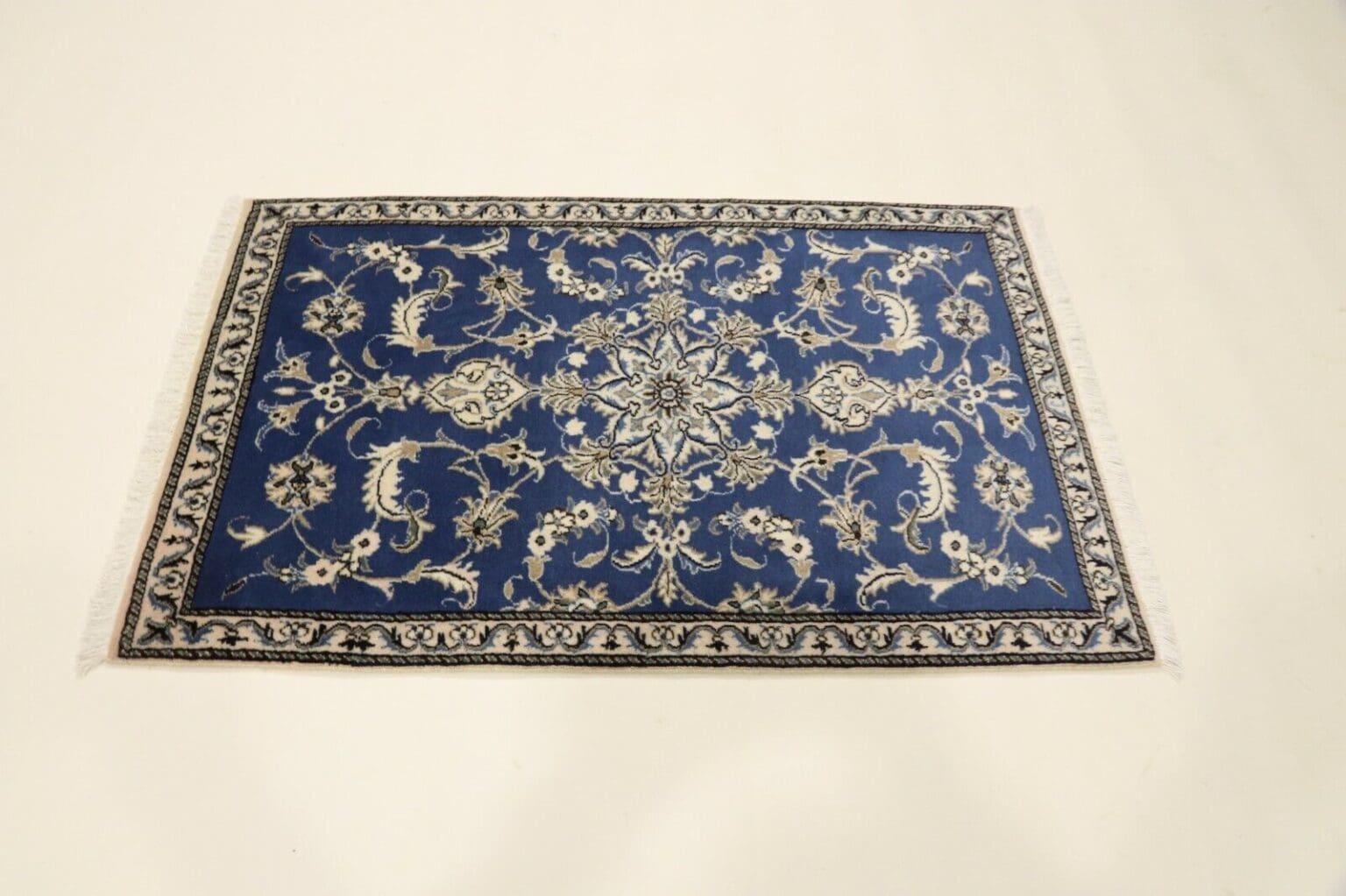
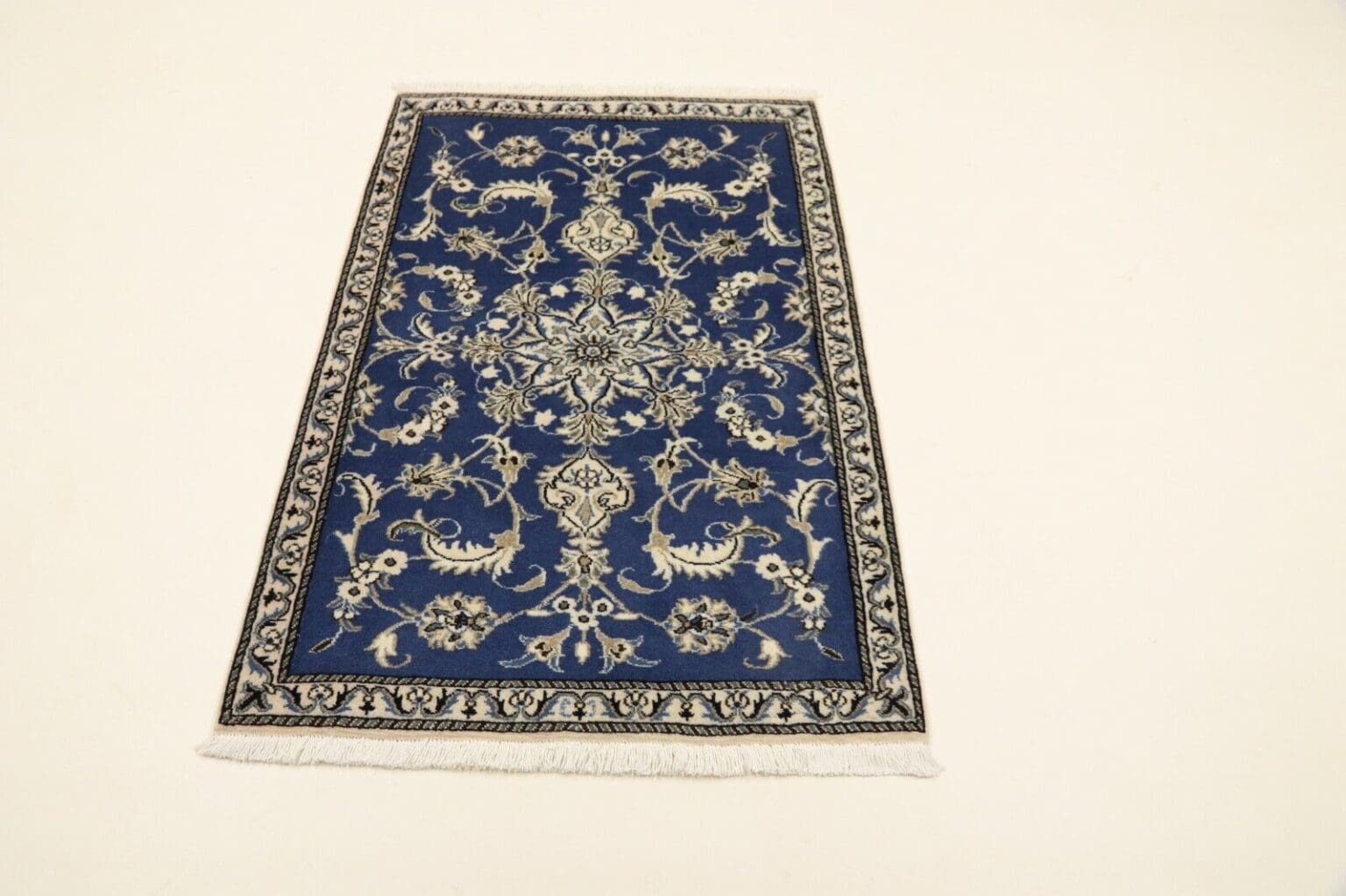
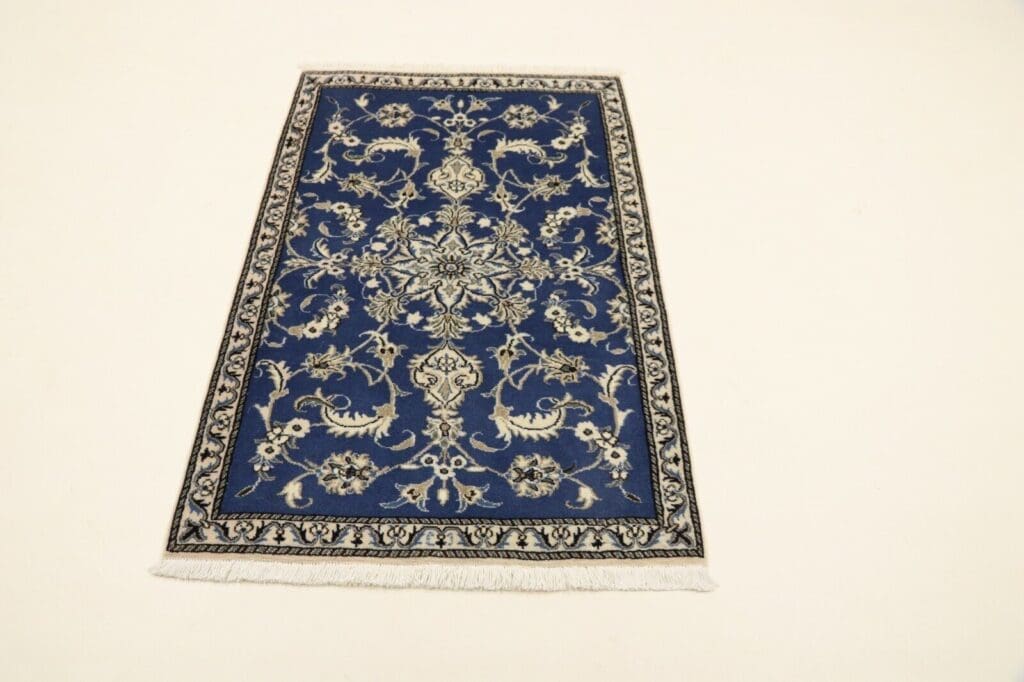
This rug combines floral and geometric motifs. Floral ornament brings stems, leaves and blossoms into the composition, while geometric structure gives the design order through repeated shapes, borders or balanced placement. Together, these two visual languages create a pattern that is detailed without depending on a single isolated image.
The design is described as graceful, with finely drawn motifs and a harmonious palette. Nain rugs are traditionally associated with delicate colours, and colour is used not only for decoration but also to separate the field from the border and to make the pattern readable. Gentle shades can establish a quiet foundation, while stronger tones may define outlines or draw attention to selected details. The balance between softer and more pronounced colours is part of the design character described for this rug.
Floral motifs in Persian rug design are often arranged according to a principle of rhythm and balance. A branch may be repeated, mirrored or extended across the field so that the eye moves naturally through the composition. Geometric elements can stabilise this movement by framing the central area or dividing the ornament into ordered sections. The precise relationship between these parts is especially important in a fine hand-knotted rug, where small changes in knot placement can alter the line of a leaf or the edge of a border.
A Nain composition is generally appreciated for its clarity rather than for visual disorder. The pattern can be read from the overall arrangement down to the smaller ornaments, allowing the rug to function as a coherent design in a room. At the same time, the combination of floral detail and geometry gives it enough structure to remain visually present in different settings. The source description places it in the living room, bedroom or hallway, where its decorative role can accompany the existing interior.
The design tradition also explains why a Nain rug is viewed as more than a simple utility object. A pattern records the decisions of the designer and the weaver: the placement of motifs, the balance of colour and the degree of detail all belong to the craft. Each hand-knotted piece is consequently made through a specific sequence of manual actions. The visual identity of this rug comes from that sequence, from its floral and geometric vocabulary and from the restrained harmony associated with Nain.
Special Features
A defining feature of this rug is its knot density of 300,000 knots per square metre. The compact knotting supports detailed pattern work and is connected with the stability and durability associated with the rug. Its construction is hand-knotted, and the individual work of the knotter makes the piece a one-off. The stated combination of new wool and silk adds a further distinction: wool provides a robust basis, while silk contributes a smooth surface and subtle sheen.
The cultural role of oriental rugs extends beyond their use as floor coverings. They can represent the skill of the weaver, the continuity of a regional tradition and the value placed on patient manual work. Their motifs may communicate order, balance and an established decorative language. For this reason, the detail contained in each knot remains central to how such rugs are understood and appreciated.
This Nain Persian rug brings together a named Iranian tradition, a floral and geometric design, a wool and silk pile, and hand-knotting at a stated high density. Those characteristics describe the object without separating its appearance from the process that produced it.
FAQ
How should a Nain Persian rug be cleaned?
Regular vacuuming is recommended to remove loose dust and everyday particles. Care should be taken to avoid excess moisture and aggressive cleaning products, as they can affect the fibres. When a deeper cleaning is needed, professional rug cleaning is the appropriate approach. Specialists can take the wool and silk composition, the hand-knotted construction and the condition of the rug into account before selecting a method. Prompt attention to spills is also sensible, but rubbing, soaking or applying untested household cleaners can spread a mark or damage the pile. Proper care helps preserve the surface, the colour impression and the structure of the rug over time.
What distinguishes a hand-knotted rug?
A hand-knotted rug is formed by tying individual knots by hand rather than by producing the surface through an automated manufacturing process. This allows the design to be built from many small decisions and makes detailed floral or geometric drawing possible. Knot density influences how finely a pattern can be rendered, while the material affects the feel and appearance of the pile. Handwork can also create minor variations that belong to the individual piece. In this rug, the hand-knotted technique is combined with a density of 300,000 knots per square metre and a pile of new wool with silk, giving the construction its stated technical and material character.
How can the authenticity of a Persian rug be checked?
Several aspects should be considered together when examining a Persian rug. Knot density, the fibres used, the drawing of the design and the quality of the workmanship can provide useful indications. The regional style should also be considered: Nain is associated with fine wool and silk, delicate colours, floral motifs and geometric organisation. A seller’s certificates or other provenance documents may provide additional support, although documentation should be assessed alongside the physical rug. Looking at the back, the knot structure, the finish and the way the pattern is formed can help distinguish hand-knotting from other production methods. For a reliable assessment, an experienced rug specialist or an independent expert can examine the piece in person.
To provide the best experiences, we use technologies like cookies to store and/or access device information. Consenting to these technologies will allow us to process data such as browsing behavior or unique IDs on this site. Not consenting or withdrawing consent, may adversely affect certain features and functions.
Functional Always active
The technical storage or access is strictly necessary for the legitimate purpose of enabling the use of a specific service explicitly requested by the subscriber or user, or for the sole purpose of carrying out the transmission of a communication over an electronic communications network.
Preferences
The technical storage or access is necessary for the legitimate purpose of storing preferences that are not requested by the subscriber or user.
Statistics
The technical storage or access that is used exclusively for statistical purposes.The technical storage or access that is used exclusively for anonymous statistical purposes. Without a subpoena, voluntary compliance on the part of your Internet Service Provider, or additional records from a third party, information stored or retrieved for this purpose alone cannot usually be used to identify you.
Marketing
The technical storage or access is required to create user profiles to send advertising, or to track the user on a website or across several websites for similar marketing purposes.
 SECURE PAYMENT
 SHIPPING PARTNERS


