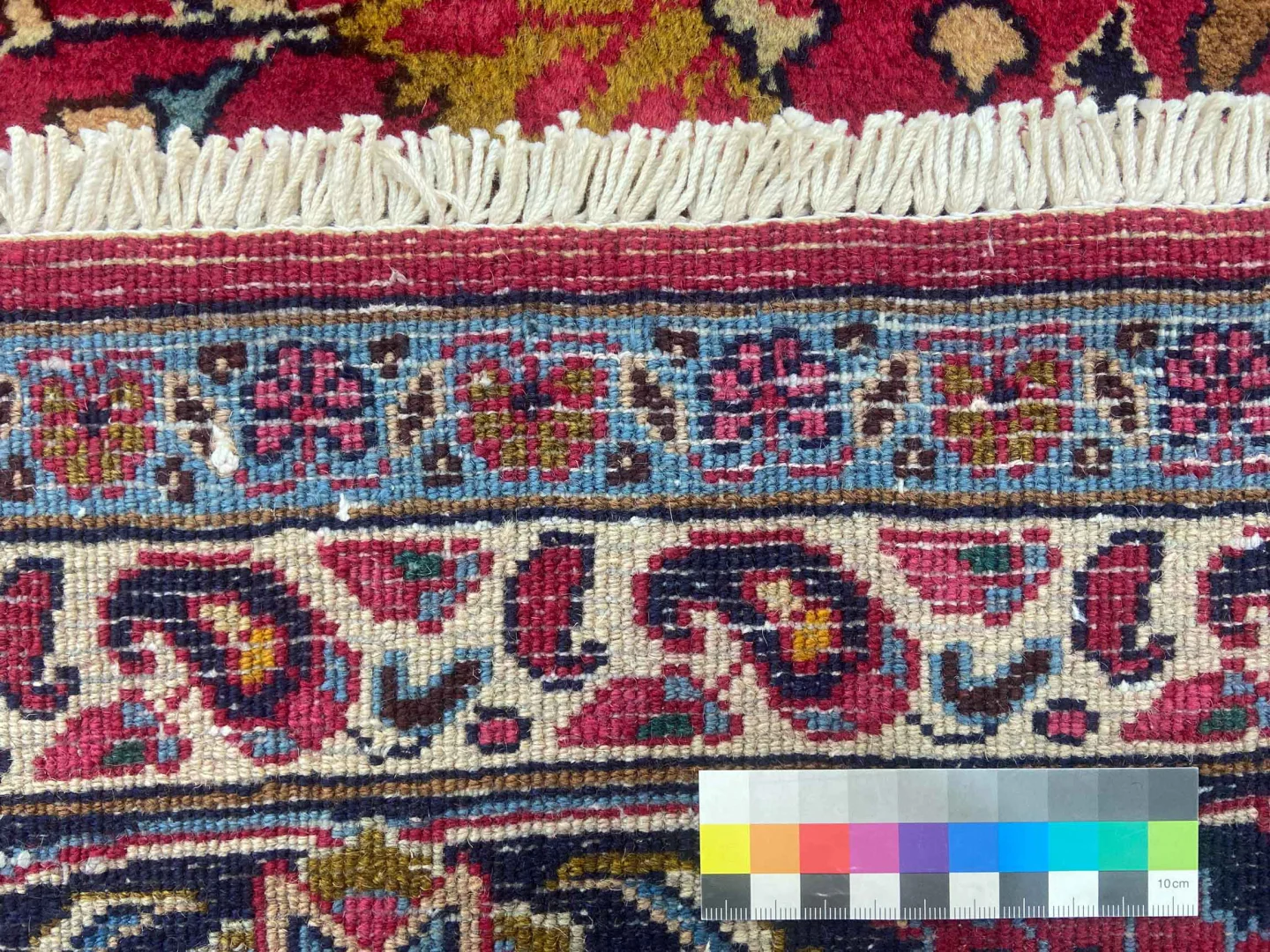
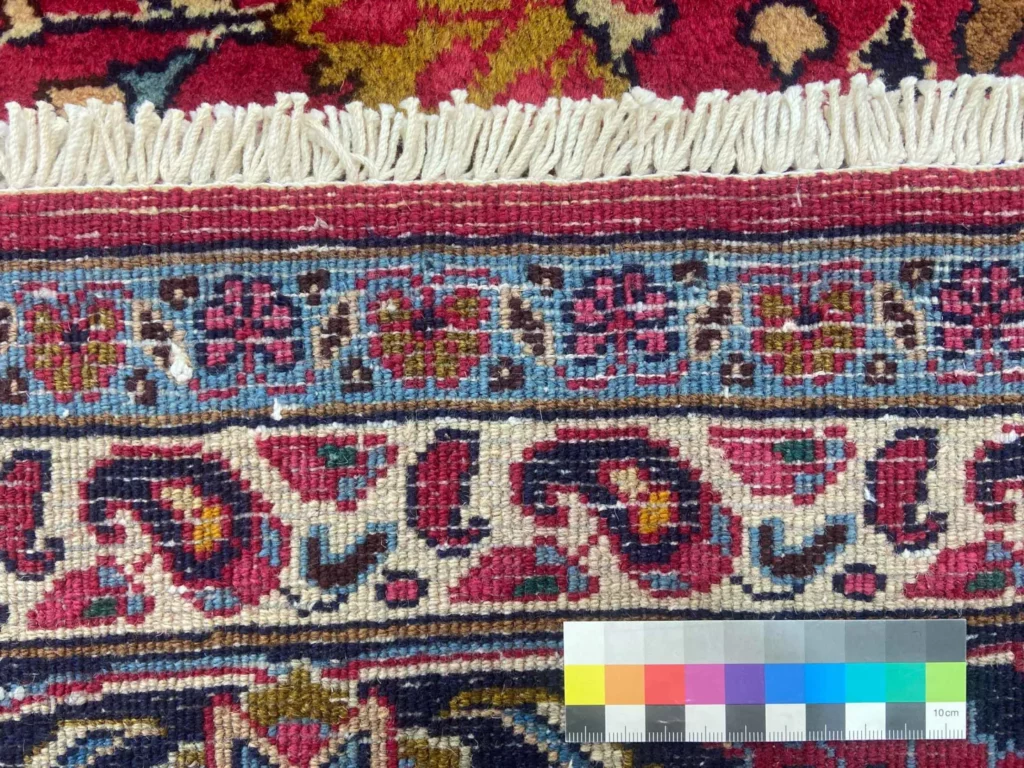
This Mashhad Persian rug is hand-knotted. Individual knots are tied into the foundation by hand, building the pile and the pattern progressively across the textile. Once the knotting is complete, the surface is worked so that the design can be read clearly. In a hand-knotted rug, the visual character is therefore inseparable from the making process: the pattern is created by the placement of knots rather than printed onto a finished surface.
The specified pile material is high-quality wool. Wool has a long-established place in oriental rug making because its natural structure provides a firm yet tactile surface. It accepts colour well and supports the clear rendering of flowers, leaves, curved stems and other ornamental details. As a natural fibre, wool responds to light and touch in a way that reinforces the textile quality of a handmade rug.
The knot density given for this rug is 180,000 to 250,000 knots per square metre. Knot density indicates how closely the knots are placed within the construction. A denser structure can allow contours and decorative details to be drawn with greater precision. It is assessed together with the quality of the pile, the evenness of the workmanship and the condition of the finished rug. Here, the documented density accompanies a floral design centred on a classic medallion.
Hand-knotting requires the weaver to follow a design while controlling tension, colour placement and the progression of each section. The work is carried out knot by knot rather than through an industrial printing process. Small variations may occur in handmade textiles, but the principal composition is maintained through the relationship between the field, the central motif and the surrounding ornaments. This method gives the rug its character as a crafted textile.
Origin and Tradition
Mashhad is a major city in northeastern Iran and an important centre of Persian carpet production. It is also a significant cultural and historical centre of the wider Khorasan region. The carpet tradition of Mashhad has been passed on through generations of workshop practice. A Mashhad Persian rug therefore belongs to an Iranian tradition in which regional design, manual skill and established methods of production are closely connected.
Persian carpet making developed in many different regional centres. Over time, each centre established particular preferences in drawing, colour, proportions and construction. Mashhad rugs are often associated with substantial compositions and a strong colour presence. Red is frequently used as an important ground colour in Persian designs, while blue and other shades can provide contrast and separate the medallion, field and borders.
Workshop production begins with a planned design that is transferred into the developing textile. The weaver must interpret the pattern, keep the knotting regular and maintain the intended relationship between the different areas. This calls for practical knowledge of the foundation, the yarn and the sequence of colours. The number of knots is one technical point of reference, but the clarity of the pattern, the consistency of the pile and the balance of the composition are also part of the craft.
The Persian carpet tradition includes many recognised places of production. Tabriz is known for detailed drawings and varied ornamental arrangements. Isfahan is associated with refined knotting and carefully balanced designs. Kerman is known for elegant patterns and delicate colour effects. These places represent distinct regional traditions. Their role in the broader history of Persian rugs does not change the origin of this rug, which is identified as a Mashhad piece.
Skills are transmitted through practical instruction and repeated work. They include preparing the foundation, reading a design, tying the knots, maintaining tension and finishing the pile. The final treatment of the surface helps make the pattern distinct and prepares the rug for use. This sequence of tasks explains why a hand-knotted Persian rug can be understood both as a functional furnishing textile and as a record of regional craftsmanship.
Persian rugs have traditionally been made in different formats for different areas of a home. The format affects how the design occupies a room, while the pattern determines the visual organisation of the surface. A central composition can gather attention in the middle, a border can define the outer edge and the relationship between field and frame can create a balanced whole. These principles appear in many Persian workshop traditions, including the floral medallion language associated with this type of rug.
Design and Pattern
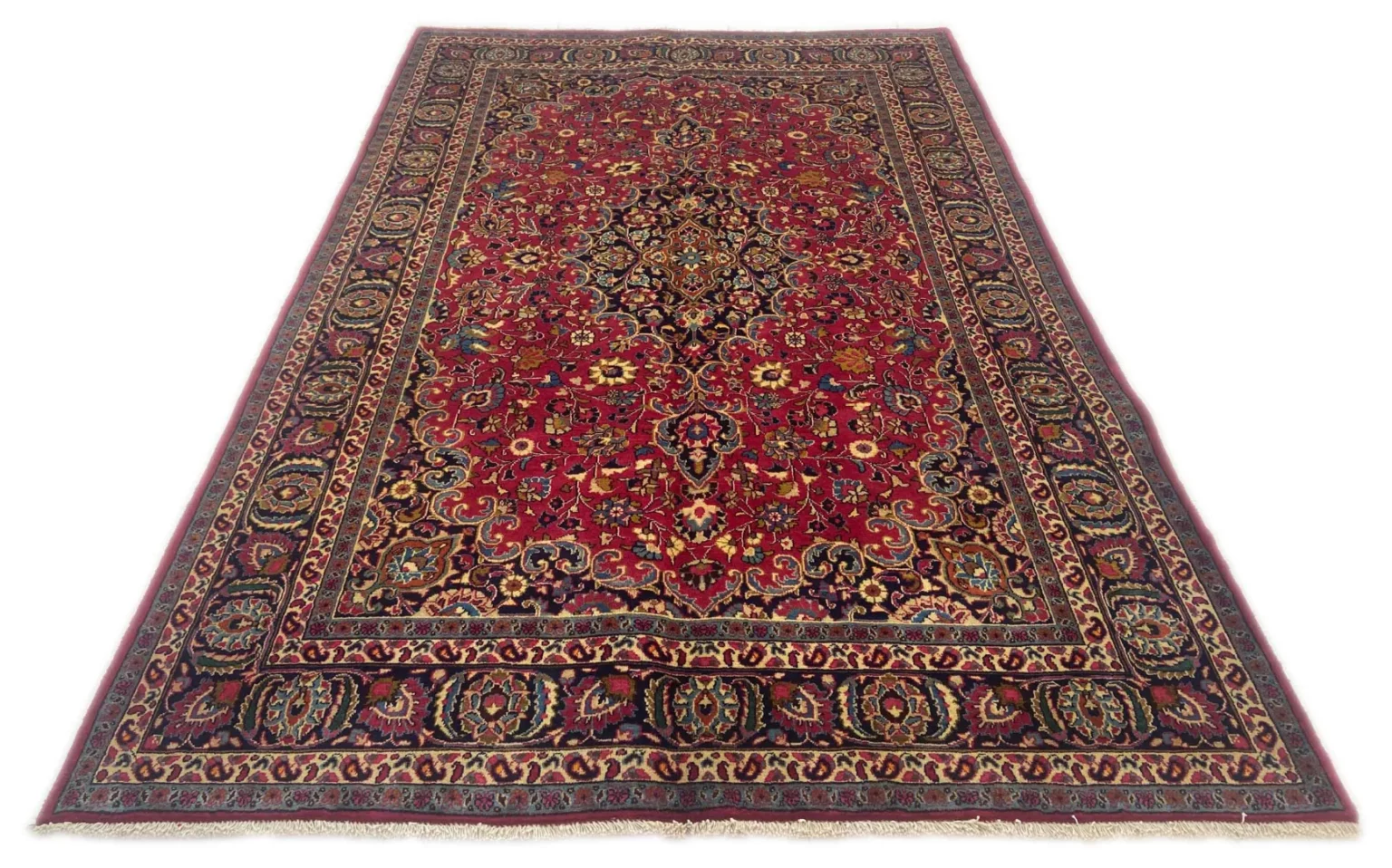
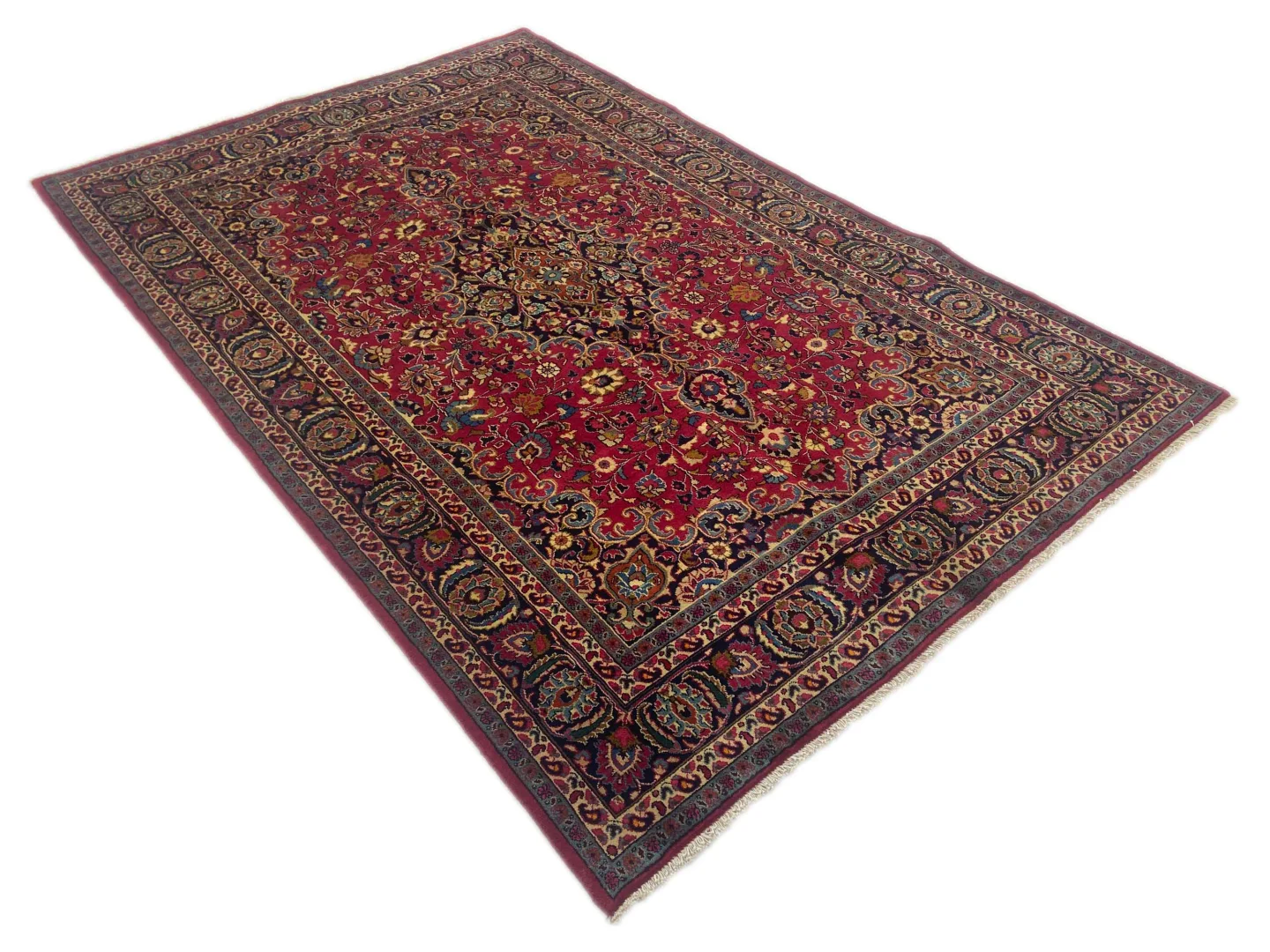
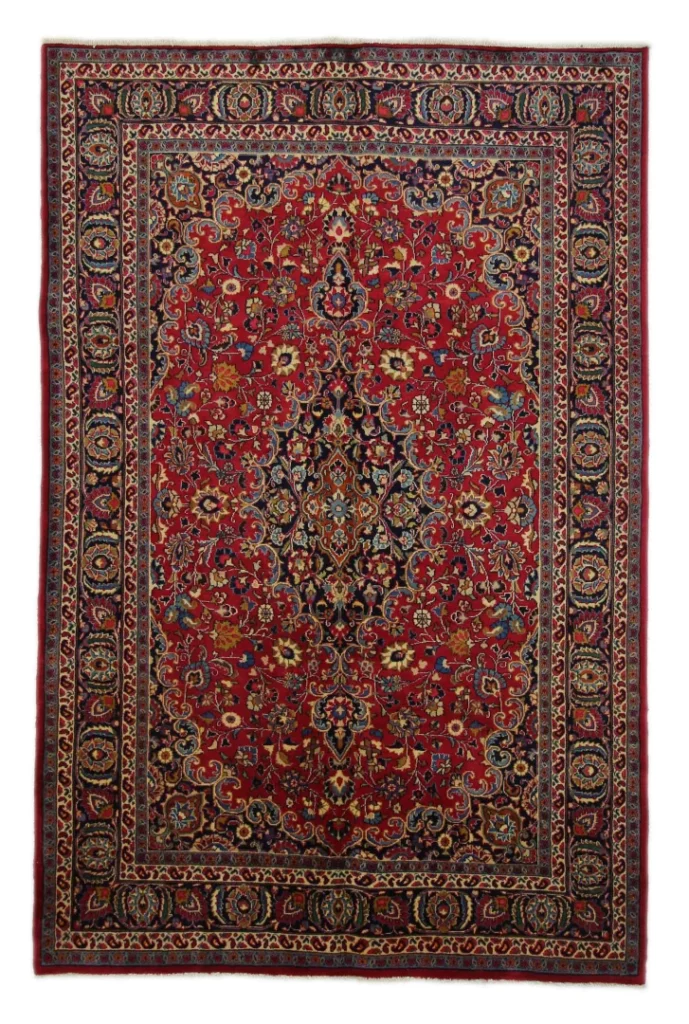
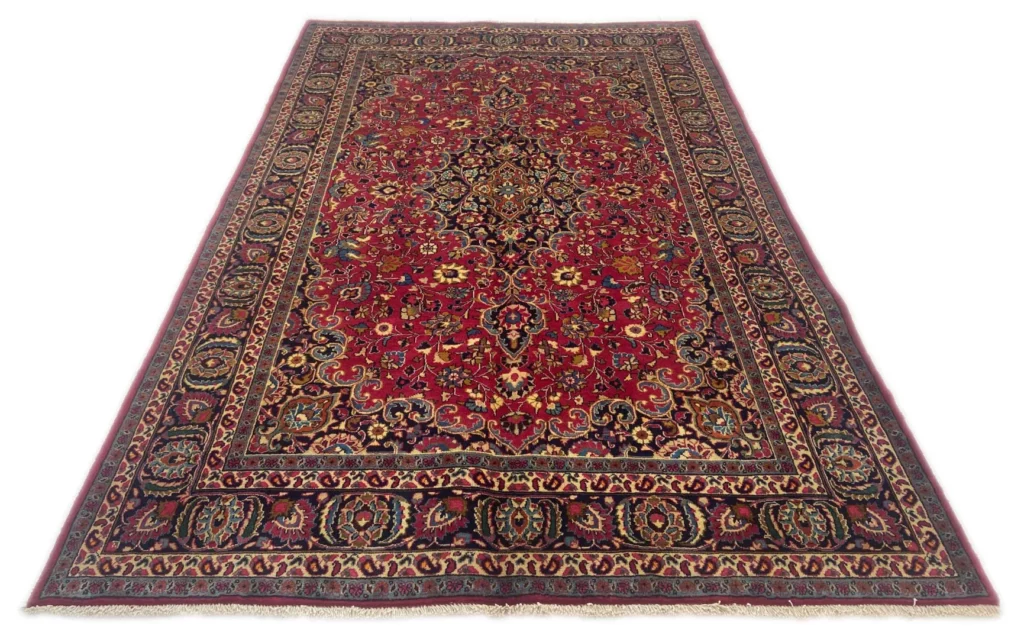
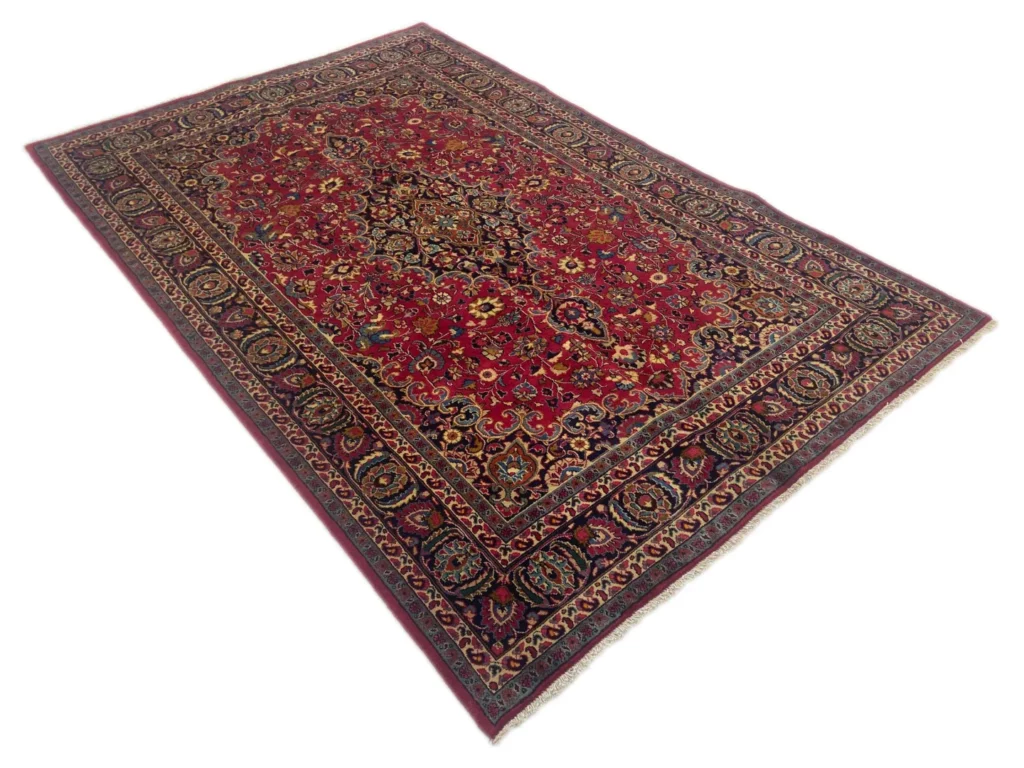
The design of this rug is floral and organised around a classic medallion. In Persian carpet design, a medallion commonly serves as the centre of the composition. It gathers the principal lines of the pattern in the middle of the field and provides a framework for the surrounding flowers, leaves and vines. The floral elements connect the central motif with the areas around it, allowing the design to be read as one continuous ornamental structure.
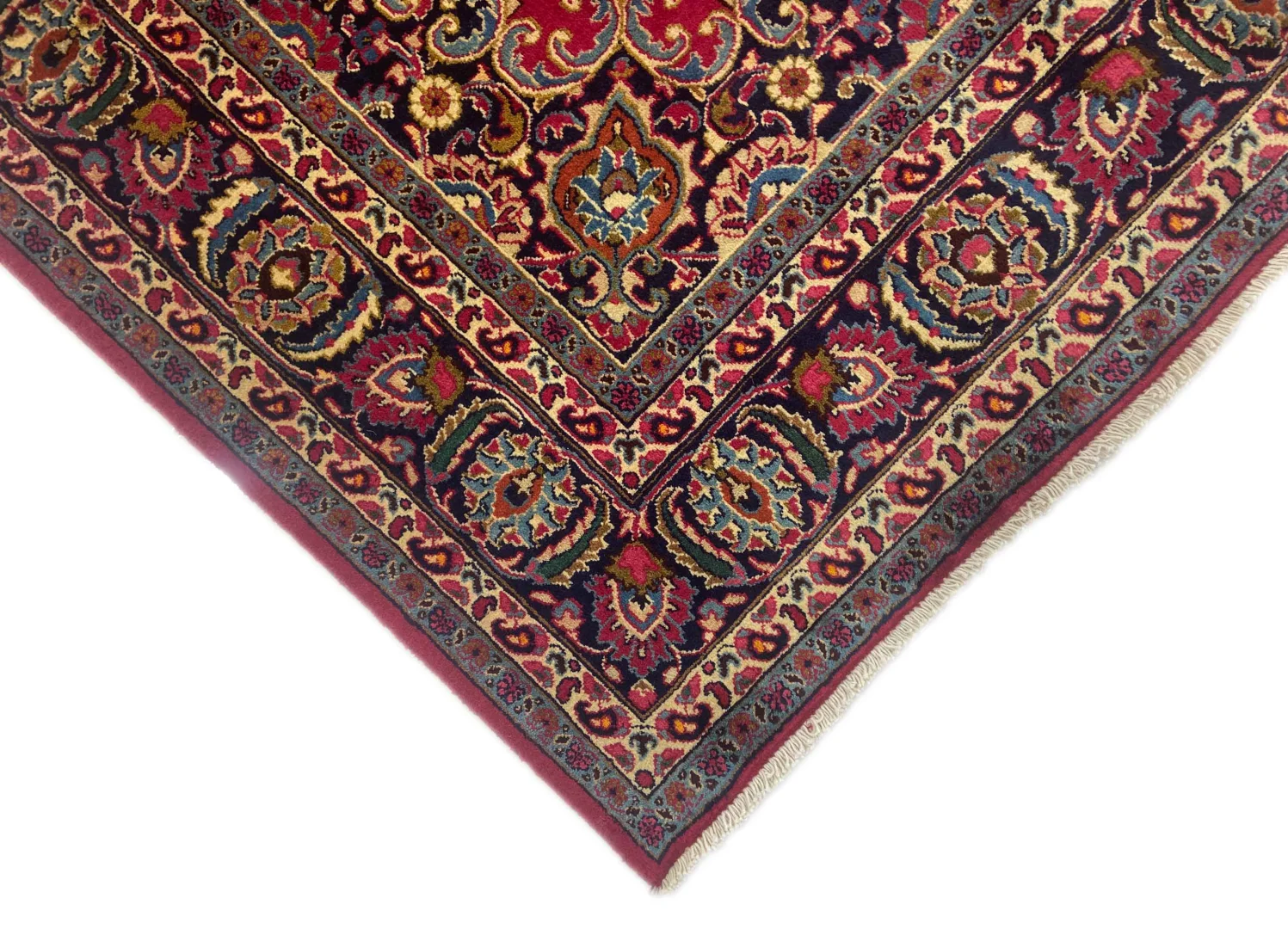
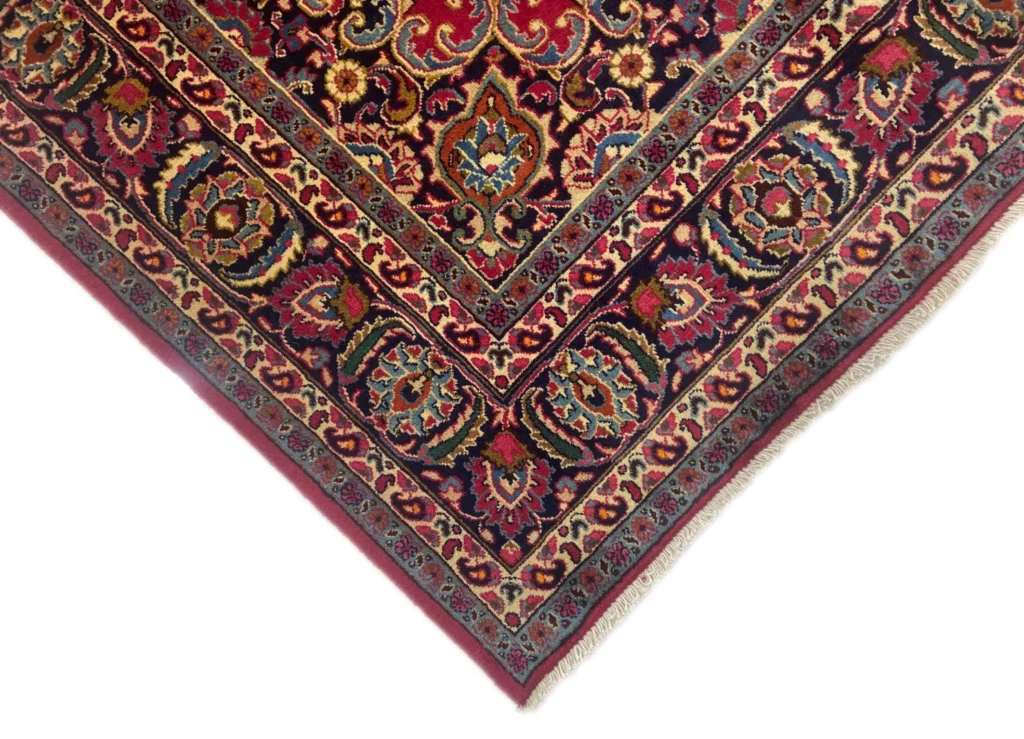
A classical medallion arrangement depends on balance between centre, field and border. Secondary motifs distribute visual weight around the main form, while repeated flowers and curved branches create rhythm. The border encloses the composition and gives the eye a clear outer limit. These flowers are stylised ornaments rather than a literal depiction of one particular garden. Their forms belong to a decorative vocabulary developed and refined within Persian textile art over many generations.
Red is the predominant colour described for this rug. Blue and purple tones provide additional accents within the floral composition. Red gives the surface a warm and coherent foundation. Blue introduces a cooler contrast, while purple creates a transitional relationship between warm and cool areas. This combination helps distinguish the central medallion from the surrounding field and keeps the various floral elements visually connected.
In a floral medallion rug, pattern clarity depends on the relationship between outline, colour and knot placement. Curving stems may connect separate blossoms, leaves can fill the spaces between larger forms, and smaller ornaments create transitions across the field. A relatively dense knot structure supports the rendering of such details. Because the design is formed in the knotting itself, the decorative image is part of the construction rather than something applied after the rug has been made.
Mashhad designs belong to the wider Persian language of central compositions, floral ornament and carefully organised colour. Individual workshops may vary the proportions of the medallion, the shape of the flowers and the arrangement of the border. The specific features documented for this rug are a floral design, a classic medallion and a palette dominated by red with blue and purple tones. These elements define its described decorative character without requiring additional assumptions about the design.
The central medallion first directs the eye towards the middle, while the surrounding floral details lead it across the field. This interplay of centre and ornament is a recurring principle in classical Persian rugs. It creates a structured surface in which the motifs remain related rather than appearing as isolated decorations. Colour contrasts reinforce that structure and make the divisions between the principal and secondary elements easier to follow.
Special Features
The documented features of this one-off rug are its hand-knotted construction, a knot density of 180,000 to 250,000 knots per square metre, a pile made from high-quality wool and a floral design with a classic medallion. Red is the main colour, complemented by blue and purple tones. These details describe the rug’s material, technique, construction and visible design without adding characteristics that are not stated.
The condition is described as very well preserved. Regular care for a hand-knotted wool rug should be gentle. Vacuuming without a brush attachment helps remove loose dust while reducing stress on the pile. Spills should be treated promptly with a damp cloth, avoiding vigorous rubbing and harsh cleaning products. Professional cleaning every few years can be considered when deeper treatment is needed, with the aim of protecting the colours and the material.
FAQ
How can the quality of a Mashhad Persian rug be assessed?
Useful points of reference include knot density, pile material, evenness of construction, clarity of the pattern and the condition of the rug. This piece is specified with 180,000 to 250,000 knots per square metre and a pile made from high-quality wool. A higher density can support more finely rendered contours and floral details, but it should not be considered on its own. The relationship between knots, pile, colours, pattern and preservation gives a more complete view of quality.
What care does a Mashhad Persian rug require?
For regular maintenance, the rug should be vacuumed without a brush attachment. This removes loose particles while avoiding unnecessary abrasion of the wool pile. Spills should be addressed immediately with a damp cloth. Strong rubbing and aggressive cleaning products should be avoided, as they may affect the fibres or colours. Professional cleaning every few years is recommended when thorough care is needed, so that the rug’s material and colouration are treated appropriately.
Can a Mashhad Persian rug work with modern interiors?
Yes. The classic medallion and floral design can provide a defined focal point alongside clean-lined contemporary furniture. The predominantly red palette creates a clear accent, while blue and purple tones can be coordinated with other colours and textiles in the room. The traditional pattern can also be combined with more classical furnishings. The most suitable arrangement depends on the room’s light, furniture, textiles, available floor area and existing colour scheme.
To provide the best experiences, we use technologies like cookies to store and/or access device information. Consenting to these technologies will allow us to process data such as browsing behavior or unique IDs on this site. Not consenting or withdrawing consent, may adversely affect certain features and functions.
Functional Always active
The technical storage or access is strictly necessary for the legitimate purpose of enabling the use of a specific service explicitly requested by the subscriber or user, or for the sole purpose of carrying out the transmission of a communication over an electronic communications network.
Preferences
The technical storage or access is necessary for the legitimate purpose of storing preferences that are not requested by the subscriber or user.
Statistics
The technical storage or access that is used exclusively for statistical purposes.The technical storage or access that is used exclusively for anonymous statistical purposes. Without a subpoena, voluntary compliance on the part of your Internet Service Provider, or additional records from a third party, information stored or retrieved for this purpose alone cannot usually be used to identify you.
Marketing
The technical storage or access is required to create user profiles to send advertising, or to track the user on a website or across several websites for similar marketing purposes.

 SECURE PAYMENT
 SHIPPING PARTNERS


