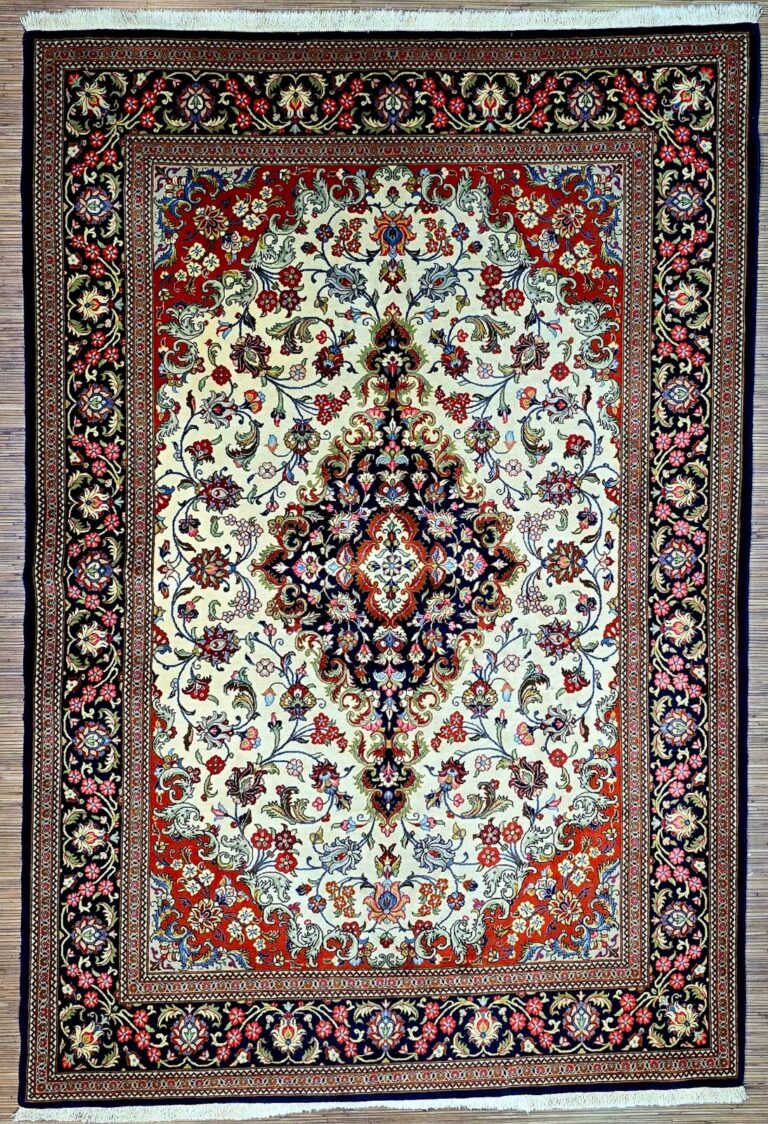
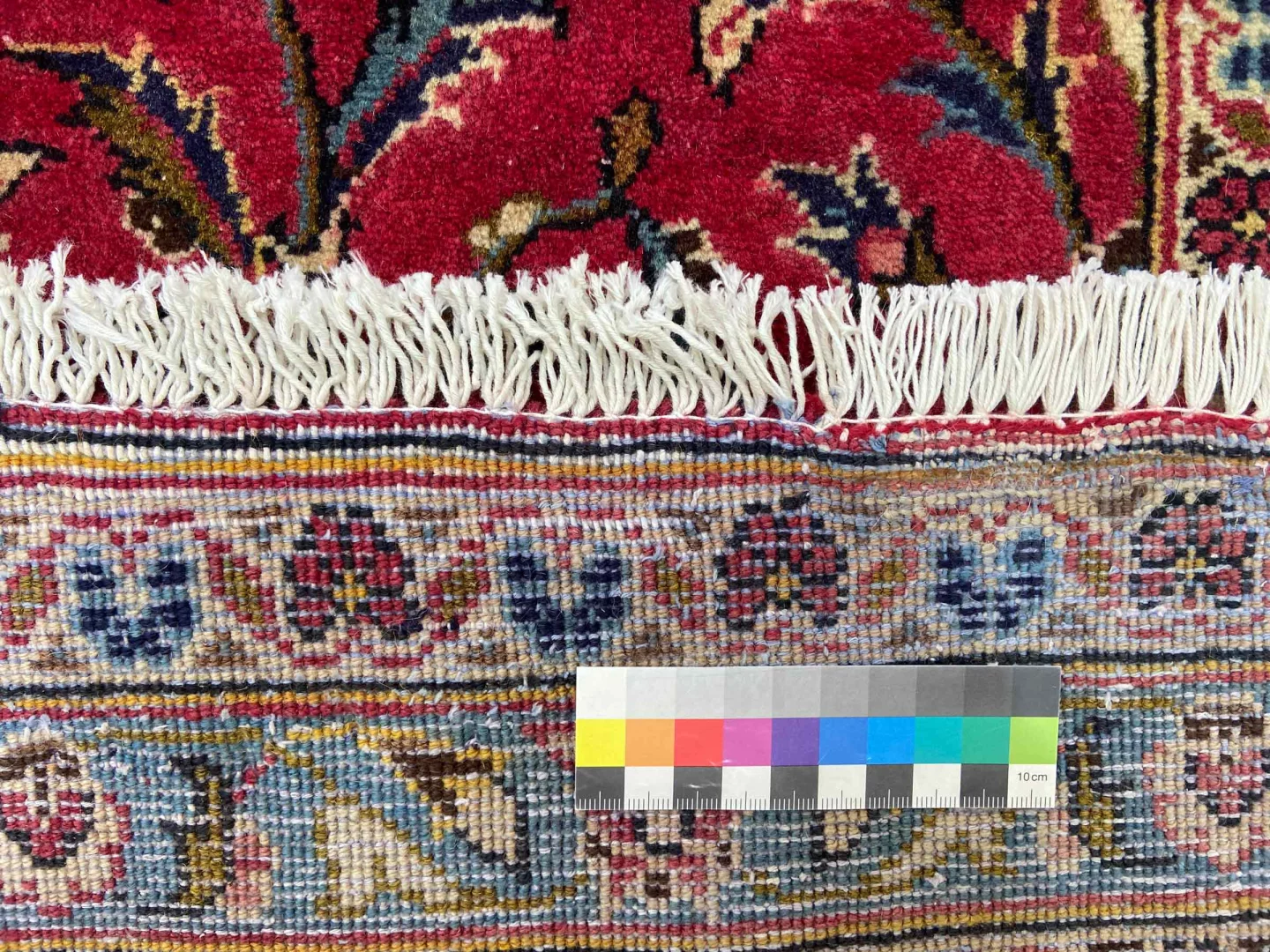
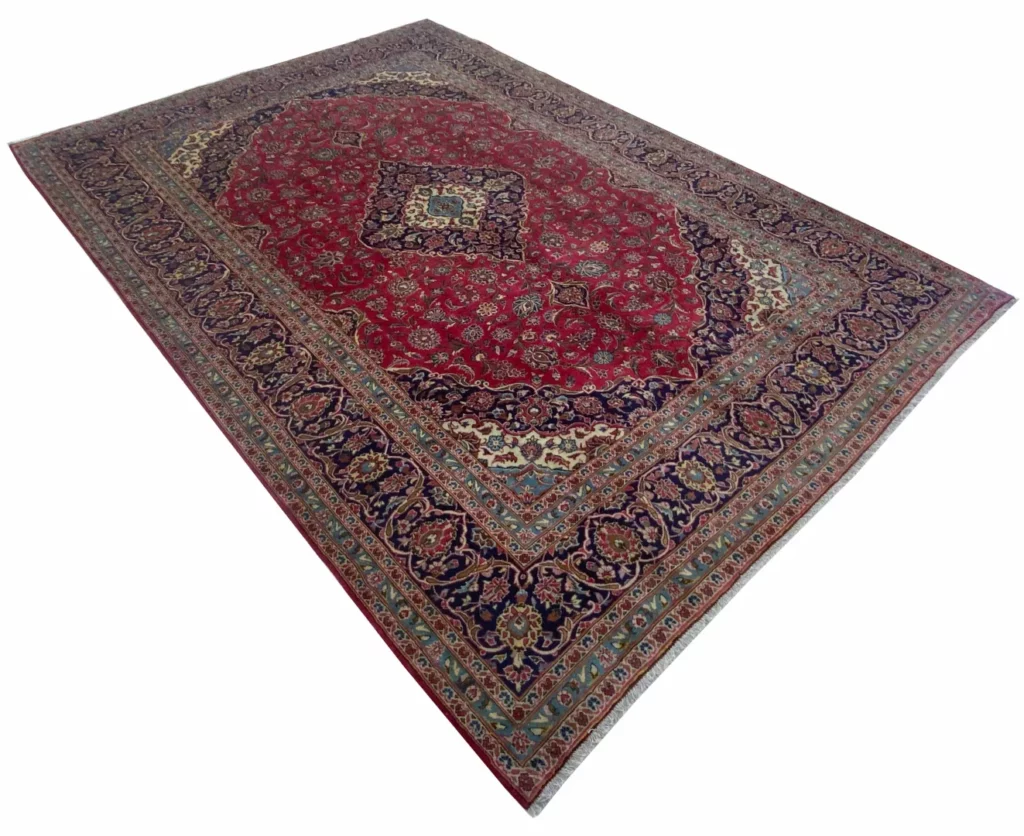
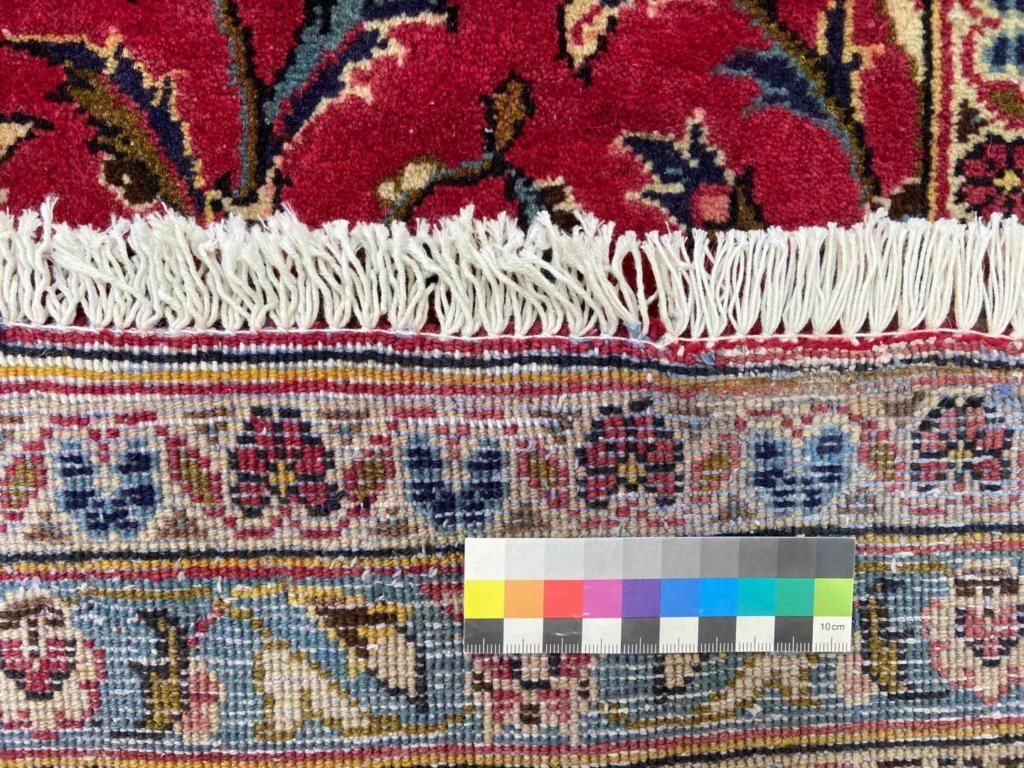
This Keshan Persian rug is hand-knotted with a pile made from high-quality sheep wool. Durable cotton is used for the warp and weft. This combination is a familiar foundation of traditional Iranian rugs: wool creates the visible, warm and pleasantly tactile surface, while cotton provides a firm textile structure beneath it. The pile is short, which helps keep the drawing distinct and makes routine surface care easier.
The recorded knot density is between 150.000 and 300.000 knots per square metre. Dense knotting supports a finely articulated design and contributes to the rug’s durability. In hand-knotting, each knot is inserted individually into the foundation. The pile is then clipped and aligned so that the intended design becomes legible. This process requires practical experience as well as control over tension, colour placement and the treatment of lines and contours.
Sheep wool is valued in Keshan weaving for its comfortable handle and natural warmth. Cotton in the warp and weft complements the wool with a resilient foundation. The resulting construction combines a soft, warm pile with a stable ground. The very good condition of this individual rug adds to the qualities of its workmanship and materials.
Origin and Tradition
Keshan Persian rugs originate in Keshan, Iran, and belong to the long Iranian weaving tradition. Keshan has been associated with finely made rugs for a long time. In the region, knowledge of preparing the foundation, placing the knots, arranging colours and finishing the pile has been passed down through generations. A hand-knotted rug therefore reflects more than a practical weaving method: it also represents a craft based on patience, precision and repeated manual work.
The place of origin shapes the visual language associated with Keshan rugs. Iranian workshops developed compositions that place importance on balance, clear drawing and carefully coordinated ornament. A Keshan rug can consequently be formal in its design while remaining suitable for everyday interiors. Its character comes from the relationship between the planned design, the chosen materials and the work of the individual knotter rather than from an industrially uniform production process.
Iranian rug history is marked by the interaction of local identities and established design principles. Keshan is associated with a style in which detailed execution and an orderly composition are important. Weavers in the region use inherited techniques and apply them to a range of designs. This gives Keshan weaving a recognizable tradition without requiring every rug to follow one identical layout.
Iran contains many other important rug centres, each with its own vocabulary. Isfahan and Nain are also associated with refined knotting and elegant compositions. Tabriz is known for varied arrangements and detailed pattern work. These places are not origins for this rug; they illustrate the breadth of Iranian rug culture. The piece described here is a Keshan Persian rug from Persia.
The tradition also explains why Keshan rugs can be used in very different interior settings. Their ordered ornament can complement a classical room, while a clearly structured design can also work in a more restrained contemporary setting. The enduring principle is the balance between field, rhythm and detail. The character of a hand-knotted Keshan comes from crafted variation and careful execution, not from short-lived fashion.
Design and Pattern
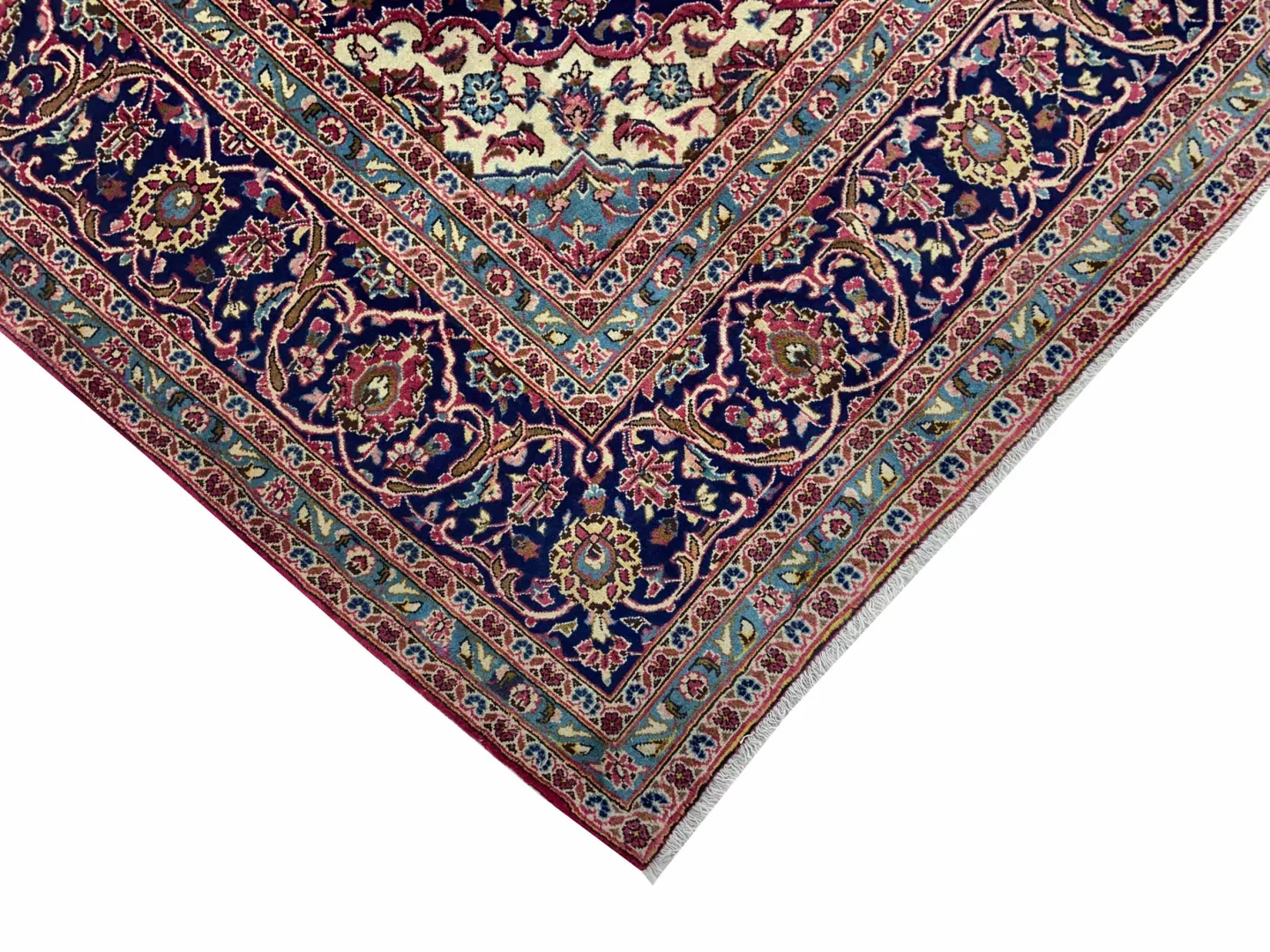
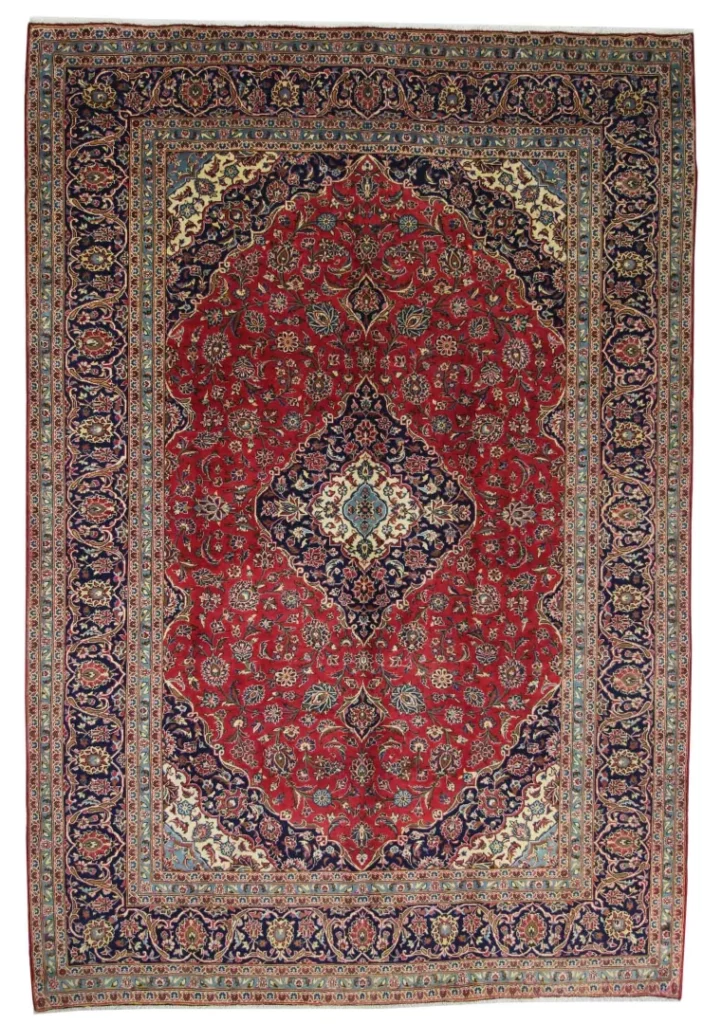
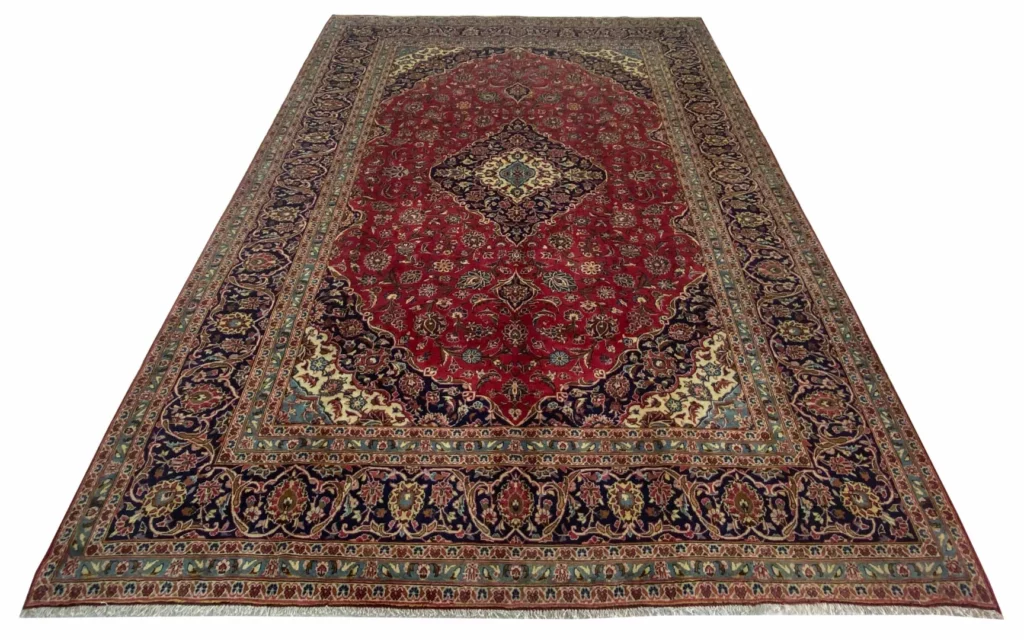
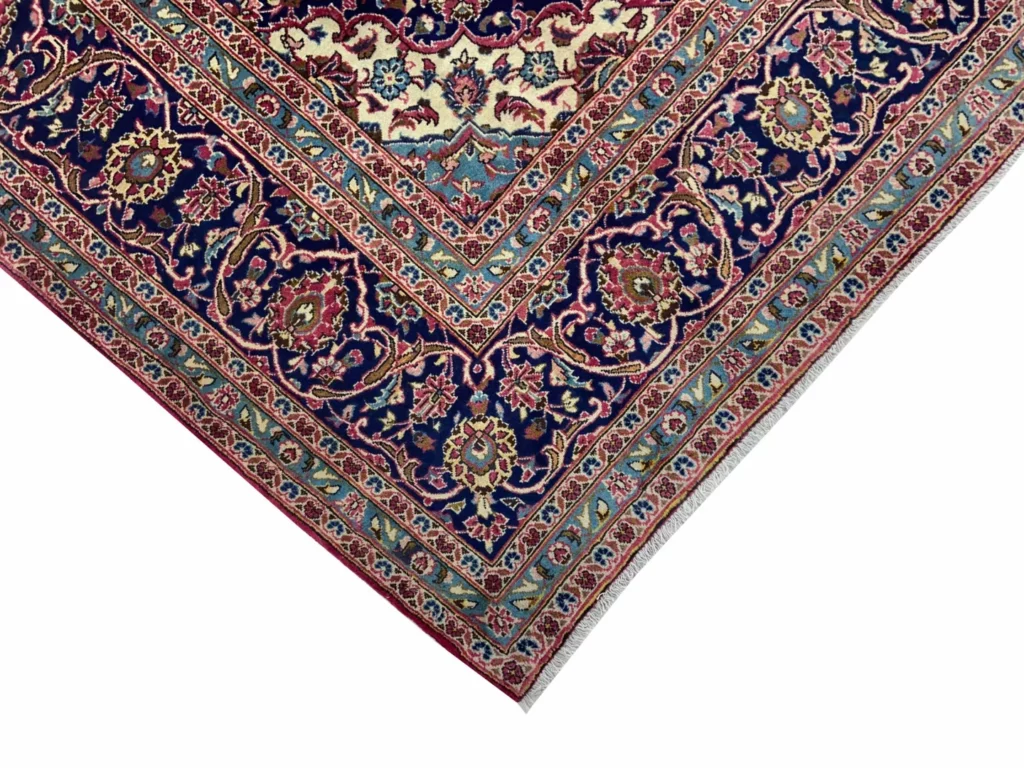
The pattern of this Keshan rug is described through floral motifs and intricate geometric designs. Floral ornament introduces organic forms, while geometric elements give the composition structure and defined boundaries. Keshan designs often bring these two visual languages together. Flowers, leaves and vines may be arranged within an ordered overall composition, allowing natural forms to participate in a disciplined decorative scheme.
Geometric pattern creates a recognizable rhythm through repetition, axes and enclosed areas. Floral details soften that structure and give it movement. The relationship between straight lines and curved forms is a recurring feature of classical Oriental rug design. Dense hand-knotting is particularly suited to such work because it allows small details, transitions and contours to be rendered with care.
Keshan pattern traditions include central compositions, all-over ornament and arrangements that combine several fields. These are general possibilities within the rug type and are not additional claims about the precise layout of this individual piece. What is established here is the combination of floral motifs and elaborate geometric designs. The pattern’s detailed character is supported by the rug’s dense knotting.
The relationship between a main field and its borders is also important in Iranian rug design. Borders frame the composition, minor borders create transitions and smaller ornaments can enliven the spaces between larger forms. Keshan workshops have traditionally paid attention to controlled repetition so that the design remains coherent and balanced. Handwork allows the weaver to maintain the connection between individual details and the overall arrangement.
Iranian pattern traditions developed over a long period and combine decorative presence with visual order. For this reason, floral and geometric Keshan designs can sit comfortably in different furnishing schemes. They may reinforce the ornament of a traditional interior or appear as a clearly organized textile image in a modern room. Their effect comes from the placement of forms and the precision of the weaving, rather than from a temporary decorative trend.
Special Features
The defining features of this rug include its hand-knotted construction, high-quality sheep-wool pile and cotton used for the warp and weft. Its short pile makes cleaning easier while retaining a clear and elegant appearance. The combination of wool and a durable cotton foundation gives the rug a balanced textile character, combining a warm surface with a firm underlying structure.
The condition is very good. Together with the dense knotting and detailed pattern, this makes the rug a clear example of Keshan workmanship, material selection and decorative tradition. As a one-off hand-knotted piece, it brings together the practical role of a floor covering and the visual role of a carefully made textile work.
FAQ
How should I care for a Keshan Persian rug?
Regular gentle vacuuming helps remove dust and loose dirt from the short pile. Occasional professional cleaning is recommended for more thorough care. Direct sunlight should be avoided so that the colours do not fade. Because a hand-knotted rug is a crafted textile, strong rubbing and harsh cleaning products should be avoided. Professional cleaners familiar with Oriental rugs can select an appropriate cleaning method for the wool pile and cotton foundation.
What are the main characteristics of a Keshan Persian rug?
Keshan Persian rugs are associated with high knot density, fine sheep wool, detailed designs and cotton used in the warp and weft. Floral motifs are often combined with intricate geometric forms. Hand-knotting permits careful rendering of the design, while the wool pile and cotton foundation provide a durable construction. A short pile also supports a clearly readable pattern and makes regular cleaning more manageable.
How can I identify an authentic Keshan Persian rug?
An authentic Keshan Persian rug is hand-knotted and has a high knot density. The quality of the sheep wool, the cotton warp and weft, and the careful execution of the pattern provide further points of reference. Floral motifs and complex geometric designs belong to the recognized Keshan design tradition. Certificates or traceable documentation of origin can provide additional support when assessing authenticity. The relevant combination is the material, technique, pattern and connection with the Iranian Keshan tradition.
To provide the best experiences, we use technologies like cookies to store and/or access device information. Consenting to these technologies will allow us to process data such as browsing behavior or unique IDs on this site. Not consenting or withdrawing consent, may adversely affect certain features and functions.
Functional Always active
The technical storage or access is strictly necessary for the legitimate purpose of enabling the use of a specific service explicitly requested by the subscriber or user, or for the sole purpose of carrying out the transmission of a communication over an electronic communications network.
Preferences
The technical storage or access is necessary for the legitimate purpose of storing preferences that are not requested by the subscriber or user.
Statistics
The technical storage or access that is used exclusively for statistical purposes.The technical storage or access that is used exclusively for anonymous statistical purposes. Without a subpoena, voluntary compliance on the part of your Internet Service Provider, or additional records from a third party, information stored or retrieved for this purpose alone cannot usually be used to identify you.
Marketing
The technical storage or access is required to create user profiles to send advertising, or to track the user on a website or across several websites for similar marketing purposes.
 SECURE PAYMENT
 SHIPPING PARTNERS