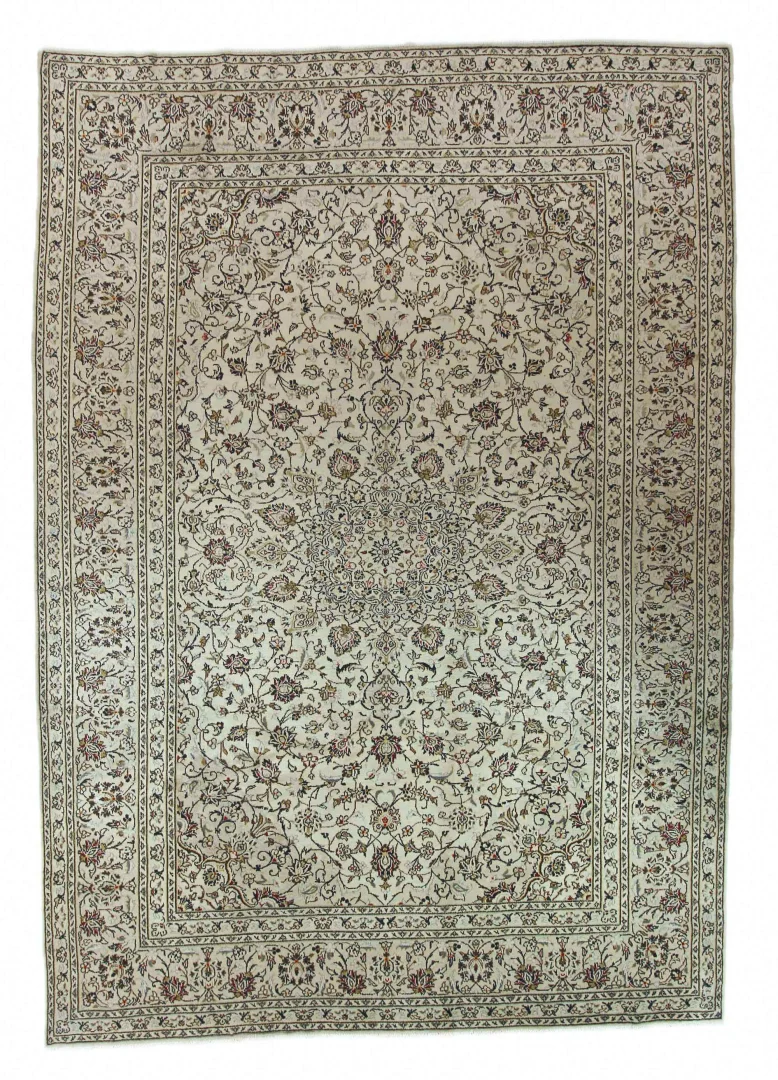
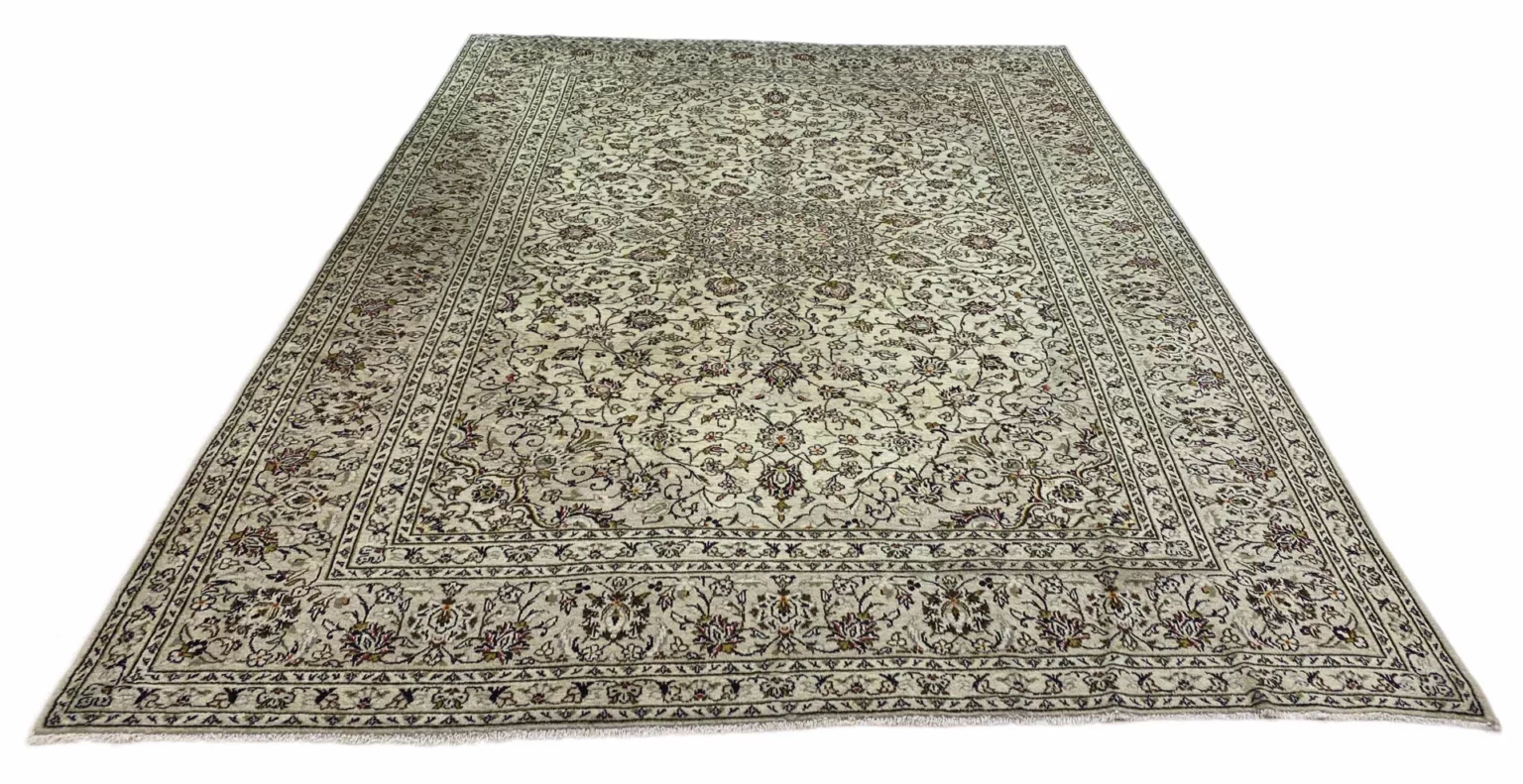
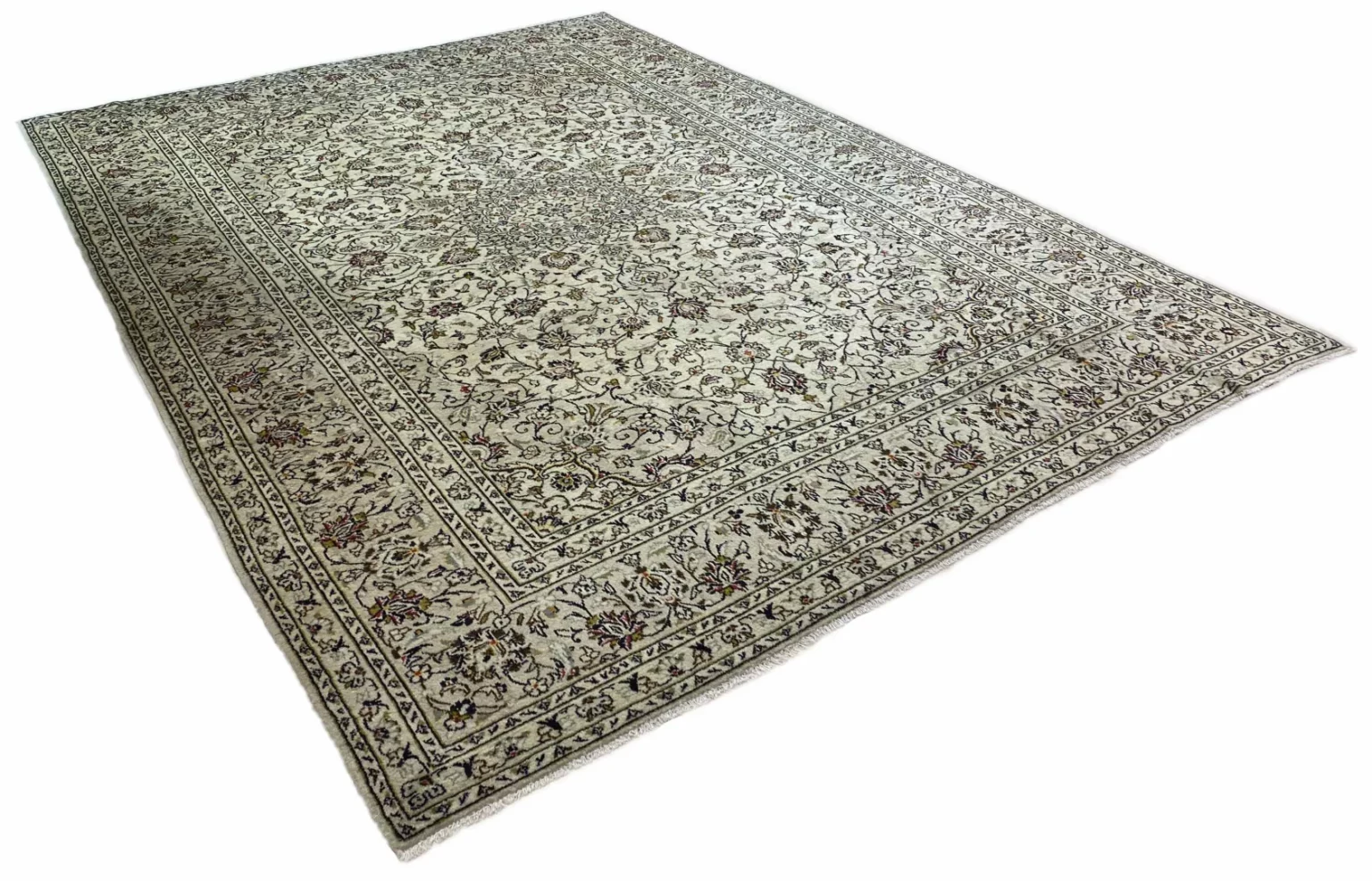
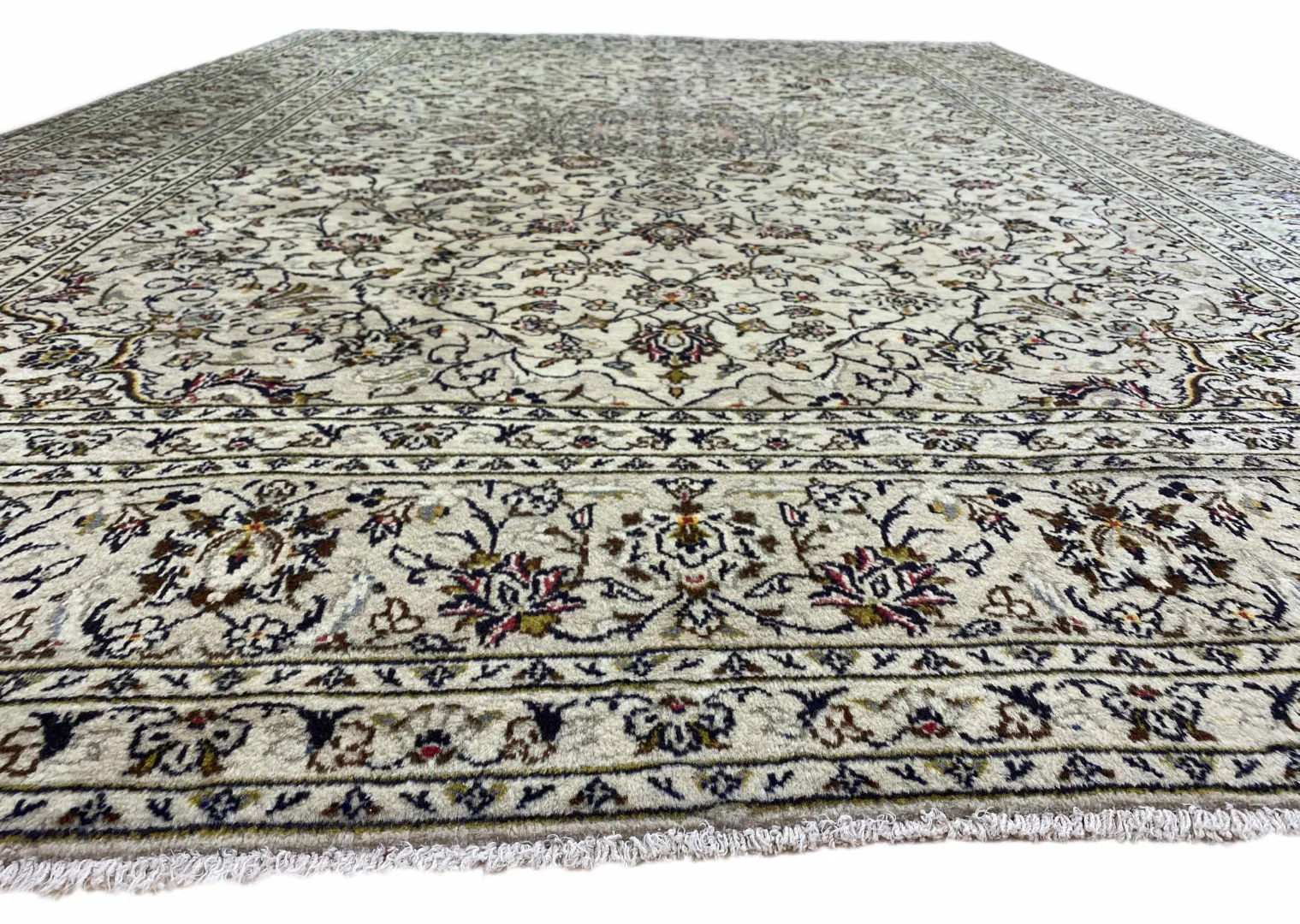
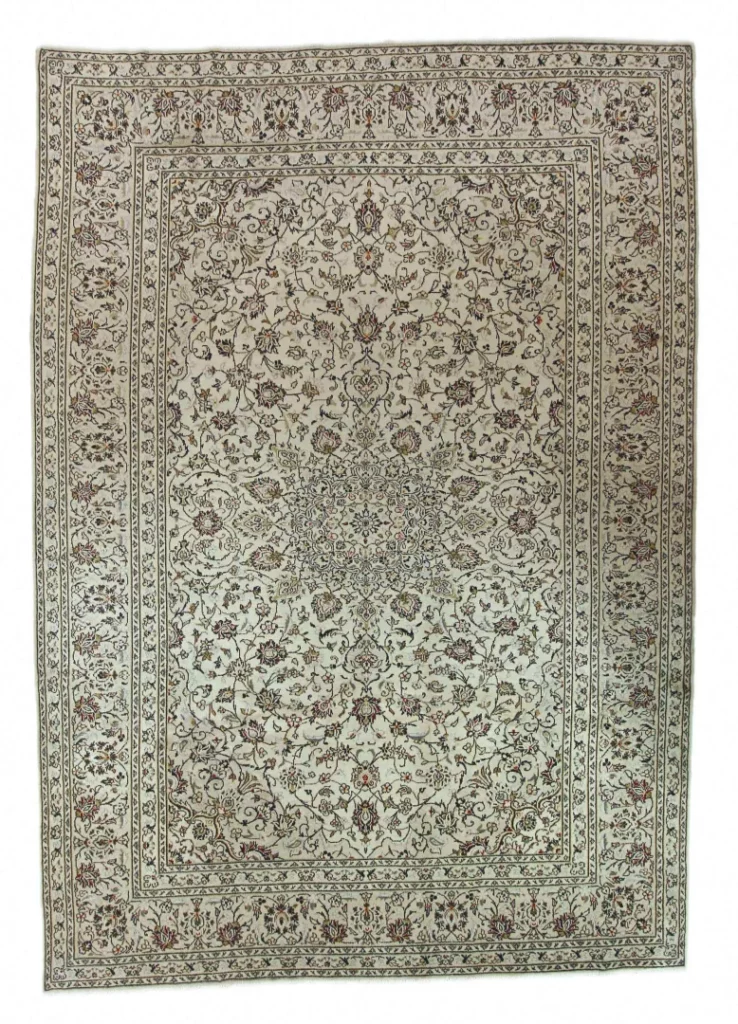
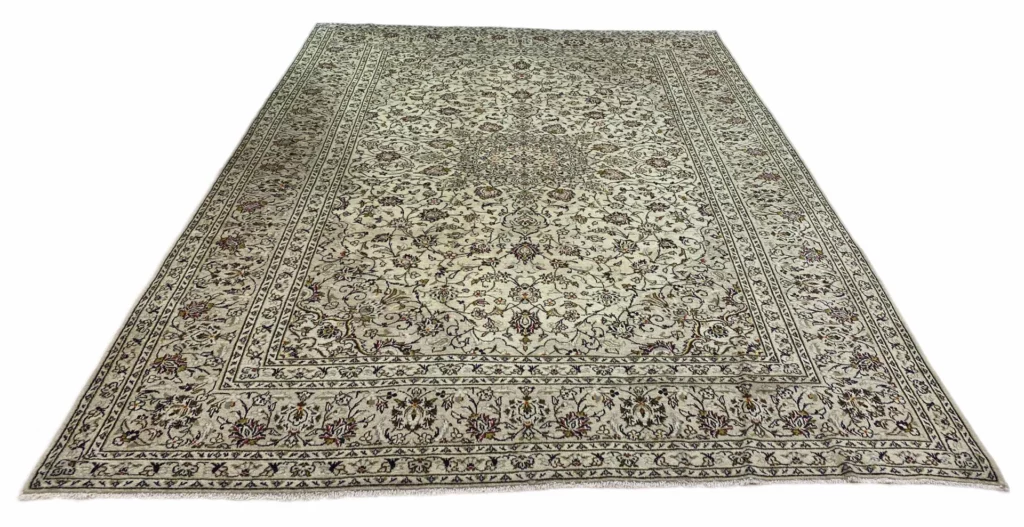
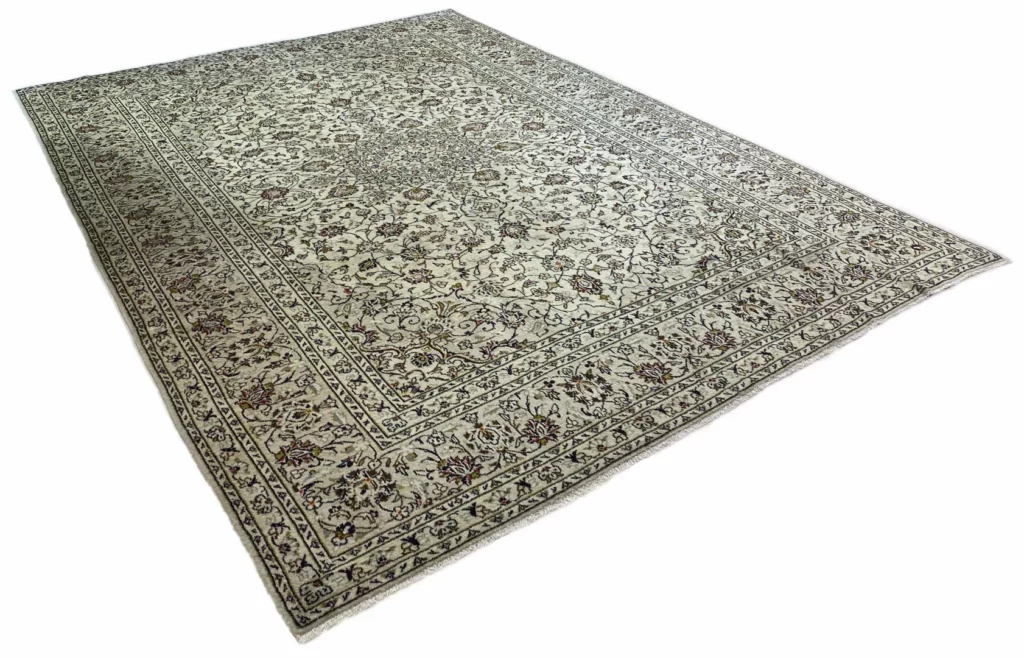
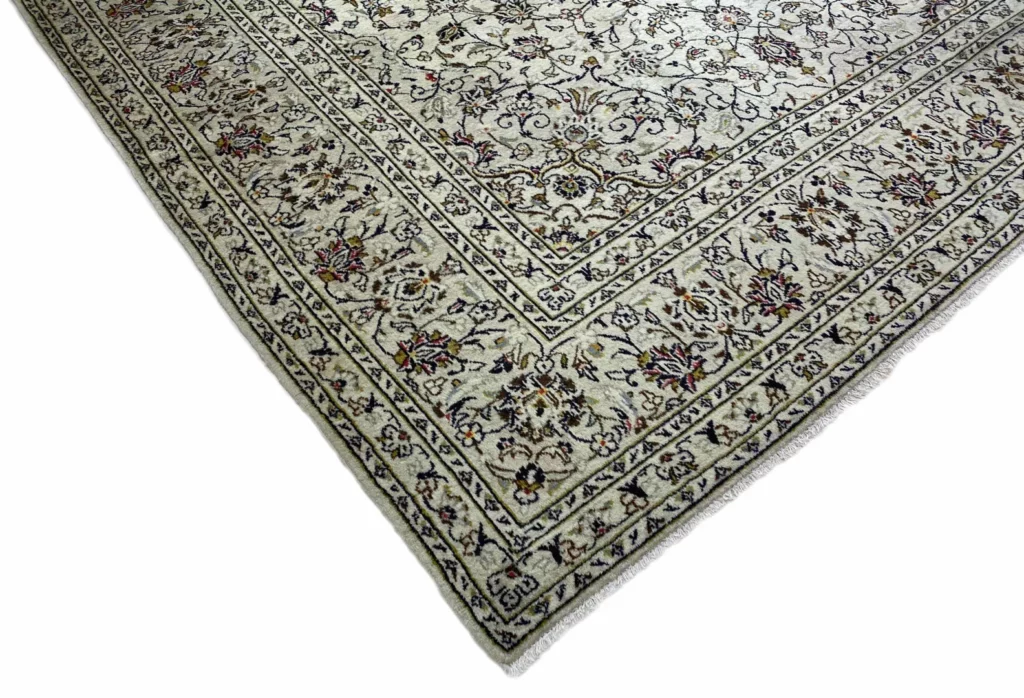
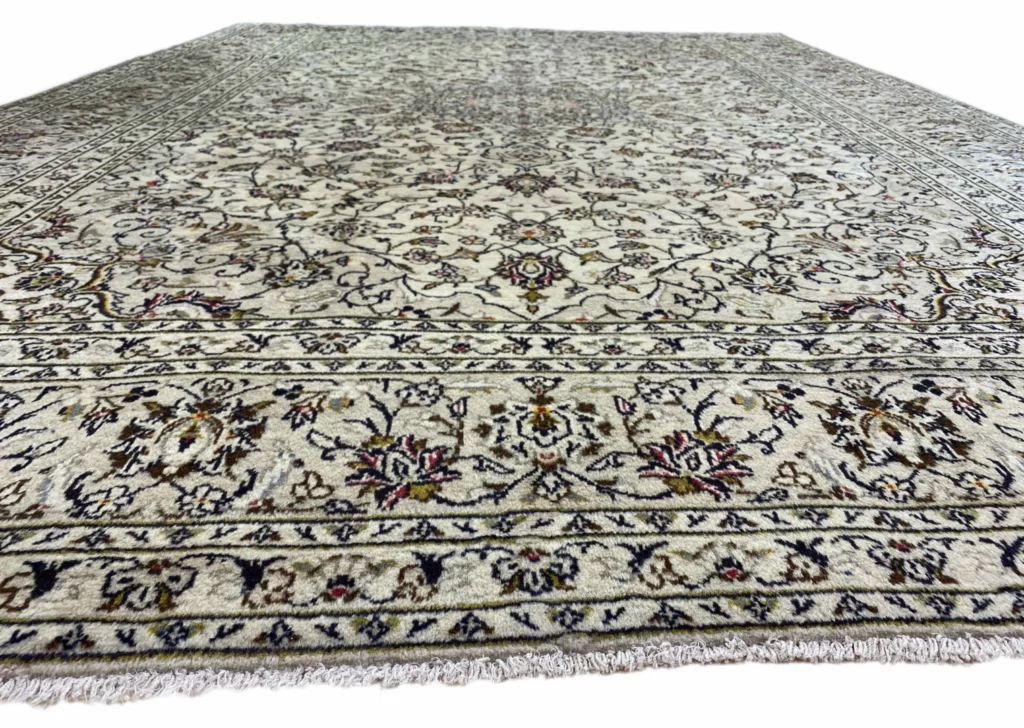
Hand-knotted Keshan Persian Rug | Knot density: 100,000 – 300,000 knots/m² | Material: Sheep wool and cotton | Size: 349 x 247 cm | Pattern: Medallion design in red, blue and beige | Condition: Very good
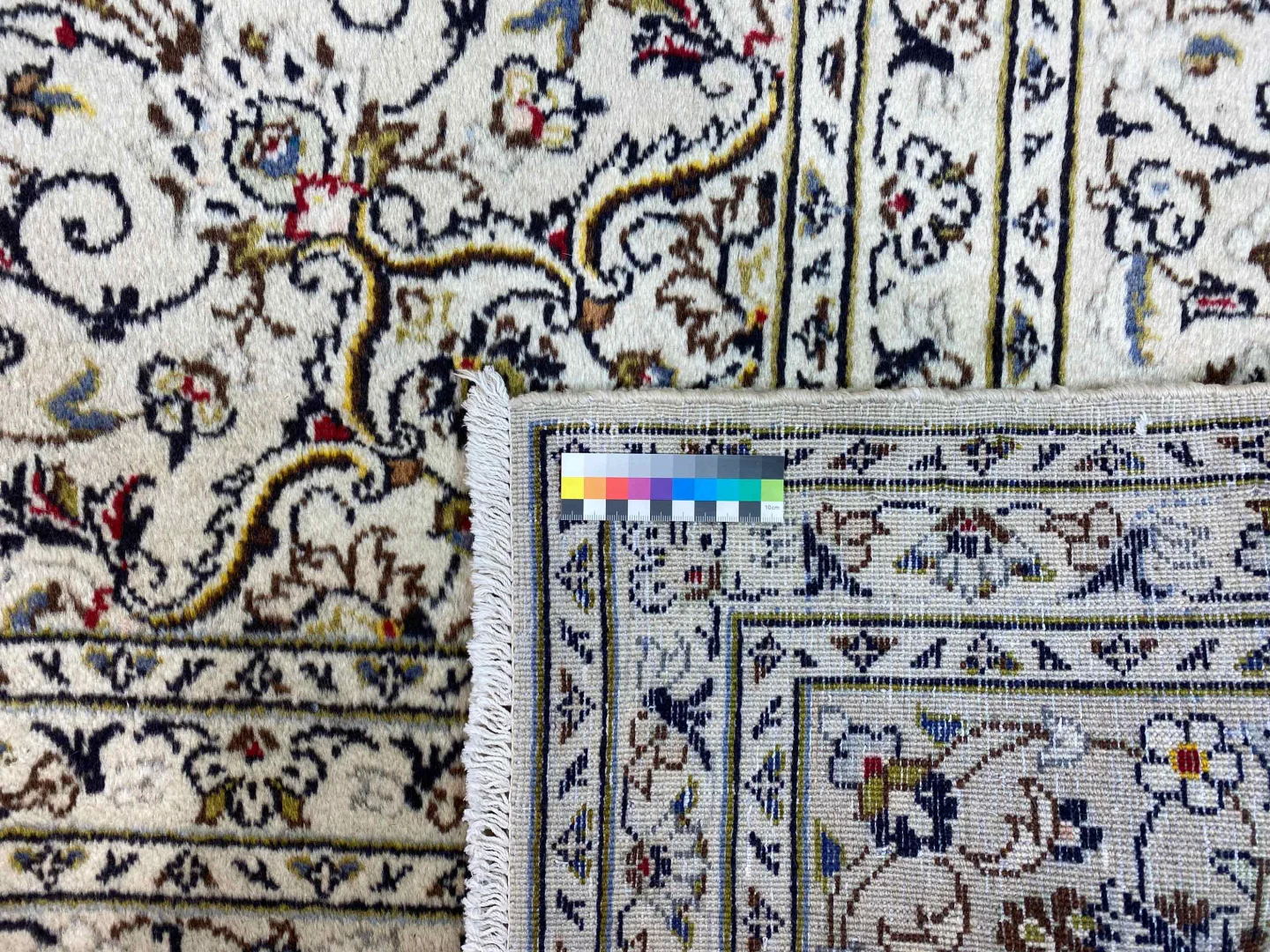
This Keshan Persian rug is hand-knotted. The listed materials are high-quality sheep wool and cotton. Sheep wool is part of the established making tradition of Keshan rugs. Wool yarn is prepared for the pile, while cotton is commonly used in rug construction for supporting elements. For this individual rug, the description names both materials without specifying their respective proportions or exact roles.
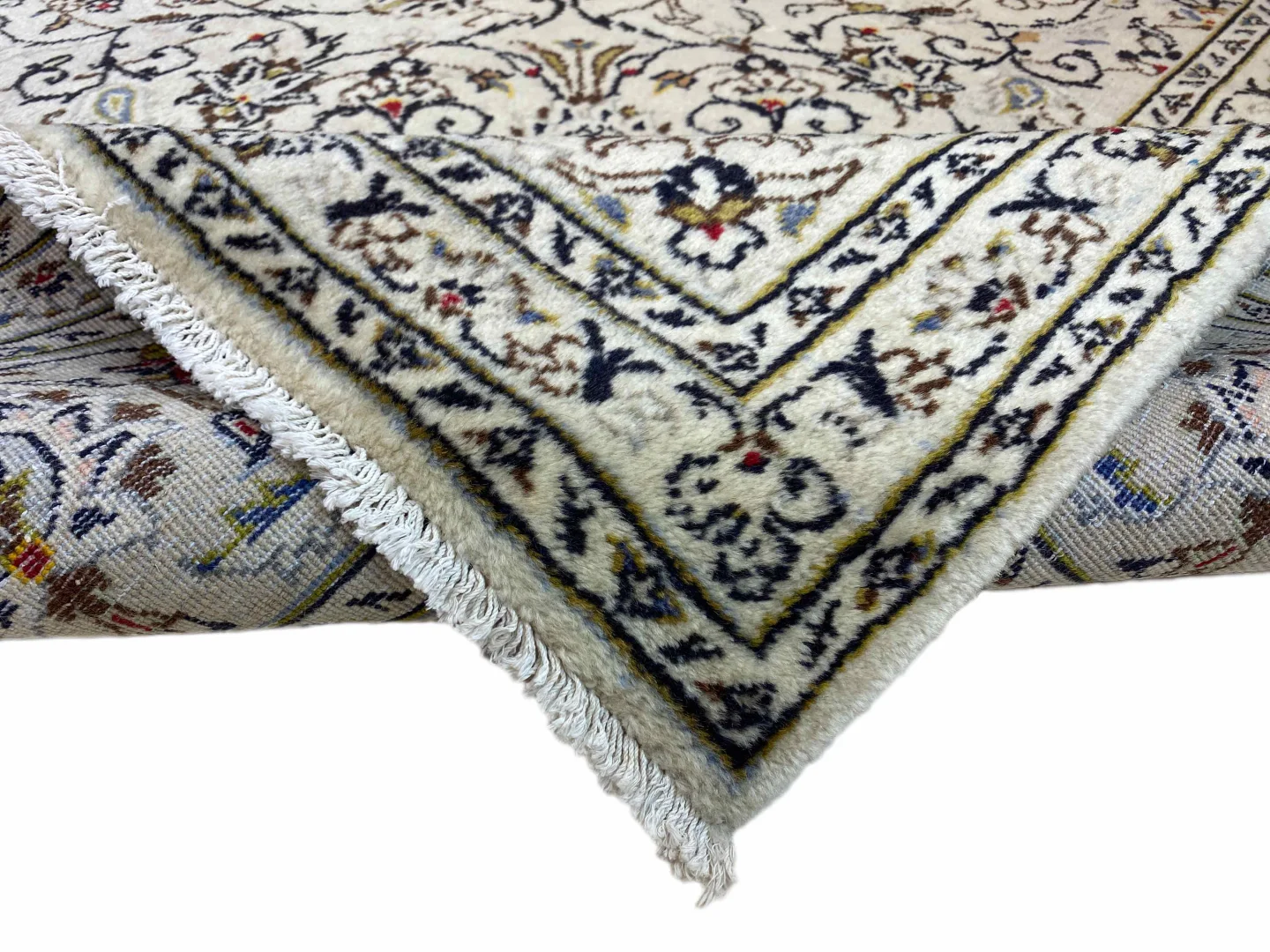
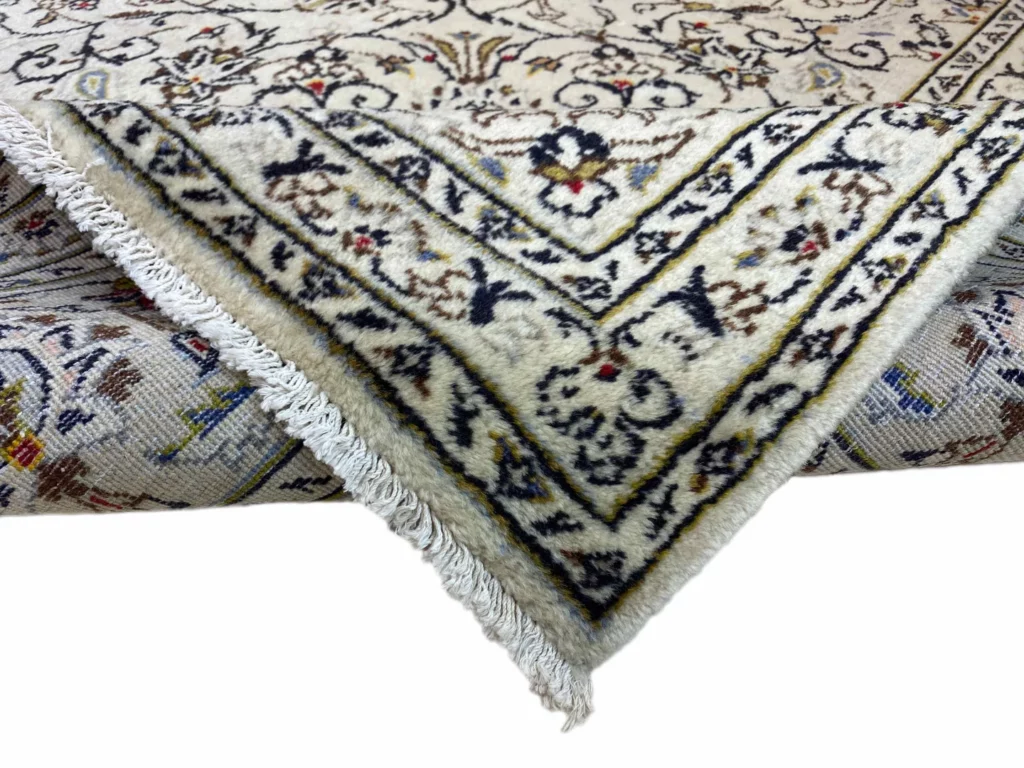
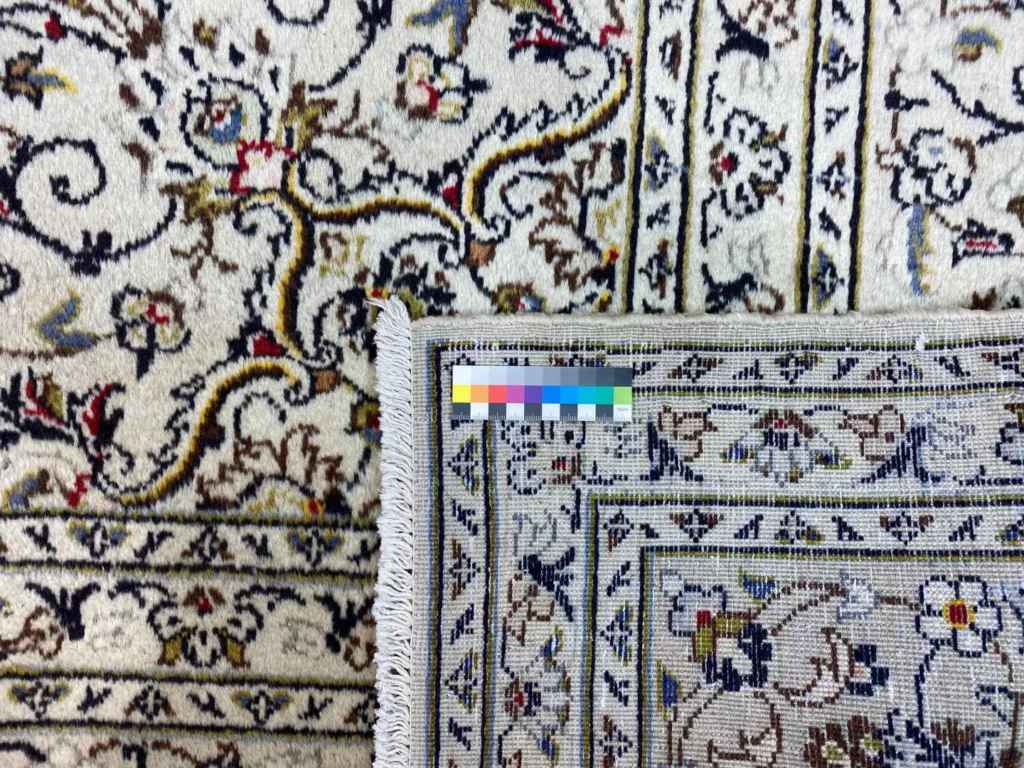
Hand-knotting means that individual knots are tied by hand around the prepared warp threads. The woven surface is built row by row, with the pattern taking shape during the knotting process itself. This method distinguishes a hand-knotted rug from a machine-made floor covering. Keshan rugs are described as having between 100,000 and 300,000 knots per square metre. In this rug tradition, knot density is associated with the ability to render small ornaments and carefully structured medallion designs.
The description places this rug in a quality category using high-quality sheep wool and records its condition as very good. No information is supplied about pile height, age, weight or signature. The documented details are the hand-knotted construction, the named materials, the knot-density range and the medallion design.
Origin and Tradition
Keshan rugs originate in Keshan, Iran. The city belongs to a region with a long textile tradition closely connected to the history of Persian craftsmanship. Keshan became known for its rugs, textiles and ceramics. These crafts formed part of a local culture in which fibre preparation, ornamental design and practical weaving knowledge were developed and passed from one generation to the next.
Keshan’s history reaches back to the period of the Persian Empire. In later centuries, the city flourished along the trading routes of the Silk Road and became an important place for the movement of goods and ideas. Rugs were among the forms of craftsmanship traded beyond the region. Their designs could be encountered and adapted elsewhere, while workshops in Keshan maintained their own approaches to structure, colour and production.
A Keshan rug is therefore identified not only by its place of origin but also by a regional approach to composition and ornament. A clearly organised field is often combined with a central form. The arrangement of the inner field, surrounding borders and recurring botanical or geometric details is balanced to create a unified design. This tradition allows for both densely articulated compositions and versions with a more open visual rhythm.
Historically, Keshan rugs were important trade goods and were associated with the prosperity of the region. Many Keshan rugs are now more than a century old and attract the attention of collectors. That general historical fact is not an age statement about this individual rug. For this piece, the documented facts are its origin in Keshan, its Iranian classification, its hand-knotted construction and its very good condition; no production date is given.
Within the wider Persian rug landscape, Keshan is often discussed alongside Isfahan and Tabriz. Rugs from Isfahan and Tabriz have their own workshop traditions and stylistic histories, and are not the same origin as this Keshan rug. Nain and Kashan are also recognised for carefully made rugs. These references describe related rug types rather than changing the stated provenance of the present piece.
Design and Pattern
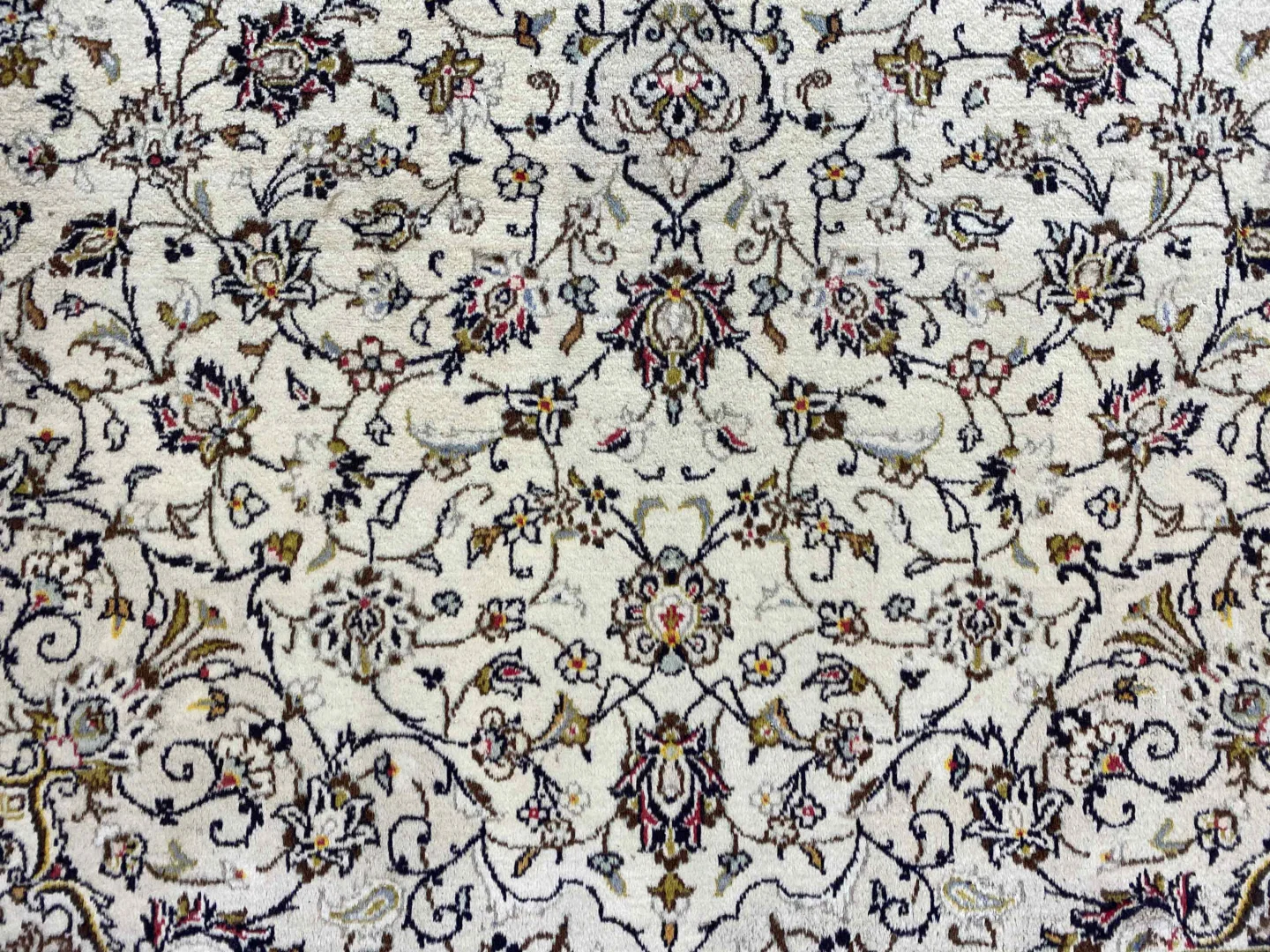
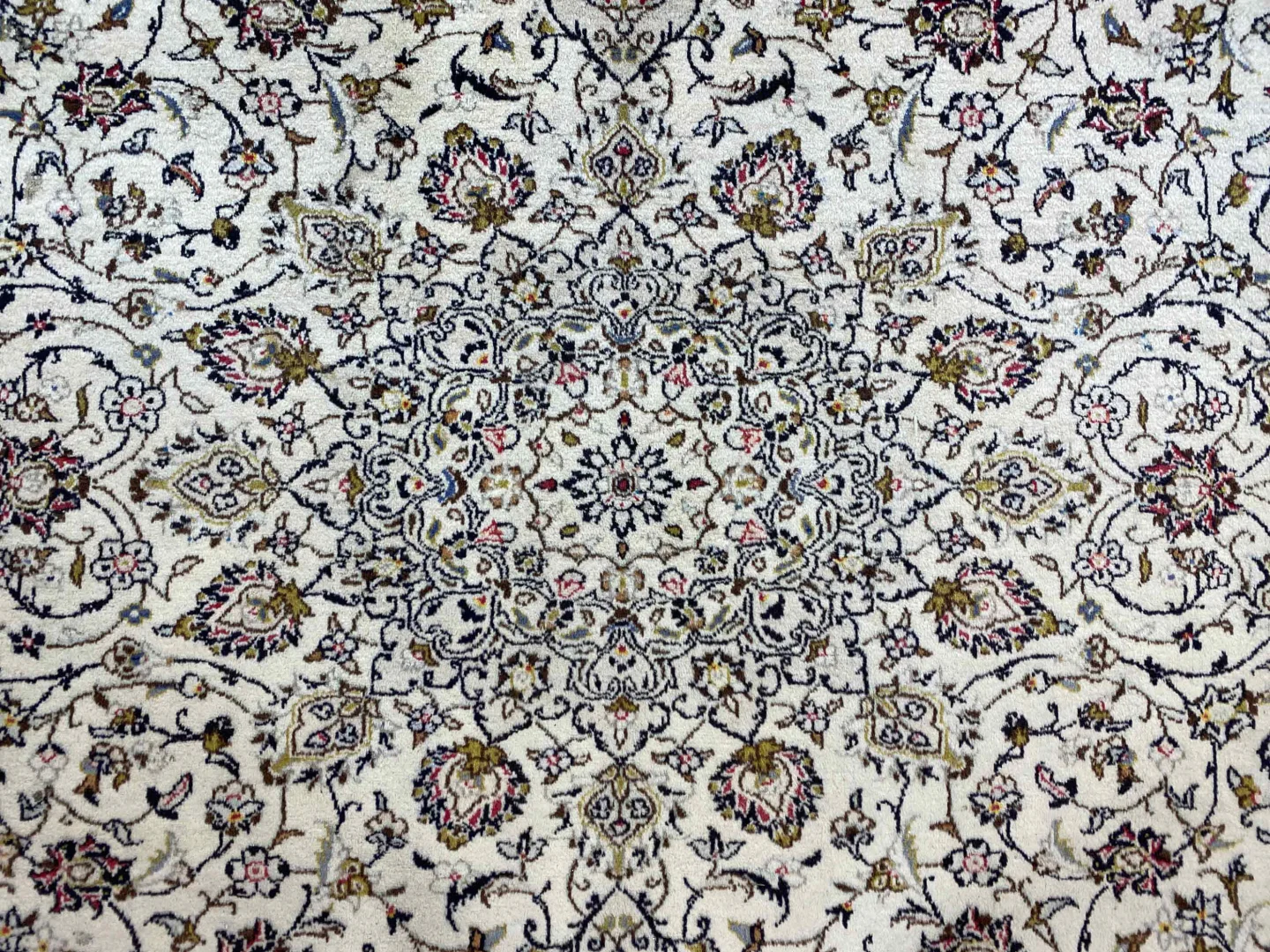
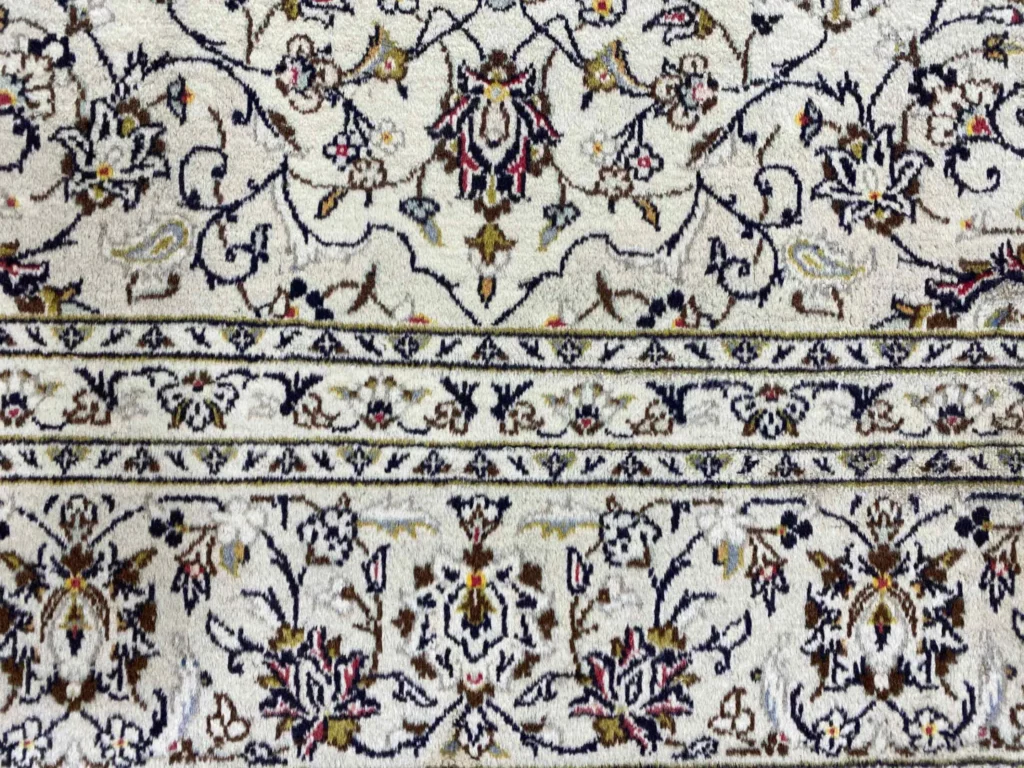
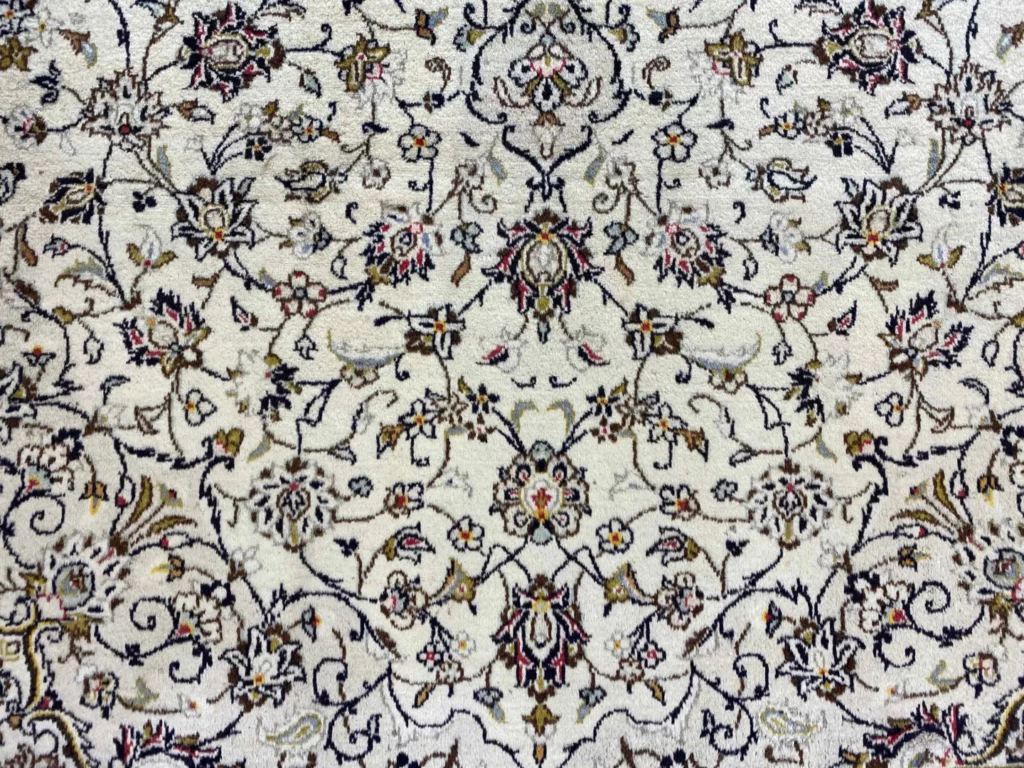
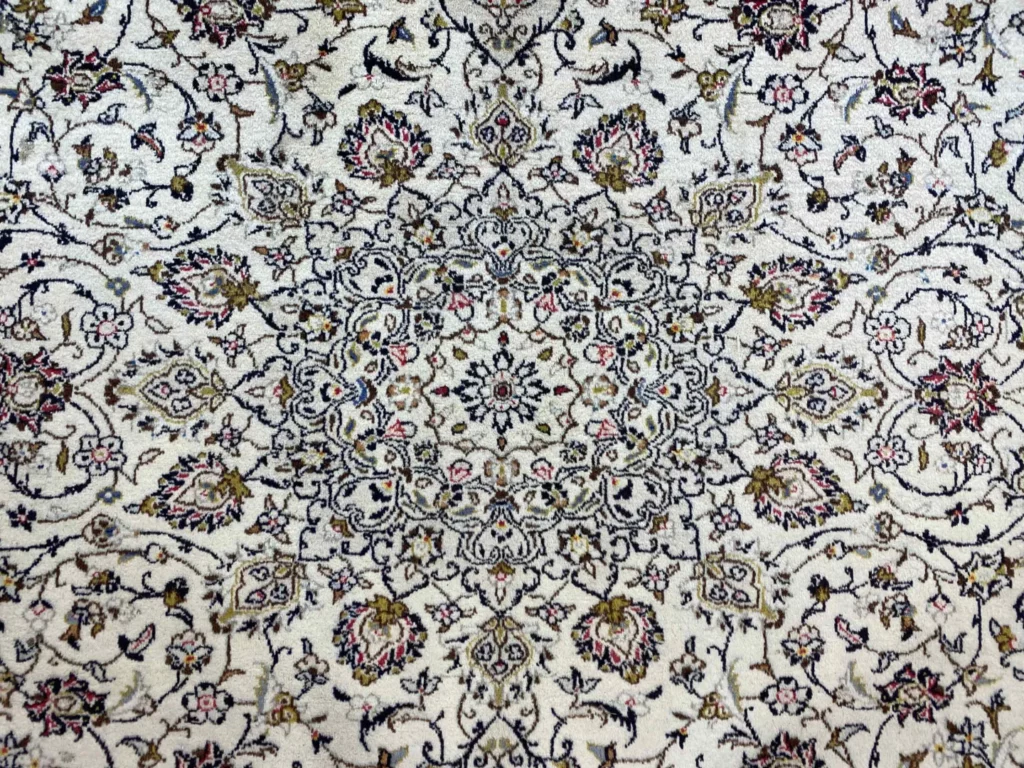
The pattern of this rug is described as a medallion design in red, blue and beige. A medallion generally forms the visual centre of the field. It may be elongated, rounded, polygonal or composed of several nested forms. Supporting ornaments are placed around the central structure to balance the field and direct attention towards its centre.
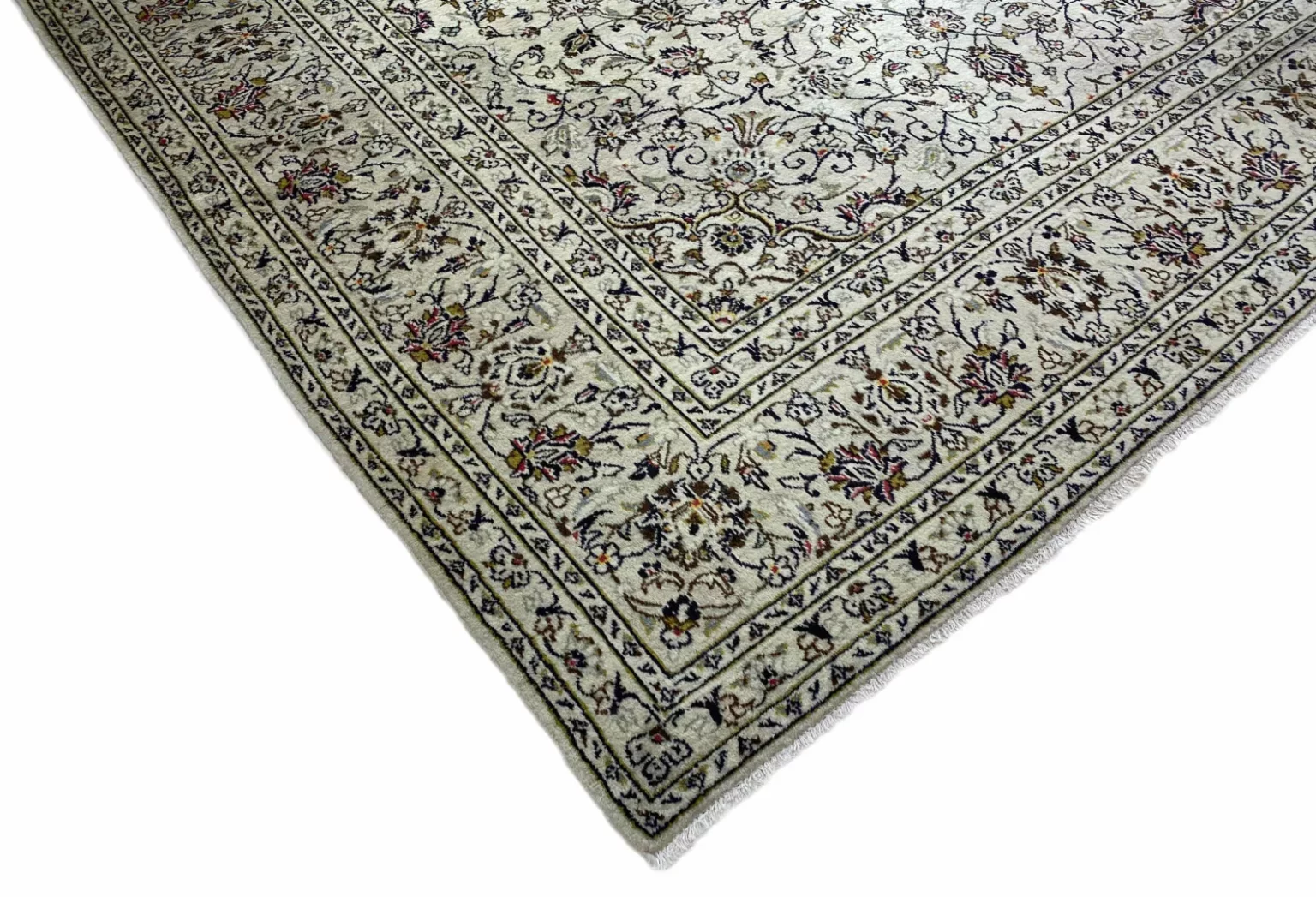
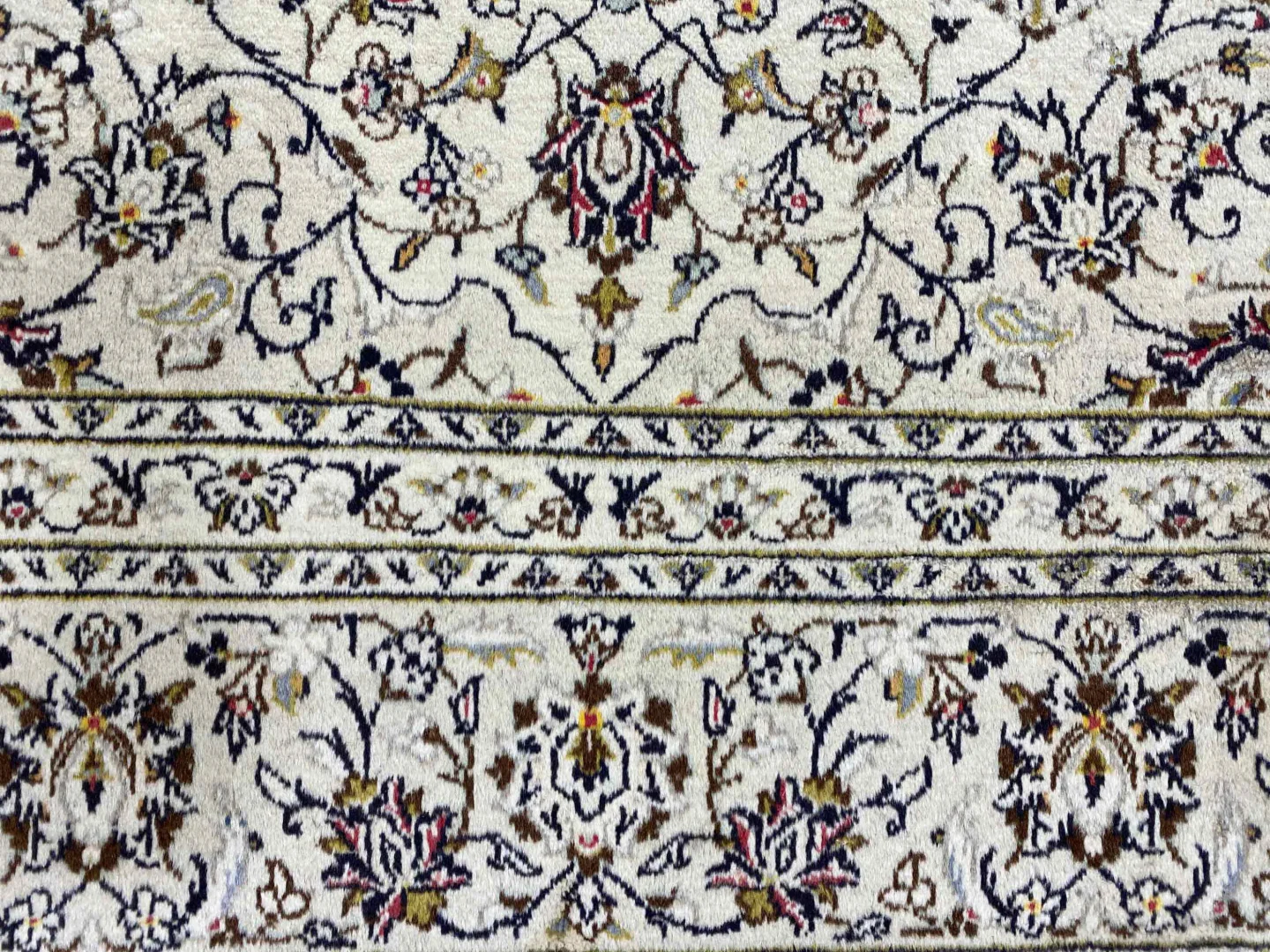
Classic Keshan compositions frequently use a central medallion. Curving vines, flowers, leaves and finely divided secondary forms may be arranged around it. These elements are treated as a connected ornamental system rather than as isolated symbols. Borders frame the inner field and often repeat shapes or colour accents already present in the central design.
Red, blue and beige are the colours specified for this rug. In Persian rug design, red can serve as a dominant ground colour or as an accent, while blue introduces contrast and additional division within the composition. Beige can link separate areas and soften the transition between stronger tones. The description does not provide further details about the distribution, brightness or precise drawing of the colours, so those aspects are not expanded here.
Keshan rugs are also made with all-over patterns in addition to medallion compositions. In an all-over design, the field is not dominated by one central form; instead, ornaments repeat across the entire inner area. Such versions are particularly popular in Europe and may also appear in combinations of grey, blue and beige. This individual rug, however, is specifically described as a medallion design in red, blue and beige.
The knot density given for Keshan rugs, from 100,000 to 300,000 knots per square metre, generally permits the detailed rendering of fine motifs. In a medallion, this can support carefully drawn outlines, internal ornament and gradual transitions between design areas. The relationship between knotting technique and pattern construction helps explain why Keshan designs often have a clearly organised and finely articulated appearance.
Special Features
The features documented for this one-off rug are its origin in Keshan, Iran, its hand-knotted construction, high-quality sheep wool and cotton, and a knot density of 100,000 to 300,000 knots per square metre. Its pattern is a medallion design in red, blue and beige. Its condition is recorded as very good.
These details combine a named Persian origin with a classic central pattern structure. The material description identifies sheep wool and cotton without giving percentages or a more detailed division. It also does not include information about age, a signature, pile height or restoration. The special features of this listing therefore remain limited to the properties explicitly documented for this rug.
FAQ
How should I care for my Keshan Persian rug?
Regular vacuuming helps remove dust and dirt from the rug. If a spill or mark occurs, dab the area immediately with a damp cloth rather than rubbing it. Special carpet cleaners may be used for further treatment. Professional cleaning every few years can also be helpful. With a hand-knotted rug, the cleaning method should be selected to suit the materials used in its construction.
Where can I buy an authentic Keshan Persian rug?
Authentic Keshan Persian rugs can be found at specialist rug dealers, craft markets and online shops focused on Persian rugs. When buying, ask for certificates or proof of authenticity. Such documents should make the stated origin and the main details of the rug verifiable.
What makes Keshan Persian rugs distinctive?
Keshan Persian rugs combine a high knot density, high-quality wool and rich, vivid patterns with a long-established tradition of hand craftsmanship. The work of the knotters gives each individual rug its own execution. They can therefore serve both decorative and practical purposes. The medallion design and the palette of red, blue and beige are defining features of this rug’s appearance.
To provide the best experiences, we use technologies like cookies to store and/or access device information. Consenting to these technologies will allow us to process data such as browsing behavior or unique IDs on this site. Not consenting or withdrawing consent, may adversely affect certain features and functions.
Functional Always active
The technical storage or access is strictly necessary for the legitimate purpose of enabling the use of a specific service explicitly requested by the subscriber or user, or for the sole purpose of carrying out the transmission of a communication over an electronic communications network.
Preferences
The technical storage or access is necessary for the legitimate purpose of storing preferences that are not requested by the subscriber or user.
Statistics
The technical storage or access that is used exclusively for statistical purposes.The technical storage or access that is used exclusively for anonymous statistical purposes. Without a subpoena, voluntary compliance on the part of your Internet Service Provider, or additional records from a third party, information stored or retrieved for this purpose alone cannot usually be used to identify you.
Marketing
The technical storage or access is required to create user profiles to send advertising, or to track the user on a website or across several websites for similar marketing purposes.
 SECURE PAYMENT
 SHIPPING PARTNERS


