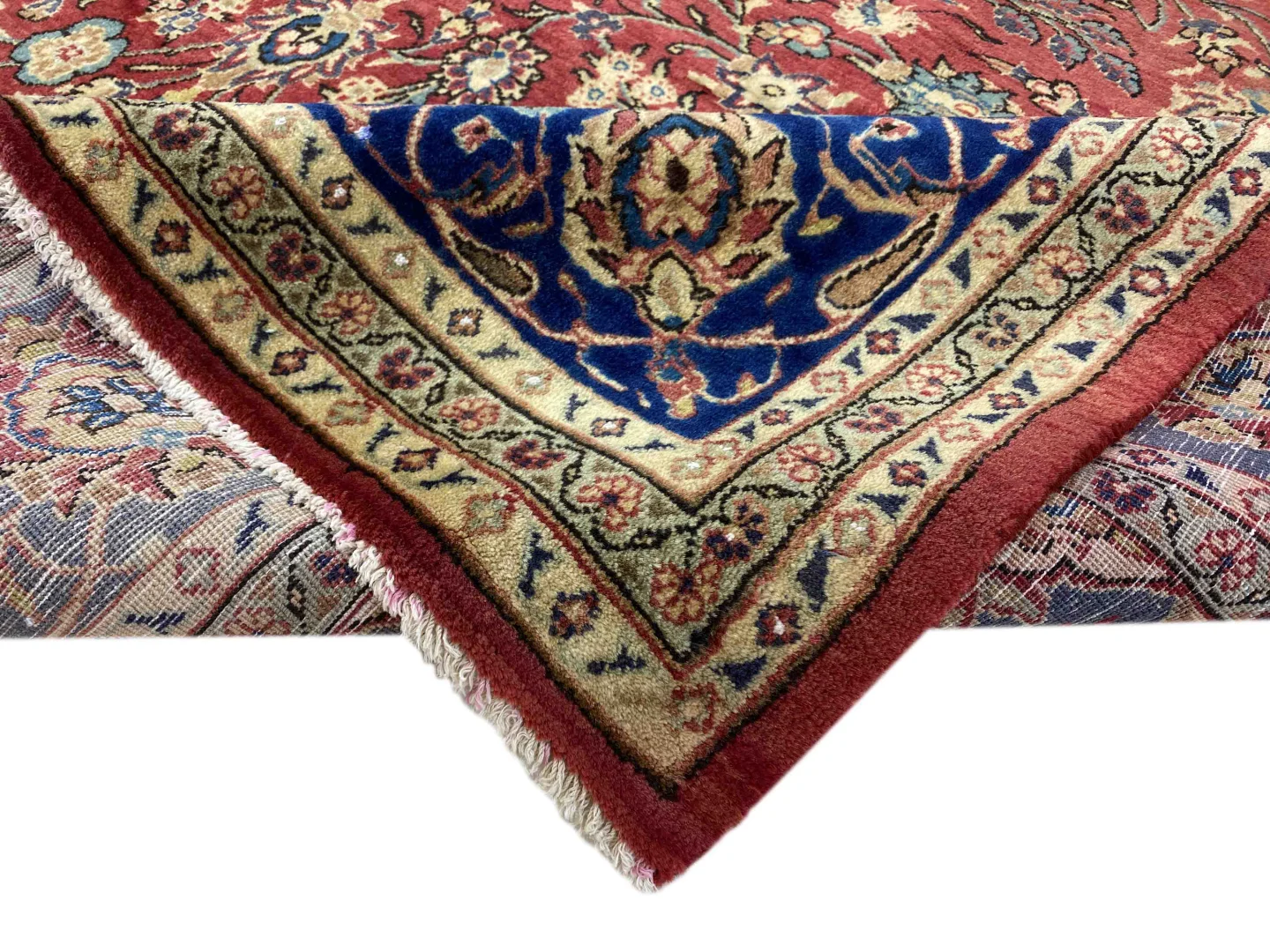
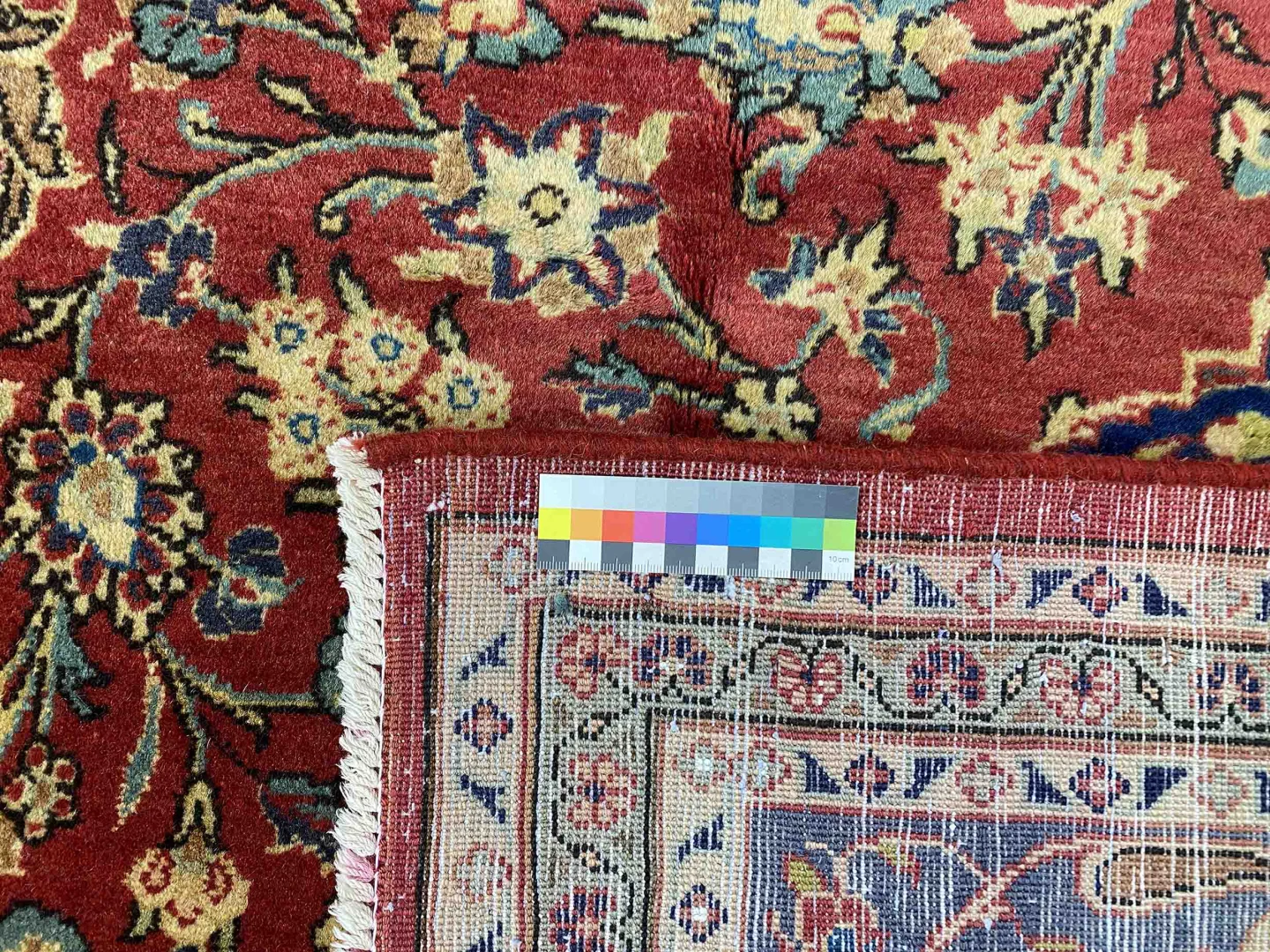
This Keshan Persian rug is hand-knotted and made with high-quality sheep wool and cotton. The sheep wool forms the pile, while the cotton belongs to the supporting foundation of the knotting. Combining these fibres according to their different functions is an established principle in Persian rug making. Wool has traditionally been selected for the visible surface because it is resilient and pleasantly tactile. Cotton provides an orderly and stable basis for arranging the knots.
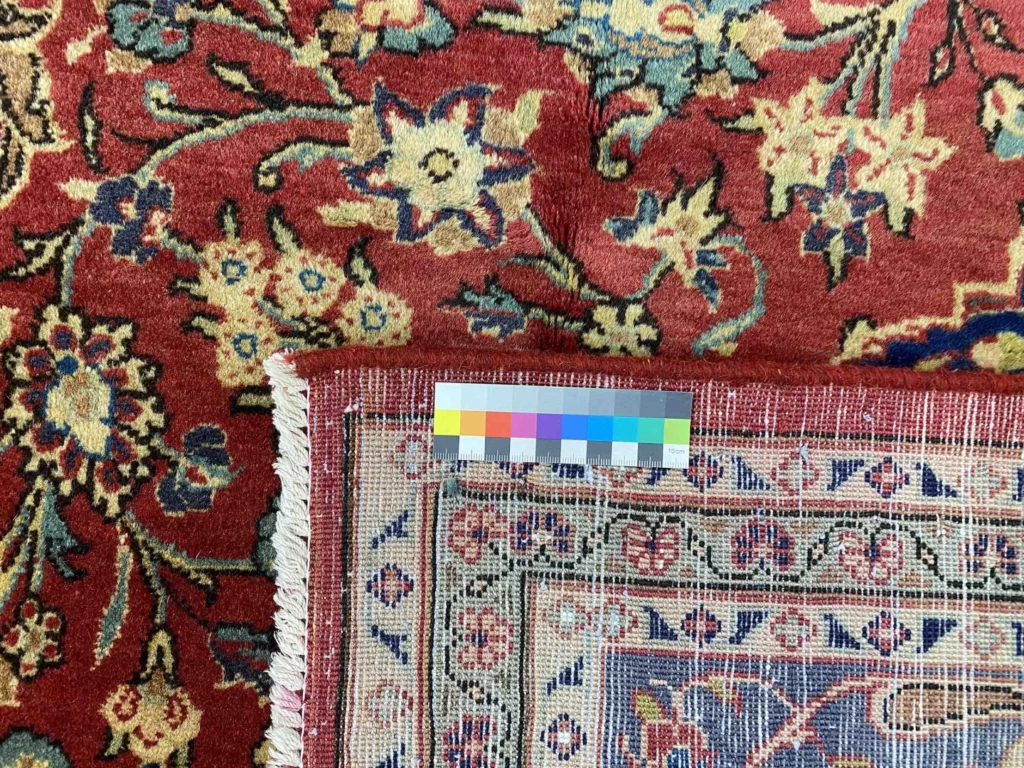
Hand-knotting is carried out one knot at a time. Each knot is placed into the prepared warp, row after row, and the structure is secured as the weaving progresses. This differs from a machine-made floor covering, where the surface is produced by an industrial process. Hand-knotting requires control of tension, consistent working habits and close attention to the pattern. Small elements of a drawing can therefore be transferred directly into the textile structure through the placement of individual knots.
The knot density of this rug is 150,000 to 300,000 knots per square metre. In general, a greater number of knots allows lines, flowers, scrolling forms and geometric details to be rendered more finely. It also affects the compactness of the surface and the clarity with which a complex design can be read. Knot density should always be considered together with the fibre, pile and consistency of the workmanship. In Keshan rug making, dense construction supports the detailed character associated with classic designs.
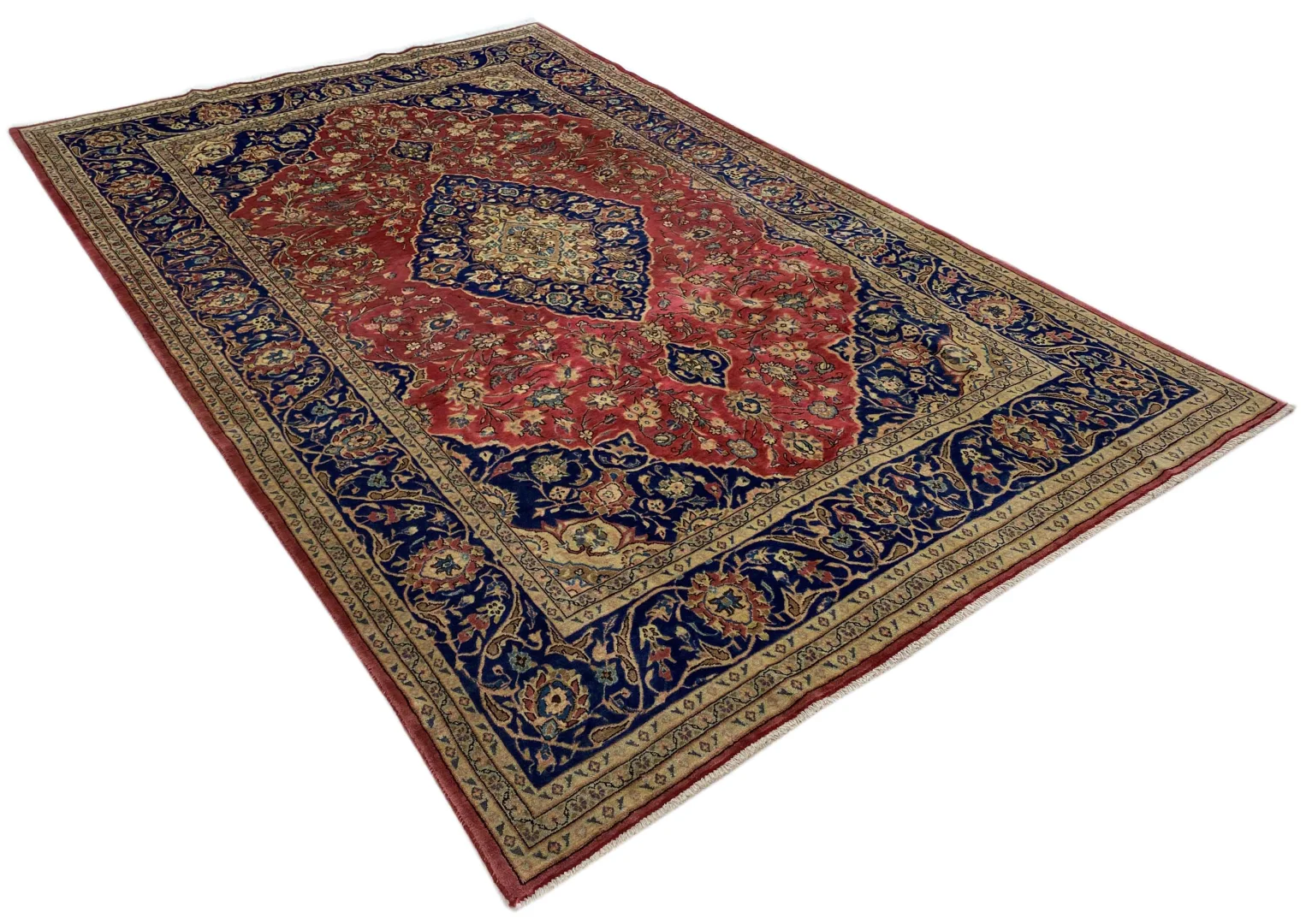
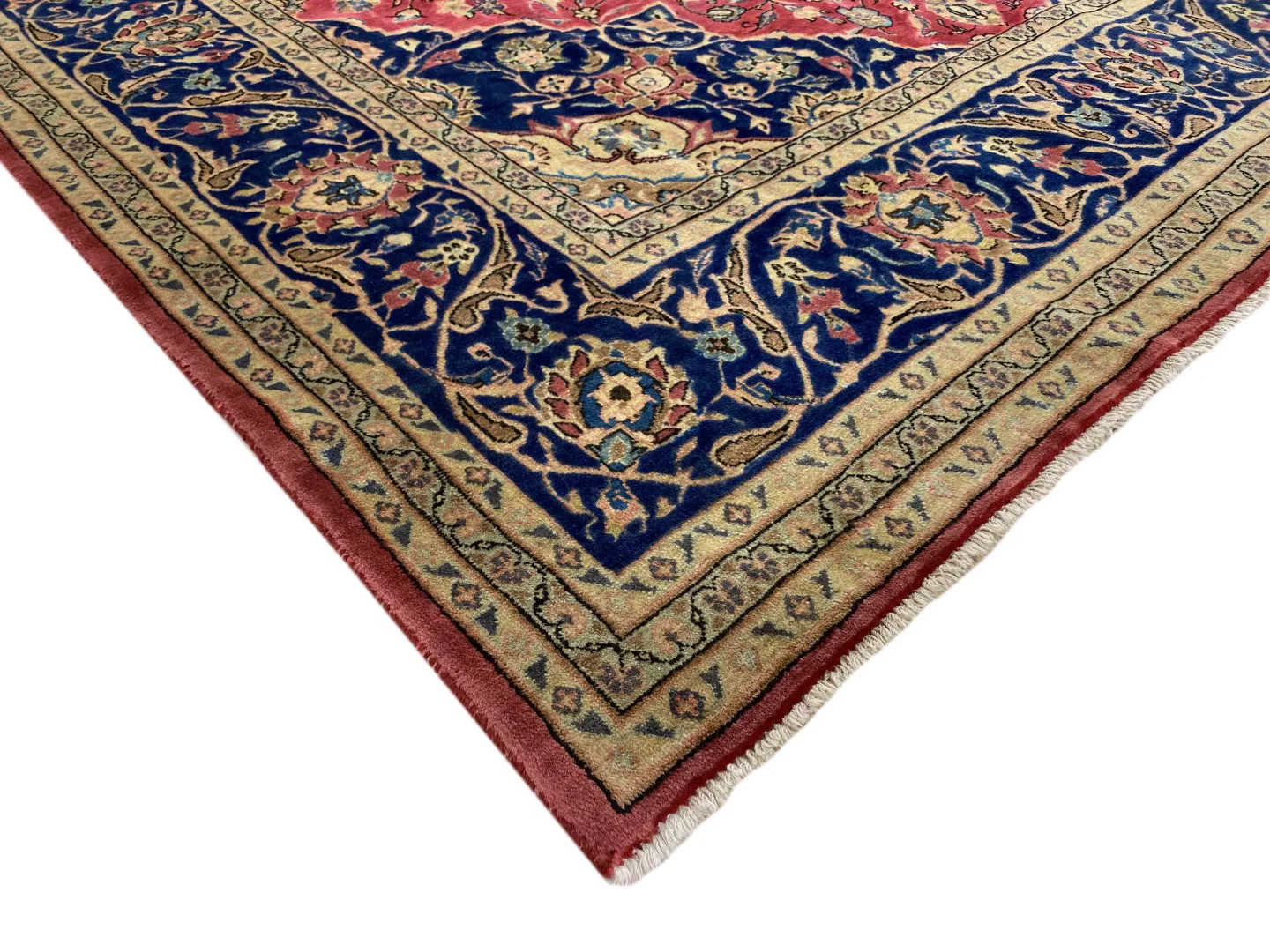
Keshan rugs are often made with a short, dense pile. A shorter pile can keep the outlines of the pattern distinct, while a compact surface is comparatively straightforward to maintain. Sheep wool is suitable for everyday use because of its durability. Cotton contributes to the order and stability of the construction during the knotting process. The two materials therefore work together: wool determines the visible surface, while cotton supports the underlying structure.
Origin and Tradition
Keshan Persian rugs originate in Keshan, Iran. The city is known for its rug makers and its established tradition of craftsmanship. Keshan consequently identifies both a place of origin and a developed approach to making and designing rugs. Knowledge of fibre preparation, colour relationships, pattern drawing and hand-knotting has been passed through generations. These elements belong together and explain why regional rugs are classified not only by appearance, but also by the place and tradition connected with their production.
Keshan has a long cultural history and was an important trading centre for centuries. Its position on routes associated with the Silk Road encouraged the exchange of goods, materials and artistic influences. Rugs made in the region could travel far beyond the city where they were produced. Trade connected local workshops with distant markets and helped establish the name Keshan in the wider history of Persian rugs.
Persian rug culture is closely connected with cities and regions that developed their own workshop traditions. In Keshan, rug making became an important craft in which knowledge of proportion, ornament and material was taught from one generation to the next. Making a rug combines planning with practical execution. The overall order of the design is established first, and that order is then translated into a textile surface through the gradual work of knotting.
Hand-knotted rugs in Persia were part of everyday life and also represented a highly developed craft culture. They were made for interiors, used as furnishings and circulated through markets and long-distance trade. Their significance came from the combination of practical use, knowledge of materials and decorative design. Keshan rugs occupy a regional place within this history, joining careful handwork with compositions that are often clearly organised and richly ornamented.
The name Keshan should not be understood as referring to only one fixed drawing. It points to an origin and a weaving tradition in which several classic design approaches can occur. Many Keshan rugs share an appreciation for detailed patterning, careful workmanship and traditional materials. The precise colours and arrangement of motifs may differ from one rug to another. Regional identity therefore remains present even when individual compositions are not identical.
Isfahan and Tabriz are also well-known Iranian rug centres. Isfahan rugs are often associated with finely articulated motifs and careful detail. Tabriz rugs are recognised for varied arrangements of colour and pattern. Nain and Kashan are likewise connected with Iranian rug production and their own regional design traditions. These centres share the importance of handwork, but each has developed distinct historical and technical practices. Keshan retains its own position within this network of Persian origins through its workshop heritage and characteristic approach to ornament.
Craft knowledge was transmitted not only through finished rugs, but also through practical training in the workshops. Beginners learned to control the tension of the warp, follow the colour plan and repeat motifs at regular intervals. With experience, they could work more complex borders, central fields and smaller ornaments. The tradition is therefore visible in both the finished design and the controlled construction of the rug. Regional handcraft combines an inherited visual language with the concrete decisions made during production.
Design and Pattern
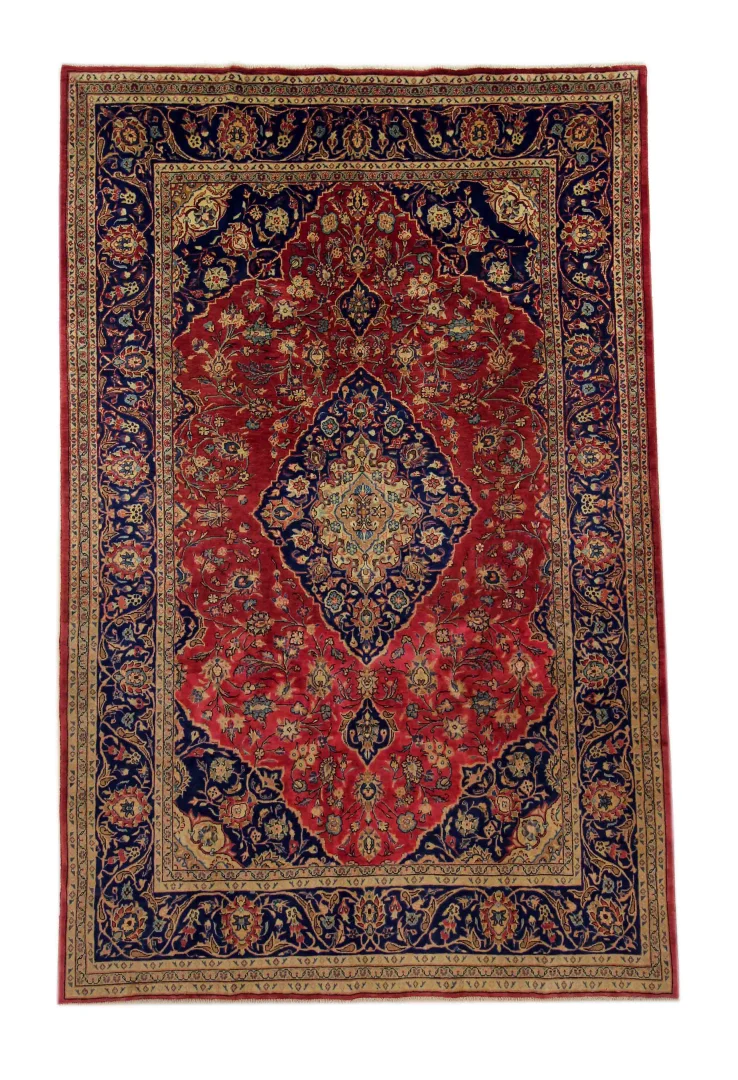
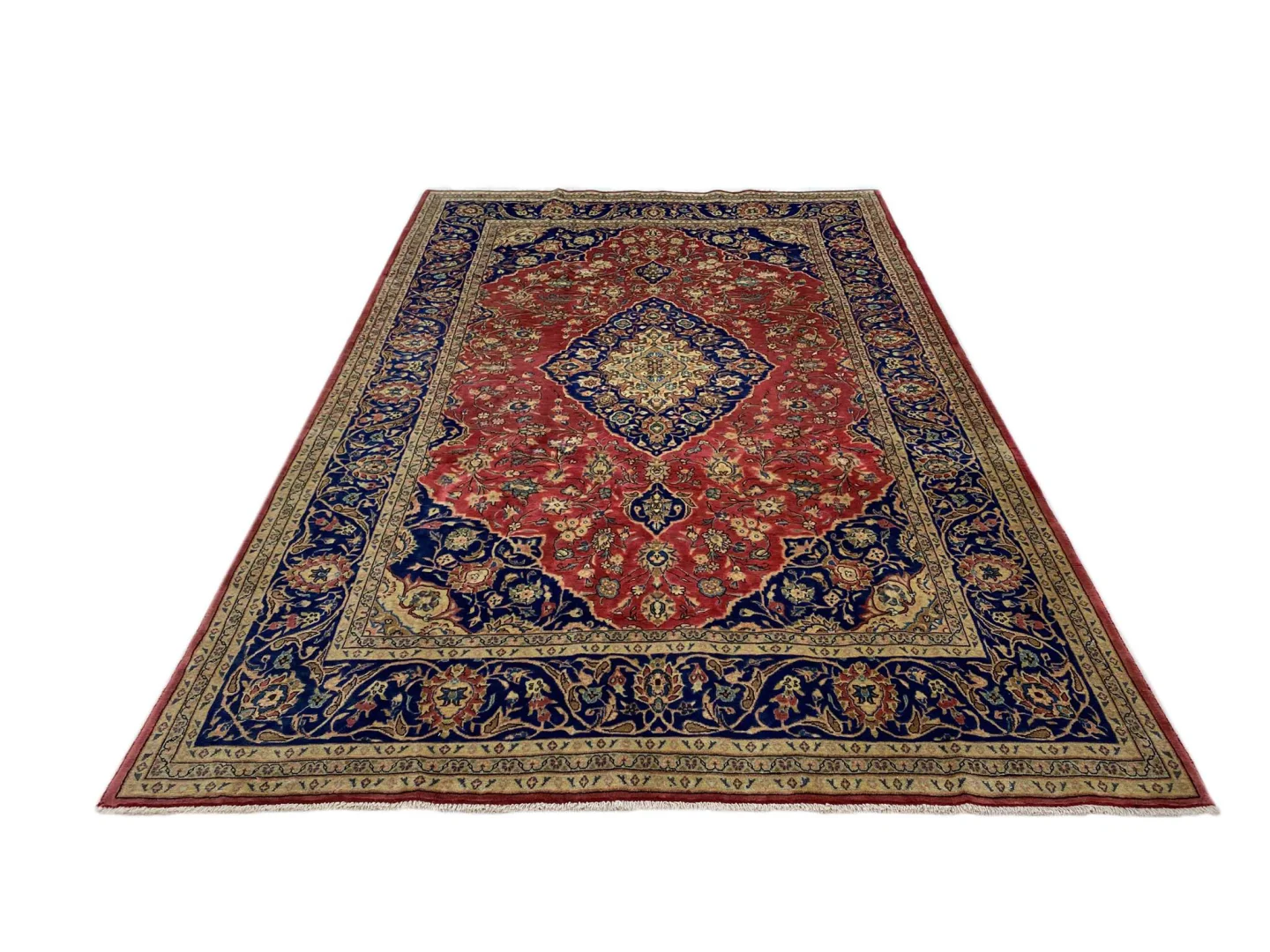
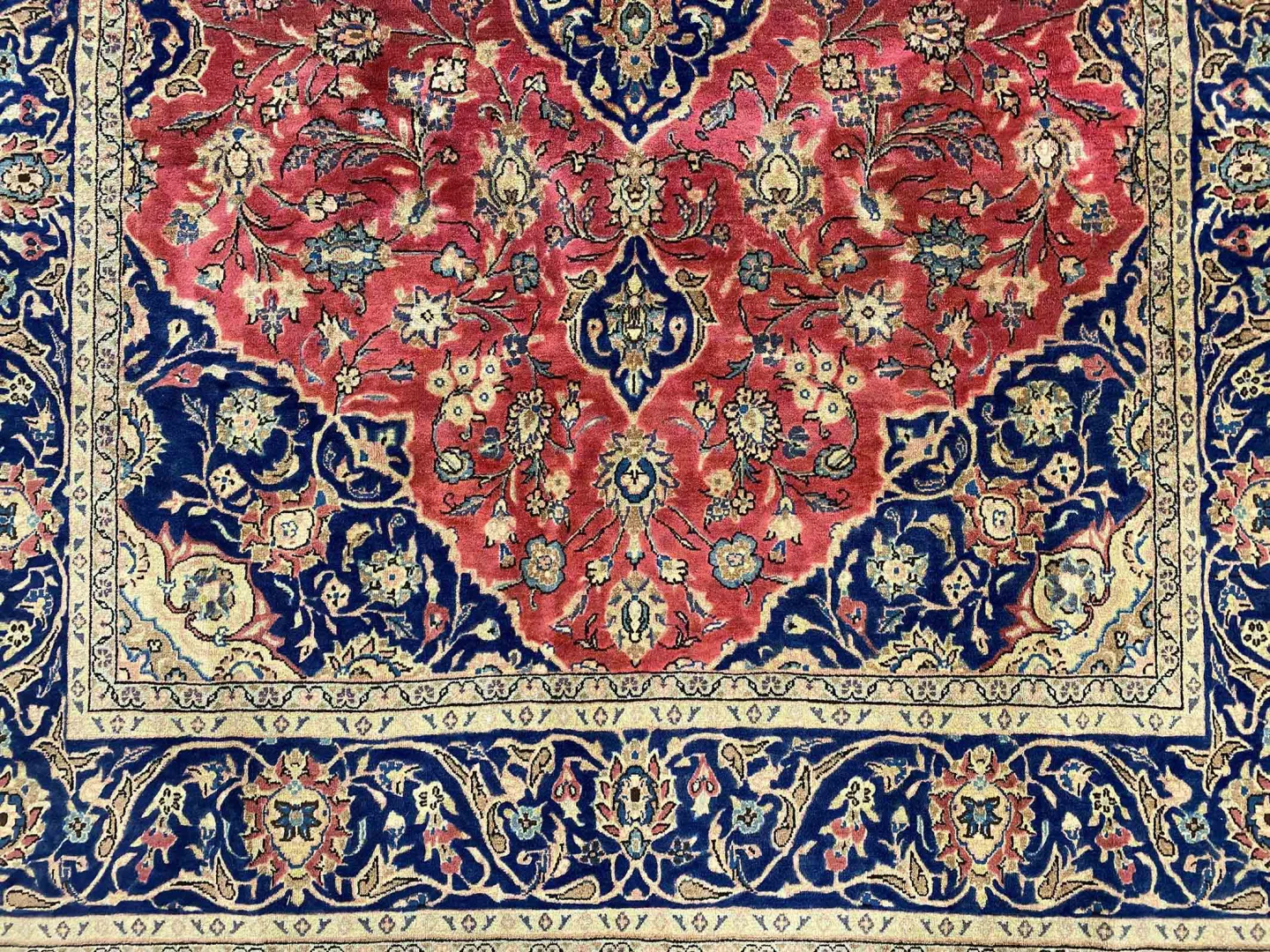
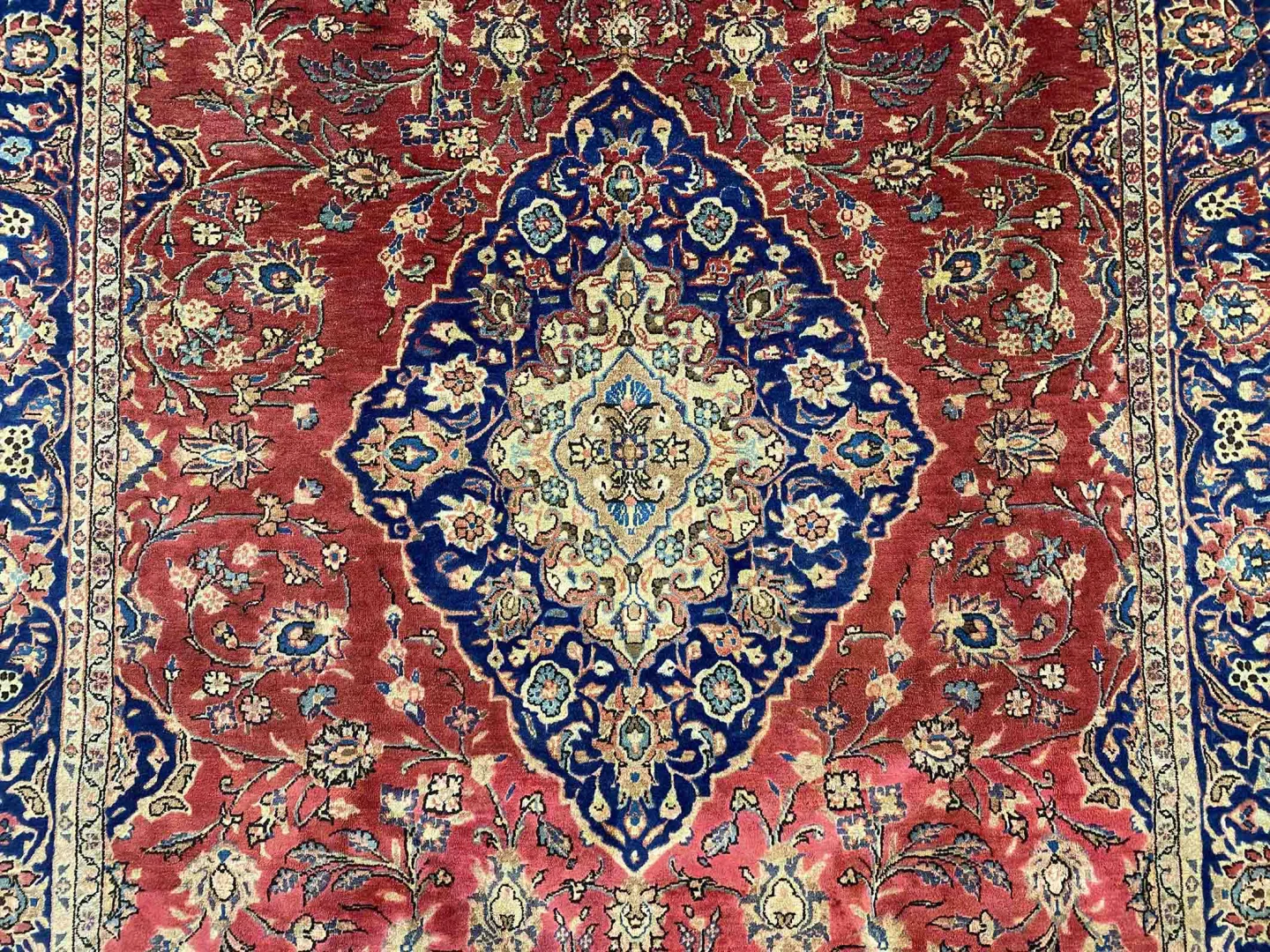
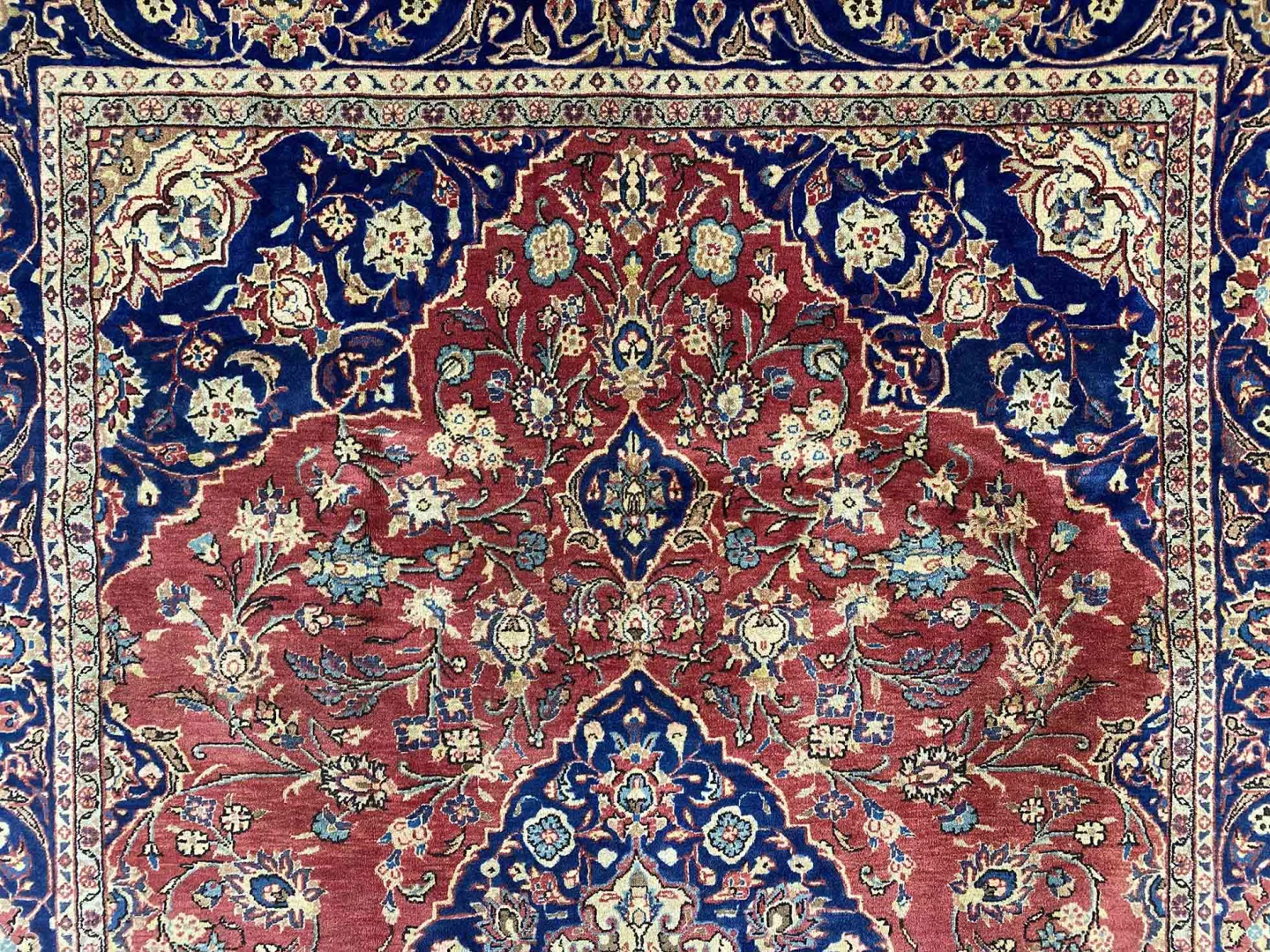
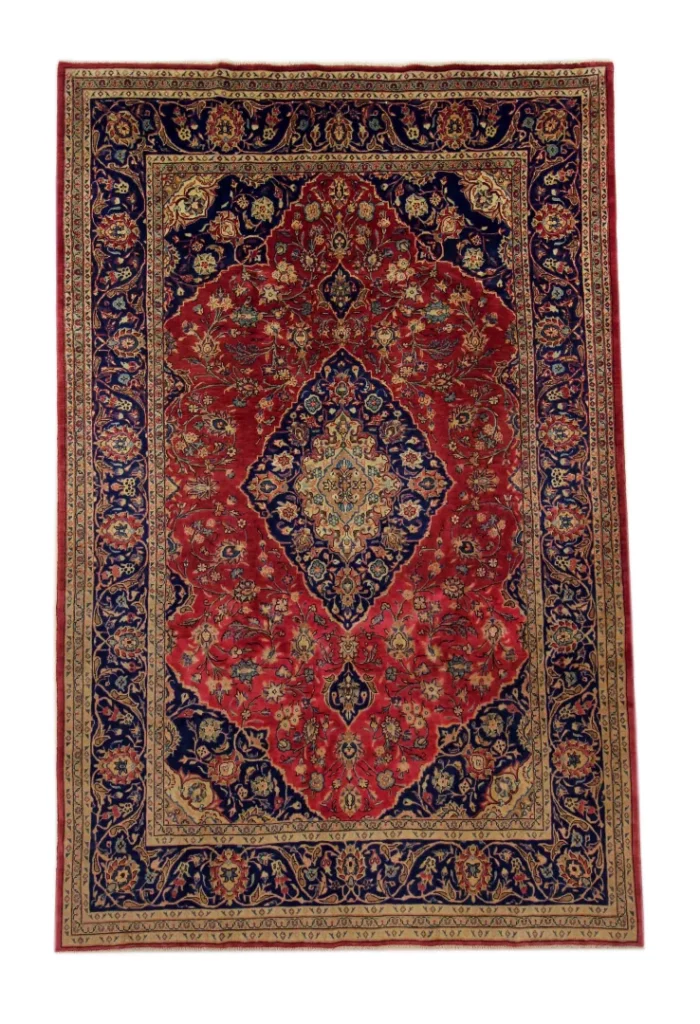
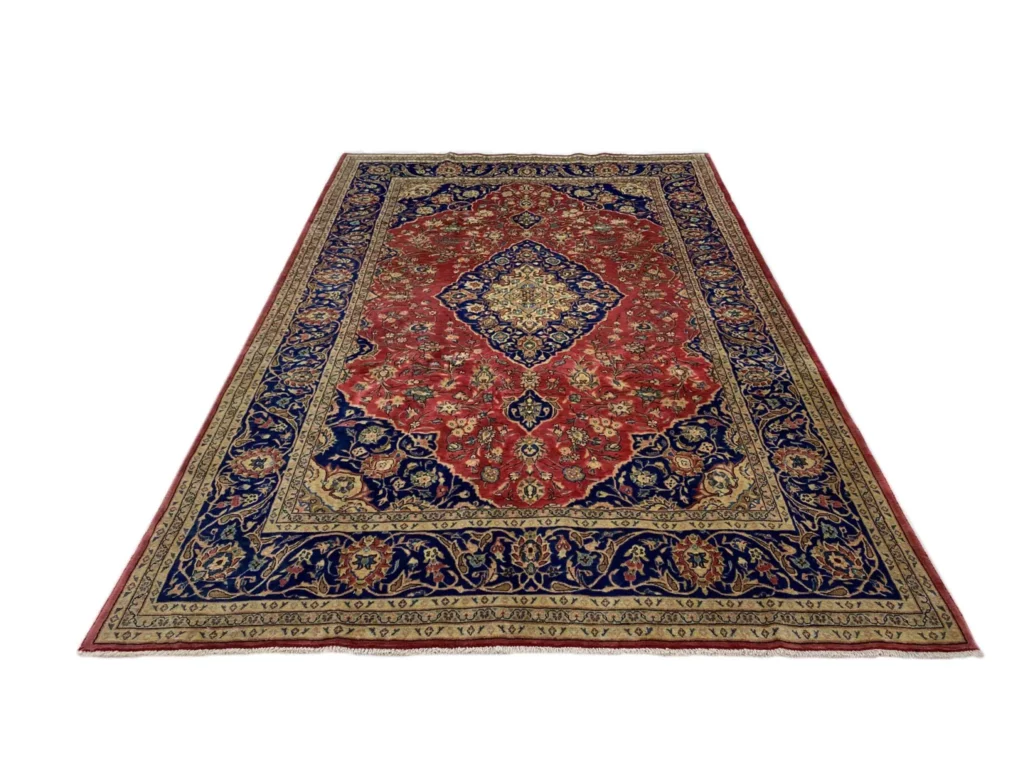
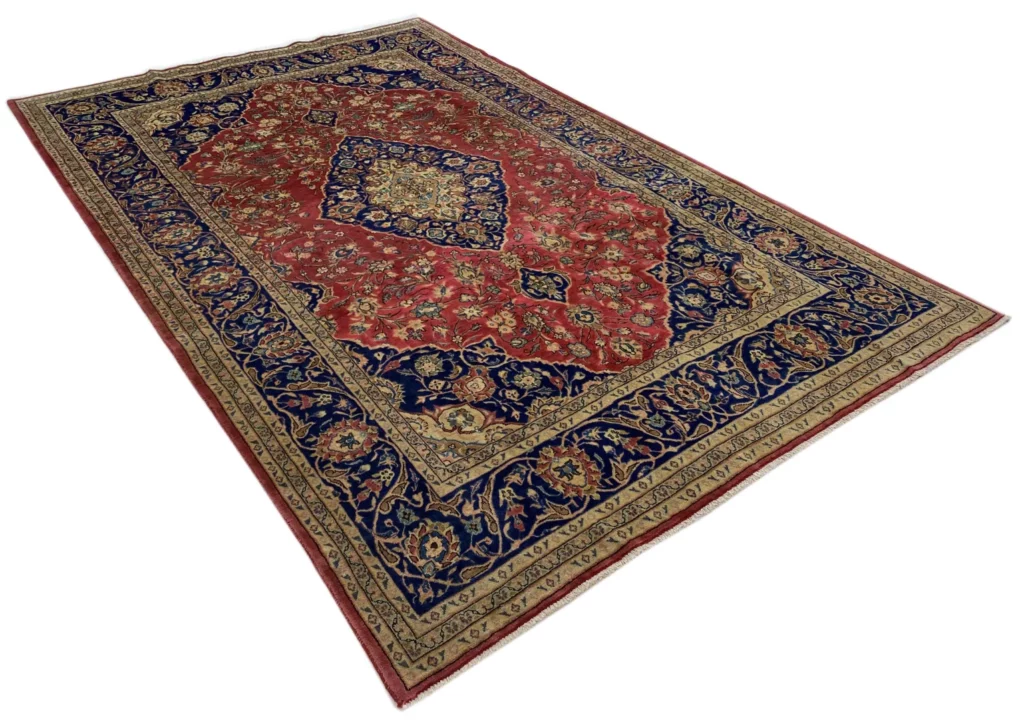
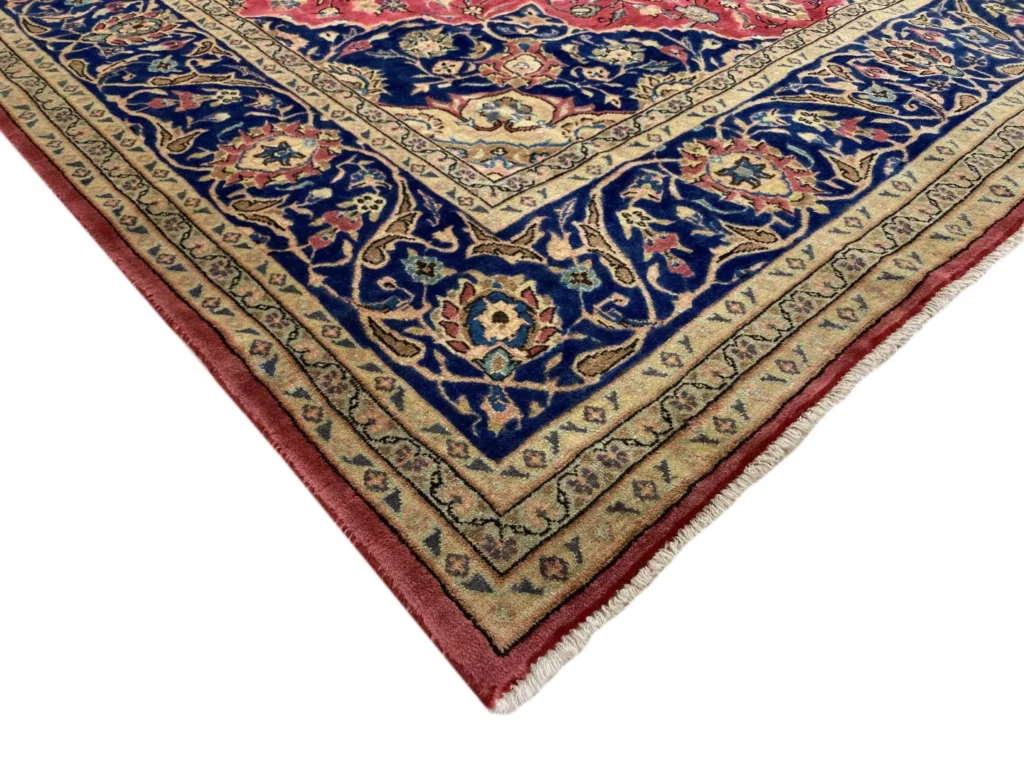
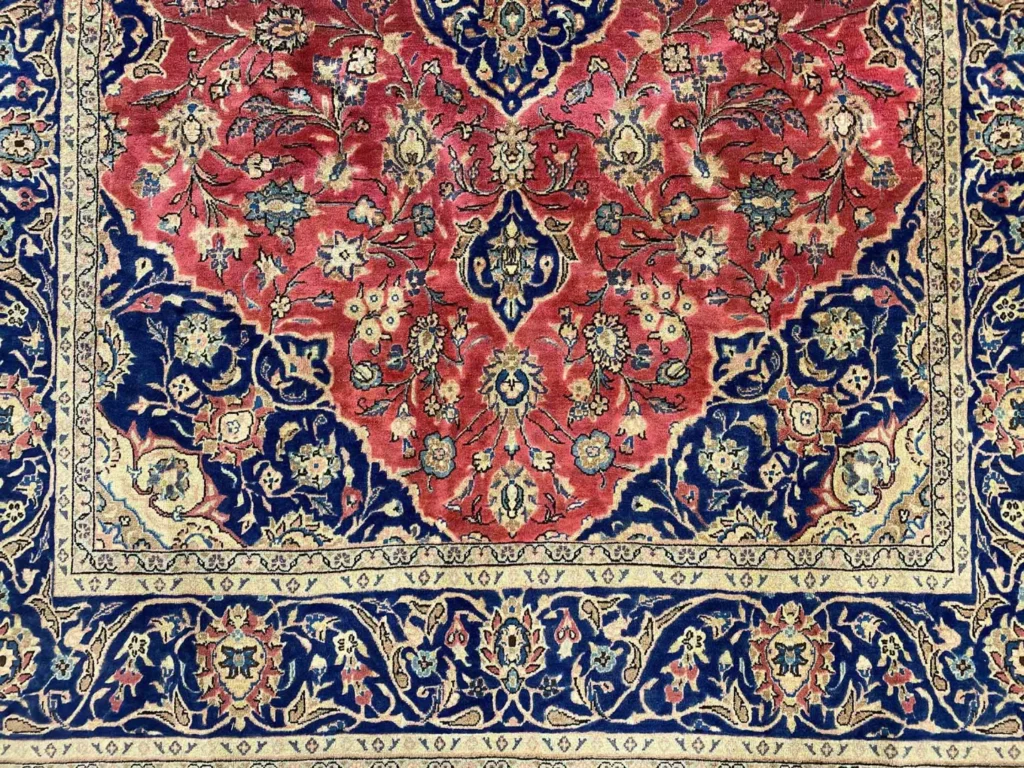
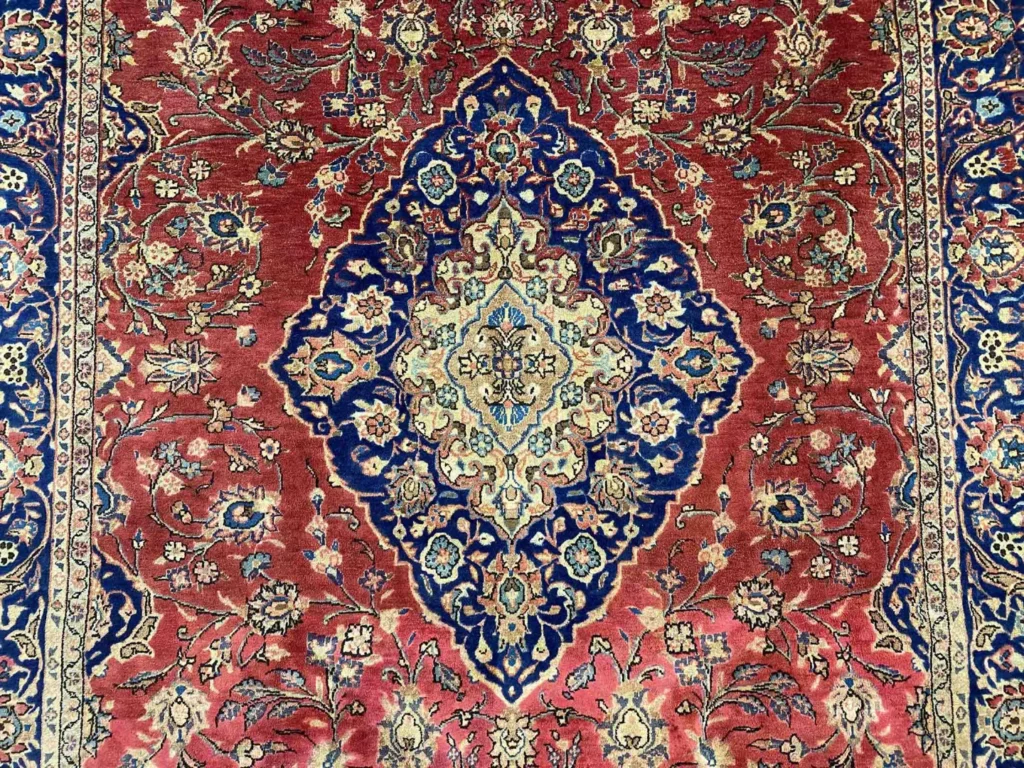
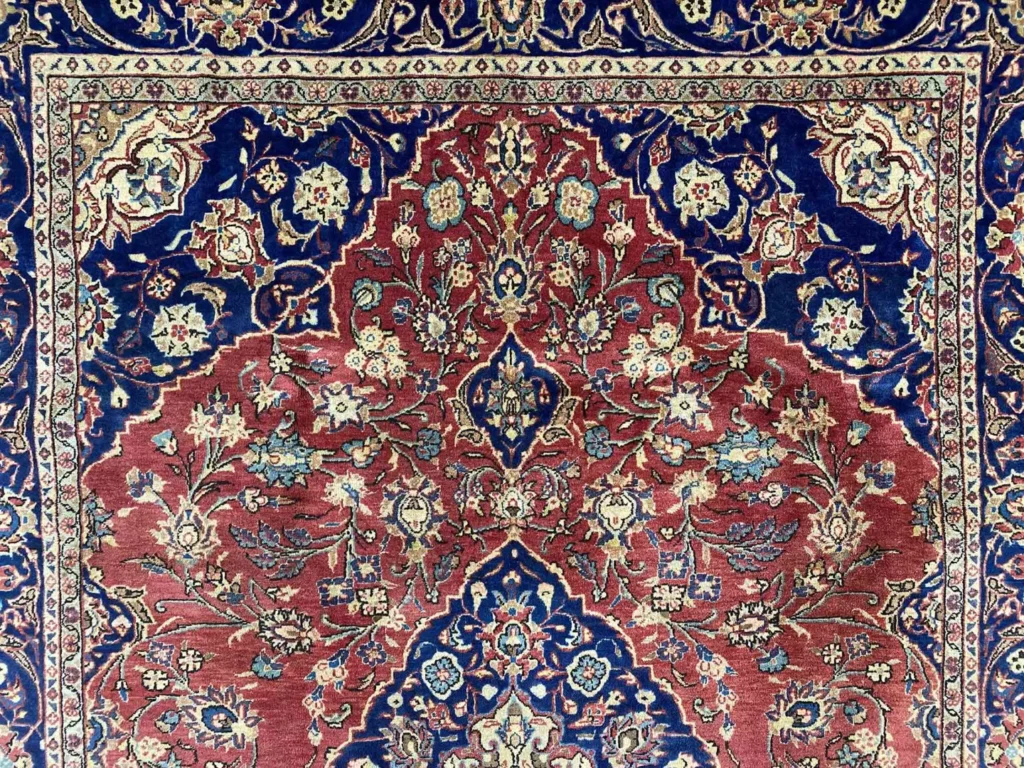
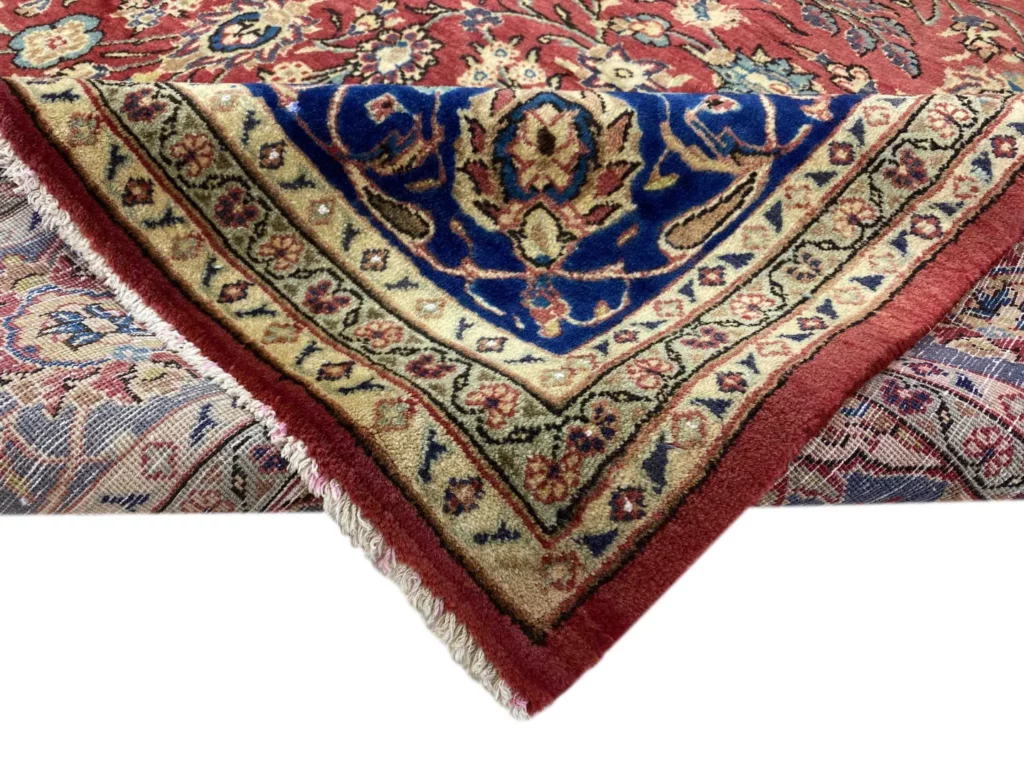
The pattern of this rug is described as classic and detailed. Classic Keshan designs often organise the surface clearly while including a large number of carefully drawn ornaments. Floral and geometric elements may be combined. Flowers, leaves and vines introduce organic movement, while lines, angles and symmetrical repetitions provide structure. The dense knotting supports the precise expression of this detailed arrangement.
A traditional Persian rug design is often divided into a central field and surrounding borders. The central field carries the principal drawing. Borders frame it and create a transition between the interior composition and the outer edge. Depending on the design, motifs may be mirrored, repeated or placed at measured intervals. This organisation prevents numerous details from appearing disconnected. Instead, the surface becomes a coherent image with a recognisable visual rhythm.
Floral ornament is one of the enduring visual languages of Persian rug design. Plant forms are not copied literally from nature; they are stylised and adapted to the woven surface. A flower may be repeated at different scales, while a vine can create a continuous connection between several motifs. Leaves and petals are drawn so that they fit within the geometry of the composition. The result keeps the reference to plants recognisable while preserving the ordered character of a rug pattern.
Geometric elements complement the floral drawing. They may appear as firm outlines, repeated shapes or symmetrical axes. Straight lines and angular boundaries give the design a stable framework. When combined with curved vines, they create a balance between movement and order. This relationship is common in classic Persian compositions and helps explain why a detailed Keshan rug can appear lively without losing its sense of balance.
The traditional colour range of Keshan rugs extends from soft pastel tones to strong, vivid colours. The effect of a design depends not only on individual hues, but also on how they are distributed. Restrained colour relationships can make the drawing appear quiet and finely controlled. Stronger contrasts bring flowers, vines and geometric boundaries forward. Field colour, motif colour and border colour must work together so that numerous small details remain readable as one composition.
In a classically organised rug, the relationship between ornament and open space is equally important. The gaps between motifs guide the eye through the design. Closely placed forms create a rich, compact impression, while wider spaces allow individual ornaments to stand out. Hand-knotting permits these proportions to be rendered with precision. Close viewing can reveal individual contours and small details; from farther away, the pattern can read as an integrated whole.
Detailed patterning also makes the work of the weaver visible across the surface. Repeated motifs create orientation, while the particular execution belongs to the individual hand-knotted piece. Each rug combines inherited design knowledge with decisions made during its actual production. The regional character remains legible through the composition, even though individual rugs can differ in colour balance, scale and exact motif placement.
Special Features
The stated features of this rug include hand-knotted construction, a knot density of 150,000 to 300,000 knots per square metre, high-quality sheep wool and cotton, and a classic, detailed pattern. Its condition is described as very good. The short, dense pile is among the characteristics associated with Keshan rugs and is linked with a clear pattern effect and comparatively uncomplicated care.
Keshan rugs can be used in living rooms, offices or as decorative elements in hallways. Their durable construction is suitable for areas that receive more frequent use. Routine care includes gentle vacuuming. Direct sunlight should be avoided. If a stain occurs, it is advisable to act promptly and use a mild cleaning product. This treats the surface carefully and avoids placing unnecessary stress on the wool and cotton.
FAQ
How can the quality of a Keshan Persian rug be assessed?
Important points include knot density, the materials used and the precision of the pattern. A higher number of knots per square metre can allow ornaments to be drawn with greater fineness. High-quality sheep wool is an indication of careful pile-material selection. The regularity of the knotting should also be considered: lines, flowers and geometric shapes should be clearly worked and logically arranged across the surface. This rug is described as having 150,000 to 300,000 knots per square metre, high-quality sheep wool and cotton, and a classic, detailed pattern. Its very good condition is another part of assessing this individual piece.
How should a Keshan Persian rug be cared for?
Regular vacuuming removes dust and loose particles from the pile. The surface should be treated gently during this process. Direct sunlight should be avoided because it may affect the appearance of the colours. Stains should be addressed as soon as possible, using a mild cleaning product so that the materials are not damaged. More substantial or extensive soiling should be handled by a professional rug cleaner. Appropriate use, regular care and protection from intense sunlight help preserve the pile and the visual clarity of the pattern over time.
Where can an authentic Keshan Persian rug be purchased?
Authentic Keshan Persian rugs can be found at specialist rug dealers, art galleries and reputable online platforms that focus on hand-knotted rugs. Buyers should look for a clear description covering origin, construction, materials, pattern and condition. Certificates may provide additional confirmation of authenticity. Specialist advice is useful when distinguishing Keshan as a place of origin and weaving tradition from a pattern name used in another context. For a hand-knotted one-off, the details of the construction and the condition should be examined carefully before purchase so that the characteristics of the individual rug are properly understood.
To provide the best experiences, we use technologies like cookies to store and/or access device information. Consenting to these technologies will allow us to process data such as browsing behavior or unique IDs on this site. Not consenting or withdrawing consent, may adversely affect certain features and functions.
Functional Always active
The technical storage or access is strictly necessary for the legitimate purpose of enabling the use of a specific service explicitly requested by the subscriber or user, or for the sole purpose of carrying out the transmission of a communication over an electronic communications network.
Preferences
The technical storage or access is necessary for the legitimate purpose of storing preferences that are not requested by the subscriber or user.
Statistics
The technical storage or access that is used exclusively for statistical purposes.The technical storage or access that is used exclusively for anonymous statistical purposes. Without a subpoena, voluntary compliance on the part of your Internet Service Provider, or additional records from a third party, information stored or retrieved for this purpose alone cannot usually be used to identify you.
Marketing
The technical storage or access is required to create user profiles to send advertising, or to track the user on a website or across several websites for similar marketing purposes.
 SECURE PAYMENT
 SHIPPING PARTNERS


