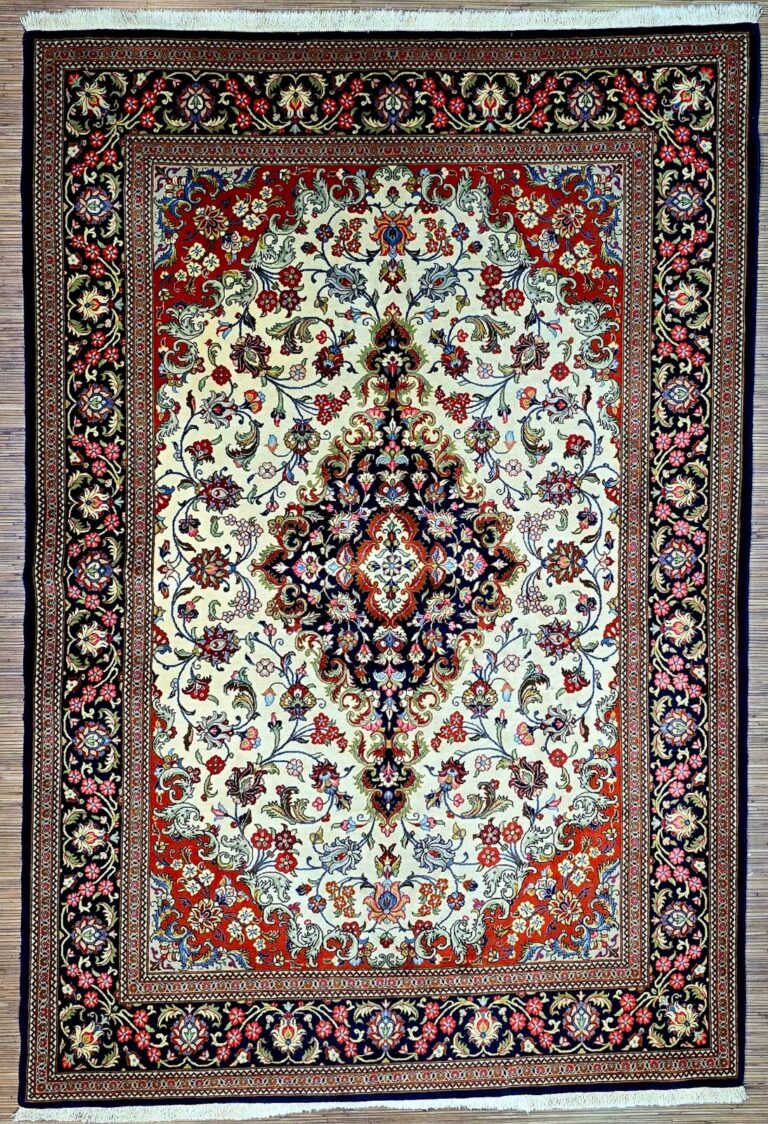
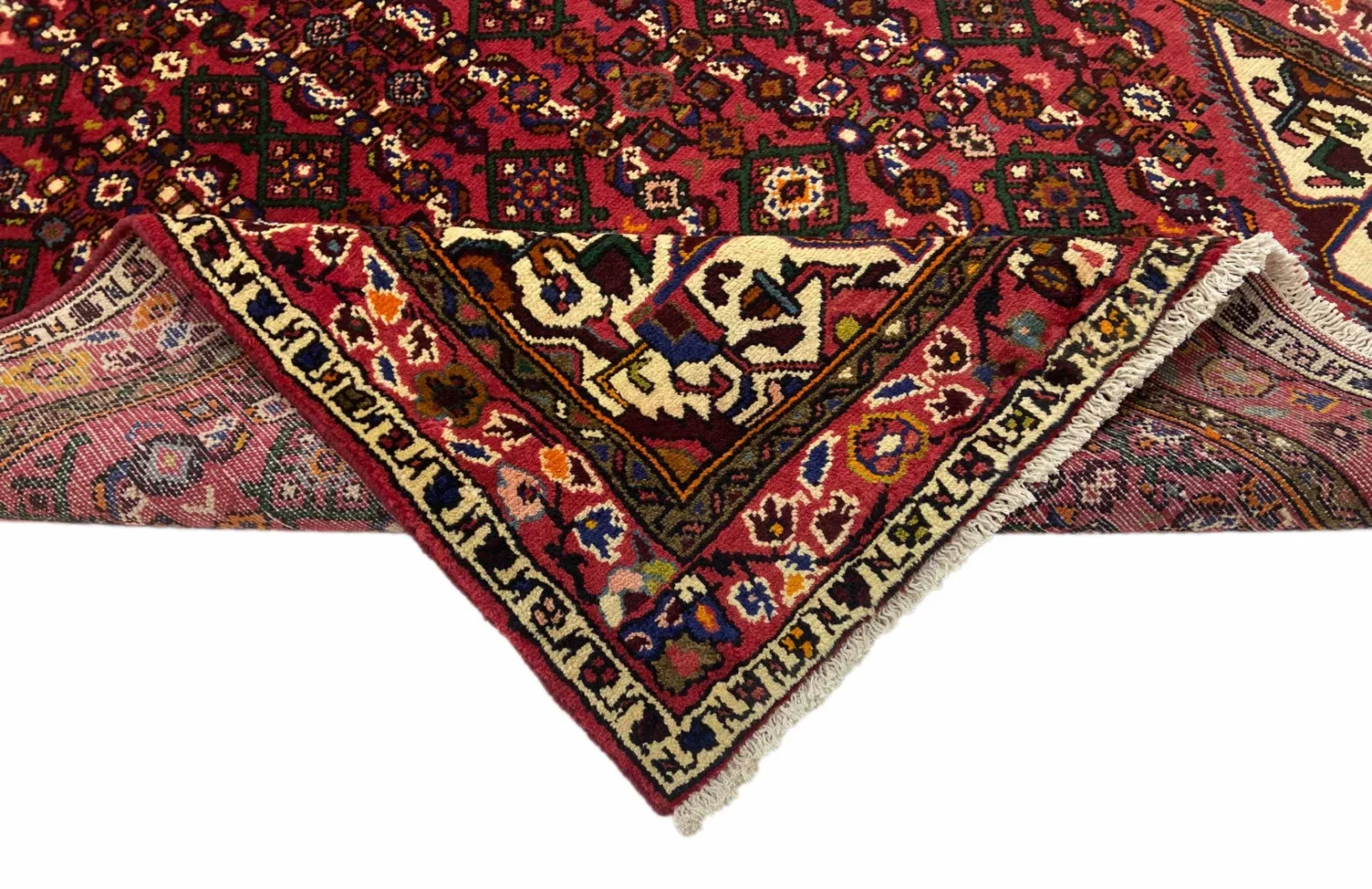
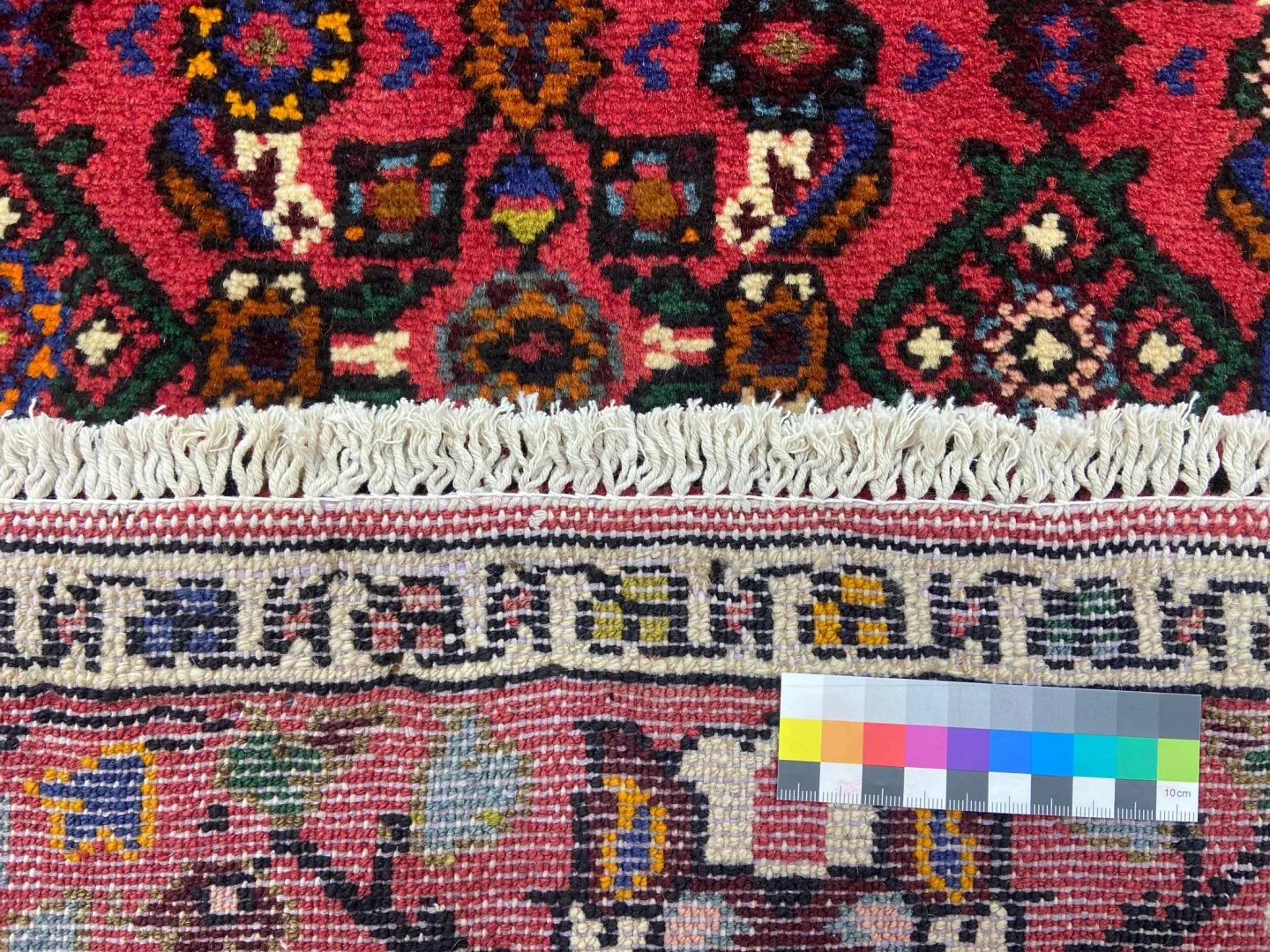
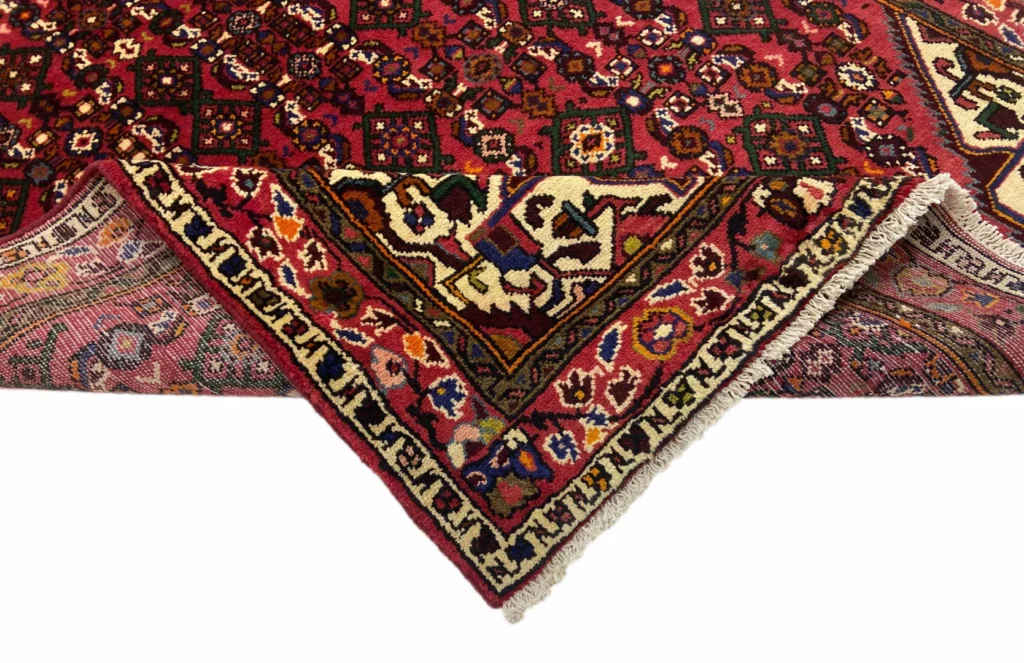
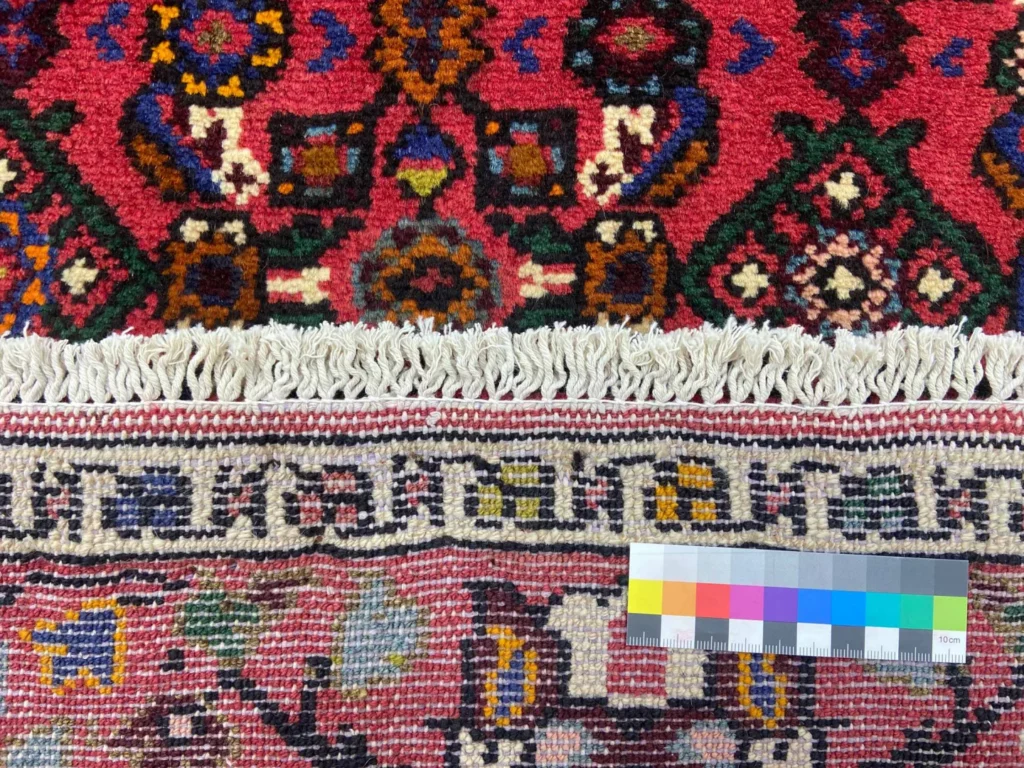
This Hosseinabad Persian rug is hand-knotted and has a pile made from durable wool. Hand-knotting is a central method in Persian rug making: individual knots are placed into the foundation so that the design develops row by row. Unlike an industrial floor covering, a hand-knotted rug is built as a textile during the making process rather than receiving its appearance from a printed surface. The wool forms the visible pile and combines a practical feel with the durability stated for this rug.
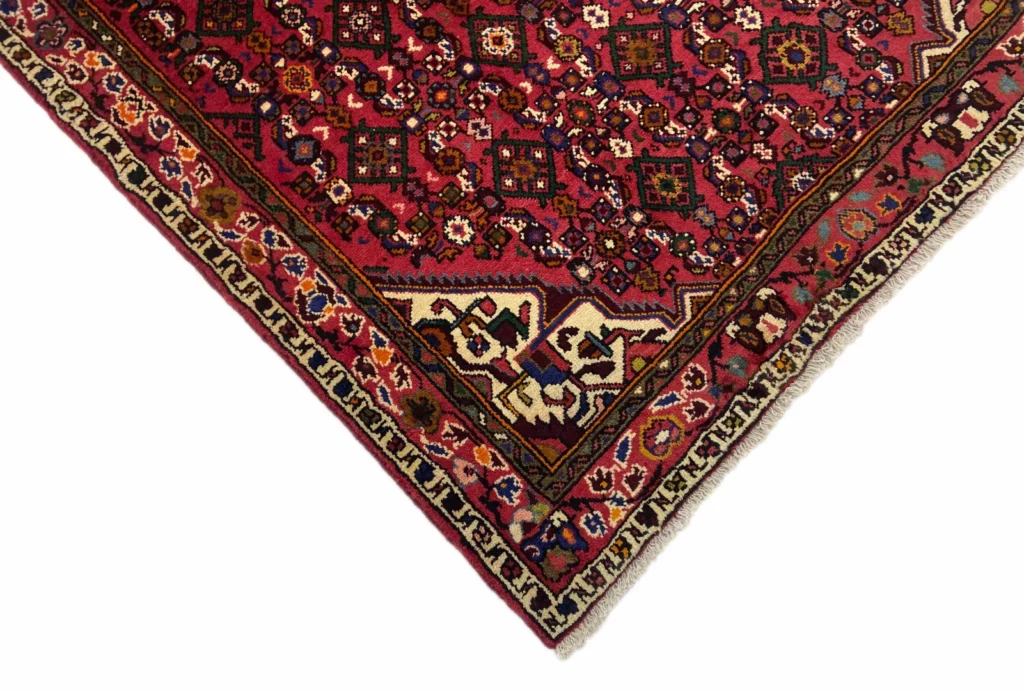
The listed knot density is 200.000 to 250.000 knots per square metre. A dense construction is characteristic of Hosseinabad rugs and supports the clear rendering of a structured design. The rug is also described as durable and in very good condition. These are properties of this individual piece: it is a hand-knotted wool rug whose construction and material are suited to regular use.
Sheep wool and cotton are traditionally used in rug production in the region. Wool is valued for the pile because it is resilient and accepts colour well, while cotton is used in many traditional constructions as part of the foundation. For this rug, the specified pile material is durable wool. Its hand-knotted technique, dense construction and very good condition together form the craftsmanship profile given for the piece.
Origin and Tradition
The rug comes from Hosseinabad in north-western Persia. Hosseinabad lies about 500 kilometres south of Hamadan and belongs to a region with a long-established rug-making tradition. Hosseinabad rugs are known for dense knotting and durability. The local character is therefore associated with the combination of carefully worked patterning and a sturdy construction intended for practical use.
Rug culture in north-western Persia developed through regional workshops and inherited working methods. Knowledge of preparing the foundation, placing knots, defining outlines and coordinating colours is passed through craft traditions. A rug is not simply decorated after completion; its design is formed while the textile is being woven and knotted. Technical control and visual composition are consequently part of the same process.
Hosseinabad also belongs to a wider north-west Persian context. The area around Hamadan has produced many rug types with geometric, floral and medallion-based arrangements. Hamadan rugs are likewise associated with durable materials and varied designs. They often combine geometric forms with floral details. This regional relationship does not mean that all such rugs share one pattern. Rather, it reflects a common preference for distinct outlines, ordered layouts and materials appropriate for everyday use.
Other Persian centres, including Tabriz and Nain, are connected with fine knotting and carefully balanced colour compositions. Their traditions are nevertheless different from those of Hosseinabad. Rugs from Tabriz and Nain may present especially detailed designs and can include luxurious materials such as silk. This particular rug is described as a hand-knotted wool rug from north-western Persia, so its classification follows the stated Hosseinabad origin rather than a comparison with another weaving centre.
The regional tradition is expressed through the meeting of practical construction and decorative order. A rug had to function as a floor covering while also creating a clearly organised textile surface. For that reason, durable materials, dense knotting and readable compositions have long existed together in the area. Hosseinabad therefore identifies both a place and a craft context in which regional experience, manual precision and everyday function are closely connected.
Design and Pattern
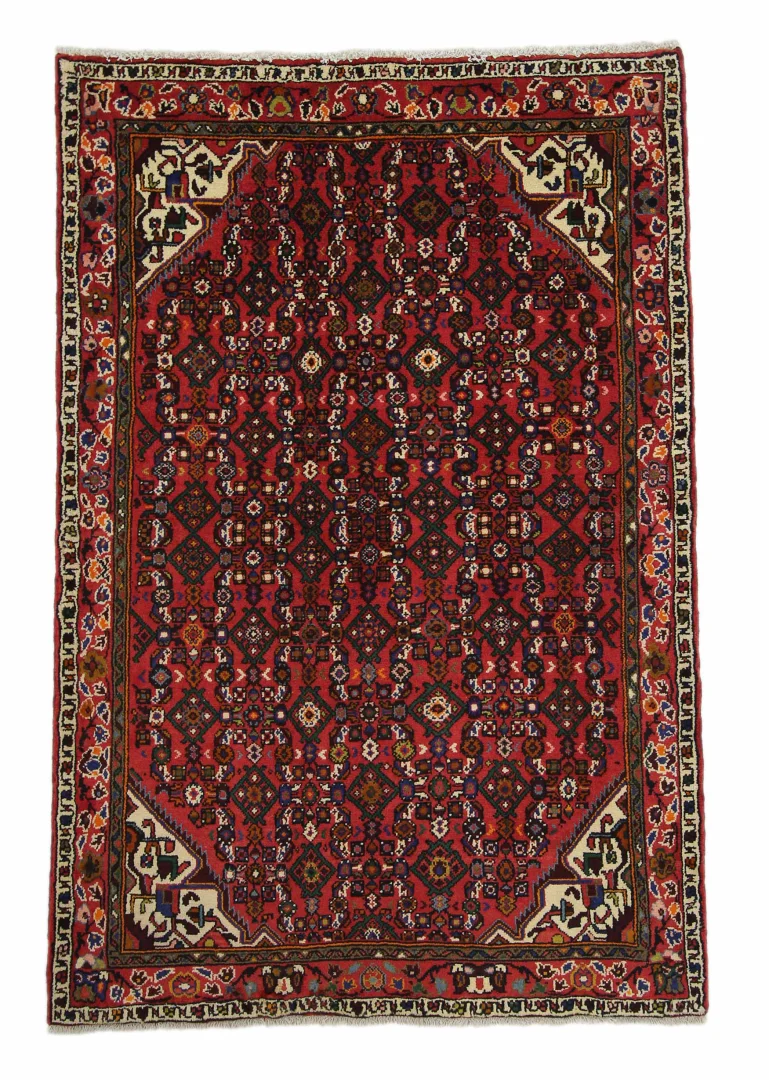
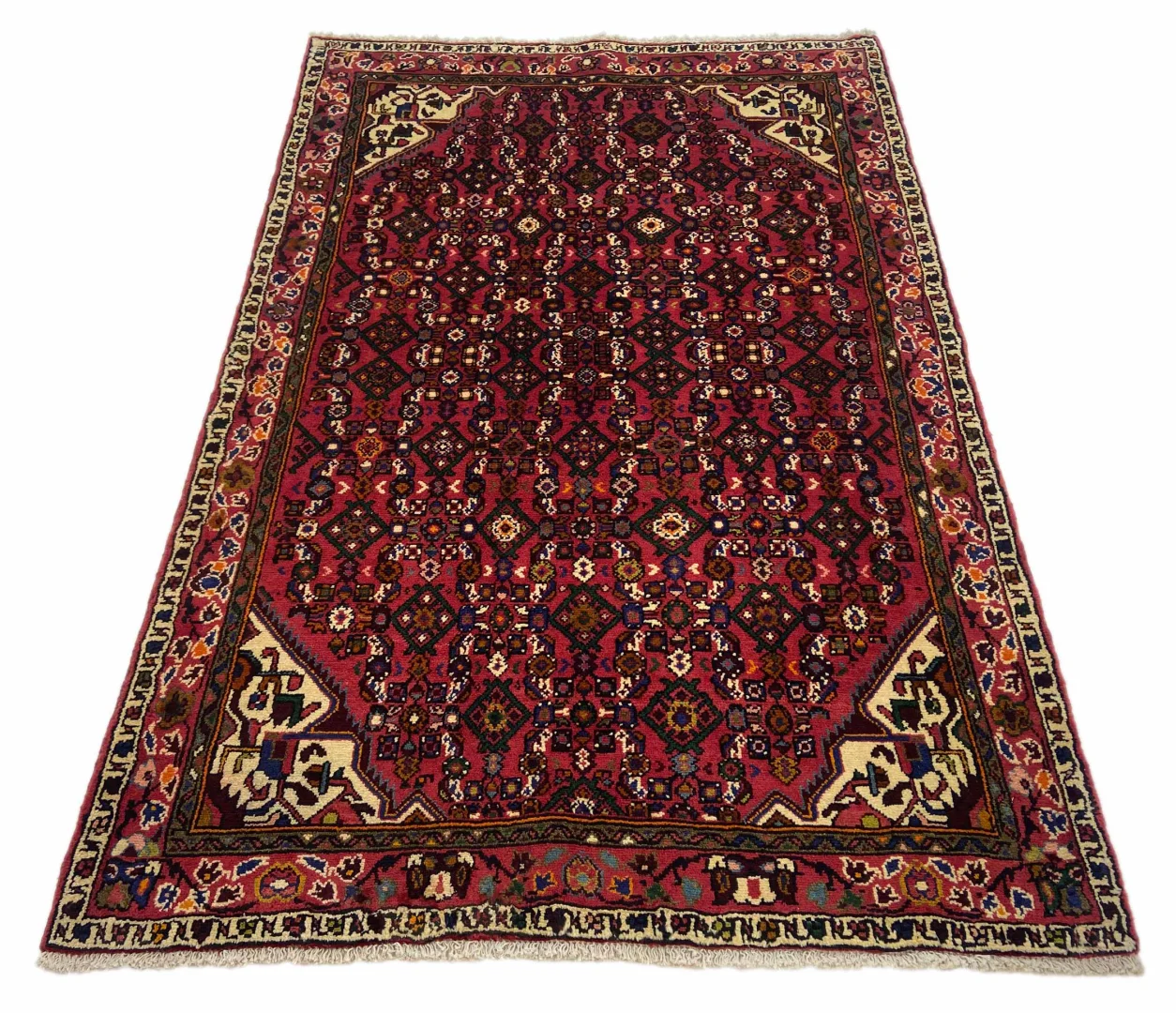
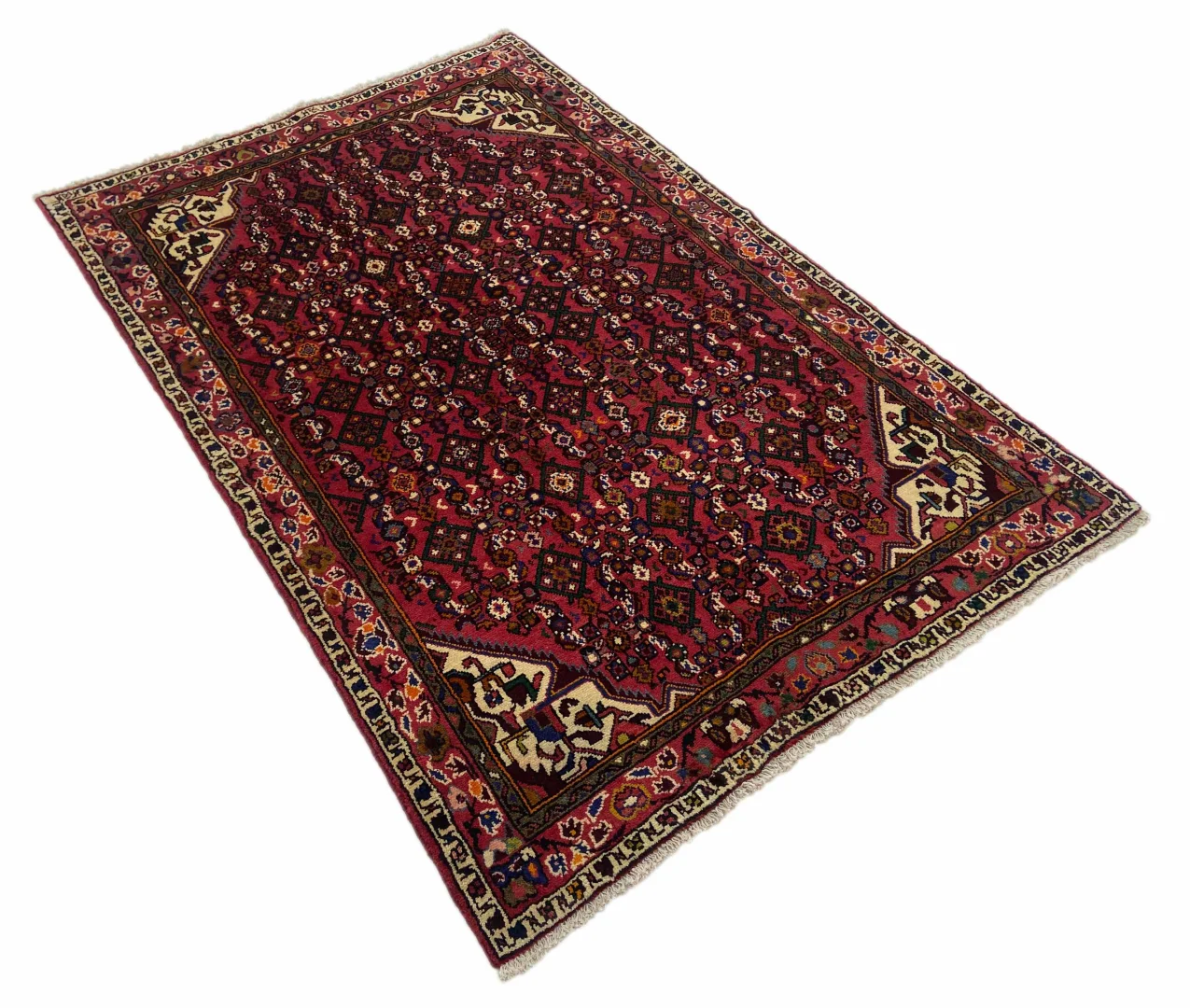
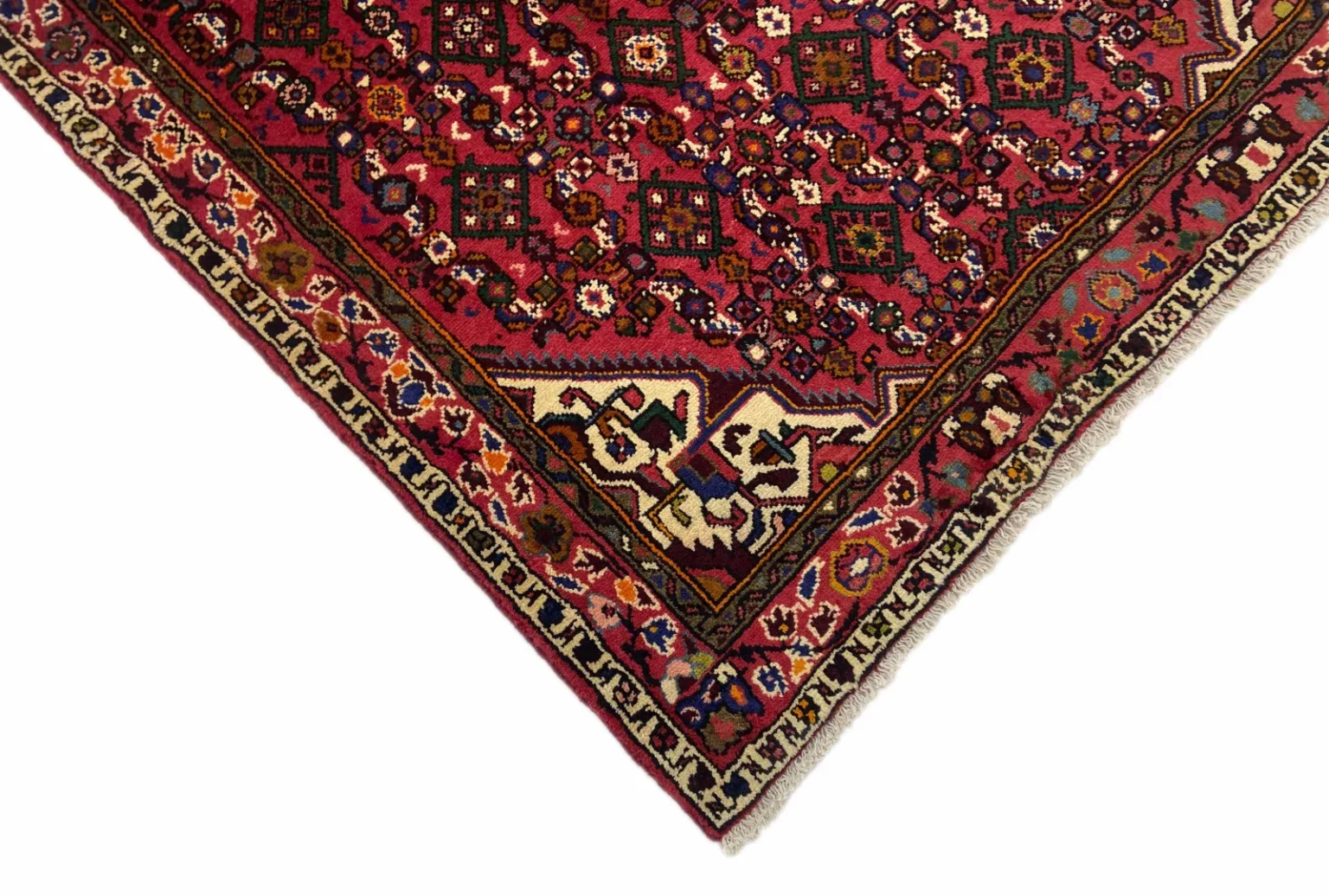
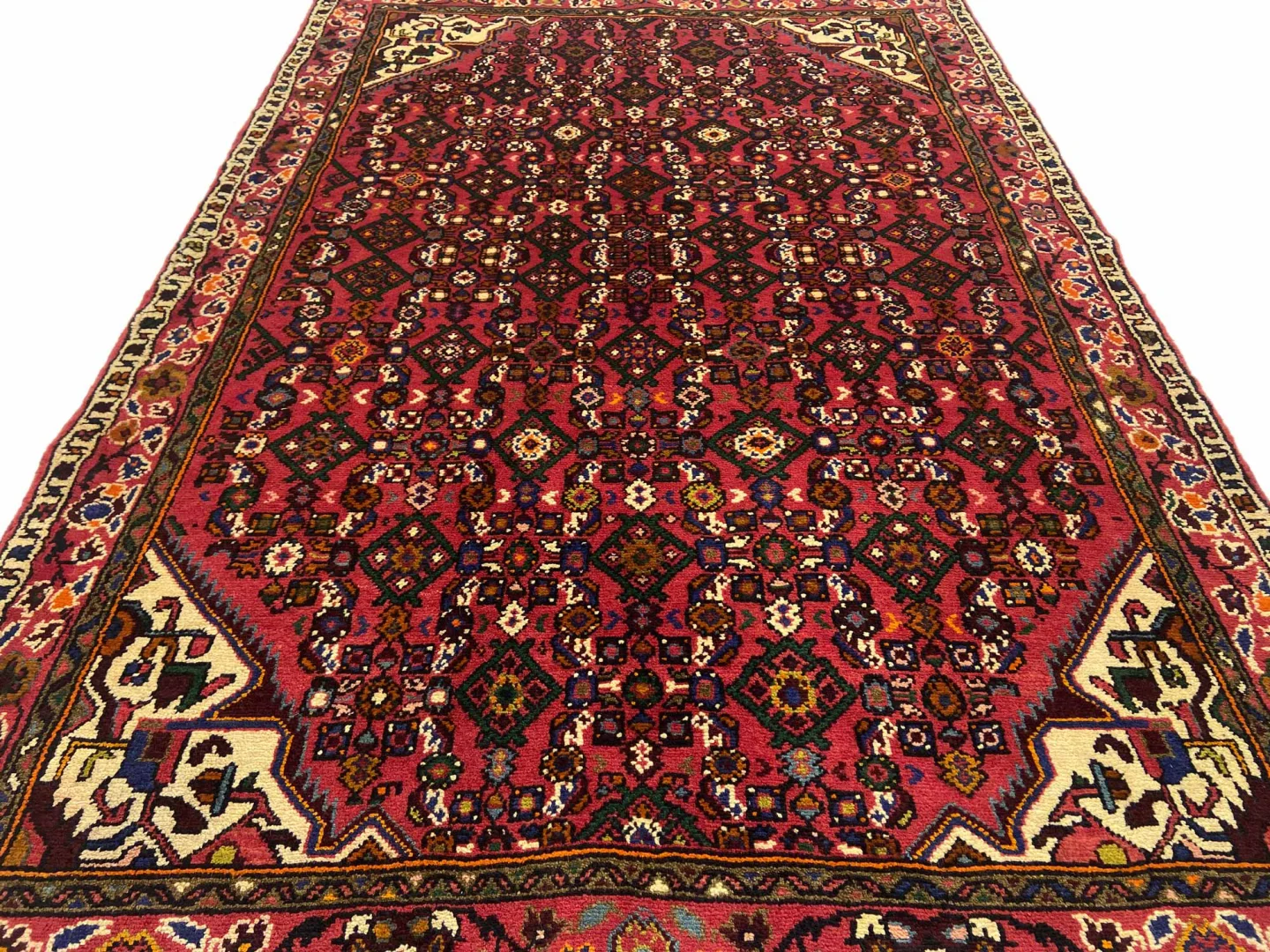
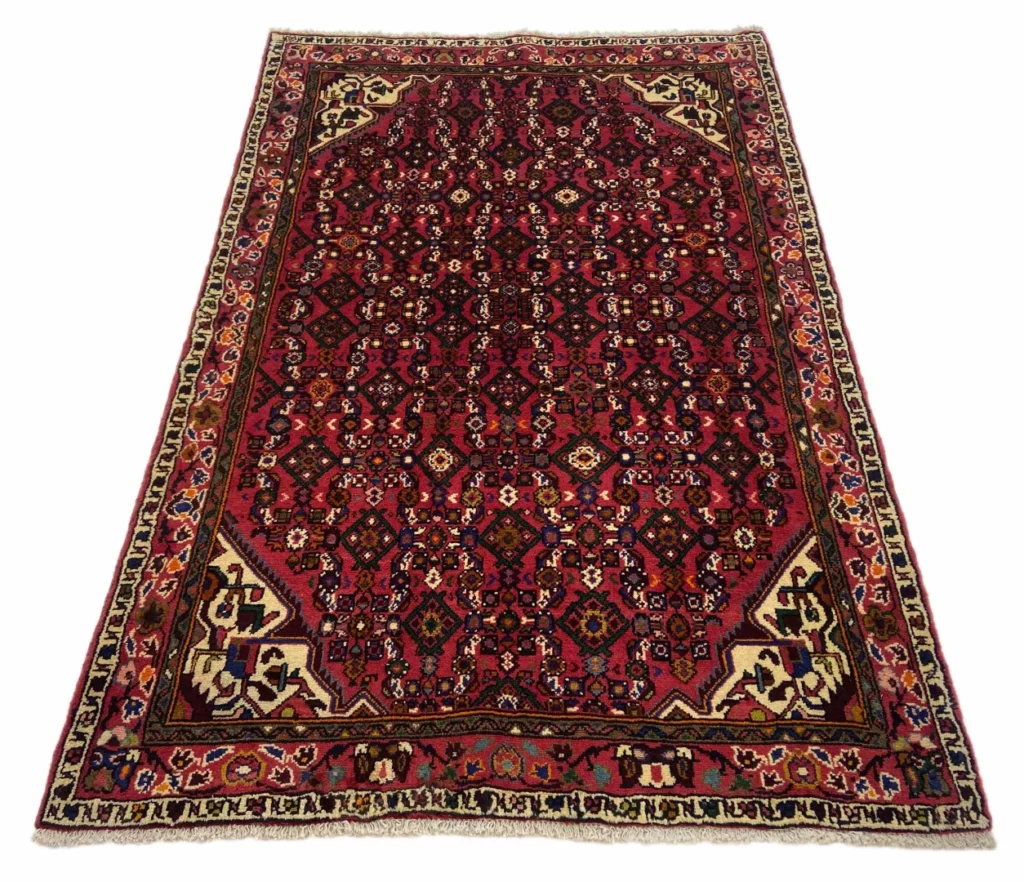
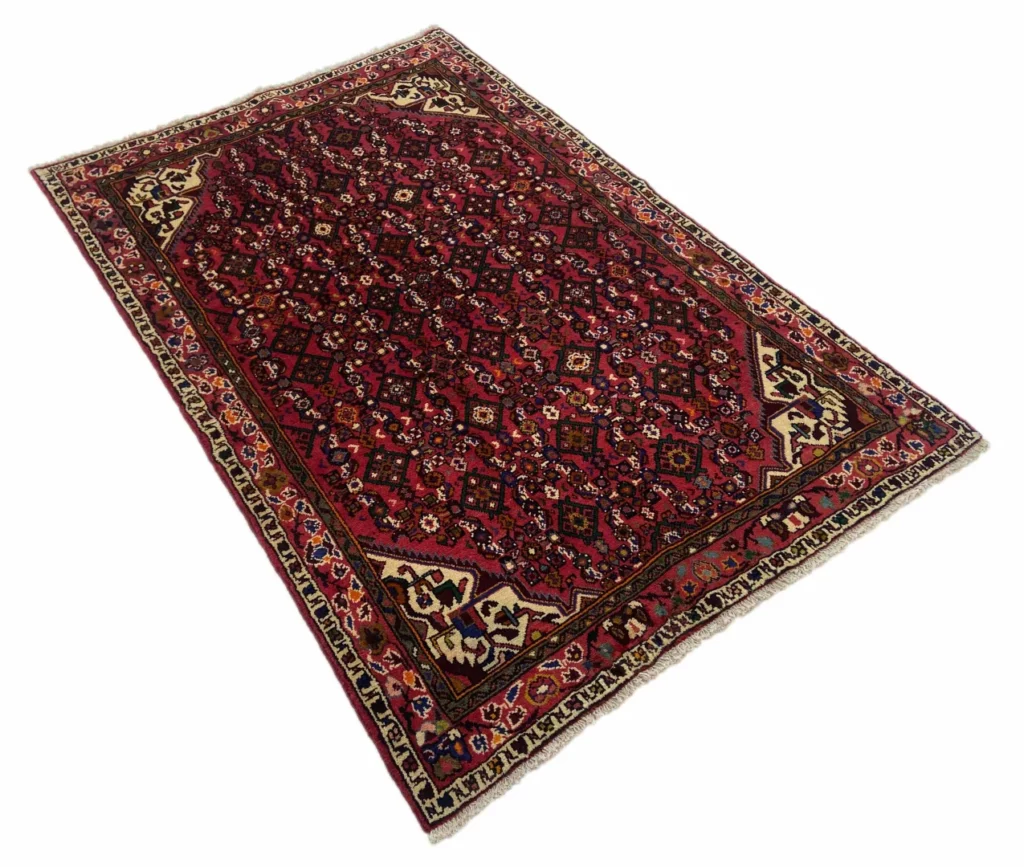
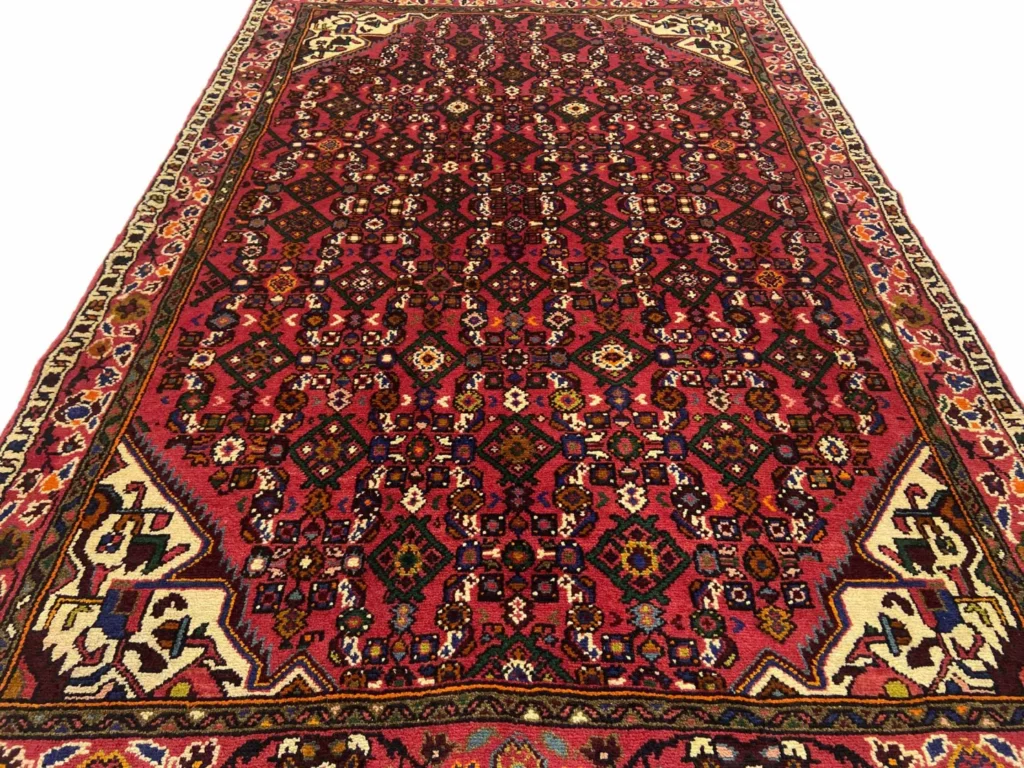
The pattern is described as either a diamond-shaped medallion or a continuous Herati pattern. Both are established elements of Persian rug design, but they organise the field in different ways. A medallion concentrates the composition in a highlighted central form, whereas a Herati pattern distributes a repeating arrangement of connected floral and geometric elements across the field. The description names these two pattern possibilities without assigning further details to the individual drawing.
A diamond medallion is a geometric form of the central rug motif. The diamond creates a strong centre and may be accompanied by surrounding details, outlines and a border. In Persian design, a medallion gives the field a visual point of orientation and establishes a relationship between the central area and its surroundings. Its effect depends on symmetry, line direction and the contrast between the inner field and the areas around it.
The Herati pattern is one of the recognised repeat designs in Persian weaving. Its motif tradition brings together leaves, diamonds, blossoms and curving lines in an ordered sequence. A continuous Herati repeat can animate the entire surface without relying on one dominant centre. The elements are arranged as a rhythmic network in which geometric definition and floral suggestion work together.
The colour given for this rug is red. The broader description of Hosseinabad designs refers to warm red and dark red tones. Red has a long presence in Persian rug design because it can separate motifs clearly and give a composition visual cohesion. In a medallion design, red may emphasise the centre or its surrounding field; in a Herati repeat, it may act as a connecting ground or accent colour. The precise role of each colour area is not specified for this individual rug.
Geometric medallions and Herati repeats represent two important principles of composition: concentrating attention on a centre and creating movement through repetition across the field. Both can be executed with precision in a hand-knotted textile. The listed knot density supports the clear definition of outlines, but it does not change the stated origin or establish a different pattern. The design remains identified in the description with this Hosseinabad Persian rug.
Special Features
The individual features of this rug include its Hosseinabad origin, hand-knotted construction, durable wool pile, listed knot density and very good condition. Its decorative description names either a diamond-shaped medallion or a Herati pattern, together with a red colour scheme. The result is a regional Persian design tradition combined with a material description focused on resilience.
The two pattern descriptions suggest different visual arrangements: a central diamond medallion creates a focal point, while a continuous Herati pattern establishes a repeated rhythm. In either case, the north-west Persian origin remains the defining classification. Furniture in neutral colours or made from natural materials can accompany the design without competing with it. Wooden or metal furniture in dining and living areas is mentioned as a harmonious complement. These are furnishing suggestions, not additional properties of the rug itself.
The combination of a very good condition, durable wool and dense hand-knotting summarises the main special features. The rug is presented both as a usable floor covering and as a traditional textile from Hosseinabad. Its character comes from the relationship between the named regional origin, the hand-made construction and the structured pattern alternatives given in the description.
FAQ
What makes this Hosseinabad Persian rug distinctive?
Its distinctive features are its origin in Hosseinabad in north-western Persia, its hand-knotted construction and its durable wool pile. The listed knot density is 200.000 to 250.000 knots per square metre. The design is described as either a diamond-shaped medallion or a Herati pattern, and the colour is red. The rug is in very good condition. Together, these details combine a regional design tradition with a sturdy textile construction.
How should I care for my Hosseinabad Persian rug?
Regular vacuuming is recommended for routine care. Occasional professional cleaning may also be considered. Direct sunlight should be avoided so that the colours do not fade. The durable wool is suitable for regular use, but cleaning should still take the hand-knotted structure into account. If the rug has heavier soiling, professional rug cleaning is the appropriate option for treating the textile carefully.
Which furniture works well with this Hosseinabad Persian rug?
Furniture in neutral colours or made from natural materials works well with the red rug. This allows the diamond medallion or Herati pattern to remain legible without the room competing with the design. Wooden or metal furniture for dining and living areas is named as a harmonious addition. A restrained setting can echo the rug’s regional colour and pattern tradition while allowing the hand-knotted textile to remain a distinct element of the room.
To provide the best experiences, we use technologies like cookies to store and/or access device information. Consenting to these technologies will allow us to process data such as browsing behavior or unique IDs on this site. Not consenting or withdrawing consent, may adversely affect certain features and functions.
Functional Always active
The technical storage or access is strictly necessary for the legitimate purpose of enabling the use of a specific service explicitly requested by the subscriber or user, or for the sole purpose of carrying out the transmission of a communication over an electronic communications network.
Preferences
The technical storage or access is necessary for the legitimate purpose of storing preferences that are not requested by the subscriber or user.
Statistics
The technical storage or access that is used exclusively for statistical purposes.The technical storage or access that is used exclusively for anonymous statistical purposes. Without a subpoena, voluntary compliance on the part of your Internet Service Provider, or additional records from a third party, information stored or retrieved for this purpose alone cannot usually be used to identify you.
Marketing
The technical storage or access is required to create user profiles to send advertising, or to track the user on a website or across several websites for similar marketing purposes.
 SECURE PAYMENT
 SHIPPING PARTNERS