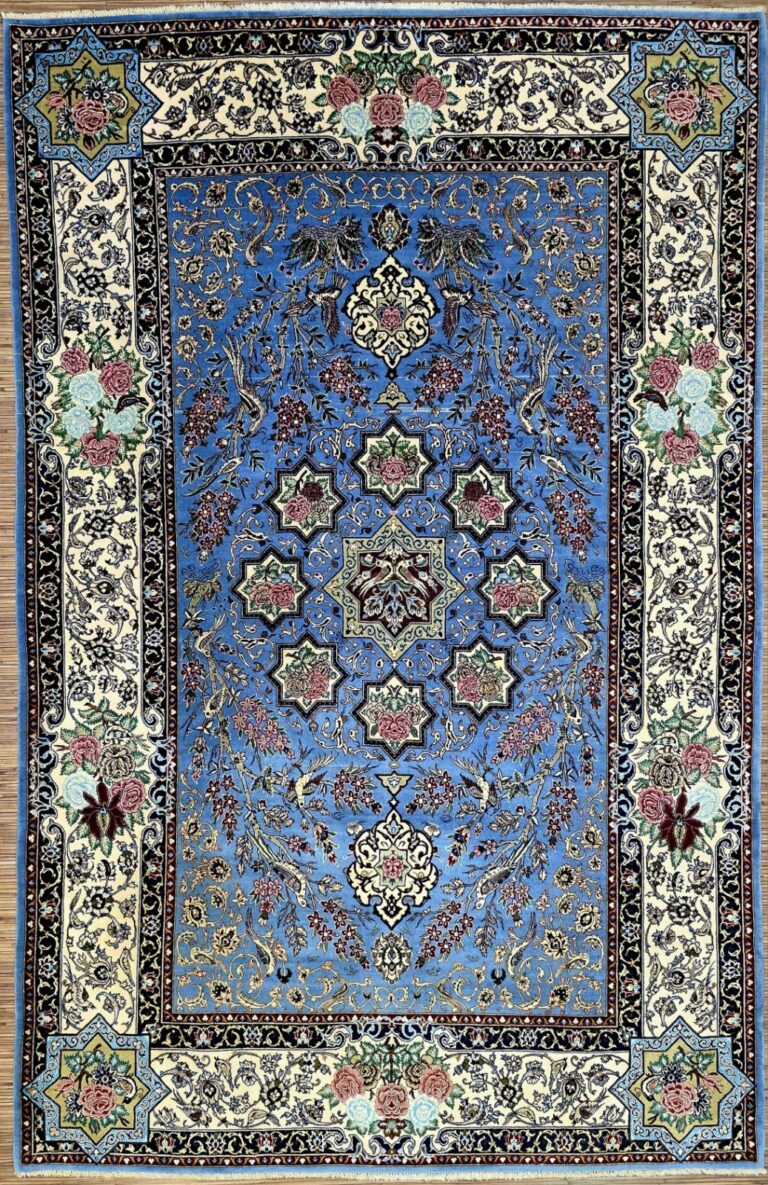
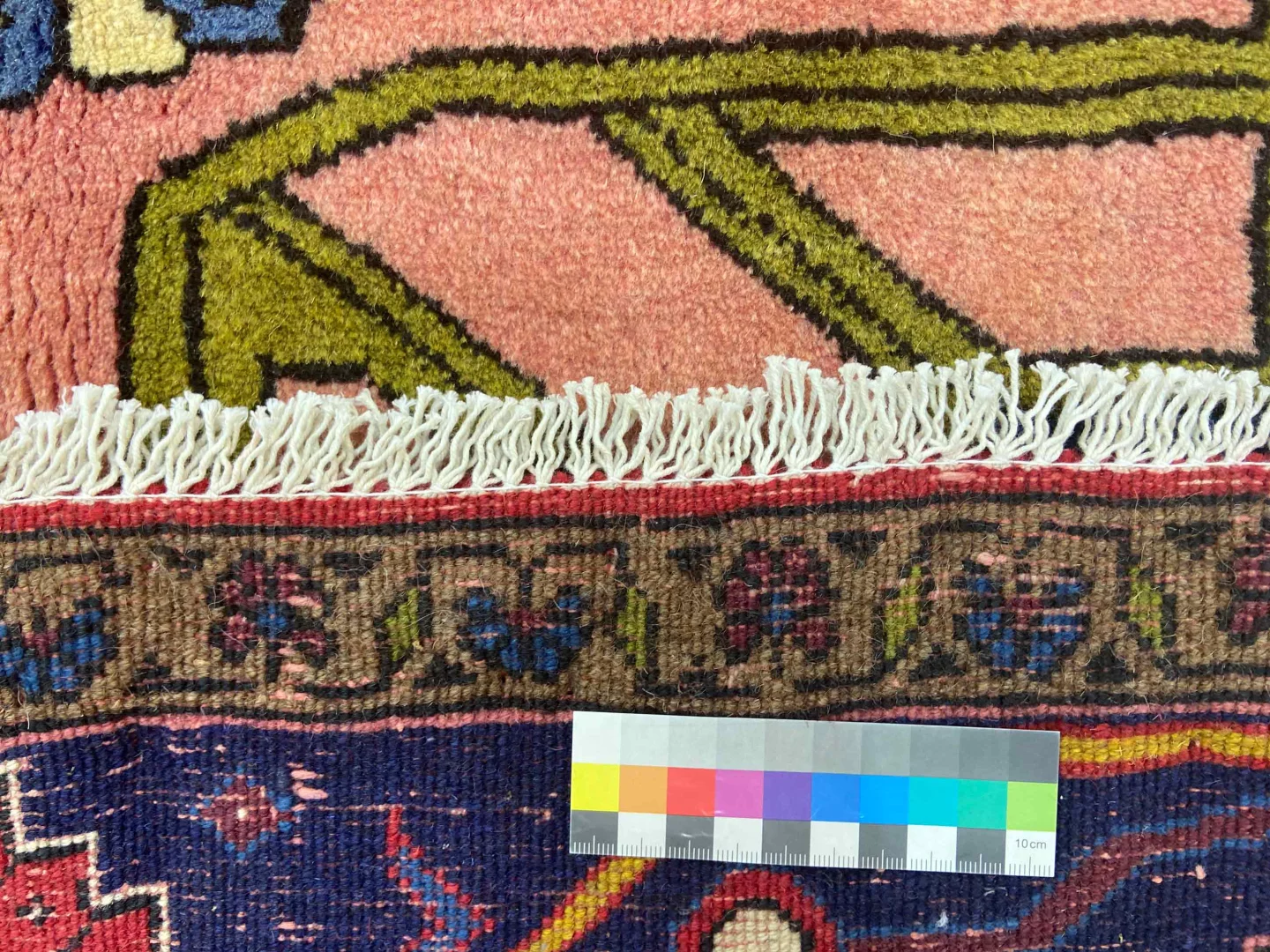
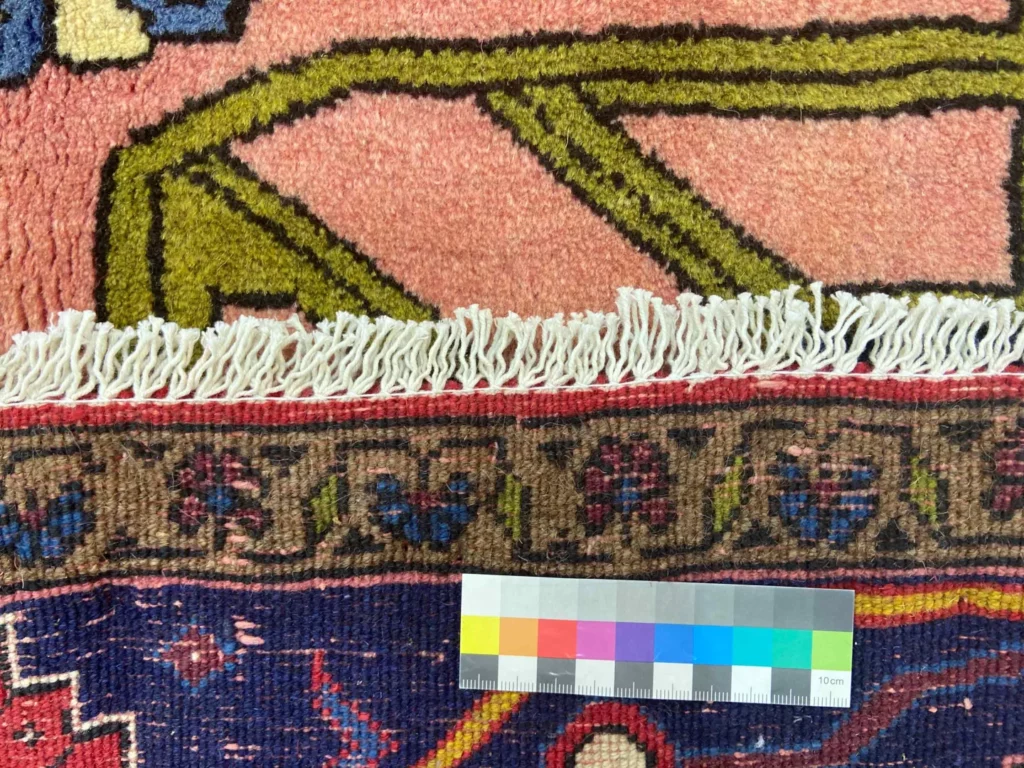
This Hamadan Persian rug is hand-knotted and made from durable wool. The wool forms a resilient pile, a material valued in rug making for its ability to withstand regular use. In a hand-knotted rug, the design is built knot by knot. The visual composition is therefore directly connected with the craft of making the rug. Its stated knot density is 100,000 to 350,000 knots per square metre. This density permits a differentiated rendering of motifs and is one of the technical characteristics given for this rug.
Wool has been used in rug weaving for centuries because it is hard-wearing and adaptable. A firm wool pile can hold the outlines of ornaments while retaining a tactile surface. In Hamadan rug making, the combination of hand-knotting and durable wool is an important part of the regional tradition. For this particular piece, the relevant material and construction facts are its wool pile, its hand-knotted technique and its stated knot density.
Making a hand-knotted rug involves a sequence of careful operations. The foundation is prepared first, after which coloured wool threads are tied in successive rows. Each row is compacted as the work progresses, creating a connected pile. The pattern develops from the arrangement of individual knots. Lines, fields and ornaments must remain coordinated as the design is built, which is why hand-knotting combines a planned drawing with sustained manual work.
Origin and Tradition
This rug comes from Hamadan in north-western Persia, in present-day Iran. Hamadan refers not only to one city but also to a broad rug-producing area. The network includes places such as Assadabad, Khamseh, Maslaghan, Enjelas, Nahawand and Tuyserkan. The villages and settlements of this region have developed their own working knowledge and stylistic preferences. Together they form a varied tradition within Persian rug weaving.
The region is known for producing rugs for everyday use as well as for more formal interiors. Over time, the communities around Hamadan developed different approaches to ornament, colour arrangement and fineness of execution. The name Hamadan therefore indicates a regional origin while also encompassing a considerable range of local expressions. Rugs associated with the area do not need to share one single design in order to belong to the Hamadan tradition.
Persian rugs are shaped by the interaction of regional practice, materials, knotting technique and the design selected for an individual piece. In Hamadan, floral and geometric elements are both part of the established vocabulary. Some compositions may be strongly structured, while others may place greater emphasis on repeated or freely distributed motifs. This variety reflects the broad production network rather than a lack of stylistic identity.
Other well-known Persian weaving areas provide useful points of comparison. Senneh rugs, associated with the area near Sanandaj, are known for fine knotting and lively colours. Kashan rugs are linked with the city of Kashan and are often recognised for complex patterns and high-quality materials that may include silk. Nain and Isfahan are also associated with distinctive designs and a strong emphasis on craftsmanship. These places are separate from Hamadan, yet they illustrate the range of regional traditions found across Persian rug weaving.
The Hamadan tradition is maintained through the transmission of practical knowledge. Preparing wool, organising the foundation, tying the knots and developing ornamental forms all require experience. Regional motifs may remain recognisable over long periods while appearing in new arrangements. This explains why Hamadan rugs can show considerable variation while still being connected to a common geographical and cultural background.
Regional rug history is not limited to one fixed pattern book. Designs change as weavers and workshops respond to local preferences and established conventions. The resulting relationship between inherited motifs and individual execution is central to understanding Hamadan rugs. It also places this hand-knotted piece within a larger Persian tradition in which village production, material choice and pattern language are closely connected.
Design and Pattern
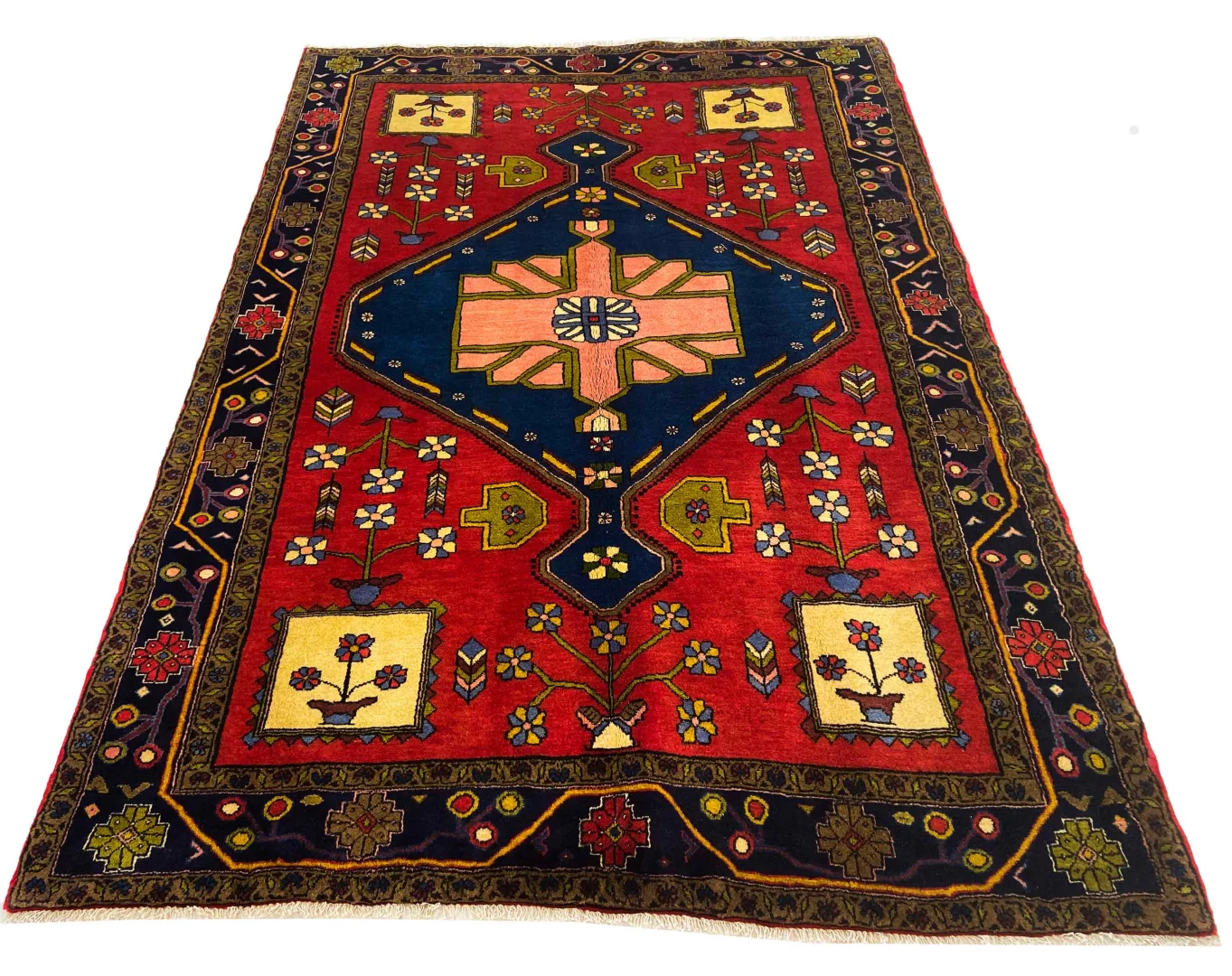
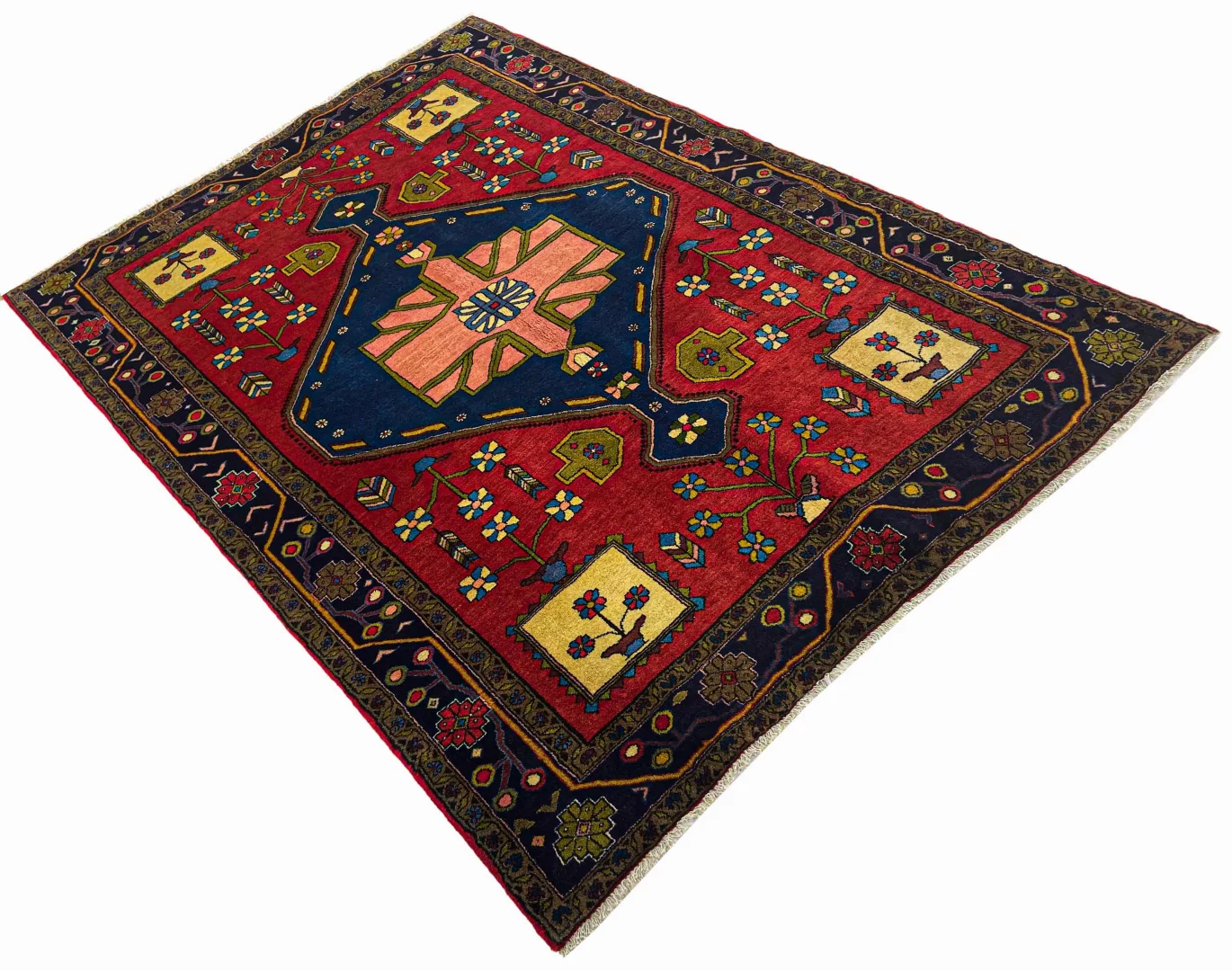
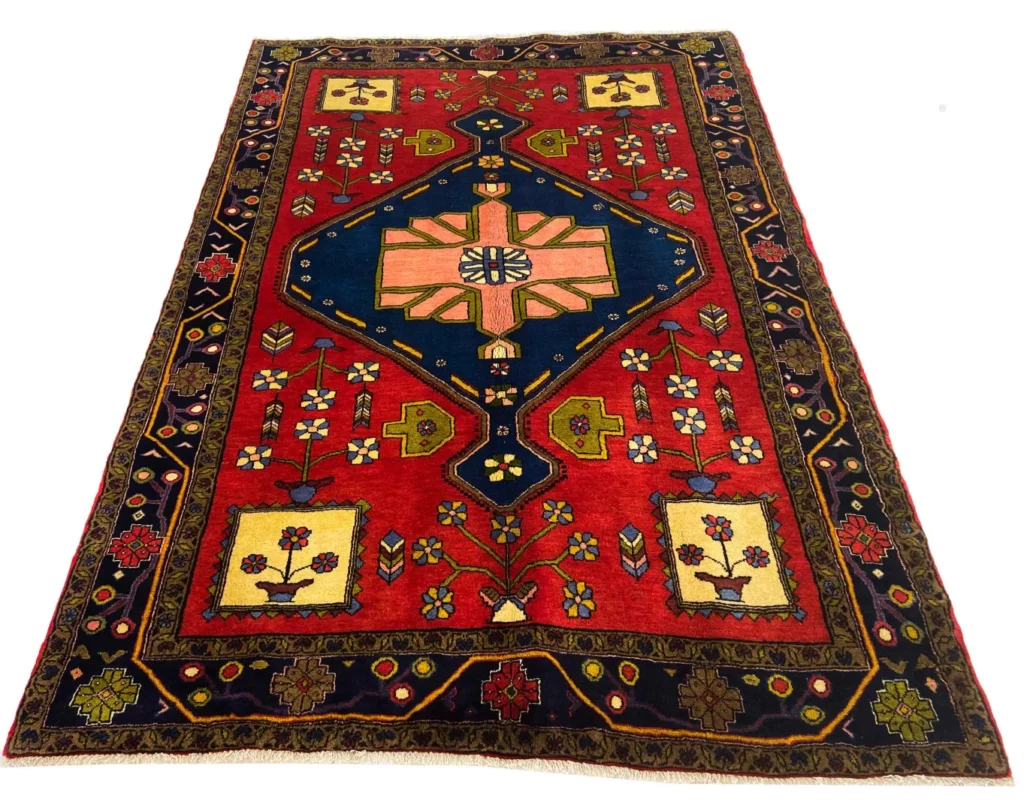
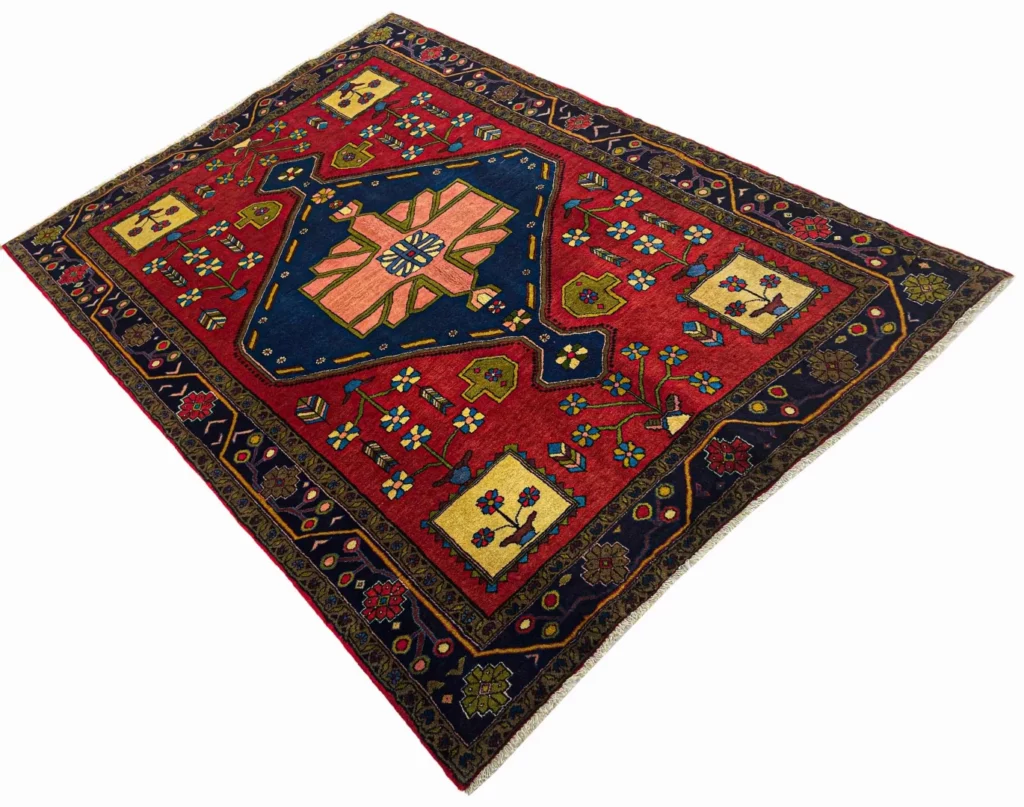
The design of this rug is described as varied. Hamadan rugs traditionally include both floral and geometric patterns. Floral forms may suggest leaves, blossoms or stylised vines, while geometric elements use lines, angles, diamonds and repeated fields to create structure. These are features of the regional design language; the specific rug is identified simply by its varied patterns rather than by one named motif.
A rug pattern is created through the placement of knots as well as through colour. Small units can be arranged into rows, fields or larger ornaments. Geometric structures establish a regular visual rhythm, whereas floral details introduce softer outlines and more flowing movement. When the two forms are combined, the design can appear ordered without becoming uniform. Hand-knotting makes the relationship between the drawn design and the finished surface particularly direct.
Hamadan rugs are often associated with earthy colours. Strong accents can be set against such a ground to bring emphasis to selected ornaments and create contrast. Colour distribution helps organise the relationship between the central field, the motifs and the border areas. The effect depends not only on the individual colours but also on their placement and on the balance between adjacent shapes.
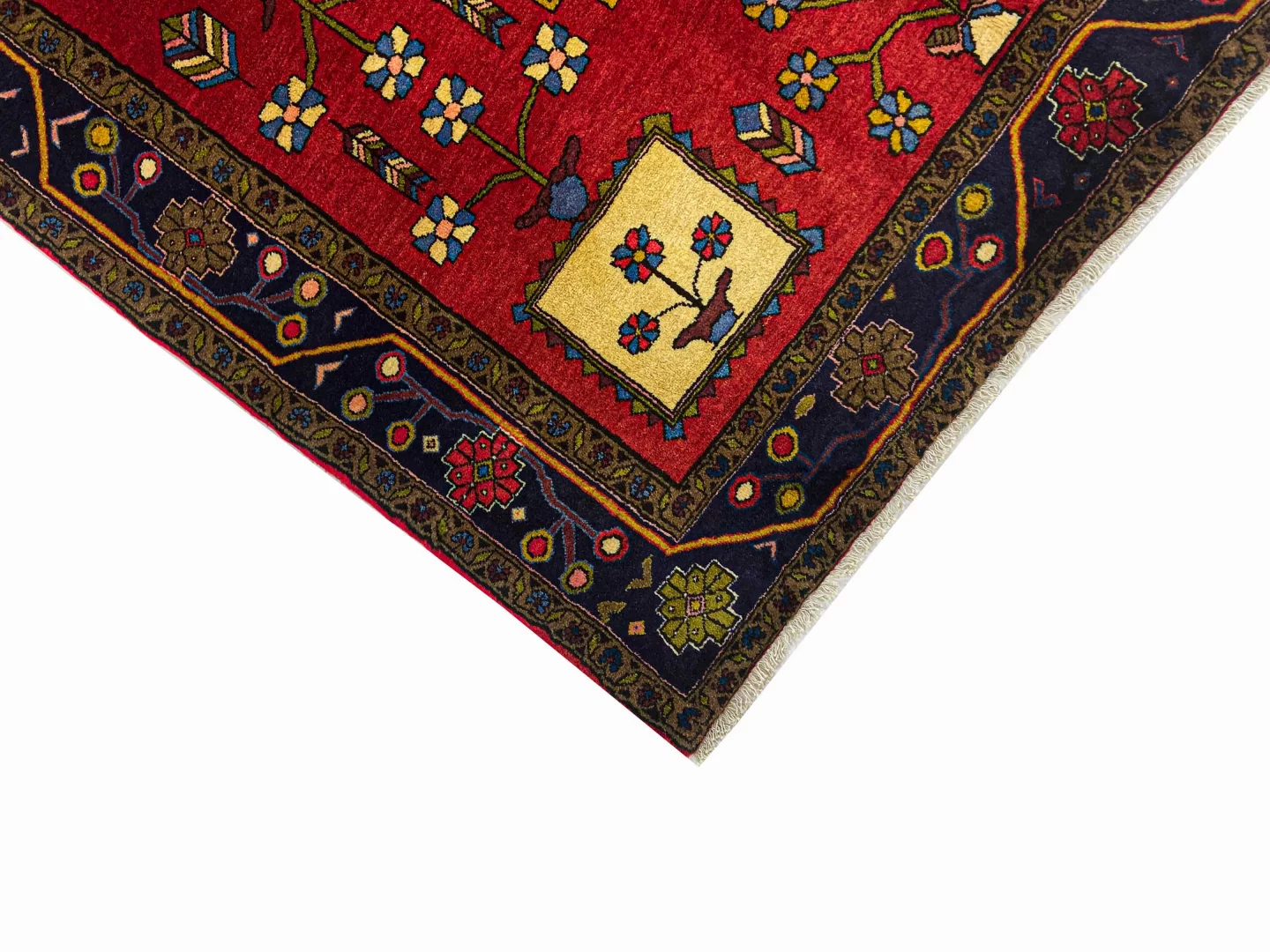
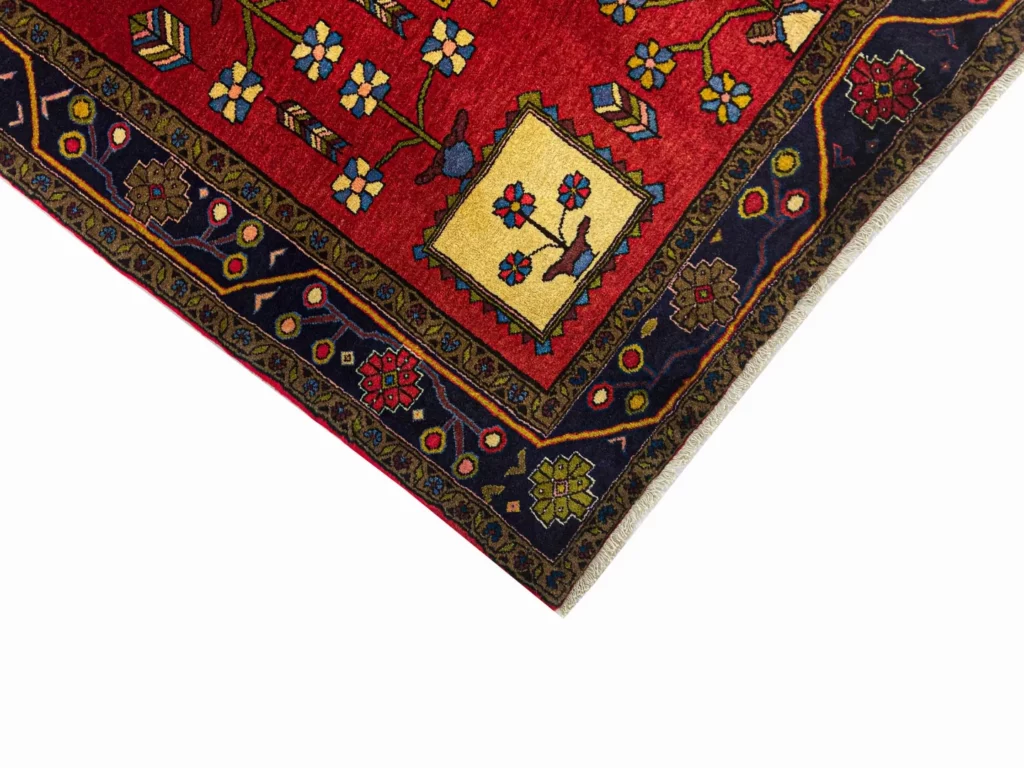
Borders frequently frame the central field in traditional rug design. Repeated motifs along the edges can create a transition between the main surface and the outer finish. Geometric borders tend to establish a regular sequence, while floral or plant-based borders may follow a more varied line. A composition may focus on a central field, an all-over arrangement or a combination of both. These are different possibilities within the Hamadan design tradition.
The range of patterns is connected with the cultural breadth of the Hamadan area. Since the region includes many villages and settlements, local preferences meet within its production history. One rug may give greater weight to compact geometric forms, another to floral details or repeating ornaments. The way these elements are tied determines how finely their outlines appear and how clearly neighbouring areas are separated.
The stated knot density has a technical relationship to the handling of pattern. A greater number of knots within a defined area allows lines and ornamental transitions to be rendered more closely. It does not mean that every Hamadan rug has the same degree of detail; rather, knotting provides different possibilities for interpreting a design. In this piece, the stated density accompanies the description of a varied pattern arrangement.
Pattern traditions also carry information about the region in which a rug was made. Floral and geometric forms are not merely decorative additions; they are part of a vocabulary passed through weaving practice. Their scale, repetition and relationship to the field can change from one local expression to another. The varied design named for this rug should therefore be read in the context of Hamadan’s broad and diverse pattern tradition.
Special Features
The specific features of this rug are its origin in Hamadan, Iran, its hand-knotted construction, its durable wool pile and its knot density of 100,000 to 350,000 knots per square metre. Its pattern is described as varied, and its condition is stated as very good. These details provide the factual basis for identifying and describing this individual piece.
The durable wool and hand-knotted construction are associated with a rug that can withstand regular use. The source description presents the Hamadan rug as easy to care for and suitable for areas with heavier foot traffic. Regular vacuuming and occasional beating are recommended to help keep it clean. For stains, a damp sponge with mild detergent can be used. Direct sunlight should be avoided in order to reduce the risk of colour fading.
The varied design allows the rug to be considered for several interior settings. Living rooms, dining rooms and hallways are named as possible locations. Its role remains that of a Persian handcraft with a regional origin, a wool pile and a pattern tradition that brings together floral and geometric possibilities.
FAQ
How should I care for a Hamadan Persian rug?
Regular vacuuming and occasional beating help keep the rug clean. If a stain occurs, a damp sponge with mild detergent may be used. Direct sunlight should be avoided to help prevent the colours from fading. The durable wool pile is one reason the Hamadan rug is described as easy to maintain, while careful cleaning remains important for preserving its surface and appearance.
What makes a Hamadan rug distinctive?
Its distinctive character comes from the combination of a high knot density, varied patterns and durable wool. The hand-knotted construction supports a differentiated rendering of floral and geometric elements. Together, these features contribute to a detailed appearance and a resilient textile surface. The rug’s origin in Hamadan also places it within a regional tradition shaped by many villages and settlements.
Where does the wool for a Hamadan rug come from?
The wool used for Hamadan rugs usually comes from sheep raised in the region. It is valued for robustness and resistance, making it suitable for producing durable, high-quality rugs. Durable wool is specified as the material for this individual piece. The precise source of its particular fibres is not identified more closely.
To provide the best experiences, we use technologies like cookies to store and/or access device information. Consenting to these technologies will allow us to process data such as browsing behavior or unique IDs on this site. Not consenting or withdrawing consent, may adversely affect certain features and functions.
Functional Always active
The technical storage or access is strictly necessary for the legitimate purpose of enabling the use of a specific service explicitly requested by the subscriber or user, or for the sole purpose of carrying out the transmission of a communication over an electronic communications network.
Preferences
The technical storage or access is necessary for the legitimate purpose of storing preferences that are not requested by the subscriber or user.
Statistics
The technical storage or access that is used exclusively for statistical purposes.The technical storage or access that is used exclusively for anonymous statistical purposes. Without a subpoena, voluntary compliance on the part of your Internet Service Provider, or additional records from a third party, information stored or retrieved for this purpose alone cannot usually be used to identify you.
Marketing
The technical storage or access is required to create user profiles to send advertising, or to track the user on a website or across several websites for similar marketing purposes.

 SECURE PAYMENT
 SHIPPING PARTNERS