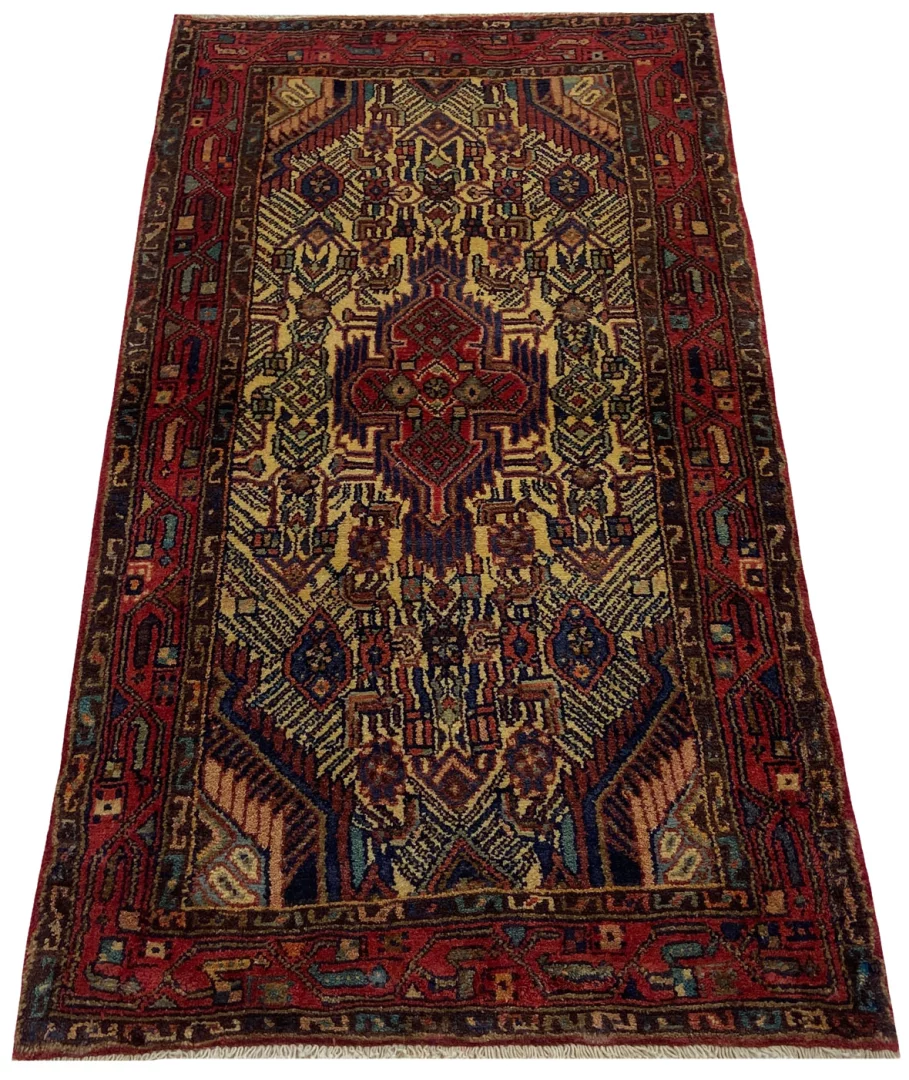
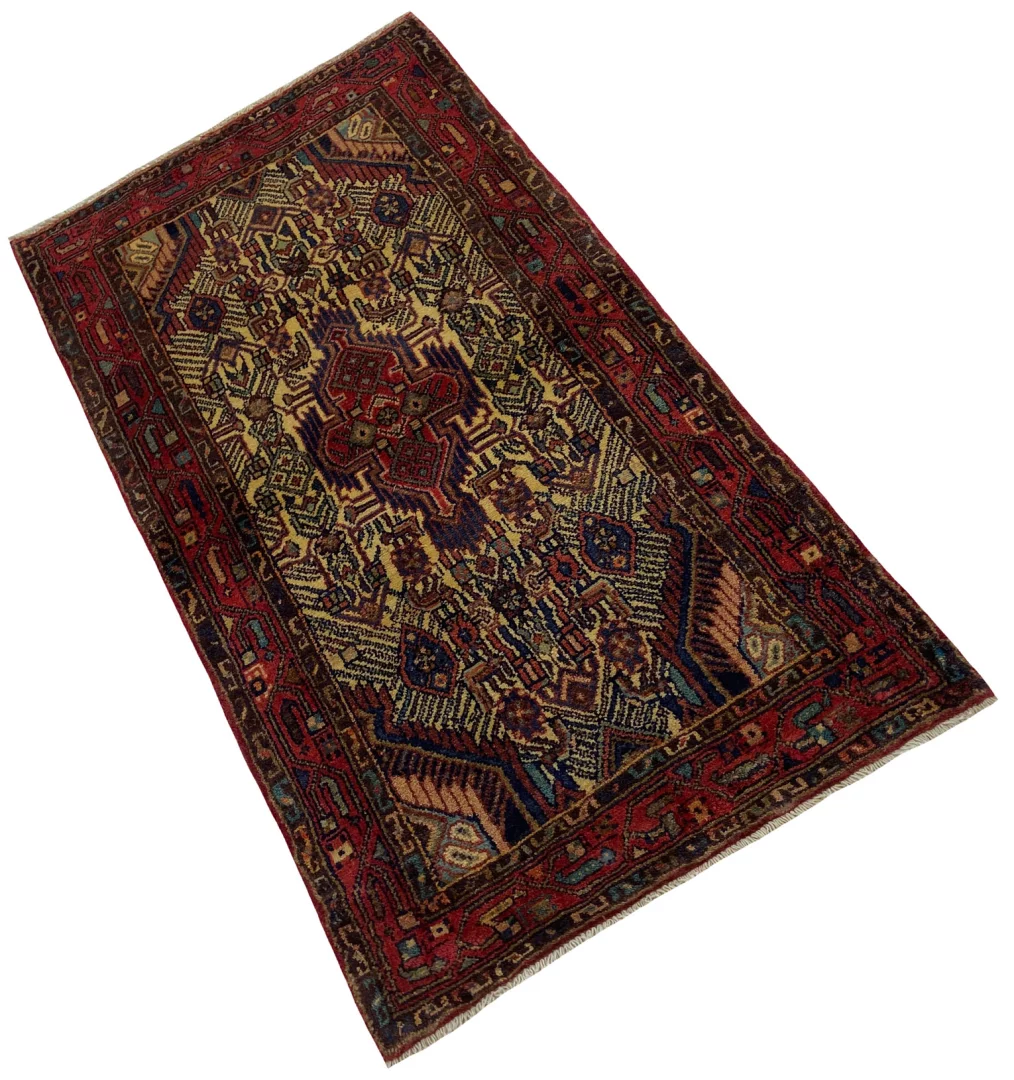
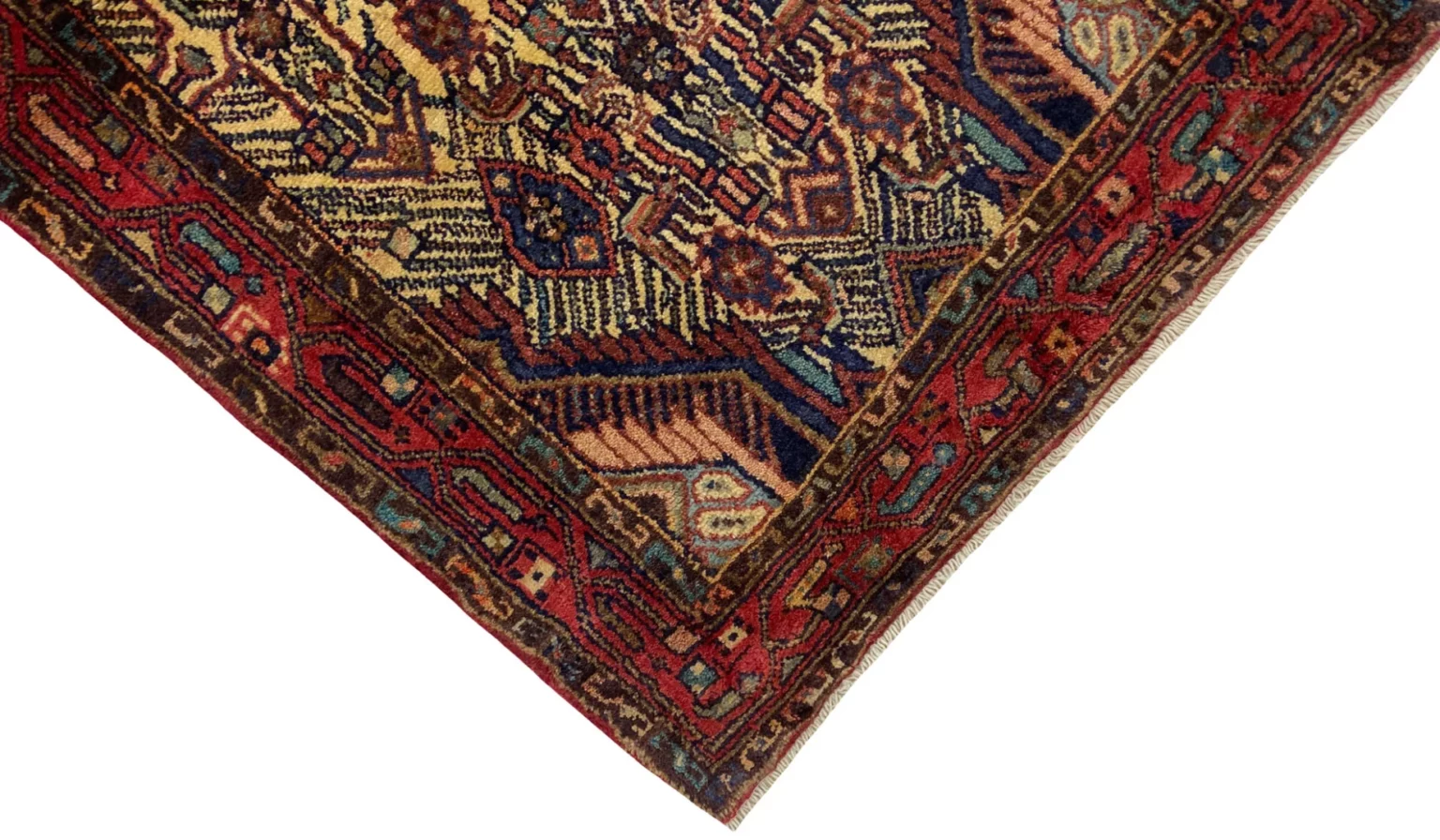
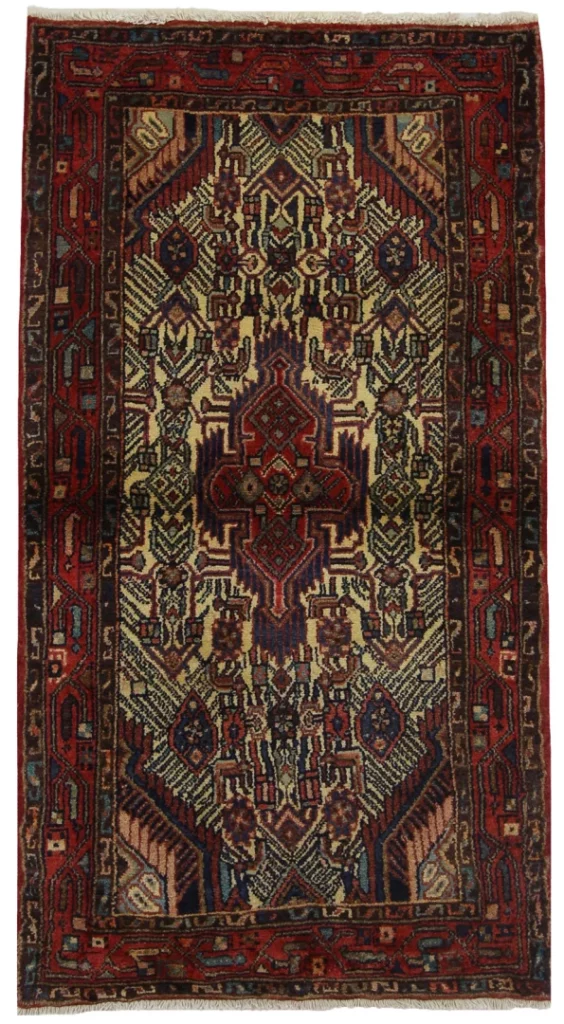
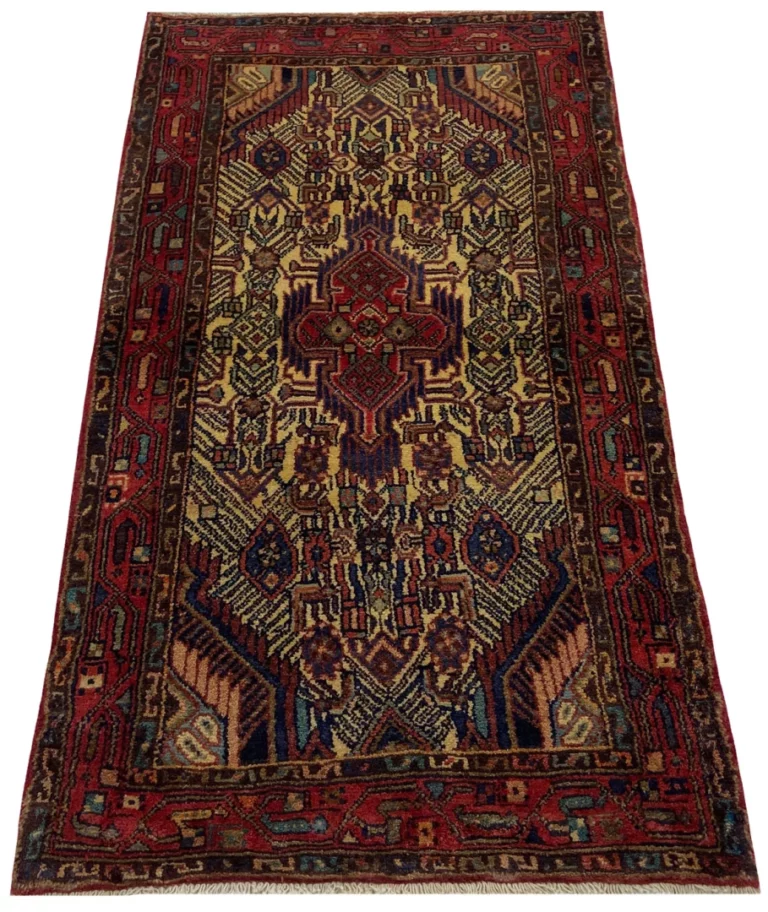
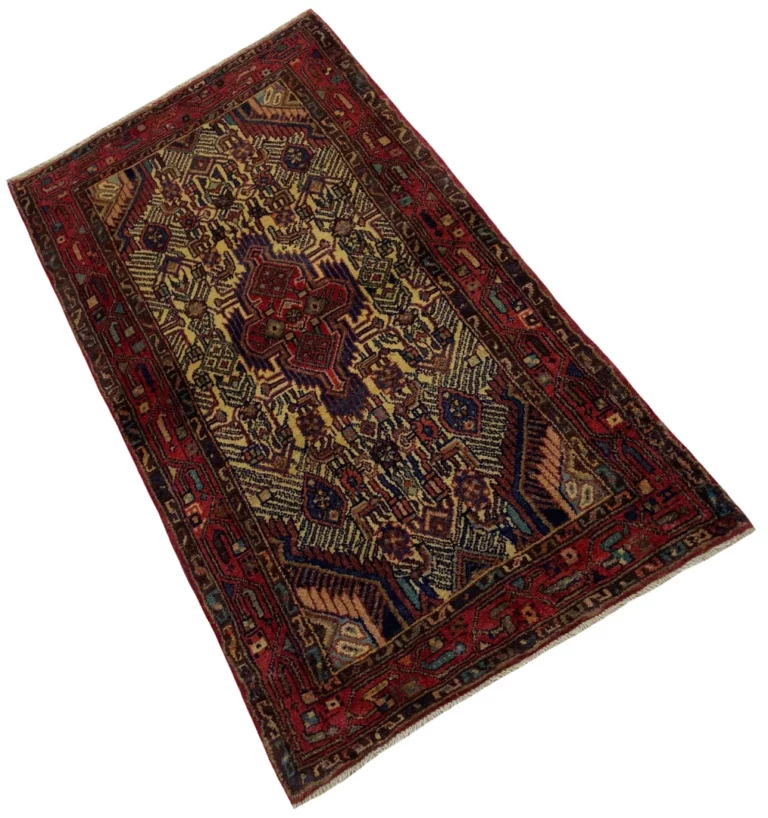
This Hamadan Persian rug is hand-knotted and made from hard-wearing wool. Wool is a traditional material in Persian rug making, valued for its resilience, natural handle and suitability for a substantial pile. In a hand-knotted rug, each knot is made individually by hand. The design is built row by row, while the wool provides the practical durability associated with a rug intended for use in the home.
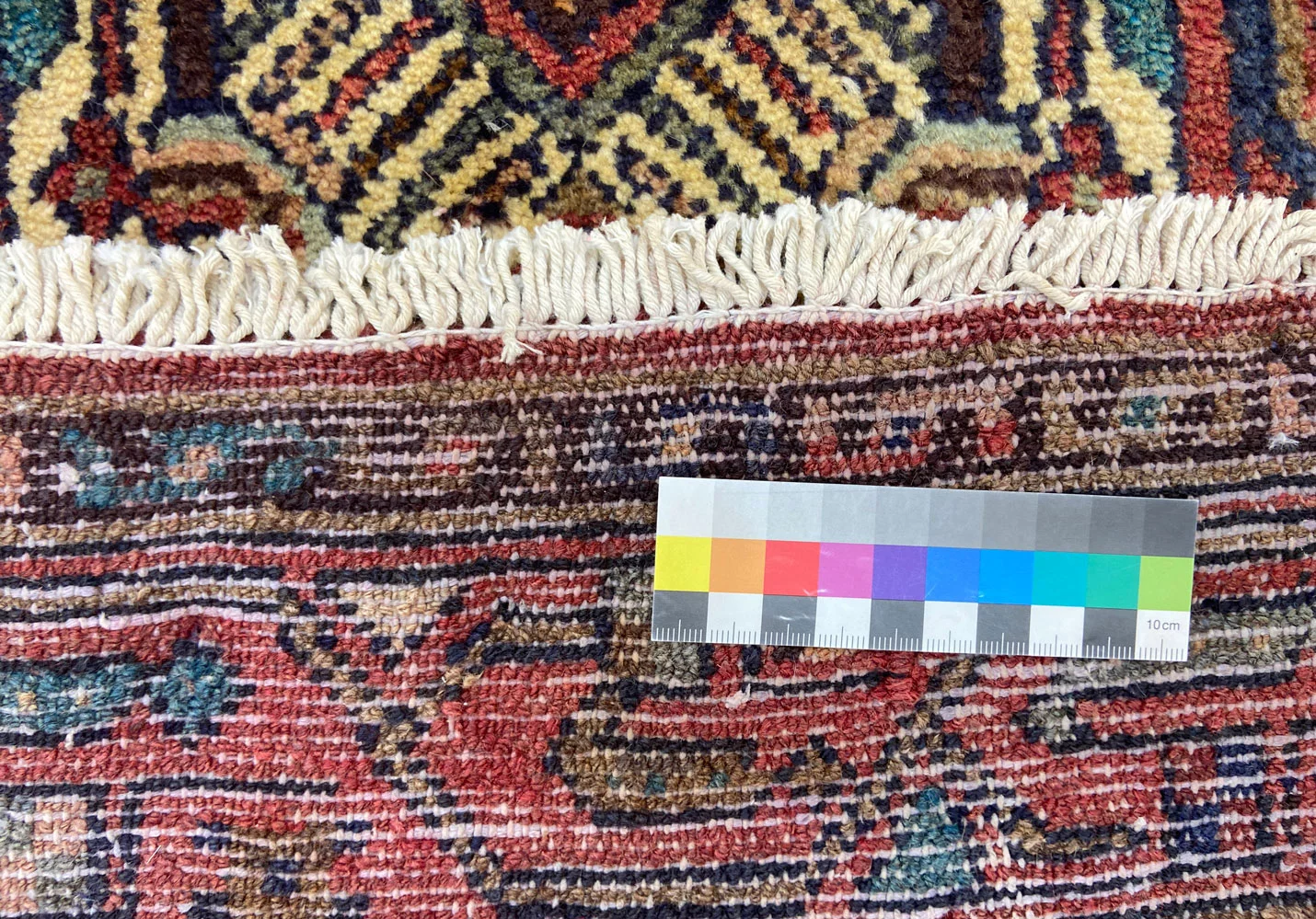
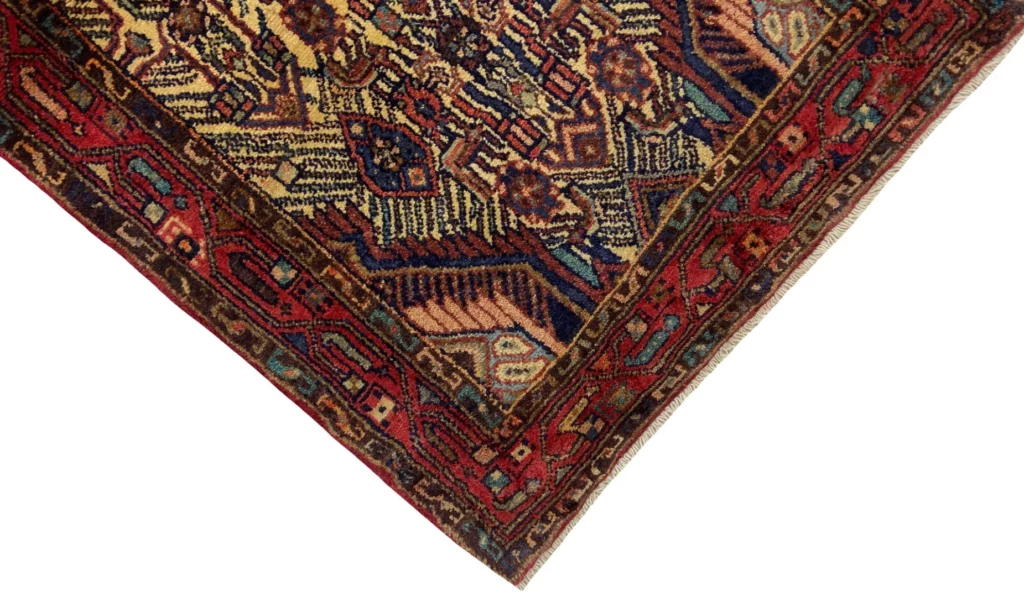
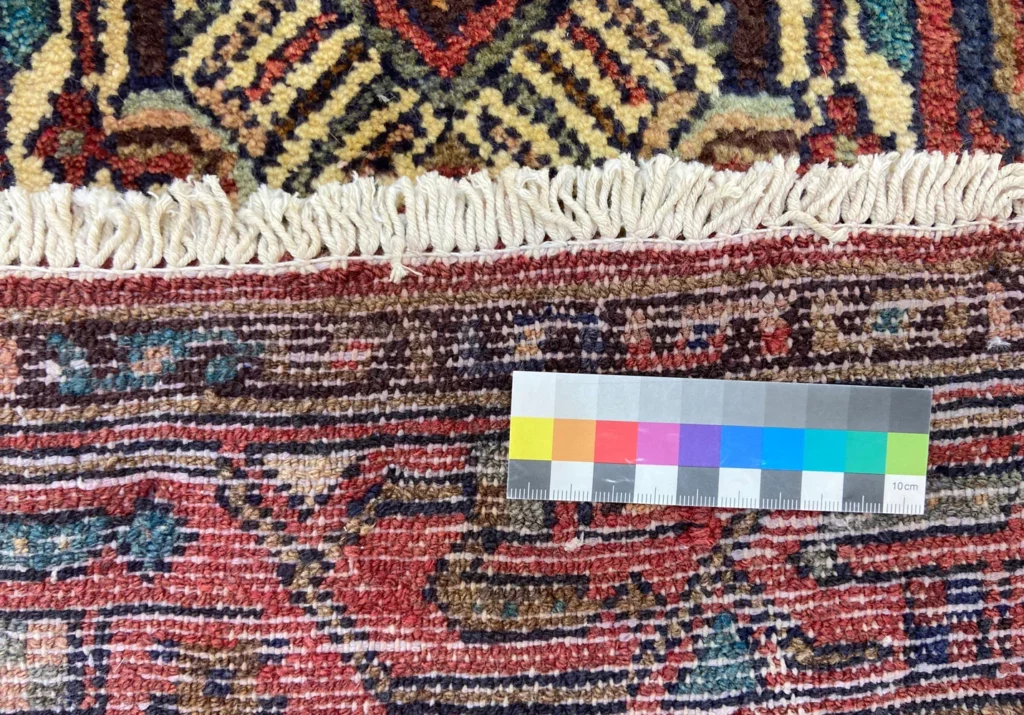
The listed knot density is 100,000 to 350,000 knots per square metre. In Hamadan rugs, this level of density supports the differentiated rendering of motifs and gives the surface a compact structure. Knot density is a technical characteristic of a hand-knotted rug. It indicates more than fineness alone, as it relates to the working method, the stability of the construction and the visible definition of a design.
Wool is well suited to traditional knotting because it can be spun, dyed and worked into separate areas of colour. Its natural pile has a tactile, resilient character and contributes to practical use. The condition of this rug is described as good. That information identifies the piece as having a well-preserved condition for living use, without adding claims about restoration, age or any other aspect that has not been specified.
Origin and Tradition
Hamadan is located in northwestern Iran and is recognised as an important Persian rug-producing region. The name Hamadan refers not only to the city itself, but often to a wider area with many individual weaving centres. Rugs from this area are therefore frequently sold under the collective name Hamadan. This rug is identified as originating in Northwestern Persia and belongs to the Persian Hamadan tradition.
The region includes villages and local weaving places whose rugs developed their own variations. Places associated with Hamadan include Assadabad, Khamseh, Maslaghan, Enjelas, Nahawand, Tuyserkan and Mousel. Their proportions, drawing and colour balance may differ even when the rugs are grouped under the same regional name. Hamadan is consequently best understood as a family of related regional rugs rather than as one fixed pattern with only one possible appearance.
Weaving in the Hamadan area has been shaped by handcraft methods passed through generations. Knotting combines the preparation of the foundation with the insertion of coloured wool and the gradual consolidation of successive rows. A durable surface develops through this repeated process, while the design emerges from the placement of individual knots. The work calls for consistent tension, a clear understanding of the intended layout and careful repetition of colour rhythms. This combination of local tradition and practical construction is central to the identity of Hamadan rugs.
The region is also known for the breadth of its production. Hamadan rugs have been made with varied pattern concepts and in different formats, allowing them to serve both compact areas and larger domestic settings. The use of hard-wearing wool corresponds to this history of rugs made for everyday life. Durability and sound workmanship are traditionally associated with Hamadan rugs, although not every rug from the region has the same colours or the same drawing.
As a Persian rug, this piece belongs to the wider weaving culture of Iran. That culture contains numerous regional centres distinguished by knotting methods, materials, dye traditions and pattern vocabulary. Hamadan occupies a distinct place within it because of the wide range of village and workshop rugs linked to the region. The regional name is therefore an important indication of craft origin, while the precise design of an individual rug must always be considered on its own terms.
Design and Pattern
Hamadan rugs are not limited to one pattern type. The regional tradition includes geometric compositions as well as floral motifs. Geometric designs may use strong lines, lozenges, medallions, repeated compartments or stylised forms. Floral layouts can include leaves, blossoms and scrolling elements in either simplified or more articulated versions. This variety describes the Hamadan group as a tradition; it does not assign a particular pattern to this individual rug.
The appearance of a hand-knotted pattern is built from many small decisions. Outlines are formed knot by knot, fields are separated through sequences of colour and repeated elements are carried across the composition. A denser knotting structure can support a more precise rendering of small details. At the same time, a regional design may remain clear and rhythmic rather than densely intricate. The relationship between order, repetition and variation is a basic feature of many traditional Oriental rugs.
Hamadan rugs are often described with strong, lively colours. Deep reds, warm earth tones and vivid blues are among the colour families frequently associated with regional examples. Traditional dyeing can also involve natural colourants. These observations explain the broader Hamadan palette and do not state that a particular colour arrangement is present in this rug. The actual visual effect of a one-off piece depends on its own distribution of colours and motifs.
A Hamadan composition may function as a central focal arrangement or as a more evenly distributed field. Medallion designs draw attention towards the centre, while all-over ornament can create a more continuous movement across the surface. Borders frame the interior field and provide a clear outer structure. Village traditions often use a direct and distinctive visual vocabulary, which can remain recognisable even when local versions vary in detail.
The Hamadan pattern tradition can be placed within the broader range of Persian rug design. Qom is often associated with finely drawn designs and finer knotting, Isfahan with elaborate floral compositions, and Tabriz with a wide spectrum ranging from traditional to contemporary layouts. These regional examples illustrate the diversity of Persian weaving. They do not alter the origin of this piece, which is described as a Hamadan Persian rug from Northwestern Persia.
Special Features
The specifically stated features of this rug are its origin in Northwestern Persia, its Hamadan attribution, its hand-knotted construction, its hard-wearing wool and its listed knot density of 100,000 to 350,000 knots per square metre. The condition is described as good. Together, these details summarise the principal technical and factual characteristics of this one-off rug.
The combination of wool and hand-knotting represents a traditional method of production. The stated range of knot density points to a differentiated technical construction, but it does not establish a particular drawing, colour sequence or age. No information is provided about a signature, date of manufacture, restoration work or an individual pattern name, so no further claims are added.
FAQ
What distinguishes a Hamadan Persian rug?
Hamadan Persian rugs belong to the northwestern Persian weaving tradition centred on Hamadan. The name can cover several weaving places and villages in the surrounding region, including Assadabad, Khamseh, Maslaghan, Enjelas, Nahawand, Tuyserkan and Mousel. The group is known for handcraft production, the use of wool and a broad range of geometric and floral pattern ideas. This example is hand-knotted, made from hard-wearing wool and recorded with a knot density of 100,000 to 350,000 knots per square metre. Its condition is described as good.
How should I care for a Hamadan Persian rug?
A wool rug benefits from regular, gentle vacuuming with equipment suitable for a pile surface. Unnecessary pressure and harsh treatment should be avoided. Prolonged direct sunlight should also be limited so that the colours remain as even as possible. Spills and marks should be blotted carefully with a damp cloth rather than rubbed vigorously. More extensive soiling is best handled by a professional rug-cleaning service. These recommendations take account of the wool pile and hand-knotted construction of this Hamadan rug.
Can a Hamadan Persian rug be considered an investment?
Hamadan Persian rugs may be regarded as durable, enduring furnishings because of their handcraft tradition, regional identity and hard-wearing construction. A specific valuation depends on several factors, including material, knot density, condition, design and market demand. This rug is hand-knotted, made from hard-wearing wool, listed with a knot density of 100,000 to 350,000 knots per square metre and described as being in good condition. Those details alone do not provide a binding forecast of value or investment performance.
To provide the best experiences, we use technologies like cookies to store and/or access device information. Consenting to these technologies will allow us to process data such as browsing behavior or unique IDs on this site. Not consenting or withdrawing consent, may adversely affect certain features and functions.
Functional Always active
The technical storage or access is strictly necessary for the legitimate purpose of enabling the use of a specific service explicitly requested by the subscriber or user, or for the sole purpose of carrying out the transmission of a communication over an electronic communications network.
Preferences
The technical storage or access is necessary for the legitimate purpose of storing preferences that are not requested by the subscriber or user.
Statistics
The technical storage or access that is used exclusively for statistical purposes.The technical storage or access that is used exclusively for anonymous statistical purposes. Without a subpoena, voluntary compliance on the part of your Internet Service Provider, or additional records from a third party, information stored or retrieved for this purpose alone cannot usually be used to identify you.
Marketing
The technical storage or access is required to create user profiles to send advertising, or to track the user on a website or across several websites for similar marketing purposes.

 SECURE PAYMENT
 SHIPPING PARTNERS


