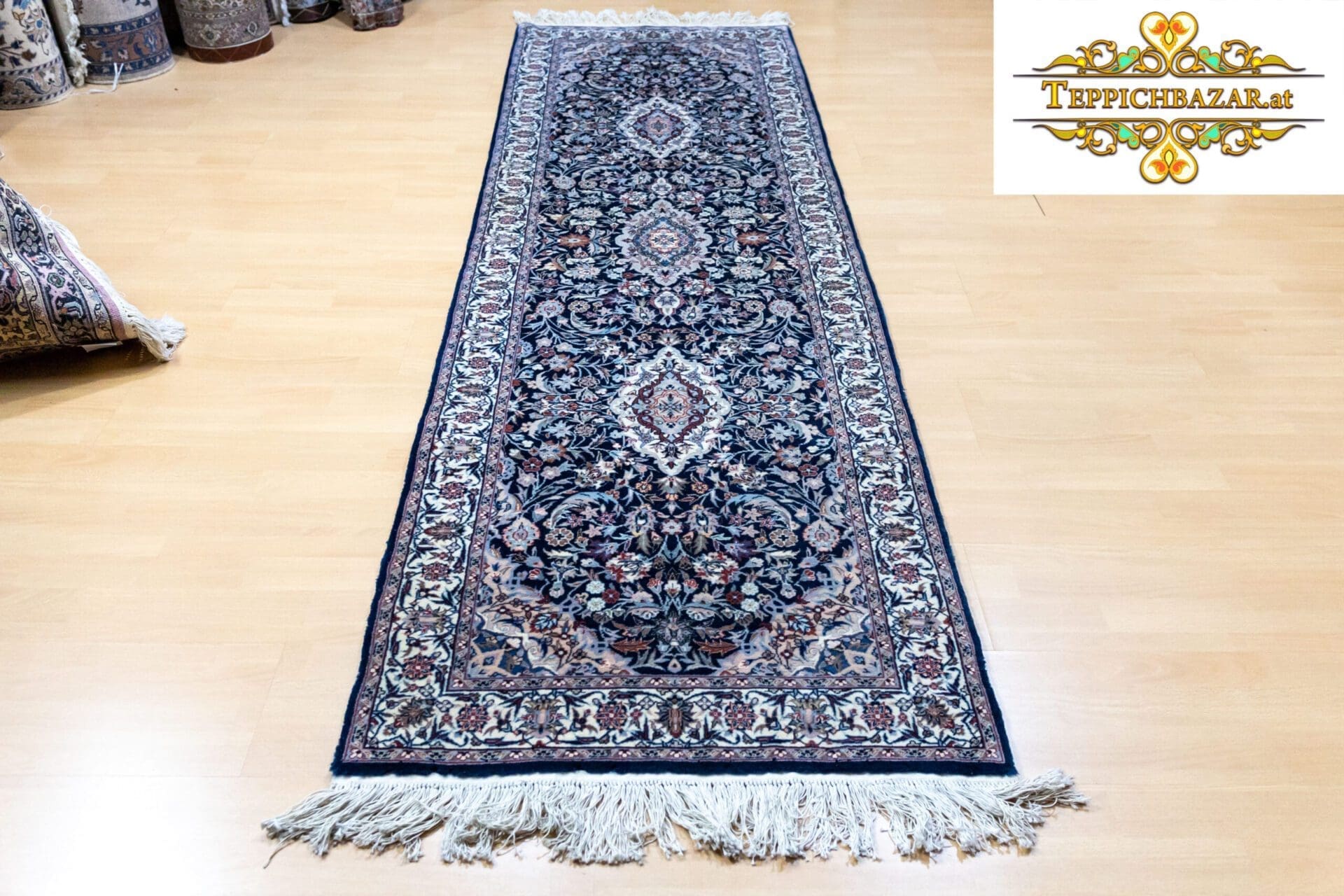
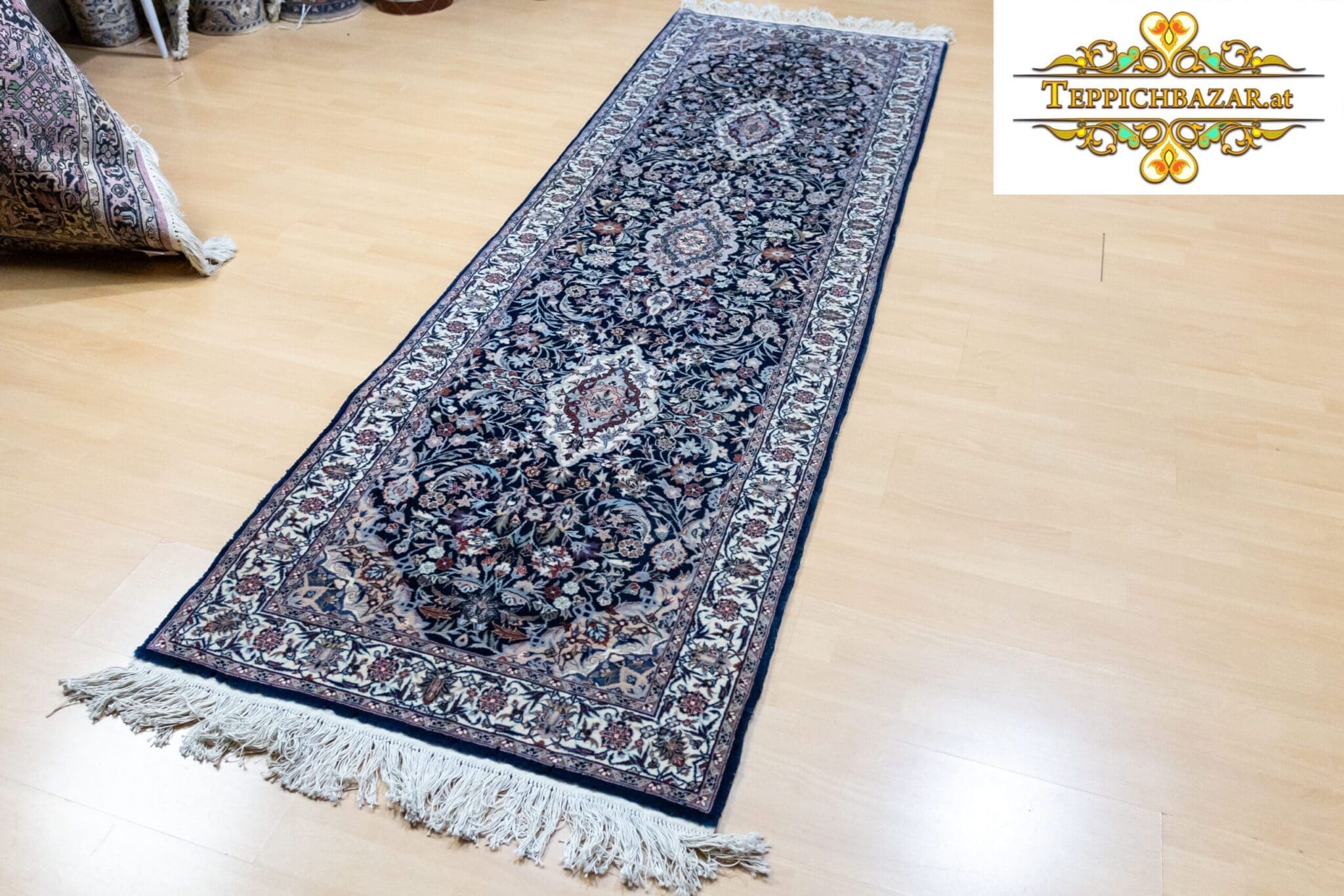
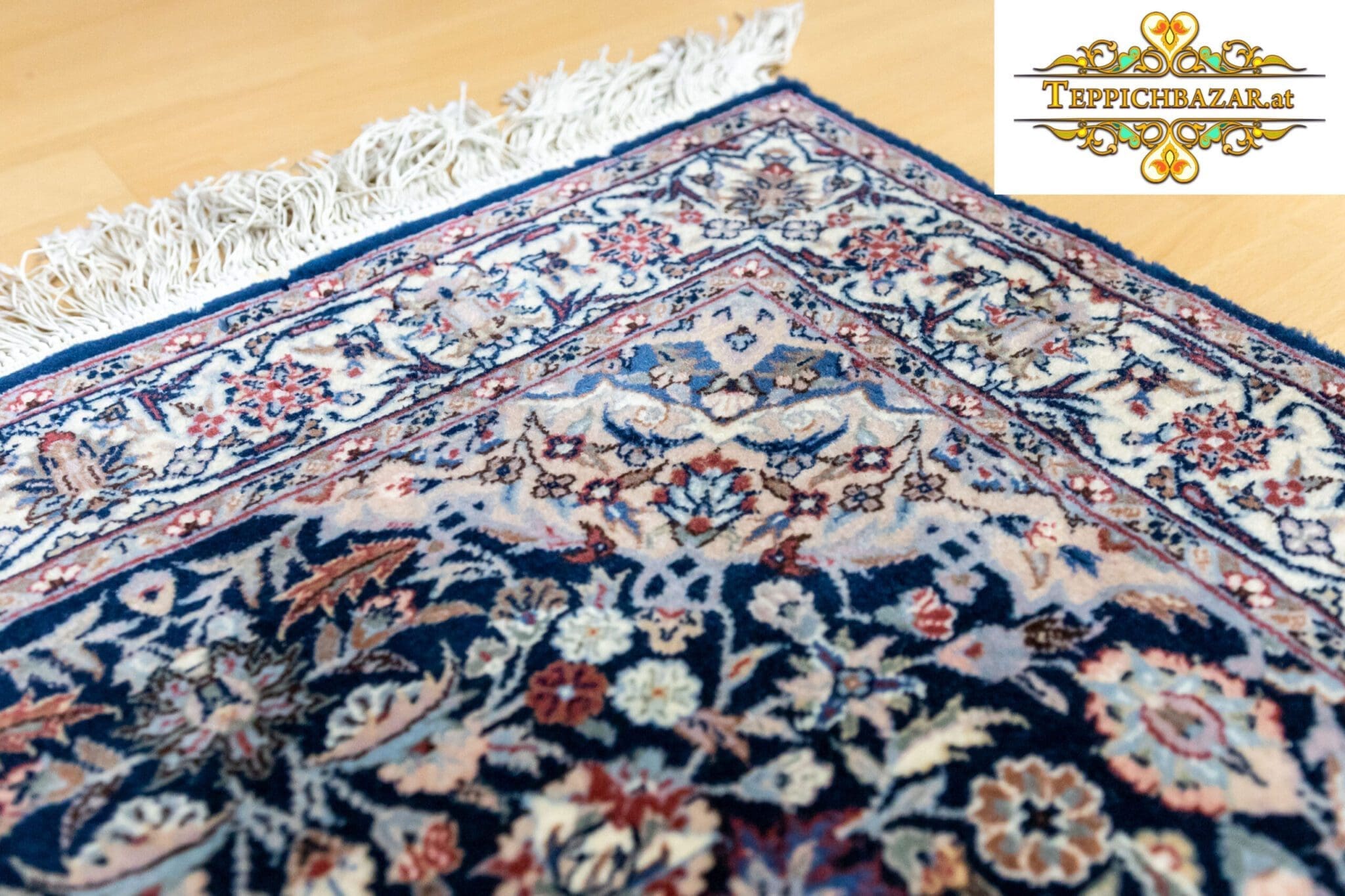
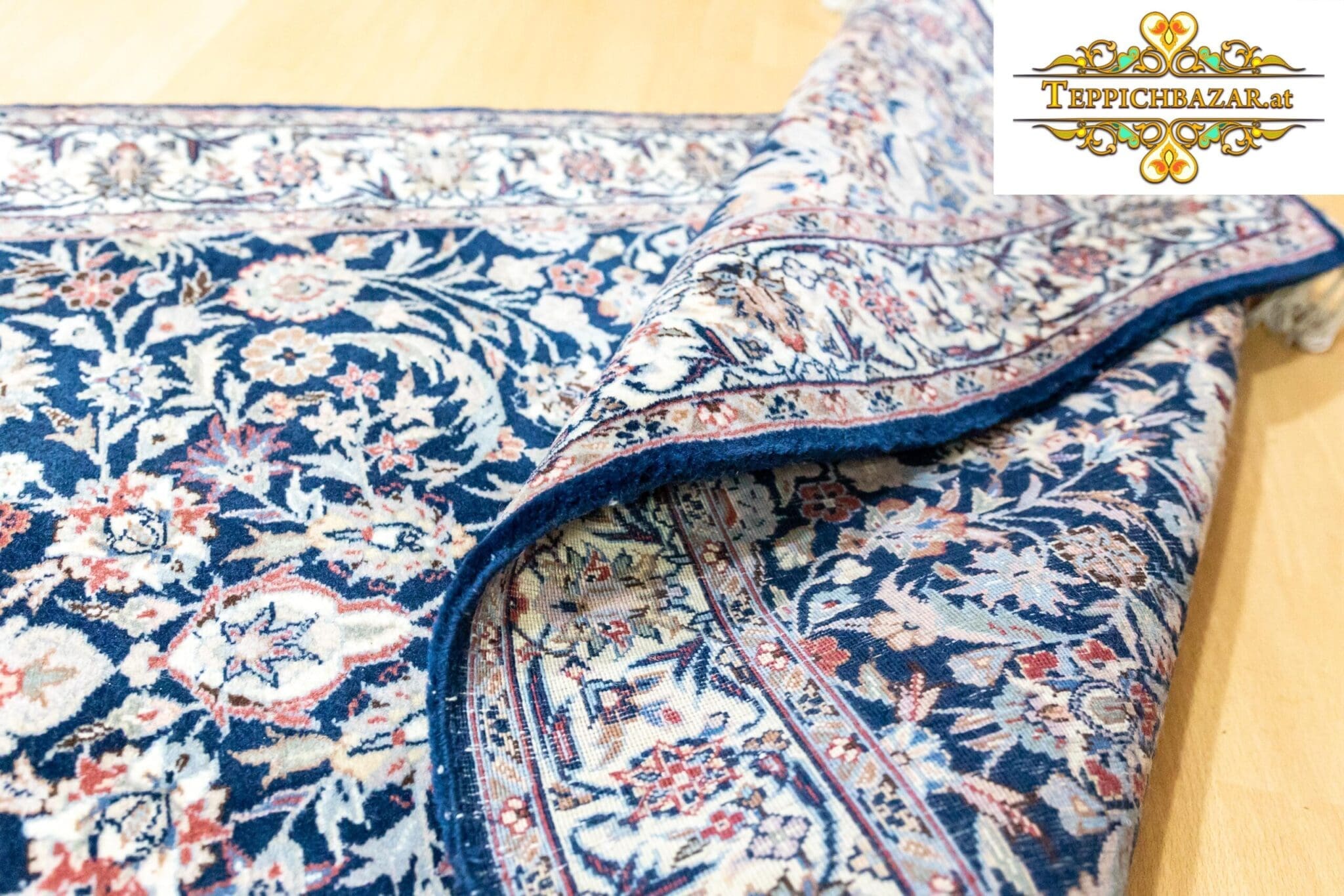
The W1(#268) is a hand-knotted Persian rug with a pile made from 100% wool and a warp made from 100% cotton. Wool forms the visible surface of the rug and gives the pile its tactile character. It is traditionally used in rug making for its pleasant handle, resilience and insulating properties. The cotton warp belongs to the structural foundation of the rug: the pile is secured to this underlying framework as the piece is built row by row.
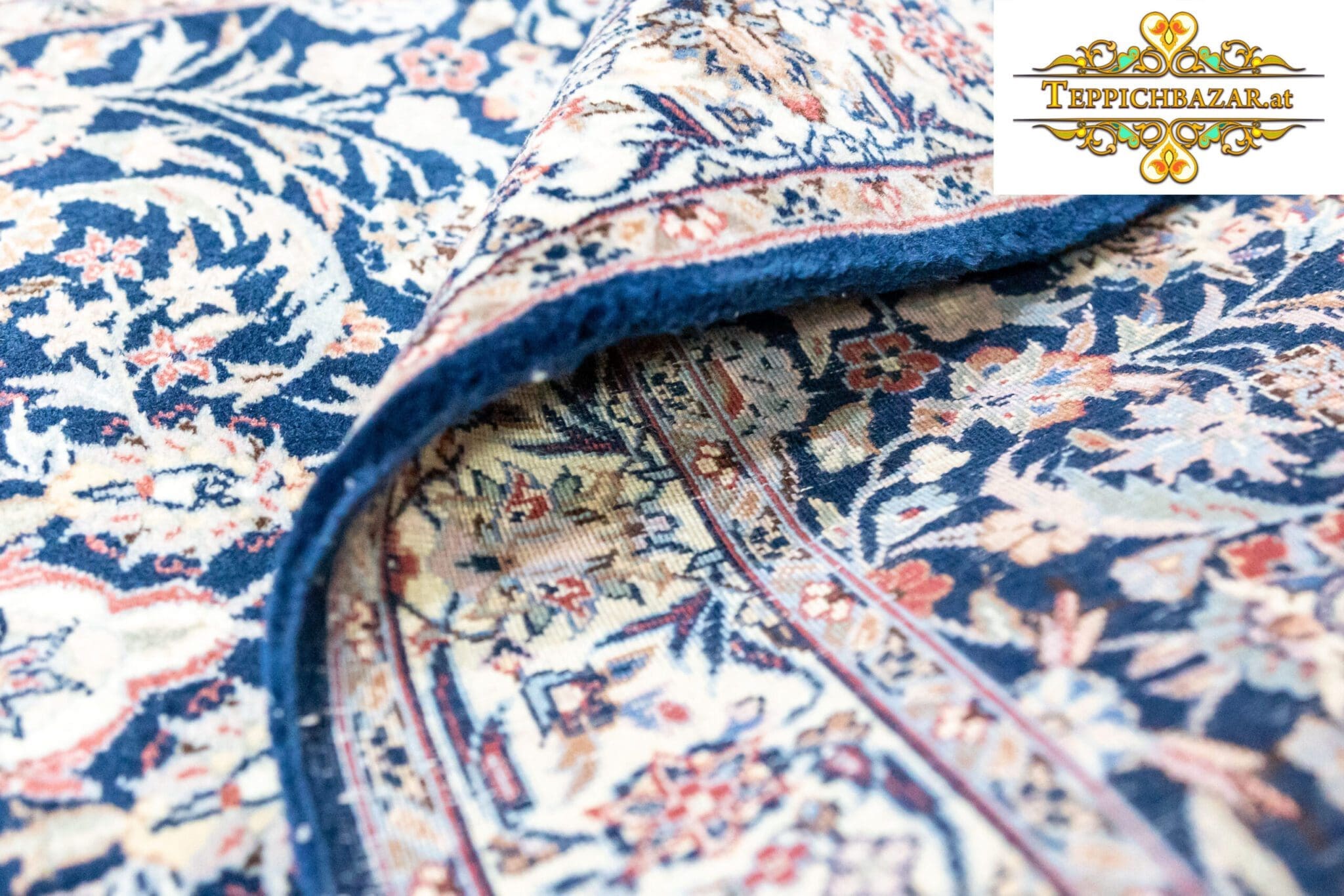
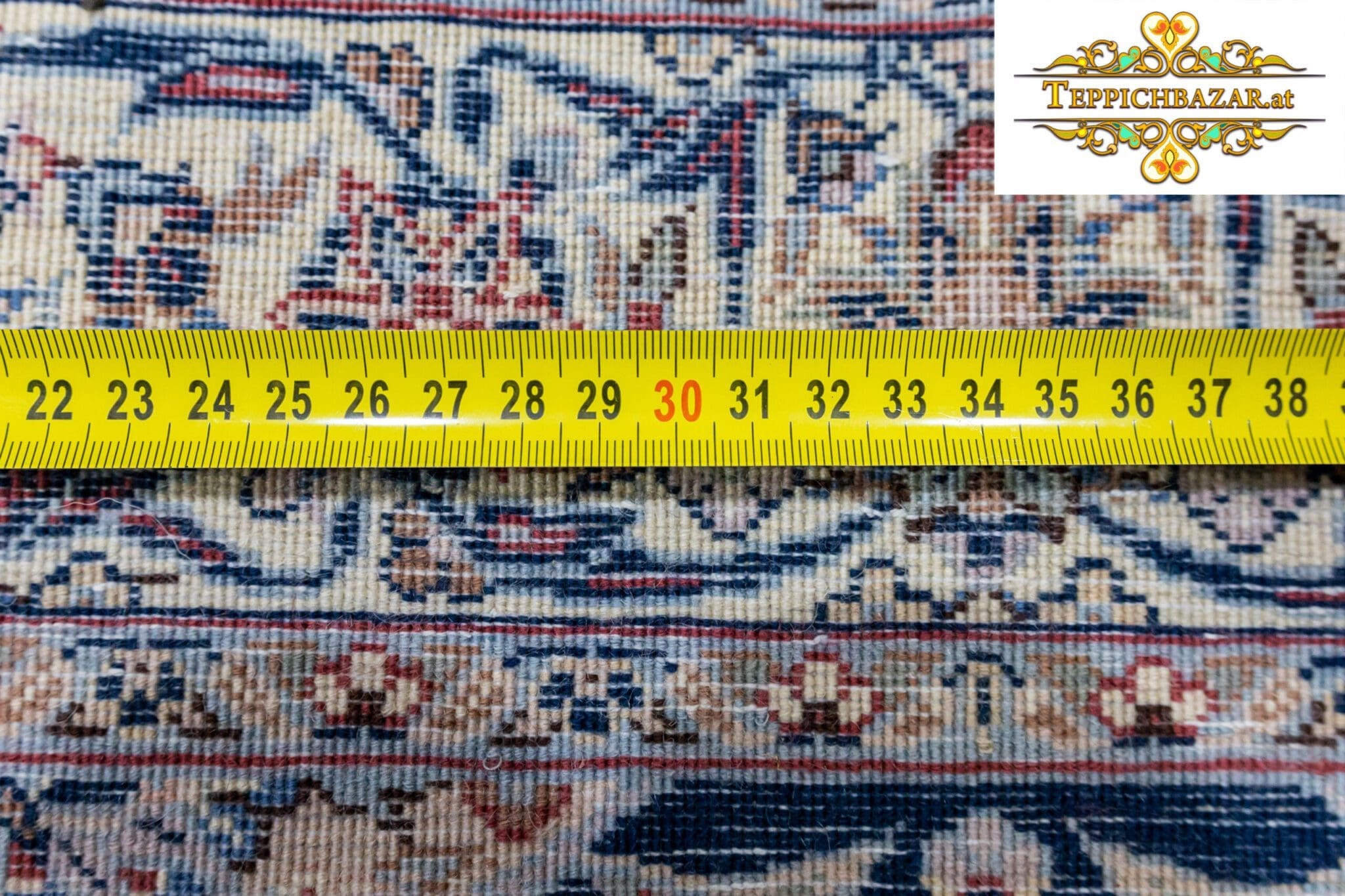
Hand knotting means that the pile threads are tied individually into the prepared warp. Weft threads are then inserted and compacted as the work progresses, creating a stable textile surface. This process allows the pattern to be developed gradually rather than printed or mechanically reproduced. The W1(#268) is listed with a knot density of 500000 knots per square metre. Such a dense construction can support carefully defined floral forms and a closely built surface.
The combination of wool pile, cotton warp and manual knotting determines the rug’s construction. Wool provides the surface material, while the warp provides the foundation for the rows of knots. The knotting technique also permits the weaver to distinguish small areas of colour and outline within a design. The rug is described as being in like-new condition. Its material and workmanship therefore comprise both the stated fibre content and the traditional method used to form the pile.
Origin and Tradition
The W1(#268) is identified as a Persian rug from Iran. Iranian rug making is one of the established textile traditions of the Orient. It has developed over many generations through urban workshops, rural communities and family-based weaving practices. These settings produced varied approaches to knotting, colour, composition and ornament. A Persian rug is consequently both a functional floor covering and the result of a long-established craft in which a surface is built from individually placed knots.
Traditional production starts with the preparation of the warp and weft structure. The weaver then inserts and secures the pile knots in successive rows, following a design or an inherited pattern vocabulary. After the knotting is complete, the surface is trimmed and finished so that the pile and drawing work together. The final character depends on the density of the knots, the choice of fibres, the handling of the yarn and the precision with which the stages are carried out.
Iranian rug history is often discussed through important centres such as Isfahan, Tabriz and Kashan. These names refer to major traditions within Persian carpet art, each associated with particular historical workshops and design approaches. Isfahan is widely associated with finely organised compositions and detailed ornament. Tabriz developed a broad urban weaving tradition with precise drawing and many classical arrangements. Kashan is also closely linked to Persian rug production and to floral and ornamental designs. These centres provide cultural context, but no particular province or city is stated as the origin of the W1(#268).
The Persian design vocabulary includes medallions, borders, scrolling vines, geometric devices and floral fields. Motifs have been passed on, adapted and combined over time rather than remaining fixed in one form. A workshop may refine a traditional arrangement through different proportions, colours or levels of detail. Knot density has an important technical relationship with this vocabulary because a closely knotted surface can distinguish small contours and transitions. The W1(#268) belongs to the Iranian Persian rug tradition described by its origin and technique, without requiring an unrecorded regional attribution.
Iranian rug making also reflects the relationship between practical construction and visual order. The warp and weft provide a foundation, while the pile creates the visible design. The repeated rhythm of knotting turns a drawn or remembered motif into a durable textile surface. Different regions and workshops have contributed their own methods, but the source identifies this rug only as Iranian and Persian. That distinction preserves the documented origin while allowing the broader history of Persian carpet craft to explain its context.
Design and Pattern
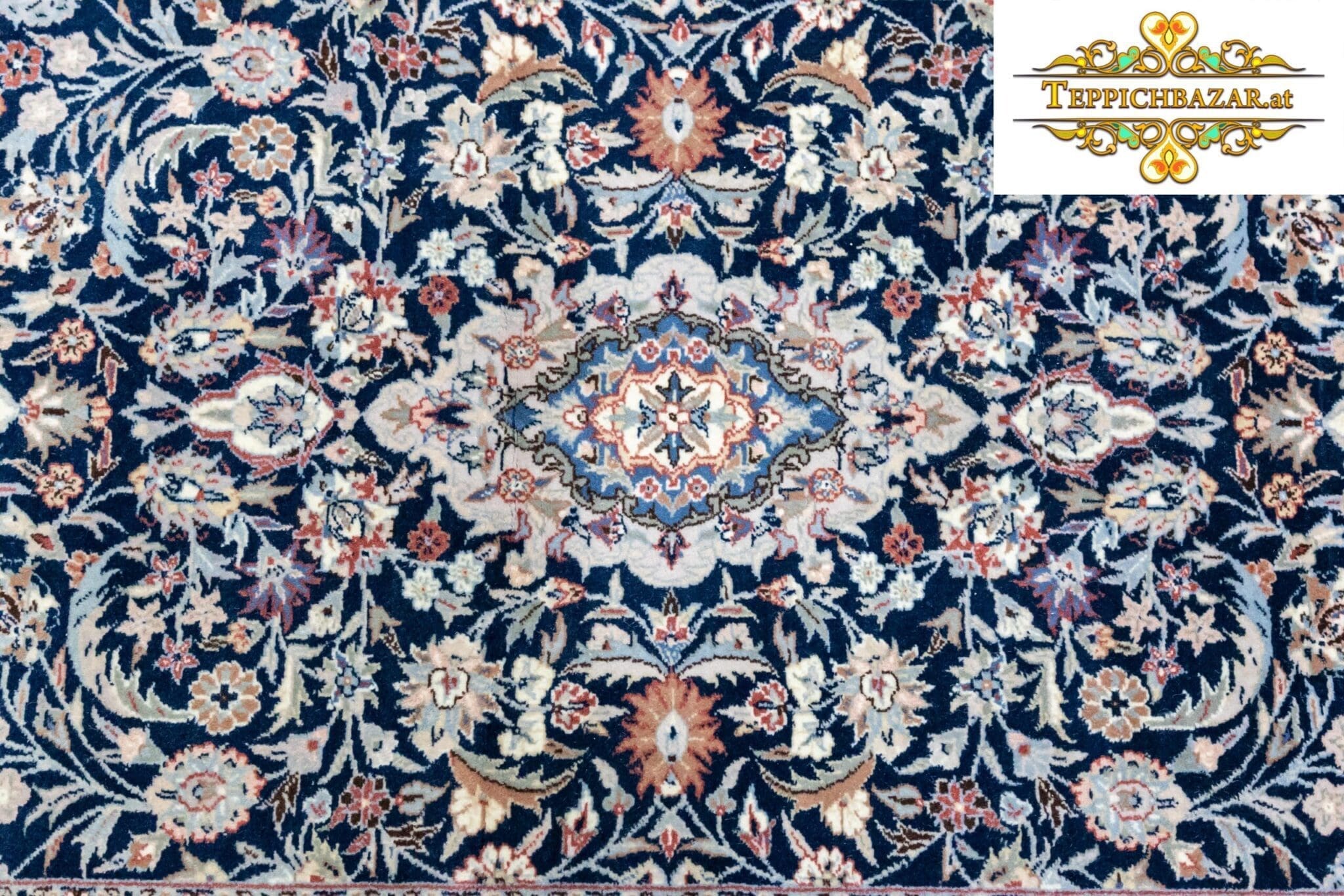
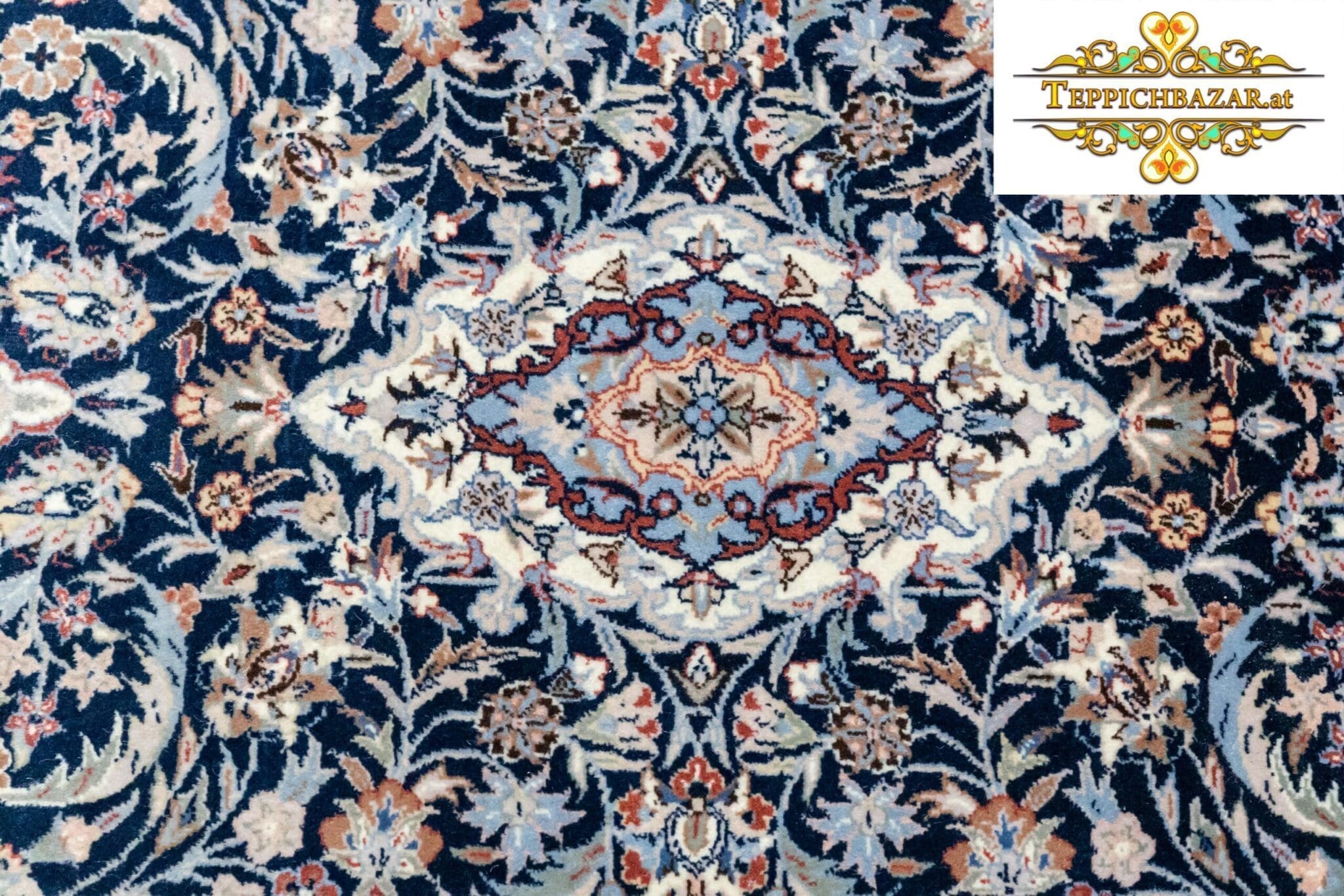
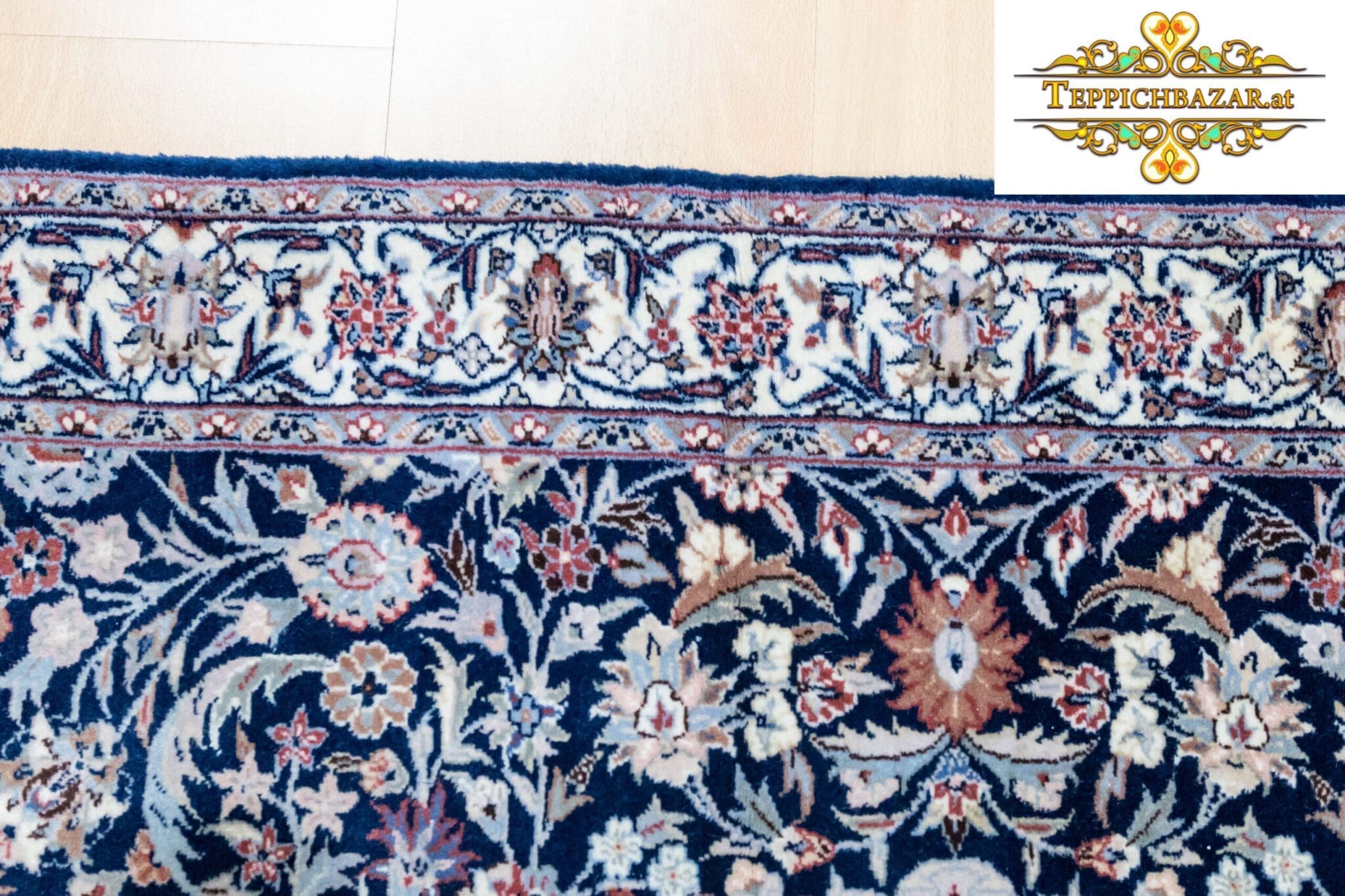
The pattern of the W1(#268) is described as floral. Floral rug designs draw on plant forms such as blossoms, leaves, stems and scrolling vines. In Persian carpet art, these elements are generally organised into a decorative system rather than copied as a literal botanical image. Motifs may be repeated, mirrored, linked by stems or arranged in a continuing rapport. The resulting surface is made from many connected details whose rhythm gives the composition its visual structure.
A floral composition can distribute its elements in several ways. Some designs place an ordered field inside a border, while others repeat blossoms and branches across the entire surface. A central arrangement may be balanced around a dominant form, whereas an all-over design relies on recurring motifs and spacing. For this rug, the source establishes the floral category but does not specify a medallion, border layout or individual plant motifs. The description therefore remains with the documented floral character.
Plant ornament has a long place in Persian design history because it provides a flexible language for rhythm, balance and variation. A blossom can be simplified into a small emblem, expanded into a larger focal form or connected to a vine that leads the eye through the field. Leaves can create pauses between flowers, and repeated stems can give direction to the composition. The dense hand-knotted construction allows such elements to be rendered through changes in colour and contour, while the wool pile gives the surface a textile relief.
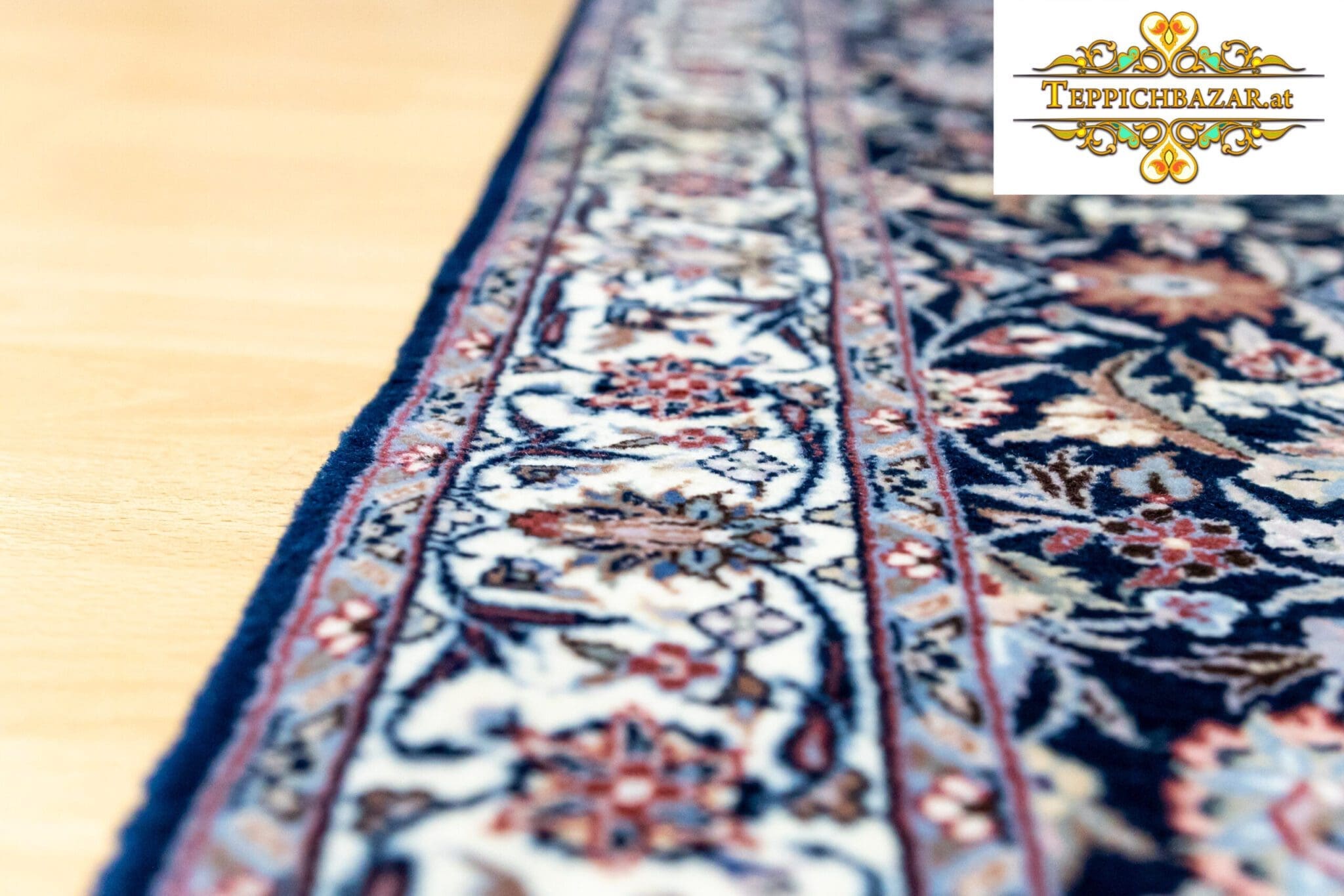
The colour description names muted earth tones together with vivid accents. Earth tones provide a restrained base for the floral arrangement, while stronger accents can separate selected blossoms, leaves or lines from their surroundings. This combination creates contrast without changing the stated floral identity of the design. The pattern is also described as elegant and timeless. That character comes from the enduring floral vocabulary, the balanced colour relationship and the hand-worked surface rather than from a separately named regional pattern.
Pattern is experienced through more than the outline of an individual motif. The spacing between flowers, the direction of a vine, the density of the drawing and the relationship between ground and ornament all influence the appearance of a hand-knotted rug. Because the surface is assembled knot by knot, small changes in colour placement can become part of the finished texture. In the W1(#268), the floral designation, the earth-toned palette with vivid accents and the dense construction describe the documented design features without adding an unspecified motif name.
Special Features
The most distinctive stated feature of the W1(#268) is its knot density of 500000 knots per square metre. This figure describes a very closely constructed knot field and can support a high level of detail in a floral pattern. Dense knotting may also contribute to an even surface and a soft, compact handle. The description connects this density with detail, softness and durability.
The other recorded features are the 100% wool pile, the 100% cotton warp, the hand-knotted technique and the like-new condition. Together, these details describe the rug’s fibres, construction and present state. Regular vacuuming is recommended for care. Harsh cleaning products should be avoided; mild soap and water are suggested for stains. Periodic professional cleaning is recommended to help preserve the rug over time.
FAQ
How should a hand-knotted Persian rug be cared for?
Regular vacuuming helps remove loose dirt from the pile and keeps the surface maintained. Harsh cleaning agents should not be used on the rug. For stains, the care guidance recommends mild soap with water and a gentle approach. Professional cleaning at regular intervals is also recommended to support long-term preservation. Since the W1(#268) has a wool pile and a hand-knotted construction, cleaning should take account of the behaviour of wool and the structure of a knotted rug rather than treating it like a machine-made floor covering.
Where can the W1(#268) be placed?
The W1(#268) is described as suitable for living areas, hallways and offices. Its floral pattern, muted earth tones and vivid accents can be combined with a range of furnishing styles. The design is described as suitable for both modern and traditional interiors, where it creates a welcoming room effect. When choosing a location, the intended use, the desired visual arrangement and the protection of the hand-knotted wool pile should all be considered.
How can the quality of a hand-knotted rug be assessed?
Knot density is an important reference point because a closer knot structure can allow a more detailed pattern. The W1(#268) is listed with 500000 knots per square metre. Fibre content is another relevant factor: its pile is 100% wool and its warp is 100% cotton. The hand-knotted construction also provides information about how the surface was made, while the like-new condition describes its stated present state. These characteristics should be considered together when assessing the material and workmanship of this rug.
To provide the best experiences, we use technologies like cookies to store and/or access device information. Consenting to these technologies will allow us to process data such as browsing behavior or unique IDs on this site. Not consenting or withdrawing consent, may adversely affect certain features and functions.
Functional Always active
The technical storage or access is strictly necessary for the legitimate purpose of enabling the use of a specific service explicitly requested by the subscriber or user, or for the sole purpose of carrying out the transmission of a communication over an electronic communications network.
Preferences
The technical storage or access is necessary for the legitimate purpose of storing preferences that are not requested by the subscriber or user.
Statistics
The technical storage or access that is used exclusively for statistical purposes.The technical storage or access that is used exclusively for anonymous statistical purposes. Without a subpoena, voluntary compliance on the part of your Internet Service Provider, or additional records from a third party, information stored or retrieved for this purpose alone cannot usually be used to identify you.
Marketing
The technical storage or access is required to create user profiles to send advertising, or to track the user on a website or across several websites for similar marketing purposes.
 SECURE PAYMENT
 SHIPPING PARTNERS


