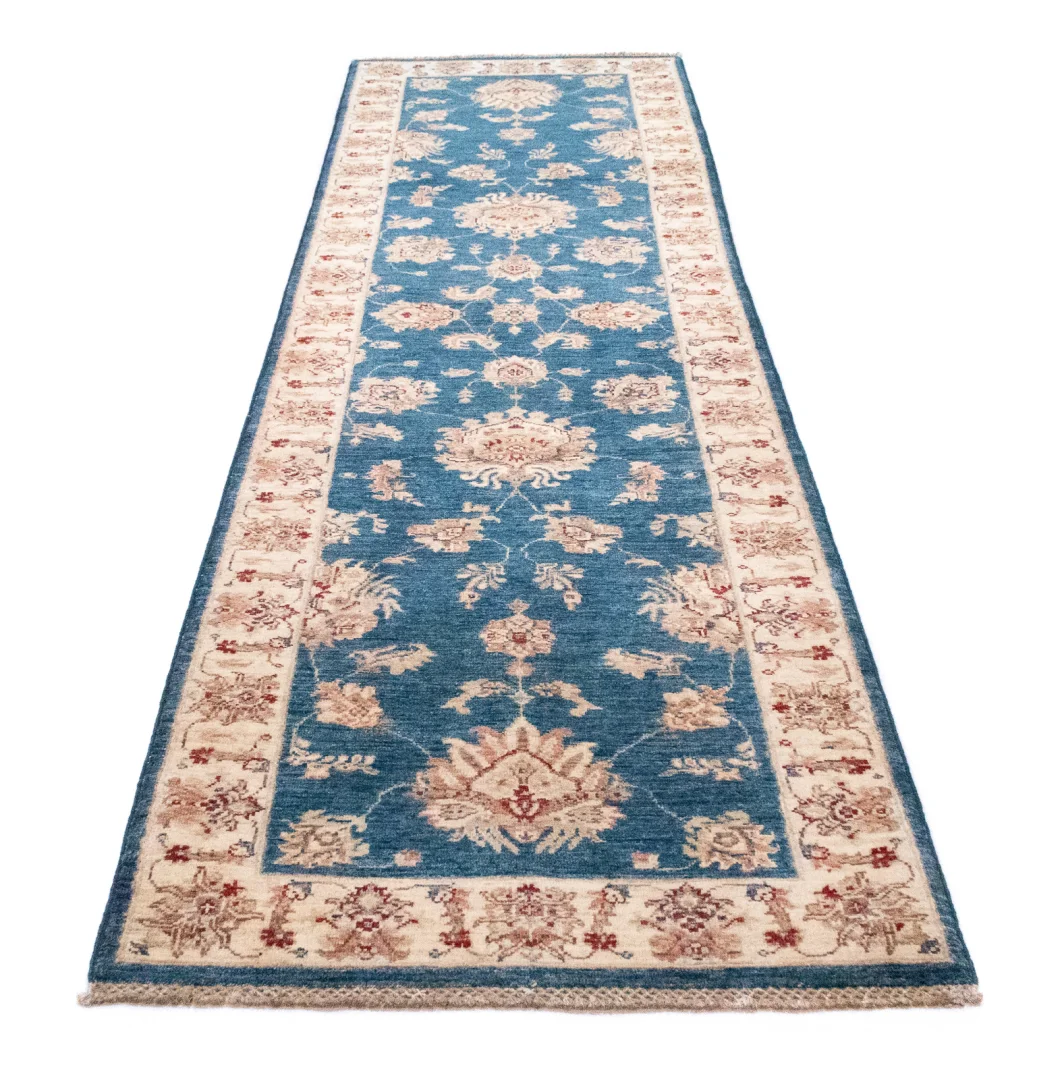
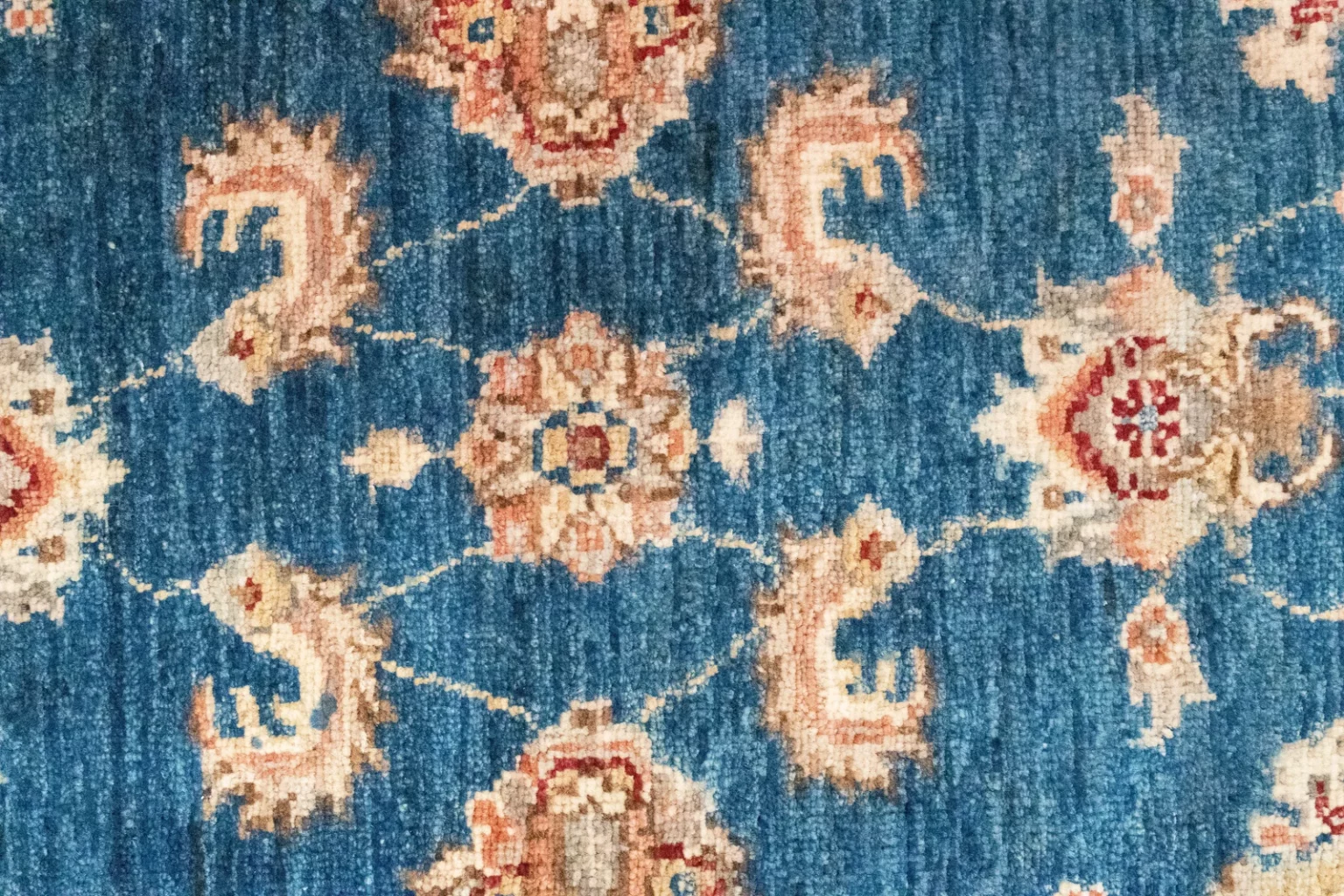
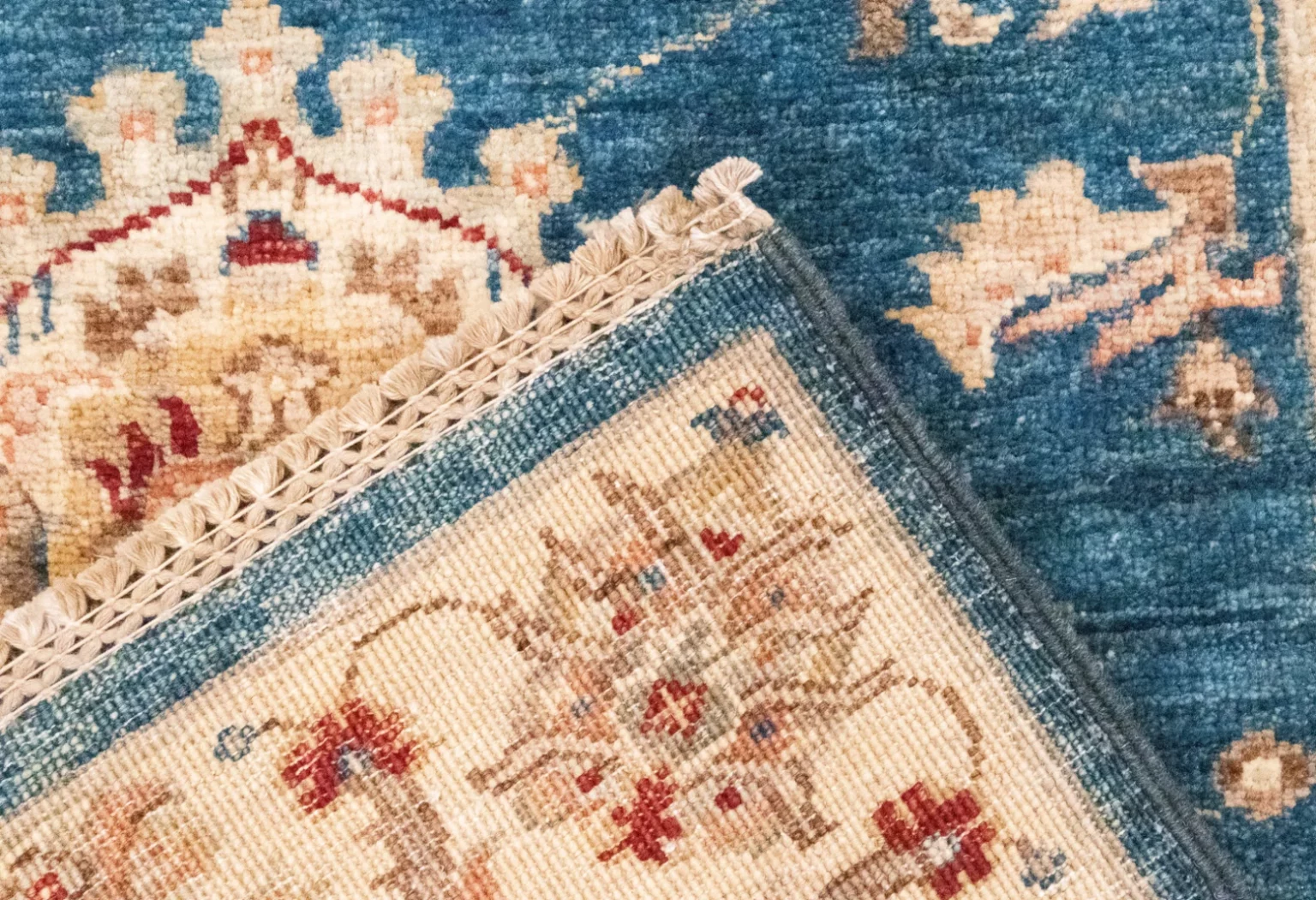
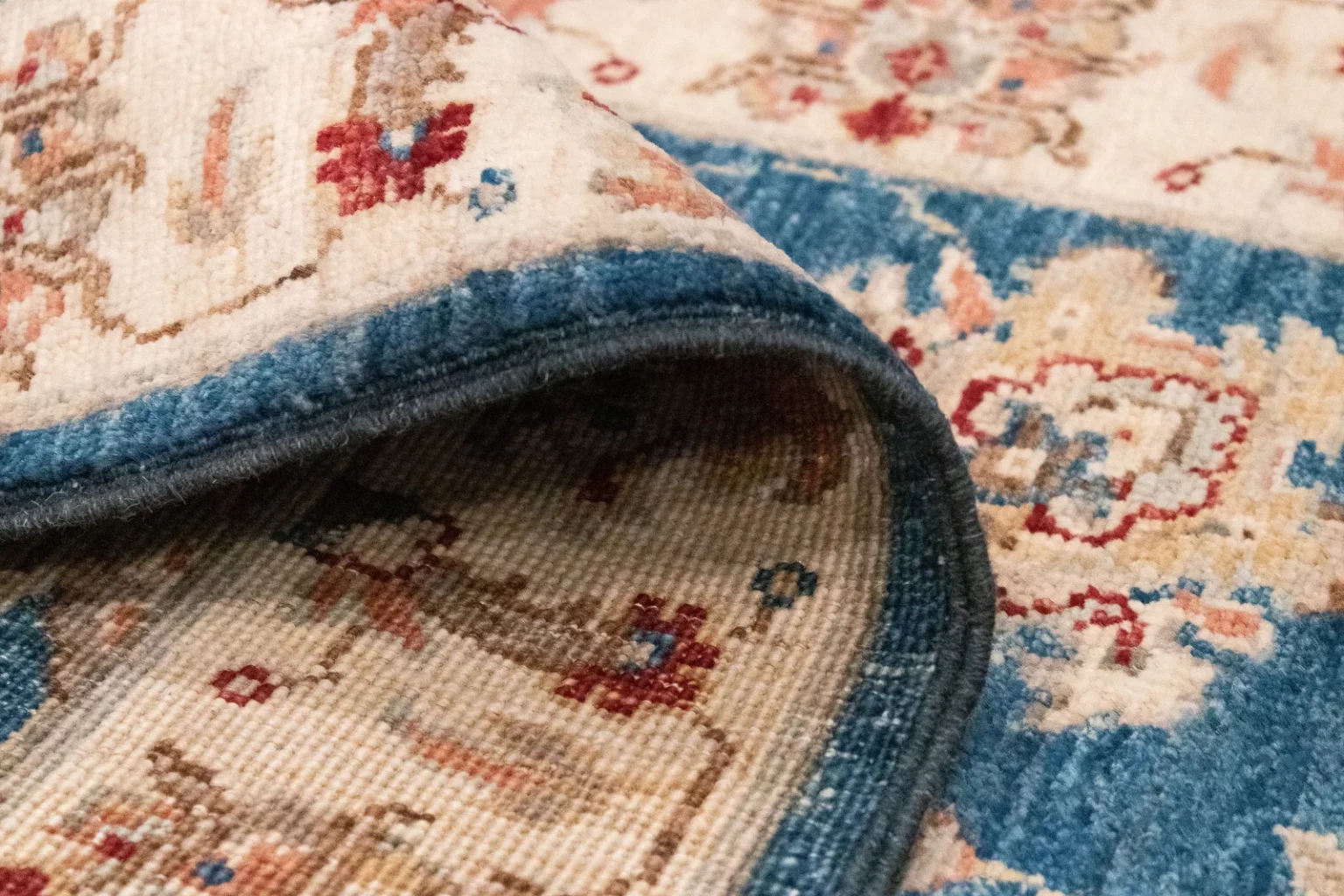
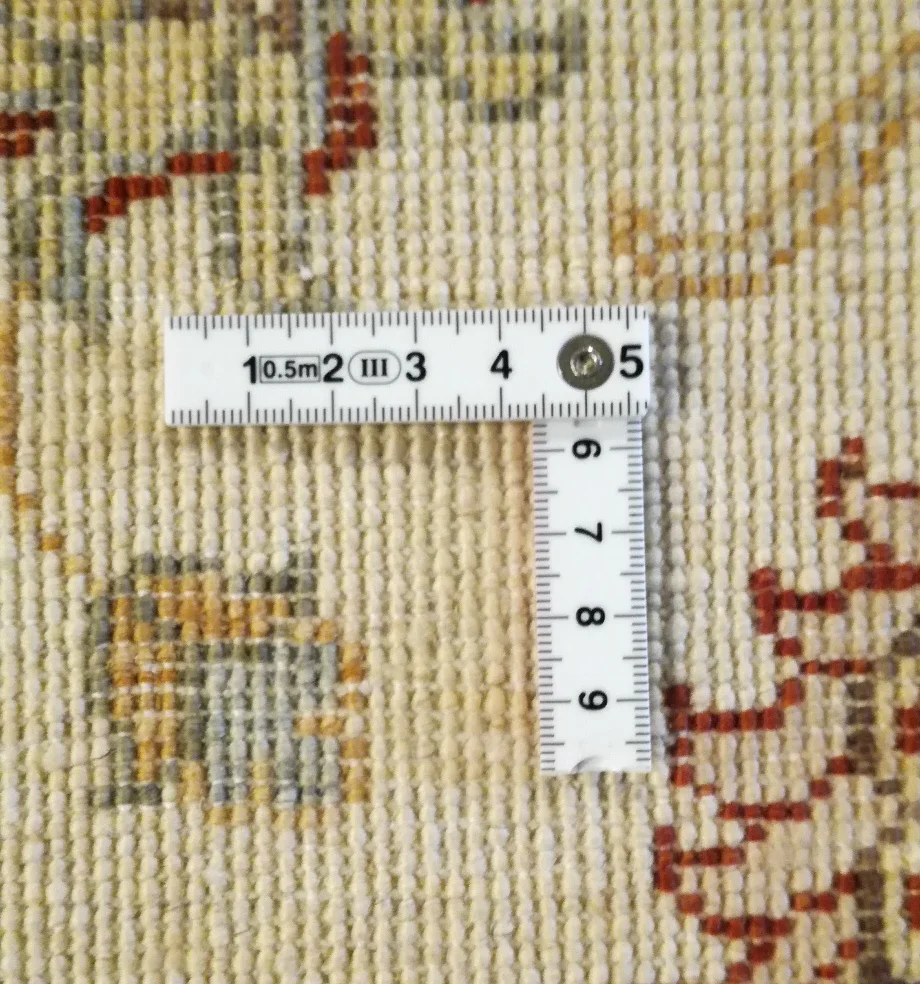
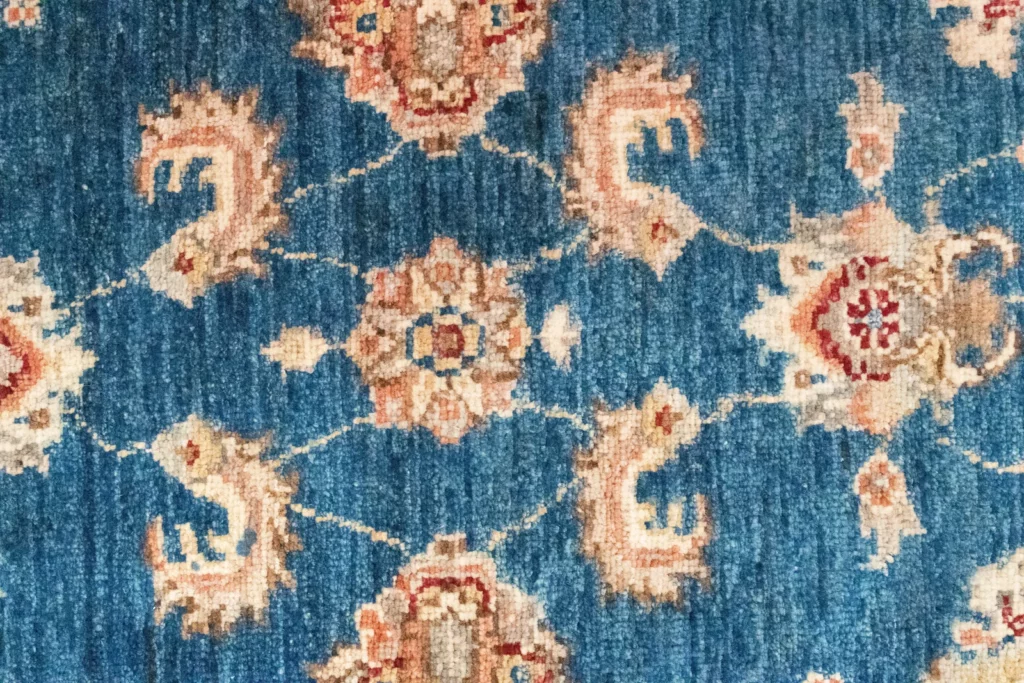
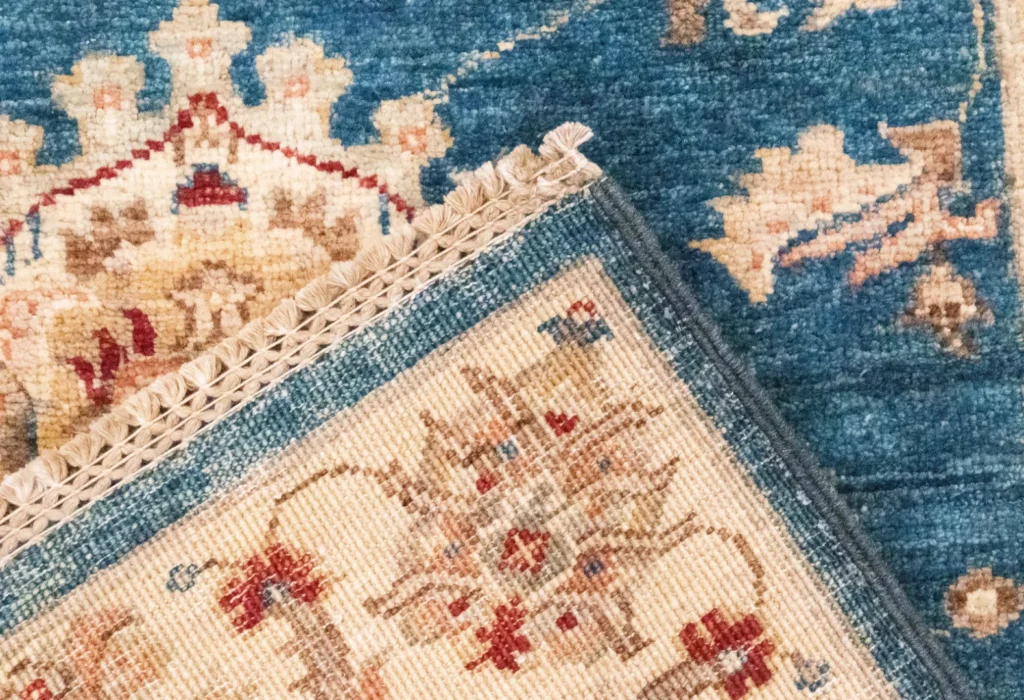
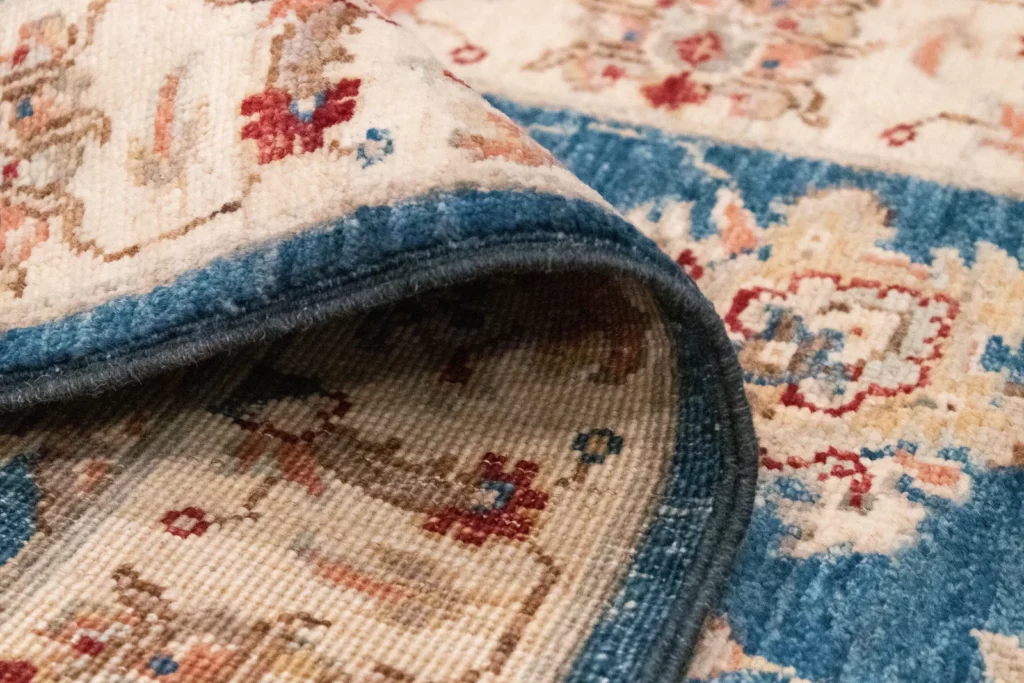
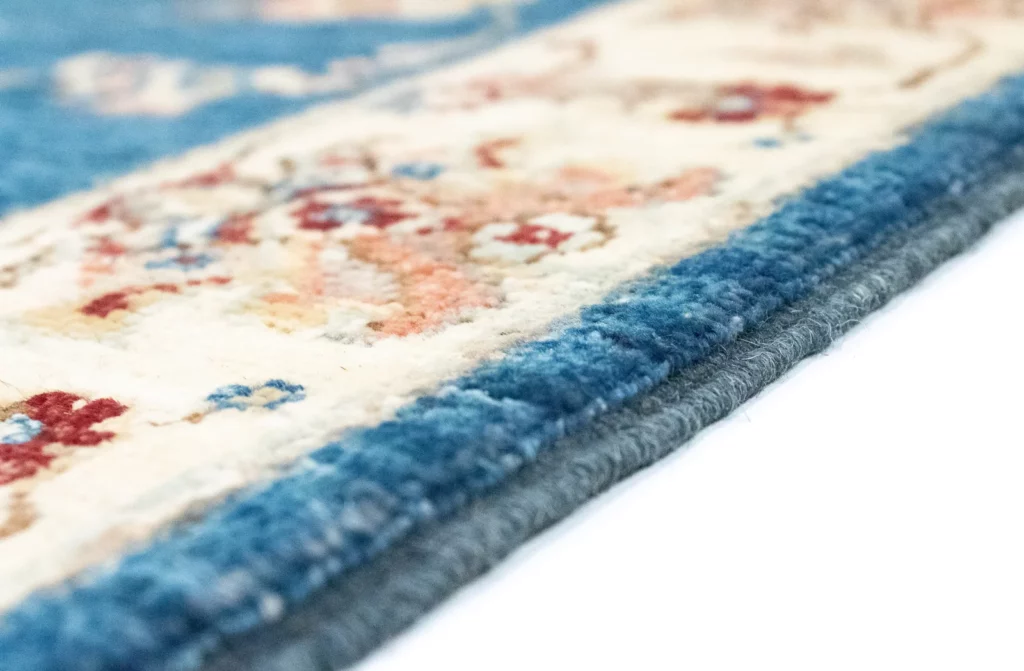
This Ziegler Oriental rug is hand-knotted and has a pile made from high-quality wool. In this traditional method, the design is built into the textile one knot at a time. The maker follows the intended composition while creating the pile, outlines and colour fields together. Unlike a printed image, the pattern is therefore part of the rug’s actual construction. Hand-knotting gives the surface the tactile character associated with individually made rugs.
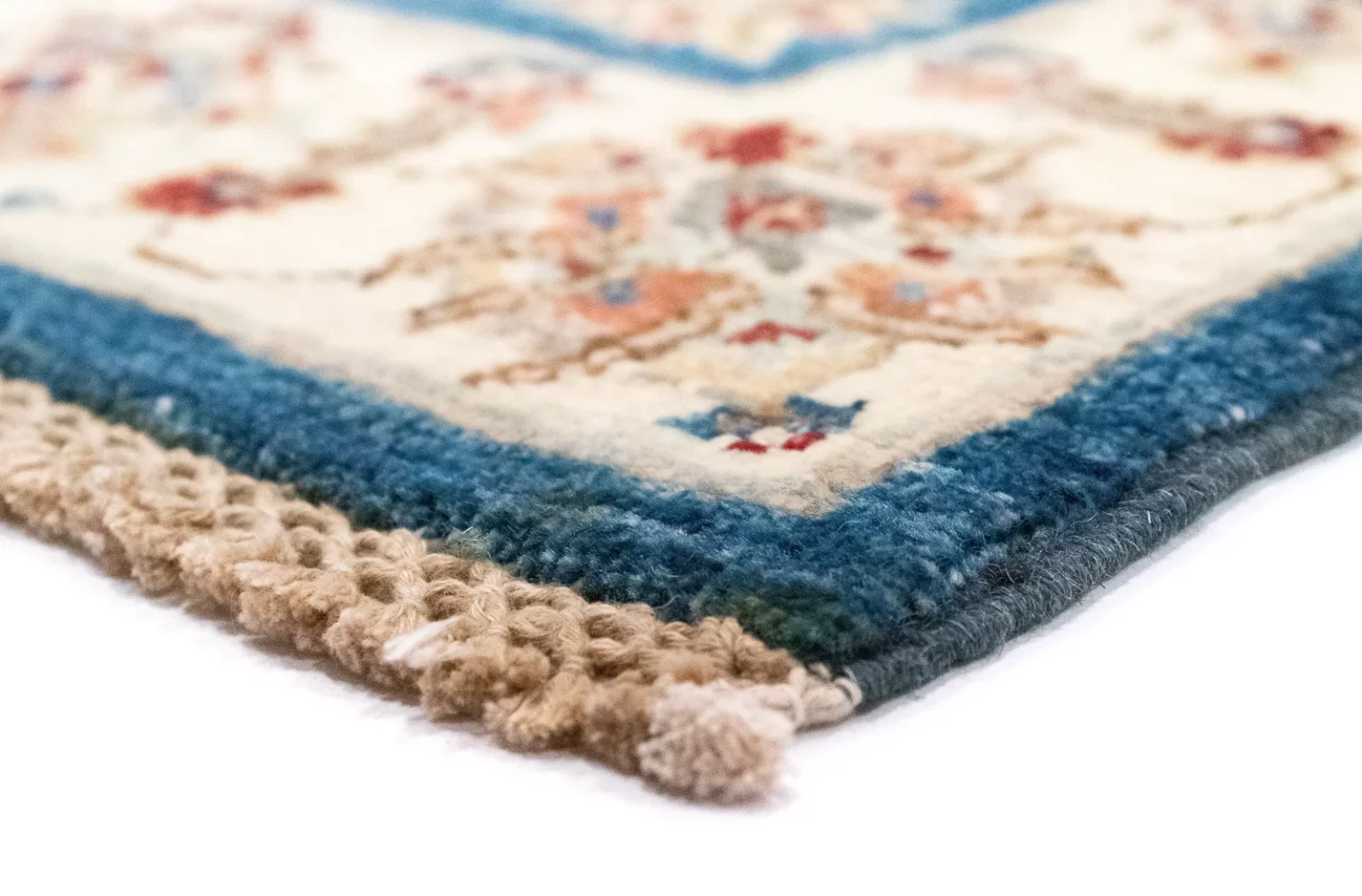
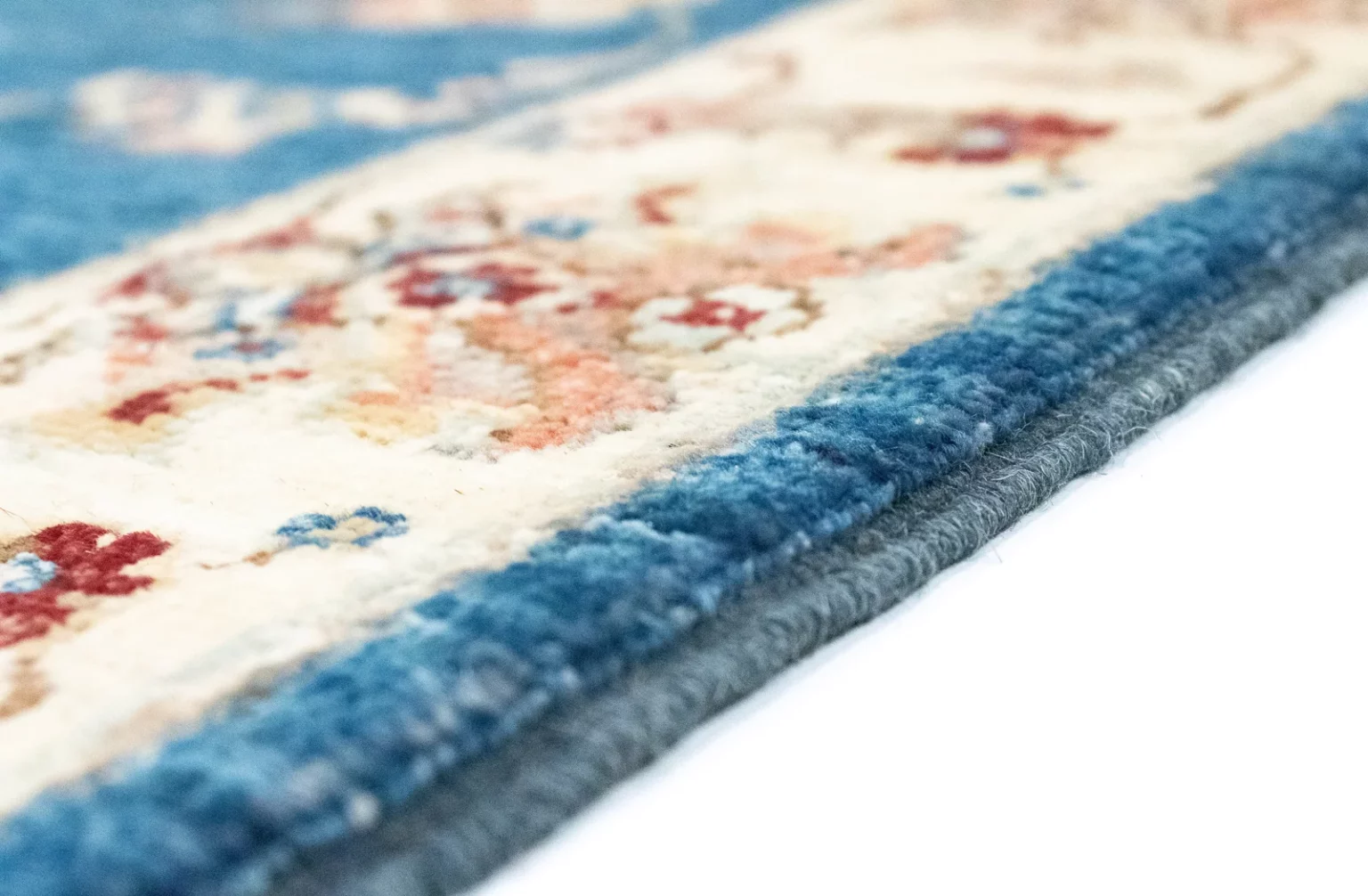
Wool is one of the established materials of rug production. Its natural resilience makes it suitable for a durable pile, while its texture gives the surface a firm but pleasant handle. Wool also accepts colour with depth and subtle variation. Different arrangements of the fibre can make tones appear soft, layered or gently contrasted. These qualities support both floral ornament and more structured geometric drawing.
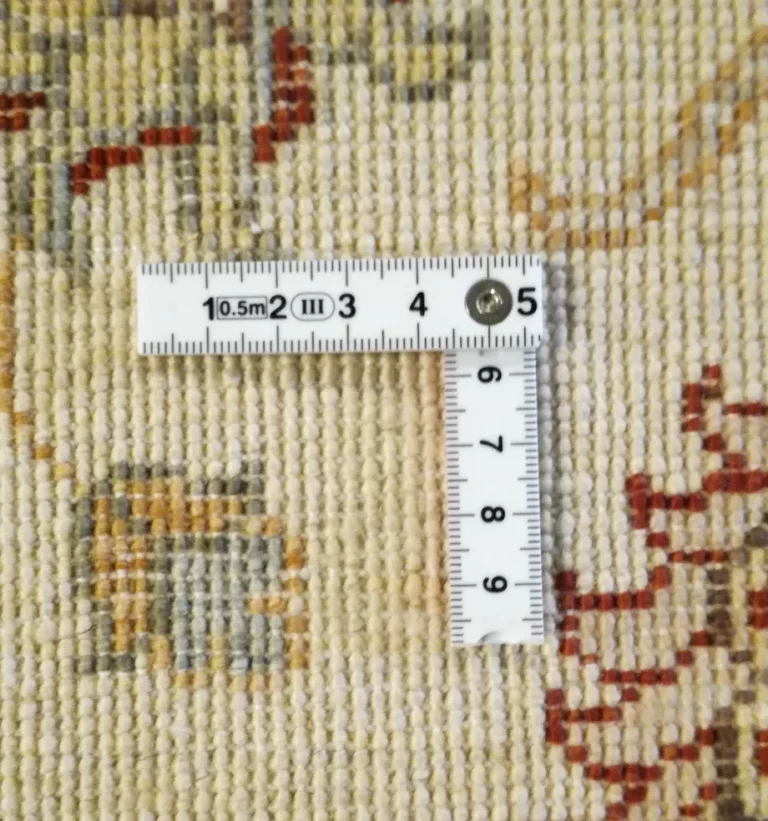
The making of a hand-knotted rug requires control of knot placement, tension, pile direction and colour sequence. The craftsperson works through the design gradually, building each section from repeated knots. A dense construction can support smaller details and more carefully defined transitions. The material and the technique are therefore closely connected: wool provides the tactile surface, while knotting determines how the visual design is formed.
This rug is also described as stone-washed. Stone washing is used in this type of rug to soften the appearance of the colours and create a gently faded visual effect. It changes the way the palette is perceived without replacing the underlying pattern. Floral shapes and geometric lines may consequently appear less sharp and more settled within the composition. The listed features of this piece are its high-quality wool pile, hand-knotted construction and stone-washed finish.
The rug is stated to be new. Its character therefore comes from its construction and finish rather than from a claim of age. No additional treatment or material is added to the description. The relevant facts are the wool pile, hand-knotting, stone washing and the specified knot density.
Origin and Tradition
The name Ziegler refers to a rug tradition associated with Persian models and with the Sarough and Arak region. During the nineteenth century, the Swiss merchant Ziegler brought Persian rug production to Europe. This historical connection helped establish a recognisable design tradition. Ziegler rugs became associated with carefully made surfaces, decorative floral compositions, controlled geometry and colour palettes that could appear soft and restrained.
Sarough and Arak form part of the wider history of Iranian rug making. Workshops in this cultural region developed methods for preparing wool, arranging borders, balancing a central field and translating drawn designs into knotted textiles. Craft knowledge was passed on through practice and instruction. The resulting design language can include vines, blossoms, repeated ornaments and geometric organisation, with the different elements brought together in a coherent composition.
Rug traditions have always travelled through trade and the movement of designs between workshops. A pattern associated with one region can be adapted elsewhere, using local skills and materials while retaining recognizable elements of its original visual language. This is why a style name and a production location must be distinguished. The name Ziegler can describe a design tradition without proving that an individual rug was made in the historical Iranian region connected with that tradition.
This particular rug is stated to have been hand-knotted in Pakistan. It is therefore described as an Oriental rug rather than a Persian rug. The Ziegler designation identifies the style and pattern background, not an Iranian origin for this individual piece. Pakistani workshops make Oriental rugs in a range of established traditions and may interpret designs connected with Persian weaving centres. For this rug, Pakistan is the stated place of manufacture.
This distinction is especially relevant to Ziegler rugs because the historical name has become part of an international design vocabulary. A rug can reflect the colours, floral arrangements and softened appearance associated with Ziegler patterns while being produced outside Iran. The regional history explains the design tradition; it does not change the stated origin of the piece. Here, the design reference and the Pakistani manufacture belong to two separate parts of the description.
Sarough rugs are related to this wider background and are often associated with lively colours and complex patterns. Kerman rugs are known in rug history for detailed compositions, sometimes including narrative or pictorial suggestions. Nain and Tabriz represent other established Persian traditions with their own approaches to structure, colour and ornament. These references provide context for Oriental rug design and are not additional origins for this Pakistani-made Ziegler rug.
The broader history of Oriental rugs is shaped by the exchange of techniques, motifs and commercial connections across regions. Designs were copied, adapted and refined as they moved between workshops and markets. The result is a large field of related but distinct traditions. Ziegler rugs illustrate this process: a style with Persian historical associations became recognizable in international production, while the actual origin of each individual rug must still be identified separately.
Design and Pattern
Ziegler designs commonly bring floral and geometric elements together. Leaves, vines and stylised blossoms can create an organic movement across the field. Lines, angles, repeated forms and balanced divisions introduce structure. The two approaches do not have to compete. A carefully arranged composition can use floral detail to soften a geometric framework, or use geometry to give order to a field of scrolling plant forms.
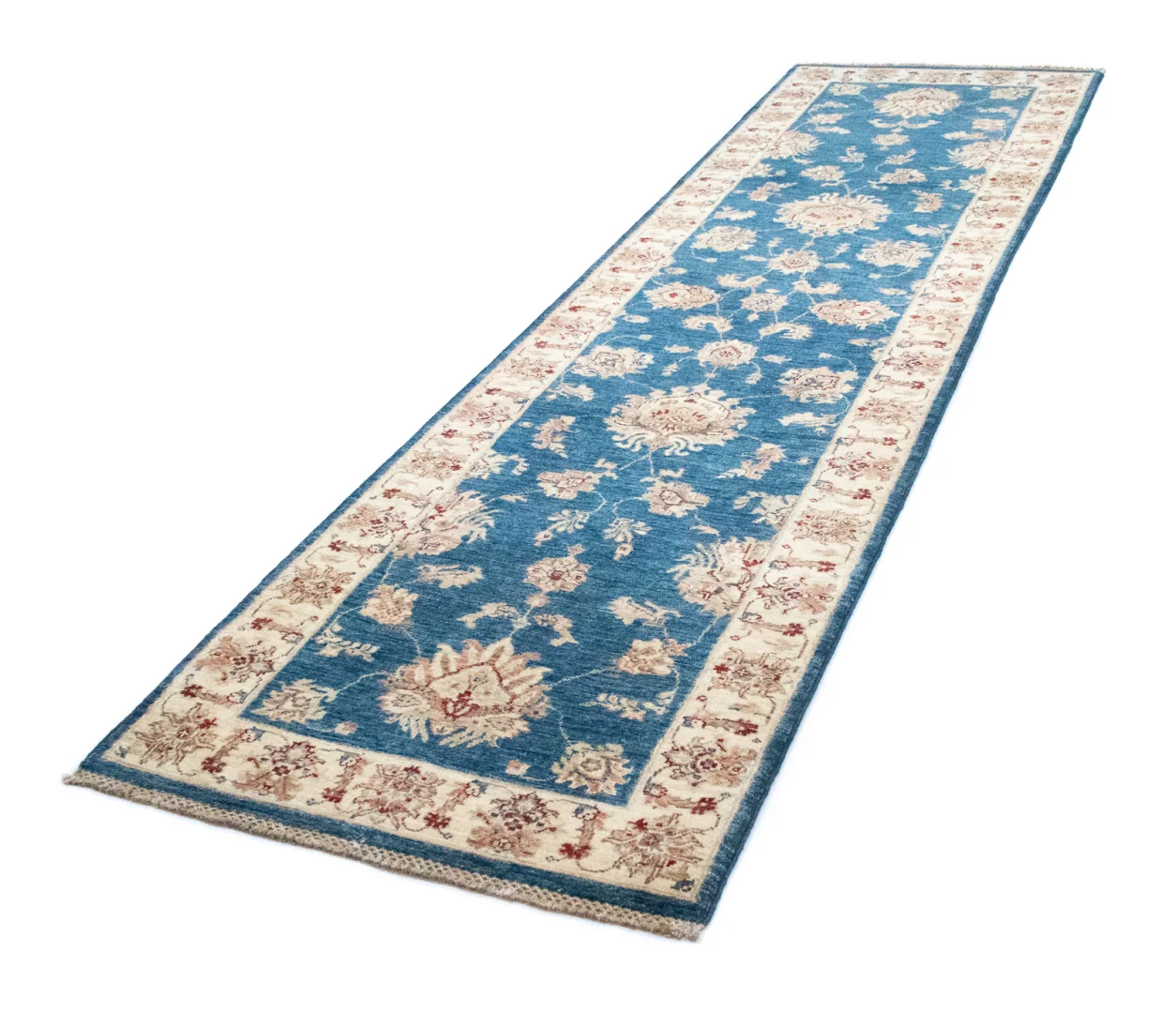
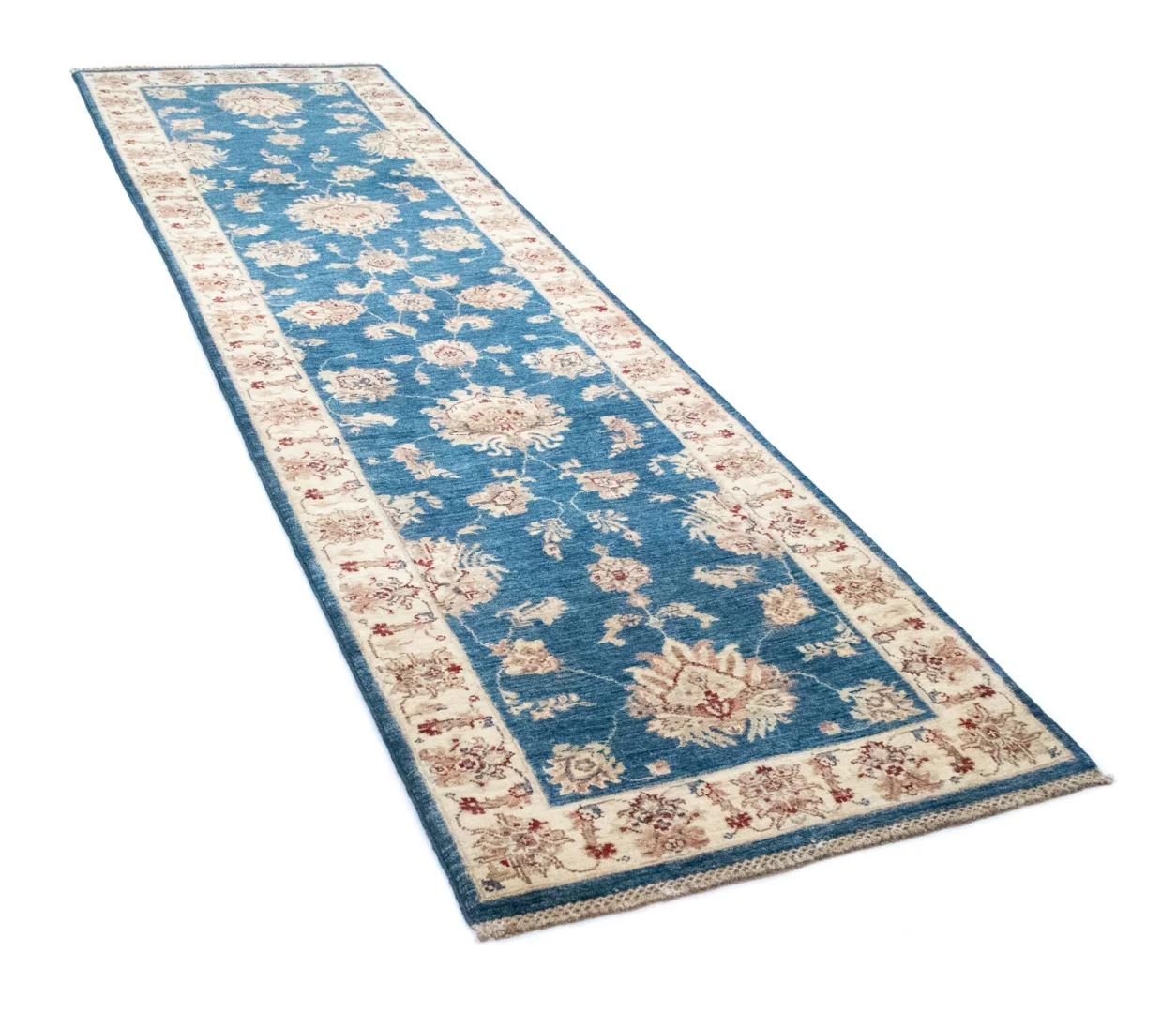
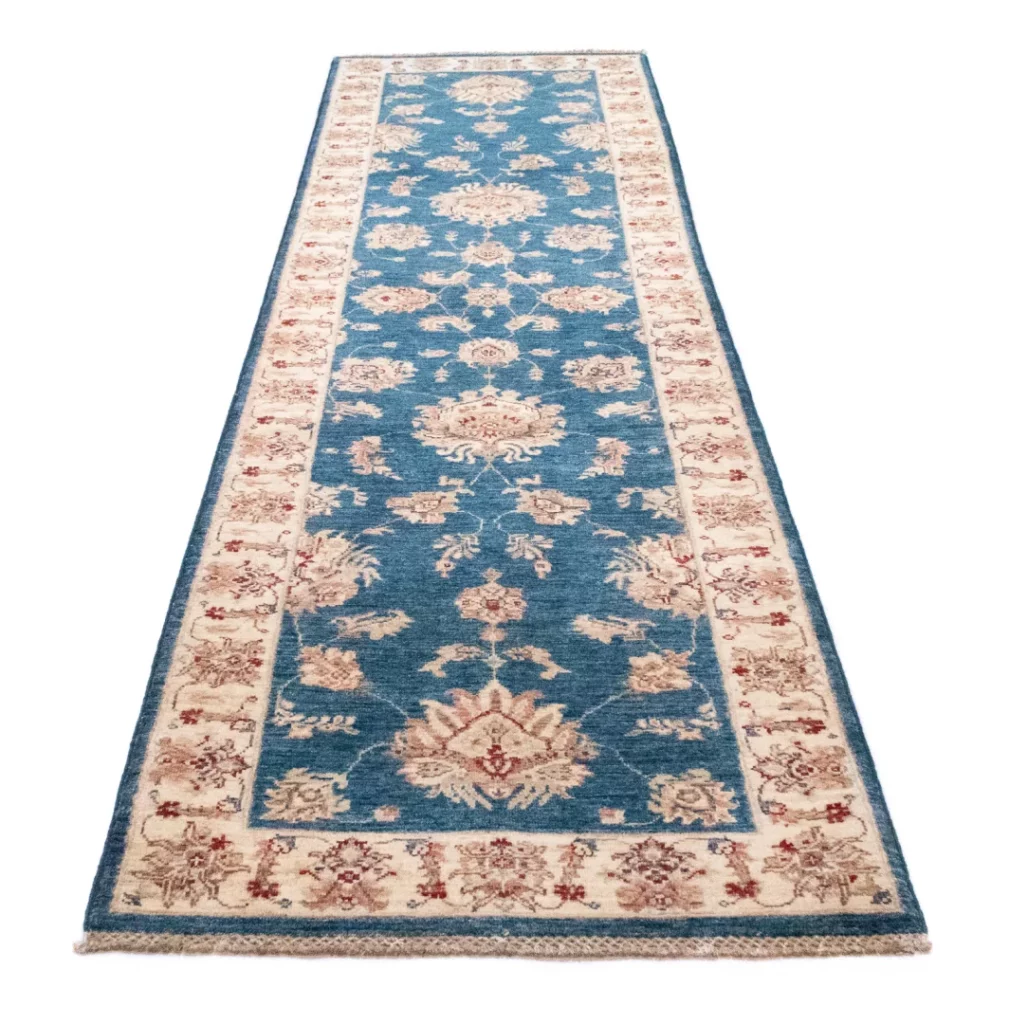
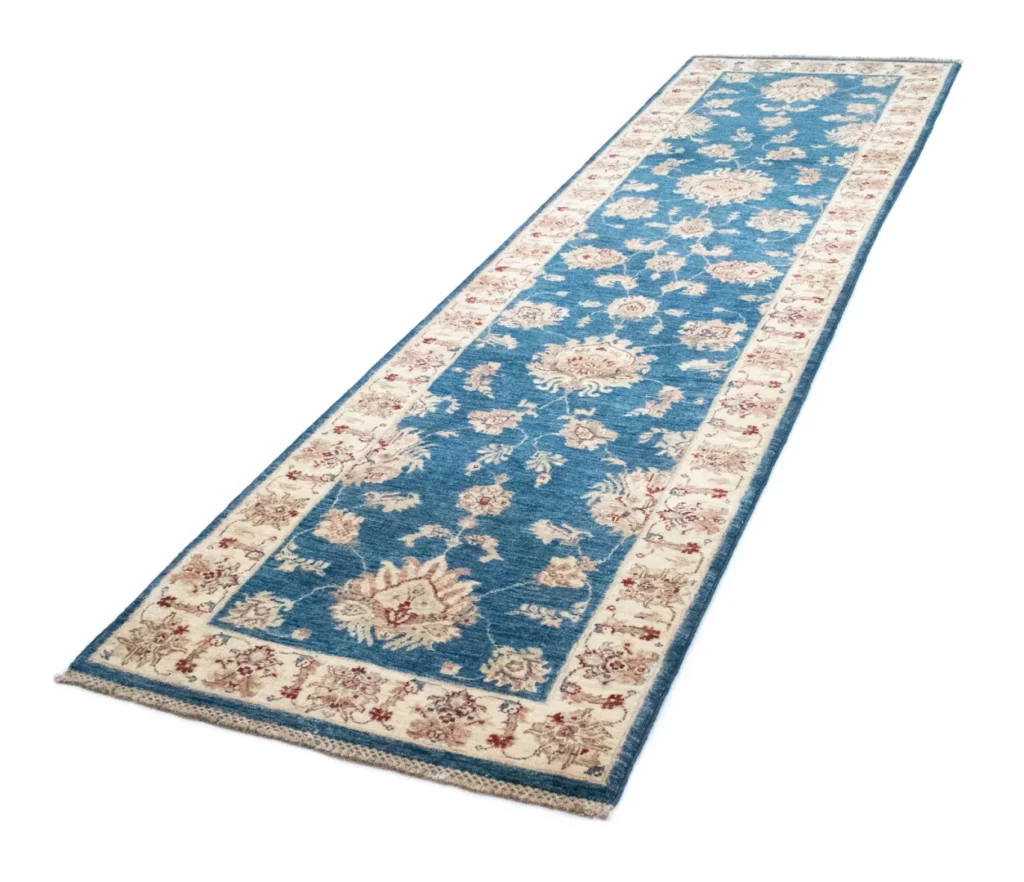
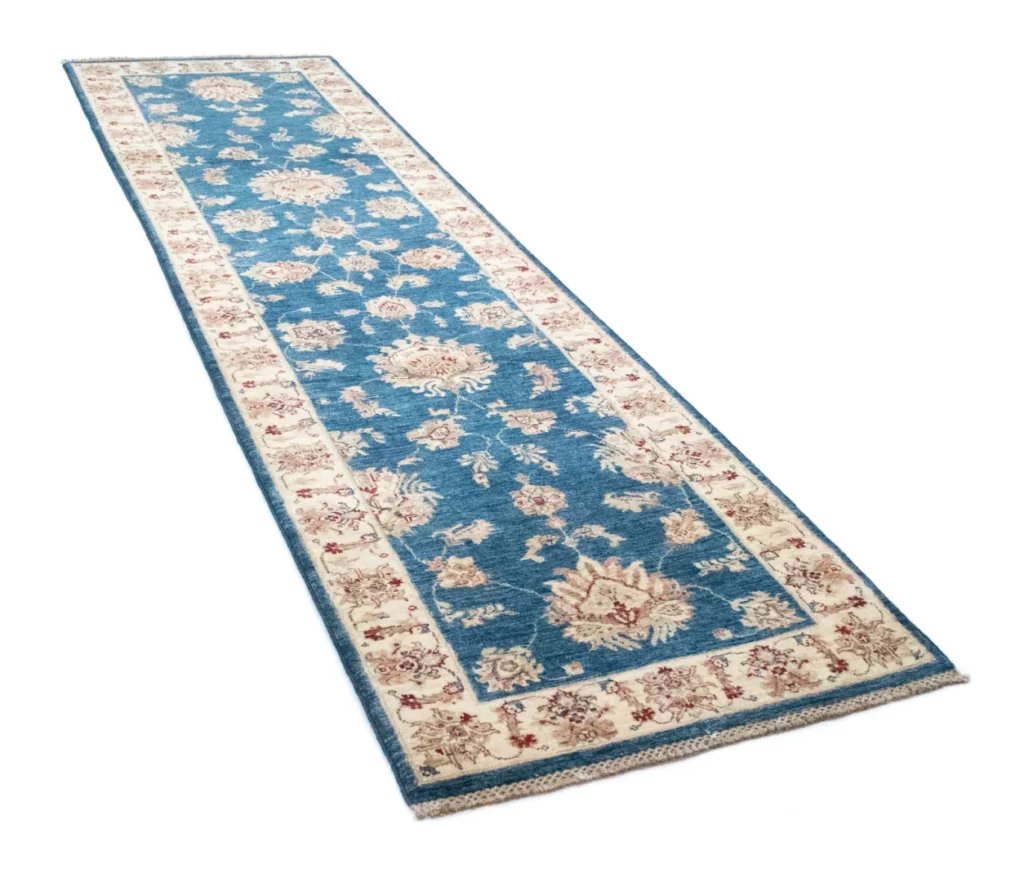
This rug is described as having varied colours and designs. Its stone-washed finish gives the palette a softer and slightly faded appearance. The treatment affects the visual intensity of the colours while leaving the basic design language in place. Tones may therefore seem more subdued, and transitions between adjacent areas can appear gentler. This muted effect is closely associated with many Ziegler-style rugs.
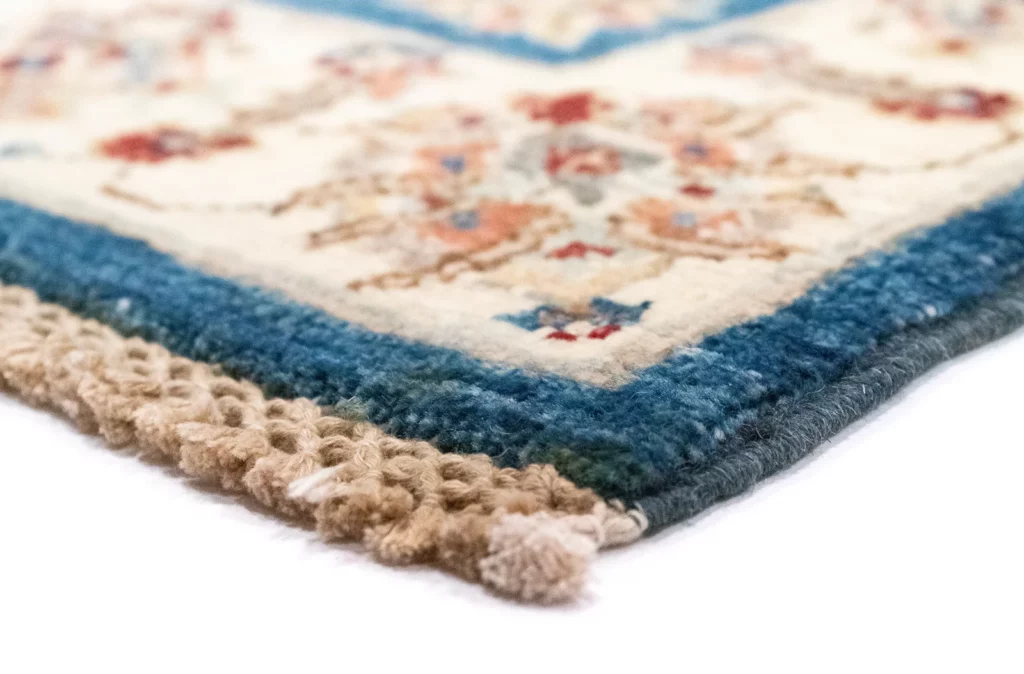
Many traditional rug designs are organised through a central field and one or more surrounding borders. The field holds the main pattern, while the border frames it and creates a visual edge. Depending on the design, borders may contain vines, blossoms, repeated geometric units or stylised boteh forms. No specific motif name is supplied for this rug. Its pattern is described by the stated variety of colours and designs and by the floral and geometric character of the Ziegler tradition.
In a hand-knotted rug, pattern is not applied as a separate printed layer. It is created through the sequence of knots and the selection of coloured yarns. This gives each contour a textile structure and allows the design to be read through both colour and pile. A dense knotting structure supports detailed drawing and more gradual changes between shades. The wool pile adds depth and a soft tactile connection between the separate areas of the composition.
The stone-washed appearance influences the balance of the whole design. Stronger tones can look more restrained, while lighter shades may blend into a calmer overall field. Floral details then appear decorative without being overly sharp, and geometric lines can retain their order while taking on a softened character. This balance helps explain why Ziegler designs can relate to traditional interiors as well as more contemporary settings.
Floral elements introduce organic movement, and geometric elements make the arrangement easier to read. Their combination gives the style a broad decorative range. The precise impression of an individual hand-knotted rug depends on the relationship between its knotting, pile direction, colour placement and finish. Small variations arising from manual work are part of the making process and distinguish a hand-knotted textile from a mechanically uniform surface.
The runner format is generally suited to compositions that can guide the eye along a narrow or elongated area. It may be used in a hallway, passage or other transitional zone, and it can also function as a textile accent in a living room or bedroom. The suitability of a particular placement depends on the room’s furnishings, colours and use. These are general applications of a runner and do not add facts about the rug’s origin.
Special Features
The notable features of this rug are its hand-knotted production in Pakistan, its high-quality wool pile, its stated knot density and its stone-washed finish. It is new and made as a runner. The design is described through varied colours and designs, with the Ziegler tradition linking floral and geometric elements. The stone wash gives the surface a soft and slightly faded colour effect.
As a runner, the rug is generally suitable for elongated areas such as hallways, passages or narrow parts of a room. It can also be used as a textile accent in a living room or bedroom, depending on the surrounding interior. Regular vacuuming is recommended for care, with professional cleaning when necessary. Direct sunlight should be avoided because prolonged exposure can encourage the colours to fade.
FAQ
What makes this Ziegler Oriental rug distinctive?
Its distinctive features are hand-knotting in Pakistan, a pile of high-quality wool, the specified knot density and a stone-washed finish. The rug combines a detailed textile structure with varied colours and designs. Floral and geometric elements belong to the Ziegler design tradition, while the stone wash gives the colours a soft, gently faded appearance. The piece is new and made as a runner.
How should I care for a Ziegler rug?
The rug should be vacuumed regularly so that dust and loose dirt do not remain in the pile. Professional cleaning is recommended when more intensive cleaning is needed. Direct sunlight should be avoided because it can contribute to fading. Gentle, consistent care helps maintain the wool pile and the colour effect created by the stone-washed finish.
Where can a Ziegler runner be used?
A Ziegler runner is generally suitable for elongated areas such as hallways, passages and narrow room sections. It can give a transitional space a clear textile structure and may also serve as an accent in a living room or bedroom. Whether it suits a particular setting depends on the existing furnishings, the surrounding colours and the way the space is used.
To provide the best experiences, we use technologies like cookies to store and/or access device information. Consenting to these technologies will allow us to process data such as browsing behavior or unique IDs on this site. Not consenting or withdrawing consent, may adversely affect certain features and functions.
Functional Always active
The technical storage or access is strictly necessary for the legitimate purpose of enabling the use of a specific service explicitly requested by the subscriber or user, or for the sole purpose of carrying out the transmission of a communication over an electronic communications network.
Preferences
The technical storage or access is necessary for the legitimate purpose of storing preferences that are not requested by the subscriber or user.
Statistics
The technical storage or access that is used exclusively for statistical purposes.The technical storage or access that is used exclusively for anonymous statistical purposes. Without a subpoena, voluntary compliance on the part of your Internet Service Provider, or additional records from a third party, information stored or retrieved for this purpose alone cannot usually be used to identify you.
Marketing
The technical storage or access is required to create user profiles to send advertising, or to track the user on a website or across several websites for similar marketing purposes.

 SECURE PAYMENT
 SHIPPING PARTNERS


