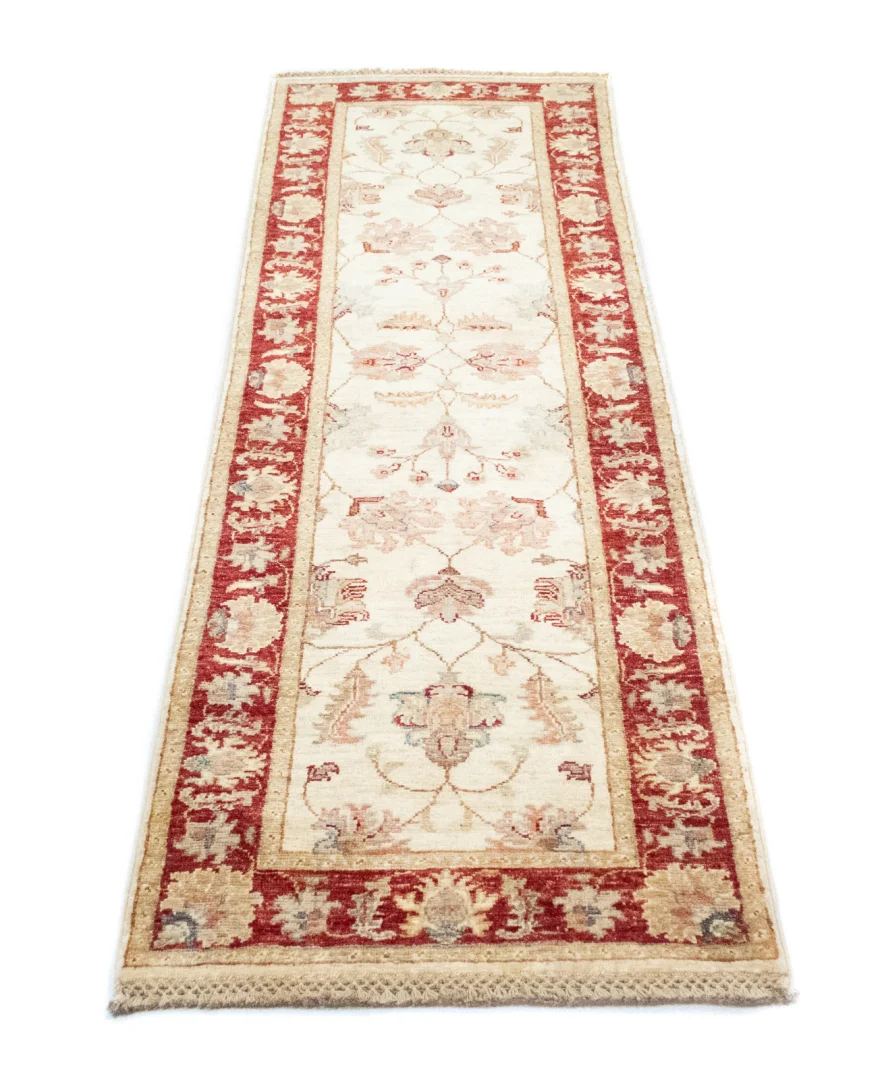
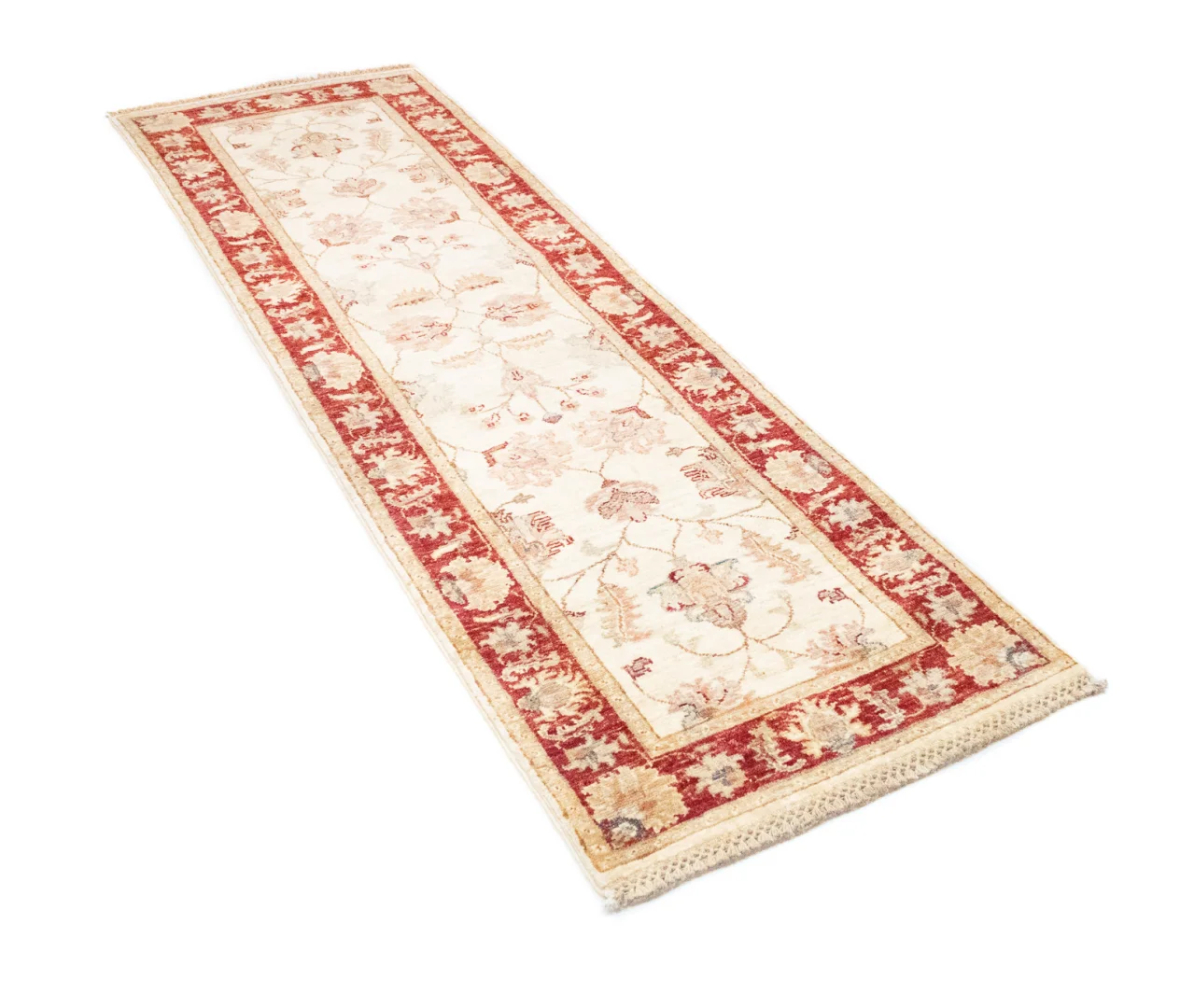
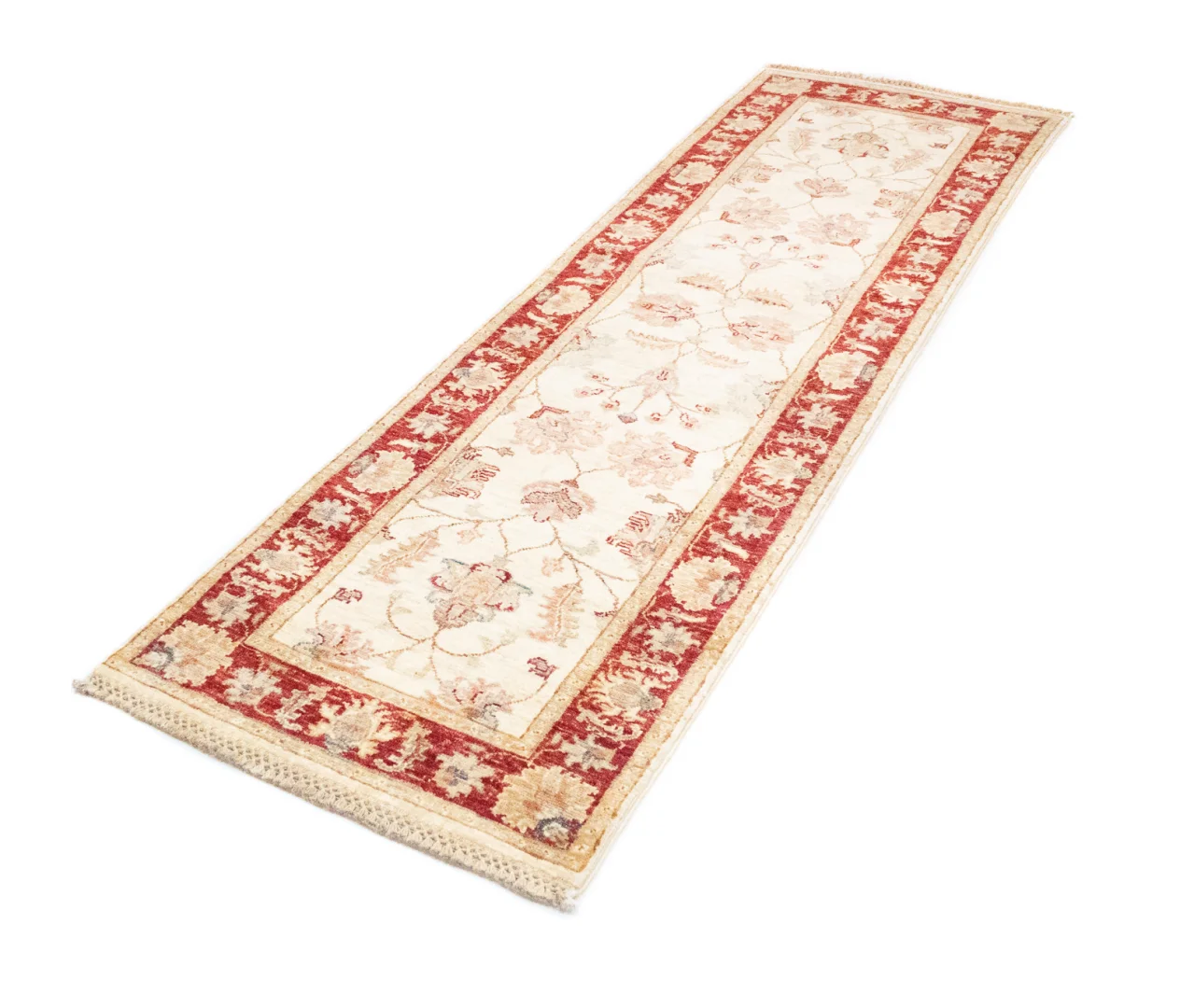
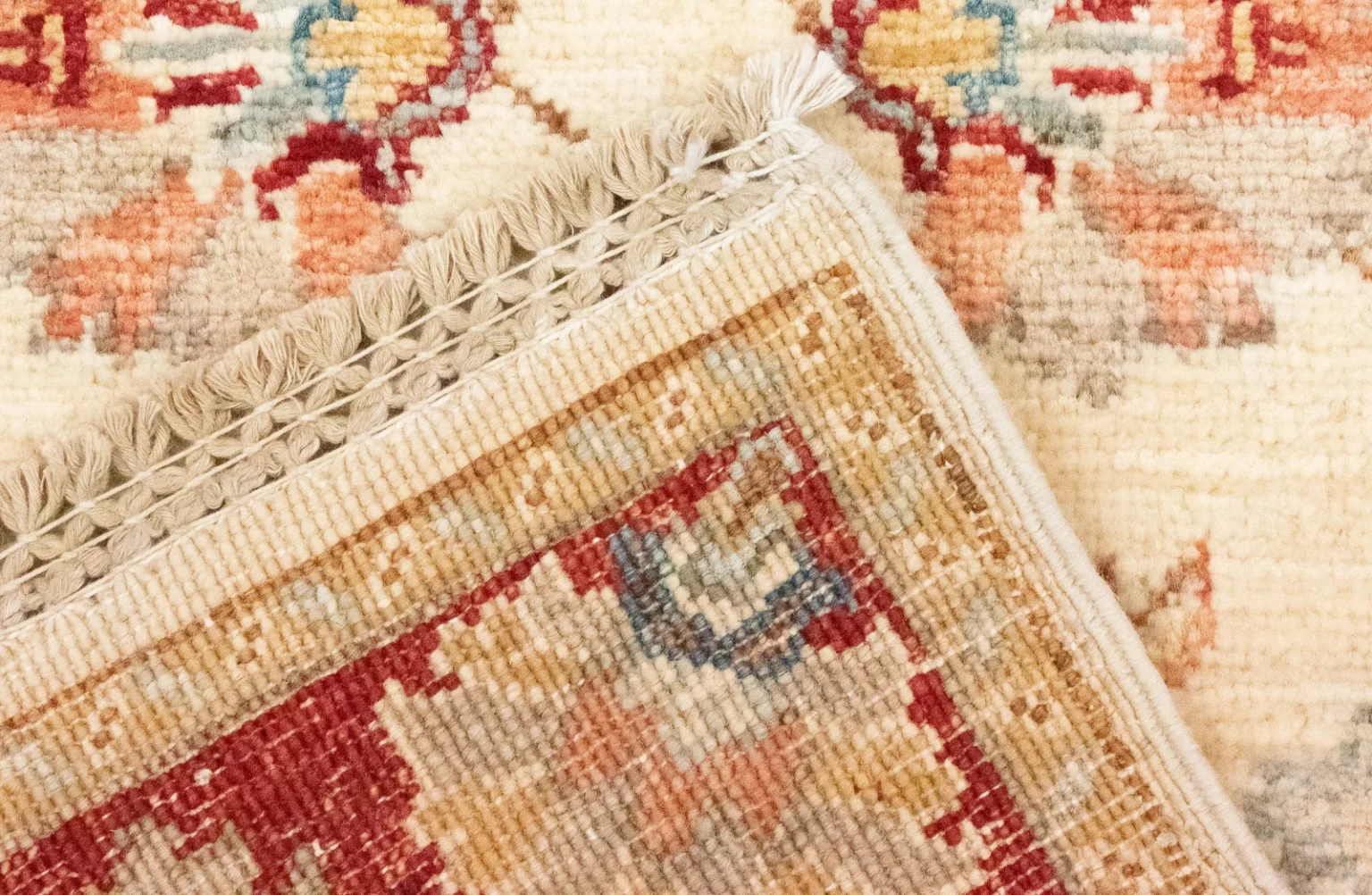
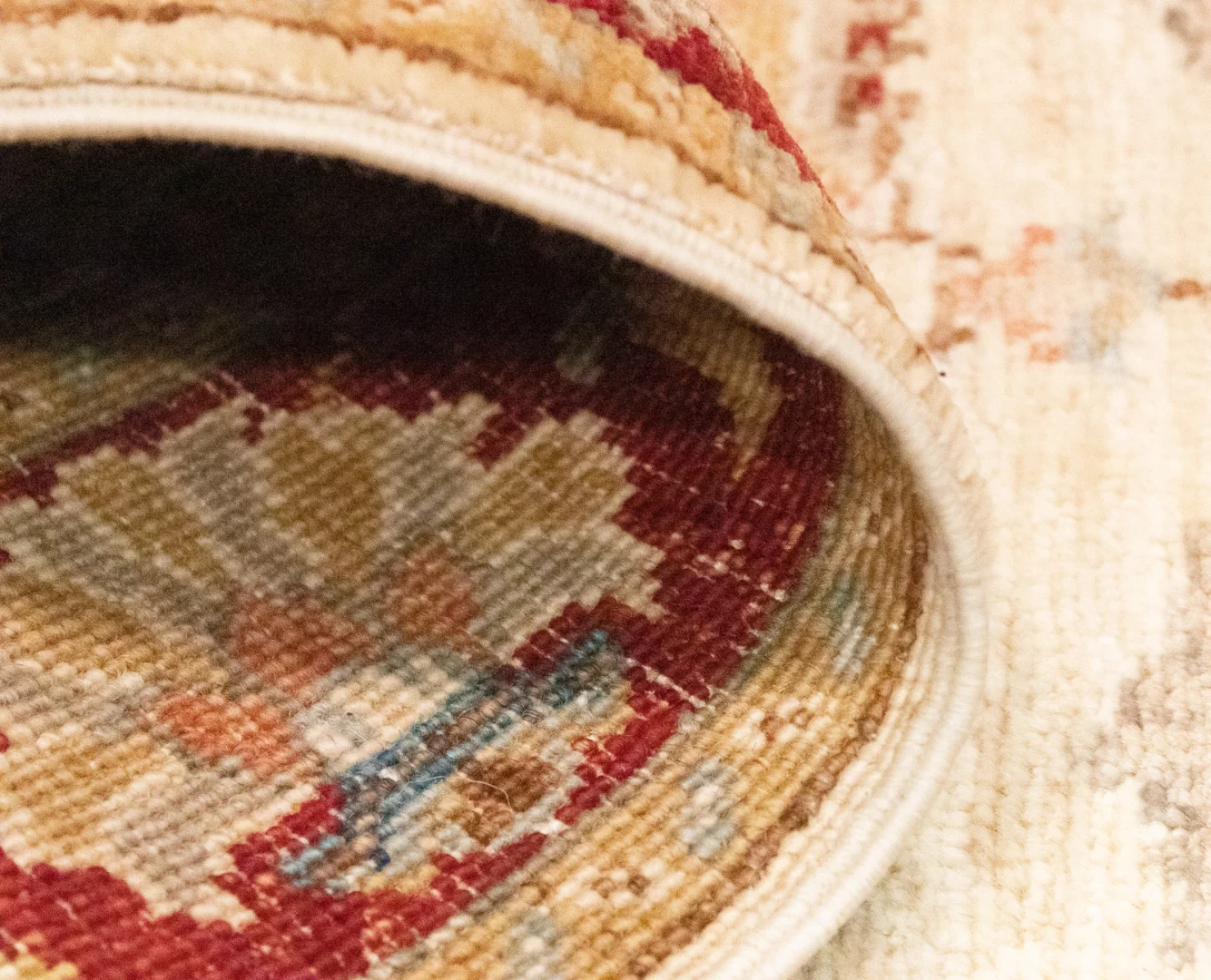
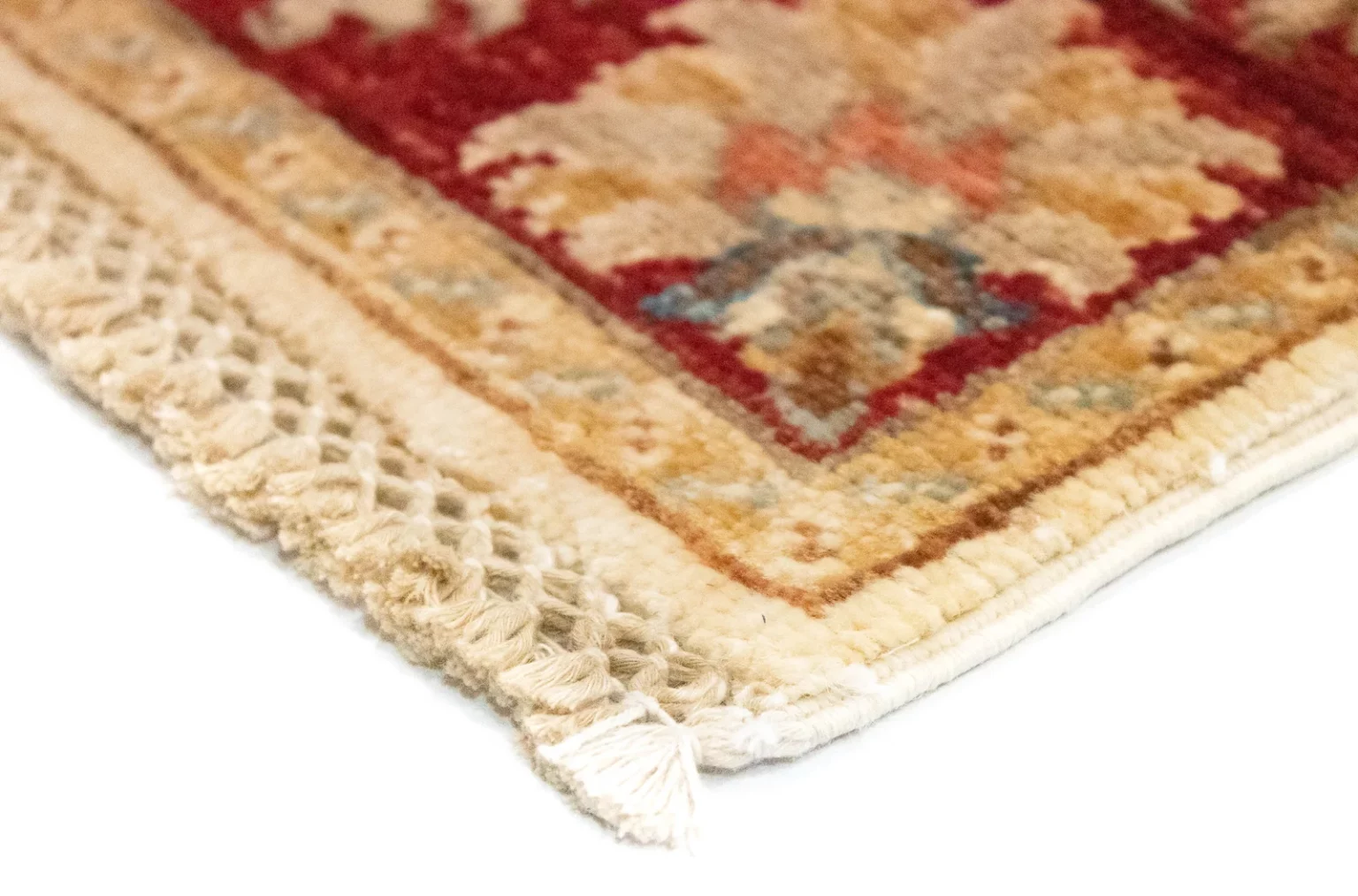
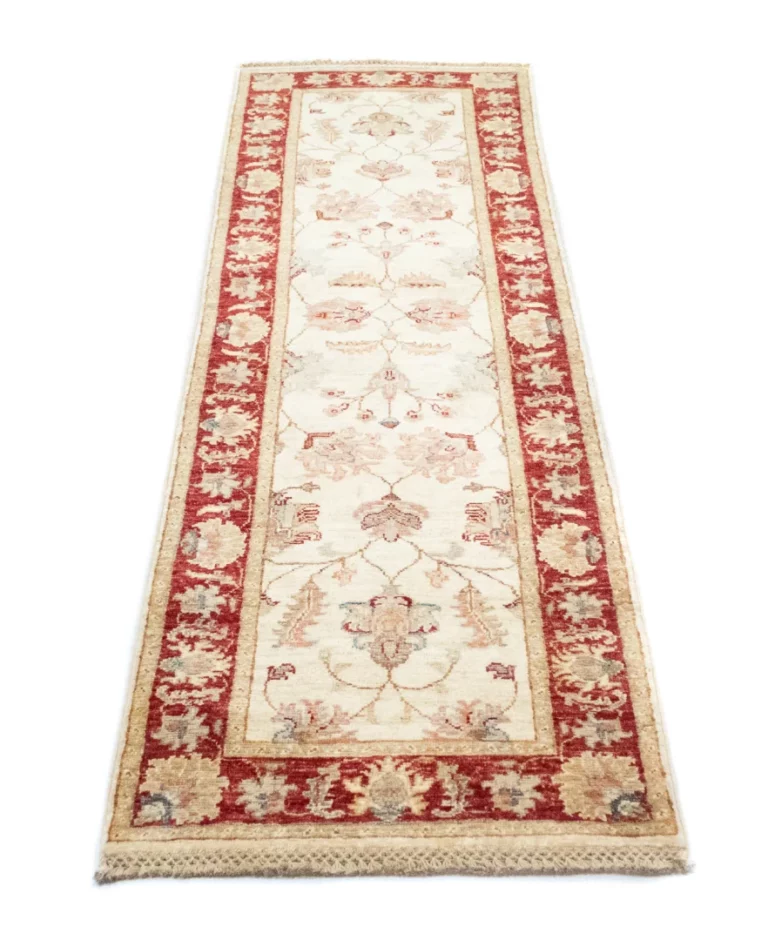
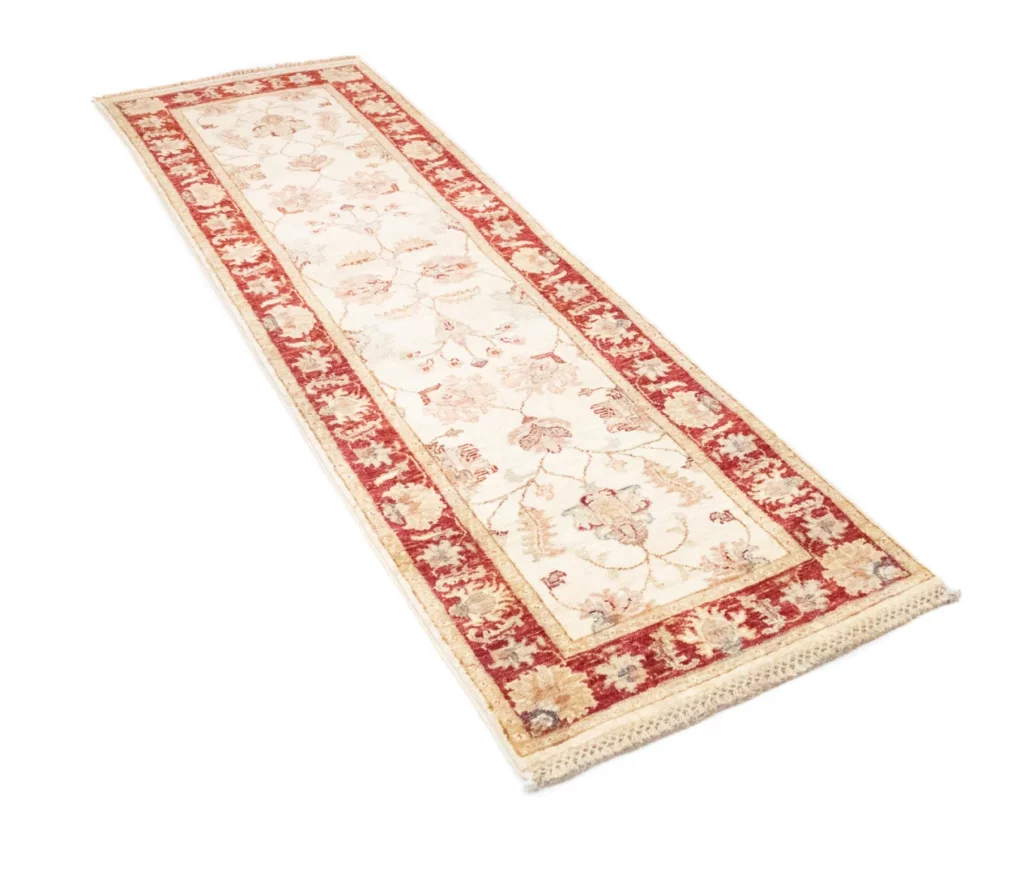
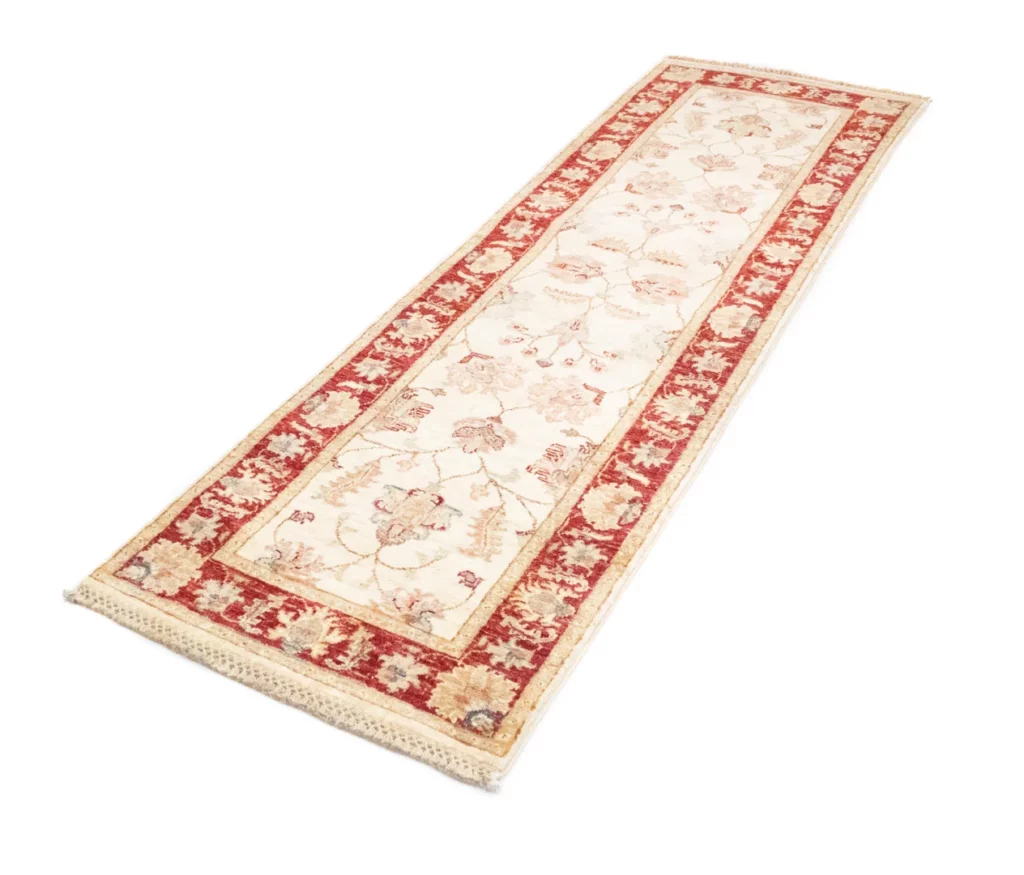
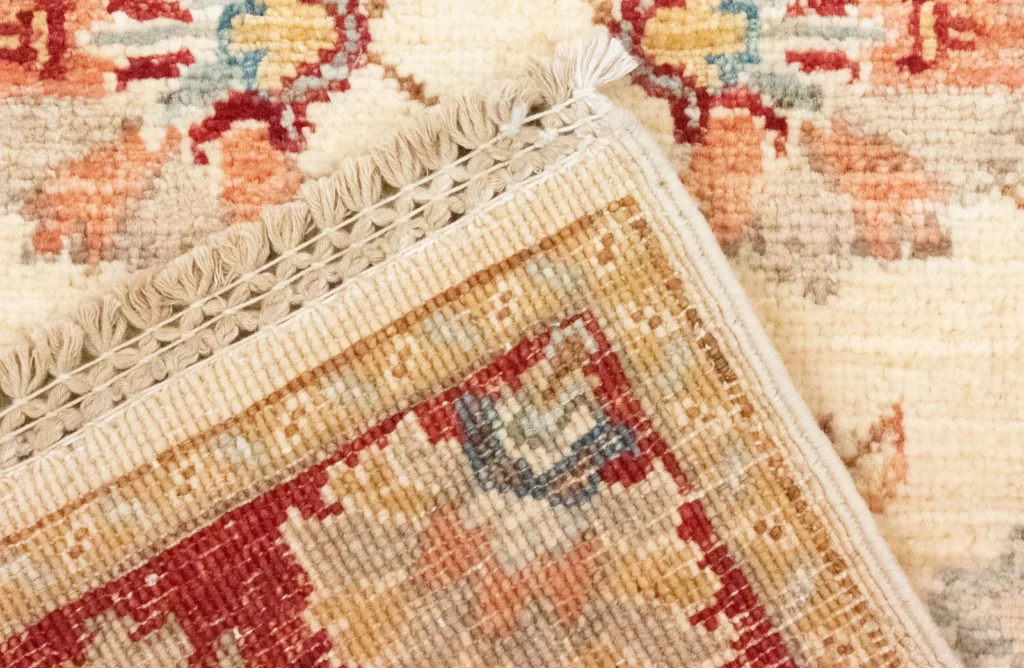
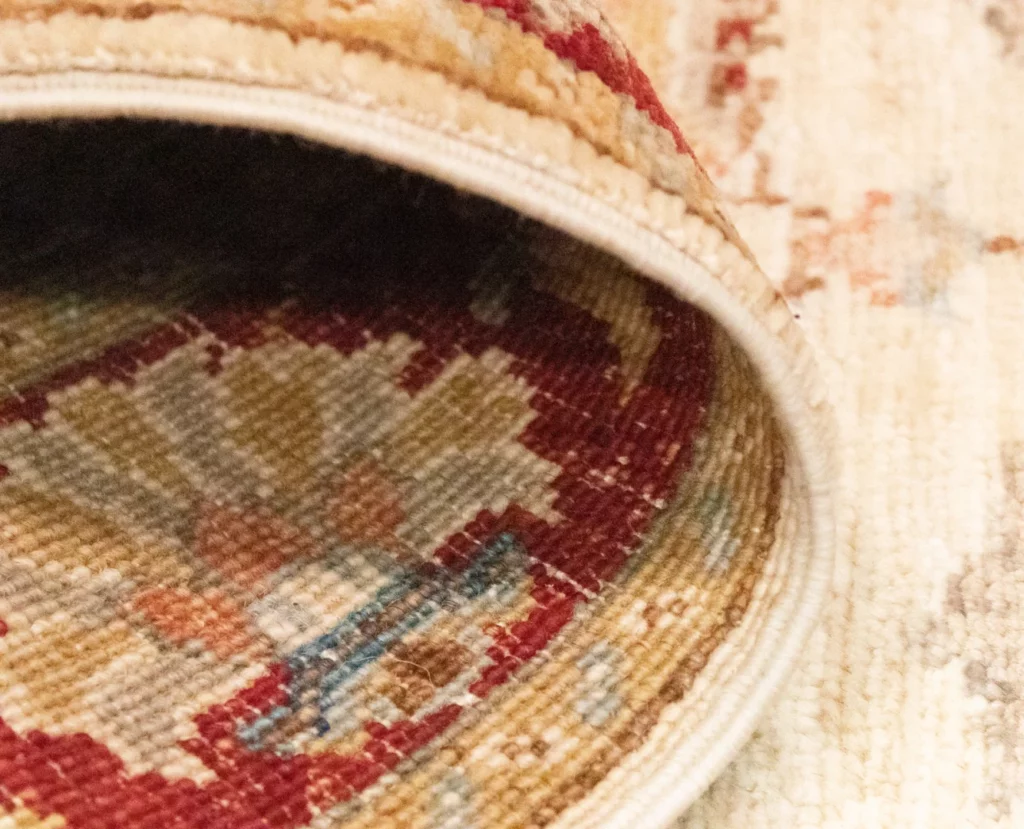
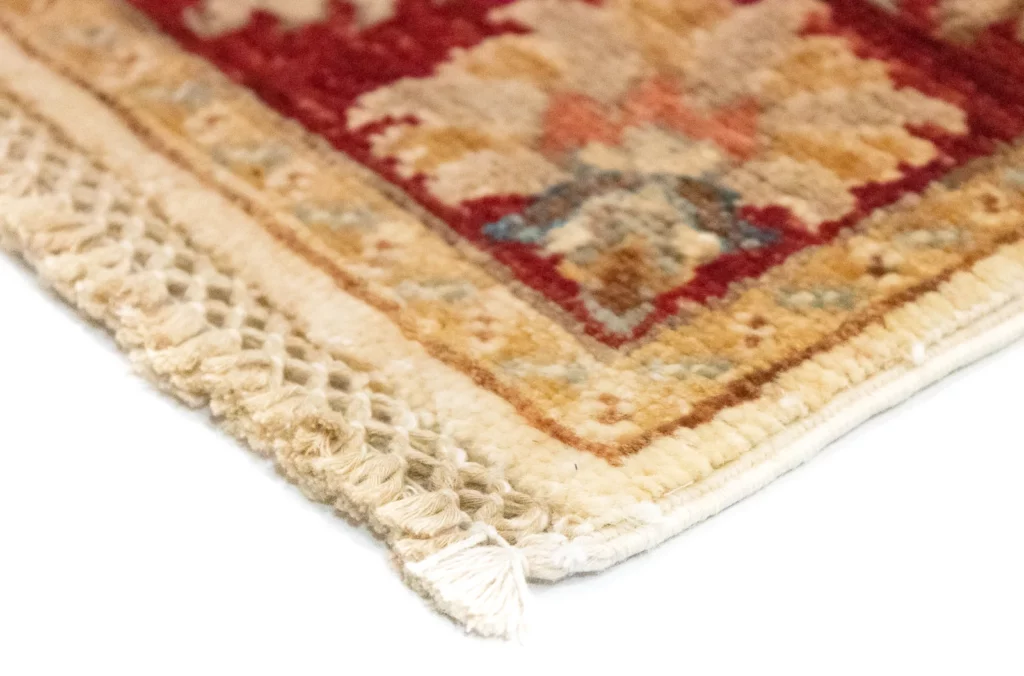
This Ziegler Oriental rug is hand-knotted and made from high-quality wool. Its construction combines established knotting practice with the visual language associated with Ziegler rugs. Each knot is worked individually into the textile structure, giving the surface the direct character of hand production. Wool forms the pile and therefore determines much of the rug’s tactile quality and visible texture.
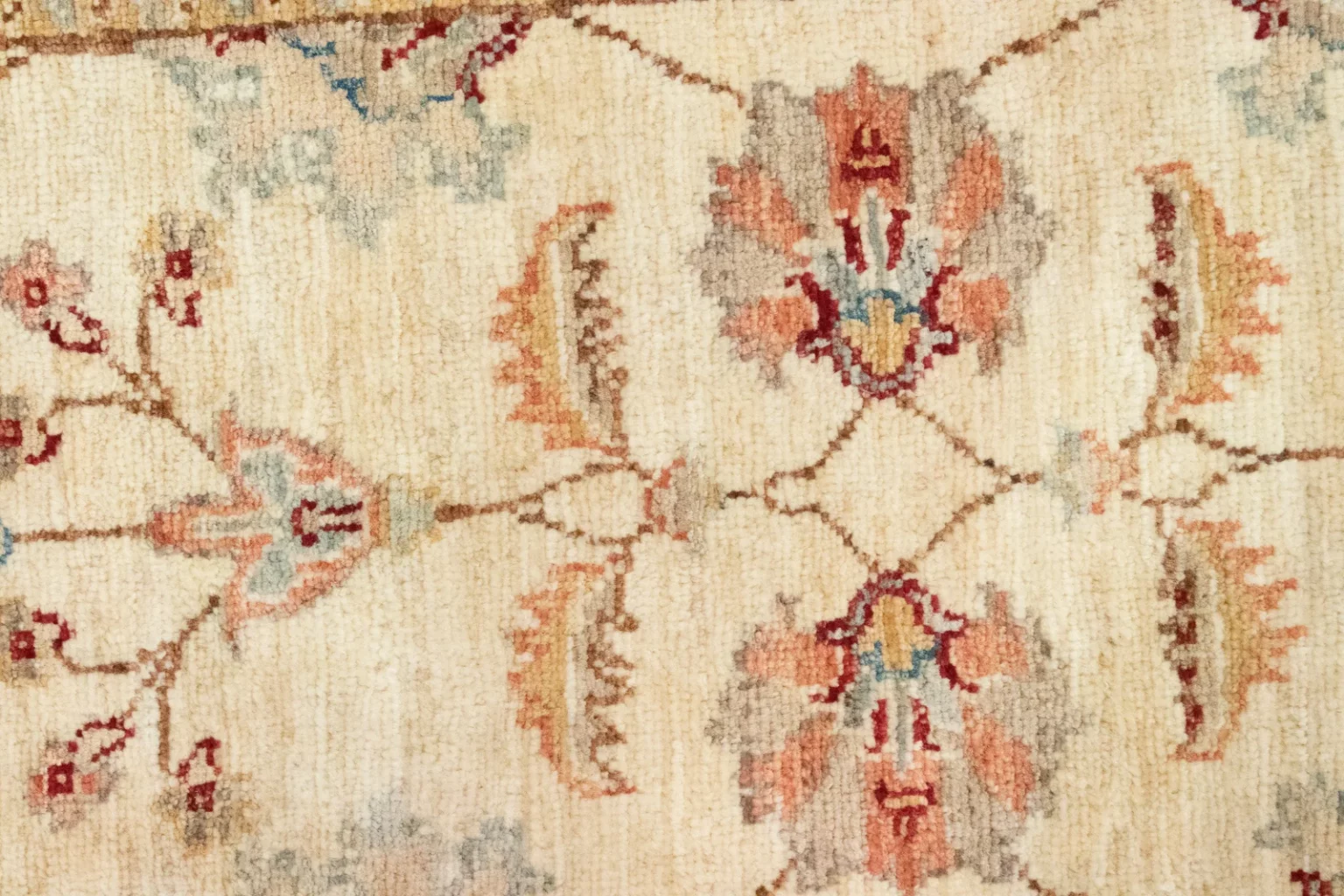
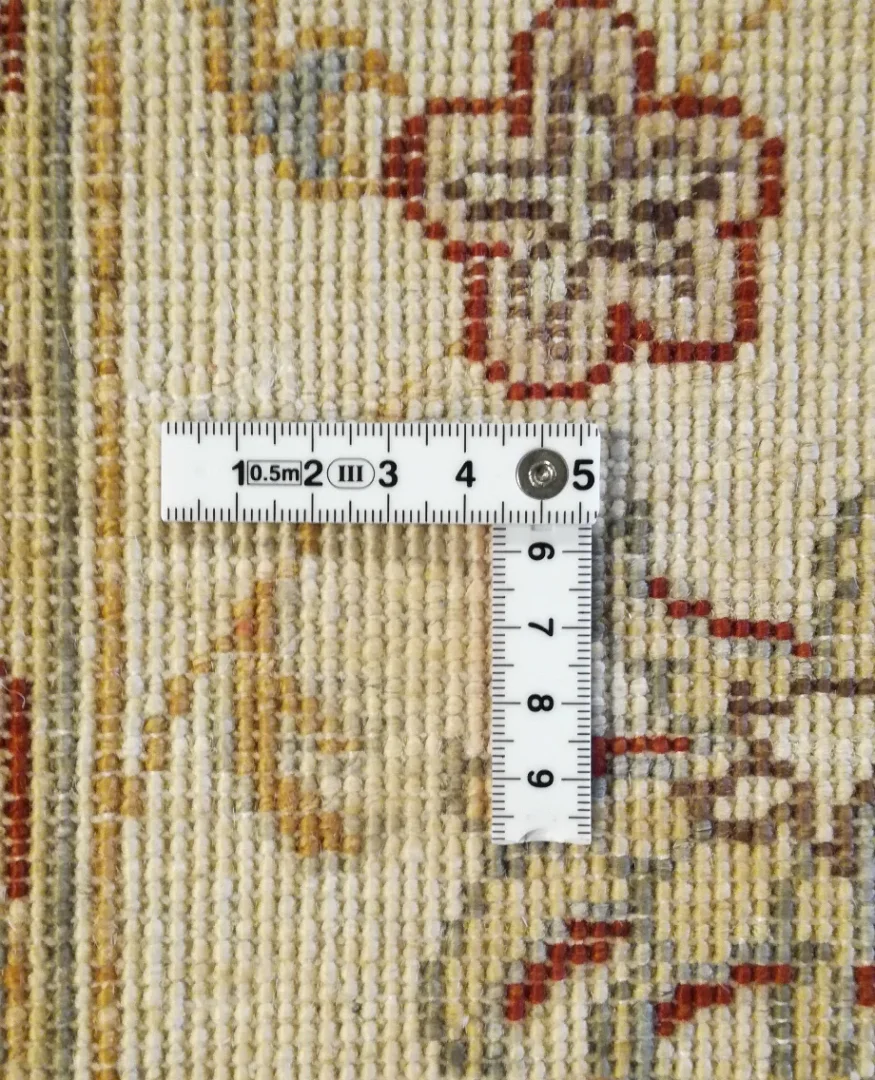
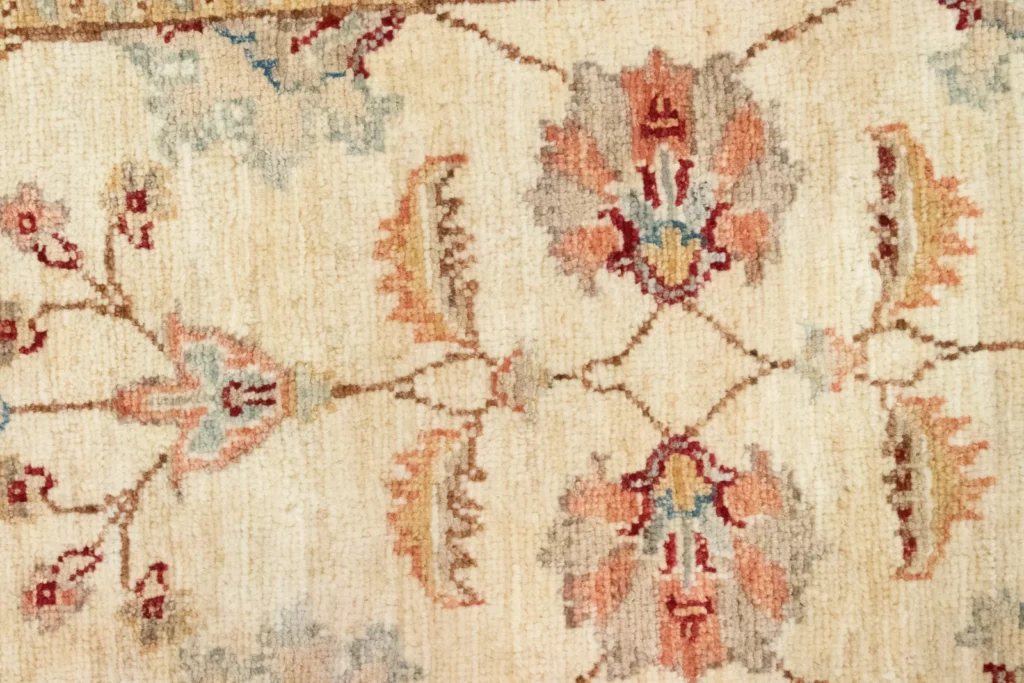
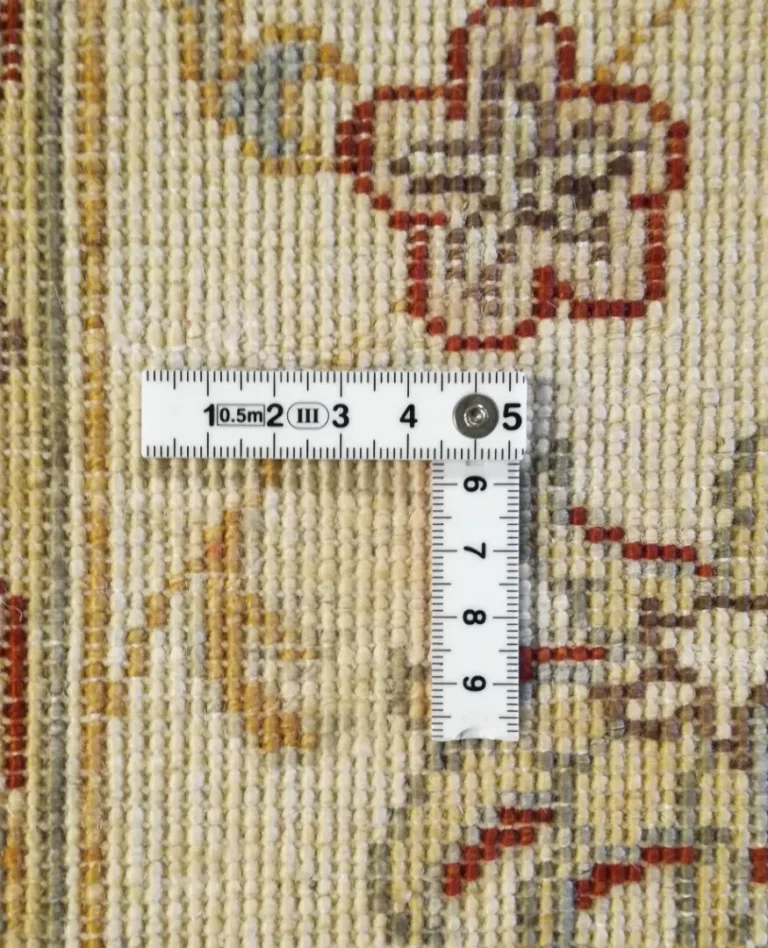
The stated knot density is approximately 200,000 knots per square metre. This dense construction supports a finely articulated surface on which floral and geometric elements can be drawn with distinction. The pattern is carried by the sequence of coloured knots rather than by an industrial print. Hand knotting also means that this rug is a one-off textile object rather than an identical factory reproduction.
A special stone-washing treatment gives the rug its faded colour effect. This process softens the visual intensity of the colours and creates the slightly darkened appearance described for the piece. Stone washing is one of the defining visual treatments associated with the Ziegler look. It affects not only the way the colours are seen but also contributes to the pleasant handle mentioned in the product description.
Origin and Tradition
Ziegler rugs belong to a tradition that began in the nineteenth century. The name refers to a particular design and method of presentation within the wider world of Oriental rugs. Hand craftsmanship, natural wool and a restrained colour character are central to this tradition. Classical carpet motifs are combined with a composition intended to appear balanced rather than sharply contrasted.
The Ziegler tradition is commonly connected with the Sarough/Arak region and its rich carpet history. Sarough and Arak are recognised centres of Persian carpet culture, where floral compositions, careful drawing and measured colour schemes have played an important role. This background helps explain the design vocabulary associated with Ziegler rugs. It must not, however, be confused with the stated origin of this particular rug: this rug comes from Pakistan and Afghanistan and is therefore classified as an Oriental rug.
Pakistan and Afghanistan each have their own established weaving traditions, in which Oriental designs and inherited techniques continue to be used. A Ziegler rug made in these countries can adopt the Ziegler design language while also reflecting the working practices of its actual place of manufacture. In this sense, Ziegler identifies the style, while Pakistan and Afghanistan are the countries of origin given for this individual rug.
The history of Oriental rugs includes the movement of patterns, colours and technical knowledge across regional boundaries. Weavers reinterpret familiar motifs and place them in new local contexts. A Ziegler pattern can therefore appear in different countries without every example coming from the same region. For this rug, Pakistan and Afghanistan are the relevant origin details. The association with Sarough/Arak describes the historical design background and does not replace the stated origin.
Hand-knotted rugs also record a relationship between material knowledge, time and inherited working methods. Wool, knot density and finishing treatment all contribute to the character of the completed textile. In a Ziegler rug, these elements meet a design tradition built around softened colour, botanical drawing and geometric organisation. The result is a form of Oriental carpet that joins historical reference with a deliberately subdued surface treatment.
Design and Pattern
The pattern of this rug combines floral and geometric designs. Floral elements introduce organic lines and botanical movement, while geometric forms provide structure and clearly defined intervals. The two vocabularies work together rather than appearing as unrelated decorations. Their combination is a central feature of the Ziegler design described for this piece.
Floral motifs may be understood as stylised leaves, blossoms and vines. In a hand-knotted rug, these shapes are created through the placement of differently coloured knots, not through a smooth printed image. Small variations in line and contour are therefore part of the making process. Geometric components give the composition a measured rhythm, allowing repetition and variation to exist within the same design.
The palette is described as consisting of soft, earthy tones. Instead of producing sharp colour contrasts, such a palette brings the individual motifs into a quieter overall arrangement. The special stone washing reinforces this quality by giving the colours a faded and slightly darkened appearance. The treatment is part of the rug’s surface character and is not merely an added decorative effect.
Stone washing can soften the relationship between foreground and background. Colour transitions appear less forceful, and the drawing may acquire a muted, settled appearance. At the same time, the hand-knotted structure remains visible. The tactile quality of the wool adds a physical textile dimension to the washed colour effect, so that the design is experienced through both sight and touch.
Ziegler designs are often placed in a broad range of interior settings because floral drawing, geometric order and earthy colour can be read in different ways. The style can refer to traditional carpet art in a classic room or introduce a textile counterpoint in a more restrained setting. This is a general observation about the design type, not a claim about a particular room. For this one-off rug, the relevant features are its floral and geometric pattern and the faded effect produced by stone washing.
Other recognised Oriental carpet traditions demonstrate the range of designs found in this field. Gabbeh rugs are associated with simple, powerful forms and lively colours. Tabriz rugs are known for detailed drawing and complex compositions. Nain and Kashan are also connected with distinctive designs and a strong carpet-making reputation. These examples are not alternative names for this rug. The piece described here is a Ziegler rug with floral and geometric decoration.
Special Features
The special features of this one-off rug include its hand-knotted construction, its pile of high-quality wool and the stated knot density of approximately 200,000 knots per square metre. The special stone washing is another defining characteristic. It produces the faded colour effect and gives the surface its slightly darkened appearance. This makes the colours look different from those of an untreated, more vivid surface.
The combination of wool, dense knotting and stone washing defines the rug’s textile character. Wool provides a natural handle, while the hand-built construction supports the drawn pattern. The condition is described as good. Together with the Ziegler design and the stated origin in Pakistan and Afghanistan, these details identify the piece as a hand-knotted Oriental rug.
FAQ
How should I care for this Ziegler Oriental rug?
The rug should be vacuumed regularly using a gentle approach that does not place unnecessary strain on the wool surface or hand-knotted structure. Direct sunlight should be avoided because it can alter the appearance of a rug’s colours. If a stain occurs, it should be treated immediately with a damp cloth and a mild cleaning agent. Vigorous rubbing and harsh products are not part of the care method described here and should not replace the gentle treatment specified for the rug. Stone washing contributes to the piece’s particular appearance, so care should aim to preserve both the faded colour effect and the tactile quality of the wool.
Where do the materials for Ziegler rugs come from?
The materials used for Ziegler rugs come mainly from the Persian region, where high-quality wool and silk are used. High-quality wool is the material specified for this rug. Silk is not stated as a component of this particular piece and is therefore not listed as one of its materials. Natural fibres are part of the wider tradition of Oriental carpet making and give the surface its own textile character. The material statement for this rug is limited to its wool pile. Its origin is given as Pakistan and Afghanistan, and that country information should be kept distinct from the broader material tradition.
What sizes are available for Ziegler rugs?
Ziegler rugs are made in a range of sizes. The general range extends from small runners to large area rugs, allowing the type to be used in different rooms and furnishing arrangements. This general range does not describe the dimensions of any particular one-off piece. The rug presented here is identified as a runner. Its individual size is provided in the product information but is not repeated in this long description. The specific size attached to the offer therefore remains the relevant reference for this rug.
To provide the best experiences, we use technologies like cookies to store and/or access device information. Consenting to these technologies will allow us to process data such as browsing behavior or unique IDs on this site. Not consenting or withdrawing consent, may adversely affect certain features and functions.
Functional Always active
The technical storage or access is strictly necessary for the legitimate purpose of enabling the use of a specific service explicitly requested by the subscriber or user, or for the sole purpose of carrying out the transmission of a communication over an electronic communications network.
Preferences
The technical storage or access is necessary for the legitimate purpose of storing preferences that are not requested by the subscriber or user.
Statistics
The technical storage or access that is used exclusively for statistical purposes.The technical storage or access that is used exclusively for anonymous statistical purposes. Without a subpoena, voluntary compliance on the part of your Internet Service Provider, or additional records from a third party, information stored or retrieved for this purpose alone cannot usually be used to identify you.
Marketing
The technical storage or access is required to create user profiles to send advertising, or to track the user on a website or across several websites for similar marketing purposes.

 SECURE PAYMENT
 SHIPPING PARTNERS


