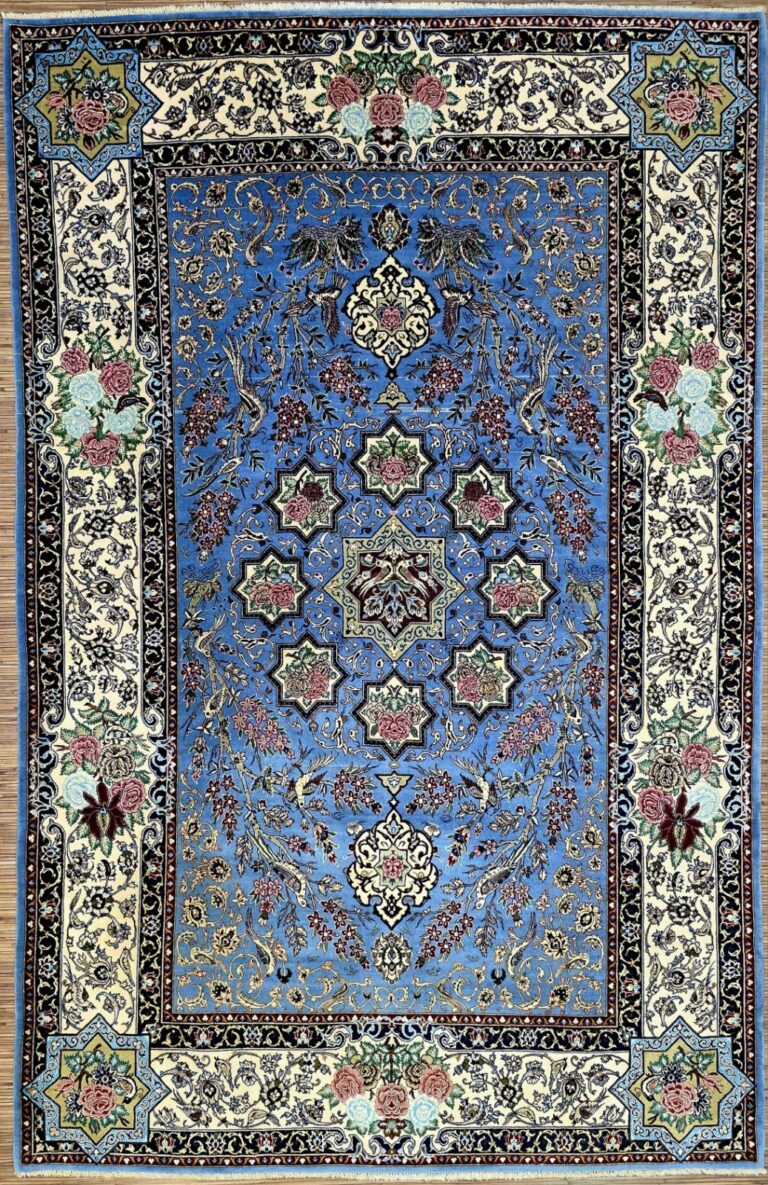
Oriental Rug Peking 250 x 250 cm Wool Hand-knotted
€ 3195
Hand-knotted Peking Oriental rug | Knot density: High | Material: 100% wool pile | Size: 250 x 250 cm | Pattern: Royal Peking, Art Deco | Condition: New without label
This Peking Oriental rug is hand-knotted and has a pile made from 100% wool. Hand-knotting is a deliberate textile process in which individual knots are worked into a prepared foundation to build the surface and design. The pattern is therefore created progressively rather than applied as a single printed image. The rug is described as having a high knot density. In hand-knotted rugs, a high knot density can support a more controlled rendering of lines, shapes and ornamental transitions.
Wool has a long-established role in the production of Oriental rugs. The natural fibre can be spun, coloured and worked into a resilient pile, making it suitable for traditional knotting methods. Once the knots have been placed, the pile is brought into an even surface through further finishing work. This rug has a stated pile height of 15 mm. Pile height refers to the visible wool surface above the foundation and forms part of the rug’s construction.
The craft of knotting brings together fibre, foundation and design. A knot is tied around the structural elements of the rug, and rows of knots gradually form the finished textile. The arrangement of colours and knots determines how the design appears across the surface. The high knot density is one of the recorded technical characteristics of this piece. Its other stated construction details are a hand-knotted technique, a 100% wool pile and a 15 mm pile height.
Origin and Tradition
The rug comes from Peking in China. Also widely known today as Beijing, Peking is one of China’s major historical and cultural centres. Chinese rug production includes several regional traditions, and Peking rugs form part of the broader field of Chinese Oriental rugs. Their identity is connected with Chinese manufacture and design rather than with Persian origin. For that reason, this piece is described as an Oriental rug, not as a Persian rug.
Chinese textile arts developed through contact between court culture, religious traditions, regional crafts and changing decorative tastes. Historical Chinese rugs may draw on symbolic forms, balanced layouts, stylised plants, geometric organisation or restrained border systems. The precise combination varies between workshops, periods and individual designs. Peking occupies an important place in this history because the city served as a centre in which artistic influences and specialist crafts could meet.
Peking rugs should not be treated simply as copies of rugs made in Persia. Chinese weavers developed their own approach to proportion, ornament and the relationship between open ground and decorated areas. Some designs may share broad Asian or international influences, but the place of manufacture remains China. In this case, Peking identifies the stated origin, while Royal Peking identifies the named pattern or design. Keeping those two terms separate gives a more precise description of the rug.
The hand-knotted technique also links the rug to a wider Asian weaving tradition. It requires a prepared foundation, a sequence of individually tied knots and careful control of the pattern as the work progresses. The method can be adapted to different visual languages. In Chinese production, traditional local aesthetics can coexist with modern or internationally recognisable design directions. The technique remains a craft process even when the visual vocabulary is associated with a twentieth-century style such as Art Deco.
Regional names in rug catalogues can refer to a place of manufacture, a design tradition or a commercial pattern name. Here, the source identifies the origin as Peking, China, and separately gives Royal Peking as the pattern. No additional workshop, maker, signature or date is provided. The reliable historical context is therefore the relationship between this stated Chinese origin, the Peking rug tradition and the hand-knotting method used for the piece.
Design and Pattern
The listed pattern is Royal Peking, and the style is Art Deco. The colour is navy blue. These are the documented design characteristics of this individual rug: the Royal Peking designation, an Art Deco classification and a deep blue colour field. No specific medallion, floral arrangement, border or geometric figure is described. The pattern can therefore be presented accurately without assigning additional motifs that are not identified.
Art Deco emerged as an international design movement in the early twentieth century. Its general visual language is associated with order, strong contours, stylised ornament, rhythmic repetition and a deliberate balance between straight and curved forms. In rug design, Art Deco influence may appear through simplified shapes, structured layouts or decorative elements arranged with clear visual discipline. The style label establishes the design direction, but it does not by itself identify every detail of an individual composition.
Royal Peking designs are commonly understood as combining elements of Chinese decorative tradition with a more modern, internationally oriented sense of organisation. Such designs may use carefully controlled fields, symmetry or stylised ornament, depending on the particular interpretation. Each rug remains an individual composition, however. For this piece, the accurate description is limited to the Royal Peking pattern name, its Art Deco style and its navy-blue colour.
Navy blue is a deep and comparatively restrained shade of blue. In an interior, a dark blue textile surface can provide visual weight and a calm background for surrounding furnishings. The way the colour is perceived changes with daylight, artificial lighting, the angle of view and the materials around it. Wool pile can also give a colour a subtly varied appearance because the fibres reflect light in different directions. The stated colour of this rug is navy blue.
A square rug creates a balanced format in which the composition can be read evenly from several directions. Square formats can suit arrangements that benefit from visual symmetry or a defined central area, although no particular central motif or border is specified here. The concrete design information remains the Royal Peking pattern, the Art Deco classification and the navy colour. These details describe the rug without extending the pattern beyond the source.
Special Features
The specific features of this rug are its hand-knotted construction, its 100% wool pile, its high knot density and its 15 mm pile height. Together, these details describe the material and the principal aspects of the workmanship. The rug is also listed as new without a label. This records its stated condition without adding a production date, a prior ownership history or a claim about a particular workshop.
The design is called Royal Peking and is classified as Art Deco. Its colour is navy blue, and its origin is Peking in China. The rug is suitable for a variety of rooms, including living rooms and bedrooms. This indicates possible areas of use rather than prescribing one specific placement. The square format and the named design complete the main catalogue information for the piece.
As a one-off rug, these characteristics define this particular item. Other hand-knotted rugs may differ in origin, material, knot density, pile height, colour, condition or pattern. No signature, restoration, maker’s name or date is stated for this piece, so those details are not added to its description.
FAQ
How should I care for the hand-knotted Peking Oriental rug?
Regular, gentle vacuuming is suitable for routine care. The vacuum should be moved without an aggressive brushing action so that the wool pile and the knotted structure are not placed under unnecessary stress. If liquid is spilled, it should be blotted promptly with a clean absorbent cloth rather than rubbed into the fibres. For a deeper clean, a professional service experienced with hand-knotted Oriental rugs is the appropriate choice. Prolonged direct sunlight should be avoided because strong light can gradually alter textile colours. Cleaning solutions, substantial moisture and household remedies should not be applied across the rug without specialist advice. A careful maintenance routine helps preserve the appearance of the wool surface and the clarity of the design.
Where does the Peking Oriental rug come from?
The rug comes from Peking in China. Peking, now commonly called Beijing, is a major Chinese cultural centre with a long history of artistic and textile production. In this description, Peking identifies the stated place of origin, while Royal Peking is the name given to the pattern or design. Since the rug was made in China, it is correctly classified as an Oriental rug rather than a Persian rug. Its hand-knotted construction places it within a craft tradition in which the design is built from many individual knots. No precise date, workshop, maker’s signature or additional provenance is provided.
What design does the rug have?
The rug has a Royal Peking pattern and is described in the Art Deco style. Its colour is navy blue. Art Deco is generally associated with a clear, ordered visual language, stylised ornament and often geometric or rhythmically repeated forms. Royal Peking identifies the named design within the Peking rug tradition. The source does not specify individual floral, geometric or border motifs for this particular piece. It is therefore most accurate to describe the design through the Royal Peking pattern name, the Art Deco classification and the navy-blue colour.
To provide the best experiences, we use technologies like cookies to store and/or access device information. Consenting to these technologies will allow us to process data such as browsing behavior or unique IDs on this site. Not consenting or withdrawing consent, may adversely affect certain features and functions.
Functional Always active
The technical storage or access is strictly necessary for the legitimate purpose of enabling the use of a specific service explicitly requested by the subscriber or user, or for the sole purpose of carrying out the transmission of a communication over an electronic communications network.
Preferences
The technical storage or access is necessary for the legitimate purpose of storing preferences that are not requested by the subscriber or user.
Statistics
The technical storage or access that is used exclusively for statistical purposes.The technical storage or access that is used exclusively for anonymous statistical purposes. Without a subpoena, voluntary compliance on the part of your Internet Service Provider, or additional records from a third party, information stored or retrieved for this purpose alone cannot usually be used to identify you.
Marketing
The technical storage or access is required to create user profiles to send advertising, or to track the user on a website or across several websites for similar marketing purposes.


 SECURE PAYMENT
 SHIPPING PARTNERS