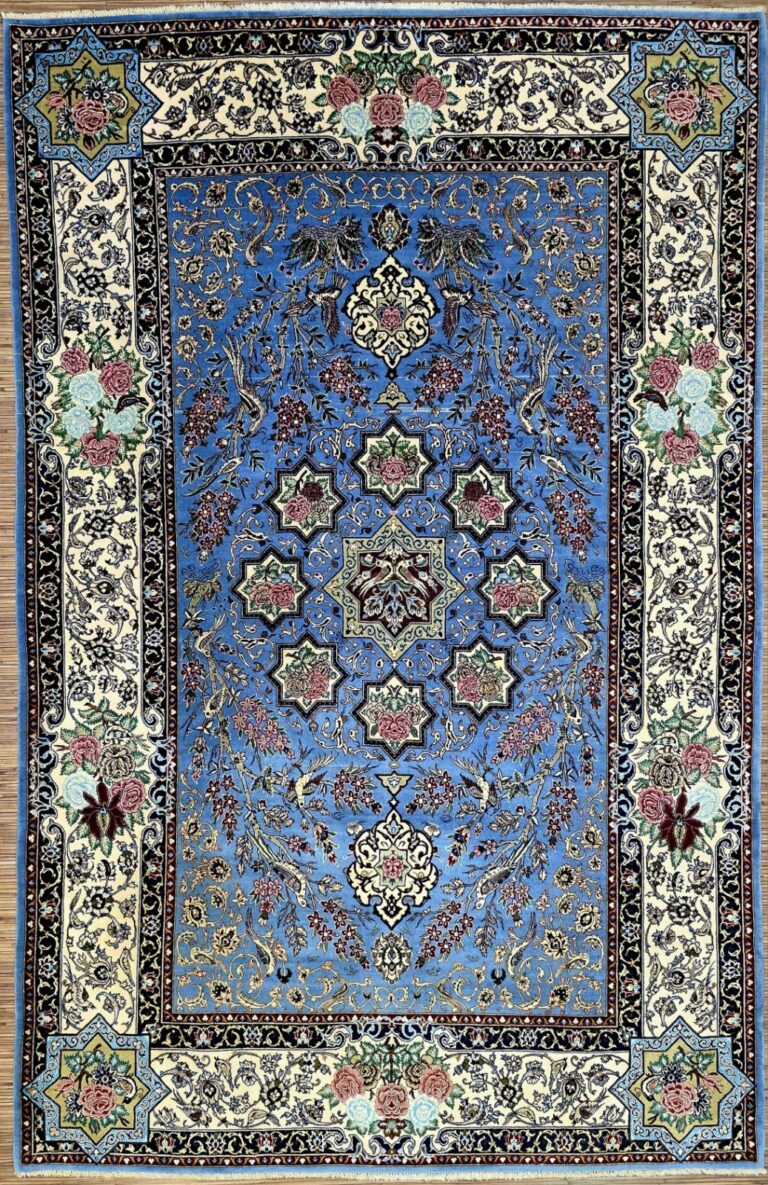
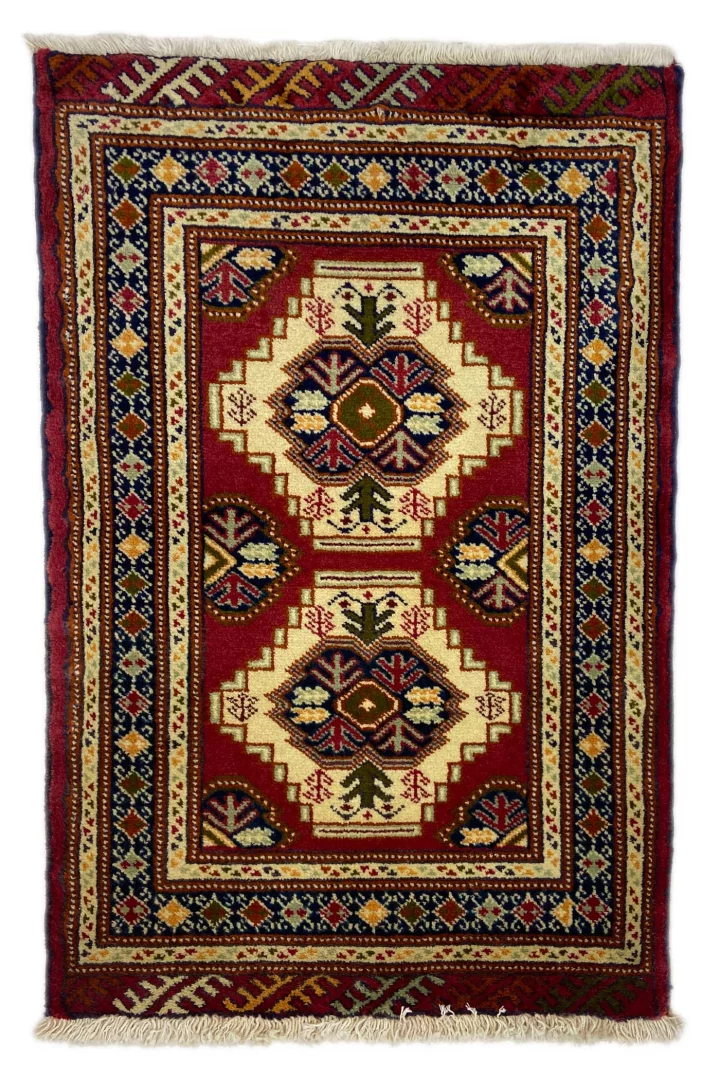
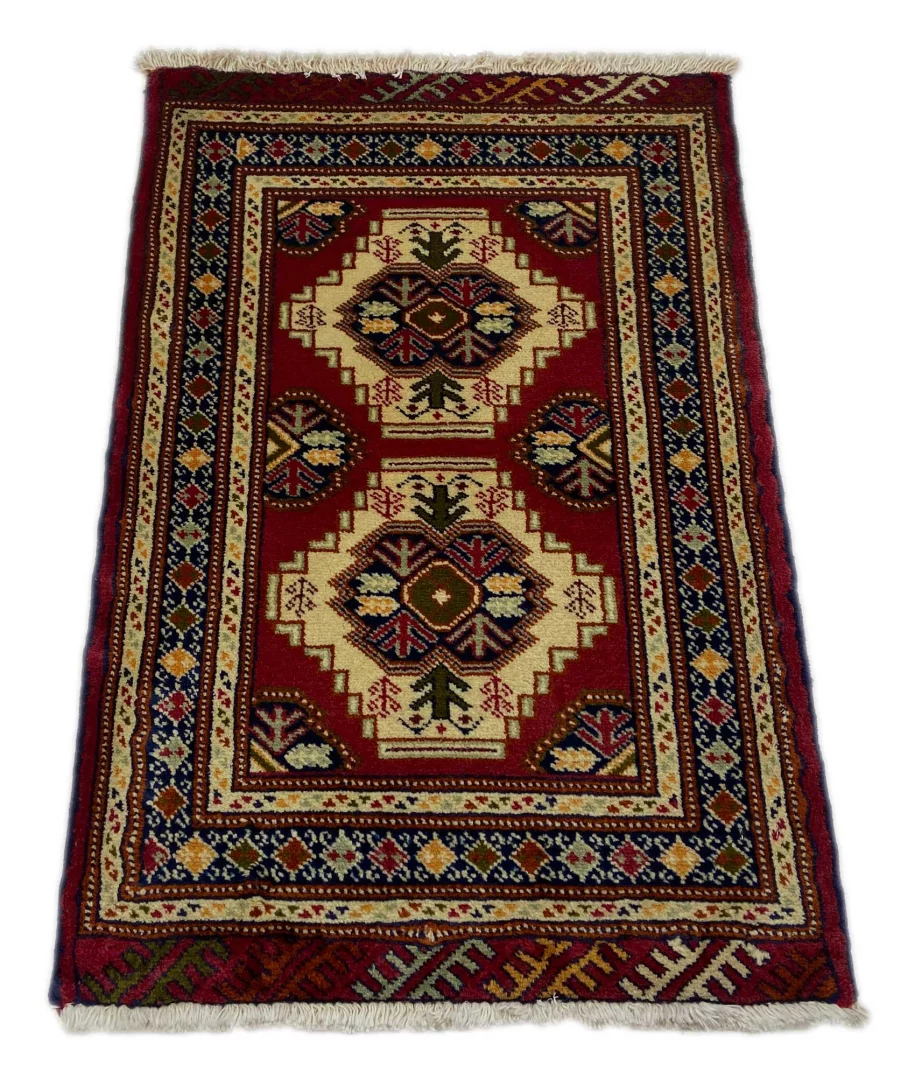
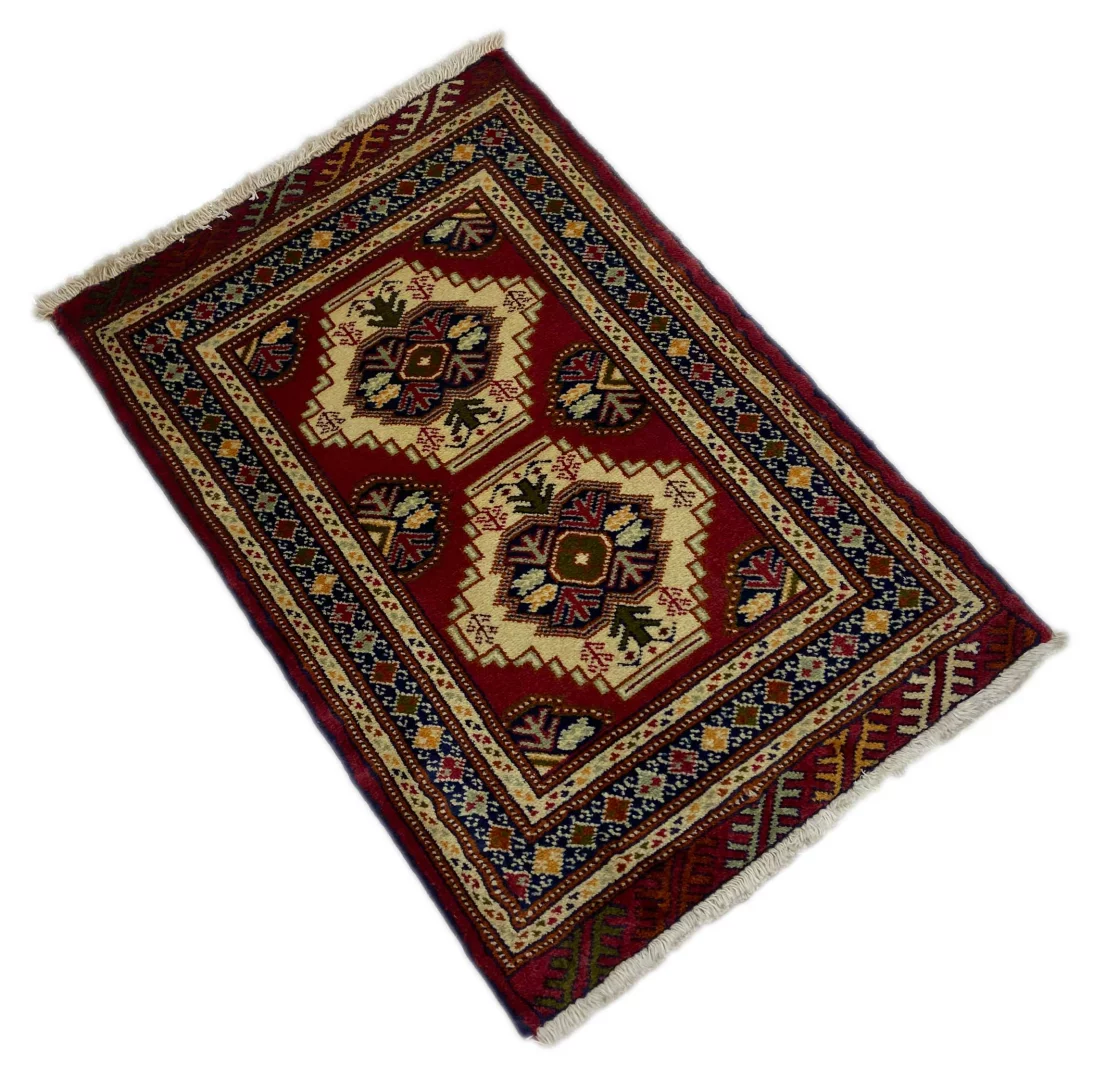
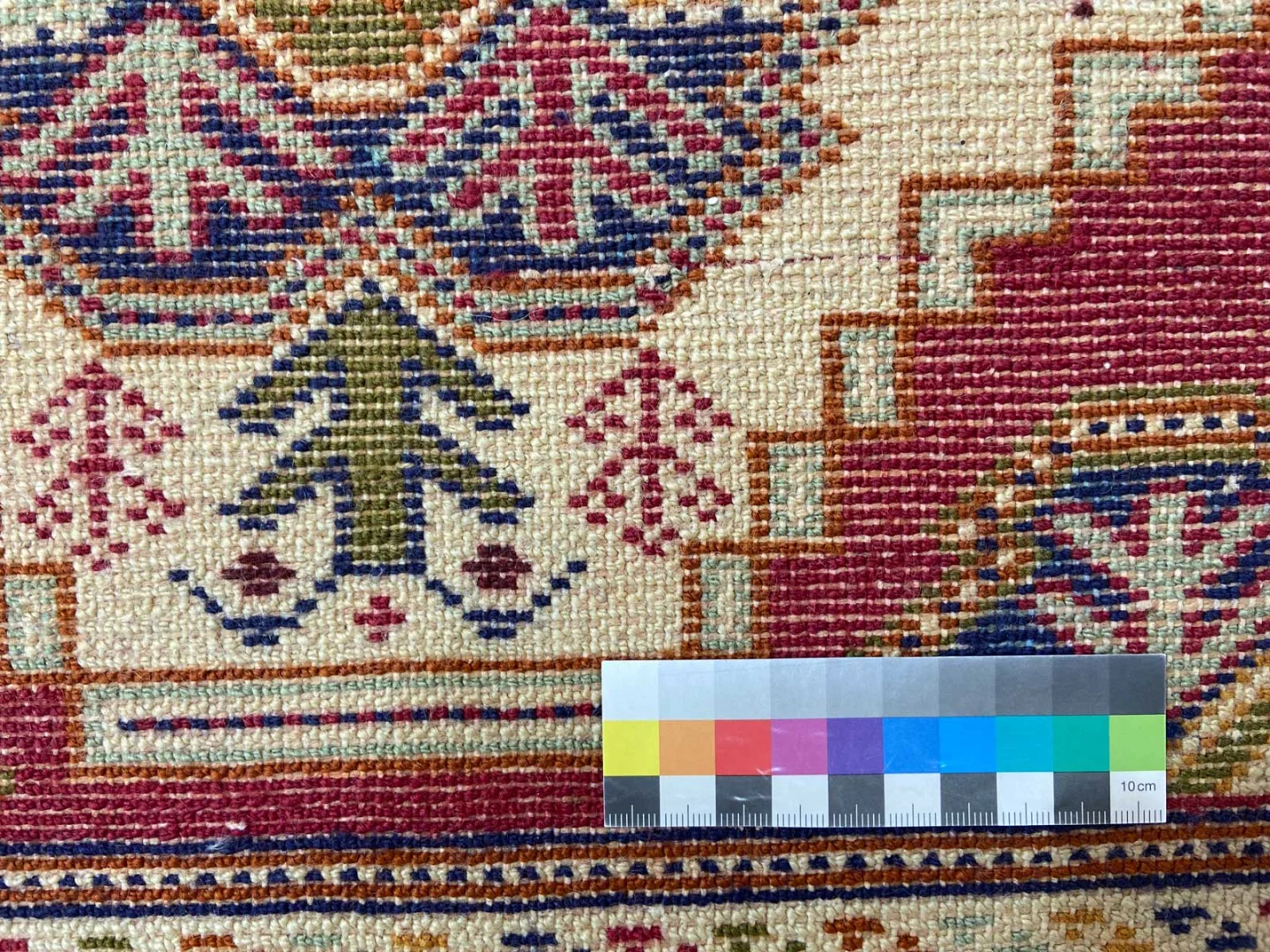
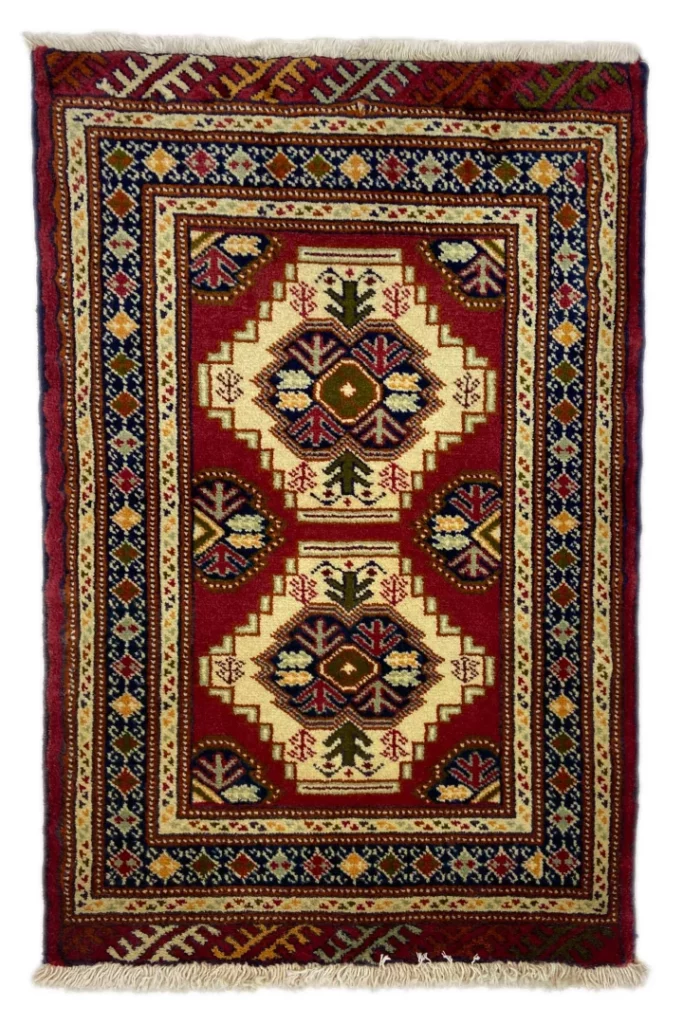
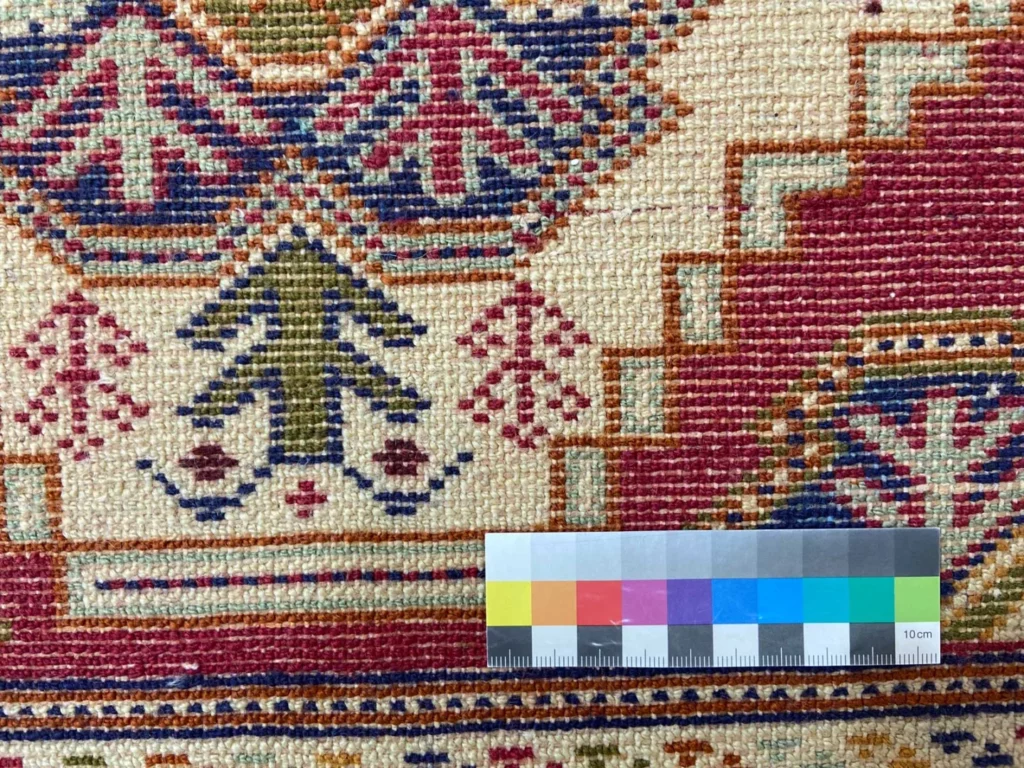
Hand-knotted Turkman Persian Rug | Knot density: approx. 200,000 knots/m² | Material: pile wool | Size: 95 x 63 cm | Pattern: Göl design in red, violet and brown | Condition: excellent
This Turkman Persian rug is hand-knotted and made from high-quality wool. The wool forms the pile and gives the rug the substantial textile character associated with Turkman work. A hand-knotted rug is built knot by knot on a loom. Each knot is placed and secured by hand before becoming part of the developing structure. The pile is then worked and finished so that the drawing becomes clear and the surface gains an even appearance.
The rug is described as having a high knot density. Dense knotting allows small ornamental details to be rendered with precision and gives the pile a compact structure. In a hand-knotted wool rug, yarn quality, knot regularity and careful finishing all contribute to resilience. The properties specified for this piece bring together high-quality wool, dense knotting and notable durability. These are characteristics of its construction, not claims about a machine-made product.
The pattern uses red, violet and brown. The description also identifies natural dyes. Traditional natural dyes may be obtained from plant, mineral or other natural sources and are used to create nuanced colour relationships. Wool accepts colour well, allowing the ornament to remain legible across the pile. Here, the three named tones form the visible palette of the Göl design, with red providing a strong presence, violet adding a distinct accent and brown introducing an earthy note.
The rug is in excellent condition. This describes the preservation of this individual piece. It does not add an unstated age, signature or restoration history. Alongside its condition, the rug is defined by its hand-knotted construction, its high-quality wool, its high knot density and its use of the stated colours. Together, these details describe the material and workmanship of the rug without assigning features that are not recorded.
Origin and Tradition
The rug originates in northern Persia, near the border with Turkmenistan. This location places it within a cultural area where Persian and Turkmen design traditions have long met. The name Turkman refers here to a rug tradition associated with the visual language of Turkmen communities, while the northern Persian origin identifies this particular rug as a Persian rug. The geographical description and the stylistic name therefore serve different purposes and should not be confused.
Northern Persia has a long history of carpet making. Knowledge of wool preparation, dyeing, knotting and pattern construction has traditionally been transmitted through workshops and families. A hand-knotted carpet is not produced as a fully printed surface. The design is built through the repeated decisions of the weaver, who follows a composition while placing coloured knots row after row. This process gives each finished rug its own material and visual character.
Turkman carpet traditions are strongly associated with Göl forms. In carpet terminology, a Göl is a repeated ornamental unit, often built as a medallion-like geometric figure. Göl elements may be arranged in rows, linked through a larger field or surrounded by smaller supporting motifs. Their identity comes from the outline, the internal divisions, the surrounding spaces and the colour contrasts. A Göl is therefore more than a decorative emblem: it helps organise the entire surface and makes the design tradition recognisable.
The proximity to Turkmenistan is relevant to the cultural context, but it does not change the stated origin of this rug. This piece is from northern Persia. Border regions often bring different visual traditions into contact, and Turkman designs can reflect that interaction through geometric order, repeated symbols and references to nomadic life. The result is a pattern language that can appear highly structured while still carrying associations with movement, landscape and community tradition.
Persian rugs are commonly distinguished by origin, technique, pattern tradition and the working practices of their makers. Turkman rugs are part of this broad field. Other recognised names include Gabbeh and Heriz. Gabbeh rugs are associated with rustic designs and strong colours, while Heriz rugs are known for geometric compositions and vivid colour combinations. These names describe different traditions and should not be treated as interchangeable labels. Bakhtiari and Qashqai rugs provide further examples of regional work valued for artistic patterning and quality materials.
The cultural role of a carpet extends beyond its practical use. A rug can define a space, provide a durable textile surface and preserve a visual vocabulary at the same time. In Turkman work, Göl ornaments carry much of that vocabulary. Repetition, symmetry and colour establish a rhythm that can be read across the field. The craft preserves not only a method of making textiles, but also a body of signs, arrangements and inherited design knowledge that connects one generation with the next.
Because the rug is hand-knotted, its tradition is present in the physical construction as well as in the motif. The design is not simply placed on top of the material; it is formed within the pile itself. This relationship between structure and ornament is central to Persian carpet making. Northern Persian Turkman rugs therefore bring together a named regional origin, a cultural connection with Turkmen design and the disciplined work required to build a patterned wool surface by hand.
Design and Pattern
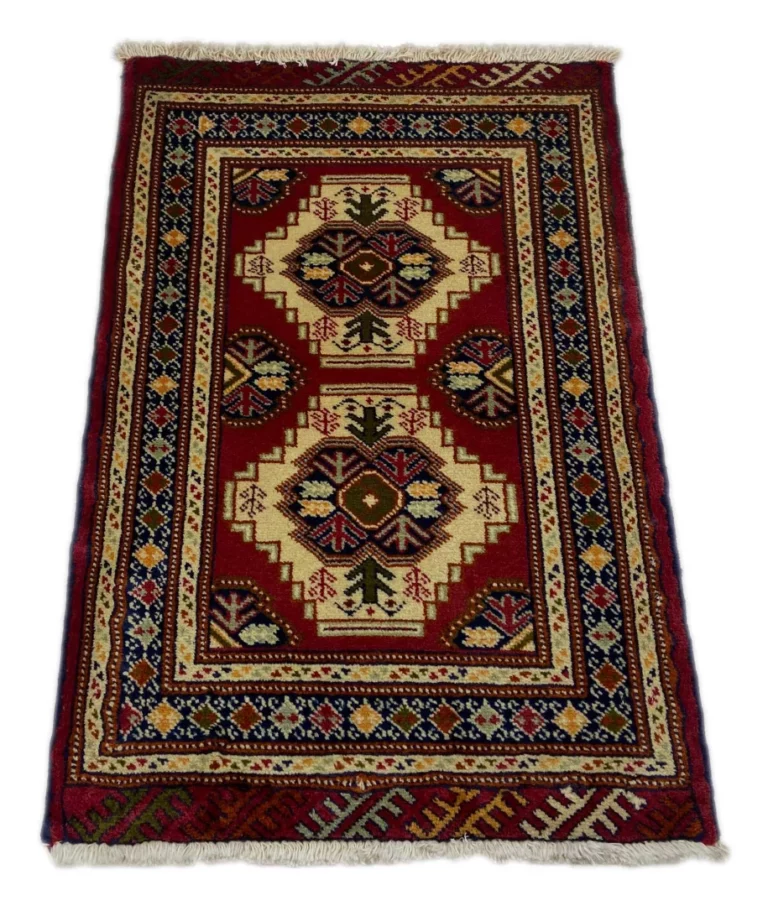
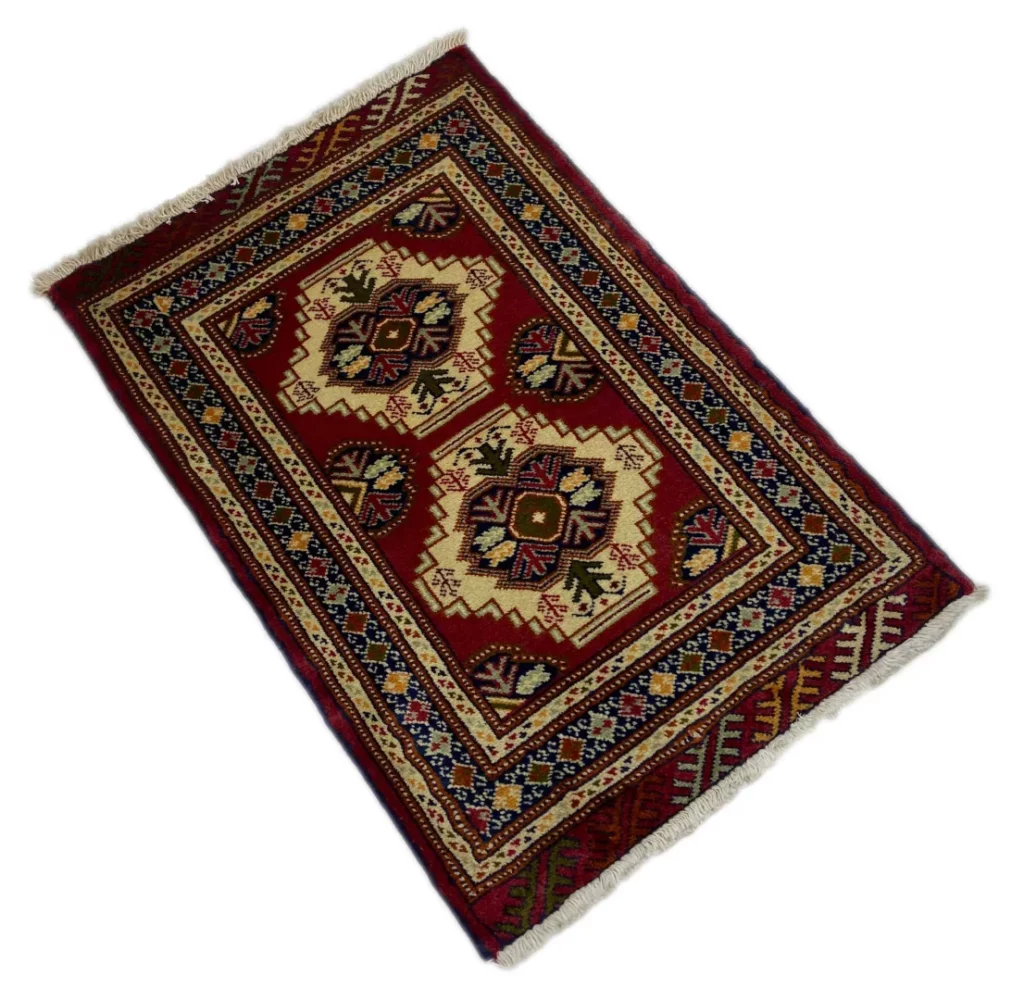
The pattern of this rug is identified as a Göl design. Its defining element is therefore the Göl form, a characteristic ornament within Turkman carpet traditions. Göl motifs are generally composed as clearly bounded, often symmetrical geometric shapes. Their interiors may contain smaller angular signs, stylised floral details or repeated linear elements. The exact arrangement depends on the individual design and its execution. For this rug, the Göl structure is the stated feature that gives the composition its identity.
The colour scheme consists of red, violet and brown. Red creates a firm visual foundation and gives the ornament presence. Violet introduces a separate, more distinctive accent that can mediate between deeper and brighter areas. Brown brings an earthy tone into the composition and helps connect the other colours. Together, the three colours create a patterned surface rather than a flat field. Their contrast makes the repeated Göl forms easier to distinguish.
Geometric carpet designs gain their rhythm through repetition, symmetry and intervals between motifs. A Göl may be read as a central unit or as one element in a continuing sequence. Smaller companion ornaments and framed areas can support the main design and organise the surrounding field. Lines, angles and repeated shapes guide the eye across the surface, while changes in colour separate one section from the next. The result is an ordered composition built from many individual knots.
Turkman pattern traditions are often discussed in relation to nature and the culture of nomadic tribes. Natural references do not necessarily appear as literal pictures. Instead, leaves, flowers, animals or symbolic signs may be simplified into geometric forms and adapted to a repeating layout. This transformation turns an observed or inherited image into a durable ornament. It also leaves room for regional interpretation, because the same basic idea can be redrawn through different outlines, fillings and colour relationships.
The design consequently has several functions. It decorates the rug, establishes a clear visual order and carries elements of an inherited symbolic vocabulary. Since the rug is hand-knotted, the pattern is created through coloured knots rather than printed onto a finished surface. Small variations in manual work can give the drawing an individual character while the overall structure remains coherent. The Göl motif stays recognisable, while the red, violet and brown palette defines the appearance of this particular piece.
Turkman designs can work with a range of interior approaches because their geometry is structured and their colours retain a traditional character. In a more classical setting, the pattern can emphasise its regional background. In a contemporary room, the same forms can be read as a graphic arrangement of repeated shapes. This describes the flexibility of the design language, not a prescribed use for the rug. Its central visual identity remains the Göl design and the specified combination of red, violet and brown.
Comparison with other Persian traditions further clarifies the character of this pattern. Gabbeh is often associated with a simpler, more rustic visual language, while Heriz is recognised for pronounced geometric layouts and lively colour combinations. Bakhtiari and Qashqai rugs may also display strong artistic designs and carefully selected materials. The Turkman rug differs through the particular role of the Göl ornament and through the palette named for this piece. These comparisons provide context without changing its northern Persian origin.
Special Features
The special features of this individual rug are its hand-knotted construction, high-quality wool, high knot density and Göl design. Red, violet and brown are used in the pattern, and natural dyes are identified in the description. The rug is also described as being in excellent condition. These details define the piece without adding an unstated signature, age or restoration record.
Its cultural character comes from the combination of northern Persian origin, proximity to Turkmenistan and Turkman pattern tradition. The Göl motif connects the rug with an established ornamental vocabulary, while the handwork keeps the method of production visible in the textile itself. It is therefore both a regional expression and the result of the individual work involved in making one hand-knotted rug.
FAQ
How can I recognise an original Turkman Persian rug?
Useful indicators include dense knotting, high-quality wool and characteristic Göl patterns. Hand-knotted construction is also part of the traditional method. Fine knotting supports precise ornamental detail, while natural colours such as red, violet and brown can contribute to the customary visual effect. The northern Persian origin and the connection with Turkmen design traditions are also relevant when assessing the name. No single colour or motif is sufficient on its own; material, construction, pattern and origin should be considered together.
Can a Turkman rug be professionally cleaned?
Yes. A specialist in hand-knotted Oriental rugs should be consulted for professional cleaning. Wool, a hand-knotted structure and natural dyes require a suitable treatment rather than a standard household process. A qualified cleaner can check colour stability and determine an appropriate method for the pile and textile structure. Strong rubbing, unsuitable detergents and do-it-yourself soaking should be avoided because they may affect the surface or alter the appearance of the colours. Professional care helps protect both the wool and the pattern.
Which rooms are suitable for a Turkman rug?
Turkman rugs can be used in a variety of living areas, including the living room, bedroom and hallway. The Göl design introduces a clearly organised traditional pattern, while red, violet and brown can be coordinated with different interior schemes. In a living room, the design can act as a visual link between furnishings. In a bedroom, it can provide a defined textile area, and in a hallway it can highlight the rug’s regional craft tradition. The most suitable placement depends on the room and the intended interior arrangement.
To provide the best experiences, we use technologies like cookies to store and/or access device information. Consenting to these technologies will allow us to process data such as browsing behavior or unique IDs on this site. Not consenting or withdrawing consent, may adversely affect certain features and functions.
Functional Always active
The technical storage or access is strictly necessary for the legitimate purpose of enabling the use of a specific service explicitly requested by the subscriber or user, or for the sole purpose of carrying out the transmission of a communication over an electronic communications network.
Preferences
The technical storage or access is necessary for the legitimate purpose of storing preferences that are not requested by the subscriber or user.
Statistics
The technical storage or access that is used exclusively for statistical purposes.The technical storage or access that is used exclusively for anonymous statistical purposes. Without a subpoena, voluntary compliance on the part of your Internet Service Provider, or additional records from a third party, information stored or retrieved for this purpose alone cannot usually be used to identify you.
Marketing
The technical storage or access is required to create user profiles to send advertising, or to track the user on a website or across several websites for similar marketing purposes.
 SECURE PAYMENT
 SHIPPING PARTNERS