This Turkman Persian rug is made of high-quality wool and is hand-knotted. It therefore combines a natural textile fibre with a traditional method in which the pile is built knot by knot. The wool forms the rug’s pile and shapes its feel, surface and visual character. The source description presents it as soft and hard-wearing. For Turkman rugs, the use of wool is a central part of the established weaving tradition.
Hand-knotting creates the pile in successive rows over a prepared foundation. Each knot is placed by hand and incorporated into the developing structure. The design takes shape gradually through the relationship between knots, colours and lines. This method distinguishes a hand-knotted rug from a mechanically produced floor covering. It requires concentration, practical experience and close attention to the intended drawing.
The source gives a knot density of approximately 200,000 knots per square metre, indicating a closely structured pile. Such a structure allows geometric forms to be worked with definition and makes smaller changes within an ornament visible. Traditional techniques and hand craftsmanship are part of the identity of a Turkman rug. Every hand-knotted rug is produced as an individual textile piece.
Wool is used in oriental rugs for more than its pleasant surface. It can be dyed, trimmed and formed into a durable pile structure. Its natural properties support a combination of practical use and decorative design. For this rug, the source identifies wool as the high-quality material; no information is given about the warp, age or condition.
Origin and Tradition
This rug comes from Northern Persia. The name Turkman, also written Torkman or Torkaman, refers to a rug tradition associated with the northern regions of Persia and areas close to the border with Turkmenistan. Northern Persia has long been shaped by different communities, trade routes and textile practices. Within this setting, distinct approaches to ornament, colour and the transmission of craft knowledge developed.
Turkman rugs are traditionally associated with a strong geometric vocabulary. Their designs are not simply random arrangements, but rely on recurring symbols and carefully organised fields. Weavers adapted motifs from regional visual traditions within individual workshops, families or communities. As a result, rugs from the same tradition may share recognisable features while still differing in their precise compositions.
The proximity to Turkmenistan helps explain the cultural connections associated with the Turkman name. Carpet traditions do not follow rigid borders that separate every pattern into a single category. Motifs, colours and technical knowledge travelled across markets and routes between neighbouring areas. The Northern Persian Turkman tradition can therefore be understood as an exchange in which local characteristics meet ornament influenced by Turkmen textile culture.
Northern Persian rugs were made both for domestic use and as a form of textile expression. Knotting was a practical craft whose knowledge was passed on within communities. Selecting the wool, preparing the foundation, planning the colours and building a Göl motif step by step all required experience. The finished rug preserves this connection between everyday use, skilled labour and regional design.
Related rug types from the region include Shahsavan and Qashqai rugs. Shahsavan rugs are often associated with symmetrical designs and strong colours, while Qashqai rugs are known for lively, folkloric compositions. These comparisons help place the variety of regional rug art in context, but they do not turn a Turkman rug into a Shahsavan or Qashqai rug. Nain and Isfahan are also recognised names in Persian rug making, each representing its own craft and design traditions.
The designation Northern Persia describes this rug’s regional context. It should be distinguished from the name of a motif: a pattern may refer to forms also found in other rug traditions without changing the origin of the individual piece. Keeping origin and design terminology separate is essential when describing oriental rugs accurately.
Design and Pattern
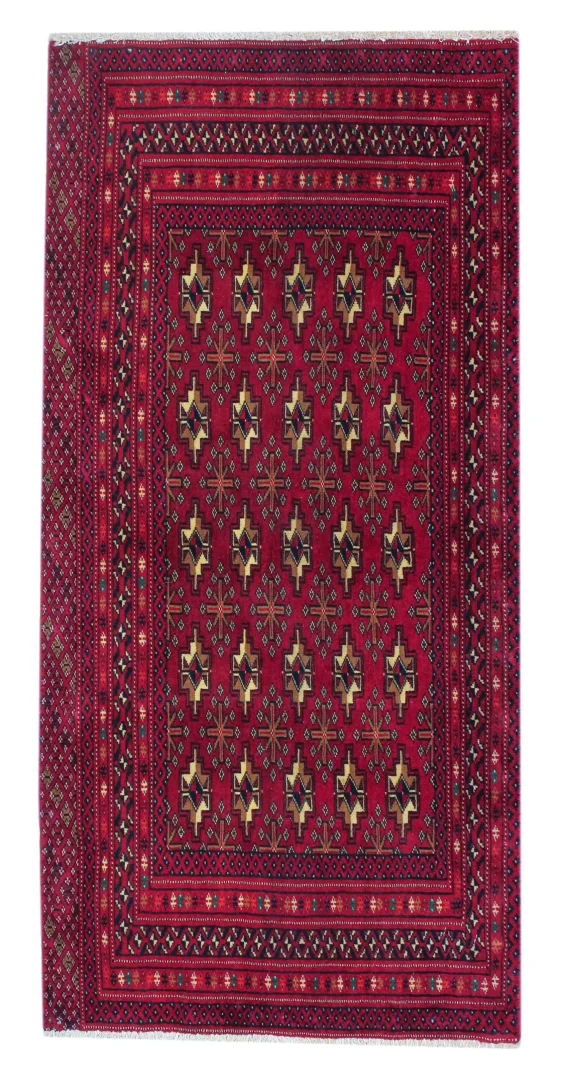
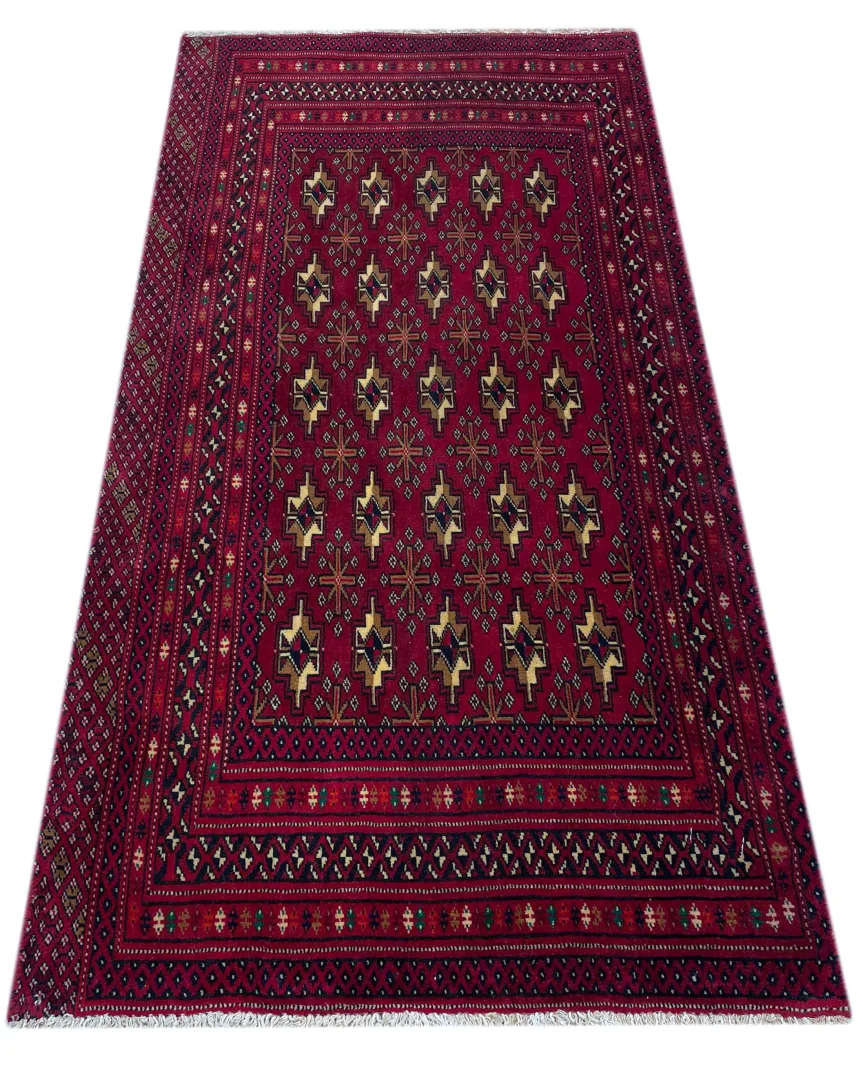
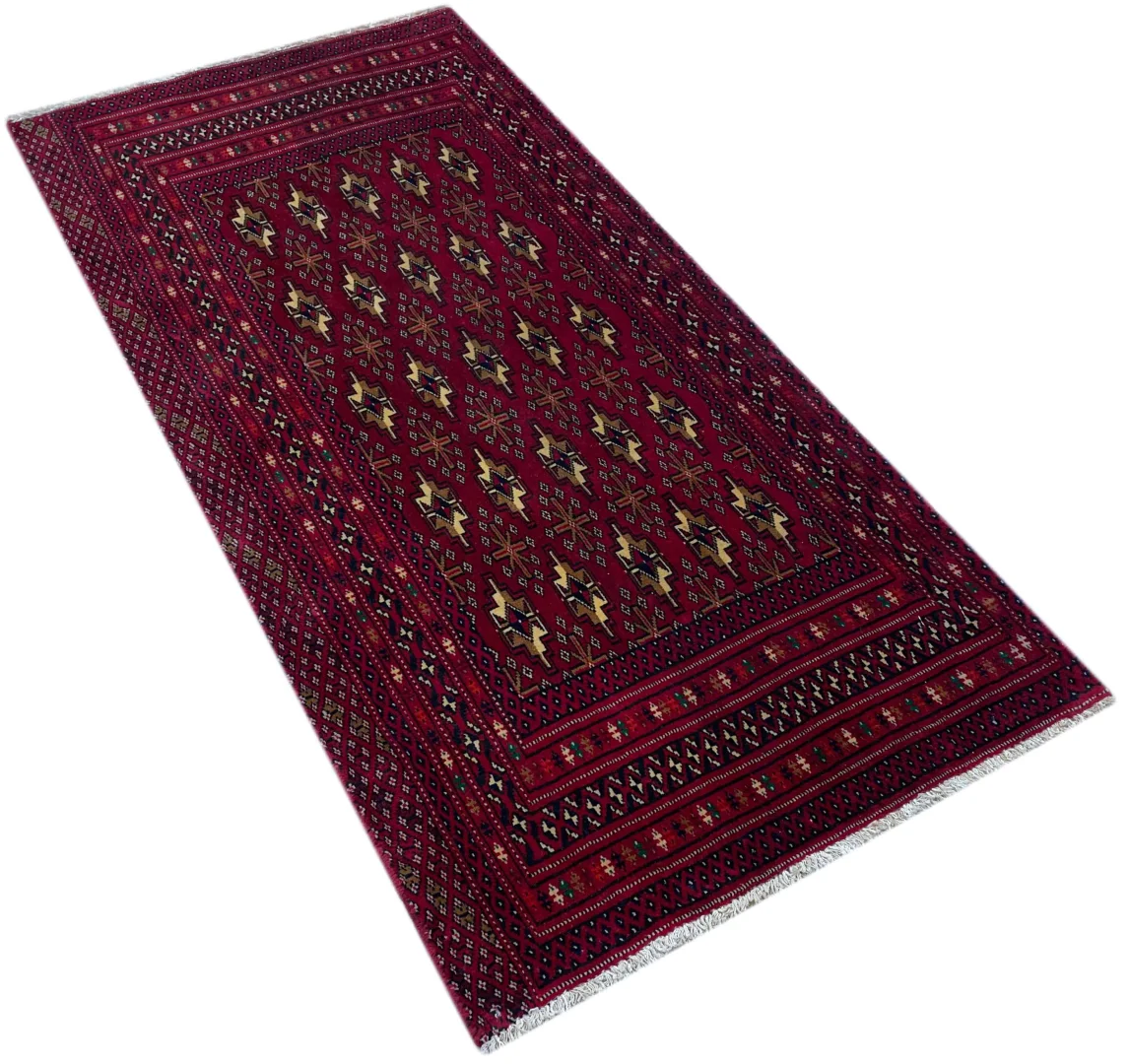
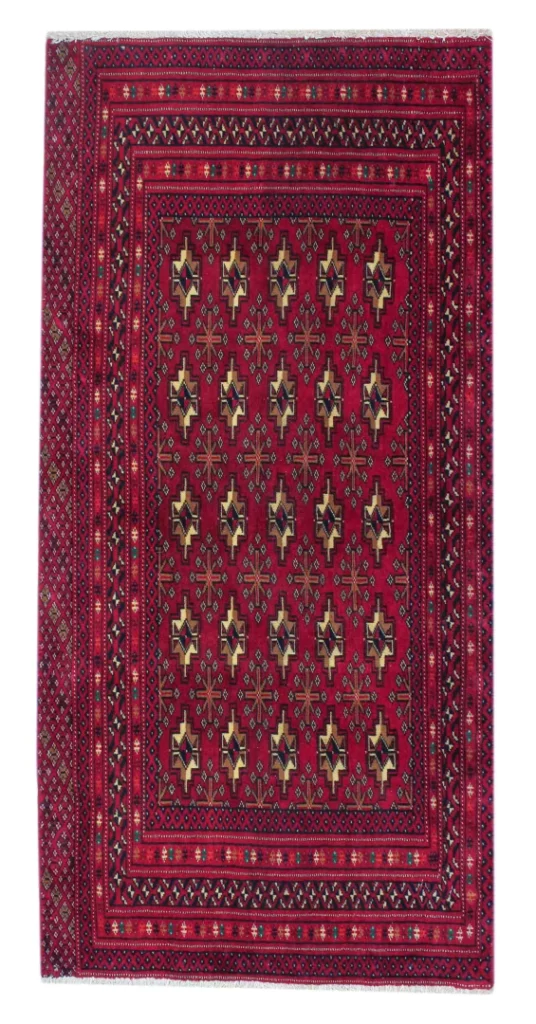
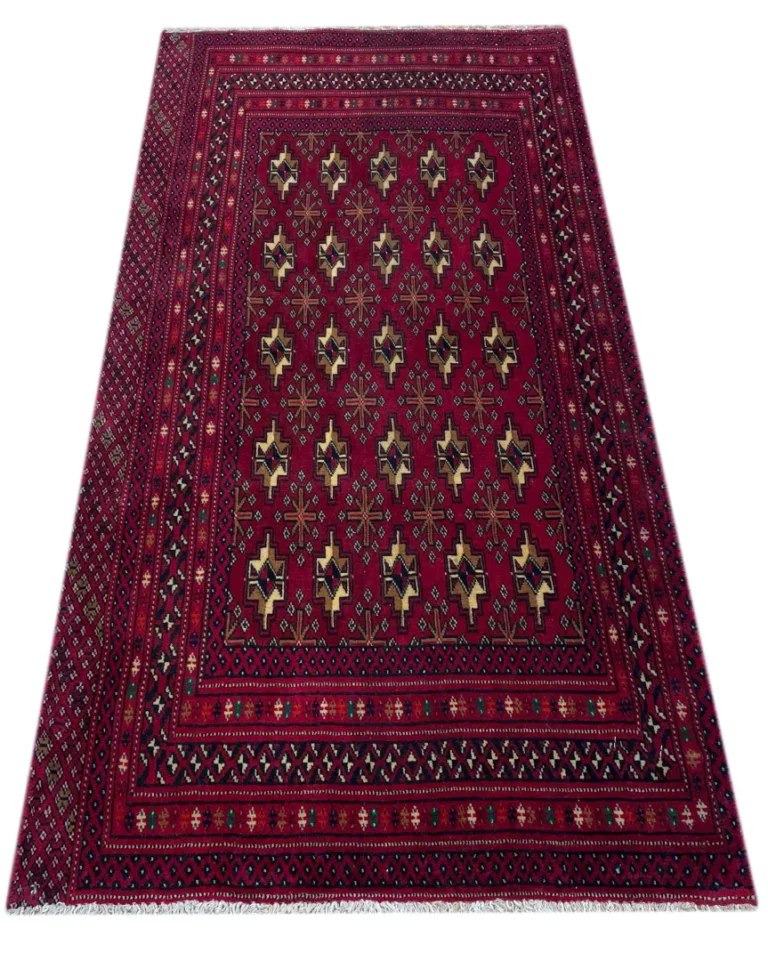
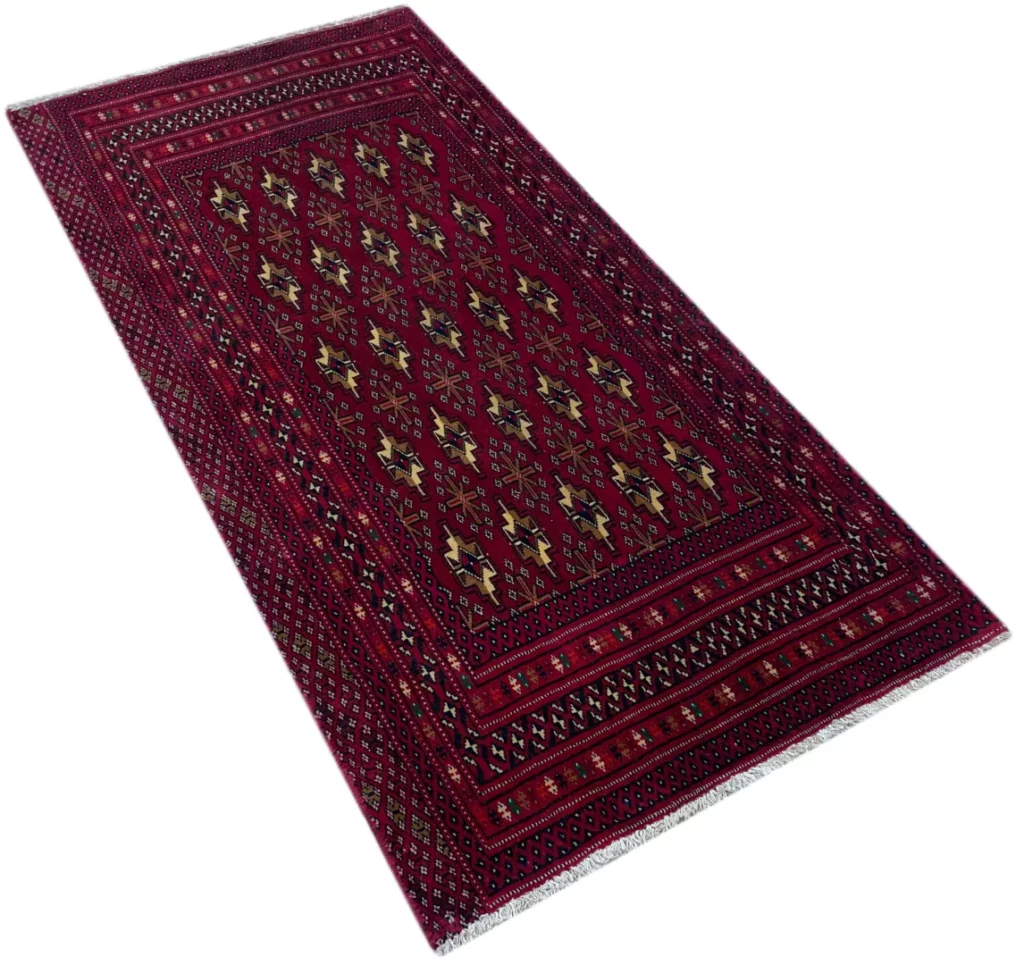
The central design feature of this rug is its variety of Göl motifs. In carpet terminology, Göl refers to a medallion-like or ornamental form that may be repeated or varied within a composition. In Turkman rugs, such forms are often arranged in a clearly structured geometric order. They organise the field and create a recurring rhythm for the eye.
Geometric rug designs are built from lines, angles, diamonds, hooked forms and stylised outlines. A Göl does not have to appear in exactly the same form every time. Small changes in the contour, internal drawing or colour sequence can give an ornament its individual character. In a hand-knotted rug, the design is translated through the practical work at the loom rather than mechanically printed onto a finished surface.
The colours named for this rug are red, violet and brown. Red can serve as a principal ground or accent shade in regional rug design. Violet introduces a contrasting colour note, while brown adds a warm, earth-related quality to the composition. Together, these three named colours establish the colour range of the piece. No further colours are specified for this rug.
When a Göl pattern is viewed, the individual medallion is only one part of the design. The intervals between forms, the repetition of ornaments and the relationship between internal drawing and surrounding field are equally important. Geometric motifs can create a cohesive overall effect without relying on naturalistic images. Their visual language is based on proportion, repetition and the interaction of colour and outline.
Turkman pattern traditions are often discussed in connection with cultural inheritance. Ornaments may reflect tribal affiliation, local preferences or the continuation of established visual signs. An individual motif should not, however, be assigned one fixed meaning too quickly. Carpet designs are decorative, technical and cultural forms at the same time. Their significance develops from the complete arrangement and the tradition in which the forms are used.
Compared with Shahsavan and Qashqai rugs, which have their own stylistic emphases, Turkman rugs are associated with the combination of Göl forms, geometric order and Northern Persian or Turkmen-influenced ornament. This places the design within a broader tradition without claiming details that are not provided for the individual rug. The documented features here are the varied Göl motifs and the colours red, violet and brown.
Special Features
This rug’s special features are the combination of Northern Persian origin, hand-knotted construction, high-quality wool and varied Göl motifs. The named colours red, violet and brown give the design a clearly defined colour direction. The high knot density, described in the source as approximately 200,000 knots per square metre, is another stated characteristic.
As a hand-knotted one-off, the rug follows a process in which textile structure and pattern develop together. The combination of material, knotting technique and regional vocabulary makes it an individual representative of the Turkman tradition. The description provides no information about age, signature or a specific state of preservation.
FAQ
How should a Turkman rug be cared for?
Regular cleaning and careful removal of dust help preserve the pile and colours. Strong, direct sunlight should be avoided so that the colours do not fade unnecessarily. Professional rug cleaning is advisable when heavier soiling occurs. Harsh cleaning products or an improvised wet treatment can affect wool and dyes, so they should not be used without appropriate specialist advice.
Where is a Turkman rug suitable for use?
Turkman rugs are suitable for living rooms, bedrooms and hallways. Their geometric Göl motifs can be integrated into both modern and traditional interiors. The robust construction described in the source also makes Turkman rugs generally suitable for areas with frequent use. For a particular placement, light exposure, room traffic and careful treatment of the hand-knotted pile should also be taken into account.
What makes Turkman rugs distinctive?
Their character comes from the combination of traditional handwork, high-quality wool and regionally shaped patterns. The varied Göl forms organise the field geometrically, while red, violet and brown define the stated colour palette. The Northern Persian origin and the connection with the Turkmen rug tradition complete these design characteristics. Each hand-knotted piece is created as an individual textile work.
To provide the best experiences, we use technologies like cookies to store and/or access device information. Consenting to these technologies will allow us to process data such as browsing behavior or unique IDs on this site. Not consenting or withdrawing consent, may adversely affect certain features and functions.
Functional Always active
The technical storage or access is strictly necessary for the legitimate purpose of enabling the use of a specific service explicitly requested by the subscriber or user, or for the sole purpose of carrying out the transmission of a communication over an electronic communications network.
Preferences
The technical storage or access is necessary for the legitimate purpose of storing preferences that are not requested by the subscriber or user.
Statistics
The technical storage or access that is used exclusively for statistical purposes.The technical storage or access that is used exclusively for anonymous statistical purposes. Without a subpoena, voluntary compliance on the part of your Internet Service Provider, or additional records from a third party, information stored or retrieved for this purpose alone cannot usually be used to identify you.
Marketing
The technical storage or access is required to create user profiles to send advertising, or to track the user on a website or across several websites for similar marketing purposes.
 SECURE PAYMENT
 SHIPPING PARTNERS


