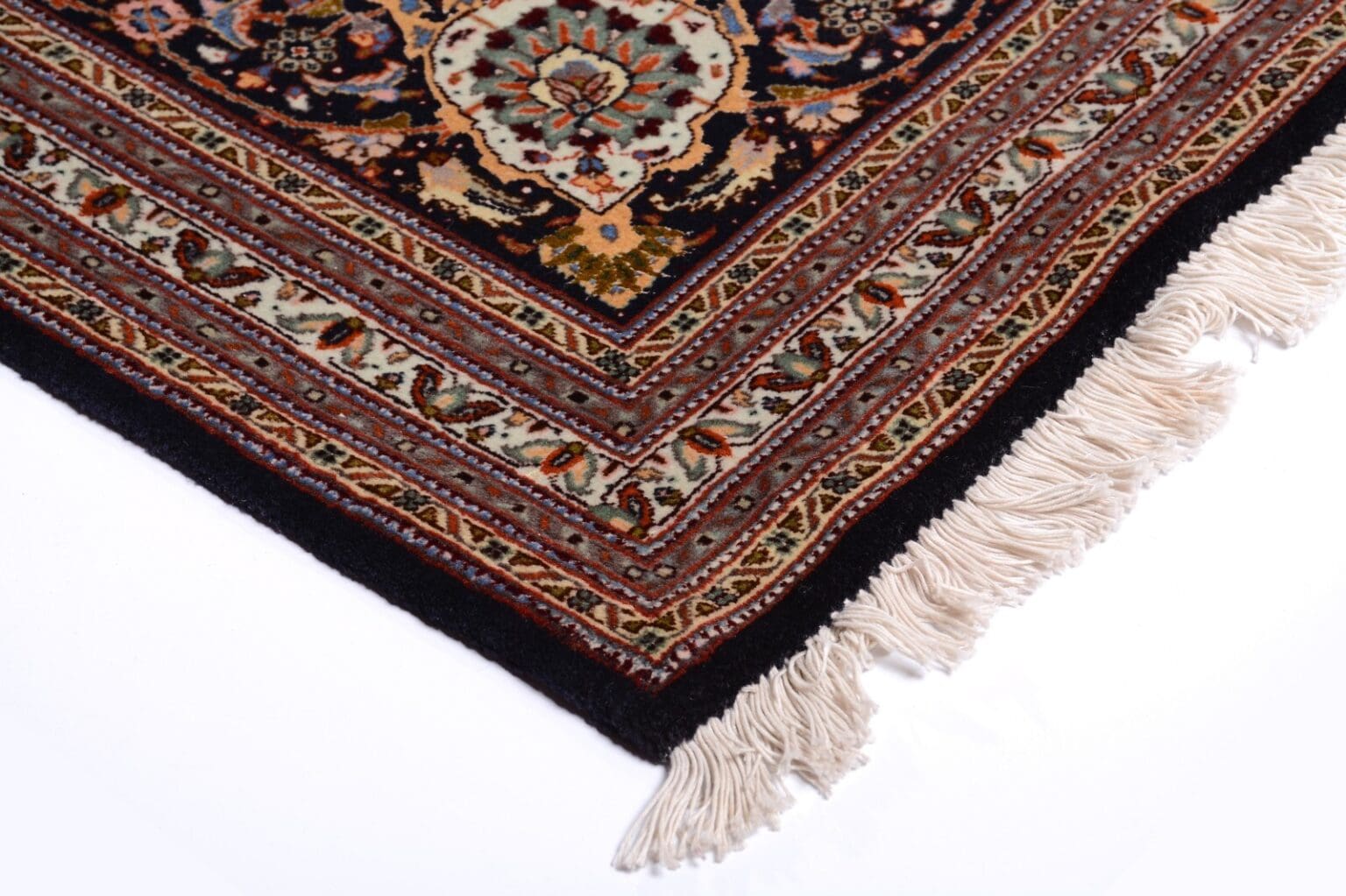
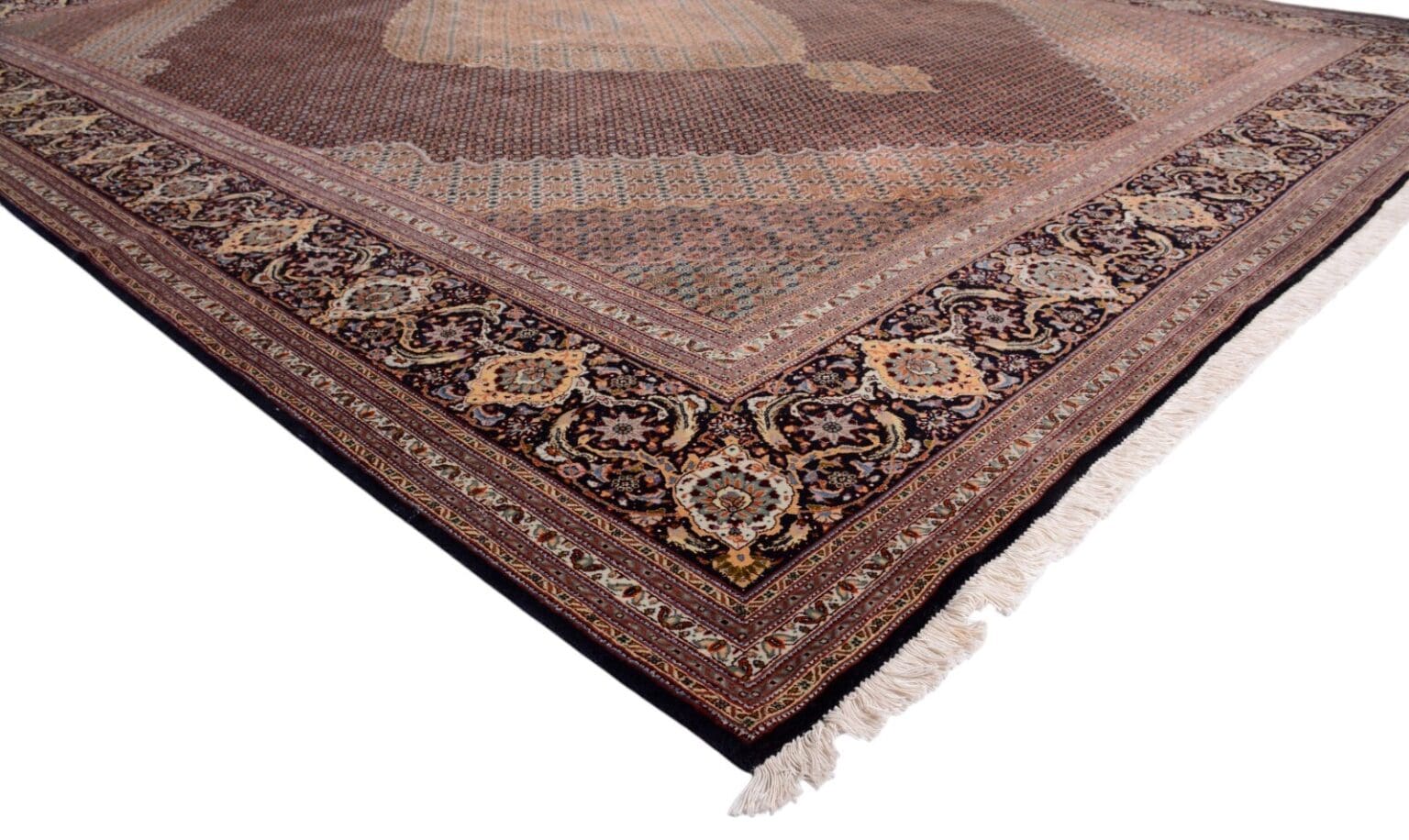
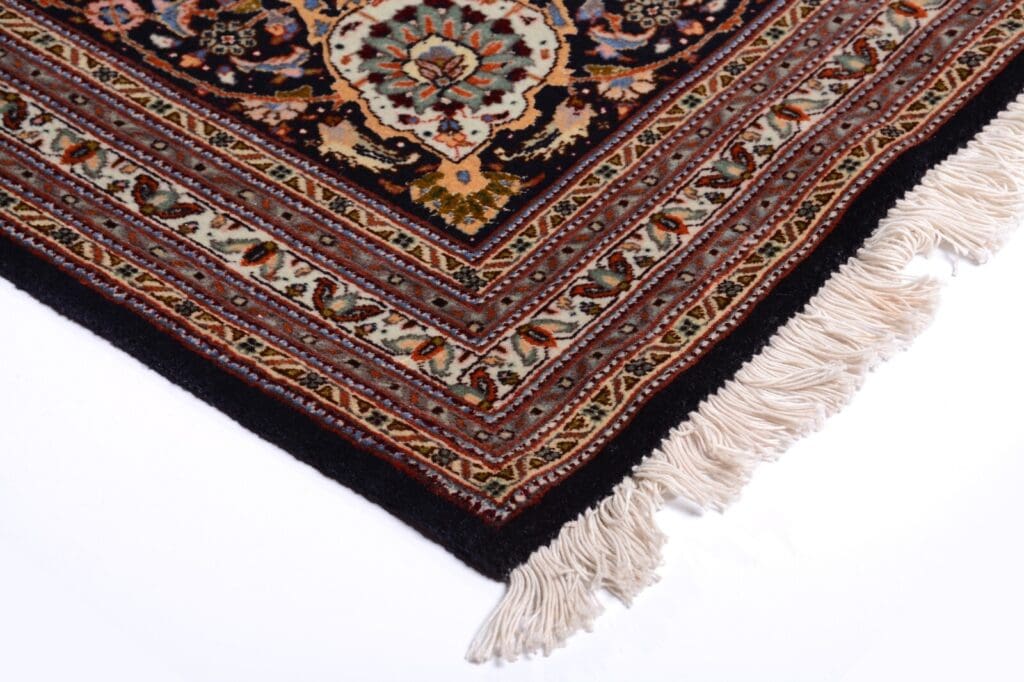
This Tabriz Persian rug is hand-knotted. Its pile is made of 100% wool, while the warp is specified as 100% cotton. In a traditional rug structure, these materials serve different purposes: wool forms the visible and tactile surface, while cotton provides the foundation on which the knots are arranged. Wool is widely used in rug making for its resilient character and comfortable feel underfoot. Cotton is valued as a warp material because it can provide a regular base for the construction of the rug.
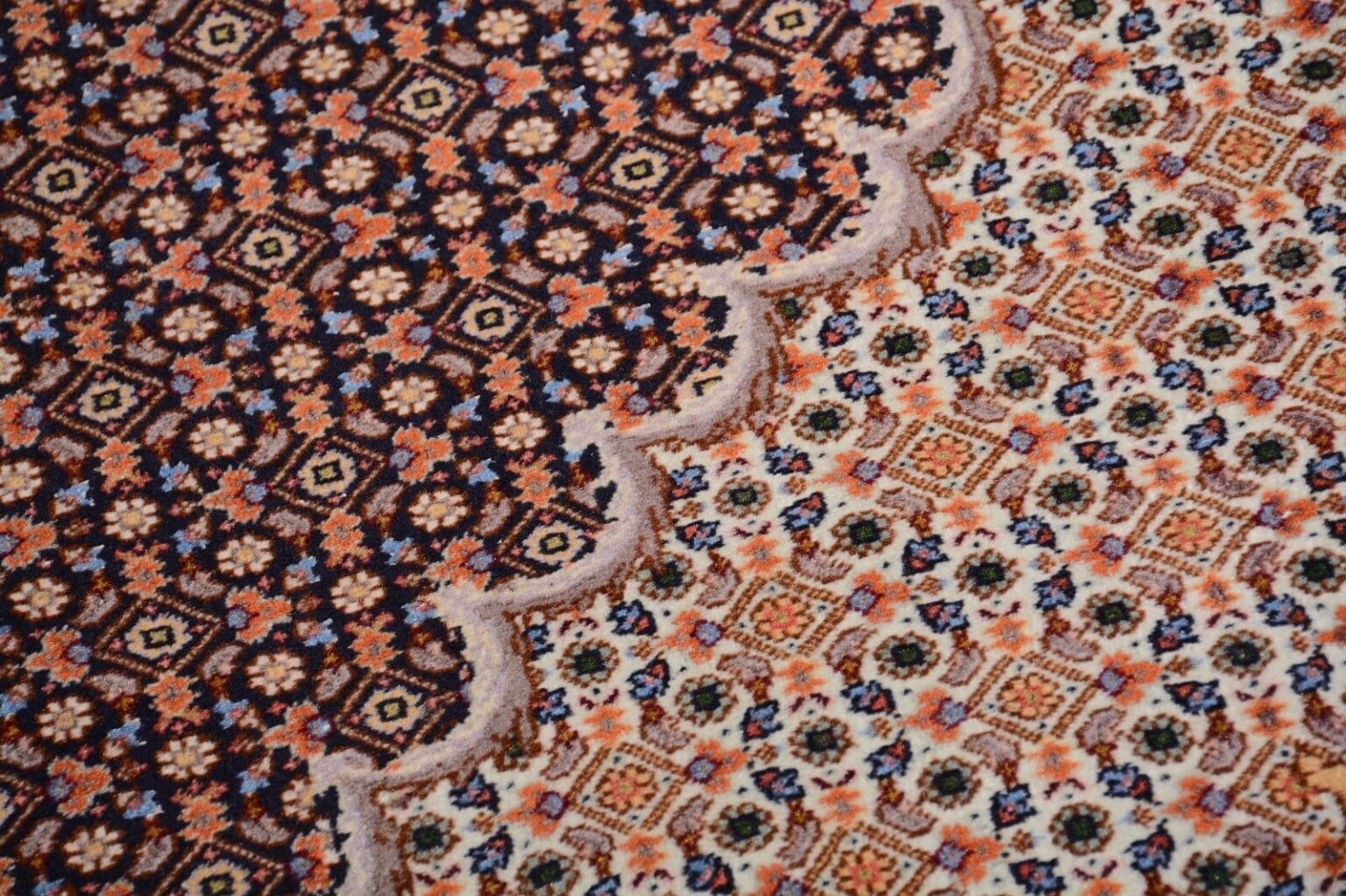
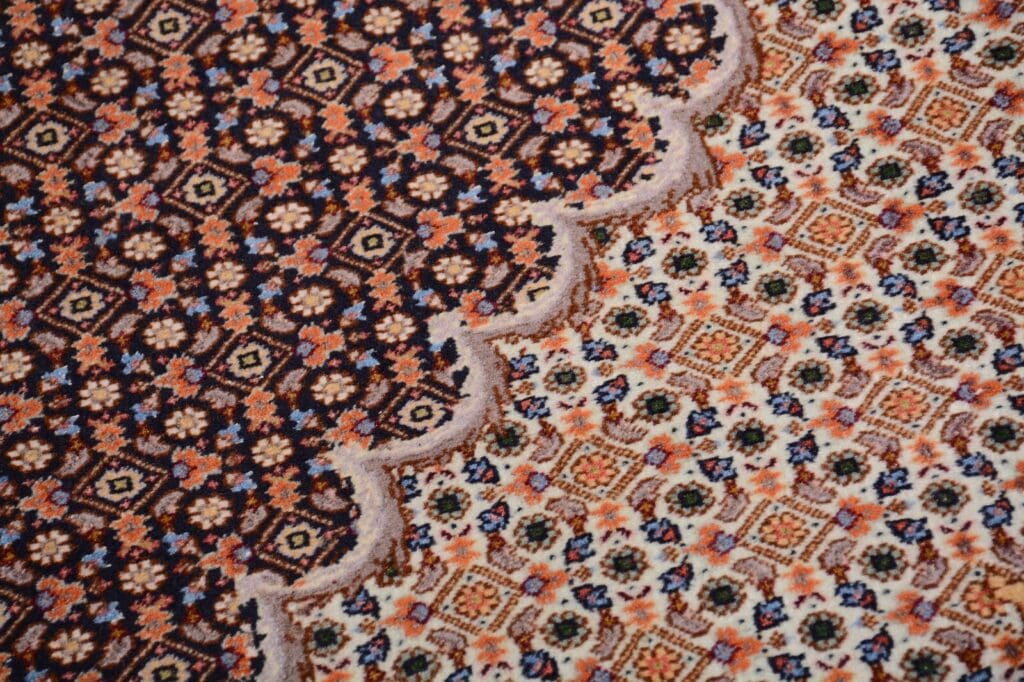
The rug has a knot density of 550,000 knots per square metre. Knot density indicates how many individual knots are placed within a defined area and helps explain the amount of manual work involved. A dense knotting structure allows a weaver to draw narrow outlines, small changes of colour and finely scaled ornaments. In a hand-knotted rug, the surface is built gradually, row by row, with each knot inserted by hand. The result is a textile object whose precise execution belongs to the individual piece.
The rug is approximately 10 mm thick and has an approximate weight of 3 kg per square metre. It is described as perfect and unused. These details refer to this particular rug. Its wool pile, cotton warp and hand-knotted construction bring together materials traditionally associated with Persian rug making and a method that depends on sustained, careful manual work.
Origin and Tradition
Tabriz is located in north-western Persia and is one of the important centres of Iranian rug culture. The city lies in the historic region of Azerbaijan and has long served as a place of trade, craft and cultural exchange. Its position connected Persian traditions with influences from the Caucasus, Anatolia and Mesopotamia. This setting contributed to the development of Tabriz rugs, which are often associated with carefully drawn designs and a clearly organised overall composition.
The city’s weaving tradition has deep historical roots. Tabriz became especially important during the Safavid period, when Persian artistic production developed in court workshops and regional centres. Designs using central medallions, flowering vines and ordered fields were refined during this period and continued to influence later rug making. In the centuries that followed, Tabriz remained a place where designers, dyers and weavers worked within an established craft environment.
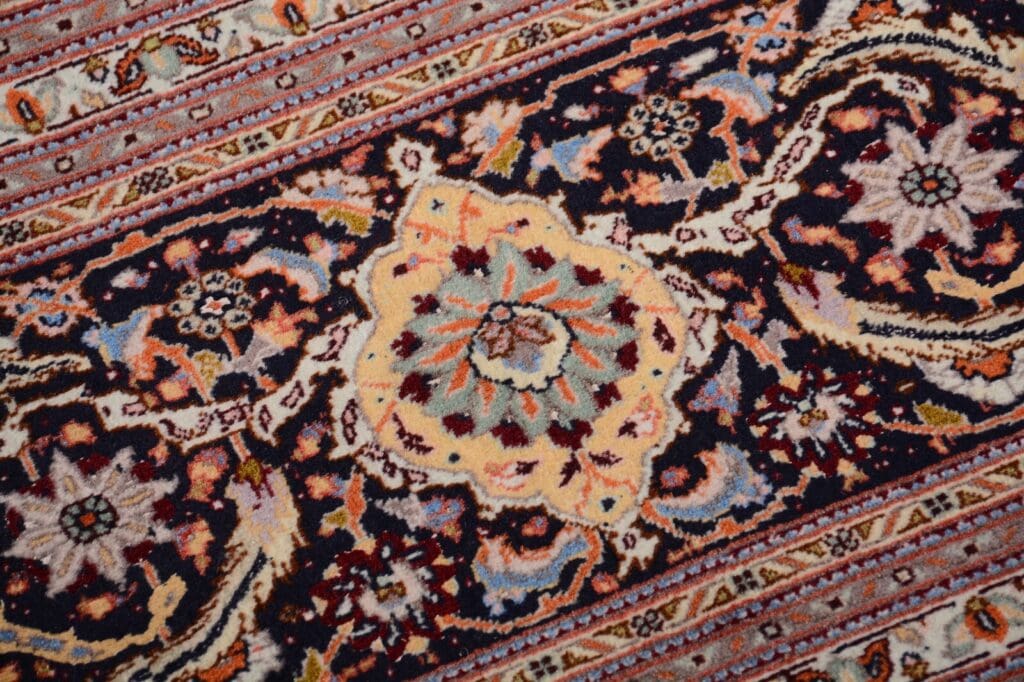
Tabriz tradition is known for its combination of precise drawing and varied layouts. Common design families include central medallion compositions, all-over fields, prayer designs and large floral arrangements. Some are strongly symmetrical, while others use a more continuous flow of vines and ornaments. A design is normally prepared before the knotting begins, providing a plan for the field, borders and principal motifs. The weaver then translates this plan into rows of knots, building the image into the textile structure.
The Tabriz designation connects this rug with the Iranian weaving tradition of the city in north-western Persia. Persian rugs are identified not only by colour, but also by regional design vocabulary, workshop practice and the way a composition is distributed across the surface. The Tabriz school represents a developed and detail-conscious approach to these elements. Its influence can be seen in both classical Persian designs and later interpretations that retain a structured field, carefully articulated ornaments and a defined relationship between centre and border.
Design and Pattern
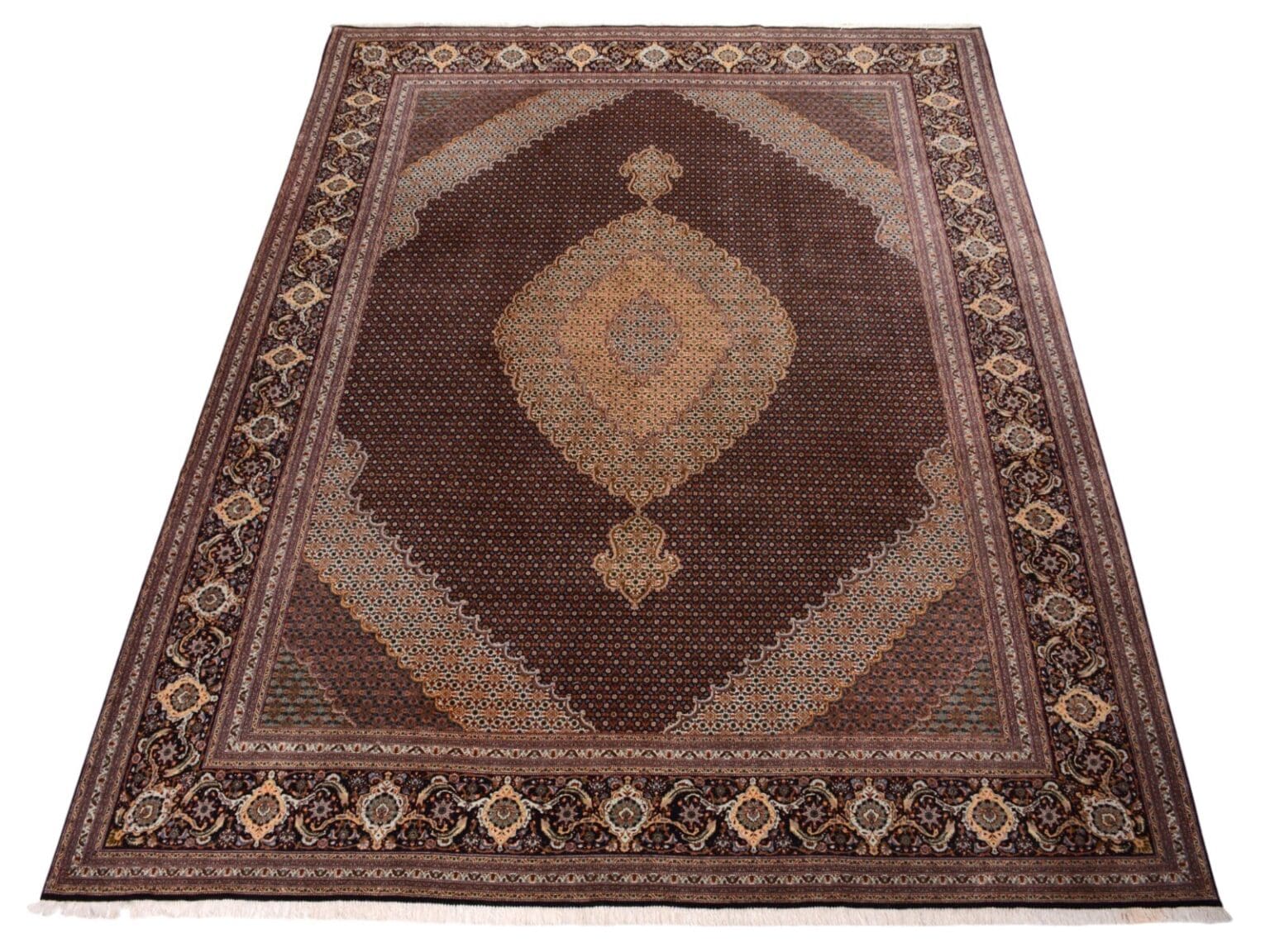
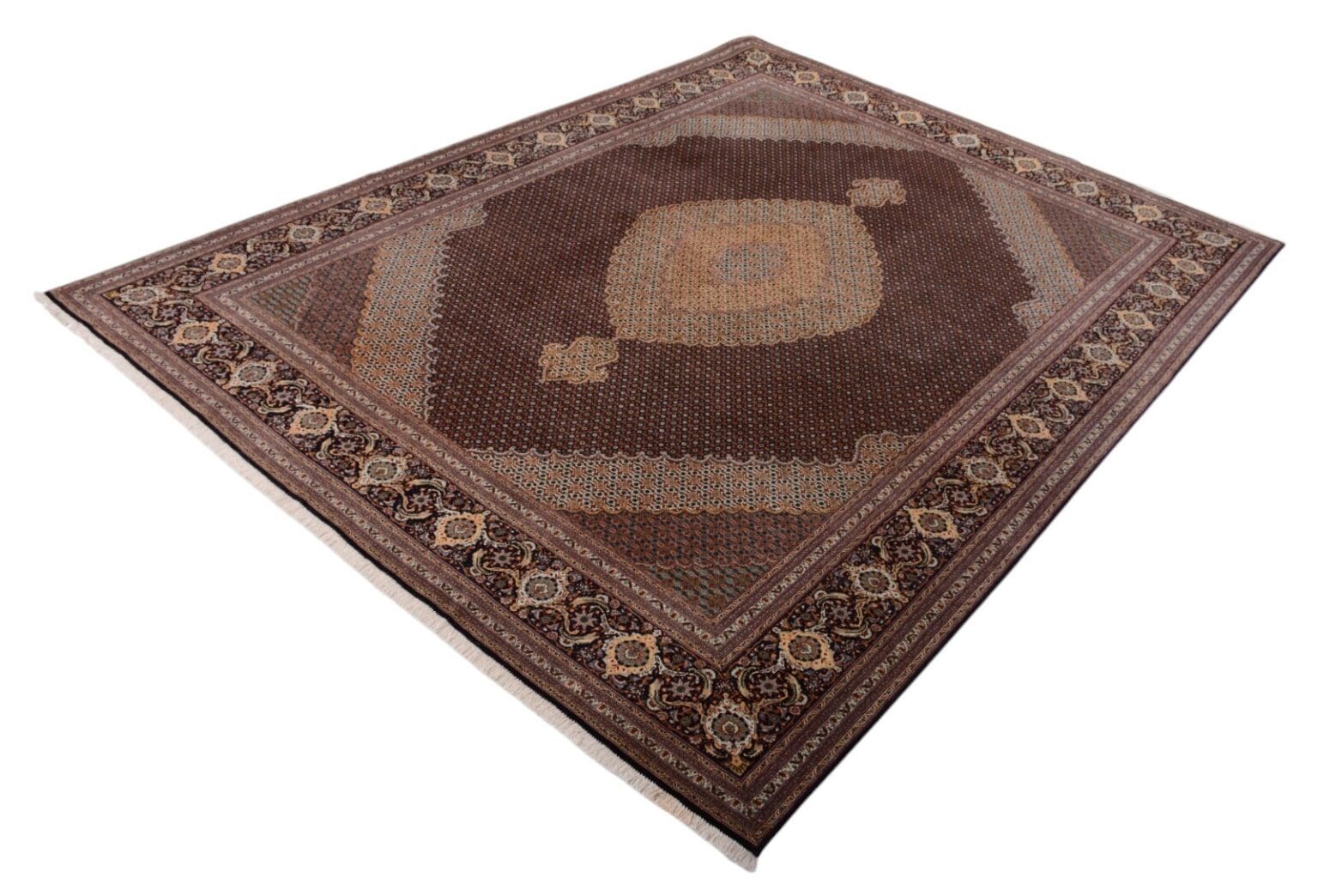
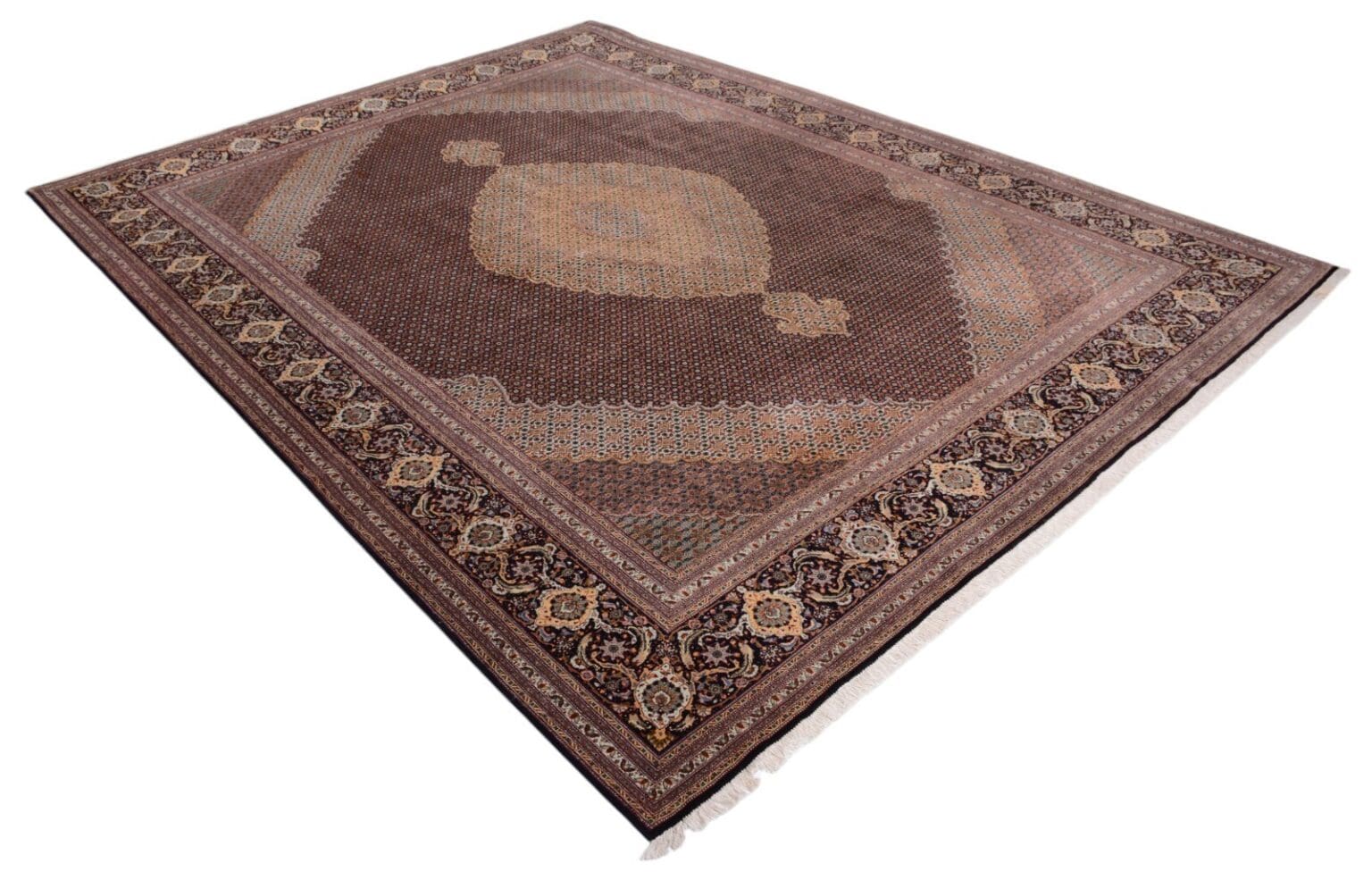
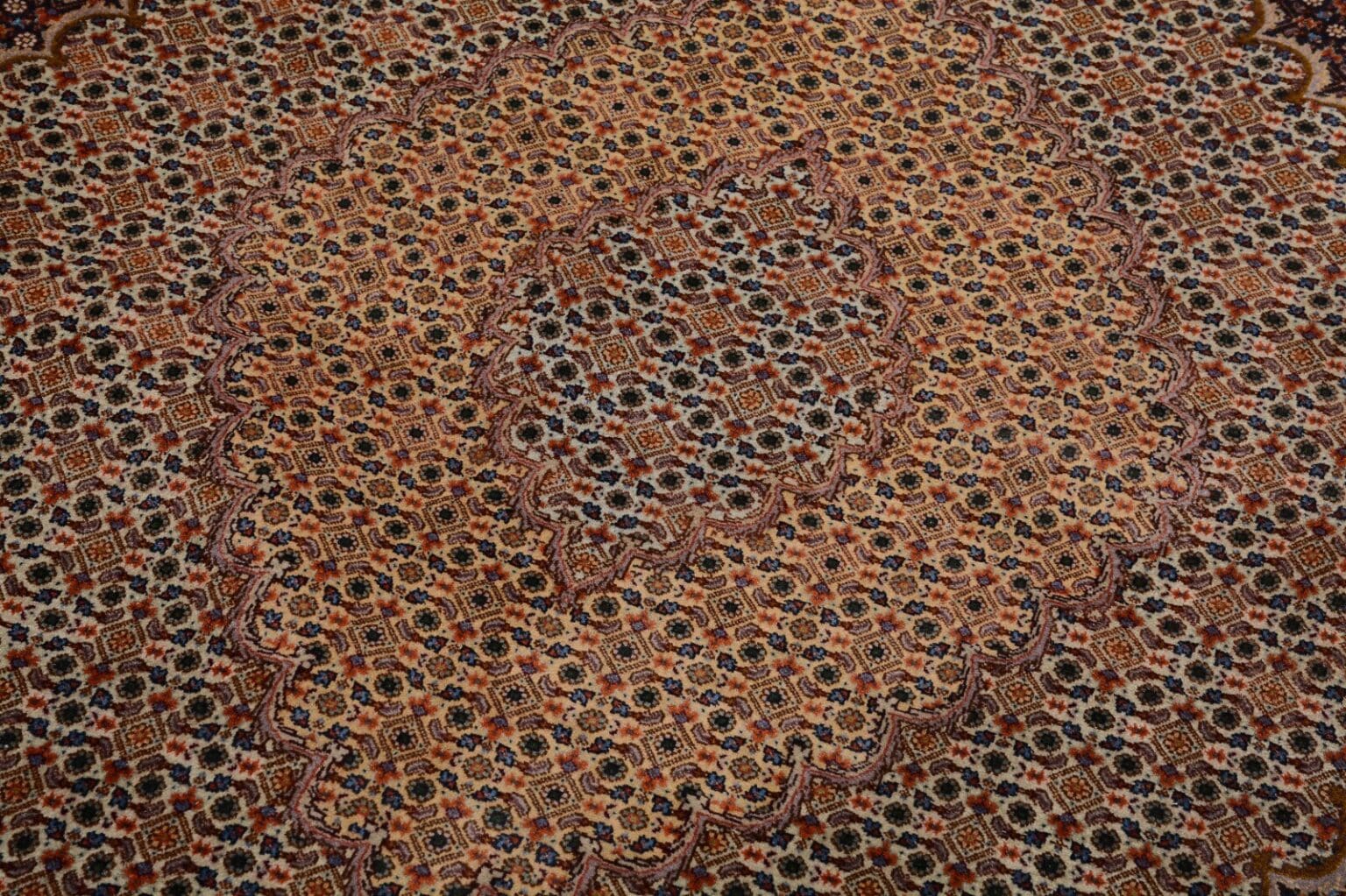
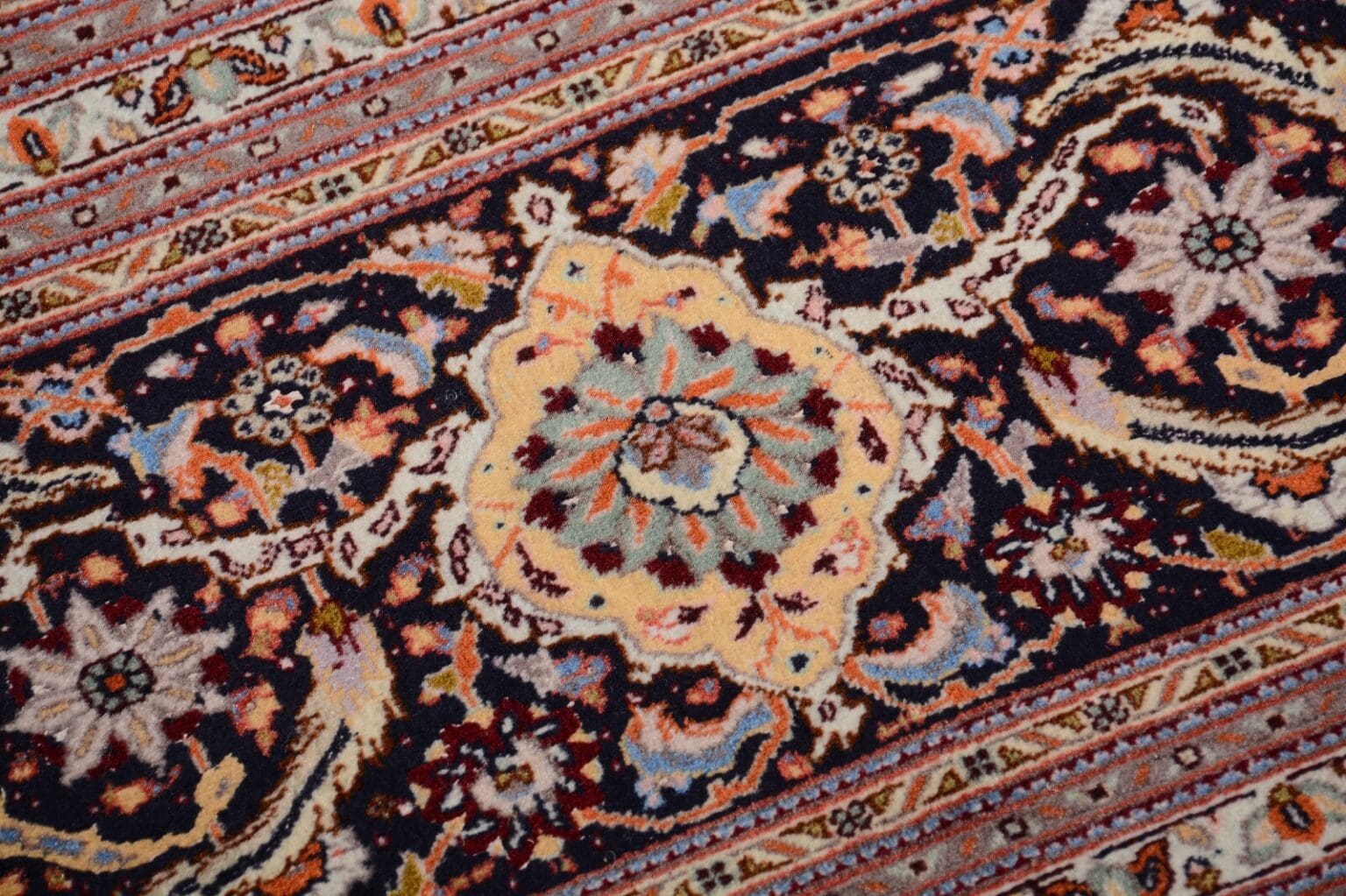
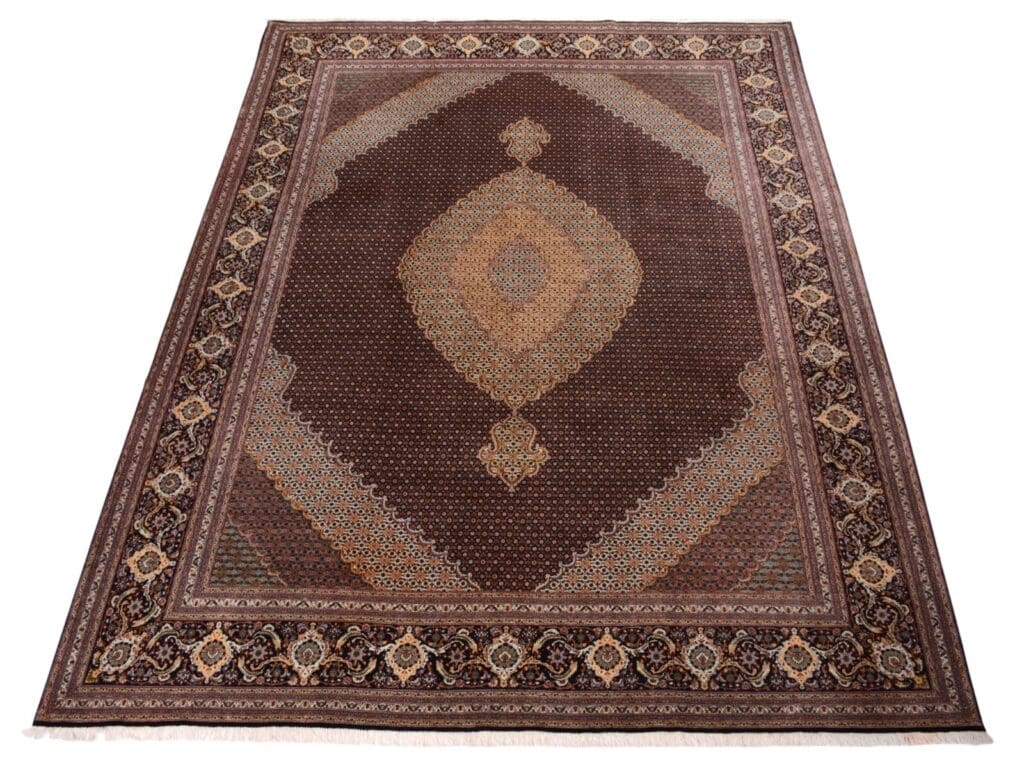
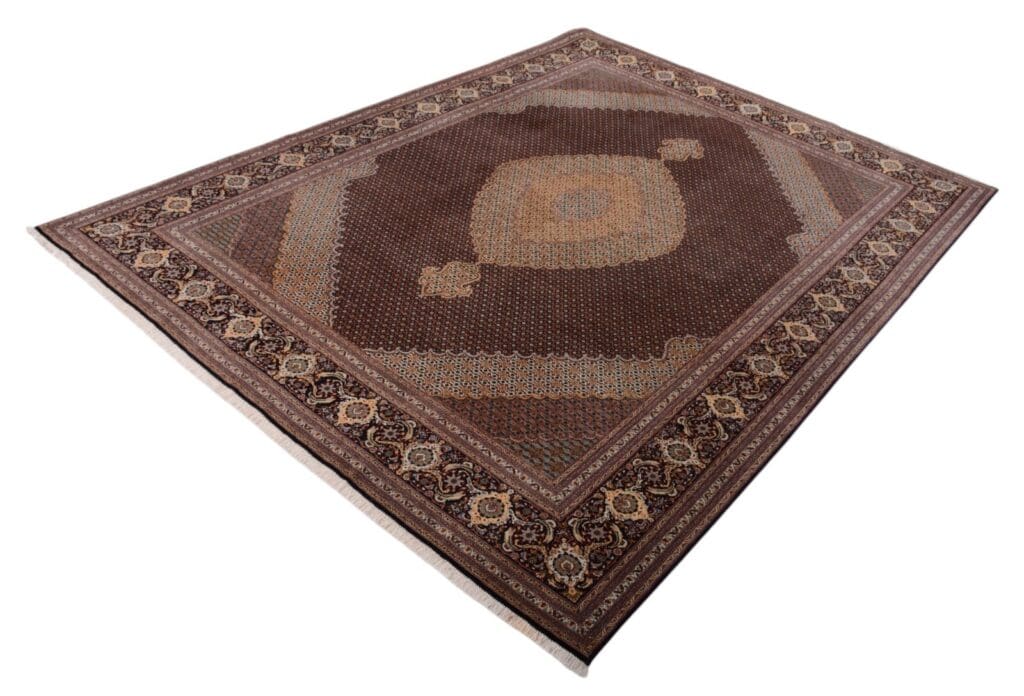
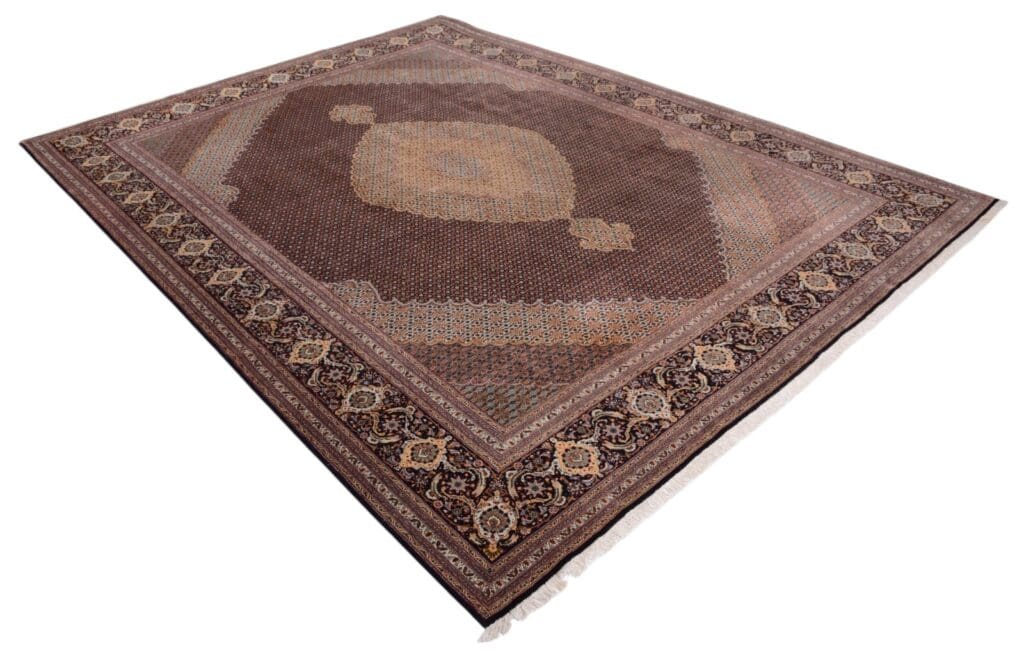
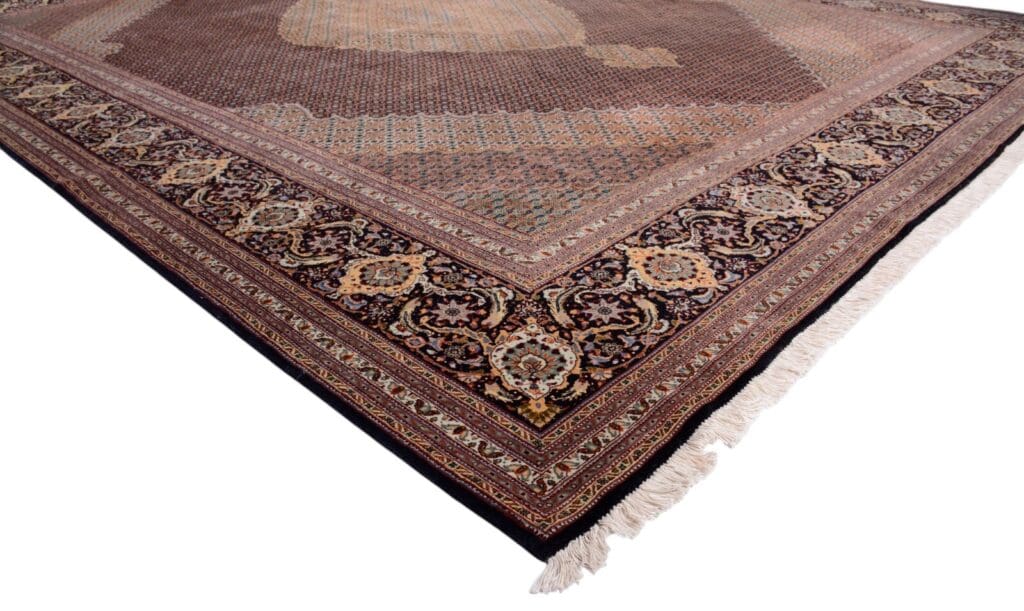
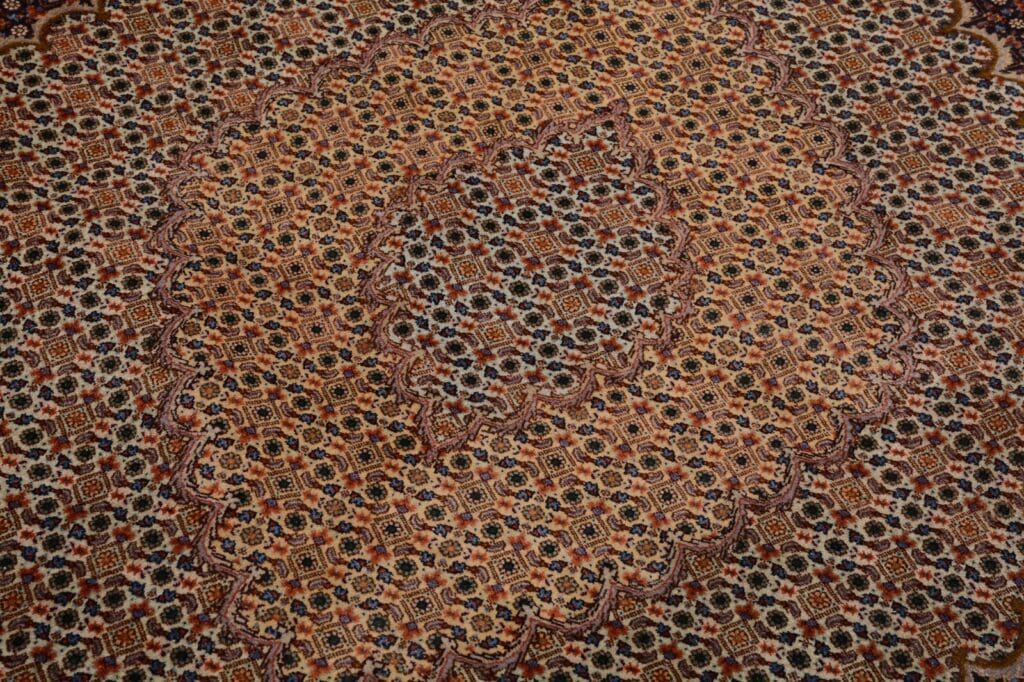
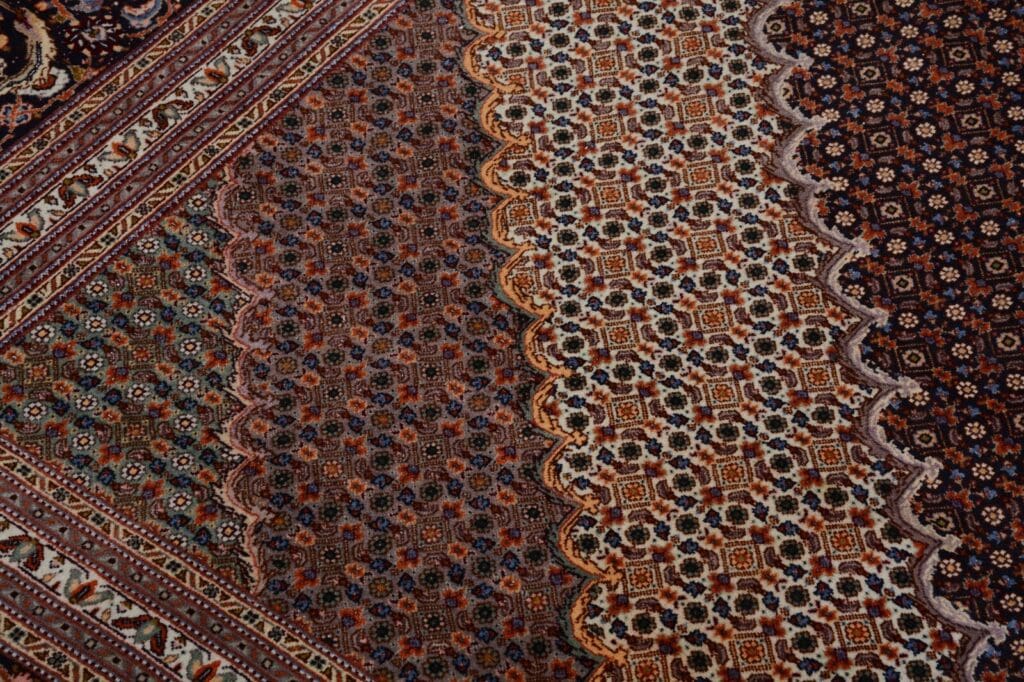
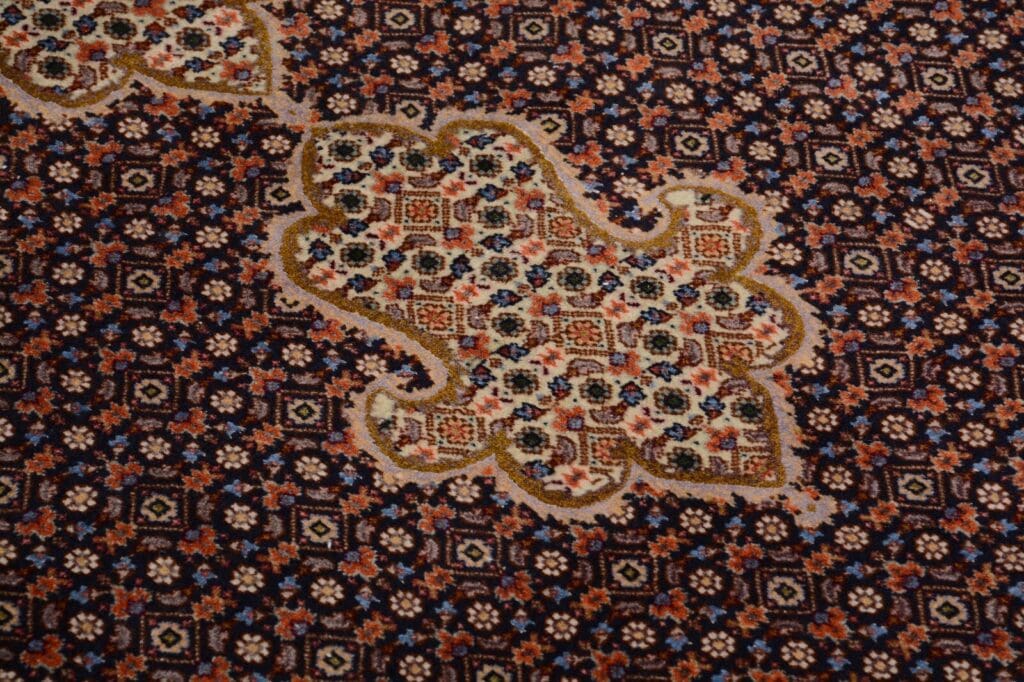
The pattern of this rug is described as a detailed medallion with fish motifs. In Persian rug design, a medallion usually acts as the visual centre of the field. It may be circular, oval, diamond-shaped or built from several nested outlines. Surrounding vines, leaves and smaller ornaments are arranged around it to form a coherent composition. On this rug, the fish motifs are part of the relationship between the central medallion and the surrounding ornamental language.
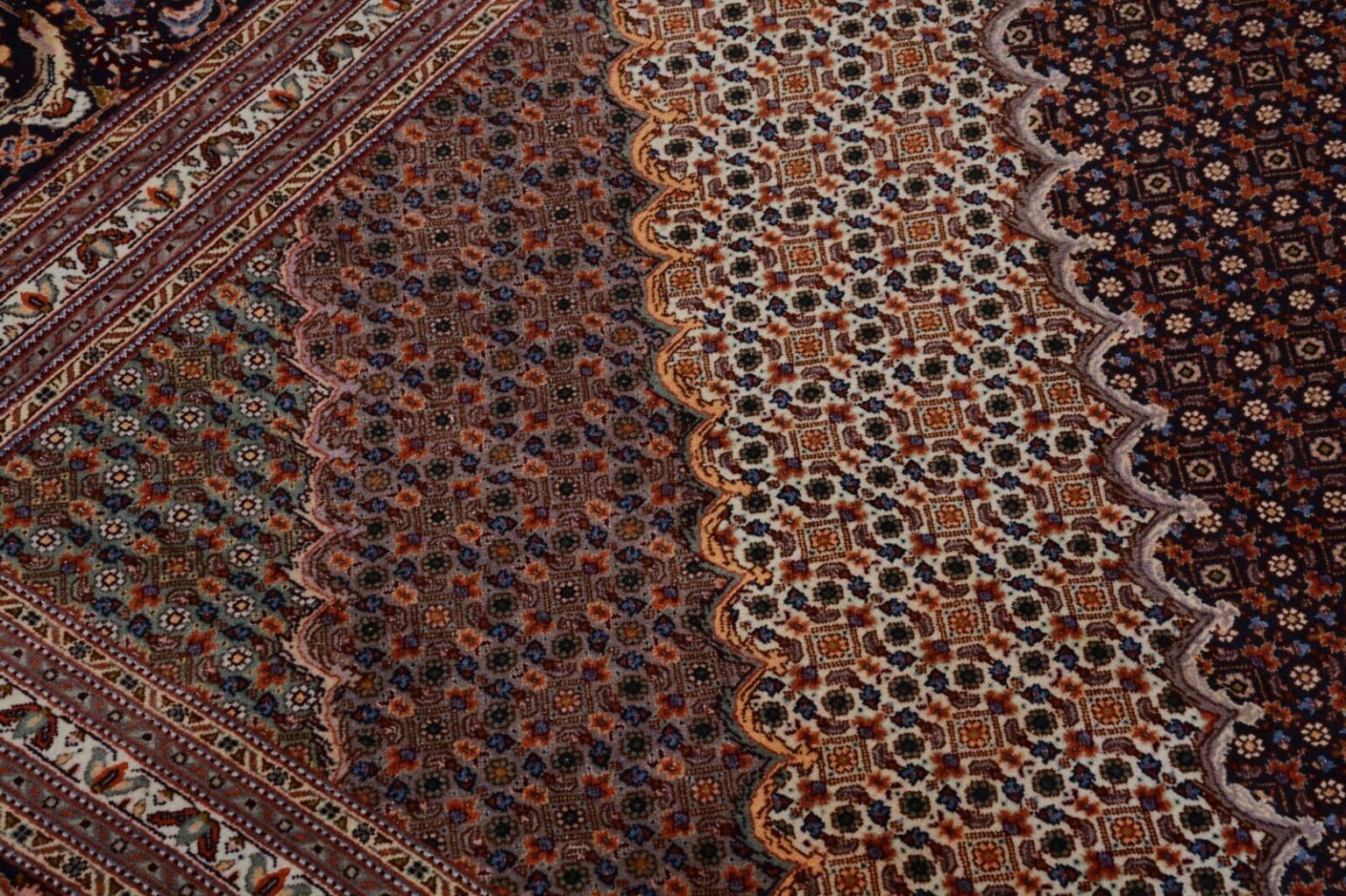
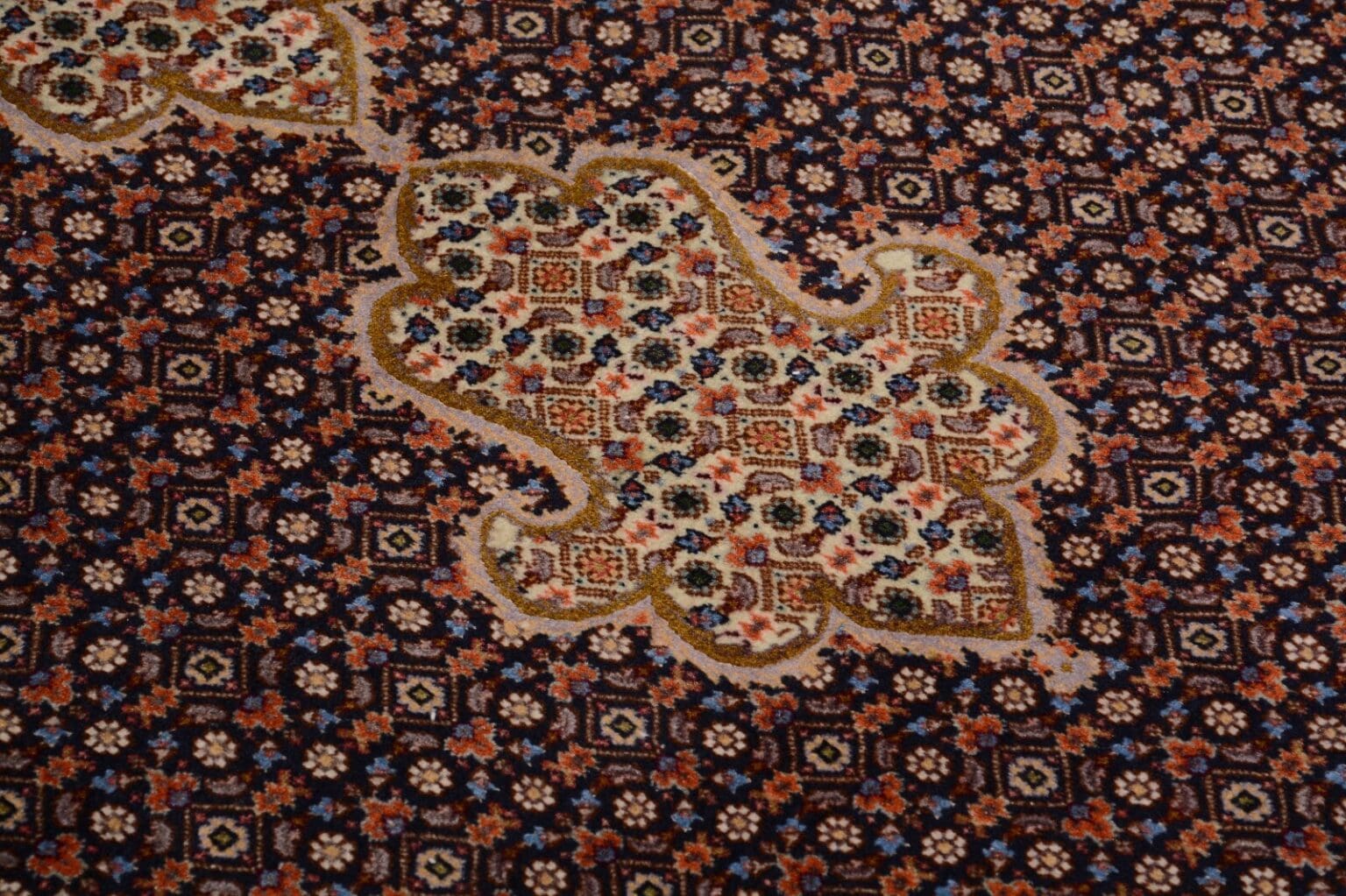
Fish motifs belong to a familiar group of Persian rug ornaments. In the Mahi pattern tradition, the word refers to fish, and small stylised fish are often repeated in pairs or in mirror-like arrangements among flowers, leaves and scrolling vines. They are not intended as naturalistic animal pictures. Instead, their form is reduced to a recognisable ornament that can be repeated across a field and joined to other elements. This allows the design to create a measured rhythm and a sense of continuous movement.
A medallion layout gives the eye a fixed point from which the rest of the pattern can be read. Borders frame the field and create a transition between the central design and the outer edge. Fine lines, repeated forms and small connected details help keep the composition legible. The stated knot density is suited to the rendering of numerous narrow contours and small ornaments, while the underlying structure remains organised around the central design. This balance between order and detail is characteristic of many Tabriz-inspired compositions.
Blue is an expressly stated feature of this rug. In Persian weaving, blue may be used as the main field colour, as a border colour or as an accent that separates individual motifs. Its visual effect changes according to the surrounding tones and the density of the ornament. A deep blue ground can give fine lines a clear background, while lighter blue passages can distinguish leaves, fish forms and medallion contours. Here, the blue colouring accompanies the Tabriz design tradition and the Mahi-related fish ornament.
The pattern is classified as traditionally Oriental and Persian. This classification refers to the decorative language of the rug: an ordered field, a recognisable centre and carefully developed ornamental details. It complements rather than replaces the regional name Tabriz. The origin tradition and the design vocabulary can therefore be described together, while the medallion and fish motifs remain the specific visual features identified for this piece.
Special Features
The specific features of this rug include its hand-knotted construction, a knot density of 550,000 knots per square metre, a wool pile and a cotton warp. The detailed medallion, fish motifs and blue colouring further define its appearance. The condition is described as perfect and unused. These points document the construction, design and condition of the individual rug without making a claim about future value or appreciation.
The rug is suitable for use with underfloor heating. A moderate temperature is advisable when placing a hand-knotted wool rug over a heated floor, so that the fibres are not exposed to unnecessary thermal stress. As with hand-knotted wool rugs generally, the surface should be kept clean and dry. Gentle regular vacuuming removes loose dust and particles, while professional cleaning can be considered when a more thorough treatment is needed.
FAQ
How should I care for a Tabriz Persian rug?
Regular vacuuming helps remove dust and loose particles from the wool pile. A gentle setting should be used so that the surface is not subjected to unnecessary abrasion. Prolonged exposure to strong sunlight should be avoided, and the rug should not be placed in a damp environment. If more intensive cleaning is required, professional rug cleaning is recommended. Rubbing a spill aggressively can disturb the pile and spread the mark, so careful treatment is preferable for a hand-knotted textile. Keeping the rug dry, removing loose dirt routinely and arranging professional care when necessary are practical measures for maintaining its condition.
Can this rug be used with underfloor heating?
Yes. This hand-knotted Tabriz Persian rug is suitable for rooms with underfloor heating. The heating should not be set too high, because a moderate temperature places less stress on the fibres. The floor beneath the rug should be clean and dry, and the area should be checked during normal use so that moisture or accumulated dirt does not remain underneath. Its stated suitability means that the rug can be combined with an existing heated floor while still being treated as a natural wool textile. Moderate heat and ordinary, careful maintenance are appropriate for this type of use.
How can I identify a hand-knotted rug?
Hand-knotted rugs often show a knot density that is not perfectly uniform and a back that differs from the highly regular reverse of a machine-made product. Such variations result from the fact that the knots are inserted individually by hand. The presence of natural materials such as wool or silk can also point to traditional rug construction, although material alone does not establish authenticity. The knots and the structure of the reverse should be examined carefully, as should the relationship between the pattern and the woven foundation. A relevant certificate may provide additional support for authentication. For a reliable assessment, material, knotting, pattern, reverse and any available origin documentation should be considered together.
To provide the best experiences, we use technologies like cookies to store and/or access device information. Consenting to these technologies will allow us to process data such as browsing behavior or unique IDs on this site. Not consenting or withdrawing consent, may adversely affect certain features and functions.
Functional Always active
The technical storage or access is strictly necessary for the legitimate purpose of enabling the use of a specific service explicitly requested by the subscriber or user, or for the sole purpose of carrying out the transmission of a communication over an electronic communications network.
Preferences
The technical storage or access is necessary for the legitimate purpose of storing preferences that are not requested by the subscriber or user.
Statistics
The technical storage or access that is used exclusively for statistical purposes.The technical storage or access that is used exclusively for anonymous statistical purposes. Without a subpoena, voluntary compliance on the part of your Internet Service Provider, or additional records from a third party, information stored or retrieved for this purpose alone cannot usually be used to identify you.
Marketing
The technical storage or access is required to create user profiles to send advertising, or to track the user on a website or across several websites for similar marketing purposes.
 SECURE PAYMENT
 SHIPPING PARTNERS


