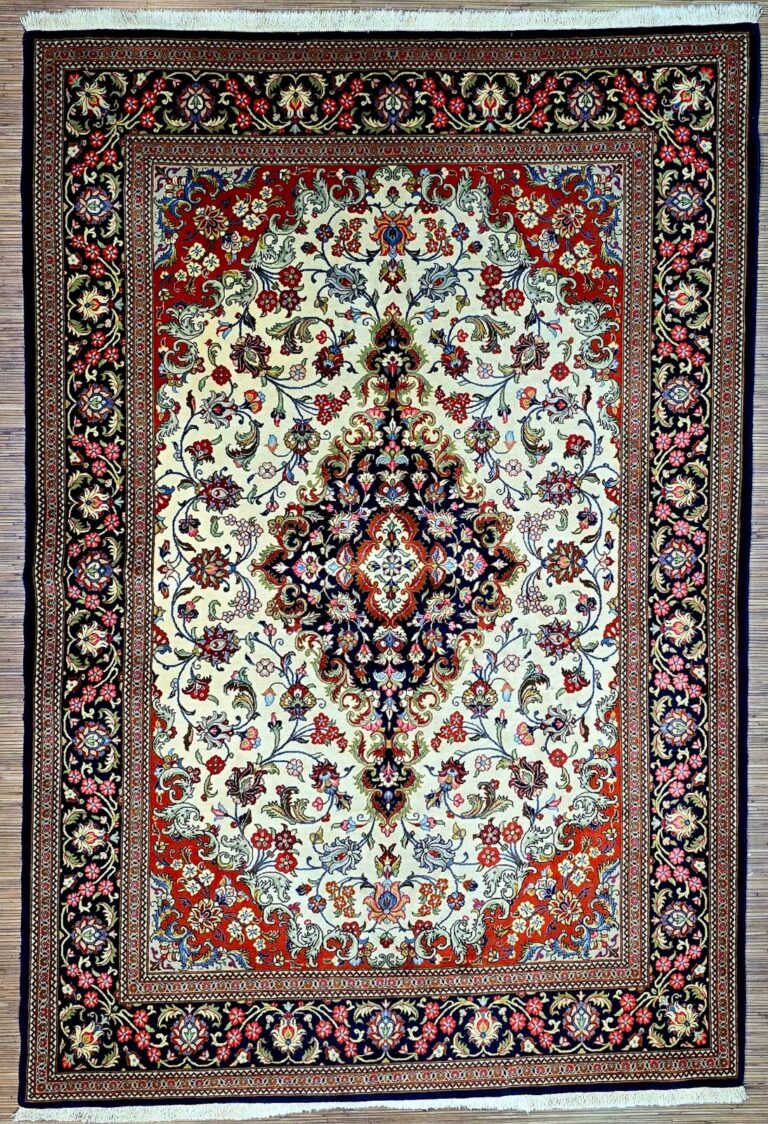
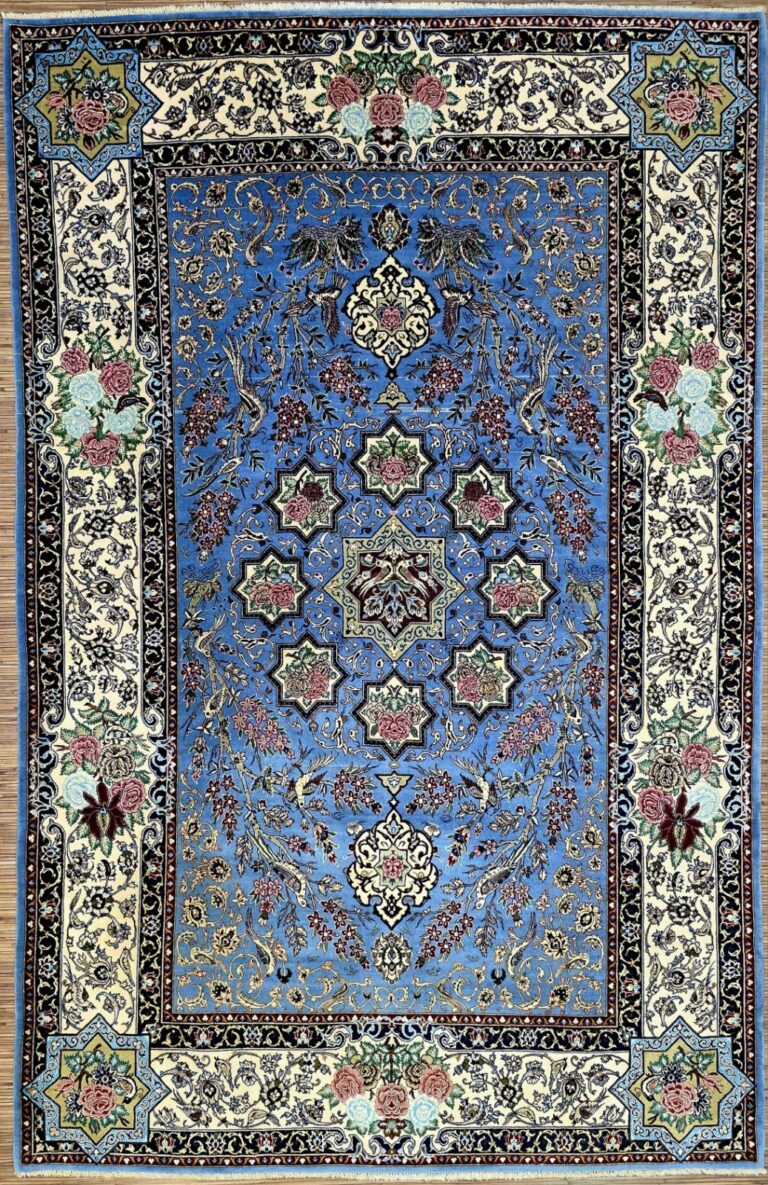
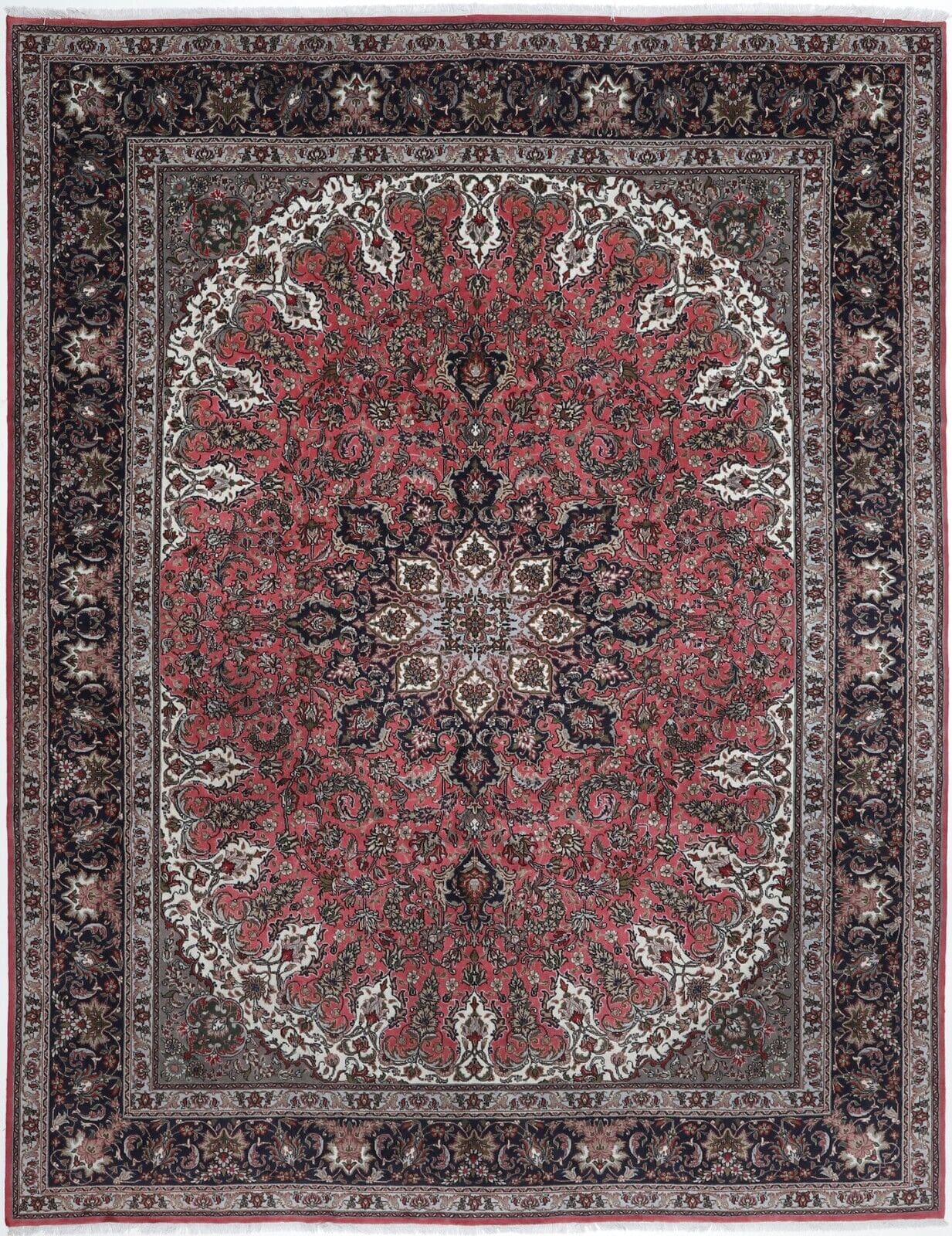
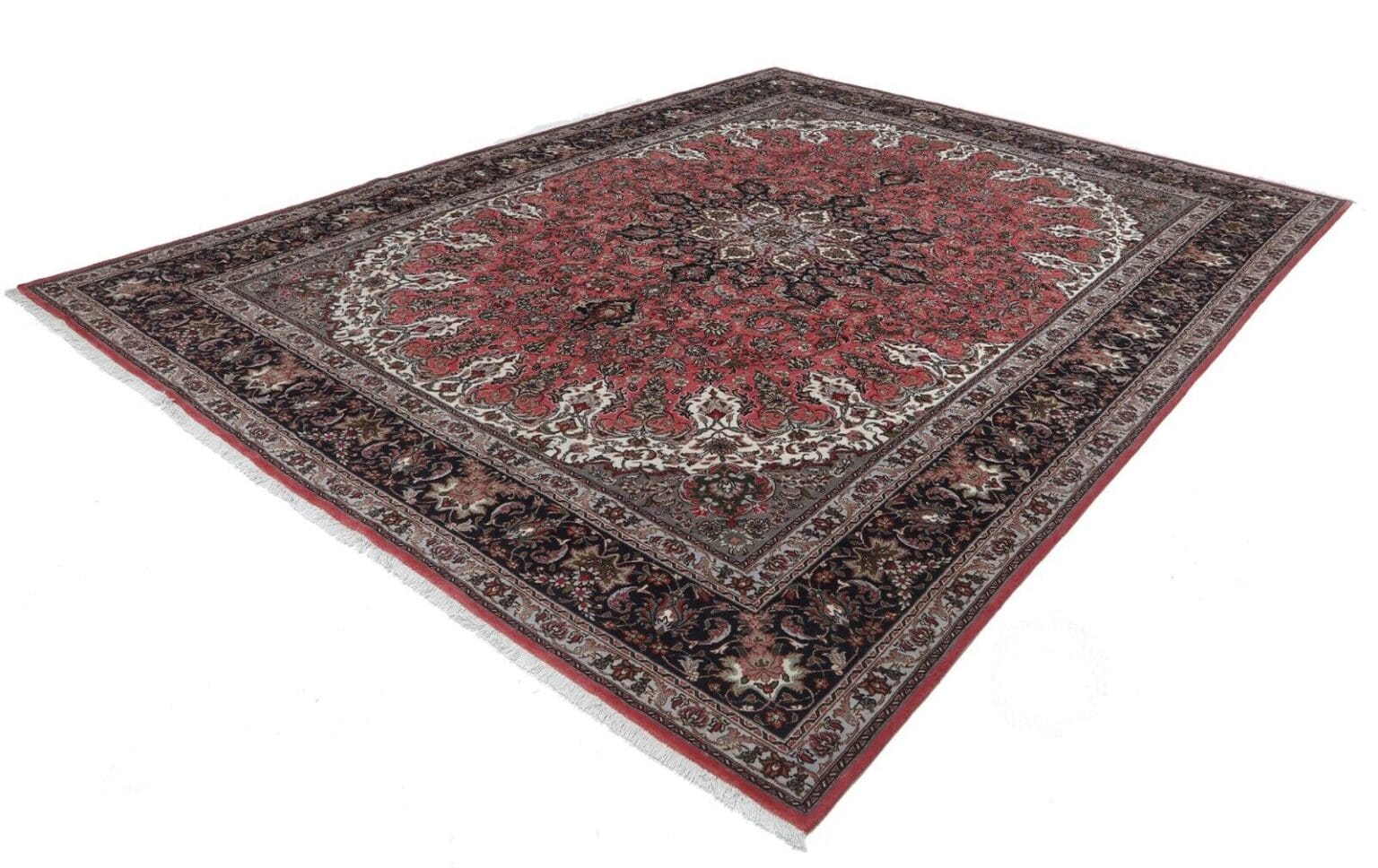
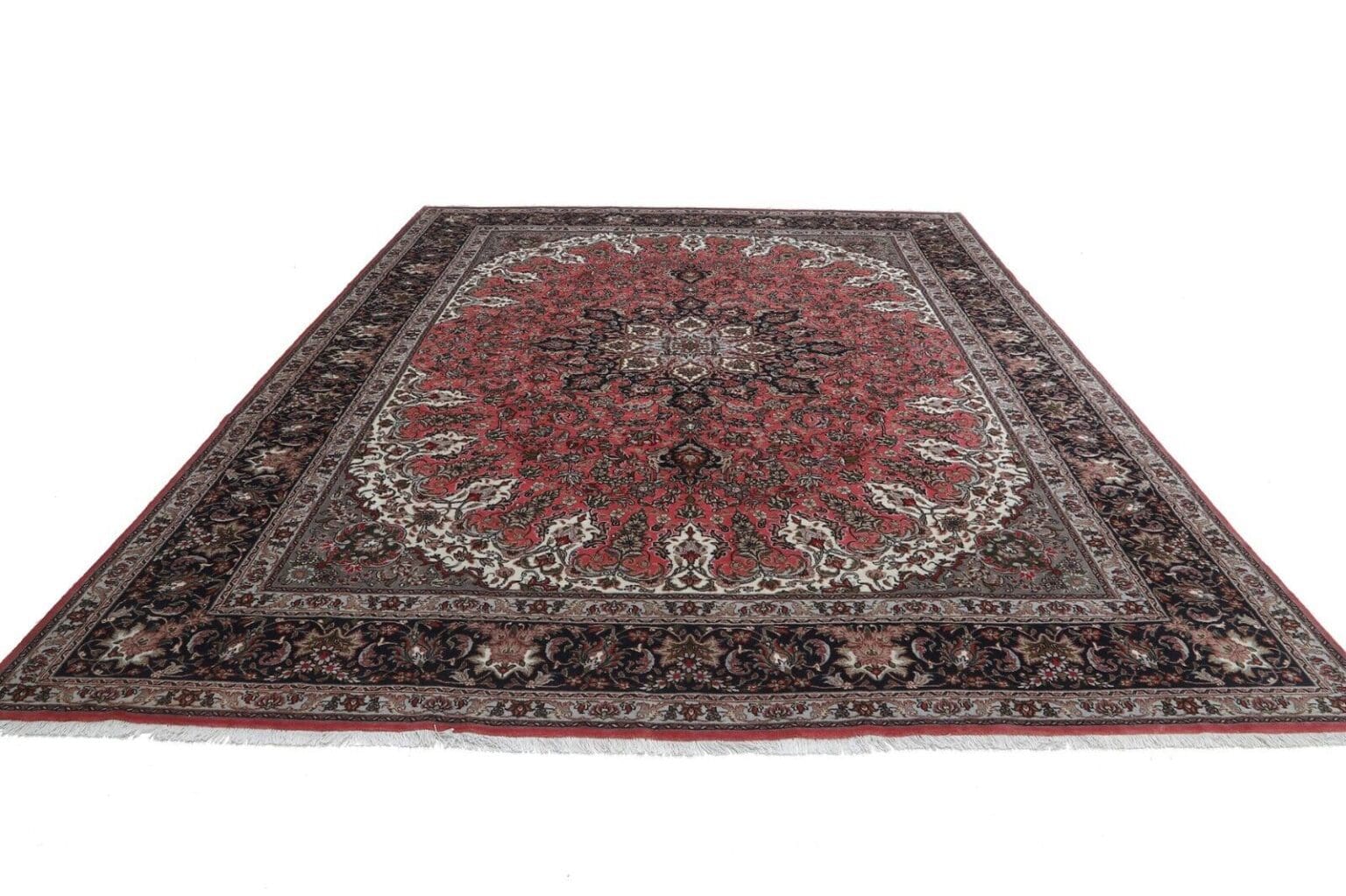
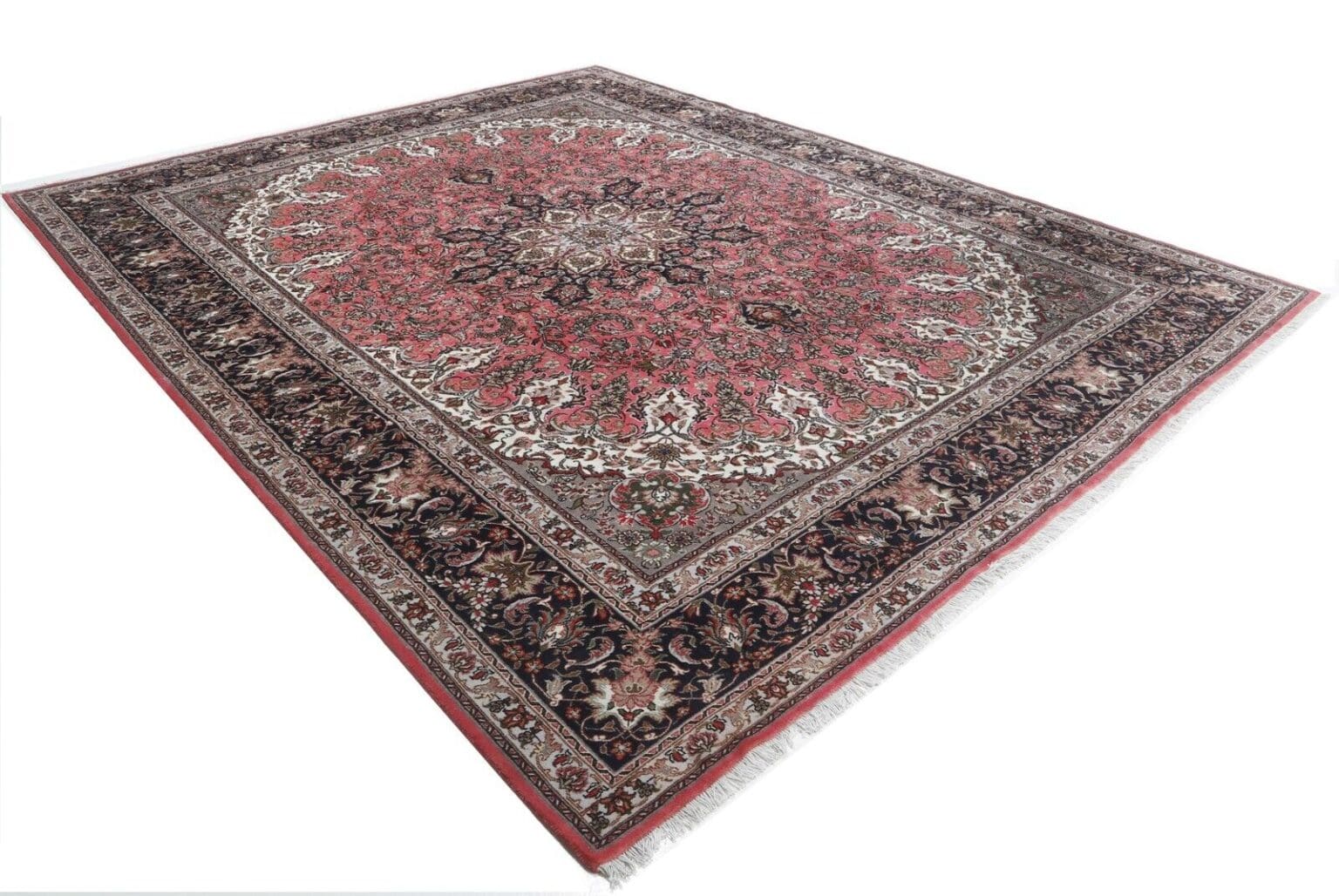
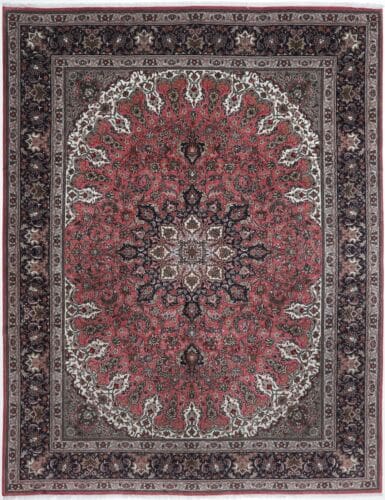
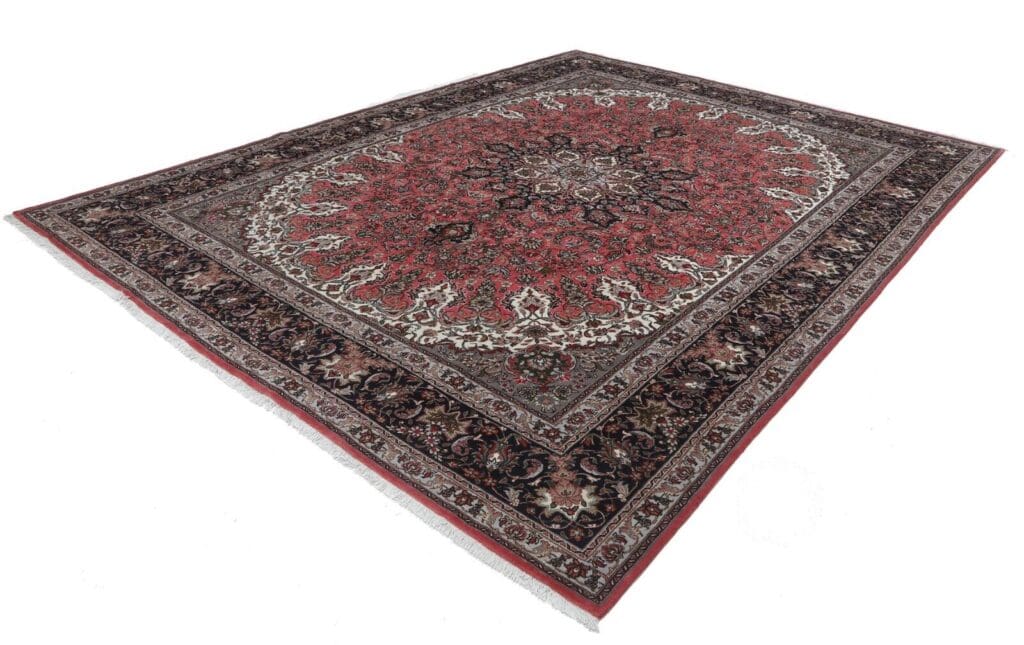
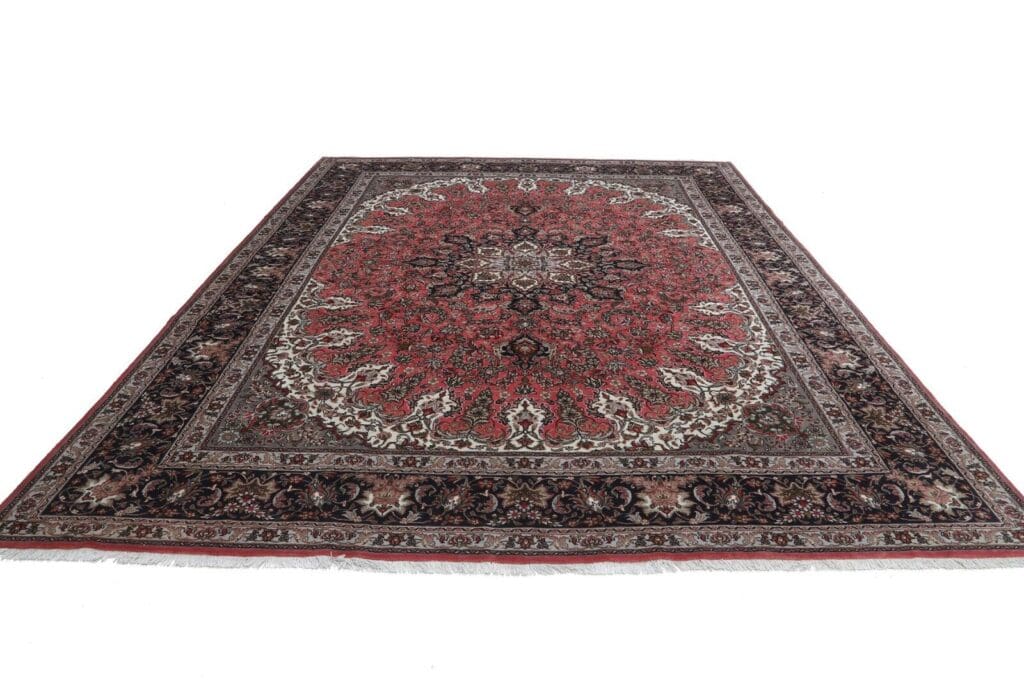
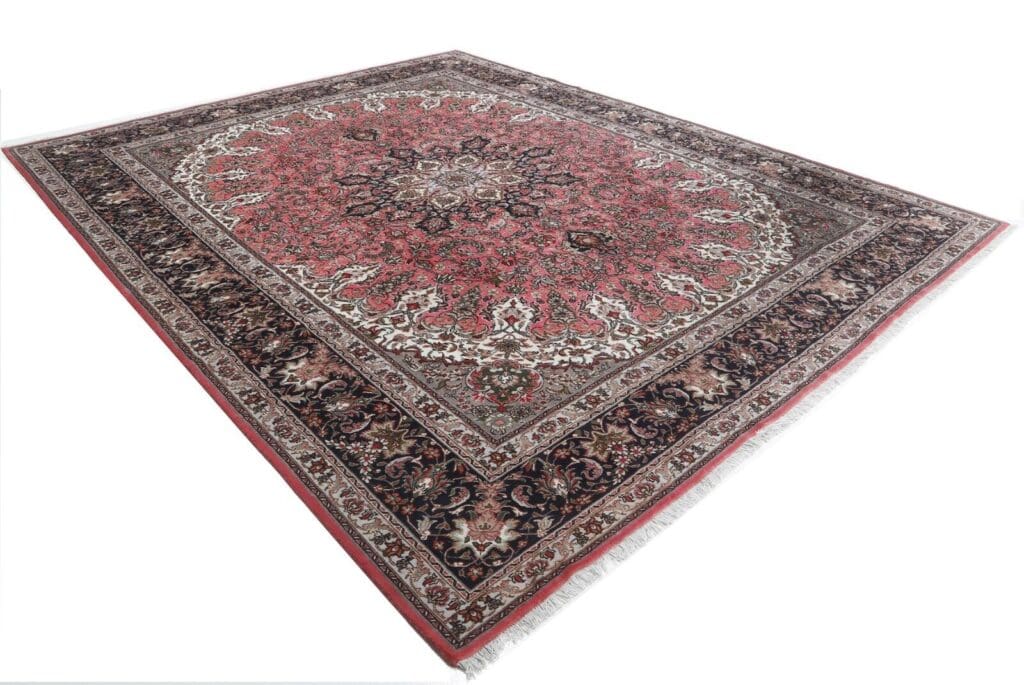
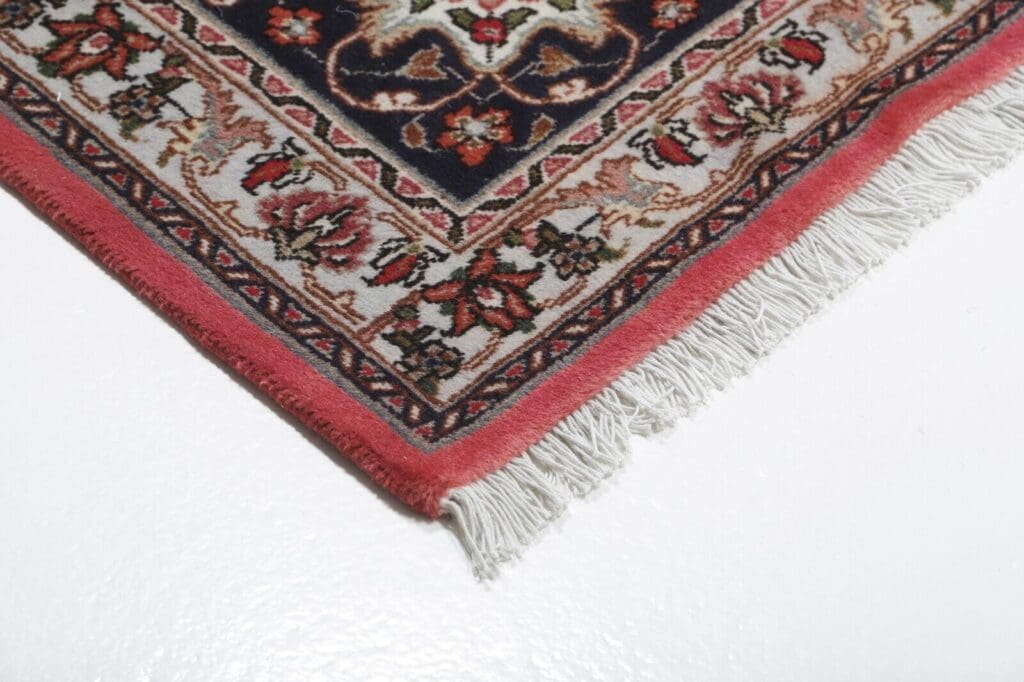
Hand-knotted Tabriz Persian Rug | Knot density: 40 Raj | Material: 100% wool pile, 100% cotton warp | Size: 390 x 300 cm | Condition: Top condition, like new
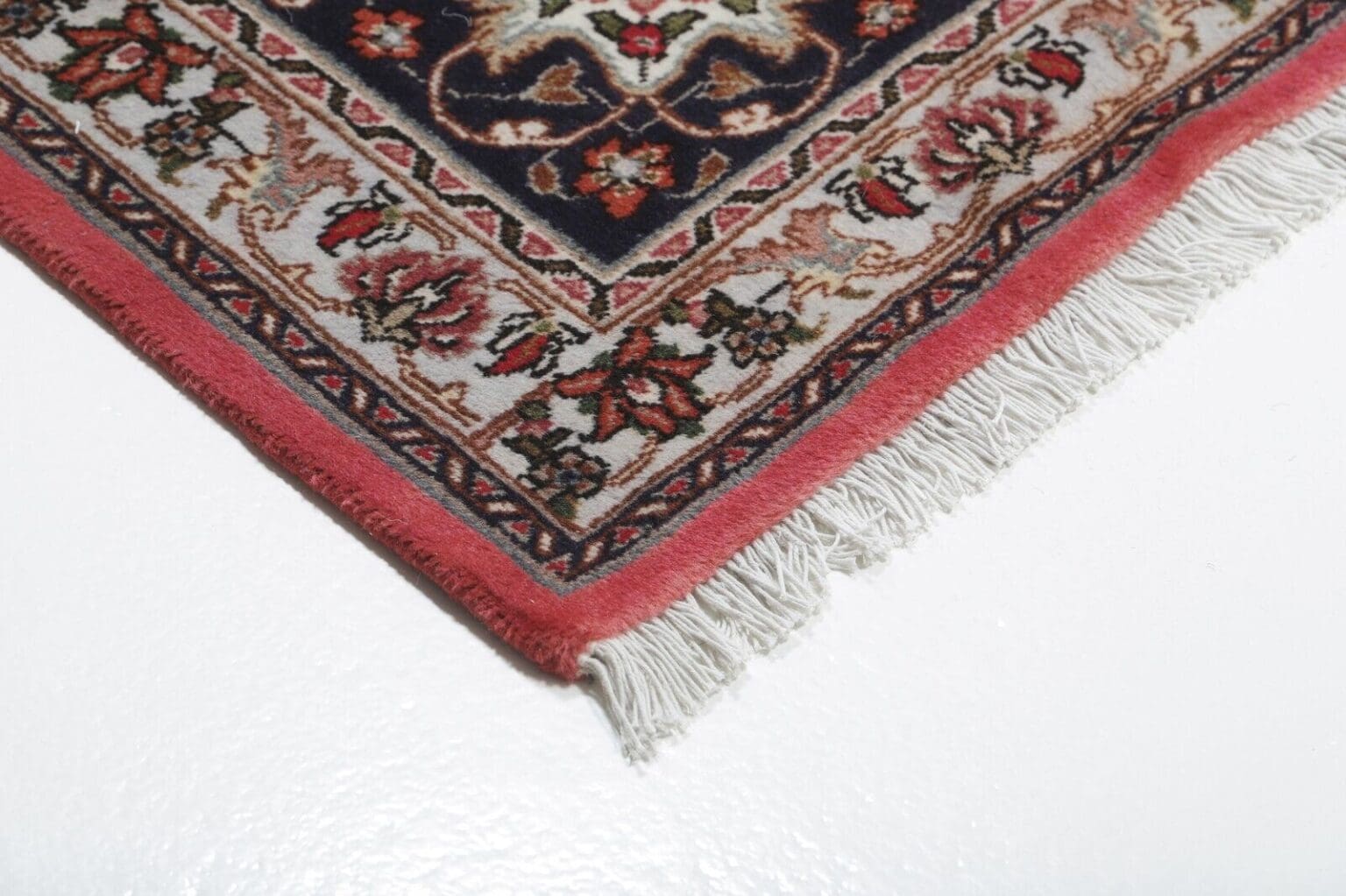
This hand-knotted Persian rug from Tabriz has a pile made of 100% wool and a warp made of 100% cotton. The combination of a wool pile with a cotton warp is a traditional construction in Persian rug making. The pile forms the visible and usable surface, while the warp provides the underlying framework into which the knots are tied. Both materials are specifically identified for this rug: wool in the pile and cotton in the warp.
Hand knotting is carried out one knot at a time. The warp is stretched on the loom, individual tufts are tied into it, and weft threads secure the work as the rows progress. The pile is then trimmed so that the design can be read across the surface. Unlike an industrially produced floor covering, a hand-knotted rug is built through a repeated manual process. Its knot density is given as 40 Raj. Raj is a traditional Persian measure used to describe knot fineness and gives an indication of the structure of the knotting.
Wool has long been used for rug pile because it is resilient and well suited to regular use. It has a naturally tactile surface, accepts dyes effectively, and gives the pile a substantial textile feel. Cotton is often chosen for the warp because it creates a firm foundation for the knots. The stated material construction therefore separates the practical qualities of the pile from the stabilising role of the warp.
The hand-knotted technique also allows the maker to follow a drawn composition with considerable control. Lines, floral details, repeated ornaments, and border divisions are created through the placement and colour of individual knots. The 40 Raj specification identifies the fineness of this particular knotting, while the materials identify what the pile and supporting structure are made from. Together, these details describe the rug’s basic construction without assigning it a pattern that is not specified.
Origin and Tradition
The rug comes from Tabriz, an important centre of Persian carpet making in north-western Iran. Tabriz has a long history as a commercial and cultural city, and its position helped different artistic and trading influences meet there. Over time, local workshops developed a recognisable approach to drawing, weaving, and finishing while continuing to work within the broader Persian tradition.
Tabriz rugs are not limited to one visual formula. Workshops in the region have produced formal medallion designs, all-over floral compositions, pictorial scenes, and more geometric arrangements. This variety reflects the depth of the local weaving tradition. A Tabriz rug is identified by its regional origin and workshop heritage, not by one compulsory decorative scheme.
Traditional Persian rug production begins with the preparation of the loom and the careful alignment of the warp. Knots are tied across the warp, rows are secured with weft, and the pile is periodically levelled. The work demands consistent tension, accurate colour placement, and a steady sense of proportion. In Tabriz, drawing and weaving have historically been closely connected, allowing intricate designs to be transferred from a planned composition into a knotted surface.
The city’s carpet tradition also developed through contact with a wide range of Persian artistic sources. Floral ornament, courtly composition, architectural imagery, and narrative scenes have all influenced Persian carpet design at different times. Tabriz workshops could adapt these sources to different formats and requirements while retaining the discipline of balanced borders, ordered fields, and carefully articulated details.
This rug is assigned to the twenty-first century, specifically the period from 2000 to 2009. It therefore represents a modern continuation of an established Iranian craft tradition rather than an antique piece. Its condition is described as top condition and like new. The regional designation Tabriz, the hand-knotted construction, and the stated period place it within a contemporary chapter of Persian rug production.
Persian rugs from different Iranian centres can vary considerably. Isfahan, Kashan, Nain, Kerman, and Tabriz each have their own histories, workshop practices, and commonly associated design vocabularies. Such regional names are not interchangeable. Tabriz identifies this rug’s origin and connects it with the north-western Iranian weaving tradition.
Design and Pattern
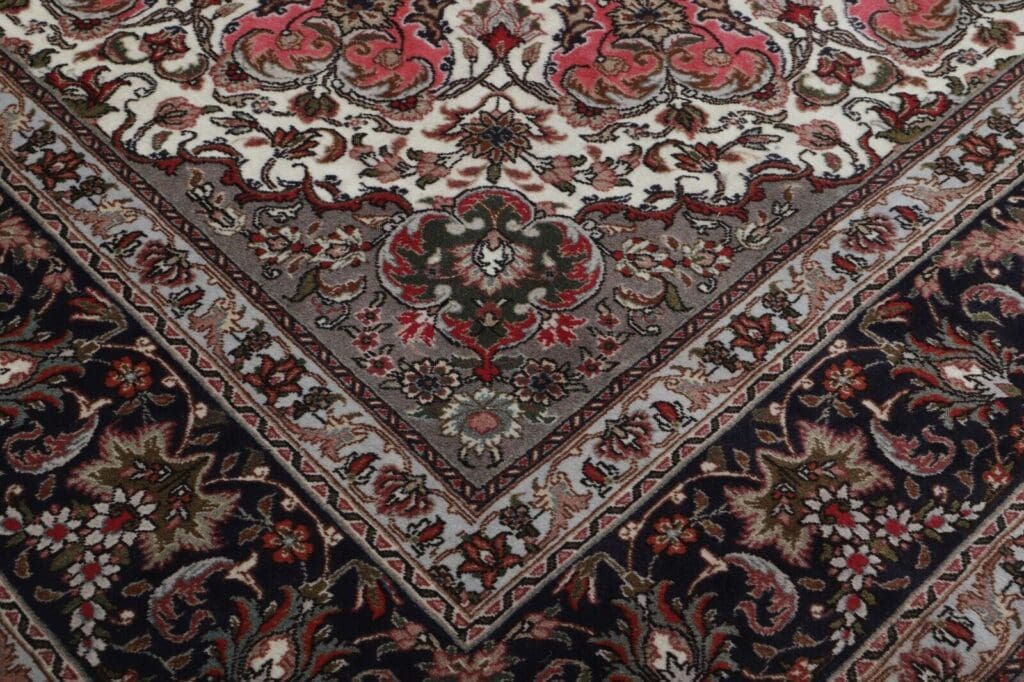
The wider Tabriz design tradition includes many forms of organised ornament. A central medallion may structure the field, with corner pieces and surrounding vines reinforcing the composition. An all-over design distributes repeated flowers, leaves, and scrolling branches across the field. Other compositions use geometric divisions, strong axes, or pictorial arrangements. These are established possibilities within Tabriz and Persian carpet design, not a statement that every one of them appears on this rug.
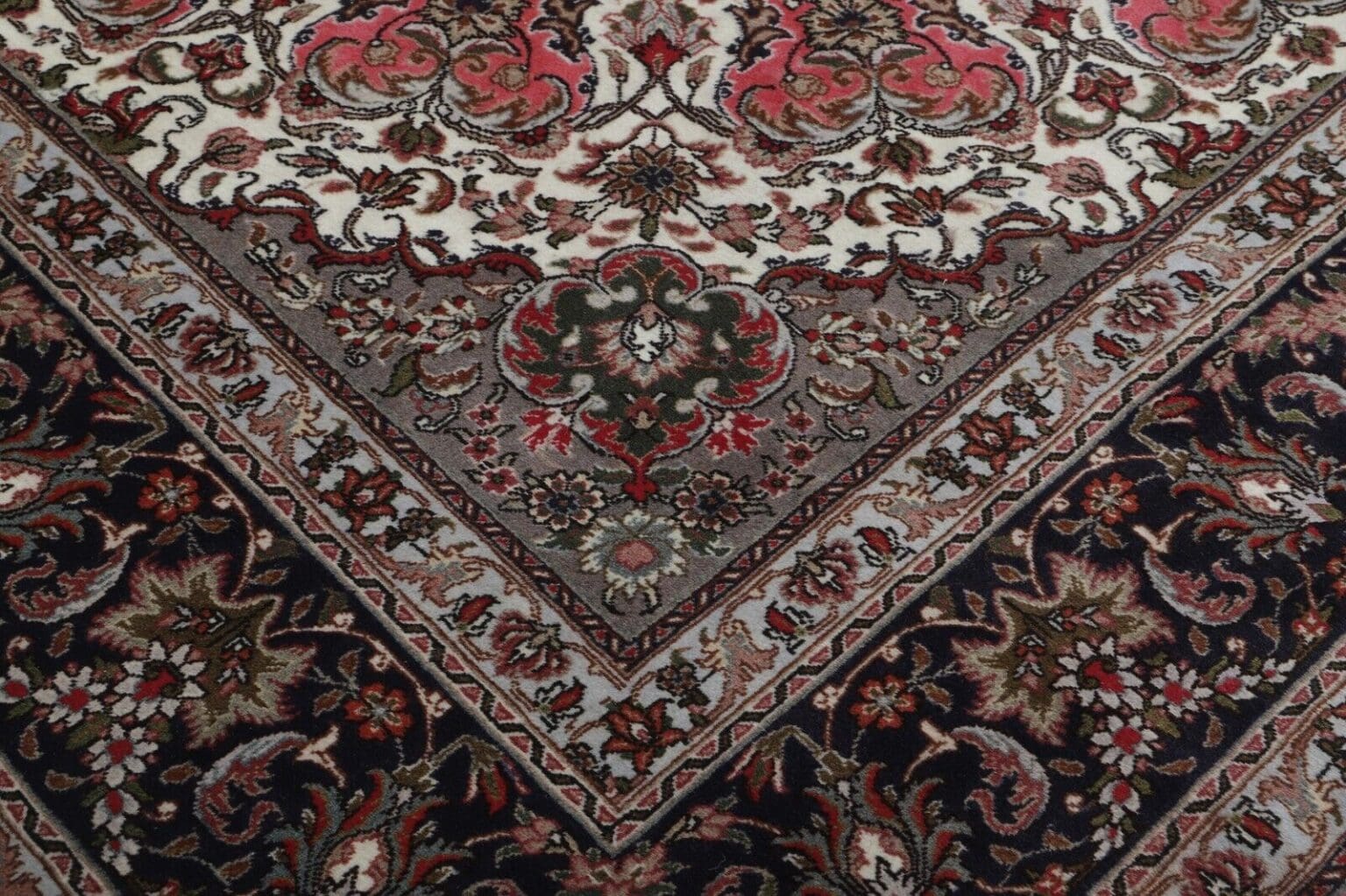
Floral Persian ornament often relies on a carefully balanced relationship between stems, leaves, blossoms, and palmettes. The drawing may be fine and detailed or more open and restrained. Repetition creates rhythm, while variations in scale help distinguish the main field from the borders. In a medallion design, the eye is guided toward a central form; in an all-over design, the repeated pattern creates continuity across the surface.
Borders are an important part of Persian carpet composition. A principal border can be framed by narrower guard borders, creating a transition between the central field and the outer edge. Rosettes, vines, leaves, and other recurring ornaments may be arranged along these bands. In pictorial designs, borders can frame scenes and add architectural order. The border system gives the overall design a visual structure and helps maintain a sense of proportion.
The appearance of a knotted pattern depends on the relationship between the drawing, the knot placement, the pile, and the colour arrangement. Fine knotting can support detailed contours, while clear outlines help separate adjoining motifs. Wool contributes a particular depth to colour because its surface is not completely flat or reflective. Tabriz weaving is widely associated with controlled line work and precise composition, qualities that can support both delicate floral detail and more structured geometry.
It is useful to distinguish a regional name from a pattern name. Tabriz refers to the Iranian origin and the associated weaving tradition; it does not by itself prescribe a single motif. Persian design vocabulary includes medallions, floral scrolls, arabesques, repeated boteh forms, garden layouts, pictorial scenes, and geometric arrangements. The regional identity remains connected to the methods and design culture of Tabriz even when individual workshop compositions differ.
Traditional motifs also carry different historical associations. Floral forms can suggest cultivated gardens or the ordered beauty of nature, while repeated geometric structures emphasise balance and symmetry. Pictorial carpets may draw on literature, architecture, or everyday scenes. These interpretations belong to the broader history of Persian carpet art. They provide context for understanding Tabriz design without adding an undocumented motif to this particular rug.
Special Features
The rug is described as suitable for allergy-conscious households, slip-resistant, suitable for use with underfloor heating, and easy to clean. These are the specific practical features assigned to the piece. The slip-resistant description concerns its use as a floor covering, while compatibility with underfloor heating identifies an additional domestic application. Its easy-care description relates to everyday handling and cleaning.
Care should nevertheless remain gentle. Regular careful vacuuming can remove loose surface dirt, while fresh spills should be dabbed promptly with a damp cloth rather than rubbed forcefully. Strong household chemicals are not appropriate for a wool pile. For more extensive cleaning, professional rug cleaning is the suitable approach. These measures support the stated easy-cleaning characteristic while respecting the hand-knotted construction.
The condition is recorded as top condition and like new. The rug belongs to the twenty-first century period from 2000 to 2009. This places it in a modern production context and distinguishes it from a rug described as antique. Its stated origin is Tabriz in Iran, and its material structure consists of a 100% wool pile with a 100% cotton warp. The practical features, condition, period, origin, and construction together define the documented profile of this one-off rug.
FAQ
How should a hand-knotted Persian rug be cared for?
Regular, gentle vacuuming is suitable for routine care. If a spill occurs, it should be absorbed promptly with a damp cloth rather than scrubbed into the pile. Aggressive cleaning agents should be avoided because the rug has a wool surface and a hand-knotted construction. For a thorough cleaning, professional rug cleaning is recommended. This approach helps preserve the textile structure while keeping everyday maintenance straightforward.
What are the advantages of a hand-knotted Persian rug?
A hand-knotted Persian rug is made through a manual knotting process, giving it an individual textile character rather than the uniform construction of a machine-made floor covering. Wool provides a durable pile, while cotton forms the warp in this example. The rug is also described as suitable for allergy-conscious households, slip-resistant, compatible with underfloor heating, and easy to clean. Its like-new condition is another stated characteristic.
Where do Tabriz Persian rugs come from?
Tabriz Persian rugs come from Tabriz, an Iranian centre in the north-west of the country with a long tradition of hand-knotted carpet production. The region is known for a varied design culture that can include medallions, floral arrangements, geometric structures, and pictorial compositions. The name Tabriz identifies the origin and weaving tradition rather than one mandatory pattern. This rug is assigned to the twenty-first century, specifically the period from 2000 to 2009.
To provide the best experiences, we use technologies like cookies to store and/or access device information. Consenting to these technologies will allow us to process data such as browsing behavior or unique IDs on this site. Not consenting or withdrawing consent, may adversely affect certain features and functions.
Functional Always active
The technical storage or access is strictly necessary for the legitimate purpose of enabling the use of a specific service explicitly requested by the subscriber or user, or for the sole purpose of carrying out the transmission of a communication over an electronic communications network.
Preferences
The technical storage or access is necessary for the legitimate purpose of storing preferences that are not requested by the subscriber or user.
Statistics
The technical storage or access that is used exclusively for statistical purposes.The technical storage or access that is used exclusively for anonymous statistical purposes. Without a subpoena, voluntary compliance on the part of your Internet Service Provider, or additional records from a third party, information stored or retrieved for this purpose alone cannot usually be used to identify you.
Marketing
The technical storage or access is required to create user profiles to send advertising, or to track the user on a website or across several websites for similar marketing purposes.

 SECURE PAYMENT
 SHIPPING PARTNERS