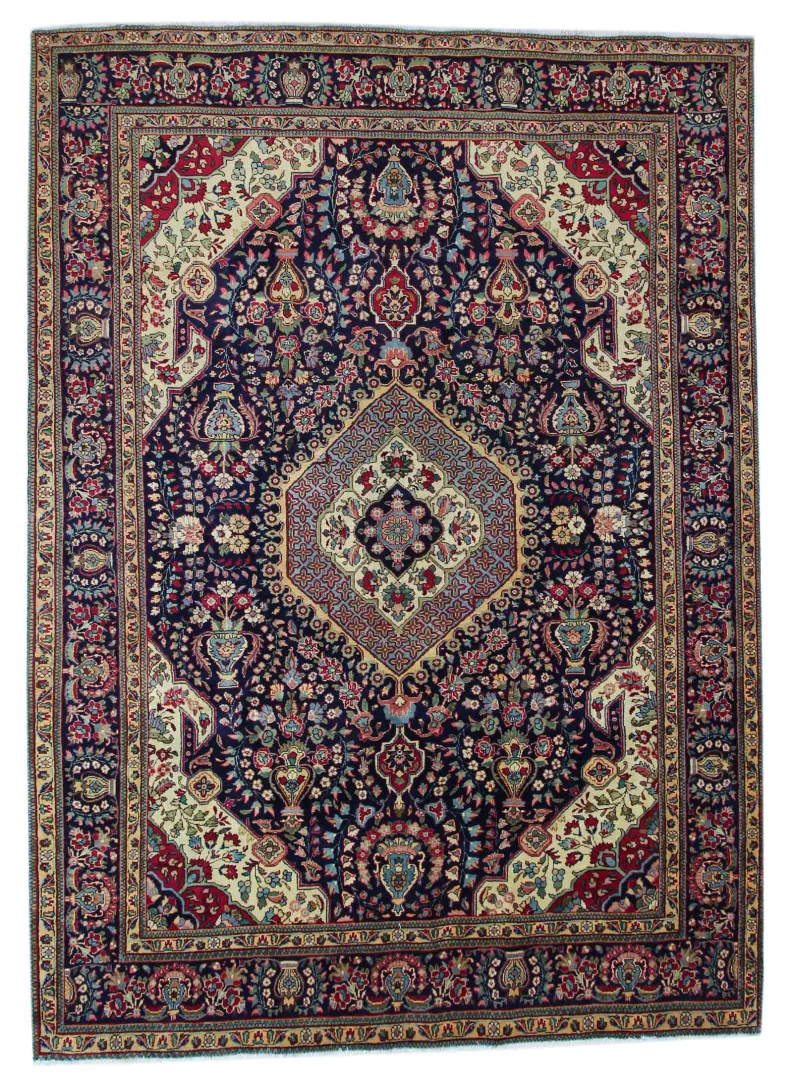
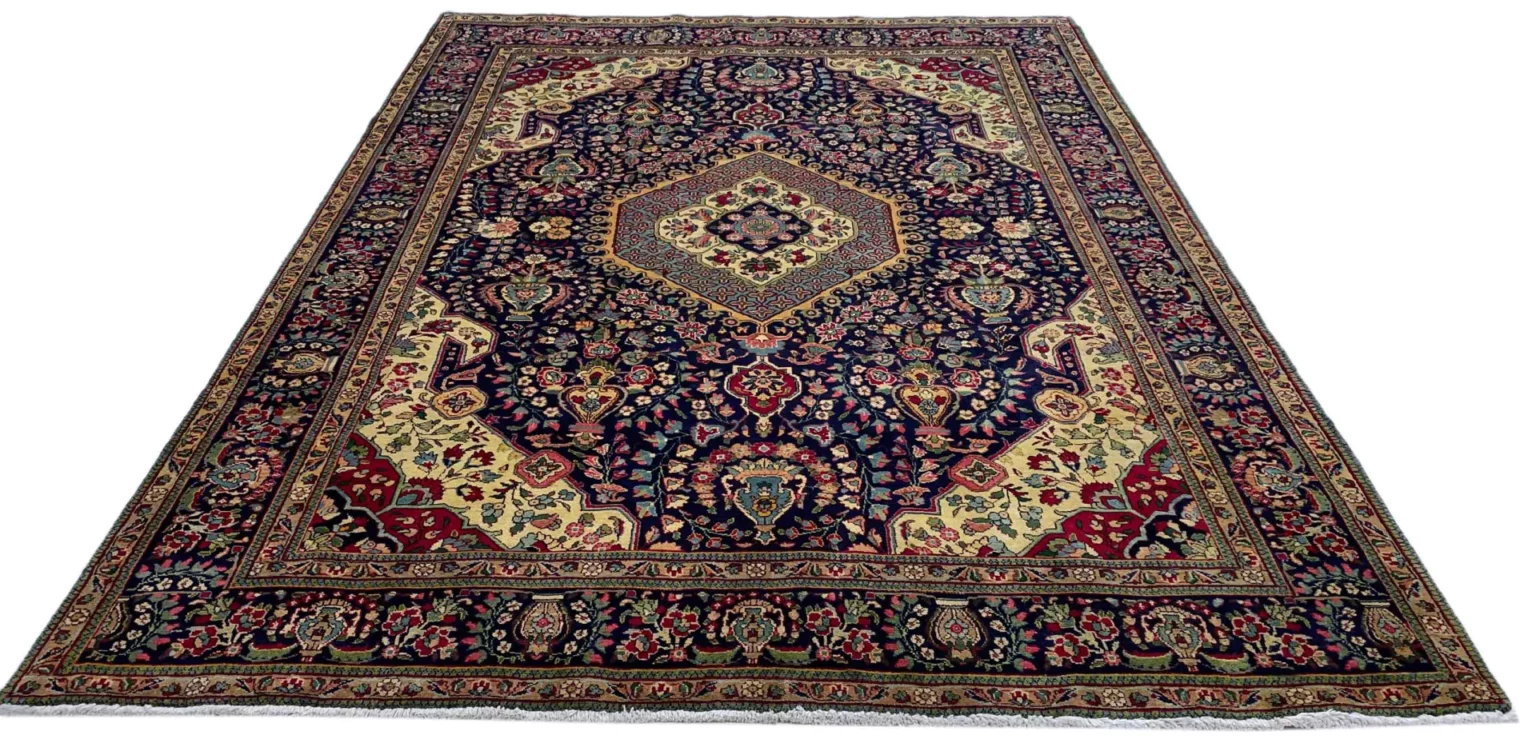
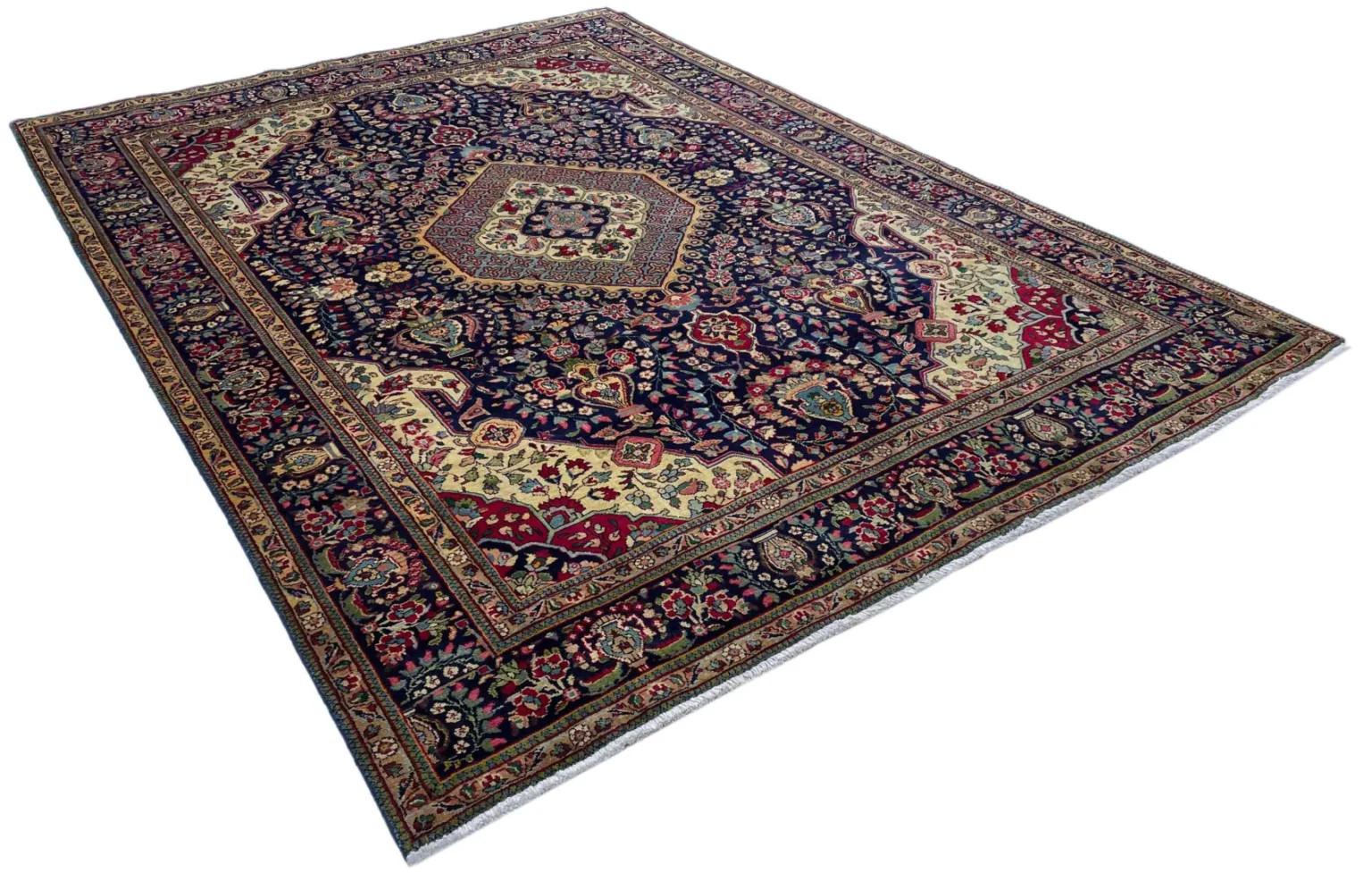
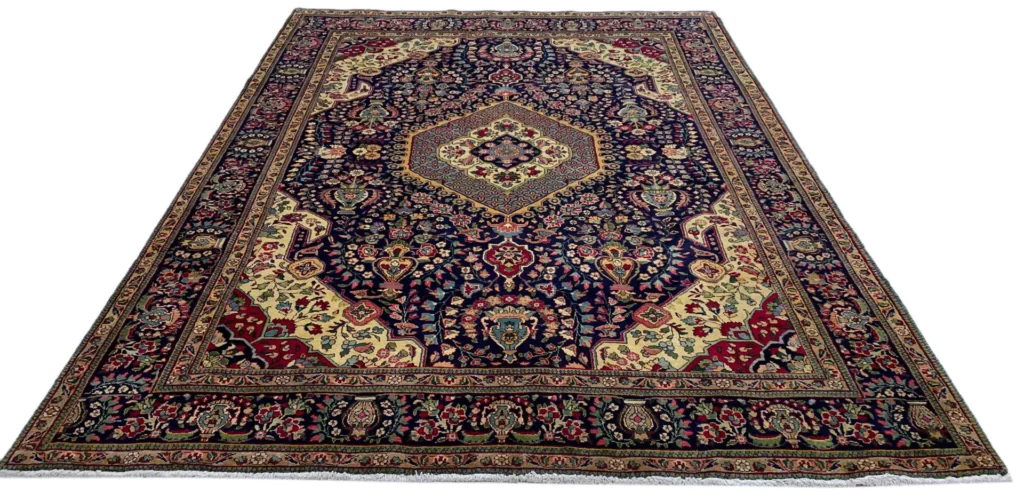
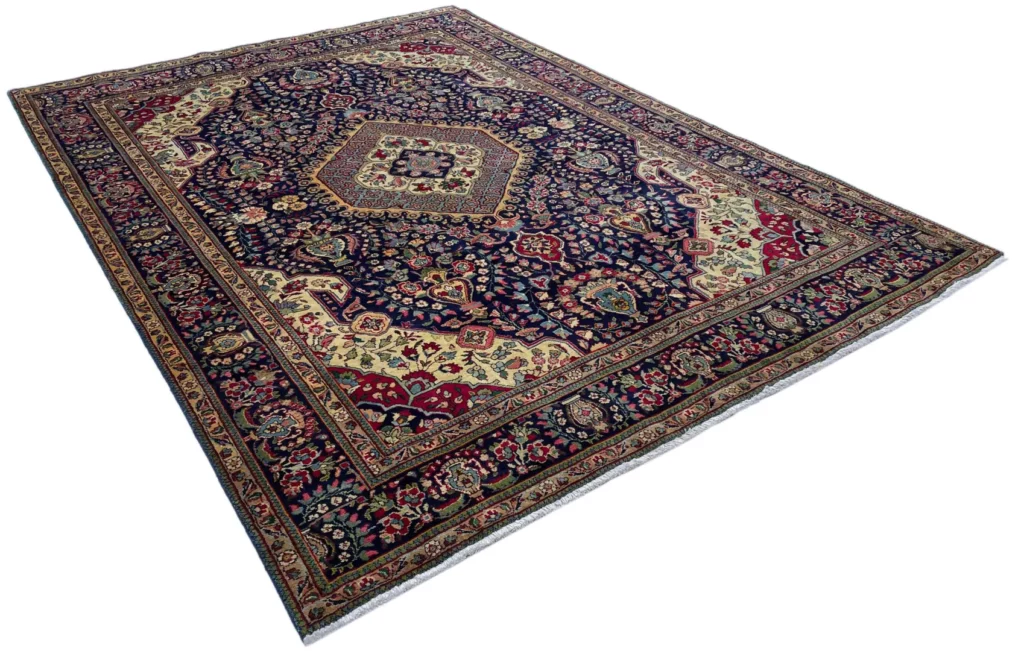
Hand-knotted Tabriz Persian Rug | Knot density: 180,000 knots/m² | Material: pile wool and silk | Size: 354 x 254 cm | Pattern: Traditional Oriental design | Condition: Very well preserved
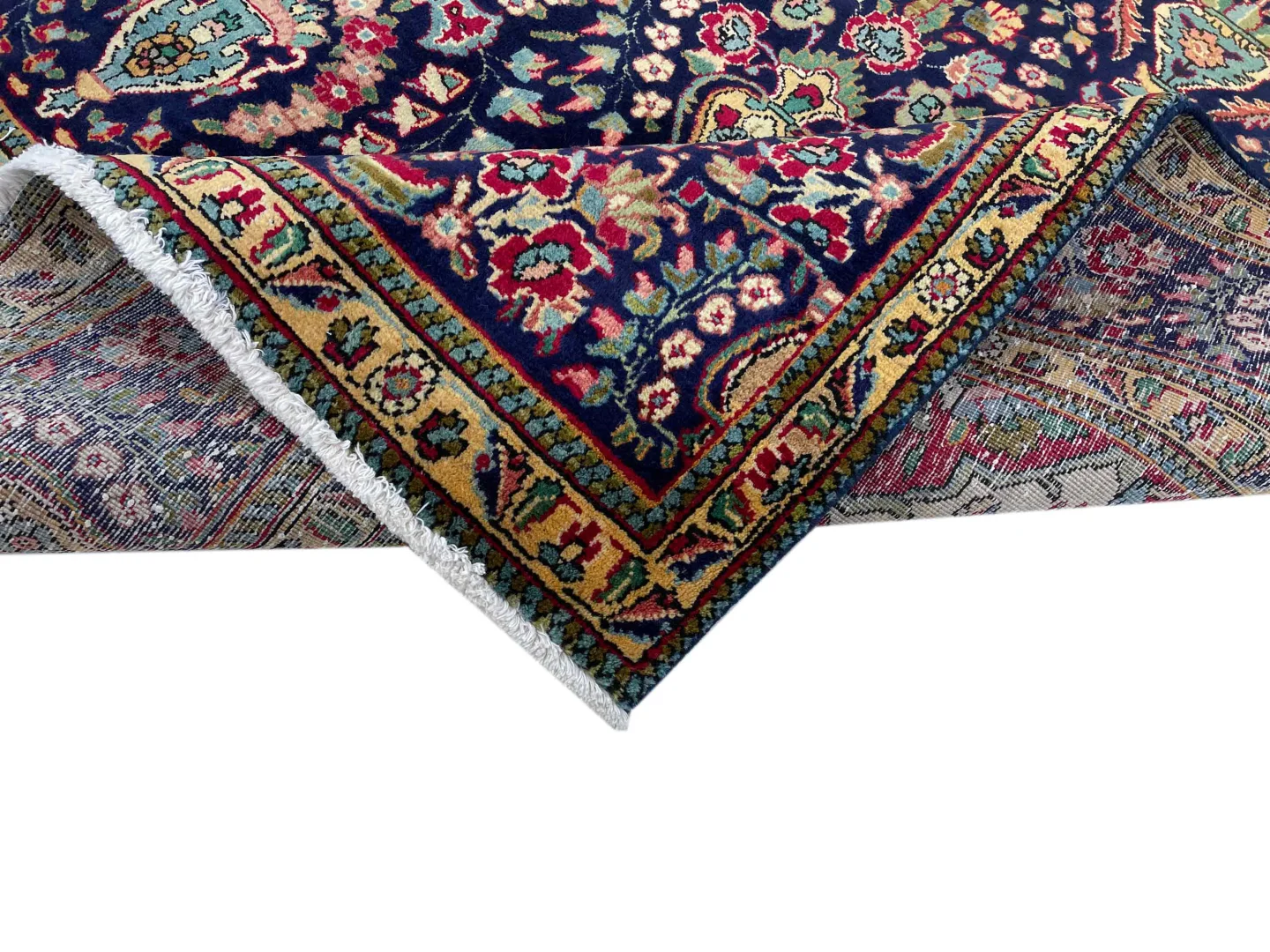
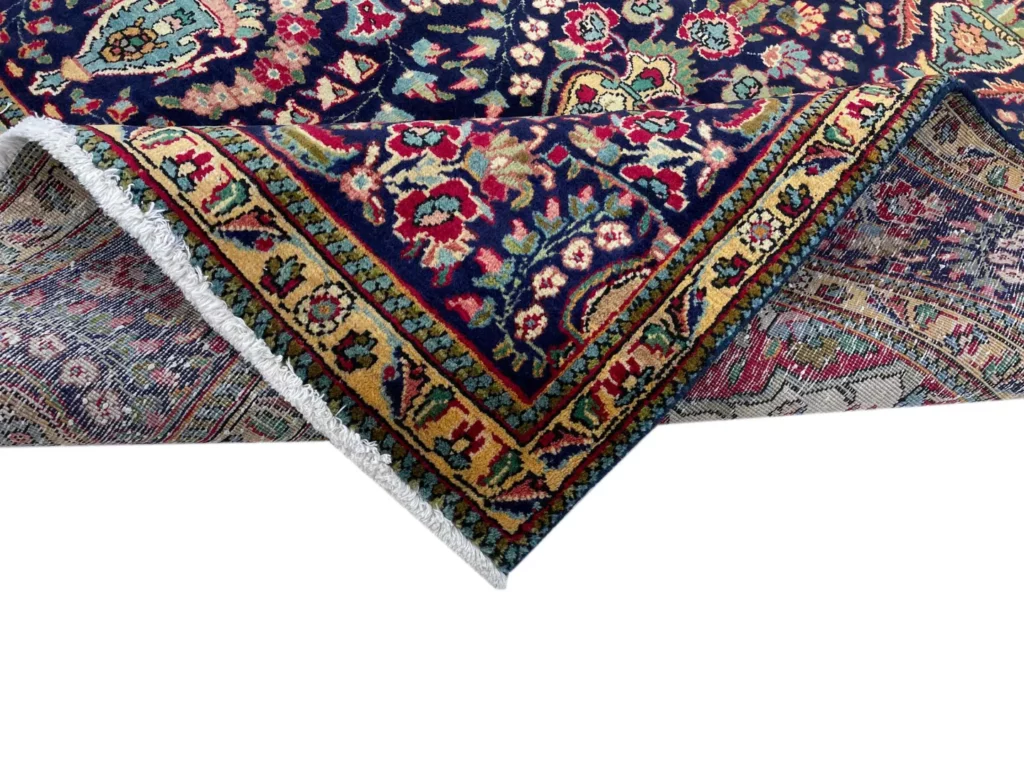
This Persian rug from Tabriz is hand-knotted and made from high-quality wool and silk. The combination of these materials gives the rug its particular textile character. Wool is valued in Tabriz rugs for its durability and natural lustre. It provides a resilient foundation for a floor covering intended to remain part of an interior over time. Silk adds a finer surface quality and a subtle sheen, creating further variation in the way the rug receives light.
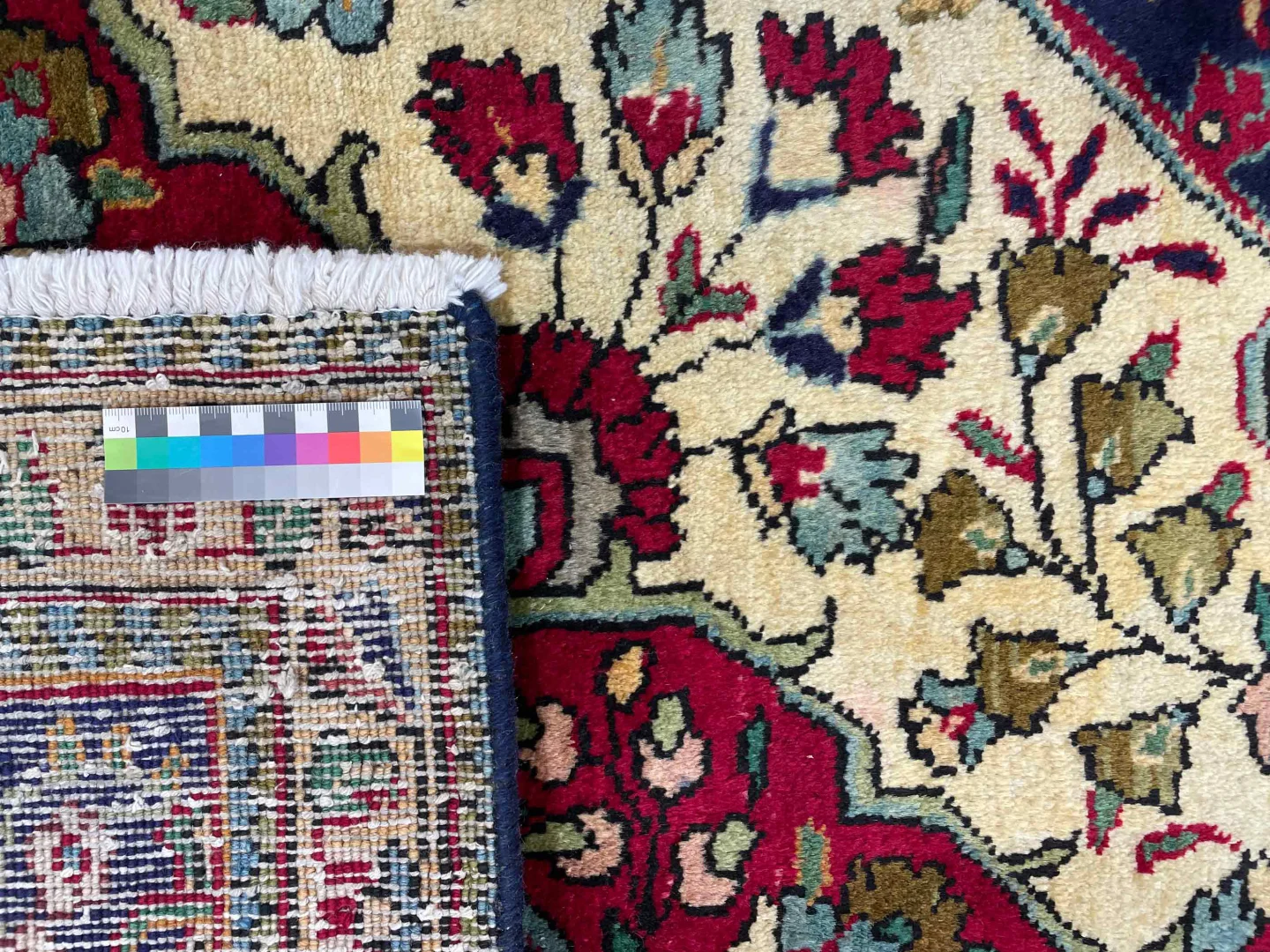
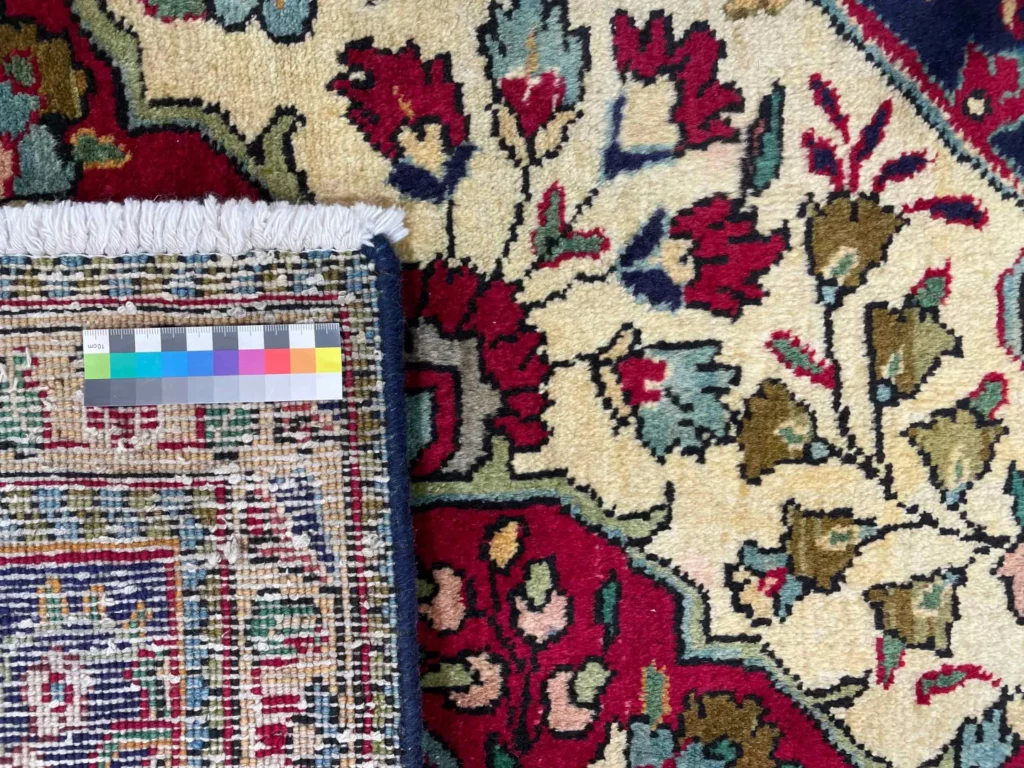
Knot density is an important part of how Tabriz rugs are assessed. Closely placed knots allow motifs to be drawn with clarity and make delicate transitions in colour more visible. In hand-knotting, the design is built gradually, with every knot contributing to the finished textile image. This method distinguishes a hand-knotted rug from a mechanically produced floor covering in both construction and production.
Silk may be used in the pile of Tabriz rugs, where it can give the surface changing reflections as the viewing angle shifts. Some examples also use pure silk for the warp; no separate warp specification is given for this rug. It is described as an example made from wool and silk. The stated materials and the handwork are therefore central features when considering its construction and its place within the Tabriz rug tradition.
Origin and Tradition
Tabriz is the capital of East Azerbaijan and has a long-established tradition of carpet production. The city is known for its refined rug making, with knowledge of design, material selection, colouring and knotting passed from one generation to the next. A Tabriz rug therefore refers not only to a place of origin but also to a developed craft culture. The regional identity is expressed through the relationship between a carefully planned design and the precision required to execute it by hand.
Tabriz weaving developed in a setting where elaborate design and controlled workmanship were closely connected. Workshops in the region produce rugs in different quality grades. Knot density is one of the characteristics used to distinguish these grades. In specialist terminology, the fineness of Tabriz knotting is often discussed using the term Raj. A higher Raj value indicates a finer construction and allows very small floral details, narrow outlines and carefully graduated forms to be rendered more precisely.
The history and cultural importance of the city are reflected in the regional rug tradition. Tabriz rugs are associated with compositions that may include both floral elements and ordered geometric structures. Their arrangements are not random: field, borders and recurring ornaments are brought together as parts of a considered design. This combination of planning and manual precision has shaped the reputation of Tabriz as one of the important Persian rug centres.
East Azerbaijan is also a region where different cultural influences meet. Its weaving tradition preserves established forms while allowing workshops to develop them in varied ways. As a result, Tabriz rugs can differ in colour balance, ornament, level of detail and overall structure. The regional connection remains recognisable even when individual designs are not identical. Tabriz is named alongside other important centres of Oriental rug production as a source of Persian carpets with a long craft history.
Quality classification is part of the way Tabriz rugs are traditionally understood. Finer examples can achieve very high knot densities and reproduce particularly small elements of a design. Other rugs place greater emphasis on the presence of wool or on a more open and clearly defined ornament. What unites them is their connection to a region where carpet making has been refined over a long period. This rug combines that Tabriz origin with the stated use of wool and silk.
Design and Pattern
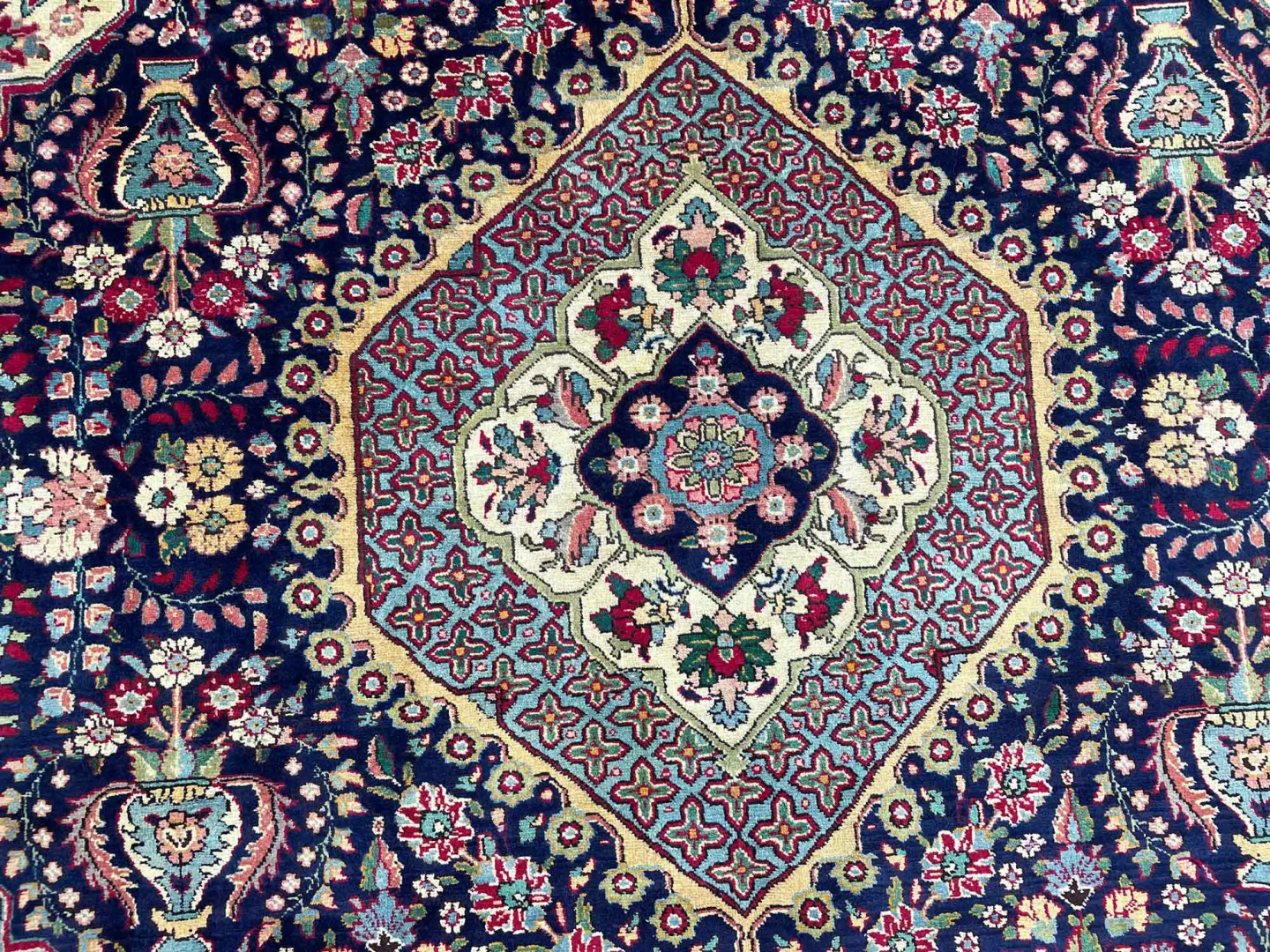
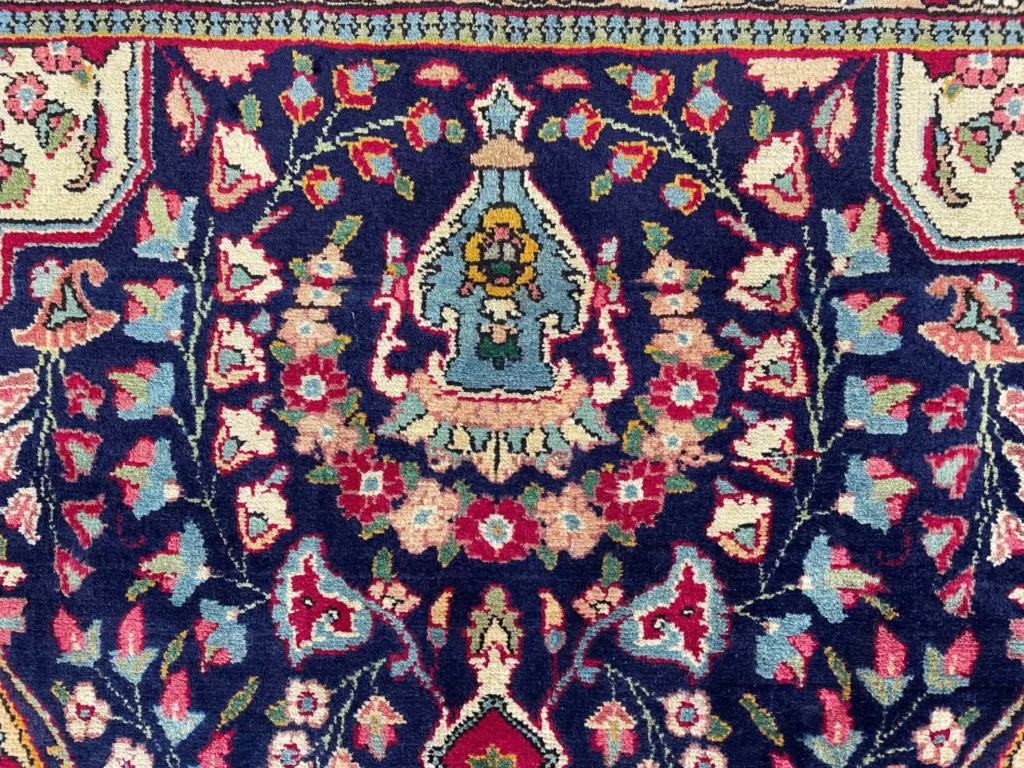
The pattern of this rug is described as a traditional Oriental design. Tabriz rugs are known for a broad range of compositions rather than one single fixed pattern. Their design vocabulary includes floral arrangements with blossoms, leaves and vines, as well as geometric forms arranged with clear order. The description of this particular rug remains intentionally general and does not assign a more specific motif name. Its stated classification is a traditional Oriental design.
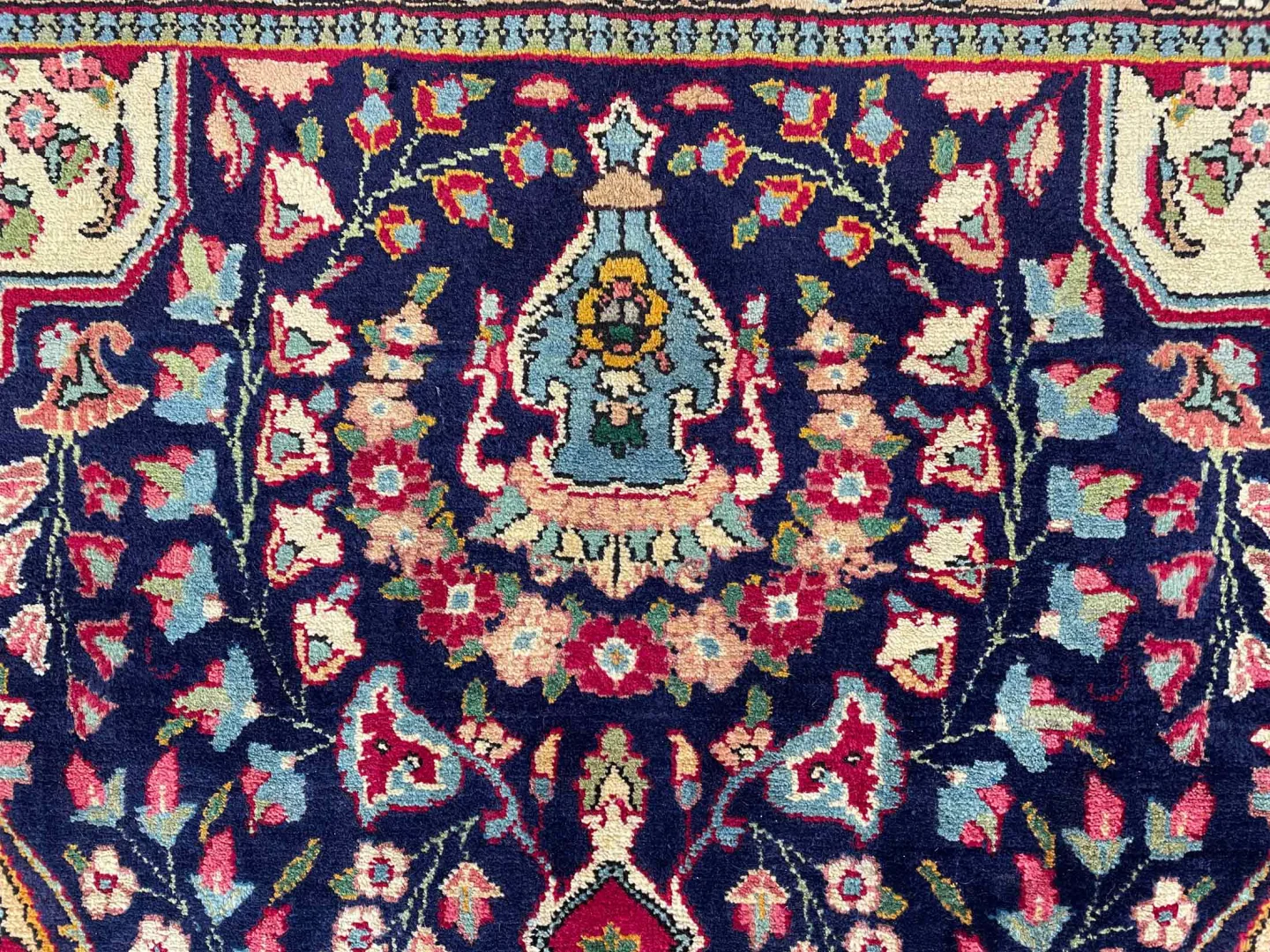
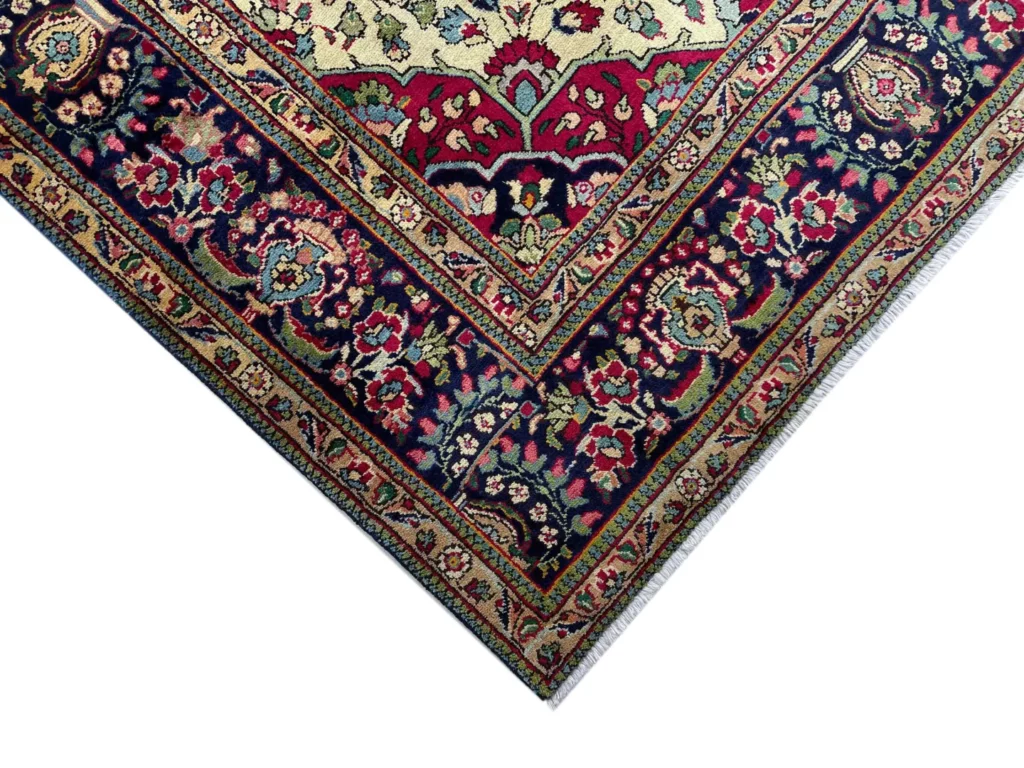
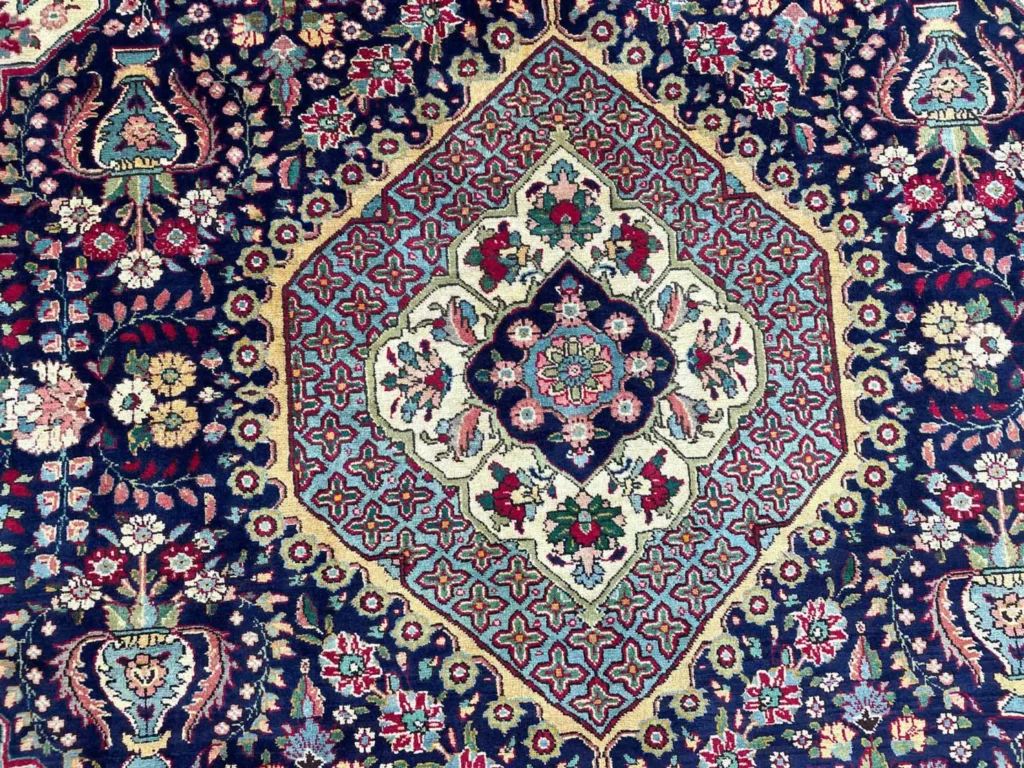
In many Tabriz compositions, a central field provides the starting point for the visual arrangement. Borders may surround the field and give the rug a defined frame. Floral ornaments are often repeated rhythmically, while geometric structures add order and make the composition easier to follow. These devices belong to the wider design language of the Tabriz tradition. They explain how a rug can be decorative while still being built around a carefully organised relationship of field, border and ornament.
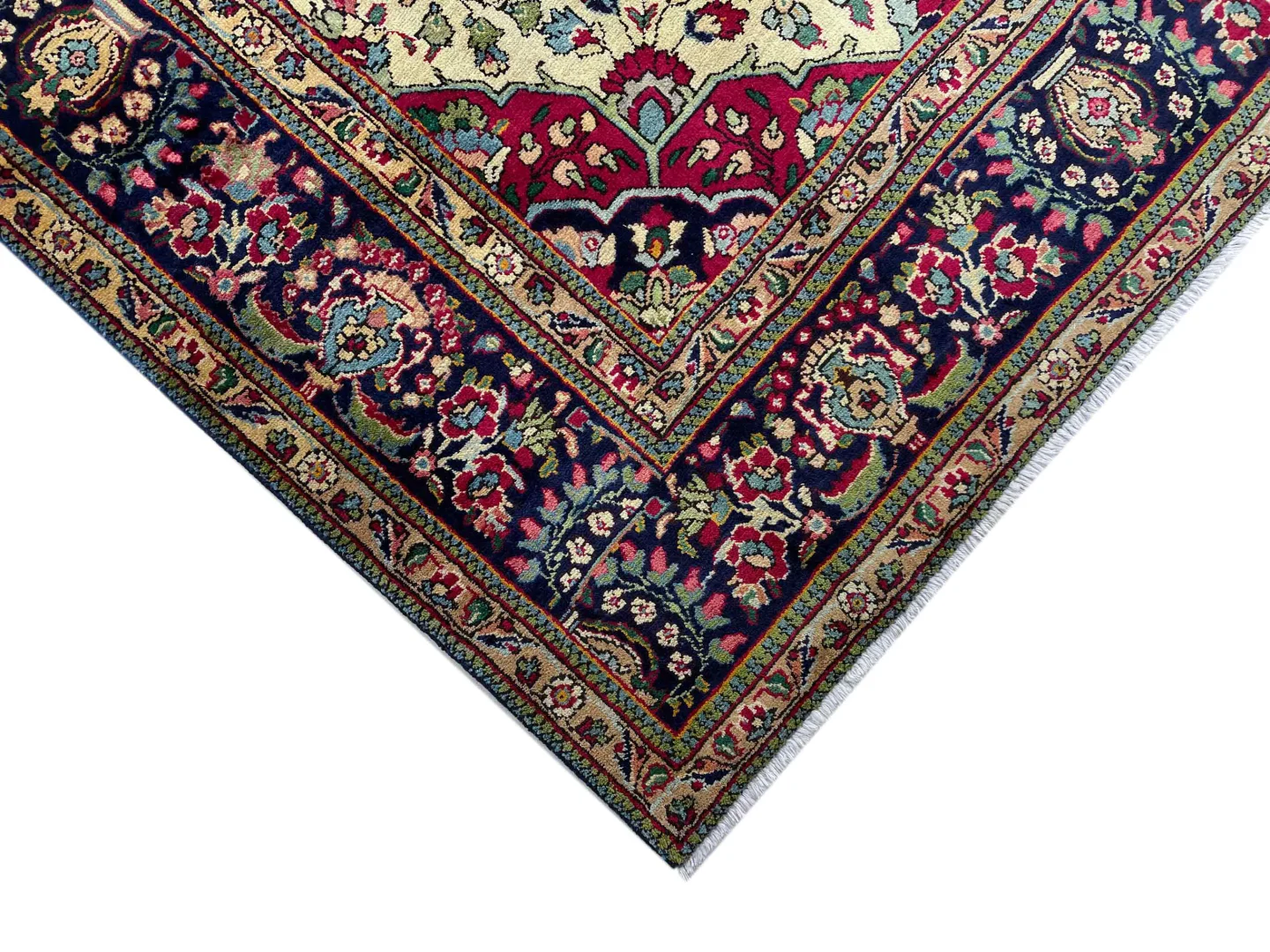
The high knot density associated with Tabriz rugs as a quality feature supports the rendering of fine detail. Small blossoms, narrow lines and differentiated contours can be executed with greater precision in a finer construction. Knot density is therefore considered together with material, colour, pattern structure and workmanship rather than treated as an isolated measure. For this rug, a density of 180,000 knots per square metre is specified.
Wool and silk also affect the way a design is perceived. Wool gives a surface a naturally soft and deeper appearance, while silk can receive light and return it in fine highlights. As a result, outlines and transitions may appear differently from changing viewpoints. This is a general quality of the material combination and complements the traditional design language associated with Tabriz rugs.
The pattern tradition of Tabriz is connected with the culture and history of the region. It does not consist of one prescribed visual code, but of many inherited ways of arranging motifs. Traditional floral designs can exist alongside more strictly geometric compositions. The balance between field and border can also vary according to workshop and quality grade. This allows the regional character to remain clear without making every Tabriz rug look the same.
Oriental patterning is also shaped by repetition and balance. In a hand-knotted rug, this order is not printed mechanically onto a finished surface; it is translated into textile form through the planned placement of individual knots. The result is a woven interpretation of a design rather than an applied image. In this example, the traditional Oriental pattern is combined with the attention to detail and knotting quality associated with Tabriz production.
Special Features
The defining features of this rug are its origin in Tabriz, East Azerbaijan, its hand-knotted construction, and its material composition of high-quality wool and silk. It also has the specified density of 180,000 knots per square metre. The traditional Oriental design places it within the broad pattern tradition of Tabriz Persian rugs.
The rug is very well preserved. This condition description complements the information about its material, origin and workmanship. The combination of wool and silk, the manual knotting process and the regional design are the principal characteristics of this one-off piece.
FAQ
What distinguishes a Tabriz Persian rug?
A Tabriz Persian rug represents the long carpet-making tradition of Tabriz in East Azerbaijan. Common references to the regional craft include careful hand-knotting, a considered relationship between field and borders, and traditional floral or geometric designs. Knot density is also important because it affects the fineness with which motifs can be rendered. This example is specified at 180,000 knots per square metre and is described as being made from high-quality wool and silk.
How should I care for a Tabriz Persian rug?
The rug should be vacuumed regularly and gently. It is advisable not to put unnecessary pressure on the surface and to use a setting suitable for rugs. Direct sunlight should be avoided so that the colours and textile surface remain as even as possible. When a thorough cleaning is needed, professional rug cleaning is recommended. Expert treatment is particularly appropriate for a material combination of wool and silk, as both materials should be handled according to their textile properties.
Where do the finest Tabriz rugs come from?
Tabriz in East Azerbaijan is regarded as an important centre of Persian carpet making. The city has a long weaving tradition, and the relevant craft knowledge has been passed down through generations. The quality of a Tabriz rug depends not only on its place of origin but also on its materials, knot density, pattern and workmanship. This piece comes from Tabriz and is described as a very well-preserved, hand-knotted Persian rug made from wool and silk.
To provide the best experiences, we use technologies like cookies to store and/or access device information. Consenting to these technologies will allow us to process data such as browsing behavior or unique IDs on this site. Not consenting or withdrawing consent, may adversely affect certain features and functions.
Functional Always active
The technical storage or access is strictly necessary for the legitimate purpose of enabling the use of a specific service explicitly requested by the subscriber or user, or for the sole purpose of carrying out the transmission of a communication over an electronic communications network.
Preferences
The technical storage or access is necessary for the legitimate purpose of storing preferences that are not requested by the subscriber or user.
Statistics
The technical storage or access that is used exclusively for statistical purposes.The technical storage or access that is used exclusively for anonymous statistical purposes. Without a subpoena, voluntary compliance on the part of your Internet Service Provider, or additional records from a third party, information stored or retrieved for this purpose alone cannot usually be used to identify you.
Marketing
The technical storage or access is required to create user profiles to send advertising, or to track the user on a website or across several websites for similar marketing purposes.
 SECURE PAYMENT
 SHIPPING PARTNERS


