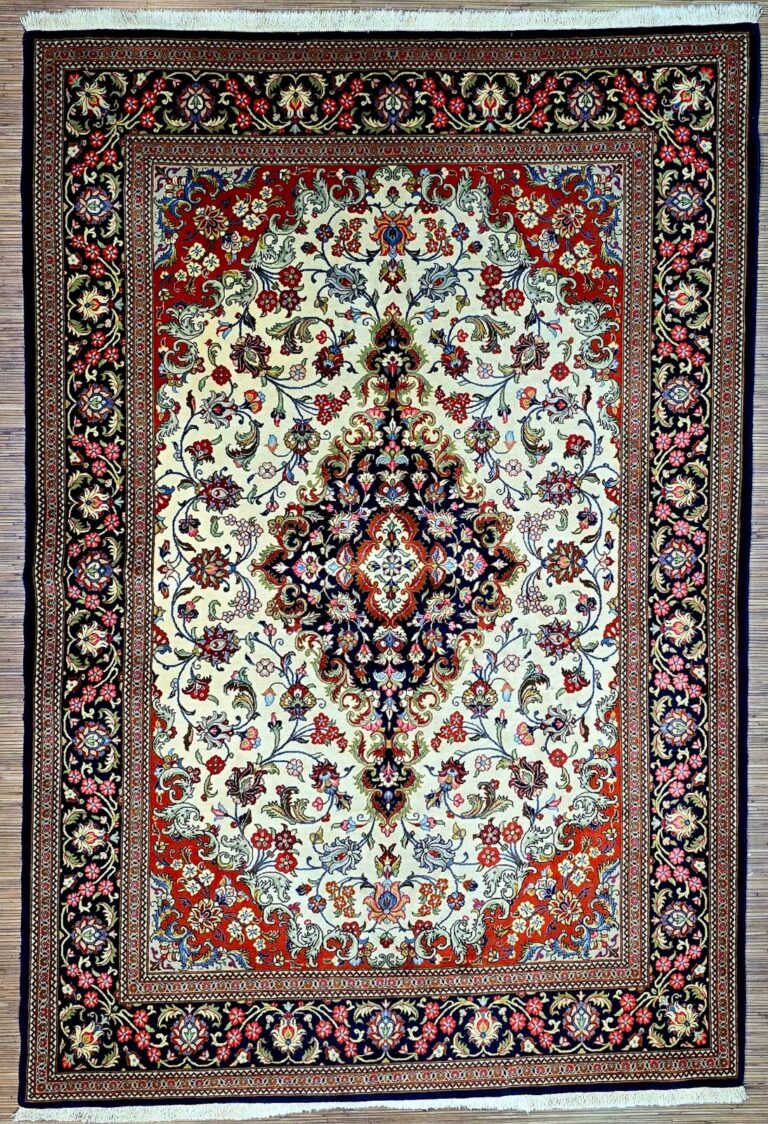
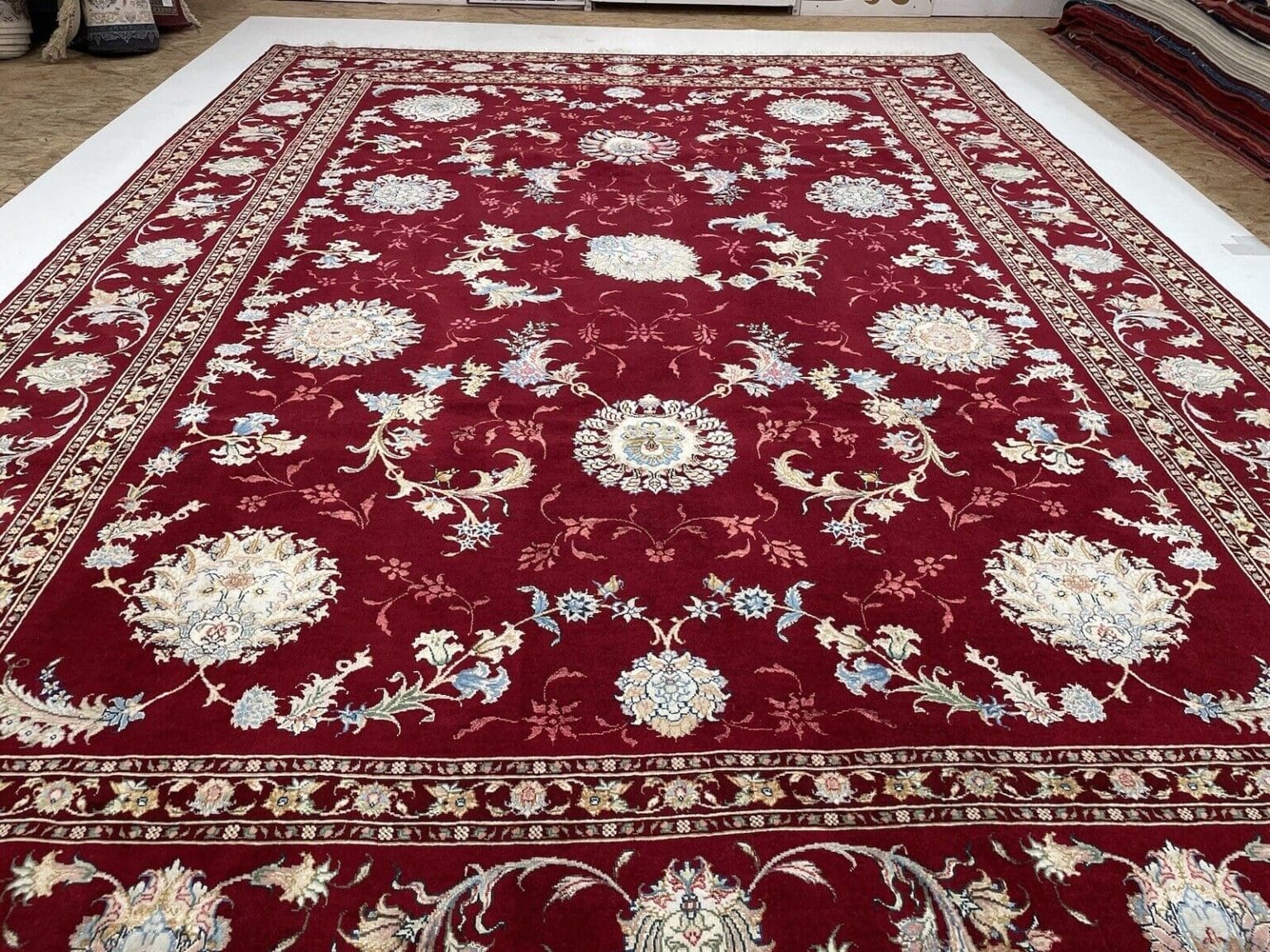
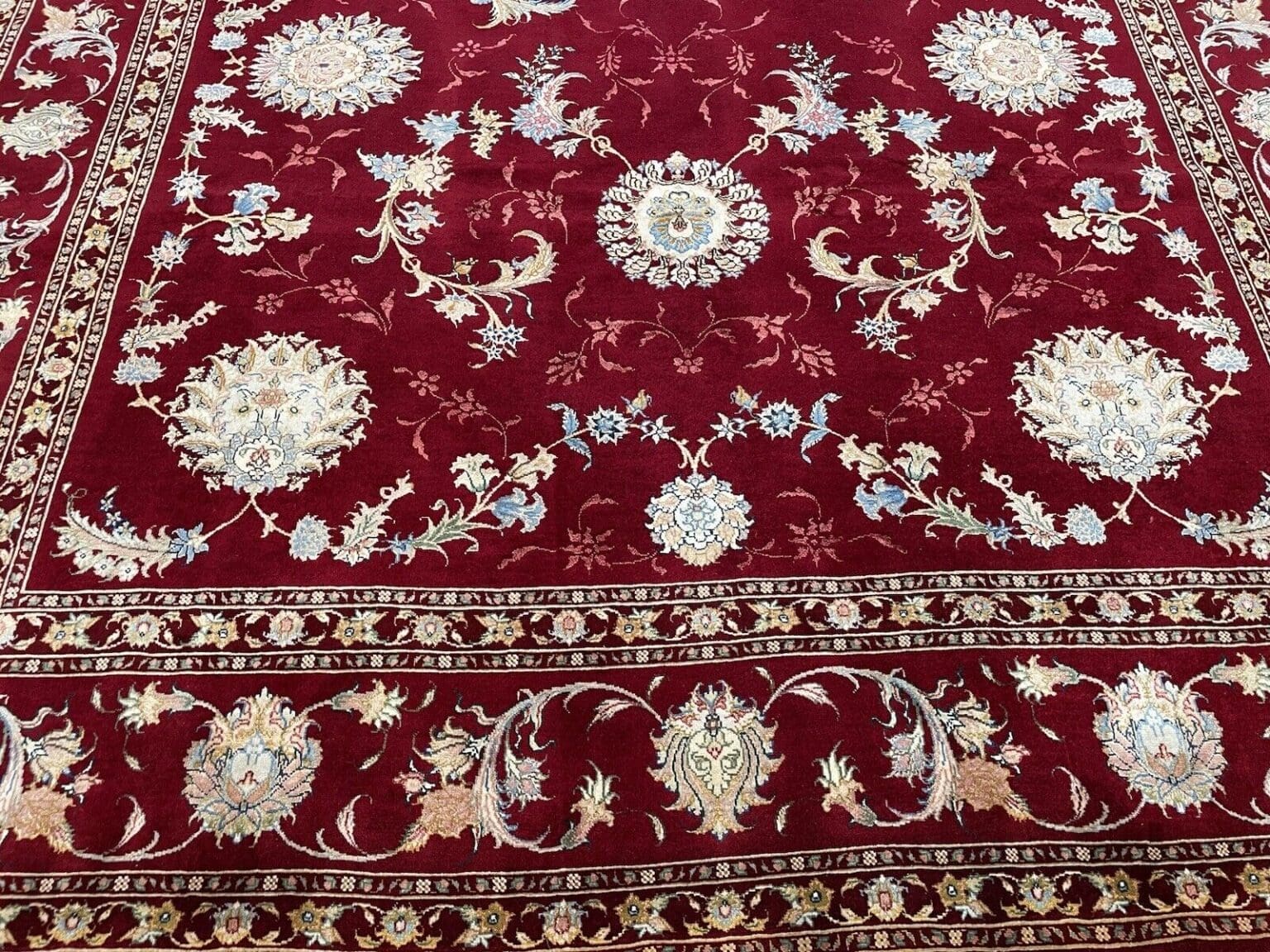
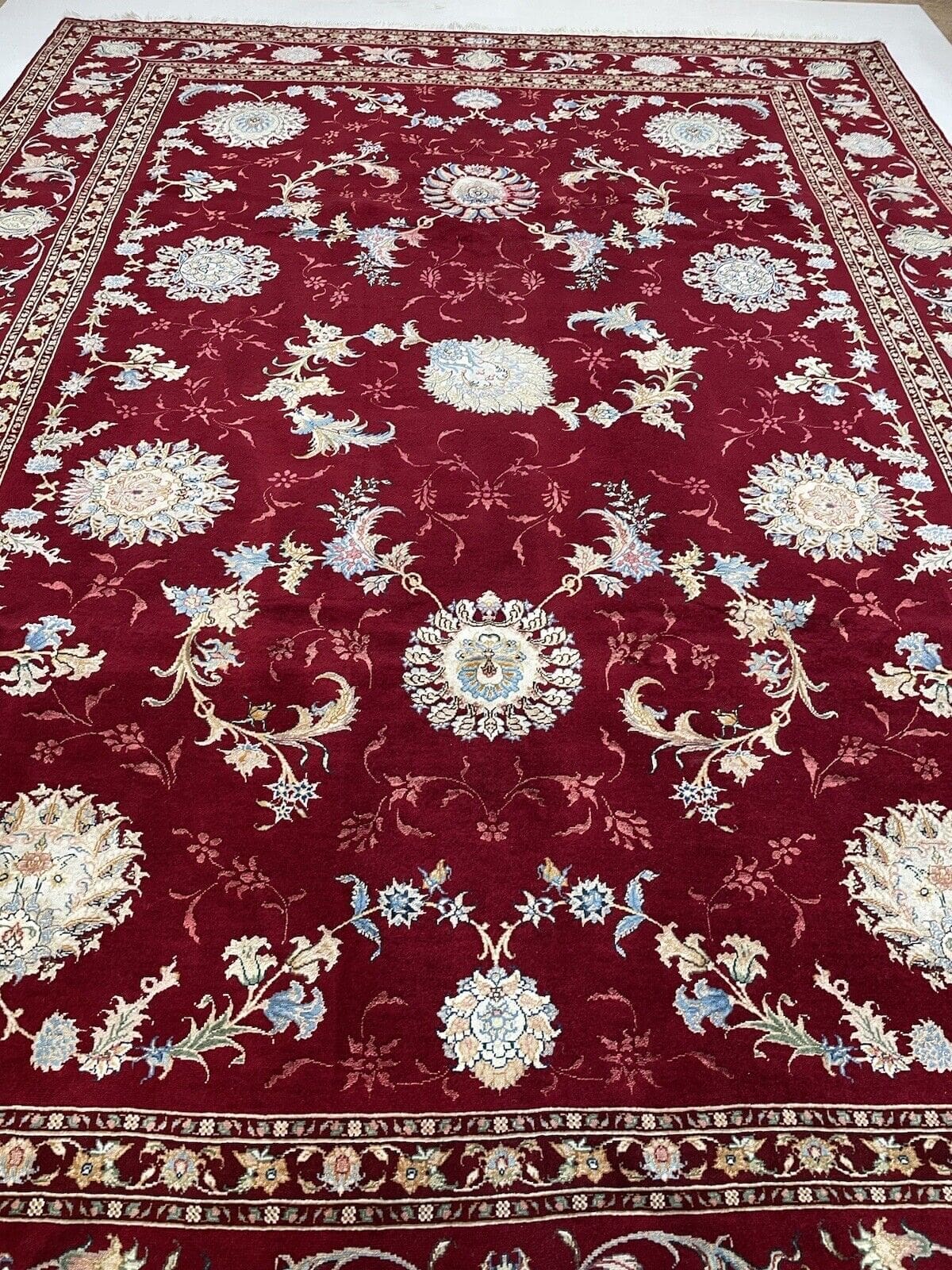
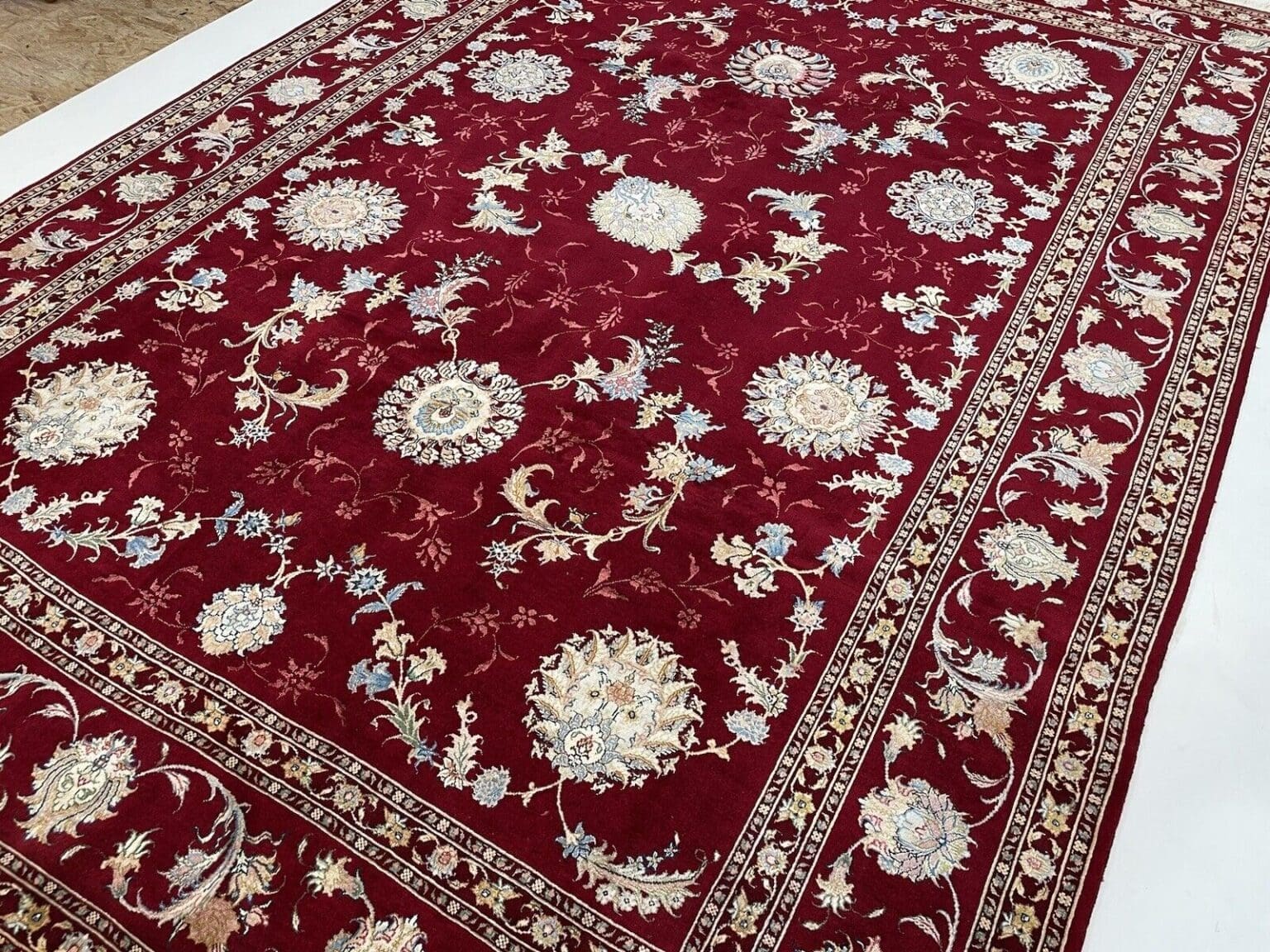
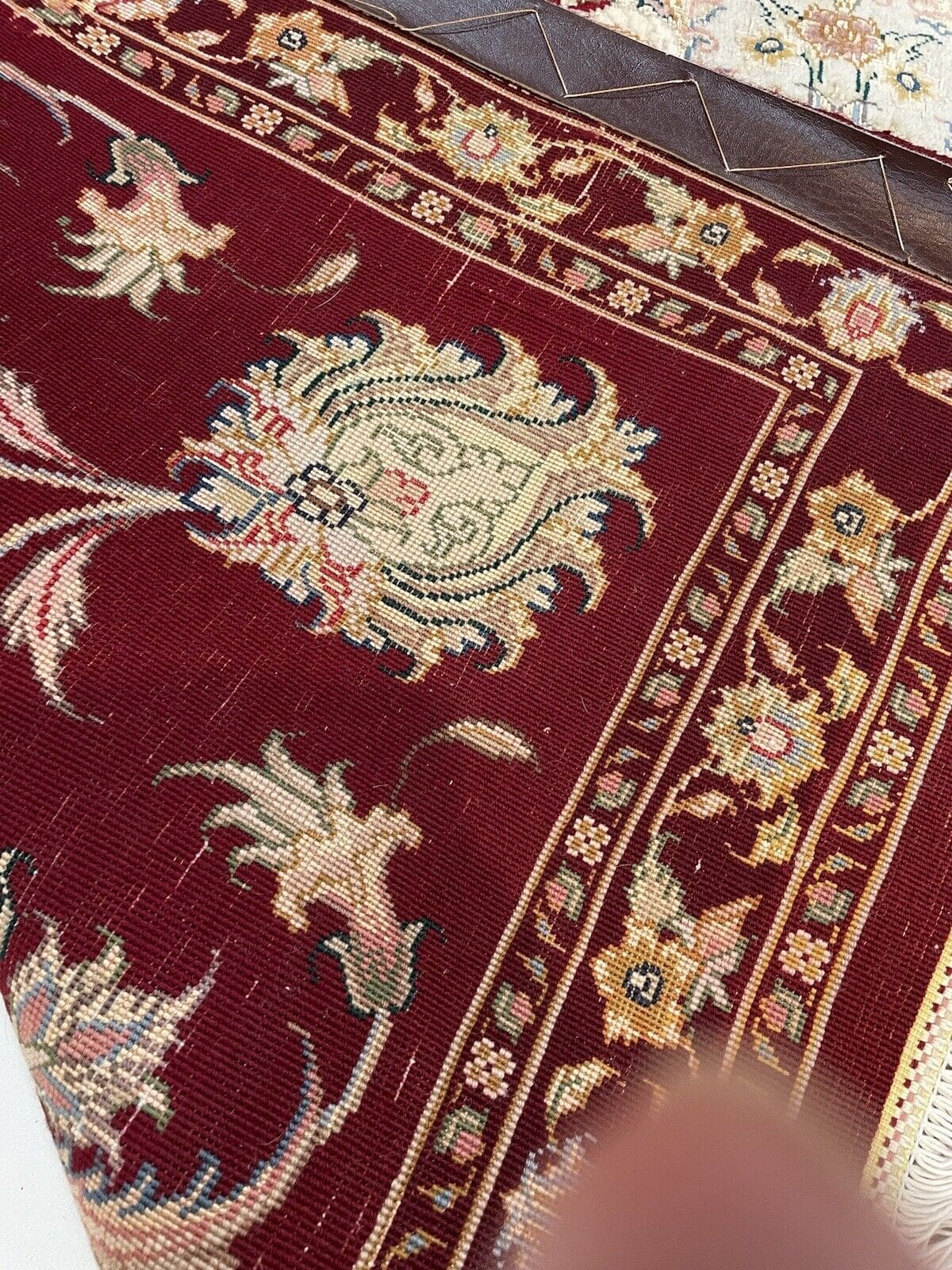
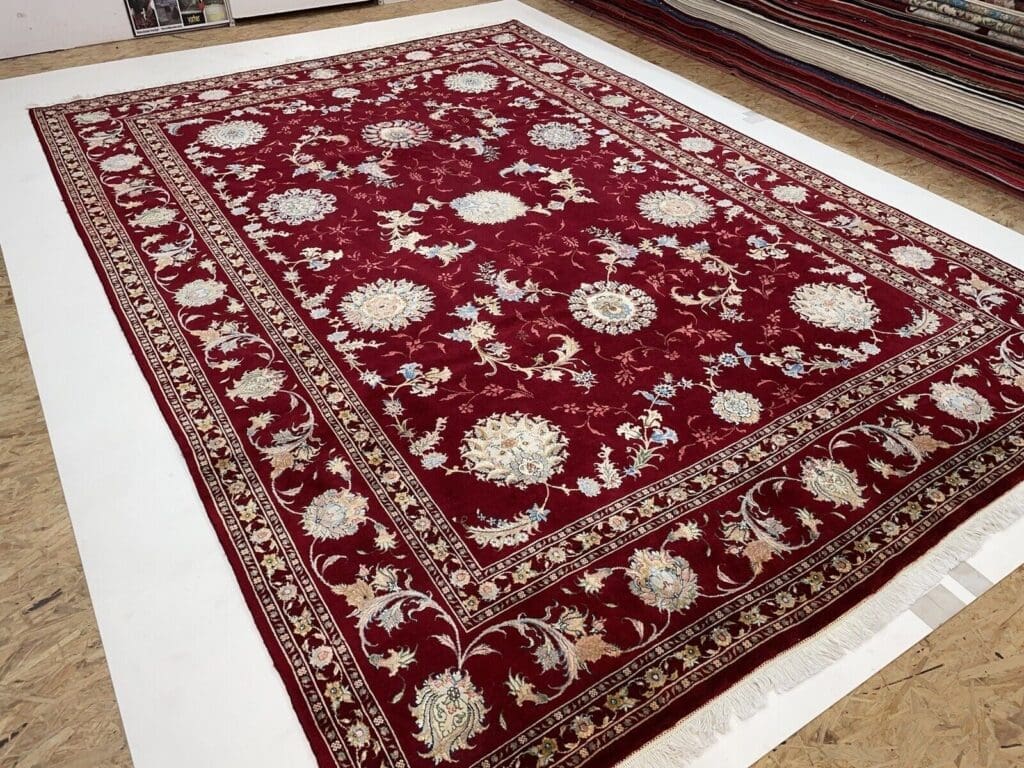
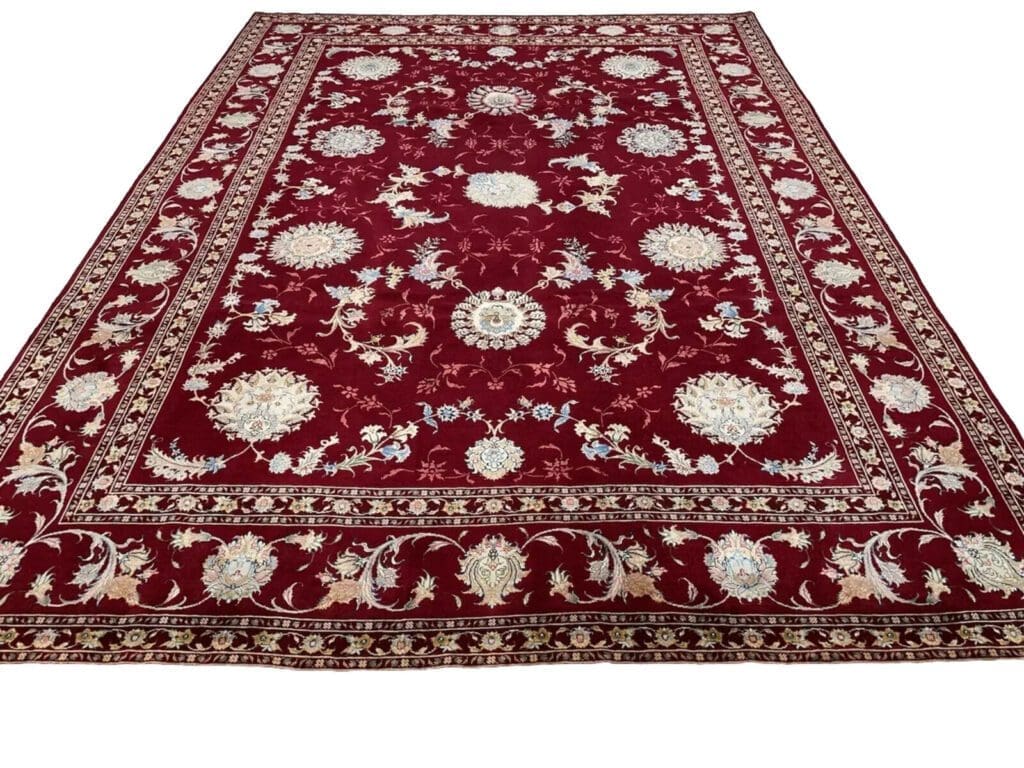
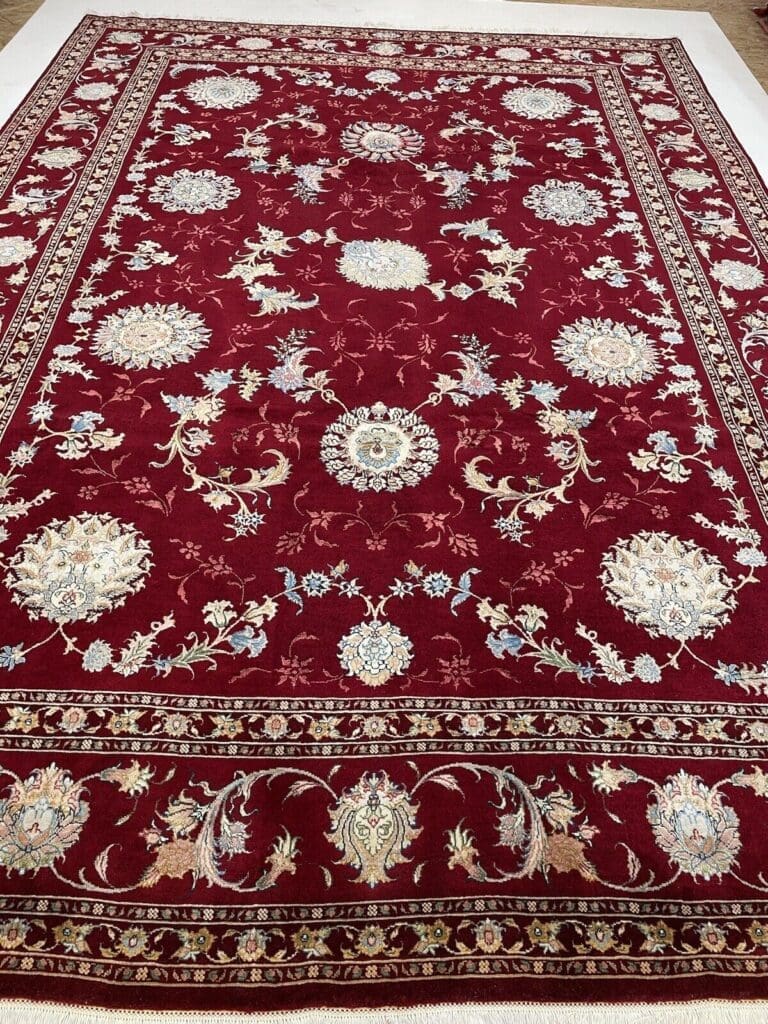
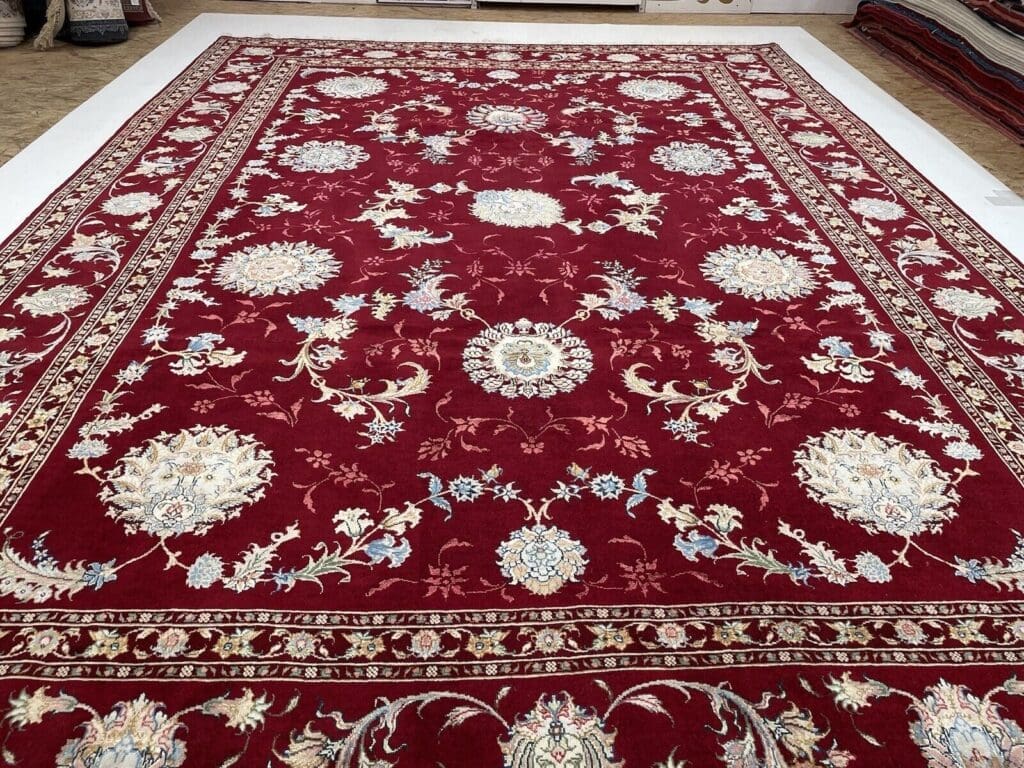
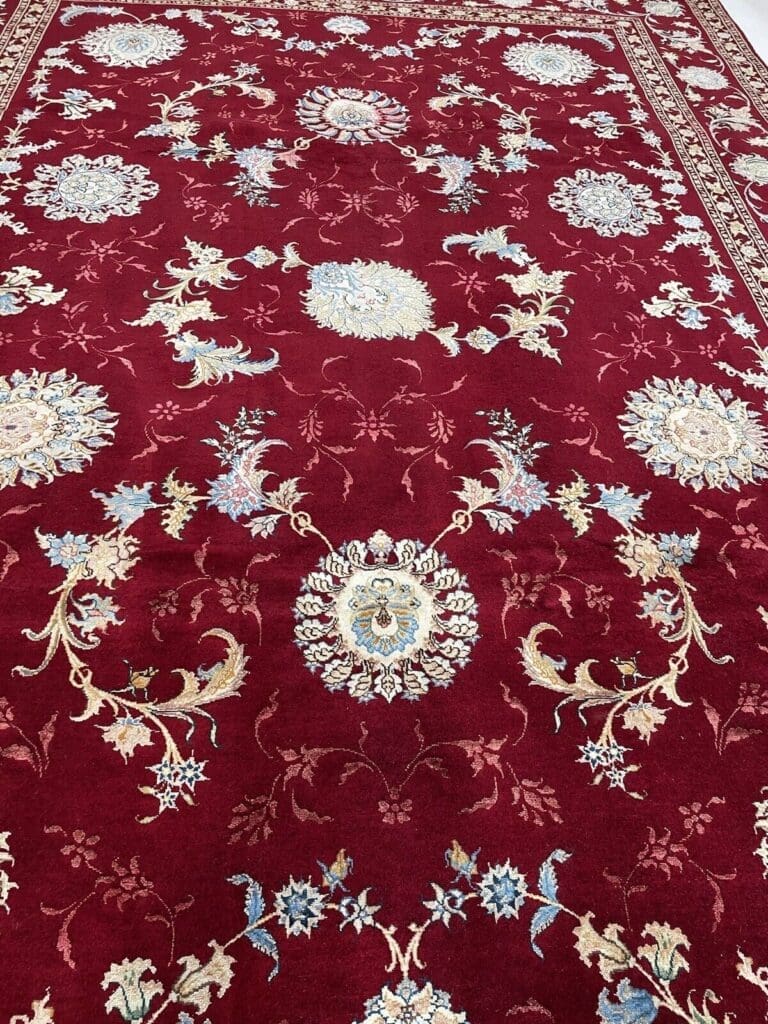
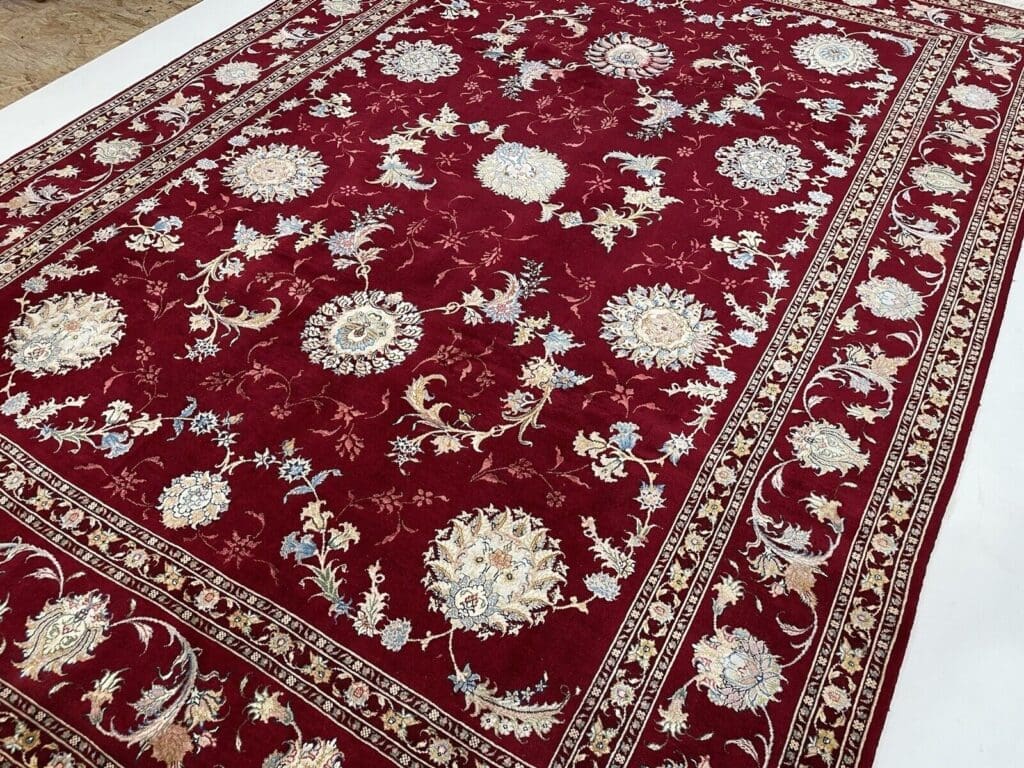
Hand-knotted Tabriz Persian rug | Knot density: 640000 knots | Material: 100% wool and silk pile, 100% cotton warp | Size: 348×248 cm | Condition: New with tag
This Tabriz Persian rug is hand-knotted, with a pile made from 100% wool and silk. The warp is specified as 100% cotton. This combination places a woollen textile structure alongside the smooth appearance and light-reflecting quality associated with silk. Cotton is identified as the warp material, so it belongs to the supporting foundation of the rug rather than to the visible pile description. The material information therefore distinguishes clearly between the pile and the warp.
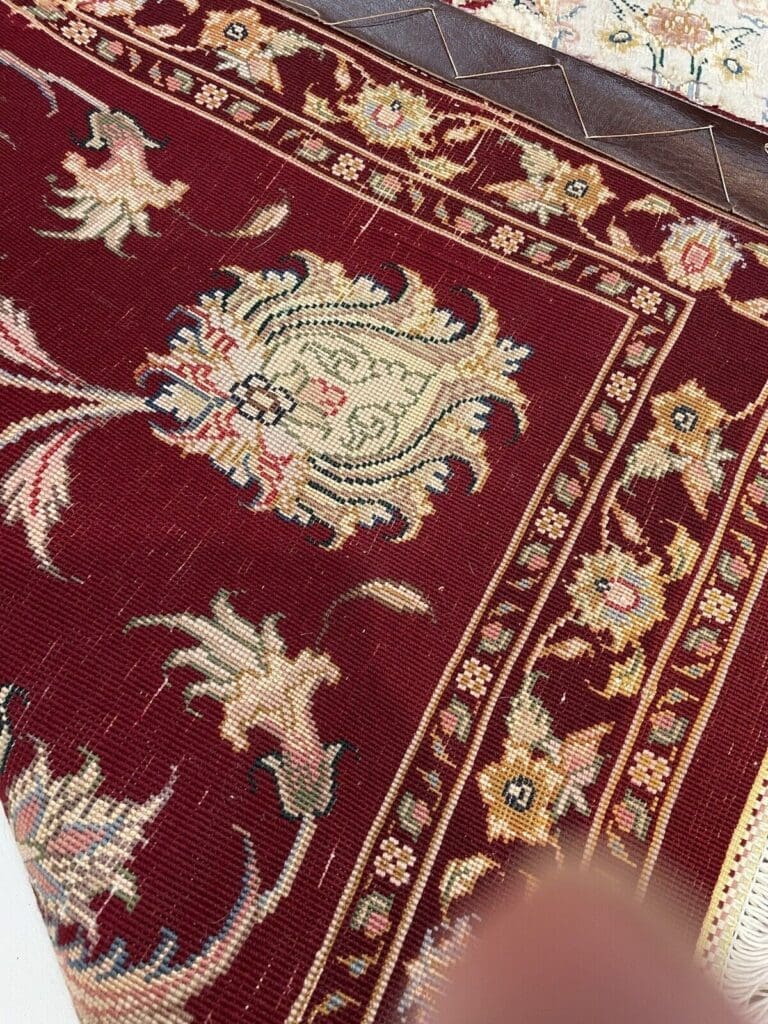
The rug has a knot density of 640000 knots and is described as Tabriz 60 Raj. Raj is traditionally used in Persian rug terminology to classify fineness by referring to knots within a defined length. A fine knotting allows a weaver to set small forms and narrow lines close together. In this rug the exact figure is given as 640000 knots, and that figure is retained without conversion or rounding.
The pile height is 6 mm. A low pile can support a clearly drawn surface and allows the structure created by the knots to remain comparatively close to the design. Hand-knotting means that individual knots are tied into the prepared warp, with each successive row building the textile ground and the visible pattern. Knot density describes the number of knots, while pile height describes the height of the finished surface; the two specifications refer to different aspects of construction.
The rug is new with a tag and is suitable for underfloor heating. That suitability concerns its intended use in a living space. As with any hand-knotted rug, the foundation, airflow and care routine should be considered when it is laid. Cleaning should be selected for a pile containing both wool and silk, since these fibres do not respond identically to every treatment. The product information does not state an age, previous ownership or individual provenance.
Origin and Tradition
Tabriz is a city in north-western Iran and one of the established centres of Persian rug production. The city has played an important role in the development, making and circulation of woven and knotted designs. Tabriz rugs are associated with careful drawing and complex compositions. The city’s tradition was shaped by its position at the meeting point of Persian, Caucasian and Anatolian cultural influences, which helped create a broad vocabulary of layouts, borders and ornamental details.
Tabriz weaving developed through the work of successive generations of workshops and weavers. Older patterns were preserved, adapted and combined with new arrangements for different periods and interiors. As a result, Tabriz is not defined by one single design. Regional examples include floral fields, central medallions, architectural scenes, hunting compositions and geometric layouts. These are established possibilities within the tradition, not a list of confirmed motifs in this particular rug. The source describes the rug as Tabriz but does not identify one specific individual pattern.
The term 60 Raj is connected with the fine-knotting tradition of Persian rugs. In general use, Raj refers to a method of expressing knot fineness over a particular length. The details of counting can vary in explanations used by the trade, but the term is generally associated with a dense and precise construction. The 60 Raj designation therefore places this rug within a fine Tabriz quality. In addition, the documented knot density is 640000 knots, which is stated separately and is not replaced by a general description.
Tabriz became widely known through regional and long-distance rug commerce. Workshops produced rugs in different formats and for different settings, while maintaining a disciplined approach to drawing. The ability to organize many small elements across a coherent field is an important part of the tradition. Fine knotting can help define narrow outlines, floral details and layered borders. The craft lies in keeping the structure consistent while transferring a prepared design into rows of individual knots.
Tabriz belongs to the wider history of Iranian rug centres alongside Isfahan, Kashan and Qom. Isfahan is often associated with finely ordered floral compositions, Kashan with traditional medallion designs and deep colour arrangements, and Qom with elaborate silk rugs. These comparisons provide context for the variety of Persian weaving traditions. They do not change the stated origin of this piece, which is Tabriz, and they do not add materials or motifs to it that have not been specified.
Design and Pattern
Tabriz design is known for its range of floral and ornamental arrangements. Curving vines, blossoms, leaves and scrolling lines may be set within a carefully balanced field. A central medallion can be surrounded by corner pieces, multiple borders and small secondary motifs. Other compositions distribute decoration throughout the field without one dominant centre. All of these are part of the regional design vocabulary. They should not be presented as a precise description of this rug because the product information does not name a particular motif.
Geometric structure is another element found in Tabriz traditions. Straight lines, repeated units and defined compartments can be combined with delicate botanical forms. This creates an interplay between measured order and flowing movement. Persian rugs may also include architectural, literary or figurative themes, each carrying its own historical associations. When describing a single piece, however, a distinction must be maintained between the tradition and the documented object. The confirmed facts here are the Tabriz designation, the 60 Raj classification, the knot density, the materials and the hand-knotted construction.
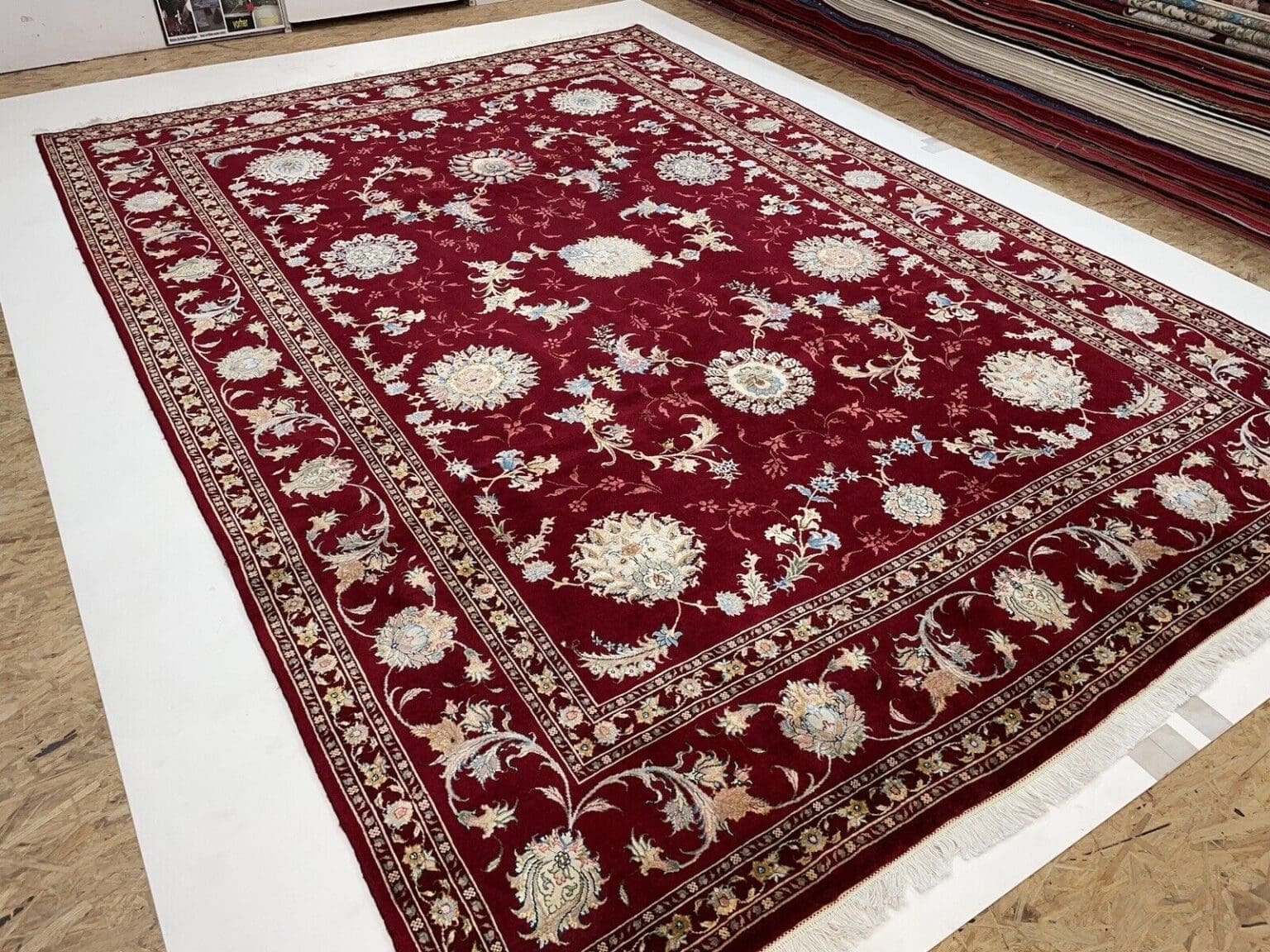
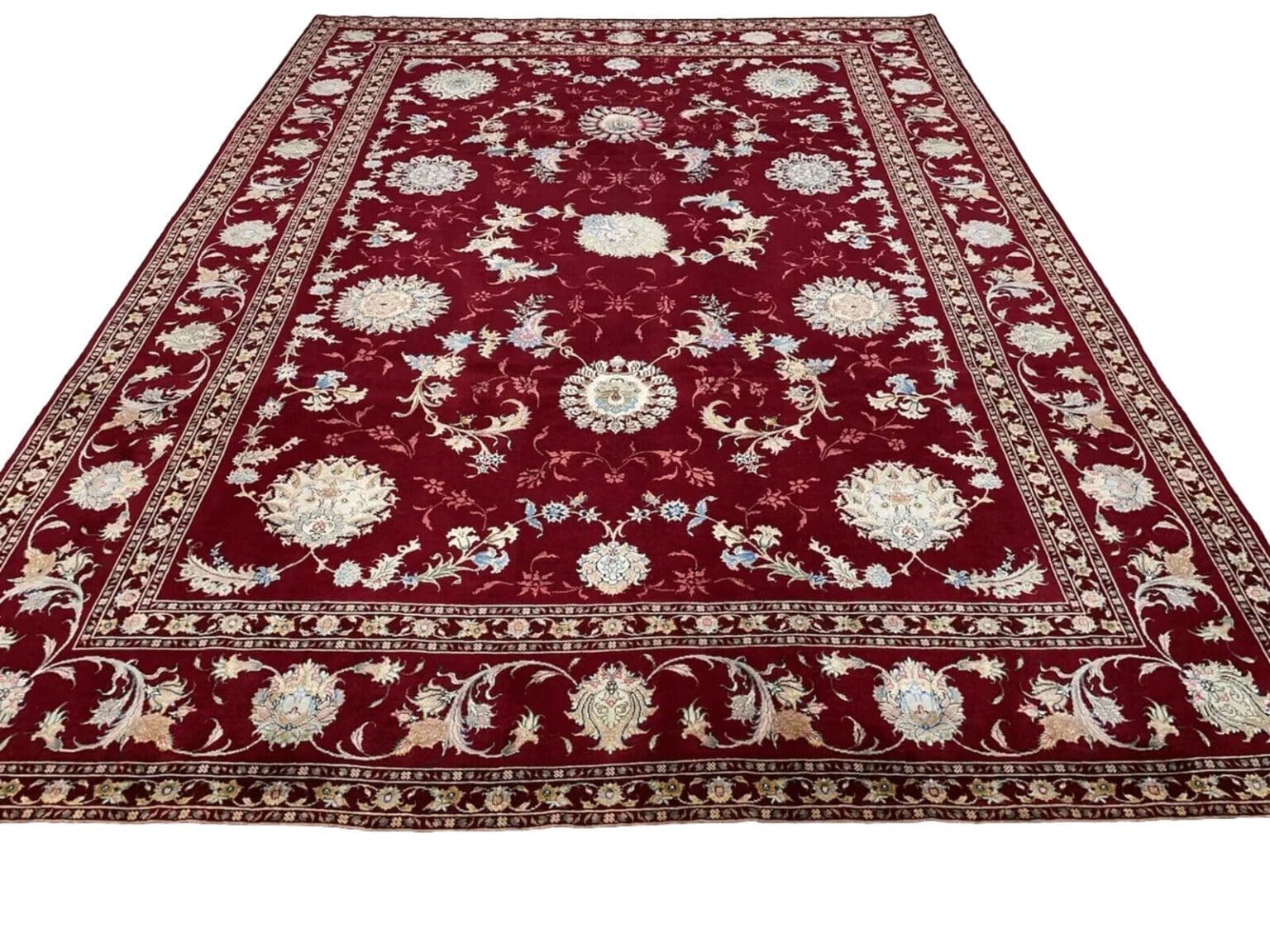
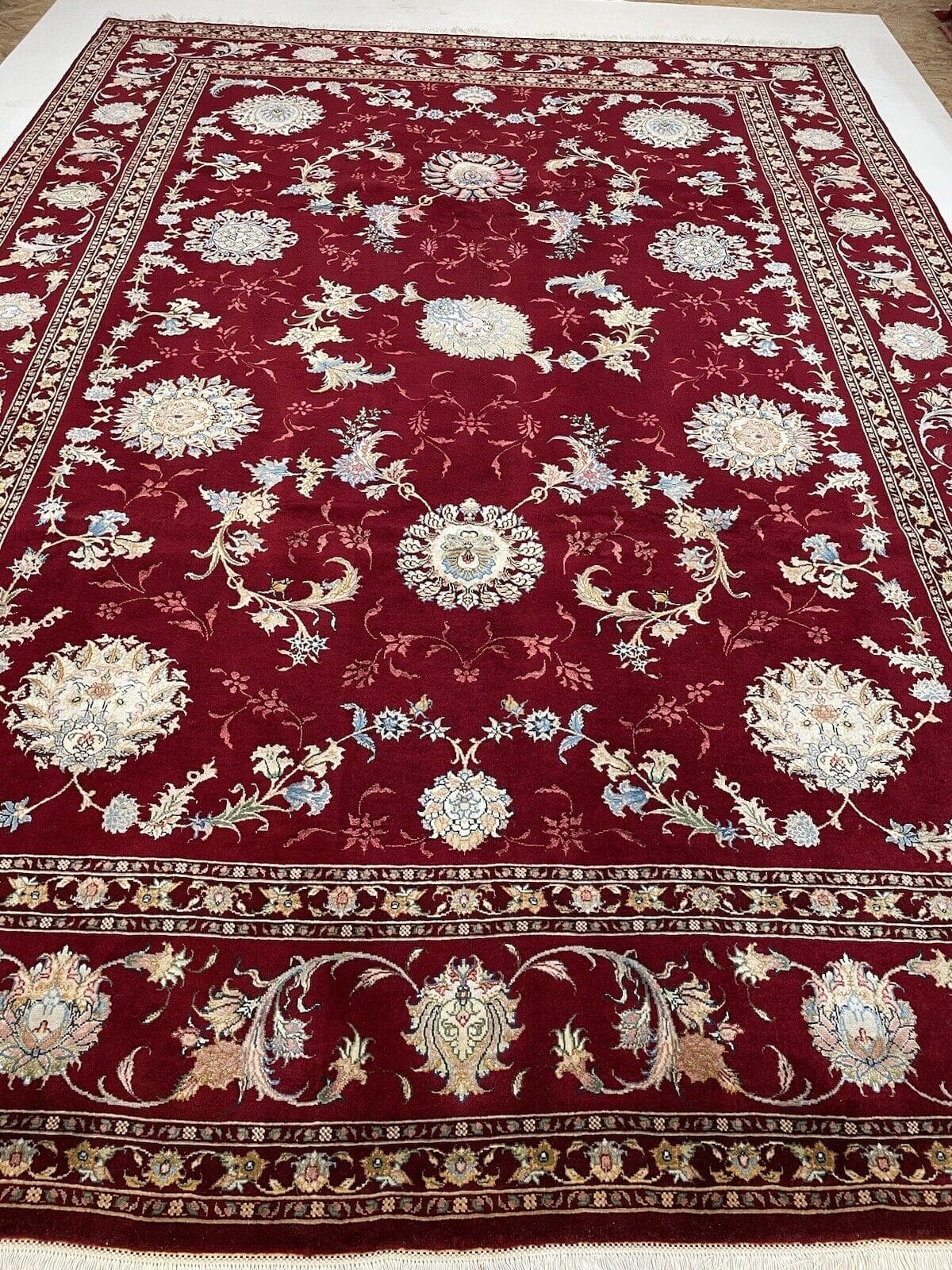
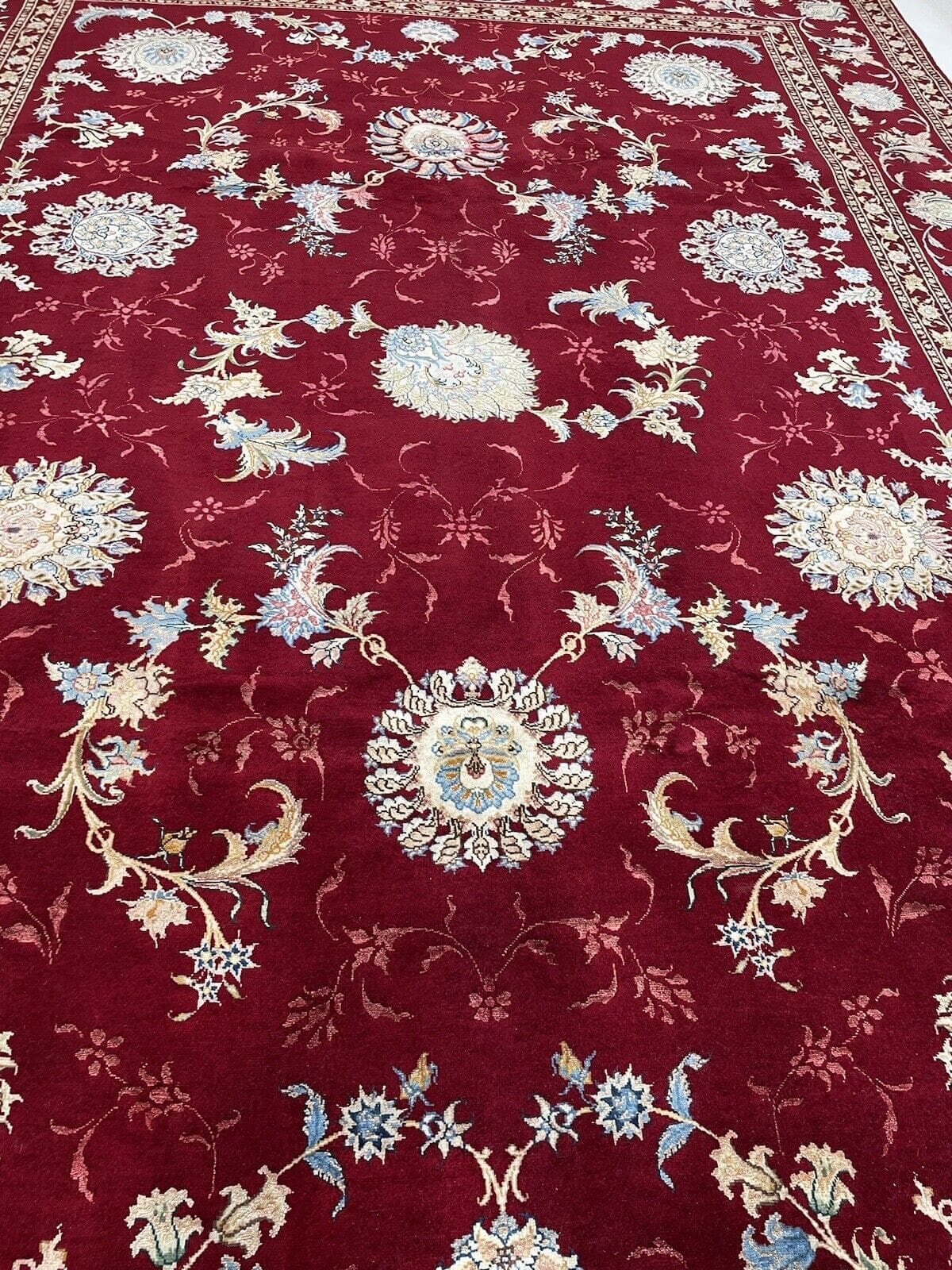
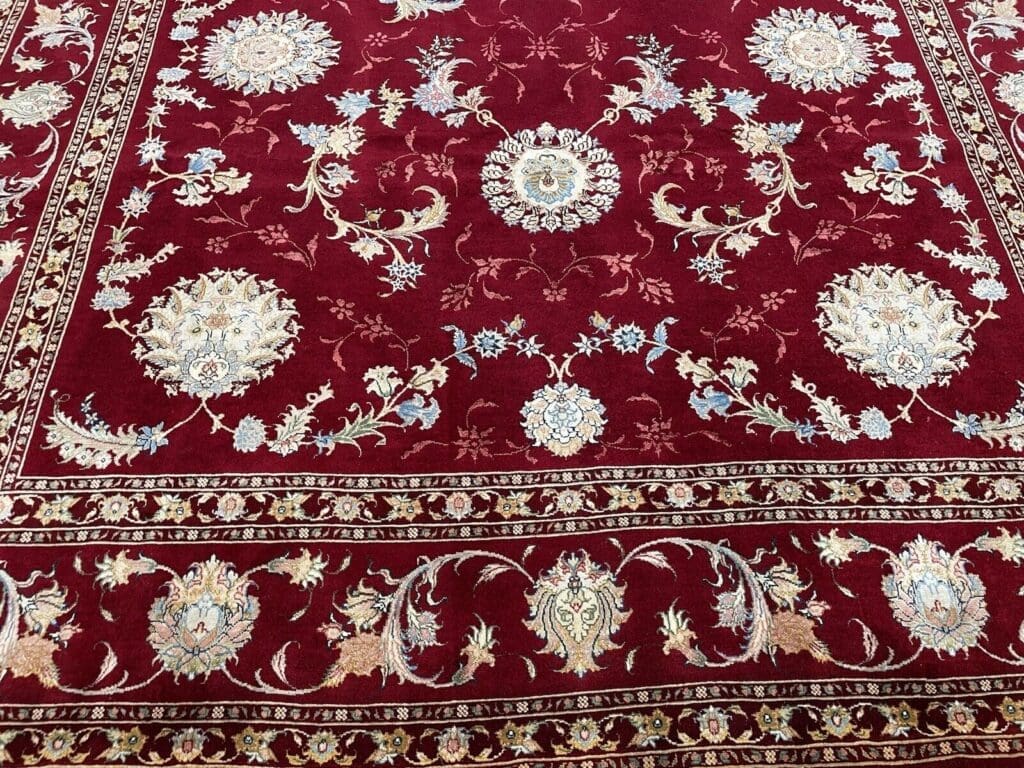
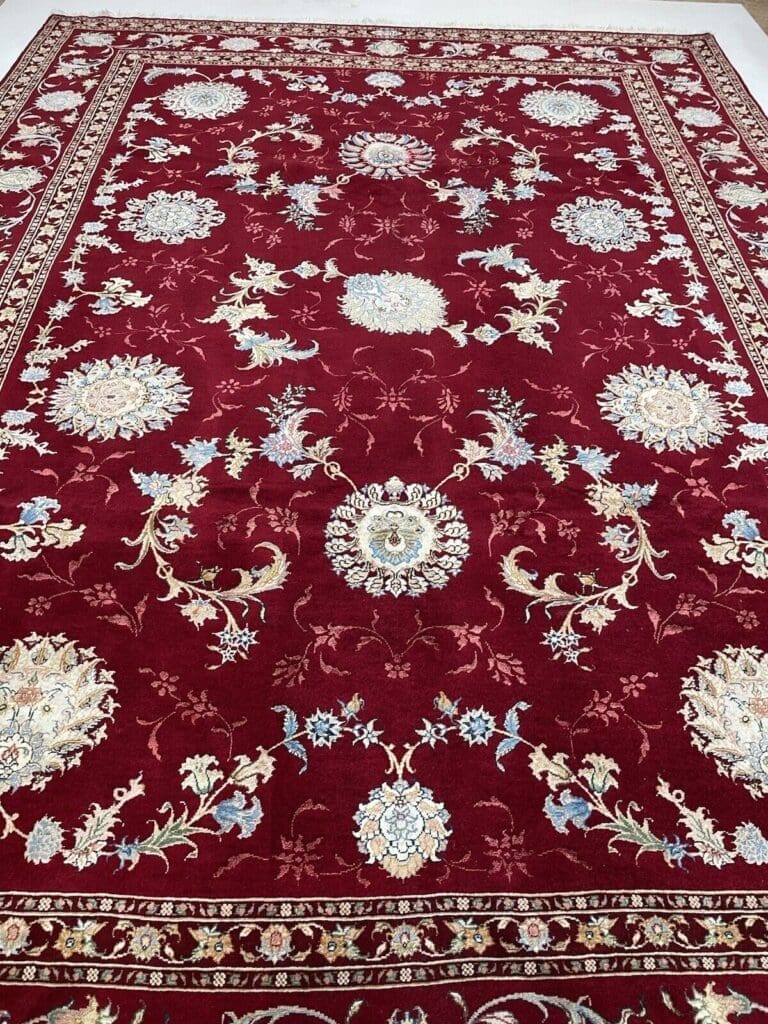
A dense knotting can support a finely resolved drawing because small areas of colour and narrow outlines can be placed close together. This is one reason fine Tabriz qualities are linked with detailed compositions. The visual result also depends on fibre, pile height, dyeing and the particular design selected by the workshop. This rug is made with wool and silk and has a 6 mm pile. No exact colour palette, medallion, border arrangement or field pattern is supplied, so those details are intentionally left open.
Silk has a long place in Persian rug making as a material for fine detail and a smoother surface effect. Its fibres can catch light differently from wool and may be used to separate accents or sharpen outlines within a design. Wool contributes another surface character and is a central material in many Persian rug traditions. The combination of wool and silk provides two distinct textile qualities, but it does not by itself prove a particular colour scheme or ornament.
A Tabriz rug can work with traditional furnishings as well as with a more restrained contemporary setting because the regional repertoire includes many types of composition. This rug is rectangular and is suitable for underfloor heating. Its use in a room will depend on furniture placement, available floor space, lighting and the colours already present. A responsible description does not assign a specific visual effect where no colour or pattern record is available. The regional background explains the design language without turning general Tabriz motifs into unverified claims about this one-off piece.
Special Features
The recorded features are its hand-knotted construction, the Tabriz 60 Raj designation, a knot density of 640000 knots, and a pile made from 100% wool and silk over a 100% cotton warp. The pile height is 6 mm. The rug is new with a tag and suitable for underfloor heating. These details cover production, material, condition and intended use. They do not imply a stated age, signature, repair history or provenance beyond the identified Tabriz origin.
The combination of fine knotting and two pile fibres gives this rug a clear technical profile. Wool and silk have both been used in Persian rug making for generations, with their different surfaces allowing weavers to vary texture and light response. The hand-knotted method remains the basis of the construction: individual knots make up the field and the design. The new condition with tag is the condition expressly provided, while no further history of ownership is given.
Care should take account of the wool and silk pile. Regular gentle vacuuming helps remove loose dust and everyday surface dirt. Prolonged direct sunlight should be avoided to protect the textile surface and colours. Professional cleaning every few years is recommended in the product information. A specialist should assess stains and choose a method appropriate for the fibre combination. Underfloor heating is listed as suitable, although a suitable rug pad and adequate ventilation remain useful considerations when the rug is installed.
FAQ
What makes a Tabriz 60 Raj rug distinctive?
The Tabriz 60 Raj designation connects this rug with the fine-knotting tradition of Tabriz in Iran. Its documented density is 640000 knots, and it is hand-knotted rather than mechanically produced. The pile uses 100% wool and silk, a combination that brings together two different textile surfaces. Fine Persian knotting is traditionally valued for its ability to render narrow lines, small floral elements and carefully arranged borders. The product information does not identify a particular motif on this rug, so the answer rests on the confirmed construction, regional designation and materials rather than on an assumed medallion or colour scheme. Its 6 mm pile height is another stated part of the technical description.
How should this Tabriz Persian rug be cared for?
Vacuum the rug regularly and gently to remove loose dust without putting unnecessary stress on the pile. Keep it out of prolonged direct sunlight, since light exposure can affect textile surfaces and colours over time. Professional cleaning every few years is recommended. Because the pile contains both wool and silk, cleaning should be carried out by a specialist familiar with these fibres. Strong chemicals, excessive moisture and vigorous rubbing are generally unsuitable for delicate natural materials. For an individual stain, a professional should determine the appropriate treatment rather than applying an untested household product. The rug is listed as suitable for underfloor heating, but it should still be laid flat with appropriate ventilation and protection against slipping.
Where can this Tabriz rug be used?
The rectangular rug can be placed in a central living area such as a living room or dining room, where a larger textile surface can help organize the furniture. It can also be used in a bedroom to add a defined textile area beneath or around the furnishings. Its stated suitability for underfloor heating makes it compatible with rooms equipped with that system. The best position depends on the room plan, furniture, circulation and available floor area. It should lie evenly and be protected from excessive movement. The exact visual effect will depend on the unspecified colours and pattern of this one-off rug, together with the light and furnishings of the room.
To provide the best experiences, we use technologies like cookies to store and/or access device information. Consenting to these technologies will allow us to process data such as browsing behavior or unique IDs on this site. Not consenting or withdrawing consent, may adversely affect certain features and functions.
Functional Always active
The technical storage or access is strictly necessary for the legitimate purpose of enabling the use of a specific service explicitly requested by the subscriber or user, or for the sole purpose of carrying out the transmission of a communication over an electronic communications network.
Preferences
The technical storage or access is necessary for the legitimate purpose of storing preferences that are not requested by the subscriber or user.
Statistics
The technical storage or access that is used exclusively for statistical purposes.The technical storage or access that is used exclusively for anonymous statistical purposes. Without a subpoena, voluntary compliance on the part of your Internet Service Provider, or additional records from a third party, information stored or retrieved for this purpose alone cannot usually be used to identify you.
Marketing
The technical storage or access is required to create user profiles to send advertising, or to track the user on a website or across several websites for similar marketing purposes.

 SECURE PAYMENT
 SHIPPING PARTNERS