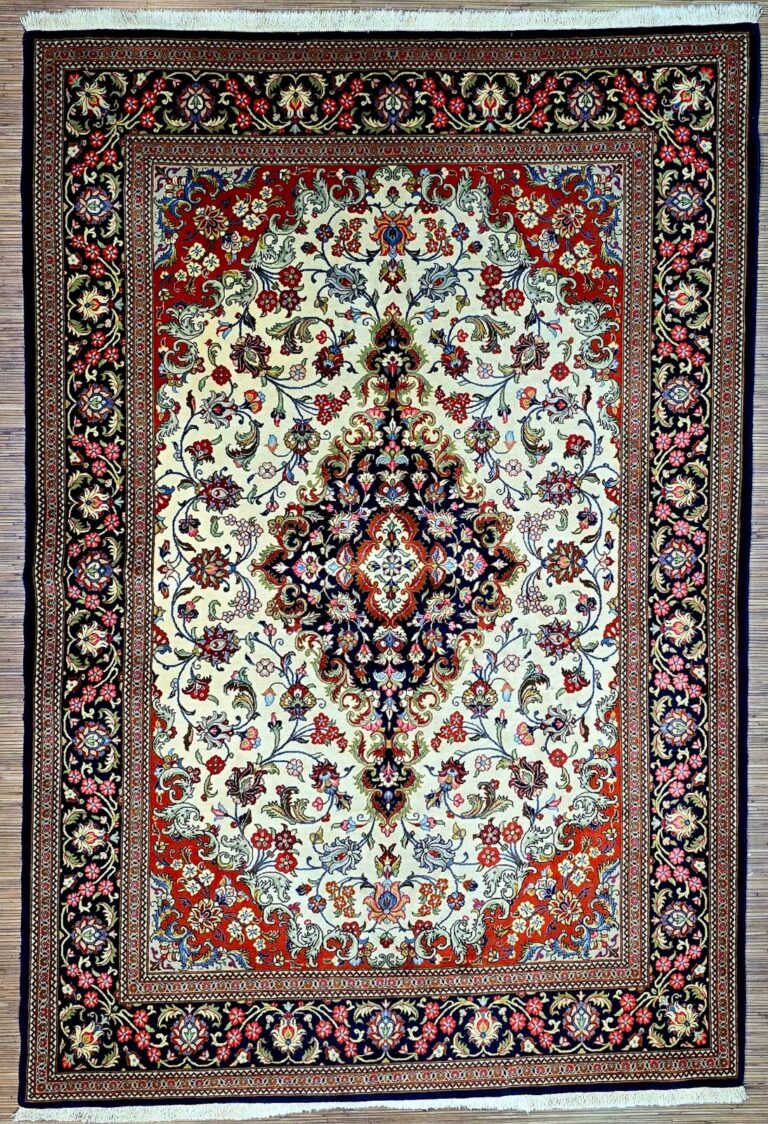
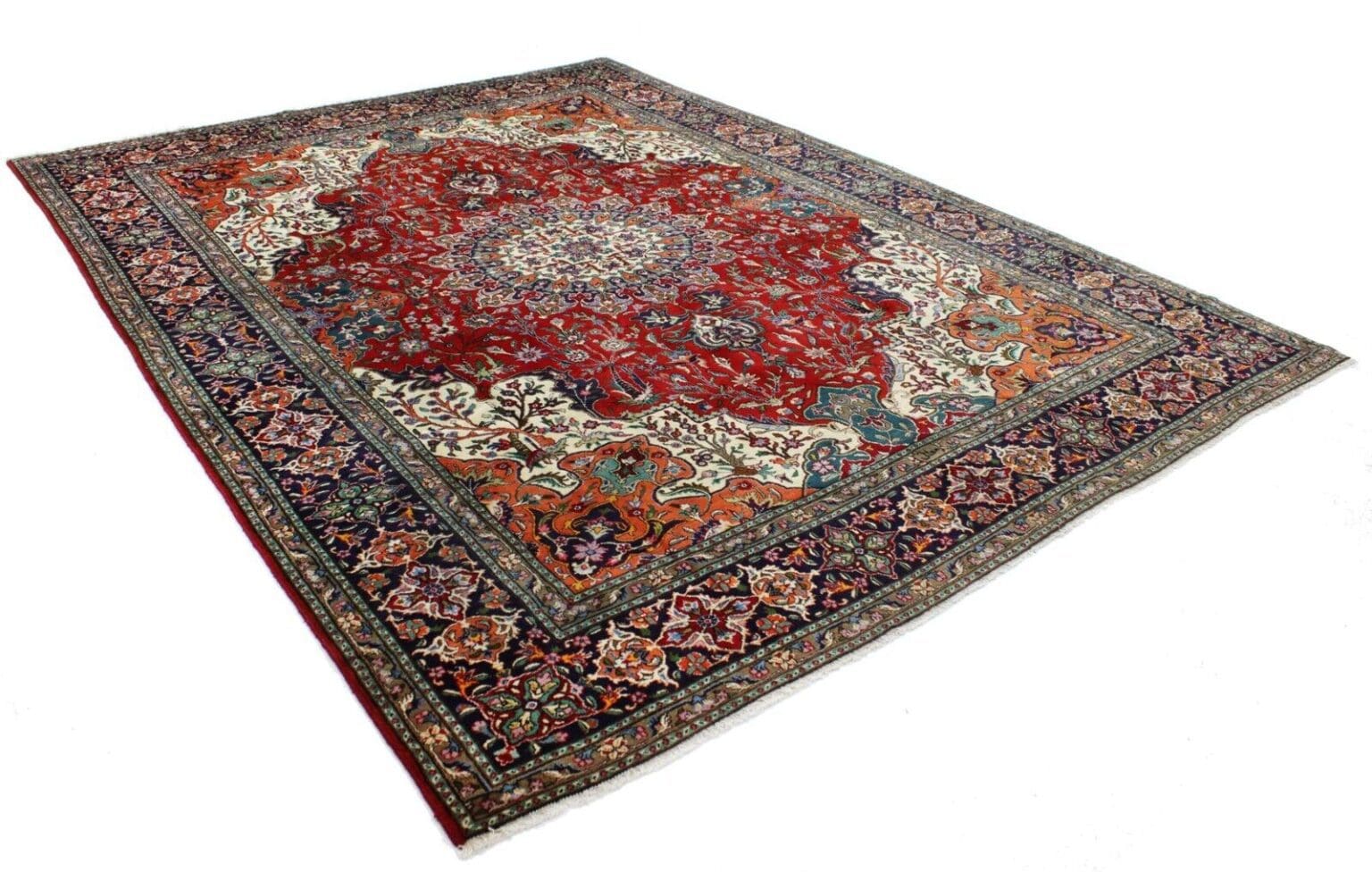
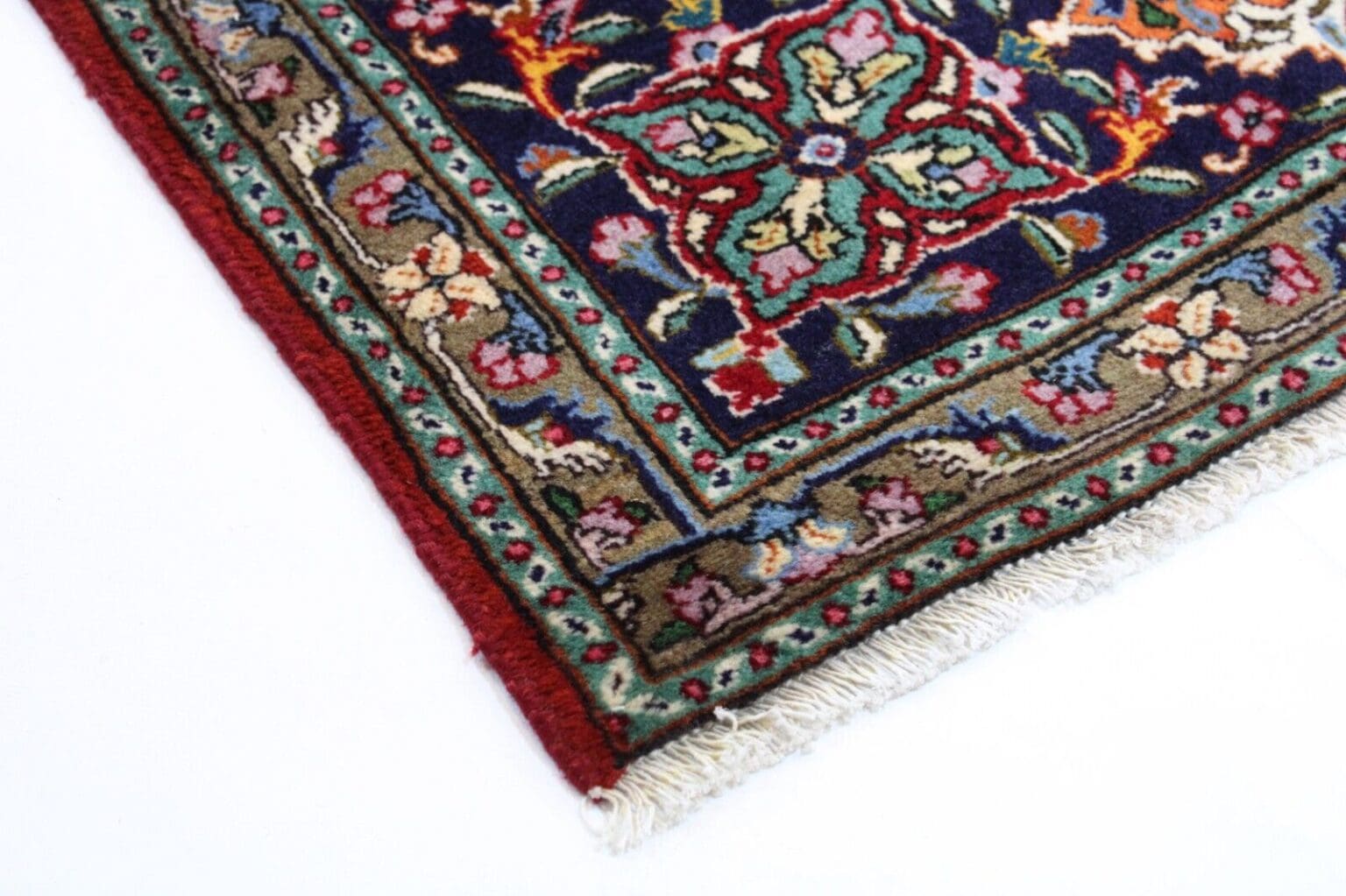
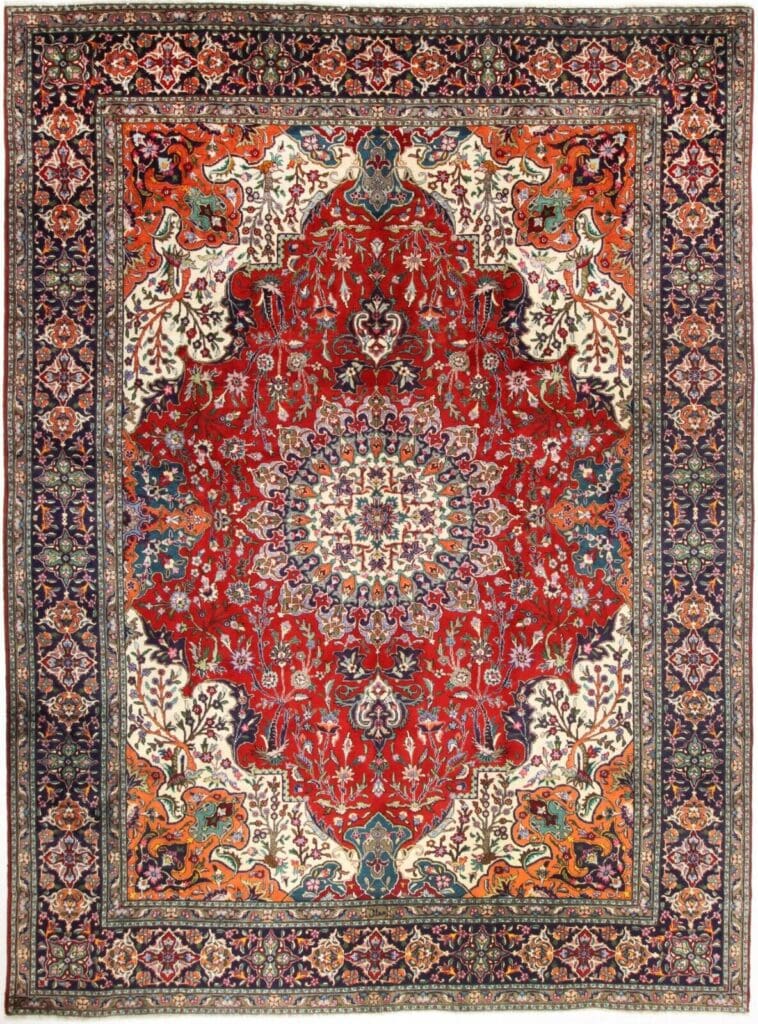
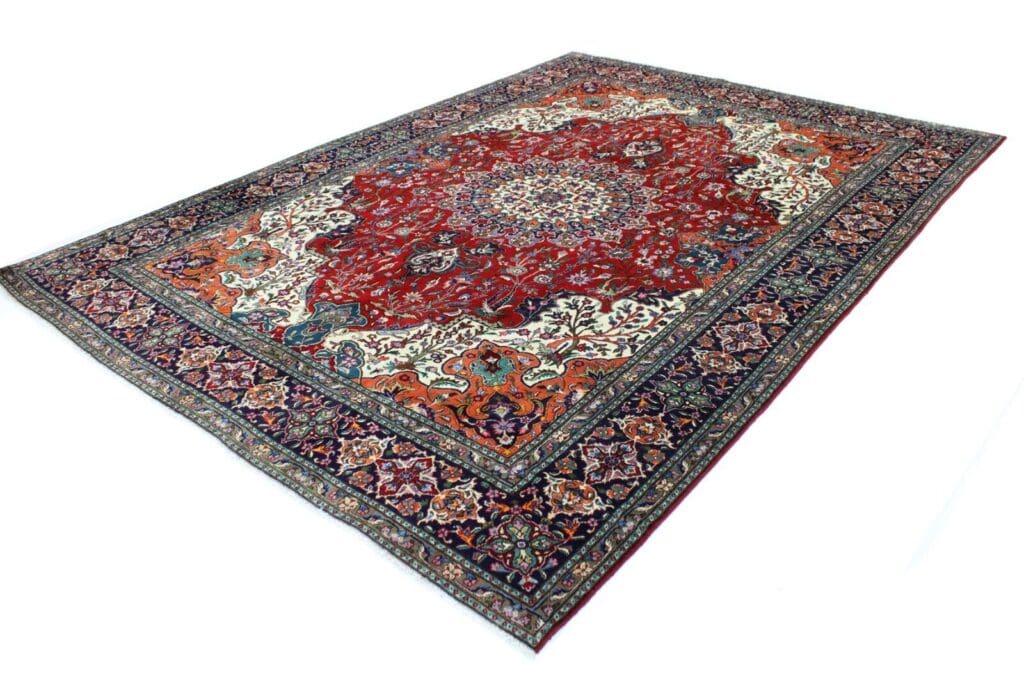
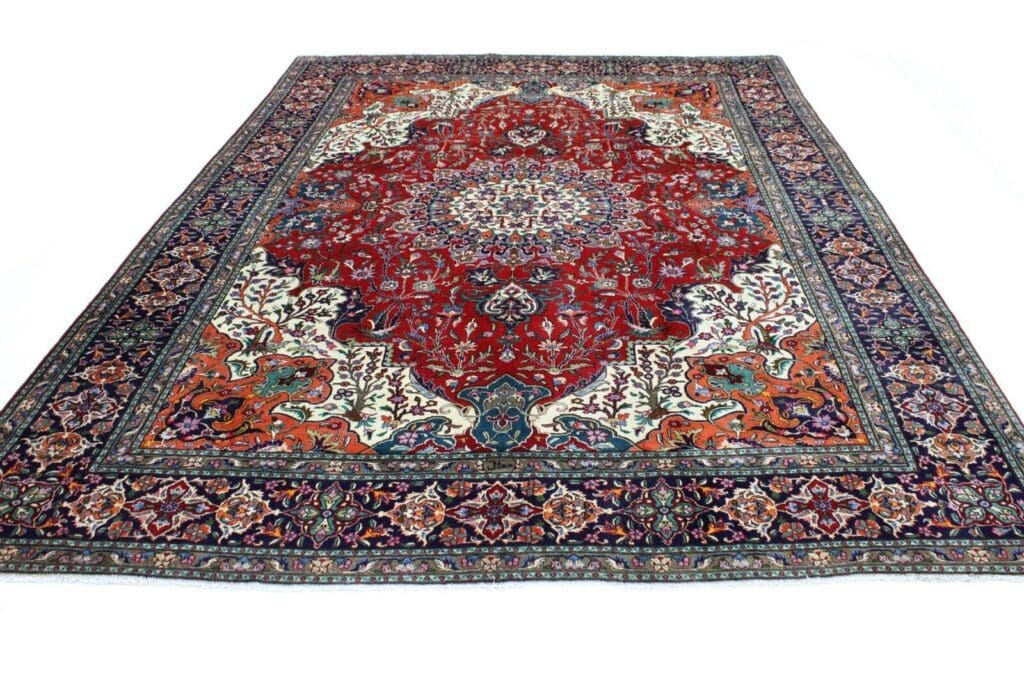
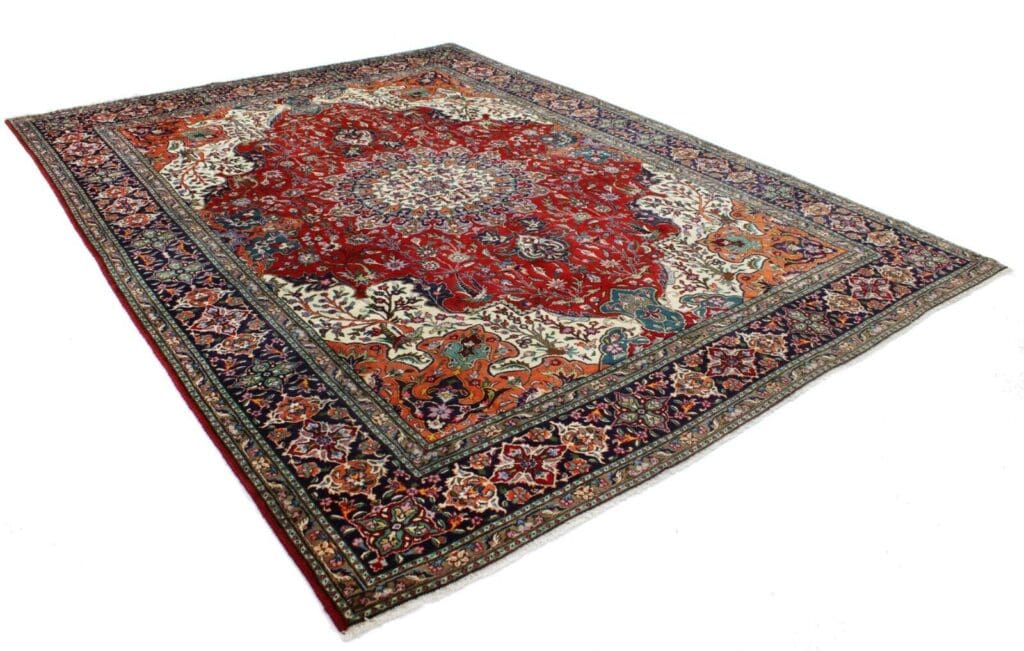
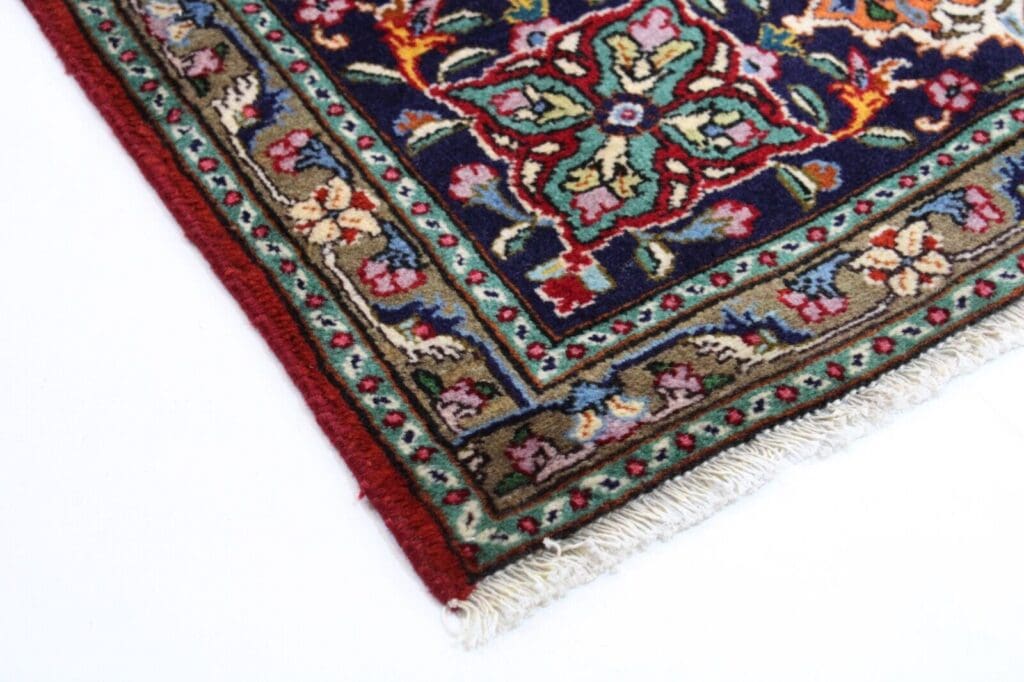
This Persian rug from Tabriz is hand-knotted and described in the title as finely hand-knotted. Its construction is formed knot by knot on a cotton warp. The pile is made of 100% wool. The cotton warp provides the textile foundation into which the wool knots are secured. The resulting rug has a wool surface supported by a woven structure, with its character determined by the relationship between pile, warp and the rows of knots.
The listed knot density is 40 Raj. Raj is a traditional term used in the carpet trade to describe the fineness of a weave, particularly in connection with Tabriz rugs. It expresses the density of the knotting within a customary technical system. This information adds precision to the description of the hand-knotted construction. It does not, by itself, describe the geometric pattern or the condition of the individual rug.
Wool has long been used for the pile of Persian rugs because it provides a resilient natural surface with a distinct tactile feel. Cotton is commonly used for the warp because it can form a stable, even foundation for the knotting process. The materials specified for this rug are precise: wool in the pile and cotton in the warp. No other material is stated for this piece.
The rug is used and washed. These details describe its present condition and confirm that washing has taken place. They do not establish a particular age, provenance story, signature or restoration history; none of those details is given. Its hand-knotted construction remains a separate and central feature of the workmanship, regardless of its used condition.
Origin and Tradition
This rug comes from Tabriz and is identified as an original Persian rug. Tabriz is in northwestern Iran and is one of the established centres of Persian carpet production. The city developed as an important cultural and commercial location, allowing ideas and goods to move between different areas. That exchange contributed to a varied regional weaving tradition with a strong emphasis on orderly design and precise workmanship. Tabriz therefore refers both to a place of origin and to a recognised carpet tradition.
Traditional Tabriz carpets are built on a prepared loom. Warp threads establish the lengthwise framework, while weft threads and knots build up the textile surface. After rows of knots are made, further weaving secures and stabilises the structure. This process requires controlled tension, careful counting and familiarity with the planned design. A hand-knotted rug is not produced by simply applying a picture to a finished surface. Its pattern is created through the placement of individual knots, which together form the pile, outlines and areas of colour.
Tabriz has a long tradition of working with carefully organised designs. A drawing may divide a rug into a central field, surrounding borders and corner areas, with each part related to the others through proportion and repetition. The regional tradition includes floral arrangements, medallion compositions, linear structures and geometric solutions. Tabriz is therefore not limited to one decorative formula. Its identity is connected with the methods of drawing, knotting and finishing that have been passed through workshops and generations.
Persian rugs are produced in many parts of Iran. Isfahan, Kashan and Tabriz are among the well-known weaving regions, and each has developed its own combination of workshop practice, materials, construction and design vocabulary. Regional attribution is not based on a pattern name alone. It can relate to the tradition of the weaving centre, the character of the structure and the way a design is interpreted. This rug is assigned to Tabriz; references to other Persian regions do not change that origin.
The cultural importance of a Persian carpet lies in the combination of utility, design and inherited technical knowledge. From preparing the warp to trimming and completing the pile, the making of a hand-knotted rug involves many deliberate stages. The maker translates a planned design into rows of knots, and the finished textile retains the evidence of that labour in its construction. Each hand-knotted piece is an individual object, even where it follows a recognised regional pattern. This rug brings together Persian origin, Tabriz tradition and a finely hand-knotted structure.
Design and Pattern
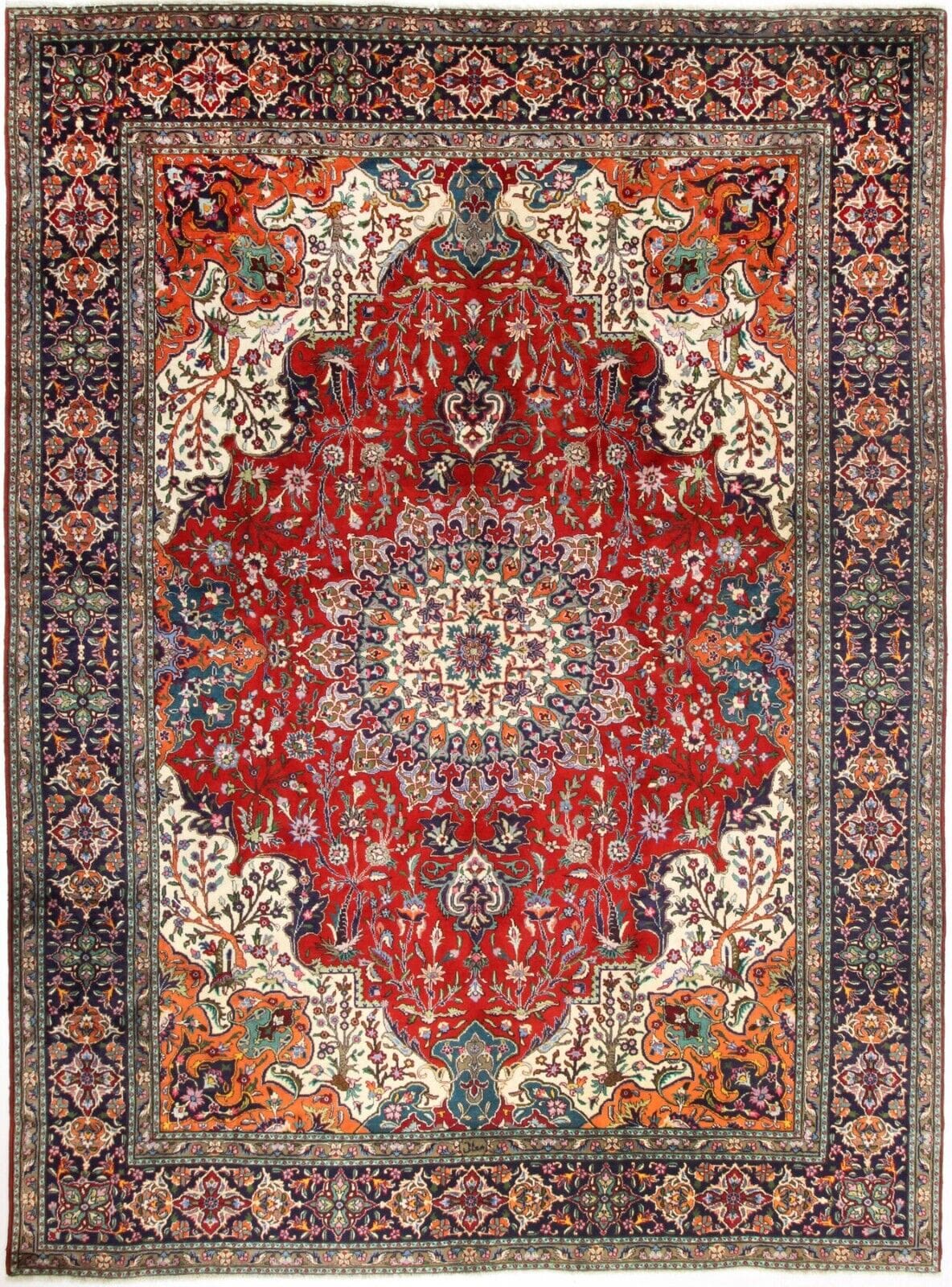
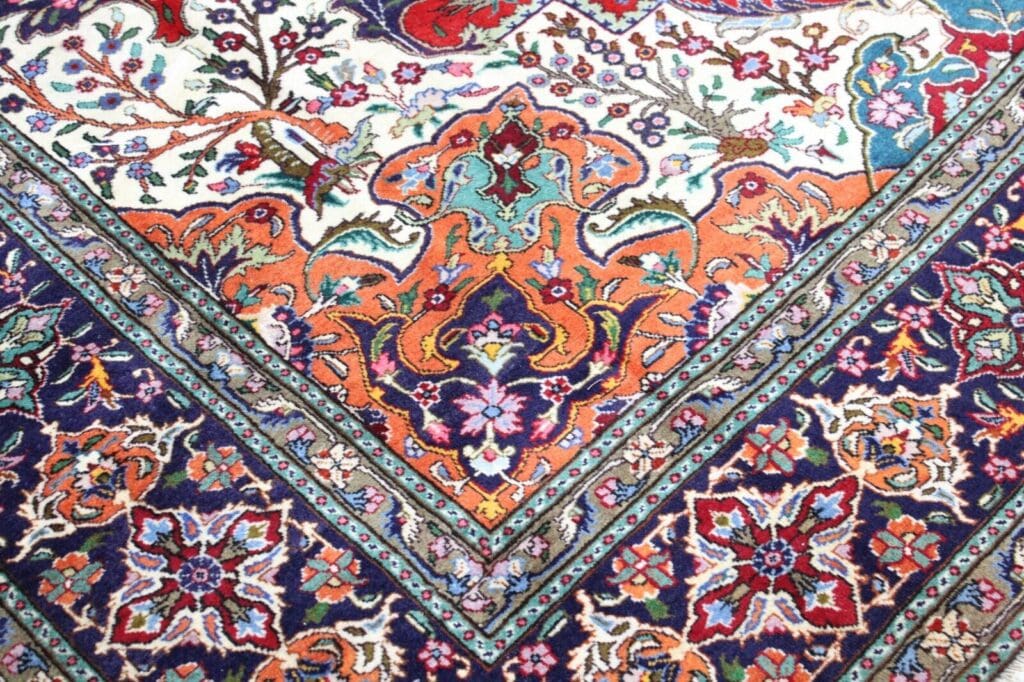
The pattern of this rug is geometric. That description refers to a design language based on lines, angles, defined areas and forms arranged in a regular or rhythmic order. Geometric patterns may divide a field into sections, create a border system or repeat selected shapes across the surface. The term identifies the stated visual character of this rug without adding floral, figurative or narrative motifs that are not specified.
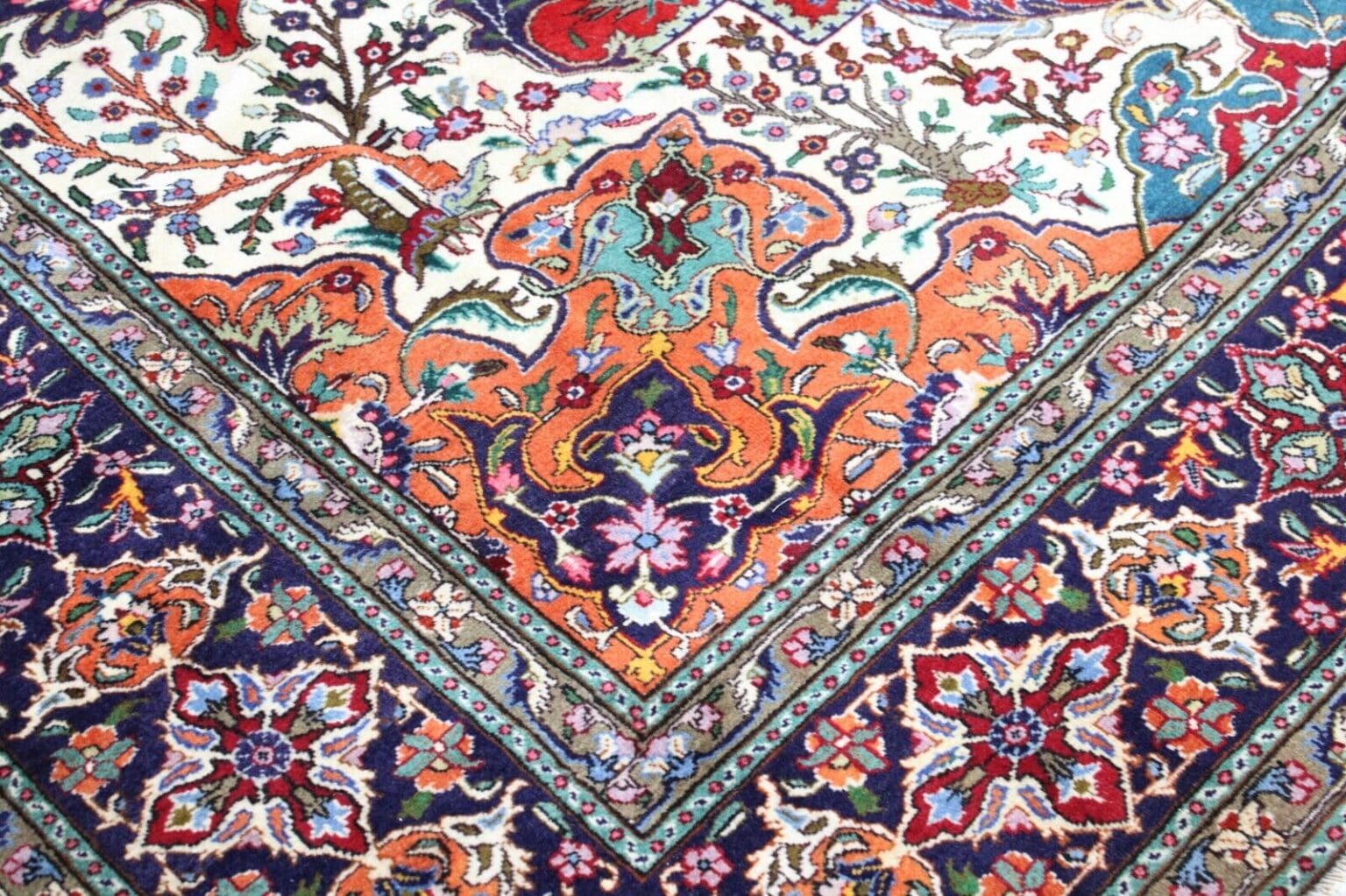
In Persian carpet making, a geometric composition is formed through the interaction of the drawing and the knotting. A line is not painted onto the completed pile as it would be on a flat image. Instead, its contour is built from successive knots. The stepped quality that can appear in a woven design reflects the structure of the textile itself. Knot direction, row sequence and pile density all influence the clarity with which a geometric element is read.
Geometric designs can organise a carpet in several ways. A central field may be structured through repeated units, while narrow or broad borders define the transition toward the edges. Reflection, repetition and measured spacing can create visual order. Other compositions use offset forms or a less symmetrical distribution. The specific arrangement must be read from the individual surface; the documented pattern description for this rug remains simply geometric.
The Tabriz tradition accommodates more than one type of ornament. Workshops have produced designs for different interiors, uses and aesthetic preferences, ranging from richly divided compositions to more clearly structured forms. The combination of accurate knotting and a coherent drawing is an important part of the regional language. On this rug, that regional design tradition is represented through the stated geometric pattern rather than through a named floral or medallion design.
Persian carpets may also feature floral motifs, medallions or scenes connected with stories and daily life. This variety explains why an origin name cannot be used as a complete description of a pattern. Tabriz is associated with several design approaches, while this particular rug is expressly recorded as geometric. It is also described as oriental in style. That is a broad classification within the world of oriental rugs, not an additional specific motif or place of origin.
Special Features
The rug is used and washed. It is also described as suitable for underfloor heating and as allergy friendly. These are practical details associated with its intended use. Suitability for underfloor heating relates to placement in a room with that type of heating, while the allergy-friendly designation addresses use by people concerned about allergens. No further claims are made here about colour, wear, repairs, stains, previous rooms or a particular cleaning date.
For Persian rugs, regular vacuuming without a brush attachment and occasional professional cleaning are recommended. Direct sunlight should be avoided because it can contribute to fading. These general care principles are appropriate for a hand-knotted wool rug. This rug has already been washed; that fact does not establish when or by which specific method the washing was carried out.
FAQ
How can I recognise a genuine Persian rug?
A genuine Persian rug can be assessed through several characteristics: its knotting technique, materials, construction and design. A hand-knotted rug is made from individual knots and is therefore different from a machine-made product. Knot density can provide additional information about the fineness of the construction. In this case, the identification as an original Persian rug, the Tabriz origin, the hand-knotted workmanship, the wool pile and the cotton warp all form part of its stated description.
How should I care for my Persian rug?
Regular vacuuming without a brush attachment is recommended for everyday care. This removes loose dust while avoiding unnecessary mechanical stress on the wool pile. Occasional professional cleaning is also advisable. Direct sunlight should be avoided, as prolonged exposure can cause colours to fade. This rug is described as washed. If further cleaning is needed, the treatment should take account of its wool pile, cotton warp and hand-knotted construction.
Which types of rugs are comparable to Persian rugs?
Rugs from the same broad region and related craft traditions include Ziegler, Gabbeh and Nain rugs. They share a long history and traditional workmanship, but differ in style and materials. Ziegler rugs are associated with gentle colours and traditional patterns. Gabbeh rugs are known for a coarser texture and modern designs. Nain represents another Persian tradition and is often associated with fine, intricate compositions. These are separate rug types and do not alter the stated Tabriz origin of this Persian rug.
To provide the best experiences, we use technologies like cookies to store and/or access device information. Consenting to these technologies will allow us to process data such as browsing behavior or unique IDs on this site. Not consenting or withdrawing consent, may adversely affect certain features and functions.
Functional Always active
The technical storage or access is strictly necessary for the legitimate purpose of enabling the use of a specific service explicitly requested by the subscriber or user, or for the sole purpose of carrying out the transmission of a communication over an electronic communications network.
Preferences
The technical storage or access is necessary for the legitimate purpose of storing preferences that are not requested by the subscriber or user.
Statistics
The technical storage or access that is used exclusively for statistical purposes.The technical storage or access that is used exclusively for anonymous statistical purposes. Without a subpoena, voluntary compliance on the part of your Internet Service Provider, or additional records from a third party, information stored or retrieved for this purpose alone cannot usually be used to identify you.
Marketing
The technical storage or access is required to create user profiles to send advertising, or to track the user on a website or across several websites for similar marketing purposes.
 SECURE PAYMENT
 SHIPPING PARTNERS