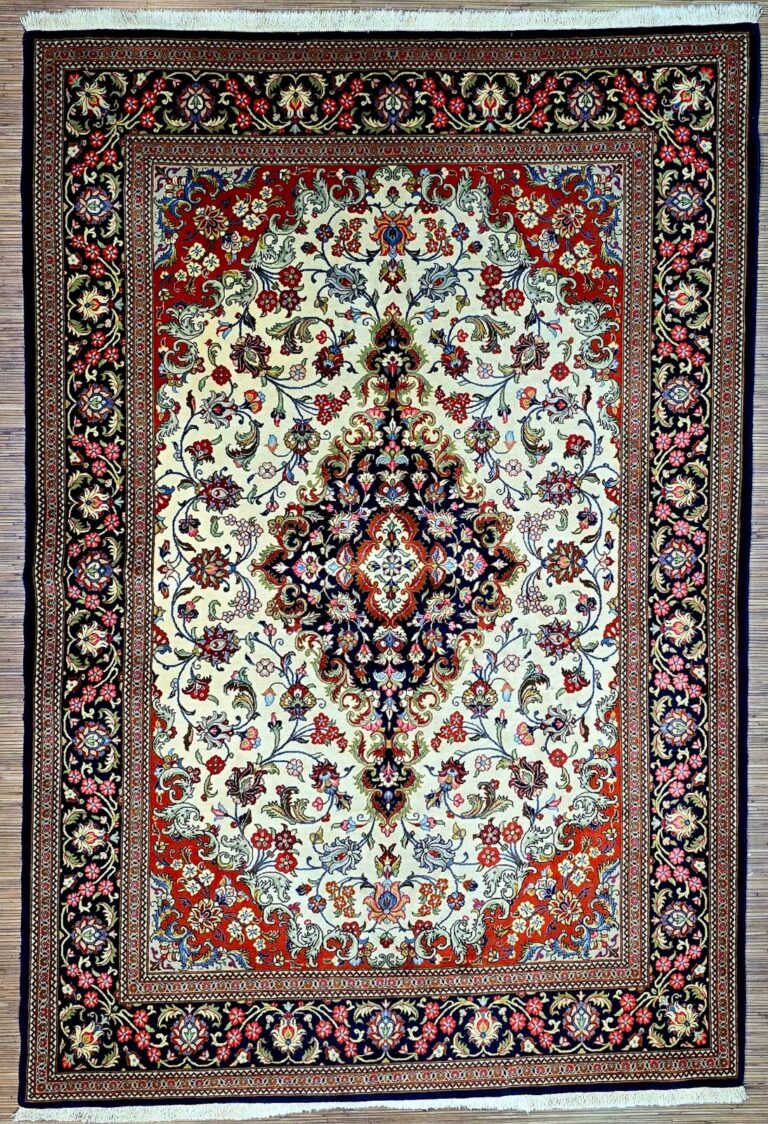
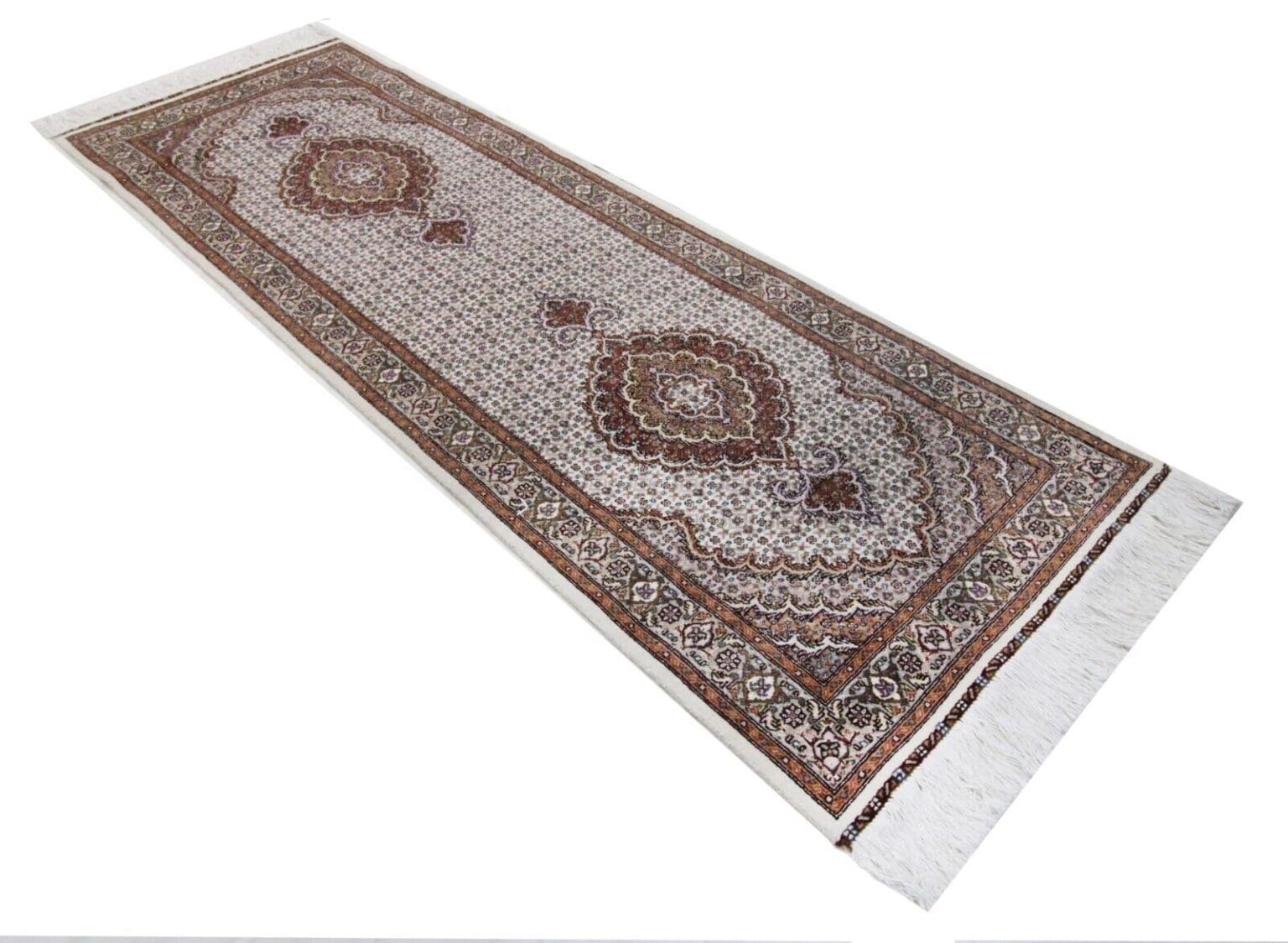
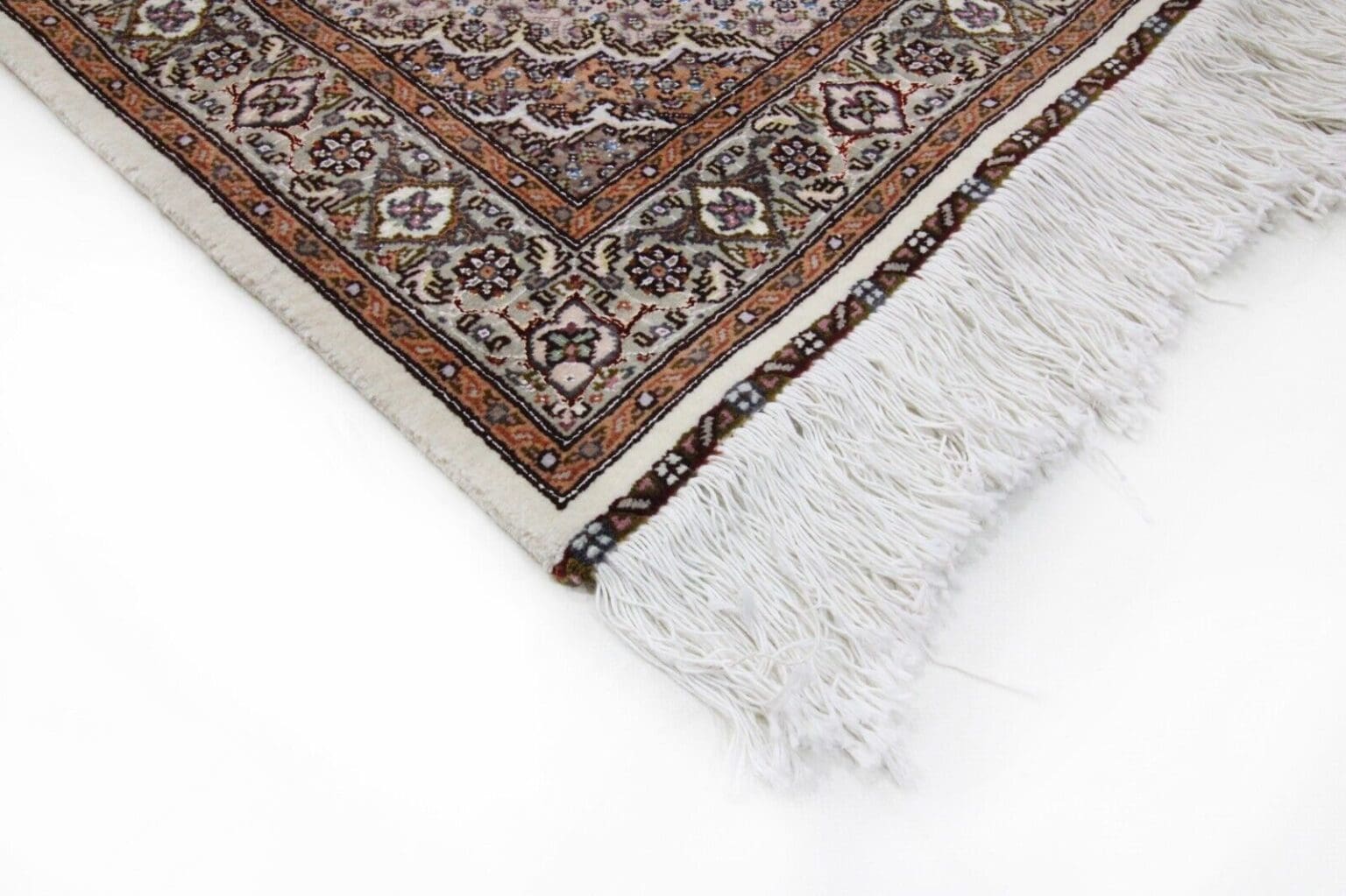
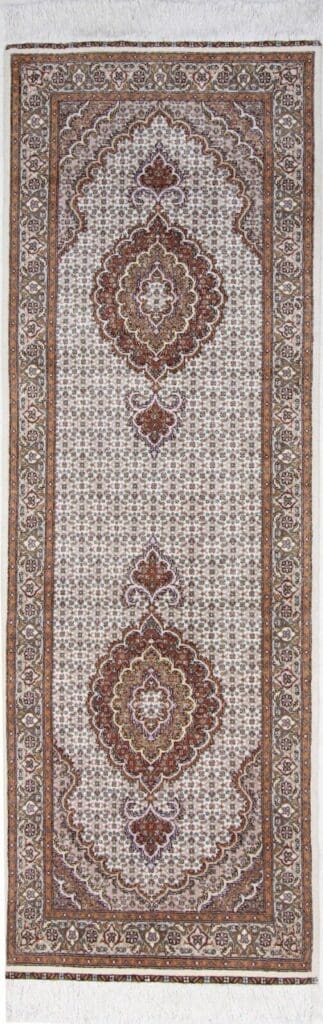
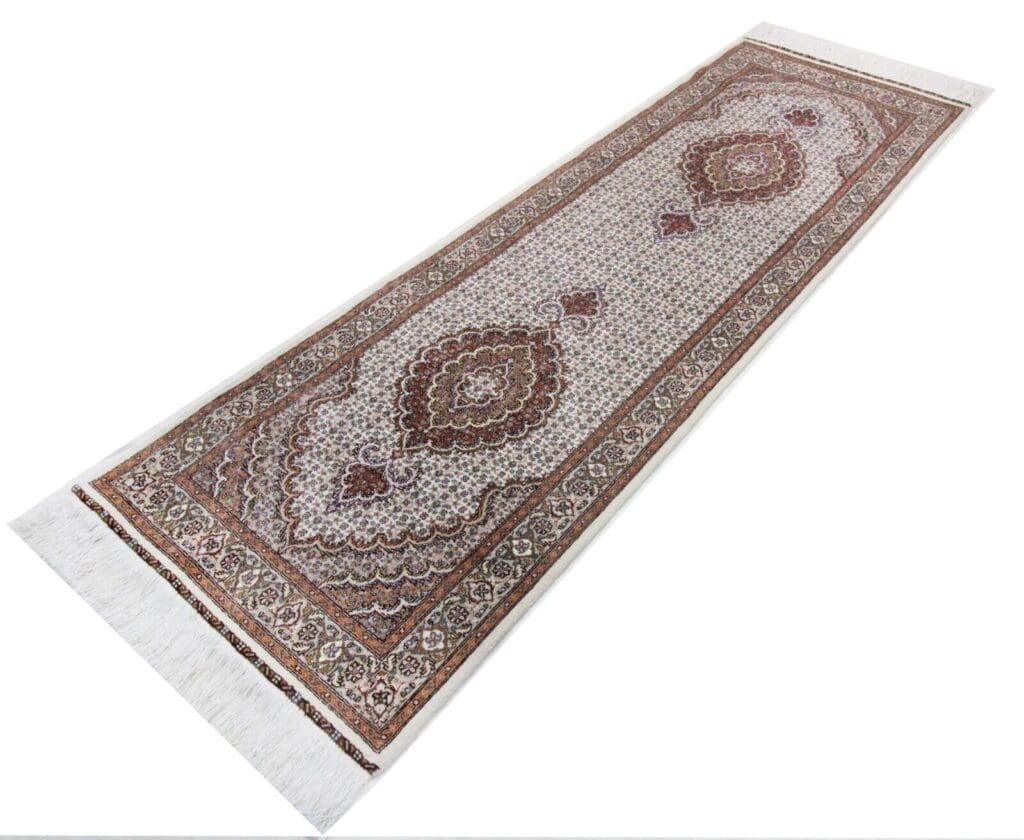
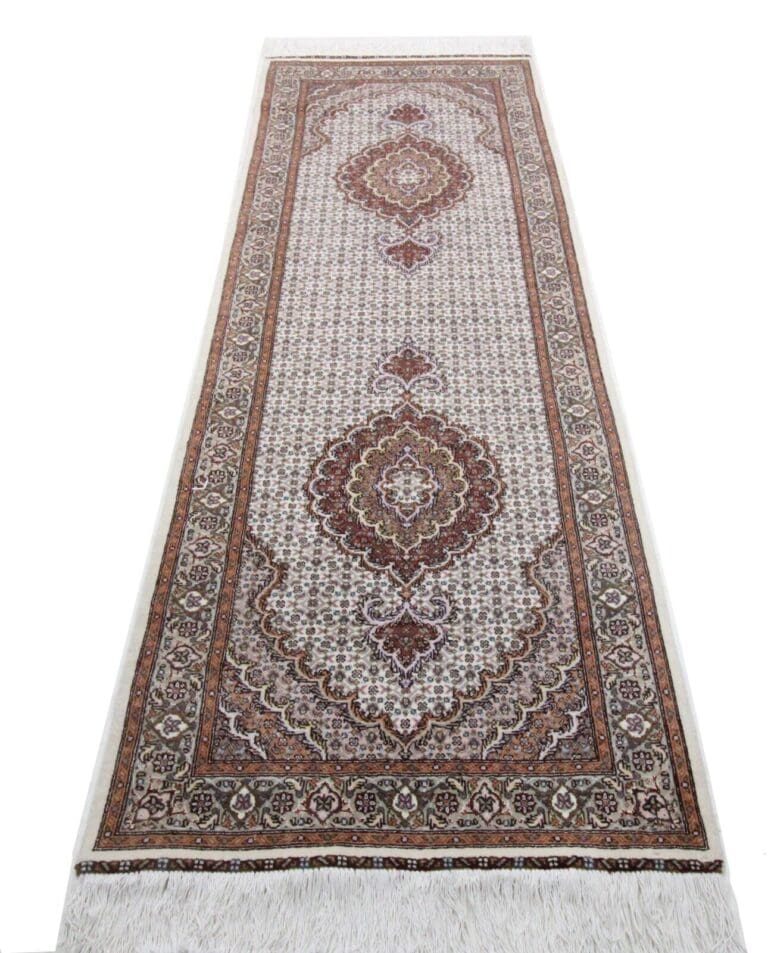
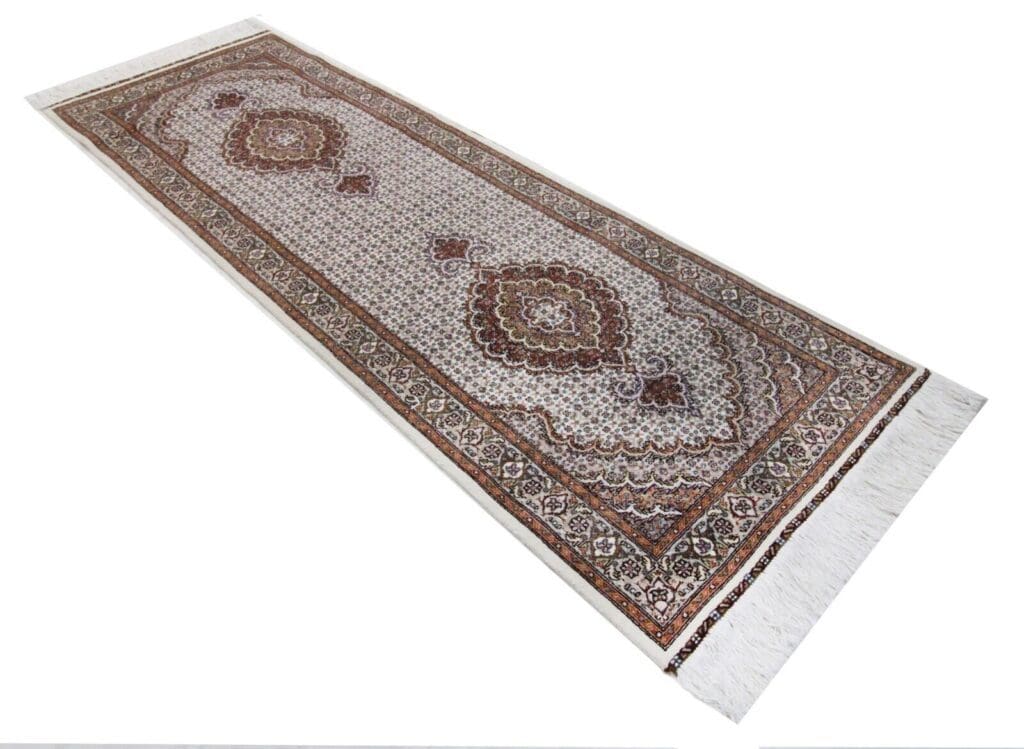
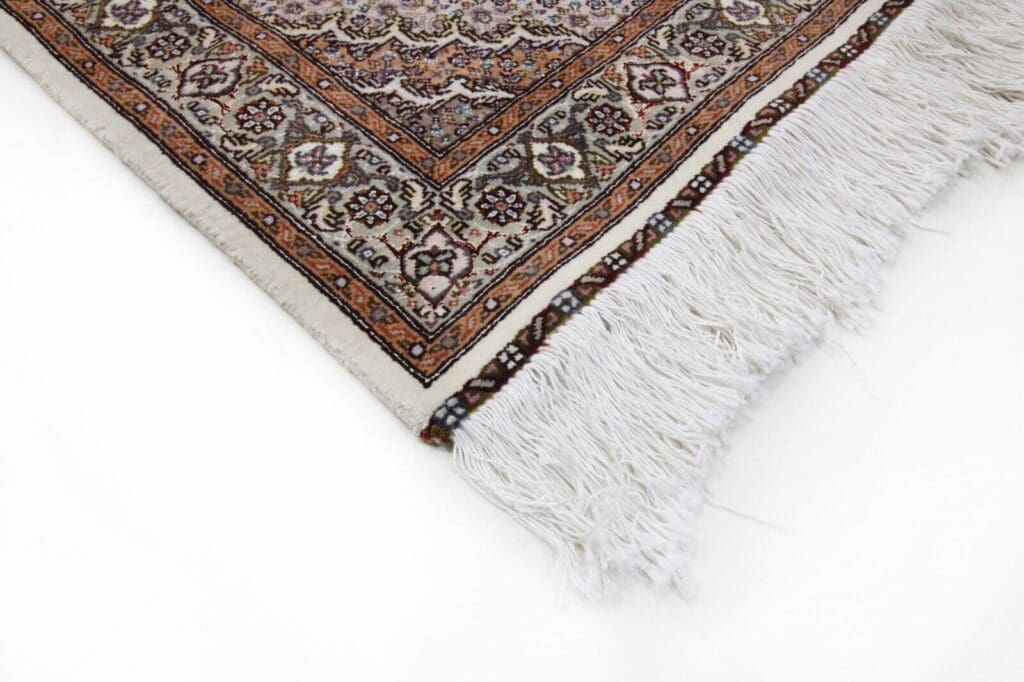
This Persian rug is hand-knotted. In this traditional method, individual knots are inserted by hand into the foundation of the rug. The pile is then evened and finished so that the surface forms a coherent textile layer. Hand-knotting is different from machine production and also differs from the flat-weaving technique used for Kelim. It requires time, practical knowledge and consistent handling of the yarn throughout the weaving process.
The pile is made of 100% wool. Wool has been used in Persian rugs for centuries because it provides a resilient, tactile and naturally flexible surface. It accepts colour well and gives the pile a textile appearance with a character that differs from a synthetic fibre. The warp is made of 100% cotton. The listed materials therefore have distinct functions in this rug: wool forms the pile, while cotton forms the warp that supports the structure.
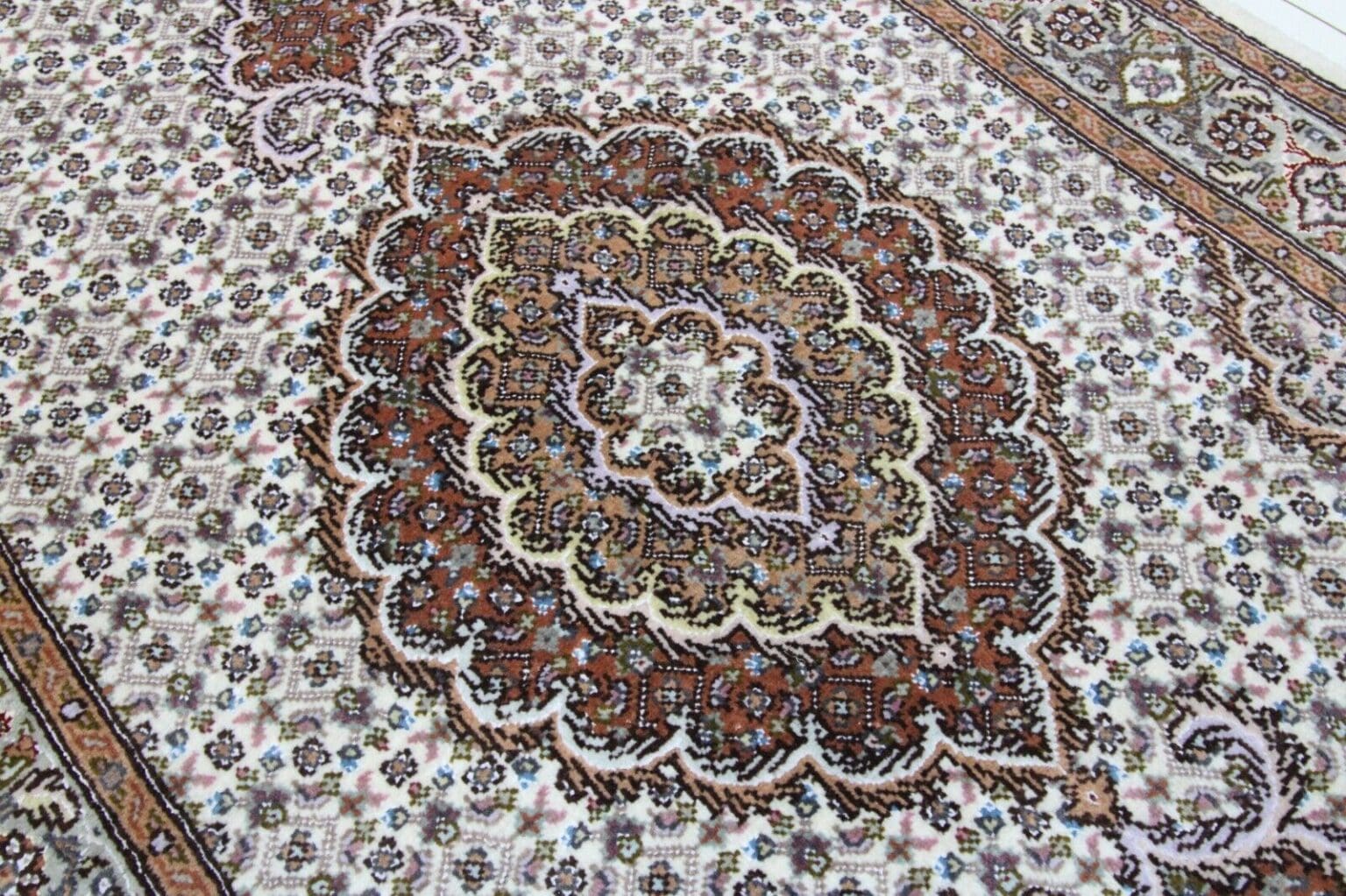
The knot density is listed as 50 Raj. Raj is a traditional way of describing knot density in Tabriz rugs. Knot density is connected with the ability to render small details, fine outlines and closely arranged design elements. The visual result also depends on the wool, the drawing of the pattern and the skill with which the knots are placed. For this rug, 50 Raj is the stated technical classification of the knotting.
The pile height is described as normal. The rug is new and is offered without a label. These details describe the present condition and the recorded construction of this individual piece. They do not add an unlisted age or a further provenance claim. As a hand-knotted rug, it has the individual character associated with a surface made through manual work.
Origin and Tradition
The rug comes from Täbriz in Persia. Tabriz, also written as Täbriz, is one of the established centres of Persian carpet weaving. The city lies in north-western Persia and has long been an important place of trade and cultural exchange. Connections between different regions helped patterns, colours and technical approaches circulate. A varied weaving tradition developed as a result, combining ordered compositions with a wide range of floral, geometric and historical references.
Tabriz weaving is associated with the transmission of designs, knotting methods and workshop knowledge from one generation to the next. There is no single pattern that defines every Tabriz rug. Regional production includes medallion layouts, scrolling vines, floral fields, geometric arrangements and designs based on older Persian models. The character of an individual rug emerges from the relationship between its drawing, its knotting, its colour arrangement and the finishing of the pile.
Persian rugs are understood through both their technique and the places where they are made. Isfahan, Kashan, Shiraz and Tabriz are frequently named as important centres, with each area developing recognisable preferences in composition and colour. Tabriz is associated with precise drawing and a broad design vocabulary. This general regional background places the rug in the long tradition of Tabriz weaving without assigning an unlisted workshop, designer or historical date to this piece.
The term Persian rug refers to its Persian origin rather than to one particular pattern. A floral or geometric design may appear in more than one weaving region, where it can be interpreted through local conventions. The origin Täbriz is therefore a separate fact from the pattern description “Oriental”. The first identifies where the rug comes from; the second gives a broad description of its visual language.
Traditional Persian rug production combines a prepared warp, inserted weft and rows of hand-tied knots. Once the knotting is complete, the projecting fibres are worked and the pile is brought into a finished surface. The process requires attention to alignment, because borders, outlines and fields must remain coherent as the work progresses. Knot density is an important technical feature, but it is not the sole measure of a rug’s design or workmanship. Fibre quality, the precision of the drawing and the finishing work also contribute to the result.
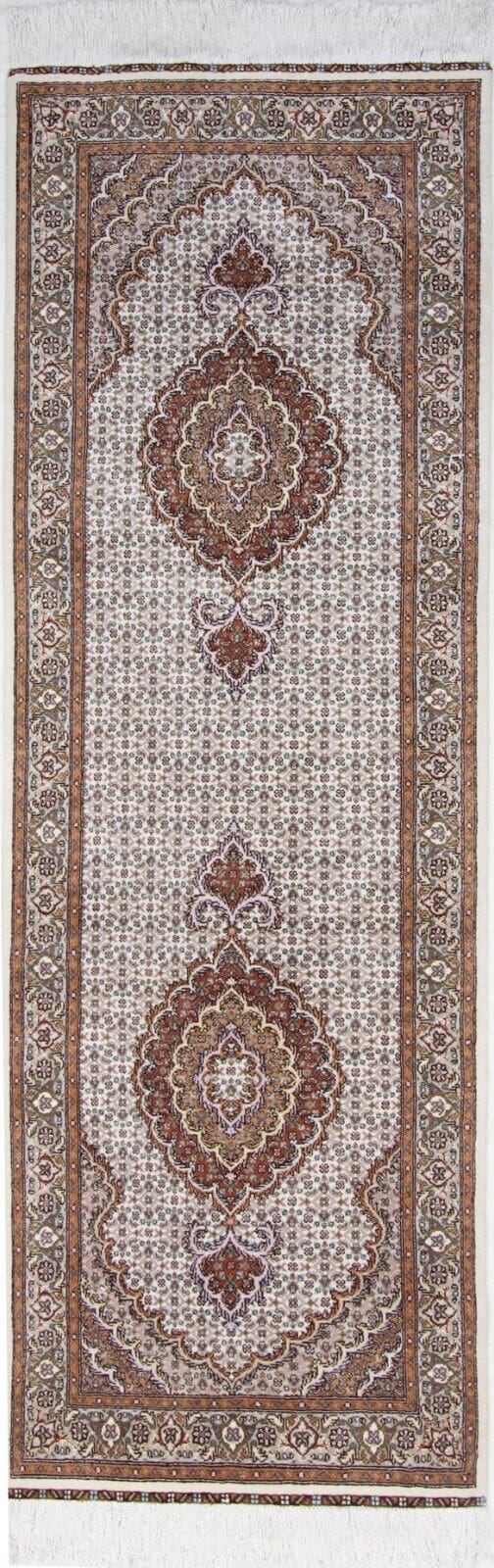
Persian rugs are produced in many formats, including broad room rugs and narrow runners. A runner is traditionally suited to hallways, passageways and other elongated areas. The product description identifies this rug as a runner. Its narrow format therefore belongs to a familiar category of Persian rug use, while its Tabriz origin connects it with the region’s established hand-knotting tradition.
The history of Tabriz weaving also reflects the role of design circulation. Motifs could be adapted from architectural decoration, manuscripts, garden imagery and older carpet compositions. This did not create one uniform style; instead, it allowed workshops and weavers to work within a shared vocabulary while producing different arrangements. The broad label Oriental accommodates that visual range. It should not be read as a claim that this rug contains a particular motif that has not been specified.
Design and Pattern
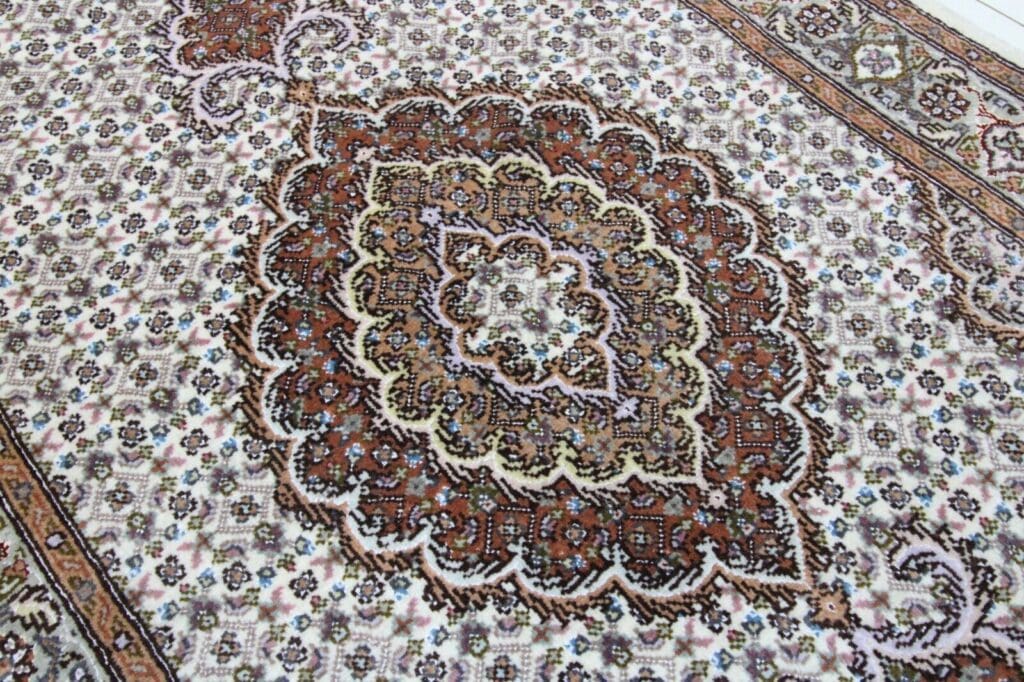
The pattern of this rug is described as Oriental. This is a broad design category associated with carpets from the Orient and, in particular, with Persian ornamental traditions. It does not identify one exclusive motif. Oriental carpet designs may include floral elements, geometric shapes, scrolling vines, medallions or repeated borders. The exact combination depends on the individual drawing and on the regional tradition in which it was made.
Floral designs occupy an important place in Persian carpet art. Flowers, leaves and vines can be linked into an all-over field, arranged around a central medallion or placed inside separate compartments. Other compositions are more geometric and rely on repeated shapes, axes and clearly divided areas. Since this rug is only classified as Oriental in the source, no specific floral, medallion or geometric design should be assigned to it.
A medallion composition normally establishes a centre and organises the surrounding field around it. An all-over composition distributes motifs across the surface without giving one central form priority. Borders provide another method of structuring a rug: a main border may be accompanied by narrower guard borders, creating a frame around the interior field. These are general principles of Persian carpet design. They explain how such rugs can be organised, but they are not a description of an unlisted detail in this particular rug.
Colour in an Oriental rug helps distinguish fields, define outlines and establish visual rhythm. Persian traditions include naturalistic colour relationships, strong contrasts and subtle changes between related shades. Plant forms, historical ornament and geometric order may all influence the choice and placement of colour. The source does not specify the colours used here, so the rug is described only through its Oriental pattern category rather than through a claimed palette.
Tabriz is known for a broad range of designs. Some compositions relate to classical floral layouts, some to formal medallion structures and others to more strictly organised geometric fields. The knotting translates the drawing into many small units, allowing outlines, repeated flowers and border details to be developed with precision. The stated 50 Raj is a technical description of the knot density; it is not the name of a motif or a pattern family.
The wider Persian tradition includes many related but distinct forms. Gabbeh rugs are known for simpler designs and strong colours, while Kelim and Kilim are flat-woven textiles with their own construction and often geometric patterns. Nain and Qom are also associated with the variety of Persian carpet production. These examples illustrate the breadth of the tradition. They are not alternative origins or additional pattern names for this Tabriz rug.
Design in a hand-knotted rug is created gradually rather than printed onto a completed surface. The drawing must be followed knot by knot, with each section contributing to the overall balance. Small variations can occur as part of manual production, while the finished pattern remains governed by the underlying design. Tabriz’s place in Persian carpet history is linked to this combination of careful structure and an extensive ornamental vocabulary.
Special Features
The rug is described as allergy-friendly. It is also listed as having an anti-slip feature and as being suitable for use over underfloor heating. These are the specific special features given for this piece. They concern its intended use and functional characteristics, not its origin or its broad Oriental pattern classification.
The rug is new and has no label. Its hand-knotted construction, wool pile and cotton warp bring together traditional production and the stated practical features. For routine care, regular vacuuming and occasional professional cleaning are recommended. Direct, intense sunlight should be avoided because it can cause colours to fade over time. Care appropriate to a hand-knotted wool rug helps keep the pile and the visible design in good condition.
FAQ
How should I care for this hand-knotted Persian rug?
Regular vacuuming removes loose dust and helps keep the wool pile clean. Use a setting suitable for rugs and avoid applying unnecessary force to the surface. Occasional professional cleaning provides a deeper form of care. Direct sunlight should be avoided because prolonged exposure can fade colours. Spills should be dealt with promptly and professionally rather than rubbed aggressively into the pile. As this is a hand-knotted wool rug, a cleaner experienced with Oriental rugs is appropriate for thorough cleaning and stain treatment.
Which patterns are typical of Persian rugs?
Floral designs, geometric forms and traditional ornamental motifs are all typical of Persian rugs. Floral compositions may use flowers, leaves and scrolling vines, while geometric designs can be based on lines, repeated shapes and divided fields. Medallions and borders are also common organising elements. Regional traditions influence how these elements are drawn and combined, with Isfahan, Tabriz and Kashan often cited among the important Persian weaving centres. This rug is classified broadly as Oriental, so no single specific motif is stated.
How long can a hand-knotted Persian rug last?
With proper care, a hand-knotted Persian rug can last for several generations. The quality of the materials, the construction of the knotting and the knot density all play an important role. Daily wear, suitable placement, regular cleaning and protection from strong sunlight also affect longevity. The materials named for this rug are a wool pile and a cotton warp. Since the rug is offered as new without a label, no additional age information is attached to it.
To provide the best experiences, we use technologies like cookies to store and/or access device information. Consenting to these technologies will allow us to process data such as browsing behavior or unique IDs on this site. Not consenting or withdrawing consent, may adversely affect certain features and functions.
Functional Always active
The technical storage or access is strictly necessary for the legitimate purpose of enabling the use of a specific service explicitly requested by the subscriber or user, or for the sole purpose of carrying out the transmission of a communication over an electronic communications network.
Preferences
The technical storage or access is necessary for the legitimate purpose of storing preferences that are not requested by the subscriber or user.
Statistics
The technical storage or access that is used exclusively for statistical purposes.The technical storage or access that is used exclusively for anonymous statistical purposes. Without a subpoena, voluntary compliance on the part of your Internet Service Provider, or additional records from a third party, information stored or retrieved for this purpose alone cannot usually be used to identify you.
Marketing
The technical storage or access is required to create user profiles to send advertising, or to track the user on a website or across several websites for similar marketing purposes.
 SECURE PAYMENT
 SHIPPING PARTNERS