This Persian rug comes from Shiraz in Iran, is hand-knotted and has a pile made from natural wool. The surface is formed knot by knot by hand rather than through an industrial printing or machine-making process. Each stage of the work contributes to the finished textile surface, and the handmade method gives the individual rug its own execution. The result is a floor covering whose material and construction remain visible in the character of the pile.
Natural wool is used in rug making for its resilient fibre, comfortable feel and suitability for regular interior use. It creates a durable pile with a distinct textile texture. Wool can naturally absorb and release moisture, which may contribute to a comfortable room climate. These properties explain why wool has remained an important material in Persian rug production. Its practical qualities support everyday use while preserving the tactile character expected of a hand-knotted rug.
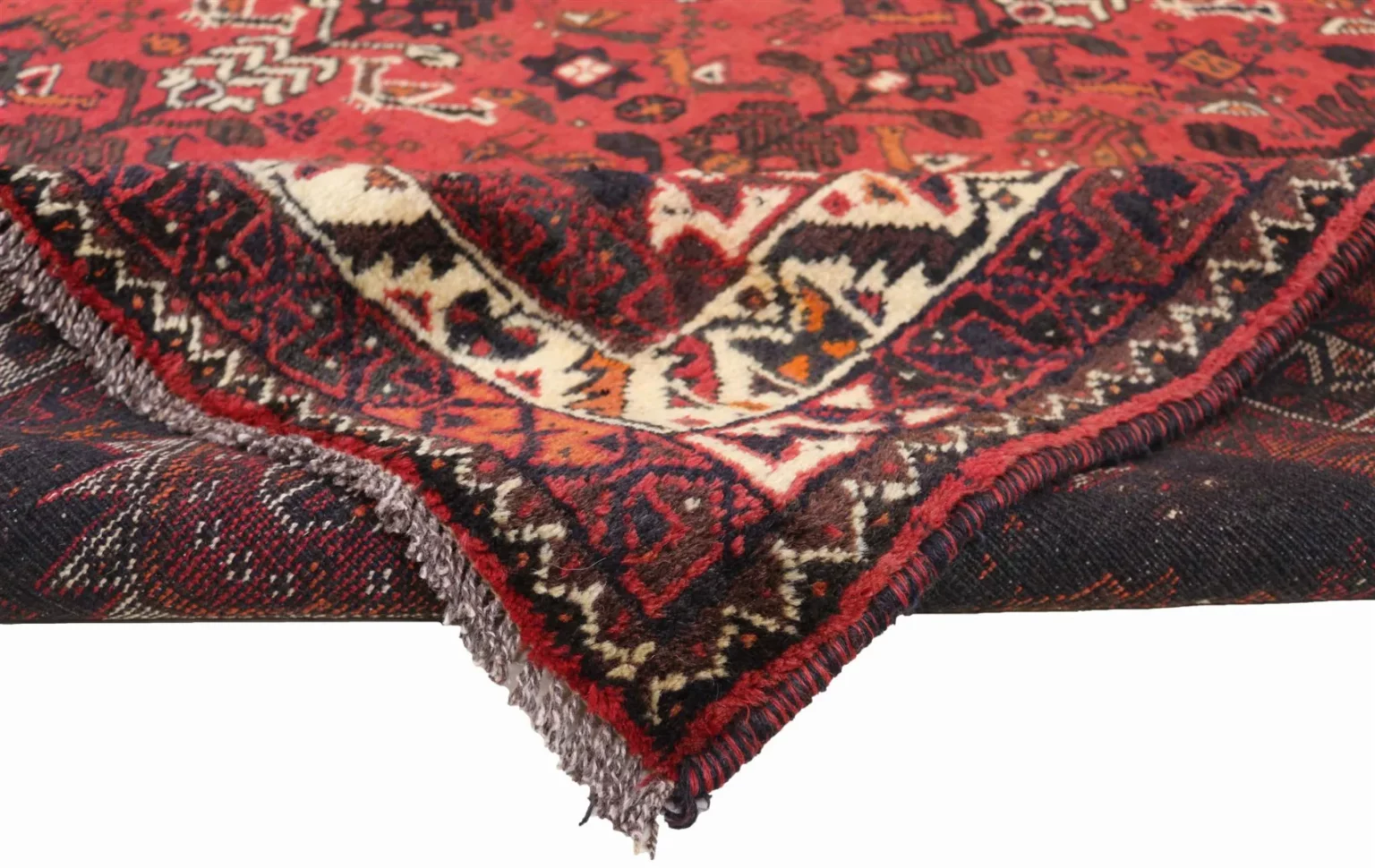
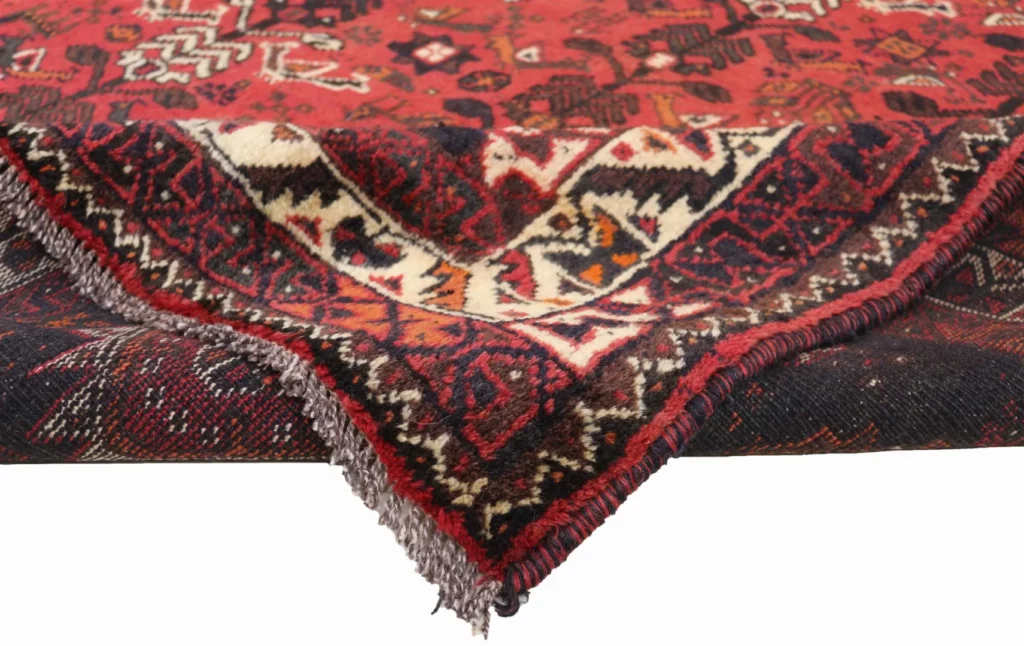
The knotting of this rug is dense. Dense construction supports durability and allows geometric ornaments to be worked clearly into the surface. In hand-knotting, the pattern is not added after the pile has been made. It is created directly through the placement of the knots. The weaver therefore has to follow the sequence of forms, the distribution of colours and the tension of the textile while working. This combination of material knowledge and manual control is central to the craft.
Hand production differs from machine manufacture, in which a design is repeated through a standardised sequence. A hand-knotted rug develops gradually. Minor variations in execution are part of the method and help distinguish one handmade piece from another. Shiraz rugs are traditionally often knotted without a fully prepared plan. This way of working relies on experience, memory, proportion and the ability to develop a composition while the rug is being made.
Natural wool should be cared for with a restrained approach. Regular vacuuming removes dust, while spills should be dabbed promptly with a damp cloth. Harsh cleaning products should be avoided. If a more intensive cleaning is needed, it should be carried out by a professional. Appropriate care is especially useful for a hand-knotted wool rug because it helps protect both the surface and the appearance of the colours.
Origin and Tradition
The rug originates in Shiraz, Iran, and therefore belongs to the Persian rug tradition. Shiraz is part of a culturally varied region with a long association with handcraft and regional textile production. Rugs from the area are particularly associated with geometric patterns and lively colour arrangements. Their visual language brings together clear forms, repeated ornaments and strong fields of colour, creating a design tradition that can be recognised without reducing every Shiraz rug to one fixed template.
Persian rug making is based on knowledge passed through generations. The work includes more than tying knots. Wool must be selected and prepared, fibres may be dyed, and the composition has to be developed through an understanding of proportion, colour and repetition. Finishing the surface is also part of the process. These stages influence one another, so a rug combines practical material knowledge with regional design culture and the time required for manual production.
In a traditional working approach, the composition is not always transferred from a completely detailed plan. Especially in regional and nomadic settings, forms may be developed during the knotting process. Weavers rely on memory, inherited motifs and personal experience. Geometric designs are well suited to this method because they can be repeated, enlarged, reduced or joined to neighbouring forms while retaining their basic visual language. The method gives the finished rug an individual character.
The area around Shiraz is also associated with the Ghashghai tradition. Ghashghai rugs often use related geometric ideas, but are described as having a higher degree of detail, a sophisticated knotting technique and deeper colour intensity. They represent their own tradition and should not be treated as identical to every Shiraz rug. Their comparison with Shiraz weaving instead shows how related forms can develop differently within the same broader region.
Nomadic rugs from the surrounding area are another part of the cultural setting. They are often less elaborate and offer a wide range of colours and patterns. Their designs can reflect nomadic ways of life and the circumstances in which the rugs were made. Nomadic weaving differs from work produced in settled workshops because mobility, available materials and inherited visual forms affect the process. The result is a distinct regional expression rather than a simplified version of workshop production.
Shiraz stands within a landscape where urban, village and nomadic influences meet. This helps explain the variety of rugs associated with the region. Geometric ornaments, vivid colour and different levels of detail recur across local traditions, but the precise execution depends on the makers, the workshop environment and the inherited technique. The origin name Shiraz therefore identifies a regional context. It does not imply that every rug from the area has an identical composition or construction.
Persian rug making has a long history as both a practical craft and a form of textile design. Rugs have been used to furnish living spaces, provide protection from the ground and carry decorative patterns. Motifs are passed on, adapted and combined with local preferences. Workshops may specialise in particular knotting methods or design traditions, while individual weavers bring their own experience to the work. This continuity allows regional patterns to remain recognisable while still changing over time.
Well-known Persian rug makers and workshops have devoted themselves to traditional knotting techniques. Their work exists alongside production by smaller workshops and regional weavers. Each setting preserves knowledge about wool, dyeing, pattern structure and finishing. In this context, a Shiraz rug is considered not only for its decorative role but also as part of an Iranian craft tradition in which manual skill and regional identity are closely connected.
Design and Pattern
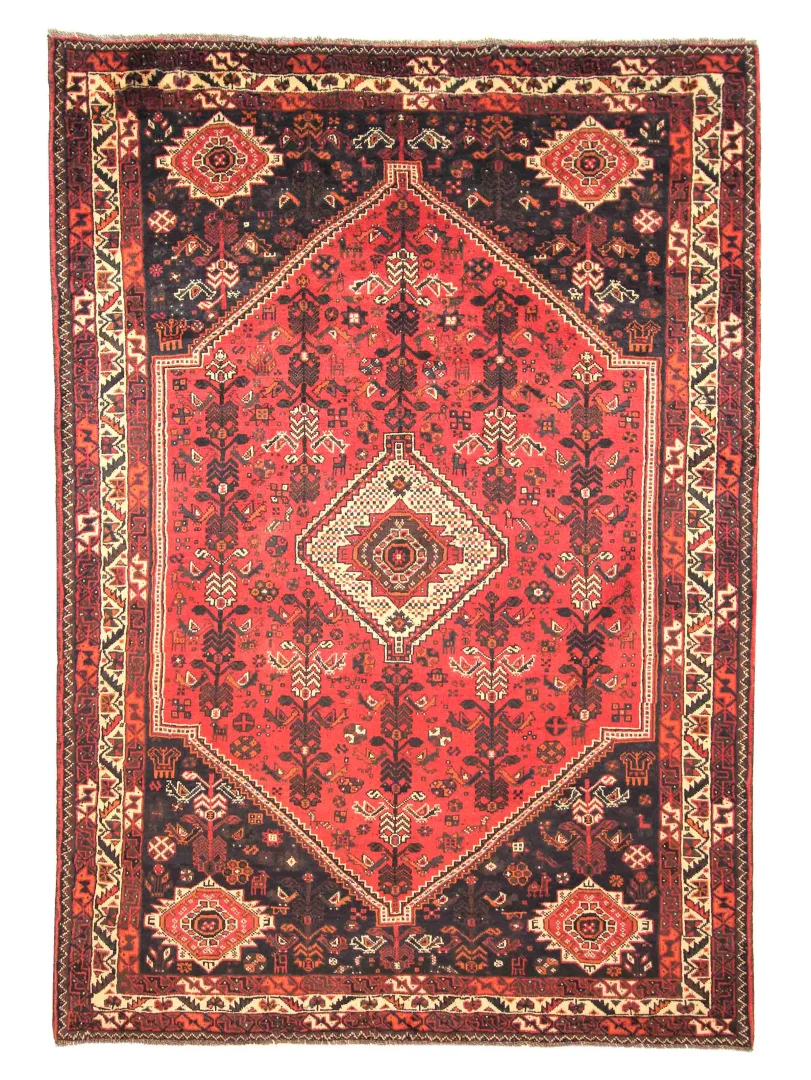
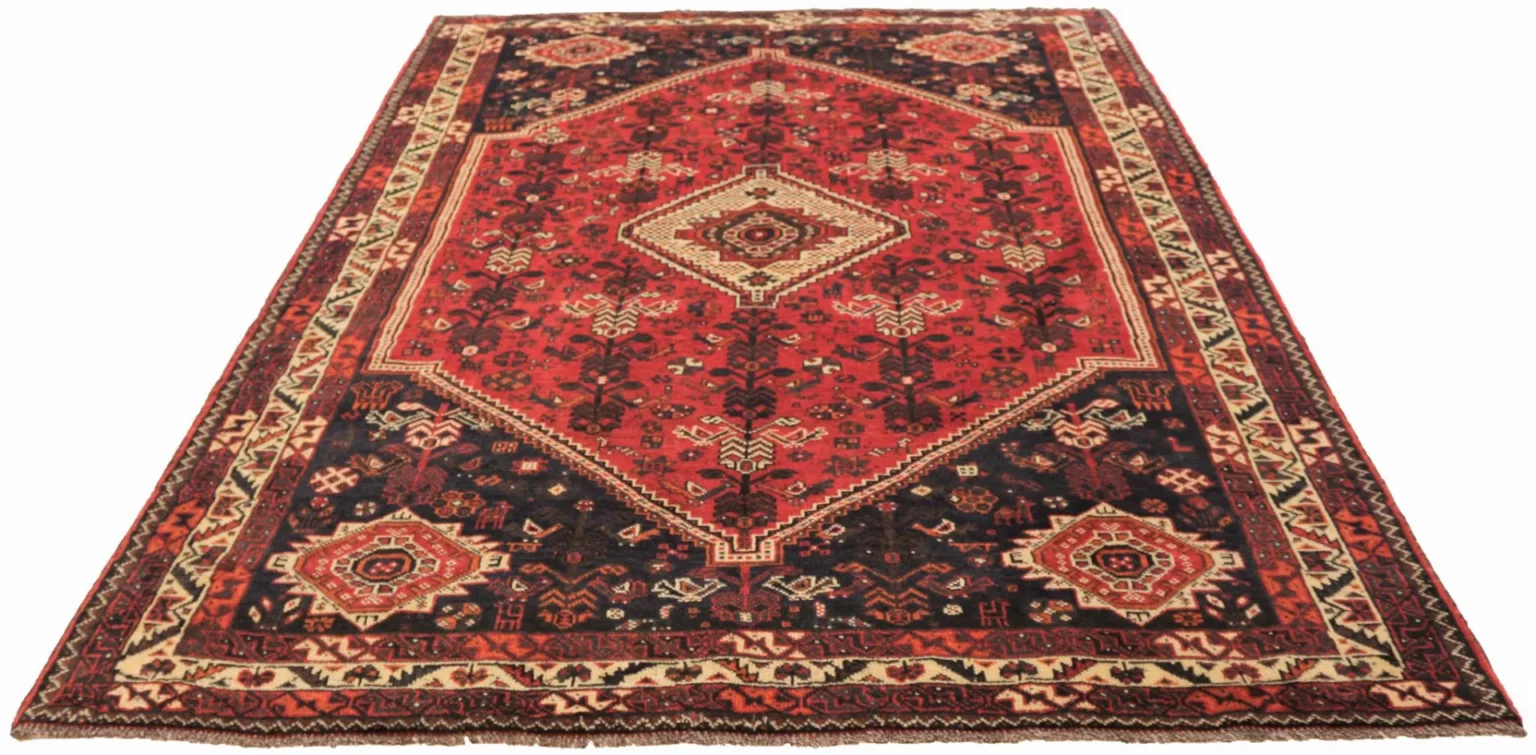
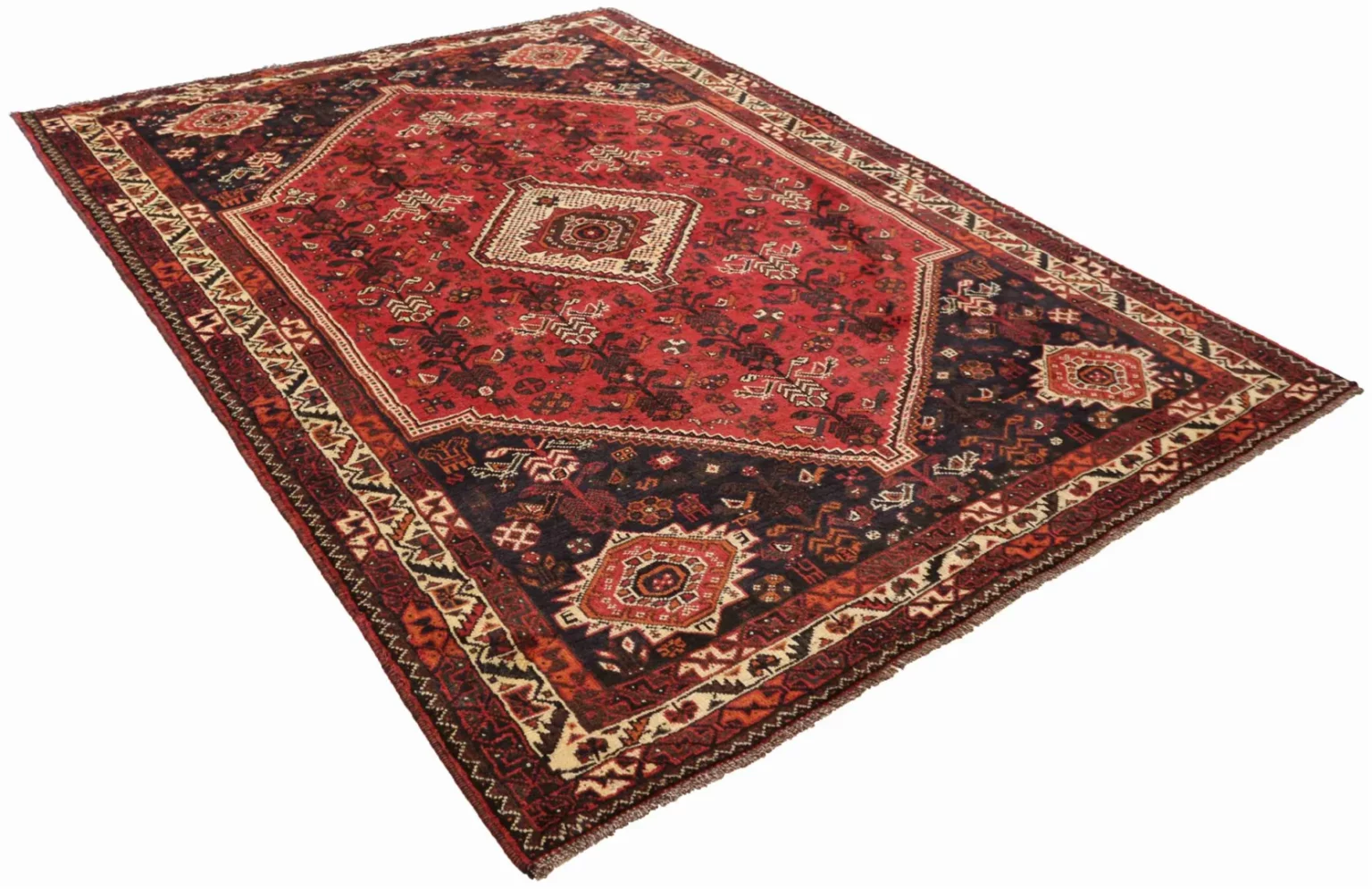
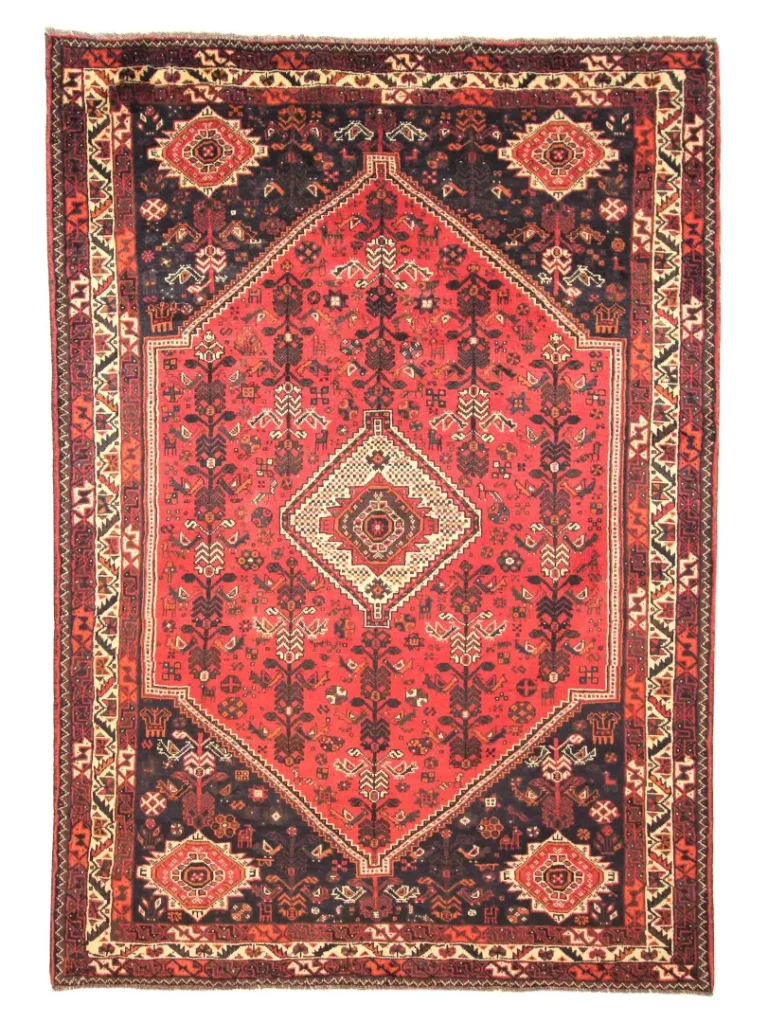
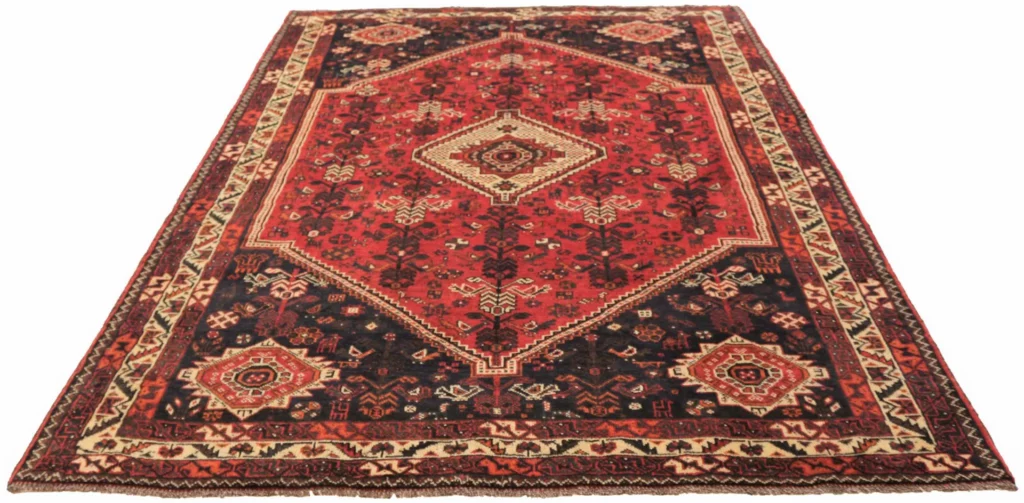
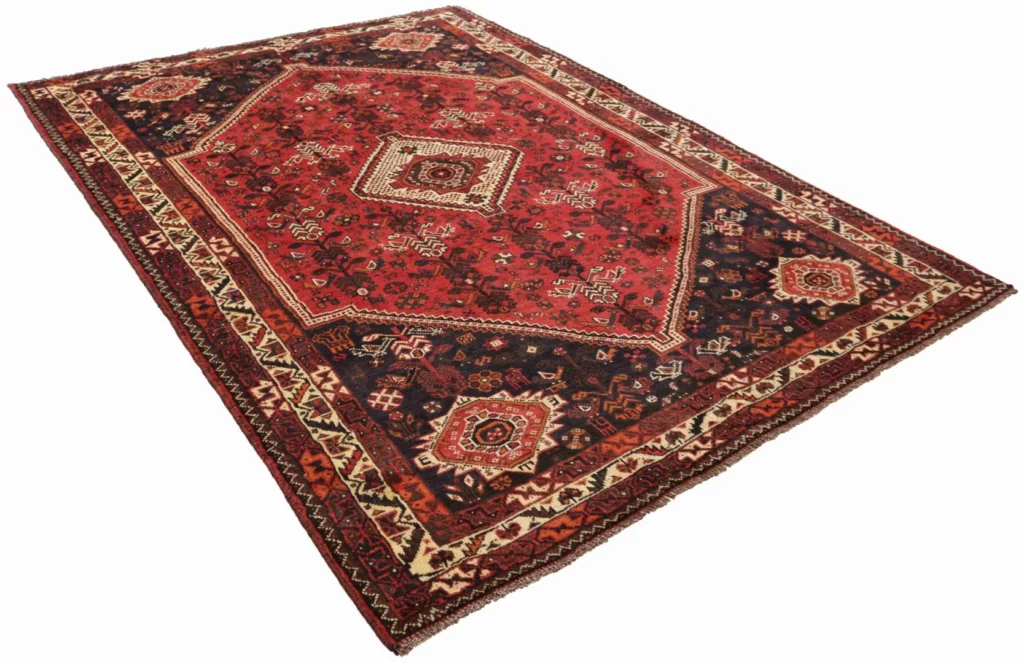
The pattern of this rug consists of geometric ornaments. Geometric design uses lines, angles, diamonds, divided fields and repeated shapes to establish order across the surface. It does not depend on a naturalistic image of a plant, landscape or figure. Instead, its effect comes from relationships between forms, open spaces, repetition and colour. A carefully organised geometric field can guide the eye and give the rug a structured visual rhythm.
The recorded colours are shades of red and shades of brown. Red can serve as a strong ground or accent in Persian rug design, while brown provides an earthy and quieter contrast. Used together, the two colour families create a distinct palette and help separate the geometric ornaments from the surrounding field. Colour is therefore not only decorative. It also supports the structure of the pattern by defining boundaries, repetitions and visual emphasis.
The regional colour tradition of Shiraz is often associated with vivid reds and browns. The source description also connects this tradition with natural dyes derived from plants and mineral sources. Such dye materials are used to colour wool before the knotting process. The final appearance depends on the fibre, the dyeing process, the arrangement of the knots and the light falling on the surface. For this particular rug, the stated colour range is red and brown; no additional colours are introduced here.
Geometric ornaments can be built from individual repeated signs or from larger connected compositions. A border may frame a central field, while smaller forms fill spaces or create transitions between areas. In a hand-knotted rug, every motif is established through the arrangement of knots rather than applied to an already finished surface. Dense knotting supports a clear reading of the design and allows the relationship between adjoining shapes to remain legible.
The design language of Shiraz can be viewed alongside the wider weaving traditions of southwestern Iran. Ghashghai rugs may use similar geometric principles while showing a higher level of detail, a more elaborate knotting technique and deeper colour. Nomadic rugs from the surrounding area are often less elaborate and combine varied patterns and colours with references to nomadic life. These comparisons provide cultural context without changing the stated origin of this rug, which is Shiraz in Iran.
The effect of geometric pattern does not depend on one isolated symbol. Rhythm is created through recurrence and variation. A form can return several times while changing its scale, direction or position. Lines can give movement, while enclosed shapes can establish visual pauses. The balance between figure and ground, regularity and deviation, gives geometric rugs their particular kind of order. This vocabulary is adaptable and can be interpreted differently by different weaving communities.
Hand-knotting gives the design a specific material presence. The pattern is created at the same time as the pile, so colour, texture and drawing are inseparable. The selection of wool, the preparation of the dyed fibres, the order of the knots and the handling of each colour field all influence the final surface. A regional design tradition is therefore combined with the decisions made during the production of one particular handmade rug.
A geometric Shiraz rug can be placed in both traditional and modern interior settings. Its red and brown tones can accompany classic furnishings, while the clear ornament can create a defined contrast with minimalist furniture and restrained lines. This possible use does not alter the rug’s provenance. The name Shiraz continues to refer to the Iranian region and the tradition in which this type of Persian rug is made.
Special Features
The rug is very well preserved. Its stated characteristics are its origin in Shiraz, Iran, its hand-knotted construction, its natural wool pile, dense knotting, geometric ornaments and colours in shades of red and brown. It is suitable for areas of the home that receive frequent use. Natural wool can regulate moisture and contribute to a comfortable indoor climate. For care, dust should be removed regularly, spills should be dabbed with a damp cloth and harsh cleaning products should be avoided. Professional cleaning is appropriate when a more thorough treatment is required.
As a hand-knotted Shiraz Persian rug, this piece brings together a regional ornament tradition and a natural wool surface. The clear geometry and strong colour palette allow it to sit within traditional interiors as well as contemporary rooms. Its handmade construction identifies it as an individual textile work rather than a product made from an endlessly repeated industrial pattern.
FAQ
How should I care for my Shiraz Persian rug?
Vacuum it regularly to remove dust and loose dirt. Spills should be dabbed promptly with a damp cloth rather than rubbed aggressively. Harsh cleaning products should be avoided because they may affect the natural wool and the appearance of its colours. When a complete cleaning is necessary, use a professional who is familiar with hand-knotted wool rugs. Careful treatment helps preserve the pile and the visual character of the rug.
Can I use the Shiraz Persian rug in a modern interior?
Yes. The geometric ornaments provide a clear, ordered design that can work with minimalist furniture and clean contemporary lines. Shades of red and brown can create a deliberate contrast against neutral colours or restrained surfaces. The rug can also be combined with more traditional furnishings. Its suitability for a modern interior comes from the structured pattern and defined palette, while its Shiraz origin remains part of its character.
How can I recognise an authentic Persian rug?
Authentic Persian rugs are hand-knotted and have a high knot density. The use of natural dyes may be visible in the depth and liveliness of the colours. Careful workmanship and the absence of factory markings are further points to examine. These features can provide initial indications, but they do not replace a qualified assessment of a specific rug. For reliable authentication, consult a specialist experienced with hand-knotted Persian rugs.
To provide the best experiences, we use technologies like cookies to store and/or access device information. Consenting to these technologies will allow us to process data such as browsing behavior or unique IDs on this site. Not consenting or withdrawing consent, may adversely affect certain features and functions.
Functional Always active
The technical storage or access is strictly necessary for the legitimate purpose of enabling the use of a specific service explicitly requested by the subscriber or user, or for the sole purpose of carrying out the transmission of a communication over an electronic communications network.
Preferences
The technical storage or access is necessary for the legitimate purpose of storing preferences that are not requested by the subscriber or user.
Statistics
The technical storage or access that is used exclusively for statistical purposes.The technical storage or access that is used exclusively for anonymous statistical purposes. Without a subpoena, voluntary compliance on the part of your Internet Service Provider, or additional records from a third party, information stored or retrieved for this purpose alone cannot usually be used to identify you.
Marketing
The technical storage or access is required to create user profiles to send advertising, or to track the user on a website or across several websites for similar marketing purposes.
 SECURE PAYMENT
 SHIPPING PARTNERS


