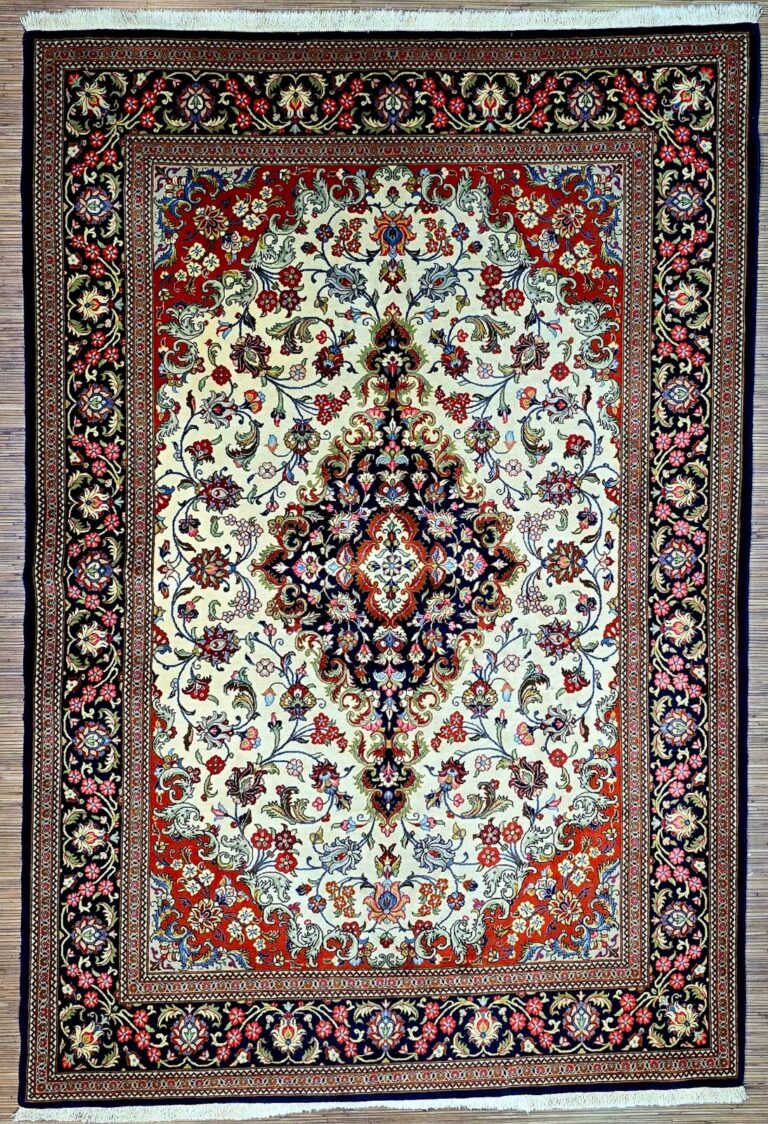
This Persian rug comes from Shiraz and is hand-knotted with a pile made of high-quality virgin wool. Natural wool is a traditional textile material in the region and is valued for its tactile surface, resilience and suitability for a durable pile. In hand-knotting, every knot is made individually and placed in successive rows. The weaver builds the textile surface step by step, inserting the knots, securing the structure and shaping the ornament through the arrangement of the pile.
The rug has a knot density of 100,000 to 250,000 knots per square metre. Knot density records the number of knots within a defined area and therefore provides a technical indication of the fineness of the construction. It should be read together with the material, the knotting method and the design rather than treated as an isolated judgement. Here, the stated density belongs to a hand-knotted rug whose ornament is formed through many individual points of work.
Virgin wool is suitable for traditional rug making because it accepts colour and can be worked into a firm yet tactile pile. Its natural fibre structure gives the surface a distinct hand. During knotting, the wool is placed according to the intended drawing, allowing geometric areas and outlines to develop across the textile. The result brings together a natural pile material and a manual technique that has been passed through regional weaving traditions.
Origin and Tradition
The rug originates in Shiraz, Iran. Shiraz is both the city named as its source and the regional designation of this Persian rug. The city belongs to the wider Iranian carpet tradition, where wool, hand production and ornament are combined in practical textiles with a recognisable regional character. The source description associates Shiraz rugs with nomadic tribes in the surrounding region. Such work may traditionally be carried out outdoors, linking the process of making with the everyday circumstances of the communities that produce the rugs.
A regional rug tradition involves more than a knot count or a single construction detail. It includes the selection and preparation of wool, the handling of colour, the planning of the field and borders, and the knowledge required to translate a design into rows of knots. A hand-knotted rug is not printed after completion. Its surface grows through the gradual placement of the knots. This relationship between design and execution explains why rugs from one area may share visual principles while each individual piece retains its own character.
Shiraz rugs are connected with the weaving work of nomadic groups in the region. That association places practical textile making alongside ornament and pattern. A rug must be carefully constructed and useful as a floor covering, while its design gives the surface a visual order. Regional traditions can therefore be understood through the balance between serviceable materials, manual construction and motifs arranged in repeated or clearly bounded forms.
Iran has several important carpet-producing traditions, each with its own commonly recognised design language. Kerman rugs are often associated with delicate colours, fine detail and artistic compositions. Isfahan rugs are known in general carpet history for elaborate floral designs and high knot densities. Tabriz is widely associated with varied designs, arabesque forms and finely executed workmanship. These comparisons provide regional context; they do not alter the stated origin of this rug, which is Shiraz.
Design and Pattern
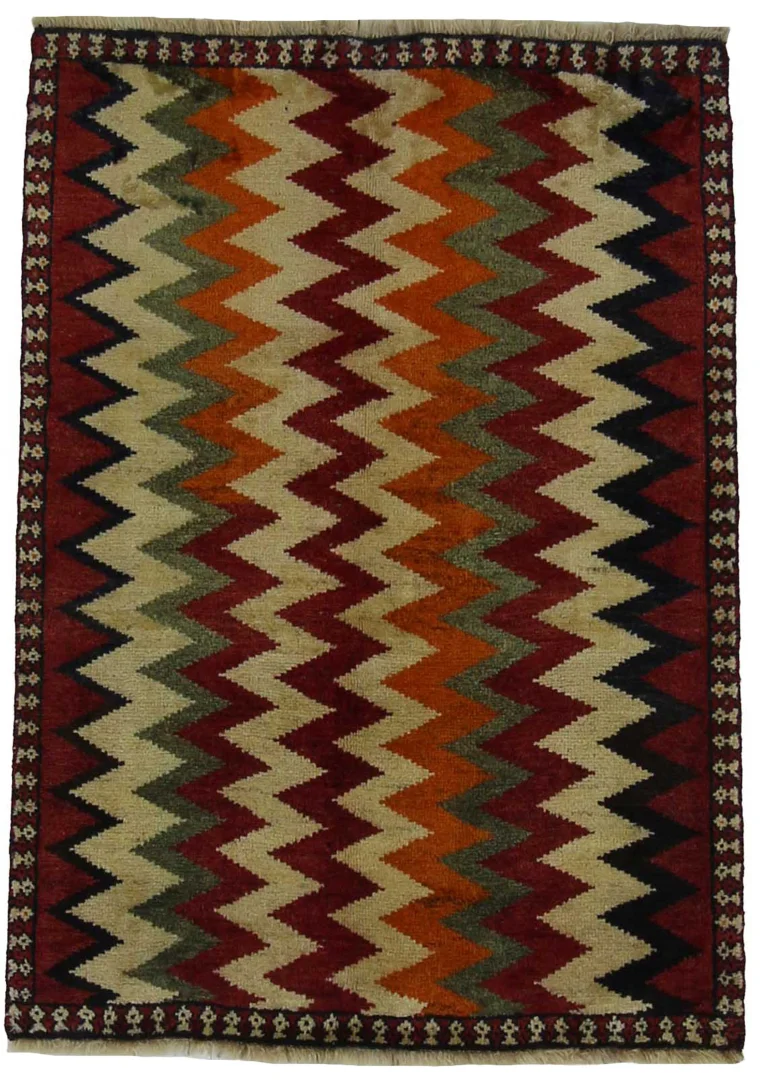
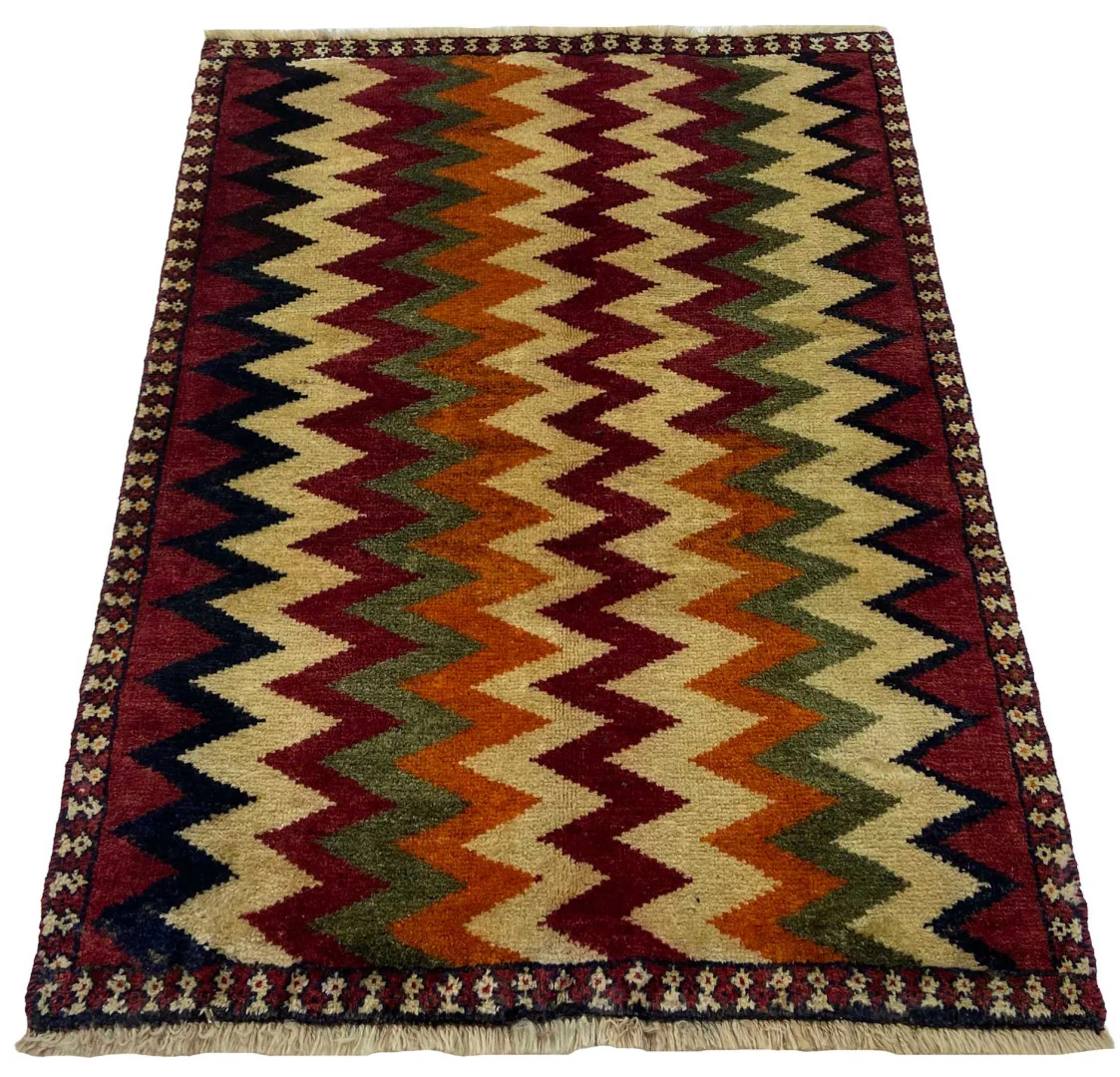
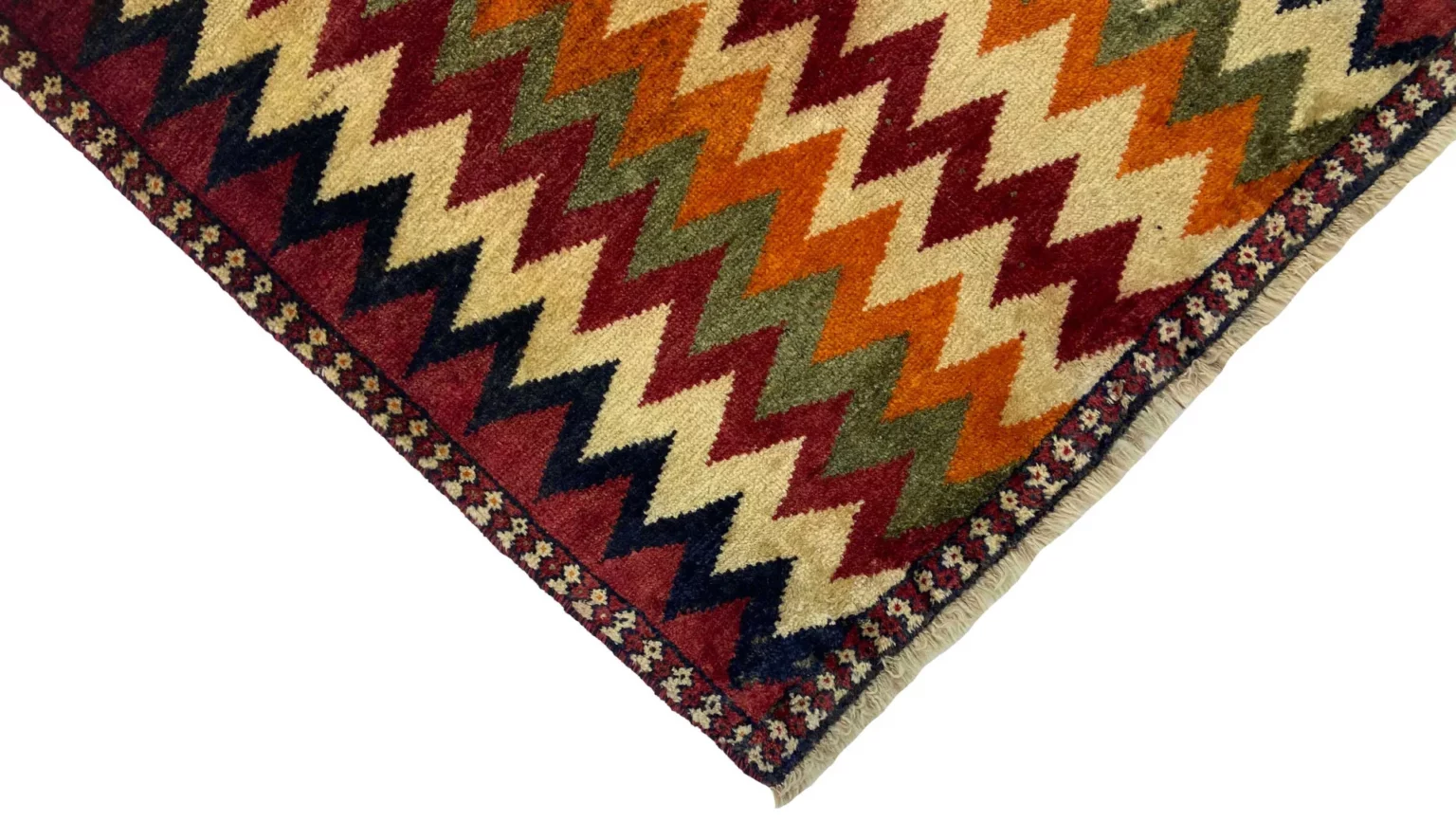
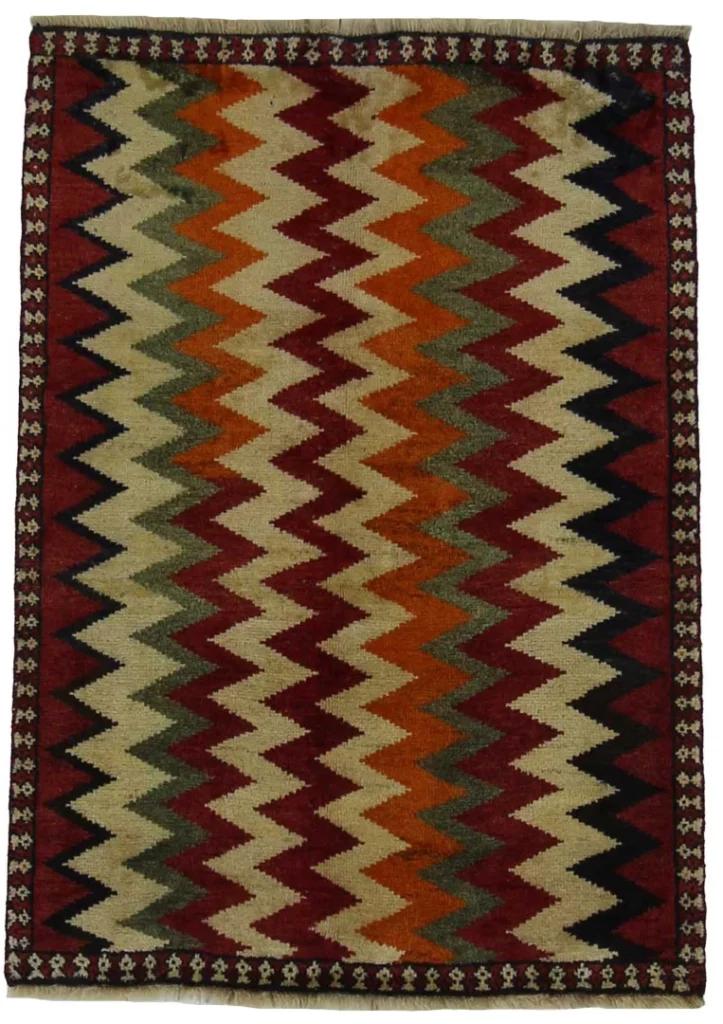
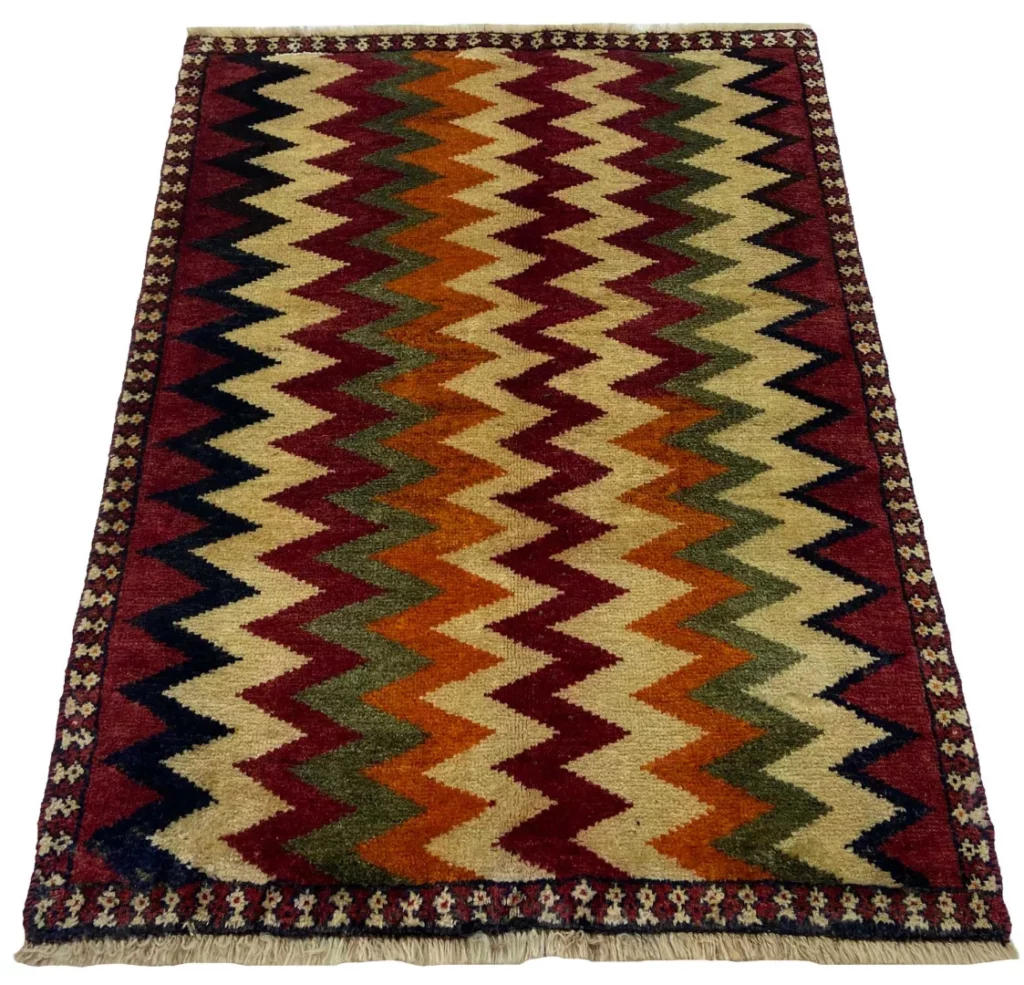
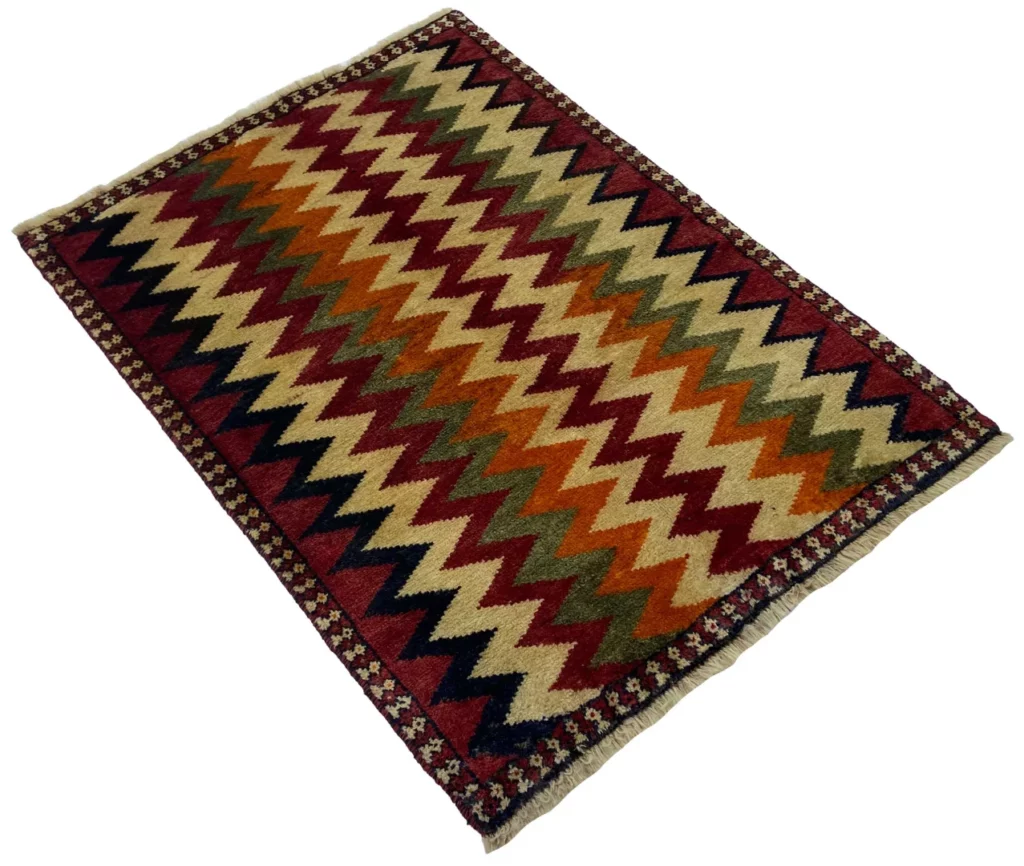
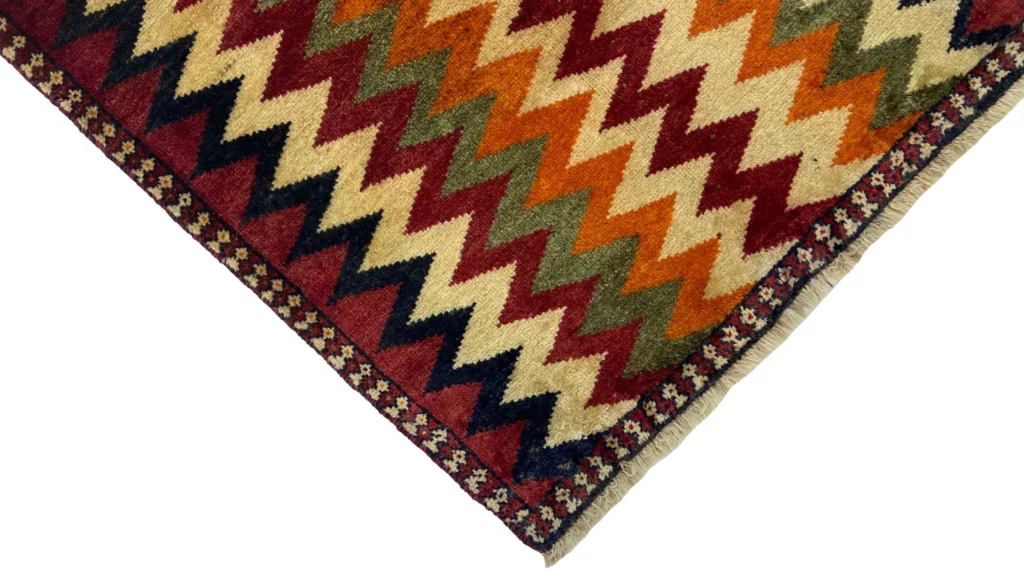
The pattern of this rug is described as geometric ornaments. Geometric ornament is built from lines, angles, planes and recurring shapes. A composition may use repeated units, framed areas or a rhythm that moves across the field. In a hand-knotted rug, such forms are not applied as a finished image. They are assembled from coloured knots and rows, so the clarity of the drawing depends on both the planned design and the accuracy of the weaving.
Geometric patterns have an established place in Iranian rug design. They can organise a central field, separate sections or give a border a regular cadence. The exact drawing differs from one rug to another, but the underlying principle is the creation of order through repetition and proportion. Small individual elements become a coherent ornament when they are placed in relation to the surrounding forms. This makes geometry particularly suited to a construction in which the image develops knot by knot.
Shiraz rugs are often described as having an intense palette, including warm reds and browns. Such regional colour associations can give geometric ornaments a strong outline and a distinctly traditional appearance. General characteristics of Shiraz weaving should not be confused with an exhaustive description of the colours in one particular piece. The specific design recorded for this rug is its geometric ornamentation.
Geometric ornament is one strand of Persian carpet design alongside floral compositions, arabesques and complex repeating arrangements. Kerman and Isfahan traditions are frequently discussed through their detailed floral language, while Tabriz is also known for arabesque structures and varied compositions. Shiraz designs may instead be recognised through clearly divided forms and recurring ornamental units. These distinctions are useful for understanding regional design traditions without assigning another region’s pattern name as the origin of this rug.
Special Features
The documented features of this rug are its Shiraz origin in Iran, its hand-knotted construction, its pile of high-quality virgin wool and its knot density of 100,000 to 250,000 knots per square metre. The pattern consists of geometric ornaments. Its condition is excellent. Together, these details identify the material, technique, origin, visual language and recorded condition of this individual rug.
The combination of Iranian origin and hand production places the rug within the tradition of Persian hand-knotted rugs. The geometric design gives it a clearly structured ornamental character, while the wool pile identifies its principal surface material. The knot-density range adds technical information about the construction. These features form a precise description of the piece without treating it as interchangeable with every other rug associated with Shiraz.
FAQ
How should I care for my Shiraz Persian rug?
Regular vacuuming helps remove loose dust and everyday debris from the pile. The surface should be treated gently so that routine cleaning does not place unnecessary stress on the wool. Direct sunlight should be avoided in order to protect the textile and its colour appearance. If a spill occurs, dab the affected area promptly with a damp cloth rather than rubbing it. Rubbing can work dirt further into the pile or disturb the surface structure. For more extensive cleaning, a method suitable for hand-knotted wool rugs is appropriate, with particular care given to the construction and natural pile.
Which rooms are suitable for a Shiraz rug?
A Shiraz rug can be used in a range of living spaces. The living room, dining room and bedroom are specifically suitable settings, where geometric ornaments can contribute a clear structure to the interior. Hallways and entrance areas are also possible locations. The best placement depends on the available space, the way the room is used and the suitability of the floor beneath the rug. It therefore does not belong to only one type of room. Its Iranian origin and geometric pattern make it appropriate wherever a traditional hand-knotted textile with an ordered ornament is wanted.
Are Shiraz rugs a good investment?
Shiraz rugs combine traditional hand craftsmanship, natural materials and a regional design tradition. In this case, the hand-knotted construction, high-quality virgin wool pile, recorded knot density and excellent condition are relevant characteristics when the rug is considered as a durable textile and a one-off handmade object. No general statement about future value can be based on the place name alone. The assessment of an individual rug also depends on its condition, material, execution and design. These factors should be considered together when deciding whether a Shiraz rug suits a collection, an interior or a long-term purchase.
To provide the best experiences, we use technologies like cookies to store and/or access device information. Consenting to these technologies will allow us to process data such as browsing behavior or unique IDs on this site. Not consenting or withdrawing consent, may adversely affect certain features and functions.
Functional Always active
The technical storage or access is strictly necessary for the legitimate purpose of enabling the use of a specific service explicitly requested by the subscriber or user, or for the sole purpose of carrying out the transmission of a communication over an electronic communications network.
Preferences
The technical storage or access is necessary for the legitimate purpose of storing preferences that are not requested by the subscriber or user.
Statistics
The technical storage or access that is used exclusively for statistical purposes.The technical storage or access that is used exclusively for anonymous statistical purposes. Without a subpoena, voluntary compliance on the part of your Internet Service Provider, or additional records from a third party, information stored or retrieved for this purpose alone cannot usually be used to identify you.
Marketing
The technical storage or access is required to create user profiles to send advertising, or to track the user on a website or across several websites for similar marketing purposes.
 SECURE PAYMENT
 SHIPPING PARTNERS